www.jeseh.net
Achievement Levels of Middle School
Students in the Standardized Science and
Technology
Exam
and
Formative
Assessment Probes: A Comparative
Study
Nermin Bulunuz1, Mızrap Bulunuz1, Funda Karagöz2, Ömer Faruk Tavşanlı1
1Uludağ University
2Eskişehir Mehmet Gedik Secondary School
To cite this article:
Bulunuz, N., Bulunuz, M., Karagoz, F. & Tavsanli, Ö.F. (2016). Achievement levels of
middle school students in the standardized science and technology exam and formative
assessment probes: A comparative study.
Journal of Education in Science, Environment and
Health (JESEH), 2
(1), 33-50.
This article may be used for research, teaching, and private study purposes.
Any substantial or systematic reproduction, redistribution, reselling, loan, sub-licensing,
systematic supply, or distribution in any form to anyone is expressly forbidden.
Authors alone are responsible for the contents of their articles. The journal owns the
copyright of the articles.
Achievement Levels of Middle School Students in the Standardized Science
and Technology Exam and Formative Assessment Probes: A Comparative
Study
Nermin Bulunuz*1, Mızrap Bulunuz1, Funda Karagöz2, Ömer Faruk Tavşanlı1 1Uludağ University
2Eskişehir Mehmet Gedik Secondary School
Abstract
The present study has two aims. Firstly, it aims to determine eighth grade students’ conceptual understanding of floating and sinking through formative assessment probes. Secondly, it aims to determine whether or not there is a significant difference between students’ performance in formative assessment probes and their achievement in the Standardized Science and Technology Exam (TEOG 1) exam. The sample of this research is 61 eighth grade students from a central middle school in Eskişehir. Data collection tools are four two-stage formative assessment probes and the scores of the student taken from the first TEOG 1 exam. The answers of the students to the two-stage probes were scored by use of a rubric. Findings indicated that most of the students either: a) both chose incorrect answer and did not write correct scientific explanation (%41); b) chose correct answer but did not write correct scientific explanation (%33); and c) chose correct answer but wrote partially correct explanation (%43). This result indicates the poorness of students' explanation and interpretation skills in formative assessment probes. In addition, the findings of the dependent sample t-test results also indicate that there is a significant difference between the scores of the students taken from the standardized science test (TEOG 1) and the formative assessment probes on the concepts of floating and sinking. This finding shows that the students are more successful on standardized science test than the formative assessment probes in general. These research findings, suggest that students should be exposed to teaching practices based on "formative assessment" that promotes the development of students’ skills of explaining, interpreting, and reasoning rather than multiple-choice tests in science lessons.
Key words: Formative assessment, science teaching, TEOG 1
Introduction
When we hear the word ‘assessment’ in our education system, we first think of written and oral exams, marks obtained in the exams, ranking, stress, or failure. For most of the time, assessment is even used to mean written and oral exams and homework. Using the word assessment as if it was synonymous with summative assessment types simplifies the complex structure, stages and the aim of assessment (Atkin & Coffey, 2005). This is because the marks and points obtained actually constitute only the smallest part of the assessment. However, assessment is a fairly comprehensive concept ranking at the top of Bloom’s taxonomy and a skill that requires an advanced performance. The basis of the assessment is to understand what a student has learnt, what he/she does not know well or to determine what kind of misconceptions he/she has in mind and to find qualitative and quantitative solutions.
Researches show that the assessment practices that are not integrated into teaching do not contribute to conceptual understanding of students (Black & William, 1998; Kavanagh & Sneider, 2007; Yin, Tomita, & Shavelson, 2013). The conventional evaluation and assessment methods such as “true-false”, “matching”, “fill in the gaps”, and “multiple choice” questions that are applied at the end of a unit or semester lead to superficial learning and memorizing as they include fragmentary, discrete, and detailed information that students will forget in a short time (Butler, 1987; Butler & Neuman, 1995). Since these kinds of assessment methods which measure the level of learning by heart and low-degree gains focus on giving marks rather than teaching, the learning function of assessment becomes of secondary importance (Black, 1993; Black & William, 1998; Crooks, 1988). Conceptual learning requires such knowledge and skills as explanation, giving examples, interpretation, applying what has been learnt into new cases, and problem-solving rather than learning by heart. It is a known fact that “conceptual learning” is mostly not realized in science lessons where the information is given most of
*
the time without taking the prior knowledge that the students already have into consideration. To Angelo and Cross (1993), learning can be achieved without any teaching at all, too. However, teaching without ensuring conceptual understanding is a very ironic situation in educational practices.
Types of Assessment
When the related literature is examined, it is seen that there are 3 common types of assessment which are 1) diagnostic assessment (determining prior knowledge), 2) summative assessment, and 3) formative assessment (Keeley, Eberle & Farrin, 2005; Keeley, 2008).
Diagnostic Assessment
Diagnostic assessment is carried out in order to determine whether the prior knowledge that students have about a subject or field is correct and to determine the misconception that students might have about that subject or field (Keeley, Eberle & Farrin, 2005; Keeley, 2008; Tan, 2010). Such assessments are applied at the beginning of the educational process. The aim of this type of assessment is to recognize the student and to place him/her in the program or job that fits him/her. The placement tests that are applied at schools and private education centers as well as the university placement exams that only aim to classify students based on their achievement levels can be given as examples to diagnostic assessment. The data obtained in these exams do not contribute to the learning of students unless they are used to determine scope and methodology of the course in line with the needs of students. Nevertheless, the aim of the diagnostic assessment should be to determine the level of readiness of students by finding out their imperfect knowledge and what they know wrong before teaching.
Summative Assessment
Called shortly as the assessment of learning, this type of assessment is used mostly to determine academic achievement score and achievement order (Keeley, Eberle, & Farrin, 2005; Keeley, 2008). Being a study to make a judgement about the learning levels among students, this type of assessment measures and certifies whether the students have reached the intended gains in lessons with a certain mark. For example, the mid-term and final exams in universities, the written and oral exams applied in primary and middle schools, high school entrance exams, and international exams such as PISA and TIMMS can be given as examples to summative assessment (Tan, 2010). In this regard, summative assessment is separated from the learning process, and is rather about determining what students have achieved and what they have not.
Formative Assessment
Being a comparatively less known new approach in comparison to diagnostic and summative assessments in the literature, formative assessment has come to forefront over the last 10-15 years in Europe and America especially with the book of Black and William (1998) titled Working Inside the Black Box. It is defined as the assessment carried out to learn (Black & William, 2004) and to teach without any purpose of giving marks (Keeley, Eberle & Farrin, 2005). What is meant by assessment carried out to learn and to teach is to find out what students already know about the subject to be taught and to determine how the lesson is going to be given in the light of their prior knowledge (Black & William, 1998; Furtak, 2012; Yin, Shavelson, Ayala, Ruiz-Primo, Brandon, & Furtak, 2008; Yin, Miki, Tomita & Shavelson, 2013). In his book titled Educational Psychology (1968), Ausubel mentioned this in a very impressive way: In the preface to his book Educational Psychology: A Cognitive View, he says that “If [he] had to reduce all of educational psychology to just one principle, [he]
would say this: The most important single factor influencing learning is what the learner already knows. Ascertain this and teach him accordingly” (Ausubel, 1968, p. vi)” It is promising that this foresight put forward by Ausubel 40-50 years ago has taken place in the literature of today through reference books (Keeley, 2005; 2007; 2008) and studies (Bulunuz & Bulunuz, 2013; Bulunuz Bulunuz, & Peker, 2014; Keeley, 2011; 2012;Torrance & Pryor, 2001).
teaching method is re-adjusted in the light of the feedback received from students. If the information collected in diagnostic assessment regarding what students know /do not know or what they do not know well is not used during the teaching of a lesson, there is no formative assessment. Formative assessment is integrated with learning, continuous, and process-oriented.
Formative assessment method has been known in the international literature since the late 1990s and there are several studies where the effectiveness of this method is investigated (Ali & Iqbal, 2013; Black & William, 1998; Keeley, 2008; 2011; 2012; Kopittke, Behnard Wehr, & Menzies, 2012; Torrance & Pryor, 2001; Trauth-Nare and Buck, 2011; Yin, Tomita, & Shavelson, 2013). The results obtained from these studies generally show that the activities carried out through this method increase the cognitive level of students; students display a positive attitudes towards the lesson; and their critical thinking skills are developed. For example, Black and William (1998) have found out in their meta-analysis study where they reviewed nearly 250 studies that formative assessment method increases students’ attendance to the lesson, conceptual understanding, and learning motivations. In the action research where the opinions of student groups were asked regarding the method, the participants stated that the implementer- researcher feature of this method contributed to the development of their pedagogical knowledge and skills and thus they had an idea about a more efficient usage of formative assessment processes in the classroom (Trauth-Nare & Buck, 2011). Nevertheless, the studies conducted on the formative assessment method are very limited in Turkey (Aydeniz & Pabuçcu, 2011; Bulunuz & Bulunuz, 2013: 2014; Metin & Özmen, 2010; Yalaki, 2010).
Formative Assessment Probes
One of the forms of formative assessment that has been used successfully in science education is the formative assessment probe (Keeley, 2011). The equivalent of the word “probe” in Turkish means to investigate, to drill, and to research. According to the Dictionary of TDK (Turkish Language Association) (2014), it means “the act of checking, looking for, and counting in order to understand whether something or someone is present at some certain place and time”. Similarly, these formative assessment probes are the questions used both to find out the
prior knowledge of students about the subject before the lesson and to determine the method to teach the lesson without any purpose of giving marks. According to Keeley (2011), only collecting information about students’ ideas does not make a probe formative. If the information is used to improve teaching and learning, then the probe can be formative in nature.
In general, formative assessment probes are composed of two parts. In the first part, there is a problem or a question that is written inside a specific context and there are multiple choice answers under the question, unlike the conventional teaching practices. All the distracters that are wrong in this part are the answers that were obtained from the results of the studies carried out in this field. Students are asked to mark the answer that they think is correct. The second part that comes below is the open-ended section where the student is asked to explain “why the choice that he/she marked is correct” or give a detailed scientific explanation to the question.
Research on Floating and Sinking
The concepts of “floating and sinking” are two very common concepts that have been studied both in different countries and also in Turkey. All around the world, there are numerous studies (Hadjiachilleos, Valanides, & Angeli, 2013; Luo, 2006; Potvin, Masson, Lafortune, & Cyr, 2015; Srisawasdi, & Panjaburee, 2015; Wong, & Lau, 2014; Yin et al., 2013) recently focused specifically on middle school students’ conceptual understanding on the concepts of floating and sinking. The findings of these studies listed above indicate that middle school students have limited or incorrect understanding about floating and sinking. The results of the research conducted in other counties are quite similar to the research was conducted in Turkey.
conceptual development of the students during the teaching stage, the researcher also found out that the students gave scientific answers about some concepts, but failed to make an absolute progress regarding some others.
In the studies carried out with teacher candidates on the same subject, it is seen that they have different concepts about floating, sinking, buoyancy force, and pressure. Demir, Uzoğlu and Büyükkasap (2012) found out in the research that they conducted with science teacher candidates that they had several misconceptions concerning force and motion concepts. With the aim of determining these misconceptions within the scope of this research, some open-ended questions and questions similar to concept cartoons were used, and it was seen at the end of the research that teacher candidates had many misconceptions that were not related to scientific facts about force and motion subjects.
In another study carried out on university students from different majors, Kalın and Arıkıl (2010) aimed to identify the misconceptions that university students had regarding “solutions” and to determine how the “dissolution” in particle size is defined by students. At the end of the study, it was found out that students did not have much difficulty in mathematically calculating the density of a pure substance and the solution given, but they had misconceptions regarding the concept of density. With the research, the reasons behind the misconceptions that students had in mind were determined to be teachers and failure of students in associating their prior knowledge with the new knowledge they acquire in a reasonable way. In another study conducted by Ültay and Kasap (2014) on the second year students studying in the major of Primary School Teaching, the effect of “floating and sinking objects and buoyancy force in liquids” subject that was prepared based on the
conceptual change approach on the conceptual understanding of students was investigated. It was found out that students had misconceptions concerning floating and sinking objects and the buoyancy force in liquids, and the conceptual change approach that was applied became efficient in teaching them these concepts correctly. This study has two purposes. The first purpose is to determine the 8th grade students’ levels of conceptual understanding of the concepts of floating and sinking through the formative assessment probes. The second purpose is to determine whether there is a significant difference between the performances of students in the formative assessment probes and their achievement in the TEOG 1 exam. In this study, an attempt was made to answer the below-mentioned research questions:
1. What are the 8th grade students’ levels of conceptually understanding the formative assessment probes prepared on the subject of floating and sinking?
2. Is there a difference between the performances that students display in the formative assessment probes and their achievement levels in the TEOG 1 (transition from primary to secondary education) 1 exam?
Method
The Design of the Study
This research has been conducted in the survey model (Karasar, 1998; Kaptan, 1998; & Robson, 1997). According to Karasar (1998, p. 77) the survey model is a research approach aiming to describe a past or present situation. In this study, by using the survey model formative assessment probes were used to collect information about middle school students’s current initial understandings about the concepts of floating and sinking. In addition, the students’ open ended explananations for thev second part of the formative assessment probes on their choices and their TEOG 1 scores were also used to describe these students’ conceptual levels about these physical science concepts.
Participants
Data Collection Tools
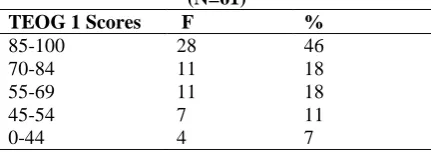
TEOG 1 exam is a set of exams conducted every semester for 6 basic courses at the 8th grade by teachers. It has been in practice since the beginning of the 2013- 2014 academic year. TEOG 1 exam consists of 20 multiple choice questions. Each one of these questions is composed of a question statement, one correct answer, and three other distracters. In the TEOG 1 exam conducted in the 2014- 2015 academic year, questions on mitosis, meiosis, heredity, DNA and genetic code, adaptation, and evolution were asked from the “living beings and the life” unit while there were questions about the buoyancy force of liquids and gases, density, and floating and sinking of an object on/in the water from the “force and motion” unit. In the research, the achievement marks that students obtained from 20 science questions were used. The frequency and percent values of the achievement marks that the students participating in the present study obtained from this exam are indicated in the table below. Four 2-stage questions were used for data collection tool based on the formative assessment method. At the end of the first TEOG 1 exam, 61 8th grade students attending a middle school in Eskişehir were asked to answer four 2-stage formative assessment probes in writing.
Table 1. Frequency and percent values of the students’ TEOG 1 achievement scores (N=61)
TEOG 1 Scores F %
85-100 28 46
70-84 11 18
55-69 11 18
45-54 7 11
0-44 4 7
In the study, 4 formative assessment probes developed concerning the concepts of force and motion by Keeley and Harrington (2010) were used as a data collection tool based on the formative assessment approach. Before choosing the assessment probes, the gains that were set with regards to the force and motion subject in the curriculum were examined and it was aimed to ensure that the probes were compatible with the gains. The assessment questions selected in line with this aim were adapted to Turkish. In the light of the feedback received from field experts in this process, the necessary changes were made, and the assessment probes were finalized. The formative assessment probes are composed of 2 parts. The first part includes different choices regarding the question. As for the second part, students are asked to explain the rule or logic that they use while choosing one particular answer. In the first assessment probe, the relationship between the amount of matter and density is investigated in objects of different sizes but made of the same matter while in the second probe it is asked what position an object floating on the water will have when a hole is made on it. In the third question, the relationship between the amount of matter and the floating and sinking situation is asked while in the fourth question the relationship between the density of an object and its position in a liquid is investigated. The formative assessment probes used in the research can be found in the Appendix A.
Data Analysis
In the related literature, the analyses of the two stage questions are generally made by classifying the answers of students into categories (Çalık, Kolomuç & Karagölge, 2010; Karataş et al., 2003). The probe questions used in this study were evaluated using a rubric developed for the analysis of two-stage questions by Karataş (2003) (See Appendix B). The assessments were made independently by the first author and the third author (i.e. researcher-teacher) of this paper. Whether there was a consistency between the marks given by the two researchers was determined via SPSS based on the inter-rater reliability coefficient. This coefficient was found to be .95 which showed that the assessments of the two researchers were highly consistent with each other. Accordingly, the data were entered in SPSS by matching the data obtained from the questions with the science scores that students got in the TEOG 1 exam. Later, the average scores that students got from the formative assessment probes were compared, by use of t-test with their average achievement scores in the science test within TEOG 1.
Results
Part One of the Study
The First Formative Assessment Probe: Comparing Cubes
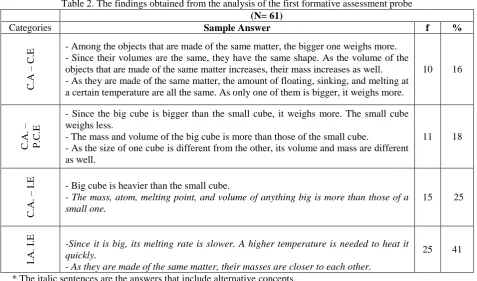
In the first assessment probe, the “relationship between the amount of matter and the density in the objects that are of different sizes but made up of the same matter.” was asked. The findings obtained from the analysis of the
answers to this question are indicated in Table 2.
Table 2. The findings obtained from the analysis of the first formative assessment probe (N= 61)
Categories Sample Answer f %
C
.A
–
C
.E - Among the objects that are made of the same matter, the bigger one weighs more. - Since their volumes are the same, they have the same shape. As the volume of the objects that are made of the same matter increases, their mass increases as well. - As they are made of the same matter, the amount of floating, sinking, and melting at a certain temperature are all the same. As only one of them is bigger, it weighs more.
10 16
C
.A.
–
P.C
.E
- Since the big cube is bigger than the small cube, it weighs more. The small cube weighs less.
- The mass and volume of the big cube is more than those of the small cube.
- As the size of one cube is different from the other, its volume and mass are different as well.
11 18
C
.A.
–
I
.E - Big cube is heavier than the small cube.
- The mass, atom, melting point, and volume of anything big is more than those of a small one.
15 25
I.
A.
I
.E -Since it is big, its melting rate is slower. A higher temperature is needed to heat it
quickly.
- As they are made of the same matter, their masses are closer to each other.
25 41
* The italic sentences are the answers that include alternative concepts.
As it is seen in the Table 2, the majority of the students gave answers that fit in the category of (I.A. - I.E) for the question where the concepts of force and motion were asked. 16% of the students gave answers that fit in the category (C.A -C.E) while 18% in (C.A– P.C.E) When we take a look at the category (C.A–I.E), it is seen that 25% of the students gave answers that fit in this category. Also, it was found out that the students had the following alternative conceptions: The atom, melting temperature and density of any big object will be more than those of a small one; the melting temperature of a big object will be lower; and the masses of two objects will be similar as they are made of the same matter.
The Second Formative Assessment Probe:Solids and Holes
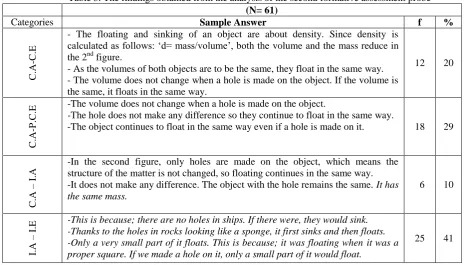
In the second assessment probe, whether “the position of an object changes inside the water when a hole is made on it” was asked. The findings obtained through the assessment of the answers to this question in line with the criteria identified are presented in Table 3.
Table 3. The findings obtained from the analysis of the second formative assessment probe (N= 61)
Categories Sample Answer f %
C
.A
-C
.E
- The floating and sinking of an object are about density. Since density is calculated as follows: ‘d= mass/volume’, both the volume and the mass reduce in the 2nd figure.
- As the volumes of both objects are to be the same, they float in the same way. - The volume does not change when a hole is made on the object. If the volume is the same, it floats in the same way.
12 20
C
.A
-P.C
.E -The volume does not change when a hole is made on the object. -The hole does not make any difference so they continue to float in the same way.
-The object continues to float in the same way even if a hole is made on it. 18 29
C
.A
–
I.
A
-In the second figure, only holes are made on the object, which means the structure of the matter is not changed, so floating continues in the same way. -It does not make any difference. The object with the hole remains the same. It has the same mass.
6 10
I.
A
–
I.
E -This is because; there are no holes in ships. If there were, they would sink.
-Thanks to the holes in rocks looking like a sponge, it first sinks and then floats. -Only a very small part of it floats. This is because; it was floating when it was a proper square. If we made a hole on it, only a small part of it would float.
25 41
* The italic sentences are the answers that include alternative concepts.
The Third Formative Assessment Probe: Floating Logs
In the third assessment probe, the “relationship between the amount of matter and the floating and sinking situation” was asked. The findings obtained from the analysis of this question are presented in Table 4.
Table 4. The findings obtained from the analysis of the third formative assessment probe ESKİŞEHİR (N= 61)
Categories Sample Answer f %
C
.A
–C
.E
. -I think it does not make any difference if it is big or small. If their densities are the same and they are made of the same matter, they float in the same way. -This is because; the sinking volume of the object is about the density of the object and liquid. No matter how big the object is, its volume will remain the same.
-The volume and the mass of the big log have increased but it floats in the same way as its density is the same.
19 31
C
.A
-P.C
.E -This is because; their densities are the same -This is because; they are made of the same wood.
-As the densities of the identical matters are the same, the mass or volume is not important.
19 31
C
.A
-I
.E - Floating and sinking are not about the size or width.
- As they are made up of the same matter, the size is not important. - The choice B is more reasonable compared to A and C.
20 33
I.
A
-
I.
E -As it is 2-fold bigger, it weighs more.
-More than half of the big log floats on the water because its volume is more.
- If we put a log that is two times bigger than the 1st log, less than half of it floats. 3 5
* The italic sentences are the answers that include alternative concepts.
•
detected: More than half of the big log floats on the water as its volume is higher. If a half of a log floats while the other half sinks, a log that is 2-fold bigger floats with less than half of it sinking in the water.
The Fourth Formative Assessment Probe: Floating High and Low
The findings obtained from the analysis of the 4th Formative Assessment Probe that questions the “relationship between density of an object and its position inside a liquid” are presented in Table 5 below.
Table 5. The findings obtained from the analysis of the fourth formative assessment probe (N= 61)
Categories Sample Answer f %
C .A – C .E .
-For an object to float on the water, its density has to be high. Accordingly, a matter of a higher density may be used or an extra weight may be added to the ball which will increase the density of the ball.
-For the ball to sink more under the water, a matter of a higher density but the same size may be used. When the density of the ball increases, it sinks more. Also, an extra weight might be added to the ball as it will sink more easily as its mass increases.
-Adding an extra weight to the ball makes a counter-effect and makes the ball sink more. Using a ball of the same size but of a higher density makes the ball sink more because as the density increases the volume that sinks increases as well.
11 18
C
.E
–
P.C
.E
-If a matter that is of higher density than the water is used, the ball sinks. If an extra weight is added to the ball, the water will not hold the ball over the surface and it will sink more.
-We get this result when a pressure is made on the top of the ball because either the density or the mass must be higher for the ball to sink deep. -Because the matters of a higher density sink deeper. If the material is denser, we will have the lower buoyancy. As the weight increases, the ball goes down in the water because it is inversely proportional with the buoyancy force.
26 43
C
.A
–
I.
E
-As the mass increases, the buoyancy force decreases. As the density increases, the buoyancy force decreases. When we add some salt inside the water, the ball goes up toward the surface. So it does not sink.
-If the density is high, the volume that sinks decreases.
-If the density of the liquid or the volume of the object changes, the rate of floating and sinking changes as well.
14 23
I.
A
–
I.
E
-If it is made of a matter with higher density, it becomes the same because the ball on the right has a higher density.
- It is possible if a bigger ball made of the same matter or a ball made of a matter with a higher density is used.
-A liquid with much more density should be used here because the object sinks as the density increases.
10 16
* The italic sentences are the answers that include alternative concepts.
As it is seen on Table 5, 16% of the students gave answers that fit in the category of (I.A-I.E) while 18% of the students marked for (C.A–C.E) and 43% for (C.A-P.C.E) As for the (C.A-I.E) category, it has 23% of the answers. Also, it was found out that students had the following alternative concepts: As the mass of the matter increases, the buoyancy force of the liquid increases as well. The big ball that is of a bigger size but made up of the same matter sinks much more. For the object to sink deeper, a liquid with a higher density is needed. If the density of the object increases, the volume that is sinking reduces.
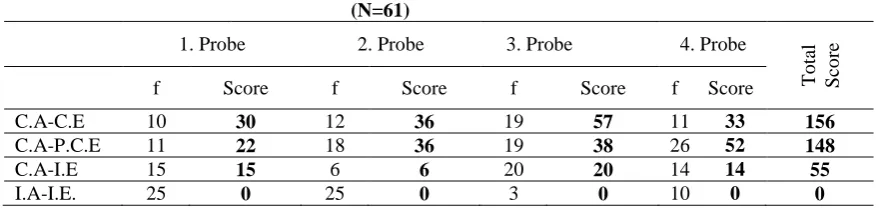
Table 6. The performance scores of the students in formative assessment probes (N=61)
1. Probe 2. Probe 3. Probe 4. Probe
T
o
tal
Sco
re
f Score f Score f Score f Score
C.A-C.E 10 30 12 36 19 57 11 33 156
C.A-P.C.E 11 22 18 36 19 38 26 52 148
C.A-I.E 15 15 6 6 20 20 14 14 55
I.A-I.E. 25 0 25 0 3 0 10 0 0
Part Two of the Study
Is there a difference between the achievement levels that the students reached in TEOG 1 exam and their performances in the formative assessment probes?
Whether there is a difference between the achievement scores that the students got in science and technology in TEOG 1 exam and their performances in the formative assessment probes was analyzed using the matched-pairs t-test. The result of the analysis is presented on Table 7.
Table 7. Average scores from TEOG 1 and the formative assessment probes and their standard deviations
N M SD t
TEOG 1 Scores 61 75.00 19.57 11,28*
Formative Assessment Probes Scores 61 52.02 23.54 * p<.001
The results of the matched-pairs t-test revealed that there is a significant difference between the average scores that the students got in science and technology in TEOG 1 exam and their performances in the formative assessment probes: t (61) = 11.28, p =.001.
Conclusion and Discussion
In the first part of the research, the level of conceptual understanding of the 8th grade students about the concepts of floating and sinking was determined through the formative assessment probes. As for the second part, it was found out whether there was a significant difference between the achievement scores of the students in science questions in TEOG 1 and their formative assessment scores. The results obtained in the study are explained below:
Part One of the Study
In order to answer the first research question (i.e. “What are the 8th grade students’ levels of conceptually understanding the formative assessment probes prepared on the subject of floating and sinking?”), the answers that the students gave to the 4 formative assessment probes were analyzed. The results are indicated below:
The 1st Formative Assessment Probe: Comparing the Cubes
Based on these data, it can be said that students cannot use their knowledge on the question, nor can they make deductions, and they have difficulty in comparing objects made up of the same matter but being of different sizes in terms of melting point, density, floating and sinking, atom size, mass, and volume and in making an explanation even if they find the correct answer. The reason behind this failure might be the fact that students have been subject to conventional summative evaluation and assessment methods such as “true-false”, “matching”, “fill in the gaps”, and “multiple choice” questions that are applied continuously at the end of units or semesters. These conventional evaluation and assessment methods generally lead to superficial learning and learning by heart as they contain fragmentary and discrete knowledge that is forgotten in a short period of time. In this regard, it is clear that students cannot analyze more than one case at the same time nor can they make deductions and explanations. The results obtained from this assessment probe are in parallel with the results of Şahin and Çepni (2011). Similarly, they also found out that students have a low level of conceptual understanding and have alternative concepts regarding the subjects of density and floating and sinking within the force and motion unit.
The 2nd Formative Assessment Probe: With and Without Hole
In this probe, the question ‘whether an object that is floating on the water continues to do so if holes are made on it?’ was asked to students. When the answers are examined, it is seen that nearly half of the students (41%) gave answers that fit the category of (I.A. - I.E). Only 20% of the students guessed correctly that making holes on an object will not change its floating on the water, but they did not make the explanations well. Even though they explained the relationship between the density and the floating and sinking situation correctly, they had difficulty in explaining how making a hole in an object can affect its floating and sinking. This shows us that students fail to use their basic conceptual knowledge in different cases.
The examples that students gave by making a wrong analogy in their explanations such as “If there were holes in ships, they would sink. So any object with a hole on it must sink in the water.” and “There are holes on sponge as well, so the object first sinks and then floats on the water.” also confirm that. These findings reveal that students cannot put what they learn in the lesson into practice in their daily lives, and they learn the information written on course books by heart and thus have difficulty in building a cause-effect relationship in different questions. The results reached through this question are in parallel with the results of Ültay and Kasap (2014) who determined the conceptual understanding levels of students regarding floating and sinking objects.
The 3rd Formative Assessment Probe: Floating Logs
To the question that asked the position of a log that is floating on the water first but then is made two-fold bigger one, most of the students (95%) gave the correct answer. When compared to the other probes, the highest level of achievement was achieved in this one. This may be because; this question did not involve more than one situation that had to be compared. When the students think about only one situation, they can find the answers more easily. However, when they have to consider more than one situation in the questions, it can be said that they have difficulty in interpreting. Similar to Kalın and Arıkıl (2010), it was seen in the present study that students do not have difficulty while making a density calculation but find it difficult to make an interpretation concerning the density concept in different situations and have many misconceptions about the subject.
The 4th Formative Assessment Probe: Floating and Sinking
Part Two of the Study
In the second part of the research, it was investigated whether there is a significant difference between the performances of the 8th grade students in formative assessment questions and their achievement scores in science questions in TEOG 1 exam regarding the concepts of floating and sinking. The significant difference between these scores in favor of TEOG 1 exam shows that students are more successful in the standardized middle school science test (TEOG 1) compared to the formative assessment probes. The most important reason why the students generally obtained low scores in formative assessment probes is that they were asked to explain in detail the justification behind the answers that they marked as correct in the second part of the exam. Since the 8th grade students were used to having multiple choice exams, they did not have any difficulty in finding the right answer in the multiple choice part of the assessment questions. For example, more than 50% of the students gave the correct answer to all assessment questions. However, the analysis results indicate that the students who found the correct answer had difficulty in explaining why they chose that answer in the second part of the assessment questions (23%). This result demonstrates that the explanation and interpretation skills of students are underdeveloped. This is because; even though approximately 15% of the students found the correct answer in the first part, they gave a wrong justification in the second part; and while 14% of the students marked the correct answer in the first part, the explanation they wrote in the second part was partially correct. This finding shows that generally one third, which is a very high rate, of the students have difficulty in making an explanation in the assessment probes. This result might have several reasons. The first reason is that the word ‘assessment’ has almost all the time come to mean multiple choice tests in the Turkish education system. Since the TEOG 1 exam is composed of multiple choice test questions, both the written exams that teachers hold at schools and the questions in course books are composed of multiple choice tests and there is no question based on reasoning. Letting students be subject to test questions from primary school to middle school does not improve their reasoning and explanation skills, which is not a surprising result. The fact that students cannot make an explanation about the correct answer of a question indicates that they have not understood the subject (Murchan, Shiel,Vula, Bajgora, & Balidemajson, 2013). Among the reasons why students fail when they encounter the question types different from multiple choice tests may be as follows: teachers do not go beyond the conventional methods while evaluating the performance of students; they do not diversify the examples while teaching the subject and do not associate the lessons with the daily life; and they just convey the information in books to the students.
On the other hand, students do not feel a need to make an explanation about why a particular choice is correct even if they find the correct answer because the current assessment system measures mostly the information. Instead of thinking ‘How can I use this information in my daily life? or ‘How can I make use of the information I have in different situations?’, students always worry about solving more and more test questions. This is because they are assessed through the TEOG 1 exam, are subject to an achievement order, and are placed in a high school according their scores. For this reason, students are concerned about the question “How can I keep more information in mind?” rather than “How can I fulfill conceptual learning?” or “What should I do for permanent learning?” All of these can be considered among the reasons why students fail to make an explanation or indicate their ideas in writing about their answers in an exam. One of the most important differences between the formative assessment method and the summative method is that the former helps to re-arrange the lesson plan based on the feedbacks that teachers receive from students through the formative assessment. Conceptual learning can be realized only when that occurs. Since our students have been raised in an assessment system that is based on getting marks at the end of each semester, they cannot receive an effective and objective feedback about their performance in the lesson from their teachers, which causes them to fail to learn the subjects properly and on a scientific basis (Black & William, 1998; Black, et al., 2004).
Recommendations
2. In order to implement the formative assessment methods on their students and to increase their performances, teachers should be encouraged to do an action research by applying new formative assessment methods and to present the results of their studies at congresses or to share them with stakeholders by publishing the results. 3. The teachers who have been accustomed to making a summative assessment should go beyond the ordinary and concentrate on the questions that improve the reasoning and interpretation skills and the abilities of students to explain their ideas verbally or in writing and on the activities that will improve these skills in the classroom.
4. Teachers should ask about the prior knowledge of students regarding the subject that they are going to teach, schedule their lesson plan in the light of this information, and rearrange the course of the lesson within the scope of the feedbacks they receive while teaching the subject and thus give efficient and objective feedbacks to their students in return.
5. The subject of floating and sinking is one of the subjects that is less known or about which there are a lot of misconceptions in the minds of students, as is the case in many subjects within the science curriculum for middle schools. In order to teach this subject in a more effective way, the problems that are included in the probe questions should be selected from the daily life.
References
Ali, I., & Iqbal, H.M. (2013). Effect of formative assessment on students’ achievement in science, World Applied Sciences Journal. 26 (5), 677-687.
Angelo, T., & Cross, K. P. (1993). Classroom Assessment Techniques: A Handbook for “College Teachers. San Francisco: Jossey-Bass Publishers.
Atkin, J. M., Coffey, J. E., Moorthy, S., Sato, M., & Thibeault, M. (2005). Designing everyday assessment in the science classroom. New York: Teachers College Press.
Ausubel, D. P. (1968). Educational Psychology: A Cognitive View. New York and Toronto: Holt, Rinehart and Winston.
Aydeniz, M., & Pabuçcu, A. (2011). Understanding the impact of formative assessment strategies on first year university students’ conceptual understanding of chemical concepts. Necatibey Faculty of Education Electronic Journal of Science and Mathematics Education, 5 (2), 18-41.
Black, P. J. (1993). Formative and summative assessment by teachers. Studies in Science Education, 21, 49-97. Black, P., & Wiliam, D. (1998). Assessment and classroom learning. Assessment in Education, 5 (1), 7–74. Black, P., Harrison, C., Lee, C., Marshall, B., & Wiliam, D. (2004) Working inside the black box: Assessment
for learning in the classroom. Phi Delta Kappan, 86 (1), 8-21
Bulunuz, M., & Bulunuz, N. (2013). Fen öğretiminlumede Biçimlendirici Değerlendirme ve Etkili Uygulama Örneklerinin Tanıtılması. Türk Fen Eğitimi Dergisi (TUSED), 10(4), 119-135.
Bulunuz, N., Bulunuz M., & Peker, H. (2014) Effects of Formative Assessment Probes Integrated in Extra-Curricular Hands-On Science: Middle School Students' Understanding. Journal of Baltic Science Education, 13(2), 1-19.
Butler, R. (1987). Task-involving and ego-involving properties of evaluation: effects of different feedback conditions on motivational perceptions, interest and performance. Journal of Educational Psychology, 79
(4), 474–482.
Butler, R., & Neuman, O. (1995). Effects of task and ego-achievement goals on help seeking behaviours and attitudes. Journal of Educational Psychology, 87 (2), 261-271.
Crooks, T. J. (1988) The impact of classroom evaluation practices on students, Review of Educational Research, 58, 438-481.
Çepni, S., & Şahin, Ç. (2012). Effect of different teaching methods and techniques embedded in the 5E instructional model on students' learning about buoyancy force. Eurasian Journal of Physics and Chemistry Education, 4(2).
Demir, Y., Uzoğlu, M., & Büyükkasap, E. (2012). Fen Bilgisi Öğretmen Adaylarının Kuvvet ve Hareket ile İlgili Sahip Olduğu Kavram Yanılgılarının Belirlenmesinde Kullanılan Karikatürlerin ve Çoktan Seçmeli Soruların Etkililiğinin Karşılaştırılması. Eğitim ve Öğretim Araştırmaları Dergisi, 1 (1), 2146-9199. Furtak, E. M. (2012). Linking a learning progression for natural selection to teachers’ enactment of formative
assessment. Journal of Research in Science Teaching, 49 (9), 1181–1210.
Hadjiachilleos, S., Valanides, N., & Angeli, C. (2013). The impact of cognitive and affective aspects of
Kalın, B., & Arıkıl, G. (2010). Çözeltiler Konusunda Üniversite Öğrencilerinin Sahip Olduğu Kavram Yanılgıları. Necatibey Eğitim Fakültesi Elektronik Fen ve Matematik Eğitimi Dergisi, 4 (2), 177-206. Kaptan, S. (1998). Bilimsel araflt›rma ve istatistik teknikleri. Ankara: Tek›fl›k Web Ofset Tesisleri. Karasar, N. (1998). Bilimsel araştırma yöntemi. Ankara: Nobel Yayın Dağıtım.
Karataş, F. Ö. (2003). Lise 2 kimyasal denge konusunun öğretiminde bilgisayar paket programları ile klasik yöntemlerin etkililiğinin karşılaştırılması, KTÜ Fen Bilimleri Enstitüsü, Yayınlanmamış Yüksek Lisans Tezi, Trabzon.
Karataş, F. Ö., Köse, S. & Coştu, B. (2003). Öğrenci yanılgılarını ve anlama düzeylerini belirlemede kullanılan iki aşamalı testler, Pamukkale Üniversitesi Eğitim Fakültesi Dergisi, 1, 13, 54-69.
Kavanagh, C., & Sneider, C. (2007). Learning about gravity I. free fall: A guide for teachers and curriculum developers. The Astronomy Education Review, 5 (2), 21-52.
Keeley, P., Eberle, F., & Farrin, L. (2005). Uncovering student ıdeas in science, vol. 1: 25 formative assessment
probes. California: Corwin & NSTA Press.
Keeley, P., Eberle, F., & Tugel, J. (2007). Uncovering student ıdeas in science, vol. 2: 25 formative assessment
probes. California: Corwin & NSTA Press.
Keeley, P. (2008). Science formative assessment: 75 practical strategies for linking assessment, ınstruction, and learning. California: Corwin & NSTA Press.
Keeley, P. (2009). Uncovering student ıdeas in science, volume 4: 25 new formative assessment probes. California: Corwin & NSTA Press.
Keeley, P., & Harrington, R. (2010). Uncovering student ıdeas in physical science, vol.1 – 45 new force and
motion assessment probes. California: Corwin & NSTA Press.
Kopittke, P. M., Bernhard Wehr, J., & Menzies, N. (2012). Does Formative Assessment
Improve Student Learning and Performance in Soil Science? Journal of Natural Reasources & Life Sciences Education, 41 (1), 59-64.
Luo, H.J. (2006). Case study on students’ understanding on floating and sinking: Preliminary findings. Retrieved 15 February 2009 from http://se.risechina.org/rjsy/200608/1737.html (in Chinese).
Metin, M., & Özmen H. (2010). Biçimlendirici Değerlendirmeye Yönelik Öğretmen Adaylarının Düşünceleri.
Milli Eğitim Dergisi, 187, 293-310.
Murchan, D., Shiel, G., Vula, E., Bajgora, A. G., & Balidemaj, V. (2013). Formatif [Biçimlendirici Değerlendirme] (2013) file:///C:/Users/User/Downloads/Formatif%20De%C4%9Ferlendirme.pdf
adresinden indirilmiştir.
Potvin, P., Masson, S., Lafortune, S., & Cyr, G. (2015). Persistence of the intuitive conception that heavier objects sink more: A reaction time study with different levels of interference. International Journal of Science and Mathematics Education, 13(1), 21-43.
Robson, C. (1997). Real world research: A resource for social scientists and practitioner-researchers.Oxford: Blackwell.
Seçer, S. (2008). 6. sınıf öğrencilerinin kuvvet ve hareket konusundaki alternatif kavramlarının belirlenmesi ve kavramsal gelişimin incelenmesi. Yüksek Lisans Tezi, Balıkesir Üniversitesi, Fen Bilimleri Enstitüsü. Srisawasdi, N., & Panjaburee, P. (2015). Exploring effectiveness of simulation-based inquiry learning in science
with integration of formative assessment. Journal of Computers in Education, 1-30.
Şahin, Ç. & Çepni, S. (2011). “Yüzme- Batma, Kaldırma Kuvveti ve Basınç” Kavramları ile İlgili iki Aşamalı Kavramsal Yapılardaki Farklılaşmayı Belirleme Testi Geliştirilmesi. Türk Fen Eğitimi Dergisi, 8 (1), 79-110.
Tan, Ş. (2010). Öğretimde ölçme ve değerlendirme. Ankara: Pegem Akademi.
TDK Sözlük (2013). [Online] http://www.tdk.gov.tr/index.php?option=com_gts&view=gts.
Torrance, H., & Pryor, J. (2001). Developing formative assessment in the classroom: Using action research to explore and modify theory. British Educational Research Journal, 27(5), 615-631.
Trauth-Nare, A., & Buck, G. (2011). Using reflective practice to incorporate formative assessment in a middle school science classroom: A participatory action research study. Educational Action Research, 19(3),
379–398.
Ültay, N., & Kasap, G. (2014). Kavramsal Değişim Yaklaşımına Göre Hazırlanan Etkinliklerin Öğrencilerin Yüzen-Batan Cisimleri Anlamalarına Etkisinin Belirlenmesi. Kastamonu Eğitim Dergisi, 22 (2), 455-472.
Wong, D., & Lau, C. Y. (2014). The Development and Implementation of a Guided-Inquiry Curriculum for Secondary School Physics. In Inquiry into the Singapore Science Classroom (pp. 89-110). Springer Singapore. Yalaki, Y. (2010). Simple formative assessment, high learning gains in college generalchemistry. Eğitim
Arastırmaları - Eurasian Journal of Educational Research, 40, 223-240.
Yin, Y., Tomita, M. K., & Shavelson, R. J. (2008). Diagnosing and dealing with student misconceptions: Floating and sinking. Science Scope, 31(8), 34–39.
Yin, Y., Tomita, M.K., & Shavelson, R. J. (2013) Using formal embedded formative assessments aligned with a short-term learning progression to promote conceptual change and achievement in science, International
Appendices
Appendix A
First Formative Assessment Probe
COMPARING CUBES
Sofia has two solid cubes made of the same mate rial. One cube is very large, and the other cube is very small. Put an X next to all the statements you
think are true about the two cubes.
A. The larger cube has more mass than the smaller cube.
B. The larger cube has less mass than the smaller cube.
C. The larger cube melts at a higher temperature than the smaller cube.
D. The larger cube melts at a lower temperature than the smaller cube. E. The density of the larger cube is greater than the smaller cube. F. The density of the larger cube is less than the smaller cube.
G. The larger cube is more likely to float in water than the smaller cube. H. The larger cube is more likely to sink in water than the smaller cube. I. The larger cube is made up of larger atoms than the smaller cube. J. The larger cube is made up of smaller atoms than the smaller cube.
Explain your thinking. Describe the "rule" or reasoning you used to compare the cubes.
__________________________________________________________________________________________ __________________________________________________________________________________________ __________________________________________________________________________________________
Second Formative Assessment Probe
SOLIDS AND HOLES
you think Lance will observe when he puts t e materi al with holes back in the water? Circle your prediction.
A It w i l l sink.
B It will barely float.
C It will float the same as it did before the holes were punched in it.
D It will neither sink nor float. It will bob up and down in the water.
Explain your thinking. Describe the "rule" or reasoning you used to make
your prediction.
_______________________________________________________ _______________________________________________________ _______________________________________________________ _______________________________________________________ _______________________________________________________ _______________________________________________________ __________________________________________
Third Formative Assessment Probe
FLOATING LOGS
A log was cut from a tree and put in water. The log floated on its side so that half the log was above the water surface. Another log was cut from the sa me tree. This log was twice as long and twice as wide. How does the larg er log float com pared with the smaller log? Circle the best answer:
A More t h an ha l f of the larger log floats above the water surface.
B Half of the larger log floats above the water su rface.
C Less than half of the larger log floats above the water surface.
•
Fourth Formative Assessment Probe FLOATING HIGH AND LOW
Sam put a solid ball in a tank of water. As shown by the ball on the left, it floated halfway above and halfway below the water level. What can Sam do to make a ball float like the ball on the right? Put an X next to all the things Sam can do to have solid ball float so that most of it is below
the water level.
A. Use a l arger ball made out of the same material. B. Use a smaller ball made out of the same material.
C. Use a ball of the same size made out of a denser material. D. Use a ball of the same size made out of less dense material. E. Add more water to the tank so it is deeper.
F. Add salt to the water. G. Attach a weight to the ball.
Explain your thinking. Describe the "rule" or reasoning you used to determine how to change how an object floats in water.
Appendix B
GRADING MANUAL
The Rubric Used for Evaluating the Answers Given to the Two-Tiered Formative Assessment Probes 1.
Comprehension
Levels Explanation Evaluation Criteria Scores
Correct Elaboration
Integrated with scientific perspective and clear with elaboration
Correct Answer- Correct
Elaboration (C.A-C.E.) 3
Partially Correct Elaboration
Partially correct or limited elaboration
Correct Answer- Partially Correct Elaboration (C.A-P.C.E.)
2 Incorrect
Elaboration
Incorrect answer or clearly evident misconception
Incorrect Answer- Correct
Elaboration (I.A-C.E) 2
No Answer No response or clearly evident misconception
Correct Answer-Incorrect
Elaboration (C.A-I.E.) 1
Incorrect Answer- Incorrect