Available online on 15.03.2019 at http://jddtonline.info
Journal of Drug Delivery and Therapeutics
Open Access to Pharmaceutical and Medical Research
© 2011-18, publisher and licensee JDDT, This is an Open Access article which permits unrestricted non-commercial use, provided the original work is properly cited
Open Access
Research Article
Stability indicating Ultra Performance Liquid Chromatography method
development and validation for simultaneous estimation of artemether and
lumefantrine
in bulk and pharmaceutical dosage form
Sukanya Bandari*, Mohan Goud V, Anitha P
Department of Pharmaceutical Analysis, Joginpally B. R Pharmacy College, Yenkapally, Moinabad, R.R. Dist. Telangana.
ABSTRACT
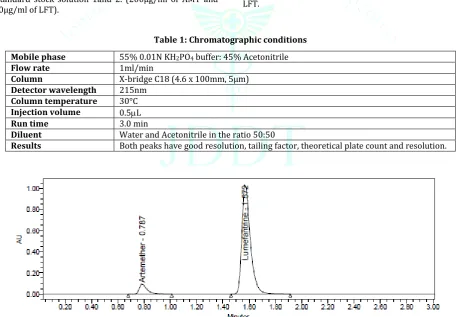
Ultra performance liquid chromatography method was developed for the simultaneous estimation of the Artemether (AMT) and Lumefantrine (LFT) in Tablet dosage form. Chromatogram was run through X-bridge C18 100 x 2.1 mm, 3.5. Mobile phase containing Buffer 0.01N KH2PO4 (3.5pH): Acetonitrile taken in the ratio 55:45 was pumped through column at a flow rate of 0.3ml/min. Buffer used in this method was 0.01N KH2PO4. Temperature was maintained at 30°C. Optimized wavelength selected was 215nm. Retention time of AMT and LFT were found to be 0.787 min and 1.572min. %RSD of the AMT and LFT were and found to be 0.7 and 0.6 respectively. %Recovery was obtained as 99.49% and 100.22% for AMT and LFT respectively. LOD, LOQ values obtained from regression equations of AMT and LFT were 0.03, 0.08 and 0.095, 0.288 respectively. Regression equation of AMT is y = 19308x + 1509 and y = 36919x + 11566 of LFT. The developed method was simple and economical that can be adopted in regular Quality control test in Industries.
Keywords: Artemether (AMT), Lumefantrine (LFT), Acetonitrile, UPLC.
Article Info: Received 31 Jan 2019; Review Completed 04 March 2019; Accepted 09 March 2019; Available online 15 March 2019
Cite this article as:
Sukanya B, Mohan Goud V, Anitha P, Stability indicating Ultra Performance Liquid Chromatography method development
and validation for simultaneous estimation of artemether and lumefantrine in bulk and pharmaceutical dosage form,
Journal of Drug Delivery and Therapeutics. 2019; 9(2):217-221 http://dx.doi.org/10.22270/jddt.v9i2.2408
*Address for Correspondence:
Sukanya Bandari, Department of Pharmaceutical Analysis, Joginpally B. R Pharmacy College, Yenkapally, Moinabad, R.R. Dist. Telangana
INTRODUCTION
AMT 1, 2 is an antimalarial agent used to treat acute
uncomplicated malaria. Chemical name of AMT is 3,12-Epoxy-12H-pyrano[4,3-j]-1,2-benzodioxepin, decahydro-10-methoxy-3,6,9-trimethyl-, (3R,5aS,6R,8aS,9R,10S,12R,12aR). It is administered in combination with LFT for improved efficacy. This combination therapy exerts its effects against the erythrocytic stages of Plasmodium spp. and may be used to treat infections caused by P. falciparum and unidentified Plasmodium species, including infections acquired in
chloroquine-resistant areas 3.
LFT is an antimalarial agent used to treat acute uncomplicated malaria. Chemical name of LFT 2-(dibutylamino)-1-[(9Z)-2,7-dichloro-9-[(4-chlorophenyl) methylidene] -9H-fluoren-4-yl] ethan-1-ol. It is administered in combination with AMT for improved efficacy. This combination therapy exerts its effects against the erythrocytic stages of Plasmodium spp. and may be used to treat infections caused by P. falciparum and unidentified Plasmodium species, including infections acquired in
chloroquine-resistant areas 4.
Structure:
O
CH3
O CH3
C H3
O C H3
O O
Cl Cl Cl
N OH
CH3
C H3
AMT LFT Figure.1: Structures for AMT and LFT
Literature review 7- 19 reveals that different methods
RP-HPLC, UV, LCMS for its analysis in formulations. Hence our present plan is to develop a new, sensitive, robust& accurate method for its analysis in formulation, after a detailed study, a new UPLC method was decided to be developed and
MATERIALS AND METHODS
Instruments Used:
Electronics Balance-Denver, pH meter -BVK enterprises,
India, Ultra sonicator-BVK enterprises, WATERS UPLC 2695 SYSTEM equipped with quaternary pumps, Photo Diode Array detector and Auto sampler integrated with Empower 2 Software. UV-VIS spectrophotometer PG Instruments T60 with special bandwidth of 2 mm and 10mm and matched quartz cells integrated with UV win 6 Software was used for measuring absorbances of AMT and LFT solutions.
Drug samples:
AMT 20mg and LFT 120mg. Reagents and Solutions:
Distilled water, Acetonitrile, Phosphate buffer, Methanol, Ortho-phosphoric acid [All are HPLC grade], Potassium dehydrogenate ortho phosphate buffer [AR].
Analytical methodology:
Diluent: Based up on the solubility of the drugs, diluent was selected, Acetonitrile and Water taken in the ratio of 50:50. Preparation of Standard stock solutions: Accurately weighed 5 mg of AMT, 30 mg of LFT and transferred to
individual 25 ml volumetric flasks separately. 3/4th of
diluents was added to both of these flasks and sonicated for 10 minutes. Flasks were made up with diluents and labeled as Standard stock solution 1and 2. (200µg/ml of AMT and 1200µg/ml of LFT).
Preparation of Standard working solutions (100% solution): 1ml from each stock solution was pipetted out and taken into a 10ml volumetric flask and made up with diluent. (20µg/ml AMT of and 120µg/ml of LFT).
Preparation of Sample stock solutions: 5 tablets were weighed and the average weight of each tablet was calculated, then the weight equivalent to 1 tablet was transferred into a 50 ml volumetric flask, 25ml of diluents was added and sonicated for 25 min, further the volume was made up with diluent and filtered by HPLC filters (400µg/ml of AMT and 2400µg/ml of LFT).
Preparation of Sample working solutions (100% solution): 0.5ml of filtered sample stock solution was transferred to 10ml volumetric flask and made up with diluent. (20µg/ml of AMT and 120µg/ml of LFT).
Preparation of buffer:
0.1% OPA Buffer: 1ml of Conc. Ortho Phosphoric acid was diluted to 1000ml with water.
Mobile phase: Mobile phases used for HPLC are typically mixtures of organic solvents and water or aqueous buffers.
RESULTS AND DISCUSSION
Method Development
Optimized method: Trials were performed for the method development and the best peak with least fronting factor was found to be with RT=0.783 min for AMT and 1.573min for LFT.
Table 1: Chromatographic conditions Mobile phase 55% 0.01N KH2PO4 buffer: 45% Acetonitrile
Flow rate 1ml/min
Column X-bridge C18 (4.6 x 100mm, 5µm)
Detector wavelength 215nm Column temperature 30°C Injection volume 0.5L
Run time 3.0 min
Diluent Water and Acetonitrile in the ratio 50:50
Results Both peaks have good resolution, tailing factor, theoretical plate count and resolution.
Figure 2: System suitability chromatogram
System Suitability: According to ICH guidelines plate count
Table 2: System suitability parameters for AMT and LFT
S. No AMT LFT
Injection RT (min) USP Plate Count Tailing RT (min) USP Plate
Count Tailing Resolution
1 0.786 2017 1.45 1.568 3312 1.33 7.4
2 0.786 2013 1.47 1.568 3520 1.39 7.3
3 0.786 2962 1.47 1.570 3479 1.37 7.4
4 0.787 2041 1.47 1.570 3349 1.41 7.0
5 0.787 2934 1.59 1.570 2798 1.42 6.8
6 0.788 2837 1.62 1.572 2834 1.42 6.8
Methods for Validation
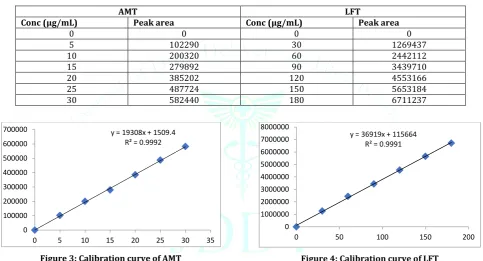
Linearity: Six linear concentrations of AMT (5-30µg/ml) and LFT (30-180µg/ml) were injected in a duplicate manner. Average areas were mentioned above and linearity
equations obtained for AMT was y = 19308x + 1509.4 and of LFT was y = 36919x + 115664 Correlation coefficient obtained was 0.999 for the two drugs.
Table 3: Linearity table for AMT and LFT
AMT LFT
Conc (μg/mL) Peak area Conc (μg/mL) Peak area
0 0 0 0
5 102290 30 1269437
10 200320 60 2442112
15 279892 90 3439710
20 385202 120 4553166
25 487724 150 5653184
30 582440 180 6711237
Figure 3: Calibration curve of AMT Figure 4: Calibration curve of LFT
Precision: From a single volumetric flask of working standard solution six injections were given and the obtained areas were mentioned above. Average area, standard deviation and % RSD were calculated for two drugs. % RSD
obtained as 0.3% and 0.3% respectively for AMT and LFT. As the limit of Precision was less than “2” the system precision was passed in this method.
Table 4: System precision table of AMT and LFT
S. No Area of AMT Day-Day precision Peak area Area of LFT Day-Day precision Peak area
1. 380088 374570 4595070 4590553
2. 380169 371816 4585652 4515867
3. 378427 374545 4591200 4506563
4. 380085 377682 4586047 4596058
5. 380944 376553 4611663 4538194
6. 381169 370952 4610550 4545747
Mean 380147 374353 4596697 4548830
S.D 964.0 2608.0 11697.6 37328.2
%RSD 0.3 0.7 0.3 0.8
y = 19308x + 1509.4 R² = 0.9992
0 100000 200000 300000 400000 500000 600000 700000
0 5 10 15 20 25 30 35
y = 36919x + 115664 R² = 0.9991
0 1000000 2000000 3000000 4000000 5000000 6000000 7000000 8000000
Accuracy: Three levels of Accuracy samples were prepared by standard addition method. Triplicate injections were given for each level of accuracy and mean %Recovery was
obtained as 99.49% and 98.71% for AMT and LFT respectively.
Table 5: Recovery studies for AMT and LFT
%Concentration AMT LFT
50% 100% 150% 50% 100% 150%
Trail-I 96.88 96.88 99.66 100.53 100.10 99.90
Trail-II 98.71 98.71 99.80 99.26 98.97 98.71
Trail-III 99.20 99.20 100.54 101.35 101.56 101.64
AVG (%Recovery) 98.3 100.2 100.00 100.38 100.21 100.08
SD 1.22 1.13 0.47 1.051 1.2990 1.4752
%RSD 1.24 1.13 0.47 1.05 1.30 1.47
Robustness: Robustness conditions like Flow minus (0.9ml/min), Flow plus (1.1ml/min), mobile phase minus (55B:45A), mobile phase plus (45B:55A), temperature minus (25°C) and temperature plus (35°C) was maintained and
samples were injected in duplicate manner. System suitability parameters were not much affected and all the parameters were passed. %RSD was within the limit.
Table 6: Robustness data for AMT and LFT
S. No. Condition %RSD of AMT %RSD of LFT
1 Flow rate (-) 0.9ml/min 0.6 0.6
2 Flow rate (+) 1.1ml/min 1.7 1.6
3 Mobile phase (-) 55B:45A 0.5 0.1
4 Mobile phase (+) 45B:55A 1.1 0.2
5 Temperature (-) 25°C 0.1 0.3
6 Temperature (+) 35°C 0.9 0.3
LOD and LOQ: LOD and LOQ were estimated from the signal-to-noise ratio. The LOD for AMT and LFT were found to be 0.03 and 0.08μg/ml and the LOQ were 0.095 and 0.0288μg/ml respectively.
Table 7: LOD AND LOQ of AMT and LFT
Molecule LOD LOQ
AMT 0.03 0.08
Lumefantrine 0.095 0.288
Degradation data: Degradation studies were performed
with the formulation and the degraded samples were injected. Assay of the injected samples was calculated and all the samples passed the limits of degradation.
Table 8: Degradation data of AMT and LFT Type of
degradation AREA %RECOVERED AMT % DEGRADED AREA %RECOVERED LFT % DEGRADED
Acids 356108 93.30 6.70 4377916 95.05 4.95
Base 365252 95.70 4.30 4338107 94.19 5.81
Peroxide 370534 97.08 2.92 4339047 94.21 5.79
Thermal 371099 97.23 2.77 4469922 97.05 2.95
Uv 375429 98.36 1.64 4479189 97.25 2.75
Water 379345 98.36 1.64 4550018 98.79 1.21
CONCLUSION
The UPLC method was developed and validated. The developed method was system suitability, precision, accuracy, limit of detection and limit of quantization and degradation studies of the simultaneous estimation of AMT and LFT in bulk and pharmaceutical dosage form. The combination of these drugs is easy to administer and may improve adherence in the treatment of uncomplicated
REFERENCES
1. Artemether and Lumefantrine. The American society of health-system pharmacists. Archived from the original on 2015-12-08. Retrieved Dec 2, 2015.
2. Artemether and Lumefantrine. International Drug Price Indiactor. Retrived 4 December 2015.
3. Makanga. Efficiency and safety of the six-dose regimen of Artemether-Lumefantrine: in pediatrics with uncomplicated plasmodium falciparum malaria: a pooled analysis of individual patient data, American Journal of Trop med hyg 74(6):991-998. 4. Lumefantrine. The stephanieoadberg, in drugs during pregnancy and lactation (Third Edition), Anti Infective Agent 2015.
5. ICH Harmonised Tripartite Guideline. Validation of analytical procedures, Text and methodology, Q1 R2. International Conference on Harmonization, 2005, 1-13.
6. ICH Harmonised Tripartite Guideline, Stability Testing of New Drug Substances and Products, Q1A (R2). International Conference on Harmonization, 2003, 1-18.
7. Agarwal, Suraj P, Ali, Asgar, Ahuja. Analytical Method Development and Validation for Estimation of Lumefantrine: in Pharmaceutical Dosage Forms by HPLC, American Journal of Chemistry 2007; 19:4407-4414.
8. Sunil J, Sanjithnath M, Samba Moorthy U. HPLC method development and validation for simultaneous estimation of Artemether and lumefantrine: in pharmaceutical dosage forms, by International Journal of Pharmacy and Pharmaceutical Sciences 2010; 2(4):0975-1491.
9. Philip Debrah, Henry Nettey, Katja Kjeldgaard Miltersen, Patrick Ayeh-Kumi, BirgitteBrock, Joseph Adusei Sarkodie. Artemether–Lumefantrine Concentrations in Tablets and Powders from Ghana Measured: by a New High-Performance Liquid Chromatography Method, American 2016; 95(1):158– 163.
10. Noon Kamal Saeed, Mohamed Elmukhtar A, Aziz. HPLC method development and validation for estimation of Artemether and lumefantrine tablets by world journal of pharmaceutical and medical research 2017; 3(2):13-17.
11. Wang, Ziyou, Chen, Zufen, Yaowu, Fenxi. Simultaneous determination of Artemether and its metabolite and urine by a HP-LCMS using Electrospray ionization:
Pharmaceutical analysis, Journalof Current pharmaceutical Analysis 2000; 20:178-179.
12. Arun R and Anton Smith A. Development of Analytical Method for Lumefantrine: by UV Spectrophotometry, By International Journal of Research in Pharmaceutical Sciences: 0975-7538. 13. Laxmi M, Somsubhra Ghosh, Ravi kumar B.V.V. analytical
method development & validation of Artemether: in bulk drug by RP- HPLC method, International journal of pharmacy and pharmaceutical sciences. As per ICH guidelines 2015; 2:0975-1491.
14. Emanual Michael Patelia, Rakesh Thakur and Jayesh Patel.Bio-Analytical Method Development and Validation for Estimation of Lumefantrine: in Human Plasma by Using LC-Ms/Ms, By International Journal of Biomedical Data Mining: 2090-4924. 15. Mohamed Aly Amin Ahmed Ibrahim, Mohamed Aly Abd El Aziz
Aly El Degwy. HPLC Method Development and Validation for Determination of Lumefantrine: in Pharmaceutical Dosage Forms, by Journal of PharmaSciTech: 2015; 5(1):1-4.
16. Gupta NK, Babu AM and Pramila Gupta. Simultaneous Estimation of Artemether and Lumefantrine: by RP-HPLC Method development in pharmaceutical tablet dosage form, By International Journal of Pharmaceutical Erudition: 2013; 3(1):10-17.
17. Vinodh M, Mastiholimath Vinayak, Patware Pankaj, Kharya Rahul and Mascarenhas Renita. Analytical method development and validation for simultaneous estimation of Artemether and lumefantrine: in pure and pharmaceutical dosage form using RP-HPLC method, By Malaysian Journal of Analytical Sciences 2013; 17(3):348–358.
18. Wagh MP, Arvindranpise A. Development and validation of a rp-hplc method for simultaneous determination of artemether and lumefantrine: in tablet dosage form, by international journal of life science and pharma research July 2017; 7(3):2250-0480.