A C
ONCEPTUAL
M
ODEL TO
S
UPPORT
S
ECURITY
A
NALYSIS IN THE
I
NTERNET OF
T
HINGS
Orestis Mavropoulos1, Haralambos Mouratidis1, Andrew Fish1,
Emmanouil Panaousis1, and Christos Kalloniatis1,2
1
School of Computing, Engineering, and Mathematics University of Brighton, Brighton, UK
{o.mavropoulos,h.mouratidis,andrew.fish,e.panaousis}@brighton.ac. uk
2 Department of Cultural Technology and Communication University of the Aegean, Lesvos, Greece
Abstract. This paper proposes a conceptual model to support decision makers dur-ing security analysis of Internet of Thdur-ings (IoT) systems. The world is enterdur-ing an era of ubiquitous computing with IoT being the main driver. Taking into account the scale of IoT, the number of security issues that are arising are unprecedented. Both academia and industry require methodologies that will enable reasoning about secu-rity in IoT system in a concise and holistic manner. The proposed conceptual model addresses a number of challenges in modeling IoT to support security analysis. The model is based on an architecture-oriented approach that incorporates sociotechni-cal concepts into the security analysis of an IoT system. To demonstrate the usage of the proposed conceptual model, we perform a security analysis on a small scale smart home example.
Keywords:Internet of Things, Conceptual Model, Security.
1.
Introduction
An area that has attracted a lot of attention from research and industry alike is the Internet of Things (IoT). The vision of IoT is not new but has existed since the early conception of computer networks. Weiser, in 1991 [43], provides one of the most accurate yet simple visions of IoT by stating that the most profound technologies merge with the environment. He states that technology will be so evident that we will start perceiving it as a natural part of life. IoT along with cloud computing promises to make that statement into a reality.
into consideration during the development cycle [36]. The practice of implementing secu-rity analysis during development ensures that the final product will meet specific secusecu-rity standards. The security standards, in turn, will ensure its robustness when the product is actively deployed in real life scenarios. The method of including secure practices early in the development cycle is advocated by the field of requirements engineering. Require-ments engineering analysis is applied by identifying the stakeholders’ requireRequire-ments in the development cycle to produce security requirements [7].
IoT systems allow the network integration of a variety of different devices. Devices such as personal computers, mobile phones, and printers can be considered traditional devices since they have been used in networking scenarios in the past. Traditional devices are used to access the Web, share files or host websites. Devices such as light bulbs, cars or heart monitors are only now gaining networking capabilities and as a result they have significant security flaws [39]. IoT is unique in the sense that it brings together old and robust technology with new and untested technology. The pairing of mature technology with immature technology naturally results in security issues. Given the unique challenges faced by IoT systems, our main question in this paper is how a security engineer can elicit security requirements in IoT systems? The previous question can be expanded to the following research questions:
1. How can IoT systems be modeled in order for an engineer to elicit security require-ments of the IoT system?
2. As IoT systems exhibit a high degree of interdependencies, which stakeholders are responsible for satisfying each security requirement?
3. How can we support decision makers to select security controls in IoT systems?
The proposed conceptual model contributes to addressing the first of the above re-search questions. It is going to be part of a security framework that will address all three research questions. The components of the security framework will be the following:
1. Terminology: used to define the terms that describe the concepts of the proposed security framework. The terminology will facilitate the reasoning about the security of an IoT system by establishing a common language among security engineers. 2. Modeling language: provides components to create IoT system model that will
cap-ture the information needed by a security engineer in order to perform security anal-ysis for an IoT system. Part of the modeling language will be the conceptual model presented in this paper. Other parts of the language will be the language semantics and language notation. The models created using the conceptual model will be able to be expressed in both graphical and textual notation. The textual notation will be used to facilitate computer aided analysis, while the graphical notation will be used to assist in visual analysis.
3. Methodology: used to create model instances of an IoT system for security require-ments elicitation by security engineers. The methodology will provide instructions as well as restrictions on how modeling instances are created using the modeling lan-guage.
The conceptual model enables reasoning about security in IoT systems using infor-mation retrieved by studying the hardware architecture of an IoT system. The proposed model is based on our previous work [31], which models the hardware architecture of an IoT system with its core concepts being the IoT node and the network connection. The architecture of a system offers valuable information for security analysis, such as the supported protocols of network connections between nodes or the flow of data inside a network domain. On the other hand, [31] does not express certain aspects of a system, such as user interaction or authentication mechanisms. Thus, the proposed conceptual model aims to address the limitations of a hardware architectural approach by introduc-ing non-hardware architectural concepts along with hardware architectural concepts. Each concept is grouped into different modules based on their thematic context, to allow a se-curity engineer to only use the modules she needs. Since IoT has computer networking components, concepts from computer networks such asnetwork connectionsandnetwork domainsas well as concepts from non domain specific modeling languages such asactor, are incorporated in the proposed metamodel. The security requirements concepts of the metamodel are based on the Secure Tropos method [33]. Secure Tropos was chosen be-cause it is an established requirements engineering method whose security concepts align with other requirements methods such as [16].
Our work here extends [31], by introducing:
– additional concepts to the metamodel that capture additional information from an IoT system. For example, we introduce the concept of Net to express external networks to an IoT system. Moreover, concepts that are introduced in the present metamodel can be used to represent social constructs, such as users and stakeholders, or security constructs, such as threats and vulnerabilities. Social concepts are used to model users activity or behavior, while security concepts are used to model security issues.
– IoT systems are a network of various devices. Our initial attempt in [31] was to model an IoT system in a similar manner to a computer network. In our present work, we introduce concepts to express users, threat or security policies. Such concepts have little relation to computer networks. For that reason, the proposed metamodel divides its concepts into different modules based on their thematic context. Concepts that are used to express network related constructs constitute the network module, while security related concepts constitute the security module. A security engineer may only need to model the network aspect of an IoT system. If that is the case, she only needs to use concepts of the network module.
1.1. Outline
2.
Related work
IoT, due to its magnitude and relatively young age, may be considered the technological field with largest attack surface today [37]. The insecurity of IoT is demonstrated by a large number of surveys that have identified a variety of security issues and challenges found in IoT systems [1, 4, 20, 29]. However, there have been few attempts to address its security issues from a security requirements point of view.
Some academic works identify security challenges in IoT while proposing future di-rections that security researchers should take. For example, Kumar et al. conceptually breaks down an IoT system into different layers and proceeds to identify the security challenges of each layer and states the options that researchers have to prevent such is-sues [24].
An attempt was made to provide a framework for security and privacy in IoT sys-tems using requirements engineering by Alqassem [2]. They identify the complexity of analyzing security in IoT systems and states that the key components in IoT are only two: RFID systems and networks of sensors. To reason about security in IoT, they pro-pose the use of the i∗framework in order to undertake security analysis in future case studies. In the paper, other technologies and topologies that are common in IoT systems, are not considered. For example, IoT is not restricted to RFID systems but is able to use any communication technology, such Wi-Fi, NFC or Bluetooth. Moreover, architectural topologies are not restricted to networks solely comprised of sensors but may include any type of device capable of using a network protocol.
IoT systems as a whole are composed of a multitude of devices. Many of those devices are embedded devices. An informative paper from Gürgens illustrates a vision in applying security engineering to embedded systems [15]. In their paper, they identify a number of security challenges faced by embedded systems that should be addressed in order to have a secure system. Furthermore, they reason that security requirements tools should be designed and tailored to the needs of embedded systems.
Babar et al. propose a framework aiming to provide security in embedded IoT sys-tems [5]. They propose a basic three-step security framework to elicit requirements in embedded systems, by identifying the building blocks of embedded systems in IoT. Tian et al. design a security framework specific to wireless sensor networks [41]. The frame-work proposes a system architecture that is broken down into eight modules. Each module has specific functionality to mitigate security issues. In summary, the presented works do not view IoT in a comprehensive manner. They only aim to mitigate security issues in specific domain areas. Accordingly, they cannot be used to offer a universal security anal-ysis to any IoT scenario, but only aim to address specific instances of IoT systems. While it is important to argue about domain specific IoT security issues, there is a need to reason about IoT security in a holistic manner that does not limit a security engineer [35].
Ikram et al. [17] propose an alternative approach to modeling IoT. They argue that the complexity of IoT can be modeled in a similar manner to chemical computing models. Their work presents a chemical reaction-inspired computational model using the concepts of graphs and reflection, which attempts to address the complexities associated with the visualization, modeling, interaction, analysis and abstraction of information in the IoT. Laghari et al. [26] model a self-adaptive architecture for managing the Carbon footprint in a corporate environment using a heterogeneous multiagent system. They use Cogni-tive Agent-based Computing (CABC) to create models. Both works propose concepts to model social constructs. They were not designed to perform security analysis and as such do not propose security related concepts.
ThingML is developed as a domain-specific modeling language which includes con-cepts to describe both software components and communication protocols. The formalism used is a combination of architecture models, state machines, and an imperative action language [42]. ThinkML is supported by a set of open source tools that are built using the Eclipse Modeling Framework. ThingML was developed to model the hardware, software components and communication protocols of IoT systems. It does not have concepts to model social or security components of IoT, such as users, stakeholders, threats or vul-nerability.
ASSIST is an agent-based simulator of Social Internet of Thing (SIoT) [21]. The idea behind SIoT is that smart objects will connect with each other to form social networks. ASSIST uses an agent-based approach by defining three types of agents: Device Agents, Human Agents, and Task Agents. While ASSIST can be used to express the social com-ponents of IoT systems, it was not designed with security analysis is mind. As such it cannot be used to express security components.
In their work, Ge et al. [11], proposed a framework for modeling and assessing secu-rity in an IoT system. The framework has a graphical secusecu-rity model that evaluates the level of security using specific security metrics. The security of an IoT system is assessed in a comprehensive manner and in not limited to a specific IoT scenario, such as embed-ded systems or RFID systems. Another framework that separates security requirements of IoT systems depending on their architectural layer is made by Rahman et al. [34]. In their work, they propose a four layer approach, with each layer having different security needs. They state that their framework can be used by other researchers to build new security solutions for IoT. In our work, we use a similarly comprehensive approach to security of IoT systems although from a requirements engineering point of view.
3.
The proposed conceptual model
and virtual) things based on existing and evolving interoperable information and commu-nication technologies” [19].
The presented model extends our previous work on the APPARATUSframework [31]. The initial model of APPARATUSconsisted of two concepts. The first concept was theIoT Nodeand the second concept was theNetwork Connection. The IoT node was used to rep-resent devices of IoT systems, while the Network Connection was used to reprep-resent how the IoT nodes can communicate with each other. Using those two concepts we modeled the hardware architecture of IoT systems in order to analyze their security.
In this work, we extend the model by introducing new concepts to represent social and security components. TheIoT nodehas been renamed toDeviceand additional concepts have been introduced in order to represent the hardware components of the IoT system. The metamodel is presented via a UML class diagram. Each class represents a concept that can be used to describe specific objects of IoT systems. Each concept has a number of properties that further describe it in the system. The UML diagram of the model is shown in Fig. 1. The concepts of the presented model have been divided into different modules. The metamodel consists of three modules:
1. Network module:is used to model network objects of IoT systems. The Network module is considered the core module of the metamodel. Every other module is de-signed as an extension to the Network module. This modeling choice was made to give emphasis to the interconnecting nature of IoT systems. The Network module is represented with the color blue in Fig. 1.
2. Social module:extends the Network module in an object-oriented manner with so-cial concepts. Soso-cial concepts are used to model users and stakeholders. The soso-cial module is represented with the color gray in Fig. 1.
3. Security module:extends the Network and Social modules with security concepts. The security concepts are used to model threats, assets, security controls and attackers in an IoT system. The concepts used by the Security module are heavily influenced by Secure Tropos security concepts [12]. The security model is represented with the color purple in Fig. 1.
The presented metamodel is used to model an IoT during at the implementation phase. During the implementation phase, a security engineer has more detailed knowledge of an IoT system. For example, during the implementation, the security engineer knows the type of network protocols that are used by the system, the type, and versions of the devices that provide services to the system. All the concepts of the metamodel, unless otherwise stated, have the property ofdescriptionwhich describes the concept in the system. The modules of the implementation phase metamodel along with their concepts are the following:
Network Module
(1) aspect: declares whether the Device is a single node, or composed of sub-nodes. The aspectphysicalmeans that a Device is a parent Device and may be composed by morevirtualDevices;(2) layer: the conceptual layer of the IoT architecture to which the Device belongs. APPARATUSuses a three-layer architecture that consists of the Application Layer, Network Layer and the Perception Layer [32, 44]. Other works identify other architectures that provide more levels of abstraction. For exam-ple, a SOA-based approach identifies five layers,application, service composition, service management, object abstraction, objects[4]. Another approach by Lu, iden-tifies other layers, that areapplication, middleware, coordination, backbone network, existed alone network, access layer, edge technology[28]. The proposed architec-tures for Internet of Things have yet to fuse into a single reference model [23], for that reason we chose the three-layer approach. The three-layer approach provides the necessary properties for reasoning about security while allowing to be extended if more levels of abstraction are introduced into the final reference model of IoT. The layers of IoT architecture should not be confused with the OSI model [25] since the two models try to conceptualize different constructs and concepts. Thelayerconcept takes an enumerated value as input that is one ofapplication, gateway, perception;
(3) type: defines the kind of the Device. A Device type may be a sensor, a mobile phone or a server;(4) service: is the type of role or operation that the Device per-forms for the network. This value may include network services such asssh,ftp, data processing filtering and relaying of data;(5) input: what is required in order for the node to perform its role or operation. It takes an enumerated value as an input that is drawn fromdataEnvironmental, dataDigital, command, action, notification, trigger;
(6) output: is the result of the Device operation or role. It may take the same values as theinputproperty.(7) update:represents the process of how the software aspect of the Device is being updated. Theupdatecan beautomatic, require a specificaction
orfalse.
2. Network Connection: the type of network communication protocol used between the Devices. The properties of the network connection are:(1) description: the type of connection, it can either bewireless, signifying a connection using a wireless protocol orcable, signifying a connection using a wired medium. It takes an enumerated value as an input;(2) listOfProtocols: is a list of the network protocols that are supported by the network connection. It takes an array of string values as an input, each value in the array represents a supported network protocol.
3. Micronet: represents environments that a security engineer can configure in terms of their security. A Micronet is a managed environment that constitutes a collection of Things necessary for an IoT system to perform a function. Examples of Micronets are a smart home, an agricultural network of sensors or company’s internal network. The properties of the Micronet are:(1) state: represents if the Devices in the Micronet remain in the same location. Thestatecan either bedynamic, meaning that the De-vices in the network change network domains during their usage orstaticmeaning that the Devices in the system do not change network domains. Examples ofdynamic
4. Net: represents external networks to the IoT system. While Micronet represents en-vironments that have their security configured by a security engineer, Net represents environments that their security configuration is not known. Examples of a Net are external networks to the IoT system that a security engineer has little knowledge of, such as a third party cloud infrastructure or hostile deployment environments. Dur-ing security analysis, the Net is considered a hostile environment. Communication between a Micronet and a Net is under the assumption that the Net is compromised. 5. Unidentified Node: is a Device that is not directly connected to a Micronet and a
security engineer has little knowledge of. It may be a malicious device or a legitimate device that is not known by the system. For example, it can be an unauthenticated laptop from a legitimate user trying to connect to an office network or it can be a laptop operated by a malicious attacker trying to compromise the system.
6. Data: information that is produced or stored by a Device. Examples of Data is infor-mation stored in a database or user passwords. The property of Data is:(1) location: corresponds to the geographical location of the Data stored in the device. It can be used to represent if Data are physically stored inside a network or are hosted by a third party service. Moreover different regions have different laws regarding digital information that ultimately affect the overall security of a system.
Social Module
1. Actor: is used to represent people or groups of people that interact with an IoT sys-tem [12]. An Actor may be a stakeholder of the syssys-tem. The concept of Actor can be used to represent groups of people with different privileges, such as root users or the administration personnel of a University. An Actor may never be malicious. To represent malicious Actor, the concept of the Security Module,Malicious Actor is used. The property of the Actor is the following:(1) intent: describes what an Actor wants to achieve or gain by interacting with the IoT system.
Security Module
1. Malicious Actor: is a person with malicious intent. Malicious Actors are used to representing attackers or insider threats. The concept of the malicious actor is a gen-eralization of the concept Actor.
2. Asset: any Actor, Device or Data of the system that either (1) is considered valuable by the stakeholders and needs to be protected; of (2) a malicious actor wants; or (3) acts as a stepping stone for further attacks. Examples of Assets are the access credentials known by an actor, sensitive user information stored in a database or a sensor that has read/write privileges to a server.
3. Threat: a malicious function, or system that has the means to exploit a vulnerabil-ity of a legitimate system. A Threat can only target an Asset of the IoT system. The property of the Threat is:(1) threatType:represents the classification of the Threat ac-cording to the STRIDE (Spoofing, Tampering, Repudiation, Information Disclosure, Elevation of Privilege) [38]. It takes an enumerated value.
5. Constraint: a restriction related to security issues, such as privacy, integrity and avail-ability, which can influence the analysis and design of an IoT system under develop-ment by restricting some alternative design solutions, by conflicting with some of the requirements of the system, or by refining some of the system’s objectives [12]. Con-straint has the following property:(1) propertyType:how the Constraint is classified according to the extended CIA (Confidentiality, Integrity, Authentication, Authoriza-tion, Non-repudiaAuthoriza-tion, Availability) [3]. It takes an enumerated value.
6. Mechanism: a Mechanism, when implemented, protects against one or more Vulner-abilities.
Fig. 1.Metamodel of APPARATUS
Constraints on the Metamodel
1. If a Device has a more than one function, it has to be represented as a cluster of Devices, with each Device in the cluster having a single function. This choice adds more nodes in the model. For example, a Device with one hundred functions has to be represented as 101 nodes. One node is used to represent the Device and the remaining 100 nodes are used to represent the functions of the Device. In terms of security, each function is a potential vulnerability that has to be addressed. By having each function represented as an individual node, other concepts can act upon the Device function nodes to represent Threats, Mechanisms that are present in the system due to the function of the Device. Another option to represent the different functions of a Device would be to add multiple functions as attributes inside a single node that constitutes the Device. Although it is a cleaner approach given the fact that it does not introduce more nodes, other concepts cannot directly interact with individual functions but with the node as a whole. For example, a vulnerability may result from a specific function of a Device. The proposed mitigation mechanisms should only affect that specific vulnerability. If the vulnerable function from the Device is removed, the same would apply to the mitigation mechanism.
2. As demonstrated by the metamodel in Fig. 1 the concept ofThreat can only target the concept ofAsset. Security analysis is only made on concepts that are considered Assets by the stakeholders or the security engineer.
3. The properties that have enumerated values must only take one of the enumerated values.
4. AnActormay never be malicious, but must only have legitimate intentions on using an IoT system. Attackers or insider threats have to be represented by the concept of
Malicious Actor.
5. We consider IoT systems as systems deployed in hostile environments. The concept of Net is used to represented systems that we cannot configure in terms of security. As such they are considered compromised and malicious. On the other hand, Mi-cronets represents systems whose components can be configured in terms of their security. Since Micronets security can be configured, Devices communicating inside Micronets share a level of trust. When a Device from a Micronet communicates with an Unidentified Node from the Net it does so in the lowest level of the trust and al-ways verifies the exchange. For security purposes, Micronets and Nets have a Zero Trust Network architecture [22].
4.
Apparatus concepts based on IoT system modeling
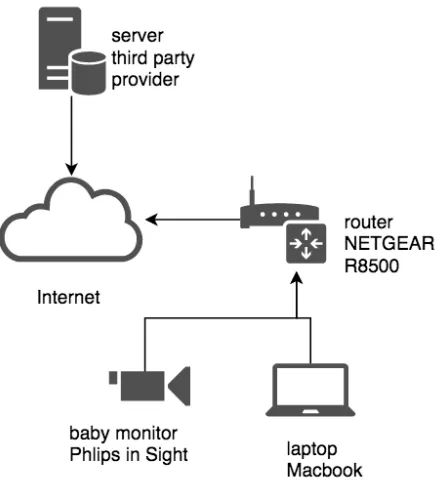
for use by engineers. The analysis of the system will be done by creating UML model instances of the IoT system shown in Fig. 2.
The scenario follows a young couple with a newborn baby. To monitor the baby’s activity the couple installs a baby monitor that can be accessed from the Internet. The system is composed of a baby monitor that functions as a camera, the Philips in Sight B120/37 and Macbook laptop. The two devices have access to the Internet through a NETGEAR R8500 router. The baby monitor can be accessed outside of the local network through a third party service. The scenario is similar to commonly deployed IoT systems found in domestic environments. A user buys the IoT equipment, installs it in his home and controls it using a third party application. The processing or authentication is being performed by a third party application on its servers, so in reality, it is a decentralized network. Since the processing is taking place on the Cloud, the IoT system requires an Internet connection in order to function properly.
The hardware components of the network are the following: (1) baby monitor, (2) router, (3) laptop, (4) web server. The laptop can be used to view the camera feed from inside the local network. To access the camera feed from outside the network a user must access the camera through the third party web server. The web server is outside the private network of the application and has to be accessed using an Internet connection, while the baby monitor, router and laptop are connected to the same Local network of the user. In Fig. 2 the network layout of the IoT system is shown.
For our example, the stakeholders of the IoT system provide us with the following security requirements:
SR1 Camera feed from the baby monitor should only be accessible by authorized users.
SR2 Devices of the smart home should be physically protected.
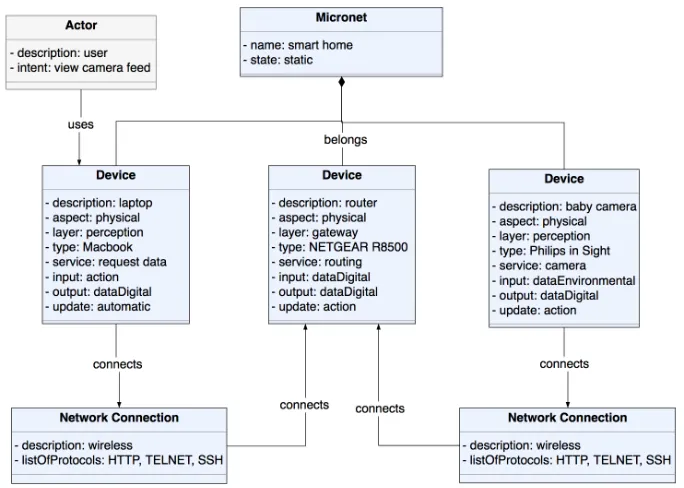
In order to group together Devices with specific functionality the concept of Micronet is used. The smart home under analysis has one Micronet. The Devices of the Micronet are the baby monitor, the laptop, and the router. During our security analysis, we make the assumption that the Devices in the Micronet will remain connected to the same network domain. To represent that assumption the Micronet has the property ofstate: static. The web server that enables users to access the baby from outside the smart home’s local network is part of the Net. Because we cannot configure the security of the web server and have limited information about it, we represent the web server as an Unknown Node. The Unknown Node is connected to the Net. In Fig. 3 we show the view of the high-level components of the IoT system.
Fig. 3.Network and Social constructs of the IoT system
We identify the following Assets of IoT system:
A1 camera feed of the baby monitor.
A2 credentials to remotely access the smarts home’s router.
The security analysis will be performed on the Micronet of the smart home. We ex-press the components of the smart home using the Network and Social modules of the metamodel as shown in Fig. 3. The smart home Micronet is composed of three Devices. The Devices are a laptop, a baby monitor, and a router. The router provides the Micronet with wireless connectivity, so each Device can communicate using a wireless medium. For the purposes of the example, the only supported network protocols would be HTTP, Telnet, and SSH. We represent a legitimate user with the intent of viewing the camera feed as an Actor.
Due to the paper’s size limitations, instead of using a single model for our analysis, we will create a separate model for each Asset. Normally, the analysis is performed in the same model.
A1: camera feed of the baby monitor. To satisfy SR1 we specify an authorization Con-straint on the users. The baby monitor is a Philips in Sight B120/37. The Asset that we want to protect is the Data that is being transmitted by the baby monitor. By performing a vulnerability search of that model we identify a direct browsing vulnerability, CVE-2015-28841. The remote viewing stream is created by a proxy connection to the camera’s internal web service via the cloud provider and is bound to a public hostname and port number without credentials. The attacker can locate the hostname and port number and access the camera feed. To mitigate the vulnerability we could create a rule to whitelist the allowed users. The intent of the Malicious Actor is toview the camera feed. The model of the security analysis is shown in Fig. 4.
Fig. 4.Threat modeling of A1
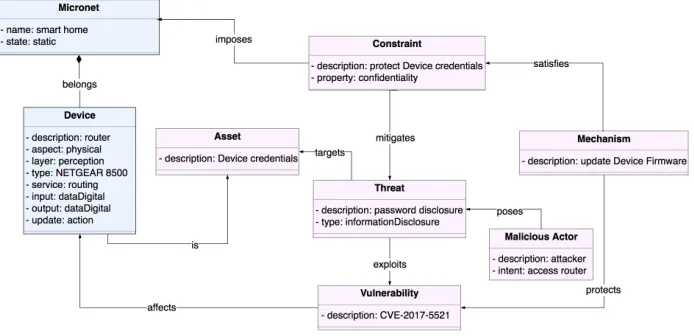
A2: credentials to remotely access the smarts home’s router. The router is a Device that belongs to the gateway IoT layer. It acts as the bridge between the local network of the smart home and the remaining of the Internet. If the router is compromised then an
1
attacker can access the camera feed of the baby monitor. To satisfy SR1 the router’s cre-dential must be protected. The router’s model is NETGEAR R8500. Those models have a password disclosure Vulnerability, the CVE-2017-55212. When trying to access the web panel, a user is asked to authenticate; if the authentication is canceled and password recovery is not enabled, the user is redirected to a page that exposes a password recov-ery token. To mitigate the CVE-2017-5521, the proposed Mechanism is to update the firmware of the Device. The router has the propertyupdate: action, meaning that a user has to manually apply the update as shown in Fig. 5. The intent of the Malicious Actor, in this case, is toaccess the router.
Fig. 5.Threat modeling of A2
A3: physical aspect of the smart home’s Devices. In Fig. 6, the Assets are the physical aspect of the Devices of the smart home. Protecting those Assets is the SR2. The security issue is that an attacker can physically access the Devices of the system. Physical access allows an attacker a variety of attacks such as installing rootkits, backdoors, stealing data and physically damaging the Devices. The Threat is the physical tamperingof the de-vices and the Vulnerability it exploits is that the dede-vices arephysically accessibleby an attacker. The Security Constraint that mitigates the Threat is that thedevices of the system should be physically protected. The proposed Security Constraint satisfies the SR2 and it is implemented by the Mechanism ofphysically secure access to the devices. The idea is that the system’s devices will be placed in a secure location that an attacker will not have access to. The Threat ofphysical tamperingis manifested by the Malicious Actor with the intention of stealing the Devices.
The Constraints from Fig. 4, Fig. 5 and Fig. 6 may be used to develop a security pol-icy that each device in the Micronet must follow. Each component in the smart home’s Micronet must adhere by the security policy imposed by the Constraints of the system.
2
Fig. 6.Threat modeling of A3
If the stakeholders introduce a new Device in the smart home, Constraints in Fig. 7 must be enforced in order for the system to be secure. For example, one of the enforced Con-straints is to ensure the protection of the physical aspect of the Devices. When Devices are introduced in the Micronet they must be physically protected.
In Table. 1 a presentation of the security concepts that were used, showing the Con-straints, Mechanisms, Threats, Vulnerabilities, and Assets is presented.
Fig. 7.Security policy of smart home
Table 1.Presentation of security concepts of smart home
Asset
camera feed Device credentials Device physical aspect
Constraint
secure camera feed password disclosure Device physical protection
Threat
direct browsing protect Device credentials physical tampering
Mechanism
whitelist authorised users update Device Firmware physically secure access
Vulnerability
CVE-2015-2884 CVE-2017-5521 physically secure access
Information encoded in a model can be used to deduce security issues that would not be otherwise apparent to a security engineer. The conceptDatahas the attribute of
a device can receive security updates, we introduce theupdateattribute in the concept of
Device. Certain devices will not be able to receive any security update and as such will be vulnerable. If a device has the value offalsein theupdateattribute it can be considered compromised in the context of security analysis.
The concept ofNetwork Connectionhas the attribute oftype, which is used to repre-sent whether the connection between two Devices is wireless or wired. In the majority of cases, a wired connection is more secure than a wireless one since it is less prone to spoof-ing attacks. Wired connections also have a longer transmission range than wireless ones. Depending on thetypea security engineer can propose different security mechanisms. For example, wireless connections, even short range ones, require encryption mechanisms to protect against replay attacks. Consider the case where an implanted heart defibrillator communicates without any encryption to external devices. Any attacker will be able to control it with fatal consequences. The other attribute of theNetwork Connectionis the
supportedProtocolswhich holds an array of the supported networks of the connection. In the presented example of the smart home, the supported network protocols were the HTTP, TELNET, and SSH. HTTP and TELNET are unencrypted protocols that are sub-ject to a variety of attacks, most commonly spoofing attacks. On the other hand, SSH is a more secure protocol since it supports encryption by default. The knowledge of which network protocols are used between devices is helpful to a security engineer in a number of ways. For example, the NFC (Near Field Communication) has a range of 10cm. In order for spoofing attacks to be successful, an attacker has to be in close proximity to the target.
A design choice that may be considered a limitation is that security analysis can only be made on components that are consideredassets. The general consensus in security en-gineering is that “a system is as strong as its weakest link”, and in the case of APPARATUS it can be argued that a system can be compromised by a component that is not considered an asset. One of the definitions ofAssetin APPARATUSis that:(3) may act as a stepping stone to further attacks. If a component can be used to compromise an IoT system, it is considered anAssetand as such has to be secured.
5.
Conclusion
Given the dynamic nature of IoT systems and their vast applications, it is expected that their security specifications will differ from system to system. In the present paper, a con-ceptual model to express IoT system for security analysis was proposed. The concon-ceptual model is used to create models to reason about security in IoT systems from a system’s hardware architectural point of view. It consists of different modules, with each module extending its security analysis capabilities when needed. The core module, callednetwork
module, is used to map an IoT system in a similar manner to a computer network, by ex-pressing its hardware architecture as a cluster of nodes in a network. In order to model users and stakeholders, thesocialmodule was proposed, that extends the core network module. Security concepts that allow security analysis were introduced in thesecurity
To demonstrate how the concepts of the proposed metamodel can be used to model an IoT system, we perform a security analysis in a smart home. The smart home was composed of a baby monitor, a laptop, and a router. The smart home was modeled using the metamodel’s concepts, with the smart home’s network diagram as a basis. Based on the security requirements of the smart home’s stakeholders, we identified three threats that impact the assets of the smart home. Based on the threats and the information of the model instance, we identified specific vulnerabilities that exist in the system. We proposed mechanisms to mitigate the vulnerabilities along with security constraints on the system to further secure it. The identified security constraints were used to create a security policy that was imposed on the system.
Future work aims to extend the metamodel with additional modules to enable other types analysis. Currently, we are planning on introducing two modules. One such module is theeventmodule, that will introduce concepts more akin to event driven system secu-rity to facilitate dynamic secusecu-rity analysis. Whereas another module will be the privacy module, which will introduce privacy related concepts. Privacy in any context is not taken into account in the current metamodel.
The metamodel is supported by a software application [30] namedASTothat facilitates the security analysis of IoT systems. The application is hosted on Github under the MIT license. It is based on Electron [13] and Cytoscape.js [10].
References
1. Al-Fuqaha, A., Guizani, M., Mohammadi, M., Aledhari, M., Ayyash, M.: Internet of things: A survey on enabling technologies, protocols, and applications. IEEE Communications Surveys & Tutorials 17(4), 2347–2376 (2015)
2. Alqassem, I.: Privacy and security requirements framework for the internet of things (iot). Companion Proceedings of the 36th International Conference on Software Engineering - ICSE Companion 2014 pp. 739–741 (2014)
3. Andress, J.: The basics of information security: Understanding the fundamentals of Infosec in theory and practice. Syngress Media,U.S., United States (2014)
4. Atzori, L., Iera, A., Morabito, G.: The internet of things: A survey. Computer Networks 54(15), 2787–2805 (2010)
5. Babar, S., Stango, A., Prasad, N., Sen, J., Prasad, R.: Proposed embedded security framework for internet of things (iot). 2011 2nd International Conference on Wireless Communication, Vehicular Technology, Information Theory and Aerospace & Electronic Systems Technology (Wireless VITAE) pp. 1–5 (2011)
6. Benabdessalem, R., Hamdi, M., Kim, T.H.: A survey on security models, techniques, and tools for the internet of things. 2014 7th International Conference on Advanced Software Engineer-ing and Its Applications (2014)
7. Coles, E.S.: Analyzing and specifying security requirements in early stages of software devel-opment life cycle. Journal of Mobile, Embedded and Distributed Systems 7(2), 87–94 (2015) 8. Díaz, M., Martín, C., Rubio, B.: State-of-the-art, challenges, and open issues in the integration
of internet of things and cloud computing. Journal of Network and Computer Applications 67, 99–117 (2016)
9. Du, J., Chao, S.: A study of information security for m2m of iot. 2010 3rd International Con-ference on Advanced Computer Theory and Engineering(ICACTE) (2010)
11. Ge, M., Kim, D.S.: A framework for modeling and assessing security of the internet of things. In: 2015 IEEE 21st International Conference on Parallel and Distributed Systems (ICPADS). pp. 776 – 781. Institute of Electrical & Electronics Engineers (IEEE), Melbourne, VIC (2015) 12. Giorgini, P., Mouratidis, H.: Secure tropos: A security-oriented extension of the tropos
method-ology. International Journal of Software Engineering and Knowledge Engineering 17(02), 285– 309 (2011)
13. GitHub Inc: electron.http://electron.atom.io/(2015)
14. Granjal, J., Monteiro, E., Silva, J.S.: Security for the internet of things: A survey of existing protocols and open research issues. IEEE Communications Surveys & Tutorials 17(3), 1294– 1312 (2015)
15. Gürgens, S., Rudolph, C., Maña, A., Nadjm-Tehrani, S.: Security engineering for embedded systems. Proceedings of the International Workshop on Security and Dependability for Re-source Constrained Embedded Systems - S&D4RCES ’10 (2010)
16. Haley, C., Laney, R., Moffett, J., Nuseibeh, B.: Security requirements engineering: A frame-work for representation and analysis. IEEE Transactions on Software Engineering 34(1), 133– 153 (2008)
17. Ikram, A., Anjum, A., Hill, R., Antonopoulos, N., Liu, L., Sotiriadis, S.: Approaching the internet of things (iot): a modelling, analysis and abstraction framework. Concurrency and Computation: Practice and Experience 27(8), 1966–1984 (2015)
18. Irshad, M.: A systematic review of information security frameworks in the internet of things (iot). 2016 IEEE 18th International Conference on High Performance Computing and Commu-nications; IEEE 14th International Conference on Smart City; IEEE 2nd International Confer-ence on Data SciConfer-ence and Systems (HPCC/SmartCity/DSS) (2016)
19. ITU: Global standards initiative on internet of things recommendation itu-t y.2060 (2012), http://handle.itu.int/11.1002/1000/11559
20. Jing, Q., Vasilakos, A.V., Wan, J., Lu, J., Qiu, D.: Security of the internet of things: Perspectives and challenges. Wireless Networks 20(8), 2481–2501 (2014)
21. Kasnesis, P., Toumanidis, L., Kogias, D., Patrikakis, C.Z., Venieris, I.S.: Assist: An agent-based siot simulator. In: Internet of Things (WF-IoT), 2016 IEEE 3rd World Forum on. pp. 353–358. IEEE (2016)
22. Kindervag, J.: No more chewy centers: Introducing the zero trust model of information security. Forrester Research (2010)
23. Krco, S., Pokric, B., Carrez, F.: Designing iot architecture(s): A european perspective. In: 2014 IEEE World Forum on Internet of Things (WF-IoT). pp. 79 – 84. Institute of Electrical & Electronics Engineers (IEEE), Seoul (2014)
24. Kumar, S.A., Vealey, T., Srivastava, H.: Security in internet of things: Challenges, solutions and future directions. 2016 49th Hawaii International Conference on System Sciences (HICSS) pp. 5772–5781 (01 2016)
25. Kurose, J.F., Ross, K.W.: Computer networking: A top-down approach. Addison-Wesley Edu-cational Publishers, Boston, 6 edn. (2012)
26. Laghari, S., Niazi, M.A.: Modeling the internet of things, self-organizing and other complex adaptive communication networks: a cognitive agent-based computing approach. PloS one 11(1), e0146760 (2016)
27. Liu, J., Xiao, Y., Chen, C.P.: Authentication and access control in the internet of things. In: 2012 32nd International Conference on Distributed Computing Systems Workshops. pp. 588– 592. Institute of Electrical & Electronics Engineers (IEEE), Macau (2012)
28. Lu, T., Neng, W.: In: Future internet: The Internet of things. vol. 5, pp. 376–5. IEEE, Chengdu (2010)
29. Madhura, Jain, P., Ranjith, Bilurkar, N.: A survey on internet of things: Security and privacy issues. IJITR 3(3), 2069–2074 (2015)
31. Mavropoulos, O., Mouratidis, H., Fish, A., Panaousis, E., Kalloniatis, C.: Apparatus: Reason-ing about security requirements in the internet of thReason-ings. Advanced Information Systems Engi-neering Workshops 249, 219–230 (2016)
32. Miao, W., Ting-lie, L., Fei-Yang, L., Ling, S., Hui-Ying, D.: Research on the architecture of internet of things. vol. 5, pp. 484–5. IEEE, Chengdu (2010)
33. Mouratidis, H., Argyropoulos, N., Shei, S.: Security requirements engineering for cloud com-puting: The secure tropos approach. Domain-Specific Conceptual Modeling pp. 357–380 (2016)
34. Rahman, A.F.A., Daud, M., Mohamad, M.Z.: Securing sensor to cloud ecosystem using internet of things (iot) security framework. Proceedings of the International Conference on Internet of things and Cloud Computing - ICC ’16 79(79), 1–5 (2016)
35. Roman, R., Najera, P., Lopez, J.: Securing the internet of things. Computer 44(9), 51–58 (09 2011)
36. Roy, S., Manoj, B.S.: Iot enablers and their security and privacy issues. Modeling and Opti-mization in Science and Technologies 8(8), 449–482 (2016)
37. Sadeghi, A.R., Wachsmann, C., Waidner, M.: Security and privacy challenges in industrial internet of things. Proceedings of the 52nd Annual Design Automation Conference on - DAC ’15 54(54), 1–6 (2015)
38. Shostack, A.: Threat modeling: Designing for security. John Wiley & Sons, Indianapolis, IN (2014)
39. Stojmenovic, I., Wen, S., Huang, X., Luan, H.: An overview of fog computing and its security issues. Concurrency and Computation: Practice and Experience 28(10), 2991–3005 (2015) 40. Suo, H., Wan, J., Zou, C., Liu, J.: Security in the internet of things: A review. In: 2012
Interna-tional Conference on Computer Science and Electronics Engineering. pp. 648 – 651. Institute of Electrical & Electronics Engineers (IEEE), Hangzhou (2012)
41. Tian, B., xian Yang, Y., Li, D., Li, Q., Xin, Y.: A security framework for wireless sensor net-works. The Journal of China Universities of Posts and Telecommunications 17(2), 118–122 (2010)
42. Vasilevskiy, A., Morin, B., Haugen, O., Evensen, P.: Agile development of home automation system with thingml. In: 2016 IEEE 14th International Conference on Industrial Informatics (INDIN) (2016)
43. Weiser, M.: The computer for the 21st century. Scientific American 265(3), 94–104 (1991) 44. Yang, Z., Yue, Y., Yang, Y., Peng, Y., Wang, X., Liu, W.: Study and application on the
architec-ture and key technologies for iot. In: 2011 International Conference on Multimedia Technology. pp. 747 – 751. Institute of Electrical & Electronics Engineers (IEEE), Hangzhou (2011)
Orestis Mavropoulosis a PhD candidate at SenSe Research Cluster at the University of Brighton. He holds a diploma in Electronic Engineering from Piraeus University of Applied Sciences. He received his MSc in Network and Computer System Security from the University of Greenwich with Honors and top of his class. From 2005 to 2007 he was employed as a network engineer to develop network monitoring software. From 2007 until 2014 he worked as an independent network security consultant for a number of companies. From 2016 he develops and teaches the Network Security Lab sessions of the University of Brighton Information Security MSc Degree. His research is focused on developing a framework for security analysis of Internet of Things systems. Currently, he is working on software aided security analysis of socio-technical IoT systems.
B.Eng. (Hons) from the University of Wales, Swansea (UK), and an M.Sc. and Ph.D. from the University of Sheffield (UK). He is also Fellow of the Higher Education Academy (HEA) and Professional Member of the British Computer Society (BCS). Haris has been a visiting researcher at the National Institute of Informatics (NII), Japan, and a visiting fellow at the British Telecom (BT), U.K and the University College London, U.K. He is a visiting professor at the University of the Aegean, Greece. His research interests lie in the area of secure software systems engineering, requirements engineering, and information systems development. He is interested in developing methodologies, modeling languages, ontologies, tools and platforms to support the analysis, design, monitoring of security, privacy, risk and trust for large-scale complex software systems. He has published more than 130 papers (h-index 22) and he has secured funding as Principal Investigator from national (Engineering and Physical Sciences Research Council (EPSRC), Royal Academy of Engineering, Technology Strategy Board (TSB)) and international (EU, NII) funding bodies as well as industrial funding (British Telecom, ELC, Powerchex, FORD) towards his research. His “Powerchex KTP” project was finalist for the best 2012 UK National Knowledge Transfer Partnership TSB award. He has acted as an evaluator for national and international funding bodies (e.g. EPSRC, HEA, and EU) and invited subject expert for organisations (e.g. TSB, NATO). He is a member of the ERCIM Security and Trust Management Working Group and of the IFIP Working Group 8.1: Design and Evaluation of Information Systems. He is on the editorial boards of the Requirements Engineering Journal and the International Journal of Information System Modeling and Design and he has been involved in the organization of various events related to his research interests. He was the General co-Chair of CAiSE’14.
Dr. Andrew Fishis a Reader in Mathematics and Computing. He has wide-ranging in-terests rooted in mathematics and computer science but with developing connections in engineering and to the arts. His primary focus has been centred on a visual representation theme, which also facilitates connections between areas. Research interests have included combinatorial knot theory, set-based information visualisation, and visual languages, log-ics and interfaces. Dr. Fish’s personal mission is to amplify research quality and impact by interacting with and connecting diverse research avenues, researchers and industry.
Dr. Fish co-leads the Mathematics research group, with responsibilities including dis-crete mathematics and its applications. This research group’s vision includes bringing to-gether a broad range of mathematical and statistical avenues which provide a fundamental basis for real world applications.
of Science, Engineering and Computing, Kingston University, London, UK (Aug ’12 – Jan ’13).
He received the BSc degree in Informatics and Telecommunications from National and Kapodistrian University of Athens, Athens (which is ranked internationally within the 201-250 top universities in Computer Science and Information Systems), Greece, in 2006, the MSc degree in Computer Science from the Department of Informatics of the Athens University of Economics and Business, Athens, Greece in 2008 and the PhD degree in Mobile Communications Security from Kingston University, London, UK in 2012.
Dr. Christos Kalliniatisholds a Ph.D. from the Department of Cultural Technology and Communication of the University of the Aegean and a master degree in Computer Science from the University of Essex, UK. Currently, he is an assistant professor in the Depart-ment of Cultural Technology and Communication of the University of the Aegean. He is also a deputy member of the board of the Hellenic Authority for Communication Security and Privacy. His main research interests are the elicitation, analysis and modeling of secu-rity and privacy requirements in traditional and cloud-based systems, Privacy Enhancing Technologies and the design of Information System Security and Privacy in Cultural In-formatics. He is an author of several refereed papers in international scientific journals and conferences and has served as a visiting professor in many European Institutions. Prior to his academic career, he has served at various places on the Greek public sector including the North Aegean Region and Ministry of Interior, Decentraliastion and e-Governance. He is a lead-member of the Cultural Informatics research group as well as the privacy requirements research group in the Department of Cultural Technology and Communica-tion of the University of the Aegean and has a close collaboraCommunica-tion with the Laboratory of Information & Communication Systems Security of the University of the Aegean. He has served as a member of various development and research projects. He lives in Mitilini, the capital of Lesvos island along with his wife Liana and his daughter Elpiniki.