Cross-layer Design and Optimization Techniques in
Wireless Multimedia Sensor Networks for Smart Cities
?Hasan Ali Khattak1, Zoobia Ameer2, Ikram Ud Din3, and Muhammad Khurram Khan*4
1 COMSATS University Islamabad, 44550 Islamabad, Pakistan.
2
Shaheed Benazir Bhutto Women University Peshawar, 25500 Peshawar, Pakistan. [email protected]
3
Department of Information Technology, The University of Haripur, Haripur 22620, Pakistan. [email protected]
4
Center of Excellence in Information Assurance (CoEIA), King Saud University, Riyadh 11451, Kingdom of Saudi Arabia.
Abstract. The future smart cities vision can be developed through leveraging the potentials of Internet of Things (IoT) and wireless sensor network (WSN) technolo-gies. WSN is a resource constrained network where network nodes are tiny devices that are run on battery power. Diverse types of applications such as environmen-tal and habitual monitoring, detection, and tracking, use WSNs. The invention of new network protocols, the establishment of new models for communications, and testing the available solutions in real world environment are some of the current research issues in WSNs. Main challenges in such networks include energy conser-vation in an efficient way, dealing with variable channel capacity, and the resource constrained nature of such networks. The design of architecture for such networks has a vital role in solving the issues to some extent, i.e., the cross layer design ap-proach is an architectural technique that offers the interaction of different layers to-gether to enhance the performance, minimize the energy consumption, enhance the network life time, and provide Quality of Service (QoS) in real time communica-tions. These are some of the current areas where cross-layer design approaches are being used. This paper presents different types of cross-layer design techniques in wireless multimedia sensor networks. Using such architectural techniques, different state of the art cross-layer optimization approaches are discussed while giving the reader an insight on prominent challenges and issues along with future directions.
Keywords:Optimization, Multimedia, Wireless Sensor Networks, Smart Cities, In-ternet of Things.
1.
Introduction
Wireless Sensor Networks (WSNs) include a large number of low-power devices nor-mally known as sensor nodes. Sensor devices are resource-constraint nodes with respect to computational power, storage capacity, energy, bandwidth, and communication range [26]. Depending on the application scenario, sensor nodes are either precisely placed in the area of interest (e.g., structure monitoring of a building) or randomly deployed in the
field (e.g., environmental monitoring). Furthermore, these nodes are responsible for the sensing parameter of interest and/or detect an event from their environment and report it to a base station that is often called sink node or gateway node. The sink is more resourceful node compared to other nodes in the WSN.
Recent advancement in the sensor technology and micro-miniaturization has enabled the emergence of a more specialized field of WSN that is known as Wireless Multime-dia Sensor Network (WMSN), which has applications in various domains in futuristic smart cities such as health-care monitoring [27], home automation [16], transportation & vehicular networks [18,11]. In WMSN, sensor nodes are equipped with audio and video capturing devices, such as microphones and inexpensive CMOS cameras. Sensor nodes are also responsible for capturing and delivering multimedia content, such as (a) audio, (b) video, and (c) still images to the gateway node [2]. Some applications of the WMSN are surveillance [10,16], traffic management [29,36], health-care services [2,19], environ-mental monitoring [35], and industrial process management [41], as shown in Fig. 1.
The rapid and persistent evolution in tools and technologies along with the explosive growth in the market proliferation of IoT devices has made WSN a ubiquitous medium towards the realization of smart cities [12,13]. WSNs have presented various applications and have given space for developing several services to benefit smart city infrastructures. There have been several issues and challenges which hinder the full scale deployment of the future generation of IoT enabled smart cities [14].
In resource constraint IoT based network infrastructures, for example, WMSN, achiev-ing (a) low frame loss, (b) reduced delay, and (c) better end-to-end video quality are a challenging task. In order to ensure higher quality of service with constrained resources, one has to think out of the box. Traditional smart city design approaches might not be suitable and efficient for taking full benefit from the WMSN. One such approach is the cross-layer design for cross layer optimization, being an optimal approach, which is used not only to improve but also optimize the overall network performance. The cross layer optimization has made it possible for the smart cities research community.
”Cross-layer design techniques with regards to the reference layered model is the de-sign of protocols, architectures, or algorithms, that not only exploit but also offer a set of inter-layer interaction which is a super set of the standard interfaces provided by the overall reference layered architecture” [20]. According to [38], the cross-layer design is a back-and-forth information flow that merges different layers and couples those layers that have no common interface. In contrast to the layered reference model, there are explicit interfaces among layers and some time the concept of shared database. In a layered struc-ture, protocols communicate with adjacent layers via function calls, while a cross-layer design violates such limitations of communications [6].
2.
Cross Layer Design
A great deal of research is being carried out since last few years in the field of wire-less technology to come up with better architectural approaches. Most of these efforts are focused towards reducing strong inter-dependency among layers, which is a typical char-acteristic of the layered architecture. The cross-layer design is an emerging technique for both wireless and wired networks. The theme behind this approach is optimizing the flow of data in such a way that any two or more layers can be crossed for upgrading the com-plete performance of the network [49]. The ultimate goal is to enhance the performance of WMSNs in terms of energy usage, routing, delivery of multimedia contents, and network management.
Depending on the user requirements, two, three, or four layers of the layered architec-ture can be crossed. For example, in order to accomplish in-network processing and better multi-path selection, the application layer and routing layer are combined. Service level differentiation, priority scheduling, and efficient routing techniques are achieved when the routing and MAC layers work together. Moreover, achieving QoS and reliability of multimedia content when multiple routing paths scheme is used, the routing and transport layer contribute in achieving these enhancements [3].
The cross-layer design approach is one of the preposition in this regard that enables the designers to develop protocols which enable communications across layers (in contrast to the layered architecture approach) [15].
3.
Cross Layer Design Techniques
Every layer contributes different functionalities in the protocol stack of WSNs and WM-SNs. Crossing these layers can achieve performance gain in different scenarios. The most common of these performance enhancements are discussed in this section. Energy effi-ciency is a broad category as the nature of WMSN is resource constrained with respect to energy. The ultimate focus of every alike contribution is energy preservation of such networks. Other areas such as QoS and communication reliability along with security are also discussed later in this section.
3.1. Energy Efficiency
run, the energy efficiency is provided for the whole network when the sleep duration is in-creased. Following are related works from the literature that contribute energy efficiency with the use of cross-layer design approaches.
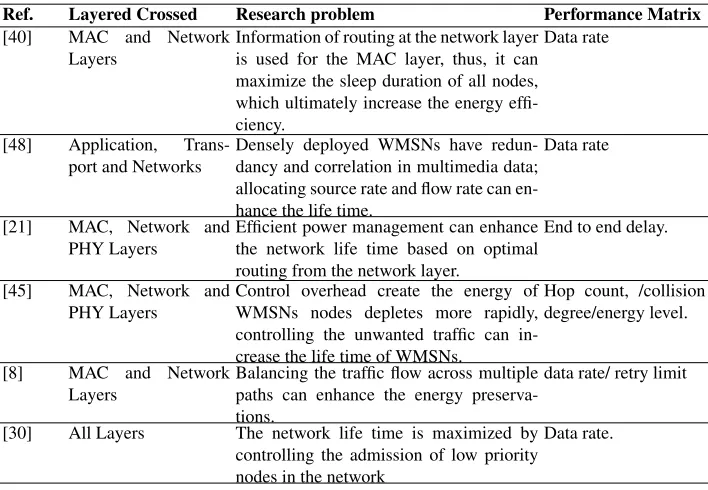
The cross-layer technique, discussed in [48], deals with the life time optimization of WMSNs, where the correlation between sensing data and the redundancy due to overlap regions consume more energy and degrade the life time of the network. Three layers are contributing in the optimization in such a way that the application layer is sharing the global variables, the transport layer is controlling the source rate, and the responsibility of the network layer is to adjust the flow rates on links.
Similarly, Leeet al.[21] address the problem of end to end video delivery in resource constrained sensor networks and life time enhancement. Routing and power allocation are optimized by the cross layer optimization. This is a three step procedure, i.e., first, the physical layer does the energy management by announcing power allocations to upper layers. Second, the network layer performs optimal routing on the basis of channel state and hop count. Third, the MAC layer performs power allocation by finding the optimum power allocation matrix with regards to information from other layers. The data rate and network life time are increased that achieve better end to end video delivery.
Collision Aware Routing Protocol (CARP) [45] uses two parameters, i.e., collision degree and energy level, for routing and rout adjustment rather than traditional hop count. High collision in the network consumes more energy, while the cross layer design avoids high collisions. The energy level is calculated with the help of residual and initial energies. A logical control unit over the network layer attains parameters from the physical and link layers. The more residual energy nodes are chosen based on the parameter value from the physical layer as relay nodes to save the energy. The CARP’s routing metric needs physical layer functions characteristics such as data rate, number of collisions, and state parameters so as to set up an autonomous logical control unit in the network layer that fetches the physical and link layer parameters, and computes the degrees of collision and energy for routing. The control overhead is avoided by using the route metric in the RREP and RREQ packet header.
The cross-layer technique presented in [8] optimizes the energy usage by balancing the traffic flow across multiple paths, thus, the life time of the network is increased. The contributions presented in this work for different layers are as follows: At the routing layer, the multiple paths are used for data transmissions. In addition, when the retry limit of transmissions is over, the MAC layer is controlled for each channel.
The cross-layer optimization design presented in [30] increases the life time of WM-SNs in two stages. In the first one, the number of connected sensor nodes is increased while in the second case, the network life time is increased by controlling the connection of low priority nodes in the network. All layers are involved in this optimization design technique.
3.2. Quality of Service
Table 1.State of the art in Cross Layer Energy Optimization Techniques
Ref. Layered Crossed Research problem Performance Matrix
[40] MAC and Network Layers
Information of routing at the network layer is used for the MAC layer, thus, it can maximize the sleep duration of all nodes, which ultimately increase the energy effi-ciency.
Data rate
[48] Application, Trans-port and Networks
Densely deployed WMSNs have redun-dancy and correlation in multimedia data; allocating source rate and flow rate can en-hance the life time.
Data rate
[21] MAC, Network and PHY Layers
Efficient power management can enhance the network life time based on optimal routing from the network layer.
End to end delay.
[45] MAC, Network and PHY Layers
Control overhead create the energy of WMSNs nodes depletes more rapidly, controlling the unwanted traffic can in-crease the life time of WMSNs.
Hop count, /collision degree/energy level.
[8] MAC and Network Layers
Balancing the traffic flow across multiple paths can enhance the energy preserva-tions.
data rate/ retry limit
[30] All Layers The network life time is maximized by controlling the admission of low priority nodes in the network
Data rate.
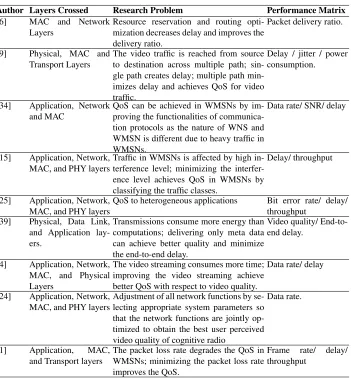
Well-known areas like QoS achievement are discussed, e.g., QoS in terms of resource reservation, video quality, and packet loss etc.
QoS in terms of resource Reservations A model based channel capacity prediction scheme is presented in [50] for providing statistical QoS. The scheme perceives the state of a link from the MAC re-transmission information where statistical channel capacity is calculated when the traffic load is saturated. Based on the proposed model, the QoS rout-ing optimization and resource reservations are carried out. The proposed scheme assigns network resources and forwards packet taking into consideration the interference among flows and state of a link.
The path reservation technique, VSN-Module, is presented in [9]. This protocol is based on UltraWideBand (UWB). The VSN-Module provides the QoS support while the path reservation is done in a distributed manner in the network.
Multi-hop routes are set from source to sink and different parameters such as jitter, end-to-end delay, and bandwidth are satisfied based on flow requirements. The physical layer is integrated with the upper layer functionalities, for example, MAC, network and transport layers. The UWB technology is set at the physical layer while the channel access and transmission parameters are coupled.
The increase in video sources in WMSNs along with the QoS is hard to achieve. Thus, frames are classified by the traffic classifier module and the rout classifier module of the framework selects the appropriate path for each frame delivery. The MAC layer maps frames in access controllers (ACs) according to the priorities and the appropriate trans-mission mode is then chosen by the network layer.
QoS in terms of prioritization of streams The new framework introduced in [15] pro-vides QoS for each stream by prioritizing them. The traffic in WMSNs is classified into six classes. The network is partitioned into hexagonal cells to minimize the interference. A shared database is used for the cross layer design.
A single node supports multiple applications in this framework via reserving some area in the memory. Each application requests for its protocol parameters and a middle-ware is used for the interaction of shared database and applications. The middlemiddle-ware sets suitable parameters at different layers on the basis of network conditions and application requirements from physical channel conditions and MAC layer feedback. Then the appli-cation is informed by the middleware about the status of the network so that its behaviors can be adapted by the applications accordingly.
QoS in terms of application requirements The communication paradigm on the basis of time-hoping impulse radio ultra-wide band technology is presented in [25]. A control unit called cross-layer control unit (XLCU) controls and configures the networking func-tionalities at three layers, i.e., physical, MAC, and network layer. The QoS is provided on the basis of unified logic that takes decisions. These decisions depend on two condi-tions. First is the application requirements at application layer and second is the status of the functional blocks that implement the networking functionalities. Reliability and flexibility are achieved when delivering contents to different types of applications.
QoS in terms of streaming video quality The cross-layer framework in [39] aims to de-liver only the summaries of video instead of the video file over wireless channels. Three layers, i.e., physical, data link, and application are combined in a cross-layer fashion that provide the best quality of video across the WMSN. Each layer optimizes the parameters like coding scheme, adaptive modulation, source coding, and retransmission. Source cod-ing is optimized at the application layer. Similarly, ARQ at the data link layer and other parameters, e.g., adaptive modulation and encoding schemes at the physical layer.
An integrated cross-layer optimization algorithm is presented in [4] for video stream-ing across multi-hop networks [4]. It optimizes different control parameters across the application layer, network layer, MAC layer, and physical layer to provide QoS in multi-path transmission networks using IEEE 802.11a/e. At routing layer, the end-to-end opti-mization is done for path choosing. At MAC layer, the maximum retry limit is set and the modulation scheme is chosen at physical layer.
perceived video quality using cognitive radio. The dynamic channel coding MAC (DCC-MAC) technique is used in this system to allow the concurrent transmissions of distinct pairs of source and destination that reduce the interference among nodes.
A new architecture, called QoS MAC is presented in [46], where different contention windows for application specific QoS requirements are set thereby the traffic is catego-rized on the basis of delay requirements. The proposed MAC scheme efficiently shares channel and contention windows are updated dynamically to set it for different types of categories of traffic in the WMSN.
QoS in terms of packet loss A novel transport layer protocol, i.e., User Datagram Dis-patcher Protocol (UDDP), minimizes packet loss ratio in WMSNs [1]. Information is taken from MAC and Application layers which send number of packets and frame types to the transport layer. Similarly, the MAC layer sends MTU to the transport layer for fragmenting a video frame into a corresponding number of packets.
3.3. Reliable communication
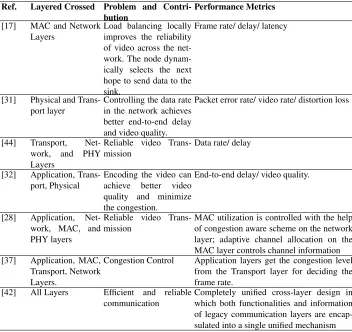
The technique presents two geographic forwarding schemes [17]. These schemes are based on the cross-layer design. The first scheme is called Load Balanced Reliable For-warding (LBRF). The LBRF integrates network and MAC layers for efficient and reliable data delivery in WMSNs. The idea behind this scheme is considering the buffer occu-pancy level information of those sensor nodes that are used as relay nodes. Every sensor reports buffer occupancy conditions of relay sensors by passively monitoring and storing this information.
A sensor is simply piggybacking information to the MAC layer and neighbors store this information for future use by overhearing. Stored buffer occupancy information of candidate nodes is used for dynamic load balancing.
To enhance the video quality of every video stream in WMSNs and maintaining the balance in video quality among video streams, a new rate control strategy is introduced [31]. The end-to-end data rate is controlled through the cross-layer optimization control algorithm, while the strength of the channel coding and video quality at the physical layer. The SNR is calculated along the forward path at the physical layer and the lowest SNR value is recorded in the packet. This information is sent back to the sender after extracting from the packet at the network layer. Thus, the most recent forward path SNR value is used. Congestion is avoided by computing the end-to-end data rate.
The interaction of physical, network, and transport layers is a cross-layer design that dynamically adjusts the transmission radius and data generation rate for energy efficiency [44]. The optimum transmission radius of sensing devices is chosen at the physical layer. Multiple routing paths are discovered at the network layer. The qualified multiple paths are selected at the transport layer and the information creation rate adjustment is carried out at the Physical layer.
Table 2.Cross Layer Optimization for Quality of Service
Author Layers Crossed Research Problem Performance Matrix
[6] MAC and Network Layers
Resource reservation and routing opti-mization decreases delay and improves the delivery ratio.
Packet delivery ratio.
[9] Physical, MAC and Transport Layers
The video traffic is reached from source to destination across multiple path; sin-gle path creates delay; multiple path min-imizes delay and achieves QoS for video traffic.
Delay / jitter / power consumption.
[34] Application, Network and MAC
QoS can be achieved in WMSNs by im-proving the functionalities of communica-tion protocols as the nature of WNS and WMSN is different due to heavy traffic in WMSNs.
Data rate/ SNR/ delay
[15] Application, Network, MAC, and PHY layers
Traffic in WMSNs is affected by high in-terference level; minimizing the interfer-ence level achieves QoS in WMSNs by classifying the traffic classes.
Delay/ throughput
[25] Application, Network, MAC, and PHY layers
QoS to heterogeneous applications Bit error rate/ delay/ throughput
[39] Physical, Data Link, and Application lay-ers.
Transmissions consume more energy than computations; delivering only meta data can achieve better quality and minimize the end-to-end delay.
Video quality/ End-to-end delay.
[4] Application, Network, MAC, and Physical Layers
The video streaming consumes more time; improving the video streaming achieve better QoS with respect to video quality.
Data rate/ delay
[24] Application, Network, MAC, and PHY layers
Adjustment of all network functions by se-lecting appropriate system parameters so that the network functions are jointly op-timized to obtain the best user perceived video quality of cognitive radio
Data rate.
[1] Application, MAC, and Transport layers
The packet loss rate degrades the QoS in WMSNs; minimizing the packet loss rate improves the QoS.
coding is controlled at the application layer. Last, the adaptive parity at the physical layer and the rate is controlled at the transport layer.
A technique [28] where all layers perform some controlling, for example, on the ap-plication layer, optimal routing is achieved by controlling video bit stream and adaptive FEC. The MAC utilization is controlled with the help of congestion aware scheme on the Network layer. The adaptive channel allocation on MAC layer controls channel informa-tion.
Some cross-layer techniques [42] combine all layers into a single one for energy ef-ficiency. The objective of this model is the development of a highly reliable communi-cation, avoiding congestion locally, and adaptability in communication decisions. The design principle is a completely unified cross-layered such that both functionalities and information of legacy communication layers are encapsulated in one particular protocol.
Congestion is always caused by the communications waste and the minimization in energy efficiency. Sensor fUzzy-based Image Transmission (SUIT) is a cross-layer based image transport protocol [37]. Congestion estimation is done based on fuzzy logic that
Table 3.Cross Layer Optimization for Communication Reliability
Ref. Layered Crossed Problem and Contri-bution
Performance Metrics
[17] MAC and Network Layers
Load balancing locally improves the reliability of video across the net-work. The node dynam-ically selects the next hope to send data to the sink.
Frame rate/ delay/ latency
[31] Physical and Trans-port layer
Controlling the data rate in the network achieves better end-to-end delay and video quality.
Packet error rate/ video rate/ distortion loss
[44] Transport, Net-work, and PHY Layers
Reliable video Trans-mission
Data rate/ delay
[32] Application, Trans-port, Physical
Encoding the video can achieve better video quality and minimize the congestion.
End-to-end delay/ video quality.
[28] Application, Net-work, MAC, and PHY layers
Reliable video Trans-mission
MAC utilization is controlled with the help of congestion aware scheme on the network layer; adaptive channel allocation on the MAC layer controls channel information [37] Application, MAC,
Transport, Network Layers.
Congestion Control Application layers get the congestion level from the Transport layer for deciding the frame rate.
[42] All Layers Efficient and reliable communication
decreases the image quality on the fly, which can mitigate the congestion. The idea behind this is to drop some packets of frames that lower the quality but with acceptability. The application layer receives the congestion level from the transport layer while determining the frame rate. A table is generated by the MAC layer that caches the neighbors’ buffer occupancy by piggybacking the completeness of the transport layer’s buffer into every outgoing packet. The transport layer uses the elements of this table during the fuzzy logic-based congestion estimation. Moreover, at the time of congestion estimation, the transport layer invites the ID of the next hop sensing device from the network layer.
3.4. Security
Security is always the main concern of WSNs and WMSNs. For securing the communi-cation among wireless sensor nodes, the algorithm is based on the information taken from the application layer wherein this information will trigger the algorithm of the provided solution [5], which is a routing algorithm at the network layer. Event notification message is broadcasted by a node that would probably be under attack in some time. The closer nodes will receive a lot of messages, which means that the node is closer with which the incident is going to happen. The counter for that event messages will be used to locate the node in the neighborhood of any node. The algorithm running on the network layer is based on an assumption that there is one or more backup receivers associated with the sink. In this case, the distance is calculated by Euclidean distance formula. Once it is de-tected that a receiver is under attack, information from the application layer is forwarded and the secondary sink is selected as a receiver. The proposed cross-layer optimization approach [43] is to secure the delivery of images via wireless channels. The parameters– BER, ARQ retry limit, and transmission rate are optimized across the three layers (i.e., PHY, MAC, and APP).
An Efficient Dynamic Selective Encryption Framework (EDES) to ensure security of multimedia traffic in WMSNs is proposed in [33]. Among three security levels, the selection depends upon the energy and QoS parameters, and for the EDES, a cross-layer approach is used to take different parameters from physical, MAC, and upper layers. The capacity metric is used for the evaluation to increase or decrease the level of security. The EDES is a two-step framework wherein in the first step, network performance parameters are assessed by combining the QoS parameters and residual energy to capacity function CAP. This needs parameters from the MAC, network, and upper layers. The second step selects the security level based on CAP.
3.5. Error Correction
3.6. Network Resource Management
A cross-layer optimization across three layers, i.e., physical, link, and application layer, manages network resources [7]. This new approach is adapted for the Direct Sequence Code Division Multiple Access (DS-CDMA) using visual sensor networks. Source coding rate, channel coding rate, and power level are also assigned simultaneously to all nodes in the network. The network resources can be optimally allocated to nodes based on two criteria that maximize the video quality of the network as follows:
– Minimize the average end-to-end distortion among nodes.
– Minimize the maximum distortion of the network.
Based on the node density and video quality, the capacity of the WMSNs can be deter-mined to allocate resources.
4.
Challenges of Cross-layer Design
Cross-layer design approaches though present much needed improvements to the network and improve the overall Qos. However, some studies have suggested that these techniques
Table 4.Cross Layer Optimization for Security Provision
Ref. Layers Crossed Research Problem Performance Metrics
[5] Application and Net-work Layers
Event notification message is broadcast by a node that would probably be under attack in some time. The more closer nodes will receive a lot of messages which means that the node is closer on which the incident is going to happen
Radio range
[43] Physical, MAC, and Application layer
The images traveling across the network need to be secured.
Retry limit/ transmis-sion rate/ frame length [33] MAC, Network,
Transport, and Appli-cation
Defining the security level for different scenarios can enhance the energy effi-ciency as well as QoS.
Residual energy/ ca-pacity function
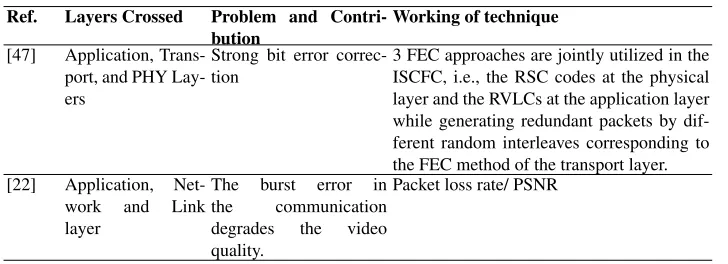
Table 5.Cross Layer Optimization for Error Corrections
Ref. Layers Crossed Problem and Contri-bution
Working of technique
[47] Application, Trans-port, and PHY Lay-ers
Strong bit error correc-tion
3 FEC approaches are jointly utilized in the ISCFC, i.e., the RSC codes at the physical layer and the RVLCs at the application layer while generating redundant packets by dif-ferent random interleaves corresponding to the FEC method of the transport layer. [22] Application,
Net-work and Link layer
The burst error in the communication degrades the video quality.
violate strong dependencies in layered approaches. Such dependencies have significant role to play once we consider the abstraction and seamless integration they provide. Thus, there are several inherited challenges of wireless technology for multimedia sensor net-works.The new challenges for cross-layer approaches make it a difficult task for the de-signers and developers alike.
While achieving the cross-layer design in order to optimize the overall interactions, the TCP/IP layered architecture is dismantled. This not only disturbs the encapsulation mechanism of a well structured model but also makes it rather difficult to make further improvements in the well structured and planned TCP/IP reference model. In the event of a modification, we must consider almost all layers that are interacting. This might be the most significant issue with the cross-layer design.
One of the prominent challenges is the unavailability of a uniform cross-layer design. There have been many designs proposed but what lacks is a unified approach. This is due to the fact that these designs are normally modelled for specific problems and therefore not easy to have two different designs which can achieve the desired goals. One solution for this problem is to minimize the interactions between cross-layers as much as possible. This way, multiple cross-layer designs may co-exist through a proper standardization.
Generally, cross-layer design tends to resolve a specific issue or target a particular sce-nario such as video surveillance or vehicular infotainment system. Rather than providing a uniform approach for all situations, it improves only specific aspects of the communi-cation. For example, in vehicular networks, infotainment system requires a lower TCP retry value but in case of text based transmission regarding vehicle’s situations, we may require a longer TCP retry value to cope with fragmented or bad networks. Developing a universal cross-layer design is also a significant open research issue. One approach with finding common schemes in various designs can be a good approach towards modeling a uniform design. In case of vehicular networks, we may need to find common grounds in video streaming designs and finally come up with a design which has advantages of each of these designs.
5.
Conclusion and Future Directions
Future smart urban spaces are realized through a lot of IoT and WSN applications requir-ing millions of sensors to work together. These sensor nodes generate a large amount of data. Among these applications, a prominent one is where sensors are deployed for captur-ing multimedia data such as for video surveillance, patient health monitorcaptur-ing, and traffic management to name a few. In order to have an optimal network throughput, cross-layer design techniques have posed promising results.
Table 6.Cross Layer Optimization for Network Resource Management
Ref. Layers Crossed Problem and Contribution Working of tech-nique
[7] Application, Link, and Physical Layers
Proper resource management in WMSNs can receive a better video quality.
In this paper, we have discussed in detail various cross-layer optimization techniques for Multimedia Wireless Sensor Networks (WMSN) on different layers. WMSNs present one of the promising applications for the IoT in Smart Cities. Though similar to generic WSN applications, WMSN leverages the underlying infrastructure to communicate au-dio visual feedback from a certain environment. Thus, enabling various applications and services in smart cities such as high definition surveillance, traffic control and manage-ment, health-care diagnosis and efficient drug delivery, industrial and building automa-tion, surveillance and monitoring to name a few.
Multimedia applications tend to put a considerable burden over the WMSN. This kind of network load can be optimized through several cross-layer optimization techniques. In this paper, we have put forward several such techniques which not only improve the overall interactions but also improve the Quality of Service (QoS). Similarly, we consider that along with the cross-layer optimization, WMSNs also require raw data in-network processing. In future work, we intend to extend the work by developing a test-bed using state of the art Technologies. One of the important future directions would be to fully test the cross-layer optimization techniques through proper testing it under controlled experiments.
Acknowledgments.Authors extend their appreciation to the Deanship of Scientific Research at King Saud University for funding this work through research group no (RG-1439-58)
References
1. Aghdam, S.M., Khansari, M., Rabiee, H.R., Salehi, M.: UDDP: A user datagram dispatcher protocol for wireless multimedia sensor networks. 2012 IEEE Consumer Communications and Networking Conference, CCNC’2012 pp. 765–770 (2012)
2. Akyildiz, I.F., Melodia, T., Chowdhury, K.R.: A survey on wireless multimedia sensor net-works. Computer Networks 51(4), 921–960 (2007)
3. Almalkawi, I.T., Zapata, M.G., Al-Karaki, J.N., Morillo-Pozo, J.: Wireless multimedia sensor networks: Current trends and future directions. Sensors 10(7), 6662–6717 (2010)
4. Andreopoulos, Y., Mastronarde, N., Van Der Schaar, M.: Cross-Layer Optimized Video Streaming Over Wireless Multihop Mesh Networks. IEEE Journal on Selected Areas in Com-munications 24(11), 2104–2115 (2006), http://ieeexplore.ieee.org/lpdocs/ epic03/wrapper.htm?arnumber=1717624
5. Approach, C.l., Faghani, M.R., Nguyen, U.T.: Incident-Driven Routing in Wireless Sensor. Computing pp. 402–406 (2011)
6. Aune, F.: Cross-Layer Design Tutorial. Norwegian University of Science and Technology, p. 35 pp. (2004)
7. Bentley, E.S., Matyjas, J.D., Medley, M.J., Kondi, L.P.: Wireless visual sensor network re-source allocation using cross-layer optimization. Proceedings of SPIE 7257(0704), 72570G– 72570G–10 (2009),http://link.aip.org/link/PSISDG/v7257/i1/p72570G/ s1{&}Agg=doi
8. Bouabdallah, F., Bouabdallah, N., Boutaba, R.: Cross-layer design for energy conservation in wireless sensor networks. In: IEEE International Conference on Communications. pp. 1–6 (2009)
10. Cucchiara, R.: Multimedia surveillance systems. In: Proceedings of the third ACM interna-tional workshop on Video surveillance & sensor networks - VSSN ’05. p. 3 (2005),http: //portal.acm.org/citation.cfm?doid=1099396.1099399
11. Din, I., Kim, B.S., Hassan, S., Guizani, M., Atiquzzaman, M., Rodrigues, J.: Information-centric network-based vehicular communications: overview and research opportunities. Sen-sors 18(11), 3957 (2018)
12. Din, I.U., Asmat, H., Guizani, M.: A review of information centric network-based internet of things: communication architectures, design issues, and research opportunities. Multimedia Tools and Applications pp. 1–16 (2018)
13. Din, I.U., Guizani, M., Hassan, S., Kim, B.S., Khan, M.K., Atiquzzaman, M., Ahmed, S.H.: The internet of things: A review of enabled technologies and future challenges. IEEE Access (2018)
14. Din, I.U., Guizani, M., Kim, B.S., Hassan, S., Khan, M.K.: Trust management techniques for the internet of things: a survey. IEEE Access (2018)
15. Farooq, M.O., Kunz, T., St-Hilaire, M.: Cross layer architecture for supporting multiple appli-cations in Wireless Multimedia Sensor Networks. In: IWCMC 2011 - 7th International Wireless Communications and Mobile Computing Conference. pp. 388–393 (2011)
16. Iqbal, J., Khan, M., Talha, M., Farman, H., Jan, B., Muhammad, A., Khattak, H.A.: A generic internet of things architecture for controlling electrical energy consumption in smart homes. Sustainable Cities and Society 43, 443 – 450 (2018), http://www.sciencedirect. com/science/article/pii/S2210670718300489
17. Isik, S., Donmez, M.Y., Ersoy, C.: Cross layer load balanced forwarding schemes for video sensor networks. Ad Hoc Networks 9(3), 265–284 (may 2011)
18. Khan, O.A., Shah, M.A., Din, I.U., Kim, B.S., Khattak, H.A., Rodrigues, J.J., Farman, H., Jan, B.: Leveraging named data networking for fragmented networks in smart metropolitan cities. IEEE Access (2018)
19. Khattak, H.A., Ruta, M., Di Sciascio, E.: Coap-based healthcare sensor networks: a survey. In: 11th International Bhurban Conference on Applied Sciences & Technology, Islamabad. (2014) 20. Kumar, K., Yang, E.H.: On the growth mode of two-lobed curvilinear graphene domains at atmospheric pressure. Scientific Reports 3 (2013), http://www.springer.com/ engineering/signals/book/978-0-387-39022-2
21. Lee, K., Lee, H., Lee, S.: A cross-layer scheduling technique for maximizing end-to-end video quality. In: International Conference on Information Networking 2011, ICOIN 2011. pp. 410– 413 (2011)
22. Liu, H., Zhao, S., Qian, J.: Quality-aware cross-layer scheduling for robust video streaming over wireless channels. Journal of Electronics 28(3), 303–312 (2011)
23. Luo, H., Ci, S., Wu, D.: A Cross-Layer Design for the Performance Improvement of Real-Time Video Transmission of. IEEE Transactions on Circuits and Systems 21(8), 1040–1048 (2011) 24. Luo, H., Ci, S., Wu, D.: A cross-layer design for the performance improvement of real-time
video transmission of secondary users over cognitive radio networks. IEEE Transactions on Circuits and Systems for Video Technology 21(8), 1040–1048 (2011)
25. Melodia, T., Akyildiz, I.: Cross-layer QoS-aware communication for ultra wide band wireless multimedia sensor networks. Selected Areas in Communications, . . . 28(5), 653–663 (2010) 26. Murthy, J.K., Kumar, S., Srinivas, A.: Energy Efficient Scheduling in Cross Layer Optimized
Clustered Wireless Sensor Networks. International Journal of Computer Science and Commu-nication 3(1), 149–153 (2012)
27. Muzammal, S.M., Shah, M.A., Khattak, H.A., Jabbar, S., Ahmed, G., Khalid, S., Hussain, S., Han, K.: Counter measuring conceivable security threats on smart healthcare devices. IEEE Access 6, 20722–20733 (2018)
29. Pascale, A., Nicoli, M., Deflorio, F., Dalla Chiara, B., Spagnolini, U.: Wireless sen-sor networks for traffic management and road safety. IET Intelligent Transport Systems 6(1), 67 (2012),http://digital-library.theiet.org/content/journals/ 10.1049/iet-its.2010.0129
30. Phan, K.T., Fan, R., Jiang, H., Vorobyov, S.A., Tellambura, C.: Network lifetime maximization with node admission in wireless multimedia sensor networks. IEEE Transactions on Vehicular Technology 58(7), 3640–3646 (2009)
31. Pudlewski, S., Melodia, T.: DMRC: distortion-minimizing rate control for wireless multimedia sensor networks. Mobile Adhoc and Sensor Systems, . . . (2009)
32. Pudlewski, S., Prasanna, A., Melodia, T.: Compressed-sensing-enabled video streaming for wireless multimedia sensor networks. IEEE Transactions on Mobile Computing 11(6), 1060– 1072 (2012)
33. Rachedi, A., Kaddar, L., Mehaoua, A.: EDES - Efficient dynamic selective encryption frame-work to secure multimedia traffic in Wireless Sensor Netframe-works. IEEE International Conference on Communications (2012)
34. Shah, G.A., Liang, W., Akan, O.B.: Cross-layer framework for QoS support in wireless multi-media sensor networks. IEEE Transactions on Multimulti-media 14(5), 1442–1455 (2012)
35. Shi, H., Hou, K.M., Diao, X., Xing, L., Li, J.J., De Vaulx, C.: A wireless multimedia sensor network platform for environmental event detection dedicated to precision agriculture. arXiv preprint arXiv:1806.03237 (2018)
36. Siddiqa, A., Shah, M.A., Khattak, H.A., Akhunzada, A., Ali, I., Razak, Z.B., Gani, A.: Social internet of vehicles: Complexity, adaptivity, issues and beyond. IEEE Access 6, 62089–62106 (2018)
37. Sonmez, C., Isik, S., Donmez, M.Y., Incel, O.D., Ersoy, C.: SUIT: A cross layer image transport protocol with fuzzy logic based congestion control for wireless multimedia sensor networks. In: 2012 5th International Conference on New Technologies, Mobility and Security - Proceedings of NTMS 2012 Conference and Workshops. pp. 1–6 (2012)
38. Srivastava, V., Motani, M.: Cross-layer design: A survey and the road ahead. IEEE Communi-cations Magazine 43(12), 112–119 (2005)
39. Studi, D., Ferrara, D.I., Di, D., In, R., Dell, S.: Cross-layer Optimization for Video Delivery over Wireless Networks. IEEE Access 25(4), 1–10 (2013)
40. Suh, C., Ko, Y.B.Y., Son, D.D.M., Salarian, H., Chin, K.W., Naghdy, F.: An energy-efficient mobile-sink path selection strategy for wireless sensor networks. Vehicular Technology, IEEE Transactions on 63(5), 2407–2419 (2014)
41. Tekin, N., Erdem, H.E., Gungor, V.C.: Analyzing lifetime of energy harvesting wireless multi-media sensor nodes in industrial environments. Computer Standards & Interfaces 58, 109–117 (2018)
42. Vuran, M.C., Akyildiz, I.F.: A Layer Protocol for Wireless Sensor Networks A Cross-Layer Protocol for Wireless Sensor Networks. Information Sciences (2006)
43. Wang, W., Peng, D., Wang, H., Sharif, H.: A cross layer resource allocation scheme for secure image delivery in wireless sensor networks. In: Proceedings of the 2007 interna-tional conference on Wireless communications and mobile computing. p. 157 (2007),http: //portal.acm.org/citation.cfm?id=1280940.1280973
44. Wang, Y.: Cross Layer Optimization for Data Gathering in Wireless Multimedia Sensor Net-works within Expected Network Lifetime. Journal of Universal Computer Science 16(10), 1343–1367 (2010)
45. Yan, J., Zhou, M., Ding, Z.: Recent advances in energy-efficient routing protocols for wireless sensor networks: A review. IEEE Access 4, 5673–5686 (2016)
(2009), http://digital-library.theiet.org/content/conferences/10. 1049/cp.2009.1925
47. Yang, Y., Chen, Y., Yi, W.: Cross-layer forward error control for reliable transfer in wireless multimedia sensor networks. Proceeding of The 7th IEEE Consumer Communications and Networking Conference (CCNC ’10) pp. 1–2 (2010)
48. You, L., Liu, C.: Robust cross-layer design of wireless multimedia sensor networks with corre-lation and uncertainty. Journal of Networks 6(7), 1009–1016 (2011)
49. Zacharias, J.: Sensor Networks, Where Theory Meets Practice, vol. 10. Springer (2009),
http://link.springer.com/10.1007/978-3-642-01341-6
50. Zhao, H.T., Zhang, R., Song, R.F., Zhang, H., Dong, Y.N., Tian, F.: A capacity-aware cross-layer QoS optimization scheme for wireless multimedia networks. In: 2011 International Con-ference on Wireless Communications and Signal Processing, WCSP 2011 (2011)
Hasan Ali Khattak received his PhD in Electrical and Computer Engineering degree from Politecnico di Bari, Bari, Italy in April 2015, Master’s degree in Information Engi-neering from Politecnico di Torino, Torino, Italy, in 2011, and B.CS. degree in Computer Science from University of Peshawar, Peshawar, Pakistan in 2006. He is currently serving as Assistant Professor of Computer Science since January 2016. His current research in-terests focus on Distributed system, Web of Things and Vehicular Ad Hoc Networks, and Data and Social Engineering for Smart Cities. He is involved in a number of funded re-search projects in Internet of Things, Semantic Web and Fog Computing while exploring Ontologies, Web Technologies using Contiki OS, NS 2/3 and Omnet++ frameworks.
Zoobia Ameerreceived her Ph.D. in Bio-molecular Magnetic Materials from University of Salento, Lecce. Her Research work has been centered around characterization and fab-rication of DNA based sensors which can be used for invasive diagnosis as well as drug delivery. She is currently work as Assistant Professor of Physics Department, Shaheed Benazir Bhutto Women University Peshawar. Where is involved in a number of research activity for optimization through various bio-inspired techniques and study of sensor net-work integration through in-body and on-body monitoring of patients.
Ikram Ud Dinreceived his PhD degree in Computer Science from the School of Com-puting, Universiti Utara Malaysia (UUM). He received his MSc in Computer Science and MS in Computer Networking from the Department of Computer Science, University of Peshawar, Pakistan in 2006 and 2011, respectively. Currently, he is a Lecturer in the De-partment of Information Technology, The University of Haripur, Pakistan. He also served as the IEEE UUM Student Branch Professional Chair. His current research interests in-clude resource management and traffic control in wired and wireless networks, mobility and cache management in Information-Centric Networking, and Internet of Things.
Muhammad Khurram Khanis currently working as a full professor at the Center of Excellence in Information Assurance, King Saud University, Saudi Arabia. He has pub-lished more than 300 papers in international journals and conferences. In addition, he is an inventor of 10 U.S./PCT patents. He is the Editor-in-Chief of a well reputed jour-nal, Telecommunication Systems (Springer), and a member of several editorial boards. His research interests include cybersecurity, biometrics, multimedia security, and digital authentication. His profile can be visited at http://www.professorkhurram.com