Available online on 15.03.2019 at http://jddtonline.info
Journal of Drug Delivery and Therapeutics
Open Access to Pharmaceutical and Medical Research
© 2011-18, publisher and licensee JDDT, This is an Open Access article which permits unrestricted non-commercial use, provided the original work is properly cited
Open Access
Research Article
Design, optimization and evaluation of aceclofenac fast dissolving tablets
employing starch glutarate: A new superdisintegrant
R. Santosh Kumar*, T. Naga Satya Yagnesh
GITAM Institute of Pharmacy, GITAM (Deemed to be University), Rushikonda, Visakhapatnam, A.P 530045, INDIA
ABSTRACT
In solid dosage forms, fast dissolving tablets has proven the best way for ease of administration for the pediatrics and geriatric patients. The current study involves in the evaluation of starch glutarate as a superdintegrant in the formulation of fast dissolving tablets of poorly soluble drugs employing 23factorial design. Starch glutarate was synthesized by esterification process. The synthesized starch glutarate was subjected to
physical and micromeritic evaluation. To establish as starch glutarate as a superdisintegrant, fast dissolving tablet of aceclofenac was prepared employing starch glutarate in different proportions in each case by direct compression method employing 23 factorial design. All fast dissolving
tablets prepared were evaluated for drug content, hardness, friability, disintegration time and other dissolution characteristics like percent dissolved in 5 min (PD5), Dissolution efficiency in 5 min (DE5%) and first order rate constant (K1). The starch glutarate prepared was found to be
fine, free flowing amorphous powder. Starch glutarate exhibited good swelling in water. Fourier transform infrared spectra (FTIR) and Differential scanning calorimetry (DSC) study indicated the absence of interaction between aceclofenac and starch glutarate. All the fast dissolving tablets formulated employing starch glutarate were of good quality with regard to drug content (100±5%), hardness (3.6–4 kg/sq. cm), and friability (0.12-0.15%). The optimized formulation F8 has the least disintegration time i.e., 30±0.02s. The in vitro wetting time was less (i.e., 90s) in optimized formulation F8. The cumulative drug dissolved in the optimized formulation F8 was found to be 99.15±0.56% in 15 min. Starch glutarate was found to be a superdisintegrant which enhanced the dissolution efficiency when combined with crospovidone, croscarmellose sodium, with the aceclofenac and hence it could be used in the formulation of fast dissolving tablets to provide immediate release of the contained drug within 15 minutes.
Keywords: Fast dissolving, Superdisintegrant, Starch glutarate, Dissolution efficiency.
Article Info:Received 09 Feb 2019; Review Completed 10 March 2019; Accepted 12 March 2019; Available online 15 March 2019
Cite this article as:
Santosh Kumar R, Satya Yagnesh TN, Design, optimization and evaluation of aceclofenac fast dissolving tablets employing starch glutarate: A new superdisintegrant, Journal of Drug Delivery and Therapeutics. 2019; 9(2):259-269
http://dx.doi.org/10.22270/jddt.v9i2.2564
*Address for Correspondence:
R. Santosh Kumar, GITAM Institute of Pharmacy, GITAM (Deemed to be University), Rushikonda, Visakhapatnam, A.P 530045, INDIA
INTRODUCTION
In the present scenario the fast dissolving tablets (FDT) of solid dosage form helps in the redemption of complications facing by the patients like difficulty in swallowing, nausea, retching, and motion sickness complications. Fast dissolving tablets contain indicated substances which disintegrate rapidly, usually within few seconds when placed upon tongue requiring additional water to facilitate swallowing 1. Fast dissolving tablets overcome this problem and provide the advantages for pediatrics, geriatric 2-3, bedridden, disabled patients and also for who may have difficulty in swallowing tablets, capsules and liquid orals. FDT will rapidly disintegrate in the mouth without the need of water 4-5. Fast dissolving tablet formulation provides sufficient strength, quick disintegration/ dissolution in the mouth without water 6, rapid dissolution and absorption of the drug, which will produce the quick onset of action. Pre gastric absorption of FDT can result in improved bioavailability and as a consequence of reduced dose 7.
ISSN: 2250-1177 [260] CODEN (USA): JDDTAO The present study deals with an attempt of systematic
formulation approach for optimization of aceclofenac fast dissolving tablets employing starch glutarate, crospovidone, and croscarmellose sodium as superdisintegrants. A 23 factorial design was applied to investigate the main and interaction effects of the three formulation variables i.e., starch glutarate (A), crospovidone (B), croscarmellose sodium (C) in each case to find the formula with less disintegration time and more dissolution efficiency 5 min and to authorize the arbitrary selection of tablets with immediate release of drug with in 5 min.
MATERIALS AND METHODS
Materials:
Sodium hydroxide, mannitol was purchased from Finar chemicals Ltd, Ahmedabad. Potato starch, aceclofenac, crospovidone, croscarmellose sodium was obtained from Yarrow chem. Products, Mumbai. Microcrystalline cellulose was bought from Qualigens fine chemicals, Mumbai. Talc and magnesium stearate was obtained from Molychem, Mumbai. Preparation of starch glutarate (a novel
Superdisintegrant):
Initially 10g of glutaric acid and 10g of potato starch was dissolved in 25ml distilled water. Then, pH of the solution was adjusted to, pH 3.5. This dispersion was conditioned for 16 hrs. After conditioning the dispersion was kept it in an oven at 60º C until dried. The mass was washed with distilled water, to remove unreacted glutaric acid. The product was kept in oven at 600C until dried. The product obtained was ground and sieved (# 120).
Characterization of starch glutarate:
The starch glutarate prepared was evaluated for the following
Solubility:
The solubility of starch glutarate was tested in water, aqueous buffer of pH 1,2,3,4,5,6,7.4 and organic solvents like alcohol, acetone, dichloromethane, chloroform, and petroleum ether.
pH:
The pH of 3% w/v slurry was measured by pH meter. Melting point:
The melting point was determined by using melting point apparatus.
Viscosity:
The viscosity of 1% dispersion in water was measured using ostwald viscometer.
Swelling index:
Starch glutarate (200 mg) was added to 10 ml of water and light liquid paraffin, taken in two different graduated test tubes and mixed. In the tubes the dispersion was allowed to stand for 12 h. The volumes of the sediment in the tubes were noted. The swelling index of the material was determined as follows.
Test for gelling property:
The gelling property (gelatinization) of the starch and starch glutarate prepared was evaluated by heating 7% w/v dispersion of each, in water at 1000C for 30 min.
Particle size:
The particle size analysis was performed by sieving using standard sieves.
Density:
The density (g/cc) was measured by liquid displacement process using benzene as liquid.
Bulk density:
Both loose bulk density (LBD) and tapped bulk density (TBD) were calculated by transferring the accurate weighed amount of sample in 50 ml measuring cylinder, the granules without any agglomerates and determined the volume of packing and tapped 50 times on a plane surface and tapped volume of packing recorded LBD and TBD measured by following formula8.
Percentage compressibility index
Percentage compressibility of powder mix was determined by Carr’s compressibility index calculated by the following formula 9.
Where, TBD = Tapped bulk density; LBD = Loose bulk density.
Angle of repose
The frictional forces in loose powder or granules can be determined by the angle of repose. This is the highest angle possible between the surface of a mass of powder or granules and the horizontal plane. Angle of repose is measured by applying the next equation;
Where θ = angle of repose; h = height of pile; r = radius of pile.
Fourier transform infrared (FTIR) spectroscopy:
FTIR spectra of starch glutarate was recorded on samples prepared in potassium bromide (KBr) disks using a BRUKER FT –IR,(Tokyo, Japan). The preparation of samples was performed in (KBr) disks by means of a hydrostatic press at 6-8 tons pressure. The scanning range was 500 to 4000 cm-1. X – Ray diffraction:
Diffraction pattern of starch glutarate was recorded with an x-ray diffractometer (Analytical spectra’s Pvt. Ltd., Singapore). X-ray diffraction was performed at room temperature (300C) with a diffractometer; target, Cu(λ1.54 A), filter, Ni; voltage,40 ⱪV; current 30mA; time constant 10mm/s ; scanning rate 20/min; measured from 2.5-500 at full scale 200.
Drug – Excipients compatibility studies:
Differential Scanning Calorimetry (DSC):
DSC thermograms of aceclofenac, and their mixtures (1: 1) with starch glutarate were recorded on Perkin Elmer thermal analyser samples (2- 5 mg) were sealed into aluminium pans and scanned at a heating rate of 100C min-1 over a temperature range 30 – 3500C.
Infrared Spectroscopy:
Fourier transform infra red (FTIR) spectra of aceclofenac, and their mixtures (1: 1) with starch glutarate were recorded on a Perkin Elmer, IR Spectrophotometer model: Spectrum RXI, using KBr disc as reference.
Preparation of aceclofenac fast dissolving tablets The tablets were prepared by direct compression method employing 23 factorial design in which 3 independent variables {superdisintegrants i.e., starch glutarate (A),
crospovidone (B), croscarmellose sodium (C)} and 1 dependent variable (dissolution efficiency in 5 min) were selected. The composition of different formulation of aceclofenac fast dissolving tablets is given in table no 1, in which superdisintegrants were selected at 2 levels i.e., higher and lower. At the higher level i.e., 5% concentration of starch glutarate (A), crospovidone (B) and croscarmellose sodium(C) and at the lower level i.e., 0% concentration of starch glutarate (A), crospovidone (B) and croscarmellose sodium(C). For uniformity in particle size each ingredient was flown through #100 mesh sized screen before mixing. Starch glutarate, crospovidone, croscarmellose sodium, mannitol and microcrystalline cellulose were accurately weighed mixed using mortar and pestle, and then aceclofenac was added. Finally talc and magnesium stearate were administered to the powder mixture. Finally, the mixed blend was compressed by using eight station rotator press Karnawathi Machineries Pvt, Ltd., Ahmedabad, India).
Table: 1: Formulae of Aceclofenac fast dissolving tablets employing starch glutarate.
Ingredients (mg/tablet) F1 F2 F3 F4 F5 F6 F7 F8
Aceclofenac 100 100 100 100 100 100 100 100
Starch glutarate --- 25 --- 25 --- 25 --- 25
Croscarmellose Sodium --- --- 25 25 --- --- 25 25
Crospovidone --- --- --- --- 25 25 25 25
Mannitol 130 105 105 80 105 80 80 55
Micro crystalline cellulose 250 250 250 250 250 250 250 250
Talc 10 10 10 10 10 10 10 10
Magnesium Stearate 10 10 10 10 10 10 10 10
Total 500 500 500 500 500 500 500 500
Evaluation of aceclofenac fast dissolving tablets: Hardness test
Hardness demonstrates the ability of a tablet to withstand mechanical shocks while handling. The hardness of the tablet was determined using Monsanto hardness tester and expressed in kg/cm² 10
Uniformity of weight:
Weight variation test was done with 20 tablets. The individual tablet weight variation from the average weight of 20 tablets.
Friability:
The friability of tablets was measured using a Roche fribilator. At 25 rpm tablets were rotated for 4 minutes or up to 100 revolutions. Then the tablets were reweighed after removal of fines and the percentage of weight loss was calculated.
F
Drug content uniformity:
For content uniformity, ten tablets were weighed and powdered a quantity of powder equivalent to 10mg of aceclofenac, which was extracted into 7.4 phosphate buffer and filtered. The aceclofenac content was calculated by measuring the absorbance spectrophotometrically at 274 nm after appropriate dilution with 7.4 phosphate buffer. The drug content was measured as an average of three determinations11.
Wetting Time:
The wetting time of tablets was measured using a very simple procedure five circular tissue papers of 10 cm
diameter were placed in a petridish with a 10 cm diameter. Ten ml of water containing a water soluble dye (amaranth) was added to the petridish. A tablet was carefully placed on the tissue paper. Time needed for water to reach the upper surface of the tablet was noted as wetting time12, 13. Water absorption ratio:
A piece of tissue paper folded twice in a small petridish containing 6 ml of water. A tablet was kept on the tissue paper and allowed to wet completely. The wetted tablet was then weighed. Water absorption ration R was determined using following equation.
Where,
Wd = weight of tablet after water absorption. We = weight of tablet before water absorption. In – vitro disintegration time:
Disintegration time for FDTs was determined using USP disintegration apparatus 0.1 N HCl buffer. The volume of medium was 900 ml and temperature was 37 ± 0.20C. The time in second taken for complete disintegration of the tablet with no palatable mass remaining in the apparatus was determined14.
In – vitro dissolution studies:
ISSN: 2250-1177 [262] CODEN (USA): JDDTAO technology T360 UV/Visible Double beam
spectrophotometer. Cumulative percentage release was measured using standard absorbance from the calibration curve. All the dissolution experiments were conducted in triplicate (n = 3).
RESULTS AND DISCUSSION
The starch glutarate prepared was found to be fine, free flowing slightly amorphous powder. The physical and micromeritics properties of the starch glutarate are summarized in table 2. It was insoluble in aqueous solvents and insoluble in organic solvents tested (methanol, petroleum ether, dichloromethane, and chloroform) the pH of 3% aqueous dispersion.
Starch glutarate exhibited good swelling in water. The swelling index was 50% all micrometric properties resulted good flow and compressibility needed for solid dosage from
manufacturing. The density of starch glutarate was found to be 1.0044 g/cc. The angle of repose and compressibility index showed good flow properties of starch glutarate. The FTIR spectrum of potato starch and starch glutarate is shown in fig: 1 and 2. The presence of peaks absorption at 2908.38 cm-1and 2927.26 cm-1 characteristic peaks of ester, so from FTIR studies it was concluded that starch glutarate (ester) was formed when starch was allowed to react with formic acid. The X-ray diffraction pattern (fig: 3) of starch glutarate showed no peaks, which indicates that the structure is slightly amorphous. The disappearance of pink colour in the ester test confirmed the presence of ester, i.e., starch glutarate. As the starch glutarate was slightly amorphous powder and it had got all the characteristic of superdisintegrants it was concluded that starch glutarate can be used as novel superdisintegrant in the formulation of fast dissolving tablets.
Table: 2. Physical and micromeritics properties of the starch glutarate prepared
Parameters Observation
Solubility Insoluble in all aqueous and organic solvents tested pH(1% w/v aqueous dispersion) 3.5%
Melting Point Charred at 178ºC
Viscosity(1% w/v aqueous dispersion) 0.8422cps
Swelling index 50%
Gelling property No gelling and the swollen particles of starch glutarate separated from water. Where as in the case of starch, it was gelatinized and formed gel.
Particle Size 136 µm (80/120 mesh)
Density 1.0044 g/cc
Bulk Density 2 g/cc
Angle of Repose 18.40
Compressibility Index 25%
D:\FTIR DATA\2018 MARCH\M. SIVA SRUTHI.1 STARCH GLUTARATE SOLID 3/7/2018
37
53
.2
0
34
18
.8
7
29
27
.2
6
23
75
.9
6
17
12
.8
0
16
50
.2
9
15
21
.1
7
14
09
.6
5
13
02
.0
9
12
59
.4
0
11
54
.0
1
10
80
.1
4
10
24
.2
3
93
2.
01
86
0.
57
76
2.
55
70
4.
33
57
4.
14
1000 1500
2000 2500
3000 3500
4000
Wavenumber cm-1
0
20
40
60
80
100
T
ra
ns
m
itt
an
ce
[
%
]
Page 1/1
Figure 2: Fourier transform infrared spectra of starch glutarate
Figure 3: X-Ray diffraction pattern of starch glutarate
The X-ray diffraction pattern of starch glutarate showed no charactersistic peaks, which indicates that structure is amorphous. The compatibility of starch glutarate with the selected drug (aceclofenac) was evaluated by DSC, FTIR studies. The DSC thermograms of aceclofenac and aceclofenac – starch glutarate are shown in Fig.4 and 5. The DSC thermograms of aceclofenac and aceclofenac– starch glutarate exhibited exothermic peaks at 152.570C and 152.510C respectively. These melting peaks of aceclofenac and aceclofenac – starch glutarate are nearer to the melting points of aceclofenac (149-1530C). The peaks observed in the DSC thermograms of aceclofenac and aceclofenac – starch glutarate mixtures correspond to the melting points of the respective drug indicating no interactions between the selected drug and starch glutarate polymer. The DSC study, thus, indicated no interaction between starch glutarate and selected drug.
The FTIR spectra of aceclofenac and aceclofenac – starch glutarate are shown in Figs.6 and 7. The characteristic FTIR bands of aceclofenac at 2968.92 cm-1 (COOH), and aceclofenac – starch glutarate at 2966.28 cm-1(COOH)were all observed in the FTIR spectra of both aceclofenac and aceclofenac – starch glutarate. These FTIR spectra observations also indicated no interaction between starch glutarate and the drug selected.
ISSN: 2250-1177 [264] CODEN (USA): JDDTAO
Figure 4: DSC Thermogram of aceclofenac pure drug
Figure 5: DSC Thermo gram of aceclofenac with starch Glutarate
D:\FTIR DATA\2018 MARCH\M. SIVA SRUTHI.2 ACECLOFENAC SOLID 3/7/2018
33
17
.3
0
32
77
.2
5
30
26
.8
3
29
68
.9
2
29
34
.0
1
28
59
.3
8
25
23
.9
4
23
06
.9
9
21
06
.3
3
19
16
.6
7
18
49
.8
8
17
70
.0
8
17
18
.1
7
15
80
.5
5
15
05
.4
7
14
45
.7
6
13
44
.3
1
12
89
.7
8
12
50
.9
6
11
47
.2
7
10
53
.9
6
96
3.
56
92
8.
24
89
5.
14
85
0.
44
74
8.
98
71
7.
39
66
2.
45
61
5.
19
1000 1500
2000 2500
3000 3500
4000
Wavenumber cm-1
0
20
40
60
80
100
Tr
an
sm
itt
an
ce
[%
]
Figure 6: FTIR spectra of aceclofenac
D:\FTIR DATA\2018 MARCH\M. SIVA SRUTHI.0 ACECLOFENAC + STARCH GLUTARATE SOLID 3/7/2018
33 17 .7 9 32 77 .2 8 30 26 .9 4 29 66 .2 8 29 32 .7 4 19 16 .8 8 18 51 .4 5 17 69 .7 5 17 17 .9 8 15 83 .6 1 15 05 .9 3 14 46 .3 0 14 16 .3 0 13 44 .2 4 12 87 .1 3 12 52 .4 2 11 48 .8 9 10 99 .1 3 10 52 .6 0 96 4. 84 92 6. 84 89 5. 52 85 1. 98 77 3. 50 74 8. 81 71 6. 42 66 3. 51 61 6. 09 58 1. 15 1000 1500 2000 2500 3000 3500 4000 Wavenumber cm-1 0 20 40 60 80 100 Tr an sm itt an ce [% ] Page 1/1
Figure 7: FTIR Spectra of aceclofenac with starch glutarate
Evaluation of tablets Hardness
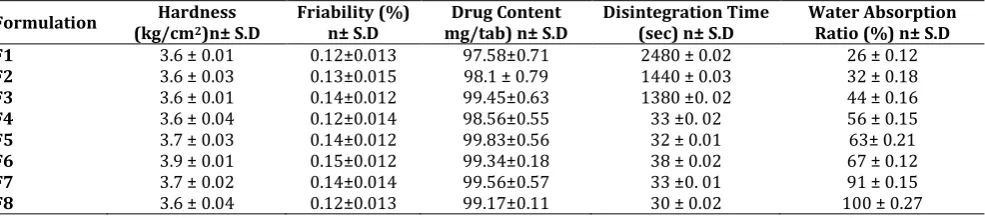
Hardness of tablets from all batches was found to be in the range of 3.6±0.04 kg/cm2to 3.9±0.01 kg/cm2. All tablets were found hard enough so that they could easily withstand the handling and storage conditions without getting broken. Friability
All the tablets exhibited acceptable friability as none of the tested batches showed percentage friability that exceeded 1%. As per IP, percent friability below 1% is an indication of good mechanical resistance of the tablets. Percent friability of all batches found in the range of 0.12%-0.15 %. Thus, it was proved that tablets could withstand the pressure, mechanical shocks during handling, transportation, storage and manufacturing processes.
Drug content
Drug content of all the formulation batches was found to be between 97.34±0.71 to 99.83±0.56. Hence, it can be concluded that all the formulations are having an accurate amount of drug distributed uniformly in powder mass and followed acceptable limits as per IP 15. i.e. 85 to 115 % of average content table 3.
Disintegration studies
In vitro disintegration time was done by the USP dissolution apparatus. The disintegration rate has a correlation with water absorption capacity of disintegrate and The In vitro
disintegration time was found between 30 ±0.02 to 2480 ± 0.02 s. The outcomes were tabulated and data demonstrated in table 3. It was found that the formulation F8 will show least disintegration time 30s as compare to other formulation. The order for a disintegration time in fast dissolving tablet was found to be F8<F7<F6<F5 <F4<F3<F2<F1. The order of disintegration time may be due to the interaction and main effects of the super disintegrants used in the fast dissolving tablets.
Water absorption ratio and wetting time
The water absorption ratio was in between 26±0.12-100±0.27. The wetting time found between 30±0.17-170±0.02. The outcomes were tabulated and data demonstrated in table 3 and Fig. 8 and 8a. It was found that the formulation F8 containing 5 % starch glutarate, 5% crospovidone and 5 % croscarmellose sodium showed less
wetting time i.e. 30±0.17s as compared to other formulations.
In vitro dissolution studies
ISSN: 2250-1177 [266] CODEN (USA): JDDTAO Fast dissolving tablets formulated employing starch
glutarate (5%), crospovidone (5%) and croscarmellose sodium (5%) as super disintegrants exhibited in percentage dissolved in 5 min, wetting time, water absorption ratio and dissolution efficiency in 5 min. Formulation F8 gave release of 99.15% in 15 min fulfilling the official specification, based
on percentage dissolved in 5 min, wetting time, water absorption ratio and dissolution efficiency in 5 min. Formulation F8 is considered as a good fast dissolving tablet formulations of aceclofenac which was found to better than the aceclofenac fast dissolving tablets formulated by Manohara P et al 15.
Table 3: Physical Properties: Hardness, Friability Drug Content of aceclofenac fast dissolving tablets prepared by direct compression method.
Formulation (kg/cmHardness 2)n± S.D Friability (%) n± S.D mg/tab) n± S.D Drug Content Disintegration Time (sec) n± S.D Water Absorption Ratio (%) n± S.D
F1 3.6 ± 0.01 0.12±0.013 97.58±0.71 2480 ± 0.02 26 ± 0.12
F2 3.6 ± 0.03 0.13±0.015 98.1 ± 0.79 1440 ± 0.03 32 ± 0.18
F3 3.6 ± 0.01 0.14±0.012 99.45±0.63 1380 ±0. 02 44 ± 0.16
F4 3.6 ± 0.04 0.12±0.014 98.56±0.55 33 ±0. 02 56 ± 0.15
F5 3.7 ± 0.03 0.14±0.012 99.83±0.56 32 ± 0.01 63± 0.21
F6 3.9 ± 0.01 0.15±0.012 99.34±0.18 38 ± 0.02 67 ± 0.12
F7 3.7 ± 0.02 0.14±0.014 99.56±0.57 33 ±0. 01 91 ± 0.15
F8 3.6 ± 0.04 0.12±0.013 99.17±0.11 30 ± 0.02 100 ± 0.27
*SD Standard Deviation from mean, n=3
F1of aceclofenac Fast dissolving Tablet F2 of aceclofenac fast dissolving tablet At time = 0 sec At time = 170sec At time = 0 sec At time = 70 sec
F3 of aceclofenac fast dissolving tablet F4 of aceclofenac fast dissolving tablet At time = 0 sec At time = 50 sec At time = 0 sec At time = 44 sec
Figure 8(A): Aceclofenac fast dissolving tablets Prepared Employing starch glutarate.
F5 of aceclofenc fast Dissolving Tablet F6 aceclofenac fast dissolving tablet At time = 0 sec At time = 45 sec At time = 0 sec At time = 43 sec
F7 of aceclofenc fast dissolving tablet F8 of aceclofenac fast dissolving tablet
At time = 0 sec At time = 33 sec At time = 0 sec At time = 30 sec
Figure 8(B): Aceclofenac fast dissolving tablets prepared employing starch glutarate.
Figure 9(A): Dissolution profiles of aceclofenac fast dissolving tablets prepared employing starch glutarate
(F1- F4)
Figure 9(B): Dissolution profiles of aceclofenac fast dissolving tablets prepared employing starch glutarate
(F5-F8)
Figure 10(A): Time Vs Log percent drug undissolved plots for aceclofenac fast dissolving tablets prepared employing starch glutarate (F1- F4)
Figure 10(B): Time Vs Log percent drug undissolved plots
ISSN: 2250-1177 [268] CODEN (USA): JDDTAO Table 4: Dissolution parameters of aceclofenac fast dissolving tablets formulated employing starch glutarate.
Time(mins) F1 F2 F3 F4 F5 F6 F7 F8
PD5 2.75 41.08 35.97 61.42 30.34 45.99 61.74 73.62
DE5 % 1.2 6.7 12.2 31.6 14 21.8 32 43
No of folds increase in DE5 % 0.60 0.43 0.93 1.05 3.54 3.54 3.54 0.82
K1 (min-1) 0.0092 0.10 0.05 0.14 0.06 0.15 0.13 0.20
No of folds increase in K1 (min-1) 0.1 0.2 0.4 0.5 - 1.6 - 0.7
*SD standard deviation from mean, n=3, PD5--percent dissolved in 5 min., DE5%-dissolution efficiency in 5 min., K1 =first order rate constant
Table 5 ANOVA of percentage dissolved in 5 min of aceclofenac fast dissolving tablets formulated employing starch glutarate.
Source of Variation d. f S.S M.S.S Variance ratio Result
Replicates 2 0.02 0.01 0.5 P > 0.05
Treatments 7 1038.4 1482.91 74145.5 P ˂ 0.05
Starch glutarate (A) 1 3106.96 3106.96 155348 P ˂ 0.05
Crospovidone(B) 1 475.43 475.43 23771.5 P ˂ 0.05
Starch glutarate + Crospovidone (AB) 1 99.51 99.51 4975.5 P ˂ 0.05
Croscarmellose sodium (C) 1 1846.08 1846.08 92304 P ˂ 0.05
Starch glutarate+ Croscarmellose sodium (AC) 1 501.87 501.87 25093.5 P ˂ 0.05
Crospovidone+ Croscarmellose sodium (BC) 1 12.95 12.95 647.5 P ˂ 0.05
Starch glutarate+ Crospovidone+ Croscarmellose sodium (ABC) 1 33.39 33.39 1669.5 P ˂ 0.05
Error 14 0.38 0.02 -- --
Total 23 -- -- -- --
*SD Standard Deviation from mean, n=3, P<0.05 indicate significance; p>0.05 indicate non-significance, d. f–Degree of Freedom *S. S–Sum of Square *M. S. S–Mean Sum of Squares, ANOVA= Analysis of Variance.
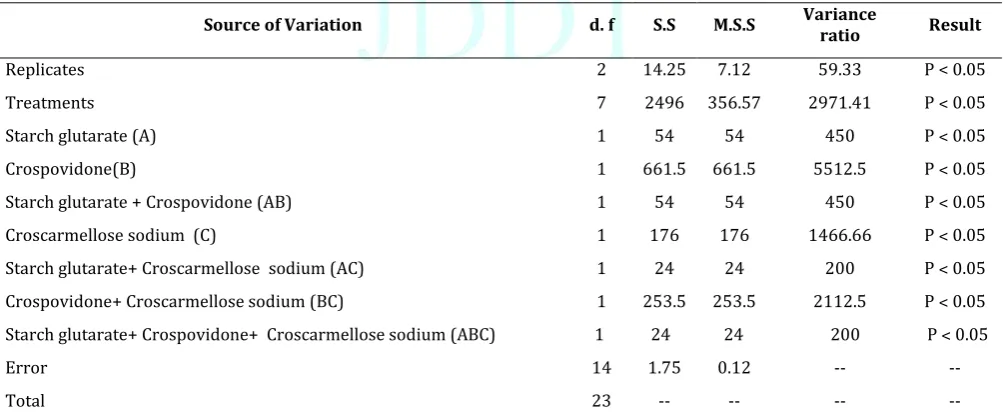
Table 6 ANOVA of wetting time of aceclofenac fast dissolving tablets formulated employing starch glutarate.
Source of Variation d. f S.S M.S.S Variance ratio Result
Replicates 2 14.25 7.12 59.33 P < 0.05
Treatments 7 2496 356.57 2971.41 P ˂ 0.05
Starch glutarate (A) 1 54 54 450 P ˂ 0.05
Crospovidone(B) 1 661.5 661.5 5512.5 P ˂ 0.05
Starch glutarate + Crospovidone (AB) 1 54 54 450 P ˂ 0.05
Croscarmellose sodium (C) 1 176 176 1466.66 P ˂ 0.05
Starch glutarate+ Croscarmellose sodium (AC) 1 24 24 200 P ˂ 0.05
Crospovidone+ Croscarmellose sodium (BC) 1 253.5 253.5 2112.5 P ˂ 0.05
Starch glutarate+ Crospovidone+ Croscarmellose sodium (ABC) 1 24 24 200 P ˂ 0.05
Error 14 1.75 0.12 -- --
Total 23 -- -- -- --
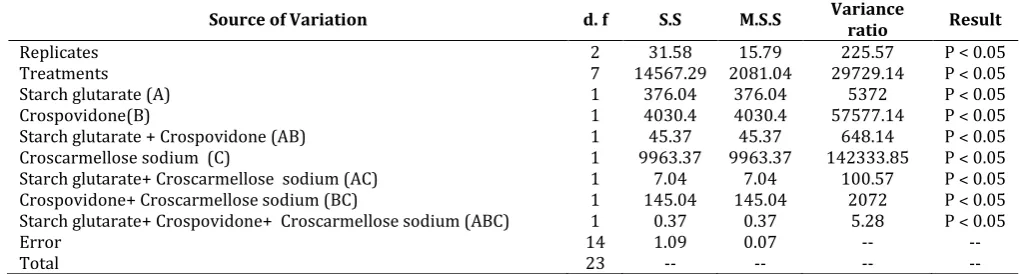
Table 7 ANOVA of water absorption of time of aceclofenac fast dissolving tablets formulated employing starch glutarate.
Source of Variation d. f S.S M.S.S Variance ratio Result
Replicates 2 31.58 15.79 225.57 P < 0.05
Treatments 7 14567.29 2081.04 29729.14 P ˂ 0.05
Starch glutarate (A) 1 376.04 376.04 5372 P ˂ 0.05
Crospovidone(B) 1 4030.4 4030.4 57577.14 P ˂ 0.05
Starch glutarate + Crospovidone (AB) 1 45.37 45.37 648.14 P ˂ 0.05
Croscarmellose sodium (C) 1 9963.37 9963.37 142333.85 P ˂ 0.05
Starch glutarate+ Croscarmellose sodium (AC) 1 7.04 7.04 100.57 P ˂ 0.05
Crospovidone+ Croscarmellose sodium (BC) 1 145.04 145.04 2072 P ˂ 0.05
Starch glutarate+ Crospovidone+ Croscarmellose sodium (ABC) 1 0.37 0.37 5.28 P ˂ 0.05
Error 14 1.09 0.07 -- --
Total 23 -- -- -- --
*SD Standard Deviation from mean, n=3, P<0.05 indicate significance; p>0.05 indicate non-significance, d. f–Degree of Freedom *S. S–Sum of Square *M. S. S–Mean Sum of Squares, ANOVA= Analysis of Variance.
Table 8 ANOVA of Dissolution Efficiency in 5min of Aceclofenac Fast Dissolving Tablets Formulated employing starch glutarate.
Source of Variation d. f S.S M.S.S Variance ratio Result
Replicates 2 3.06 1.53 7.28 P < 0.05
Treatments 7 4311.57 615.93 2933 P ˂ 0.05
Starch glutarate (A) 1 425.88 425.88 2028 P ˂ 0.05
Crospovidone(B) 1 2115.00 2115.00 10071.42 P ˂ 0.05
Starch glutarate + Crospovidone (AB) 1 110.94 110.94 528.28 P ˂ 0.05
Croscarmellose sodium (C) 1 1309.80 1309.80 6237.14 P ˂ 0.05
Starch glutarate+ Croscarmellose sodium (AC) 1 5.70 5.70 27.14 P ˂ 0.05
Crospovidone+ Croscarmellose sodium (BC) 1 4.08 4.08 19.42 P ˂ 0.05
Starch glutarate+ Crospovidone+ Croscarmellose sodium (ABC) 1 43.74 43.74 208.28 P ˂ 0.05
Error 14 3.04 0.21 -- --
Total 23 -- -- -- --
*SD Standard Deviation from mean, n=3, P<0.05 indicate significance; p>0.05 indicate non-significance, d. f–Degree of Freedom *S. S–Sum of Square *M. S. S–Mean Sum of Squares, ANOVA= Analysis of Variance.
CONCLUSION
Starch glutarate is an efficient superdisintegrant for fast dissolving tablets. The disintegration and dissolution efficiency of the fast dissolving tablets of aceclofenac was good and depended on the concentration of superdisintegrant employed i.e., starch glutarate(5%), crospovidone (5%) and crosscarmellose sodium (5%). The formulated fast dissolving tablets of aceclofenac employing starch glutarate, crospovidone and crosscarmellose sodium exhibited good dissolution efficiency in 15 min which can be used for the fast therapeutic action of Aceclofenac.
Overall, Starch glutarate was found to be a superdisintegrant which enhanced the dissolution efficiency when combined with crospovidone and croscarmellose sodium, with the aceclofenac and hence it could be used in the formulation of fast dissolving tablets to provide immediate release of the contained drug within 15 min.
Abbreviations
FTIR - Fourier transform infrared spectra DSC - Differential scanning calorimetry ANOVA – Analysis of variance
REFERENCES
1. Suresh B, Rajender KM, Ramesh G, Yamsani MR. Orodispersible tablets: An overview. Asian J Pharm 2008; 2:2-11.
2. Seager H. Drug delivery product and zydis-fast dissolving dosage form. J Pharm Pharmacol 1998; 50:375-82.
3. Abdelbary G, Prinderre P, Couani C, Taochim J, Reynier JP, Riccerelle P. The preparation of orally disintegrating tablets using a hydrophilic waxy binder. Int J Pharm 2004; 278(2):423-33.
4. Sastry SV, Nyshadham JR, Fix JA. Recent technological advances in oral drug delivery: a review. Pharm Sci Techol Today 2000; 3(4):138-45.
5. Lachman L, Libermann HA, Kanig JL. The theory and practice of industrial pharmacy. 3rdedition; 1991. p. 233-5.
6. Biradar S, Bhagavati S, Kuppasad I. Fast dissolving drug delivery system: A brief overview. Internet J Pharmacol 2005; 4:2. edition; 1991. p. 233-5.
7. Indurwade NH, Rajyaguru TH, Nakhat PD. Noval approach-fast dissolving tablets. Indian Drug 2002; 38(8):405-9.
8. The United States Pharmacopoeia 29, National Formulary 24, Asian Edition. Rockville, MD: United States Pharmacopoeia Convention, Inc; 2006. p. 1890.
9. Jacob S, Shirwaikar A, Joseph A, Srinivasan KK. Novel co-processed excipient of mannitol and microcrystalline callous for preparing fast dissolving tablet of Glipizide. Indian J Pharm Sci 2007; 69(5):633-9. 10. Hiremath JG, Shastry CS, Srinath MS. Pharmaceutical approaches of taste masking in oral dorage forms. Indian Drugs 2004; 41:253-7. 11. Abdelbary A, Elshafeey AH, Zidan G. Comparative effects of different cellulosic-based directly compressed orodispersible tablets on oral bioavailability of famotidine. Carbohydrate Polymers 2009; 77:799-806.
12. Battu SK, Michael AR, Soumyajit M, Madhusudan Y. Formulation and evaluation of rapidly disintegrating fenoverine tablets: effect of super disintegrants. Drug Dev Ind Pharm 2007; 33:1225-32. 13. Goel H, Vora N, Rana V. A novel approach to optimize and formulate fast disintegrating tablets for nausea and vomiting. AAPS PharmSciTech 2008; 9:774–8.
14. Puttewar TY, Kshirsagar MD, Chandewar AV, Chikhale RV. Formulation and evaluation of orodispersible tablet of taste masked doxylamine succinate using ion exchange resin. J King Saud University (Sci) 2010; 22:229–40.