IJSRSET196253 | Received : 01 Feb 2018 | Accepted : 20 Feb 2018 | January-February-2018 [(4) 1 : 1722-1727 ]
© 2018 IJSRSET | Volume 4 | Issue 1 | Print ISSN: 2395-1990 | Online ISSN : 2394-4099 Themed Section : Science and Technology
1722
Study of Electronic, Acoustical and Elastic properties of CdCe
Sanjay Kumar
Department of Physics, J. V. Jain College, Saharanpur, Uttar Pradesh, India
*Corresponding author E-mail address : [email protected]
ABSTRACT
Elastic, acoustical and electronic properties of CdCe have been performed using the full-potential augmented plane-waves + local orbital (FP-LAPW + lo) method. The equilibrium lattice parameter, bulk modulus and its pressure derivative have been obtained using optimization method within generalized gradient approximation (GGA). Young’s modulus, shear modulus, Poisson ratio, acoustical velocities for longitudinal and shear waves, Debye average velocity, Debye temperature and Grüneisen parameter have also been calculated. From electronic calculations, it has been found that electronic conductivity in CdCe is mainly caused by d-orbitals electrons of Cd with small contribution of Ce p-orbitals.
Keywords : Elastic Properties, Electronic Structure of Metals and Alloys, Ab-Initio Calculations
I.
INTRODUCTION
Cadmium cerium (CdCe) has cesium chloride structure with the space group Oh1-Pm3m (No.
221).In CdCe unit cell the atoms occupy at the positions:
Cd: (0, 0, 0) Ce: (1/2, 1/2, 1/2)
The calculated lattice constant and density of CdCe, a
= 3.865 0
A and d = 7.262 g/cm3 as reported in
reference [1].
Elastic properties of materials are directly related to their microstructure as they determine the response of the crystal to external forces, as characterized by bulk modulus, shear modulus, Young’s modulus, and Poisson’ s ratio, and obviously play an important role in determining the strength and stability of materials [2]. The elastic constants of materials are used to obtain the several other physical parameters viz. acoustic attenuation, Debye temperature, Debye average velocity, Grüneisen parameter, nonlinearity
coupling constants, thermal relaxation time, phonon viscosity and other physical properties of materials. Therefore, these are of great interest in applications where the mechanical strength and durability are important [3].
Computational detail
The full-potential linear augmented plane wave + Lo (FP-LAPW + Lo) method [5] has been used to calculate the total energies as well as the ground state properties. Generalized Gradient Approximation (PBE-GGA) based on Perdew-Burke-Ernzerhof (PBE) [6] has been used to determine the optimized structure of the compound CdCe. In this method, the basis set is obtained by dividing the unit cell into non-overlapping atomic spheres and an interstitial region. Inside the atomic sphere a linear combination of radial function times the spherical harmonics is used; in the interstitial region, a plane wave expansion is augmented by an atomic like function in each atomic sphere. The generalized gradient approximation parameterized by Perdew et al. [7] is used for calculating the exchange and correlation energy. The total energies are fitted to Murnaghan, equation of state [8] to obtain the ground state properties (lattice parameter, bulk modulus and its pressure derivative) and elastic constants, which in turn have been used to obtain the Youngs modulus, shear modulus, Poisson ratio, sound velocities for longitudinal and shear waves, Debye average velocity, Debye temperature and Grüneisen parameter.
In a cubic crystal, there are three independent elastic constants, namely, C11, C12 and C44. As a result, a set of
three equations is needed to determine all the constants. Hence, three types of strain must be applied to the starting crystal [9, 10].
(i) The first type strain involves calculating the bulk modulus, given by the formula
0
(
112
12) / 3
B
=
C
+
C
(1)(ii) Second type strain involves performing volume conservative tetragonal strain given by the following tensor.
(2)
This strain has an effect on the total energy from its unstrained state given by following equation.
)
(
)
(
3
)
0
(
)
(
E
C
11C
12V
0
2o
3E
=
+
−
+
(3)
(iii) Finally, for the third type of deformation, we use the volume conserving rhombohedral strain tensor given by
1
1
1
1
1
1
1
1
1
3
(4)
This volume conserving rhombohedral strain transforms the total energy to
) ( )
4 2
( 6 1 ) 0 ( )
(
E C11 C12 C12 V0
2 o
3E = + + + +
(5) Once we have calculated three elastic constants namely C11, C12 and C44, bulk modulus, B (see
equation(5)), Young’ s modulus, Y, isotropic shear modulus, G and Poisson ratio,
.(which are important fundamental parameter closely related to many physical properties viz. internal strain, thermoelastic stress, sound velocity, fracture toughness) can be calculated easily using the following explicit expressions [11]:2
/
)
(
G
VG
RG
=
+
(6) Here GV is Voigt’ s shear modulus corresponding to4
/
)
2
(
C
11C
12C
44G
V=
−
+
(7))] ( 3 4 /[ )] ) [(
5 C11 C12 C44 C44 C11 C12
GR = − + −
(8)
B
G
GB
Y
3
9
+
=
(9))
2
6
/(
)
2
3
(
B
−
G
B
+
G
=
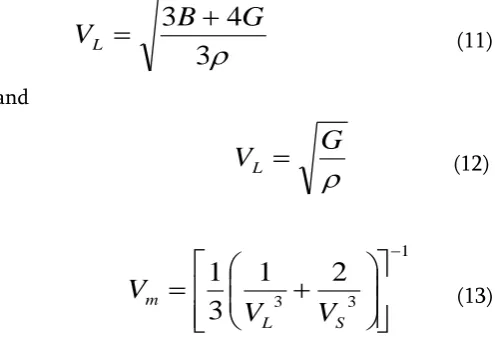
(10)Sound velocity depends upon second order elastic constants and mass density. Therefore, sound velocity for longitudinal and shear waves (VL and VS) and
Debye average velocity (Vm) can be obtained using
calculated elastic moduli and mass density. The explicit expressions are as follows [12]:
3
4
3
B
G
V
L=
+
(11)and
G
V
L=
(12)1 3 3
2
1
3
1
−
+
=
S L mV
V
V
(13)
The Debye temperature, θD and Grüneisen parameter,
are two useful parameters in solid state problems because of their inherent relationship to lattice vibrations. The Debye temperature θD can be used incharacterizing the excitation of phonons and to describe various lattice thermal phenomena and Grüneisen parameter describes the phonons contribution to specific heat.
Debye temperature,
D [12] and Grüneisen parameter,
[13] are sound velocity and mass density dependent, which are calculated using the expressions given by m a B D V M N n k 3 / 1 4 3 =
(14))
2
(
2
)
3
4
(
9
2 2 2 2 S L S LV
V
V
V
+
−
=
(15)Here ( =h/2
) h being the Plank Constant and
Bis Boltzmann constant.To obtain the structural ground state parameters viz. equilibrium lattice constant, bulk modulus and its pressure derivative, total energy has been fitted to the Murnaghan equation of state [8] and the total energy has been plotted as a function of reduced volume for CdCe. The plot connecting the total energies to relative volumes for the compound is shown in Figure 1. The calculated ground state properties viz. equilibrium lattice constant, bulk modulus and its pressure derivative are tabulated in Table 1.
Table 1Calculated lattice constant, a0 ( 0
), bulk modulus, B0(GPa), its pressure derivative, B0' , elastic
moduli for CdCe using GGA functional.
No experimental values of the equilibrium bulk modulus (B0) and its pressure derivative (B0) are
available in literature, thus, no comparison can be made for B0 and B0 for CdCe. However, value of
lattice constant (a0) is available in the literature [1]
which is in good agreement with calculated value of lattice constant (Table 1). Present calculations are based on the density functional theory within the framework of the GGA, which is sufficiently accurate in predicting the ground state properties.
Table 2. Calculated elastic moduli, Cij (GPa), Bulk
Table 3. Calculated, Mass density, ρ (gm/cm3), sound
velocities (103 m/sec) for longitudinal and shear wave
(VLand VS), Debye average velocity, Vm(103 m/sec),
Debye temperature, θD (K) and Grüneisen parameter
The calculated elastic moduli are given in Table 2. The elastic stability criteria for a cubic crystal [4] at ambient conditions can validate our calculations for elastic moduli. At ambient conditions the stability conditions are C11-C12 > 0, C11 > 0, C44 > 0, C11 + 2C12 > 0 including the cubic condition C12< C11and C12 < B < C11. Since, our calculated values of C11, C12 and C44
satisfy the elastic stability criteria, Therefore, justifying the calculated values of elastic moduli.
Bulk modulus, B isotropic shear modulus, G Young’ s modulus, Y and Poisson ratio,
are also the important physical parameters, which tell more about the mechanical stability, hardness, brittle and ductile properties of materials. The calculated values of B, G, Y and
are given in Table 2. For covalent and ionic materials, the typical relations between bulk and shear moduli are G = 1.1B and G = 0.6B [10], respectively. In our case, the obtained factor relating the bulk and shear moduli is less than the condition G=0.6B and approaching to ionic condition, found to be 0.29, indicating weaker ionic bonding in CdCe. Poisson ratio gives the ductile or brittle behavior of material. The compounds for which ν > 0.30 are brittle otherwise ductile [10]. Poisson ratio for CdCe is 0.36, reflecting brittle character.The mass density (ρ), sound velocities for longitudinal and shear waves (VL and VS), Debye average velocity
(Vm), Debye temperature (θD) and acoustic Grüneisen
parameter (ζ) of a crystal are also the material parameters associated with lattice vibrations, which are basically depend upon the elastic moduli. In the present work, the calculated values of ρ, VL, VS, Vm,
θD and ζ have been presented in Table 3. Only the
value of mass density is available in literature [1], which is in good agreement with our calculated value of mass density. Since the values of VL, VS, Vm, θDand
ζ have been calculated from the elastic constants using the first principle theory (which is most reliable theory), therefore, we beleive that our calculated values of VL, VS, Vm, θDandζ are valid.
Figure 1. Total energy as a function of volume for CdCe with GGA calculation
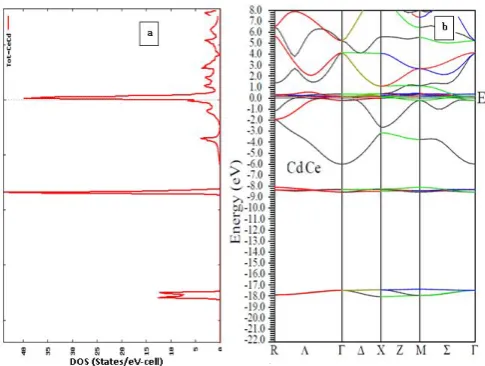
Figure 2 (a) calculated total density of states and (b) self-consistent electron dispersion curve along symmetry direction in the Brilloun zone for CdCe
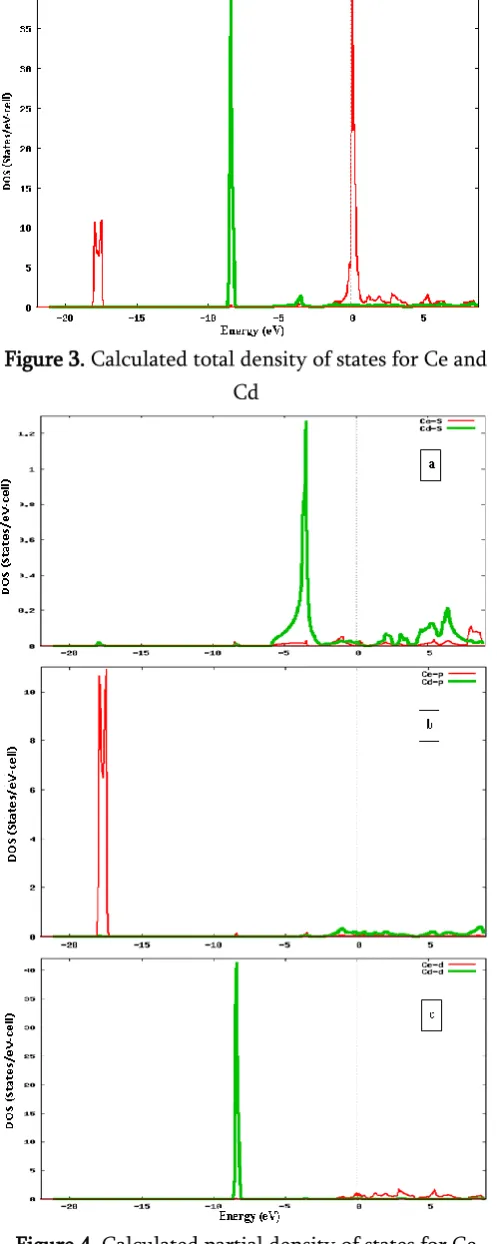
Figure 3. Calculated total density of states for Ce and Cd
Figure 4. Calculated partial density of states for Ce and Cd for (a) s-states (b) p-states (c) d-states
Figure 2 consists (a) calculated total density of states and (b) self-consistent electron dispersion curve along symmetry direction in the Brilloun zone for CdCe. It is clear from Figure 2 that there are total three bands at around -18 eV, -8.2 eV and -4 eV below the Fermi level.
Figure 3 shows the calculated total density of states for Ce and Cd atoms which indicates that Cd dominants over the Ce in contribution to electrical conductivity. Figure 4 shows the calculated partial density of states (for s, p, d states) for Ce and Cd respectively. It is clear from Figure 4 that lowest-lying band (at around -18 eV) arises from the Ce p-states and the bands lying above this (at around -8.2 eV) is mainly contributed by the d-like states of the Cd atom. Well above these, the bands (at around -4 eV) arise from the Cds states
Therefore, Cd d-states play key role in contribution to electrical conductivity with small contribution of Ce p-states (Figure 2-4).
II.
CONCLUSION
III.
REFERENCES
[1]. Swanson, H. E. Mcmurdie, H. F. Morris, M. C. and Evans, E. H. National Bureau of Standards Monograph 25- Section 5 (Library of Congress Catalog Card Number: 53- 61386), Issued August 31, (1967)
[2]. Peng, F. Han, Y. Fu, H. Yang, X. First-principles calculations on structure and elasticity of wurtzite-type indium nitride under pressure. J. Alloys and comp. 475, 885 (2009).
[3]. Ravindran, P. Fast, L. Korzavyi, P. A. Johansson, B. Wills, J. and Eriksson, O. Density Functional Theory for Calculation of Elastic Properties of Orthorhombic Crystals: Application to TiSi2, J. Appl. Phys. 84, 4891(1998).
[4]. Heciri, D. Beldi, L. Drablia, S. Meradji, H. Derradji, N. E. Belkhir, H. Bouha, B. First principles elastic constants and electronic structure of beryllium chalcogenides BeS, BeSe and BeTe. Comput. Mat. Sci. 38, 609 (2007).
[5]. Blaha, P. Schwarz, K. Madson, G. K. H. Kvasnicka, D. and Luitz, J. An Augmented Plane Wave Plus Local Orbitals Program for Calculating Crystal Properties, Comput. Phys.Comm. 59, 399 (1990).
[6]. Perdew, P. and Burke, S. Ernzerhof Generalized Gradient Approximation Made Simple. Phys. Rev. Lett. 77, 3865 (1996).
[7]. Perdew, J. P. Wang, Y. Accurate and Simple Analytic Representation of the Electron Gas Correlation Energy. Phys. Rev. B 45, 13244 (1992).
[8]. Murnaghan, F. D. The compressibility of media under extreme pressures Proc. Natl. Acad. Sci. U.S.A. 30, 244 (1944).
[9]. Kalarasse, K. Kalarasse, L. Bennecer, and B. Mellouki, A. Elastic and electronic properties of Li2ZnGe. Comput. Mat. Sci. 47, 869 (2010). [10].Bouhemadou, A. Khenata, R. Moakafi, M. Seddik,
T. Reshak, A.H. and Al-Douri, Y. FP-APW+lo calculations oe elastic properties in zinc blend III-P compounds under pressure effect. Comput. Mat. Sci. 45, 474 (2009).
[11].Chen, W. and Jiang, J. Z. Elastic properties and electronic properties of 4d-and 5d-transition metal mononitrides. J. Alloys and Compounds 499, 243 (2010).
[12].Haddadi, A. Bouhemadou, A. Louail, L. Maabed, S. and Maouche, D. Structural and elastic
properties under pressure effect of the cubic antiperovskite compounds ANCa3 (A = P, As, Sb, and Bi). Phys. Lett. A 373, 1777 (2009).