Available online on 20.08.2019 at http://jddtonline.info
Journal of Drug Delivery and Therapeutics
Open Access to Pharmaceutical and Medical Research© 2011-18, publisher and licensee JDDT, This is an Open Access article which permits unrestricted non-commercial use, provided the original work is properly cited
Open Access
Research Article
Human papillomavirus is the cause of human prostate cancer
Ilija Barukčić
Internist, Horandstrasse, DE-26441 Jever, Germany
ABSTRACT
Objective: The aim of the present meta-analysis study is to investigate whether human papillomavirus (HPV) serves as a cause or as the cause of human prostate cancer (PC).
Methods: The PubMed database was searched for suitable articles. Previously published expert reviews and systematic meta-analysis were used as an additional source to identify appropriate articles. Articles selected for this meta-analysis should fulfill the following inclusion criteria: (a) no data access barrier, (b) polymerase chain reaction (PCR) DNA based identification of HPV. The method of the conditio sine qua non relationship was used to prove the hypotheses whether being married is a necessary condition (a conditio sine qua non) of PC. In other words, without being married no PC. The method of the conditio per quam relationship (sufficient condition) was used to prove the hypotheses if HPV is present in human prostate tissues then PC is present too. The mathematical formula of the causal relationship k was used to prove the hypothesis, whether there is a cause effect relationship betw een HPV and PC. Significance was indicated by a p-value (two sided) of less than 0.05.
Results: In to more than 33 studies were considered for a meta-analysis. Several studies support the hypotheses without being married no PC. All the studies considered for a re-analysis support the null-hypotheses if HPV then PC, while the cause effect relationship between HPV and PC was highly significant.
Conclusions: HPV is the cause of PC.
Keywords: Human papillomavirus, prostate cancer, causality
Article Info:
Received 19 June 2019; Review Completed 21 July 2019; Accepted 05 Aug 2019; Available online 20 August 2019Cite this article as:
Ilija Barukčić, Human papillomavirus is the cause of human prostate cancer, Journal of Drug Delivery and Therapeutics. 2019; 9(4-s):577-588 http://dx.doi.org/10.22270/jddt.v9i4-s.3385
*Address for Correspondence:
Ilija Barukčić, Horandstrasse, DE-26441 Jever, Germany. Tel: 49-4466-333.
INTRODUCTION
Human
1papilloma
2virus
3(HPV) is a small DNA
4virus and
responsible for several benign and malignant diseases. More than
200 types
5of HPV have been identified to date. Meanwhile, HPV is
identified as the cause
6of human cervical cancer
7while equally
one of the most prevalent sexually transmitted infections (STI) in
the United States
8and worldwide
9too. In about 72.9% of the male
partners in heterosexually active couples are HPV positive
10.
McNicol and Dodd
11detected HPV even in prostate cancer (PC)
tissues of adults. Oddly enough, PC has not been documented in
very young and sexually inactive male
12children. The mortality
burden of PC has risen to over 360,000 deaths per year
13. Some
risk factors
14for PC like like genetic polymorphisms, family
history of prostate cancer, race, age, height, physical activity, BMI,
total energy consumption, intakes of calcium, tomato sauce and
alpha-linolenic acid and cigarette smoking history are discussed
in literature while evidence is conflicting
. Especially, several
stated. To clarify the contradictory results of these and other
investigations, this meta-analysis with updated data has been
carried out to obtain a more precise picture of the relationship
between HPV and PC.
MATERIAL AND METHODS
Search strategy
The electronic database PubMed was searched for appropriate
studies conducted in any country which investigated the
relationship between HPV and PC. In assessing the shortcomings
of PubMed, additionally, appropriate review articles and
references published within the same were checked.
Study selection
Table 1. Flow Diagram of the article selection process. Adopted from PRISMA
21, 222009.
1. Identification of records
Size
Total
Records identified by searching in the databases
PubMed
45
Additional records identified from other sources:
58
Review of Yin (n=24)
Review of Bae (n=30)
Dillner et al., 1998
Pourmand et al., 2007
Schiffmann et al., 2015
Loeb et al., 2017
103
2. Clean-up of search
Inappropriate articles excluded
64
3. Eligibility
Articles evaluated for eligibility
39
Articles excluded for various reasons
-
Self-contradictory data
13
4. Included
Articles included in the meta-analysis
26
Data analysis
The following
data were recorded for analysis.
The data of the studies analyzed
The studies reviewed
23–44in this publication investigated the
conditio per quam relationship between HPV and PC while using
the highly sensitive PCR technique are presented in more detail by
a table (
Table 2).
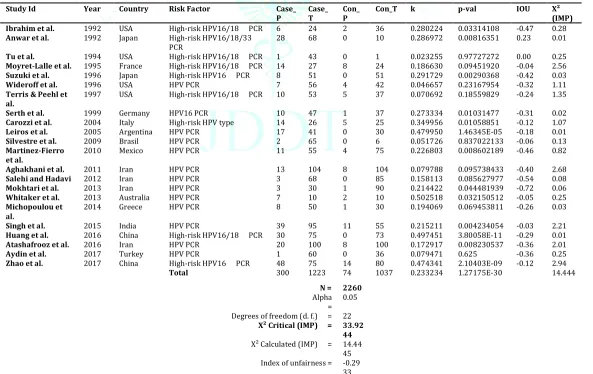
Table 2. The HPV PCR Studies
23–44considered for a re-analysis of conditio per quam.
Study Id Year Country Risk Factor Case_
P Case_T Con_P Con_T k p-val IOU X² (IMP) Ibrahim et al. 1992 USA High-risk HPV16/18 PCR 6 24 2 36 0.280224 0.03314108 -0.47 0.28
Anwar et al. 1992 Japan High-risk HPV16/18/33
PCR 28 68 0 10 0.286972 0.00816351 0.23 0.01
Tu et al. 1994 USA High-risk HPV16/18 PCR 1 43 0 1 0.023255 0.97727272 0.00 0.25
Moyret-Lalle et al. 1995 France High-risk HPV16/18 PCR 14 27 8 24 0.186630 0.09451920 -0.04 2.56
Suzuki et al. 1996 Japan High-risk HPV16 PCR 8 51 0 51 0.291729 0.00290368 -0.42 0.03
Wideroff et al. 1996 USA HPV PCR 7 56 4 42 0.046657 0.23167954 -0.32 1.11
Terris & Peehl et
al. 1997 USA High-risk HPV16/18 PCR 10 53 5 37 0.070692 0.18559829 -0.24 1.35
Serth et al. 1999 Germany HPV16 PCR 10 47 1 37 0.273334 0.01031477 -0.31 0.02
Carozzi et al. 2004 Italy High-risk HPV type 14 26 5 25 0.349956 0.01058851 -0.12 1.07
Leiros et al. 2005 Argentina HPV PCR 17 41 0 30 0.479950 1.46345E-05 -0.18 0.01
Silvestre et al. 2009 Brasil HPV PCR 2 65 0 6 0.051726 0.837022133 -0.06 0.13
Martinez-Fierro
et al. 2010 Mexico HPV PCR 11 55 4 75 0.226803 0.008602189 -0.46 0.82
Aghakhani et al. 2011 Iran HPV PCR 13 104 8 104 0.079788 0.095738433 -0.40 2.68
Salehi and Hadavi 2012 Iran HPV PCR 3 68 0 85 0.158113 0.085627977 -0.54 0.08
Mokhtari et al. 2013 Iran HPV PCR 3 30 1 90 0.214422 0.044481939 -0.72 0.06
Whitaker et al. 2013 Australia HPV PCR 7 10 2 10 0.502518 0.032150512 -0.05 0.25
Michopoulou et
al. 2014 Greece HPV PCR 8 50 1 30 0.194069 0.069453811 -0.26 0.03
Singh et al. 2015 India HPV PCR 39 95 11 55 0.215211 0.004234054 -0.03 2.21
Huang et al. 2016 China High-risk HPV16/18 PCR 30 75 0 73 0.497451 3.80058E-11 -0.29 0.01
Atashafrooz et al. 2016 Iran HPV PCR 20 100 8 100 0.172917 0.008230537 -0.36 2.01
Aydin et al. 2017 Turkey HPV PCR 1 60 0 36 0.079471 0.625 -0.36 0.25
Zhao et al. 2017 China High-risk HPV16 PCR 48 75 14 80 0.474341 2.10403E-09 -0.12 2.94
Total 300 1223 74 1037 0.233234 1.27175E-30 14.444
N = 2260
Alpha = 0.05
Degrees of freedom (d. f.) = 22
X² Critical (IMP) = 33.92 44
X² Calculated (IMP) = 14.44
45
Index of unfairness = -0.29 33
The studies reviewed
23–44in this publication which investigated the causal relationship between HPV and PC while using the highly
sensitive PCR technique are presented in more detail by a table (
Table 3).
Table 3. The causal relationship between human papilloma virus and prostate cancer
Study Id Year Country Risk Factor Case_P Case_T Con_P Con_T k p-val (HGD) IOU X²(k)
Huang et al. 2016 China High-risk HPV16/18 PCR 30 75 0 73 0.497451 3.80058E-11 -0.29 36.62
Zhao et al. 2017 China High-risk HPV16 PCR 48 75 14 80 0.474341 2.10403E-09 -0.12 34.88
Leiros et al. 2005 Argentina HPV PCR 17 41 0 30 0.479950 1.46345E-05 -0.18 16.36
Suzuki et al. 1996 Japan High-risk HPV16 PCR 8 51 0 51 0.291729 0.002903682 -0.42 8.68
Singh et al. 2015 India HPV PCR 39 95 11 55 0.215211 0.004234054 -0.03 6.95
Anwar et al. 1992 Japan High-risk HPV16/18/33 PCR 28 68 0 10 0.286972 0.008163513 0.23 6.42
Atashafrooz
et al. 2016 Iran HPV PCR 20 100 8 100 0.172917 0.008230537 -0.36 5.98
Martinez-Fie
rro et al. 2010 Mexico HPV PCR 11 55 4 75 0.2268030 0.008602189 -0.46 6.69
Serth et al. 1999 Germany HPV16 PCR 10 47 1 37 0.273334 0.010314777 -0.31 6.28
Carozzi et al. 2004 Italy High-risk HPV type 14 26 5 25 0.349956 0.01058851 -0.12 6.25
Whitaker et
al. 2013 Australia HPV PCR 7 10 2 10 0.502518 0.032150512 -0.05 5.05
Ibrahim et
al. 1992 USA High-risk HPV16/18 PCR 6 24 2 36 0.280224 0.033141089 -0.47 4.71
Mokhtari et
al. 2013 Iran HPV PCR 3 30 1 90 0.214422 0.044481939 -0.72 5.52
Total 241 697 48 672 0.698497 2.95206E-73 -0.49 150
N = 1369
Alpha = 0.05
Degrees of freedom (d. f.) = 13
X² Critical (k)
= 22.36
X² Calculated
(k) = 150.37
p value (k) < 0.00001 Case_P: cases, positive; Case_T: cases, total; Con_P: controls, positive; Con_T: controls, total.
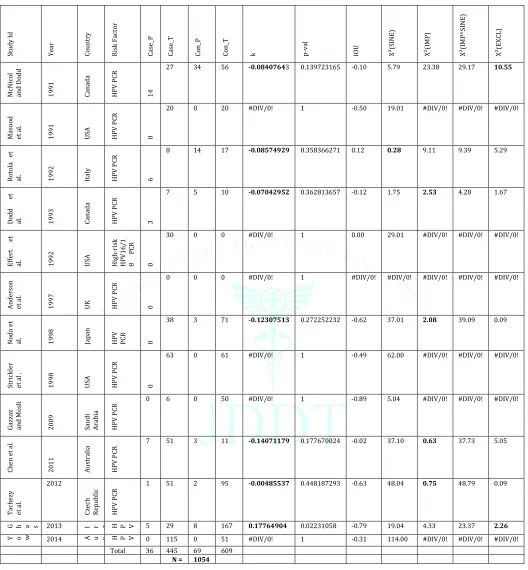
The Data of the studies not analyzed
Studies
11,45–56which published data self-contradictory are viewed
by
Table 4
and have not been considered for a review of the
causal relationship. The reason for the contradiction is highlighted
Table 4. The studies
11,45–56not considered for a re-analysis
St ud y Id Ye ar Co un try Ris k Fa ct or Ca se _P Ca se _T Co n_ P Co n_ Tk p-va
l
IOU X²(S
IN E) X² (I M P) X² (I M P^S IN E) X² (E XC L) M cN ic ol an d D od d
1991 Cana
da HP V P CR 14
27 34 56 -0.08407643 0.139723165 -0.10 5.79 23.38 29.17 10.55
M as oo d et a l.
1991 USA HP
V
P
CR
0
20 0 20 #DIV/0! 1 -0.50 19.01 #DIV/0! #DIV/0! #DIV/0!
Ro to la et al .
1992 Ital
y HP V P CR 6
8 14 17 -0.08574929 0.358366271 0.12 0.28 9.11 9.39 5.29
D od d et al .
1993 Cana
da HP V P CR 3
7 5 10 -0.07042952 0.362813657 -0.12 1.75 2.53 4.28 1.67
Ef fe rt et al .
1992 USA Hig
h-ris k HP V 16 /1 8 PC R 0
30 0 0 #DIV/0! 1 0.00 29.01 #DIV/0! #DIV/0! #DIV/0!
An de rs on et a l.
1997 UK HP
V
P
CR
0
0 0 0 #DIV/0! 1 #DIV/0! #DIV/0! #DIV/0! #DIV/0! #DIV/0!
No da e t al .
1998 Japa
n HP V PC R 0
38 3 71 -0.12307513 0.272252232 -0.62 37.01 2.08 39.09 0.09
St ric kl er et a l .
1998 USA HP
V
P
CR
0
63 0 61 #DIV/0! 1 -0.49 62.00 #DIV/0! #DIV/0! #DIV/0!
G az za z an d M os li
2009 Saud
i Ara bia HP V P CR
0 6 0 50 #DIV/0! 1 -0.89 5.04 #DIV/0! #DIV/0! #DIV/0!
Che n et a l. 2011 Aus tra lia HP V P CR
7 51 3 11 -0.14071179 0.177670024 -0.02 37.10 0.63 37.73 5.05
T ac he zy et a l. 2012 Cz ec h Re pub lic HP V P CR
1 51 2 95 -0.00485537 0.448187293 -0.63 48.04 0.75 48.79 0.09
G h a s 2013 e m i a n I er ta n H aP lV . 5 P C 29 R 8 167 0.17764904 0.02231058 -0.79 19.04 4.33 23.37 2.26
Y o w e2014 t a l .A u s tH rP aV l 0 iP a C 115 R 0 51 #DIV/0! 1 -0.31 114.00 #DIV/0! #DIV/0! #DIV/0!
Total 36 445 69 609
Marital status and HPV positivity
The Iranian study and Ghasemian
55et al. provided detailed
information about the martial status and HPV positivity. The data
on the relationship between marital status and HPV positivity are
viewed by the
Table 5
. The data of study of Pourmand
57et al. are
self-contradictory and were not considered for a review on this
topic.
Table 5. Marital status
55and HPV positivity
The study of
Ghasemian et al.
HPV
positive
Yes = +1 No = +0 Total
Married
Yes =+1
12
167
179
No = +0
1
16
17
Total
13
183
196
Marital status and prostate cancer
Data on the relationship between marital status and prostate
cancer were published by Ghasemian
55et al. are viewed by the
Table 6
. The Iranian data on the relationship between marital
status and prostate cancer were compared with the data as
published by the study of Dillner
58et al. The data as published by
Dillner et al. are viewed by the
Table 6
too. The data as provided
by Schiffmann
59et al. and Huang
60et al. and Loeb
61et al. are not
appropriate enough and were not considered for a re-analysis.
Table 6. Marital status and prostate cancer
Study
Year
N
Case_P Case_T Con_P Con_T k
p(k)
X²(SINE|B
t) X²(SINE|A
t) p(IOU)
p(IOI)
Dillner et al.
1998 452 154
164
259
288
+0,07 0,05
0,61
2,56
0,27655 0,55088
Ghasemian et
al.
2013 196 27
29
152
167
+0,03 0,278 0,14
0,24
0,06122 0,76531
Statistical Analysis
All the statistical analyses for the meta-analysis were conducted
by Microsoft ® Excel ® for Mac ® version 16.2 (181208) software
(© 2018, Microsoft GmbH, Munich, Germany), with statistical
significance at P < 0.05. P value, provided with capital letter P, is
stated as exact number with three decimal places (i.e. P = 0.027).
The data extracted from the papers were checked for
self-contradictions and publication bias by the index of
unfairness
62and by the index of independence. The
conditio sine
qua non
relationship, the
conditio per quam
relationship
6and the
mathematical formula of the
causal
63relationship
were used to
prove the relationship between HPV and PC for causality. The
hypergeometric distribution was used to calculate P values.
Whether a
sample
distribution observed is identical with a
theoretica
l distribution expected was proofed by Pearson’s
Chi-square goodness of fit test
63too. The applicability of using
the Pearson chi-squared statistic in cases where the cell
frequencies of a 2× 2 contingency table are not greater than five is
widely discussed in literature.
The rule of three
63has been
applied by the analysis of the study of Whitaker et al.
38. The use of
Yate’s continuity correction in this context is to some extent
controversary and not essential.
Additionally, the odds ratio
63(OR), even if severely and
justifiably criticized and disproved especially by Karl Pearson
63(1857–1925) and Heron, with a confidence interval of 95% was
determined.
Definitions
Definition 1. (The 2x2 Table)
A two by two table (also called a contingency table, a notion first
used by Karl Pearson in 1904) is a useful tool for examining
relationships between Bernoulli (i. e. Binomial) distributed
random variables. Consider the case of a Bernoulli distributed
random variable A
toccurring/existing et cetera with the
probability p(A
t) at the Bernoulli trial (period of time) t.
Furthermore, consider the case of another Bernoulli distributed
random variable B
toccurring/existing et cetera with the
probability p(B
t) at the same Bernoulli trial (period of time) t. Let
p(a
t)= p(A
t
B
t) denote the joint probability distribution of A
tand
B
tat the same Bernoulli trial (period of time) t. The following
table (
Table 7
) may show the relationships in more details.
Table 7. The probabitlities of a contingency table
Conditioned
B
Yes = +1 No = +0 Total
Condition A
Yes =+1
p(a
t)
p(b
t)
p(A
t)
No = +0
p(c
t)
p(d
t)
p(A
t)
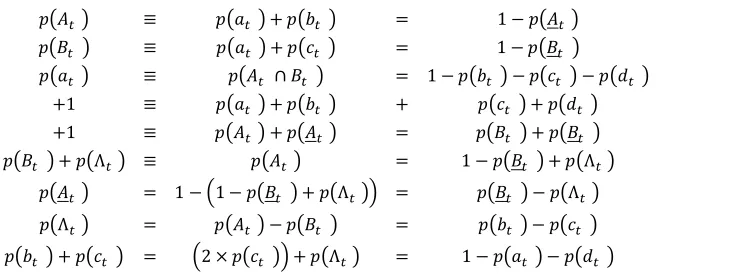
In this context, it is
per definitionem
(
)
(
) (
)
(
)
(
)
(
) (
)
(
)
(
)
(
)
(
) (
) (
)
(
) (
)
(
) (
)
(
) (
)
(
) (
)
(
) (
)
(
)
(
) (
)
(
)
( (
) (
))
(
) (
)
(
)
(
) (
)
(
) (
)
(
) (
)
( (
)) (
)
(
) (
)
(1)
while +1 denotes
the normalized sample space
of A
tand B
t. Under conditions of Einstein’s general theory of relativity,
indicates the cosmological
“constant”. Einstein’s field equation expressed completely under conditions of classical logic and equally of probability theory simplifies to
p(B
t)
+ p(
t) = 1 - p(B
t) + p(
t) = p(A
t)
at each point in space-time t while p(a
t), p(b
t), p(c
t) and p(d
t) may denote equally the probability as associated
with the four basic fields of nature. Under circumstances were the probability of an event is constant from trial to trial (i. e. Binomial distribution),
the relationships before simplifies. We obtain some of the relationships
per definitionem
(
) (
)
(
)
(
) (
)
(
)
(
)
(
)
(
)
(
)
(
)
(
) (
)
(
) (
)
(
) (
)
(
) (
)
(2)
The meaning of the abbreviations a, b, c, d, n et cetera are explained by following 2 by 2-table (
Table 8
).
Table 8. The sample space of a contingency table
Conditioned B
(Outcome)
Yes = +1
No = +0
Total
Condition A
(risk factor)
Yes =+1
a
b
A
No = +0
c
d
A
Total
B
B
n
Definition 2. Index of unfairness
T
he probability of an index of unfairness
(IOU) is defined as
( ) ((
) )
(3)
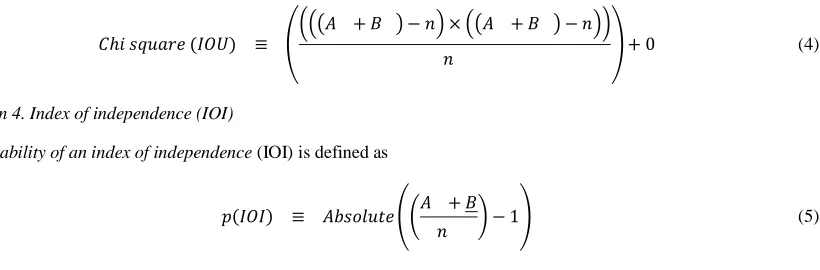
Definition 3. The Chi Square of an Index of unfairness
( ) (
((( ) ) (( ) )*
)
(4)
Definition 4. Index of independence (IOI)
The probability of an index of independence
(IOI) is defined as
( ) ((
) )
(5)
Definition 5. The Chi square of an Index of independence
The index of independence is grounded on the relationship that N = A + B. Under very appropriate conditions, there should be no deviation of A + B
from N and the IOI should be equal to 0. T
he Chi square of an index of independence
(IOI) is defined as
( ) (
((( ) ) (( ) )*
)
(6)
Definition 6. Independence
In the case of independence
63of A
tand B
tit is generally valid that
(
) (
) (
)
(7)
Definition 7. The Mathematical Formula of the Causal Relationship k
The mathematical formula of the causal relationship k
63is defined
at every single event,
at every single Bernoulli trial t,
as
(
)
(
) ( (
) (
))
√ (
) ( (
)) (
) ( (
))
(8)
where A
tdenotes the cause and B
tdenotes the effect. Under some certain circumstances, the chi-square distribution can be applied to
determine the significance of causal relationship k. Again, it necessary to point out that
neither
Pearson’s concept of correlation
nor
Pearson’s
concept of
is identical with causation. The mathematical formula of the causal relationship k has nothing to do with Pearson’s methods and is
not identical with correlation. This has been proved many times and is widely discussed in many publications.
Definition 8. The 95% Confidence Interval of the Causal Relationship k
The 95% interval for the causal relationship k was calculated by the formula
{ (
) √
(
) √
}
(9)
Definition 9. The Chi Square Distribution
The following critical values of the chi square distribution
63as visualized by
Table 9
are used in this publication.
Table 9. The critical values of the chi square distribution (degrees of freedom: 1)
p-Value
One sided X²
Two sided X²
The chi square distribution
0.1000000000
0.0500000000
1.642374415
2.705543454
2.705543454
RESULTS
Theorem 1.
Without
being married
no
HPV positivity.
Claims.
Null hypothesis:
Marriage is a necessary condition (a conditio sine qua non) of HPV
positivity of an Iranian man. In other words, the
sample
distribution
of the study analyzed agrees with the hypothetical
(theoretical) distribution
of a necessary condition.
Alternative Hypothesis:
Marriage is not a necessary condition (a conditio sine qua non) of
HPV positivity of an Iranian man. In other words, the sample
distribution of the study analyzed does not agree with the
hypothetical (theoretical) distribution of a necessary condition.
The significance level (Alpha) below which the null hypothesis
will be rejected is alpha= 0.05.
Proof.
The results of the data reviewed and re-analyzed by this article
which investigated the relationship between marital status and
HPV positivity of an Iranian man are viewed by the table (
Table
5
). The study design of the study of Ghasemian et al. is very
impressive (p(IOU) = 0,06). The data can be used for causal
analysis and for the analysis of conditions too. The study analyzed
was able to provide evidence of a positive cause effect
relationship. Furthermore, the null-hypothesis:
without
being
married
no
HPV positivity of an Iranian man (
Table 10
) could not
be rejected. Marriage is a necessary condition (a conditio sine qua
non) of HPV positivity of an Iranian man (p
Sine(Married
HPV
positive) = 0,995; Chi sq. 1 (SINE) = 0,08; Chi sq. 2 (SINE) =
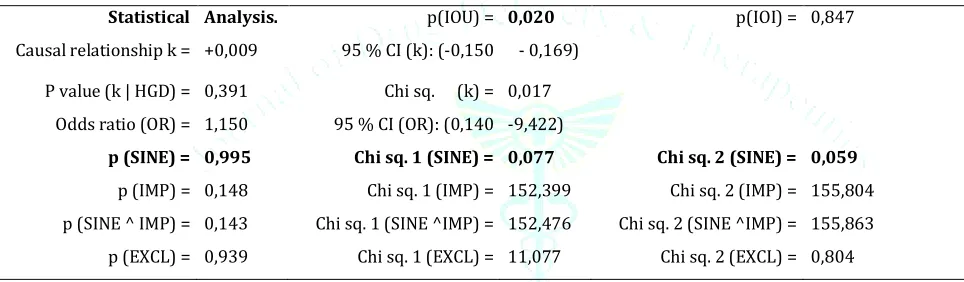
0,06; p(IOU) =0,02, k > 0).
Quod erat demonstrandum.
Table 10. Statistical analysis of the marital status and HPV positivity
Statistical Analysis.
p(IOU) =
0,020
p(IOI) = 0,847
Causal relationship k = +0,009
95 % CI (k): (-0,150 - 0,169)
P value (k | HGD) = 0,391
Chi sq. (k) = 0,017
Odds ratio (OR) = 1,150
95 % CI (OR): (0,140 -9,422)
p (SINE) = 0,995
Chi sq. 1 (SINE) = 0,077
Chi sq. 2 (SINE) = 0,059
p (IMP) = 0,148
Chi sq. 1 (IMP) = 152,399
Chi sq. 2 (IMP) = 155,804
p (SINE ^ IMP) = 0,143
Chi sq. 1 (SINE ^IMP) = 152,476
Chi sq. 2 (SINE ^IMP) = 155,863
p (EXCL) = 0,939
Chi sq. 1 (EXCL) = 11,077
Chi sq. 2 (EXCL) = 0,804
Theorem 2.
Without being married no prostate cancer
Claims.
Null hypothesis:
Marriage is a necessary condition (a conditio sine qua non) of
prostate cancer. In other words, the
sample distribution
of the
study analyzed agrees with the hypothetical
(theoretical)
distribution
of a necessary condition.
Alternative Hypothesis:
Marriage is not a necessary condition (a conditio sine qua non) of
prostate cancer. In other words, the sample distribution of the
study analyzed does not agree with the hypothetical (theoretical)
distribution of a necessary condition.
The significance level (Alpha) below which the null hypothesis
will be rejected is alpha= 0.05.
Proof.
The results of the re-analyses of the data reviewed by this article
which investigated the relationship between marital status and
prostate cancer are viewed by the table (
Table 6
). Altogether,
both studies (Finland and Iran) which were meta-analyzed
provided significant evidence of a conditio sine qua non
relationship between marital status and prostate cancer. In the
same respect, the causal relationship k was k > 0. The
null-hypothesis cannot be rejected. Thus far, the conclusion with
respect to the studied sample is inescapable,
without
being
married
no
prostate cancer.
Quod erat demonstrandum.
Theorem 3.
Human papilloma virus is a sufficient condition
of prostate cancer
Claims.
Null hypothesis:
HPV is a sufficient condition (a conditio per quam) of prostate
cancer. In other words, the
sample distribution
of the studies
analyzed agrees with the hypothetical
(theoretical) distribution
of
a sufficient condition.
Alternative Hypothesis:
HPV is not a sufficient condition (a conditio per quam) of prostate
cancer. In other words, the
sample distribution
of the studies
analyzed does not agree with the hypothetical
(theoretical)
distribution
of a sufficient condition.
Proof.
The results of the re-analyses of the data which investigated the
conditio per quam relationship between HPV and prostate cancer
are viewed by the table (
Table 2
). Altogether, if was not possible
to reject the null-hypothesis:
if
HPV infection (HPV PCR DNA
positive)
then
prostate cancer (X² Calculated (IMP) = 14,4445 <
X² Critical (IMP) =
33,9244; degrees of freedom: 22; sample
size n = 2260). HPV is a sufficient condition of PC.
Quod erat demonstrandum.
Theorem 4.
Human papilloma virus is a cause of prostate
cancer
Claims.
Null hypothesis:
HPV is not a cause of prostate cancer. In other words, k = 0.
Alternative Hypothesis:
HPV is a cause of prostate cancer. In other words, k > 0.
The significance level (Alpha) below which the null hypothesis
will be rejected is alpha= 0.05.
Proof.
The data which investigated the causal relationship between HPV
and prostate cancer are viewed by the table (
Table 3
). Altogether,
if was necessary to reject the null-hypothesis and to accept the
alternative hypothesis: HPV is a cause of prostate cancer (X²
Calculated (k) = 150.37 > X² Critical (k) = 22.36; degrees of
freedom: 13; sample size n = 1369).
Quod erat demonstrandum.
Theorem 5.
Human papilloma virus is the cause of prostate
cancer
Claims.
Null hypothesis:
HPV is not the cause of prostate cancer. In other words, k = 0.
Alternative Hypothesis:
HPV is the cause of prostate cancer. In other words, k > 0.
The significance level (Alpha) below which the null hypothesis
will be rejected is alpha= 0.05.
Proof.
The study group of Whitaker et al.
38investigated the relationship
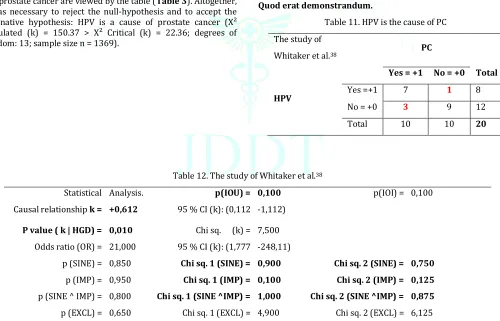
between HPV and prostate cancer and provided data view by
Table 11
. The statistical analysis is illustrated by
Table 12
. The
Fisher exact test statistic value is 0.0198 for conditio sine qua non
relationship and for the conditio per quam relationship. The
critical value of the conditio sine qua non relationship calculated
according to the rule of three
63is
p
critical(SINE) = 1- (3/20) =
0,85. Based on the data of Whitaker et al.
38without
HPV
no
PC and
equally
if
HPV
then
PC. The conclusion is inescapable: HPV is the
cause of PC.
Quod erat demonstrandum.
Table 11. HPV is the cause of PC
The study of
Whitaker et al.
38PC
Yes = +1 No = +0 Total
HPV
Yes =+1
7
1
8
No = +0
3
9
12
Total
10
10
20
Table 12. The study of Whitaker et al.
38Statistical Analysis.
p(IOU) = 0,100
p(IOI) = 0,100
Causal relationship
k =
+0,612
95 % CI (k): (0,112 -1,112)
P value ( k | HGD) = 0,010
Chi sq. (k) = 7,500
Odds ratio (OR) = 21,000
95 % CI (k): (1,777 -248,11)
p (SINE) = 0,850
Chi sq. 1 (SINE) = 0,900
Chi sq. 2 (SINE) = 0,750
p (IMP) = 0,950
Chi sq. 1 (IMP) = 0,100
Chi sq. 2 (IMP) = 0,125
p (SINE ^ IMP) = 0,800
Chi sq. 1 (SINE ^IMP) = 1,000
Chi sq. 2 (SINE ^IMP) = 0,875
4. DISCUSSION
Besides of the multiple advantages of the highly valuable and very
sensitive polymerase chain reaction
64(PCR) technique, PCR does
have severe limitations
65too. A key factor is the skill of the
personnel involved in performing and interpreting the
investigations.
Studies analyzed the impact of
marital status
(single, married,
divorced/separated, and widowed) on PC with contradictory
results. The Iranian study of Ghasemian et al. provided data which
support the hypothesis that being married is a necessary
condition to become HPV positive. In other words,
without being
married no HPV positivity
(p
Sine(Married
HPV positive) =
0,995; Chi sq. 1 (SINE) = 0,08; Chi sq. 2 (SINE) = 0,06; p(IOU)
=0,02, k > 0). The study design is extremely fair (p(IOU) =0,02)
while the causal relationship is positive but not significant. The
study of Dillner et al. and of Ghasemian et al. provided data on the
relationship between the marital status and prostate cancer. Both
studies support the hypothesis,
without being married no PC
.
The study design of Dillner et al. with p(IOU) = 0,28 was a very
unfair (p
Sine(Married
PC) =0,978; Chi sq.1 (SINE) =0,61; Chi sq.
2 (SINE) = 2,56; k > 0). The study design of Ghasemian et al. with
p(IOU) = 0,06 was a little bit unfair (p
Sine(Married
PC) =0,989;
Chi sq. 1 (SINE) =0,14; Chi sq. 2 (SINE) =0,24).
The studies analyzed provided a very convincing evidence of a
cause effect relationship between HPV and PC (X² Calculated (k) =
150.37 > X² Critical (k) = 22.36; degrees of freedom: 13; sample
size n = 1369). Whitaker et al.
38provided data which support the
hypothesis that HPV is the cause of PC (P value 0.0198).
5. CONCLUSION
HPV is the cause of PC.
Financial support and sponsorship
Nil.
Conflict of interest statement
None.
REFERENCES
1. Shope RE, Hurst EW. Infectious papillomatosis of rabbits : with a note on the histopathology, J Exp Med, 1933; 58(5):607-624. doi: https://doi.org/10.1084/jem.58.5.607 [PMID: 19870219] [PMCID: PMC2132321]
2. Koss LG, Durfee GR. Unusual patterns of squamous epithelium of the uterine cervix: cytologic and pathologic study of koilocytotic atypia, Ann N Y Acad Sci, 1956; 63(6):1245-1261. doi: https://doi.org/10.1111/j.1749-6632.1956.tb32134.x [PMID: 13314471]
3. zur Hausen H, Gissmann L, Schlehofer JR. Viruses in the etiology of human genital cancer, Prog Med Virol Fortschritte Med Virusforsch Progres En Virol Medicale, 1984; 30:170-186. [PMID: 6087412] 4. Favre M. Structural polypeptides of rabbit, bovine, and human
papillomaviruses, J Virol, 1975; 15(5):1239-1247. [PMID: 167184] [PMCID: PMC354579]
5. Burd EM. Human papillomavirus and cervical cancer, Clin Microbiol
Rev, 2003; 16(1):1-17. doi:
https://doi.org/10.1128/cmr.16.1.1-17.2003 [PMID: 12525422] [PMCID: PMC145302]
6. Barukčić I. Human Papillomavirus—The Cause of Human Cervical Cancer, J Biosci Med, 2018d; 06(04):106-125. doi: https://doi.org/10.4236/jbm.2018.64009
7. IARC. Human papillomaviruses, IARC Monogr Eval Carcinog Risks
Hum, 2007; 90:1-636. [PMID: 18354839]
8. Satterwhite CL, Torrone E, Meites E, et al. Sexually transmitted infections among US women and men: prevalence and incidence estimates, 2008, Sex Transm Dis, 2013; 40(3):187-193. doi: https://doi.org/10.1097/OLQ.0b013e318286bb53 [PMID: 23403598]
9. de Martel C, Plummer M, Vignat J, Franceschi S. Worldwide burden of cancer attributable to HPV by site, country and HPV type, Int J
Cancer, 2017; 141(4):664-670. doi:
https://doi.org/10.1002/ijc.30716 [PMID: 28369882] [PMCID: PMC5520228]
10. Bleeker MCG, Hogewoning CJA, Berkhof J, et al. Concordance of specific human papillomavirus types in sex partners is more prevalent than would be expected by chance and is associated with increased viral loads, Clin Infect Dis Off Publ Infect Dis Soc Am, 2005; 41(5):612-620. doi: https://doi.org/10.1086/431978 [PMID: 16080082]
11. McNicol PJ, Dodd JG. High prevalence of human papillomavirus in prostate tissues, J Urol, 1991; 145(4):850-853. [PMID: 1848641] 12. Badar F, Mahmood S. Epidemiology of cancers in Lahore, Pakistan,
among children, adolescents and adults, 2010-2012: a cross-sectional study part 2, BMJ Open, 2017; 7(12):016559. doi: https://doi.org/10.1136/bmjopen-2017-016559 [PMID: 29273649] 13. Pernar CH, Ebot EM, Wilson KM, Mucci LA. The Epidemiology of Prostate Cancer, Cold Spring Harb Perspect Med, January 2018. doi: https://doi.org/10.1101/cshperspect.a030361 [PMID: 29311132] 14. Giovannucci E, Liu Y, Platz EA, Stampfer MJ, Willett WC. Risk factors
for prostate cancer incidence and progression in the health professionals follow-up study, Int J Cancer, 2007; 121(7):1571-1578. doi: https://doi.org/10.1002/ijc.22788 [PMID: 17450530]
15. van Dong H, Lee AH, Nga NH, Quang N, Le Chuyen V, Binns CW. Epidemiology and Prevention of Prostate Cancer in Vietnam, Asian Pac J Cancer Prev, 2014; 15(22):9747-9751. doi: https://doi.org/10.7314/APJCP.2014.15.22.9747
16. Lin Y, Mao Q, Zheng X, et al. Human papillomavirus 16 or 18 infection and prostate cancer risk: a meta-analysis, Ir J Med Sci,
2011; 180(2):497-503. doi:
https://doi.org/10.1007/s11845-011-0692-6 [PMID: 21400096] 17. Hrbacek J, Urban M, Hamsikova E, Tachezy R, Heracek J. Thirty years
of research on infection and prostate cancer: no conclusive evidence for a link. A systematic review, Urol Oncol, 2013; 31(7):951-965. doi: https://doi.org/10.1016/j.urolonc.2012.01.013 [PMID: 22459691]
18. Bae J-M. Human papillomavirus 16 infection as a potential risk factor for prostate cancer: an adaptive meta-analysis, Epidemiol
Health, 2015; 37:2015005. doi:
https://doi.org/10.4178/epih/e2015005 [PMID: 25687950] 19. Yang L, Xie S, Feng X, et al. Worldwide Prevalence of Human
Papillomavirus and Relative Risk of Prostate Cancer: A
Meta-analysis, Sci Rep, 2015; 5:14667. doi:
https://doi.org/10.1038/srep14667 [PMID: 26441160]
20. Russo GI, Calogero AE, Condorelli RA, Scalia G, Morgia G, La Vignera S. Human papillomavirus and risk of prostate cancer: a systematic review and meta-analysis, Aging Male Off J Int Soc Study Aging Male,
January 2018:1-7. doi:
https://doi.org/10.1080/13685538.2018.1455178 [PMID: 29571270]
21. Moher D, Liberati A, Tetzlaff J, Altman DG. Preferred reporting items for systematic reviews and meta-analyses: the PRISMA Statement, Open Med Peer-Rev Indep Open-Access J, 2009; 3(3):123-130. [PMID: 21603045]
evaluate health care interventions: explanation and elaboration,
PLoS Med, 2009; 6(7):1000100. doi:
https://doi.org/10.1371/journal.pmed.1000100 [PMID: 19621070] 23. Anwar K, Nakakuki K, Shiraishi T, Naiki H, Yatani R, Inuzuka M. Presence of ras oncogene mutations and human papillomavirus DNA in human prostate carcinomas, Cancer Res, 1992; 52(21):5991-5996. [PMID: 1382850]
24. Ibrahim GK, Gravitt PE, Dittrich KL, et al. Detection of human papillomavirus in the prostate by polymerase chain reaction and in situ hybridization, J Urol, 1992; 148(6):1822-1826. [PMID: 1279224]
25. Tu H, Jacobs SC, Mergner WJ, Kyprianou N. Rare incidence of human papillomavirus types 16 and 18 in primary and metastatic human prostate cancer, Urology, 1994; 44(5):726-731. doi: https://doi.org/10.1016/s0090-4295(94)80215-7 [PMID: 7974946]
26. Moyret-Lalle C, Marçais C, Jacquemier J, et al. ras, p53 and HPV status in benign and malignant prostate tumors, Int J Cancer, 1995; 64(2):124-129. [PMID: 7542226]
27. Suzuki H, Komiya A, Aida S, Ito H, Yatani R, Shimazaki J. Detection of human papillomavirus DNA and p53 gene mutations in human prostate cancer, The Prostate, 1996; 28(5):318-324. doi: https://doi.org/10.1002/(SICI)1097-0045(199605)28:5<318::AID-PROS8>3.0.CO;2-7
28. Wideroff L, Schottenfeld D, Carey TE, et al. Human papillomavirus DNA in malignant and hyperplastic prostate tissue of black and white males, The Prostate, 1996; 28(2):117-123. doi: https://doi.org/10.1002/(SICI)1097-0045(199602)28:2<117::AID-PROS7>3.0.CO;2-D [PMID: 8604392]
29. Terris MK, Peehl DM. Human papillomavirus detection by polymerase chain reaction in benign and malignant prostate tissue is dependent on the primer set utilized, Urology, 1997;
50(1):150-156. doi:
https://doi.org/10.1016/S0090-4295(97)00126-X [PMID: 9218040]
30. Serth J, Panitz F, Paeslack U, Kuczyk MA, Jonas U. Increased levels of human papillomavirus type 16 DNA in a subset of prostate cancers, Cancer Res, 1999; 59(4):823-825. [PMID: 10029070]
31. Carozzi F, Lombardi FC, Zendron P, et al. Association of human papillomavirus with prostate cancer: analysis of a consecutive series of prostate biopsies, Int J Biol Markers, 2004; 19(4):257-261. [PMID: 15646830]
32. Leiros GJ, Galliano SR, Sember ME, Kahn T, Schwarz E, Eiguchi K. Detection of human papillomavirus DNA and p53 codon 72 polymorphism in prostate carcinomas of patients from Argentina,
BMC Urol, 2005; 5:15. doi:
https://doi.org/10.1186/1471-2490-5-15 [PMID: 16307686] [PMCID: PMC1314892]
33. Silvestre RVD, Leal MF, Demachki S, et al. Low frequency of human papillomavirus detection in prostate tissue from individuals from Northern Brazil, Mem Inst Oswaldo Cruz, 2009; 104(4):665-667. doi: https://doi.org/10.1590/s0074-02762009000400024 [PMID: 19722096]
34. Martinez-Fierro ML, Leach RJ, Gomez-Guerra LS, et al. Identification of viral infections in the prostate and evaluation of their association with cancer, BMC Cancer, 2010; 10:326. doi: https://doi.org/10.1186/1471-2407-10-326 [PMID: 20576103] [PMCID: PMC2912861]
35. Aghakhani A, Hamkar R, Parvin M, et al. The role of human papillomavirus infection in prostate carcinoma, Scand J Infect Dis,
2011; 43(1):64-69. doi:
https://doi.org/10.3109/00365548.2010.502904 [PMID: 20662618]
prostate cancer, J Med Virol, 2012; 84(9):1423-1427. doi: https://doi.org/10.1002/jmv.23268 [PMID: 22825821]
37. Mokhtari M, Taghizadeh F, Hani M. Is prostatic adenocarcinoma in a relationship with Human Papilloma Virus in Isfahan -Iran, J Res Med Sci Off J Isfahan Univ Med Sci, 2013; 18(8):707-710. [PMID: 24379849]
38. Whitaker NJ, Glenn WK, Sahrudin A, Orde MM, Delprado W, Lawson JS. Human papillomavirus and Epstein Barr virus in prostate cancer: Koilocytes indicate potential oncogenic influences of human papillomavirus in prostate cancer, The Prostate, 2013; 73(3):236-241. doi: https://doi.org/10.1002/pros.22562 [PMID: 22851253]
39. Michopoulou V, Derdas SP, Symvoulakis E, et al. Detection of human papillomavirus (HPV) DNA prevalence and p53 codon 72 (Arg72Pro) polymorphism in prostate cancer in a Greek group of patients, Tumour Biol J Int Soc Oncodevelopmental Biol Med, 2014;
35(12):12765-12773. doi:
https://doi.org/10.1007/s13277-014-2604-7 [PMID: 25213701] 40. Singh N, Hussain S, Kakkar N, Singh SK, Sobti RC, Bharadwaj M.
Implication of high risk human papillomavirus HR-HPV infection in prostate cancer in Indian population--a pioneering case-control
analysis, Sci Rep, 2015; 5:7822. doi:
https://doi.org/10.1038/srep07822 [PMID: 25592643]
41. Atashafrooz F, Rokhbakhsh-Zamin F. Frequency and Type Distribution of Human Papilloma Virus in Patients with Prostate Cancer, Kerman, Southeast of Iran, Asian Pac J Cancer Prev APJCP, 2016; 17(8):3953-3958. [PMID: 27644644]
42. Huang L, Wu M-G, He J, et al. [Correlation of high-risk HPV 16/18 infections with prostate cancer], Zhonghua Nan Ke Xue Natl J Androl, 2016; 22(6):501-505. [PMID: 28963837]
43. Aydin M, Bozkurt A, Cikman A, et al. Lack of evidence of HPV etiology of prostate cancer following radical surgery and higher frequency of the Arg/Pro genotype in Turkish men with prostate cancer, Int Braz J Urol Off J Braz Soc Urol, 2017; 43(1):36-46. doi: https://doi.org/10.1590/S1677-5538.IBJU.2015.0429 [PMID: 28124524]
44. Zhao X, Zhou Z, Chen Y, Chen W, Ma H, Pu J. Role of antibodies to human papillomavirus 16 in prostate cancer: A seroscreening by peptide microarray, Tumour Biol J Int Soc Oncodevelopmental Biol
Med, 2017; 39(6):1010428317698371. doi:
https://doi.org/10.1177/1010428317698371 [PMID: 28618964] 45. Masood S, Rhatigan RM, Powell S, Thompson J, Rodenroth N. Human
papillomavirus in prostatic cancer: no evidence found by in situ DNA hybridization, South Med J, 1991; 84(2):235-236. [PMID: 1703667]
46. Effert PJ, Frye RA, Neubauer A, Liu ET, Walther PJ. Human papillomavirus types 16 and 18 are not involved in human prostate carcinogenesis: analysis of archival human prostate cancer specimens by differential polymerase chain reaction, J Urol, 1992; 147(1):192-196. [PMID: 1309581]
47. Rotola A, Monini P, Di Luca D, et al. Presence and physical state of HPV DNA in prostate and urinary-tract tissues, Int J Cancer, 1992; 52(3):359-365. [PMID: 1328067]
48. Dodd JG, Paraskevas M, McNicol PJ. Detection of human papillomavirus 16 transcription in human prostate tissue, J Urol, 1993; 149(2):400-402. [PMID: 7678873]
49. Anderson M, Handley J, Hopwood L, Murant S, Stower M, Maitland NJ. Analysis of prostate tissue DNA for the presence of human papillomavirus by polymerase chain reaction, cloning, and automated sequencing, J Med Virol, 1997; 52(1):8-13. [PMID: 9131451]
[PMID: 9694597]
51. Strickler HD, Burk R, Shah K, et al. A multifaceted study of human papillomavirus and prostate carcinoma, Cancer, 1998; 82(6):1118-1125. [PMID: 9506358]
52. Gazzaz FS, Mosli HA. Lack of detection of human papillomavirus infection by hybridization test in prostatic biopsies, Saudi Med J, 2009; 30(5):633-637. [PMID: 19417961]
53. Chen AC-H, Waterboer T, Keleher A, et al. Human papillomavirus in benign prostatic hyperplasia and prostatic adenocarcinoma patients, Pathol Oncol Res POR, 2011; 17(3):613-617. doi: https://doi.org/10.1007/s12253-010-9357-4 [PMID: 21240663] 54. Tachezy R, Hrbacek J, Heracek J, et al. HPV persistence and its
oncogenic role in prostate tumors, J Med Virol, 2012; 84(10):1636-1645. doi: https://doi.org/10.1002/jmv.23367 [PMID: 22930513]
55. Ghasemian E, Monavari SHR, Irajian GR, Jalali Nodoshan MR, Roudsari RV, Yahyapour Y. Evaluation of human papillomavirus infections in prostatic disease: a cross-sectional study in Iran, Asian Pac J Cancer Prev APJCP, 2013; 14(5):3305-3308. [PMID: 23803120]
56. Yow MA, Tabrizi SN, Severi G, et al. Detection of infectious organisms in archival prostate cancer tissues, BMC Cancer, 2014; 14:579. doi: https://doi.org/10.1186/1471-2407-14-579 [PMID: 25106851]
57. Pourmand G, Salem S, Mehrsai A, et al. The risk factors of prostate cancer: a multicentric case-control study in Iran, Asian Pac J Cancer Prev APJCP, 2007; 8(3):422-428. [PMID: 18159981]
58. Dillner J, Knekt P, Boman J, et al. Sero-epidemiological association
between human-papillomavirus infection and risk of prostate cancer, Int J Cancer, 1998; 75(4):564-567. doi: https://doi.org/10.1002/(SICI)1097-0215(19980209)75:4%3C564 ::AID-IJC12%3E3.0.CO;2-9 [PMID: 9466657]
59. Schiffmann J, Beyer B, Tennstedt P, et al. Oncological outcome after radical prostatectomy: Marital status does not make a difference, Int J Urol Off J Jpn Urol Assoc, 2015; 22(5):484-489. doi: https://doi.org/10.1111/iju.12717 [PMID: 25781055]
60. Huang T-B, Zhou G-C, Dong C-P, et al. Marital status independently predicts prostate cancer survival in men who underwent radical prostatectomy: An analysis of 95,846 individuals, Oncol Lett, 2018; 15(4):4737-4744. doi: https://doi.org/10.3892/ol.2018.7964 [PMID: 29552113]
61. Loeb S, Folkvaljon Y, Damber J-E, Alukal J, Lambe M, Stattin P. Testosterone Replacement Therapy and Risk of Favorable and Aggressive Prostate Cancer, J Clin Oncol Off J Am Soc Clin Oncol,
2017; 35(13):1430-1436. doi:
https://doi.org/10.1200/JCO.2016.69.5304 [PMID: 28447913] 62. Barukčić I. Index of Unfairness, Mod Health Sci, 2019; 2(1):p22. doi:
https://doi.org/10.30560/mhs.v2n1p22
63. Barukčić I. Smoking of tobacco is the cause of human lung cancer, J
Drug Deliv Ther, 2019; 9(1-s):148-160. doi:
https://doi.org/10.22270/jddt.v9i1-s.2273
64. Mullis KB. The unusual origin of the polymerase chain reaction, Sci Am, 1990; 262(4):56-61, 64-65. [PMID: 2315679]