World Maritime University
The Maritime Commons: Digital Repository of the World
Maritime University
World Maritime University Dissertations Dissertations
2015
The implications of the implementation of part iii of
the united nations convention on the law of the sea
(UNCLOS) 1982 to the safety of navigation and
marine environmental protection in the straits used
for international navigation : The review of policy
and cooperation, and future direction of the
cooperative mechanism in the straits of Malacca
and Singapore
Nanditya Darma Wardhana
World Maritime University
Follow this and additional works at:http://commons.wmu.se/all_dissertations
Part of theLaw of the Sea Commons
Recommended Citation
Wardhana, Nanditya Darma, "The implications of the implementation of part iii of the united nations convention on the law of the sea (UNCLOS) 1982 to the safety of navigation and marine environmental protection in the straits used for international navigation : The review of policy and cooperation, and future direction of the cooperative mechanism in the straits of Malacca and Singapore" (2015).
World Maritime University Dissertations. 501.
WORLD MARITIME UNIVERSITY
Malmö, Sweden
THE IMPLICATIONS OF THE
IMPLEMENTATION OF PART III OF THE
UNITED NATIONS CONVENTION ON THE LAW
OF THE SEA (UNCLOS) 1982 TO THE SAFETY
OF NAVIGATION AND MARINE
ENVIRONMENTAL PROTECTION IN THE
STRAITS USED FOR INTERNATIONAL
NAVIGATION
The Review of Policy and Cooperation, and Future Direction of the
Cooperative Mechanism in the Straits of Malacca and Singapore
By
NANDITYA DARMA WARDHANA
Indonesia
A dissertation submitted to the World Maritime University in partial Fulfillment of the requirements for the award of the degree of
MASTER OF SCIENCE
In
MARITIME AFFAIRS
(Maritime Law and Policy)Class of 2015
DECLARATION
I certify that all the material in this dissertation that is not my own work has been identified, and that no material is included for which a degree has previously been conferred on me.
The contents of this dissertation reflect my own personal views, and are not necessarily endorsed by the University.
(Signature): ...
(Date): ...
Supervised by: Associate Professor María Carolina Romero Lares
World Maritime University
Assessor: Associate Professor Aref Fakhry
Institution/organisation: World Maritime University
Co-assessor: Dr. Chie Kojima
ACKNOWLEDGMENTS
First of all, I would like to express my gratefulness to Allah SWT for the strength during the writing process until this dissertation was finally completed and also for making this long and difficult journey possible.
I would like also to convey my sincere thanks to the Sasakawa Peace Foundation for sponsoring my studies here at World Maritime University. I am sure that with the knowledge which was received here, I would be able to assist my country to enhance the safety of navigation and marine environmental protection in Indonesian waters.
I would like also to extend my utmost gratitude for those who have assisted me in the process of writing this dissertation, especially for Professor María Carolina Romero Lares for the guidance in the supervision of this dissertation. Further, I would like to extend my special thanks to:
1. All the faculty and staff members of World Maritime University, especially the faculty members of Maritime Law and Policy, for sharing the experience and knowledge of the maritime law, and also for the library staffs, for the continues support and assistance during my course at World Maritime University;
2. Ms. Inger Battista and Ms. Anne Pazaver, for the support in giving linguistic advice;
3. Mr. A. Tonny Budiono, for the support and encouragement to pursue this degree;
4. Michael Lazaro, Captain Tan Weng Ho, and Fatima Aleli Angeles, for the friendship, the meaningful discussion and conversation during our course at World Maritime University;
6. The Indonesian S15 students; Radhitya Saputra, Yudha Rizkie Kurniawan, Iffansyah Yuliatmono, Whisnu Adhinegoro, Ali Attaturk, Usman Saroni, Yunian Krisnanda, Kharis Fauzi, Prahara Pradita, Nina Oktaviani, Widya Dwi Astutik, for the encouragement and support during process of writing this dissertation and also for the great time we had at World Maritime University;
7. Mas Gus Rional, Mr. Raymond Ivan Sianturi, Mr. Soedirman, Lalu Rano Agiansyah, Oktima Wuryantari, and other staff of The Directorate of Navigation, Directorate General of Sea Transportation of Indonesia, for the continues support during my studies here;
8. All of the S15 students at World Maritime University, for the great time during the studies at World Maritime University;
9. Papa Darma, Mama Tituk, Mbak Tia, Mas Rully, Dedek Ayka, Papa Ali, Mama Nina, Kakang and Dedek for the support and inspiration.
Last but not least, I would like also to extend my special thanks to my beloved wife, Rachma Wulan Lestari, and my lovely daughter Aletha Kayla Wardhana, for their patience and great support during my absence.
“No bird soars too high if he soars with his own wings”
ABSTRACT
Title of Dissertation: The Implications of the Implementations of Part III of the United Nations Convention on the Law of the Sea (UNCLOS) 1982 to the Safety of Navigation and Marine Environmental Protection in the Straits Used for International Navigation - The Review on the Policy and Cooperation, and Future Direction of the Cooperative Mechanism in the Straits of Malacca and Singapore.
Degree: MSc
Due to the development of the international trade, the shipping industry has become one of the prime methods of carrying commodities. Commodities are usually shipped through the main international routes, including the main international straits, which are usually used for international navigation. To regulate the rights and obligations between the littoral States and user States in the international Straits, UNCLOS 1982 adopted provisions, which are related to the Straits Used for International Navigation regime. The Straits of Malacca and Singapore are part of this regime.
To enhance the safety of navigation and marine environmental protection in the Straits of Malacca and Singapore, the littoral States (Indonesia, Malaysia and Singapore) have developed policies and initiatives based on Part III of UNCLOS 1982. The littoral States also successfully established the Cooperative Mechanism in the Straits, to invite broader involvement from the user States, shipping industry and stakeholders in the enhancement of the safety of navigation and marine environmental protection in the Straits of Malacca and Singapore, under the spirit of burden sharing under Article 43 of UNCLOS 1982.
This research aims to review the implications of the implementation of Part III of UNCLOS 1982 in the enhancement of the safety of navigation and marine environment protection in the Straits of Malacca and Singapore, and also to review the current development of the Cooperative Mechanism and policies taken under the Tripartite Technical Experts Group (TTEG) on safety of navigation in the Straits. Based on the marine accidents and marine pollution data in the Straits of Malacca and Singapore in the period of 2001 – 2014 and also from the meeting reports and other related sources, where the accidents and pollution were decreasing, it could be concluded that the implementation of Part III of UNCLOS 1982, in particular the establishment of Cooperative Mechanism, was effective in enhancing the safety of navigation and marine environmental protection in the Straits of Malacca and Singapore. Further, all of the policies developed under TTEG and Cooperative Mechanism, are in accordance with Part III of UNCLOS 1982, and also with the prevailing rules and regulations.
TABLE OF CONTENTS
DECLARATION i
ACKNOWLEDGMENTS ii
ABSTRACT iv
TABLE OF CONTENTS v
LIST OF TABLES ix
LIST OF FIGURES x
LIST OF ABBREVIATIONS xi
1. Introduction 1
1.1. Background 1
1.2. Objectives 6
1.3. Methodology 6
1.4. Limitation of the Research 7
1.5. Structure of the Research 7
2. General Information of the Straits of Malacca and Singapore 9
2.1. Introduction 9
2.2. Geographical Condition 10
2.3. Navigation Hazards through the Straits of Malacca and Singapore 11
2.4. The Importance of the Straits of Malacca and Singapore 12 3. Legal Regime of the Straits of Malacca and Singapore 17
3.1. UNCLOS 1982 Provision Related with the Straits Used for International
Navigation 17
3.1.1. Legal Status of the Straits of Malacca and Singapore under
UNCLOS 1982 18
3.1.2. The Rights and Duties of Littoral States and Ships in the Straits of
3.2. Jurisprudence Related to the Straits Used for International Navigation 22
3.2.1. The S.S. Wimbledon Case (The United Kingdom, France, Italy & Japan
v. Germany, 1923) 22
3.2.2. The Corfu Channel Case (The United Kingdom v. Albania, 1949) 22
3.3. IMO Conventions and IMO Resolutions Related to the Straits of Malacca
and Singapore 23
3.3.1. IMO Conventions Related to the Straits of Malacca and Singapore 23
3.3.2. IMO Resolutions and IMO Circular Related to the Straits of Malacca
and Singapore 25
3.4. Littoral States’ National Legislation Related to the Safety of Navigation and
Marine Environment Protection 27
3.4.1. Indonesia National Legislation Related to the Safety of Navigation and
Marine Environment Protection 27
3.4.2. Malaysia National Legislation Related to the Safety of Navigation and
Marine Environment Protection 28
3.4.3. Singapore National Legislation Related with the Safety of Navigation
and Marine Environment Protection 29
3.4.4. Findings on the Littoral States’ National Legislation Related to the Safety of Navigation and Marine Environment Protection 30
3.5. Maritime Delimitation in the Straits of Malacca and Singapore 30
3.5.1. Maritime Delimitation Between Indonesia and Malaysia in the Straits of
Malacca and Singapore 31
3.5.2. Maritime Delimitation Between Indonesia and Singapore in the Straits of
Malacca and Singapore 32
3.5.3. Findings on the Maritime Delimitation in the Straits of Malacca and
Singapore 34
4. Cooperation to Enhance the Safety of Navigation and Marine Environment Protection in the Straits of Malacca and Singapore 35
4.1. Littoral States’ Initiatives to Enhance the Safety of Navigation and Marine Environment Protection in the Straits of Malacca and Singapore 35
4.1.2. Agreement on Safety of Navigation in the Straits of Malacca and Singapore 1977 and Joint Statement on Safety of Navigation in the Straits of
Malacca and Singapore 1977 37
4.2. The Establishment and Development of the Cooperative Mechanism in the
Straits of Malacca and Singapore 39
4.2.1. Batam Joint Statement 2005 40
4.2.2. Jakarta Meeting in the Straits of Malacca and Singapore: Enhancing Safety, Security and Environmental Protection, 2005 40
4.2.3. Kuala Lumpur Meeting 2006 42
4.2.4. Singapore Meeting 2007 42
4.3. Policy and Initiatives Developed Under Tripartite Technical Expert Group (TTEG) and Cooperative Mechanism in the Straits of Malacca and Singapore 45
4.3.1. Policy and Initiatives under TTEG 46
4.3.2. Projects and Initiatives under Cooperative Mechanism 49
4.4. The Involvement and Roles of User States and Stakeholders 51
4.5. Marine Accidents in the Straits of Malacca and Singapore 55 4.6. States Practices on the Management and Operation of International Straits 56
4.6.1. Turkish Straits 57
4.6.2. The Strait of Gibraltar 57
4.6.3. Torres Strait 58
4.6.4. The Strait of Dover 59
4.6.5. Conclusion on the States’ Practices on the Management and Operational
of the International Straits 59
5. The Review of the Current Policy and Cooperation in the Straits of Malacca and
Singapore 61
5.1. The Review of the Implications of the Implementation of Part III of
UNCLOS 1982 Provision Related to the Straits Used for International Navigation to Enhance the Safety of Navigation and Marine Environmental Protection 61
5.1.1. Introduction 61
5.1.3. The Review of the Implementation of Article 43 of UNCLOS 1982 to Enhance the Safety of Navigation and Marine Environmental Protection in the
Straits of Malacca and Singapore 68
5.1.4. Problems with the Implementation of Part III UNCLOS 1982 by the Littoral States in the Straits of Malacca and Singapore 73
5.2. The Review of the Policy and Initiatives Developed under Tripartite
Technical Experts Group (TTEG) and Cooperative Mechanism 75
5.3. Future Direction of the Policy under Tripartite Technical Experts Group (TTEG) and Cooperation under Cooperative Mechanism Which Related to the Safety of Navigation and Marine Environmental Protection 78
6. Conclusion and Recommendations 83
6.1. Conclusion 83
6.2. Recommendations 85
REFERENCES 86
LIST OF APPENDICES
Appendix A: List of Conventions Ratified by the Littoral States 93
Appendix B: The Joint Statement 1971 97
Appendix C: The Joint Statement in Safety of Navigation in the Straits of Malacca
and Singapore, 1977 98
Appendix D: The Batam Joint Statement, 2005 99
Appendix E: Major Accidents in the Straits of Malacca and Singapore, 1971-2007 100
LIST OF TABLES
Table 1: The traffic Data in the Straits of Malacca and Singapore 13
Table 2: Oil and Liquefied Natural Gas (LNG) flows in the Straits of Malacca and
Singapore 16
Table 3: The Volume of the Cargo Loading and Unloading at Ports in the Straits of
Malacca and Singapore 16
Table 4: Straits Projects Under the Cooperative Mechanism in the Straits of Malacca
and Singapore 50
Table 5: Marine Accidents and Marine Environmental Damage Cases in the Straits
of Malacca and Singapore, 2008-2014 56
LIST OF FIGURES
Figure 1 : The Straits of Malacca and Singapore 10
Figure 2: The Critical Areas on the Straits of Malacca and Singapore 12 Figure 3: Type and Size of Transiting Vessels on the Straits of Malacca and
Singapore 14
Figure 4: The Volume of Crude Oil and Petroleum Products through world
Chokepoints 15
Figure 5: TSS in the Straits of Malacca and Singapore 26
Figure 6: STRAITREP Operational Areas 26
Figure 7: The Territorial Sea Delimitation Between Indonesia and Malaysia in the
Strait of Malacca 31
Figure 8: The Continental Shelf Delimitation Between Indonesia and Malaysia in the
Strait of Malacca 32
Figure 9: The Territorial Sea Delimitation Between Indonesia and Singapore in the
Strait of Singapore 33
Figure 10: The Components of the Cooperative Mechanism 44
Figure 11: The Number of Accidents Which Involved Littoral States’ Flags Vessel
Above 300 GT (2007-2014) 67
Figure 12: Comparison on the Marine Accidents in the Straits of Malacca and
Singapore, 1978-2014 70
Figure 13: Marine Pollution in the Straits of Malacca and Singapore, Before and After the Establishment of Cooperative Mechanism in 2007 71
Figure 14: Total Contributions Received by the Aids to Navigation Fund
(2008-2014) 73
LIST OF ABBREVIATIONS
AIS Automatic Identification System review
ANF Aids to Navigation Fund
APMs Associated Protective Measures
CF Cooperation Forum
COLREG’s The International Regulations for Preventing Collisions at Sea 1972
EEZ Exclusive Economic Zone
ICJ International Court of Justice
IMO International Maritime Organization
MARPOL 73/79 the International Convention for the Prevention of Pollution from Ships, 1973 as modified by the Protocol of 1978
MEH Marine Electronic Highway
PCC Project Coordination Committee
PCIJ Permanent Court of International Justice
PSSA Particularly Sea Sensitive Areas
SLOCs Sea Lines of Communication
SOLAS 74 International Convention for the Safety of Life at Sea, 1974
STCW 78 The International Convention on Standards of Training, Certification and Watchkeeping for Seafarers, 1978
SRS Ship Reporting System
STRAITREP the Mandatory Ship Reporting System in the Straits of Malacca and Singapore
TTEG Tripartite Technical Experts Group
UNCLOS 1982 United Nations Convention on the Law of the Sea, 1982
UNCLOS III The Third United Nations Conference on the Law of the Sea
1. Introduction
1.1. Background
The Straits of Malacca and Singapore has unique characteristics. It stretches from the Andaman Sea to the South China Sea (±600 NM), with narrow, shallow and critical areas in some parts of the Straits. The Straits of Malacca and Singapore is also considered as one of the strategic straits in the world, which is used for international navigation and domestic navigation by the three littoral States (Indonesia, Malaysia, and Singapore).
The geographical location of the Straits, which are located between the Indian Ocean and the Pacific Ocean makes the Straits become one of the main shipping routes which are used to transport various goods. According to the BIMCO (2014), almost one third of the world’s traded goods are transported through the Straits of Malacca and Singapore. This makes the Straits considered as one of the busiest shipping lanes in the world.
The most difficult stretch in the Straits of Malacca and Singapore for navigation is in areas where the Traffic Separation Scheme (TSS) spans between Horsburgh lighthouse in the east and One Fathom Bank off Port Klang in the west. The TSS extends to ±250NM and the narrowest point in the TSS is at the Phillips Channel, which is about 1.9 NM in width. There were also several navigational hazards in the Straits of Malacca and Singapore, which are related to the shipwrecks and shoal (Rusli, 2009).
predicted that there will be a significant increase of traffic in the Straits of Malacca and Singapore.
The Straits of Malacca and Singapore are also very vulnerable to the marine casualties. There were several accidents that occurred in the Straits of Malacca and Singapore, due to the high traffic and difficult geographical condition. The Straits also has a risk on the marine environmental disaster, since the high number of ships which pass through the Straits could result in pollution of the waters in the Straits.
In order to regulate the passage of foreign vessels to navigate not only in the Straits of Malacca and Singapore, but also in the other areas, which are related with the rights and obligations from both coastal States and user States, the United Nations adopted the United Nations Convention on the Law of the Sea (UNCLOS) 1982.
The UNCLOS 1982 developed a new legal framework concerning the right and responsibilities of the States in the six maritime zones, which are: Internal Waters, Archipelagic Waters, Territorial Waters, Contiguous Zone, Exclusive Economic Zone (EEZ), Continental Shelf, and High Seas. Each maritime zone contains its own legal status. Further, the UNCLOS 1982 also regulates the different passage regimes under the marine spaces. The passage regimes are the right of innocent passage, the right of transit passage and the right of archipelagic sea lane passage.
“The rights of navigation and overflight in the normal mode solely for
the purpose of continuous, expeditious and unobstructed transit
between one part of high seas or an exclusive economic zone and
another part of the high seas or an exclusive economic zone.”
The last passage regime under UNCLOS 1982 is the right of transit passage. Based on Article 38 (2) of UNCLOS transit passage is defined as:
“The freedom of navigation and overflight solely for the purpose of
the continuous and expeditious transit of the Strait between one part of
the high seas or an exclusive economic zone and another part of the
high seas or an exclusive economic zone.”
According to Rothwell (2010), the transit passage applies to foreign vessels within the territorial sea of an international strait which is subject to overlapping the territorial sea from the adjoining coast.
As mentioned, the regime related to the Straits Used for International Navigation is applied using the right of transit passage. It was developed in order to ensure that foreign vessels could have safe and expeditious passage through the international straits in order to carry out commercial and other activities.
On the Third United Nations Conference on the Law of the Sea (UNCLOS III) which started in 1973, the convention managed to draft the provisions related to the straits used for international navigation which applied between one part of high seas or an exclusive economic zone and another part of the high seas or an exclusive economic zone. The meeting also managed to draft the transit passage regime that is used in the Straits used for international navigation. Both provisions are later also mentioned in Part III of the UNCLOS 1982.
The UNCLOS 1982 also gives the opportunity for coastal States, user States, the shipping industry and other stakeholders to cooperate in the safety of navigation and marine environmental protection, based on the spirit of burden sharing of Article 43 of UNCLOS 1982. Further, under UNCLOS 1982 the Straits of Malacca and Singapore are considered as Straits Used for International Navigation, where the transit passage regime is applied.
In principle, the responsibility to ensure the safety of navigation and marine environmental protection in the Straits of Malacca and Singapore is under the littoral States. The littoral States have the sovereignty and sovereign rights over the Straits, based on the settlement of Maritime Delimitation between the three States (Indonesia, Malaysia and Singapore). Based on these settlements the littoral States could implement and develop their national legislation and International Maritime Organization (IMO) conventions and regulations, which are related to the safety of navigation and marine environment protection. Further, the littoral States developed cooperation to enhance the safety of navigation and marine environmental protection, based on their rights over the waters.
the commencement of the Joint Statement 1977, the coastal States jointly promoted the safety of navigation and marine environmental protection in the Straits by establishing a Tripartite Technical Experts Group (TTEG) on Safety of Navigation.
After the commencement of the series of meeting, which were sponsored by littoral States and IMO, under the IMO’s Protection of Vital Shipping Lanes Initiatives, which are the Jakarta Meeting 2005, the Kuala Lumpur Meeting 2006 and the Singapore Meeting 2007. Further, based on Article 43 of UNCLOS 1982, the littoral States established the Cooperative Mechanism in the Straits of Malacca and Singapore.
The said Mechanism was established to promote the cooperation between the littoral States, the user States, the shipping industry and stakeholders, in enhancing the safety of navigation and marine environmental protection in the Straits of Malacca and Singapore. The Cooperative Mechanism in the Straits of Malacca and Singapore is comprised of the Cooperation Forum, the Project Coordination Committee. TTEG is also designated as the principal coordinating body of the littoral States in the Cooperative Mechanism
Based on Part III of UNCLOS 1982, TTEG and Cooperative Mechanism have developed various policies and initiatives, which are related to the enhancement of the safety of navigation and marine environmental protection in the Straits of Malacca and Singapore. Further studies on the impact of the related policy and initiatives under TTEG and from the establishment of the said Cooperative Mechanism are needed, to show whether the system is working effectively to enhance the safety of navigation and marine environmental protection in the Straits of Malacca and Singapore.
1.2.Objectives
The objectives of this research are as follows:
1. To review and identify the implications of the implementation of Part III UNCLOS 1982, concerning Straits Used for International Navigation, in the enhancement of the safety of navigation and marine environment protection in the Straits of Malacca and Singapore;
2. To review the current development of the Cooperative Mechanism and the policy taken under TTEG on Safety of Navigation by littoral States in the Straits of Malacca and Singapore to enhance the safety of navigation and marine environmental protection;
3. To give the recommendations on the future direction of the Cooperative Mechanism in the Straits of Malacca and Singapore and on policy under TTEG, which could be implemented by the littoral States to improve the safety of navigation and marine environment protection in the Straits of Malacca and Singapore; and
4. To provide consolidated information concerning the cooperation in the Straits of Malacca and Singapore to enhance the safety of navigation and marine environmental protection, as well as the recommendation for the littoral States to have effective implementation of the policies and initiatives taken under TTEG and Cooperative Mechanism.
1.3.Methodology
1.4.Limitation of the Research
The subject of the research is limited to the implementation of UNCLOS 1982 as well as the other measures which were adopted by the coastal States, based on the IMO related Conventions and other related regulations. The issues that are being discussed in this research are also only limited to the safety of navigation and marine environment protection in the Straits of Malacca and Singapore, as the subject under Part III of UNCLOS 1982, and not related to the maritime security.
The research is also reviewing the marine casualty data which occurred in the Straits of Malacca and Singapore. The research will be limited by using data from the marine casualties from 2001 – 2014, which were obtained from the report of the three littoral States (Indonesia, Malaysia, and Singapore), and other references. Further, the research also studies the policy of the three littoral States by analysing the reports of the meetings under TTEG and the Cooperative Mechanism in the Straits of Malacca and Singapore, and analysing the related national laws and legislation from littoral States.
1.5.Structure of the Research
This research is organised into six chapters, namely:
1. Chapter one explains the background of the research, objectives, methodology, limitation of the study, and also the structure of the study; 2. Chapter two contains the general information of the Straits of Malacca and
Singapore;
3. Chapter three explains the legal regime in the Straits of Malacca and Singapore;
5. Chapter five contains the review of the present policy and cooperation in the Straits of Malacca and Singapore, and the future direction of the cooperation under the TTEG and the Cooperative Mechanism related to the safety of navigation and marine environmental protection;
2. General Information of the Straits of Malacca and Singapore
2.1. Introduction
The Straits of Malacca and Singapore have unique characteristics. The two major Straits of the world, namely the Malacca Strait and the Singapore Strait, are under the territory of three littoral States, which are Indonesia, Malaysia and Singapore. The Straits of Malacca and Singapore were officially started being mentioned as one Strait, based on the Joint Statement made by the three littoral States on 16 November 1971.
The Straits is very important for the international trade since it is providing the shortest sea routes between the Indian Ocean and the Pacific Ocean. The routes have been considered as the vital shipping routes for international and domestics navigation, and they are also being considered as the major artery for marine communication and thus became increasingly important to the maritime world. According to Khalid (2012), the Straits of Malacca and Singapore are considered as one of the Sea Lines of Communication (SLOCs), which are the key maritime passageways that facilitate high shipping traffic volumes and used to transport key maritime trades.
According to Leifer (1978), the Straits started to be used in the 15th century and became more important to maritime trade since the opening of the Suez Canal in 1869. Further, since the 1950’s the Straits have become important for the carriage of oil and general cargo from the Persian Gulf, India and Japan. There are also roles of the European countries as well as Singapore, South Korea, Hong Kong and Japan to transport their export and import activities.
In this Chapter, the author will give a brief explanation of the current conditions of the Straits by explaining the related information on geographical conditions, hazards to navigation through the Straits and also to shows the importance of the Straits of Malacca and Singapore for the international and domestic shipping industry. With the understanding on current conditions of the Straits, it will give a clear background of the needs to promote the safety of navigation and marine environmental protection of the Straits of Malacca and Singapore.
2.2.Geographical Condition
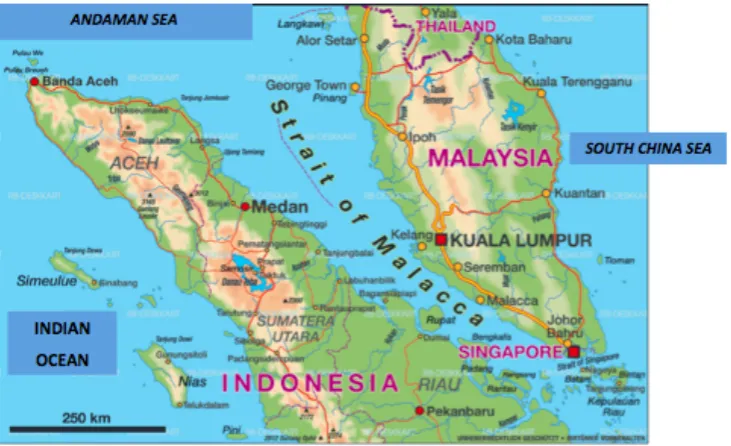
Leifer (1978) stated that the Straits of Malacca and Singapore extend for approximately 600 NM, stretch from the Andaman Sea to the South China Sea, and are situated between the southwestern part of the South China Sea and the southeastern part of the Andaman Sea. The Malacca Strait located between the west coast of peninsular or west Malaysia and the east coast of the Indonesian island of Sumatra. While Singapore Strait located south of the island of Singapore and the south-eastern part of peninsular Malaysia and north of the Indonesian Riau Island. (See Figure 1)
The Strait of Malacca is bordered by Thailand, Indonesia and Malaysia while the Strait of Singapore is bordered by Singapore, Indonesia and Malaysia. The Strait of Malacca forms a converging waterway as it narrows to the south before joining the Strait of Singapore. According to Rusli (2012), the narrowest width of the Strait of Singapore is situated at the southern part of Singapore, where the breadth is slightly more than a kilometre.
The length of the Straits of Malacca and Singapore from the Andaman Sea to the South China Sea is ±600 NM, while the length of the TSS from One Fathom Bank to Horsburg which was designated by the three littoral States, is ±260 NM. (Ministry of Transportation, Indonesia, 2013)
2.3.Navigation Hazards through the Straits of Malacca and Singapore
The Straits of Malacca and Singapore are located in the tropical area, where the high humidity and the high amount of rainfall occur almost everyday. The currents in the Straits, especially on the edge of the Strait of Malacca and the Andaman Sea, are very strong and unstable. According to Rusli (2009), there are parts of the Straits that are very narrow and shallow because of siltation. Haze could also cause problems in the Straits because it could lead into poor visibility for vessels that are navigating through the Straits.
There are several hazards to navigation in the Straits of Malacca and Singapore, namely: (Rusli, 2012)
1. Ship wrecks that may impede navigation;
2. Small islands, isles and shoals in the South Eastern exit to the Strait of Singapore;
Figure 2 shows some of the critical areas in the Straits of Malacca and Singapore, especially in the TSS, which is divided into the narrow and shallow area, and also the crossing area with high navigational traffic. In total, there are six critical areas in the TSS, with the width of sea lane not more than ±3.7 NM,
and with the depth not less than ±23M.
Figure 2: The Critical Areas on the Straits of Malacca and Singapore
2.4.The Importance of the Straits of Malacca and Singapore
The Straits of Malacca and Singapore has played an important role in the international maritime world. The geographical location of the Straits, which located between the Indian Ocean and the Pacific Ocean, makes the Straits become a strategic route not only for domestic navigation of the three coastal States but also for the international navigation passing through the Straits. The Straits of Malacca is also considered as the shortest sea route between the
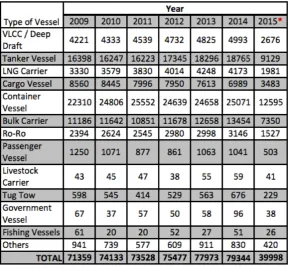
Based on the data of Marine Department Malaysia (2015), it was stated that there were 79,344 vessels navigating through the Straits of Malacca and Singapore in 2014, and it was predicted that there would be a significant increase in traffic in the Straits. The vessels which navigate through the straits was varied from VLCC, tanker vessels, LNG carriers, cargo vessels, container vessels, bulk carriers, Ro-Ro vessels, passenger vessels, livestock carriers, tugs, government vessels, and fishing vessels. As can be seen in Table 1, the highest users of the Straits are container vessels and tanker vessels, which reach almost 42,000 vessels per year.
Table 1: The traffic Data in the Straits of Malacca and Singapore
According to the Table 1, the world trade is very dependent on the Straits of Malacca and Singapore. By the figures of 79,344 per year in 2014, it can be estimated that almost 217 vessels transiting through the Straits each day. It means that nine vessels will pass through the Straits every hour. The research made by the Directorate General of Sea Transportation, Ministry of Transportation of Indonesia (2012) even stated that there would be an increasing number of vessels within five years. It was estimated that the vessels that will pass through the Straits in 2020 would reach almost 129,000 vessels per year.
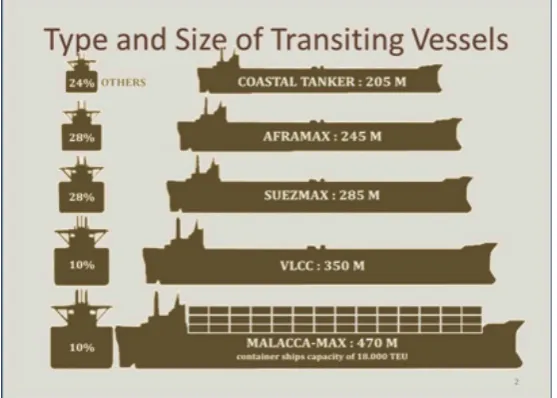
The number of navigating vessels on the Straits of Malacca and Singapore will be increased due the prediction that the economic condition within the region of East Asia and South East Asia will continue to grow and produce goods as well as import mineral resources. The growth of the economy in the area and also as a result from the improvement of shipping technology, makes the size and type of vessels passing through the Straits become bigger. This means that the vessels will reach the maximum type and size in the Straits of Malacca and Singapore, with the so called “Malacca-max”, as shown in the Figure 3.
Almost one third of the world’s traded goods are transported through the Straits. Based on the US Energy Information and Administration (2014), the Straits of Malacca and Singapore is considered as one of the world’s chokepoints for the maritime industry. It was stated that by blocking the chokepoint this can lead to substantial increases in total energy cost and world energy prices, since the disruptions of these routes could affect oil prices and add thousands of miles of transit in alternative routes.
The main commodities transported through the Straits of Malacca and Singapore are oil coal, iron ore and minerals, which are exported from the Middle East to East Asia and North East Asia (Ho, 2009). While on the other side the containers bringing cars, electronics, and other consumer goods to Africa nations and the Middle East. Figure 4 and Table 2 show that the Straits of Malacca was transited by an estimated 15.2 million barrels of oil per day and also 4,2 trillion cubic feet of LNG per year in 2013.
Figure 4: The Volume of Crude Oil and Petroleum Products through world Chokepoints
Table 2: Oil and Liquefied Natural Gas (LNG) flows in the Straits of Malacca and Singapore
Main Ports at the Straits of Malacca and Singapore
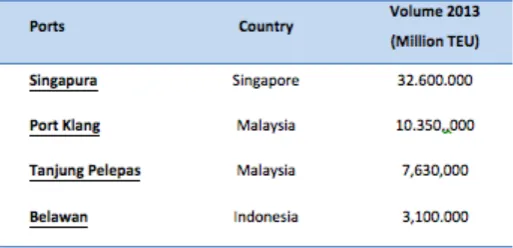
The Straits of Malacca and Singapore are not only used by transiting vessels to support the economy in other countries. The littoral States also used the opportunity to enhance their economic competitiveness. There are several main ports in the Straits of Malacca and Singapore that are used to support the economic condition in each littoral States. The main ports that are usually used are the Singapore ports, the Port Klang and Tg. Pelepas, which are located in Malaysia, and Belawan, which located in Indonesia.
As can be seen in Table 3, in 2013 the above mentioned ports play a very important role in the region. Singapore Port is one of the busiest ports in the world, and is also considered as the world major hub port. The four ports have also commenced development and expansion of their facilities to be able to receive and send more cargos.
Table 3: The Volume of the Cargo Loading and Unloading at Ports in the Straits of Malacca and Singapore
3. Legal Regime of the Straits of Malacca and Singapore
As mentioned before in Chapter one, the implementation of the Straits Used for International regime was initially started when the UNCLOS 1982 was adopted and had entered into force. The UNCLOS 1982 has the role as the umbrella convention which gives the rights and obligations for States and also user States in the enhancement of the safety of navigation and marine environmental protection in the Straits Used for International Navigation. The implementation of Part III of UNCLOS 1982 itself is closely related with the maritime delimitation settlement and also the enforcement of the national legislation and the IMO conventions and resolutions.
In this chapter, the author would like to give a brief explanation on the development of the Straits Used for International regime, international customary law related with the application of the regime, the related IMO conventions and resolutions which are related with the regime, the explanation of the littoral States’ national legislation, and also the maritime delimitation conditions in the Straits. The explanation of these areas are necessary to give a clear understanding of the development and implementation of the Straits Used for International Navigation regime in the Straits of Malacca and Singapore.
3.1.UNCLOS 1982 Provision Related with the Straits Used for International Navigation
sometimes using the main international straits, which are usually used for international navigation.
Based on the fact that international straits have always had an important role on international trade, there are needs to develop particular provisions to regulate the Straits Used for International regime. The development of the regime could be observed prior to the adoption of the UNCLOS 1982, where it is already started to be discussed at The Institut de Droit International, in 1894-1912, until the enactment of UNCLOS 1982.
3.1.1. Legal Status of the Straits of Malacca and Singapore under UNCLOS 1982
After series of meetings and negotiations, during the commencement of the UNCLOS III, there were several issues that were agreed by the States who have an interest in the international straits. According to Churchill (1999), the convention manages to reach a compromise between the different interest from the coastal States and the user States of the international straits. The transit passage regime allows less coastal States control over transiting vessels than innocent passage and the regime also allows the same freedom of navigation as exist if the waters of the Straits constituted the high seas.
The main focus of part III of UNCLOS 1982 is the straits which are used for international navigation between one part of the high seas and the EEZ, and another part of the high seas or the EEZ, and the transit passage regime which is applicable within the straits. According Rothwell (2010), Part III of UNCLOS 1982 also made a categorization of the straits, namely:
1. Straits which are regulated in whole or in part by long standing international conventions (Article 35 (c) of UNCLOS 1982);
3. Straits which are used for international navigation between one part of the high seas or an exclusive economic zone and another part of the high seas or an exclusive economic zone (Article 37 of UNCLOS 1982)
4. Straits which exist between the mainland and an island where there exist seaward of the island a route through the high seas or EEZ (Article 38 (1) of UNCLOS 1982);
5. Straits used for international navigation between one part of the high seas or EEZ and the territorial sea of a foreign State (Article 45 of UNCLOS 1982).
In UNCLOS 1982, the Straits of Malacca and Singapore is considered as the Straits Used for International Navigation under Article 37 of UNCLOS 1982, where the Transit Passage regime is applied. It is related to the definition of the transit passage which available in Article 38 (2) of UNCLOS 1982. In the article, it was stated that transit passage means the exercise in accordance with this Part of the freedom of navigation and overflight solely for the purpose of continuous and expeditious transit of the strait between one part of the high seas or an exclusive economic zone and another part of the high seas or an Exclusive Economic Zone. In addition, based on Article 44 of UNCLOS 1982, in the Straits Used for International Navigation, the vessels cannot be hampered and suspended when practicing the transit passage.
3.1.2. The Rights and Duties of Littoral States and Ships in the Straits of Malacca and Singapore
Based on Article 39 (1) of UNCLOS 1982, during the transit passage the vessels and aircraft are obliged to comply with four duties, namely: proceed without delay through the Strait; refrain from any threat or use of force against the sovereignty, territorial integrity or political independence of States bordering the Strait; refrain from any activities other than those incident to their normal modes of continuous and expeditious transit unless rendered necessary by force
majeure or by distress; and comply with other relevant provision of Part III of
Further, ships in transit passage are under duties to:
1. Comply with generally accepted international regulations, procedures, and practice for safety at sea, including the International Regulation for Preventing Collisions at Sea, and for the prevention, reduction and control of pollution from ships. (Article 39 (2) of UNCLOS 1982)
2. Refrain from carrying out any research or survey activities without the prior authorisation of the States bordering Straits. (Article 40 of UNCLOS 1982)
3. Respect applicable sea lanes and traffic separation scheme. (Article 41 (7) of UNCLOS 1982)
In the Article 41 of UNCLOS 1982, the littoral States may designate sea lanes and TSS for navigation in the Straits where necessary to promote the safe passage of vessels. According Yturriaga (1990), the States could only designating the said sea lanes when several requirements are met, which are as follows: its necessary to promote the safe passage of vessels; should conform with the “generally accepted international regulations”; need to be adopted by the competent international organization; and the States should indicate the designated sea lanes on the charts. Further, in Article 41 (5) of UNCLOS 1982 stated that, when more than two States bordering the Straits, the States should cooperate to develop the proposals for sea lanes and traffic separation scheme.
authority to adopt laws and regulations which are stricter than international regulations and standards.
Article 42 (1) of UNCLOS 1982 is also related to the Article 233 of UNCLOS 1982. The article gives the rights to coastal States to enforce their national laws, if the foreign vessels committed violation of the laws and regulation mentioned referred into Article 42 (1) of UNCLOS 1982, and causing or threatening major damage to the marine environment.
Based on this, if the foreign vessels committed violation of the national laws of the coastal States and causing major damage to the marine environment, the coastal States could commence the necessary enforcement measures based on Article 220 of UNCLOS 1982, which are as follows; undertake the physical inspection and institute the proceedings including detention of the vessels.
Article 43 of UNCLOS 1982 requires user States and States bordering a Strait to cooperate in the establishment and maintenance in a Strait of necessary navigational and safety aids or other improvements in aid of international navigation, and for the prevention, reduction and control of pollution from vessels.
3.2.Jurisprudence Related to the Straits Used for International Navigation
There are two main cases which are accepted as the jurisprudence and international customary law related to the legal regime in the straits used for international navigation, which are the Permanent of International Court of Justice (PCIJ) case, the S.S. Wimbledon case, and ICJ case, the Corfu Channel case.
3.2.1. The S.S. Wimbledon Case (The United Kingdom, France, Italy & Japan v. Germany, 1923)
The case is related with measures made by the German government on 21 March 1921, for refusing the English steamship Wimbledon to pass through the Kiel Canal because the ship carried 4,200 tons of ammunition and artillery stores from Salonica, Greece to a Polish naval base at Danzig. The reason for Germany to take these measures was because of their neutrality in accordance with the Russo-Polish war. The United Kingdom, France, Japan and Italy claims that Germany violated articles 380 to 386 of the Treaty of Versailles, which stated that the Kiel Canal should remain free and open to the vessels of commerce of war for all nations at peace with Germany on terms of entire equality (Brown, 2004).
On the judgment, the PCIJ declared Germany had no right to refuse entrance to the S.S Wimbledon because of the cargo that was carried. Kiel Canal should be considered as an international waterway, which is the connection between two parts of the high seas, and should be open to all vessels because the geographical condition of the canal could provide easier access to the Baltic Sea (PCIJ Reports of the Case of the S.S. Wimbledon (United Kingdom, France, Italy & Japan v. Germany), Judgement on 17 August 1923).
3.2.2. The Corfu Channel Case (The United Kingdom v. Albania, 1949)
Greek island in the Mediterranian Sea, called Corfu, bordered by Greece and Albania. On 22 October 1946, during the passage, HMS Saumarez and HMS
Volage, struck mines, which had been laid in the fairway, and caused 44 officers lost their lives, 42 officers were injured, and serious damage was caused to the two vessels. On 12 and 13 November 1946, the British forces arranged an operation called “Operation retail” on the Corfu Channel to sweep the mines. The United Kingdom asked for compensation for the losses due to the accidents however, the Albanian government refused to give such compensation, claiming that the British vessel had violated the international law by navigating the waters without having prior notification and authorization from Albania. Further, the United Kingdom filed the case against Albania to the ICJ.
Further, Brown (1994) also states that on the judgment of the Court stated that in times of peace States have a right to send their warships through straits used for international navigation between two parts of the high seas without prior authorization of a coastal State, provided that the passage is innocent. Unless otherwise regulated in an international convention, there is no right for a coastal State to prevent such passage through the straits in time of peace. Based on this judgment, the Court had decided that ships had unsuspended right of innocent passage through international straits.
Both cases, the S.S. Wimbledon Case and the Corfu Channel Case, were able to determine the non suspendable right of innocent passage of the foreign vessels which navigate through international straits. These judgements were later used to develop the transit passage regime in UNCLOS 1982.
3.3.IMO Conventions and IMO Resolutions Related to the Straits of Malacca and Singapore
3.3.1. IMO Conventions Related to the Straits of Malacca and Singapore
IMO conventions on safety of navigation, maritime security and marine environment protection.
Based on IMO (2015), Indonesia, Malaysia and Singapore are parties to the International Convention for the Safety of Life at Sea (SOLAS) 1974, the Convention on the International Regulations for Preventing Collisions at Sea (COLREG) 1972, the International Convention for the Prevention of Pollution from Ships (MARPOL) 1978, the International Convention on Standards of Training, Certification and Watchkeeping for Seafarers (STCW) 1978, the International Convention on Civil Liability for Oil Pollution Damage (CLC) 1969, and its amendments, the International Convention on Load Lines (LL) 1972, the International Convention on Tonnage Measurement of Ships (TONNAGE), 1969, and also the International Convention on the Control of Harmful Anti-fouling Systems on Ships (AFS), 2001.
However, only Singapore has ratified the Convention for the Suppression of Unlawful Acts Against the Safety of Maritime Navigation (SUA Convention) 1988, only Malaysia has ratified the International Convention for the Control and Management of Ship’s Ballast Water and Sediments (BWM) 2004, and only Indonesia has ratified the Special Trade Passenger Ships Agreement (STP) 1971 Convention. The list of conventions already ratified by the littoral States is listed in Appendix A.
3.3.2. IMO Resolutions and IMO Circular Related to the Straits of Malacca and Singapore
There are several IMO resolutions related with the Straits of Malacca and Singapore, namely:
1. IMO Resolution A. 375 (X) adopted on 14 November 1977 concerning Navigation Through the Straits of Malacca and Singapore.
This resolution adopted the Traffic Separation Scheme and Rules for Vessel Navigating Through The Straits of Malacca and Singapore. The TSS in the Straits of Malacca and Singapore is shown in Figure 5.
2. IMO Resolution A. 476 (XII) adopted in 19 November 1981 concerning the amendment of the Navigation Through The Straits of Malacca and Singapore.
This resolution adopted the revision on the Traffic Separation Scheme and Rules for Vessel Navigating Through The Straits of Malacca and Singapore.
3. IMO Resolution MSC. 73 (69) adopted in 19 May 1998 concerning the Mandatory Ship Reporting Systems in the Straits of Malacca and Singapore.
Figure 5: TSS in the Straits of Malacca and Singapore
Figure 6: STRAITREP Operational Areas
The IMO Circulars related to the Straits of Malacca and Singapore, are as follows:
1. IMO circular SN.1/Circ.282 dated 27 November 2009 related with the Prohibition of Anchoring in the Straits of Malacca and Singapore.
In this circular, the coastal States introduce the prohibition for vessels to anchor in all areas of the TSS, as well as between the landward limits of the TSS and approaches to the ports.
2. IMO circular SN.1/Circ.317 dated 4 December 2012 related to the Routeing Measures Other Than Traffic Separation Schemes.
In this circular, the littoral States introduce the Recommendatory Measure for Vessels Crossing the TSS and Precautionary Areas in The Singapore Strait During Hours of Darkness.
3.4.Littoral States’ National Legislation Related to the Safety of Navigation and Marine Environment Protection
On this section, the author would like to give a brief review and description regarding the measures of Indonesia, Malaysia and Singapore, as coastal States, to adopt the international maritime conventions related with to safety of navigation and marine environmental protection into its national legislations.
3.4.1. Indonesia National Legislation Related to the Safety of Navigation and Marine Environment Protection
Besides ratifying the UNCLOS 1982 and several IMO conventions as stated on the previous sub chapter, Indonesia has also adopted the rules and regulations into its national legislation. There are several main regulations that are related with the safety of navigation and marine environmental protection in the Straits of Malacca and Singapore, namely:
This law is regulating the rights and obligation of the States based on the regulation stipulated under UNCLOS 1982. Section three of the Law, regulates the Right of Transit Passage in the Indonesian waters, especially regarding the implementation of the transit passage regime in the Straits of Malacca and Singapore.
2. Law of the Republic Indonesia Number 17 Year 2008 concerning Shipping. The Law Number 17 Year 2008 concerning Shipping is regulating maritime security, safety of navigation and marine environmental protection in general.
3. Government Regulation of Republic Indonesia Number 5 Year 2010 concerning Navigation.
The said Government Regulation regulates the measures to ensure the safety of navigation in Indonesian waters, including in the Straits of Malacca and Singapore, and also the rules regulating COLREG 1972.
4. Government Regulation of Republic Indonesia Number 21 Year 2010 concerning Marine Environmental Protection.
The Government Regulation regulates the measures to ensure the protection of marine environment in Indonesian waters, including in the Straits of Malacca and Singapore.
3.4.2. Malaysia National Legislation Related to the Safety of Navigation and Marine Environment Protection
1. Merchant Shipping Ordinance 1952, and Merchant Shipping (Amendment and Extension) Act 2007;
This Act contains regulations on the ship registry, seafarer’s rights, maritime safety and security, pollution from ships, liabilities of shipowners, wreck and salvage, and pilotage.
2. Merchant Shipping (Oil Pollution) Act 1994;
This act contains regulations to ensure the protection of marine environment protection, especially from oil pollution.
3. Merchant Shipping (Collision Regulations) Order 1984;
This order contains the regulation of the prevention collision at sea based on the COLREG 1972.
4. Merchant Shipping (Collision Regulations) (Rules for Vessels Navigating Through the Straits of Malacca and Singapore) Order 1984.
This order contains additional regulations on the Merchant Shipping (Collision Regulations) Order 1984, especially to add the Rules for Vessels Navigating through the Straits of Malacca and Singapore, which were adopted by IMO.
3.4.3. Singapore National Legislation Related with the Safety of Navigation and Marine Environment Protection
In addition to the ratification of UNCLOS 1982 and IMO conventions, there are two Singapore’s national legislations statute/act that regulates the safety of navigation and marine environmental protection, namely: (Maritime Port and Authority, www.mpa.gov.sg, 2015)
1. Merchant Shipping Act (Chapter 179)
2. Prevention of Pollution of the Sea Act (Chapter 243)
This act contains the regulation which is related to the measures to enhance the marine environment protection as well as the regulation which aims to prevent pollution originating from sea.
3.4.4. Findings on the Littoral States’ National Legislation Related to the Safety of Navigation and Marine Environment Protection
Based on the littoral States’ national legislation which related to the safety of navigation and marine environment protection, in addition to the ratified UNCLOS 1982 and the important IMO conventions, the littoral States have also developed and regulated the conventions into their national legislation, to be enforced in their waters. From the list of national legislation, it could be stated that the littoral States have already given their commitments and efforts to enhance the safety of navigation and marine environmental protection in the Straits of Malacca and Singapore, by strengthen their national legislation framework in accordance with international law, especially with the Article 42 of UNCLOS 1982.
3.5.Maritime Delimitation in the Straits of Malacca and Singapore
In addition to the implementation of Part III UNCLOS 1982, the settlement on maritime delimitation between States in the Straits of Malacca and Singapore also plays an important role to enhance the safety of navigation and marine environmental protection. The settlement, which was conducted by using the relevant Article in UNCLOS 1982 and the Geneva Convention 1958, is important because littoral States need to practice their sovereignty and sovereign rights, given by UNCLOS 1982, including practicing their domestic rules and regulation to prevent collisions of ships as well as protecting the environment at sea.
Singapore are mainly bordered by Indonesia. There are only few parts of the Straits that need to be delimitated by Malaysia and Singapore.
3.5.1. Maritime Delimitation Between Indonesia and Malaysia in the Straits of Malacca and Singapore
Based on the agreement signed on the 17 March 1971, Indonesia and Malaysia had settled the territorial sea delimitation of the Malacca Strait. Since some parts of the Malacca Strait width are less than 24 nm, the territorial sea delimitation between the two States was drawn by equidistance line based on the provision of the Geneva Convention on the Territorial Sea and Contiguous Zone, 1958. Figure 7 shows that there are already several areas agreed by both governments, however, there are a few areas in the Singapore Strait which have not yet been settled by both governments.
Figure 7: The Territorial Sea Delimitation Between Indonesia and Malaysia in the Strait of Malacca
However, on the Continental Shelf, both governments have an agreement which was signed on 27 October 1969. Both governments managed to settle the Continental Shelf line based on the Geneva Convention on the Continental
Shelf, 1958, since UNCLOS III just started on the 1976. The agreed continental shelf delimitation in the Straits of Malacca, is shown in Figure 8.
Figure 8: The Continental Shelf Delimitation Between Indonesia and Malaysia in the Strait of Malacca
For the EEZ, both States have not yet agreed on the establishment of the line, since there is an issue related to the EEZ delimitation not yet settled. The Malaysian government stated that the Continental Shelf and EEZ are the same line, as mentioned in their declaration when Malaysia ratified UNCLOS 1982. On the other hand, Indonesia views that the EEZ and Continental Shelf are two separate lines that need to be further negotiated.
3.5.2. Maritime Delimitation Between Indonesia and Singapore in the Straits of Malacca and Singapore
Since the width on the Singapore Strait is less than 24 nm, both States agreed to only discuss the Territorial Sea delimitation. Both States managed to settle
Transportation of Indonesia (2014), there are three segments that were negotiated on the territorial sea delimitation negotiation between both States, which are the Eastern segment, middle segment, and Western segment. The middle segment, which was signed on 25 May 1973, is the first segment agreed by both States. The Western segment agreement was signed on 10 March 2009, and the latest agreement which was reached on the Eastern segment, was signed on 3 September 2014.
In the negotiation for the Western segment and the Eastern segment, Indonesia used the archipelagic baselines in accordance with Article 47 of UNCLOS 1982, while Singapore used the normal baselines in accordance with Article 5 of UNCLOS 1982. Both governments also agreed to use special circumstances, by taking into consideration the traffic conditions and other circumstances in the Singapore Strait, in accordance with Article 15 of UNCLOS 1982. Currently there is only one trijunction part involving Malaysia, which has not been settled. The illustration of the delimitation between Indonesia and Singapore is shown in Figure 9.
3.5.3. Findings on the Maritime Delimitation in the Straits of Malacca and Singapore
From the facts already described, it shows that the littoral States manage to nearly settled the maritime delimitation in the Straits of Malacca and Singapore, based on the international law, in example UNCLOS 1982 and Geneva Convention 1958, and with the spirit of understanding and cooperation among the littoral States. As the member of the Association of Southeast Asian Nation (ASEAN), the littoral States has also agreed to promote the peaceful settlement of dispute related to the maritime delimitation.
4. Cooperation to Enhance the Safety of Navigation and Marine Environment Protection in the Straits of Malacca and Singapore
4.1.Littoral States’ Initiatives to Enhance the Safety of Navigation and Marine Environment Protection in the Straits of Malacca and Singapore
Before the adoption and enactment of UNCLOS 1982, especially related to the provision on the Straits Used for International Navigation, there were debates between the coastal States’ interests on the safety, security and marine environmental protection on its waters, and the user States’ interest on right of international navigation in the International Strait.
The debate was started when the Straits of Malacca and Singapore gained the acknowledgement as one of the busiest and vital Straits that used in international trade. Because of its strategic roles for international trade, there were concerns related to the safety of navigation and marine environmental protection in the Straits of Malacca and Singapore, especially because the Straits has very unique characteristics, and is widely known to be among the most difficult routes to navigate. According to Djalal (2006), the concerns led into the attempt by several States to have greater involvement in the management and operation of the Straits of Malacca and Singapore, as well as making the status of the Straits under the “free transit” regime.
Further, to ensure and to promote the safety of navigation and marine environmental protection in the Straits of Malacca and Singapore, as well as to declared that the waters in the Straits are under the sovereignty of the littoral States, the three Straits States issued several initiatives, which are the Joint Statement 1971, Agreement on Safety of Navigation in the Straits of Malacca and Singapore 1977 and Joint Statement on Safety of Navigation in the Straits of Malacca and Singapore 1977.
same time implement and enforce their national legislation regarding the safety of navigation and marine environmental protection, based on the generally accepted international regulation.
4.1.1. Joint Statement 1971
After the Torrey Canyon accident, which occurred in 1967, there were attempts from the littoral States to cooperate and coordinate their views of and policy in the Straits of Malacca and Singapore, especially related to the legal regime and measures on the safety of navigation. Based on Koh (1982), in principle, the littoral States would like to maintain the Straits to be a zone of peace, freedom and neutrality, and also free from any form of interference from other States. It means that the littoral States would like to maintain the legal regime of the Straits under full sovereignty of the littoral States.
After several years of consultation, in the Ministerial meetings in October and November 1971, the littoral States finally manage to issued a Joint Statement on 16 November 1971, which basically stated that the Safety of Navigation is the responsibility of the littoral States, the needs to promote the safety on navigation in the Straits of Malacca, and the statement that the Straits of Malacca and Singapore is not an international strait. According to Djalal (2006), the Joint Statement was an important milestone in the cooperation in the Straits of Malacca and Singapore, especially related to the issue of the management of the Straits on the safety of navigation related matters. (See Appendix B)
Further, according to Koh (1982), the joint statement also highlighted that Indonesia and Malaysia did not consider the Straits as International Straits because they only recognised the application of the innocent passage in accordance with the rules and regulations related to territorial seas in the Straits, and not under free transit regime. The reason for this is that because at the time the compromise regime under UNCLOS 1982 had not yet been adopted, and there were still debates on the status of the Straits, whether it was under the innocent passage regime or under the free transit regime.
4.1.2. Agreement on Safety of Navigation in the Straits of Malacca and Singapore 1977 and Joint Statement on Safety of Navigation in the Straits of Malacca and Singapore 1977
As a follow up of the Joint Statement in 1971 and as a result of the Showa Maru incidents, which occurred on 6 January 1975, when the grounded vessels spilled almost 54,000 barrels of oil in the Singapore Strait, the three Littoral States agreed to meet and discuss the possible measures that could be taken to prevent and to promote and also to reconfirm their position in the Straits of Malacca and Singapore in relation to the safety of navigation and marine environment protection. (Djalal, 2006)
One of the results of the series of meetings held by the littoral States is the Agreement on Safety of Navigation in the Straits of Malacca and Singapore 1977, which was signed by the Ministers for Foreign Affairs from Indonesia, Malaysia, and Singapore, in Manila on 24 February 1977.
The agreement itself also agreed to adopt the measures and recommendations in The Joint Statement on Safety of Navigation in the Straits of Malacca and Singapore 1977, to keep the Straits open and safe for the international navigation. (See Appendix C)
The important measures adopted by the littoral States on the Joint Statement were the establishment of TSS, the designation of the Under Keel Clearance (UKC) as well as reporting procedures. After several meetings, the littoral States agreed to designated the 3.5 Metres UKC in the Straits of Malacca and Singapore. Based on Djalal (2006), this issue was considered as one of the most controversial issues, since there were different points of view between Indonesia and Malaysia, and on the other hand Singapore. Initially, Indonesia and Malaysia wanted to have a high safety margin, while on the other hand Singapore would like to accommodate bigger draught and tonnage vessels.
Financial matters are also one of the issues that were addressed by the littoral States in the Joint Statement. In one of the paragraph of the Joint Statement, the littoral States stated that the financial burden caused by the implementation of the TSS should not only be imposed on the littoral States but also on the user. This statement was an embryo for the cost burden sharing cooperation used by the littoral States on the Cooperative Mechanism, which was established in 2007. The other measures adopted are related to pilotage, reporting procedures, compulsory insurance and installation of safety devices.
Further, based on the Joint Statement, the proposal for the establishment of TSS in the Straits of Malacca and Singapore, and the Rules for Vessels Navigating through the Straits of Malacca and Singapore, was adopted by Inter-Governmental Maritime Consultative Organization (IMCO) with IMCO Resolution A. 375 (X) on 14 November 1977.