World Maritime University World Maritime University
The Maritime Commons: Digital Repository of the World Maritime
The Maritime Commons: Digital Repository of the World Maritime
University
University
World Maritime University Dissertations Dissertations
2006
Application of green GDP concept to the calculating method of
Application of green GDP concept to the calculating method of
economic benefits of the Yangshan deep-water port
economic benefits of the Yangshan deep-water port
Ruizhi Wang
WMU
Follow this and additional works at: https://commons.wmu.se/all_dissertations
Part of the Transportation Commons
Recommended Citation Recommended Citation
Wang, Ruizhi, "Application of green GDP concept to the calculating method of economic benefits of the Yangshan deep-water port" (2006). World Maritime University Dissertations. 940.
https://commons.wmu.se/all_dissertations/940
WORLD MARITIME UNIVERSITY
Shanghai, China
Application of green GDP Concept to the
Calculating Method of Economic Benefits of the
Yangshan Deep-water Port
By
WANG RUIZHI
China
A research paper submitted to the World Maritime University in partial Fulfillment of the requirements for the award of the degree of
MASTER OF SCIENCE
(INTERNATIONAL TRANSPORT AND LOGISTICS)
2006
DECLARATION
I certify that all the material in this research paper that is not my own work has been identified and that no material is included for which a degree has previously been conferred on me.
The contents of this research paper reflect my own personal views, and are not necessarily by the University.
Wang Ruizhi June 18th 2006
Supervised by
Professor Hou Ronghua Shanghai Maritime University
Assessor
Associate Professor Pierre Cariou World Maritime University
Co-Assessor
ACKNOWLEDGEMENT
After great effort of over than six months, my dissertation, which is the study on the application of green GDP concept to the calculating method of economic benefits of the Yangshan Deep-water Port, has finally come to the end. This dissertation is completed under the instructions of my supervisor, Professor Hou Ronghua. Here, please allow me to express my thanks to my supervisor Professor Mr. Hou, who generously gave his kind help and introduction during the whole progress of my paper writing .Every time he had to spend a lot of time in correcting my paper. Without his support and help, I can not accomplish my project very well. As Professor Hou’s strict requirements of study, great passion for working and respectable high efficiency at the process of this work, I can complete my research with required quality and quantity. Hence, these influential personalities will continuously affect my attitudes towards study and work tremendously in my life. I have also benefited quite a lot from the instructions and ability trained by Professor Hou during the daily communication in the progression of this dissertation.
ABSTRACT
Title: APPLICATION OF GREEN GDP CONCEPT TO THE CALCULATING METHOD OF ECONOMIC BENEFITS OF THE YANGSHAN DEEP-WATER PORT
Degree:Master of Science (International transport and logistics)
With the construction of the first phrase of the Yangshan Deep-water Port, it has successfully brought Shanghai and its surrounding areas billions of dollars benefit income. It is quite obvious that every transportation project is aimed to get the most economic benefit income, but it is also can not denied that certainly negative influences to humans’ health, natural resources and ecologic environment is being brought when the transport project is being built and putting into operating. So it is obvious that any economic benefits making by the Yangshan Deep-water Port should not at the sacrifice of environment and ecology.
But refer to the present method of calculating the economic benefits of the Yangshan Deep-water Port, it has mostly focus on the economic evaluation aspects, so we put forward the question of how to apply green gross domestic product (GDP) index which bases on ecologic and environmental aspects into the method of calculating the benefits of the Yangshan Deep-water Port to meet the requirement of sustainable development.
introduced the present methods to calculate economic benefits of a certain transport project. And in chapter three, it will present the background of Yangshan Deep-water Port and “with and without test” which is the present method to calculate the economic benefits of the Yangshan Deep-water Port. The forth chapter is referring to application of green GDP concept into the calculating method of economic benefits of Yangshan Port. There would be three aspects will be influenced from the construction and operating stages of the Yangshan deep-water Port, such as the human being health, natural resources and ecologic environment. And in the last chapter, it discusses the difficulties to apply green GDP concepts into the whole evaluation method.
So after a period of time’s researching the relating theories and backgrounds of this problem, and with the help and guidance of Professor Hou Ronghua, I have tried my best to make analysis of the present method of calculating economic benefits of Yangshan Deep-water Port, and provided solutions and recommendations of how to modify the method under the concepts of green GDP.
LIST OF ABBREVIATIONS
GDP Gross Domestic Product
LIST OF TABLES
Table 3.2.1 Cargo loading level
Table 3.2.2.1 Economic benefits of the Yangshan Deep-water Port
Table 3.2.2.2 The evaluation of direct influence of the first period of the Yangshan Deep-water Port
Table 3.2.2.3 Total economic benefits of Yang Shan Port
Table 4.3.2.1 Major Transport Land Use Comparisons
LIST OF FUNCTIONS
1. Green GDP’s calculating function: Green GDP = A – B – C
= E – C (1) Where
A--- GDP B--- Fixed assets
C--- Usage value of natural resources in production E--- Net domestic product
F--- Usage value of natural resources in production
2. Project national economy appraisal criterion under green GDP accounting
= A – E1 – E2 – E3 (2) Where
A--- Project national economy appraisal criterion E1--- Value of project effect on human health
E2--- Value of project effect on resource E3--- Value of project effect on environment
3. The Yangshan Deep-water Port’s national economy appraisal criterion under green GDP accounting
=A–E1 – E2 –E3 (3) Where
A --- The Yangshan Port national economy appraisal criterion E1--- Value of the Yangshan Port effect on human health
E2--- Value of the Yangshan Port effect on resource
4. The effect on human health by transport project generated particle can be evaluated by the following equation:
1 2 3 4 1 E E E E E PA PD PC + + + × × =
(4) Where
PC---value of effect on human health by transport project generated particle
PD---particle led disease number PA---medical cost per disease
E1--- transport project generated particle E2---chimney generated smoke
E3---fire generated smoke particle E4---other generated particle
5. The effect on human health by transport project noise pollution can be evaluated by the following equation:
NC =ND×NF×NA+NR+NP (5)
Where
NC--- value of effect on human health by Yangshan Deep-water Port project noise pollution
ND--- the Yangshan Port project noise pollution related disease number
NF--- factor of the Yangshan Port noise pollution in final disease NA--- medical cost per disease
TABLE OF CONTENTS
Declaration ⅱ Acknowledgement ⅲ
Abstract ⅳ List of Abbreviations ⅵ
List of Tables ⅶ List of Functions ⅷ
CHAPTER ONE INTRODUCTION 1
1.1 Problem Formulation 1
1.2 Purposes and Methodology of Study 4
1.3 Overall structure of the dissertation 5
CHAPTER TWO LITERATURES REVIEW 7
2.1 Traditional research contribution to the calculating method 7
of economic benefits of transport projects 2.2 The background of Green GDP theory 9
2.2.1 GDP theory in foreign countries 9
2.2.1.1 The formation of sustainable development theory 10
2.2.1.2 The development from GDP to green GDP 12
2.2.1.3 Definition of green GDP 14
2.2.1.4 Indications of green GDP 14
2.2.2 Green GDP theory in China 15
2.2.2.1 The situation of environmental studying 15
2.2.2.2 Green GDP theory study 16
2.2.2.3 Current situation in China 16
CHAPTER THREE
PRESENT METHOD OF CALCULATING ECONOMIC BENEFITS
OF THE YANGSHAN DEEP-WATER PORT 20
3.1 Background of the Yangshan Deep-water Port 20
3.1.1 Geographic background 20
3.1.2 Advantages Analyses 21
3.1.2.1 Infrastructure structure 21
3.1.2.2 Geographical position 22
3.1.2.3 Handling speed 22
3.1.2.4 Modern logistics parks 23
3.1.2.5 Developing hinterlands to western and inland areas 24
3.1.2.6 New city emerges in Shanghai 25
3.2 The present method to calculate economic benefits of the Yangshan Deep-water Port (“with and without test”) 25
3.2.1 Short-term economic loss if Shanghai has no deep water port 26
3.2.2 Long term economic loss if Shanghai has no deep water port 29
3.3 Chapter summary 34
CHAPTER FOUR APPLICATION OF GREEN GDP CONCEPT TO THE CALCULATING METHOD OF ECONOMIC BENEFITS OF THE YANGSHAN DEEP-WATER PORT 35
4.1 The significance of calculating economic benefits of the Yangshan Deep-water Port under the principles of green GDP 37
4.2 The overall environmental evaluation of the Yangshan Port 40
4.3 The environmental indications of the Yangshan Deep-water Port under green GDP concept 42 4.3.1 Evaluation of Effect on Human Health by the Yangshan Port Project
4.3.1.1 Evaluation of effect on human health by the emission 42
4.3.1.2 Evaluation of effect on human health by the Yangshan deep-water Port project noise 46
4.3.2 Evaluation of Effect on Natural Resources by the Yangshan Port Project 49
4.3.2.1 Land 49
4.3.2.2 Water 51
4.3.3 Evaluation of Effect on Environment by the Yangshan Port Project 52 4.4 Chapter summary 55
CHAPTER FIVE THE DIFFICULTIES TO IMPLEMENT GREEN GDP CONCEPT TO THE CALCULATING METHOD 57
5.1 Thetechnical difficulties 58
5.2 The ideological obstacle 58
CHAPTER SIX CONCLUSION 60
CHAPTER ONE INTRODUCTION
1.1 Problem Formulation
China boasts fast economic growth over the past two decades, but behind the "growth" were enormous environmental costs. That is to say, the process of economic growth, however, is also a process involving the increased consumption of natural resources, environmental pollution and ecological degradation. China's ocean environment, especially the shallow waters just off the coast, has been severely polluted by an increasing run-off of contaminants into the sea. The oceans have a limited capacity to absorb pollution. Now we have less and less fish and the ocean environment is deteriorating. We cannot endlessly exploit the oceans any more. We should protect them. Furthermore, it is difficult for oceans to recover from pollution, and so the pressing task is to reduce pollution in the future. At present, China cannot recycle all the pollutants it produces due to lagging recycling facilities and poor environmental awareness in some areas. But the authorities have pledged to make more efforts to improve this situation.
environmental preference should be introduced while calculating the economic benefits of transport projects.
As we all know that the Yangshan Deep-water Port is one of the most important transport projects not only to Shanghai but also to China. It has a profound influence on transportation, trade and economy of Shanghai and its nearby areas, even the whole country. Then what is rather significant to make it clear is that how much economic benefit the Yangshan Deep-water Port can contribute to Chinese economic growth? So it is very worthy to make a detailed and deep studying for the accounting method of economic benefits for the Yangshan Deep-water Port. After the research and analysis, we find that the present method is not so perfect and complete, because it is not including the cost of the loss of natural resources and the cost of environmental pollution. As it known to all that both in the processes of construction and operation, the Yangshan Deep-water Port really costs a lot of natural resources and environment to produce the economic value, for example, it destroys millions arcs of plow lands, impairing the valuable usage of tide energy, reducing even using up many mineral resources, and it will contaminate the environment of air, water and vegetation, breaking the balance of nature and also do harm to the wild animals and human beings living around.
Therefore, in this paper, the author raised a kind of method to revise and improve the present method of accounting the economic benefit for the Yangshan Deep-water Port, which includes the consideration of the costs of natural resources and environmental pollution. It is called “Green Method”, which is under the concept of green GDP.
Green GDP is derived from Gross Domestic Product (GDP), which is a core indication of domestic economy accounting system to measure the economic level, analyzing the economic benefit and making forecasts of economic situations in a country or an area. However, as the idea and of sustainable development strategy come out and more and more attention is given to environmental protections, the indication of the GDP is obviously not that complete to meet the requirement, since it is lacking the calculation of summing up all the cost of natural resources and environmental pollution. So it is an opportunity for green GDP to come out of water, green GDP is made out to modify the GDP, making more focus on environment problems, especially adding the cost of natural resources and environmental pollution to the total economic cost. Green GDP successfully solves the problem of deficiency and inaccurate of GDP. And at the same time, it is also very practical and reasonable to apply the green GDP concept and its indications into the accounting method of economic benefit for the Yangshan Deep-water Port.
indications in order to get the real economic benefits of the Yangshan Deep-water Port.
In the paper, it has also raised the issue of how to set up a system to evaluate the economic benefits which based on the principle of green GDP. And with the further investigation and research, it comes three categories of the impacts of the Yangshan Deep-water Port, such as human being health, natural resources and ecologic environment. So with these three aspects of modifications, the result of economic benefits is surely been more reasonable and accurate which can meet the requirement of sustainable development and environmental preservation.
1.2 Purposes and Methodology of Study
In the dissertation, it presents the “with and without test” to calculate the economic benefits of the Yangshan Deep-water Port. The “with and without test” means “Contrast between Have and not Have”on Economic Evaluation of Transport Project. This test is one of the most popular tests to evaluate the economic benefits of a certain project in quantity, and others are like Evaluation of Increase Test, Forth and Back Contract Test, Comprehensive Test and Horizontal contract Test, these kinds of tests are so as to find out effects through making contracts between the two aspects:
(a) Forth and Back Contrast Test is the direct way to evaluate the relative benefits between the indications before and after the construction of the project.
(c) Horizontal Contrast Test means the contracts between the relevant indications which are in the same industry category, so as to evaluate the economic benefits and competitive ability of the project.
Refer to the “With and without test”, which means the contract of actual impacts and economic benefits before and after the construction of a certain project. Here “With” means the economic benefits brought by the construction of this project, and “Without” means the project has not built any more. This test can reflect the actual economic benefits after the built up of the project.
Therefore, in the dissertation, “with and without test” is applied in the method to calculate economic benefits of the Yangshan Deep-water Port. Under several reasonable assumptions and referring to many statistics from some information sources and the investigations and researches made by experts both in domestic and aboard, with the help of this test, it can get the total estimating economic benefits of the Yangshan Deep-water Port. This test will be divided into two aspects, one is from the short term and the other is from the long term. From these two time periods, it will get a more accurate and practical result of the economic benefits.
1.3 Overall structure of the dissertation
“with and without test” which is the present method to calculate the economic benefits of the Yangshan Deep-water Port. The forth chapter is referring to application of green GDP concept into the calculating method of economic benefits of Yangshan Deep-water Port. And in the last chapter, it discusses the difficulties to apply green GDP concept to the modified whole evaluation method. In order to further analysis and make the explanation, the overall structure of the dissertation is as follows:
The Problem Formulation
Past Research Distribution
Comparison between the Calculating Methods of Economic Benefits of the Yangshan Deep-water Port under green GDP Concept
Human Health Natural Resources Ecologic Environment
Application of Green GDP Concept to the Calculating Method of Economic Benefits of the Yangshan Deep-water Port
CHAPTER TWO LITERATURES REVIEW
2.1 Traditional research contribution to the calculating method of economic benefits of transport projects
Regarding the economic appraisal of transport projects, European countries have begun to evaluate their effect on environment on a quantitative basis (Grant-Muller, 2001). In the USA, their promotion on economy has been emphasized (Adler, 1987). The environment protection requirements are lower than those in the EU. In international context, the most recent development is to use AEANDP (AFTER ENVIRONMENTAL ADJUSTMENT NET DOMESTIC PRODUCT), which deduces artificial capital depreciation, environmental resources depreciation and loss from the environment pollution, to study the projects effect on national economy. That is, environment loss has been regarded as a cost.
of environmental effect.
The framework of green GDP accounting was established. Experiment of it has begun in one province or city for every big region. Although China's green GDP theory was leading in the world and has gained support and recognition in practice, no breakthroughs have been made on techniques and methods till now. This can be shown that construction project incidence on the environment has the problem of market insensitivity which means there is no market price for the effect. This leads to difficulty in accounting. The pricing of environmental effect is also a world wide difficult problem.
gained internal energy.
In fact, if the project can be resource-saving and environmentally friendly, it means the cost of resources and environment protection is reduced. Hence, ultimately and from a long-term development view, green GDP brings more benefit to business and project than harm.
2.2 The background of Green GDP theory
In order to get the new economic pattern and changes and developments of the green GDP and sustainable development, experts and scholars from home and abroad have conducted a series of researches of green GDP development and its indication systems in many respects. The brief introduction of this topic’s studying development process as follows.
2.2.1 Green GDP theory in foreign countries
GDP (gross domestic product),the market value of all final goods and services produced by all resident units within a country(or a region) in a given period of time. GDP is not just reflecting the development of product but reflecting the tendency of increase of all services, reflecting the scale and level in the national economy and social development, GDP is also one of the most essential core indications of national income accounting system, it gathering up the product outcomes of all activities into an extreme statistic figure, and this figure can completely measure the economic level of a country or a region, analysis the economic benefits and forecast the economic tendency.
taxes on production, operating surplus, depreciation of fixed assets, and the GDP data obtained with use approach is t he total expenditure on final consumption, total capital formation and net export of goods and services. There three approaches in theory can get the same result; but in fact, it will be different from different statistics. GDP has been the well recognized and united measurement, because it has followed several functions:
(a) GDP can reflect the economical and poverty level of a country or a region
(b) GDP can reflect the scale of economic development and the tendency of economic growth
(c) GDP can analysis the economic policy and modify the industrial structure
2.2.1.1 The formation of sustainable development theory
The sustainable development theory is coming to meet the requirement of environment preservation. After the late of 80s, sustainable development theory is popularly accepted and spread by international societies and governmental organizations as a complete definition of “the sustainable development is not only satisfying the need of present generation, but also do no harm to the ability of gaining satisfaction for the next generation.”
natural imbalance, so in 1977, the experts of United Nations environment arrangement department put out a report, which concerning about the concept of environmental development. In the report, environmental development refers to the development which meets the requirement of environmental development, that is the economic development should be in the limitation of the rules of environment, once it beyond the limit, the function of reproduction of natural resources and self-cleaning of environment will be destroyed, then will cause serious environment problems to effect the sustainable development of productivity.
In 1980s, some experts and international institutes has worked on the relationship between environment and economy and made such a big breakthrough, that is economy and social development are the basis of smoothing the important environment problems, and at the same time, the goals of economy and social development should be avoided the environmental pollution, or minimize the degree of pollution.
In 1987s, in the report of “our common future” delivered by the international environment and development committee, it explains the concept of ‘sustainable development”. After this report, sustainable development is accepted and spread by international societies, governments and organizations.
2.2.1.2 The development from GDP to green GDP
In 1980s, there are three kinds of methods to add natural resources and environmental pollution cost into GDP accounting system. The first is setting up a totally brand new system which includes environmental considerations, this is the most effective way to show results in the indications of GDP, but the new system is too difficult to build. The second method is to maintain the existing GDP system at one hand, and make a few modifications and adjustments of environmental cost to GDP at the other hand, and this method is now adopted by the United Nations as the principle of Green GDP. The third one is to build the other system which includes the environmental expenses parallel to the existing GDP system; however, this way is not accepted by United Nations nowadays.
As mentioned in above, the way to calculate GDP has not included the natural resources, so it can not reflect the economic loss of natural resources. That means take air, water and forests as an example, everyone can get as much as these natural resources at free, these natural resources loss are not included in the field of calculating GDP. So GDP can not reflect the economic loss of natural resources, and also can not restrict the uses of natural resources by people efficiently and effectively. Furthermore, it can lead to the severe environmental pollution and the losing of valuable natural resources. As a solution to meet the requirement of sustainable development, it comes out the point of adding environmental factors into the accounting method of GDP and the concept of “environmental cost”, which then developed into green GDP theory.
value of direct products served to human beings by ecology system, but not calculate the indirect value produced by ecology system as the living supportive system, so the concept of GDP is not so complete and perfect in some aspects. It results these main negative impacts, the first is aggrandize the economic growth rate based on the rising of GDP figure, the second is not predict the loss of devaluation of natural resource and degradation of environment, the third is to ruin the natural resource and environmental which are the basis and conditions to economic development due to the over-pursuing of material fortune, so these three deficiencies obstacle the sustainable healthy development of an economic society and can not satisfy the requirement of sustainable development.
So in the late 1990s, more and more scholars suggested to modify the accounting items of GDP by some environmental indications. In a word, there are three kinds of methods to modify GDP, the first is to set up a totally new GDP accounting system, it is the most efficient way to reflect the indications of economic development ability, but it is very hard to calculate this system by present accounting level, the second is still to maintain the system of national income accounting system, but only modify the environmental cost of the net national product value, the concept of green GDP is just derived from this method, and now adopted by United Nations, the third one is to set up another system which is parallel to the present national income accounting system and includes a complete environmental indications item, but this way is not accepted by United Nations. Then we will focus on the one of green GDP as follows:
called “ecology GDP”. It removes out the environmental cost from the total national income value, implying the sustainable development principles and realizing the optimal union of economic benefit, social benefit and ecology benefit.
2.2.1.3 Definition of green GDP
As for the definition of green GDP there are several sayings. We define it as a data obtained after the deduction of the cost of resources, environment and human health from the traditional GDP. Therefore, the judgment of specific projects will be altered by these three items under the green GDP accounting framework. Generally speaking, the economic indications will become worse after the adjustment.
The switch of concepts from GDP to green GDP can not only make out the significance of sustainable development, but also provide a more accurate and more reasonable method to calculate the total value of domestic product. Furthermore, this concept also can be applied into the accounting method of economic benefit in any valuable product. It is also the practical value and objective, so we make Yangshan Port be an example to calculate its economic benefit in the new method which based on the concept of green GDP.
2.2.1.4Indications of green GDP
Green GDP’s calculating function: Green GDP = A – B – C
= E – C (1) Where
A--- GDP B--- Fixed assets
C--- Usage value of natural resources in production E--- Net domestic product
F--- Usage value of natural resources in production
2.2.2 Green GDP theory in China
2.2.2.1 The situation of environmental studying
2.2.2.2 Green GDPtheory study
In China, green GDP is considered as an adjusted GDP, it is also an indication of sustainable development. Green GDP is modified by a series of environmental indications on the basis of the present method of GDP. And these environmental indications have four parts:
A. environmental capital depreciation
B. expenses of the preventing for environmental destroy C. expenses of the recovery for resources and environment D. the extra expenses caused by using resources not optimize
2.2.2.3 Current situation in China
With regard to China, green GDP is the most efficient indication to reflect sustainable development. From now on, there is not one country can calculate green GDP to meet the requirement of statistics, neither can China.
China now is to establish "green GDP" index system. The State Statistical Bureau (SSB) and the State Environmental Protection Administration (SEPA) are jointly working on the criteria for the so-called green GDP, which deducts the cost of environmental damage and resources consumption from the traditional gross domestic product.
the introduction of a "green GDP" index system has become an urgent and crucial task for sustainable development.
In the past 25 years, China has achieved an economic miracle with average GDP growth at above 8 percent every year. However, as GDP has become the main standard, or the only standard in some regions, to evaluate the government's performance, many local officials have turned a blind eye to development in other fields, including medical care, education, culture and environmental protection. The traditional GDP index could not fully reflect the relationship between economic growth and the environment, the environment and people.
If the current high-cost growth and serious pollution continues, China will face a heavily-polluted environment and a serious shortage of natural resources in the near future, which would not support its future development. We must adopt a scientific approach to the current accounting system of GDP, a comprehensive indicator of the economy.
Southwest China's Chongqing Municipality, the only trial city designated by the SSB in 2001 for developing the "green GDP" system, has studied data collected from 1,415 local enterprises and non-profit institutions. Based on the study, an initial feasible "green" GDP accounting approach has come into being.
from the conventional GDP. The pilot calculation will not include the cost of resource consumption. The investigation will cover the cost on pollution management and sewage disposal, the effect of air and water pollution on human health, the effect of water pollution on crops, the condition of construction materials and the economic loss caused by pollution.
Beijing, along with nine other provinces and municipalities, was chosen by the central government in March to conduct experiments on calculating the green GDP. The full test results are expected to be released next year and will lay the foundation for a nationwide system of green GDP.
With the further social improvement and economic development, there is an increasing number of economic experts have realized the importance of GDP, the indication of a country’s economic level, but at the same time, they also aware of the significance and the huge impact of environment protection and natural resources preservation.
2.3 Chapter summary
CHAPTER THREE PRESENT METHOD OF CALCULATING ECONOMIC BENEFITS OF THE YANGSHAN DEEP-WATER
PORT
3.1 Background of the Yangshan Deep-water Port 3.1.1 Geographic background
The Yangshan Deep-water Port is a mega-port project under construction on the Eastern China Sea. It will turn Shanghai into the shipping hub of northeast Asia, with complete logistic facilities and surging foreign trade as support. It is being built on two islands 27 kilometers from Luchao port in the southern Nanhui District. So far, RMB YUAN 3.5 billion (US$421 million) has been spent after a year of construction, about 24.5 percent of the anticipated total investment in the first-phase construction, which includes a 31.8-kilometer-long cross-sea bridge and five berths. According to the plan, the Yangshan Deep-water Port has about 18 square meters continental areas and about 20km deep water coastal line, it has more than 50 container berths and container throughput will be 2.2 million TEUs in 2005, 5.5 million TEUs in 2010 and 13.4 million TEUs in 2020.
3.1.2 Advantages Analyses
There are four main advantages of the Yangshan Deep-water Port, the first is to accept large size ships based on its deep water container berths and infrastructure facilities; the second is its better geographical position to gain large cargo throughput and to become the hub port to attractive national and international containers; the third is its highly handling speed; the forth is to offer integrative service of transshipment, processing, warehousing and multimodal transportation. However, the Yangshan Deep-water Port’s most important task is focused on the first function, which means to solve the two problems of lacking of deep water port and deficiency of container throughput for the long term development of Shanghai Port, so as to reach improvement of port function and set the firm basis of sustainable development.
3.1.2.1 Infrastructure structure
3.1.2.2 Geographical position
Geographically, the Yangshan Deep-water Port is seated in Shanghai, which is the largest economic center and the big coastal port city of China and also near the trunk line of international sea-routes, therefore, with this perfect and advantageous position, the Yangshan Deep-water Port can attract multi-liner ships to call at and to be the deep-water container hub port of Shanghai International Shipping Center and make Shanghai be the most important port of northwest Asia. Shanghai's geographic advantage of abutting on the sea and the Yangtze River endows it with an advantageous position as a big port in the world. With China's smooth entry into WTO, the imports and exports in foreign trade will continually increase. The economic hinterland of Shanghai Port will also continuously stretch towards the middle and western regions with the improvement of national traffic network system, and with convenient distribution and transport conditions and prompt and considerate port service environment, more ship owners and cargo owners will deem Shanghai Port as the cargo distribution center. It is predicted that until 2005, the container throughput of Shanghai Port will surpass 15 million TEUs.
3.1.2.3 Handling speed
3.1.2.4 Modern logistics parks
On April 8th of this year, Shanghai International Transportation Center started the Yangshan Logistics Park project as the matching project of the Yangshan Deep-water Port Construction Project. By the end of 2005, the logistics park project has been accomplished and put into use with the first phase of the Yangshan Deep-water Port construction simultaneously.
The Logistics Park, covering 13.8 square meters, is to be built into the biggest modern logistics park in Asia. It includes three functional sections, logistics as storage, logistics electrical machinery, electrical appliances as storage, logistics and IT information. Three are three advantages of the Logistics Park are:
(a) Opposite the Yangshan Deep-water Port with "water" in between, the park is the most important hinterland of the deepwater port and meets the strong radiation from it, becoming the "battlefront" of Shanghai's new round economic booming.
(b) Convenient traffic.
The park has convenient traffic network, it takes no more than 50 minutes driving from the Zone to Pudong Airport, the Yangshan Deepwater Port, Shanghai Chemical Industrial Park and downtown.
(c) Advantageous investing environment.
3.1.2.5 Developing hinterlands to western and inland areas
The Yangshan Deep-water Port should continually expand its hinterland both in the country and overseas. In detail, it means the Yangshan Deep-water Port should not only take the account of covering the areas along the Yangtze River, but also should consider western and inland areas these old and conventional manufacturing areas as its expanding hinterlands to increase domestic sea trade transportation competition. For example, if a container transship base can be built in Xian, it will be a container resource center in northwest areas for the Yangshan Deep-water Port. Furthermore, based on the previous example of taking Taicang Port as the feeder port for Jiangsu Province, Shanghai can let Congming and Changxing or Wusong areas be its transshipment feeder ports to efficiently and effectively handle the containers in and out the Yangtze River. According to some statistics, and with the contrast of some free ports like Singapore and Hong Kong, which has the transshipment throughput ratio of 50%, there is only 2% of international transshipment throughput in the whole throughput quantity in Shanghai, so it is very obvious that it is very important for the Yangshan Deep-water Port is to become the international transshipment port, then it can realize to be the international transport port.
As for the connection of Shanghai and westerns and hinterland areas,
the first railway train has already depart from Luchao port railway
station, it marks the official opening of railway services in Shanghai's
Pudong area. The rail-line, costing a total RMB YUAN 2 billion
(US$248 million) and extending for 42.87 kilometers, is the first
element of the new transport links to the Yangshan Deep-water Port.
Currently with four stations, at Ruanxiang, Caojing, Haiwan and Pingan,
the Pudong railway is designed to pass through several districts across
containers to and from the Yangshan Deep-water Port on the East China
Sea and the mainland.
3.1.2.6 New city emerges in Shanghai
The Lingang New City, a city close to the Yangshan Deep-water Port,
was unveiled recently after two years of construction.
The city, which made its debut in late March, has already signed
investment contracts of US$1.25 billion with domestic and foreign
companies, an official of the Lingang New City told reporters on
Tuesday. The development of the new city so close to the Yangshan
Deepwater Port was a strategic step towards the Shanghai's goal of
building an international shipping center by 2020. Lingang, covering
nearly 300 square kilometers with a population of 800000, has the most
potential among the country's developing areas. At the southeastern tip
of Shanghai, Lingang faces Pudong International Airport to the north
and the Yangshan Deep-water Port to the south, boasting easy access to
five modes of transportation: ocean, air, river, highway and railway.
Lingang is designed to be an equipment manufacturing base that will
house automotive, ship, logistic, electronic and aerospace equipment,
and will be a supporting stronghold for the emerging the Yangshan
Deep-water Port.
3.2 The present method of calculating economic benefits of the
Yangshan Deep-water Port
In April 1st 2002, the Yangshan Deep-water Port project has officially
broken through. Shanghai Tongsheng Investment (group) limited
corporation has invested huge amount of money into the Phase One
including port areas, bridge and all equipments with five container
So since then, Shanghai has enough deep-water port to handle the
biggest container ships. The whole the Yangshan Deep-water Port
project has divided into four constructive periods using single channels,
and will be completely done in 2020 with the total budget of RMB
YUAN 500 billion and can reach 15000000 TEU annually. As a part of
Shanghai Port, the Yangshan Deep-water Port can solve the problem of
lacking deep-water port in Shanghai before, and it has a batch of 15
meters deep berths to satisfy the requirement of the enlargement of international container ships, and also has better competitive advantages to other ports. So in this part, the “with and without test” is used to calculate the main economic benefits of the Yangshan Deep-water Port in the following several aspects.
The “With and without test”
3.2.1 Short-term economic benefit loss of Shanghai without a deep-water port
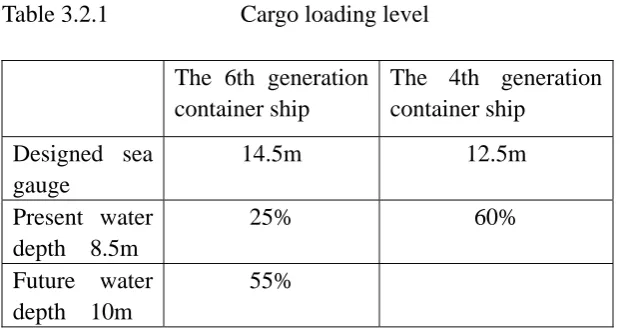
The forth generation container ships has a designed draft of 12.5 meters, it can reach 60% of container slots coverage with 8.5 meters water depth in Shanghai Port. After the second dredging project, it will deepen the water depth to 10 meters, and the sixth generation ship can cover 55% of total slots, so it should be taken into consideration of if there are enough cargoes to fulfill the ship transport capability of once or twice a week of 3300TEU. In the short term of about five years, the choice of which kind of ship scales for shipping companies is according to the water depth, the local cargoes amount and the frequency of liner schedule.
Conditions used in the following calculating are in the Table 3.2.1:
Table 3.2.1 Cargo loading level
The 6th generation container ship
The 4th generation container ship
Designed sea gauge
14.5m 12.5m
Present water depth 8.5m
25% 60%
Future water depth 10m
55%
In the next step, it will choose two possible water depths to analysis the problem in the short term:
The first hypothesis: when water depth is increased into 10 meters, the shipping company will use the sixth generation container ships. The second hypothesis: when water depth maintains 8.5 meters, the
shipping company will use the forth generation container ships.
two meters, but this usage of tides can cause expensive time consuming loss.
(a) The economic loss of waiting tides
The hourly cost of the sixth generation container ships is 1900 dollars, and the forth generation is 1500 dollars. How much time for waiting tides is decided by the draft when ship starts to sail, which means it depends on the ship’s stowage rate. If we suppose that the average waiting time is six hours, which is the half of tides’ lasting time.
So in the first hypothesis, every time the sixth generation container ships call at the port, it will make the loss of 11400 dollars (1900 dollar per hour * 6 hours). Since the sixth generation container ships are designed to get 60% of the container slots loading rate, the total number of containers in Shanghai Port is 100% of stowage rate (suppose that the same amount of import and export cargo quantity). Therefore, the average waiting time loss is 1.9 dollars per TEU (11400 dollars / 60% of container loading rate). In the second hypothesis, the waiting time loss is 2.2 dollars per TEU of the forth generation container ships using the same kind of calculating method as mentioned above. In a word, these two timing loss per TEU is all opportunity cost, which means the cost margin between with and without deep water port in Shanghai.
(b) The increased voyage cost caused by using smaller ships
grounding of the calculation, total containers of every round voyage including containers from other areas except Shanghai will increased by 33 dollars per TEU. Therefore, in the second hypothesis, the opportunity cost of without deep water port will divided into two parts, the lose of time waiting loss and the lose of using smaller ships loss, then adding them up to 35 dollars per TEU.
(c) The meaning of short term loss
The loss caused by water draft limitation, especially in the second hypothesis is rather huge, but this large loss is still not big enough to lead shipping companies to change its service mode in Shanghai fundamentally, which means shipping companies will not change to call at other regional hub ports instead of Shanghai port directly. In conclusion, in the short term, the amount of cost increasing is not very large and can not influence the service mode for shipping companies. So does not impact a lot without deep water port in Shanghai.
3.2.2 Long term economic loss if Shanghai has no deep water port
So in a word, the long term economic loss is much more than short term economic loss in Shanghai and eastern areas. From the long term view, shipping companies may give up calling at Shanghai port directly and at the same time to provide cargoes to other regional hub ports. So from the long term view, it will impact a lot on economic loss if Shanghai has no deep water port, and it will increase a lot of costs and also influence the shipping companies to change its service mode and the possibility of providing cargoes to other regional hub ports. Here we use “with and without test” to estimate the economic benefits loss of transshipment.
(a) The economic benefits loss of voyage cost
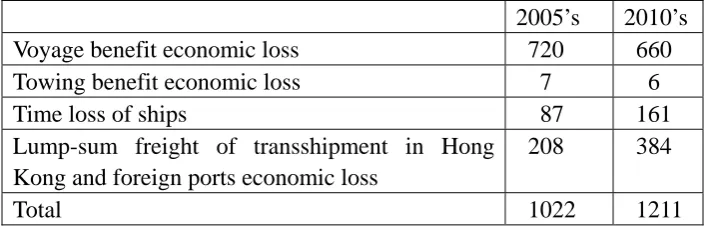
First we supposed that if the Yangshan Deep-water Port has not been constructed, so trunk lines ships can not call at Shanghai Port, the transshipment should have to be done in other countries. However, after the Yangshan Deep-water Port has built to serve the fifth and the sixth generation container ships, the cost of per TEU of these big ships is much cheaper than those small ships since the economic scale. As statistics show that in 2005, the economic benefits loss of voyage cost in transshipment overseas can be RMB YUAN 7.2 billion without Yangshan Port, and till 2010 this figure can be gone up to RMB YUAN 6.6 billion.
(b) The economic loss of using towing boats
piloting and towing boats can be summed up to about RMB YUAN 7 million due to the transshipment happened in foreign countries not in Shanghai. And till to the year 2010, the final economic benefit cost can be increased to RMB YUAN 6 million.
(c) The economic loss of ships on the voyage
If there is no the Yangshan Deep-water Port, super large container ships will still wait for tides to enter the port, so the shipping companies may not to use these big ships. There can be two ways, the first is to arrange 2700 TEU ships for the overseas transportation lines, but this kind of ship has a low speed which can increase the time consuming cost of the voyage. The other way is to use siding line ships to do the transshipment in Hong Kong or other foreign transshipment ports, which will result the time increased by siding line ships to wait for trunk ships and transshipment handling. We suppose that the cargo value is 20000 dollars per TEU, and the cargo cash flow loaning rate is 7%, and the increasing time of transshipment is 42 hours, so according to the annually planned container throughput quantity of the Yangshan Deep-water Port, the economic loss of the transshipment in foreign countries will be RMB YUAN 87 million in 2005, and will increase to RMB YUAN 1.61 billion in 2010.
(d) The economic loss of lump-sum freight of transshipment in Hong Kong or other foreign ports
freight is RMB YAUN 1600 per TEU, the economic loss of lump-sum freight of transshipment in Hong Kong and foreign ports will be RMB YUAN 20.8 billion in the year 2005 and then increase to RMB YUAN 38.4 billion in the year 2010.
Table 3.2.2.1
Economic benefits of the Yangshan Port
In RMB million
2005’s 2010’s
Voyage benefit economic loss 720 660 Towing benefit economic loss 7 6
Time loss of ships 87 161
Lump-sum freight of transshipment in Hong Kong and foreign ports economic loss
208 384
Total 1022 1211
Table 3.2.2.2
The evaluation of direct influence of the first period of the Yangshan Port
In RMB billion
2002 2003 2004 2005 2006 After 2007 Transportation 2.05 5.11 7.67 10.23 Construction 34.47 28.73 28.73 22.98
Direct influence
Produce 34.47 28.73 30.78 280.9 7.67 10.23
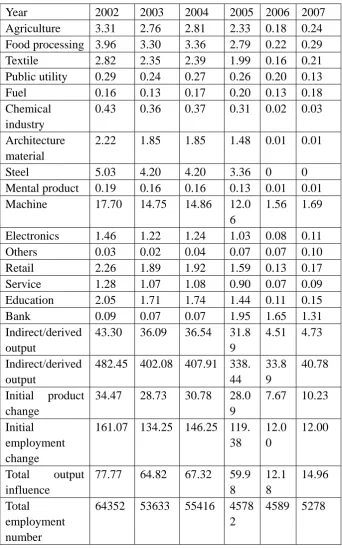
Table 3.2.2.3
Total economic benefits of Yang Shan Port
In RMB billion
Year 2002 2003 2004 2005 2006 2007 Agriculture 3.31 2.76 2.81 2.33 0.18 0.24 Food processing 3.96 3.30 3.36 2.79 0.22 0.29 Textile 2.82 2.35 2.39 1.99 0.16 0.21 Public utility 0.29 0.24 0.27 0.26 0.20 0.13 Fuel 0.16 0.13 0.17 0.20 0.13 0.18 Chemical
industry
0.43 0.36 0.37 0.31 0.02 0.03
Architecture material
2.22 1.85 1.85 1.48 0.01 0.01
Steel 5.03 4.20 4.20 3.36 0 0 Mental product 0.19 0.16 0.16 0.13 0.01 0.01 Machine 17.70 14.75 14.86 12.0
6
1.56 1.69
Electronics 1.46 1.22 1.24 1.03 0.08 0.11 Others 0.03 0.02 0.04 0.07 0.07 0.10 Retail 2.26 1.89 1.92 1.59 0.13 0.17 Service 1.28 1.07 1.08 0.90 0.07 0.09 Education 2.05 1.71 1.74 1.44 0.11 0.15 Bank 0.09 0.07 0.07 1.95 1.65 1.31 Indirect/derived
output
43.30 36.09 36.54 31.8 9
4.51 4.73
Indirect/derived output
482.45 402.08 407.91 338. 44 33.8 9 40.78 Initial product change
34.47 28.73 30.78 28.0 9
7.67 10.23
Initial employment change
161.07 134.25 146.25 119. 38 12.0 0 12.00 Total output influence
77.77 64.82 67.32 59.9 8 12.1 8 14.96 Total employment number
64352 53633 55416 4578 2
3.3 Chapter summary
CHAPTER FOUR APPLICATION OF GREEN GDP CONCEPT TO THE CALCULATING METHOD OF ECONOMIC
BENEFITS OF THE YANGSHAN DEEP-WATER PORT
In the last chapter, it presents the economic benefits income of the Yangshan Deep-water Port with the “with and without test”. From the statistics in the tables above, till year 2010, this number will be amounted to about RMB YUAN 121100 million of total economic benefits of the Yangshan deep-water Port.
influence on the overall environment and ecology can last for really a long time, and some pollutions and damages are not able to be recovered or renewable. So how to set up a complete system to evaluate a construction project on both environment and economic aspects is urgent ahead of all the issues.
That is quite obvious that every transportation project is aimed to get the most economic benefits, but it is also can not denied that certainly negative influences to humans’ health, natural resources and ecologic environment is being brought when the transport project is being built and putting into operating. So any economic benefit making should not at the sacrifice of environment and ecology. Keeping the balance of nature and reduce environment pollution are the two requirements which should be reached simultaneously and definitely.
So refer to the transportation project of the Yangshan Deep-water Port, we should also give the evaluation form both the economic and environmental aspects. In the last chapter, it has presented the economic benefits calculating of the Yangshan deep-water Port with the “with and without test”. But this method has not make further economic evaluation of its negative influences on human being, natural resources and ecologic environment either in quantity or quality, so it is taken granted as the shortage of this method.
health, natural resources and ecologic environment issues. And some formulas and functions to calculate the economic evaluations of these negative impacts of the Yangshan Deep-water Port.
In the following, it will analysis this problem in several respects, the first is to present the important meaning to calculate the economic benefits of the Yangshan Deep-water Port under the concept of green GDP; the second is to give the overall ecologic environmental evaluation of the Yangshan Deep-water Port; the third is from three different aspects to illustrate the negative impacts on human health, natural resources and ecologic environment brought by the Yangshan Deep-water Port.
4.1 The significance of calculating economic benefits of the Yangshan Deep-water Port under the concept of green GDP
There are the four important reasons why green GDP concepts and principles should be taken into the consideration of the evaluation of the Yangshan Deep-water Port:
(a) Improvement of efficient usage of the limited natural resources (b) Reach the economic benefits evaluation of the Yangshan
Deep-water Port under the concept of green GDP, and then make the comparison between the two economic benefits results.
(c) Providing evaluative standards for a nation to evaluate a project, on the basis of different influences on the ecologic environment made by different kinds of transportation modes.
In the cost, income and profit analysis of a transport construction project, in terms of a traditional national economy appraisal of transport projects, resources costs are opportunity costs or shadow prices; their external costs include pollution prevention and treatment and accidents. But the loss of non marketable production, mental injury, death, pain and other costs related to human life values are excluded, while all these, that need researching in future, must be taken into account now. Therefore, under the concept of green GDP, there would be the overlap or losing calculating items between the old and new green economic benefits evaluations, for example, the loss of labor ability cause from mental pains, distress, mental damage, death and so on losses relating to the cost of human being life values can not to be included in the calculating items of this green calculating method of economic benefits, on the other hand, it always neglects to account the economic loss of damaging the natural environment, so in a word, it needs the further analysis and research on the economic evaluation of a transport project.
So project national economy appraisal criterion under green GDP accounting
= A – E1 – E2 – E3 (2) Where
A--- Project national economy appraisal criterion E1--- Value of project effect on human health
E2--- Value of project effect on resource E3--- Value of project effect on environment
The Yangshan Deep-water Port’s national economy appraisal criterion under green GDP accounting
= B – E1 – E2 – E3 (3) Where
B --- The Yangshan Port national economy appraisal criterion E1--- Value of the Yangshan Port’s effect on human health
E2--- Value of the Yangshan Port’s effect on resource E3--- Value of the Yangshan Port’s effect on environment.
As is known to all, all the port constructions will definitely impact a lot on the surrounding ecologic balance, so on the basis of green GDP concepts, when we calculating the economic benefits for the Yangshan Deep-water Port, the national economy appraisal of transport projects is studied in terms of several aspects accounted in the green GDP: the first is their effects on human health are analyzed on a quantitative basis; the second is the evaluation of transport project of the Yangshan Deep-water Port’s effect on resources studied are water pollution of port construction and operation. Land use comparison is conducted among major transport infrastructure. Some measures are put forward to reduce the negative incidence. The third is how to maintain the ecological environment when the project is being constructed is suggested. Finally, national economy appraisals of transport projects are comparatively studied under the traditional and green GDPs accounting. The results obtained have a strong theoretical and practical implication for the realization of sustainable development of transport, especially the Yangshan Deep-water Port.
refer to the economic level, the monetary value, and the economic benefits income of the Yangshan Deep-water Port in the total national gross domestic product is very important to the environmental quality of evaluating a transport project, and is also significant to the further improvement to satisfy the requirement of sustainable development.
4.2 The overall environmental evaluation of the Yangshan Port
The Yangshan deep-water Port is located near Hangzhou Bay. It is the closest natural deep-water port of Shanghai, and it is famous for its beautiful views, multiple kinds of creature breeds and rich fish resources.
In the construction and operating processes, the Yangshan deep-water Port is also focusing on the ecological protection. Since two years ago, the right moment the port has broken through there are thousands ecologic professions both in domestic and foreign countries have inspected the ecologic indications of the Yangshan Deep-water Port. Recently, the latest investigation evaluation from Shanghai Environmental Inspection Centre, says that since the broke through of the Yangshan deep-water Port, it has basically not given obvious bad impacts on the quality of surrounding water and the nearby land environment, and has not impact sever on the whole ecologic environment balance of Hangzhou Bay waters. Therefore, this evaluation has a profound meaning that the Yang Shan deep-water Port can be the world ecologic port project.
However, though many measures have been taken in the construction and operation periods, every huge port areas project has more or less surely to influence the nearby ecologic environment, natural resources and human beings. The latest advanced scientific evaluation and the long-term ecologic trace investigation can decrease these bad influences to the lowest degree. So on the basis of this point of view, in the first period of the port construction, Shanghai Government has taken “ecology’ as the key word in the whole project.
the residents’ points of two provinces of Shanghai and Hangzhou, everyone is looking forward the Yangshan deep-water Port can not only be an international hub port, but also to be ecologic idealist place along the East Sea.
However, though many measures have been taken in the construction and operation periods, the every huge port areas project has more or less surely to influence the nearby ecologic environment, natural resources and human beings. The latest advanced scientific evaluation and the long-term ecologic trace investigation can decrease these bad influences to the lowest degree.
4.3 The environmental indications of the Yangshan Deep-water Port under green GDP concept
Though there are many different systems of indications of green GDP, in this dissertation, we divide these indications into three main parts, and they are human being health, natural resources and ecologic environment. In the next step, we will develop these three parts as much detailed as possible.
4.3.1 Evaluation of Effect on Human Health by the Yangshan Port Project
Generally speaking, referring to the Yangshan deep-water Port project, it has a negative bearing upon human health via environment. In the following, the sources of negative effects on the human being health will be divided into two aspects, air pollution emissions and noises.
4.3.1.1 Evaluation of effect on human health by the emissions
air pollution.
4.3.1.1.1 The effect on human health by the Yangshan deep-water Port project generated hazardous gases
As is known to all, in the construction and operating periods of the Yangshan deep-water Port project, it will consume a large quantity of oil fuel. But when oil fuel burned, hazardous gas will be generated if the fuel cannot be fully burned mainly. These emissions are mainly CO, NOx and CH, etc.
A. CO
CO is the middle product of burning of hydrocarbons fuel, produced as hydrocarbons cannot be fully burned mainly due to local lack of oxygen or low temperature, and is emitted with gas waste from internal combustion engine. When automotive is overloaded, at slow speed or at neutral gear, fuel cannot be completely burned and gas waste will contain considerably more CO. It will be combined with Hemoglobin in blood after entering human blood via breathe, forming Car boxy-hemoglobin, which causes low ability of carrying oxygen and body reaction. For example, hearing will be harmed due to lack of oxygen for ear nerve cell. Breathe of over CO will cause human choke, lip purple or even death. Long-time breathe of CO is a potential threat to people nearby transport projects.
B. NOx and HC
to their relation in the generation of light chemical oxidizer. HC and NOx in the air can produce a new pollutant, light chemical smog, when exposed to strong ultraviolet ray of the sun. Then smog can lead to more bronchitis, coronary heart disease, TB and heart feeble.
These hazardous gases can do harm to our human health severely. So refer to the Yangshan Deep-water Port, in order to evaluate the impact on human health, we should make the analysis of the main sources of using oil fuel which will produce hazardous gas. The large amount of oil fuel would be used in two main different aspects, one is the total consumption in the port inside areas, and the other is from ships.
In the port areas, it is not so hard to evaluate how much oil fuel will be needed in the overall operating and maintenance of infrastructures and equipments, such as container handling machines, cargo movement trucks, power plants and the all equipments used in the rear area of the port. These complicated infrastructure equipments need a huge amount of oil fuel, which is a main resource of hazardous fuel emission gases.
The other source of fuel emission is from ships, according to results of a study conducted by Civic Exchange, emission from ships is one of the few sources of pollution that continues to increase by the year. And unlike other major pollution sources, such as power plants, ships also pollute the air in a severe degree. The emission from ships is associated with the quality of fuel used, which means the excessive emissions may be a result of engine problems.
So as mentioned above, the consumption from the port inside areas and from ships are the main sources of the emission of oil fuel. As the largest port construction, the Yangshan Deep-water Port with large number of infrastructures, equipments and trucks will consume a lot of fuel oil and generate hazardous gases as mentioned above. So when we calculate the economic benefits of the Yangshan Deep-water Port, we should deduct the cost of hazardous gas’s damage to human health from the total economic benefit result of the Yangshan Deep-water Port. But if there are other activities that generate these harmful gases, say, heavy industries and chemical industries, their effect must be deducted. Otherwise, harm of the Yangshan Deep-water Port on human body would be assessed too high.
4.3.1.1.2. The effect on human health by the Yangshan deep-water Port project generated particle
In addition to the hazardous gases released from oil fuel burning, particle which is generated from the Yangshan Deep-water Port is anther way to impact human being health.
on human health by transport project generated particle can be evaluated by the following equation:
1 2 3 4 1 E E E E E PA PD PC + + + × × =
(4)
Where
PC---value of effect on human health by transport project generated particle
PD---particle led disease number PA---medical cost per disease
E1--- transport project generated particle E2---chimney generated smoke
E3---fire generated smoke particle E4---other generated particle
According to this function, if port authority is going to calculate the total particle quantity, it should put the quantity figure into the above function, and then under this measurement, the port authority may get the economic benefits evaluation of particle emission from the effect of the Yangshan Deep-water Port on human health. In the construction and operating processes of the Yangshan deep-water Port project, the particle emission to the air is one of key sources of the damage to human health.
4.3.1.2 Evaluation of effect on human health by the Yangshan deep-water Port project noise
(a) Disturbance of sleep
Noise in environment can make people asleep or awaken, which will negatively affect work efficiency and health. Generally speaking, 40db continuous noise can affect 10% of people, 70db can affect about 50% of people, while 40db sudden noise can awake 10% of people, and 60db can awake 70% of people. The long term disturbance of sleep can lead to sleepless, fatigue, bad memory and also the serious neurasthenic problem. And in the high degree of noise environment, this kind of disease will happen to reach more than 50% or 60%.
(b) Impairing hearing
When people are in the situation of noisy environment in the short time, after they get back to the normal surroundings, earring will also be damaged in the short term and can recovered in the short time. But when people are exposed in the relatively high degree of noise without any protection actions, it will need more than several hours or long time to get recovery of earring sensitive ability. And if this situation lasts for a long periods, it may not be get to the original ability. Generally, noise below 85db will not harm hearing, but above that it can be dangerous. Statistics show that long term working under circumstances of noise above 85db can significantly increase hearing impairing.
(c) Causing disease
Besides hurting hearing, noise can cause other diseases like stress, high blood pressure, gastric ulcer, circulatory system disease and cordial disease. Long term working under noisy environment hampers also cause heart attack and nerves problems.
Port will affect a lot to the nearby residents’ rest and even their health. So if port authority is going to calculate the value of impact of noise on human health, the effect on human health by the Yangshan Deep-water Port noise pollution can be evaluated by the following equation:
NC =ND×NF×NA+NR+NP
(5)
Where
NC--- value of effect on human health by the Yangshan deep-water Port project noise pollution
ND--- the Yangshan Port project noise pollution related disease number
NF--- factor of the Yangshan Port noise pollution in final disease NA--- medical cost per disease
NR--- cost for elimination of the Yangshan deep-water Port noise NP--- compensation for affected residents nearby project
If we put the figure into the above function, and then under this measurement, the port authority may get the economic benefits evaluation of noise pollution from the effect of the Yangshan Deep-water Port on human health.
4.3.2 Evaluation of Effect on Natural Resources by the Yangshan Port Project
As we all know, China has given more and more support to research and study its natural resources especially relating to a certain transportation project. In order to build large port constructions without harming the environment, China has expanded research on cultivation of port related resources, the utilization of sea water and energy, and the monitoring and surveying of ocean pollution. The core research work of a comprehensive survey will make better account of China's oceanic properties.
However, it says that the port authority and many experts have paid an increasing number of attentions to the protection of natural resources and the preservation of ecologic balance, there is still many kinds of severe pollution problems, especially in the large scale transport project, like the Yangshan Deep-water Port. In order to make a clear analysis of this problem of the effect from the Yangshan Deep-water Port on the natural resources, here natural resources can be categorized into three general parts, such as land, water and fishery.
4.3.2.1 Land
resource.
In general, highway occupies more land than railway (Communications Science Research Institute, 2005). But in the construction of a port, only docks, warehouses and storage areas need land to build, and navigation channels does not need land. We can see the below table of comparison of land occupying among railway, highway and water:
Table 4.3.2.1
Major Transport Land Use Comparison in acre per ton km
railway highway water
1996(2002) 19.7(24.47) - 12 future 20-25 100-200 6 Source: www.iicc.ac.cn