Examining the Implementation of an Online Curriculum Designed with the PERSON Theoretical Framework on Student’s Evidentiary Reasoning and Self-regulated Learning
Robert Marsteller Wesley College, USA
Al Bodzin
Lehigh University, USA
Abstract
An online curriculum about biological evolution was designed according to the Promoting Evidentiary Reasoning and Self-Regulation Online (PERSON)theoretical framework to support evidentiary reasoning and self-regulation. An efficacy study was conducted with 83 suburban high school biology students using design-based research methods. Data sources and instruments included the Biological Evolution Assessment Measurement (BEAM), self-regulatory ability measures, discussion forum posts, and embedded evidence based reasoning assessments. Findings revealed that BEAM posttest scores were significantly greater than pretest scores for items designed to measure evidentiary reasoning. Performance on daily evidentiary reasoning tasks strongly predicted BEAM posttest scores. Self-regulatory ability did not significantly predict BEAM gain scores. Further, self-regulatory ability was not demonstrably improved as a result of this intervention. Implications for designing science instruction in asynchronous online learning environments to support evidentiary reasoning and self-regulation are discussed.
Key words: online learning; evidentiary reasoning; self-regulated learning
Correspondence: Please address all correspondence to Robert B. Marsteller,
[email protected], Wesley College, 120 N State Street, Dover, DE, 19901
Introduction
Electronic Journal of Science Education ejse.southwestern.edu in online courses often lack skills necessary to succeed academically in those settings and lack opportunities to engage in higher order learning activities. In science education, these activities include analyzing and interpreting data, using models to understanding relationships in nature, constructing explanations based on evidence, and engaging in scientific reasoning by critically evaluating evidence and formulating inferences.
Evolution, an important NGSS disciplinary core content area, is widely regarded as a difficult and conceptually complicated subject (Baumgartner & Duncan 2009; Burton & Dobson 2009). Research studies have identified specific aspects of biological evolution that are prone to high school students’ misunderstandings. These include conflating popular and technical uses of the word theory (van Dijk & Reydon 2009), a belief that evolution claims humans have evolved from modern apes (Heddy & Sinatra 2013), thinking that evolution proceeds by random chance (Probiner 2012), is impossible to observe (Isaak 2005), or necessarily results in increased complexity (Heddy & Sinatra 2013). Understanding concepts pertaining to biological evolution requires evidentiary reasoning skills in which claims are evaluated in relation to their supporting evidence.
To address the need to promote self-regulated learning and evidentiary reasoning skills with online biological science learning with secondary learners, we developed a framework, Promoting Evidentiary Reasoning and Self-Regulation Online(PERSON). To test the efficacy of this framework in an online learning environment, we developed an asynchronous biological evolution module for U.S. high school learners. In this article, the PERSON framework is described. An efficacy study is presented that investigated whether and to what extent an online module designed according to the PERSON framework was able to promote the development of self-regulated learning and evidentiary reasoning skills among high school biology students.
Literature Review
Research about online learning has been conducted since the early 1990’s (for reviews, see Black, 2007; Feasley & Bunker, 2007). Considerable research comparing online learning to “traditional” pedagogies have found no significant differences in learning outcomes between these learning environments (Allen et al., 2004; Bediako Asare, 2014; Beebe, Vonderwell, & Boboc, 2010; Bernard et al., 2004; Cavanaugh, Barbour, & Clark, 2009; Pentina & Neeley, 2007; Stack, 2015; Summers, Waigandt, & Whittaker, 2005). Often, online course instructors transfer traditional pedagogies such as didactic presentation of materials without taking advantage of the affordances an online learning environment has to offer. These include access to interactive scientific visualizations that can be manipulated by students, model building and testing applications, access to real-time or near real-time scientific data, and asynchronous discourse areas that can be purposefully structured to help promote sense-making. Designing curriculum for more effective online science learning involves moving away from traditional pedagogical practices and move towards more reform-based practices as described in the NGSS (NGSS Lead States, 2013).
that struggle in traditional classrooms such as ESL learners (Bassett, 2011), students with learning disabilities (Graves, Asunda, Plant, & Goad, 2011), or students who are reluctant to participate in face-to-face discussions (Al-Salman, 2009; Bassett, 2011; Gerbic, 2010). Asynchronous online learning environments permit increased time for reflection and thoughtful participation in coursework (Giesbers, Rienties, Tempelaar, & Gijselaers, 2014; Younghee, & Reeves, 2008). Nevertheless, it has also been argued that asynchronous learning environments require learners to act more independently than learners in comparable synchronous environments (Giesbers et al., 2014). Because the students that most benefit from the unique opportunities of asynchronous online learning environments often lack the capacity to learn independently, consideration must be paid to supporting learner independence (Nandi, Hamilton, & Harland, 2012).
Successful students have strategies to learn independently; less successful learners often lack these strategies (Hodges, & Kim, 2010; Jakubowski & Dembo, 2004). These strategies have been collected together under the umbrella of self-regulated learning (SRL). Kitsantas and Zimmerman (2009) defined self-regulation of learning as the degree that students are metacognitively, motivationally, behaviorally, and actively responsible for their learning processes. SRL includes awareness of learning needs, the use of effective learning strategies, and the ability to evaluate learning outcomes (Pata, 2009). Previous research has found that support for self-regulation must make learners actively engage in the process of self-regulation (Chang, 2007; Hodges & Kim; 2010). While this research agrees conceptually, there is as of yet no clearly defined set of best practices for supporting self-regulation in online learning environments.
Developments in research about effective instruction in online learning environments have been concurrent with efforts to reform science instruction for K-12 students. A key component of the Next Generation Science Standards (NGSS) (NGSS Lead States, 2013) is to promote scientific practices in the curriculum. An important scientific practice is evidentiary reasoning (NGSS Lead States, 2013; NRC, 2012). Evidentiary reasoning is the process of collecting and organizing information to support inferences (Pellegrino, Wilson, Koenig, & Beatty, 2014). Previous research has found that K-12 students lack skills associated with evidentiary reasoning (Marsteller & Bodzin, 2015; Schalk, van der Schee, & Boerman, 2013). Further, students do not seem to have many opportunities to develop those skills (Biggers, Forbes, & Zangori, 2013). Consequently, it is necessary to create instruction that promotes evidentiary reasoning.
The Promoting Evidentiary Reasoning and Self-Regulation Online(PERSON)theoretical framework was developed to promote online science instruction focused on supporting evidentiary reasoning and self-regulation. Prior studies have identified six common characteristics of effective online science instruction: inquiry-based instruction (Hickey, Kindfteld, Horwitz, & Christie, 1999; Geier et al., 2008); scaffolding (Lee, Linn, Varma, & Liu, 2010; Resier, 2004); methods of communication (Chang, Hurst, & McLean, 2015; Crawford-Ferre & Wiest, 2012); discussion & reflection (Linn, Clark, & Slotta, 2003; Vonderwell & Zachariah, 2005); visualizations (Linn et al., 2003; Lee et al., 2010); and simulations & modeling (Beckham & Watkins, 2012; Linn, 2003). PERSON is a design framework based on these research-based best practices and a synthesis of Bandura’s (1977) social cognitive theory and Lave and Wenger’s (1991) situated learning theory. Additionally, the PERSON framework’s approach to addressing the motivational needs of students is informed by the ARCS design model (Keller, 1999).
Electronic Journal of Science Education ejse.southwestern.edu Social learning theory and situated learning theory complement each other by focusing on the interactions learners have with each other and members of communities of practice. As learners engage in legitimate practices within a field, they are able to synthesize knowledge with existing cognitive structures that provide relevance for their learning. The ARCS instructional design model analyzes motivational needs of learners based on four dimensions that are attention, relevance, confidence, and satisfaction (Keller, 1999). The four dimensions of motivation identified by the ARCS model have been applied to the key elements of PERSON that was used to guide the curriculum module in this study. The key elements include:
• Foundational Knowledge • Simulation Study
• Analyze and Extend • Case Study
• Social Discourse
• Scaffolding of Self-regulation • Scaffolding Evidentiary Reasoning • Evaluation
Facts and basic concepts are initially presented in the Foundational Knowledge section. The initial presentation attempts to gain learner’s attention. This is followed by inquiry-based exploration in the Simulation Study. The Analyze and Extend element provides scaffolded problem solving and prepares students to engage with scientific practices in the Case Studies. Students use an asynchronous discussion forum to exchange ideas throughout the curriculum as a method of promoting Social Discourse. These four elements are designed to be as relevant as possible to high school age learners. Students receive regular and consistent Scaffolding of Self-Regulation to develop skills necessary to learn independently. The skills of Evidentiary Reasoning are scaffolded and practiced continuously throughout the module. The scaffolded elements of PERSON are designed to address learners’ needs for confidence, to support engagement in complex tasks, and maintain student motivation. Evaluation provides formative and summative feedback. Providing students with a sense of successful accomplishment is consistent with the satisfaction dimension of the ARCS model.
The eight key elements of the PERSON framework are interrelated and reliant on each other to engender successful learning outcomes. A prototype evolution module using the PERSON framework was implemented with 77 rural high school students. Findings revealed gains in biological content knowledge but required additional supports to develop evidentiary reasoning. Students required greater scaffolding to support complex, process-oriented tasks (Marsteller & Bodzin, 2015).
Research Focus and Questions
As noted earlier, the research literature lacks specific knowledge about the efficacy of science curriculum designs to promote evidentiary reasoning and self-regulated learning in an asynchronous online learning environment. This study builds on the outcomes from the initial prototype implementation study described above.
This study was guided by the following research questions:
2) How well does student baseline self-regulatory ability predict success in using the online curriculum?
3) How well does the online curriculum promote student self-regulation?
Curriculum Description
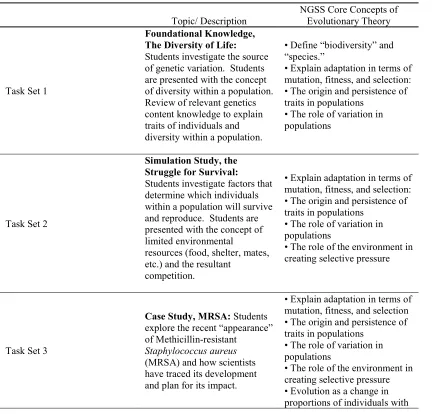
A 5-day curriculum unit, made up of 8 different learning task-sets was developed using eight elements of the PERSON framework to address topics in biological evolution, consistent with the NGSS core concepts of evolutionary theory (see Table 1). Learning activities were organized into task set folders that contained access to videos, simulations, questions sets, and forums. Support for Self-Regulation was included throughout the online curriculum with self-regulation mini-lessons at the beginning of each task set and progress monitoring checklists.
Table 1
Description of sequence, content, and core concepts of evolutionary theory
Topic/ Description NGSS Core Concepts of Evolutionary Theory
Task Set 1
Foundational Knowledge, The Diversity of Life:
Students investigate the source of genetic variation. Students are presented with the concept of diversity within a population. Review of relevant genetics content knowledge to explain traits of individuals and diversity within a population.
• Define “biodiversity” and “species.”
• Explain adaptation in terms of mutation, fitness, and selection: • The origin and persistence of traits in populations
• The role of variation in populations
Task Set 2
Simulation Study, the Struggle for Survival:
Students investigate factors that determine which individuals within a population will survive and reproduce. Students are presented with the concept of limited environmental
resources (food, shelter, mates, etc.) and the resultant
competition.
• Explain adaptation in terms of mutation, fitness, and selection: • The origin and persistence of traits in populations
• The role of variation in populations
• The role of the environment in creating selective pressure
Task Set 3
Case Study, MRSA: Students
explore the recent “appearance” of Methicillin-resistant
Staphylococcus aureus
(MRSA) and how scientists have traced its development and plan for its impact.
• Explain adaptation in terms of mutation, fitness, and selection • The origin and persistence of traits in populations
• The role of variation in populations
Electronic Journal of Science Education ejse.southwestern.edu particular traits within a
population
• Biological evolution is not a linear, goal-oriented process.
Task Set 4
Simulation Study, Island
Biogeography: Students are
presented with scenarios involving the migration of a population to an uninhabited island. Based on the characteristics of the island, students predict which members of the population are most likely to survive and reproduce. How does the environment put pressure on a population to adapt?
• The role of the environment in creating selective pressure
Task Set 5
Case Study, Lactose (in)tolerance: Students investigate the genetic basis for lactose (in)tolerance and find out how scientists have traced the appearance and persistence of this mutation to specific regions of the world.
• Biological evolution is not a linear, goal-oriented process. • Evolution as a change in proportions of individuals with particular traits within a population
Task Set 6
Foundational Knowledge,
Charles Darwin: Students
explore the work of Charles Darwin, including the voyage of the Beagle, and the years of research leading to the
publication of On the Origin of Species. Attention given to Darwin’s methods and the data he collected. Comparisons made between the work of Darwin and Alfred Russel Wallace.
• Contrast vernacular definitions of “theory” with biological definitions. • Contrast vernacular
definitions of “evolution” with biological definitions.
• The role of the environment in creating selective pressure
Task Set 7
Foundational Knowledge, How Evolution Works, Then and Now: Students contrast Darwin’s initial explanations for the mechanism of evolution by natural selection with modern explanations including the incorporation of genetics and punctuated equilibrium.
Task Set 8
Simulation Study, Modifying
a Simulation: Students modify
a simulation that demonstrates how human activity (e.g. building roads) can impact animal populations (e.g. nesting birds). Students then propose a method of fulfilling human needs while limiting impact on animal populations.
• The role of variation in populations
• The role of the environment in creating selective pressure
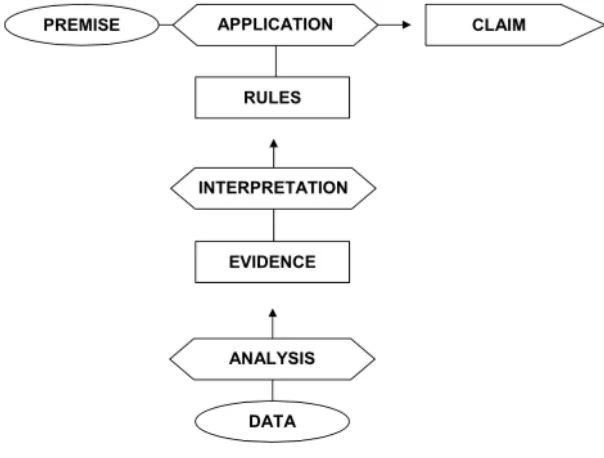
Evidentiary Reasoning was a central component of the online curriculum. The Evidence-Based Reasoning Framework (EBRF) (Brown, Furtak, Timms, Nagashima, & Wilson, 2010) was used to teach students the components of evidentiary reasoning. Students were provided with a flow chart showing distinct elements that are necessary for successful evidentiary reasoning (see Figure 1). Additionally, student Web-based forums were used for student reflection on the use of evidence since the use of prompted reflection has been shown to increase the use of explanations and generalizations about evidence (Schalk, van der Schee, & Boerman, 2013).
Figure 1: EBRF Flowchart
Electronic Journal of Science Education ejse.southwestern.edu Through the course of the curriculum unit, students received explicit instruction in the EBRF model in the form of a brief video presentation and structured practice in the use of the model as it applies to the module’s content. A series of guided questions embedded in the Analyze and Extend section allowed students to practice use of the EBRF model. As the unit progressed, the degree of scaffolding was gradually decreased.
Methods
The study was conducted in a public school district in the northeast United States in December 2016. A convenience sample of 83 ninth grade high school students (ages 14-15) from four intact biology classrooms was obtained. The school is located in a suburban area with middle-income households. The population was 92% Caucasian, 3% Hispanic, and 3% Black, and 2% Asian. Forty-four students were male and 39 students were female. About one sixth (16%) of the district population participates in the free and reduced lunch program. Eighty participants completed the online curriculum unit. The curriculum was implemented during five 90-minute class periods.
This study used design-based research methods to evaluate the effectiveness of the online curriculum design and implementation approach. Design-based research is an appropriate methodology for this study since it enables research to focus on iterative design, development, implementation and analysis (The Design-Based Research Collective, 2003). Based on findings from the prototype implementation study (Marsteller & Bodzin, 2015), the PERSON framework was revised to include scaffolding and direct instruction designed to support evidentiary reasoning and self-regulation.
Instrumentation and Data Collection
Biological Evolution Assessment Measurement (BEAM). The BEAM was designed to measure biological evolution content understandings and use of evidentiary reasoning. Students completed the BEAM before they began the online module, and completed the same assessment measure when they completed the unit. The BEAM was used in the previous iteration of the curriculum (see Marsteller and Bodzin, 2015). The assessment included 15 items: 5 quiz and test items, 4 academic prompts, and 6 performance tasks. A total score of 37 points was possible: 5 points from quiz and test items (1 point each); 10 points from academic prompts; and 22 points from the performance tasks. Both the academic prompts and performance task items were designed to measure evidentiary reasoning, as well as applied content knowledge.
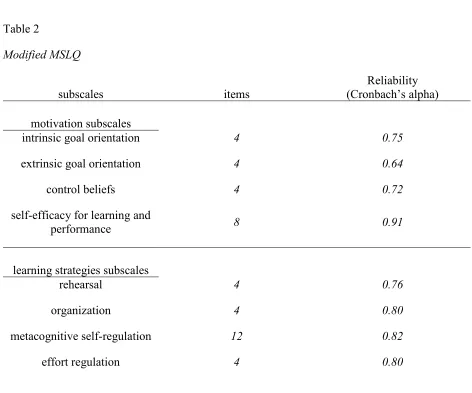
Table 2
Modified MSLQ
subscales items (Cronbach’s alpha) Reliability
motivation subscales
intrinsic goal orientation 4 0.75
extrinsic goal orientation 4 0.64
control beliefs 4 0.72
self-efficacy for learning and
performance 8 0.91
learning strategies subscales
rehearsal 4 0.76
organization 4 0.80
metacognitive self-regulation 12 0.82
effort regulation 4 0.80
Discussion forums. Discussion forum posts were examined for use of evidentiary reasoning. Two discussion forums prompted students to use evidence in their responses. In addition to explicit prompting, the researcher assumed a participant role to model evidentiary reasoning and to provide scaffolding for students within the discussion forums. Student posts were classified as either evidence present or evidence absent. Posts with evidence present were further classified to indicate use of evidence to support a scientific assertion, or evidence without a clear connection to a scientific assertion.
Formative assessments of evidentiary reasoning. Student responses to guided questions to practice use of the EBRF model were analyzed to determine the efficacy of scaffolding for evidentiary reasoning. Each of the 8 task sets contained Analyze and Extend items specifically designed to provide practice of evidentiary reasoning skills and use of the EBRF framework. Student responses for each task set were compared to describe patterns of improvement across the online curriculum unit.
Electronic Journal of Science Education ejse.southwestern.edu Data sources and instruments included (1) the Biological Evolution Assessment Measurement (BEAM); (2) the modified Motivated Strategies for Learning Questionnaire (MSLQ); (3) discussion forum posts; (4) formative assessments of evidence based reasoning; (5) Prediction, Monitoring, and Reflection forms (PMR); and (6) field notes. Statistical analysis of the quantitative data was conducted with IBM SPSS Statistics for Windows Version 24.0 (IBM Corp., 2016). Qualitative coding and analysis were conducted by reviewing data sources for emergent themes in collaboration with a co-rater (Marshall & Rossman, 1989; Patton, 1990). All data is presented as it relates to each research question.
Results RQ1: Development of Evidentiary Reasoning
The first research question investigated how well evidentiary reasoning is promoted by the online curriculum. Several data sources were utilized to answer this question. Ten of the fifteen items on the BEAM were specifically designed to assess evidentiary reasoning, 4 academic prompts, and 6 performance tasks. A total score of 32 points was possible: 10 points from academic prompts; and 22 points from the performance tasks. These ten items were reviewed for specific evidence of the development of evidentiary reasoning. In addition, two sources of qualitative data, student discussion forums and formative assessment item responses, were analyzed to examine how well the scaffolding promoted students’ evidentiary reasoning.
Assessment items on the BEAM assessing evidentiary reasoning were analyzed using a paired sample t-test. A comparison between mean scores on evidentiary reasoning items on the pretest and posttest are presented in Table 3. Findings from the t-test indicate posttest scores were significantly higher than pretest scores for items associated with evidentiary reasoning (p <.001) with an effect size of 0.80, a large effect size (Cohen, 1977). This large effect size demonstrated improved performance on assessment items associated with evidentiary reasoning resulting from the online curriculum implementation.
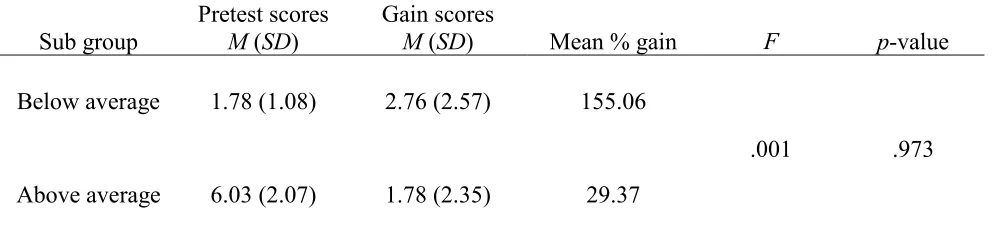
A subgroup analysis of student performance on BEAM items designed to assess evidentiary reasoning was conducted. Students’ scores were divided into groups based on whether their pretest scores for evidentiary reasoning items were above or below the average score for those items, as seen in Table 4. The group of student scores that were below average ranged from 0-3 and accounted for 40 of 73 total student scores (54.8%). The group of student scores that were above average ranged from 4-12 and accounted for 33 of 73 total student scores (45.2%). A comparison of gain scores between these two groups revealed that the students with below average pretest scores had a greater mean percent gain than students with above average pretest scores. This indicates that students did learn evidentiary reasoning skills in the course of the investigation.
Table 3
Comparison of BEAM Pretest and Posttest Scores for Items Assessing Evidentiary Reasoning (n=73)
Pretest
3.66 (2.58) 5.99 (3.26) 63.66 7.940 < .001 Table 4
Subgroup Analysis of Evidentiary Reasoning Items Based on Mean Pretest Scores
Sub group Pretest scores M (SD) Gain scores M (SD) Mean % gain F p-value
Below average 1.78 (1.08) 2.76 (2.57) 155.06
.001 .973
Above average 6.03 (2.07) 1.78 (2.35) 29.37
Discussion forums were examined to determine if students used evidence when explicitly directed to do so, and further to determine if students used evidence to support scientific arguments. The researcher and a co-rater examined the entire sample of 190 discussion forum posts, coding posts according to whether or not students used evidence, and if that evidence was used in support of scientific arguments. Initial agreement between co-raters was found to be 87%. The co-raters met to resolve discrepancies, resulting in 100% agreement for all discourse interpretations. It was found that students used evidence in 38.2% of discussion forums, and that 6.3% of discussion forum posts used evidence support of scientific arguments.
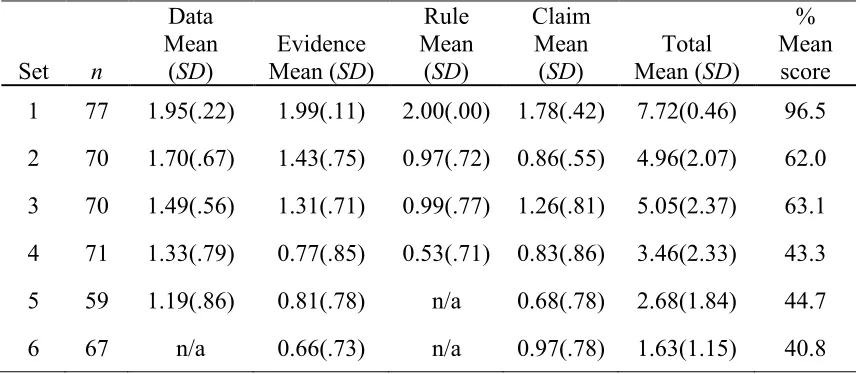
Daily question sets, representing the Analyze and Extend part of the curriculum, contained formative assessment of evidentiary reasoning. Each question set contained 2-4 items specifically addressing evidentiary reasoning in a manner consistent with the EBRF model. The level of scaffolding was gradually decreased throughout the curriculum. The number of students that completed daily task sets ranged from 59-77 (see Table 6). The researcher and a co-rater examined 414 responses to daily question sets, coding posts according to whether or not students accurately employed techniques of the EBRF model using a criterion-based rubric. Initial agreement between co-raters was found to be 82%. The co-raters met to resolve discrepancies, resulting in 100% agreement. It was found that student scores declined from 96.5% in the first set to 40.8% in the last set.
Table 5
Student Use of Evidentiary Reasoning in Discussion Forums
Electronic Journal of Science Education ejse.southwestern.edu Lactose
intolerance 98 38 (38.8%) 10 (10.2%)
Charles
Darwin 93 23 (24.7%) 2 (2.2%)
Table 6
Student Use of Evidentiary Reasoning Components in Formative Assessments
Set n
Data Mean
(SD) Mean (Evidence SD)
Rule Mean (SD)
Claim Mean
(SD) Mean (Total SD)
% Mean score 1 77 1.95(.22) 1.99(.11) 2.00(.00) 1.78(.42) 7.72(0.46) 96.5 2 70 1.70(.67) 1.43(.75) 0.97(.72) 0.86(.55) 4.96(2.07) 62.0 3 70 1.49(.56) 1.31(.71) 0.99(.77) 1.26(.81) 5.05(2.37) 63.1 4 71 1.33(.79) 0.77(.85) 0.53(.71) 0.83(.86) 3.46(2.33) 43.3 5 59 1.19(.86) 0.81(.78) n/a 0.68(.78) 2.68(1.84) 44.7 6 67 n/a 0.66(.73) n/a 0.97(.78) 1.63(1.15) 40.8
Note. Each evidentiary reasoning component was scored from 0-2; sets 1-4 had 8 total possible points, set 5 had 6 total possible points, and set 6 had 4 total possible points.
A linear correlation analysis was conducted to determine if student performance on items in daily question sets designed to formatively assess scaffolded evidentiary reasoning predicted outcomes in the gain scores for BEAM items assessing evidentiary reasoning. Of the 80 students that participated in the curriculum implementation only 66 completed the daily task sets, as well as both the pretest and posttest. Findings from the linear correlation indicate that total scores on formative assessments of evidentiary reasoning did not significantly predict the standard deviation of the BEAM posttest items designed to assess evidentiary reasoning (adjusted R2 = 0.016, standard error of the estimate 2.497). ANOVA analysis conducted with the same variables indicated that BEAM gain scores were not strongly predicted by performance on daily evidentiary reasoning tasks predicts (F=0.007, p=.933). Students that successfully completed the Analyze and Extend items designed to promote evidentiary reasoning did not perform significantly better on items on the BEAM that assessed evidentiary reasoning compared to their peers.
RQ2: Self-Regulation as a Predictor of Success
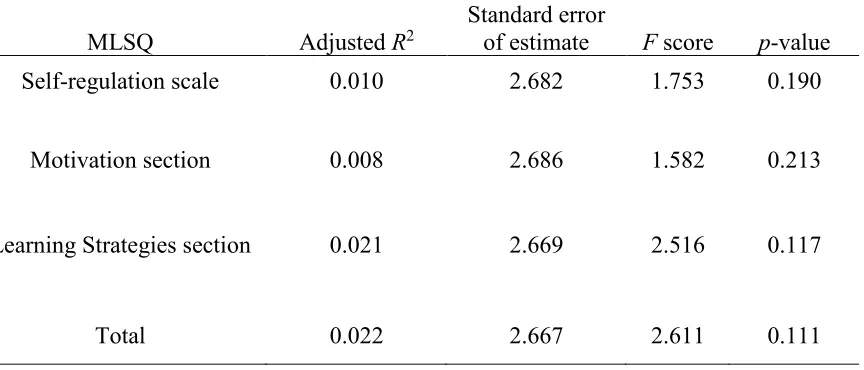
predicted success in using the online curriculum. MSLQ subscales were summed into corresponding larger motivation and learning strategies scales. A linear correlation analysis was conducted to determine if student scores on MSLQ predicted outcomes in BEAM gain scores. Findings from the linear regression indicate that MSLQ pretests did not significantly predict BEAM gain scores (see Table 7). Total MSLQ scores had an adjusted R2 of 2.2%, indicating that 1% of variation in BEAM gain scores may be accounted for by the total MSLQ pretest scores. Analysis of subscales for the MSLQ demonstrated correlations explaining 0.8% of the variance for the motivation subscale, and 2.1% of the variance for the learning strategies subscale. Further analysis of a linear regression between only the self-regulation scale and BEAM gain scores demonstrated a correlation of 1%. This low degree of correlation indicates that differences in student success in using the online curriculum cannot be predicted by self-regulatory ability as measured by the MSLQ.
Table 7
Linear Correlation Between MSLQ Pretest Sections with BEAM Gain Scores (n=73)
MLSQ Adjusted R2 Standard error of estimate F score p-value
Self-regulation scale 0.010 2.682 1.753 0.190
Motivation section 0.008 2.686 1.582 0.213
Learning Strategies section 0.021 2.669 2.516 0.117
Total 0.022 2.667 2.611 0.111
RQ3: Promoting Self-Regulation
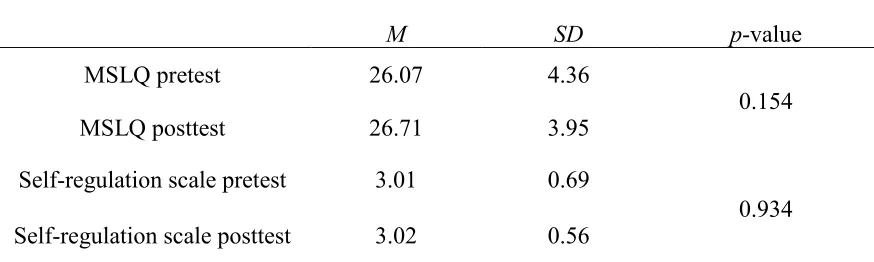
The third research question investigated how well did the online curriculum promote student self-regulation. A comparison between mean scores on the MSLQ and self-regulation scale pretest and posttest is presented in Table 8. Paired sample t-tests were used to compare student performance on the MSLQ and self-regulation scale pretests and posttests. Findings from the t-tests indicated that the posttest scores were not significantly different than total pretest scores for the entire MSLQ (p = .154) and for the self-regulation scale (p = .934). These findings do not support improved student self-regulatory ability resulting from the online curriculum implementation.
Table 8
Electronic Journal of Science Education ejse.southwestern.edu
M SD p-value
MSLQ pretest 26.07 4.36
0.154
MSLQ posttest 26.71 3.95
Self-regulation scale pretest 3.01 0.69
0.934 Self-regulation scale posttest 3.02 0.56
Additionally, it was hypothesized that student use of progress monitoring forms would act as a scaffold to promote self-regulation. Students were provided with Planning, Monitoring, and Reflection sheets corresponding to each of the task sets. Two trained raters familiar with assessment design and self-regulation scored the PMR sheets using a rubric that assigned scores between 0 and 9. All 80 students that participated in this investigation completed a majority of progress monitoring forms. Students were assigned to descriptive categories of “proficient”, “developing”, or “poor” self-regulatory skills based on mean scores across all forms. An initial random sample of 10 students’ responses was reviewed according to scoring criteria to ensure consistency of scoring. A summary of scores for progress monitoring forms is presented in Table 9.
An examination of the relationship between PMR scores and MSLQ posttest scores is presented in Table 10. A one-way ANOVA compared categorical outcomes of student PMR performance with MSLQ posttest scores for self-regulation, motivation, learning strategies, and total posttest score. None of these comparisons yielded statistically significant relationships. These findings do not demonstrate improved student self-regulatory ability resulting from the use of Planning, Monitoring, and Reflecting sheets.
Table 9
PMR scores (n=80) Category
Score range n of students
Proficient 7-9 31 (38.75%)
Developing 4.5-6.9 37 (46.25%)
Poor 0-4.4 12 (15.0%)
Table 10
MSLQ posttest score F score p-value
Self-regulation scale .134 .875
Motivation section .484 .618
Learning Strategies section 1.007 .371
Total posttest score .622 .540
Discussion Promoting Evidentiary Reasoning
Participants in this research study demonstrated significant improvements on scores for BEAM items designed to assess evidentiary reasoning from the pretest to the posttest. This increase, coupled with the large effect size, supports the assertion that the online curriculum successfully promoted evidentiary reasoning with high school students. The elements of the PERSON framework that most directly promote evidentiary reasoning were Analyze and Extend, Simulation Study, and Case Study. These elements of the PERSON framework most likely promoted evidentiary reasoning. These findings are consistent with other research about high school students’ use of scientific process skills, such as evidentiary reasoning. Leonard, Speziale, and Penick (2001) conducted a study comparing the implementation of a high school biology curriculum designed to promote scientific inquiry skills. Sixteen teachers across the United States taught both the Biology: A Community Context and a traditional curriculum to separate classes of students during one whole school year. Students receiving the intervention curriculum performed significantly better than the control group on posttest measures of conceptual understandings and science process skills. The study conducted by Wilson, Taylor, Kowalski, and Carlson (2010) demonstrated that an innovative curriculum effectively promoted scientific reasoning, and construction of scientific understandings better than traditional methods of instruction.
In this study, average scores on Academic Prompts for Evidentiary Reasoning items were 32% of total possible points; average scores on Performance Tasks for Evidentiary Reasoning items were 13% of total possible points. Average scores on Academic Prompts for Evidentiary Reasoning items ranged from 0-80% of total possible points and average scores on Performance Tasks for Evidentiary Reasoning items ranged from 0-41% of total possible points. When defining acceptable performance as 70%, only one student achieved acceptable performance on Academic Prompts for Evidentiary Reasoning; and no students achieved acceptable performance on Performance Tasks for Evidentiary Reasoning. Two possible explanations for the poor level of performance are considered below. First, high school students are inexperienced with evidentiary reasoning (Maloney & Simon, 2006), and second, the BEAM does not use familiar assessment types, and introduces confounding elements when assessing student performance.
Electronic Journal of Science Education ejse.southwestern.edu scores were divided relative to the average pretest score for evidentiary reasoning items. The students with below average pretest scores had a larger gain on the posttest items for evidentiary reasoning than students with above average pretest scores. However, students with below average pretest scores earned fewer total points on posttest items designed to assess evidentiary reasoning compared to peers with above average pretest scores. While the mean scores for students with below average pretest scores remained below their peers, there was considerably greater improvement. This indicates that students did learn evidentiary reasoning skills in the course of the investigation, but perhaps there was an additional factor contributing to poor outcomes.
Literature that discusses the development of assessments aligned to NGSS asserts that most school-based testing is knowledge oriented, rather than performance-based (Pellegrino et al., 2014). It is possible that the poor student performance on BEAM items designed to assess evidentiary reasoning resulted from a lack of familiarity with these assessment item types. In fact, performance task items on the posttest resulted with a mean of 2.81 of 22 possible points (13%). However, even academic prompts, which are expected to be more familiar in a typical school setting, only resulted with a mean of 3.18 of 10 possible points (32%) on the posttest.
High school and university level biology teachers were consulted when validating the design of the BEAM items and assessment standards. However, expectations among teachers were inconsistent as to what defined a complete answer, especially in multi-part questions. For example, BEAM item number 9 asks students to “explain why evolution may be described as either a process or the result of that process. Support your explanation with examples.” Some teachers noted that some students in lower-tracked classes could have difficulty with compound questions. These classroom teachers explained that they did not ask lower tracked students compound questions at any time in their class. The design of the BEAM uses compound questions for all of the items assessing evidentiary reasoning. It is possible that students participating in this investigation have little or no experience answering compound questions.
student participants.
Student performance on formative assessments of evidence based reasoning showed a decline in performance that corresponds to the level of scaffolding provided (see Table 5). When lesser scaffolding was provided, students did not score as well. Existing literature supports the importance of scaffolding complex tasks for learners (Lee, et al., 2010; Resier, 2004). When given highly structured scaffolding (e.g. choices for answers), students were able to select the correct answer an average of 96.5% of the time. When provided with reduced scaffolding (e.g. multiple-choice items were replaced with fill-in the blank items), performance fell to averages of 62.0% and 63.1%. These items remained structured, but required student to supply correct terminology. As the level of scaffolding declined to hints and reminders about the correct use of evidentiary reasoning, performance fell to averages of 43.3%, 44.7%, and 40.8%.
This suggests that the population of students represented by participants may have an optimal level of scaffolding that allows them to develop evidentiary reasoning skills. It can further be speculated that these students require a longer time at a given level of scaffolding before progressing to the next, less structured level. The second level of scaffolding, where students provided their own terminology in fill-in the blank items, is possibly the optimal level of scaffolding for this population. Zero students scored below 70% for the question set with the first level of scaffolding. For the question sets with the second level of scaffolding, 54% and 51% of students earned below 70% of possible points. While for question sets with the third level of scaffolding, 79%, 83%, and 67% of students earned below 70% of possible points. Vygotsky (1978) described the zone of proximal development as cognitive development through engaging in tasks that learners can only accomplish with support. Tasks that learners can accomplish independently do not promote cognitive growth. Therefore, the first level of scaffolding is not challenging enough to develop the evidentiary reasoning abilities of students, but the third level of scaffolding does not provide enough support. The second level of scaffolding likely provides the most appropriate challenge for students in this population. This does not mean that these students should never be expected to demonstrate evidence based reasoning without significant scaffolding, only that they must receive appropriate support for the length of time necessary to develop these skills. This contention is supported by a study conducted by McNeill, Lizotte, Krajcik, and Marx (2006) that found 7th grade students who received fading instructional supports for creating scientific explanations performed significantly better on posttest assessments than peers who received continuous levels of support throughout an 8-week intervention.
Electronic Journal of Science Education ejse.southwestern.edu
Promoting Self-Regulation
Participants in this research study did not demonstrate significant improvement on scores for MSLQ items designed to assess self-regulation from the pretest to the posttest. This lack of significance, coupled with the small effect size, demonstrates that the online curriculum designed according to the PERSON framework did not successfully promote self-regulation with high school students. The PERSON element of Scaffolding of Self-Regulation was not effective. Other research about the development of self-regulation suggests a possible explanation for this outcome. Chang (2005) found that the use of reflective journals and study time records for 28 students in a one-semester web-based college course demonstrated improved measures of responsibility and confidence as measured by a pre and post-test comparison of MSLQ scores. An additional study by Chang (2007) utilized a similar web-based self-monitoring form with students in another online college course. Students using the self-monitoring form in this study demonstrated significantly better academic performances and motivational beliefs compared to their peers in the control group. Reflective journals were investigated as a method to develop self-regulation in a face-to-face high school chemistry course (Al-Rawahi & Al-Balushi, 2015). Sixty-two students participated in an 8-week instructional unit. Thirty-two students were taught to use reflective journaling to develop self-regulation. The researchers compared MSLQ scores of students using reflective journals to a control group. Students in the treatment group demonstrated significantly better self-regulation scores than peers in the control group. A study conducted by Şen, Yılmaz,
and Geban (2015) investigated the effects of an inquiry-based curriculum on the development of self-regulation with 115 11th grade chemistry students during a semester-long intervention. Students were divided into two groups that received the intervention curriculum and two groups that received a traditional approach to instruction. After the intervention, students in the treatment groups demonstrated significantly better measurements of self-regulation compared to peers in the control groups.
While the studies cited above demonstrate various effective methods for promoting self-regulation, it is noteworthy to draw attention to the length of time used for these implementations.
Both studies by Chang (2005 and 2007) as well as the study conducted by Şen, Yılmaz, and Geban
(2015) were conducted over the course of a semester. The briefest of these studies was conducted by Al-Rawahi and Al-Balushi (2015) over an eight-week period. By contrast, this investigation was only five days long. Jakubowski and Dembo (2004) have argued that the development of self-regulated learning is time-consuming. Winne and Stockley (1998) claim that developing expert-level skills in self-regulation requires 85% of a student’s formal learning time. It is likely that this investigation was not conducted over a long enough period of time to noticealy promote self-regulation among participants.
Conclusion
struggled to succeed academically in traditional learning environments may benefit from learning online, it is necessary to support their independence (Nandi et al., 2012).
This research study explored the ability of online learning environments to support the higher order thinking demanded by recent science education reform documents including the NGSS and NRC Framework (NGSS Lead States, 2013; NRC, 2012). The goals of science education reform have not been readily achieved in traditional learning environments (Burton & Frazier, 2012). Online learning environments may present an opportunity to address these demands. The PERSON framework is an attempt to create online learning that emphasizes higher-order thinking compatible with the goals of current science education reform.
This study found that students developing the higher-order thinking skills of evidentiary reasoning likely require an optimal level of scaffolding to support this learning. Students differ in their capacity to acquire new thinking skills and require scaffolding that matches their needs. Flexibility in scaffolding will be important for the continued development of the PERSON framework.
Additionally, asynchronous online learning environments demand an unusually high level of independence from K-12 students. Self-regulated learning is a set of interrelated skills associated with actively monitoring and regulating one’s own learning. The PERSON framework has included support for self-regulation as a key component of the design of instruction. However, this study revealed that a 5-day unit implementation was not sufficient for students to achieve improvements in their self-regulation abilities.
Every student deserves to be appropriately supported in order to meet rigorous academic challenges. Increasingly, online learning environments are called on to serve the students most in need of support to achieve challenging goals, such as those in lower academically tracked classes. It is unacceptable to continue to place students in online courses that are neither appropriately challenging nor stimulating. The design and delivery of specific elements of the PERSON framework will be revised and redeveloped to continue in an effort to address the need for stimulating online learning that supports all learners.
Electronic Journal of Science Education ejse.southwestern.edu
References
Allen, M., Mabry, E., Mattrey, M., Bourhis, J., Titsworth, S., & Burrell, N. (2004). Evaluating the effectiveness of distance learning: A comparison using meta-analysis. Journal of Communication, 54(3), 402-420.
Al-Rawahi, N. M., & Al-Balushi, S. M. (2015). The effect of reflective science journal writing on students' self-regulated learning strategies. International Journal of Environmental & Science Education, 10(3).
Al-Salman, S. M. (2009). The role of the asynchronous discussion forum in online communication. Journal of Instruction Delivery Systems, 23(2), 8-13.
Bandura, A. (1977). Social learning theory. Englewood Cliffs, NJ: Prentice Hall.
Barth, P., Hull, J., & St Andrie, R. (2012). Searching for the reality of virtual schools. Alexandria, VA: Center for Public Education, National School Boards Association. Retrieved May, 18, 2012.
Baumgartner, E., & Duncan, K. (2009). Evolution of students’ ideas about natural selection through a constructivist framework. American Biology Teacher, 71(4), 218-227.
Bassett, P. (2011). How do students view asynchronous online discussions as a learning experience? Interdisciplinary Journal of E-Learning & Learning Objects, 7(1)69-79. Beckem II, J. M., & Watkins, M. (2012). Bringing life to learning: Immersive experiential
learning simulations for online and blended courses. Journal of Asynchronous Learning Networks, 16(5), 61-70.
Bediako Asare, K. (2014). Looking beyond the residential education and distance education debate, what matters in education is.... Turkish Online Journal of Distance Education (TOJDE), 15(3), 143-154.
Beebe, R., Vonderwell, S., & Boboc, M. (2010). Emerging Patterns in Transferring Assessment Practices from F2f to Online Environments. Electronic Journal of E-Learning, 8(1), 1-12. Bernard, R. M., Abrami, P. C., Lou, Y., Borokhovski, E., Wade, A., Wozney, L., ... & Huang,
B. (2004). How does distance education compare with classroom instruction? A meta-analysis of the empirical literature. Review of Educational Research, 74(3), 379-439. Biggers, M., Forbes, C. T., & Zangori, L. (2013). Elementary teachers' curriculum design and
pedagogical reasoning for supporting students' comparison and evaluation of evidence-based explanations. The Elementary School Journal, 114(1), 48-72. doi: 0013-5984/2013/11401-0003
Black, L. (2007). A history of scholarship. In M. G. Moore (Ed.), Handbook of Distance Education, (2nd ed, pp. 3-14). Mahwah, New Jersey: Lawrence Erlbaum Associates. Brown, N. J., Furtak, E. M., Timms, M., Nagashima, S. O., & Wilson, M. (2010). The
evidence-based reasoning framework: Assessing scientific reasoning. Educational Assessment, 15(3-4), 123-141.
Burton, S. R., & Dobson, C. (2009). Spork & beans: Addressing evolutionary misconceptions. American Biology Teacher, 71(2), 89-91.
Burton, E. P., & Frazier, W. M. (2012). Voices from the Front Lines: Exemplary Science Teachers on Education Reform. School Science & Mathematics, 112(3), 179-190. doi:10.1111/j.1949-8594.2011.00131.x
Chang, C., Hurst, B., & McLean, A. (2015). You've got mail: Student preferences of instructor communication in online courses in an age of advancing technologies. Journal of Educational Technology Development & Exchange, 8(1), 39-48.
Chang, M. M. (2005). Applying self-regulated learning strategies in a web-based instruction— an investigation of motivation perception. Computer Assisted Language Learning, 18(3), 217-230.
Chang, M. M. (2007). Enhancing web-based language learning through self-monitoring. Journal of Computer Assisted Learning, 23(3), 187-196.
Christensen, C. M., Horn, M. B., & Johnson, C.W. (2008). Disrupting class: how disruptive innovation will change the way the world learns. New York: McGraw Hill.
Cohen, J. (1977). Statistical power analysis for the behavioral sciences, Rev. ed. Hillsdale, NJ: Lawrence Erlbaum Associates.
Crawford-Ferre, H. G., & Wiest, L. R. (2012). Effective online instruction in higher education. Quarterly Review of Distance Education, 13(1), 11-14.
The Design-Based Research Collective. (2003). Design-based research: An emerging paradigm for educational inquiry. Educational Researcher, 32(1), 5-8.
Feasley, C., & Bunker, E.L. (2007) A history of national and regional organizations and the ICDE. In M. G. Moore (Ed.), Handbook of Distance Education, (2nd ed, pp. 15-29). Mahwah, New Jersey: Lawrence Erlbaum Associates.
Geier, R., Blumenfeld, P. C., Marx, R. W., Krajcik, J. S., Fishman, B., Soloway, E., & Clay-Chambers, J. (2008). Standardized test outcomes for students engaged in inquiry-based science curricula in the context of urban reform. Journal of Research in Science Teaching, 45(8), 922-939.
Gerbic, P. (2010). Getting the blend right in new learning environments: A complementary approach to online discussions. Education and Information Technologies, 15, 125-137. Giesbers, B., Rienties, B., Tempelaar, D., & Gijselaers, W. (2014). A dynamic analysis of the
interplay between asynchronous and synchronous communication in online learning: The impact of motivation. Journal of Computer Assisted Learning, 30(1), 30-50. doi:10.1111/jcal.12020
Graves, L., Asunda, P. A., Plant, S. J., & Goad, C. (2011). Asynchronous online access as an accommodation on students with learning disabilities and/or attention-deficit hyperactivity disorders in postsecondary STEM courses. Journal of Postsecondary Education and Disability, 24(4), 317-330.
Heddy, B.C. & Sinatra, G.M. (2013). Transforming misconceptions: Using transformative experience to promote positive affect and conceptual change in students’ learning about biological evolution. Science Education, 97(5), 723-744.
Hickey, D. T., Kindfteld, A. C., Horwitz, P., & Christie, M. A. (1999). Advancing educational theory by enhancing practice in a technology-supported genetics learning environment. Journal of Education, 25-55.
Hodges, C. B., & Kim, C. (2010). Email, self-regulation, self-efficacy, and achievement in a college online mathematics course. Journal of Educational Computing Research, 43(2), 207-223.
Electronic Journal of Science Education ejse.southwestern.edu Isaak, M. (2005). Five major misconceptions about evolution. California Journal of Science
Education, 5(2), 133-142.
Jakubowski, T.G., & Dembo, M.H. (2004). The relationship of self-efficacy, identity style, and stage of change with academic self-regulation. Journal of College Reading and Learning, 35(1), 7-24.
Keller, J. M. (1999). Using the ARCS motivational process in computer-based instruction and distance education. New Directions for Teaching & Learning, 1999(78), 39.
Kitsantas, A., & Zimmerman, B.J. (2009). College students’ homework and academic achievement: The mediating role of self-regulatory beliefs. Metacognition Learning, 4, 97-110. doi: 10.1007/s11409-008-9028-y
Lave, J., & Wenger, E. (1991). Situated learning: Legitimate peripheral participation. New York: Cambridge university press.
Lee, H. S., Linn, M. C., Varma, K., & Liu, O. L. (2010). How do technology-enhanced inquiry science units impact classroom learning? Journal of Research in Science Teaching, 47(1), 71-90.
Leonard, W. H., Speziale, B. J., & Penick, J. E. (2001). Performance assessment of a standards-based high school biology curriculum. The American Biology Teacher, 63(5), 310-316. Linn, M. (2003). Technology and science education: starting points, research programs, and
trends. International Journal of Science Education, 25(6), 727-758.
Linn, M. C., Clark, D., & Slotta, J. D. (2003). WISE design for knowledge integration. Science education, 87(4), 517-538.
Maloney, J., & Simon, S. (2006). Mapping children’s discussions of evidence in science to assess collaboration and argumentation. International Journal of Science Education, 28(15), 1817-1841.
Marshall, C., & Rossman, G. (1989). Designing qualitative research. Newbury Park, CA: Sage Publications.
Marsteller, R. B., & Bodzin, A. M. (2015). The effectiveness of an online curriculum on high school students’ understanding of biological evolution. Journal of Science Education and Technology. 24(6), 803-817. doi: 10.1007/s10956-015-9565-5
McNeill, K. L., Lizotte, D. J., Krajcik, J., & Marx, R. W. (2006). Supporting students' construction of scientific explanations by fading scaffolds in instructional materials. The Journal of the Learning Sciences, 15(2), 153-191.
Nandi, D., Hamilton, M., & Harland, J. (2012). Evaluating the quality of interaction in asynchronous discussion forums in fully online courses. Distance Education, 33(1), 5-30. doi:10.1080/01587919.2012.667957
National Research Council. (2012). A framework for K-12 science education: Practices, crosscutting concepts, and core ideas. Washington, DC: National Research Council. NGSS Lead States. (2013). Next generation science standards: For states, by states. Washington,
DC: National Academies Press.
Pata, K. (2009). Modeling spaces for self-directed learning at university courses. Educational Technology & Society. 12(3), 23-43.
Patton, M. (1990). Qualitative evaluation methods. Newbury Park, CA: Sage Publications. Pellegrino, J. W., Wilson, M. R., Koenig, J. A., & Beatty, A. S. (Eds.). (2014). Developing
Pentina, I., & Neeley, C. (2007). Differences in characteristics of online versus traditional students: Implications for target marketing. Journal of Marketing For Higher Education, 17(1), 49-65. doi:10.1300/J050v17n01_05
Pintrich, P. R., Smith, D.A.F., Garcia, T., & McKeachie, W.J. (1991). A manual for the use of the motivated strategies for learning questionnaire (MSLQ). Ann Arbor, MI: National Center for Research to Improve Postsecondary Teaching.
Pobiner, B. L. 2012. Use human examples to teach evolution. American Biology Teacher 74(2): 71-72.
Reiser, B. J. (2004). Scaffolding complex learning: The mechanisms of structuring and problematizing student work. The Journal of the Learning Sciences, 13(3), 273-304. Schalk, H. H., van der Schee, J. A., & Boersman, K. T. (2013). The development of understanding
of evidence in pre-university biology education in the Netherlands. Research in Science Education, 43(2), 551-578. doi: 10.1007/s11165-011-9276-8
Şen, Ş., Yılmaz, A., & Geban, Ö. (2015). The effects of process oriented guided inquiry learning
environments on students’ self-regulated learning skills. Problems of Education in the 21st Century, 66.
SPSS, I. (2016). IBM SPSS statistics for Windows, version 24.0. New York: IBM Corp.
Stack, S. (2015). Learning outcomes in an online vs. traditional course. International Journal for The Scholarship Of Teaching & Learning, 9(1), 1-18.
Summers, J., Waigandt, A., & Whittaker, T. (2005). A comparison of student achievement and satisfaction in an online versus a traditional face-to-face statistics class. Innovative Higher Education, 29(3), 233-250. doi:10.1007/s10755-005-1938-x
Van Dijk, E. M., & Reynold, T. A., (2010). A conceptual analysis of evolutionary theory for teacher education. Science & Education, 19 (6-8), 655-677. doi: 10.007s11191-009-9190-x
Vonderwell, S., & Zachariah, S. (2005). Factors that influence participation in online learning. Journal of Research On Technology In Education (International Society For Technology In Education), 38(2), 213-230.
Vygotsky, L. S. (1978). Mind in society: The development of higher mental process. Cambridge, MA: Harvard, University Press.
Watson, J., Murin, A., Vashaw, L., Gemin, B., & Rapp, C. (2012). Keeping pace with K-
12 online and blended learning: An annual review of policy and practice. Evergreen Education Group. Retrieved from: http://kpk12.com/cms/wp-content/uploads/KeepingPace2012.pdf
Wilson, C. D., Taylor, J. A., Kowalski, S. M., & Carlson, J. (2010). The relative effects and equity of inquiry-based and commonplace science teaching on students' knowledge, reasoning, and argumentation. Journal of Research in Science Teaching, 47(3), 276-301. Winne, P.H., & Stockley, D.B. (1998). Computing technologies as sites for developing self-regulated learning. In D. Schunk & B. Zimmerman (Eds.), Self-regulated learning: From teaching to self-reflective practice (pp. 106-136). New York: The Guilford Press.