Available online on 10.01.2019 at http://jddtonline.info
Journal of Drug Delivery and Therapeutics
Open Access to Pharmaceutical and Medical Research© 2011-18, publisher and licensee JDDT, This is an Open Access article which permits unrestricted non-commercial use, provided the original work is properly cited
Open Access
Research Article
Formulation of fast dissolving ketoprofen tablet by solid dispersion
technique
Sisodiya Rahul*, Jain Neetesh, Bairagee Deepika, Singh Gurdeep, Vishwakarma Laxmi
Oriental College of Pharmacy and Research, Oriental University, Indore Madhya Pradesh
ABSTRACT
Recent developments in fast dissolving/disintegrating tablets have brought convenience in dosing to elderly and children who have trouble in swallowing tablets. The objective of the present study was to prepare the mouth disintegrating tablet of ketoprofen (NSAID). As precision of dosing and patient's compliance become important prerequisite for a long term NSAID treatment, there is a need to develop a formulation for this drug which overcomes problems such as difficulty in swallowing, inconvenience in administration while travelling and patient's acceptability. Hence, the present investigation was undertaken with a view to develop a fast disintegrating tablet of ketoprofen which offers a new range of product having desired characteristics and intended benefits. The drug is poorly water soluble therefore to enhance the solubility and release of drug, solid dispersion of drug with mannitol was prepared by melt solvent method and melting method. In addition, the physical mixture was prepared for comparison. Different superdisintegrants such as croscarmellose sodium, sodium starch glycolate, crospovidone were used. Directly compressible mannitol was used as a carrier and to enhance the mouth feel and taste. The tablets were prepared by direct compression technique on rotary tablet machine. The tablets were evaluated for hardness, friability, weight variation, wetting time, dispersion time and uniformity of content and in vitro dissolution test. All the tablets had hardness 3-4.5 kg/cm2 and friability of all formulations was less than 1%, weight variation and drug content were within official limit.
Keywords: Ketoprofen; FDT; Superdisintegration; NSAIDS; Direct Compressible Mannitol
Article Info:Received 15 Oct 2018; Review Completed 25 Dec 2018; Accepted 28 Dec 2018; Available online 10 Jan 2019
Cite this article as:
Sisodiya R, Jain N, Bairagee D, Singh G, Vishwakarma L, Formulation of fast dissolving ketoprofen tablet by solid dispersion technique, Journal of Drug Delivery and Therapeutics. 2018; 8(6-A):85-92
*Address for Correspondence:
Sisodiya Rahul, Oriental College of Pharmacy and Research, Oriental University, Indore Madhya Pradesh
INTRODUCTION
The fast dissolving tablets usually dissolve in the oral cavity within 15 seconds to 3 minutes. In another words a fast-dissolving tablet is tablet that dissolves or disintegrates in
the oral cavity without the need of water or chewing1. It is
advantageous because of ease of administration to
pediatrics, geriatrics and psychiatric patient, free from the risk of suffocation due to physical obstruction when
swallowing, no need of water to swallow2-4 etc. However,
there it certain limitations like Drugs with relatively larger doses are difficult to formulate into FDT e.g. antibiotics like ciprofloxacin with adult dose tablet containing about 500 mg of the drug, Patients who concurrently take anti-cholinergic medications may not be the best candidates for FDT. Similarly patients with Sjögren's syndrome or dryness of the mouth due to decreased saliva production may not be
good candidates for this tablet formulations5-7.
The drug Ketoprofen having Chemical name-
2-(3-benzoylphenyl)-propionic acid, 3-Benzoyl-
-methylbenzeneacetic acid and Molecular formula-
C16H14O3,.Ketoprofen inhibit the cyclooxygenase which results in various beneficially effects like analgesia, antipyresis, anti-inflammatory, antithromotic and closure of
ductus arteriosus. Ketoprofen is used in treatment of rheumatoid arthritis, osteoarthritis, dysmenorrhea and management of pain.
Bioavailability of ketoprofen is limited because of its poor water solubility following oral administration. Ketoprofen was also reported to cause local gastrointestinal side effects which require withdrawal of treatment .Therefore, several solubilization techniques were applied and reported to enhance the aqueous solubility of ketoprofen. For improving the solubility and dissolution rate of the drug in water, formation of inclusion complexes with cyclodextrin and skimmed milk were carried out. To enhance the dissolution rate and bioavailability of ketoprofen, a novel dry elixir dosage form has been proposed. The formation of ketoprofen solid dispersions and ketoprofen-dextran ester prodrug has been reported to improve ketoprofen solubility and dissolution and to reduce its ulcerative side effects. Solid dispersions are widely used to improve the water solubility and dissolution of many drugs and are traditionally prepared using fusion or solvent techniques.
Both techniques suffer from a number of disadvantages8.
advantages over other available techniques. In this technique, we prepare physical mixture and solid dispersion of drug in combination with Polaxomar-188 and evaluate both the combinations on different parameters .Thereafter; we prepare Fast Dissolving Tablet By using different superdisintegrants like Ac-Di-Sol, Sodium starch glycolate, Crospovidone and Effervescent agents.
MATERIAL AND METHOD
Materials
We have purchased drug and excipients such as Ketoprofen, Poloxamer-188, Ac-Di-Sol, Sodium Starch Glycolate, Crospovidone, Sodium Bicarbonate, Citric Acid, Avicel PH 102, Lactose, Dextrose, Magnesium Stearate, Talc, Sodium Phosphate, Sodium Hydroxide, Menthol LR, Acetone LR from various industries like Cadila Pharmaceuticals, Ahmedabad, Signel Chemicals Pvt. Ltd. , Mumbai, Central Drug House (P) Ltd., Mumbai, E. Merch (India) Ltd., Mumbai, S. D. Fine Chem Limited Mumbai. All water used was distilled and De-ionized. All the chemicals were reagent grade and used as received.
Methods
1.1 Preparation of physical mixtures of ketoprofen Physical mixtures of Ketoprofen(KP) were prepared using Poloxamer 188 as a carrier in a weight ratio. First drug and carrier were passed through a 40 mesh screen and then weighed and mixed by using motor and pestle (Table 1).
Table 1 Composition of Ketoprofen-Poloxamer 188 Physical Mixture
Formulation Number Drug : Carrier weight ratio
KP1 1:2
KP2 1:4
KP3 1:6
KP4 1:8
KP5 1:10
1.2 Preparation of solid dispersions of ketoprofen
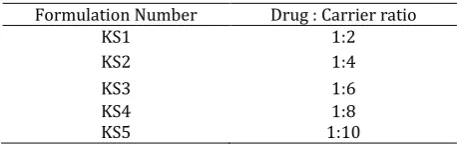
Melt fusion method was used to prepare solid dispersions of Ketoprofen (KS). Table 8.3 depicts the composition for
preparing solid dispersions of poloxamer 188 in various ratios. Ketoprofen and poloxamer 188 were weighed according to these weighed ratios. Poloxamer 188 was
melted at 600C. In this melted poloxamer 188, Ketoprofen
was added. It was mixed well and flashed cooled on an ice bath and then stored over night in a dessicator. The prepared solid dispersion was then grounded by using a mortar and pestle, sieved through a mesh 40 and stored over a fused calcium chloride in a dessicator for further use.
9(Table 2)
Table 2 Composition of Ketoprofen-Poloxamer 188 Solid Dispersions
Formulation Number Drug : Carrier ratio
KS1 1:2
KS2 1:4
KS3 1:6
KS4 1:8
KS5 1:10
1.3 Formulation of fast dissolving tablets
Fast dissolving tablets containing selected solid dispersion were prepared by direct compression method using single punch tablet machine to produce convex faced tablets weighing 500 mg each with a diameter of 11 mm. A
minimum of 100 tablets were prepared for each batch.The
formulations were developed by using different techniques.
1.3.1 By Addition of Super Disintegrants
The superdisintegrants (Ac-Di-Sol, Sodium starch glycolate and Crospovidone) in varying concentration (1-5%) were used to develop the tablets. All the ingredients were shown in Table 8.6-8.8 were passed through sieve no. 60 and were co- grounded in a glass pestle motor. These blends were evaluated for mass-volume relationship (Bulk Density, Tapped Density, Hausners Ratio, Compressibility Index) and flow properties (Angle of Repose). The mixed blend of excipients was compressed using a single punch tablet machine (Cadmach, Ahmedabad) to produce convex faced tablets weighing 500 mg each with a diameter of 11 mm. (Table 3-5)
Table 3 Formulation of Fast Dissolving Tablet Using Ac-Di-Sol
Ingradient F1 F2 F3 F4 F5
KS2 250 250 250 250 250
Ac-Di-Sol 5 10 15 20 25
Lactose 70 70 70 70 70
Dextrose 70 70 70 70 70
Avicel PH 102 135 130 125 120 115
Talc 10 10 10 10 10
Magnesium Stearate 10 10 10 10 10
Table 4 Formulation of Fast Dissolving Tablet Using Sodium Starch Glycolate
Ingredients F6 F7 F8 F9 F10
KS2 250 250 250 250 250
Sodium starch glycolate 5 10 15 20 25
Lactose 70 70 70 70 70
Dextrose 70 70 70 70 70
Avicel PH 102 135 130 125 120 115
Talc 10 10 10 10 10
Table 5 Formulation of Fast Dissolving Tablet Using Crospovidone
Ingredients F11 F12 F13 F14 F15
KS2 250 250 250 250 250
Crospovidone 5 10 15 20 25
Lactose 70 70 70 70 70
Dextrose 70 70 70 70 70
Avicel PH 102 135 130 125 120 115
Talc 10 10 10 10 10
Magnesium Stearate 10 10 10 10 10
1.3.2 By Effervescence Technology
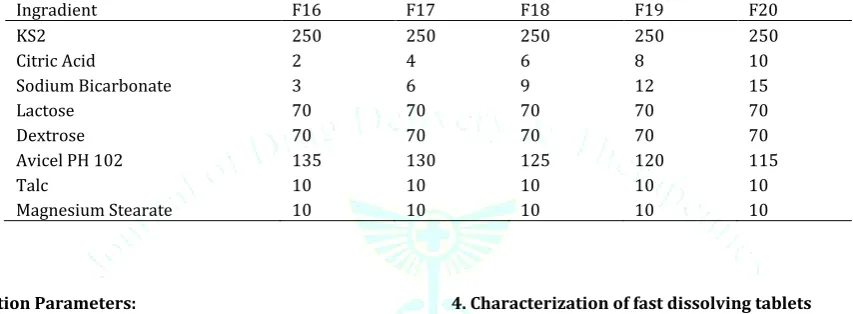
Fast dissolving tablets were prepared by using Citric acid and Sodium bicarbonate in combination in (2:3 ratio) with other excipients shown in Table 8.9 was co-grounded in glass pestle and mortar. These tablets contain (1-5%) effervescent agent in various proportion. These blends were
evaluated for mass-volume relationship (Bulk Density, Tapped Density, Hausners Ratio, Compressibility Index) and flow properties (Angle of Repose). The mixed blends of excipient were compressed using a single punch machine (Cadmach, Ahmedabad) to produce convex faced tablets weighing 300 mg each with a diameter of 11 mm. (Table 6)
Table 6 Formulation of Fast Dissolving Drug Free Tablet Using Effervescent Agents
Ingradient F16 F17 F18 F19 F20
KS2 250 250 250 250 250
Citric Acid 2 4 6 8 10
Sodium Bicarbonate 3 6 9 12 15
Lactose 70 70 70 70 70
Dextrose 70 70 70 70 70
Avicel PH 102 135 130 125 120 115
Talc 10 10 10 10 10
Magnesium Stearate 10 10 10 10 10
Evaluation Parameters:
2.1 IR spectra show is showing the authenticity of procured
sample of drug Ketoprofen (Figure-1A and 1B).
2.2 Ultraviolet Absorption Maxima: Ultraviolet absorption
in the rage 200 to 400 nm of a 5g/ml solution in 5% (v/v)
methanolic Sorensons Buffer (pH 6.8) was measured. The
absorption maxima (λmax) of Ketoprofen (5 µg/ml) in this solution was found to be 260 nm which is concordant with the Indian Pharmacopoeia (1996) shown in (Figure-2).
3. Preformulation Studies
3.1 Solubility
The solubility of Ketoprofen was determined in different solvent systems and buffers. An excess quantity of the drug was mixed with 10 ml of each solvent in screw capped glass tubes and shaken on constant water bath shaker for 24
hours at 25o. The solutions were examined physically for the
absence or presence of drug particles and also by spectrophometrically for quantitative determination of drug in buffers. The drug is highly soluble in Methanol and Ethanol.
3.2 Drug Polymer Interaction Studies
The infrared absorption spectra of pure polymer and physical mixture of polymer and drug were performed for
polymer drug interaction studies between 4000 cm-1-500
cm-1 placed at 40 ± 50C and 75 ± 5% RH for 4 weeks. The IR
spectra of physical mixture of polymers and drug were shown in Figure 6.5-6.7. Physical changes and absorption maxima were also evaluated (Figure-3,4,5).
4. Characterization of fast dissolving tablets
After compression of powder, the tablets were evaluated for organoleptic characteristics like color, odor, taste, diameter, thickness and physical characteristics like hardness, friability, disintegration time, wetting time, dispersion time and dissolution studies. The results were shown in Table 7-8, Figure-6.
4.9 Content Uniformity
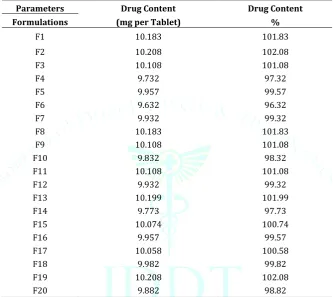
Ten randomly selected tablets were weighed and powdered in a glass mortar pestle. The weight equivalent to 10 mg Ketoprofen was weighed and dissolved in 5 ml of methanol in volumetric flask using magnetic stirrer, the volume was adjusted to 100 ml with Sorenson’s buffer (pH 6.8) and the solution was filtered. An aliquot of 1.0 ml of solution were diluted to 10 ml Sorenson’s buffer (pH 6.8) in separate volumetric flask. The content in was determined spectrophotometrically at 260 nm. The results were shown in Table 9.
4.10 In-vitro dissolution studies:
In vitro dissolution studies of formulation were carried out
using USP paddle method at 50 rpm in 900 ml of Sorenson’s buffer (pH 6.8) as dissolution media, maintained at
37±0.50C. 5 ml of aliquot was withdrawn at the specified
5. RESULT AND DISCUSSION .
In the present project FDT of Ketoprofen were prepared and evaluated for achievement of fast action of active moiety. The tablets were prepared by direct compression method by using solid dispersion technology. Fast disintegration of tablets was achieved by using superdisintegrants and effervescent agents. The Ketoprofen is water insoluble drug so this is necessary to increase the water solubility of the drug for that purpose firstly the solid dispersion of Ketoprofen were prepared and evaluated. The optimized solid dispersion were incorporated in FDTs. These prepared tablets were evaluated for their quality control parameter.
The FT-IR spectra verified the authenticity of the procured sample(Figure 1A,1B).characteristics peak of Ketoprofen
are present at 1696 cm-1 and 1657cm-1 in sample spectra.
The absorption maxima of Ketoprofen was observed at 260 nm in 5% methanolic Sorenson’s buffer, which is concordant with the value given in IP 1996. The UV spectra of Ketoprofen was shown in Figure 2. The maximum solubility was found in methanol and ethanol and least in distilled water. Drug-polymer interaction study was carried out by FT-IR. Results were shown in Figure 3-5. Both the drug and polymers were compatible with each other. Hence the drug and polymers can be successfully incorporated in the design of solid dispersion as well as fast dissolving tablets.
Figure-1A
Figure-1B
Figure 1 IR Spectra (A) Ketoprofen IP Spectra and (B) Sample of Ketoprofen
0 0.2 0.4 0.6 0.8 1 1.2 1.4
180 230 280 330 380
Wavelength (nm)
Abs
orba
nc
e
Figure 4 IR Spectra of Mixture of Drug and Sodium Starch Glycolate
Figure 5 IR Spectra of Mixture of Drug and Crospovidone
Physical mixtures and solid dispersions of Ketoprofen with poloxamer 188 (1:2 to 1:10) were prepared by melt fusion technique, the prepared PM and SD were evaluated for drug content, solubility, IR. The composition of various formulations of physical mixtures and solid dispersion were shown in Table 1 and 2.
It was observed that the saturation solubility of drug was increased by 20 to 50 folds by converting the drug into solid dispersion, due to change in physical state of Ketoprofen from crystalline to amorphous state which was confirmed by the IR, studies. Enhanced solubility of Ketoprofen from solid dispersions prepared from poloxamer 188 could be correlated to the chemical structure of highly water soluble poloxamer 188. Poloxamer 188 consists of ethylene oxide (EO) and propylene oxide (PO) blocks. These blocks results in an amphiphilic nature of poloxamer, which has the properties to self-assemble into micelles in aqueous solution; the hydrophobic core (PO block) can act as reservoir for the drug, while the hydrophilic portion (EO) acts as interface between the aqueous medium and the drug. At low concentrations, approximating those at which more conventional nonionic detergents form micelles, the poloxamer monomers are thought to form monomolecular micelles by a change in configuration in solution. At higher concentration, these monomolecular micelles associate to form aggregates of varying size, which have the ability to solubilize drugs and to increase the stability of solubilized agents.
Several mechanisms may be possible for the enhanced release of Ketoprofen in the solid dispersion formulation with the water soluble polymeric surfactant poloxamer 188.
In the dry state, drug particles were in close contact or adhered to the polymer particles as a result of mixing (supported by IR). When the mixture comes in contact with water, the polymer particles might have hydrated rapidly into polymer solution solubilizing the adjacent drug particles and subsequently releasing the drug into the medium.
Dissolution efficiency of pure Ketoprofen and all the physical mixtures and solid dispersion formulations at 6 minutes and 10 minutes were calculated . As the dissolution time was increased from 6 to 10 minutes, the dissolution efficiency was increased in all the formulations. Among the formulations KS2 has shown maximum dissolution efficiencies of 46.61% and 48.27% respectively. However, KP1, KP2, KP3, KP4, KP5, KS1, KS3, KS4 and KS5 also produce comparable results on terms of dissolution efficiency.
From the above characterization of solid dispersions the KS2 (solid dispersion of Ketoprofen with poloxamer 188 in ratio 1:4) found to be more approachable for incorporation in fast dissolving tablets due to the high saturation solubility in low concentration of poloxamer 188.
In the present study, total twenty drug formulations were formulated using KS2 (Solid dispersion). Ingredients for prepared tablets are shown in Table 3-6.
Table 7. The friability of all the formulations was found to be less than 1.0 %, which indicates the tablet’s ability to withstand abrasion in handling, packaging and shipment.
The hardness of tablet were varied from 2.5-3.7 kg/cm2
(Table 7), which has satisfactory strength to withstand with the applied mechanical shocks. Friability of F5, F11, F19 and F20 are found very near to one so these formulations are not forwarded for further studies.
In the formulation of fast dissolving tablet the three superdisintegrants (Ac-Di-Sol, Sodium Starch Glycolate and
Crospovidone) and effervescent agent (Citric acid and Sodium bicarbonate) were used in different concentrations. The tablets with Crospovidone disintegrate faster then the tablets with the Citric acid, Sodium Starch Glycolate and Ac-Di-Sol.
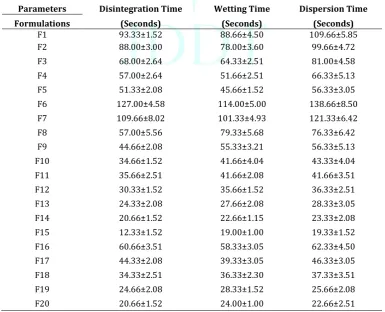
The disintegration time of all the formulations were found between 12.33±1.52 s to 57.00±2.64 s except F1, F2, F3, F6, F7 and F16. The results were shown in Table 8.
Table 7 Characterization of Fast Dissolving Tablets
Parameters Thickness Weight Fribility Hardness
Formulations (mm) (mg) (%) (kg/cm2)
F1 6.325±0.014 498.8±3.551 0.42±0.033 3.1±0.152
F2 6.342±0.026 494.7±3.632 0.47±0.037 3.0±0.096
F3 6.343±0.034 496.2±4.427 0.62±0.042 2.8±0.126
F4 6.325±0.004 496.8±3.321 0.73±0.039 2.8±0.134
F5 6.349±0.037 499.1±2.731 0.94±0.051 2.7±0.157
F6 6.342±0.029 498.5±3.654 0.72±0.055 3.1±0.095
F7 6.348±0.043 500.4±4.246 0.44±0.038 3.7±0.125
F8 6.349±0.021 497.9±3.176 0.80±0.049 3.0±0.133
F9 6.334±0.034 499.2±2.923 0.66±0.053 3.2±0.113
F10 6.325±0.008 501.6±3.765 0.49±0.060 3.6±0.109
F11 6.345±0.016 496.4±3.874 0.96±0.057 3.4±0.165
F12 6.372±0.031 497.6±3.652 0.73±0.047 3.2±0.187
F13 6.346±0.034 495.8±4.233 0.61±0.052 3.6±0.126
F14 6.335±0.031 496.8±3.522 0.48±0.043 3.1±0.123
F15 6.348±0.031 497.1±2.672 0.47±0.062 3.3±0.165
F16 6.344±0.034 497.9±3.176 0.57±0.043 2.6±0.093
F17 6.363±0.035 501.3±3.765 0.68±0.029 2.7±0.133
F18 6.343±0.016 498.3±3.551 0.81±0.059 2.8±0.183
F19 6.366±0.041 497.3±3.654 0.93±0.034 2.5±0.165
F20 6.321±0.339 500.4±4.246 0.96±0.072 2.7±0.165
Data are expressed as mean S.D. (n = 3)
Table 8 Characterization of Fast Dissolving Tablets
Parameters Disintegration Time Wetting Time Dispersion Time
Formulations (Seconds) (Seconds) (Seconds)
F1 93.33±1.52 88.66±4.50 109.66±5.85
F2 88.00±3.00 78.00±3.60 99.66±4.72
F3 68.00±2.64 64.33±2.51 81.00±4.58
F4 57.00±2.64 51.66±2.51 66.33±5.13
F5 51.33±2.08 45.66±1.52 56.33±3.05
F6 127.00±4.58 114.00±5.00 138.66±8.50
F7 109.66±8.02 101.33±4.93 121.33±6.42
F8 57.00±5.56 79.33±5.68 76.33±6.42
F9 44.66±2.08 55.33±3.21 56.33±5.13
F10 34.66±1.52 41.66±4.04 43.33±4.04
F11 35.66±2.51 41.66±2.08 41.66±3.51
F12 30.33±1.52 35.66±1.52 36.33±2.51
F13 24.33±2.08 27.66±2.08 28.33±3.05
F14 20.66±1.52 22.66±1.15 23.33±2.08
F15 12.33±1.52 19.00±1.00 19.33±1.52
F16 60.66±3.51 58.33±3.05 62.33±4.50
F17 44.33±2.08 39.33±3.05 46.33±3.05
F18 34.33±2.51 36.33±2.30 37.33±3.51
F19 24.66±2.08 28.33±1.52 25.66±2.08
F20 20.66±1.52 24.00±1.00 22.66±2.51
Figure 6 Effect of Concentration of Superdisintegrant and Effervescent Agent on Disintegration Time
Table 9 Drug Content in the Fast Dissolving Tablet of Ketoprofen
Parameters Drug Content Drug Content
Formulations (mg per Tablet) %
F1 10.183 101.83
F2 10.208 102.08
F3 10.108 101.08
F4 9.732 97.32
F5 9.957 99.57
F6 9.632 96.32
F7 9.932 99.32
F8 10.183 101.83
F9 10.108 101.08
F10 9.832 98.32
F11 10.108 101.08
F12 9.932 99.32
F13 10.199 101.99
F14 9.773 97.73
F15 10.074 100.74
F16 9.957 99.57
F17 10.058 100.58
F18 9.982 99.82
F19 10.208 102.08
F20 9.882 98.82
Data are expressed as mean S.D. (n = 3)
The in vitro wetting time was also studied to know the time
required for complete wetting of tablets when placed on
tonge. The in-vitro wetting time of all the formulations were
varied between 19±1 to 114±5. The results were shown in Table 8. The swelling properties of the superdisintegrant were depend upon their concentration and the results shows that as the concentration of the superdisintegrant increased the time taken for swallowing was reduced. The swelling time was rapid in Crospovidone followed by citric acid, Ac-Di-Sol and Sodium starch glycolate. The same sequence was observed in case of measurement of dispersion time of the tablet.The drug content of all the tablet formulations was determined spectrophotometrically at 260 nm. It varied from 9.632 to 10.208 mg per tablet. The correlation of variation was found to be less than 0.5, indicating uniformity of the drug content in the prepared tablets. The results of the content uniformity and percent drug content were shown in Table 9.
In vitro drug release experiments were performed at 37±1oC
in seven basket dissolution apparatus.. The maximum drug release was found in formulation F15 (96.264%).
The order of drug release was found to be:
F15>F20>F14>F10>F19>F13>F9>F5>F12>F18>F4>F8> F11>F17>F3>F2>F16>F1>F7>F6
Formulations F5, F10, F15 and F20 which contains 5% of Ac-Di-Sol, Sodium starch glycolate, Crospovidone and citric acid + sodium bicarbonate respectively. The release was estimated after five minutes was 81.1083%, 86.680%, 96.264% and 93.116% respectively. The formulation with Crospovidone shows more release than the tablets with Citric acid, Ac-Di-Sol and Sodium starch glycolate.
6. CONCLUSION .
Compounds with poor aqueous solubility are extremely challenging to be developed as new formulations. It is well known that drug dissolution rather than permeation through the epithelia of the gastrointestional tract is responsible for a low oral absorption. One of the pharmaceutical strategies to improve the oral bioavailability is the formulation of solid dispersions. Ketoprofen was selected as model drug for the research work because it has a poor aqueous solubility and low dissolution rate, while high permeability. The model drug was formulated as physical mixture and solid dispersions with poloxamer 188 in order to improve the drug dissolution. Ketoprofen-poloxamer 188 solid dispersions were prepared by melt fusion technique. Solid dispersions were characterized for
percent drug content, solubility, FT-IR, in vitro drug release
studies and dissolution efficiency. Formulations containing Ketoprofen and poloxamer 188, solid dispersions in 1:4 ratio (KS2) showed better dissolution rate and promising dissolution efficiency.The disintegration properties of tablet were observed as Crospovidone > Citric acid + Sodium
bicarbonate >Sodium starch glycolate > Ac-Di-Sol. The rapid
drug dissolution might be due to the easy and fast breakdown of tablet and rapid absorption of drug into the dissolution media.
The drug release was found as
F15>F20>F14>F10>F19>F13>F9>F5>F12>F18>F4>F8>F1
1>F17>F3>F2>F16>F1>F7>F6 The selected tablets
formulations which posses the best physical quality were Ac-Di-Sol 4% w/w (F4), Sodium starch glycolate 4% w/w
(F9), Crospovidone 5% w/w (F15) and Sodium bicarbonate +citric acid (1:2) 5% w/w (F18). All prepared tablets
followed First order kinetics for release of drug. On
experimental data it was concluded that Fast dissolving
tablet of Ketoprofen would be an effective alternative approach for management of various inflammatory disorders and pain. Superdisintegrant Crospovidone in 5% w/w concentration (F15) formulation is the most promising dosage form for rapid release of Ketoprofen.
REFERENCES
1. Kuchekar BS, Bhise SB, Arungam V. Design of Fast Dissolving Tablets. Indian J Pharm Educ 2005; 35:150.
2. Chein YW. Oral drug delivery and delivery systems, 2nd ed.,
New York: Marcel Dekker; 1992.
3. Habib W, Khankari R, Hontz J. Fast-Dissolve Drug Delivery System. Crit Rev Ther Drug Carrier Systems 2000; 17(1):61-72.
4. Chang R, Guo X, Burnside BA, Couch RA. Fast Dissolving Tablets. Pharmaceutical Technology 2000; 24(6):52-58. 5. Kuchekar BS, Atul, Badhan C, Mahajan HS. Mouth Dissolving
Tablets: A Novel Drug Delivery System. Pharma Times 2003; 35:7-9.
6. Gupta GD, Patel PB, Chaudhary A. Fast Dissolving Drug Delivery Systems: An Update, www.pharmainfo.net/ review/ Fast_dissolving _drug_delivery_systems :_an_update
7. http://www.pharmpedia.com/Fast_dissolving_drug_delivery_ system.
8. Ahmed I. S. and Nafadi M. M. Drug Development and Industrial Pharmacy, 2006; 32:437–442