IJSRSET173152 | Received : 25 Jan-2017 | Accepted : 02 Feb-2017 | January-February-2017 [(3)1 : 179-186 ]
© 2017 IJSRSET | Volume 3 | Issue 1 | Print ISSN: 2395-1990 | Online ISSN : 2394-4099 Themed Section: Engineering and Technology
179
Effect of Barrel Radius on the Billet in the Upsetting Process
P. Sharma
1, M. S. Khidiya
2, M. A. Saloda
3, B. P. Nandwana
4 1M. Tech Scholar Assistant Professor2, Associate Professor3, Professor4
College of Technology and Engineering, Maharana pratap University of Agriculture and Technology, Udaipur, Rajasthan, India
ABSTRACT
Upsetting is the primary technique to form the material to gain importance in the manufacturing industry. It is well known that the increase in level of deformation increases the hardness of material. The hardness distribution is not uniform and will vary inside the billet at different point because of barreling nature of the billet. the present work is to optimize the process parameter responsible for the non-uniform hardness distribution inside the billet, Barreling behaviour and the deformation load using Taguchi technique. The optimum process parameter was suggested and the percentage of contribution of each parameter was noted down using ANNOVA analysis. This optimum parameter reduced the indifference in the hardness distribution. Simulation study was conducted for predicting the strain distributions. In the hot forging process at the die/billet interface, influence of friction plays a significant role. In this work, the influence of varied friction conditions on the barreling behavior is studied. The friction factors of these lubricants grease (m=0.22), boric acid (m=0.30), and vaseline (m=0.29) were obtained from a Ring Compression Test (RCT).
Keywords: ANNOVA, RCT, CTM
I.
INTRODUCTION
The effect of temperature on particle size will helps improving the ductility and thus reducing the hardness of the material. Further, the effect of bulging on the bulge head, billet centre and outer end of the top will lead to form fracture with the crack near the bulge head. In addition, these three parameter, friction, temperature and lubricant condition will help to reduce these negative aspects of the bulging effects
Forming process requires stress above flow stress of the material being deformed. The effect of external work done on work piece during forming is converted into heat. About 5 to 10% of the work is stored within as internal energy. Friction can also result in heating and increase in internal energy of workpiece.
ΔT = Uplastic / ρCp, where Uplastic is plastic work done per unit volume of work piece. Cp is specific heat and ρ is density.
1.1.Constitutive relation between hardness and effective strain
The relation between hardness number and yield strength was developed by Tabour D (1951).the Vickers hardness no. Hv was defined as
Hv = 2.9Y to 3.0Y (1)
Tabour developed an equation Tabor developed an equation correlating Hv and yield strength evaluated at a representative plastic strain for the materials which had undergone strain hardening
Hv = 2.9Y (at an engineering Plastic strain of 0.08) (2) Modified equation of Hv by Tekkaya is
Hv = 2.475Y (3)
Increasing temperature generally has the following effects on stress strain curves:
a) It raises ductility and toughness, and
b) It lowers the yield stress and modulus of elasticity
Temperature also affects the strain-hardening exponent of most metals.
II.
METHODS AND MATERIAL
2.1 Literature Review
The previous work carried out by the researchers in the field of lubrication techniques, temperature, aspect ratio and hardness distribution in upsetting process.
Wei et al. (2000) found that boric acid can firmly adhere to aluminium surfaces and provides very low friction coefficient (about 0.04) under certain circumstances. The lubricity of boric acid is related to its layered structure, in which the bonds between the layers are much weaker than the intralayer bonding.Rao K.P. et al (2011) investigated that Fresh surfaces of boric acid lubricant layer provide least friction and forging speed has no influence on the performance of boric acid lubricant. The average of peak forces obtained with tools having different surface coatings indicated that the hardness of the coating also has no effect on the effectiveness of the boric acid lubricant. Sonmez et al. (2007) carried out finite element studies to produce a cold formed part and developed an analytical equation relating hardness measurement and yield stress. They validated the numerically obtained equation for predicting hardness number with the experimental data available from the bibliography. Poursina. M. et. al. (2008) found out that, in hot deformation of stainless steel work hardening can be neglected and constitutive equation can be taken as a function of strain rates only. The suggested constitutive equation was also reconfirmed by comparing the geometrical deformation of the specimens and numerical simulation of the compression test.
Lindgren et al. (2007) made experimental investigations on the cold rolling of sheet metal to form U-channel. Their mathematical modeling on the stress and strain distributions has laid the foundation of further studies on the forming processes. Hot working and heat
treatment of the material also improves the mechanical properties of the material.
The studies indicate that the hardness is not uniform and will vary inside the billet at different point because of barreling nature of the billet Reduce the tool forces and the amount of heat generated.
Investigation plan: Taguchi approach will be followed
to optimize the barreling behavior which requires a minimum of 3 parameters.
(i) Friction at the die/billet interface: Friction coefficient varies with the lubricant applied which was evaluated from the Ring Compression test.
(ii) Height to the diameter ratios of the billet cylindrical billets of diameter 24mm were machined to different height to the diameter ratios of h/d=1, h/d=0.75 and h/d=1.25..
(iii) Heat Treatment process: The billets were heat treated in a furnace at a temperature of 900 0c and then water quenched. The quenched samples were tempered at 350 0C , 450 0C and 550 0C
After performing these steps the samples need to be deformed by applying the necessary conditions for the optimization approach.
The objective of the present work is to optimize the process parameters involved in billet expansion process by using Taguchi and ANOVA methods. The settings of process parameters were determined by using Taguchi‟s experimental design method. Orthogonal arrays of Taguchi, the signal-to-noise (S/N) ratio, the analysis of variance (ANOVA), and regression analyses are employed to find the optimal levels and to analyze the effect of the process parameters on experimental values. The parameters that affect the process were determined using Taguchi method, and the most significant process parameters and their percentage contribution were determined by using ANOVA technique. Confirmation test with the optimal levels of process parameters was carried out in order to illustrate the effectiveness of Taguchi‟s optimization method.
2.2 Material Used
strength. Carbon percentage in this steel is 0.36 to 0.45% and the hardness is 35±2 HRC.
Figure 1: Raw Workpiece Material
2.3 Ring Compression Test
A series of ring compression tests were conducted by CTM (Compression testing machine) on EN8 Steel 4 ring specimen for each condition of lubrication, 4 ring samples were compressed to different heights within different loads. In the present study, the friction calibration curves were constructed and the deformation behaviour of the geometry of the ring specimen was examined. This method has the advantage of determining friction coefficient based on the dimensional changes of the geometry of ring specimen.
Figure 2 : Compression Testing Machine
Figure 3 : Male and Cockcroft calibration curve (Rajesh and Siva Prakash 2013)
Table 1: Processing Conditions for the Ring Compression test
Ring specimen size 6:3:2
Total no of sample 4
Compression testing machine
Capacity of 2000 Ton
Measurement of
geometry parameter
Digital Vernier callipers
The calibrated curve by the Male and Cockcroft of dimension ratio outer is used to determine the friction coefficient. Friction factor of the grease, boric acid and Vaseline was determined which were respectively 0.22, 0.30 and 0.42 and for the dry condition was 0.67.
2.4 Problem Statement
The present work focuses on the application of „Taguchi‟ optimization technique for the upsetting of EN 8 steel billet. Upsetting process involves many process parameters which directly or indirectly influence the hardness distribution in billet and barreling nature of the billet. Different height (h) to diameter (d) ratios were considered as process parameters. The hardness is not uniform throughout the entire billet and will vary with the lubricant employed at the die billet interface, height to the diameter ratio and temperature condition.
In the present work the effect of these parameters and percentage contribution of each parameter were calculated and were optimized to get uniform hardness distribution, to reduce the deformation load and barreling effect.. Using ANOVA analysis percentage contribution of each factor was determined. In the end the optimum values were predicted and these values were compared with the experimental values.
2.5 Experimental Procedure
Solid cylindrical test specimens of different aspect ratios were compressed between two rigid flat dies to different strain levels. As the material undergoes plastic deformation, a bulge near the equatorial region can be observed. When this plastic deformation becomes severe, the material damages and a crack will appear on the surface of the cylindrical specimen. The non-uniform deformation of the cylinder is because of the high friction between the contact surfaces of the billet and the dies. By applying proper lubrication, the cylindrical billets can be deforming without failure, utilizing the material, and processing conditions effectively.
A series of EN8 steel solid cylinders will be compressed between the rigid cylindrical dies for the lubricant conditions using a 2000 ton capacity CTM
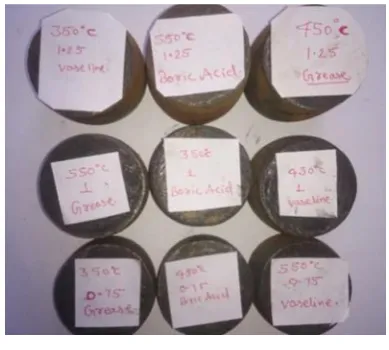
Figure 4 : Specimens used in experiment
Figure 5: billets after compression
Table 2 : Factors and Levels for upsetting process
At each stage of the deformation process, the following parameters will be noted using digital Vernier callipers. For every lubricant condition, to find the ductility property for 3 different categories in 9 different pieces, by applied on the faces of the billet and were reduced to 23% in height. Thereby the geometry parameters will be compared for all the conditions of the lubrication as mentioned.
2.6 Barrel radius measurement
Figure 6: Representation of dimension of compressed billet
(1)
Hf -height of the specimen after deformation
Db- central bulging after deformation
Dc- contact diameter at the die/billet interface
Ra- barrel radius after deformation
Figure 6 : Measurement of dimensions of billet after compression
Table 3. Response characteristics measured table and Responses table for S/N Ratio of barrel radius
III.
RESULTS AND DISCUSSION
3.1 Analysis of barrel radius
For the analysis of cutting force in dry machining, S/N ratio is generated using Taguchi method using the
condition „the larger is better‟. Response table for S/N ratio are shown in Table 4
Table 5. Responses table for means of barrel radius
Response for mean
Level A B C
1 22.29 37.92 41.37
2 38.04 38.33 38.04
3 55.23 38.31 38.16
Delta 32.94 1.39 5.21
Rank 1 3 2
3.2 ANOV Analysis
Analysis of Variance for barrel radius
Table 6: Analysis of variance for barrel radius
Analysis of variance (ANOVA) table for barrel radius generated for determined percentage contribution of different independent parameters on dependent variable is shown in Table 6.
From the analysis of variance of the barrel radius, the contribution of the aspect ratio is 96.26 and lubricant is 2.47% and temperature is 0.18% on barrel radius.
In S/N ratio, Signal defined as desired parameter and noise define as undesired parameter of any experimental work. High S/N ratio is essential condition for any experimental work
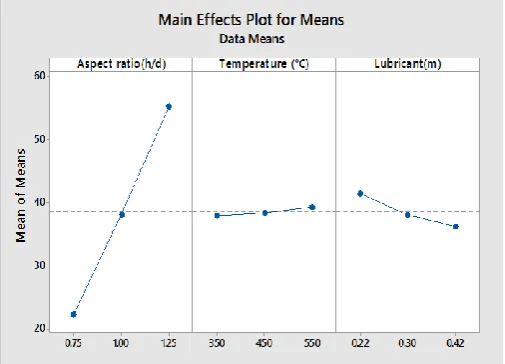
It is clear from the values of tables 5 and 6 that size of billet is major factor among all the parameter followed by friction and temperature. The main effect plots for S/N ratio are clearly illustrated in fig
barrel radius. When the billets of different aspect ratios were reduced to same strain level, the amount of bulge at the equator of the billet will be more, in case of h/d =1.25 compared to other two aspect ratios.
Similarly, the temperature 550 would give the highest barrel radius as compared to other two temperature conditions. This is because the toughness will be more at higher temperature condition.
To obtain the results of maximum barrel radius, the response “larger the better” has been chosen for which the S/N ratio Eq. (2) is as follows
(2)
Table 9 : Barrel radius for different independent parameters in upsetting process
Independent Parameters Dependent Variable
S/N Ratio Aspect ratio(h/d)
(AS)
Temperature
T Lubricant
(m)
Barrel radius (R2) (mm)
0.75 350 0.24 23.25 27.3285
0.75 450 0.33 23.62 27.4656
0.75 550 0.4 20.00 26.0206
1 350 0.33 36.25 31.1862
1 450 0.4 34.20 30.6805
1 550 0.24 43.68 32.8057
1.25 350 0.4 54.27 34.6912
1.25 450 0.24 57.17 35.1434
1.25 550 0.33 54.25 34.6880
Figure 7: main effect plot of S/N ratio of barrel radius
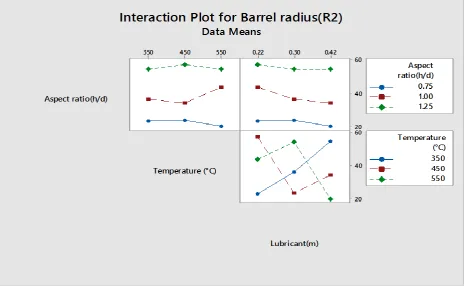
Figure 9 : Interaction plot for barrel radius in upsetting
In ANOVA, “F” value also indicates more and less affecting parameter. Parameter which has more or less F value indicates most and least affecting parameter. Table 9 shows that aspect ratio is more significant parameter as it has high F value while temperature is less significant parameter as it has lower F value. The interaction plot generated for given experimental measurements show the change in barrel radius for given parameters of aspect ratio, temperature and lubricant in Figure 9.Similar results were obtained by Sonmez et. al. (2007).
Regression equation is formulated to predict the barrel radius. This term is use for finding out the correlation between the data.
Barrel radius(R2) = -19.88 + 65.88 Aspect ratio + 0.00693 temperature -32.8 lubricant(m) (3)
The values of barrel radius can be obtained by putting different values of independent parameter in Equation 3. The regression equation can also be used for finding more values of barrel radius at different aspect ratio and lubricant and temperature condition values other than ones used in present work
3.3 Confirmation Test
The confirmation experiment is very important in parameter design, particularly when screening or small fractional factorial experiments are utilized. The confirmation tests were conducted to evaluate the results predicted from Taguchi technique. It can be examined that the results obtained are within the span of predicted 95 % confidence level and the predicted values are in close agreement with the experimental results. There for the optimum results can be obtained under the above given conditions in the upsetting of the billet
IV.
CONCLUSION
The major parameter affecting the barreling behaviour is size of the billets, which contributes 96.26% followed by friction and temperature condition of the billet.
The optimum factor for barreling behaviour was A3, B3 and C1 and the optimum value was 58.84 mm
V.
REFERENCES
[1]. Banerjee J. K.,."Barreling of Solid Cylinders Under Axial Compression”. Journal of Engineering Materials and Technology, 107 ,2,1985 ,pp. 138-144 ,doi:10.1115/1.3225789. [2]. Haluk T and Sonmez F. O."Optimum shape
design of die and preform for improved hardness distribution in cold forged parts" .journal of materials processing technology. 209, pp. 1538-1549.
[3]. Rao K.P. and Xie C.L. ,. "A comparative study on the performance of boric acid with severalconventional lubricants in metal forming processes". Tribology International .2006, 39 7,pp. 663–668..
[4]. HariKrishna et al."Effect of Lubrication and Anisotropy on Hardnessin the Upsetting Test".Transactions of the Indian Institute of Metals 2015 ,69 ,7 ,pp.1459-1457 .
[5]. Sonmez F. O. , Ahmet D. ."Analytical relations between hardness and strain for cold formed parts".Journalof Materials Processing Technology,2007,186, pp. 163–173.
[6]. Baskaran K. and Narayanasamy R.,.Some aspects ofbarreling in elliptical shaped billets of aluminium during cold upset forging with lubricant. Materials and Design2008,29, 3 pp. 638–661.
[7]. Wei Jianjun ,ErdemirAli and Fenske R.George, " Dry Lubricant Films for Aluminum Forming"2000,43,3 pp. 535-541,DOI: 10.1080/10402000008982374.
[8]. PoursinaM., Ebrahimib H.and Parvizianc J.,"Flow stress behaviorof two stainless steels And experimental–numerical investigation".Journal of Materials ProcessingTechnology, 2008 199,1–3, pp. 287–294.