Available online on 15.05.2015 at http://jddtonline.info
Journal of Drug Delivery and Therapeutics
Open access to Pharmaceutical and Medical research
© 2015, publisher and licensee JDDT, This is an Open Access article which permits unrestricted noncommercial use, provided the original work is properly cited
RESEARCH ARTICLE
DEVELOPMENT AND VALIDATION OF REVERSED PHASE HPLC METHOD FOR
ESTIMATION OF CEFTRIAXONE IN PHARMACEUTICAL DOSAGE FORM
*Shah RY and Jat RK
Institute of Pharmacy, JJT University Jhunjhunu (Rajasthan), India
Received 11 March 2015; Review Completed 19 April 2015; Accepted 06 May 2015, Available online 15 May 2015
INTRODUCTION
Ceftriaxone sodium (Figure 1) is chemically
(6R,7R)-7- [[(2Z
)-(2-amino-4- thiazolyl)(methoxyimino)acetyl]amino]-8-oxo-3-[[(1,2,5,6-tetrahydro-2-methyl-5,6-ioxo-1,2,4-tria- zin- 3-yl)thio]-methyl]-5-thia-1-azabicyclo[4.2.0]oct-2-ene-2-carboxylic acid 1. Ceftriaxone is a third generation, semi- synthetic cephalosporin antibiotic. Cephalosporins are deri- vatives of 7-aminocephalosporic acid and are closely rela- ted to penicillins in structure. Ceftriaxone sodium is a long acting, broad-spectrum cephalosporin antibiotic for pare- nteral use. The bactericidal activity of ceftriaxone sodium results from inhibition of cell wall synthesis. It exerts in vitro activity against a wide range of Gram-negative and Gram-positive microorganisms. It is highly stable to most beta-lactamases, both penicillinases and cephalosporinases, of Gram-positive and Gram-negative bacteria. A thorough literature survey has revealed that HPLC method for ceftriaxone sodium with combination of other drugs and individually in dosage forms 2-5, microbia bioassay methods 6, 7, and spectrophotometric methods in dosage forms 8–12 have been reported for analysis of ceftriaxone sodium. Costlier and volatile solvents were used as mobile phase solvent system and the time of analysis was more in some reported methods. Some spectrophotometric methods are recently descri- bed in the literature for analysis of drugs in raw material and finished products such as ceftazidime 13–15, cefuroxime , and cefazolin . These spectrophotometric methods
involve the use of no toxic organic solvents, which do not contribute to the generation of this kind of waste by the chemicals or industries. In this context, spectrophotometry stands out. Therefore, the trend is that the industries look for ways to reduce the impacts of their activities on the environment. So, the principle objective of this study was, therefore, to develop a simple, selective, precise, less time consuming, and economical method with a wide linear range and good sensitivity for assay of ceftriaxone sodium in the powder for injection dosage forms. The parent drug stability guidelines issued by the interna- tional conference of harmonization (ICH) require that analytical test procedure should indicate stability. Therefore, the present study was extended to establish the inherent sta- bility of ceftriaxone sodium under different stress conditions such as, alkaline, acidic, oxidative, and photolytic conditions. Thus, this method can be utilized to compare the results for the content analysis of stability samples, since the purpose of stability studies is to monitor possible changes to a product or a material over a time at different storage conditions.
*Address for correspondence:
Mr. Shah Ravi Yashwant* JJT university, Jhunjhunu, Rajasthan, India
E-mail: [email protected]
ABSTRACT
A simple, accurate rapid and precise RP-HPLC method has been developed and validated for determination of Ceftriaxone in
bulk drug. The RP-HPLC separation was achieved on Promosil C-18, (250 mm, 4.6 mm, 5µm)using mobile phase buffer:
methanol ph 6.8 (90: 10 v/v) at flow rate of 1.0 ml/min at ambient temperature. The retention times were 7.111 min. for Ceftriaxone. Calibration plots were linear over the concentration range 1-20µg/ml. Quantification was achieved with photodiode array detection at 260 nm over the concentration range of 1-50 µg/ml. The method was validated statistically and applied successfully for the determination of Ceftriaxone. Validation studies revealed that method is specific, rapid, reliable, and reproducible. The high recovery and low relative standard deviation confirm the suitability of the method for the routine determination of Ceftriaxone in bulk drug.
N S
O NH N
S
N OCH3
O
O NaO
S N
N N
OH
ONa
C H3
Figure 1: Chemical structure of Ceftriaxone Sodium
MATERIALS AND METHODS
All the reagents used were of HPLC grade and analytical grade and were purchased from Merck Chemicals, India. Reference standard of Ceftriaxone
was supplied as gift sample from Sun Pharmaceutical Laboratories Limited, Mumbai with purity of 99.987%.
Preparation of buffer solution:
Mix 5mL of glacial acid in 1000mL of milli Q water. To 1000mL of 5mL glacial acetic acid solution, add 0.94gm of 1-Hexane sulphonic acid anhydrous.sonicate to dissolve.
Preparation of Mobile phase:
The mobile phase is prepared by mixing buffer: methanol in the ratio of 90:10 Filtered and degas it
Chromatographic Run:
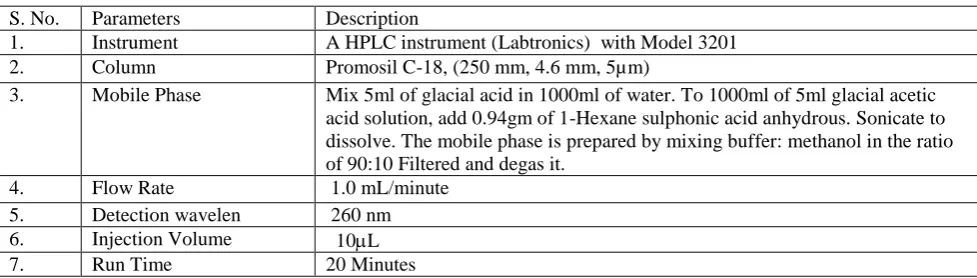
Load the standard solution of Ceftriaxone in the injector, enter the HPLC parameters as per (Table: 1), save the method, inject and run for 20min.
Table 1: Chromatographic conditions for the optimized method for Ceftriaxone
S. No. Parameters Description
1. Instrument A HPLC instrument (Labtronics) with Model 3201
2. Column Promosil C-18, (250 mm, 4.6 mm, 5µm)
3. Mobile Phase Mix 5ml of glacial acid in 1000ml of water. To 1000ml of 5ml glacial acetic acid solution, add 0.94gm of 1-Hexane sulphonic acid anhydrous. Sonicate to dissolve. The mobile phase is prepared by mixing buffer: methanol in the ratio of 90:10 Filtered and degas it.
4. Flow Rate 1.0 mL/minute
5. Detection wavelen 260 nm
6. Injection Volume 10L
7. Run Time 20 Minutes
Standard preparation of Ceftriaxone Accurately weigh and transfer about 20 mg of drug Ceftriaxone working standard into 100mL volumetric flask, and about 70 mL of diluents, sonicate to dissolve, dilute to volume with diluents and mix. Filter the solution through0.45µm.
Preparation of system suitability solution8. Accurately weigh and transfer about 10mg of working standard into 100ml volumetric flask. Add 25mL of 0.1N HCl and 25mL of Diluent. Sonicate to dissolve.
Keep the sample at about 80 °C. For 4 hours. Use this solution as system suitability solution.
Preparation of placebo solution8
Accurately weigh and transfer powdered content of placebo equivalent to 100mg of Drug into 100 mL volumetric flask. Add about 70 mL diluent and sonicate for about 15 min. dilute to the volume and mix. Filter the solution through 0.45µm filters.
Preparation of diluent
Use mobile phase as diluents {Mobile phase is Buffer: Methanol (90:10)}
METHOD VALIDATION
The developed method was validated according to ICH guidelines. Standard calibration curve were prepared in the mobile phase with 5 concentration ranging from 1-50 µg/ml for Ceftriaxone is injected in to HPLC system keeping the injection volume constant. The peak area was plotted against the corresponding concentration to obtain the calibration graphs. To study the reliability and suitability of developed method, recovery experiments were carried out at three levels 80, 100 and 120%. Known concentration of Commercial tablet is spiked with known amounts of Ceftriaxone. At each level of the amount six determinations were performed and the results obtained were compared with expected results. Recovery for pharmaceutical formulations should be within the range 100±5%. The percent R.S.D of individual measurements was also determined. Precision of the assay was determined by repeatability (intra-day) and intermediate precision (inter-day) for 3 consecutive days. Three different concentration of Ceftriaxone were analysed in six independent series in the same day (intra-day precision) and 3 consecutive days (inter-day precision). The repeatability of sample application and measurement of peak area for active compounds were expressed in terms of percent RSD.
All chromatograms were examined to determine if compounds of interest co-eluted with each other or with
any additional excipient peaks. Marketed formulation were analysed to determine the specificity of the optimized method in the presence of common tablet excipients. Limi of detection (LOD) and limit of quantitation (LOQ) were estimated from single to noise ratio. LOD and LOQ were calculated using 3.3/s and 10/s formulae, respectively. Where the standard deviation of the peak areas and s is is the slope of the corresponding calibration curve. To evaluate robustness of HPLC method a few parameters included variation of flow rate, percentage of buffer in the mobile phase, and pH of mobile phase.
RESULT AND DISCUSSION
The retention time of Ceftriaxone was peak eluted at 7.111 min. The peaks are well separated with a resolution of 3.256 and Tailing 1.231.
The mobile phase comprises of Buffer: Methanol (90:10) v/v was selected as optimized mobile phase, because of the high purity, symmetry, proper tailing, high area and low RT value at same concentration as compared to other trail mobile phase. Furthermore, the stability of the drug in the mobile phase were also studied and result indicating that the drug Ceftriaxone was found to be stable during the storage time of 48 hr (Table 2).
Table 2: Stability of the Ceftriaxone in the optimized mobile phase
S. No.
Storage conditions Mean area± SD
(At zero hrs) SE
Mean area± SD
(At 48 hrs) SE
1. Room Temperature (25±0.5 0C)
267438.3±2859.82 3474.9 248844.7±3650.63 2777.53
2. Refrigerator (4±0.5 0C)
252952.3±2859.82 3474.9 250011.3±3653.10 2778.63
*Concentration of drug 10µg/ml in mobile phase.
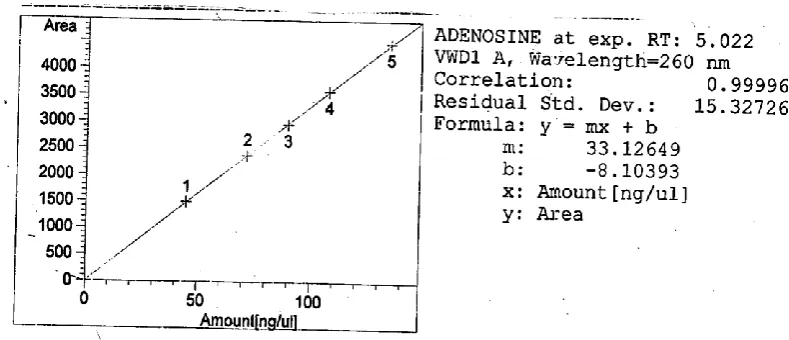
Linearity of the method was investigated by serially diluting the working standard to give a concentration range of 1-10 µm/ml and 20 µl from this was injected. The flow rate was maintained at 1 ml/min. temperature
of column was kept ambient and the effluent was monitored at 260 nm. Calibration curve was constructed by plotting concentration against peak area (fig.3).
The method was validated for linearity, precision, accuracy, specificity, limit of detection and limit of quantification as per ICH guidelines. All parameters are validated as per ICH guidelines.
Optimum condition of mobile phases was investigated in the development of an HPLC method suitable for analysis of in the bulk drug. These included Methanol: Acetonitrile: Buffer (30:20:50) (% v/v), Methanol: Acetonitrile: Buffer (40:30:30), Methanol: buffer
(50:50), Methanol: Buffer (60:40), Buffer: Methanol (80:20), and: Buffer: Methanol (90:10).The same solvent mixture was used for extraction of the drug from the formulation containing excipients. The retention time of Ceftriaxone obtained was 7.0 ±.111 (1). The system suitability tests for HPLC were carried out on freshly prepared solution of Ceftriaxone (10 µg/ml) and parameters were studied. The results were summarized in Table 3.
Table 3: System sutability test for Ceftriaxone:
Sr. No. Parameter Value
1. Retention time, min 7.000±0.111
2. Tailing factor 1.265±0.376
3. Asymmetry factor 1.165±0.876
4. Theoretical plates 5769±0.324
5. Resolution 2.678±0.879
Assay of tablets of Ceftriaxone were perfomed. Twenty tablets of each company of strength 5 mg, 10 mg and 20 mg were weighed and ground to a fine powder. A quantity of tablet powder equivalent to 10 mg of Ceftriaxone was transferred to 10 ml volumetric flask, dissolved and diluted with acetonitrile and water mixture to obtain 1 mg/ml. The solution was sonicated for 15 minute and filtered through 0.45 µm membrane
filter. The solution was further diluted to obtain concentration 10 µm/ml. Peak area of the above prepared tablet solutions of Ceftriaxone were measured by using above mentioned chromatographic conditions and the amount of Ceftriaxone were found from regression equation (Table 4) &Recovery study (Table 5).
Table 4:Results of Analysis of Commercial Tablets of Ceftriaxone
Tablet Formulation
Label claim(mg) % Label claim
estimated*(Mean ± S.D.)
% Coeff. Of Variation
Standard error
I(OFRAMAX) 250 99.325 ± 1.435 1.543 0.465
II(MONOCEF) 500 99.745 ± 1.406 1.435 0.845
III (ROCEPHIN) 1000 99.854 ±1.457 1.506 0.687
*Average of six determinations
Table 5: Recovery Studies of Commercial Tablets of Ceftriaxone
Tablet Formulation
Label claim (mg)
Drug added (mg)
% Label claim estimated*(Mean ± S.D.)
% Coeff. Of Variation
Standard error
I(OFRAMAX) 250 200 99.456 ± 1.534 1.658 0.543
II(MONOCEF) 500 500 99.654 ± 1.453 1.549 0.654
III (ROCEPHIN)
1000 1250 99.546 ±0.658 0.732 0.659
*Average of six determinations
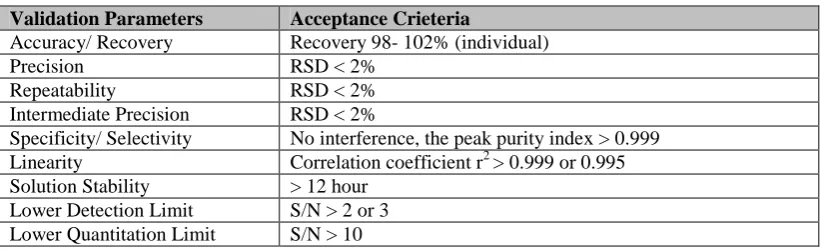
The linear regression date showed a good linear relationship over the concentration range of 1-50 µg/ml as summarized in Table 6. The limit of detection (LOD) and the limit of quantification(LOQ) of the drug were found by scanning the solution of Ceftriaxone having different lower concentrations and the LOD and LOQ were found to be 0.5 and 1 µg/ml indicates that method is sensitive (Table 6). The intraday and interday precision were determined by analyzing standard solution of Ceftriaxone at three different concentration levels (6, 8, 10 µg/ml). The % RSD for intraday and interday precision was found to be 0.376 – 0.975% and
Table 6: Stastiscal Data & Regression Equation for Ceftriaxone
Validation Parameters Acceptance Crieteria
Accuracy/ Recovery Recovery 98- 102% (individual)
Precision RSD < 2%
Repeatability RSD < 2%
Intermediate Precision RSD < 2%
Specificity/ Selectivity No interference, the peak purity index > 0.999 Linearity Correlation coefficient r2 > 0.999 or 0.995 Solution Stability > 12 hour
Lower Detection Limit S/N > 2 or 3 Lower Quantitation Limit S/N > 10
The proposed validated method was successfully applied to determine Ceftriaxone in tablet form. The results obtained for tablets of Ceftriaxone were comparable with the corresponding labeled amounts (0.5 mg/tab) (table 4). Robustness of the method was estimated by changing the mobile phase composition (3±3), wavelength ±1 nm, injection volume (20±2µl), column temperature (40±30) and RSD values for all these changes calculated were less than 2 indicate that proposed method is robust. The proposed RP-HPLC method was accurate, precise, sensitive and rapid. The method also can be extended for the routine analysis of Ceftriaxone in tablet dosage form.
CONCLUSION
It is thus concluded that the proposed method is new, simple, cost effective, accurate, safe, free from pollution and precise and can be successfully employed in the routine analysis of these drugs in pharmaceutical dosage forms. The proposed method shall prove equally effective to analyze Ceftriaxone in the corresponding drug sample and may prove to be of great importance in pharmaceutical analysis.
ACKNOWLEDGEMENT
Authors are grateful to Suresh Kalwania (Drug Inspector) and M/s. Sun Pharma Lab, Jammu for providing the gift samples of drugs.
REFERENCES
1. Budavari S, The Merck Index, Merck & Corporation, White House Station, NJ, USA, 13th edition, 2001.
2. Tariq MR. Siddiqui J. Kumar et al., “Development and vali- dation of high performance liquid chromatographic method for the simultaneous determination of ceftriaxone and vancomycin pharmaceutical formulations and biological samples,” ScienceAsia, 2010, vol. 36, no. 4, pp. 297–304.
3. Shah J, Jan MR, Shah S, and Khan MN, “Development and validation of HPLC method for simultaneous determination of ceftriaxone and cefaclor in commercial formulations and biological samples,” Journal of the Mexican Chemical Society, 2013, vol. 57, no. 4, pp. 314–320.
4. Sun H, Wang H, GE X, and Quin X, “Simultaneous deter- mination of the combined drugs ribavarin and ceftriaxone sodium in human urine by HPLC-DAD,” International Journal of Science Innovations and Discoveries, 2011, vol. 1, no. 2, pp. 216– 225.
5. Kale RS, Jain HK, Ghode PD et al., “An rphplc method for simultaneous estimation of Ceftriaxone sodium and sulbactam sodium in parenteral dosage form,” International Journal of Pharmacy and Pharmaceutical Sciences, 2011, vol. 3, supplement 5, pp. 406–409.
6. Kumar RN, Rao GN, and Naidu PY, “Stability indicating fast LC method for determination of ceftriaxone and tazobactam for injection related substances in bulk and pharmaceutical
formulation,” International Journal of Applied Biology and Phar- maceutical Technilogy, vol. 1, no. 1, pp. 145–157, 2010.
7. Shrivastava SM, Singh R, Tariq A et al., “A novel high performance liquid chromatographic method for simultaneous determination of ceftriaxone and sulbactam in sulbactomax,” International Journal of Biomedical Science, 2009, vol. 5, no. 1, pp. 37–43.
8. Nirav BP, Alpesh CA, Sneha KJ, Vipul DM, and Hemant TD, “Development and validation of stability indicating method for simultaneous estimation of ceftriaxone and sul- bactam injection using RP-UPLC method,” IOSR Journal of Pharmacy, 2012, vol. 2, no. 6, pp. 29–37.
9. Jat RK, Chhipa RC, Sharma S, Spectrophotometric Quantification of Etoricoxib in Bulk Drug and Tablets Using Hydrotropic Agent, pharmacophore International Journal, 2010, Vol. 1, Issue 2, PP 96 – 102.
10.Jat RK, Chhipa RC, Sharma S, Spectrophotometric quantification of carvedilol in bulk drug and tablets,
pharmacophore International Journal, 2010, Vol. 1, Issue 2, PP 90 – 95.
11.Jat RK, Chhipa RC, Sharma S, Quantification of clobazam in bulk drug and tablets, International Journal Pharmaceutical Current Research & Review, 2010, Vol. 1, Issue 3, PP 18 – 24.
12.Jat RK, Chhipa RC, Sharma S. Spectrophotometric estimation of fluvoxamine maleate in tablets using hydrotropic agent, International Journal of Pharmaceutical Quality Assurance, 2011, Vol 2, issue 4, pp 73-75.
13.Jat RK, Sharma S, Chhipa RC, “Spectrophotometric and HPLC methods for Poorly Water Soluble Drugs”, Ph.D. thesis, SGVU Jaipur, Rajasthan, 166-170.
14.Pal N, Rao AS, Hedi MA, “HPLC method development and validation for the assay of ceftriaxone sodium injection, Marczenko Z, Separation and spectrophotometric determination of elements, Mary Masson, Edition, ELLIS HORWOOD Limited Publishers, 2001, 216, 222, 240, 319, 435, 631.