Available online on 15.05.2018 at http://jddtonline.info
Journal of Drug Delivery and Therapeutics
Open Access to Pharmaceutical and Medical Research© 2011-18, publisher and licensee JDDT, This is an Open Access article which permits unrestricted non-commercial use, provided the original work is properly cited
Open
Access Research Article
DFT study including NBO, NLO response and reactivity descriptor of
bis and tris (1, 3-dithiole)
tetrathiafulvalene
Tahar Abbaz
1*, Amel Bendjeddou
1and Didier Villemin
21
Laboratory of Aquatic and Terrestrial Ecosystems, Org. and Bioorg. Chem. Group, University of Mohamed-Cherif Messaadia, Souk Ahras, 41000, Algeria
2
Laboratory of Molecular and Thio-Organic Chemistry, UMR CNRS 6507, INC3M, FR 3038, Labex EMC3, ensicaen & University of Caen, Caen 14050, France
ABSTRACT
We present a density functional theory (DFT) study on the reactivity of bis and tris (1,3-dithiole) TTF 1-4 by using B3LYP/6-31G (d,p) level. The possible electrophile and nucleophile attacking sites of the title compounds is identified using MEP surface plot study. Highest occupied molecular orbital (HOMO) and lowest unoccupied molecular orbital (LUMO) energy gaps were calculated to explain the frontier molecular orbitals and to predict the quantum chemical descriptors. Local reactivity properties have been investigated using average local ionization energies and Fukui functions. Natural Bond Orbital analysis was computed and possible transitions were correlated with the electronic transitions. The calculated first hyperpolarizability (β0) of bis and tris (1,3-dithiole)
TTF molecules, indicates that investigated molecules might have not the NLO applications.
Keywords: Tetrathiafulvalenes; density functional theory; computational chemistry; quantum chemical calculations.
Article Info:Received 10 Feb, 2018; Review Completed 02 May 2018; Accepted 07 May 2018; Available online 15 May 2018
Cite this article as:
Abbaz T, Bendjeddou A, Villemin D, DFT study including NBO, NLO response and reactivity descriptor of bis and tris (1,3-dithiole) tetrathiafulvalene, Journal of Drug Delivery and Therapeutics. 2018; 8(3):96-105
DOI:http://dx.doi.org/10.22270/jddt.v8i3.1716
*Address for Correspondence:
Tahar Abbaz, Laboratory of Aquatic and Terrestrial Ecosystems, Org. and Bioorg. Chem. Group, University of Mohamed-Cherif Messaadia, Souk Ahras, 41000, Algeria
1. INTRODUCTION
The tetrathiafulvalene (TTF) derivatives are one kind of organic semiconductors that have been paid considerable attention as potential charge transfer materials in organic electronic devices in recent years1-5. They have been widely explored in both materials and supramolecular chemistry6. The π-electron donor tetrathiafulvalene (TTF) and its derivatives have been studied extensively for their use in a variety of applications such as organic metals and superconductors7, Langmuir-Blodgett films8, molecular sensors9, non-linear optics10, field effect transistors11 and photovoltaics10.
Density functional theory based on the Becke's three parameter hybrid exchange functional combined with the Lee e Yang e Parr non-local correlation function level of theory displays good achievement on the
characterization of the organic molecules12-14 as a consequence of the recovering of the electron correlation in the self-consistent Kohn e Sham procedure throughout the electron density functions15-17.
molecular electrostatic potential, the frontier molecular orbital, the intramolecular charge transfer and non-linear optical activity of the title compounds have been also studied clearly.
2. MATERIALS AND METHODS
The theoretical calculations were performed using the Gaussian 09W program package19 and B3LYP (Becke’s Three parameter Hybrid Functional Using the LYP Correlation Functional) approach in conjunction with the 6-31G (d,p) basis set.
3. RESULTS AND DISCUSSION
3.1. Molecular Geometry
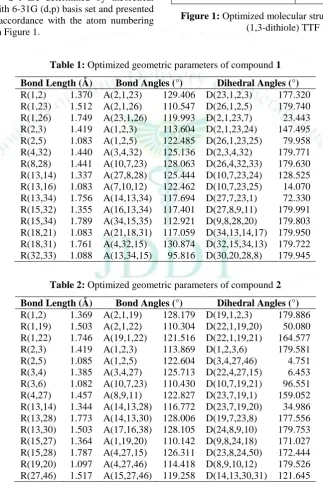
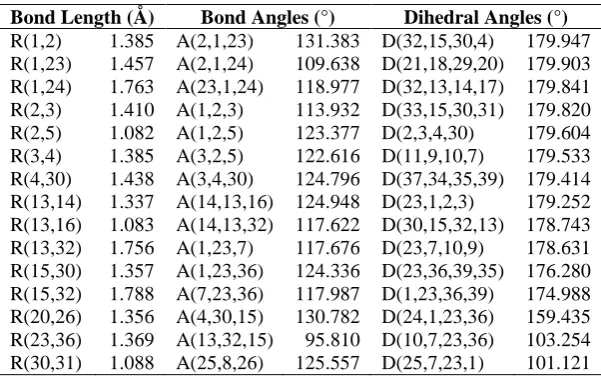
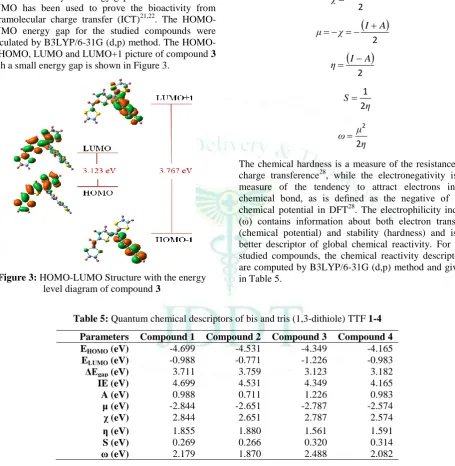
The optimized structural parameters such as bond lengths, bond angles and dihedral angles of bis and tris (1,3-dithiole) TTF 1-4 are determined by theoretical B3LYP method with 6-31G (d,p) basis set and presented in Tables 1-4 in accordance with the atom numbering scheme as given in Figure 1.
Compound 1
Compound 2
Compound 3 Compound 4
Figure 1: Optimized molecular structure of bis and tris (1,3-dithiole) TTF 1-4
Table 1: Optimized geometric parameters of compound 1
Bond Length (Å) Bond Angles (°) Dihedral Angles (°)
R(1,2) 1.370 A(2,1,23) 129.406 D(23,1,2,3) 177.320 R(1,23) 1.512 A(2,1,26) 110.547 D(26,1,2,5) 179.740 R(1,26) 1.749 A(23,1,26) 119.993 D(2,1,23,7) 23.443 R(2,3) 1.419 A(1,2,3) 113.604 D(2,1,23,24) 147.495 R(2,5) 1.083 A(1,2,5) 122.485 D(26,1,23,25) 79.958 R(4,32) 1.440 A(3,4,32) 125.136 D(2,3,4,32) 179.771 R(8,28) 1.441 A(10,7,23) 128.063 D(26,4,32,33) 179.630 R(13,14) 1.337 A(27,8,28) 125.444 D(10,7,23,24) 128.525 R(13,16) 1.083 A(7,10,12) 122.462 D(10,7,23,25) 14.070 R(13,34) 1.756 A(14,13,34) 117.694 D(27,7,23,1) 72.330 R(15,32) 1.355 A(16,13,34) 117.401 D(27,8,9,11) 179.991 R(15,34) 1.789 A(34,15,35) 112.921 D(9,8,28,20) 179.803 R(18,21) 1.083 A(21,18,31) 117.059 D(34,13,14,17) 179.950 R(18,31) 1.761 A(4,32,15) 130.874 D(32,15,34,13) 179.722 R(32,33) 1.088 A(13,34,15) 95.816 D(30,20,28,8) 179.945
Table 2: Optimized geometric parameters of compound 2
Bond Length (Å) Bond Angles (°) Dihedral Angles (°)
Table 3: Optimized geometric parameters of compound 3
Bond Length (Å) Bond Angles (°) Dihedral Angles (°)
R(1,2) 1.385 A(2,1,23) 131.383 D(32,15,30,4) 179.947 R(1,23) 1.457 A(2,1,24) 109.638 D(21,18,29,20) 179.903 R(1,24) 1.763 A(23,1,24) 118.977 D(32,13,14,17) 179.841 R(2,3) 1.410 A(1,2,3) 113.932 D(33,15,30,31) 179.820 R(2,5) 1.082 A(1,2,5) 123.377 D(2,3,4,30) 179.604 R(3,4) 1.385 A(3,2,5) 122.616 D(11,9,10,7) 179.533 R(4,30) 1.438 A(3,4,30) 124.796 D(37,34,35,39) 179.414 R(13,14) 1.337 A(14,13,16) 124.948 D(23,1,2,3) 179.252 R(13,16) 1.083 A(14,13,32) 117.622 D(30,15,32,13) 178.743 R(13,32) 1.756 A(1,23,7) 117.676 D(23,7,10,9) 178.631 R(15,30) 1.357 A(1,23,36) 124.336 D(23,36,39,35) 176.280 R(15,32) 1.788 A(7,23,36) 117.987 D(1,23,36,39) 174.988 R(20,26) 1.356 A(4,30,15) 130.782 D(24,1,23,36) 159.435 R(23,36) 1.369 A(13,32,15) 95.810 D(10,7,23,36) 103.254 R(30,31) 1.088 A(25,8,26) 125.557 D(25,7,23,1) 101.121
Table 4: Optimized geometric parameters of compound 4
Bond Length (Å) Bond Angles (°) Dihedral Angles (°)
R(1,2) 1.383 A(2,1,19) 131.255 D(22,8,9,10) 179.996 R(1,19) 1.458 A(2,1,20) 109.539 D(36,16,24,18) 178.514 R(1,20) 1.760 A(19,1,20) 119.202 D(26,15,25,4) 177.710 R(2,3) 1.412 A(1,2,3) 113.981 D(20,1,2,5) 176.619 R(4,25) 1.455 A(1,2,5) 123.372 D(8,22,48,50) 173.146 R(7,19) 1.484 A(3,4,20) 108.950 D(4,25,44,45) 165.085 R(13,14) 1.344 A(3,4,25) 125.587 D(20,1,19,52) 157.119 R(13,26) 1.773 A(14,13,26) 116.719 D(14,13,28,29) 122.273 R(13,28) 1.503 A(14,13,28) 128.005 D(17,16,36,37) 119.322 R(15,25) 1.365 A(26,13,28) 115.273 D(13,14,32,34) 118.285 R(15,26) 1.786 A(1,19,7) 117.679 D(18,22,48,51) 113.118 R(19,52) 1.369 A(1,19,52) 124.006 D(15,25,44,46) 104.471 R(25,44) 1.518 A(7,19,52) 118.312 D(21,7,19,1) 102.748 R(44,46) 1.097 A(13,26,15) 97.280 D(56,53,61,63) 62.465 R(1,2) 1.383 A(25,15,26) 122.080 D(24,16,36,38) 58.651
3.2. Molecular Electrostatic Potential (MEP)
The MEP is a very useful feature to study reactivity given that an approaching electrophile will be attracted to negative regions (the electron distribution in where effect is dominant). In the majority of the MEPs, while the maximum negative region which preferred site for electrophilic attack indications as red color, the maximum positive region which preferred site for nucleophilic attack symptoms as blue color. The importance of MEP lies in the fact that it simultaneously displays molecular size, shape as well as positive, negative and neutral electrostatic potential (MEP) of bis and tris (1,3-dithiole) TTF 1-4 is calculated by B3LYP/6-31G (d,p) and shown in Figure 2. The MEP is a plot of electrostatic potential mapped onto the constant electron density surface. The different values of the electrostatic potential at the surface are represented by different colors. Potential increases in the order red < orange < yellow < green < blue.
As observed from the figure 2 that, in all molecules, the regions exhibiting the negative electrostatic potential are localized near the thiophene spacer units while the regions presenting the positive potential are localized vicinity of the hydrogen atoms and alkyl groups.
Compound 1 Compound 2
Compound 3 Compound 4
-2.126e-2 a.u 2.126e-2 a.u
3.3. Frontier Molecular Orbitals (FMOs)
The properties of the frontier molecular orbitals (FMOs) like energy are very applied for physicists and chemists. The electron densities of these FMOs were used for predicting the most reactive position in π-electron systems and also explained several types of reaction in conjugated system20. Moreover, eigen values of the lowest unoccupied molecular orbital (LUMO) and the highest occupied molecular orbital (HOMO) and their energy gap reflect the chemical reactivity of the molecule. Recently the energy gap between HOMO and LUMO has been used to prove the bioactivity from intramolecular charge transfer (ICT)21,22. The HOMO-LUMO energy gap for the studied compounds were calculated by B3LYP/6-31G (d,p) method. The HOMO-1, HOMO, LUMO and LUMO+1 picture of compound 3
with a small energy gap is shown in Figure 3.
Figure 3: HOMO-LUMO Structure with the energy level diagram of compound 3
3.4. Global Reactivity Descriptors
Based on the energies of the frontier molecular orbitals, various chemical reactivity descriptors such as electronegativity (χ), chemical potential (µ), chemical hardness (η), global softness (S) and global electrophilicity index (ω)23-27 were proposed for
understanding the different pharmacological aspects of drug molecules. These descriptors are calculated using equations given below:
2
A I
χ
2
A I χ
μ
2
A I
η
η S
2 1
η μ ω
2
2
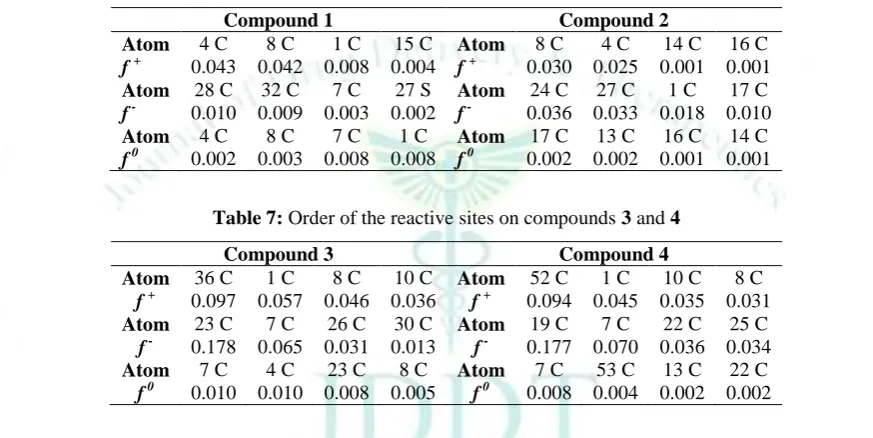
The chemical hardness is a measure of the resistance to charge transference28, while the electronegativity is a measure of the tendency to attract electrons in a chemical bond, as is defined as the negative of the chemical potential in DFT28. The electrophilicity index (ω) contains information about both electron transfer (chemical potential) and stability (hardness) and is a better descriptor of global chemical reactivity. For the studied compounds, the chemical reactivity descriptors are computed by B3LYP/6-31G (d,p) method and given in Table 5.
Table 5: Quantum chemical descriptors of bis and tris (1,3-dithiole) TTF 1-4
Parameters Compound 1 Compound 2 Compound 3 Compound 4
EHOMO(eV) -4.699 -4.531 -4.349 -4.165
ELUMO(eV) -0.988 -0.771 -1.226 -0.983
ΔEgap (eV) 3.711 3.759 3.123 3.182
IE (eV) 4.699 4.531 4.349 4.165
A (eV) 0.988 0.711 1.226 0.983
µ (eV) -2.844 -2.651 -2.787 -2.574
χ (eV) 2.844 2.651 2.787 2.574
ƞ (eV) 1.855 1.880 1.561 1.591
S (eV) 0.269 0.266 0.320 0.314
ω (eV) 2.179 1.870 2.488 2.082
The compound which have the lowest energetic gap is the compound 3 (∆Egap = 3.123 eV). This lower gap
allows it to be the softest molecule. The compound that has the highest energy gap is the compound 2 (∆Egap =
3.759 eV).The compound that has the highest HOMO energy is the compound 4 (EHOMO = -4.165 eV). This
higher energy allows it to be the best electron donor. The compound that has the lowest LUMO energy is the compound 3 (ELUMO = -1.226 eV) which signifies that it
can be the best electron acceptor. The two properties like I (potential ionization) and A (affinity) are so
0.320 eV) is lesser (greater) among all the molecules. Thus, compound 3 is found to be more reactive than all the compounds. Compound 1 possesses higher electronegativity value (χ = 2.844 eV) than all compounds so; it is the best electron acceptor. The value of ω for compound 3 (ω = 2.488 eV) indicates that it is the stronger electrophiles than all compounds. Compound 3 has the smaller frontier orbital gap so, it is more polarizable and is associated with a high chemical reactivity, low kinetic stability and is also termed as soft molecule.
3.5. Local Reactivity Descriptors
Parr and Yang29 have demonstrated that most of the frontier-electron density theory of chemical reactivity can be rationalized from the DFT. Parr and Yang defined a Fukui function (fk) to describe electrophilic
attack (fk-), nucleophilic attack (fk+) and neutral (radical)
attack (fk0). Yang and Mortier proposed a finite
difference approach to calculate Fukui function indices30. In a finite difference approximation, the condensed Fukui function values are given Yang et al. as
1
N q N q
fj j j for nucleophilic attack
N
q
Nq
fj j j
1 for electrophilic attack
1 1
2 1
0
N q N
q
fj j j for radical attack
where qk is the gross charge of the kth atom in the
neutral (N), anionic (N+1) and cationic (N-1) molecule, respectively, all with the ground state geometry of the N electron molecule. Gross charges may be determined by Mulliken, Hirschfeld and Natural charge analysis. The reactive sites on bis and tris (1,3-dithiole) TTF 1-4 are calculated by the DFT/B3LYP method with 6-31G (d,p) basis set and shown in Tables 6-7.
Table 6: Order of the reactive sites on compounds 1 and 2
Compound 1 Compound 2
Atom 4 C 8 C 1 C 15 C Atom 8 C 4 C 14 C 16 C
f + 0.043 0.042 0.008 0.004 f + 0.030 0.025 0.001 0.001
Atom 28 C 32 C 7 C 27 S Atom 24 C 27 C 1 C 17 C
f - 0.010 0.009 0.003 0.002 f - 0.036 0.033 0.018 0.010
Atom 4 C 8 C 7 C 1 C Atom 17 C 13 C 16 C 14 C
f 0 0.002 0.003 0.008 0.008 f 0 0.002 0.002 0.001 0.001
Table 7: Order of the reactive sites on compounds 3 and 4
Compound 3 Compound 4
Atom 36 C 1 C 8 C 10 C Atom 52 C 1 C 10 C 8 C
f + 0.097 0.057 0.046 0.036 f + 0.094 0.045 0.035 0.031
Atom 23 C 7 C 26 C 30 C Atom 19 C 7 C 22 C 25 C
f - 0.178 0.065 0.031 0.013 f - 0.177 0.070 0.036 0.034
Atom 7 C 4 C 23 C 8 C Atom 7 C 53 C 13 C 22 C
f 0 0.010 0.010 0.008 0.005 f 0 0.008 0.004 0.002 0.002
The parameters of local reactivity descriptors show that 4C, 8C, 36C and 52C are the more reactive sites in compounds 1, 2, 3 and 4 respectively for nucleophilic attacks. The more reactive sites for electrophilic attacks are 28C, 24C, 23C and 19C for compounds 1, 2, 3 and 4
respectively. The more reactive sites in radical attacks are 4C, 17C,forcompounds 1, 2 respectively and 7C for the both compounds 3 and 4.
3.6. Natural Bond Orbital Analysis (NBO)
A useful aspect of the NBO method is that it gives information about intra and intermolecular bonding and interactions among bonds and also provides a convenient basis for investigating the interactions in both filled and virtual orbital spaces along with charge transfer and conjugative interactions in molecular system. Some electron donor orbital, acceptor orbital and the interacting stabilization energies resulting from the second-order micro-disturbance theory are reported31,32.The large value of second order stabilization energy (E(2)) shows that the more donating
tendency from electron donors to electron acceptors and the greater the extent of conjugation of the whole system33. In order to characterize the intra and intermolecular interactions quantitatively, a second-order perturbation theory is applied that gives the energy lowering associated with such interactions. For each donor NBO(i) and acceptor NBO(j), stabilization energy (E(2)) associated with electron delocalization between donor and acceptor is estimated by an equation as34,35.
j i
ij iε ε
F q E
2 2
where q i is the donor orbital occupancy; ε i , ε j are
orbital energies of donor and acceptor NBO orbitals, respectively; F ij is the off-diagonal Fock or Kohn-Sham
Table 8: Second order perturbation theory analysis of Fock matrix on NBO of compound 1
Donor(i) ED/e Acceptor(j) ED/e E(2) Kcal/mol
E(j)-E(i) a.u
F(i.j) a.u
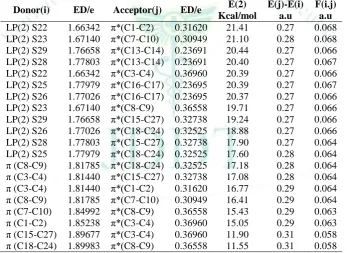
LP(2) S34 1.76226 π*(C13-C14) 0.22006 22.85 0.25 0.068 LP(2) S30 1.76003 π*(C18-C19) 0.21963 22.77 0.25 0.068 LP(2) S35 1.75627 π*(C13-C14) 0.22006 22.21 0.25 0.067 LP(2) S31 1.75279 π*(C18-C19) 0.21963 22.20 0.25 0.067 LP(2) S27 1.66431 π*(C7-C10) 0.31685 21.18 0.27 0.068 LP(2) S26 1.67209 π*(C1-C2) 0.31139 20.95 0.28 0.068 LP(2) S27 1.66431 π*(C8-C9) 0.36906 20.87 0.27 0.067 LP(2) S26 1.67209 π*(C3-C4) 0.36665 20.18 0.27 0.067 LP(2) S31 1.75279 π*(C20-C28) 0.32339 20.11 0.27 0.067 LP(2) S35 1.75627 π*(C15-C32) 0.32218 19.80 0.27 0.067 π (C3-C4) 1.80546 π*(C15-C32) 0.32218 19.23 0.27 0.067 π (C8-C9) 1.80282 π*(C20-C28) 0.32339 18.97 0.27 0.066 LP(2) S30 1.76003 π*(C20-C28) 0.32339 17.66 0.27 0.063 LP(2) S34 1.76226 π*(C15-C32) 0.32218 17.45 0.27 0.063 π (C8-C9) 1.80282 π*(C7-C10) 0.31685 16.92 0.29 0.065 π (C3-C4) 1.80546 π*(C1-C2) 0.31139 16.61 0.29 0.064 π (C1-C2) 1.84789 π*(C3-C4) 0.36665 15.32 0.29 0.063 π (C7-C10) 1.85043 π*(C8-C9) 0.36906 14.95 0.29 0.063 π (C20-C28) 1.91327 π*(C8-C9) 0.36906 11.72 0.32 0.059 π (C15-C32) 1.91577 π*(C3-C4) 0.36665 11.51 0.32 0.058
Table 9: Second order perturbation theory analysis of Fock matrix on NBO of compound 2
Donor(i) ED/e Acceptor(j) ED/e E(2) Kcal/mol
E(j)-E(i) a.u
F(i.j) a.u
LP(2) S22 1.66342 π*(C1-C2) 0.31620 21.41 0.27 0.068 LP(2) S23 1.67140 π*(C7-C10) 0.30949 21.10 0.28 0.068 LP(2) S29 1.76658 π*(C13-C14) 0.23691 20.44 0.27 0.066 LP(2) S28 1.77803 π*(C13-C14) 0.23691 20.40 0.27 0.067 LP(2) S22 1.66342 π*(C3-C4) 0.36960 20.39 0.27 0.066 LP(2) S25 1.77979 π*(C16-C17) 0.23695 20.39 0.27 0.067 LP(2) S26 1.77026 π*(C16-C17) 0.23695 20.37 0.27 0.066 LP(2) S23 1.67140 π*(C8-C9) 0.36558 19.71 0.27 0.066 LP(2) S29 1.76658 π*(C15-C27) 0.32738 19.24 0.27 0.066 LP(2) S26 1.77026 π*(C18-C24) 0.32525 18.88 0.27 0.066 LP(2) S28 1.77803 π*(C15-C27) 0.32738 17.90 0.27 0.064 LP(2) S25 1.77979 π*(C18-C24) 0.32525 17.60 0.28 0.064 π (C8-C9) 1.81785 π*(C18-C24) 0.32525 17.18 0.28 0.064 π (C3-C4) 1.81440 π*(C15-C27) 0.32738 17.08 0.28 0.064 π (C3-C4) 1.81440 π*(C1-C2) 0.31620 16.77 0.29 0.064 π (C8-C9) 1.81785 π*(C7-C10) 0.30949 16.41 0.29 0.064 π (C7-C10) 1.84992 π*(C8-C9) 0.36558 15.43 0.29 0.063 π (C1-C2) 1.85238 π*(C3-C4) 0.36960 15.05 0.29 0.063 π (C15-C27) 1.89677 π*(C3-C4) 0.36960 11.90 0.31 0.058 π (C18-C24) 1.89983 π*(C8-C9) 0.36558 11.55 0.31 0.058
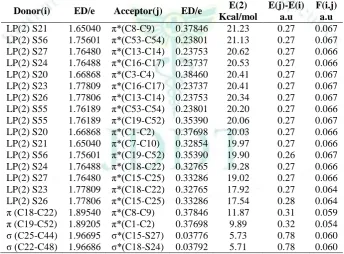
The intra molecular interaction for the title compounds is formed by the orbital overlap between: π (C3-C4) and π*(C15-C32) for compound 1, π (C8-C9) and π*(C18-C24) for compound 2, π (C3-C4) and π*(C15-C30) for compound 3 and π (C18-C22) and π*(C8-C9) for compound 4 respectively, which result into intermolecular charge transfer (ICT) causing stabilization of the system. The intra molecular hyper conjugative interactions of π (C3-C4) to π*(C15-C32) for compound 1, π (C8-C9) to π*(C18-C24) for
compound 2, π (C3-C4) to π*(C15-C30) for compound 3
Table 10: Second order perturbation theory analysis of Fock matrix on NBO of compound 3
Donor(i) ED/e Acceptor(j) ED/e E(2) Kcal/mol
E(j)-E(i) a.u
F(i.j) a.u
LP(2) S39 1.73999 π*(C34-C35) 0.22026 23.07 0.25 0.069 LP(2) S32 1.75980 π*(C13-C14) 0.22068 22.76 0.25 0.068 LP(2) S28 1.75851 π*(C18-C19) 0.21995 22.75 0.25 0.068 LP(2) S33 1.75045 π*(C13-C14) 0.22068 22.37 0.25 0.068 LP(2) S29 1.75001 π*(C18-C19) 0.21995 22.25 0.25 0.067 LP(2) S40 1.74741 π*(C34-C35) 0.22026 21.92 0.26 0.067 LP(2) S25 1.65108 π*(C8-C9) 0.37672 21.74 0.27 0.068 LP(2) S24 1.66989 π*(C3-C4) 0.38553 20.90 0.27 0.068 LP(2) S29 1.75001 π*(C20-C26) 0.32384 20.25 0.27 0.067 LP(2) S33 1.75045 π*(C15-C30) 0.33086 19.99 0.27 0.067 π (C3-C4) 1.77776 π*(C15-C30) 0.33086 19.83 0.27 0.067 LP(2) S25 1.65108 π*(C7-C10) 0.33037 19.82 0.27 0.065 LP(2) S24 1.66989 π*(C1-C2) 0.38247 19.80 0.27 0.066 LP(2) S40 1.74741 π*(C23-C36) 0.35872 19.63 0.27 0.067 LP(2) S39 1.73999 π*(C23-C36) 0.35872 19.44 0.27 0.066 π (C8-C9) 1.78802 π*(C20-C26) 0.32384 19.17 0.27 0.066 π (C8-C9) 1.78802 π*(C7-C10) 0.33037 18.29 0.29 0.067 LP(2) S28 1.75851 π*(C20-C26) 0.32384 17.73 0.27 0.063 LP(2) S32 1.75980 π*(C15-C30) 0.33086 17.46 0.27 0.063 π (C3-C4) 1.77776 π*(C1-C2) 0.38247 17.20 0.28 0.065
Table 11: Second order perturbation theory analysis of Fock matrix on NBO of compound 4
Donor(i) ED/e Acceptor(j) ED/e E(2) Kcal/mol
E(j)-E(i) a.u
F(i.j) a.u
LP(2) S21 1.65040 π*(C8-C9) 0.37846 21.23 0.27 0.067 LP(2) S56 1.75601 π*(C53-C54) 0.23801 21.13 0.27 0.067 LP(2) S27 1.76480 π*(C13-C14) 0.23753 20.62 0.27 0.066 LP(2) S24 1.76488 π*(C16-C17) 0.23737 20.53 0.27 0.066 LP(2) S20 1.66868 π*(C3-C4) 0.38460 20.41 0.27 0.067 LP(2) S23 1.77809 π*(C16-C17) 0.23737 20.41 0.27 0.067 LP(2) S26 1.77806 π*(C13-C14) 0.23753 20.34 0.27 0.067 LP(2) S55 1.76189 π*(C53-C54) 0.23801 20.20 0.27 0.066 LP(2) S55 1.76189 π*(C19-C52) 0.35390 20.06 0.27 0.067 LP(2) S20 1.66868 π*(C1-C2) 0.37698 20.03 0.27 0.066 LP(2) S21 1.65040 π*(C7-C10) 0.32854 19.97 0.27 0.066 LP(2) S56 1.75601 π*(C19-C52) 0.35390 19.90 0.26 0.067 LP(2) S24 1.76488 π*(C18-C22) 0.32765 19.28 0.27 0.066 LP(2) S27 1.76480 π*(C15-C25) 0.33286 19.02 0.27 0.066 LP(2) S23 1.77809 π*(C18-C22) 0.32765 17.92 0.27 0.064 LP(2) S26 1.77806 π*(C15-C25) 0.33286 17.54 0.28 0.064 π (C18-C22) 1.89540 π*(C8-C9) 0.37846 11.87 0.31 0.059 π (C19-C52) 1.89205 π*(C1-C2) 0.37698 9.89 0.32 0.054 σ (C25-C44) 1.96695 σ*(C15-S27) 0.03776 5.73 0.78 0.060 σ (C22-C48) 1.96686 σ*(C18-S24) 0.03792 5.71 0.78 0.060
3.7. Nonlinear Optical Properties (NLO)
NLO techniques are considered as one among the most structure sensitive method to study molecular structure and assemblies since the potential or organic materials for NLO device have been proven. Organic molecules able to manipulate photonic signals efficiently are of importance in technologies such as optical communication, optical computing, and dynamic image processing36. DFT has been extensively used as an effective method to investigate NLO properties of organic materials. In order to gain insight into NLO property of title compound, the first static hyperpolarizability (β) were calculated by the finite field
perturbation method in vacuum as well as incorporating the solvent factors with increasing polarity. First hyperpolarizability is a third rank tensor that can be described by a 3×3×3 matrix. The 27 components of the 3D-matrix can be reduced to 10 components due to the Kleinman symmetry37. The components of β are defined as the coefficients in the Taylor series expansion of the energy in the external electric field. When the external electric field is weak and homogeneous this expansion becomes:
ijkl k
j i ijk j
i ij i
iF α FF β FFF γ
μ E
where E0 is the energy of the unperturbed molecules, F i
the field at the origin and µi , αij , βijk and γijkl are the
components of dipole moment, polarizability, and the first hyperpolarizability respectively. Using the x, y and z components of β obtained from Gaussian 09 output, the magnitude of the mean first hyperpolarizability tensor can be calculated.
The total static dipole moment is μtot
μ2xμ2yμ2z
12 The mean polarizability is α0
αxxαyyαzz
3The anisotropy polarizability is
2 2 2 2
122
1 6
2 α α α α α α α xz
α xx yy yy zz zz xx
and the mean first hyperpolarizability is
2 2 2
120 βx βy βz
β
and
zzz zxx zyy
z
yxx yzz yyy y
xzz xyy xxx x
β β β β
β β β β
β β β β
The first static hyperpolarizability (β0) and its related
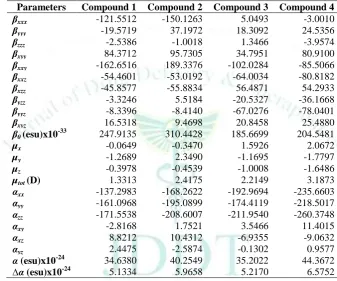
properties of title compoundshave been computed using B3LYP/6-31G (d,p) level based on finite field approach and shown in Table 12.
Table 12: The dipole moments µtot (D), polarizability α0 (esu), the anisotropy of the polarizability Δα (esu) and the first
hyperpolarizability β0 (esu) of bis and tris (1,3-dithiole) TTF 1-4.
Parameters Compound 1 Compound 2 Compound 3 Compound 4
βxxx -121.5512 -150.1263 5.0493 -3.0010
βyyy -19.5719 37.1972 18.3092 24.5356
βzzz -2.5386 -1.0018 1.3466 -3.9574
βxyy 84.3712 95.7305 34.7951 80.9100
βxxy -162.6516 189.3376 -102.0284 -85.5066
βxxz -54.4601 -53.0192 -64.0034 -80.8182
βxzz -45.8577 -55.8834 56.4871 54.2933
βyzz -3.3246 5.5184 -20.5327 -36.1668
βyyz -8.3396 -8.4140 -67.0276 -78.0401
βxyz 16.5318 9.4698 20.8458 25.4880
β0 (esu)x10-33 247.9135 310.4428 185.6699 204.5481
µx -0.0649 -0.3470 1.5926 2.0672
µy -1.2689 2.3490 -1.1695 -1.7797
µz -0.3978 -0.4539 -1.0008 -1.6486
µtot (D) 1.3313 2.4175 2.2149 3.1873
αxx -137.2983 -168.2622 -192.9694 -235.6603
αyy -161.0968 -195.0899 -174.4119 -218.5017
αzz -171.5538 -208.6007 -211.9540 -260.3748
αxy -2.8168 1.7521 3.5466 11.4015
αxz 8.8212 10.4312 -6.9355 -9.0632
αyz 2.4475 -2.5874 -0.1302 0.9577
α (esu)x10-24 34.6380 40.2549 35.2022 44.3672
∆α (esu)x10-24 5.1334 5.9658 5.2170 6.5752
Since the values of the polarizabilities (∆α) and the hyperpolarizabilities (β0) of the GAUSSIAN 09 output
are obtained in atomic units (a.u.), the calculated values have been converted into electrostatic units (e.s.u.) (for α; 1 a.u = 0.1482 x 10⁻²⁴ e.s.u., for β; 1 a.u = 8.6393 x
10-33 e.s.u.). The calculated values of dipole moment (µtot) for the title compounds were found to be 1.3313,
2.4175, 2.2149 and 3.1873 D respectively, which are approximately three times than to the value for urea (µ = 1.3732 D). Urea is one of the prototypical molecules used in the study of the NLO properties of molecular systems. Therefore, it has been used frequently as a threshold value for comparative purposes. The calculated values of polarizability are 34.6380 x 10⁻²⁴, 40.2549 x 10⁻²⁴, 35.2022 x 10⁻²⁴ and 44.3672 x 10⁻²⁴ esu respectively; the values of anisotropy of the polarizability are 5.1334, 5.9658, 5.2170 and 6.5752 esu, respectively. The magnitude of the molecular hyperpolarizability (β0) is one of important key factors
in a NLO system. The DFT/6-31G (d,p) calculated first
hyperpolarizability value (β0) of bis and tris
(1,3-dithiole) TTF molecules are equal to 247.9135 x 10⁻³³, 310.4428 x 10⁻³³, 185.6699 x 10⁻³³ and 204.5481 x 10⁻³³ esu. The first hyperpolarizability of title molecules is approximately 0.72, 0.90, 0.54 and 0.60 times than those of urea (β of urea is 343.272 x10⁻³³ esu obtained by
B3LYP/6-311G (d,p) method). The above results show that bis and tris (1,3-dithiole) TTF 1-4 might have not the NLO proprieties.
4. CONCLUSION
the molecules have been determined with the help of global and local reactivity descriptors. The stabilization energies have been calculated from second order perturbation theory. The predicted NLO properties of title compounds are much smaller than those of urea which indicates that have not the NLO materials.
Acknowledgments
This work was generously supported by the (General Directorate for Scientific Research and Technological Development, DGRS-DT) and Algerian Ministry of Scientific Research.
REFERENCES
1. Brillante A, Bilotti I, Della Valle RG, Venuti E, Milita S, Dionigi C et al, The Four Polymorphic Modifications of the Semiconductor Dibenzo-Tetrathiafulvalene. Cryst Eng Comm, 2008; 10(12):1899-1909.
http://dx.doi.org/10.1039/B810993A.
2. Crivillers N, Mas-Torrent M, Bromley ST, Wurst K, Veciana J, Rovira C, Influence of Intermolecular Interactions on the Formation of tetra(carbomethoxy)-tetrathiafulvalene Assemblies. Chem Phys Chem, 2007; 8(10):1565-1571.
http://dx.doi.org/10.1002/cphc.200700198.
3. Crivillers N, Oxtoby NS, Mas-Torrent M, Veciana J, Rovira C, Improved Synthesis of the High-Mobility Organic Semiconductor Dithio-phene-Tetrathiafulvalene. Synthesis, 2007; 11:1621-1623.
http://dx.doi.org/10.1055/s-2007-966053.
4. Leufgen M, Rost O, Gould C, Schmidt G, Geurts J, Molenkamp LW, et al, High-mobility Tetrathiafulvalene Organic Field-Effect Transistors from Solution Processing, Org Electron, 2008, 9(6), 1101-1106.
http://dx.doi.org/10.1016/j.orgel.2008.08.011.
5. Rosokha SV, Kochi JK. Molecular and Electronic Structures of the Long-Bonded π-Dimers of Tetrathiafulvalene Cation-Radical in Intermolecular Electron Transfer and in (Solid-State) Conductivity, J Am Chem Soc, 2007; 129(4):828-838.
http://dx.doi.org/10.1021/ja064166x.
6. Fourmigue M, Batail P, Activation of Hydrogen- and Halogen-Bonding Interactions in Tetrathiafulvalene-Based Crystalline Molecular Conductors, Chem Rev, 2004; 104(11):5379-5418. http://dx.doi.org/10.1021/cr030645s. 7. Day P, Kurmoo M, Molecular Magnetic Semiconductors,
Metals and Superconductors: BEDT-TTF Salts with Magnetic Anions, J Mater Chem, 1997; 7(8):1291-1295.
http://dx.doi.org/10.1039/A608508C.
8. Bryce MR, Recent Progress on Conducting Organic Charge-Transfer Salts, Chem Soc Rev, 1991; 20(3):355-390.
http://dx.doi.org/10.1039/CS9912000355.
9. Moore AJ, Goldenberg LM, Bryce MR, Petty MC, Monkman AP, Morenco C, et al, Cation Recognition by
Self‐ Assembled Layers of Novel Crown‐ Annelated Tetrathiafulvalenes, Adv Mater, 1998; 10(5):395-398.
http://dx.doi.org/10.1002/(SICI)1521-4095(199803)10:5<395::AID-ADMA395>3.0.CO;2-I.
10. Segura JL, Martίn N, New Concepts in Tetrathiafulvalene Chemistry, Angew Chem Int Ed, 2001; 40(8):1372-1409.
http://dx.doi.org/10.1002/1521-3773(20010417)40:8<1372::AID-ANIE1372>3.0.CO;2-I.
11. Mas-Torrent M, Durkut M, Hadley P, Ribas X, Rovira C. High Mobility of Dithiophene-Tetrathiafulvalene Single-Crystal Organic Field Effect Transistors, J Am Chem Soc, 2004; 126(4):984-985. http://dx.doi.org/10.1021/ja0393933. 12. U Soykan, S Cetin, B Ozturk, F Karaboga, Y Zalaoglu, M
Dogruer, et al, Synthesis and Characterization of p-benzophenoneoxycarbonylphenyl Acrylate by Means of Experimental Measurements and Theoretical Approaches, and Bulk Melt Polymerization, J Mol Struct, 2013; 1049:479-487. http://dx.doi.org/10.1016/j.molstruc.2013.07.003. 13. Breda S, Reva I, Fausto R, Molecular Structure and
Vibrational Spectra of Furanone and
2(5H)-thiophenone Isolated in Low Temperature Inert Matrix, J Mol Struct, 2008; 887(1-3):75-86.
http://dx.doi.org/10.1016/j.molstruc.2008.02.034.
14. Foresman JB, Frisch A, Exploring Chemistry with Electronic Structure Methods: a Guide to Using Gaussian, second ed., Gaussian, Pittsburgh; 1996.
15. Rauhut G, Pulay P, Transferable Scaling Factors for Density Functional Derived Vibrational Force Fields, J Phys Chem, 1995; 99(10):3093-3100.
http://dx.doi.org/10.1021/j100010a019.
16. Scott AP, Radom L, Harmonic Vibrational Frequencies: An Evaluation of Hartree−Fock, Møller−Plesset, Quadratic Configuration Interaction, Density Functional Theory, and Semiempirical Scale Factors, J Phys Chem, 1996; 100(41): 16502-16513. http://dx.doi.org/10.1021/jp960976r.
17. Durig JR, Ganguly A, El-Defrawy AM, Guirgis GA, Gounev TK, Herrebout WA, Conformational Stability from Variable-Temperature Infrared Spectra of Xenon Solutions, r0
Structural Parameters, and Vibrational Assignment of Pyrrolidine, J Phys Chem A, 2011; 115(26):7473-7483.
http://dx.doi.org/10.1021/jp200692t.
18. Bałczewski P, Kudelska W, Bodzioch A, Comprehensive Heterocyclic Chemistry III, 1st Edition, Volume Set; 2008, 15, 12500. ISBN: 9780080449920
19. Frisch MJ, Trucks GW, Schlegel HB, Scuseria GE, Robb MA, Cheeseman JR, et al, Gaussian 09, Revision C.01; Gaussian Inc.: Wallingford, CT, USA; 2010.
20. Fukui K, Yonezawa T, Shingu HJ, A Molecular Orbital Theory of Reactivity in Aromatic Hydrocarbons, J Chem Phys, 1952; 20(4):722-725.
http://dx.doi.org/10.1063/1.1700523.
21. Padmaja L, Ravikumar C, Sajan D, Joe IH, Jayakumar VS, Pettit GR, Neilsen FO, Density Functional Study on the Structural Conformations and Intramolecular Charge Transfer from the Vibrational Spectra of the Anticancer Drug Combretastatin‐ A2. J. Raman Spectrosc, 2009; 40(4):419-428. http://dx.doi.org/10.1002/jrs.2145.
22. Ravikumar C, Joe IH, Jayakumar VS, Charge Transfer Interactions and Nonlinear Optical Properties of Push-Pull Chromophore Benzaldehyde Phenylhydrazone: A Vibrational Approach. Chem. Phys. Lett, 2008; 460(4-6):552-558.
http://dx.doi.org/10.1016/j.cplett.2008.06.047.
23. Pearson RG, Absolute Electronegativity and Hardness: Applications to Organic Chemistry. J. Org. Chem, 1989; 54(6):1430-1432. http://dx.doi.org/10.1021/jo00267a034. 24. Parr RG, Pearson RG, Absolute Hardness: Companion
Parameter to Absolute Electronegativity. J. Am. Chem. Soc, 1983; 105(26):7512-7516.
http://dx.doi.org/10.1021/ja00364a005.
25. Geerlings P, De Proft F, Langenaeker W, Conceptual Density Functional Theory. Chem. Rev, 2003; 103(5):1793-1873.
http://dx.doi.org/10.1021/cr990029p.
26. Parr RG, Szentpaly L, Liu S, Electrophilicity Index. J. Am. Chem. Soc, 1999; 121(9):1922-1924.
http://dx.doi.org/10.1021/ja983494x.
27. Chattaraj K, Giri S, Aromaticity in Polyacene Analogues of Inorganic Ring Compounds. J. Phys. Chem. A, 2007; 111(21):11116-11121. http://dx.doi.org/10.1021/jp071030s. 28. Parr RG, Yang W, Density-functional Theory of Atoms and
Molecules, Oxford University Press, New York, 1989. 29. Parr RG, Yang W, Density Functional Approach to the Frontier-Electron Theory of Chemical Reactivity. J. Am. Chem. Soc, 1984; 106(14):4049-4050.
http://dx.doi.org/10.1021/ja00326a036.
30. Yang W, Mortier WJ, The Use of Global and Local Molecular Parameters for the Analysis of the Gas-Phase Basicity of Amines. J. Am. Chem. Soc, 1986; 108(19);5708-5711. http://dx.doi.org/10.1021/ja00279a008.
Studies of 2,6‐ bis (p‐ N,N‐ dimethyl benzylidene) cyclohexanone Using Density Functional Theory. J. Raman Spectrosc, 2006; 37(12);1381-1392.
http://dx.doi.org/10.1002/jrs.1554.
32. Liu J, Chen ZR, Yuan SF, Study on the Prediction of Visible Absorption Maxima of Azobenzene Compounds. J. Zhejing Univ. Sci. B, 2005; 6(6):584-589. PMC1389895
33. Foster JP, Weinhold F, Natural Hybrid Orbitals. J. Am. Chem. Soc, 1980; 102(24):7211-7218.
http://dx.doi.org/10.1021/ja00544a007 .
34. Reed AE, Curtiss LA, Weinhold F, Intermolecular Interactions from a Natural Bond Orbital, Donor-Acceptor
Viewpoint. Chem. Rev, 1988; 88(6):889-926.
http://dx.doi.org/10.1021/cr00088a005.
35. Liu CG, Guan XH, Redox and photoisomerization switching of the second-order optical nonlinearity of a
tetrathiafulvalene derivative of spiropyran across five states: A DFT study. Physical Chemistry Chemical Physics, 2012; 14(15);5297-5306. http://dx.doi.org/10.1039/c2cp23293f . 36. Kolinsky PV, New Materials and their Characterization for
Photonic Device Applications. Opt. Eng, 1992; 31(8):11676-11684. http://dx.doi.org/10.1117/12.58844.
37. Kleinmann DA, Nonlinear Dielectric Polarization in Optical Media. Phys. Rev, 1962; 126(6):1977.