Geschke Center
Doctoral Dissertations Theses, Dissertations, Capstones and Projects
2017
Investigating the Extent of Collaboration Between
Jesuit Administrators and non-Jesuit Faculty and
Staff in Jesuit Secondary Schools in the Eastern
Africa Province: Staying True to Mission
Stephen Nzyoki Nduati
University of San Francisco, [email protected]
Follow this and additional works at:https://repository.usfca.edu/diss
Part of theEducational Leadership Commons
This Dissertation is brought to you for free and open access by the Theses, Dissertations, Capstones and Projects at USF Scholarship: a digital repository @ Gleeson Library | Geschke Center. It has been accepted for inclusion in Doctoral Dissertations by an authorized administrator of USF Scholarship: a digital repository @ Gleeson Library | Geschke Center. For more information, please [email protected].
Recommended Citation
Nduati, Stephen Nzyoki, "Investigating the Extent of Collaboration Between Jesuit Administrators and non-Jesuit Faculty and Staff in Jesuit Secondary Schools in the Eastern Africa Province: Staying True to Mission" (2017).Doctoral Dissertations. 333.
INVESTIGATING THE EXTENT OF COLLABORATION BETWEEN JESUIT ADMINISTRATORS AND NON-JESUIT FACULTY AND STAFF IN JESUIT
SECONDARY SCHOOLS IN THE EASTERN AFRICA PROVINCE: STAYING TRUE TO MISSION
A Dissertation Presented to
The Faculty of the School of Education Department of Leadership Studies
In Partial Fulfillment of the Requirement for the Degree
Doctor of Education
by
Stephen Nzyoki Nduati San Francisco
ii
Dissertation Abstract
Investigating the Extent of Collaboration Between Jesuit Administrators and non-Jesuit Faculty and Staff in Jesuit Secondary Schools in the Eastern Africa Province:
Staying True to Mission
The Society of Jesus (Jesuits) is well known for its educational institutions. Over
the years, Jesuits have run excellent schools all over the world. However, Jesuits have
also realized the increasing need to incorporate non-Jesuits more fully in their ministry.
This dynamic of deeper incorporation of non-Jesuits into Jesuit works is referenced as
collaboration.
To enhance this collaboration, Jesuits have produced documents that advocate for
collaboration, delineated the path to accomplish collaboration, and the attitudes necessary
for its growth. One such document by the International Commission on the Apostolate of
Jesuit Education pointed out that Jesuit Education “stresses lay-Jesuit collaboration,” and
“relies on a spirit of community” (1987, p. 41). These characteristics formed one
component of the conceptual framework for this study. The other component was
Selznick’s concept of the institutional embodiment of purpose. The purpose of this study
was to investigate the extent of collaboration in Jesuit secondary schools in the Eastern
Africa Province.
This mixed-method study was carried out in two Jesuit secondary schools in
Tanzania. It used a researcher-constructed survey and interviews with semi structured
questions. The survey included 117 participants (teachers, nonteaching staff, and
headteachers). Afterward taking the survey, headteachers and 7 members of their
administrative teams were interviewed for more information about collaboration.
Data from this study indicated evidence of a good level of collaboration, exhibited
iii
existed between the two groups; and the different initiatives that Jesuit administrators
have put in place to help the collaborators feel valued and become more immersed in the
Jesuit charism. However, the level of knowledge about Jesuit education was very low,
and no meaningful orientation/induction program existed. This lack of a program was one
area that needed immediate improvement. Research in areas of collaboration and the
iv
and approved by the members of the committee, has been presented to and accepted by
the Faculty of the School of Education in partial fulfillment of the requirements for the
degree of Doctor of Education. The content and research methodologies presented in this
work represent the work of the candidate alone.
Stephen Nzyoki Nduati April 12, 2017
Candidate Date
Dissertation Committee
Dr. Patricia Mitchell May 18, 2017 Chairperson
Dr. Ralph Metts SJ May 18, 2017
v
In my dissertation journey, I have received assistance and help from many people
and I would like to recognize and acknowledge some of them here. First, I would like to
acknowledge the staunch support of my chairperson, Dr. Patricia Mitchell. Your caring,
encouraging, and supportive insights have seen me through the whole process. Your
timely and professional feedback ensured that I was on the right track, and your words
always uplifted me when I was tired. Thank you so much.
Second, I also want to thank the other members of my dissertation committee: Fr.
Ralph Metts SJ and Dr. Michael Duffy. Your insightful comments, especially about
Jesuit education, have helped me a great deal to focus on the topic I was covering. Both
of you have been a sure support for me during this process, and I truly thank you for that.
Third, I would also like to thank several other members of the USF School of
Education: Dr. Doreen Jones for the introduction to the doctoral journey, and for all the
advice and follow up when I began this process. I truly appreciate your encouragement
and positivity. Dr. Benjamin Baab for inspiring me and guiding me, especially around the
whole area of survey research. That was a great boost. And last, Ms. Thanh Ly. You were
always welcoming, and always had an encouraging word. Your knowledge of the
processes and your willingness to share what needed to be done were a big boost. Thank
you so much.
To my many colleagues and friends on whose support and encouragement I
depended, I am grateful. It has been a long journey, but not a lonely one. Thank you so
much. And to my family in Kenya, mom, dad, brothers, sisters, nieces and nephews,
vi
support and prayers meant to me especially when I was so far away from you. I thank you
vii
ABSTRACT ... ii
SIGNATURE PAGE ... iv
ACKNOWLEDGEMENTS ...v
LIST OF TABLES ...x
LIST OF FIGURES ... xi
CHAPTER I THE RESEARCH PROBLEM ...1
Statement of the Problem ...1
Background and Need for the Study ...4
The Call for and Development of Collaboration in Jesuit Education ....5
The Need for Collaboration in Jesuit Schools ...7
Purpose of the Study ...9
Conceptual Framework for the Study ...10
Research Questions ...12
Limitations of the Study ...13
Significance of the Study ...14
Definition of Terms ...15
Summary ...19
CHAPTER II REVIEW OF LITERATURE ...21
Introduction ...21
Overview of Review of Literature ...22
Historical Background: History of Jesuits and Jesuit Education ...23
Foundational Documents ...24
The Changing Landscape in Roman Catholic Education ...28
The Vatican Council II and the Mission of the Laity ...28
Other Catholic Church Documents on Collaboration in Catholic Schools ...28
A New Dawn in Jesuit Education ...41
The Thirty-First General Congregation (GC31, 1967): Decree 28...44
The Thirty-Fourth General Congregation (GC34; 1995): Decree 13. ...45
The Thirty-Fifth General Congregation (GC 35; 2008): Decree 6...49
Other Jesuit Writings on Collaboration ...52
Collaboration in the School Community ...59
The Importance of Collaboration in a School Community ...59
viii
Summary of the Review of Literature ...76
CHAPTER III RESEARCH METHODOLOGY ...79
Restatement of the Purpose ...79
Research Design ...79
Research Setting ...82
Population and Sample ...83
Instrumentation ...85
Collaboration in Jesuit Secondary Schools Survey ...85
Validity ...89
Reliability ...91
Interviews ...91
Data-Collection Procedures ...92
Data Analysis ...94
Ethical Considerations ...95
Researcher’s Background ...96
CHAPTER IV DATA ANALYSIS AND RESULTS ...98
An Overview of the Chapter ...98
Response Rate ...99
Demographic Information ...100
Finding for Research Questions ...100
Findings for Research Question 1 ...102
Findings for Research Question 2 ...105
Findings for Research Question 3 ...108
Findings for Research Question 4 ...117
Findings for Research Question 5 ...121
Findings for Research Question 6 ...123
Findings for Research Question 7 ...126
Additional Findings ...129
Summary of Research Findings ...132
CHAPTER V SUMMARY, DISCUSSIONS, CONCLUSIONS, IMPLICATIONS, & RECOMMENDATIONS ...134
Summary of the Study ...134
Discussions ...136
Discussions for Research Question 1 ...136
Discussions for Research Question 2 ...138
Discussions for Research Question 3 ...140
Discussions for Research Question 4 ...144
Discussions for Research Question 5 ...145
Discussions for Research Question 6 ...147
Discussions for Research Question 7 ...148
Discussion of Other Key Findings ...149
Implications ...151
Recommendations ...152
ix
Recommendations for Future Practice ...152 Closing Remarks ...155
REFERENCES ...158
APPENDIX A COLLABORATION IN JESUIT SECONDARY SCHOOLS
SURVEY ...163
APPENDIX B: PERMISSION FROM JESUIT SCHOOLS NETWORK TO USE SELF-ASSESSMENT TOOL. ...190
APPENDIX C: LIST OF VALIDITY PANEL MEMBERS AND THEIR
EXPERTISE ...191
APPENDIX D: COLLABORATION IN JESUIT SECONDARY SCHOOLS – QUESTIONNAIRE ...193
x
Table 1 Jesuit Schools in Tanzania: Geographical Region, Type of School, Number of Students, Number of Teachers and Nonteaching Staff ...84
Table 2 Congruence Between Research Questions and Survey Questions ...88
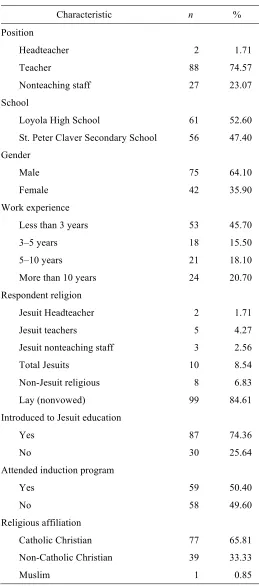
Table 3 Demographic Information ...101
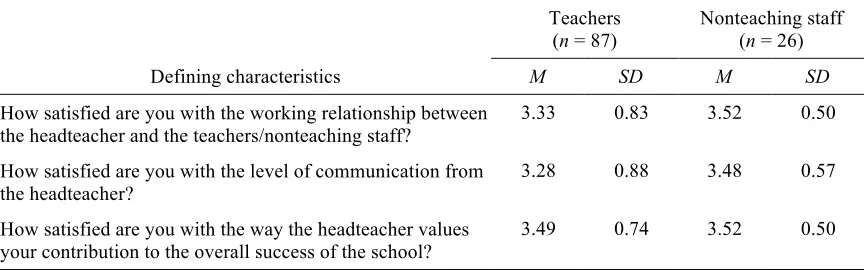
Table 4 Summary of Means and Standard Deviations of Teachers Satisfaction With Working Relationships With, Communication With, and Being Valued by the Headteachers in the Eastern Africa Province (N = 113) ...104
Table 5 Summary of Means and Standard Deviations of Respondents’ Views About the Rate of Collaboration in their Schools (N = 114) ...104
Table 6 Summary of the Means and Standard Deviations of Respondents’ View on Whether Collaboration has Increased or Decreased (N = 115) ...105
Table 7 Summary of the Means and Standard Deviations of Respondents’ Views on Keys Aspects of Collaboration (N = 115) ...107
Table 8 Summary of Means and Standard Deviations of Respondents’ Opinions on the Attitude of the Headteacher Toward Them (N = 115) ...113
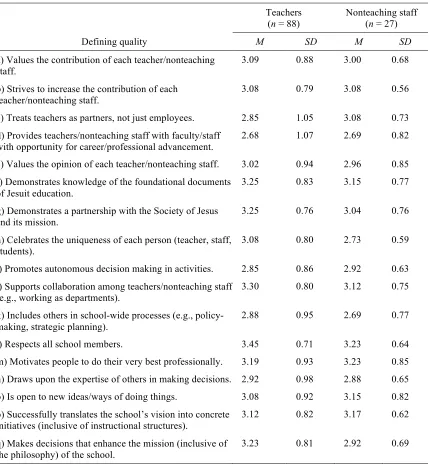
Table 9 Summary of the Means and Standard Deviations of Respondents’ Assessment of Key Qualities of the Head Teachers of Jesuit Schools (N = 115) ...116
xi
LIST OF FIGURES
Figure 1: Map of member countries of the Eastern Africa Province of the Society of Jesus. ...82
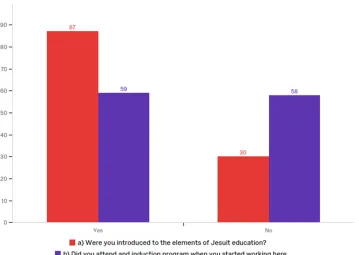
Figure 2. Responses about introduction to elements of Jesuit education and
participation in an induction program/ ...102
Figure 3. Teachers’ responses to the question about the ways through which the Jesuit headteacher has helped them to know better the values, mission and vision of Jesuit education. ...111
Figure 4. Nonteaching staff responses to the question about the ways through which the Jesuit headteacher has helped them to know better the values, mission and vision of Jesuit education. ...112
Figure 5. Teachers’ opinions about what enhances collaboration between the
headteacher and themselves. ...122
Figure 6.Nonteaching staff opinions about what enhances collaboration between the headteacher and themselves. ...123
Figure 7. Teachers’ opinions about what hinders collaboration between the
headteacher and themselves. ...125
Figure 8. Nonteaching staff opinions about what hinders collaboration between the headteacher and themselves. ...126
Figure 9. Teachers’ opinions about what should be encouraged in order to enhance collaboration between the headteacher and themselves. ...127
CHAPTER I
THE RESEARCH PROBLEM
Statement of the Problem
Education is one of the main apostolic commitments in which the Society of Jesus
has invested and stayed committed to since its foundation in 1540 by St. Ignatius of
Loyola. Like all other groups that have ventured into Catholic education, Jesuits have
been running their schools following their own charism (Ignatian charism). It is that
charism that distinguishes each religious group, and gives importance to the contribution
of each. For Jesuits, this is captured in what Donahue (1990) called the “Characteristics
of a Jesuit Vision of Education” (p. 54).
From the very beginning, Jesuit schools became a defining characteristic of the
Society of Jesus. From the beginning, Jesuits were to conduct the ministry of the word,
sacraments, works of mercy, and education (O’Malley, 1993). Hence, education is one of
the core pillars of Jesuit apostolic commitment. As O’Malley put it, “although the Jesuits’
most official documents never boldly stated it, the schools became a part of the Jesuits’
self-identification” (1993, p. 15).
At present, the mission of Jesuit education faces two realities: a declining number
of Jesuit administrators, teachers, and staff, and a diversity of key players in these
schools. These two realities were especially captured in the sixth decree of the 35th
general congregation of the Society of Jesus, which took place in 2008 (Padberg, 2009).
This decree, in its call for collaboration entitled, “Collaboration at the Heart of the
Mission,” pointed out that the said collaboration was not just with the lay people, but also
with different faiths and beliefs. The decree then disseminated: “In many countries,
important Jesuit works depend largely on the generous, loyal, and skilled collaboration of
women and men of diverse religions and humanistic convictions” (Padberg, 2009,
p. 781).
As a result of this decrease in the number of Jesuits and the diversity in the new
faculty and staff in Jesuit schools, a danger exists that the mission, vision, and indeed, the
characteristics of Jesuit schools, could disappear. At the same time, in the Jesuit tradition,
documents have focused on ways Jesuits and the non-Jesuits can relate and cooperate to
ensure that this mission remains and indeed improves. The common term for this kind of
dynamics is collaboration, as seen in such titles as “Lay–Jesuit collaborations (ICAJE,
1987), “Cooperation with the Laity in Mission” (Society of Jesus, 1995), “Creative
Companionship with Colleagues” (The Jesuit conference, 2002, p. 183), and
“Collaboration at the Heart of Mission” (Padberg, 2009).
This collaboration has been seen as a key aspect in ensuring that Jesuit schools
remain in operation and continue to offer Jesuit education, which is one of the key
ministries of the Society of Jesus. Such documents include Our Secondary Schools Today
and Tomorrow (Arrupe, 1980); Go Forth and Teach: Characteristics of Jesuit Education
(International Commission on the Apostolate of Jesuit Education [ICAJE], 1987;
Perspectives on Collaboration: A Workbook (Metts & O’Connell, 1992); Documents of
the Thirty-Fourth General Congregation of the Society (Society of Jesus, 1995); Lay–
Jesuit Collaboration in Higher Education (The Institute of Jesuit Sources, 2002); and
Jesuit Life and Mission Today: The Decrees of the 31st–35th General Congregations
For this study, collaboration refers to close working conditions between Jesuits
and non-Jesuits; a true union of hearts and minds and a sharing of vision, purpose, and
apostolic effort (ICAJE, 1987). Collaboration refers to the attitudes in a community
where all the people working in the school treat one another as equal partners, as
colleagues in the mission. Collaboration is the endeavor to create enduring relationships
and mutuality among those working in the same apostolate, forming and sustaining a
functional community whose main ingredient is social capital: an interaction of personal
relationships between all those in that community (Metts & O’Connell, 1992).
Despite the availability of the documents about collaboration between Jesuit and
the non-Jesuit partners in Jesuit education, the researcher could find no studies that
investigated how these documents were used to establish and enhance collaboration and
how collaboration really worked in concrete cases. However, although a search in
different Jesuit networks failed to reveal empirical past studies, the search revealed that
what was available in these Jesuit documents and in some Jesuit networks were manuals,
workbooks, and some survey tools designed for internal use by individual schools to
assess or evaluate themselves and their administrators on different aspects of Jesuit
education (Jesuit Schools Network [JSN], 2015a).
Collaboration in Jesuit schools was, therefore, an aspect that had not been
researched, and specifically, no studies existed about collaboration in the Jesuit schools in
the Eastern Africa Province of the Society of Jesus, nor had any school performed
self-assessment or self-evaluations. This lack of previous studies, especially as the Society of
Jesus calls for and stresses collaboration, revealed a gap in the knowledge of how the said
investigating the extent to which Jesuit schools in the Eastern Africa Province of the
Society of Jesus experienced collaboration.
The Eastern Africa Province comprises six countries: Ethiopia, Kenya, Tanzania,
Uganda, Sudan, and South Sudan (Eastern Africa Province of the Society of Jesus, 2016),
and encompasses five Jesuit secondary schools. The oldest school, Loyola High School in
Dar es Salaam, Tanzania, opened in 1995, whereas the newest school, St. Joseph
Technical Secondary School, opened in 2015 (Eastern Africa Province of the Society of
Jesus, 2016).
Background and Need for the Study
When the Society of Jesus ventured into education in 1548, Jesuits sought to
develop guidelines that would help them in running these schools. As they opened more
and more schools, the need for a document that would govern the way these schools were
run was to ensure they were conducted in a uniform way as they multiplied. Within 50
years of opening the first school in 1548, after several editions were written and revised
in a published document called the Ratio Studiorum (Conference of Major Superiors of
Jesuits, 1599/1970). The document spelled out how each Jesuit school in the world was to
be run. The document provided specific and minute details to ensure all schools were
uniform (Conference of Major Superiors of Jesuits, 1599/1970).
Although this document was useful as a manual, it is currently no longer possible
to govern all Jesuit schools with it. One key reason is that the Ratio Studiorum was
written when almost all teachers in Jesuit schools were Jesuits and did not take into
consideration other members who would be working in these schools and how their
Jesuits dropping, especially since the 1960s (M. M. Gray, 2016), and the number of
non-Jesuits working in Jesuit schools increasing during the same period, non-Jesuits sought to
develop a different method to ensure the continuity and success of Jesuit schools. To
illustrate how the numbers decreased, in January 1965, the number of Jesuits all over the
world was 36,038; by 2010, that number had dropped to 18,266; and in January 2015, the
number had decreased further to 16,740.
The Call for and Development of Collaboration in Jesuit Education
After the second Vatican Council (1962–1965), the 31st General Congregation
(GC) of the Society of Jesus, held in 1967, took up the call for collaboration at the level
of the whole Society of Jesus, and after the general congregation, established a special
commission called Jesuit Secondary Education Association (JSEA) in 1970. The
commission was established in response to the call by GC31 of the Society of Jesus to
renew Jesuit education. This association served as the guiding voice in Jesuit secondary
education, especially in the United States. The association, in its mandate, produced
several publications that have since served as guidelines for Jesuit education. Another
commission, the JSN, replaced this association in April 2015, and is currently the body
mandated by the Society of Jesus to oversee the running of Jesuit education. Like the
JSEA before it, the JSN has produced documents that provide guidelines about the
running of Jesuit schools, specifically here in the United States and in Canada. Schools in
other provinces also sometimes use these books and documents where the Society of
Jesus continues to run Jesuit schools.
It was in this background that the concept of collaboration was first introduced as
the mission of the Society of Jesus, and to recognize and incorporate them as partners, as
collaborators; not just workers. Jesuits sought to articulate ways of collaborating with the
laity and with other religious congregations in Jesuit schools and to ensure their
formation, noting that they were not welcomed only because of the decreasing number of
Jesuits in the educational apostolate, but rather as a result of a “profound conviction that
lay people have an invaluable contribution to make to our apostolate” (Arrupe, 1980,
p. 69). Arrupe (1980) encouraged Jesuits in the education apostolate to seek not only
teachers, but “responsible collaborators” (p. 69), and insisted that the way to achieve this
goal was to ensure these teachers imbibed Ignatian principles and became part of the
decision makers in the education apostolate.
Since then, the concept of collaboration was embraced in many dialogues,
discussions, and symposia, including the most important meeting of the Jesuits: GC31,
GC34, and GC35. In general, these documents proposed collaboration as the way forward
for the different missions of the Society of Jesus, seen when GC35 talked of collaboration
“at the heart of the mission” (Padberg, 2009, p.780). The proposal for collaboration has
been consistently upheld and renewed following Vatican II, 1962–1965.
Focusing specifically on education, several Jesuit documents addressed this
concept. First, in the level of the overall Society of Jesus, three GCs (GC31, GC34, and
GC35) deliberated and wrote documents (decrees) for the whole Society of Jesus,
focusing on collaboration. Apart from these decrees by the GCs, Jesuit associations and
networks also wrote about collaboration. For example, under the umbrella of JSEA,
ICAJE produced a document called Go forth and Teach: The Characteristics of Jesuit
produced a document called Lay–Jesuit Collaboration in Higher Education (H. J. Gray,
2002), providing a publication of the proceedings from a forum on various aspects of
collaboration arising from earlier documents such as GC34. Similarly, the JSN produced
two key documents: Our Way of Proceeding: Standards and Benchmarks for Jesuit
schools in the 21st century (2015b), and 2020 Vision: Ignatian Examen of Jesuit
Education for the 21st century (2015a). Individual Jesuit scholars also wrote on
collaboration and strategies for achieving and maintaining that collaboration.
Jesuits have discussed and written about the topic of collaboration to a great
extent. Many publications outlined what this collaboration means, what Jesuits need to
do, what resources need to be in place for collaboration to work, and how it can be
implemented (Padberg, 2009; Society of Jesus, 1995). Jesuits commonly use the word
collaboration when referring to the endeavor to work closely with non-Jesuits in
ministries in which Jesuits are involved. Jesuits sometimes use the term collaboration
interchangeably with cooperation or collegiality, but what defines it more succinctly is
the intentionality behind that cooperation (Padberg, 2009).
The Need for Collaboration in Jesuit Schools
Different provinces of the Society of Jesus have to address distinct factors in how
they carry out their missions. Although they have the same basis, the different provinces
must adapt to the social, political, economic, and religious realities of their geographical
settings. Some key factors include the number of Jesuits in that province, the number and
type of missions they have in the area, the diversity of the people with whom they
established the society’s charism and tradition (history) are in the institutions where they
work (Jesuits Eastern Africa, 2016b).
In most Jesuit schools, the number of Jesuits working is small. In schools in the
Eastern Africa Province, that number is less than 10% of the total number of faculty and
staff. The remaining 90% is not a homogeneous group. It comprises a mixture of
religious nuns, lay Catholics, lay non-Catholic Christians, and non-Christians.
Usually, at the beginning of working together, these different people would be at
different levels in knowledge of the mission, vision, core values of Jesuit schools, and the
characteristics of Jesuit education in general. Similarly, they have varied reasons for
working in Jesuit schools. Although this diversity of motivations is not ideal, it is
congruent with what Convey (2014) asserted: “it is not reasonable to expect that all
teachers in a Catholic school are motivated to teach in a Catholic school for the same
reasons, or have the same understanding of their dual role of academic and religious
formation” (p. 5). Although some teachers and nonteaching staff truly identify with the
school’s mission and find it motivating, others may consider teaching or working in a
Jesuit school simply as a professional opportunity. As a result, if the values, mission, and
vision of the school are to be achieved, teachers must commit to the vision and mission of
the school and imbibe the values of Jesuit education. It is only when educators achieve
this commitment that true collaboration ensues, as defined in Jesuit documents, whereby
a union of hearts and minds can be truly achieved (ICAJE, 1987). The building of a
collaborative community and a spirit of collegiality (total commitment) are necessary for
In the Eastern Africa Province, the centrality of call and need for collaboration
with others is listed in the new apostolic plan as one of the core values of the Eastern
Africa Province (Jesuits Eastern Africa, 2016a). Citing GC35 (Decree 6, No. 17) the
apostolic plan states the following:
Likewise, the importance of collaboration in mission means that all Jesuits, as
men on mission, must also be men of collaboration. Ongoing formation in this
area should be encouraged and supported within provinces and throughout Jesuit
conferences. When undertaken together with collaborators, programs of
professional development and spiritual enrichment can help us deepen our sense
of common vision and our unity in mission. (Jesuits Eastern Africa, 2016a, p. 13)
Purpose of the Study
The purpose of this study was to investigate the extent of collaboration between
Jesuit administrators and non-Jesuit faculty and staff in Jesuit secondary schools in
Eastern Africa province. Concretely, the study aimed to discover how Jesuit schools in
the Eastern Africa Province of the Society of Jesus carried out this collaboration, based
on Jesuit documents that advocated such collaboration. This study therefore aimed to
investigate how Jesuit schools translated these documents into action (ICAJE, 1987; The
Institute of Jesuit Sources, 2002; Jesuit School Network, 2015b; Metts & O’Connell,
1992; Padberg, 2009; Society of Jesus, 1995), and the level and kind of collaboration
witnessed in these schools.
As part of this investigation, the study inquired about concrete ways collaboration
was experienced, encouraged, and cultivated. The study also inquired about any
challenges. Last, the study sought opinions from the various groups being studied about
how this collaboration, on which hinges the very mission of the Society of Jesus, could
be strengthened.
Conceptual Framework for the Study
This study rested on a conceptual framework with two components. The first
conceptual basis for this study was what Selznick (1957) referenced as “the institutional
embodiment of purpose” (p. 62). The second component consisted of three characteristics
of Jesuit education that specifically address collaboration between Jesuits and non-Jesuits
working in the same school, as promulgated in the document Go Forth and Teach: The
Characteristics of Jesuit Education (ICAJE, 1987).
According to Selznick (1957), one task of an organization’s leadership is to
transform the policy of the organization into the organization’s social structure. For
Selznick, this task meant “shaping the ‘character’ of the organization” (1957, p. 63), and
emphasized the importance of all participants’ commitment to the core values of the
organization, so they shared in the organization’s thinking and responding. In turn, this
sharing could lead to increased reliability in the execution and elaboration of policy,
according to the organization’s spirit and letter.
Selznick’s (1957) concept of institutional embodiment of purpose found support
from the Congregation for Catholic Education (2012c) in its 2007 document entitled
“Educating Together in Catholic Schools: A Shared Mission Between Consecrated
Persons and the Lay Faithful,” boldly stating that “the project of the Catholic school is
convincing only if carried out by people who are deeply motivated” (p. 232). Further
“administrative leadership in an educational institute demands a capacity to work with
many different types of persons. … It challenges a person to help very different persons
to commit themselves to a common vision and task” (pp. 91–92). Further, Heft called on
leaders to actively strive to shape their educational community, and pointed out that
“recruitment and formation of staff and faculty are the most important responsibilities of
those who lead Catholic high schools. The capacity of faculty to work together as a team
or better a community, is crucial to the school’s success” (2011, p. 100).
ICAJE (1987) listed and discussed 28 characteristics of Jesuit education; of these
28, Characteristic 23 states that “Jesuit education stresses lay-Jesuit collaboration”;
Characteristic 24 states that “Jesuit education relies on a spirit of community among:
teaching staff and administrators; the Jesuit community; governing boards; parents;
students; former students; and benefactors” (p. 41); and Characteristic 25 says that “Jesuit
education takes place within a structure that promotes community” (p. 41). These
characteristics not only call for each member of the school to assume their appropriate
responsibility, but also demands that schools develop an environment in which such a
collaboration can take place.
In talking about collaboration in a school, the document stated that
In a Jesuit school, there is a willingness on the part of both lay people and Jesuits
to assume appropriate responsibilities: to work together in leadership and in
service. Efforts are made to achieve a true union of minds and hearts, and to work
together as a single apostolic body in the formation of students. There is,
These characteristics, therefore, fit together with and complemented the theory of the
institutional embodiment of purpose (Selznick, 1957). These characteristics formed the
basis of this study’s investigation.
This concept of the institutional embodiment of purpose was relevant to this study
because collaboration aims to achieve such embodiment; a situation whereby everyone
working in Jesuit school commits to the core values, vision, and mission of the Jesuit
school. This commitment would increase their involvement and participation in key
aspects of the school such as decision making, serving on various boards, and generally
sharing responsibilities for duties that may be outside their official duties. In turn, such
participation would ensure not only the best results for Jesuit schools, but also continuity
into the future, even without the actual presence of Jesuits. For this study, these two
components came together, forming the basis on which to evaluate the kind of
collaboration present between the Jesuits and their collaborators, and to discern what
more could be done to enhance the desired collaboration.
Research Questions
To investigate the reality of the collaboration between Jesuits and non-Jesuits
working in Jesuit schools in Eastern Africa Province, this study attempted to answer the
following seven research questions:
1. To what extent do those who serve in Jesuit secondary schools in East Africa
(headteacher, faculty, and staff) experience collaboration?
2. In what ways do those who serve in Jesuit secondary schools (headteacher,
3. To what extent are the Jesuit secondary school headteachers knowledgeable of
and committed to their call to cultivate collaboration with faculty and staff in
their schools?
4. How committed are the faculty and staff of Jesuit secondary schools in East
Africa to responding to the call to collaborate with headteachers?
5. What factors do those who serve in Jesuit secondary schools in East Africa
(headteachers, faculty, and staff) perceive to enhance collaboration among
them?
6. What factors do those who serve in Jesuits secondary schools (headteachers,
faculty, and staff) perceive to challenge (obstacles/barriers) collaboration
among them?
7. What do those who serve in Jesuit secondary schools (headteachers, faculty,
and staff) suggest to strengthen collaboration among them?
Limitations of the Study
The first limitation of this study was that it was be carried out in a region of the
Society of Jesus (Eastern Africa Province) which has a very short history of the presence
of the Society of Jesus (at the time of the study, the Province had just celebrated 25 years
since its creation) and whose history of Jesuit education was even shorter, having opened
its first school (Loyola High School in Dar es Salaam, Tanzania) in 1995. Thus, findings
from this study were limited in generalizability to other provinces and schools of the
Society of Jesus in the world.
A second limitation related to the short history of Jesuit schools in Eastern Africa
geographical region (Tanzania), which could limit the study’s generalizability to other
schools in other provinces of the Society of Jesus.
A third limitation was the composition of the populations and sample for the
research. Given the geographical location of the school, the composition of the teachers
and nonteaching staff in the Jesuit schools in Eastern Africa was very diverse in ethnic
and religious background. These schools are staffed with collaborators from various
countries and encompasses a considerable number of Catholics and a few
non-Christians, specifically Muslims. One consequence of such diversity was less knowledge
of Catholic education, which could have influenced their responses and limited the
generalizability of the findings from this study.
A fourth limitation arose because the study employed a self-report survey, and, as
Fowler (2009) pointed out, respondents could give socially desirable responses rather
than real facts and experiences. At the same time, a possibility existed that teachers and
nonteaching staff in these schools could give responses influenced by a fear of the
authorities that run the school, and a desire to keep their jobs.
Significance of the Study
The first significance of the study is that it added to the growing literature on the
topic of lay-Jesuit collaboration, without which the mission of Jesuits, especially in
education, faces an uncertain future. This study contributed to the existing body of
knowledge about collaboration by complementing previous literature with concrete
suggestions from research. Of the many documents on collaboration, none covered the
Jesuit collaboration from the Eastern Africa Province perspective, providing a valuable
contribution to the whole Society of Jesus.
At the same time, study results provided a basis on which these schools can assess
themselves and learn how they can ensure the required collaboration. It was hoped that
results from this study could be used to formulate policies that would lead to better Jesuit
schools, as a result of deeper collaboration. Study results could form a basis for reflection
on communal discernment; that is, engaging in a prayerful, conscious process to seek the
will of God together about these schools. Findings from this study could form a basis and
part of the induction/orientation program for new administrators, teachers, and
nonteaching staff of these Jesuit schools.
In addition to being used for such an induction/orientation program, study
findings could serve as a springboard for future studies on collaboration, such as
comparing collaboration in various provinces of the Society of Jesus and evaluating what
various provinces can learn from one another. Providing a basis for comparison about
collaboration in different provinces was especially important because currently, one
major topic in Jesuit education is the question of networking among Jesuit schools in
disparate provinces. Additionally, given that Loyola High School, Dar es Salaam, was 21
years old, this study could serve as a point of reference on which further studies on this
topic in Eastern Africa Province could be measured.
Definition of Terms
The following terms were operationalized for this study:
Apostolate/apostolic work: The mission or ministry of a particular religious
circle of Jesus and who were sent out to continue the work/mission of Christ. The attitude
toward an apostolate is that it is a mission/ministry undertaken as a continuation of the
work of Jesus; that is, the attitude that underlies the commitment of the group as they take
up this mission (Traub, 2008).
Charism: The charism of a religious community refers to the distinctive
spirituality and mission of a particular religious order. The charism is usually based on
the words and thoughts of the founder of the order.
Collaboration: The close working conditions between the Jesuits and non-Jesuits,
detailed in Jesuit Documents. Collaboration entails treating one another as equal partners,
as colleagues in the mission. According to GC35, collaboration in mission is described in
different but related ways. Some call it partnership in mission, whereas others call it
collaboration (Padberg, 2009). (The people with whom the Jesuits work are called
collaborators, Ignatian apostolic partners, or companions.)
Congregation for Catholic education: The Congregation for Catholic education is
the pontifical congregation of the Roman Curia responsible for universities, faculties,
institutes, higher schools of study, and schools and educational institutes. It was formerly
known as The Sacred Congregation for Catholic Education until 1988, when its name
changed to the current one, Congregation for Catholic Education.
Consecrated persons/Religious: Women and men who consecrate their lives in a
special way through the vows of chastity, poverty, and obedience. This group includes
priests, brothers, and nuns from various religious orders.
General congregations (GC): These are meetings called by the Jesuit Superior
Jesuits. Their deliberations and the subsequent documents they produce apply to all
Jesuits in the world.
Ignatian charism: This is the charism of the founder of the Society of Jesus (St.
Ignatius of Loyola) and stresses seeking God in all things. Ignatian charism is the spirit
that guides the work performed by Jesuits all over the world. Ignatian charism identifies a
certain work as being truly Jesuit.
Ignatian discernment: This is a process for making choices, especially between
several potentially good choices of action. Discernment involves prayer, reflection,
consultation with others, careful analysis, and evaluation before making a decision (H.
Gray, 2003).
Jesuits: Members of a Roman Catholic religious order (Society of Jesus) founded
by St. Ignatius of Loyola in 1540. Jesuits are guided by Ignatian charism in their mission.
Jesuit Secondary Education Association (JSEA): A service organization
established in 1970 to foster the Jesuit mission and identity of Jesuit secondary schools in
the United States. The JSEA was in operation until 2015.
Jesuit Schools Network (JSN): This organization replaced the JSEA. Established
in 2015, the JSN was mandated with the oversight of Jesuit education, especially in the
United States and Canada.
Jesuit education: Education carried out by the Society of Jesus and based on the
values of the Society of Jesus and the vision of St. Ignatius of Loyola. Among its key
characteristics is that it is student-centered, flexible to suit the needs of the student, and
has a particular structure that adheres to the Jesuit pedagogy, which stresses the practice
Lay/laity: People in a religious faith who are not clergy. In a Christian faith, they
are the unordained members of the Church (Traub, 2008).
Non-Jesuit: In this context, this term refers to people working with Jesuits who
are not themselves Jesuits. It includes lay people and non-Jesuit consecrated people
belonging to other religious orders and following other charisms.
School climate: This is a “set of internal characteristics that distinguish one school
from another and influence the behaviors of each school member” (Hoy & Miskel, 2005,
p. 185). The school climate affects the performance of faculty and staff, and ultimately
the academic achievement of students.
Society of Jesus: A Catholic religious order of men founded by St. Ignatius of
Loyola and his companions in 1540 (Traub, 2008). The name Society of Jesus is used
interchangeably with the title Jesuits. A member of the Society of Jesus is called a Jesuit,
and the abbreviation SJ after a name means that the person is a member of the Society of
Jesus.
Spiritual exercises: A method of prayer comprising a series of meditations or
contemplations aimed to open oneself fully to God’s spirit. St. Ignatius of Loyola
composed these exercises, aiming to lead the one doing them to contemplate or meditate
on some key aspects of Christian faith and life (Traub, 2008).
Vatican Council II: A council for the whole Catholic Church convoked by Pope
John XXIII; it took place in Rome (1962–1965). Among the significant outcomes from
the council were freedom to celebrate liturgy in local languages; a new understanding of
whole church as People of God; and recognizing and championing the use of conscience
in decision making (Traub, 2008).
Summary
This chapter delineated the need for collaboration between Jesuits and non-Jesuits
working in Jesuit secondary schools, arguing that for Jesuit education to continue into the
future, this collaboration is critical. The need for this collaboration was premised on the
decrease in the number of Jesuits working in these schools and the increase in the number
of non-Jesuits invited to work alongside Jesuits in these schools. Information in this
chapter showed that extensive Jesuit documents asserted use of this concept of
collaboration, seen as the only way forward for Jesuit education. Despite the high regard
for collaboration and the insistence that it be upheld and advanced, no studies had been
conducted to investigate how this collaboration concretely works in Jesuit schools. The
foregoing therefore set the basis for this study, which aimed to conduct one such study in
the Jesuit Province of Eastern Africa.
Chapter 1 also highlighted the purpose of the study, the research questions the
study sought to answer, and the conceptual framework that guided this research.
Selznick’s (1957) concept of the institutional embodiment of purpose, combined with
Jesuit documents on collaboration, provided a good basis on which to frame this study.
The educational significance of this study furnished credence of the need for this study.
This first chapter included limitations of the study and the definition of key terms used
throughout the study.
In the following chapter, the review of literature, focus shifts to literature about
education, reviewing several foundational documents on Jesuit education. Then, key
Jesuit documents on collaboration are comprehensively analyzed to discern exactly how
Jesuits understand collaboration, what a collaborative environment entails, who is
responsible for achieving it, and how it can be enhanced. Chapter 2 also presents reviews
of other Church documents, especially those focusing on the running and functioning of
Catholic schools since the second Vatican council. The last part of Chapter 2 reviews the
most recent studies about collaboration in school settings. As in Jesuit documents, focus
centered on what researchers found to benefit collaboration in schools and how this
collaboration could be attained, maintained, and advanced.
Chapter 3 provides details about the methodology used in carrying out the
investigation about the extent of collaboration between Jesuit administrators and
non-Jesuit teachers and nonteaching staff in non-Jesuit secondary schools in the Eastern Africa
Province of the Society of Jesus. The aspects included in the methodology are the kind of
research design and the instrument used for data collection. Also included are the setting
for the study as well as the target population and sample for the study. The chapter
includes details about the processes of data collection and data analysis performed to
answer the research questions. This chapter ends with details about ways to ensure the
CHAPTER II
REVIEW OF LITERATURE
Introduction
Education is one of the main apostolic commitments in which the Society of Jesus
has invested and stayed committed since its foundation in 1540 by St. Ignatius of Loyola.
Like all the other groups that have ventured into Catholic education, Jesuits have been
running schools following their own charism. Over the years, as Jesuits engaged in
education, they have written documents that are meant to guide those involved in the
running and administration of Jesuit schools. Some documents that Jesuits have produced
focus on the aspect of the collaboration between Jesuits and their non-Jesuit colleagues
working in Jesuit schools.
This collaboration has been seen as a key aspect in ensuring Jesuit schools remain
in operation and continue to offer Jesuit education, which is one of the key ministries of
the Society of Jesus. Such documents include Our Secondary Schools Today and
Tomorrow (Arrupe, 1980); Go Forth and Teach: Characteristics of Jesuit Education
(ICAJE,1987); Perspectives on Collaboration: A Workbook (Metts & O’Connell, 1992);
Documents of the Thirty-Fourth General Congregation of the Society (Society of Jesus,
1995); Lay–Jesuit Collaboration in Higher Education (The Institute of Jesuit Resources,
2002); and Jesuit Life and Mission Today: The Decrees of the 31st–35th General
Congregations (Padberg, 2009).
Despite the availability of these documents about collaboration between Jesuits
and their non-Jesuit partners in Jesuit education, no studies investigated how these
various Jesuit networks failed to reveal empirical past studies, but revealed these Jesuit
documents, manuals, and survey tools designed for internal use by schools to assess or
evaluate themselves and their administrators on aspects of Jesuit education (JSN, 2015a).
Collaboration in Jesuit schools was, therefore, an aspect that had not been
researched, and specifically, no studies were conducted in Jesuit schools in the Eastern
Africa Province of the Society of Jesus. Also, no self-assessments or self-evaluations
were performed by the schools. This lack of previous studies, especially as the call for
collaboration is repeatedly stressed in documents of the Society of Jesus, pointed to a gap
in the knowledge of how lay–Jesuit collaboration was practiced. The current study aimed
to fill this gap by investigating the extent to which collaboration was experienced in
Jesuit schools in the Eastern Africa Province of the Society of Jesus. This province
comprises six countries: Ethiopia, Kenya, Tanzania, Uganda, Sudan, and South Sudan
(Eastern Africa Province of the Society of Jesus, 2016). This study aimed to investigate
how the Eastern Africa Province of the Society of Jesus practiced the concept of
collaboration.
Overview of Review of Literature
The literature review for this study was partitioned into four sections. The first
section describes the historical background. This section provides a detailed history of
Jesuits and Jesuit education. In this part, also, is a review of the foundational documents
of Jesuit education and a link between these foundational documents, more recent Jesuit
documents on education, and the research study. The second section named the changing
promulgated after the Vatican Council II as guidelines for Catholic schools, including
Jesuit schools.
The third section describes a new dawn in Jesuit education, covering recent
developments. This part includes the birth and development of the topic of collaboration
and the most recent documents on Jesuit education and collaboration. As noted in chapter
1, no studies on collaboration emerged; thus, the third section analyzes recent documents
in the area of collaboration to establish the tenets required for meaningful collaboration to
be experienced. The survey instrument for this study was developed on the basis of these
documents.
The fourth section focuses on literature that points to the need for and importance
of collaboration in school settings. This section includes studies that showed the benefits
that accrued from collaborative school communities, and ways and initiatives educators
could use to enhance collaboration in school communities.
Given the nature of this study, some references are old. Some documents were
written at the beginning of the history of the Society of Jesus and were included here
because of the importance they hold for the Society of Jesus. Also, they serve as the
repositories of the methodology, charism, core values, vision, and mission of Jesuit
education.
Historical Background: History of Jesuits and Jesuit Education
St. Ignatius and the “first companions” formed the Society of Jesus in 1540
(O’Malley, 1993). These men envisioned four main components in their apostolic
ministry: the ministry of the word, sacraments, works of mercy, and education
commitment. “Although the Jesuits’ most official documents never boldly stated it, the
schools became a part of the Jesuits’ self-identification” (O’Malley, 1993, p. 15).
According to O’Malley (1993), the Society of Jesus was not primarily founded as a body
whose only or whose chief apostolic work was education; hence, documents developed at
that time did not exclusively address education; rather, they dealt with the overall
composition and mission of the Society of Jesus. Of these early documents, three are
reviewed here, because of their later impact on Jesuit education and the topic of
collaboration.
Foundational Documents
The key foundational documents on Jesuit education included The Constitution of
the Society of Jesus (St. Ignatius of Loyola, 1558–1559/1970), The Spiritual Exercises of
St. Ignatius (Puhl, 1548/1963),and the Ratio Studiorum (Conference of Major Superiors
of Jesuits, 1970). These three documents are repositories of Ignatian charism and the
values, vision, and mission of Jesuit ministry and education. They also form the basis for
newer documents on Jesuit education. The newer documents, and especially the
documents on collaboration, sometimes tie to these documents or incorporate aspects of
these documents. Thus, as one analyzes various aspects of Jesuit education, one needs a
good knowledge of some key concepts such as Ignatian pedagogy, Ignatian charism,
Ignatian vision, and Jesuit spirituality, found in these documents. In tracing the roots of
Jesuit education, its foundations and its charism, these three documents are quite useful.
Of these three documents, the Ratio Studiorum (Conference of Major Superiors of
Jesuits, 1599/1970) is the most concise in describing what Jesuit education entails. The
apostolate of the Society of Jesus.This document’s development concluded in 1599,
offering the first official document of the Society of Jesus in educational matters and
clearly delineating how Jesuit education was to look. Pavur (2010) wrote, “the Ratio
Studiorum in fact represents something that is integral to the charism of the Jesuit order”
(p. 1). Indeed, for many years the Ratio Studiorum was the guiding document for the
many Jesuit schools in the world.
Specifically, in The Constitutions of the Society of Jesus (St. Ignatius of Loyola,
1558–1559/1970), St. Ignatius outlined education in Part IV entitled “The Instruction of
Those who are Retained in the Society, in Learning and in Other Means of Helping Their
Fellowmen” (p. 171). In Part IV, Ignatius addressed many aspects of education including
administration of Jesuit schools. He wrote about the curriculum, the instruction, and the
governance of these early Jesuit colleges. The Ratio Studiorum used some articles in the
Constitutions in outlining how Jesuit education was to look.
The Ratio Studiorum also incorporated some aspects from the Spiritual Exercise
of St. Ignatius (Puhl, 1548/1963), which provided the spirit that has animated and
pervaded the educational apostolate of the Society of Jesus. In this sense, the Spiritual
Exercises influenced the development of the Ratio Studiorum, which “reflects many of
the characteristics and basic values that we find in the Spiritual Exercises” (Pavur, 2010,
p. 5).
Several aspects of the Spiritual Exercises influenced Jesuit Education, whether in
the Ratio Studiorum or in other later documents on education. The first aspect is the
insistence on and importance of repetition. Although originally in the Spiritual Exercises,
for reflection and assessment of the exercises. Reflection is a one of the hallmarks of
Jesuit education (Metts, 1994).
Among the many of the meditations found in the Spiritual Exercises is a clear
invitation to use one’s imagination and the meditations begin with an invitation of
composition of the place, by use of one’s imagination. In the exercises, too, the retreatant
doing the meditations is invited to use all their senses in contemplation in order to gain
more meaning. This invitation to use the senses and imagination means the exercises are
to involve the whole person, not merely their mental faculties, similar to advocacy for
students to use faculties other than only their intellect. According to Metts (1994), “The
Ratio Studiorum took each of these points and worked them into a Jesuit methodology
which stresses prelection, or preparation, student reflection and active involvement in the
learning process and frequent repetitions of the material learned” (p. 202).
The underlying principles that guide the methodology of Jesuit education (known
as Ignatian pedagogical paradigm) drew on the Spiritual Exercises, influencing the goals
of education and the centrality of the love and service of God that is clearly articulated in
the Constitutions and the Ratio Studiorum. The Spiritual Exercises, in a subtle yet firm
way, formed the basis from which Jesuit education springs.
In identifying the roots of and relationship between Jesuit education and the
Spiritual Exercises, Newton (1977), stressed that, like the Spiritual Exercises, Jesuit
education is instrumental, student-centered, characterized by structure and flexibility,
eclectic, and personal. In other words, the main tenet that Jesuit education drew from the
Spiritual Exercises was the method, which involves the personal discovery of truth.
for the Ratio Studiorum (1599), defined as “the order and method of studies in the
Society of Jesus” (Conference of Major Superiors of Jesuits, 1599/1970, p. i).
The Ratio Studiorum was a book of rules for various people and various aspects
of the school. In its entirety, the Ratio Studiorum covered almost every aspect of the
running of a school: administrators, teachers, students, and the duties of each; the courses
to be offered; and the methodology of teaching. The Ratio Studiorum was meant to
ensure the smooth and regulated running of the Jesuit schools that were opening all over
Europe and later in other countries, in quick succession. Given the rate at which the
Jesuits were opening schools, it was important to have a document that outlined
consistent and uniform directives about the running of the schools. For administrators and
teachers, it was a manual or guidebook for carrying out aspects of the school,
encouraging collaboration among the people working in the schools.
Thus, the Ratio Studiorum came to be seen as a handbook of practical directives
for teachers and administrators of early Jesuit schools. This handbook was addressed to
Jesuits because early Jesuit schools were staffed exclusively by Jesuits. It contained
pedagogical methods for these schools, leading to the system of Jesuit schools all over
the world where Jesuits were working.
However, although it was a very useful document for governing the running of the
original schools, over time, the overall environment in which Jesuit schools operated
changed, demanding new, more relevant documents. Despite its initial importance to
Jesuit education, the relevance of the Ratio Studiorum in its original form decreased. The
in the scenario of Jesuit education in a global context (Traub, 2008) following the second
Vatican Council.
The Changing Landscape in Roman Catholic Education
The Vatican Council II and the Mission of the Laity
The Vatican Council II, held between October 1962 and December 1965, ushered
a new era in the entire Roman Catholic Church. One key theme discussed in the council
was the role of lay people in the Church and in the works of the Church. The
ramifications of this council were felt in all aspects of the Church and were momentous
for the future of the laity in the Church. During this council, the Roman Catholic Church,
represented by Catholic Bishops from all over the world, deliberated about the vocation
of lay people in the Church and the participation of these lay people in the Church’s
ministries. One major outcome was the recognition of the need for a deeper involvement
of the laity in the ministries of the Catholic Church. The Vatican Council consequently
called for a deepening in the lay people’s involvement at different levels in the Church,
and wrote documents to advocate for and uphold this involvement.
Specifically, for education, after Vatican Council II the Roman Catholic Church
started laying more importance on the involvement of lay teachers in Catholic education
and emphasizing their contribution to the staffing and administration of these schools.
Other Catholic Church Documents on Collaboration in Catholic Schools
To support that call, the Catholic Church subsequently produced documents that
stressed and advocated for this participation and delineated key features or expectations
to accompany such a partnership. Such documents included Gravissimum Educationis
Catholic Bishops, 1972); The Catholic School (The Sacred Congregation for Catholic
Education, 1977); Lay Catholics in Schools (The Sacred Congregation for Catholic
Education 1982); The Catholic School on the Threshold of the Third Millennium (The
Congregation for Catholic education, 2012a); Consecrated Persons and Their Mission in
Schools (The Congregation for Catholic Education, 2012b); and Educating Together (The
Congregation for Catholic Education, 2012c). The Sacred Congregation for Catholic
Education was renamed The Congregation for Catholic Education in 1988. These
documents are relevant to the topic of collaboration and partnership between the different
parties working in a Catholic school because they underlined the roles and
responsibilities that these various parties bear in the overall success of Catholic
education.
In Gravissimum Educationis, the second Vatican council (1965) called on
teachers in Catholic schools to recognize that accomplishing the goals and programs of
any Catholic school depended on the teachers. The document called for teachers to be
well prepared in secular and religious knowledge and pedagogical skills needed for
proficiency in bringing the mission of Catholic education to fruition.
While upholding the important role played by teachers in a Catholic school, the
National Conference of Catholic Bishops in a document entitled To Teach as Jesus did
(National Conference of Catholic Bishops, 1972) made an explicit plea for cooperation
among all those involved in the educational apostolate: teachers, priests, consecrated
people, and lay people serving in Catholic schools. The conference specifically stressed
the need for the school community to work together. Noting that the number of the
Vatican council was declining, the council asserted greater reliance on lay personnel in
Catholic schools, pointing out that these lay persons were “full partners in the Catholic
educational enterprise … and that the Catholic community invites not only their
continued service but also their increased participation in planning and decision making
and their continued emergence in leadership roles” (National Conference of Catholic
Bishops, 1972, p. 96).
This call for the participation and coresponsibility of various groups working in a
Catholic school was further emphasized by the Sacred Congregation for Catholic
Education in their 1977 document entitled The Catholic School. This document urged
that various groups were “according to their several competencies, to be associated in
decision-making concerning the Catholic school and in the application of decision once
taken” (p. 118). This document further called for the principle of subsidiarity in the
distribution and performance of responsibilities in the functioning of Catholic schools to
ensure freedom for each person to play their proper role in the running of the school.
Further, the document urged the school authority to respect the competence of the
teachers.
Given the important role that teachers had in imparting the distinctive character to
a Catholic school, it was necessity to ensure their continued formation (Sacred
Congregation, 1977). Advocating for this formation, the Sacred Congregation (1977)
called for some form of ongoing pastoral care for teachers; this care was expected to be
extended to all those working in a Catholic school.
The importance of this call for ongoing formation of teachers gained greater
Education (1982) when it stated, “it is the lay teachers, and indeed all lay persons,
believers or not, who will substantially determine whether or not a school realizes its aim
and accomplishes its objectives” (p. 125). The Sacred Congregation pointed to the
recognition of the increased professional training of lay Catholics, and insisted that more
of them be incorporated in the educational apostolates, especially when the number of the
religious men and women dedicated to teaching was dwindling.
This Scared Congregation (1982) also urged that special attention be given to the
role that lay Catholics played in a Catholic school, pointing out that for everyone working
in the school to be able to carry out their responsibilities adequately, they needed to
develop themselves. On this point, the congregation pointed to one of the most important
characteristics of the identity of a lay Catholic teacher: professionalism. Thus, teachers
had to intentionally strive to acquire a solid professional formation. The initial acquisition
was to be followed by ongoing formation and updating of the professionalism already
acquired. The congregation charged lay teachers with the responsibility to seek whatever
they lacked in formation. Some suggestions for achieving this included reading, attending
conferences and seminars, and participating in workshops, assemblies, and congresses.
The Sacred Congregation for Catholic Education (1982) urged the Catholic
Church to have its own centers for teacher formation. At the local level, the school was
charged to provide any orientation that lay teachers needed to work well in the school.
The congregation advocated for adequate remuneration of teachers, paying them salaries
adequate to motivate them to be more committed and to work better in these schools.
Addressing itself to the teachers, the Sacred Congregation (1982) urged teachers
lay Catholic educator was to “become fully aware of the importance, the richness and the
responsibility of this vocation” (p. 135). All people working in Catholic school were to
remain aware of the mutuality and complementarity that makes the Catholic school
successful, and thus each “should be dedicated to the search for unity and coordination”
(Sacred Congregation, 1982, p. 137).
Further, the Sacred Congregation (1982), invited lay educators to “be aware of the
ideals and specific objectives which constitute the general educational philosophy of the
institution” (p. 136), to seek understanding of the specific charism and special
characteristics of the school, and to identify with these characteristics. This awareness
was to lead to a deeper and sincere commitment and sharing in the responsibility for the
attainment of the same ideals and objectives. Further still, the Sacred Congregation urged
teachers to participate in the liturgical and sacramental life of the school, because apart
from teaching, they also serve as witnesses to the students. Clearly, the congregation was
cognizant that the continued existence of Catholic schools depended and will continue to
depend on lay people.
The Congregation for Catholic Education (2012a) emphasized the importance of
lay educators in the overall functioning of the Catholic school in a document entitled, The
Catholic School on the Threshold of the Third Millennium, which reminded educators of
a point made by the second Vatican Council: it depended on the lay people “whether the
Catholic school achieves its purpose” (p. 193).
In yet another effort to renew the call for cooperation among the groups working
in a Catholic school, the Congregation for Catholic education (2012b), in a document