F e e d b a c k I n t e r v e n tio n fo r I n t e r n a tio n al S t u d e n t s . P r a c ti tio n e r
R e s e a r c h in H i g h e r E d u c a ti o n , 6 ( 1). p p . 4 0-4 9 .
Do w n l o a d e d fr o m : h t t p ://i n si g h t . c u m b r i a . a c . u k /i d/ e p ri n t/ 1 3 3 1 /
U s a g e o f a n y i t e m s f r o m t h e U n i v e r s i t y o f C u m b r i a’ s i n s t i t u t i o n a l r e p o s i t o r y
‘I n s i g h t ’ m u s t c o n f o r m t o t h e f o l l o w i n g f a i r u s a g e g u i d e l i n e s .
Any it e m a n d it s a s s o ci a t e d m e t a d a t a h el d i n t h e U niv e r si ty of C u m b r i a ’s in s ti t u ti o n al
r e p o si t o r y I n si g h t ( u nl e s s s t a t e d o t h e r wi s e o n t h e m e t a d a t a r e c o r d ) m a y b e c o pi e d ,
di s pl ay e d o r p e rf o r m e d , a n d s t o r e d i n li n e wi t h t h e JIS C f ai r d e a li n g g ui d eli n e s ( av ail a bl e
h e r e
) fo r e d u c a t i o n al a n d n o t-fo r-p r ofi t a c tiviti e s
p r o v i d e d t h a t
• t h e a u t h o r s , ti tl e a n d full bi blio g r a p h i c d e t ail s of t h e it e m a r e ci t e d cl e a rly w h e n a n y
p a r t
of t h e w o r k is r ef e r r e d t o v e r b a lly o r i n t h e w ri t t e n fo r m
• a h y p e rli n k/ U RL t o t h e o ri gi n al I n si g h t r e c o r d of t h a t it e m is i n cl u d e d i n a n y
ci t a ti o n s of t h e w o r k
• t h e c o n t e n t is n o t c h a n g e d i n a n y w a y
• all fil e s r e q ui r e d fo r u s a g e of t h e it e m a r e k e p t t o g e t h e r wi t h t h e m a i n it e m fil e.
Yo u m a y n o t
• s ell a n y p a r t of a n it e m
• r e f e r t o a n y p a r t of a n it e m wi t h o u t ci t a ti o n
• a m e n d a n y it e m o r c o n t e x t u ali s e it i n a w a y t h a t will i m p u g n t h e c r e a t o r ’s
r e p u t a t i o n
• r e m ov e o r a l t e r t h e c o py ri g h t s t a t e m e n t o n a n it e m .
T h e full p oli cy c a n b e fo u n d
h e r e
.
Alt e r n a t iv ely c o n t a c t t h e U niv e r si t y of C u m b ri a R e p o si t o ry E di t o r b y e m a ili n g
Evaluating a formative feedback intervention
for international students
Caroline Burns, Martin Foo, University of Northumbria [email protected]
Abstract
Assessment is too often concerned with measurement, rather than learning; however, there is a growing interest in research into formative assessment, which appears justified by studies into its effects on learning. Changes in higher education have led to increased numbers of students, many of whom are from non-traditional backgrounds. This has highlighted the need for transparency and student involvement in assessment. However, the corresponding pressures on staff and on resources mean that many desirable innovations are not easy to implement. The overall aim of this formative feedback intervention (FFI) was to provide timely and helpful feedback to international students who are final-year direct entrants in a large business school. Timeliness of feedback and the development of academic literacy were key concerns. The study concludes that although the FFI did not have a significant impact on module grades, the intervention was successful in getting students to engage in academic writing at an early stage. Most respondents perceived the feedback to be helpful and the feedback messages were clearly received and internalised. Whether appropriate actions were taken by the students to close the gap between their current and their target level requires further investigation.
Keywords
Academic literacy; formative feedback; international students.
Introduction
Given the importance of assessment to almost everyone in education, it is to be expected that it is the subject of frequent debate. Though as Gibbs and Simpson (2004) point out, much of the attention it receives is negative, often used to support claims of falling standards, disputed grades and examiner incompetence. When the issue of assessment is raised in the media or quality assurance settings, the focus is likely to be on measurement, rather than on learning, which is the concern of this study and others mentioned within it. Gibbs and Simpson (2004) note that for a long time assessment in higher education was characterised by a lack of transparency, and founded on tacit knowledge, “that which we know but cannot tell,” (Polyani, cited by Elander, 2003:117). So the move over the last decade towards assessment for learning, or even assessment as learning (Boyd & Bloxham, 2009), which encourages student involvement and engagement in the process, is to be welcomed.
Perhaps due to initiatives associated with Assessment for Learning, there is a considerable amount of research into formative assessment (see McDowell, Sambell & Davison, 2009, for an overview) which appears justified by studies into its effects on learning. Black and Wiliam’s (1998) review revealed
significant and consistent positive effects of formative feedback on student learning across a wide range of educational contexts. Similarly, Hattie (1987, cited by Gibbs & Simpson, 2004) reported feedback as having the single most powerful effect on student achievement. The work of Sadler (1989) underpins much of the research; he identifies three necessary conditions for students to benefit. Students must:
• possess a concept of the standard, or goal being aimed for • be able to compare their own work with this standard
To take these actions, Sadler argues, students must necessarily have some of the evaluative skills of their teacher, and this can by no means be taken for granted.
Effective formative feedback not only gives useful information to students, but also to teachers, who can inform and shape teaching (Gibbs & Simpson, 2004; Nicol and Macfarlane-Dick, 2006). These authors provide very useful analyses of formative assessment and the conditions under which it promotes worthwhile learning. Both models are offered to teachers as a means to evaluate their own assessment practice, and were considered when designing the FFI discussed here.
Changes in higher education have led to increased numbers of students, many of whom are from non-traditional backgrounds. This has highlighted the need for reform, though the corresponding pressures on staff and on resources mean that many desirable innovations are not easy to implement (Gibbs & Simpson, 2004). The many problems associated with feedback, led them to conclude that it is ‘not a pretty picture’ (Gibbs & Simpson, 2004:11). It would seem that there are barriers to a successful feedback dialogue from both student and staff perspectives, with both groups expressing frustrations. To begin with, there is evidence, and plenty of anecdotes, to suggest that some students do not, in fact, read feedback (Wojtas,1998, cited by Duncan, 2007). This has led to suggestions that students today are instrumental and grade-oriented, and cited as evidence of a new type of student-consumer, an inevitable product of the modern educational marketplace. However, Higgins et al. (2002) coined the term ‘conscientious consumer’, finding that students were intrinsically motivated and sought feedback to achieve ‘deep learning’. The reasons for the lack of interest in feedback cited by students in Higgins’ study include:
• poor quality • inconsistency
• vague or difficult language that made it difficult to understand – that is if they could even read the handwriting.
According to Lea and Street (1998) some inconsistency experienced by students may be explained by the modularised system, which means that they are moving between different discourses and responding to different discipline-specific expectations. They found that academics’ efforts to help students to deal with this have failed to scratch below the surface, where criticisms of poor writing skills mask discipline-specific epistemological beliefs that many staff find hard to articulate. Furthermore, many assessment practices do not take adequate account of the issues of identity and power relationships in which they are embedded. Lea and Street’s (1998) Academic Literacies Approach takes account of the ‘cultural and contextual component of writing and reading practices’ (1998:157). Building on this, Sutton and Gill (2010) use the term ‘feedback literacy’ arguing that:
‘Acquiring feedback literacy is part of the broader process of acquiring academic literacy, of learning to think, read and write in new ways’ (2010:11).
Many of the respondents in the studies mentioned here are those whose first language is English, so we might imagine the difficulty international students have in trying to come to terms with these issues. The importance of formative assessment means that we must appreciate the complexities involved in the process for both students and staff, for as Crisp (2007) notes, simply blaming the students is not enough. Barriers to effective communication might include:
• increased workloads • high student–staff ratios
• the number of students from non-traditional backgrounds, especially those for whom English is often an additional language.
decipher (Nicol and Macfarlane-Dick, 2006). Furthermore, feedback messages are socially situated within power relations of learning and teaching and struggle for identity (Sutton & Gill, 2010) and within a wider unequal world order (Altbach, 2004).
Aims and objectives
This pilot study aims to evaluate a formative feedback intervention whose aim was to provide timely and helpful feedback to students so that they should be:
• better prepared and more confident for semester one assignments
• on track to meet the learning outcomes of the target module in semester two.
The FFI was trialled by the authors with their students during the academic year 2009–10, with the expectation that if it proved successful, it would be adopted on a module-wide basis the following year. A third aim was to gather information for academic staff to inform the curriculum, both on the Professional Development Project (PDP) module, and in ASk (Academic Skills for international students) workshops. These workshops, delivered by Lecturers in English for Academic Purposes (EAP), are designed to support international students with English language and academic skills.
The research attempted to answer the following questions:
1. Using Gibbs’ (1998) reflective cycle, what were the students’ reflections on the usefulness of the FFI, both in terms of their understanding of their current level and how to “close the gap”?
2. Did the FFI increase the students’ confidence in preparing for semester one assignments?
3. How useful were the ASk classes in preparing students for the FFI? What further support do they need? 4. What impact did the FFI intervention have on the target module grades, and overall degree
classifications of the cohort?
Background
The authors of this study come from two different disciplines: Accounting, and English for academic purposes, and are working together to enhance the learning of the students in one particular module: the PDP. They are also concerned with the development of the students’ academic literacy and transferable skills.
The PDP was developed for final-year direct-entrant students as an alternative to the traditional dissertation, due to the low marks attained on the latter. Most of these students are international, with most originating from South East Asia. It is a 30-credit module running over two semesters, whose mark represents 25% of the final degree classification. The assignment comprises two parts:
• Part A is a reflective piece of writing entitled “Who am I as a learner?”
• Part B is a project whose title is determined by the students themselves, requiring a literature review, though not necessarily primary research.
The link between the two is the emphasis on the students’ chosen career path, which is justified by the reflection in Part A. and which ideally underpins the choice of topic in Part B.
Problems with the previous feedback model
The problems we perceived and which prompted our intervention were that the students did not appear to have much prior experience of many of the academic skills required by this and other modules. We are aware that many assumptions are made with regard to international students and that the suggestion that they are ‘lacking’ could be construed as conforming to the ‘deficit’ approach (Wingate, 2006). Perhaps a fairer explanation is that some of the skills that international students have found work for them in their home institutions are valued less in their UK institutions (Volet, 1999).
academic writing and critical evaluation of source material (Burns & Foo, 2011). We are working to embed academic literacy within the discipline. Although we are cognisant of the tendency of the study skills approach’ and even ‘academic socialisation’ (Lea & Street, 1998) to be unidirectional and teacher-led, time is a real constraint in the case of final-year direct-entrant students.
Significantly, students the previous year had expressed concern at the timing of formal feedback, none of which came in the first semester. Their semester one assignments were done ‘in the dark’ with the same skills deficit being punished in all assignments. Feedback typically arrived some three weeks into semester two (Higgins et al., 2002) and when it was disappointing had a devastating effect on the self-belief and motivation of some individuals (Nicol and Macfarlane-Dick, 2006). Another key driver of the FFI was our own observation that students had difficulty choosing a topic for Part B of the project. This was being left until well into semester two, and as a result students were under great stress to find relevant literature. Advice from members of the teaching team, such as the need to source relevant theory to underpin examples and discussion of business practice was met by apparent lack of understanding.
The intervention (FFI)
our response to this was to design a formative feedback intervention which would give feedback on a small proportion of the assignment, but which would involve academic skills that could, in theory, be used across a range of other modules. Common perceived weaknesses in student work included a lack of relevant literature, poor referencing, poor academic writing and a lack of critical evaluation. The intervention required students to write a mini literature review (up to 1,000 words) on the topic they were planning to use for Part B of the project. It was felt that this task would allow feedback on the students’ understanding and ability to write a literature review, and it would oblige students to find a topic at an early date. The mini literature review was to be handed in week 8 of the first semester.
The ASk workshops were run in tandem with PDP workshops, and were designed to provide practice in the key skills up to the handing in of the mini literature review. Following the feedback exercise, both ASk and PDP workshops could be adapted to respond to any issues arising. The submission of the mini literature review was felt to be a useful goal and was used to promote engagement with the ASk programme, which is neither strictly compulsory nor credit-bearing.
Modes of feedback
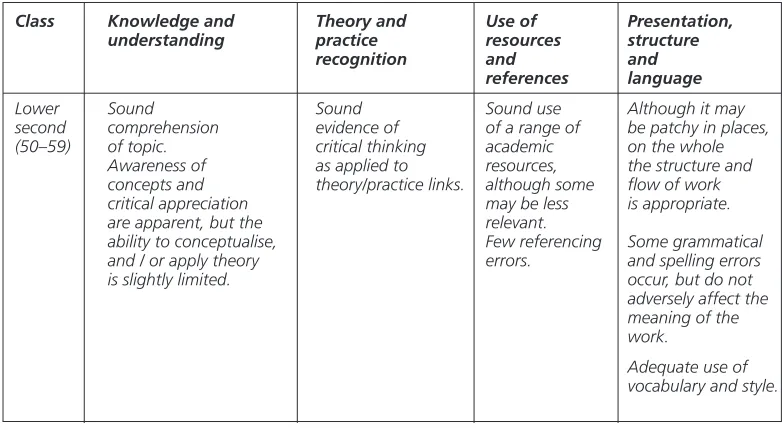
The PDP is one of the largest modules in the business school, with 218 students enrolled in the pilot study year, and with a teaching team of up to ten members. So it was important for the intervention to be practical and not to impinge on staff workloads. Students are not given an individual supervisor but instead are encouraged to work in learning sets in two-hour workshops. It was decided that feedback would be given during workshop time to avoid additional resourcing. From a pedagogical perspective, the one-to-one dialogue between student and teacher is highly valued by students (Murtagh and Baker, 2010). A matrix based on the school-wide marking criteria (McKeever et al., 2010) was adapted and extended for students whose first language was not English, and was used to indicate the current level of the student’s work. The matrix, as seen in Figure 1., shows students where they are – as evidenced by their submitted mini literature review – according to a number of criteria. It identifies the skills needed to reach the next level, i.e. the ‘gap’ referred to by Sadler (1989). The annotated copy of the student work was used alongside the matrix to show examples of the issues under discussion.
A further advantage of this approach was the opportunity it gave to engage students with the marking criteria used across the school. It would appear that this is rarely consulted, perhaps due to its opaque language (Murphy & Cornell, 2010). Engagement with the criteria is necessary if students are to develop the evaluative skills necessary to become self-regulated learners (Nicol and McFarlane-Dick, 2006) and to be able to close the gap.
comments. Furthermore, giving a grade is likely to lead to ego involvement on the part of the student, and can encourage competition rather than co-operation (see Butler, 1988 and Butler and Winnie, 1995, both studies cited by Nicol & Macfarlane-Dick, 2006). Although the assignment was an individual one, the authors sought to promote a co-operative environment where feedback was discussed and shared. Negative marks also run the risk of demotivating students as we had discovered with our own students in previous years. However, these findings seem to depend on the context and the individuals involved. It is suggested that if grades are task-focussed rather than people-focussed, and care is taken to highlight what students can do to improve their work, grades can be helpful (Black and Wiliam, 1998).
Figure 1. FFI criteria matrix (extract)
Data collection
The data was collected in two stages:
• Stage 1 was to meet research objective 1
• Stage 2 was to meet research objectives 2 and 3 (see above).
objective 4 consisted of an analysis of the module grades and degree classifications.
Stage 1
Following the one-to-one feedback dialogue, a qualitative questionnaire, previously used by McKeever et al. (2010) was offered to students to gauge the perceived helpfulness of the feedback. reflections were elicited using an adaptation of Gibbs’ (1998) reflective cycle, the objective being to monitor:
• students’ immediate reactions to the feedback, i.e. their “gut feelings” following the tutorial • students’ evaluation 2–3 days later
• students’ analysis and actions taken in response to the feedback beyond 2–3 days. The questionnaire was handed in approximately three weeks after it was issued, and 33 students responded. This may seem a low response rate, but it can probably be explained by the fact that participation was purely voluntary, and out of the large teaching team, besides the authors, only one or two members of staff actively encouraged their groups to take part.
Class Knowledge and Theory and Use of Presentation,
understanding practice resources structure
recognition and and
references language
Lower Sound Sound Sound use Although it may
second comprehension evidence of of a range of be patchy in places,
(50–59) of topic. critical thinking academic on the whole
Awareness of as applied to resources, the structure and
concepts and theory/practice links. although some flow of work
critical appreciation may be less is appropriate.
are apparent, but the relevant.
ability to conceptualise, Few referencing Some grammatical
and / or apply theory errors. and spelling errors
is slightly limited. occur, but do not
adversely affect the meaning of the
work.
Stage 2
A further structured questionnaire comprising Likert scale responses to questions was offered 5 weeks after submission of the first questionnaire. This was at the beginning of semester 2, crucially after the students had completed their semester 1 assignments but before receiving their grades.
Stage 2 yielded 50 responses. The questionnaire, with background information to the study and informed consent form, were posted electronically to the students with an invitation to participate, assuring them of confidentiality and anonymity, in accordance with the University’s ethical guidelines.
Results and discussion
The Stage 1 questions were subjected to thematic analysis (Braun and Clark, 2006, cited by Murphy & Cornell, 2010). The salient themes for each group are presented below along with some example quotations.
Stage 1
responses for the students’ initial feelings provoked a range of emotional responses. Six students expressed disappointment with their performance and the grade received:
…upset and nervous…
…shocked my proposal was evaluated so low… …quite good but not as good as expectations… However, the majority (15) declared themselves happy:
…glad, higher than expected…earlier worried…now relieved…
A survey of the students’ evaluation 2–3 days after the tutorial revealed a range of positive responses to the feedback. Nine students expressed acceptance of the feedback, four claimed that it had given them direction, two that it gave good advice, three mentioned specific areas for improvement, five that it was useful and ten ‘other’.
It was good … to remind me the mistakes in reference. I cannot correct myself without… feedback
I thought the feedback is good for me improving and providing a direction for subsequent work I need to improve my analysis deeper as well as my structure.
I read my work and feedback again… I feel the mark given is higher than my work deserves. It’s good in terms of point out the range of that my work is in and where to improve for a higher marks.
I think the feedback is true. My work still has many shortcomings…
I was graded 2(ii) but my ultimate aim is first class or 2(i) and I believe I can achieve that now after the feedback.
The responses for the students’ analysis beyond 2–3 days did not change greatly: I should enrich the theoretical framework
I have good referencing but it is not enough. I should get more journals related to topic As an overseas student, pay attention to the grammar
I’ve learnt to use sound literature in order to support my arguments
According to the questionnaire, actions taken by students beyond 2–3 days fall evenly across the FFI matrix criteria, based on areas they have identified to improve:
Finding more journals to support…my analysis. …reference my work correctly and better…
…practice in grammar and spelling… improve my reading and writing skill.
…put more effort to research and evaluate the theories and models to find the best and most suitable. Spelling and grammar errors reduced through thinking in English logic and do more practice
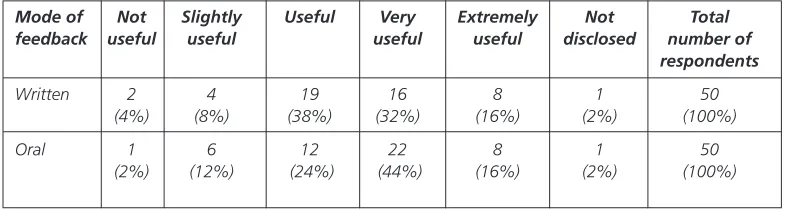
Table 1. research Question 1: responses to the mode of delivery of feedback.
The findings in Table 1. are in keeping with previous studies in which the learning dialogue is highly valued (Murtagh and Baker, 2010:25, Nicol and Macfarlane-Dick, 2006).
Stage 2
There was a striking similarity between the students’ evaluation of the feedback and their actions taken in response to it 2–3 days after the tutorial. This emerged again in Stage 2 and is illustrated in the Wordles below (Figures 2 and 3) which show the students’ response to the Stage 2 questions:
• As a result of FFI what aspects of your study did it draw your attention to?
• As a result of FFI what actions did you take in preparation for your semester 1 assignments?
A clearer distinction between feedback analysis and actions taken had been expected. For example, to the latter question some specific actions such as signing up for a class in information literacy, or consulting a specific grammar book were, perhaps naïvely on the part of the staff, expected. With reference to Gibbs and Simpson’s (2004:25) condition 9 – Feedback is received and attended to – we could conclude here that it had been received but whether it had been attended to, or acted upon could not be established. In other words, we could say that students appear to possess an understanding of the standard, but we
Mode of Not Slightly Useful Very Extremely Not Total
feedback useful useful useful useful disclosed number of
respondents
Written 2 4 19 16 8 1 50
(4%) (8%) (38%) (32%) (16%) (2%) (100%)
Oral 1 6 12 22 8 1 50
(2%) (12%) (24%) (44%) (16%) (2%) (100%)
13 Stage 2
There was a striking similarity between the students’ evaluation of the feedback and their actions taken in response to it 2–3 days after the tutorial. This emerged again in Stage 2 and is illustrated in the Wordles below (Figures 2 and 3) which show the students’ response to the Stage 2 questions:
• As a result of FFI what aspects of your study did it draw your attention to? • As a result of FFI what actions did you take in preparation for your
semester 1 assignments?
Figure 2. Wordle of responses to Stage 2 Question: As a result of FFI what aspects of your study did it draw your attention to?
Figure 3. Wordle of responses to Stage 2 question: As a result of FFI what actions did you take in preparation for your semester 1 assignments?
13
Stage 2
There was a striking similarity between the students’ evaluation of the feedback and their actions taken in response to it 2–3 days after the tutorial. This emerged again in Stage 2 and is illustrated in the Wordles below (Figures 2 and 3) which show the students’ response to the Stage 2 questions:
• As a result of FFI what aspects of your study did it draw your attention to? • As a result of FFI what actions did you take in preparation for your
semester 1 assignments?
Figure 2. Wordle of responses to Stage 2 Question: As a result of FFI what aspects of your study did it draw your attention to?
Figure 3. Wordle of responses to Stage 2 question: As a result of FFI what actions did you take in preparation for your semester 1 assignments?
Figure 2. Wordle of responses to Stage 2 Question: As a result of FFI what aspects of your study did it draw your attention to?
cannot say with confidence that the students knew how to close the gap (Sadler, 1989). Herein perhaps lies the difference between feedback and feed-forward (Boyd & Bloxham, 2009). Another explanation is that students act upon feedback messages intuitively rather than directly or instrumentally (Higgins et al., 2006). As noted earlier, feedback messages are inherently complex. Further research is needed to clarify this point, perhaps in focus groups as these are useful for understanding multiple perspectives (Murphy and Cornell, 2010).
Table 2. research Question 2: Did the FFI increase the students’ confidence in preparing for semester one assignments?
Table 2. shows that nearly two-thirds of respondents reported an increase in self-confidence towards semester 1 assignments as a result of taking part in FFI. This provides support for the notion that feedback can be empowering for students (Nicol & Macfarlane-Dick, 2006).
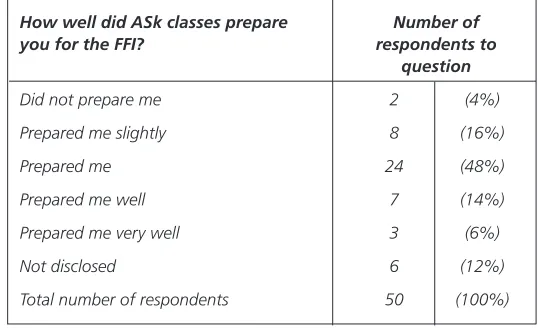
Table 3. research Question 3: How useful were the ASk classes in preparing students for the FFI?
According to Table 3., just under half of the respondents felt that ASk classes had prepared them for the FFI, with a further 20% stating that ASk had prepared them well or very well. Yet, most of the feedback focussed on the need to develop academic skills rather than subject knowledge (see Wordles, Figures 2 and 3). This confirms our earlier research into the students’ lack of prior experience of independent research, extended academic writing and referencing of source material (Burns & Foo, 2011).
Student Down Down a No Up a Up a Not Total
level of a lot little Change little lot disclosed number of
confidence respondents
Written 1 4 8 28 4 5 50
(2%) (8%) (16%) (56%) (8%) (10%)
How well did ASk classes prepare Number of
you for the FFI? respondents to
question
Did not prepare me 2 (4%)
Prepared me slightly 8 (16%)
Prepared me 24 (48%)
Prepared me well 7 (14%)
Prepared me very well 3 (6%)
Not disclosed 6 (12%)
Table 4. research Question 4: What impact did the FFI have on the target module grades, and overall degree classifications of the cohort?
As shown in Table 4., from 2009/10 to 2010/11 the average project grade increased on average by 1% per annum. While no statistical significance can be shown between FFI and grades, the qualitative data suggests the FFI has been beneficial.
Conclusions
From the evidence presented, we cannot conclude that the FFI impacted on module grades, though the average grade continues to improve. FFI appears to have been successful in engaging participating students in the writing of the extended project at an early stage. Most respondents perceived the feedback to be helpful; the feedback messages were clearly received and internalised, but whether appropriate actions were taken to close the gap requires further investigation. Both methods of feedback delivery were useful from the student perspective, enabling them to understand their current level, and what was needed to move beyond that, as well as potentially opening up a learning dialogue between student and teacher. From the authors’ point of view, the matrix allowed feedback to be given consistently across a number of criteria without impinging too heavily on workloads, which was a key concern in a large module such as this.
According to respondents, the FFI gave them direction and increased their confidence in preparing for other assignments. The feedback gave useful, though not unexpected feedback to staff, both in the discipline and ASk support. It also gave the ASk workshops a relevant context and goal, which appeared to increase student engagement.
Clearly, more needs to be done to support the development of the academic literacy of this particular cohort, and, given the timescale available to direct-entrant students, it is tempting to suggest that they need more ASk support. However, Lea and Street (1998) show that a “bolt-on” approach is unlikely to provide a satisfactory solution, though collaborative projects such as this one which seek to embed academic literacy within the discipline may be more effective. The inclusion of self- and peer-assessment opportunities may be beneficial; ASk can support this, but the time it takes for students to develop their evaluative skills should not be underestimated.
Learning about assessment practices is, arguably, as important as learning about the subject. We suggest that interventions such as this one are a step in the right direction, as they:
• provide the opportunity for students to engage in feedback discourses • allow learning dialogues to take place in low-risk settings
• make assessment processes and criteria transparent.
2007/08 % 2008/09 % 2009/10 % 2010/11 %
Firsts 3 00.3 18 0.07 14 0.09 10 0.05
2.1 18 0.18 100 0.39 46 0.31 78 0.39
2.2 46 0.46 105 0.41 60 0.40 88 0.44
Thirds 23 0.23 14 0.06 16 0.11 12 0.06
Pass 10 0.10 17 0.07 13 0.098 10 0.05
100 254 149 198
Average project
References
All websites accessed 6 January 2012.
Altbach, P.G. (2004) Globalisation and the University: Myths and realities in an unequal world, Tertiary Education and Management 10: 3–25.
Burns, C. & Foo, M. (2011) International students’ perceptions of their global skills development: a collaborative approach, Northumbria University, Emerge 3: 25–42.
Black, P. and Wiliam, D. (1998) Assessment and classroom learning. Assessment in Education, 5 (1): 7–74. Boyd, D. & Bloxham, S. (2009) Editorial: Assessment Special Edition, Practitioner Research in Higher Education, 3 (1): 1–2.
Crisp, B.r. (2007) Is it worth the effort? How feedback influences students’ subsequent submission of assessable work, Assessment and Evaluation in Higher Education, 32(5): 571–581.
Duncan, N. (2007) Feed-forward: improving students’ use of tutors’ comments, Assessment and evaluation in Higher Education, 32(3): 271–283.
Elander, J. (2003) Student assessment from a psychological perspective, Psychology, Learning and Teaching, 3(2): 114–121.
Gibbs, G. (1988) Learning by Doing: A guide to teaching and learning methods. London: Further Education Unit.
Gibbs, G. & Simpson, C. (2004) Conditions under which assessment supports students’ learning, Learning and Teaching in Higher Education 1: 3–31.
Higgins, r. Hartley, P. & Skelton, A. (2002) The Conscientious Consumer: reconsidering the role of assessment feedback in student learning, Studies in Higher Education, 27(1): 53–64.
Lea, M. & Street, B.V. (1998) Student writing in Higher Education: an academic literacies approach, Studies in Higher Education, 23(2): 157–172.
McDowell, L., Sambell, K. and Davison, G. (2009) Assessment for learning: a brief history and review of terminology, in rust, C. (ed.) (2009) Improving student learning through the curriculum, 16th International Improving Learning Symposium. oxford, Chapter 4:56-64.
McKeever, M., Davies, E., Stephenson, K. , Wild, H. and Williams, E.(2010) research with not on: students as partners in pedagogical research, 5th Academic Practice and CETL Conference. Northumbria University, Newcastle upon Tyne, 28th June.
Murphy, C. & Cornell, J. (2010) Student perceptions of feedback: seeking a coherent flow, Practitioner Research in Higher Education. 4(1): 41–51.
Murtagh, L. and Baker, N. (2010) Feedback to Feed Forward: student written response to tutors’ written comments on assignments, Practitioner Research in Higher Education. 3(1): 20–28.
Nicol, D. & Macfarlane-Dick, D. (2006) rethinking Formative Assessment in HE: A theoretical model and seven principles of good feedback practice, Studies in Higher Education. 3(2): 199–218.
Sadler, D.r. (1989) Formative assessment and the design of instructional systems, Instructional Science. 18 (2):119–144.
Sutton, P. & Gill, W. (2010) Engaging feedback: meaning, identity and power, Practitioner Research in Higher Education. 4(1): 3–13.
Volet, S. (1999) Learning across cultures: appropriateness of knowledge transfer, International Journal of Educational Research. 31:625–643.