
R E S E A R C H
Open Access
Replaceability and negotiation in a
cloud service ecosystem
Adrija Bhattacharya
1*, Sankhayan Choudhury
1and Agostino Cortesi
2Abstract
Cloud federation is an aggregation of services from different providers in a single pool supporting interoperability and resource migration. In federation, Services are assigned to the consumer’s service access pool as per their specific functional and associated Quality level requirements. The said assignment is based on the advertised features of services. Sometimes, the selected provider fails to provide the committed service or, it fails to fulfill the expected QoS level. As a result, the consumer is being deprived of getting the services at required quality levels, in spite of
subscribing and paying. Re-federation i.e. the inclusion of new services from different providers in the resource pool is a solution. This costly and time consuming re-federation process harms the overall harmony, reputation and
performance of the existing federation. In this paper, the necessary strategies to make a federation autonomic is proposed. It helps federation to work in a self-adaptive manner by delaying the re-federation process through replacement and negotiation mechanisms. This allows the federation to keep a balanced state in case of failures. The proposed methods are simulated and the claims are substantiated by the preliminary experimental outcomes.
Keywords: Cloud federation, Ecosystem, QoS, Replacement, Broker negotiation
Introduction
In the competitive cloud market, Cloud Service Providers (CSPs) advertise their offerings and service consumers choose the most suitable one from the offerings according to their need. Consumer comes with typical requirements in terms of functionalities and associated Quality of Ser-vice parameters (QoSs). The said request can be satisfied by a composed service generated through the execution of service discovery and composition in sequence. A com-posed service is represented by a typical workflow of atomic services. The selected workflow is capable to ren-der the functionalities, as requested, with desired QoS levels. But in a real time provisioning, the provider may fail to offer the committed services with the advertised QoS level. Moreover, due to some unavoidable situations, a provider may fail to render one (or more) of the con-stituent services of the selected workflow. As a result the consumer is not getting the subscribed services with desired QoS levels.
*Correspondence:[email protected] 1University of Calcutta, Kolkata, India
Full list of author information is available at the end of the article
A cloud federation is constructed of multiple cloud providers that have easy collaborations. This could help to elevate the cloud service performances into more effi-cient one [8]. The collaborated service providers in a cloud federation contribute to construct a service pool contain-ing all services of all providers. The service requirement for any consumer belongs to the federation is fulfilled by a set of candidate services from this service pool. The challenges in multi-cloud scenario can be solved by cloud
brokers also. Broker is defined formally in [14]. It works
as a middleman between the service provider(s) and con-sumer. Broker takes consumer’s service request and tries to find out plausible solution from multiple clouds. Then it provides an integrated solution to the consumer through this brokerage.
Unfortunately, the provisioning in real time within a federation fails due to the challenges stated above. In gen-eral, there exist a set of services (after discovery) that can serve the request, but one of them can be consumed. The approach to restore the previous situation is to replace the failed service with the alternatives. This concept of replacement is available in the domain of web services
with respect to workflow composition [2].
A concept of replacement can be used for risk mitigation in federation. The provisioning and replacement of ser-vices within pool under federation could result an “out of resource" situation. In that case, newer service providers with demanding services are included in the pool. This is referred as a process of re-federation [1]. This is a costly and time consuming process. In this paper, we propose a mechanism that can effectively maximize the usage of an existing service resource pool within the federation and delays the re-federation process as much possible.
Re-federation can be triggered due to the following incidents
1. The CSP deviated from the agreed quality. The failure of QoS delivery cannot be met by existing available services in the resource pool.
2. New requests cannot be served by existing services in the resource pool.
The maintenance of the agreed service quality level is important throughout the period of service provisioning. There may be some breach of SLA (Service Level Agree-ment) if the quality parameter significantly deviated from the subscribed one. Here, 9 QoS parameters (Response time, Availability, Reliability, Throughput, successability, Latency, Compliance, Best Practices and Documentation) are considered for SaaS and standard QoSs are consid-ered for IaaS. Our objective is to restore the previous state without performing a re-federation through a proposed alternative. The challenge of delaying re-federation can be resolved through the solution of the following issues.
1. How to maintain the service quality levels on the fly in case of failure of an atomic subscribed service? 2. How to accommodate a new service request (with
subsequent QoS) in case of unavailability of resource(s)?
3. How to fulfill the increased QoS request for an ongoing allocated service by a consumer?
The rest of the paper is organized as follows: The
scope of the problem is described in “Scope of the
work” section and its formal definition is discussed
in “Problem formulation” section. Service ecosystem
definition and related terms are introduced in “
Ser-vice ecosystem and related term definitions” section. “Solution proposal” section describes the proposed algo-rithm. Implementation and experimental results are
depicted in “Experiments” section. “State of the art”
section discusses the Related work. Finally, “Conclusion”
section concludes.
State of the art
Cloud Federation refers to the unionization of software,
infrastructure and platform services [10]. In federated
Cloud one CSP helps to serve the requests of other CSPs [9]. Celesti et al. [8] has an approach of establishing feder-ation by a software component in charge of executing the three main functionalities required for a federation. These three functionalities are identified as discovery of service information, matching the requirement and services and
authenticating those services. In [6], Federation approach
extends the idea of market-oriented side of clouds. In that approach the hint towards the cloud exchange policies
were discussed as a future work. Further in [5], a
federa-tion with opportunistic and scalable applicafedera-tion environ-ment was created. Research issues were pointed out in
[5] as flexible mapping, user specific QoS optimization,
enterprise integration and scalable monitoring of system
components. In another approach [13], a federated
envi-ronment is conceptualized on top of EASI-Cloud Project. This mainly focuses on the infrastructure part; such as VM migration, scheduling, performance optimization etc. The challenges found in EASI-Cloud documentation with respect to SaaS offering is limited. Moreover, the main challenge (that is someway unachievable) in EASI-Cloud is with respect to SLA-monitoring. Another challenge as mentioned by the final reporting of EASI-Cloud was absence of offer (as provided by many providers) com-parison. Comparison among the service prices and QoS monitoring was mainly unachieved. At another part in EASI-Cloud project, a tool for migrating application to SaaS was introduced.The challenge faced in this part was to make the service scalable and easy deployable on top of cloud’s virtual infrastructure resources. However, in case of SLA violation, a proper alternative has to be found out to satisfy consumers. In most of the discussed approaches only have some simulated experiments that does not included any replacement strategies or SLA negotiation proposed in SaaS layer. Moreover, the QoS monitoring only in IaaS level restricts the actual application deploy-ment and concerned QoS parameters (in SaaS layer) are deprived of actual performance assessment.
In current scenario, majority of the cloud federation approaches work in IaaS layer. However, it is clear from the above discussion that QoS consideration and moni-toring for SaaS provisioning within cloud federation is a challenging area to contribute. Let us discuss some par-allel approaches for quality management in federation. A selection process that can be used by cloud providers for collaboration is discussed in [20]. It discusses several pricing and QoS issues but no implementation has been
done. Approach in [21] describes QoS aware composition
in [15]. Only cost parameter is used as criteria and no other QoS is in consideration of this approach. Similarly
in [22] discussed about price and reliability of services.
Kertsz et al. [12] discusses approach for autonomous
ser-vice provisioning in federation. They employed the idea of Global Service Registry that would contain service per-formance information. Depending on this information the broker chooses services. This approach does not con-sider energy efficiency as a parameter to judge the service abilities.
Another concern in SaaS provisioning and mainte-nance is service replaceability. The reason behind it is described in [7]. In [7] it is shown that structural, behav-ioral, and QoS induced changes to services may cause
failures.[16] incorporates replanning of the service
bind-ings when an failure occurs. A large deviation of QoS or violates a user constraint, then replanning approach works. This alternative replacement services are not avail-able automatically. An adaptive replanning mechanism in
[2] places more emphasis on the cause-effect
relation-ship among services and accounts the service failures. An adaption framework and dynamic optimization strategies selection is the key factor in the approach. But replace-ability in true sense has not been achieved in these two
approaches. Finally a method in [2] was a significant one
with respect to service replaceability issues in web. This approach replaces the critically failed components in a service composition plan. But this issue handles a few
of QoS parameters that may not be sufficient to work in a vast domain like federated cloud. Considering all the above approaches for federation and service replace-ment, a new approach for service replaceability along with energy efficiency in a federated cloud environment is designed.
Scope of the work
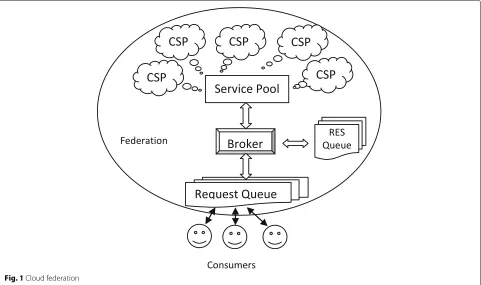
It is clear from “State of the art” section that to assess ser-vice offers we need to see the price and the quality perfor-mances. In this regard, the competitiveness can be judged by a set similar services and Risky services (which ser-vice don’t have any similar alternatives). While comparing business offers and providing the best possible solution to consumer, it is always a challenge to avoid harming the balance in federation. Replacement and negotiation are two main strategies for achieving this. These are helping in accommodating the user request into existing federation and prevent frequent re-federation. The cloud federation may be conceptualized as an Ecosystem and depicted in Fig.1.
The Combined Service Pool, Request Queue and the Brokerage are the participating entities within the Ecosys-tem. The pool is a collection of the services provided by each CSP participating in federation. The request queue has been formed through just appending the request of the consumers. The brokerage plays the role of middleman and responsible for ideal service provisioning.
Ecosystem as defined in [18] signifies the producer con-sumer relationship. In general, there is a state, called Equi-librium that ensures the balance between the producer and consumers. The equilibrium state of the proposed ecosystem is achieved when the Request Queue is empty; i.e. all the requested services are served as per require-ments. The loss of equilibrium may happen due to many reasons like when the already selected provider is failing to provide the service with desired QoS level. This deviation from equilibrium may trigger "Re-federation". The objec-tive of the work is to make the federation autonomic in this context. The broker will take an attempt to bring back the equilibrium through well defined adjustment mech-anism at earliest. As a result the re-federation may be avoided until the situation compels to do so.
There is a recent work [11] which takes care of inter
operating cloud solutions. This approach in [11] tried
to accommodate huge data in mobile devices exploring several IoT characteristics. This scenario invites some per-formance related concerns. For example, one user needs data storage service for his work backup. He has options as Google Drive, DropBox, etc. For this services con-cerned QoS parameters are Storage size, Response time, Availability. Even after subscribing for one service (say Google Drive here), the mentioned qualities may not seem good enough in some point of time. In this situation, the replacement mechanism would work to find the similar alternative matching the user’s quality criteria. When any of the available alternate solution is not matching the qual-ity requirement, the user may be offered to negotiate in some QoS(s). In both the cases, migration cost for shifting from one ongoing offering to a new one should be kept in mind.
Problem formulation
The problem clearly states that the service performances are degraded due to several reasons and those services are needed to be replaced by similar services to satisfy con-sumer. Moreover, there may be no exact matched service as per the consumer requirement. Then how to nego-tiate the consumer(s) with available services is another concern. The problem scenario is a collection of two sub-problems. The first one is the problem of replace-ability. It demands a solution to exchange an identified service with degraded quality by another from available service pool. This leads to find out a perfect match for the required service from a possibly large set of similar ser-vices. The problem of service replaceability is essentially
a search problem [2]. The second problem is mitigation
and QoS negotiation (in case of unavailability of perfect match to replace). This can be seen as a special decision problem [23].
Service consumers express their requirements by query. It contains a set of functionality to be supported by offered
services matching the quality requirement(s) specified in it. Let us consider the set of all services for a typical func-tionalityfidenoted bySi = {sij :j∈I}where j belongs to
set of positive integers.Each service have a quality specifi-cationQijfor jth service inSi. Quality specification within
a query is Q = {qk = reqk}where qk is the kth
qual-ity parameter and reqk is the value of that kth quality
parameter. The set of replaceable services is denoted byR.
Search problem formulation
The Replaceability problem can be formally defined as a search problem. Let us consider for a specific functional requirement all set of services as the search space. The ini-tial state is the state where only the services with required
functionalities were found and no service is added toR.
That is at initial state R = {}. There are some
restric-tions in terms of QoS parameters declared by query. The
Actions are defined to take arbitrary service fromSiand
check if it follows the QoS restrictions in Qor not. The
goal state comprises of all services from Si who allows th
restrictions inQare transferred toR. The search problem
is solved here efficiently by reducing the search space by narrowing it with respect to the QoS restrictions given.
Function problem formulation
QoS negotiation between two services can be defined in terms of decision (negotiable or not). It signifies whether a service is acceptable or not with a deviated QoS as an alternate of required service. Let us also define a
relation-ship as N i.e. negotiable. It is a binary relation among
two services denoting that the corresponding services are
negotiable with each other. FormallyNis defined asN =
{Ni:i∈I}.Niis defined overSifor a specific functionality
fi. i.e.Ni ⊂ Si×Si. Let us considerNi(a,b) as a
collec-tion of Boolean formulam with variables asx1,x2, ...,xn
(x ∈ {True,False}). Let us considerlqi’s are quality levels
ofqthi QoS. Each ‘level’ is defined as a range of permissi-ble QoS values (Quantitative or Qualitative) mapped as a
single qualitative value. Allowed levels for anyqi th QoS
parameter are assumed aslq1,lq2, ...,lqn. The problem is to
find an assignment ofxi’s such thatmis collectively True.
Service ecosystem and related term definitions In this section some definitions are discussed that will
be used in rest of the paper. A services Set (S) contains
all the possible atomic services. S is defined as follows,
S = ∪iSi where Si is the set of services as defined
above. Each service sij has quality offerings declared by
service providers as Qij. Qij is declared as set of
qual-ity parameters and corresponding levels as followsQij =
qk→lpqk∀kandp∈Z+
. A query is denoted by Q
requirements are specified by the following set asqk =req
whereqk is thekthQoS parameter. Query is always
sub-mitted to service broker that is mid entity between end users and cloud providers. Broker has two queues where it maintains the service request and service provisioning information. Service requests are submitted by providers are stored in the queue named REQ. Service request infor-mation already served by the broker are saved within a RES queue.
EcosystemEcosystem is defined with a set of services, service consumers along with broker(s). Here set of ser-vices has different service quality offerings and consumers have some service requirement. The ultimate objective of ecosystem is to provision required services by the con-sumers. The ecosystem changes its state(s) every time it receives newer request or older service adjustment to be
done. The state of the ecosystem is represented byEtfor
describing at a specific time point t. The possible state of the ecosystem are equilibrium and disturbed_equilibrium. There are a few components bu which the ecosystem is defined here. First of all the service pool is the main part of the ecosystem. It contains all services that are available for consumption. Two queues namely Request (REQ) and Response (RES) are stating the consumer requirement and status of ongoing services at any time. These two queues are used to decide the ecosystem states at any time.
EquilibriumIt signifies a state in the whole ecosystem when the broker’s REQ is empty and there is no interme-diate request that is un-served. i.e. not added to the RES queue. Suppose, the status of the RES and REQ is stated
byRESt = {served services at time t},REQt = {}. This
typical state of the ecosystem is called equilibrium and
the ecosystem at equilibrium is denoted byξt. The
equi-librium state of the ecosystem may be disturbed (named as disturbed_Equilibrium) due to the new service request and the degrading quality performances of the already provisioned ongoing services. That is at a specific time t,
the ecosystem may be atξt . But at time t the
ecosys-tem goes to the statEt. Broker then take roles to restore
equilibrium stateξt.
Congruence DistanceandCongruenceTwo services
sij &sik are said to be atδ distance ifsij &sik ∈ Si and
QoS parameters are the same but differs inδQoS
param-eter levels. Hereδis called congruence distance between
si & sj. Furthermore, two services sij & sik are said to
be in δ - congruence relationship ifsij & sik ∈ Si and
QoS parameters are the same i.e. same QoS parameters are specified (i.e.QijandQik) though the subsequent
lev-els are not the same. They differ in δ QoS parameter’s
levels. Say for example,sij&sikare two services with
“pay-ment” functionality from Bank domain.sij &sik are said
to be congruent if QoS parameter Availability is
men-tioned in both the service description; but the may besij
is leveled as “high” &sikis leveled as “medium” available.
These qualitative measurements of QoS parameter is done by clustering on the QoS values with same functionality domain. In this casesij&sik varies in 1- congruence
dis-tance (as there is one level disdis-tance between “high” and “medium”).
Functional SimilarityTwo servicessij&sikare said to
be in functionally similar relationship ifsij&sik ∈ Sibut
the subsequent QoSs may not match.
Absolute SimilarityTwo servicessij&sikare said to be
in absolute similar relationship ifsij &sik ∈ Siand QoS
parameters are same (i.eQijandQik are same) as well as
subsequent QoS parameter’s levels are also same.
Goodness Similar Selection of the services based on a few specific quality parameter may lead to dissatisfac-tion of consumers with respect to other important QoS parameters. It is important to provide services at moder-ate satisfaction for all QoSs. A method for such collective measures of QoSs are well described in [4]. It involves all QoS parameter to calculate the goodness of services. This measure is used here to calculate overall goodness of the services. Two servicessij&sikare said to be similarly good
sij &sik ∈ Si and QoSs are the same. i.e. (Qij and Qik)
are same and also goodness values of sij &sik (Gij,Gik)
are within a small threshold distance from each other. i.e. |Gij−Gik| =Th. Value of the threshold (Th) depends on
the functional criteria of services. SometimesTh≤1.
Goodness DistanceTwo servicessij &sik are said to
be at k-goodness distance ifsij &sik ∈ Si and QoSs are
the same i.e.Qij and Qik are same and goodness values
ofsij &sik (Gij,Gik) are within±θ from each other. i.e.
|Gij−Gik| =θ.
Emission QuotientEach of the atomic service (SaaS) is collection of some operations. Operations may be of com-puting, data access or other types. Based on the type of operations the carbon emission amount can be calculated. The total emission amount of a single service is defined as the Emission Quotient of the service. This is denoted by
Eiand defined as follows.
Ei=
j
(ej×nij) (1)
where ej denotes the standard emission quantity for jth
operation andnijis number ofjthoperation inithservice.
Solution proposal
Newer service requests can be fulfilled by any avail-able service(s) whose quality criteria matches with that of the required service(s). In general, in real life broker pro-vides a higher quality service to the consumers (more than requirement as specified inQ) in case there is no available service(s) that exactly matches the quality requirement(s). It may generate satisfactory performance but it is harmful for the proper utilization of service capabilities in terms of quality. Over-provisioning is often a common mis-take or compulsion that happens. Many poor allotments of services may exhaust the full capacity of the federa-tion. Broker has to build up a negotiation mechanism that would work in accordance with replaceability mechanism. Replaceability and negotiation mechanism helps the cloud broker towards the optimized consumption of SaaS resources. Iterative application of these mechanisms grad-ually moves the federation towards saturation of its ser-vice provisions (mainly respect to the QoSs). Full exhaus-tion of offered services would result the federaexhaus-tion to reconstruct further. This is called the process of re-federation. Often the federation advertises for newer ser-vice providers to join the federation based on the frequent requirements and availability of those services.
Service replacement on the fly
Service Replaceability is defined in [2] in terms of
fit-ness and penalties. Violation from the QoS constraints increases penalty that in turn decreases Replaceability. But the process involves fewer QoSs parameters. In this pro-posed approach replaceability is measured in terms of all available QoSs and their corresponding constraints. The proper understanding of the replaceability and replace-ment algorithm needs some more terms to be described.
Congruent- ReplaceableA set of all services that are
in k congruence relation withsij are said to be
congru-ent replaceable set for servicesij. It is denoted by(CRkij)
where k can vary overZ+. It is important to notice that
lesser the value of k the more accurately replaceable is the corresponding set of services.
Goodness- Replaceable A set of all services that are
goodness similar withsijare said to be goodness
replace-able set for servicesij. It is denote byGRij.
Absolute ReplaceableA set of all services that are
abso-lute similar with sij are said to be absolute replaceable
set for servicesij. It is denoted byARij. It is also to note
that 0-Congruent replaceable set is the same as Absolute Replaceable set. So, It is clear thatCR0ij=ARij.
Functionally Similar Services A set of all services that are functionally similar withsij are said to be set of
functionally similar service for service sij. It is denoted
byFSij.
In the definition of service replaceability all of the above cases are aggregated with the relative importance it holds. It is clear that the set of absolute replaceable services are
the most desired ones when we are thinking of replacing a service. So in the measurement of service replaceabil-ity it should carry the most weight. From the findings
of [4] it is evident that the services with similar
good-ness often carry similar QoS performances. Congruent is the most compromised solution of service replaceabili-ties. The replaceability quotient for the replaceability of jth service inSiisrijand is defined as
rij=
||ARij|| + ||GRij|| +k=1
1
k+1
||CRkij||
||FSij||
(2)
The more the Replaceability value of a service more the service is replaceable. Often, in some composition plans the candidate services having the least replaceability are called as critical component services. Replacement for those services is very difficult and often consumer has to compromise in some of the QoS parameters. The reduced problem of replacement after defining replaceability can be modified as a two objective optimization problem. Here objective function can be written as Maximize
Z=a×rij+b×
1
Eij
(3)
Subject to the QoS constraints on the existing ongoing service.
Here aand b are quotient which signifies the
impor-tance of the objectives. It can be tuned according to the application’s need. If replaceability is the most important
issue then a should be more thanb. Otherwise a less than
b. The service replacement algorithm is described in the
following subsection .
Replacement
In the Replaceability algorithm that the steps for choosing the most replaceable and least emissive services. Individ-ually these are interchangeable depending on the value of
The new request is served immediately with the freed
ser-vice. HereQis latest the query in REQ. The method of
replaceability is discussed through the algorithm.
Algorithm 1REPLACE
Input: fi,Qij,θ,Eij of the service sij,SijR = {},Ti =
{},ARij,GRij,CRki∀θ
Output: Best Replaceable service set forsij(SRij)with
max-imumrijandEij
1: Initialize: Th=0.2
2: Search for the services inARijsuch that|rij−rik| =0.2
into the setTij
3: Search for the service havingEik ≤Eij
4: Save the service inSRij 5: ifSRij={} then
6: Search for the services inGRijsuch that|rij−rik| ≤
Thinto the setTij
7: Search for the service havingEik≤Eij
8: Save the services inSRij 9: ifSRij= {} then
10: forp=1 toθdo
11: Search for the services inCRijhavingEij≤Eik
12: Save the service inSijR
13: end for 14: end if 15: end if
16: return The service (s) inSRijas best alternative tosij.
Service negotiation for newer request
Negotiation mechanism works among the provider’s qual-ity offerings and the new service requirement(s). When newer requests for service provisioning along with spe-cific quality demand occur, broker at first tries to choose services that have higher replaceability and lower emis-sion quotient. It may happen that there is no service available with the required level of QoSs according to the newer service requirement. In that case broker adjusts the existing over-provisioned services with the lower quality alternatives and provisions those services to the newer requester.
The negotiation algorithm is associated with replace-ment algorithm. The process of negotiation is initiated when the service discovery procedure cannot find the exact match of the requested service along with its quality requirements. This process has two parts. In the first part the required service (already (over) provisioned to another service provider) and proper replacement for that service are identified. If this replacement cannot be found then the newer service request is satisfied by a compromised solution with respect to some of the QoS parameters. In
Algorithm 2NEGOTIATE
Input: Qi,θ, Priority QoS list (Pr),Ng= {}(Set of services
that are negotiable withsij)
Output: Ng
Find the QoS constraint type for each QoS (qx)
param-eter inQi.
fory=1 toθdo
forx=1 to ndo
ifqxis upperthen
ifqix≤qyxthen
py+ +
else ry+ +
end if else
ifqix≥qyxthen
py+ +
else ry+ +
end if end if end for
iffor everyryparametersqyr ∈Prthen
sijandsikare not negotiable
else
sijandsikare negotiable
end if
Putsikis Ng
end for return Ng
those cases, negotiation can be done among the goodness levels and less important quality parameters. The QoS constraint type referred in the algorithm is found in [2]. If a constraint is of upper type then it accept the lower values than the required on as a valid choice. Similarly if the con-straint is of lower type then it accepts the higher values as valid choice. Response Time is a typical example of Upper constraint and Availability is a lower constraint param-eter. The above two algorithms work often individually and in some cases collectively to regain the equilibrium within the brokerage system. The algorithm for regain-ing equilibrium uses either replacement, negotiation or both. The brokerage algorithm for regaining equilibrium is described as follows.
Experiments
Algorithm 3EQUILIBRIUM
Input: Quality requirement for newer request (QN) that
cannot be served by existing available services, Qual-ity requirement of provisioned services which have degraded quality (QE), Service allocation and necessary
information about all services.
Output: Decision-State of equilibrium is regained or not
ifQNis emptythen
call REPLACE (QE)
ifno replacement foundthen
call NEGOTIATE(QE)
ifNg is emptythen
Equilibrium cannot be achieved
else
QE=Null
end if end if else
ifQEis emptythen
call NEGOTIATE(QE)
ifNg is emptythen
Equilibrium cannot be achieved
else
Equilibrium achieved
end if end if end if
(described in Table1). It handles mainly IaaS services on
top of which the SaaS federation was constructed. Queries were run consecutively. In this section the dataset prepa-ration and experimental results are discussed along with some inferences drawn.
Implementation and dataset
Dataset according to functionality are prepared from
QWS dataset available in [3]. Here, Nine standard QoS
Table 1System specification
System parameters Specification
Simulation engine CloudSim-3.0.3
Operating system Windows 8
Front end Eclipse Juno
Virtual Machine Monitor Xen
System architecture x86
Number of data centers 5
Number of host 100
Number of VM 100
Number of cloudlets 300
Number of users 20
Types of workload Random
Table 2Experiment on federation
Specifications Value
SaaS functionalities 56
Number of services 2508
Total Queries run 300
Involved QoS parameters 9
parameters for a total of 2508 service invocations are listed. Parameters are namely, Response Time, Through-put, Availability, Reliability, Successability, Compliance, Latency, Best Practices and Documentation. This dataset is considered as the combined service pool in the federation. Similar services are grouped according to Absolute replaceable, Goodness replaceable and Congruent-replaceable services as discussed before. Then the service similarity also measured for each of the group of services. Among those similar services, QoS values are clustered and included into levels (such as high, low, medium, etc.). Random carbon emission quotient per service is generated. Each of the saas is allocated to VMs upon request based on availability. Moreover, the IaaS parameters as Response Time, CPU per cycle and size of input/output data are monitored for each of the ongoing services when each new request is served. Predefined threshold are there. Overcoming those threshold indi-cates the degraded performance in corresponding SaaS (s) and replacement mechanism starts working. Each of the system level parameters are monitored at every new request arrivals to check the quality levels (signified by 9 QoSs) of the on going services. The system specification
of the simulation environment is described in the Table1.
Set of random queries are generated. These queries are considered as requirements from consumers. Each of these queries contains specific functionality with some QoS constraints (mostly qualitative constraints mentioned for majority of the mentioned nine QoS
Fig. 3Number of risky services per domain
parameters). Functionalities here are constrained to 5 (Account, Analysis, Bank, Map, Scan) domains. As a whole total 11 domains are involved in the pool. Each of the functionalities has multiple queries to run on. Each query runs replaceability as proposed as well as
accord-ing to replaceability measure discussed in [2]. Moreover,
each query is also run for proposed equilibrium gaining
algorithm and other two algorithms discussed in [19] and
[17]. The details of the experiment on federation is given
in Table2.
Results
There is an interesting relationship derived among the no of QoS parameters and number of congruent services in Fig.2. It signifies that the number of congruent services is highly dependent on the number of QoS parameters spec-ified. If the number of QoS parameters is less in the query then it is a possibility that there will be more number of congruent services.
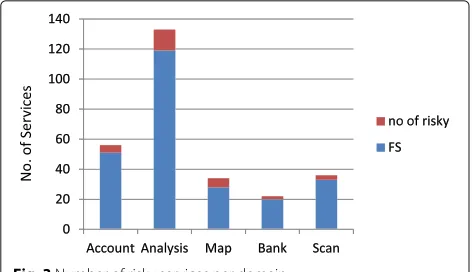
Another analysis is being done for five functionalities. A service is pointed as a risky service if it has no congru-ent services. This signifies that the failure or over demand of those services may completely disturb the equilibrium
and the federation will be broken. The Fig.3signifies that
Fig. 4Trend of risky services
Table 3Outcome of 5 Queries in “Account” Domain
Total Absolute Goodness 1 Con 2 Con 3 Con 4 Con
7 1 2 4 2 0 0
7 1 1 2 3 1 0
9 1 2 3 3 1 1
12 2 3 4 5 1 0
6 1 1 2 3 0 0
“Analysis" services the highest set of functionally similar services as well as the number of risky services.
Another interesting inference can be drawn from the
Fig.4that the number of risky services increases with the
number of functionally similar services.
For five queries in “account” functionalities Table3 is
generated. Corresponding service replaceability quotient
is also depicted in Table 4. It is evident from Table 4
that the services that have more congruence services are easily replaceable. Goodness similar services also affect the replaceability. More the available goodness similar services, more the replaceability obtained.
Comparison
The performance of the proposed approch is compared with respect to two aspects. Firstly the proposed approach is considered with respect to replaceability capability and
compared with the approach in [2] . Then two self
adap-tation strategies as mentioned in [19] and [17] were com-pared with the proposed approach to signify how well the proposed approach can adapt with dynamic changes within federation.
Replaceability
Replaceability mechanism for service composition is
implemented in [2]. We have compared proposed
replace-ability approach with that of [2] which considers
fit-ness of GA as the key criteria while choosing services within a replaceable workflow. The comparative results
are shown in Fig.5. The replaceability Mechanism in [2]
result in 19% matching executable services and 81% non-matching services. After employing proposed replaceabil-ity mechanism the Executable services were increased
Table 4Replaceability values
Query Replaceability
1 0.81
2 0.61
3 0.66
4 0.70
Fig. 5Comparison among replaceability mechanisms.aApproach in [2].bProposed approach
41%. After introducing negotiation the total service-able option increased to 74% (41% Replaceservice-able + 34% Negotiable).
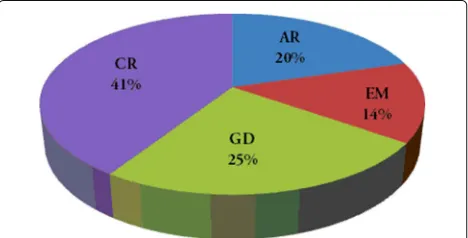
The replaceable set of services are calculated consider-ing several different similar services. The percentage of Absolute Replaceable, Goodness replaceable and Congru-ent Replaceable services are 20%, 25% and 41% respec-tively. The result is depicted in Fig.6.
In case of proposed Negotiation mechanism the services with 1 priority specification is higher achievable among the all other priority specification. This is depicted in
Fig.7. Here the One specified priority QoS have a chance
of 75% success while two, three and four priority QoS specification would have 59%, 46% and 40% success rate respectively.
Autonomous self-adaption
Thomas and Chandrasekaran [19] proposed a method of
self adaptation in federation. How well this approach and proposed approach find out wide ranges of alternatives that have been listed. The number of satisfied services for each of the query run with proposed approach and the
approach in [19] are noted. Same set of queries ran on
the same service pool. Figure 8 signifies that the
num-ber of service alternatives is better in case of proposed
Fig. 6Service types found in all executions
approach. The services satisfied through the proposed
approach have more alternatives compared to [19].
In Fig.9, the service ecosystem has been observed for
300 queries (results shown for first 50 queries) on the same service pool with the proposed approach as well as
the approach in [19]. The state of Disturbed equilibrium
(possible re-federation) is attained more number of times
for the approach in [19]. The proposed approach attained
much less in disturbed_equilibrium state. It is evident that with the proposed approach the possible re-federation will be reduced.
Another recent approach on self adaptation as [17] is
compared with the proposed approach. Number of service alternatives were listed for another random 50 random
queries for [17] and proposed approach. Comparative
performance is depicted in Fig.10
Later [17] and proposed approaches were examined for
an ongoing federation and checked how frequently both the approaches adapted with the changing environment. The results of equilibrium and disturbed equilibrium is
depicted in Fig. 11. It is clearly shown that proposed
approach (in Blue) adapts more appropriately when equi-librium gets disturbed.
The number of possible re-federation requests as
gen-erated by the proposed approach and approaches in [19]
and [17] over 300 queries are depicted in Figs.12 and
13respectively. It is evident that the proposed approach
invites less number of re-federation requests due to the imposed replacement and negotiation mechanism within the proposed equilibrium algorithm.
Conclusion
Fig. 7Average number of services found for different restricted negotiation.a1 QoS in priority.b2 QoS in priority.c3 QoS in priority.d4 QoS in priority
Fig. 8Service alternatives in case of [19] and proposed approach
Fig. 10Service alternatives in case of [17] and proposed approach
Fig. 11State of equilibrium in case of [17] and proposed approach
Fig. 13Re-federation requests in case of [17] and proposed approach
service requests may have such a typical demand of ser-vice QoS levels that may not be possible to readily pro-vide by the existing state of the ecosystem (federation). Here the replacement and negotiation are two mecha-nisms that help to regain the equilibrium in the ecosystem. Result shows that lesser the number of QoS parame-ters more the congruent services will occur. The risky points according to functionality are identified and it is shown that for analysis functionality the services have more risky components. The federation maintenance by mitigating the above issues will not only make the ser-vice provisioning better in quality and seamlessness but it will effectively increase the elasticity and scalability also. Services often in cloud are over provisioned due to the unavailability of services at a required level of QoSs. Replacement and negotiation of those over provisioning services help in increasing the elasticity and scalability indirectly. The proposed approach helped to solve three issues discussed in Introduction and as a consequence the frequency of re-federation is also reduced over a period of time. Future work includes the mechanism for insuring those services for guaranteed QoS levels as per require-ment. Number of the service alternatives increase signifi-cantly by incorporating service replaceability. Equilibrium algorithm uses negotiation and replacement algorithm as per need to regain disturbed equilibrium within the ecosystem. Results show that the service ecosystem equi-librium is maintained more successfully for most of the
incoming queries compared to recent approaches in [19]
and [17].
Abbreviations
AR: Absolute replaceable; Con: Congruent; CR: Congruent replaceable; CSP: Cloud service provider; EM: Emission equivalent; GD: Goodness replaceable; QoS: Quality of service; SaaS: Software as a service
Acknowledgements
We are thankful to Ms. Soma Das M.Tech final year student of Department of CSE, University of Calcutta for her valuable contribution towards the proposed work.
Authors’ contributions
All authors have participated in conception and design, or analysis and interpretation of the data, drafting the article or revising it critically for important intellectual content, approval of the final version.
Authors’ information Not applicable.
Funding
This manuscript is not supported by and research grant or fellowship.
Availability of data and materials
This manuscript uses data from the repository [3]. We have requested for the credential to download that data and was supplied with the same. This dataset contains service id with url and 9 QoS parameters for 2508 services. Later for the sake of implementation here we have attached some QoS values which were randomly generated.
Competing interests
This manuscript has not been submitted to, nor is under review at, another journal or other publishing venue. The authors have no affiliation with any organization with a direct or indirect financial interest in the subject matter discussed in the manuscript.
Author details
1University of Calcutta, Kolkata, India.2Università Ca Foscari Venezia, Venice,
Italy.
Received: 30 March 2019 Accepted: 21 August 2019
References
1. Al Falasi A, Serhani MA, Elnaffar S (2013) The sky: a social approach to clouds federation. Procedia Comput Sci 19:131–138
2. Al-Helal H, Gamble R (2014) Introducing replaceability into web service composition. IEEE Trans Serv Comput 7(2):198–209
3. Al-Masri E, Mahmoud QH (2008) The qws dataset.http://www.uoguelph. ca/~qmahmoud/qws/indexhtml. Accessed: 12 Mar 2013
4. Bhattacharya A, Choudhury S (2016) An efficient service selection approach through a goodness measure of the participating qos. In: Proceedings of the International Conference on Informatics and Analytics. ACM. p 94.https://doi.org/https://doi.org/10.1145/2980258.2980451 5. Buyya R, Ranjan R, Calheiros R (2010) Intercloud: Utility-oriented
federation of cloud computing environments for scaling of application services. Algorithms Architectures Parallel Process:13–31.https://doi.org/ https://doi.org/10.1007/978-3-642-13119-6_2
7. Canfora G, Di Penta M, Esposito R, Villani ML (2005) Qos-aware replanning of composite web services. In: Web Services, 2005. ICWS 2005.
Proceedings. 2005 IEEE International Conference on, IEEE. pp 121–129. https://doi.org/https://doi.org/10.1109/icws.2005.96
8. Celesti A, Tusa F, Villari M, Puliafito A (2010) How to enhance cloud architectures to enable cross-federation. In: Cloud Computing (CLOUD), 2010 IEEE 3rd International Conference on. IEEE. pp 337–345.https://doi. org/https://doi.org/10.1109/cloud.2010.46
9. El Zant B, Gagnaire M (2014) Dynamic break even pricing for cloud federation. In: Globecom Workshops (GC Wkshps), 2014. IEEE. pp 70–74. https://doi.org/https://doi.org/10.1109/glocomw.2014.7063388 10. Kertesz A (2014) Characterizing cloud federation approaches. In: Cloud
Computing, Springer. pp 277–296.https://doi.org/https://doi.org/10. 1007/978-3-319-10530-7_12
11. Kertesz A (2015) Interoperable data management using personal and infrastructure clouds. IEEE Cloud Comput 2(1):22–28
12. Kertsz A, Kecskemeti G, Marosi A, Oriol M, Franch X, Marco J (2012) Integrated monitoring approach for seamless service provisioning in federated clouds. In: Parallel, Distributed and Network-Based Processing (PDP) 2012 20th Euromicro International Conference on. IEEE. pp 567–574.https://doi.org/https://doi.org/10.1109/pdp.2012.25 13. Kohne A, Spohr M, Nagel L, Spinczyk O (2014) Federatedcloudsim: a
sla-aware federated cloud simulation framework. In: Proceedings of the 2nd International Workshop on CrossCloud Systems. ACM. p 3.https:// doi.org/https://doi.org/10.1145/2676662.2676674
14. Mell P, Grance T, et al. (2011) The nist definition of cloud computing. https://doi.org/https://doi.org/10.6028/nist.sp.800-145
15. Mihailescu M, Teo YM (2010) Dynamic resource pricing on federated clouds. In: Proceedings of the 2010 10th IEEE/ACM International Conference on Cluster, Cloud and Grid Computing, IEEE Computer Society. pp 513–517.https://doi.org/https://doi.org/10.1109/ccgrid.2010. 123
16. Na J, Li Gh, Zhang B, Zhang L, Zhu Zl (2010) An adaptive replanning mechanism for dependable service-based systems. In: e-Business Engineering (ICEBE), 2010 IEEE 7th International Conference on. IEEE. pp 262–269.https://doi.org/https://doi.org/10.1109/icebe.2010.68 17. Nallur V, Bahsoon R (2013) A decentralized self-adaptation mechanism for
service-based applications in the cloud. IEEE Trans Softw Eng 39(5):591–612.https://doi.org/10.1109/TSE.2012.53
18. Olson JS (1963) Energy storage and the balance of producers and decomposers in ecological systems. Ecology 44(2):322–331
19. Thomas MV, Chandrasekaran K (2017) Dynamic partner selection in cloud federation for ensuring the quality of service for cloud consumers. Int J Model Simul Sci Comput 08:1750036
20. Wenge O, Siebenhaar M, Lampe U, Schuller D, Steinmetz R (2012) Much ado about security appeal: cloud provider collaborations and their risks. In: European Conference on Service-Oriented and Cloud Computing. Springer. pp 80–90. https://doi.org/https://doi.org/10.1007/978-3-642-33427-6_6
21. Wu CS, Khoury I (2012) Qos-aware dynamic research component composition for collaborative research projects in the clouds. In: Cloud Computing Technology and Science (CloudCom), 2012 IEEE 4th International Conference on. IEEE. pp 883–888.https://doi.org/https:// doi.org/10.1109/cloudcom.2012.6427536
22. Xin L, Datta A (2010) On trust guided collaboration among cloud service providers. In: Collaborative Computing: Networking, Applications and Worksharing (CollaborateCom), 2010 6th International Conference on. IEEE. pp 1–8.https://doi.org/https://doi.org/10.4108/icst.trustcol.2010.6 23. Yu P (1973) A class of solutions for group decision problems. Manag Sci
19(8):936–946
Publisher’s Note

![Fig. 9 State of equilibrium in case of [19] and proposed approach](https://thumb-us.123doks.com/thumbv2/123dok_us/847398.1582421/11.595.57.540.86.308/fig-state-equilibrium-case-proposed-approach.webp)
![Fig. 10 Service alternatives in case of [17] and proposed approach](https://thumb-us.123doks.com/thumbv2/123dok_us/847398.1582421/12.595.60.541.539.719/fig-service-alternatives-case-proposed-approach.webp)
![Fig. 13 Re-federation requests in case of [17] and proposed approach](https://thumb-us.123doks.com/thumbv2/123dok_us/847398.1582421/13.595.59.542.87.268/fig-federation-requests-case-proposed-approach.webp)