R E S E A R C H
Open Access
Access control as a service for the Cloud
Nikos Fotiou
*, Apostolis Machas, George C Polyzos and George Xylomenos
Abstract
Cloud computing has become the focus of attention in the computing industry. However, security concerns still impede the widespread adoption of this technology. Most enterprises are particularly worried about the lack of control over their outsourced data, since the authentication and authorization systems of Cloud providers are generic and they cannot be easily adapted to the requirements of each individual enterprise. An adaptation process requires the creation of complex protocols, often leading to security problems and “lock-in” conditions. In this paper we present the design of a lightweight access control solution that overcomes these problems. With our solution access control is offered as a service by a third trusted party, the Access Control Provider. Access control as a service enhances end-user privacy, eliminates the need for developing complex adaptation protocols, and offers data owners flexibility to switch among Cloud providers, or to use multiple, different Cloud providers concurrently. As a proof of concept, we have implemented and incorporated our solution in the popular open-source Cloud stack OpenStack. Moreover, we have designed and implemented a Web application that enables the incorporation of our solution into Google Drive.
Keywords: Authorization; Authentication; Delegation; Security; Policies
1 Introduction
Cloud computing is a technology that offers a cost-effective way for outsourcing data storage and com-putation. Nevertheless, despite its intriguing properties, enterprises are reluctant to fully adopt it, since they are concerned–among other things–about losing the gover-nance of their outsourced assets, i.e., losing the ability to enforce their own, enterprise-specific, security poli-cies. According to PwC’s Global State of Information Security Survey 2012 [1], the largest perceived Cloud security risk is the “uncertain ability to enforce provider security policies,” whereas according to the survey of Subashini and Kavitha [2] one of the biggest security chal-lenges for providing Cloud-based services is the “adher-ence of the Cloud provider to the security policies of its clients,” as well as “the administration of user authoriza-tion systems”. This mismatch between provider-enterprise security policies severely impedes Cloud adoption and further research on effective solutions for this problem is required. Indeed, “effective models for managing and enforcing data access policies, regardless of whether the data is stored in the Cloud or cached locally on client
*Correspondence: [email protected]
Mobile Multimedia Laboratory, Department of Informatics, School of Information Sciences and Technology, Athens University of Economics and Business, Evelpidon 47A, 113 62 Athens, Greece
devices” was identified back in 2010 as a top research pri-ority, by the European Network and Information Security Agency (ENISA) [3].
One question that may arise is how likelyloss of gover-nanceof the outsourced data is, and what is its impact. According to ENISA’s Cloud Computing Security Risk Assessment report [4], the loss of governance is a risk with very high probability and very high impact. The same report states that two of the vulnerabilities that may expose an enterprise to that risk are “unclear roles and responsibilities” and “poor enforcement of role def-inition.” This outcome comes as no surprise, since the organizational structure and the security policies of an individual enterprise cannot be easily captured by a Cloud provider. Moreover, the interoperability between an enterprise and a Cloud provider requires the devel-opment of complex communication protocols; this, how-ever, increases the chances of a security breach due to implementation errors, according to the Cloud Security Alliance [5]. Armando et al. [6] exploited such implemen-tation errors in order to bypass the SAML-basedasingle sign-on system of Google apps. Similarly, Somorovsky et al. [7] gained access to multiple SAML-based systems by exploiting implementation bugs. Nevertheless, even if the developed protocol is implemented correctly, it will be Cloud provider specific, thus hindering the migration
of an enterprise to another Cloud provider; this condi-tion is known aslock-in, and has been identified as ahigh probability risk by ENISA [4].
In this paper, we propose a novel solution that enables a trusted entity to store enterprise-specific security poli-cies and take access control decisions on behalf of a Cloud provider: the Cloud provider then has only to respect the access control decision. This trusted entity, which is referred to as the Access Control Provider (ACP), may as well be provided by the enterprise itself, for exam-ple, by leveraging its user management system, or by a third party. Compared to existing systems, our solu-tion offers better end-user privacy and requires a much simpler communication protocol.
This paper extends our previous work presented in [8], with a more detailed system description, an additional proof of concept implementation, more extensive over-head evaluation, and further comparison with existing systems. The paper is organized as follows. In Section 2 we discuss related work in this area. In Section 3 we detail our scheme. In Section 4 we present our prototype that imple-ments a secure private Cloud file storage service using OpenStack, an open source Cloud stack, as well as a Web application that enables the incorporation of our solution in Google Drive. In Section 5 we evaluate the security properties of our solution and analyze its performance. Finally, in Section 6 we discuss further extensions to our solution and we conclude in Section 7.
2 Related work
Many legacy systems rely on Role Based Access Con-trol (RBAC) for controlling access to resources stored by 3rd parties (e.g., Cloud providers, web servers). These systems (e.g., [9-12]) usually adopt one of the following approaches for enforcing access control policies: (a) they either employ an existing language (such as XACML [13]) or define their own to specify the access control policy, which is then interpreted and enforced by the Cloud, or (b) they use cryptographic solutions (such as attribute based encryption [14]) to encrypt data in such a way that only authorized users can decrypt them. RBAC has a role that is orthogonal to our system: RBAC policy definition languages and roles can be used by the ACPs, whereas data stored in the cloud can be encrypted based on roles. Our system is concerned with access control delegation, rather than access control enforcement, where an RBAC solution may be used.
Single Sign-On (SSO) systems–such as Kerberos and, more recently, OpenID 2.0 [15] and OAuth 2.0 [16]– have similar goals with our scheme. Kerberos has been widely used for controlling access to network resources. In a Kerberos system aTicket Granting Service(TGS) pro-vides a “ticket" to an authenticated user that enables her to use a resource. The TGS and the resource, however,
have to belong to the same administration domain or they should be pre-configured with a shared secret. Our sys-tem requires neither common administrative domains nor pre-shared secrets.
OpenID is an identity management system that allows identity management delegation to a third trusted party, known as the Identity Provider (IdP). IdPs authenticate users and provide them with an “authentication token”, which they can use to access a resource. OpenID has been studied in the context of Cloud computing. Nunez et al. [17] used OpenID in conjunction with proxy re-encryption in order to provide Cloud based identity man-agement services. Similarly, Khan et al. [18] have imple-mented OpenID based authentication mechanisms for the OpenStack platform. OpenID provides only user authen-tication, therefore, in an OpenID-based access control system, the Cloud provider is responsible for evaluating the access control policies. Moreover, the authentication token is unique per user, therefore user activity can be tracked. In our system access control policies are evalu-ated by ACPs and not by the Cloud providers. In addition, in our system tokens are ephemeral, therefore they cannot be used to track the long term activity of a specific user.
OAuth 2.0 is an IETF standard for authorizing access to resources over HTTP. OAuth 2.0 requires the resource owner to be online during the user authorization pro-cedure (Section 1.2 of [16]), and requires implicitly the development of a communication protocol between the resource server and the authorization server in order to be able to exchange an access token whose form–as mentioned in Section 1.4 of [16]–is not specified. This vagueness impedes implementations of systems where the resource server and the authorization server belong to different administrative domains. An approach for imple-menting access control using OAuth 2.0 is the following: an access control policy based onattributesthat can be provided by an authorization server (e.g., user age, as pro-vided by a social network) is defined and stored in the Cloud, the Cloud provider accesses the required attributes using OAuth 2.0 and uses them to evaluate the access con-trol policy. In this scenario, the Cloud provider not only learns some information about the user (in this example his age), but it is also able to interpret them. In our sys-tem, Cloud providers neither learn anything about users nor do they have to understand any enterprise-specific semantics.
Moreover, a PEP and a PDP should agree on a, usually complex, communication protocol (e.g., COPS [20]). With our solution, Cloud providers are completely oblivious about access control policies. Moreover, Cloud providers neither collect nor learn any information about users. Finally, our communication protocol is much simpler, therefore less prone to implementation errors.
The Security Assertion Markup Language (SAML) is an XML-based security assertion language [21], used for exchanging authentication and authorization statements aboutsubjects. Being alanguageand not a system, SAML is orthogonal to our work. As a matter of fact, messages in our scheme can be exchanged via SAML, using the Authentication Request Protocol (Section 3.4 of [21]).
3 System design
3.1 Overview
Our scheme is composed of the following entities: the data owner (owner), thedata consumer (consumer), the Cloud provider (CP), and the access control provider (ACP). The goal of an owner is to store some data in a CP and allow authorized consumers to perform operations over this data. Each operation is protected by anaccess control policy. An access control policy is stored in an ACP and maps theidentityof a consumer to a boolean output (true, false). When the output of an access control policy is true, the consumer that provided the identification data is considered authorized.
In our scheme, the following trust relationships are con-sidered: owners trust ACPs to authorize consumers, and
owners and consumers trust CPs to respect the decisions of ACPs. The first type of trust relationship can be triv-ially established if the ACP is implemented by the owner (e.g., the ACP leverages the enterprise’s user manage-ment system). The second type of trust relationship is a relaxed form of the trust relationship that currently exists between an owner and a Cloud provider: in a contempo-rary Cloud system where access control is implemented in the Cloud, an owner trusts a Cloud provider to (i) securely store some enterprise-specific security policies (ii) to use these policies correctly, i.e., understand their semantics, and (iii) to enforce the outcome of the access control decision.
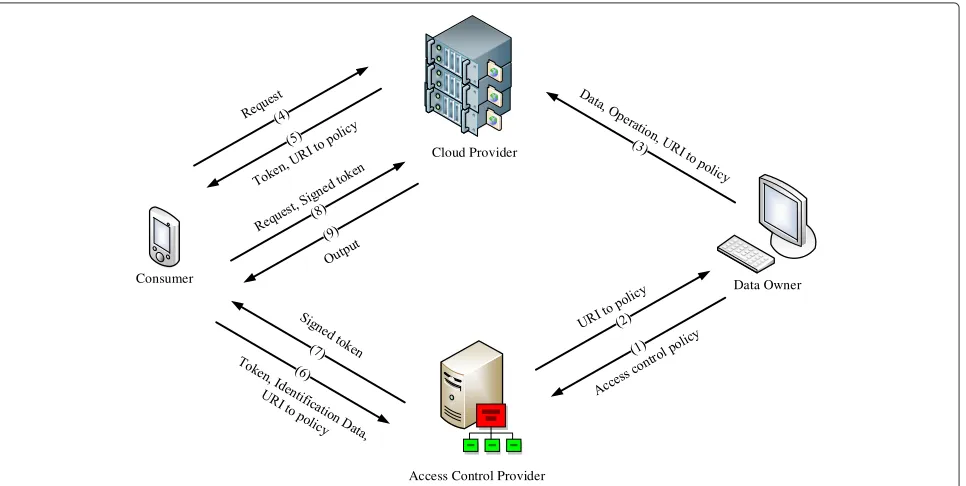
As illustrated in Figure 1 a typical transaction in our sys-tem takes place as follows. Initially, an owner stores an access control policy in an ACP (step 1) and obtains aURI for that policy (step 2). As a next step, she implements an operation over some data in a CP and stores the URI of the policy that protects this operation (step 3). When a consumer tries to perform a protected operation for the first time (step 4), she receives in response the URI of the access control policy that protects the operation and a unique token (step 5). Then, the consumer authenticates herself to a suitable ACP by providing some form of iden-tification data and requests authorization for the access control policy specified in the obtained URI (step 6). If the consumer “satisfies” the access control policy, the ACP signsthe token and sends it back to the consumer (step 7). The consumer repeats her request to the CP including this time the signed token (step 8). The CP checks the validity
Data Owner Consumer
Access Control Provider Cloud Provider
of the token and if the token is valid it executes the desired operation and returns its output (step 9).
3.2 Goals
Our goal is to build a system in which the following properties hold:
• The system is secure: Provided that all system entities respect the trust relationships described previously, it shall not be possible for an unauthorized user to perform a protected operation.
• Consumer privacy is preserved: A CP shall gain minimal information about the identity of a consumer. Ideally it will only learn that a consumer can be authorized by a specific ACP. Moreover an ACP should not be able to tell the operation a consumer wants to perform or the data she accesses. • Data can be easily migrated among different Cloud
providers: The only entities that should be aware of an access control policy and its implementation details are the ACP and the owner. CPs shall be oblivious about the access control policy implementation details. Therefore, if two CPs
implement our solution, moving data from one CP to another shall be almost as trivial as copy-pasting it. • An access control policy does not reveal anything
about the data and the operations it protects: Access control policies should be decoupled from the data and the operations they protect. An access control policy should be defined taking into account solely consumer attributes.
• Access control policies are re-usable: An access control policy should not be bound to a particular operation. It should be possible to protect many and diverse data items, stored in multiple CPs.
• An access control policy can be easily modified: The modification of an access control policy shall not involve CPs: the only entity involved in the
modification of an access control policy should be the ACP where the policy is stored.
3.3 Detailed system description
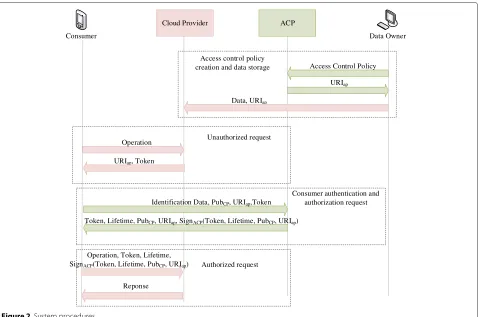
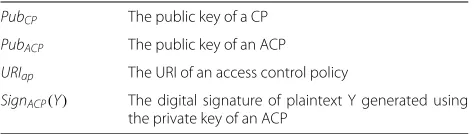
We now detail our system design (Figure 2). We have made the following assumptions: (i) ACPs and CPs have a public-private key pair, (ii) ACP’s and CP’s public keys are known to the consumers and (iii) all messages are exchanged over a secure channel. Throughout this section the notation of Table 1 is used.
Consumer
Cloud Provider ACP
Access Control Policy
URIap
Data, URIap
Operation
URIap, Token
Identification Data, PubCP, URIap,Token
Token, Lifetime, PubCP, URIap, SignACP(Token, Lifetime, PubCP, URIap)
Operation, Token, Lifetime, SignACP(Token, Lifetime, PubCP, URIap)
Reponse
Data Owner
Access control policy creation and data storage
Unauthorized request
Consumer authentication and authorization request
Authorized request
Table 1 Notation
PubCP The public key of a CP
PubACP The public key of an ACP
URIap The URI of an access control policy
SignACP(Y) The digital signature of plaintext Y generated using
the private key of an ACP
Our system consists of the following procedures:
3.3.1 Access control policy creation and data storage With this procedure an owner creates and stores an access control policy in an ACP. The ACP in return provides a URIap. For each protected operation implemented in a CP, the owner defines theURIap of the policy that protects it and thePubACPof the ACP where the policy is stored. This information is maintained in the CP’sAccess Table that contains tuples of the form:
[operation,URIap,PubACP]
AURIapis re-usable, i.e., it can be used for protecting multiple operations stored in various CPs. The mecha-nisms for creating an access control policy and for updat-ing an Access Table are ACP specific and CP specific, respectively.
3.3.2 Unauthorized request
This procedure is executed by a consumer in order to per-form an operation for the first time. The consumer sends an operation request message to the CP. Upon receiving the request the CP creates a uniquetoken (i.e., an ade-quately large random number) and sends it back to the consumer, along with the corresponding URIap. There-fore, the following exchange of messages takes place:
(1) :Consumer→CP:operation request
(2) :CP→Consumer:URIap,Token
In order to keep track of the generated tokens, a CP maintains aToken Tablethat contains entries of the form:
[Token,authenticated,expires,URIap]
When a new token is generated, a new entry is added to this table. The value of theauthenticatedfield of this entry is set tofalseand the value of theexpiresfield to the gen-eration time plus a very small amount of time, sufficient to obtain an authorization.
3.3.3 Consumer authentication and authorization request This procedure is executed by a consumer upon receiving a response to an unauthorized request. Firstly, the con-sumer sends her identification data, PubCP, URIap and the token to anACPresponsible for evaluating the access control policy identified byURIap. If the consumer sat-isfiesURIap, the ACP creates anauthorization message
that contains the token, the amount of time that the token should be valid (i.e., its lifetime),URIap, andPubCP. Then it signs this message and sends it back to the consumer. Therefore, the following messages are exchanged:
(3) :Consumer→ACP:ID,PubCP,URIap,Token
(4) :ACP→Consumer:auth,SignACP(auth) where:
auth=Token,Lifetime,URIap,PubCP
3.3.4 Authorized request
This procedure is executed by an ACP authorized con-sumer in order to perform an operation. The concon-sumer sends a message that includes the operation request, the token, the token’s lifetime and the signature of the authorization message (i.e., message (4)). Therefore the following message is sent:
(5) :Consumer→CP:
operation request,Token,Lifetime,SignACP(Auth)
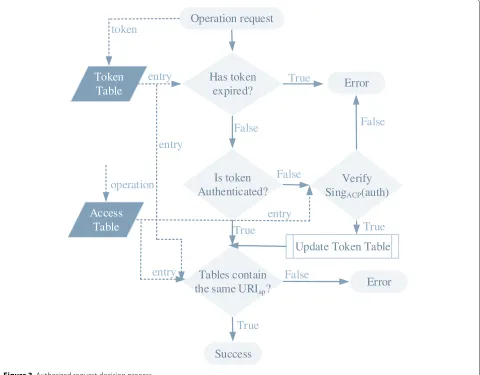
Upon receiving this message, a CP should decide if the consumer is allowed to perform the requested operation. Therefore, it executes the following algorithm (Figure 3):
1. Retrieve the entry of the Token Table that contains the token and check if the token has expired. If it has expired, return an error
2. If theauthenticated field of the corresponding record in the Token Table isfalse then
(a) Retrieve thePubACPthat corresponds to the
operation from the Access Table
(b) Retrieve theURIapthat corresponds to the
token from the Token Table
(c) Reconstruct the authorization message (d) VerifySignACP(auth), usingPubACP
(e) If the signature verification succeeds, update theToken Table entry as follows: set the expires field equal to the LifeTime field of the authorization message and set the
authenticated field to true. Proceed to Step 3a below.
(f) If the signature verification fails, return an error
3. If theauthenticated field of the corresponding record in the Token Table istrue then
(a) Find theURIapthat corresponds to the token
from theToken Table
(b) Find theURIapof the requested operation
from theAccess Table
Operation request
Token
Table
Has token
expired?
entry
Error
True
Is token
Authenticated?
token
False
Verify
Sing
ACP(auth)
True
Update Token Table
False
False
Tables contain
the same URI
ap?
Access
Table
operation
Error
False
True
True
Success
entry
entry
entry
Figure 3Authorized request decision process.
If this procedure is successful then any subsequent autho-rized request may include only the token. Moreover, the same token can be used multiple times, even for invoking different operations protected by the sameURIap.
3.4 Use case
Let us now illustrate our scheme through a use case. Enterprise A has outsourced sales records storage and analysis to Cloud provider CPA. The operations imple-mented inCPAare:update sales records,calculate statis-tics, and view statistics. Enterprise A has the following access control policies:
• Policy 1: All sales department employees can update sales records
• Policy 2: Only the sales department director can calculate statistics
• Policy 3: All shareholders can view the statistics
Enterprise A implements the above access control poli-cies in an ACP owned by itself. The public key of this
ACP is denoted byPubACP. For each policy the ACP gen-erates a URI, i.e.,entA.com/Policy1,entA.com/Policy2and entA.com/Policy3.CPA’s Access Table is updated as shown in Table 2.
The sales department director issues an unauthorized request for the calculate statistics operation. CPA gen-erates a token, namelyToken1, and responds by sending the following message (entA.com/Policy2, Token1). CP’s Token Table is then updated with the entry shown in Table 3.
As a next step, the sales department director authen-ticates himself to the ACP, which responds with
Table 2CPAaccess table new entries
Operation URIap ACP public key
Update records entA.com/Policy1 PubACP
Calculate statistics entA.com/Policy2 PubACP
Table 3CPAtoken table new entries
Token Authenticated Expires URIap
Token1 false timestamp1 entA.com/Policy2
the following, digitally signed, authorization message: (Token1, timestamp2, entA.com/Policy2,PubCPA). Then, the sales department director issues the following autho-rized request: (“calculate statistics”,Token1, timestamp2, SignACP(auth)).CPAchecks ifToken1has expired. Then, it reconstructs the authorization message by retrieving the URIap associated with thecalculate statistics opera-tion (i.e., entA.com/Policy2) from the Access Table and verifies SignACP(auth) using PubACP (also found in the Access Table). Finally,CPAchecks if theURIap found in the Access Table matches theURIapincluded in the entry forToken1 in the Token Table. If all these steps are suc-cessful,CPAexecutes thecalculate statisticsoperation and modifies the entry forToken1in the Token Table as shown in Table 4.
SinceToken1is now marked asauthenticated, the sales department director can use it in all subsequent requests, until it expires. Moreover, as long asToken1remains valid, SignACP(auth)does not have to be included in subsequent requests.
3.5 The “level” extension
In the above use case, it can be observed that if the sales department director wishes to invoke theupdate records operation, he has to re-authenticate himself, since this operation is protected by a different URIap. The level extension mitigates this shortcoming by adding a new field to an Access Table: the consumer level. The con-sumer level is a number that denotes theminimumlevel that a consumer should have in order to invoke an opera-tion. Using this extension, the Access Table of the Cloud provider considered in the use case of Section 3.4 can be modified as shown in Table 5.
With this extension, an ACP has to include the con-sumer level in the authorization messages. Moreover, a CP now takes part in the access control decision, since it has to check if the level included in the authorization message is greater or equal to the level included in the Access Table. Finally, if the level extension is used, Token Tables should, additionally, include the level that corresponds to a token. Suppose that the level of the sales department director in the previous use case is 200. Then, he would be able to successfully invoke theupdate recordsoperation, using Token1, without re-authenticating himself.
Table 4CPAtoken table modified entry
Token Authenticated Expires URIap
Token1 true timestamp2 entA.com/Policy2
Table 5CPAaccess table using level extension
Operation URIap Level
Update records entA.com/Policy2 100
Calculate statistics entA.com/Policy2 200
View statistics entA.com/Policy3 100
The ACP public key column is not shown.
4 Implementation
As a proof of concept we implemented a secure file stor-age service using a popular open source Cloud stack, the OpenStack [22], as well as a Web application that allows the incorporation of our solution in Google Drive [23]. The ACP and the consumer software used in both imple-mentations are the same. Our implementation supports the level extension. As a public-key encryption system we use RSA. Public keys are encoded in JSON format using the keyCzar [24] python library. The keyCzar library is also used for generating digital signatures.
4.1 ACP and consumer software
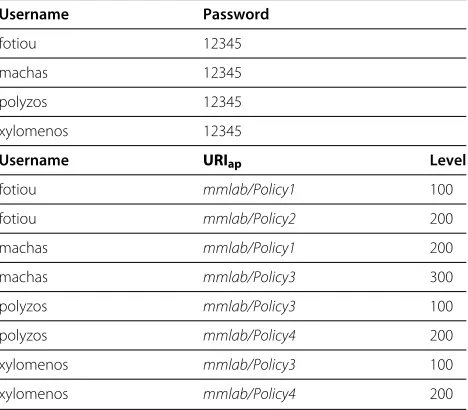
The ACP of our proof of concept is implemented as a PHP application hosted in an Apache web server. An SQLite database is used for storing username-password pairs, as well as username toURIap-level mappings. User-names are unique and a username can be mapped to many URIap-level pairs (e.g., Table 6). The consumer software implements theauthentication and authorization request, by encoding the username, the password and the request parameters in a JSON object and by POSTing this object to a particular URL, using HTTPS. The response to this request is again encoded in a JSON object. The consumer software has been pre-configured with the public keys of theCPand theACPcomponents.
Table 6 An instance of the user managements system
Username Password
fotiou 12345
machas 12345
polyzos 12345
xylomenos 12345
Username URIap Level
fotiou mmlab/Policy1 100
fotiou mmlab/Policy2 200
machas mmlab/Policy1 200
machas mmlab/Policy3 300
polyzos mmlab/Policy3 100
polyzos mmlab/Policy4 200
xylomenos mmlab/Policy3 100
4.2 OpenStack-based implementation
For our OpenStack-based CP (Figure 4), we leveraged the functionality of the OpenStack component Swift, which is used for building object storage systems. A Swift-based object storage system is composed of two networks: the internal (private) network that consists of storage nodes, and the external (public) network that consists of aproxyserver and (optionally) anauthenticationserver. The proxy server accepts HTTP(S) requests and processes them using a Web Server Gateway Interface. The param-eters used in each request are encoded in HTTP headers. Each request is pipelined through a number of add-ons, each of which may transform it, forward it, or respond on behalf of the system to the user.
Objects stored in a Swift-based system are organized in a three level hierarchy. The topmost level of this hier-archy is the accounts level, followed by the containers level (second level) and theobjectslevel (third level). The accounts level contains user accounts. Each user account is associated with many containers from the containers level. A container is used for organizing objects, there-fore a container is associated with many objects from the objects level. An object may be a file or a folder (that contains other objects). Every object within a container is identified by a container-unique name. Each request for an operation over an object contains a URI that denotes the account, the container and the name of the object in question, i.e., it is of the form “https://CPHostName/ accountname/containername/objectname”.
We implemented our system as a Swift add-on added in the pipeline of the add-ons that process incoming
requests. This add-on replaces Keystone; the default OpenStack component that handles user authentication. Our implementation allows file storage and retrieval, as well as the following operations over the stored files: orga-nizing files in containers, listing the files of a container, copying a file, moving a file and deleting a file. Token and Access Tables are implemented as SQLite tables. An owner hard codes in the Access Table records of the form: [path,URIap,level,PubACP]. A path may be account-wide, container-wide, or object-wide.
Initially, the consumer software sends an unauthorized GET/POST request over HTTPS. The desired operation is specified in a HTTP header and the URL of the request denotes the object (or the container, or the account) that will be used as input to the operation. When an unautho-rized request is pipelined through our add-on, the add-on checks if aURIap exists in the Access Table for the URL specified in the request: if such a URIap exists, the add-on generates a new token, using the token generatiadd-on mechanism provided by Swift, and creates a response (as described in Section 3.3); each part of the response is encoded in a HTTP header. The add-on then creates a new entry in the Token Table. The initial expiration time of a token is set equal to the current time plus 10 sec. Upon receiving the response, the consumer software ini-tiates the authentication and the authorization process described in Section 4.1. As a next step, the consumer software sends an authorized request, encoding all request parameters in HTTP headers. The add-on executes the authorized request decision algorithm and produces the appropriate output.
Proxy
Server
Account
Container 1
Container 2
Object 1
Object 2
Add-on
Token
gen.
SQLite
Access
Table
Token
Table
Storage Node
HTTPS Request
CP part of our
implementation
External network
Internal network
4.3 Google drive-based web application
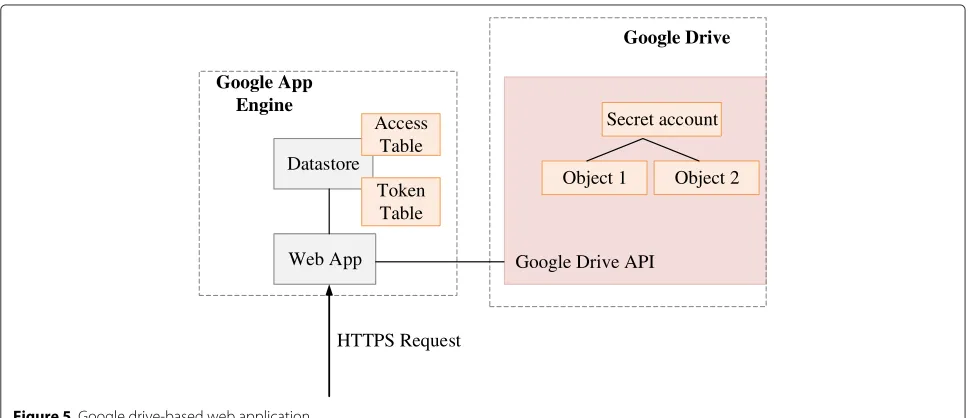
Google Drive is a popular Cloud based storage service. Google Drive provides a rich API that can be used for building applications that interact with the service over HTTPS. In our implementation we used this API and built a Web application that extends (part of ) the Google Drive API, thus providing support for our protocol (Figure 5). Our application is built using the Google App Engine [25] and the Python language. Access Tables and Token Tables have been implemented using the Google App Engine Datastore. Currently, our application supports operations for uploading and downloading files. Each operation can be invoked by making an HTTPS call to the operation-specific URL. All call parameters are encoded in HTTP headers.
Our application has been configured with a Google Drive account which is kept secret. Instead of interacting with the “drive” directly, the consumer software interacts with the application, which acts as a middleware, ensuring that only an authorized consumer can perform the imple-mented operations. The consumer learns no information about the Google Drive account.
The owner hard codes in the web application aURIap that controls who can invoke theupload fileoperation. A consumer initially performs an unauthorized request for uploading a file (the file is not included in this request). The web application generates a token using the UUID Python function, it responds to the consumer by encod-ing the token in an HTTP header and updates the Token Table. The consumer software initiates the authentication and the authorization process described in Section 4.1. Then, it issues an authorized request, by encoding the request parameters in HTTP headers and the file as raw POST data. The web application executes the authorized
request decision algorithm and if the consumer is allowed to upload the file, it stores it in the Google Drive. When uploading files, consumers are able to specify aURIapthat controls who can invoke thedownload fileoperation for that specific file.
5 Evaluation
5.1 Security evaluation
It can be easily observed that our system enhances con-sumer privacy. The only information that a CP learns about a consumer is his trust relationship with a particu-lar ACP; if the level extension is used, the CP also learns his level. Of course, the latter can be encoded in a way that reveals no meaningful information. Any other sensi-tive information is stored in a (trusted) ACP. Moreover, regardless of the lifetime of a token, a consumer may drop it and request a new one in order to avoid CPprofiling. Finally, an ACP gains no information about the operations a consumer invokes and the data he accesses: the only information that an ACP learns is the public key of the CP with which the consumer interacts.
Another security feature of our system is that access control policies can be easily modified. Access control policies are stored in a single point (i.e., the ACP) and all CPs havepointersto policies. Therefore, the modification of an access control policy does not involve communi-cation with any CP. When an access control policy is modified, all new consumers will be authorized using the new policy, whereas all already authorized consumers will be re-authorized with the new policy when their token expires.
We now proceed to the security analysis of our sys-tem using the threat model proposed by Wang at al. [26], adapted to our system. In our analysis we consider
Secret account
Object 1 Object 2
Web App Datastore
Access Table
Token Table
HTTPS Request Google App
Engine
Google Drive
Google Drive API
three different attack scenarios. In all scenarios we assume that messages are exchanged over a secure channel and communication endpoints cannot lie about their iden-tity. We do not consider the case in which a mali-cious entity acts as an ACP and steals the credentials of a consumer, since this attack is out of the scope of our system.
5.1.1 Malicious entity acting as a consumer
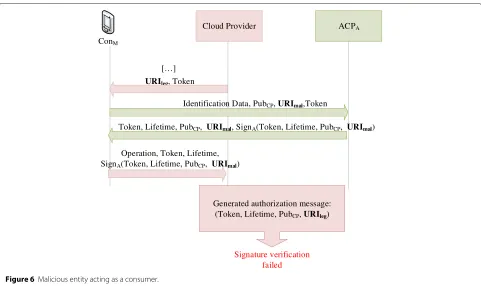
In this attack scenario a malicious entity,ConM, tries to perform an operation protected by an access control pol-icyURIlegstored inACPA.ConM can only be authorized for the access control policyURImal, also stored inACPA. ConM’s goal is to obtain an authorization message of the form(Token,Level,Lifetime,URIleg,PubCP). By following our protocol ConM will receive an authorization mes-sage of the form(Token,Level,Lifetime,URImal,PubCP). If ConMincludes the signature of this message in his authen-ticated request, theauthorized request decisionalgorithm will result in an error, since the CP will generate a dif-ferent authorization message for which this signature is not valid (Figure 6). The only way for ConM to obtain a valid signature is to include URIleg in the authentica-tion and authorizaauthentica-tion request, i.e.,ConM should send to ACPAan authentication and authorization request of the following form:(ID,PubCP,URIleg,Token). However, since ConMdoes not abide byURIlegthis message will result in an error.
5.1.2 Malicious entity acting as a CP
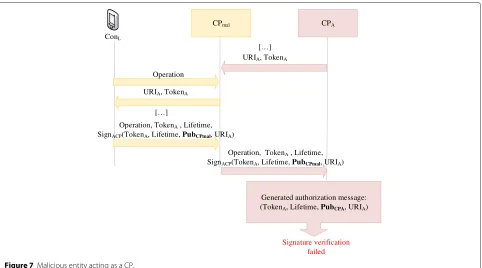
In this attack scenario the attacker’s goal is to perform an operation inCPA, protected by an access control policy URIAstored inACPA. The attacker is able to pretend to be a Cloud provider,CPmal, as well as to lure a consumer ConL that can be authorized forURIA, to perform this operation. Therefore, this is a man-in-the-middle type of attack.
The attacker initially sends an unauthorized request to CPA and receives TokenA and URIA. In order for this attack to be successful the attacker has to obtain an authorization message of the form (TokenA,
Level,Lifetime,URIA,PubCPA). ConL is lured to send an unauthorized request toCPmal(i.e., to the attacker), which responds with a message of the form: (URIA,TokenA).
Subsequently, ConL sends an authentication and authorization request to ACPA of the following form:
(ID,PubCPmal,URIA,TokenA), and receives the following
authorization message (TokenA,Level,Lifetime,URIA,
PubCPmal). If the attacker sends an authorized request using the signature of the previous message the autho-rized request decision algorithm will result in an error, since CPA will generate an authorization message that includesPubCPAand notPubCPmal(Figure 7).
5.1.3 Malicious entity co-located with a consumer
This attack scenario is applicable when a CP maintains a user management system and associates operations over
ConM
Cloud Provider ACPA
[…]
URIleg, Token
Identification Data, PubCP, URImal,Token
Token, Lifetime, PubCP, URImal, SignA(Token, Lifetime, PubCP, URImal)
Generated authorization message: (Token, Lifetime, PubCP, URIleg)
Signature verification failed Operation, Token, Lifetime,
SignA(Token, Lifetime, PubCP, URImal)
ConL
CPmal CPA
[…] URIA, TokenA
Operation
URIA, TokenA
[…]
Operation, TokenA , Lifetime,
SignACP(TokenA, Lifetime, PubCPmal, URIA)
Operation, TokenA , Lifetime,
SignACP(TokenA, Lifetime, PubCPmal, URIA)
Generated authorization message: (TokenA, Lifetime, PubCPA, URIA)
Signature verification failed
Figure 7Malicious entity acting as a CP.
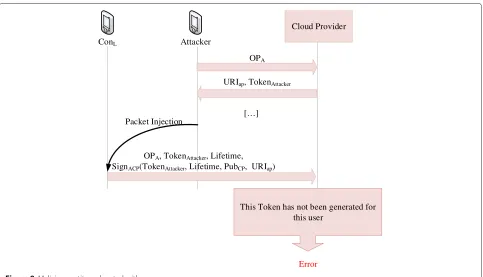
protected data with particular users (e.g., for charging rea-sons). In tis scenario a CP also maintains in its Token Table the identifier of the (CP) user for whom the token has been generated. The goal of an attacker in this scenario is to make a CP believe that a consumerConLwants to per-form a protected operation. In this scenario the attacker is a valid CP user and he is eligible to perform the same operations asConL. Moreover, the attacker is able to inject messages on behalf ofConL.
In this attack scenario, the attacker requests to perform an operationOPAand proceeds through all steps until he receives the authorization message. At this point, instead of sending an authorized request on behalf of himself, he sends it on behalf ofConL. It can be easily observed that this attack is trivially mitigated since the CP also main-tains the identifiers of the users that correspond to each token, therefore this message will be rejected (Figure 8). It should be noted, however, that this is possible due to our design choice to have the CP generating the tokens, which is not always the case in other similar systems. This attack, for example, was successfully exploited by Wang at al. [26] against three popular websites that were using Facebook Connect and Twitter OAuth for associating their user accounts with their corresponding Facebook and Twitter profiles.
5.2 Overhead
In our implementation, HTTP methods are used for invoking the desired operation. As a public-key
encryption system we use RSA. The size of an RSA pub-lic key is 2048 bits, whereas the size of a JSON encoded public key is 400 bytes. Tokens are encoded in 32 byte hex-strings, digital signatures in 512 byte hex-strings and token lifetimes in 8 byte hex-strings. Finally, a single byte is used for representing access levels. When a consumer wants to invoke an operation in a CP, protected by a URIap, a number of messages has to be exchanged. If an ACP has already generated for the consumer an autho-rization message forURIapand the corresponding token has not expired, then a single message from the consumer to the CP has to be sent. In any other case five messages have to be exchanged: three between the consumer and the CP, and two between the consumer and the ACP.
Attacker
Cloud Provider
[…] URIap, TokenAttacker
This Token has not been generated for this user
Error
OPA, TokenAttacker, Lifetime,
SignACP(TokenAttacker, Lifetime, PubCP, URIap)
ConL
OPA
Packet Injection
Figure 8Malicious entity co-located with a consumer.
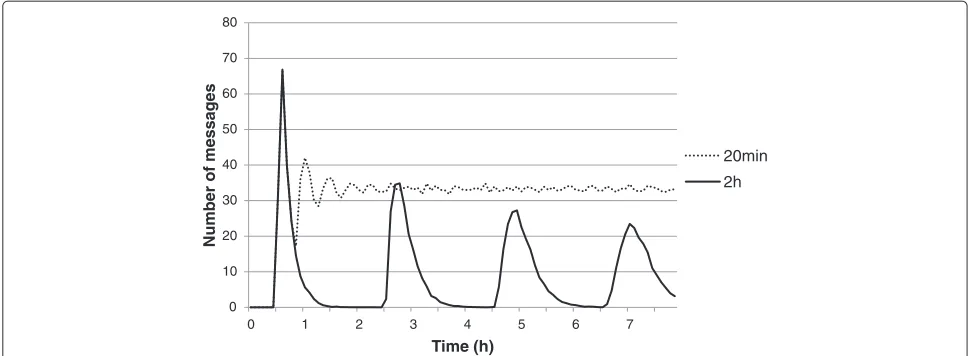
size is the average value of all the sizes the Token Table had within the 5 min measurement period). We consider two types of tokens: a token with short lifetime (20 min) and a token with long lifetime (2 hours). Figure 9 illustrates the average Token Table size of the CP throughout the sim-ulation period, whereas Figure 10 illustrates the average number of messages transmitted inside each enterprise’s network, throughout the simulation period.
5.3 Comparison with existing systems
We now compare our solution with two popular related systems: Google Drive and Amazon S3.
5.3.1 Google drive
The Google Drive Cloud-based storage service, enables users to access, share, and organize their files in the Cloud. The Google Drive API provides a limited set of policies,
0 2000 4000 6000 8000 10000 12000
0 1 2 3 4 5 6 7
Number of
records
Time (h)
20min
2h
0 10 20 30 40 50 60 70 80
0 1 2 3 4 5 6 7
Number of messages
Time (h)
20min
2h
Figure 10 Number of messages exchanged between a consumer and an ACP as a function of token lifetime, using 5 minute sampling periods. During the lifetime of a token, no messages are exchanged.
namely, “full access”, “read only access”, “metadata only access”, and “specific file access”. These policies are not applied per stored item, instead they are granted in the form of “permissions” to applications that want to access a specific drive. Before using a “drive”, an application requests from the drive owner one of the aforementioned permission types; the drive owner authenticates himself using a Google account and grants permissions using OAuth2.0. In most cases, the user that executes the appli-cation that requests permissions and the owner of the drive are the same entity. Permissions are granted in the form of a token that never expires: in order for a drive owner to remove permissions for a specific application, she has to revoke the token manually. Google Drive does not support integration with enterprise specific authenti-cation and authorization systemsc.
In order for an application to perform an operation the following messages have to be exchanged (here we con-sider that the user executing the application is the drive owner, referred to as the consumer):
1. Consumer→Google Auth: Request permission 2. Consumer→Google Auth: Authenticate 3. Consumer→Google Auth: Grant permission 4. Google Auth→Consumer: Token
5. Consumer→Google Drive: Operation, Token
Compared to our system the same number of messages is required. Nevertheless, messages 1 to 4 are usually sent once, since tokens never expire. It should be also noted that the entity that performs the authorization is the drive owner herself (the consumer), therefore authorization is a manual process.
5.3.2 Amazon S3
Amazon Simple Storage Service, or S3 for short, is a well-known Cloud-based file storage service. S3 provides Web services that allow users to store and organize their files in the Cloud. Files are organized in “buckets”. A user may setAccess Control Lists(ACLs) that define the permissions that a user or a group of users have over a specific bucket, or over a specific file. ACLs are encoded in XML and the permissions that can be granted are “read", “write", “read ACL”, “modify ACL”, “full control”. For more fine grained access control, S3 provides an “access control policy lan-guage”, that allows users to create bucket-specific policies. These policies can control the access to a bucket, and its objects, based on user identities, source IP addresses, time and date, and some other parameters.
S3 provides an API that allows users (consumers) to be authenticated using their own (enterprise specific) iden-tity provider. In order for an operation to be performed the following messages have to be exchanged:
1. Consumer→Identity Provider: Authenticate 2. Identity Provider→Amazon Token Service:
Request Token
3. Amazon Token Service→Identity Provider: Token 4. Identity Provider→Consumer: Token
5. Consumer→Amazon S3: Operation, Token
Moreover, all the users who are identified by their own identity provider are considered to have the same role (i.e., “federated users”), limiting the flexibility of the access con-trol policies. Finally, a secret has to be shared between the identity provider of the user and Amazon’s token service, in order for steps 2 and 3 to take place successfully.
6 Discussion
So far we have explored the possibilities that our solu-tion offers in a “tradisolu-tional” usage model: an enterprise that uses Cloud computing for outsourcing data storage and computations. However, the introduction of a new role, that of the ACP, and the decoupling of the data stor-age and access control assessment functions creates many new business opportunities.
One area that can benefit from our solution is that of B2B applications. Suppose that enterprise A wants to offer access to some of its (Cloud-based) services to a depart-ment of enterprise B. Enterprise B can expose a URIap that authenticates and authorizes the users of that par-ticular department. Enterprise A can use this URIap in order to protect the shared services. With this, enterprise A can perform access control without learning anything about the internal user management system of enterprise B. Enterprise A may also offer services for the customers of enterprise B using a similar approach.
Our solution also creates a new business opportunity. We envision that a new market can arise due to our solu-tion, that of the access control providers. In addition to the enterprise specific ACPs there can be independent ACPs that offer security services to end-users. Existing security companies can utilize their expertise to offer cutting edge access control services without investing in the Cloud market. Moreover, existing social networks may leverage their services and act as ACPs. To this end, future work for our scheme includes support for ACP federations and support for multiple URIACP definitions per single data item.
7 Conclusions
In this paper we proposed a solution to a thorny problem that prevents Cloud technology adoption: that of access control. The proposed solution enables data owners to outsource data storage and computation, without losing governance of their assets. In our solution access control is provided as a service by a new entity, the Access Con-trol Provider (ACP). Access conCon-trol as a service relieves Cloud providers from the burden of implementing com-plex security solutions and enables enterprises to deploy their own specific access control mechanisms. We demon-strated the feasibility of our scheme through proof of concept implementations. In particular, we implemented our system as an add-on for the open source Cloud stack OpenStack and we developed a Web application that
allows the incorporation of our system in Google Drive. We show that our scheme is secure and has significant privacy properties. The proposed system adds minimal overhead, does not require any particular Cloud imple-mentation or ACP structure and, therefore, it constitutes a realistic solution to the problem. Finally, we believe that the proposed solution can open the floor for new exciting applications and business opportunities.
Endnotes
aSAML is a generic XML language used for security
assessments between different entities.
bProvided that this does not jeopardize the security of
the scheme.
cGoogle provides a SAML based SSO system that can
be used to integrate enterprise specific authentication systems, but only in Web applications.
Competing interests
The authors declare that they have no competing interests.
Authors’ contributions
NF, AM, GCP and GX have made substantial contributions to the conception and design of the access control as a service architecture, and reviewed the final manuscript version. All authors read and approved the final manuscript.
Acknowledgment
This research was supported in part by a grant from the Greek General Secretariat for Research and Technology, financially managed by the Research Center of AUEB.
Received: 29 October 2014 Accepted: 8 April 2015
References
1. PwC: Global State of Information Security Survey (2012)
2. Subashini S, Kavitha V (2011) A survey on security issues in service delivery models of cloud computing. J Netw Comput Appl 34(1):1–11
3. Gorniak S (ed) (2010) Priorities for research on current and emerging network trends. ENISA. https://www.enisa.europa.eu/activities/identity-and-trust/library/deliverables/procent
4. Catteddu D, Hogben G (eds) (2009) Cloud Computing Benefits, risks and recommendations for information security. ENISA. https://downloads. cloudsecurityalliance.org/initiatives/top_threats/
The_Notorious_Nine_Cloud_Computing_Top_Threats_in_2013.pdf 5. Cloud Security Alliance (2013) The Notorious Nine Cloud Computing Top
Threats in 2013. https://cloudsecurityalliance.org/
6. Armando A, Carbone R, Compagna L, Cuellar J, Tobarra L (2008) Formal analysis of SAML 2.0 web browser single sign-on: breaking the SAML-based single sign-on for google apps. In: Proc. of the 6th ACM Workshop on Formal Methods in Security Engineering. ACM, New York, NY. pp 1–10 7. Somorovsky J, Mayer A, Schwenk J, Kampmann M, Jensen M (2012) On
breaking SAML: Be whoever you want to be. In: Proc. of the 21st USENIX Security Symposium. USENIX Association, Berkeley, CA Vol. 12. pp 21–21 8. Fotiou N, Machas A, Polyzos GC, Xylomenos G (2014) Access control
delegation for the cloud. In: Computer Communications Workshops (INFOCOM WKSHPS), 2014 IEEE Conference On. IEEE, Canada. pp 13–18 9. Wang G, Liu Q, Wu J (2010) Hierarchical attribute-based encryption for
fine-grained access control in cloud storage services. In: Proceedings of the 17th ACM Conference on Computer and Communications Security. CCS ’10. ACM, New York, NY, USA. pp 735–737
10. Zhou L, Varadharajan V, Hitchens M (2011) Enforcing role-based access control for secure data storage in the cloud. Comput J.
11. Li J, Zhao G, Chen X, Xie D, Rong C, Li W, Tang L, Tang Y (2010) Fine-grained data access control systems with user accountability in cloud computing. In: Cloud Computing Technology and Science (CloudCom), 2010 IEEE Second International Conference On. IEEE Computer Society, Washington, DC. pp 89–96
12. Yu S, Wang C, Ren K, Lou W (2010) Achieving secure, scalable, and fine-grained data access control in cloud computing. In: INFOCOM, 2010 Proceedings IEEE. IEEE Press, Piscataway, NJ. pp 1–9
13. OASIS (2013) eXtensible Access Control Markup Language (XACML) Version 3.0.22. http://docs.oasis-open.org/xacml/3.0/xacml-3.0-core-spec-en.html
14. Goyal V, Pandey O, Sahai A, Waters B (2006) Attribute-based encryption for fine-grained access control of encrypted data. In: Proceedings of the 13th ACM Conference on Computer and Communications Security. CCS ’06. ACM, New York, NY, USA. pp 89–98
15. Recordon D, Reed D (2006) OpenID 2.0: a platform for user-centric identity management. In: Proc. of the 2nd ACM Workshop on Digital Identity Management. ACM, New York, NY. pp 11–16
16. Hardt D (ed) (2012) The OAuth 2.0 authorization framework. RFC 6749. https://tools.ietf.org/html/rfc6749
17. Nunez D, Agudo I, Lopez J (2012) Integrating OpenID with proxy re-encryption to enhance privacy in cloud-based identity services. In: Proc of the IEEE 4th International Conference on Cloud Computing
Technology and Science. IEEE Computer Society, Washington, DC, USA 18. Khan RH, Ylitalo J, Ahmed AS (2011) OpenID authentication as a service in
OpenStack. In: Proc. of the 7th International Conference on Information Assurance and Security. IEEE. pp 372–377. (doi://10.1109/ISIAS.2011. 6122782)
19. Yavatkar R, Pendarakis D, Guerin R (2000) A framework for policy-based admission control. RFC 2753. https://tools.ietf.org/html/rfc2753 20. Durham D (ed) (2000) The COPS (Common Open Policy Service) Protocol.
RFC 2748. https://tools.ietf.org/html/rfc2748
21. Cantor S, Kemp J, Philpott R, Maler E (eds) (2005) Assertions and protocols for the OASIS Security Assertion Markup Language (SAML) v2.0. OASIS. https://docs.oasis-open.org/security/saml/v2.0/saml-core-2.0-os.pdf 22. Openstack homepage. http://www.openstack.org/, last accessed 27 Apr.
2015
23. Google Drive homepage. https://drive.google.com, last accessed 27 Apr. 2015
24. Google Keyczar homepage. https://github.com/google/keyczar, last accessed 27 Apr. 2015
25. Google App Engine homepage. https://developers.google.com/ appengine/, last accessed 27 Apr. 2015
26. Wang R, Chen S, Wang X (2012) Signing me onto your accounts through facebook and google: A traffic-guided security study of commercially deployed single-sign-on web services. In: Proc. of the IEEE Symposium on Security and Privacy. IEEE Computer Society, Washington, DC, USA. pp 365–379
Submit your manuscript to a
journal and benefi t from:
7Convenient online submission 7Rigorous peer review
7Immediate publication on acceptance 7Open access: articles freely available online 7High visibility within the fi eld
7Retaining the copyright to your article