A survey on data storage and placement
methodologies for Cloud‑Big Data ecosystem
Somnath Mazumdar
1, Daniel Seybold
2, Kyriakos Kritikos
3*and Yiannis Verginadis
4Introduction
Over the time, the type of applications has evolved from batch, compute or memory intensive applications to streaming or even interactive applications. As a result, appli-cations are getting more complex and become long-running. Such appliappli-cations might require frequent-access to multiple distributed data sources. During application deploy-ment and provisioning, the user can face various issues such as (i) where to effectively place both the data and the computation; (ii) how to achieve required objectives while reducing the overall application running cost. Data could be generated from various sources, including a multitude of devices over IoT environments that can generate a huge amount of data, while the applications are running. An application can further pro-duce a large amount of data. In general, data of such size is usually referred to as Big Data. In general, Big Data is characterised by five properties [1, 2]. These are volume,
velocity (means rapid update and propagation of data), variety (means different kinds of Abstract
Currently, the data to be explored and exploited by computing systems increases at an exponential rate. The massive amount of data or so-called “Big Data” put pressure on existing technologies for providing scalable, fast and efficient support. Recent applications and the current user support from multi-domain computing, assisted in migrating from data-centric to knowledge-centric computing. However, it remains a challenge to optimally store and place or migrate such huge data sets across data cent-ers (DCs). In particular, due to the frequent change of application and DC behaviour (i.e., resources or latencies), data access or usage patterns need to be analyzed as well. Primarily, the main objective is to find a better data storage location that improves the overall data placement cost as well as the application performance (such as through-put). In this survey paper, we are providing a state of the art overview of Cloud-centric Big Data placement together with the data storage methodologies. It is an attempt to highlight the actual correlation between these two in terms of better supporting Big Data management. Our focus is on management aspects which are seen under the prism of non-functional properties. In the end, the readers can appreciate the deep analysis of respective technologies related to the management of Big Data and be guided towards their selection in the context of satisfying their non-functional applica-tion requirements. Furthermore, challenges are supplied highlighting the current gaps in Big Data management marking down the way it needs to evolve in the near future. Keywords: Big Data, Cloud, Data models, Data storage, Placement
Open Access
© The Author(s) 2019. This article is distributed under the terms of the Creative Commons Attribution 4.0 International License (http://creat iveco mmons .org/licen ses/by/4.0/), which permits unrestricted use, distribution, and reproduction in any medium, provided you give appropriate credit to the original author(s) and the source, provide a link to the Creative Commons license, and indicate if changes were made.
SURVEY PAPER
*Correspondence: [email protected] 3 ICS-FORTH, Heraklion, Crete, Greece
data parts), veracity (related to the trustworthiness, authenticity and protection (degree) of the data) and value (the main added-value and the importance of the data to the busi-ness). A large set of different data types generated from various sources can hold enor-mous information (in the form of relationships [3], system access logs, and also as the quality of services (QoSs)). Such knowledge can be critical for improving both products and services. Thus, to retrieve the underlying knowledge from such big sized data sets an efficient data processing ecosystem and knowledge filtering methodologies are needed.
In general, Cloud-based technology offers different solutions over different levels of abstractions to build and dynamically provision user applications. The Cloud offers suit-able frameworks for the clustering of Big Data as well as efficiently distributed data-bases for their storage and placement. However, the native Cloud facilities have a lack of guidance on how to combine and integrate services in terms of holistic frameworks which could enable users to properly manage both their applications and the data. While there exist some promising efforts that fit well under the term Big Data-as-a-service (BDaaS), most of them still lack adequate support for: data-privacy [4–6], query optimi-sation [7], robust data analytics [8] and data-related service level objective management for increased (Big Data) application quality [9]. Currently, the application placement and management over multi or cross-Clouds is being researched. However, the additional dimension of Big Data management does raise significantly the complexity of finding adequate and realistic solutions.
The primary goal of this survey is to present the current state-of-affairs in Cloud com-puting with respect to the Big Data management (mainly storage and placement) from the application’s administration point-of-view. To this end, we have thoroughly reviewed the proposed solutions based on the placement and storage of Big Data through the use of a carefully designed set of criteria. Such criteria were devised under the prism of non-functional properties. This was performed in an attempt to unveil those solutions which can be deemed suitable for the better management of different kinds of applica-tions (while taking into consideration non-functional aspects). In the end, the prospec-tive readers (such as Big Data application owners, DevOps) can be guided towards the selection of those solutions in each Big Data management lifecycle phase (focused in this article) that satisfy in a better way their non-functional application requirements. The analysis finally concludes with the identification of certain gaps. Based on the latter, a set of challenges for the two Big Data management phases covered as well as for Big Data management as a whole are supplied towards assisting in the evolution of respective solutions and paving the way for the actual directions that the research should follow.
to Big Data in the Cloud ecosystem [15]. However, the primary focus of these surveys is mainly on functional aspects examined under the prism of analysing different dimen-sions and technology types related to Big Data. Further, there is no clear discussion on management aspects in the context of the whole Big Data management lifecycle as usu-ally the focus seems to be merely on the Big Data storage phase. Interestingly, our survey deeply analyses those phases in the Big Data management lifecycle that are the most crucial in the context of satisfying application non-functional requirements.
The remaining part of this manuscript is structured as follows: "Data lifecycle manage-ment (DLM)" section explicates how data modelling can be performed, analyses various data management lifecycle models and comes up with an ideal one which is presented along with the proper architecture to support it. Next, "Methodology" section attempts to explain this survey’s main methodology. "Non-functional data management features" section details the main non-functional features of focus in this article. Based on these features, the review of Big Data storage systems and distributed file systems are supplied in "Data storage systems" section. Similarly, the review of state-of-the-art data place-ment techniques is performed in "Data placeplace-ment techniques" section. Next, "Lessons learned and future research directions" section presents relevant lessons learned as well as certain directions for future research work and finally "Concluding remarks" section concludes the survey paper.
Data lifecycle management (DLM) Data lifecycle models
There exist two types of data lifecycle models focusing on either general data or Big Data management. The generic data management lifecycles usually cover activities such as generation, collection (curation), storage, publishing, discovery, processing and analysis of data [16].
In general, Big Data lifecycle models primarily comprises activities (such as data col-lection, data loading, data processing, data analysis and data visualisation [17, 18]). It is worth to note that apart from the data visualisation, they do share many identical activi-ties with the generic ones. However, such models do not mention the value of data.
directly to the activities of data integration, analysis, interaction and effectuation along with the successful management of the emergent knowledge via data intelligence.
Data modelling
The data needs to be described in an appropriate form prior to any kind of usage. The information used for the data description is termed as metadata (i.e., data about data) [22–24]. The use of metadata enriches data management so that it can properly support and improve any data management activity. Two major issues related to meta-data management are:
• How should metadata be described (or characterised)? The description of a metadata
schema which can be exploited to efficiently place a certain Big Data application in multiple Clouds by respecting both user constraints and requirements. Such a
meta-data schema has been proposed partially in [25] or completely in [26].
• How should metadata be efficiently managed and stored for better retrieval and
exploitation? The design of appropriate languages [27, 28] that focus on the
descrip-tion of how Big Data applicadescrip-tions and data should be placed and migrated across dif-ferent multiple Cloud resources.
For a better description of metadata, the authors in [22] identify available Cloud services and analyse some of their main characteristics following a tree-structured taxonomy. Another relevant effort is the DICE project [25] that focuses on the quality-driven devel-opment of Big Data applications. It offers a UML profile along with the appropriate tools that may assist software designers to reason about the reliability, safety and efficiency of data-intensive applications. Specifically, it has introduced a metamodel for describing certain aspects of Big Data-intensive applications.
Most of these efforts do not offer a direct support for expressing significant aspects of Big Data, such as data origin, location, volume, transfer rates or even aspects of the operations that transfer data between Cloud resources. One effort that tries to cover the requirements for a proper and complete metadata description is the Melodic metadata schema [26]. This schema refers to a taxonomy of concepts, properties and relationships that can be exploited for supporting Big Data management as well as application deploy-ment reasoning. The schema is clustered into three parts: (i) one focusing on specifying Cloud service requirements and capabilities to support application deployment reason-ing; (ii) another focusing on defining Big Data features and constraints to support Big Data management; (iii) a final one concentrating on supplying Big Data security-related concepts to drive the data access control.
approach where requirements are expressed as features or attributes that are annotated via elements from the metadata schema.
Data lifecycle management systems
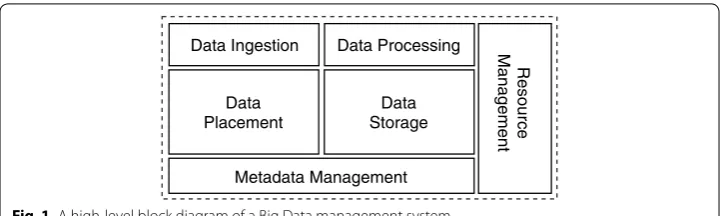
Traditional data lifecycle management systems (DLMSs) focus more on the way data is managed and not on how they are processed. In particular, the actual main services that they offer are data storage planning (and provisioning) and data placement (and execu-tion support) via efficient data management policies. On the other hand, it seems that data processing is covered by other tools or systems as it is regarded as application-spe-cific. Traditionally in Cloud, Big Data processing is offered as a separate service, while the resource management is usually handled by other tools, such as Apache Mesos or YARN. Figure 1 depicts the architecture of a system that completely addresses the data management lifecycle, as inscribed in the previous sub-section. This system comprises six primary components.
• Metadata management takes care of maintaining information which concerns both
the static and dynamic characteristics of data. It is the cornerstone for enabling effi-cient data management.
• Data placement encapsulates the main methods for efficient data placement and data
replication while satisfying user requirements.
• Data storage is responsible for proper (transactional) storage and efficient data
retrieval support.
• Data ingestion enables importing and exporting the data over the respective system.
• Big Data processing supports the efficient and clustered processing of Big Data by
executing the main logic of the user application(s).
• Resource management is responsible for the proper and efficient management of
computational resources.
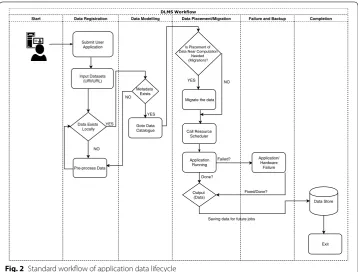
In this article, our focus is mainly on the Data storage and Data placement parts of the above architecture. Our rationale is that the integration of such parts (or Big Data lifecycle management phases) covers the core of a DLMS. An application’s data access workflow in the Cloud is presented in Fig. 2. As a first step, the application checks the availability of the input data. In general, the data needs to be known by the system to optimally handle it. It maps to two main cases: (i) data already exist and have been regis-tered; (ii) data do not exist and must be registered. In the latter case, metadata is needed
Data Processing
Metadata Management Data
Placement Storage Data
Resourc
e
Management
Data Ingestion
to register the data into the system (thus mapping to the data-registration process). Dur-ing the data modellDur-ing (see "Data modellDur-ing" sub-section), the metadata are maintained via a data catalogue (i.e., a special realisation of Metadata management component). Such an approach can guarantee the efficient maintenance of application data through-out the application’s lifecycle by both knowing and dynamically altering the values of data features (such as data type, size, location, data format, user preference, data replica numbers, cost constraints) whenever needed. In the next phase, based on the employed data placement methodology, the data is placed/migrated next to the application or both the data and application code is collocated. Here, the underlying scheduler (realising the Data placement component) acquires the up-to-date data knowledge to achieve an efficient data placement during both the initial application deployment and its runtime. Such an approach can restrain unnecessary data movement and reduces cost (at runt-ime) [30–32]. Next, during the application execution, two situations may arise: (i) new data sets are generated; (ii) data sets are transformed into another form (such as data compression). Furthermore, temporary data may also need to be handled. Finally, once application execution ends, the generated or transformed data needs to be stored (or backed up) as per user instructions.
In general, a hierarchical storage management [33] could be considered as a DLMS tool. In recent times, cognitive data management (CDM) has gained industrial sup-port for automated data management together with high-grade efficiency. The CDM
DLMS Workflow
Start Data Registration
Submit User Application
Pre-process Data NO
YES
Data Modelling
Goto Data Catalogue Metadata Exists NO
YES
Data Placement/Migration
Output (Data)
Is Placement of Data Near Computation
Needed (Migration)?
NO
Done? Migrate the data
YES
Call Resource Scheduler
Application Running
Failed?
Saving data for future jobs
Failure and Backup
Application/ Hardware Failure
Fixed/Done?
Completion
Exit Data Store Input Datasets
(URI/URL)
Data Exists Locally
(e.g., Stronglink1) is generally the amalgamation of intelligent (artificial-intelligence2/
machine learning-based approach) distributed storage including resource management together with a more sophisticated DLMS component. The CDM works on the data-base-as-a-service (DBaaS) layer which instructs the data to be used by the scheduler with an efficient management approach including the exploitation of the data catalogue via data modelling.
Methodology
We have conducted a systematic literature review (SLR) on Big Data placement and storage methods in the Cloud, following the guidelines proposed in [34]. Such an SLR comprises three main phases: (i) SLR planning, (ii) SLR conduction and (iii) SLR report-ing. In this section, we briefly discuss the first two phases. While the remaining part of this manuscript focuses on the presenting the survey, the identification of the remaining research issues and the potential challenges for current and future work.
SLR planning
This phase comprises three main steps: (i) SLR need identification, (ii) research ques-tions identification and (iii) SLR protocol formation.
SLR need identification
Here, we are advocating to add more focus on the Big Data storage and placement phases of the respective Big Data management lifecycle. Thus be able to confront the respective challenges that Big Data place on them. Such phases are also the most crucial in the attempt to satisfy the non-functional requirements of Big Data applications. The primary focus of this survey is over storage and placement phases. It is an attempt to examine if they are efficiently and effectively realised by current solutions and approaches. The twofold advantage of identifying the efficient ways to manage and store Big Data are: (i) practitioners can select the most suitable Big Data management solutions for satisfying both their functional and non-functional needs; (ii) researchers can fully comprehend the research area and identify the most interesting directions to follow. To this end, we are countering both the data placement and the storage issues focusing on the Big Data management lifecycle and Cloud computing under the prism of non-functional aspects. In contrast to previous surveys that have concentrated mainly on the Big Data storage issues in the context of functional aspects.
Research questions identification
This survey has the ambition to supply suitable and convincing answers to:
1. What are the most suitable (big) data storage technologies and how do they compete with each other according to certain criteria related to non-functional aspects? 2. What are the most suitable and sophisticated (big) data placement methods that can
be followed to (optimally) place and/or migrate Big Data?
1 https ://stron gboxd ata.com/produ cts/stron glink /.
SLR protocol formation
It is a composite step related to the identification of (i) (data) sources—here we have pri-marily consulted the Web of Science and Scopus, and (ii) the actual terms for querying these (data) sources—here, we focus on population, intervention and outcome as men-tioned in [34]. It is worth to note that such data sources supply nice structured searching capabilities which enabled us to better pose the respective query terms. The population mainly concerns target user groups in the research area or certain application domains. The intervention means the specific method employed to address a certain issue (used terms include: methodology, method, algorithm, approach, survey and study). Lastly, the outcome relates to the final result of the application of the respective approach (such as management, placement, positioning, allocation, storage). Based on these terms, the abstract query concretised in the context of the two data sources can be seen in Table 1.
SLR conduction
Systematic literature review conduction includes the following steps: (i) study selection criteria; (ii) quality assessment criteria; (iii) study selection procedure. All these steps are analysed in the following three paragraphs.
Study selection
The study selection was performed via a certain set of inclusion and exclusion criteria. The inclusion criteria included the following:
• Peer-reviewed articles.
• Latest articles only (last 8 years).
• In case of equivalent studies, only the one published in the highest rated journal or conference is selected to sustain only a high-quality set of articles on which the review is conducted.
• Articles which supply methodologies, methods or approaches for Big Data manage-ment.
• Articles which study or propose Big Data storage management systems or databases. • Articles which propose Big Data placement methodologies or algorithms.
While the exclusion criteria were the following:
• Inaccessible articles.
• Articles in a different language than English.
• Short papers, posters or other kinds of small in contribution articles.
• Articles which deal with the management of data in general and do not focus on Big Data.
Table 1 Search query
• Articles that focus on studying or proposing normal database management systems. • Articles that focus on studying or proposing normal fle management systems. • Articles that focus on the supply of Big Data processing techniques or algorithms. As
the focus in this article is mainly on how to manage the data and not how to process them to achieve a certain result.
Quality assessment criteria
Apart from the above criteria, quality assessment criteria were also employed to enable prioritising the review as well as possibly excluding some articles not reaching certain quality standards. In the context of this work, the following criteria were considered:
• Presentation of the article is clear and there is no great effort needed to comprehend it.
• Any kind of validation is offered especially in the context of the proposal of certain algorithms, methods, systems or databases.
• The advancement over the state-of-the-art is clarifed as well as the main limitations of the proposed work.
• The objectives of the study are well covered by the approach that is being employed.
Study selection procedure
It has been decided to employ two surveyors for each main article topic which were given a different portion of the respective reviewing work depending on their expertise. In each topic, the selection results of one author were assessed by the other one. In case of disagreement, a respective discussion was conducted. If this discussion was not hav-ing a positive outcome, the respective decision was delegated to the principal author which has been unanimously selected by all authors from the very beginning.
Non‑functional data management features
For effective Big Data management, current data management systems (DMSs), includ-ing distributed file systems (DFSs) and distributed database management systems (DDBMSs) need to provide a set of non-functional features to cater the storage, manage-ment and access of the continuously growing data. This section introduces a classifica-tion of the non-funcclassifica-tional features (see Fig. 3) of DMSs in the Big Data domain extracted from [10, 13, 35–37].
Non-functional Requirements
Consistency Elasticity
Scalability
Performance Availability Big Data
Figure 3 provides an overview of the relevant non-functional features while the follow-ing subsections attempt to analyse each of them.
Performance
Performance is typically referred to as one of the most important non-functional fea-tures. It directly relates to the execution of requests by the DMSs [38, 39]. Typical per-formance metrics are throughput and latency.
Scalability
Scalability focuses on the general ability to process arbitrary workloads. A definition of scalability for distributed systems in general and with respect to DDBMSs is provided by Agrawal et al. [40], where the terms scale-up, scale-down, scale-out and scale-in are defined focusing on the management of growing workloads. Vertical as well as horizon-tal scaling techniques are applied to distributed DBMSs and can also be applied to DFSs. Vertical scaling applies by adding more computing resources to a single node. While horizontal scaling applies by adding nodes to a cluster (or in general to the instances of a certain application component).
Elasticity
Elasticity is tightly coupled to the horizontal scaling and helps to overcome the sudden workload fluctuations by scaling the respective cluster without any downtime. Agrawal et al. [40] formally define it by focusing on DDBMSs as follows “Elasticity, i.e. the ability to deal with load variations by adding more resources during high load or consolidating the tenants to fewer nodes when the load decreases, all in a live system without service disruption, is therefore critical for these systems”. While elasticity has become a common feature for DDBMSs, it is still in an early stage for DFSs [41].
Availability
The availability tier builds upon the scalability and elasticity as these tiers are exploited to handle request fluctuations [42]. Availability represents the degree to which a system is operational and accessible when required. The availability of a DMS can be affected by overloading at the DMS layer and/or failures at the resource layer. During overload-ing, a high number of concurrent client requests overload the system such that these requests are either handled with a non-acceptable latency or not handled at all. On the other hand, a node can fail due to a resource failure (such as network outage or disk fail-ure). An intuitive way to deal with overload is to scale-out the system. Distributed DMSs apply data replication to handle such resource failures.
Consistency
be classified further into staleness and ordering [44]. Staleness defines the lagging of rep-lica behind its master. It can be measured either in time or versions. Ordering defines that all requests must be executed on all replicas in the same chronological order. Data-centric consistency focuses on the synchronization processes among replicas and the internal ordering of operations.
Big Data processing
The need of native integration of (big) data processing frameworks into the DMSs arises along with the number of recently advanced Big Data processing frameworks, such as Hadoop MapReduce, Apache Spark, and their specific internal data models. Hence, the DMSs need to provide native drivers for Big Data processing frameworks which can automate the transformation of DMS data models into the respective Big Data process-ing framework storage models. Further, these native drivers can exploit data locality fea-tures of the DMSs as well. Please note that such a feature is also needed based on the respective DLMS architecture that has been presented in "Data lifecycle management (DLM)" section as a Big Data processing framework needs to be placed on top of the data management component.
Data storage systems
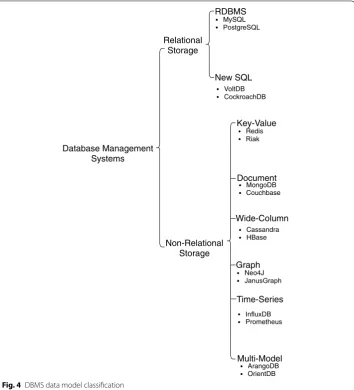
A DLMS in the Big Data domain requires both the storage and the management of het-erogeneous data structures. Consequently, a sophisticated DLMS would need to support a diverse set of DMSs. DMSs can be classified into file systems for storing unstructured data and DBMSs (database management systems) for storing semi-structured and struc-tured data. However, the variety of semi-strucstruc-tured and strucstruc-tured data requires suitable data models (see Fig. 4) to increase the flexibility of DBMSs. Following these require-ments, the DBMS landscape is constantly evolving and becomes more heterogeneous.3
The following sub-sections provides (i) an overview of related work on DBMS classifica-tions; (ii) a holistic and up-to-date classification of current DBMS data models; (iii) a qualitative analysis of selected DBMSs; (iv) a classification and analysis of relevant DFSs.
Database management systems
The classification of the different data models (see Fig. 4) for semi-structured data has been in the focus since the last decade [37] as heterogeneous systems (such as Dynamo, Cassandra [45] and BigTable [46]) appeared on the DBMS landscape. Consequently, the term NoSQL evolved, which summarizes the heterogeneous data models for semi-struc-tured data. Similar, the strucsemi-struc-tured data model evolved with the NewSQL DBMSs [13, 47].
Several surveys have reviewed NoSQL and NewSQL data models over the last years and analyze the existing DBMS with respect to their data models and the specific non-functional features [11, 13, 35–37, 48, 49]. In addition, dedicated surveys focus explic-itly specific data models (such as the time series data model [50, 51]) or specific DBMS architectures (such as in-memory DBMS [14]).
Cloud-centric challenges for operating distributed DBMS are analysed by [13], con-siders the following: horizontal scaling, handling elastic workload patterns and fault tolerance. It also classifies nineteen DDBMSs against features, such as partitioning, rep-lication, consistency and security.
Recent surveys on NoSQL-based systems [35, 49] derive both, the functional and the non-functional NoSQL and NewSQL features and correlated them with distribution mechanisms (such as sharding, replication, storage management and query process-ing). However, the implications of Cloud resources or the challenges of Big Data applica-tions were not considered. Another conceptual analysis of NoSQL DBMS is carried out by [48]. It outlines many storage models (such as key-value, document, column-oriented and graph-based) and also analyses current NoSQL implementations against persis-tence, replication, sharding, consistency and query capability. However, recent DDBMSs (such as time-series DBMSs or NewSQL DBMSs) are not analysed from Big Data as well as the Cloud context. A survey on DBMS support for Big Data with the focus on data storage models, architectures and consistency models is presented by [11]. Here, the
Database Management Systems
Relational Storage
Non-Relational Storage
RDBMS MySQL
PostgreSQL
New SQL VoltDB
CockroachDB
Key-Value Redis
Riak
Document
Wide-Column
Graph
Multi-Model MongoDB Couchbase
Cassandra HBase
InfluxDB
Prometheus Neo4J
JanusGraph
Time-Series
ArangoDB OrientDB
relevant DBMSs are analysed towards their suitability for Big Data applications, but the Cloud service models and evolving DBMSs (such as time-series databases) are also not considered.
An analysis of the challenges and opportunities for DBMSs in the Cloud is presented by [52]. Here, the relaxed consistency guarantees (for DDBMS) and heterogeneity, as well as the different level of Cloud resource failures are explained. Moreover, it is also explicated that HA mechanism is needed to overcome failures. However, the HA and horizontal scalability come with the weaker consistency model (e.g., BASE [53]) com-pared to ACID [43].
In the following, we distil and join existing data model classifications (refer to Fig. 4) into an up-to-date classification of the still-evolving DBMS landscape. Hereby, we select relevant details for the DLMS of Big Data applications, while we refer the interested reader to the presented surveys for an in-depth analysis of specific data models. Analo-gously, we apply a qualitative analysis of currently relevant DBMS based on the general DLMS features (see "Non-functional data management features" section), while in-depth analysis of specific features can be found in the presented surveys. Hereby, we select two common DBMS4 of each data model for our analysis.
Relational data models
The relational data model stores data as tuples forming an ordered set of attributes; which can be extended to extract more meaningful information [54]. A relation forms a table and tables are defined using a static, normalised data schema. SQL is a generic data definition, manipulation and query language for relational data. Popular representative DBMSs with a relational data model are MySQL and PostgreSQL.
NewSQL
The traditional relational data model provides limited data partitioning, horizontal scal-ability and elasticity support. NewSQL DBMSs [55] aim at bridging this gap and build upon the relational data model and SQL. However, NewSQL relaxes relational features to enable horizontal scalability and elasticity [13]. It is worth to note that only a few NewSQL DBMSs, such as VoltDB5 and CockroachDB,6 are built upon such architectures
with the focus on scalability and elasticity as most NewSQL DBMSs are constructed out of existing DBMSs [47].
Key‑value
The key-value data model relates to the hash tables of programming languages. The data records are tuples consisting of key-value pairs. While the key uniquely identifies an entry, the value is an arbitrary chunk of data. Operations are usually limited to simple put or get operations. Popular key-value DBMSs are Riak7 and Redis.8
4 https ://db-engin es.com/en/ranki ng.
5 https ://www.voltd b.com/.
6 https ://www.cockr oachl abs.com/.
7 http://basho .com/produ cts/riak-kv/.
Document
The document data model is similar to the key-value data model. However, it defines a structure on the values in certain formats, such as XML or JSON. These values are referred to as documents, but usually without fixed schema definitions. Compared to key-value stores, the document data model allows for more complex queries as docu-ment properties can be used for indexing and querying. MongoDB9 and Couchbase10
represent the common DBMSs with a document data model.
Wide‑column
The column-oriented data model stores data by columns rather than by rows. It ena-bles both storing large amounts of data in bulk and efficiently querying over very large structured data sets. A column-oriented data model does not rely on a fixed schema. It provides nestable, map-like structures for data items which improve flexibility over fixed schema [46]. The common representatives of column-oriented DBMSs are Apache Cas-sandra11 and Apache HBase.12
Graph
The graph data model primarily uses graph structures, usually including elements like nodes and edges, for data modelling. Nodes are often used for the main data entities, while edges between nodes are used to describe relationships between entities. Query-ing is typically executed by traversQuery-ing the graph. Typical graph-based DBMS are Neo4J13
and JanusGraph.14
Time‑series
The time-series data model [50] is driven by the needs of sensor storage within the Cloud and Big Data context. The time-series DBMSs are typically built upon existing non-relational data models (preferably key-value or column-oriented), and add a dedi-cated time-series data model on top. The data model is built upon data points which comprise a time stamp, an associated numeric value and a customisable set of metadata. Time-series DBMSs offers analytical query capabilities, which cover statistical functions and aggregations. Well-known time-series DBMSs are InfluxDB15 and Prometheus.16
Multi‑model
A multi-model address the problem of polyglot persistence [56] which signifies that each of the existing non-relational data models addresses a specific use case. Hence, multi-model DBMSs combine different data multi-models into a single DBMS while build upon one storage backend to improve flexibility (e.g., providing the document and graph data
11http://cassa ndra.apach e.org/.
12https ://hbase .apach e.org/.
13https ://neo4j .com/.
14http://janus graph .org/.
15https ://www.influ xdata .com/
16https ://prome theus .io/. 9 https ://www.mongo db.com/.
model via a unified query interface). Common multi-model DBMSs are ArangoDB17 and
OrientDB.18
Comparison of selected DBMSs
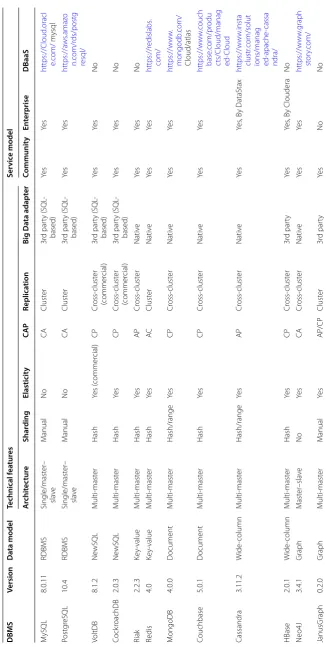
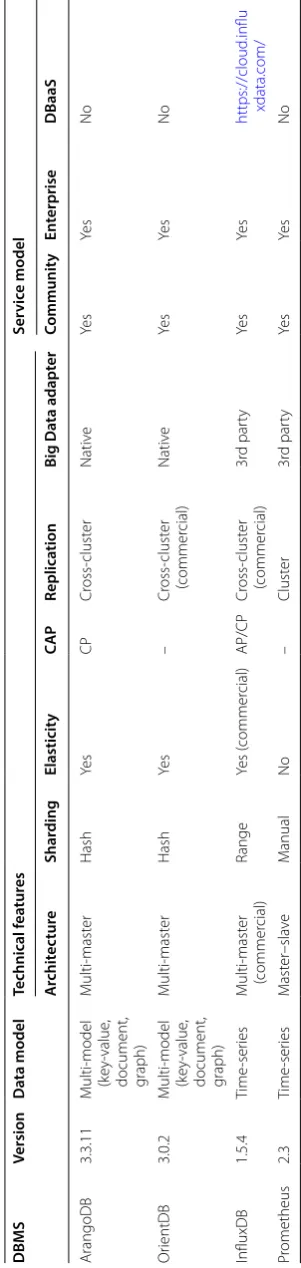
In this section, we analyse already mentioned DBMSs in the context of Big Data appli-cations (see Table 2). To perform this, we first analyse already mentioned DBMS (of the previously introduced data models) with respect to their features and supported Cloud service models. Next, we provide a qualitative analysis with respect to the non-functional features of the DMSs (refer to "Non-non-functional data management features" section). For quantitative analysis of these non-functional requirements, we refer the interested reader to the existing work focused on DBMS evaluation frameworks [44, 57– 60] and evaluation results [42, 61, 62].
Qualitative criteria
In the Table 2, the first three columns present each DBMS and its data model, followed by the technical features and the service models supported. The analysis only considers the standard version of a DBMS.
In the following, we attempt to explicate each of the technical features considered. The DBMS architecture is classified into single, master–slave and multi-master architec-tures [56]. The sharding strategies are analysed based on the DBMS architectures; they can be supported manually as well as automatically in a hash- or range-based manner. The elasticity feature relies on a distributed architecture and relates to whether a DBMS supports adding and/or removing nodes from the cluster at runtime without a down-time. For consistency and availability guarantees, each DBMS is analysed with respect to its consistency (C), availability (A) and partition tolerance (P) properties within the
CAP theorem (i.e., CA, CP, AC or AP) [43]. However, it should be highlighted that we did not consider fine-grained configuration options that might be offered for a DBMS to vary the CAP properties. Next, the replication mechanisms are analysed in terms of both cluster and cross-cluster replication (also known as geo-distribution). Consequently, a DBMS supporting cross-cluster replication implicitly supports cluster replication. The interested reader might consider [63] for more fine-grained analysis of replication mech-anisms of DDBMSs. The Big Data adapter is analysed by evaluating native and/or third-party drivers for Big Data processing frameworks. Finally, the DDBMSs are classified based on their offering as community editions, enterprise commercial editions or man-aged DBaaS. One exemplary provider is presented if the DBMS is offered as a DBaaS.
Qualitative analysis
The resulting Table 2 represents the evolving landscape of the DBMSs. The implemented features of existing DBMSs significantly differ (except the RDBMSs) even within one data model. The heterogeneity of analysed DBMSs is even more obvious across data models. Further, the heterogeneous DBMS landscape offers a variety of potential DBMS solutions for Big Data.
17 https ://www.arang odb.com/.
Table 2 (c on tinued) DBMS Version Da ta model Technical f ea tur es Ser vic e model A rchit ec tur e Shar ding Elasticit y CAP Replica tion Big Da ta adapt er Communit y En terprise DB aaS ArangoDB 3.3.11 M
ulti-model (k
ey-value
,
document, graph)
M ulti-mast er Hash Ye s CP Cr oss-clust er Nativ e Ye s Ye s No Or ientDB 3.0.2 M
ulti-model (k
ey-value
,
document, graph)
The feature analysis provides a baseline for the qualitative analysis of the non-func-tional features. From the (horizontal) scalability point-of-view, a DBMS with a multi-master architecture is supposed to provide scalability for write and read workloads, while a master–slave architecture is supposed to provide read scalability. Due to the differences between the DBMSs, the impact of elasticity requires additional qualitative evaluations [42].
The consistency guarantees correlate to the classification in the CAP theorem. Table 2 clearly shows the heterogeneity compared to the consistency guarantees. Generally, the single-master or master–slave architectures provide strong consistency guarantees. Multi-master architectures cannot be exactly classified into the CAP theorem as their consistency guarantees heavily depend on the DBMS runtime configuration [64]. Addi-tional evaluations of the consistency for the selected DBMSs are required for strong con-sistency (so as to ensure scalability, elasticity and availability) [44, 62].
Providing HA directly relates to the supported replication mechanisms to overcome failures. The analysis shows that all DBMSs support cluster-level replication, while cross-cluster replication is supported by ten out of the sixteen DBMSs. Big Data pro-cessing relates to the technical feature of Big Data adapters. Table 2 clearly shows that seven DBMSs provide native adapters and nine DBMS enable it via third-party adapt-ers to support Big Data processing. The service model of all the DBMSs is either avail-able as a self-hosted community or enterprise version. In addition, both RDBMS and six NoSQL DBMS are offered as managed DBaaS. While the DBaaS offerings are abstract-ing all operational aspects of the DBMS, an additional analysis might be required with respect to their non-functional features and cost models [65].
Cloudification of DMS
Traditional on-premise DBMS offerings are still popular, but the current trend shows that DDBMSs running in the Cloud are also well-accepted. Especially, as Big Data imposes new challenges such as scalability, the diversity of data management or the usage of Cloud resources, towards the massive storage of data [66]. In general, the dis-tributed architecture of DMSs evolved their focus over exploiting the Cloud features and catering the 5Vs of Big Data [67]. Data-as-a-service (DaaS) mostly handles the data aggregation and management via appropriate web-services, such as RESTful APIs. While database-as-a-service (DBaaS) offers database as a service which can include (dis-tributed) a relational database or a non-relational one. In most of the cases, storage-as-a-service (STaaS) includes both DaaS and the DBaaS [68]. Furthermore, BDaaS [3] is a Cloud service (such as Hadoop-as-a-service) where traditional applications are migrated from local installations to the Cloud. BDaaS wraps three primary services. They are (i) IaaS (for underlying resources), (ii) STaaS (a sub-domain of platform-as-s-service (PaaS)) for managing the data via dynamic scaling and (iii) data management (such as data placement, replica management).
Distributed file systems
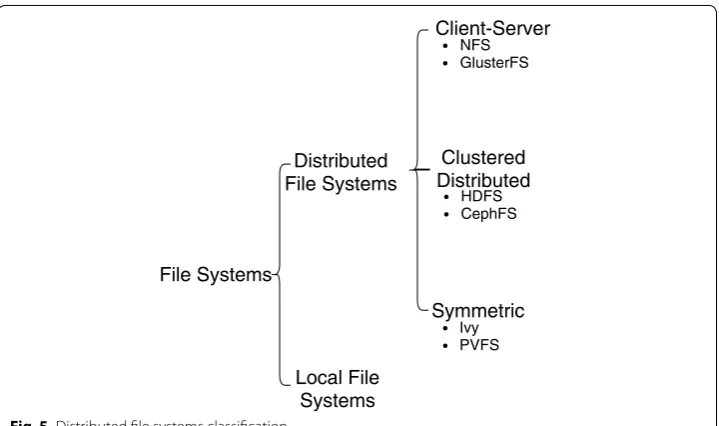
metadata support. However, the design challenges (independent of data size and stor-age type) of a DFS are transparency, reliability, performance, scalability, and security. In general, DFSs do not share storage access at the block level but rather work at the net-work level. In DFSs, security relies on either access control lists (ACLs) or respectively defined capabilities, depending on how the network is designed. DFSs can be broadly classified into three models and respective groups (see Fig. 5). First, client–server archi-tecture based file systems which supply a standardized view of a local file system. Sec-ond, clustered-distributed file systems which offer multiple nodes to enable concurrent access to the same block device. Third, symmetric file systems, where all nodes have a complete view of the disk structure. Below, we briefly analyse each category in a separate sub-section while we also supply some strictly open-source members for it.
Client–server model
In the client–server architecture based file system, all communications between servers and clients are conducted via remote procedure calls. The clients maintain the status of current operations on a remote file system. Each file server provides a standardized view of its local file system. Here, the file read-operations are not mutually exclusive but the write operations are. File sharing is based on mounting operations. Only the servers can mount directories exported from other servers. Network File System (NFS) and Glus-terFS19 are two popular open source implementations of the client–server model.
Clustered‑distributed model
Clustered-distributed based systems organize the clusters in an application-specific manner and are ideal for DCs. The model supports a huge amount of data; the data is stored/partitioned across several servers for parallel access. By design, this DFS model
Client-Server
File Systems
Distributed File Systems
Clustered Distributed
Local File Systems
Symmetric
NFS GlusterFS
HDFS CephFS
Ivy PVFS
Fig. 5 Distributed file systems classification
is fault tolerant as it enables the hosting of a number of replicas. Due to the huge vol-ume of data, data are appended instead of overwritten. In general, the DNS servers map (commonly using round-robin fashion) access requests to the clusters for load-balancing purposes. The Hadoop distributed file system (HDFS) and CephFS20 are two popular
implementations of such a DFS model.
Symmetric model
Symmetric is a DFS that supports a masterless architecture, where each node has the same set of roles. It mainly resembles a peer-to-peer system. In general, the symmetric model employs a distributed hash table approach for data distribution and replication across systems. Such a model offers higher availability but reduced performance. Ivy [70] and the parallel virtual file system (PVFS) [71] are examples of a symmetric DFS model.
DFS evaluation
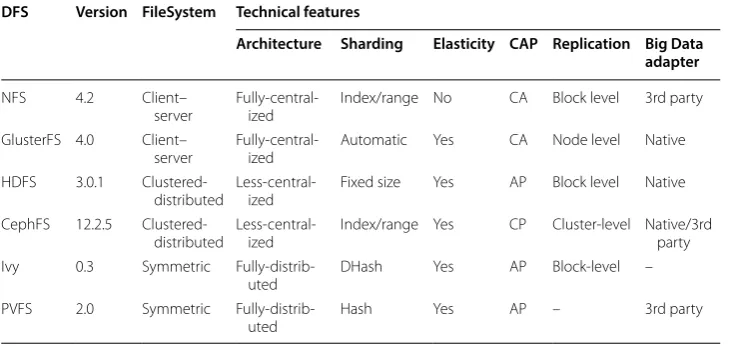
Similar to DDBMSs, we also compare the open source implementations of DFSs according to the same set of technical features or criteria. A summary of this comparison is depicted in Table 3. In general, most of the file systems are distributed in nature (except NFS and GlusterFS). However, they do exhibit some architectural differences. NFS and GlusterFS are both developed focusing on a master–slave approach, while Ivy and PVFS are based on the masterless model. Data partitioning (or sharding) is also supported dynamically (featured by Ivy and PVFS) or statically via a fixed size (as in case of HDFS) by these DFSs. Elasticity or supporting the data scaling is a very important feature for many Big Data applications (especially hosted at Cloud). We can thus observe that except NFS all mentioned DFSs sup-port scalability. Further, HDFS, CephFS, Ivy and PVFS are fault tolerant as well. Replication, highly needed for not losing data, is well supported by all DFSs. However, their granularity differs from the block to the cluster level. Finally, these DFSs also offer some form of hooks (either native or third-party supplied) to be used with Big Data frameworks.
Table 3 Feature analysis of selected DFSs DFS Version FileSystem Technical features
Architecture Sharding Elasticity CAP Replication Big Data adapter
NFS 4.2 Client–
server Fully-central-ized Index/range No CA Block level 3rd party GlusterFS 4.0 Client–
server Fully-central-ized Automatic Yes CA Node level Native HDFS 3.0.1
Clustered-distributed Less-central-ized Fixed size Yes AP Block level Native CephFS 12.2.5
Clustered-distributed Less-central-ized Index/range Yes CP Cluster-level Native/3rd party Ivy 0.3 Symmetric
Fully-distrib-uted DHash Yes AP Block-level –
PVFS 2.0 Symmetric
Fully-distrib-uted Hash Yes AP – 3rd party
Data placement techniques
In the Cloud ecosystem, traditional placement algorithms incur a high cost (including the time) on storing and transferring data [72]. Placing data while data is partitioned and distributed across multiple locations is a challenge [23, 73]. Runtime data migration is an expensive affair [30–32] and the complexity increases due to the frequent change of appli-cations as well as DCs’ behaviour (i.e., resources or latencies) [74]. Placing a large amount of data across the Cloud is complex due to issues, such as (i) data storage and transfer cost optimisation while maintaining data dependencies; (ii) data availability and replication; (iii) privacy policies, such as restricted data storage based on geo-locations. Data replication can influence consistency, while it also enhances the scalability and higher availability of data. In general, the existing data placement strategies can be grouped based on user-imposed con-straints, such as data access latency [75], fault tolerance [76], energy-cost awareness [77], data dependency [78, 79] and robustness or reliability [80, 81].
Formal definition
The data placement in a distributed computing domain is an instance of NP-hard prob-lem [82], while it can be reduced to a bin-packing problem instance. Informally, the data placement problem can be described as follows: given a certain workflow, the current data placement, and a particular infrastructure, find the right position(s) of data within the infrastructure to optimise one or more certain criteria, such as the cost of the data transfer.
A formal representation of this problem as follows: suppose that there are N datasets, represented as di (where i=1,. . .,N ). Each dataset has a certain size si . Further, suppose that there are M computational elements represented as Vj (where j=1,. . .,M ). Each computational element has a certain storage capacity denoted as cj . Finally, suppose that
there is a workflow W with T tasks which are represented as tk (where k=1,. . .,T ). Each task has a certain input tk.input and output tk.output , where each maps to a set of datasets.
The main set of decision variables is cij representing the decisions (e.g., based on privacy or legal issues) of whether a certain dataset i should be stored in a certain computational element j. Thus, there is a need to have cij==1 for each i and a certain j. Two hard con-straints need to hold: (i) a dataset should be stored in one computational element which can be represented as follows:
jcij=1 for each i. It is worth to note that this constraint holds when no dataset replication is allowed. Otherwise, it would take the following form:
jcij>=r , where r is the replication factor; (ii) the capacity of a computational element should be sufficient for hosting the respective dataset(s) assigned to it. This is represented as follows:
icij∗si<=cj for each j.
Finally, suppose that the primary aim is to reduce the total amount of data transfers for the whole workflow. In this respect, this optimisation objective can be expressed as follows:
where m(di) (which supplies as the output a value in [1, M]) indicates the index of the
computational element that has been selected for a certain dataset. This objective adds the amount of data transfers per each workflow task which relates to the fact that the task will be certainly placed in a specific resource mapping to one of the required input (1) minimise
k
di,di′∈tk.input
m(di) <>m
di′
datasets. Thus, during its execution, the data mapping to the rest of the input datasets will need to be moved in order to support the respective computation needed.
Data placement methodologies
We broadly classify the proposed data placement methods into data dependency, holis-tic task and data scheduling and graph-based methods. The methods in each category are analysed in the following subsections.
Data dependency methods
A data-group-aware placement scheme is proposed in [83] by employing the bond energy algorithm (BEA) [84] to transform the original data dependency matrix into a Hadoop cluster. It exploits access patterns to find an optimal data grouping to achieve better parallelism and workload balancing. In [85], a data placement algorithm is pro-posed for solving the data inter-dependency issue at the VM level. Scalia [86] proposes a Cloud storage brokerage scheme that optimises the storage cost by exploiting the real-time data access patterns. Zhao et al. [87] proposed data placement strategies for both initial data placement and relocation using a particle swarm optimization (PSO) algo-rithm. For fixed data set placement, this method relies on hierarchical data correlation and performs data re-allocation during the storage saturation. Yuan et al. [78] propose a k-means based dataset clustering algorithm to construct a data dependency matrix by exploiting the data dependency and the locality of computation. Later, the depend-ency matrix is transformed by applying the BEA while items are clustered based on their dependencies by following a recursive binary partitioning algorithm. In general, the preservation of time locality can significantly impact caching performance while the effi-cient re-ordering of jobs can improve the resource usage. In [79] authors propose a file grouping policy for pre-staging data by preserving time locality and enforcing the role of job re-ordering via extracting access patterns.
Task and data scheduling methods
The storage resource broker [23] provides seamless access to the different distrib-uted data sources (interfacing multiple storages) via its APIs. It works as a middleware between the multiple distributed data storages and applications. BitDew [94] offers a programmable environment for data management via metadata exploitation. The data scheduling (DS) service takes care of implicit data movement. Pegasus [95] pro-vides a framework that maps complex scientific applications onto distributed resources. It stores the newly generated data and also registers them in the metadata catalogue. The replica location service [96] is a distributed, scalable, data management service that maps the logical data names to target names. It supports both centralized as well as dis-tributed resource mapping. Kosar and Livny [81] proposes a data placement that con-sists of a scheduler, a planner and a resource broker. The resource broker is responsible for matching resources, data identification and decisions related to data movement. The scheduling of data placement jobs relies on the information given by the workflow man-ager, the resource broker and the data miner. A very interesting feature of the proposed sub-system is that it is able to support failure recovery through the application of retry semantics.
Graph‑based data placement
Yu and Pan [72] proposes the use of sketches to construct a hyper-graph sparsifier of data traffic to lower the data placement cost. Such sketches represent data structures that approximate properties of a data stream. LeBeane et al. [97] proposed on-line graph-partitioning multiple strategies to optimise data-ingress across heterogeneous clusters. SWORD [98] handles the partitioning and placement for OLTP workloads. Here, the workload is represented as a hypergraph and a hyper-graph compression technique is employed to reduce the data partitioning overhead. An incremental data re-partitioning technique is also proposed that modifies data placement in multiple steps to support workload changes. Kayyoor et al. [99] propose how to map nodes to a subset of clus-ters via satisfying user constraints. It minimises the query span for query workloads by applying replica selection and data placement algorithms. The query-based workload is represented as hyper-graphs and a hypergraph partitioning algorithm is used to process them. Kaya et al. [100] model the workflow as a hypergraph and employ a partitioning algorithm to reduce the computational and storage load while trying to minimise the total amount of file transfers.
Comparative evaluation
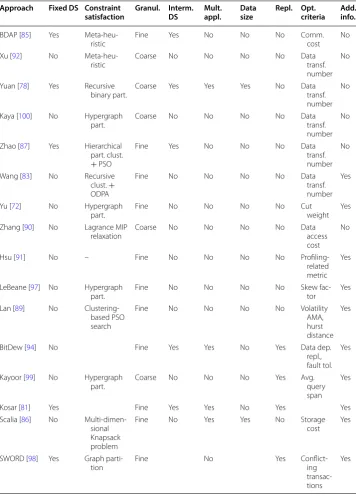
In this section, we have carefully selected a set of criteria to evaluate the methods ana-lysed in "Data placement methodologies" section. The curated criteria are: (i) fixed data sets—whether the placement of data can be a priori fixed in sight of, e.g., regulations, (ii)
information—whether additional knowledge is captured which could enable the produc-tion of better data placement soluproduc-tions. An overview of the evaluaproduc-tion based on these criteria can be observed in comparison Table 4. First of all, we can clearly see that there is no approach that covers all the criteria considered. Three approaches (Yuan et al. [78], BitDew [94] and Kosar [81]) can be distinguished, considered also as complementary to each other. However, only in [78] a suitable optimisation/scheduling algorithm for data placement has been realised.
Table 4 Comparative summary of existing data placement algorithms Approach Fixed DS Constraint
satisfaction Granul. Interm. DS Mult. appl. Data size Repl. Opt. criteria Add. info.
BDAP [85] Yes
Meta-heu-ristic Fine Yes No No No Comm. cost No
Xu [92] No
Meta-heu-ristic Coarse No No No No Data transf. number
No
Yuan [78] Yes Recursive
binary part. Coarse Yes Yes Yes No Data transf. number
No
Kaya [100] No Hypergraph
part. Coarse No No No No Data transf. number
No
Zhao [87] Yes Hierarchical part. clust. + PSO
Fine Yes No No No Data
transf. number
No
Wang [83] No Recursive clust. + ODPA
Fine No No No No Data
transf. number
Yes
Yu [72] No Hypergraph
part. Fine No No No No Cut weight Yes
Zhang [90] No Lagrance MIP
relaxation Coarse No No No No Data access cost
No
Hsu [91] No – Fine No No No No
Profiling-related metric
Yes
LeBeane [97] No Hypergraph
part. Fine No No No No Skew fac-tor Yes
Lan [89] No Clustering-based PSO search
Fine No No No No Volatility
AMA, hurst distance
Yes
BitDew [94] No Fine Yes Yes No Yes Data dep.
repl., fault tol.
Yes
Kayoor [99] No Hypergraph
part. Coarse No No No Yes Avg. query span
Yes
Kosar [81] Yes Fine Yes Yes No Yes Yes
Scalia [86] No Multi-dimen-sional Knapsack problem
Fine No Yes Yes No Storage
cost Yes
SWORD [98] Yes Graph
parti-tion Fine No Yes Conflict-ing
transac-tions
Considering now each criterion in isolation, we can observe in Table 4 that very few approaches consider the existence of a fixed or semi-fixed location of data sets. Further, such approaches seem to prescribe a fixed a-priori solution to the data placement prob-lem which can lead to a sub-optimal solution. Especially as optimisation opportunities are lost in sight of more flexible semi-fixed location constraints. For instance, fixing the placement of a dataset to a certain DC might be sub-optimal in case that multiple DCs in the same location exist.
Three main classes of data placement optimisation techniques can be observed: (i) meta-search (like PSO)/genetic programming) to more flexibly inspect the avail-able solution space and efficiently find a near-optimal solution; (ii) hierarchical parti-tion algorithms (based on BEA) that attempt to group data recursively based on data dependencies either to reduce the number or the cost of data transfers. BEA is used as the baseline for many of these algorithms. BEA also supports dynamicity. In particu-lar, new data sets are handled by initially encoding them in a reduced table-based form before applying the BEA. After the initial solution is found, the modification can be done by adding cluster/VM capacity constraints into the model. (iii) a Big Data placement problem can also be encoded via a hypergraph. Here, nodes are data and machines while hyper-edges attempt to connect them together. Through such modelling, traditional or extended hypergraph partitioning techniques can be applied to find the best possible partitions. There can be a trade-off between different parameters or metrics that should be explored by all the data placement algorithms irrespectively of the constraint solving technique used. However, such a trade-off is not usually explored as in most cases only one metric is employed for optimisation.
Granularity constitutes the criterion with less versatility as most of the approaches have selected a fine-grained approach for data-to-resource mapping, which is suitable for the Cloud ecosystem.
The real-world applications are dynamic and can have varying load at different points of time. Furthermore, applications can produce additional data which can be used for next computation steps. Thus, data placement should be a continuous process to vali-date decisions taken at different points in time. However, most approaches in data place-ment, focus mainly on the initial positioning of Big Data and do not interfere with the actual runtime of the applications.
There seems also to exist a dependency between this criterion and the fixed data sets one. The majority of the proposed approaches satisfying this criterion also satisfy the fixed data set one. This looks like a logical outcome as dynamicity is highly correlated to the need to better handle some inherent data characteristics. Further, a large volume of intermediate data can also have a certain gravity effect that could resemble the one con-cerning fixed data.
The multi-application criterion is not supported at all. This can be due to the following facts: (i) multi-application support can increase the complexity and the size of the prob-lem; (ii) it can also impact the solution quality and solution time which can be undesir-able especially for approaches that already supply sub-optimal solutions.
monitoring, suitable especially in cases where data can grow fast, and dynamic storage capacity determination, through, e.g., data growth prediction, for better supporting pro-active data allocation. However, if we consider all dynamicity criteria together, we can nominate the approach in [78] as the one with the highest level of dynamicity, which is another indication of why it can be considered as prominent.
Data replication has been widely researched in the context of distributed systems but has not been extensively employed in data placement. Thus, we do believe that there exists a research gap here. Especially as those few approaches (such as SWORD [98], Kosar [81], Kayoor [99], BitDew [94]) that do support replication still lack suitable details or rely on very simple policies driven by user input.
We can observe that the minimisation of data transfer number or cost is a well-accepted optimisation criterion. Furthermore, data partitioning related criteria, such as
skew factor and cut weight, have been mostly employed in the hypergraphs based meth-ods. In some cases, we can also see multiple criteria to be considered which are: (i) either reduced to an overall one; (ii) not handled through any kind of optimisation but just considered in terms of policies that should be enforced. In overall, we are not impressed by the performance of the state-of-the-art in this comparison criterion. So, there is a huge room for potential improvement here.
Finally, many of the methods also consider additional input to achieve a better solu-tion. The most common extra information that is exploited is data access patterns and nodes (VMs or PMs) profiling to, e.g., inspect their (data) processing speed. However, while both are important, usually only one from these two is exploited in these methods.
Lessons learned and future research directions
To conclude our survey, in this section we will discuss the issues of the current state-of-the-art and the research gaps or opportunities related to data storage and placement. Further, we also supply research directions towards a complete DLMS system in the Big Data-Cloud ecosystem.
Data lifecycle management Challenges and issues
This subsection refers to how the discussed data storage and placement challenges can be combined and viewed from the perspective of a holistic DLMS of the future. Such a DLMS should be able to cope with the optimal data storage and placement in a way that considers the Big Data processing required, along with the functional and non-func-tional variability space of the given Cloud resources at hand, in each application sce-nario. It implies the ability to consider both private and public Clouds, offered by one or several Cloud vendors, according to the specifics of each use cases, while making the appropriate decisions on how the data should be stored, placed, processed and eventu-ally managed.
this means that there should also be a consideration of the dependencies between appli-cation components and all data sources. This has the reasonable impliappli-cation that the components requiring frequent accesses to data artefacts, found at rest in certain data stores, cannot be placed in a different Cloud or even in a certain physical and network distance from the actual storage location. If such aspects are ignored then application performance certainly degrades, as expensive data migrations may incur while legisla-tion conformance issues might be applicable.
Future research directions
Among the most prominent research directions, we highlighted the design and imple-mentation of a holistic DLMS, able to cope with all of the above-mentioned aspects on the data management, while employing the appropriate strategies for benefiting from the multi-Cloud paradigm. It is important to note that data placement in virtualized resources is generally subjected to long-term decisions as any potential data migrations generally incur immense costs which may be amplified by data gravity aspects that may result in subsequent changes in the application placement. Based on this, we consider the following aspects that should sketch the main functionality of the DLMS of the future that is able to cope with Big Data management and processing by really taking advantage of the abundance of resources in the Cloud computing world:
• Use of advanced modelling techniques that consider metadata schemas for setting the scope of truly exploitable data modelling artefacts. It refers to managing the modelling task in a way that covers the description of all V’s (e.g. velocity, volume, value, variety, and veracity) in the characteristics of Big Data to be processed. The proper and multi-dimensional data modelling will allow for an adequate description of the data placement problem.
• Perform optimal data placement across multiple Cloud resources based on the data modelling and user-defned goals, requirements and constraints.
• Use of efficiently distributed monitoring functionalities for observing the status of the Big Data stored or processed and detect any migration or reconfguration oppor-tunities.
• Employ the appropriate replication, fail-over and backup techniques by considering and exploiting at the same time the already offered functionalities by public Cloud providers.
• According to such opportunities, continuously make reconfguration and migra-tion decisions by consistently considering the real penalty for the overall applicamigra-tion reconfguration, always in sight of the user constraints, goals and requirements that should drive the confguration of computational resources and the scheduling of application tasks.
Data storage
In this section, we highlight the challenges for holistic data lifecycle management with respect to both the current DBMS and DFS systems and propose future research direc-tions to overcome such challenges.
Challenges and issues
In the recent decade, the DBMS landscape has significantly evolved with respect to the data models and supported non-functional features, driven by Big Data and the related requirements of Big Data applications (see "Non-functional data management features" section). The resulting heterogeneous DBMS landscape provides a lot of new opportuni-ties for Big Data management while it simultaneously imposes new challenges as well. The variety of data models offers domain-specific solutions for different kinds of data structures. Yet, the vast number of existing DBMSs per data model leads to a complex DBMS selection process. Hereby, functional features of potential DBMSs need to be carefully evaluated (e.g., NoSQL DBMSs do not offer a common query interface even within the same data model). For the non-functional features, the decision process is twofold: (i) a qualitative analysis (as carried out in "Comparison of selected DBMSs" sec-tion) should be conducted to narrow down the potential DBMSs; (ii) quantitative evalu-ations should be performed over the major non-functional features based on existing evaluation frameworks.
While collecting data from many distributed and diverse data sources is a challenge [8] modern Big Data applications are typically built upon multiple different data structures. Consequently, current DBMSs cater for domain-specific data structures due to the vari-ety of data models supported, (as shown in our analysis Table 2). However, exploiting the variety of data models typically leads to the integration of multiple different DBMSs in modern Big Data applications. Consequently, the operation of a DBMS needs to be abstracted to ease the integration of different DBMSs into Big Data applications and to fully exploit the required features (such as scalability or elasticity). Hereby, research approaches in Cloud-based application orchestration can be exploited [101, 102]. While the current DBMS landscape already moves towards the Big Data domain, the optimal operation of large-scale or even geo-distributed DBMSs still remains a challenge as the non-functional features significantly differ for different DBMSs (especially by using Cloud resources [42, 61, 103]).