GSJ: Volume 8, Issue 1, January 2020, Online: ISSN 2320-9186
www.globalscientificjournal.com
POWER SYSTEM RESTRUCTURING IN NIGERIA Esobinenwu, Chizindu Stanley
ABSTRACT
This paper aims at power system restructuring in Nigeria. It exposes the problem associated to electricity market in Nigeria, its limitations, effects on consumers and how it got there. Two power stable country was studied to ascertain if there is something Nigeria has to learn to stabilize it power; they are United States and Germany. In US market structure controlled by states was seen. The state determines majorly how the market operates. Germany proposed a market where anybody who is willing to participate can invest. This will attract so many investors of which their major source of power is through renewable energy. This market structure will bring in a lot of competition that will beat down the price of electricity and also create a better service if the market players want to remain in the market. This can also be proposed to Nigerian market. The market whose problem is majorly political interest and sentiment can be restructured to attract investors who know the best way to handle the network for customer’s satisfaction.
Keywords: Restructuring, electricity market, competitive market
1.0 Introduction
Electricity is a key factor to consider in a developed or developing nation. It contributes to every area of the nation’s growth. This has made it the priority of every nation, both in the rural and urban environment. Nigeria stands to be one of the most affected nations suffering the effect of poor electricity supply. This problem has been on the increasing trend due to poor maintenance factor, low generation, political reasons, poor transmission and distribution lines, retrenchment of qualified staffs every year due to limited resources, poor monitoring of the electrical system by the regulators, etc (Sambo, 2008).
been generated without first supplying the national grid, which on its own have a lot of demand which suppressed the generation supplied. In other words, the federal government through its control partner (DICO, GENCOS, etc) decides how electricity should be allocated to locations without the states having an input. Since the states have no say in the allocation, they are allocated what portion the national grid control system decides. The federal government being engrossed by so many national issue should have seen a need to offload some of these issue to the state (www.RestructureNigeria.ng).
Also, in 2012, the government under the leadership of president Goodluck Ebele Jonathan decided to unbundle the power sector, especially the distribution sector, with the sole aim to create a competition in the market. This was a great move but the structure later created was still more like a monopoly market which was shared among politicians in Nigeria. The method or regulation even encouraged more greed from the distribution company and raised the bills without any improvement on the power supply, instead the power supply in Nigeria went from bad to worst. The only area in Nigeria where a distribution company (Geometrics power) challenged another distribution company (Enugu Electricity Distribution Company, EEDC), the power service have drastically improved, but geometrics power which proves to be more efficient have been suppressed by politicians. This issue has been ongoing over the years which have given so many investors the reason not to see Nigerian power system as an attractive investment.
There is a great need to regulate the market properly, not just to attract investors into the power system, but also to attract the investors who are scared of the effect of lack of power on their investment. The purpose of this paper is to discuss the need for restructuring of power system in Nigeria.
2.0 Historical Trend of Nigeria Electricity Reform
In 1998, generating electricity grew from few kilowatts used then to serve the colonial masters in Lagos which is when the first generating plant was installed. In the late 19th century, Electricity Cooperation of Nigeria (ECN) established by the Act of Parliament in 1951, Niger Dam Authority, was set up to develop hydroelectricity which was merged with ECN to National Electricity Power Authority in 1972.
in the market. This led to the change of name from NEPA to Power Holding Company of Nigeria (PHCN) Plc, comprising of eighteen (18) separate successor company that took over the assets, liabilities and employees of NEPA and responsible for the generation (6 companies), transmission and distribution (11 companies) (Presidency, 2010).
The problem that led to the reforms as stated by Olugbenga et al (2013) as highlighted by the Bureau of Public Enterprises (2011) are as follows:
- Limited access to infrastructure
- Inadequate power generating capacity
- Inefficient usage capacity
- Lack of capital for investment
- Inefficient regulation
- High technical losses and vandalization
- Insufficient transmission and distribution facilities
- Inefficient use of electricity by consumers
- Inappropriate industries and market structure
- Unclear description of role and responsibilities
With the problem identified, the reform bill hopes to address the problem by achieving the following objectives:
- Unbundle NEPA through 18 separate successor companies incorporated in PHCN
- Privatize the unbundle entities
- Establish a regulatory agency (the Nigerian Electricity Regulation Company (NERC)
- Establish a rural electrification agency and fund (the same infected with corruption to the tune of N52billion, causing its suspension between 2006 to 2009)
- Establish Electrical Power Consumers Assistance Fund)
Though some of these moves have been made, the problem of Nigerian power is still worse than what it was before.
3.0 Existing Problem in the Electricity Market Reform
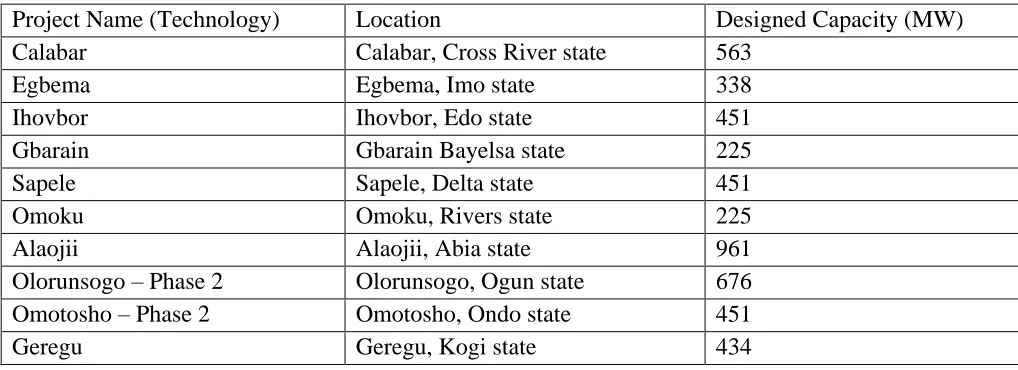
Table 1: Existing Integrated Power Project (Eberhard & Gratwick, 2012)
Project Name (Technology) Location Designed Capacity (MW)
Calabar Calabar, Cross River state 563
Egbema Egbema, Imo state 338
Ihovbor Ihovbor, Edo state 451
Gbarain Gbarain Bayelsa state 225
Sapele Sapele, Delta state 451
Omoku Omoku, Rivers state 225
Alaojii Alaojii, Abia state 961
Olorunsogo – Phase 2 Olorunsogo, Ogun state 676 Omotosho – Phase 2 Omotosho, Ondo state 451
Geregu Geregu, Kogi state 434
This move still will not satisfy the present demand of power in Nigeria. The states which would have been a better option to fast-track the solution encouraging them to build a generation company were discouraged by asking them to transmit back to the national grid after generating, which makes it look as if the greatest problem of Nigerian power is not the provision of facilities to solve the problem, but political greed. This was also the problem that led to instead of creating a competitive market by introducing more than one distribution company per area, it was shared among politicians based on zones, still maintaining a monopoly market. This issue calls for a serious restructuring of the market to attract investors and also to create an accessible open market where anybody can pertake as far as there is an assurance of constant power from the company or individual.
4.0 Restructuring of Nigerian Power
At present, there is so much need to restructure the Nigerian power if the nation wants to permanently get out of its power crisis. The first major step will be to study the power regulation rules in other countries; how it operates, their strength and weaknesses, their funding, their goals, etc. This will give a clear view of what the nation is not getting right. Two major power structures are review in this paper, they are Germany whose supply is far greater than its demand due to an open market, and United States which is the second world power producing Nation. 4.1 German Electricity Structure
Table 2: Market share of German Electricity Company (Bayer, 2015)
Sector Leading Company Market share Total No. of Providers
Transmission Amprion Transnet BW Tennet 50 Hertz Trans,
100% 4
Distribution EnBW E.ON RWE Vattenfall
The big 4 distribution company own and operate a significant portion of the distribution system, though the exact level is not clear
Approximately 890+ DSOS, about 700 of which are municipally owned.
Total Generation EnBW E-ON RWE Vattenfall
56% installed capacity (June, 2014).
59% of electricity generated (2012
Over 1000 producers (not including individuals)
Retail Suppliers EnBW E-ON RWE Vattenfall
45.5% of total electricity offlake (TWh)
Over 900 suppliers
On a closer look at table 2, it is clear that a structure which invites anybody to the market is proposed. Also, it is observed that the generators have the right to distribute the power generated. Individuals who have the power to produce power are also allowed into the market. The market structure is in such a way that the regulator comes in when there is an issue with the consumers and distributors, but there can be a direct bargain by distributor and consumers either as individual or a company. The market creates a fear in every distributor, because of the strong competition existing for more than 890 distributors. The market proposed will not only create fear for stable power, but will also cut down the cost of power.
4.2 United States Electricity Market Structure
The US electricity market is regulated by both state and Federal Regulatory Bodies. Federal Electricity Regulation Company (FERC) regulates wholesale while state utility commissions regulate everything else, especially retail rate and distribution service. The state handles the distribution rate in all states, supply rate, resource planning/adequacy, generation and transmission sitting, demand side resources, and distribution reliability (Dong, 2012).
5.0 Proposed Nigerian Market Structure
Based on the critical study of the market structure of US and Germany, the following market structure pattern can be suggested for Nigerian market.
- A market which will encourage the states to build their own generations. Each state can be mandated to produce their own power according to the demand of customers, though this will be a long-term investment.
- An open market should be created where even an individual can participate in the market. This will bring about competition, even in the rural areas.
- Generation companies should be allowed to transmit their power like constant faults and system collapse. It will also help the power producers to ascertain easily the total demand of consumers.
- Every state should have so many distribution companies. Competition will bring about stability in power and the reduction in cost of power.
- National grid should be unbundled. Nigeria has no stable economy to maintain the grid system. The grid can be disintegrated into states for proper monitoring.
- Politicians remove political sentiments from power issues. A structure where a politician even finds it difficult to invest will be more appropriate. This can be done by ensuring that the investor has an affiliation with electricity before investment permit is given unlike in Nigeria where the minster of power is a lawyer by profession.
- Renewable energy can be used to boot the network
6.0 Conclusion
The problem of Nigerian power can only stop when greed and sentiment is removed from the minds of politicians. Restructuring the system in a way the politicians will have no access to the market, but technocrats who are willing to solve the power problem.
The proposed structure pattern will not only improve the quality of power supply, but will also reduce the cost of power to the consumers, create job employment, attract investors and above all stabilize the country’s economy.
REFERENCES
Bayer, E. (2015). “Report on the German Power System”, Agora Euergiewende Resoustrase, Berlin, Germany.
Doug, N. (2012). Introduction to US electricity market”. NARUC/CAMPUT Bilateral Roundtable, Portland, Oregon. Pp.3-4.
Eberhard A, Gratwick KN, (2012). “Light inside: The experience of Independent Power Projects in Nigeria”. Infrastructure consortium for Africa.
Olugbenga, T. K. Jumah A. A. Philip D. A. (2013). “the current and future challenges of electricity market in Nigeria in the face of deregulation process.” African Journ. of Engr. Research, Yaba College of Education, Lagos, Nigeria.
Presidency ( 2010). Federal Republic of Nigeria Report, “Roadmap for Power Sector Reform”, August, 2010.
Sambo A. S. (2008). “Matching Electricity Supply with Demand in Nigeria.” International Association for Energy Economics, Fourth Quarter 2008.