49
Volume 17, 2009
EVALUATION OF CHANGES IN
PEDAGOGIC OPINIONS WITHIN THE
PROCESS OF TEACHING OF NATURAL
SCIENCES IN BASIC SCHOOL
Janis Dzerviniks Rezekne Higher Education Institution, Rezekne, Latvia E-mail: [email protected]
Abstract
After Latvia joined the united European economy space, more and more attention has been paid to development of natural sciences and technologies. These are natural sciences that teach the student to observe the nature and its phenomena objectively and without prejudice, to analyse and understand them, to formulate conclusions and foresee results. Children are investigators by nature and they actively search for information about their surroundings. They try to conceive of their environment with help of observation and experiment. Research work is an important and unsophisticated natural approach in teaching natural sciences in school. Natural sciences give everything that is necessary to develop and deepen students’ understanding about the surrounding world. They facilitate students’ thirst for knowledge and critical thinking; they depict relations between human beings and nature. Qualitative process of teaching of natural sciences at school gives students a possibility to acquire comprehensive basic knowledge and skills in the sphere of science contributing to development of the student, who will become a technologically educated member of the society, who will be encouraged to move forward in the sphere of science and technology. In order to promote the quality of education, the reform of basic education is being realised. The basis of the reform in subjects of natural sciences is orientation and direction of study content towards research work. In the article the author examines changes of pedagogic opinions in the process of teaching natural sciences, analyses students’ points of view about the progress of acquisition of proficiency in natural sciences during the reform of content of basic education content.
The aim of the research is to find out problems occurring in the process of studying of natural sciences in basic school and to emphasise facilitating development of students’ proficiency in natural sciences.
Research methods: examination and analysis of literature, inquiring.
Results of the research: the author gathered information about today’s teaching process in subjects of natural sciences, evaluated the process of acquisition of natural science in basic schools in Latvia.
Key words: competence, constructivism, education of natural science, natural science, research work.
Introduction
in the world, where the rapidity of developing, distributing and accessibility of knowledge stock is constantly growing, the necessity to memorize knowledge about the world and state is decreasing. instead of this, people need tools to choose, to process and to use knowledge that is necessary to cope with the changing world and its life models. this is the reason of the growing tendency in education to develop competencies instead of providing fact knowledge.
the concept of competency, which nowadays is introduced in the sphere of comprehensive education, is referred to a known capacity or potential to work efficiently in given conditions. The competency is considered as a general ability based on knowledge, experience, values, disposition developed by the person during the education process (Key competencies for europe, 1997).
as competencies are necessary to make person’s life independent, purposeful, responsible and successful, it is indispensable to know the competencies, which satisfy these requirements.
acquisition of natural sciences and technologies is often associated with a basic competency to use scientific knowledge, to formulate questions and to make conclusions based on facts in order to comprehend and help to take decisions about the world of nature and changes caused by people’s activities.
Theoretical Basis of the Research
Arguments for importance of science education
Acquaintance with scientific research into nature phenomena and development of understanding is very important already at the school level. modern education must provide the necessary scienticity of life experience and then the education scientifically generated by human will be reasonably used for people’s good (broks, 1998). When learning sciences the student acquires things that are necessary for improvement of his understanding of the surrounding world. science lights up the link between the human being and nature; it enables student’s thirst for knowledge, critical point of view and reminds that consumption of nature resources is not endless (science teaching in schools in europe, 2006).
natural sciences is a sphere that tells about the world’s changing solids, about the phenomena happening in the environment and about their usage for satisfying human interests and needs. Natural sciences is a significant society’s culture product, an element of the world view, that is why it is natural for every educated person to have a good knowledge of natural sciences.
in the study work at school the most important is learning the basics of natural sciences, which gives a possibility to understand natural processes and develops picture of the world in the child’s consciousness. for investigation it is necessary to learn natural sciences, physics, chemistry and biology at school. It is important to increase efficiency of teaching the natural sciences and ensure attraction of these subjects, because:
• they provide sufficient comprehensive conception about science for students who should become competent members of the technologically developed society;
• they encourage youngsters to choose career in the sphere of science.
51
of education in the 21st century Volume 17, 2009
Changes of pedagogic opinions in realisation of the science teaching process
already in the middle of the last century scientists formulated ideas about the active role of human cognition and the student’s purposeful activity in studies. it is an idea about the transition into the pedagogic paradigm, which can be called the paradigm based in the student’s activity (Žogla, 1997). Old conceptions about students as passive receivers of knowledge gradually disappeared and new ideas emerged about them as active constructors of knowledge. in various knowledge theories there is an opinion that people are purposeful individuals, who search for knowledge and they possess a highly developed ability to organise information. one of the theories, which was developed in the 90s of the 20th century is constructivism, which is considered as a combination of freely connected opinions about knowledge. the basis of these opinions is the thought that knowledge is constructed by those who study and develop it by experience. Knowledge can be gained, accumulated and kept, but the most powerful and deep knowledge is developed there, where the individual actively constructs senses in interaction with physical and social environment. if students are considered to be active, instead of passive members of the learning process, it means that studies are more often directed to activating of thinking than to filling their brains with knowledge. According to constructivism ideas students should be given a possibility to check new ideas, investigate information, solve everyday life mysteries and find new answers in different situations. When learning to solve problems, students investigate problematic situations and this work develops thinking and motivates learning. students work in cooperation, learn to doubt each other’s (also teacher’s) thoughts in order to come to the common conclusion.
Significance of constructivism supporters’ ideas in acquisition of proficiency in natural sciences is that they stimulate students to use “discoveries” in their studies, help the student to build his knowledge himself, stating differences between the initial knowledge and the new experience. it provides acquirement of concepts and understanding of principles on a basis of personal discoveries. such a way of studies demands more time for a unit of content, and it means that during a definite period of time it is possible to examine smaller quantity of content. But it can also mean that students develop deeper understanding of material and will be able to use it more efficiently in future studies and in the process of problem solving.
therefore school studies become focused on student’s learning and his/her independent development. in latvia the reform of the basic education content marked the transition from acquirement of large amount of information to development of skills to work with information; introduction of modern topics into content of education and emphasis on verities and skills, which are useful for practical life; integration of the content and harmonisation between subjects; introduction of topics corresponding to the age of students (basic educational standards, 2004). it means that nowadays in the study process the main emphasis is put on the student as a subject of studies, on learning with understanding, therefore the teacher must be able to stimulate the student to study and develop himself in different ways. school personnel and teachers’ contribution is the basis of every school’s success. teacher is an intermediary between the rapidly changing world and students, who must get fully involved in it. in the teaching process the teacher’s task is to guide student’s knowledge purposefully – to create new notions and concepts in his consciousness, to help understand conformity to natural laws, to perfect skills and abilities, simultaneously developing his abilities and stimulating interests (Zelmenis, 2000). When learning natural sciences at the basic school stage, students should be given a possibility to investigate and understand natural processes, to find their causes, to perceive nature unity and effects caused by the human economic activity, to acquire research work skills, as well as to conceive of the necessity to take care about saving and improving the environment quality, realising responsibility for results of activities (basic educational standard, 2004).
effect; they weaken body life processes and decrease energy. Under influence of these emotions a person becomes passive, disposed to idleness (Čehlova, 2002).
physics, biology and chemistry as subjects contain objective possibilities to develop students’ cognition interest. One of them is experimental substantiating of basic scientific ideas (mcKittrick, 1991). surrounding world, environment object are the start of every child’s knowledge way. Going this way, they train to understand themselves and each other, they are stimulated to get actively involved in the process of their education (hansena, Kaufmane, 1998).
it is known that in order to make students work successfully, they need an intentional wish to learn something new, they require a positive attitude to learning work (Špona, 2001), i.e. learning motives are necessary. motivation is one of decisive conditions for studies (Gudjons, 1998). students with developed interest in knowledge are more active, more attentive, they ask questions more often, express their thoughts, try to receive additional information also beside studies. Knowledge and skills are developed more successfully; they are more consistent, if the process of learning is based on the natural child’s desire for discovery (Žogla, 2001).
at lessons of natural sciences, when the teacher demonstrates or students make experiments themselves, students’ investigation work is accompanied by astonishment and surprise about their discoveries, as well as joy and satisfaction about their and others’ achievements. these intellectual feelings is the evidence of intensive cognitive work. cognition motives, intellectual feelings ensure emerging of interest (fišers, 2005; Goulmens, 2001). interest can be caused by any unanticipated event, new object, any unexpected hearing or other irritant (Немов, 1990). teacher’s demonstration can serve as a good means for evoking interest, it can be captivating. all this attracts student’s attention and facilitates appearance of interest. the teacher with purposeful tasks, the student with practical activities discovers the lack of knowledge and the need to satisfy interests.
Methodology of Research
The ideas reflected in the theoretical part allow to make a conclusion that every basic school student must develop the competency in natural sciences, which play an important role in successful personal life and probably later in professional activity. the important direction of development of this competency is qualitative acquirement of proficiency in subjects of natural sciences.
the empirical research was carried out in order to evaluate the process in the sphere of natural science education. the research was carried out within the framework of the project of the ministry of education and science of the republic of latvia “education reform in comprehensive School: Education Content Research and Implementation Problems” implemented in Rēzekne higher education institution. the project anticipated the study of the situation in schools of latgale region in connection with the implementation problems of basic education content reform. Within the framework of the project the inquiry form was developed and in order to evaluate students’ points of view about the reform of the study process and its implementation process, students’ inquiring was carried out.
53
of education in the 21st century Volume 17, 2009
Results of Research
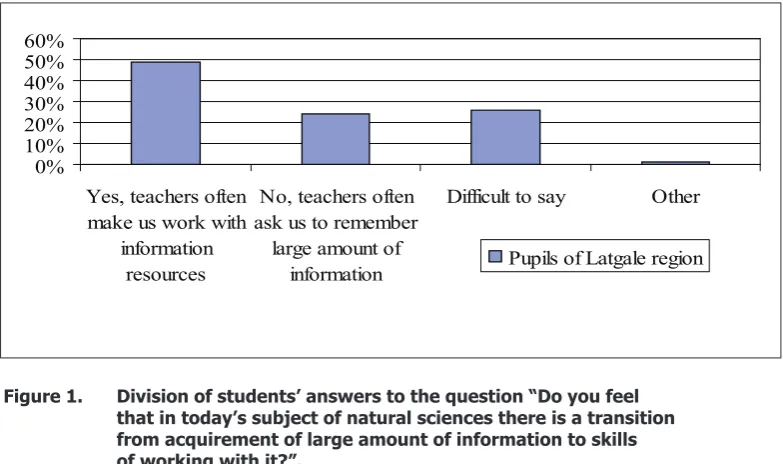
one of modern viewpoints in education foresees the advance from learning large amount of information to development of skills in working with information. nowadays it is especially important, because, due to the technological progress and rapid development, the content of science is increasing, deepening and, for living in the information society, it is necessary to be able to acquire, evaluate significant fact knowledge very quickly and transfer it with help of information and communication technologies. in this aspect the students were asked the question: “do you feel that in today’s subjects of natural sciences there is a transition from acquirement of large amount of information to skills of working with it?” about a half of students admit that teachers of natural sciences more often ask to work with information resources, but the alarming is the statement of one fourth of the students that their teachers are more inclined to demand to remember large amount of information (see figure 1). some students have an opinion that teachers think that only books are workable information resources and do not orientate students to use modern technologies.
0% 10% 20% 30% 40% 50% 60%
yes, teachers often make us work with
information resources
no, teachers often ask us to remember large amount of
information
difficult to say other
pupils of latgale region
Figure 1. Division of students’ answers to the question “Do you feel that in today’s subject of natural sciences there is a transition from acquirement of large amount of information to skills of working with it?”.
0% 10% 20% 30% 40% 50% 60%
yes no partially other
pupils of latgale region
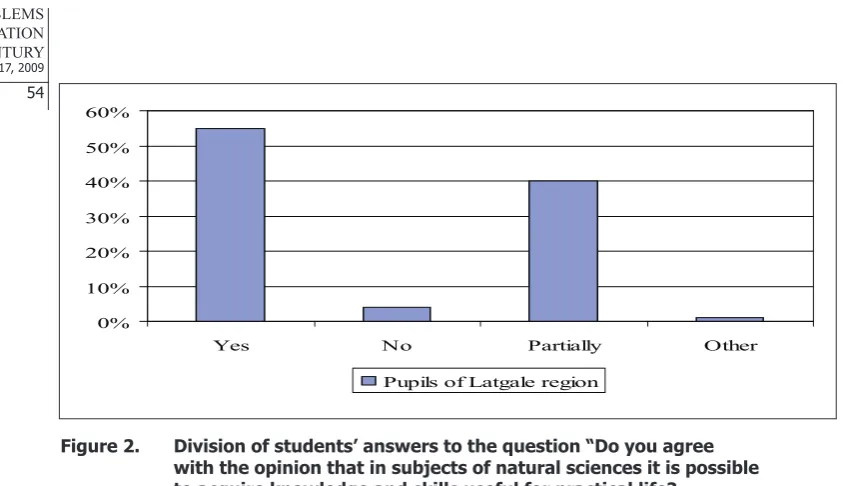
Figure 2. Division of students’ answers to the question “Do you agree with the opinion that in subjects of natural sciences it is possible to acquire knowledge and skills useful for practical life?.
learning of natural sciences at basic school is based on practical investigation work, because natural sciences are experimental sciences. it means that it is important to evaluate the material and technical support at the classroom of natural sciences and possibilities for full-blooded and qualitative teaching process, realising the requirements of the state standards of basic education in subject of natural sciences. the students were asked: “how do you evaluate the equipment of the classroom of natural sciences for performing experimental and investigational work at lessons?”
evaluating the technical support available at classrooms of natural sciences in their schools, the students describe it as out-of-date (see figure 3). 41% of students think that the equipment at the classroom has not been changed for years, and 5% of students, expressing their opinion, were even stricter saying that the inventory is old, it is difficult to work with it and the number of accessories is decreasing. only 15% of the inquired students think that classrooms of natural sciences at their schools are supplied with modern equipment and accessories.
0% 5% 10% 15% 20% 25% 30% 35% 40% 45%
classrooms are supplied with modern
equipment and accessoiries
equipment has not changed very much for
years
equipment is gradually
being supplemented other
pupils of latgale region
Figure 3. Division of students’ answers to the question “How do you
55
of education in the 21st century Volume 17, 2009
students’ knowledge interests and related motives take an important place in learning. they are expressed as students’ conscious wish to learn and the teacher must support and maintain them. it is important to develop interest in the study material, mentioning interesting facts, varying lessons, introducing new types of activities.
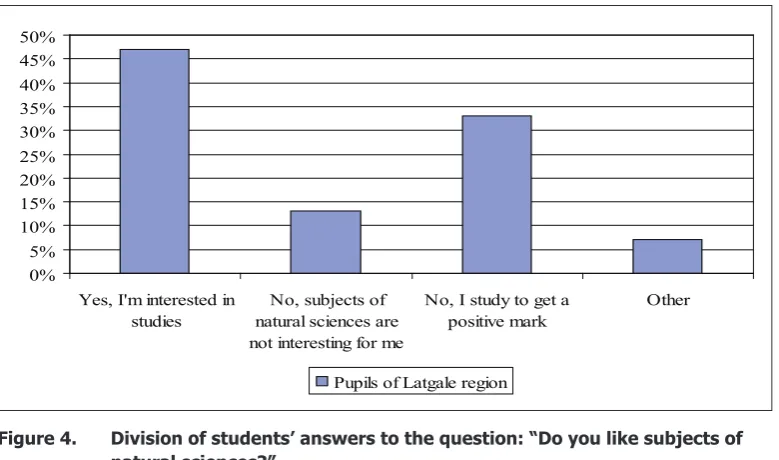
Within the inquiry students were asked: “do you like subjects of natural sciences?” results show that almost a half of students (47%) are interested in natural sciences and they learn willingly, but another half (13% and 33%) do not have this interest, natural sciences do not attract them or they study them only for getting a positive mark (figure 4). a part of students (7%) choose the reply variant “Other”, which however shows their insufficient interest in natural sciences – they affirm that they do not adore subject of natural sciences; the interest depends on a subject, they are interested only in some topics; they are interested only in laboratory practical tasks.
0% 5% 10% 15% 20% 25% 30% 35% 40% 45% 50%
yes, i'm interested in
studies natural sciences areno, subjects of not interesting for me
no, i study to get a
positive mark other
pupils of latgale region
Figure 4. Division of students’ answers to the question: “Do you like subjects of natural sciences?”.
in the process of learning natural sciences students’ concerned interest, expression of positive emotional experience can be seen:
• when new information is acquired with a moment of surprise; • when the teacher demonstrates impressive experiments;
• when a possibility is given to students to plan, prepare and perform experiments; • when the teacher shows that students could use their energy and capacity for work; • when the teacher discovers impressive problem solutions, accentuating visual attraction of equipment and models;
• when listening to convincing opinions;
• when doing independent research resulting in discovery delight.
0% 5% 10% 15% 20% 25% 30% 35% 40% 45% 50%
learning content must include more modern topics, issues related to
practical life
there must be more possibilities to work practically, make experiments, do research
studies must be directed to the search for the relations between the known and unknown, posing questions, looking
for answers and solving problems
other
pupils of latgale region
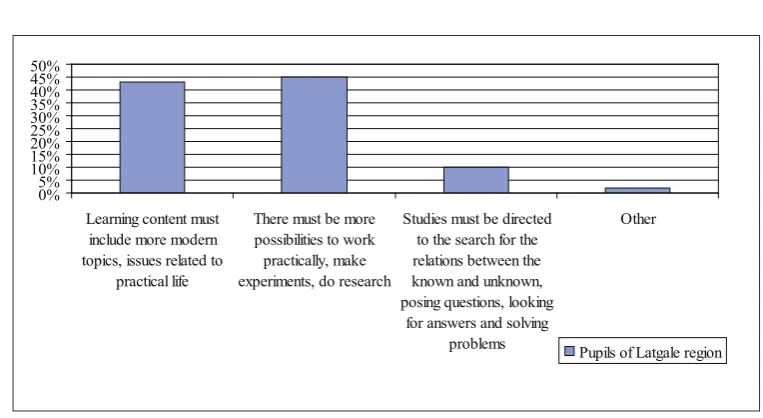
Figure 5. Division of students’ answers to the question “What should be changed to make subjects of natural sciences more interesting and attractive?”.
last years in latvia the reform of the content of basic education is going on. during its process teachers also must change many things in their work. all this requires time, but evaluating respondents’ answers we can conclude that the situation is gradually changing, furthermore the changes have desired direction and we can hope that, if the process continues, in future we can expect positive changes in the sphere of natural science education.
Conclusions
1. Natural science education is considered as a process and result of scientific investigation of nature phenomena; it is important to get prepared for work life to manage everyday life, to develop the world view and attitude to the surrounding world.
2. the content of subjects of natural science must be directed to the research work, investigating nature phenomena and processes. it is important for every teacher to realize his/her approach and work systematically, because students are able to acquire more in the systematic environment and process, instead of a chaotic and mechanical mixture of different approaches.
3. the study work at school is organised to make it possible for the student to get varied experience – to study by doing, discovering and solving problems; they could develop skills of planning, organising and realizing studies; they could find help and consultations; they could give advice and render help to others.
4. the research that was done in educational institutions of latgale region allows to judge about the process of the reform in the content of basic education. answering to every question of the inquiry approximately 50% of students give positive answers, which means that the process of the reform in acquisition of scientific education is going in the desired direction.
5. in latvian schools equipping of classrooms of natural sciences with modern accessories for research work is going on very slowly. none of the institutions participating in the given research possesses equipment that could be called optimal for organisation of the qualitative teaching process of natural science lessons. it is a serious reason that hampers ensuring investigation interest and development of students’ research skills.
57
of education in the 21st century Volume 17, 2009
References
Broks, A. (1998). Parādību zinātniskā izziņa. Skolotājs, 5, 12–17.
council of europe. (1997). Key competencies for Europe. Report of the Symposium in Berne 27–30 March, 1996. strasbourg.
Čehlova, Z. (2002). Izziņas aktivitāte mācībās. Rīga: RaKa.
eurydice. (2006). Science Teaching in Schools in Europe. Policies and Research. brussels. fišers, r. (2005). Mācīsim bērniem domāt. Rīga: RaKa.
Goulmens, d. (2001). Tava emocionālā inteliģence. Rīga: Jumava. Gudjons, h. (1998). Pedagoģijas pamatatziņas. Rīga: Zvaigzne ABC.
hansena, K., Kaufmane, r. (1998). Izglītība un demokrātijas kultūra: Bērnības pieredze. Rīga: Sorosa fonds – latvija.
isec. (2004). Pamatizglītības mācību priekšmetu standarti. Rīga.
pekrun, r. (1996). emotional development. International Encyclopedia of Developmental and Instructional Psychology. pergamon, 263–268.
Špona, a. (2001). Audzināšanas teorija un prakse. Rīga: RaKa. Zelmenis, V. (2000). Pedagoģijas pamati. Rīga: RaKa.
Žogla, I. (1997). Skolas pedagoģija. Skolotājs, 5, 8–10. Žogla, I. (2001). Didaktikas teorētiskie pamati. Rīga: RaKa.
Немов, Р.С. (1990). Психология. Москва: Просвещение.
Adviced by Velta Lubkina, Rezekne Higher Education Institution, Latvia
Janis Dzerviniks Assoc. Professor, Dean of Faculty of Pedagogy, Rezekne Higher Education Institution, Tinanova Street 70A, Rezekne, Latvia.