174
http://ijcjournal.org/Exploring Key Determinants of Job Efficiency Associated
With Adoption of Private Cloud Services
Chi-Hui Chiang*
Department of Information Management,Chia-Nan University of Pharmacy & Science
No.60, Sec. 1, Erren Rd., Rende Dist., Tainan City 71710, Taiwan (R.O.C.)
Email: [email protected]
Abstract
When adopting private cloud services, companies must consider several factors including the popularity of information technology equipment, allocation of network resources, adoption of cloud platforms, and employees’ perceived effectiveness of the technology. For enhancing job satisfaction and efficiency, this study explored the key determinants of the adoption of private cloud services based on favorable technology and resources, self-efficacy, and technology acceptance. We constructed a research model for conducting empirical analyses to test the related hypotheses. The results revealed that the key factors, namely resource-facilitating conditions, technology-facilitating conditions, and Internet self-efficacy had a significant effect on work efficiency. Moreover, web-specific control and perceived self-control had negligible effects on work efficiency. Herein, we provide implications for academicians and practitioners for future adoption, in addition to providing several suggestions for improvement.
Keywords: Private cloud service; key determinant factors; job efficiency; Internet self-efficacy; satisfaction.
1. Introduction
The rapid development of cloud computing and the ubiquity of smart devices have resulted in increasing numbers of enterprises adopting cloud services. Several studies have indicated that an appropriate cloud service is a critical consideration in the success of a network service system [1-6]. Cloud services not only offer advantages such as convenience and low-cost processing efficiency between an enterprise and employees but also provide flexibility and adaptability for using computing resources on demand [7].
---
175
Stieninger, and his colleagues [8] reported that cloud computing is an important area for information technology (IT) innovation and business investment. Cloud computing, such as cloud services, has received increasing attention in both practice and research.
Several enterprises have introduced new services that will replace many types of computational resources currently used. Thus, the key determinant factors are considered to play a fundamental role in defining how cloud services are adopted. The rapid growth of cloud computing services has attracted the attention of both the public and private sectors. Several studies have reported on the development of cloud services in the application stage. Enterprises adopt various cloud services for mobile applications with the objective of facilitating various business operations for employees and in turn improving business performance and competitiveness [4, 9-11]. Therefore, understanding the antecedents and consequences of the adoption of cloud services in companies for job efficiency promotion is important from a practical viewpoint.
Enterprises use private cloud services such as cloud storage, cloud-based email accounts, calendars (for team time planning), intranet connections, collaboration platforms, document management, applications, line groups, and video calls. Thus, employees can connect and access private cloud services through mobile devices to manage tasks [1, 4]. Accordingly, enterprises intending to adopt cloud services must consider whether their internal resources are sufficient to support cloud services. For example, for smooth Internet connections, improving the broadband speed may be necessary. Updating computer hardware may also be necessary to enable employees to run complex software functions. Specifically, cloud services focus on information streams and require well-equipped hardware and software environments to ensure that employees can access services.
Relevant studies conducted on cloud services have focused on topics such as cloud computing architecture, establishment of service platforms, applicable areas for cloud computing services, research and development of cloud technologies, potential benefits of cloud computing, integration with internal IT, and performance issues [1, 4, 9-13]. These topics indicate that cloud services have become a prominent focus of research. Their ubiquity and high profile have driven a constant stream of suppliers that will continue to provide related products and services to meet business and user needs [4, 14]. Nevertheless, performance improvements achieved by enterprises adopting private cloud services cannot solely provide clear information. Therefore, the objective of the present study was to explore key determinants of employees’ adoption of private cloud services and to determine how the adoption process effectively improves the employees’ job efficiency, which also affects the willingness of enterprises to adopt private cloud services. Few studies have focused on the adoption of cloud services by employees. In this study, we explored key determinants of enterprises’ adoption of private cloud services and demonstrated how employees benefit from the adoption of private cloud services with respect to their job efficiency.
2. Literature Review and Hypothesis Development
2.1. Cloud Services
176
provide multiple benefits such as increased flexibility and agility [8]. Because of its efficiency and convenience, cloud computing provides dynamically scalable computing resources such as storage, computing power, and applications delivered as a service [15]. Technically, cloud computing enables computer software and hardware resources to be accessed over the Internet without the need for any detailed or specific knowledge of the infrastructure used to deliver the resources [16]. Thus, the continuing development of cloud computing globally has caused companies to focus increasingly on cloud services. Major information software vendors must aggressively promote cloud building and cloud services for mobile applications. Moreover, smart mobile devices (e.g., notebooks, tablets, and smartphones) have become ubiquitous. These devices can be used to set up multifunction software such as document management, instant messaging, browser, email, GPRS mobile Internet access, multimedia content download, photography and filming, audio and video player, GPS navigation, and software update download applications.
Driven by market forces such as diversified development that combines mobile applications, cloud computing has become an important technology for corporate IT applications. Therefore, for using cloud services, enterprises must understand cloud computing architecture and its application environments. Cloud computing reduces the costs of information equipment and management by delivering scalable computing resources [4, 16]. It offers dedicated computing resources and services through the rapid deployment and configuration of innovative application tools and services through the Internet. Additionally, cloud computing allows access to computing resources and services through the Internet without the need of complex back-end management and operations models. It allows access to remote resources through the Internet and has the capability to expand in scale. Therefore, enterprises can introduce cloud services and integrate them with related internal systems. Employees can connect to their internal information systems through cloud service platforms anywhere and anytime to manage various tasks [17]. Cloud services can help developers build, deploy, and distribute Internet services and applications on the Internet. Long-term use of cloud services by employees enables companies to reduce capital expenses and operating costs required to maintain their existing applications and conduct cost planning in alignment with the reduced requirements for new services [5, 18, 19].
In our study, the use of cloud services was expected to engender convenience for employees. Regarding the measurement of perceived efficacy and behavioral control in terms of the use of private cloud services by employees, we reviewed the relevant literature. Research has suggested that perceived behavioral control (PBC) refers to people’s belief in the ease of controlling their own behaviors and that it has a direct effect on people’s behaviors [20, 21]. Ajzen [22] reported on people’s beliefs in their ability to perform a given behavior or their having the resources or opportunity to perform a given behavior. In particular, in the age of information networking technology, to remain updated and increase their effectiveness and competitiveness, enterprises introduce several IT products such as mobile equipment into organizational processes. Thus, PBC affects individuals’ ability to use their resources or opportunities. Similarly, PBC can strongly affect an employee’s actual behavior and control. Therefore, in this study, PBC was defined as the effect of the use of private cloud services for mobile devices on employees’ control, including prediction of control efficacy and measures for interpreting control efficacy.
177
technology. Organizational and social systems such as perceived behavioral influence and self-efficacy in computer or Internet resource constraints play an important role in determining the adoption of private cloud services. Consequently, an extension of the technology acceptance model (TAM) with Internet self-efficacy and the theory of planned behavior (TPB), including PBC, was required to comprehensively examine the adoption of private cloud services. In this extension, satisfaction was included as an important determinant of job efficiency.
2.2. Relationship Among Resource-Facilitating Conditions, Usefulness, and Ease of Use
PBC reflects a person’s perception of ease or difficulty toward implementing a behavior. According to the TPB, a person’s actual behavior in performing a certain action is directly influenced by the person’s behavioral intention, which may in turn be influenced by beliefs about the presence of control factors that may facilitate or hinder the behavior. Teo [23] revealed that PBC has a relational effect on technology acceptance (such as usefulness and ease of use) regarding the use of computer services. Thus, control beliefs regarding resources and technologies are the underlying determinants of PBC and can be depicted as control beliefs weighted by perceived power of the control factor. Control beliefs can be classified into three dimensions: perceived self-control (PSC), resource-facilitating conditions (RFCs), and technology-facilitating conditions (TFCs) as potential variables [24]. The decomposed TPB should provide a more complete understanding of IT adoption, compared with the more parsimonious TAM, such as ease of use and usefulness [25]. On the basis of the preceding statement, it is more favorable to extend the TAM model with the TPB or decomposed TPB in order to extensively consider the potential underlying determinants, system features, organizational members, and social system, for better predicting the intention toward the initial adoption of online services [24]. Horst and his colleagues [26] argued that the TAM may promote users to perceive behavior of e-services. Users may also adopt services because of the level of resource facilitation. Moreover, RFCs affect the usefulness and ease of use of online services. In this study, we considered that for increasing job efficiency, employees can control and access the utilization and acquisition of external resources and information associated with hardware and software updates. RFCs collated in this study included human, financial, technical, and management resources. This implies that employees can control specific resources, while the latter can also fully support the former with their need to use the equipment and systems. Mitra and his colleagues [27] further indicated that enterprises consider a variety of resources to access cloud information, such as system services and operational processes. Studies have reported that resources facilitating the tasks of online users can satisfy their perceived cloud efficiency through experience, further affecting their adoption intention [28, 29]. Thus, the higher the degree to which the resources are controlled by an employee under facilitating conditions, the more likely is the employee to succeed in performing the behavior [30]. This study investigated the effect of RFCs on job efficiency in the adoption of private cloud services by employees. The following hypotheses were proposed:
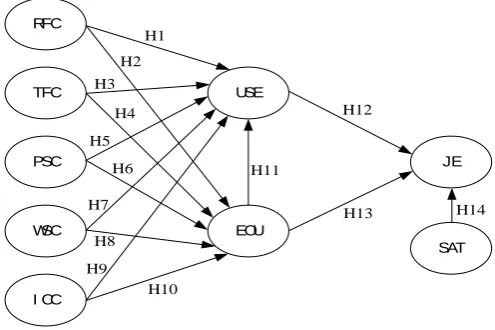
H1: RFCs have a positive effect on usefulness in the adoption of private cloud services. H2: RFCs have a positive effect on ease of use in the adoption of private cloud services.
2.3. Relationship Among TFCs, Usefulness, and Ease of Use
178
as cloud storage and calendar) and system resources (such as collaboration platforms and instant messaging groups). Moreover, TFCs refer to degree to which users believe that the existing social system infrastructure can support the use of cloud computing services [5, 15, 24, 25]. Zhang [31] reported that the import of technology is an effective means of facilitating technological progress to medium-sized industrial enterprises, thereby enhancing their productivity. Adnan and his colleagues [32] reported technology-aided operation as an important efficiency to link relative job advantages. Studies have revealed a higher degree to which the information service control can facilitating conditions and provide technical support. This indicates that the easier it is to control the equipment, the higher is the usefulness of performing the behavior [30]. This study investigated the effect of TFCs in the adoption of private cloud services by employees on the usefulness and ease of use of cloud services. Therefore, TFCs were defined as the effect of employees adopting private cloud services with the ability to control TFCs on the usefulness and ease of use. The following hypotheses were thus proposed:
H3: TFCs have a positive effect on usefulness in the adoption of private cloud services. H4: TFCs have a positive effect on ease of use in the adoption of private cloud services.
2.4. Relationship Among Perceived Self-Control, Usefulness, and Ease of Use
PSC refers to an individual’s belief that an action can be controlled or an individual’s expectations to achieve a goal or accomplish a task [33]. Specifically, the higher a person’s perceived control efficacy is, the greater the amount of resources the person obtains for the behavioral control. In particular, self-control involves not only computer skills but also the use of Internet services. In our study, we defined PSC as a person’s judgment regarding the control of computers and services. The judgment can affect the efficacy of the person after use; efficacy is based on the user’s self-assessment of his or her ability to accomplish a given behavior or task (e.g., using a computer to collect data or perform data analysis) [34].In the discussion of the relationships between PSC, usefulness, and ease of use, several researchers have considered that PSC has a direct effect on usefulness and ease of use [23, 26]. Wu and Chen [35] discovered in an online service research that users’ self-control task has a positive effect on usefulness and ease of use. In addition, with respect to professional business services, Arslanagic-Kalajdzic and Zabkar [36] further indicated that users’ perceived control function positively influences technology adoption. Studies have revealed that users with greater control abilities can also personally create and maintain tasks for different needs by applying basic computer skills through the Internet; this thus demonstrates the ease of computer control in such users [26, 37]. This study investigated the degree to which the adoption of cloud services by corporate employees affects their PSC over job efficiency. Therefore, PSC was defined as how employees assess their job efficiency in relation to their adoption of private cloud services [38]. The following hypotheses were thus proposed:
H5: PSC has a positive effect on usefulness in the adoption of private cloud services. H6: PSC has a positive effect on ease of use in the adoption of private cloud services.
179
The TPB has also been applied to explain an individual’s adoption and use of a new technology [39]. Internet self-efficacy refers to a person’s beliefs in his or her ability to effectively use or execute Internet services after using such services [34, 40]. Studies have revealed that the perceived efficacy from self-judgment by users after the use of Internet services can be considered Internet efficacy [41, 42]. Thus, users cognitively assess in favor of usefulness and ease of use, which boosts their confidence and affects their intention to adopt Internet services. Torkzadeh and van Dyke [43] reported that Internet self-efficacy is a potentially important factor in the use of e-services. In particular, understanding the acceptance pattern and role of Internet self-efficacy in e-service adoption is an important research concern. Studies have supported the relationship between computer self-efficacy and decisions involving computer usage and adoption [37, 44-46]. Chiu and Tsai [47] reported that Internet self-efficacy can predict users’ performance in job task in web-based instructions. Thus, web-specific self-control refers to an individual’s perception of his or her ability to use specific web application services within the scope of general Internet computing. Web-specific control (WSC) is the web-specific self-efficacy generated by users making subjective judgment while using Internet service platforms. Researchers revealed that users’ perceived efficacy generated after the use of web-specific services can be considered web-specific efficacy; users cognitively perceive efficacy, believing that services provided by the website are useful and easy to control [48]. Ariff and his colleagues [49] argued that self-efficacy can be used to extend the TAM to the use of web service systems. Therefore, the following hypotheses were proposed:
H7: Web-specific self-control has a positive effect on usefulness in the adoption of private cloud services. H8: Web-specific self-control has a positive effect on ease of use in the adoption of private cloud services.
2.6. Relationship Among Internet Connection Control, Usefulness, and Ease of Use
The TPB can explain and predict an individual’s acceptance of new IT, and its extended model is suitable for further understanding the acceptance of e-services because of its strong theoretical foundation and inclusion of self-efficacy [41]. By integrating factors with the TAM, Park and Kim [15] reported several cognitive factors that contribute to shaping user perceptions toward cloud computing services. This concept was extended to the generated efficacy with usefulness and ease of use after the adoption of cloud services by users through the Internet. Thus, Internet connection control (ICC) is the assessment on Internet efficacy by users after their connection to cloud services through the Internet and the generated efficacy with usefulness and ease of use will affect their intention to use. Smith [50] argued that Internet connection quality may promote users’ perceived value of adopting online services acceptance. Users may also adopt cloud services due to the control of Internet connection. In addition, Simsim [51] revealed that the factor influencing Internet service adoption may be related to users’ preference of Internet access times, communication system used for the connection, and technical attributes of the Internet connection. In our study, we created causality between ICC, usefulness, and ease of use regarding the adoption of private cloud services. Scale adoption was based on the theories introduced by Hsu and Chiu [41]. On the basis of the scale proposed by Hsu and Chiu [41], we modified a scale appropriate for measurement in this study. Therefore, the following hypotheses were proposed:
180
2.7. Relationship Among Usefulness, Ease of Use, and Job Efficiency
Efficiency can be extended from Bandura’s self-efficacy theory and refers to a person’s verified high efficiency in handling a specific task based on the person’s experience of several successes and failures managing the task [33]. In recent years, enterprises have used IT to improve the working efficiency of employees considerably [52-55]. Employees’ efficiency was usually the will that was dependent on IT [56]. Aznoli and Navimipour [57] reported that a higher perceived efficiency can motivate employees to adopt cloud services. Job efficiency is the employees’ expectation of applying self-efficacy and refers to an individual’s belief in the ability to succeed in accomplishing a given task or behavior [58].Studies have revealed that the TAM is a suitable theoretical model to verify the adoption of IT [59, 60]. Thus, usefulness and ease of use can be derived from the TAM, which has been used to verify the adoption of online service in the literature [61-64].
In particular, Park and Kim [15] revealed that ease of use is significantly affected by the usefulness of mobile cloud services. In our study, we considered that employees can accomplish their online operations more rapidly if they find that private cloud services can provide the information they need while using these services. Thus, the more users can realize the usefulness of private cloud services, the easier it is for them to focus on the use of these services.Chen and his colleagues [65], Muñoz-Leiva and his colleagues [66] have argued that the higher the usefulness and ease of use are after use, the better is the use efficacy and intention to adopt. Studies have reported that user-perceived IT usefulness and ease of use affect the efficacy of use and intention to use.
The present study applied this concept to the development of research variables regarding the adoption of private cloud services and created causality between usefulness, ease of use, and job efficiency. Therefore, we developed a scale appropriate for this study by citing and modifying Davis [60] theory and test items for usefulness and ease of use [33] and test items for job efficiency. The following hypotheses were proposed:
H11: Ease of use in the adoption of private cloud services has a positive effect on usefulness. H12: Usefulness in the adoption of private cloud services has a positive effect on job efficiency. H13: Ease of use in the adoption of private cloud services has a positive effect on job efficiency.
2.8. Relationship Between Satisfaction and Job Efficiency
This study extended the TAM by including an additional factor, namnely satisfaction. Previous research showed that satisfaction is a key factor that affects adoption intention [67]. In recent years, several studies on the adoption of Internet services have revealed that users’ intention to adopt is mainly determined by how satisfied they are with the resulting efficacy after system adoption [68-73]. These studies have further verified that satisfaction is well related to users’ intention to adopt online services [15, 74]. Duan [6] argued that cloud service performance may be crucial and beneficial to enterprises’ adoption intention. Moreover, the mentioned studies have verified that user satisfaction with online services and post-adoption efficiency affects their intention to adopt services. Thus, the following hypothesis was presented:
181
3. Methodology3.1. Research Model
On the basis of the literature review and hypotheses, this study developed an extended research model (Fig. 1). The proposed model is based on the extended TAM. Dishaw and Strong [75] reported that the TAM focuses on a particular IT developed by users based on the perceived usefulness and ease of use of the IT. The TAM is considered to be an independent concern for enterprises [76, 77]. Recently, Bach and his colleagues [59], Sternad and Bobek [78] have suggested that significant factors are not included in the TAM. For increasing the external validity of the TAM and more clearly understanding the factors that influence usefulness and ease of use, the inclusion of other significant factors is necessary. Thus, in our study, the TAM postulated that external variables intervene indirectly by influencing the perceived ease of use and usefulness. External variables considered with respect to individual acceptance of IT include situational involvement and intrinsic involvement [79].
RFC
TFC
PSC
WSC
I CC
USE
EOU
JE
SAT
H1
H2
H3
H4
H5
H6
H7
H8
H9
H10
H11
H12
H13 H14
Figure 1: Research model
182
3.2. Descriptive Statistics Analysis
The questionnaire responses comprised responses from the employees of 367 profitable small and medium enterprises (out of 480) who were eligible for the analysis. The overall response rate for the study was 76.46%, which was regarded as relatively high, especially because the respondents were employees who are supposed to be too busy to answer questionnaires. The SPSS 18 was used for the statistical analysis of the survey data. Basic descriptive statistics analysis is shown in Table 1.
Table 1: Demographic Profile of Respondents
Profiles Sample composition Frequency Ratio
(%)
Gender Male 180 49.05%
Female 187 50.95%
Age 20 or less 21 5.72%
21-30 144 39.24%
31-40 158 43.05%
41-50 32 8.72%
51 or over 12 3.27%
Education Below Senior high/ Vocational
school
34 9.26%
University & Junior college 262 71.39% Graduate school and above 71 19.35%
Industry type IT 104 28.34%
Manufacturing 136 37.06%
Services 89 24.25%
Finance 13 3.54%
Public sector 6 1.63%
Healthcare 19 5.18%
Average time of using private cloud services per day
Less than one hour 87 23.71%
1–2 h 195 53.13%
3–4 h 56 15.26%
5–7 h 21 5.72%
More than 8 h 8 2.18%
Tools for using private cloud services (multiple choices allowed)
Mobile phone 351 95.64%
Notebook 156 42.51%
Desktop 235 64.03%
Tablet 87 23.72%
Experience of using private cloud services Less than one year 76 20.71%
1–3 years 197 53.68%
4–6 years 42 11.44%
7–9 years 34 9.26%
More than 10 years 18 4.90%
Understanding of efficacy of private cloud services
Good 107 29.1%
Average 229 62.6%
Poor 31 8.4%
Acceptance of security of private cloud services Trust 277 75.5%
Distrust 90 24.5%
Type of private cloud service used (Multiple choices allowed)
Company cloud storage 196 53.41%
Company dedicated cloud-based email account
81 22.07%
Calendar (for team time planning) 62 16.89%
Internal system 175 47.68%
Collaboration platform 67 18.26%
Document management 175 47.68%
183
Instant messaging group 206 56.13%
Instant video call 127 34.60%
In all, by gender, 180 males (49.05%) and 187 females (50.95%); by age, majority of the respondents were in the age range of 31–40, numbering 158 (43.05%); by education, predominantly university graduates, numbering 262 (71.39%), by occupation, a concentration on manufacturing, numbering 136 (37.06%); majority using private cloud services for 1–2 h,
numbering 195 (53.13%); majority used private cloud services on mobile phones, numbering 351 (95.64%); majority had experience of using private cloud services for 1–3 years, numbering 197 (53.68%); and majority had good understanding of the efficacy of private cloud services, numbering 229 (62.6%). Regarding the acceptance of the security of private cloud services, 277 respondents (75.5%) expressed trust. Regarding the type of private cloud services, majority used instant messaging groups, numbering 206 (56.13%), followed by cloud storage used by 196 respondents (53.41%).
3.3. Reliability Analysis
Table 2: Matrix of items in each construct and their item–total correlations and Cronbach’s α
Constructs Measurement items Item-total
correlation Cronbach’s α Resource Facilitating Conditions (RFC)
RFC1: I think resource distribution in private cloud services is very even.
RFC2: I think resource distribution in private cloud services is efficient.
RFC3: I am satisfied with resource distribution in private cloud services.
RFC4: Overall, I think resource distribution in private cloud services is appropriate.
0.705 0.668 0.643 0.656 0.899 Technology facilitating conditions (TFC)
TFC1: I am confident about the private cloud services technology.
TFC2: I think the private cloud services technology is efficient.
TFC3: I am satisfied with the private cloud services technology.
TFC4: Overall, I am satisfied with the private cloud services technology. 0.751 0.748 0.780 0.746 0.908 Perceived self-control (PSC)
PSC1: I have the ability to control private cloud services.
PSC2: I have confidence in the control over private cloud services.
PSC3: I have the efficacy to control over private cloud services.
PSC4: Overall, I have good control over the private cloud services. 0.697 0.716 0.721 0.697 0.895 Web-specific control (WSC)
WSC1: I think the information in the private cloud service platform is correct.
WSC2: I can accomplish tasks effectively using the private cloud service platform.
WSC3: I have great confidence in the operation of the private cloud service platform.
WSC4: I have confidence in using the functions of the private cloud service platform.
184
WSC5: Overall, I am satisfied with the control over the private cloud service platform.
Internet connection control
(ICC)
ICC1: I think the Internet connection control in private cloud services is stable.
ICC2: My control over the Internet connection to private cloud services is very efficient.
ICC3: I have confidence in my control over the Internet connection to private cloud services. ICC4: I am satisfied with the Internet connection to the private cloud services.
ICC5: Overall, I am satisfied with my control over the Internet connection to the private cloud services.
0.785 0.760 0.750 0.755 0.732 0.931 Usefulness (USE)
USE1: The functions in private cloud services can help task accomplishment.
USE2: The functions in private cloud services can meet task demands.
USE3: The functions in private cloud services can improve work efficiency.
USE4: Overall, the functions in private cloud services are helpful for work.
0.796 0.760 0.763 0.773
0.907
Ease of use (EOU)
EOU1: The interface for private cloud services is easy to operate.
EOU2: The use of private cloud services is easy to understand.
EOU3: The function settings in private cloud services are easy to use.
EOU4: The functions in private cloud services are easy to control.
EOU5: Overall, I think the operation in private cloud services is easy to use.
0.702 0.685 0.677 0.717 0.704 0.916 Job efficiency (JE)
JE1: The use of private cloud services is helpful for work.
JE2: The use of private cloud services enables improved job efficiency.
JE3: The use of private cloud services enables higher speed at work.
JE4: Overall, the use of private cloud services is helpful to improve job efficiency.
0.748 0.709 0.723 0.777 0.904 Satisfaction (SAT)
SAT1: The use of private cloud services is satisfactory.
SAT2: I am satisfied with the functions in private cloud services after use.
SAT3: I have a satisfactory experience in using private cloud services.
SAT4: I have a pleasant experience in using private cloud services.
SAT5: Overall, I am very satisfied with private cloud services. 0.717 0.726 0.688 0.724 0.711 0.892
In the reliability test, the results reached the required stability and consistency. Hair and his colleagues [84] suggested that the Cronbach α value must be greater than 0.7 and the corrected item–total correlation must be greater than 0.5; a value of less than 0.5 indicates removal of the corresponding item. Items in each construct in
the study met these standards: The Cronbach α value was greater than 0.7 and the item–total correlation was
185
remove any item, as shown in Table 2.3.4. Validity Analysis
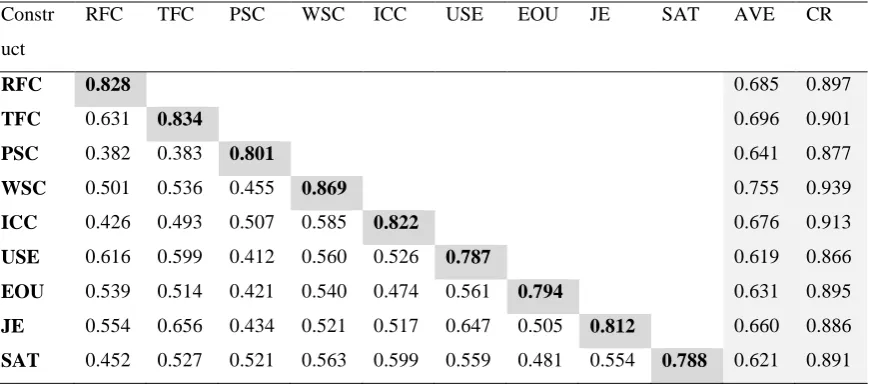
In this study, validity testing followed the construct validity introduced by Fornell and Larcker [85], which was divided into two categories: convergent and discriminant validity. Regarding convergent validity, Fornell and Larcker [85] suggested that the standardized factor loading (SFL)
should be greater than 0.5, component reliability (CR) should be greater than 0.7 in the ideal case, and average variance extracted (AVE) should optimally be greater than 0.5. The study met all of these standards, as presented in Table 3.
Regarding discriminant validity, for testing the degree of cross-construct correlation, a lower degree of correlation indicates higher discriminant validity. Chin [86] suggested that the square roots of the AVE on the diagonal line must be greater than all the cross-construct correlations on the non-diagonal lines. The square roots of the AVE in the study were all greater than the cross-construct correlation coefficients, indicating good discriminant validity, as shown in Table 3.
On the basis of the aforementioned data analysis results, the internal quality of the research model was mainly used for evaluating the significance of parameters for estimation and the reliability of individual constructs and potential variables. The described evaluation results show that all of them had component reliability levels greater than 0.7 and AVE values greater than 0.5. This implies that this model has a good internal fit. Overall, most of the indices met the suggested standards, indicating a good overall model fit in this study [84].
Table 3: Summary of Discriminant Validity Analysis, CR, and AVE
Constr uct
RFC TFC PSC WSC ICC USE EOU JE SAT AVE CR
RFC 0.828 0.685 0.897
TFC 0.631 0.834 0.696 0.901
PSC 0.382 0.383 0.801 0.641 0.877
WSC 0.501 0.536 0.455 0.869 0.755 0.939
ICC 0.426 0.493 0.507 0.585 0.822 0.676 0.913
USE 0.616 0.599 0.412 0.560 0.526 0.787 0.619 0.866
EOU 0.539 0.514 0.421 0.540 0.474 0.561 0.794 0.631 0.895 JE 0.554 0.656 0.434 0.521 0.517 0.647 0.505 0.812 0.660 0.886 SAT 0.452 0.527 0.521 0.563 0.599 0.559 0.481 0.554 0.788 0.621 0.891
Note: Diagonal line displays the square roots of AVE.
186
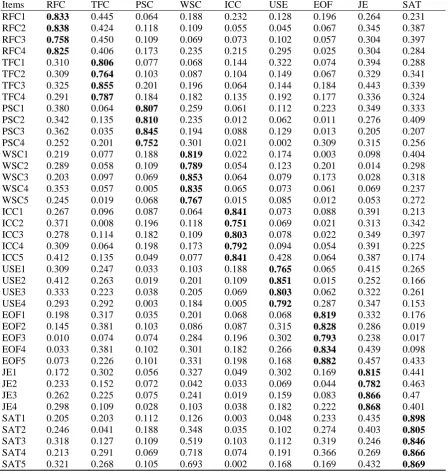
Results of Harman’s single-factor test revealed that common method bias is not a concern in this study [87], as shown in Table 4.
Table 4: Confirmatory Factor Analysis for the Full Sample (N = 367)
Items RFC TFC PSC WSC ICC USE EOF JE SAT
RFC1 0.833 0.445 0.064 0.188 0.232 0.128 0.196 0.264 0.231 RFC2 0.838 0.424 0.118 0.109 0.055 0.045 0.067 0.345 0.387 RFC3 0.758 0.450 0.109 0.069 0.073 0.102 0.057 0.304 0.397 RFC4 0.825 0.406 0.173 0.235 0.215 0.295 0.025 0.304 0.284 TFC1 0.310 0.806 0.077 0.068 0.144 0.322 0.074 0.394 0.288 TFC2 0.309 0.764 0.103 0.087 0.104 0.149 0.067 0.329 0.341 TFC3 0.325 0.855 0.201 0.196 0.064 0.144 0.184 0.443 0.339 TFC4 0.291 0.787 0.184 0.182 0.135 0.192 0.177 0.336 0.324 PSC1 0.380 0.064 0.807 0.259 0.061 0.112 0.223 0.349 0.333 PSC2 0.342 0.135 0.810 0.235 0.012 0.062 0.011 0.276 0.409 PSC3 0.362 0.035 0.845 0.194 0.088 0.129 0.013 0.205 0.207 PSC4 0.252 0.201 0.752 0.301 0.021 0.002 0.309 0.315 0.256 WSC1 0.219 0.077 0.188 0.819 0.022 0.174 0.003 0.098 0.404 WSC2 0.289 0.058 0.109 0.789 0.054 0.123 0.201 0.014 0.298 WSC3 0.203 0.097 0.069 0.853 0.064 0.079 0.173 0.028 0.318 WSC4 0.353 0.057 0.005 0.835 0.065 0.073 0.061 0.069 0.237 WSC5 0.245 0.019 0.068 0.767 0.015 0.085 0.012 0.053 0.272 ICC1 0.267 0.096 0.087 0.064 0.841 0.073 0.088 0.391 0.213 ICC2 0.371 0.008 0.196 0.118 0.751 0.069 0.021 0.313 0.342 ICC3 0.278 0.114 0.182 0.109 0.803 0.078 0.022 0.349 0.397 ICC4 0.309 0.064 0.198 0.173 0.792 0.094 0.054 0.391 0.225 ICC5 0.412 0.135 0.049 0.077 0.841 0.428 0.064 0.387 0.174 USE1 0.309 0.247 0.033 0.103 0.188 0.765 0.065 0.415 0.265 USE2 0.412 0.263 0.019 0.201 0.109 0.851 0.015 0.252 0.166 USE3 0.333 0.223 0.038 0.205 0.069 0.803 0.062 0.322 0.261 USE4 0.293 0.292 0.003 0.184 0.005 0.792 0.287 0.347 0.153 EOF1 0.198 0.317 0.035 0.201 0.068 0.068 0.819 0.332 0.176 EOF2 0.145 0.381 0.103 0.086 0.087 0.315 0.828 0.286 0.019 EOF3 0.010 0.074 0.074 0.284 0.196 0.302 0.793 0.238 0.017 EOF4 0.033 0.381 0.102 0.301 0.182 0.266 0.834 0.439 0.098 EOF5 0.073 0.226 0.101 0.331 0.198 0.168 0.882 0.457 0.433 JE1 0.172 0.302 0.056 0.327 0.049 0.302 0.169 0.815 0.441 JE2 0.233 0.152 0.072 0.042 0.033 0.069 0.044 0.782 0.463 JE3 0.262 0.225 0.075 0.241 0.019 0.159 0.083 0.866 0.47 JE4 0.298 0.109 0.028 0.103 0.038 0.182 0.222 0.868 0.401 SAT1 0.205 0.203 0.112 0.126 0.003 0.048 0.233 0.435 0.898 SAT2 0.246 0.041 0.188 0.348 0.035 0.102 0.274 0.403 0.805 SAT3 0.318 0.127 0.109 0.519 0.103 0.112 0.319 0.246 0.846 SAT4 0.213 0.291 0.069 0.718 0.074 0.191 0.366 0.269 0.866 SAT5 0.321 0.268 0.105 0.693 0.002 0.168 0.169 0.432 0.869
3.6. StructuralEquationModeling
187
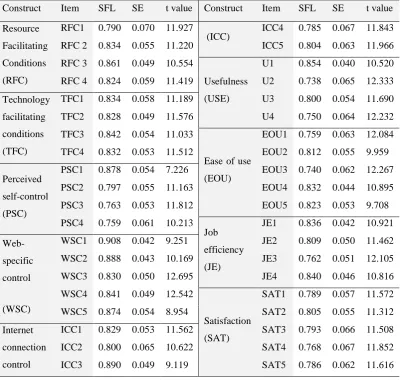
The test results showed that the SFLs were all greater than 0.5 and less than 0.95, with the standard errors (SEs) being within the nonsignificant range of 0.040-0.070, indicating a good fit in the study (Table 5).
Table 5: Analysis of Basic Goodness of Fit
Construct Item SFL SE t value Construct Item SFL SE t value
Resource Facilitating Conditions (RFC)
RFC1 0.790 0.070 11.927
(ICC) ICC4 0.785 0.067 11.843 RFC 2 0.834 0.055 11.220 ICC5 0.804 0.063 11.966 RFC 3 0.861 0.049 10.554
Usefulness (USE)
U1 0.854 0.040 10.520
RFC 4 0.824 0.059 11.419 U2 0.738 0.065 12.333
Technology facilitating conditions (TFC)
TFC1 0.834 0.058 11.189 U3 0.800 0.054 11.690 TFC2 0.828 0.049 11.576 U4 0.750 0.064 12.232
TFC3 0.842 0.054 11.033
Ease of use (EOU)
EOU1 0.759 0.063 12.084 TFC4 0.832 0.053 11.512 EOU2 0.812 0.055 9.959
Perceived self-control (PSC)
PSC1 0.878 0.054 7.226 EOU3 0.740 0.062 12.267
PSC2 0.797 0.055 11.163 EOU4 0.832 0.044 10.895 PSC3 0.763 0.053 11.812 EOU5 0.823 0.053 9.708
PSC4 0.759 0.061 10.213 Job efficiency (JE)
JE1 0.836 0.042 10.921
Web-specific control
(WSC)
WSC1 0.908 0.042 9.251 JE2 0.809 0.050 11.462 WSC2 0.888 0.043 10.169 JE3 0.762 0.051 12.105
WSC3 0.830 0.050 12.695 JE4 0.840 0.046 10.816
WSC4 0.841 0.049 12.542
Satisfaction (SAT)
SAT1 0.789 0.057 11.572 WSC5 0.874 0.054 8.954 SAT2 0.805 0.055 11.312
Internet connection control
ICC1 0.829 0.053 11.562 SAT3 0.793 0.066 11.508 ICC2 0.800 0.065 10.622 SAT4 0.768 0.067 11.852
ICC3 0.890 0.049 9.119 SAT5 0.786 0.062 11.616
3.7. Overall Model Fit
188
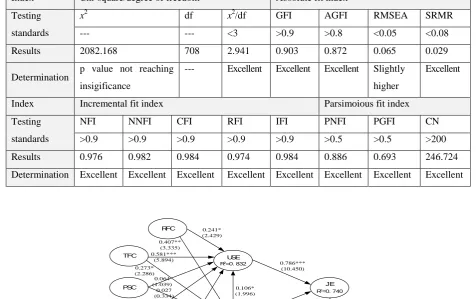
followed by RFCs (standardized coefficient = 0.241), indicating that TFCs are the most important factor that affect usefulness. “Ease of use” has 56.1% explanatory power (R2 = 0.561) and is most affected by RFCs (standardized coefficient = 0.407), followed by ICC (standardized coefficient = 0.306), indicating that RFCs are the most important factor affecting the ease of use.
Table 6: Summary of Overall Model Fit
Index Chi-square/degree of freedom Absolute fit index
Testing standards
x2 df x2/df GFI AGFI RMSEA SRMR
--- --- <3 >0.9 >0.8 <0.05 <0.08
Results 2082.168 708 2.941 0.903 0.872 0.065 0.029
Determination p value not reaching insigificance
--- Excellent Excellent Excellent Slightly higher
Excellent
Index Incremental fit index Parsimoious fit index
Testing standards
NFI NNFI CFI RFI IFI PNFI PGFI CN
>0.9 >0.9 >0.9 >0.9 >0.9 >0.5 >0.5 >200
Results 0.976 0.982 0.984 0.974 0.984 0.886 0.693 246.724
Determination Excellent Excellent Excellent Excellent Excellent Excellent Excellent Excellent
RFC TFC PSC WSC I CC USE
R2=0. 832
EOU
R2=0. 561
JE
R2=0. 740
SAT 0.241* (2.429) 0.407** (3.335) 0.581*** (5.894) 0.273* (2.286) 0.064 (1.039) 0.027 (0.334) 0.203* (2.164) 0.016 (0.288) 0.168** (2.881) 0.306*** (4.144) 0.106* (1.996) 0.786*** (10.450) 0.770*** (6.457) 0.246*** (4.780)
Figure 2: Results from the research model
4. Discussion
This study investigated the key determinants of employees’ adoption of private cloud services. Job efficiency was the key job demand for employees, and examining the key determinant factors could help improve their job effectiveness. Therefore, a research model was created based on a literature review to verify how these key determinants affect the way private cloud services help employees and how this affects job efficiency.
189
private cloud services and can also experience improved job efficiency with the help of these services (such as company cloud storage, collaboration platform, and instant messaging group) when engaging in knowledge sharing and tasks. Thus, employees perceived these services as positive and useful. The results further reveal that the adoption of private cloud services and ease of use in their access indeed affect employee-perceived value of these services; additionally, ease of use of functions related to these services is a determinant of employee adoption. Therefore, when employees adopt functional operations in private cloud services, external resources can promote their intention to adopt. The employees participating in the study reported that they could adopt private cloud services by resource conditions to improve their job efficiency. Such company-provided resources that facilitate employee adoption include education and training programs, operations documentation, and support from service people, all of which help improve employee efficiency in handling tasks.
(2) The hypothesis that TFCs in employees’ adoption of private cloud services have a positive effect on employ-perceived usefulness and ease of use was supported. This is consistent with the findings of Teo [23]. Our results show that the variable TFCs had a full effect on employees’ perception of the usefulness of private cloud services. Employees believed that cloud-based service functions engendered by technological advancements can improve their execution efficiency at work. Moreover, they have positive identification with the use of mobile devices by employees and support provided by their companies, which increase the application value of private cloud services. Thus, useful support provided to employees by private cloud services is also important for the ease of use of the functions of such services. This study results reveal that the greater is the support provided to employees for the information equipment and technology they control, the easier the service function is to control or use. Therefore, the study results show that TFCs in employees’ adoption of private cloud services can positively affect ease of use.
(3) The hypothesis that ICC in employees’ adoption of private cloud services has a positive effect on employees’ perceived usefulness and ease of use was supported. After using private cloud services through an Internet connection, employees subjectively perceived the work efficacy because of these services and the quality, stability, and speed of the Internet connection to be satisfactory. The study results reveal that after employees are connected to the Internet, their perceived efficacy based on their judgment is related to the efficacy in ICC and causes employees to perceive usefulness, thereby positively affecting the extent to which the Internet is used to connect to services. The results also reveal that cloud platforms’ connection control could be accomplished by employees using their own expertise. In particular, employees can determine the roots of connection problems they may encounter and seek problem-solving resources. This means that Internet connection can be easily controlled. Thus, the employee-perceived value of ease of use of ICC produces a positive effect.
190
controls of computer equipment would not make considerable differences. In particular, to smoothly connect to websites, employees may have to adapt to the computer's operating environment. Therefore, employees may consider that the ease of use of the computer environment must be strengthened. Thus, the test results show that ease of use of ICC in the adoption of private cloud services does not affect the intention to use in employees who adopt these services.
(5) The hypothesis that PSC in employees’ adoption of private cloud services does not have a significant effect on employees’ perceived usefulness, and ease of use was not supported. The results show that PSC is based on the judgment made by employees while using their computers to control the private cloud services, and employees may perceive that they need more educational support for functional control in private cloud services. These findings also indicate the importance of information staff. Thus, the results show that PSC has no positive effect on the perceived usefulness. The results are consistent with those of previous studies on perceived control [26, 37, 48]. This implies that companies need to plan education and training programs or have responsible personnel to train employees in order to help them understand the functional features while using their private cloud services, thereby improving the usefulness of these services. Moreover, PSC was determined to have no significant effect on the ease of use of private cloud services. This indicates that for functional control in private cloud services to be sufficiently easy to use for employees, companies should provide the necessary resources, such as education and training or online tutorial programs, so that employees can easily use private cloud services and have better control over the efficacy of services, facilitating their adoption of these services.
(6) The hypothesis that ease of use in employees’ adoption of private cloud services has a positive effect on the employees’ perceived usefulness was supported. Consistent with the findings of previous studies, our results verify the argument that perceived ease of use has a positive effect on usefulness [23, 66]. This implies that both the usability of information provided by the system and the ease of use of functions in private cloud services affect employee-perceived value.
191
5. Conclusions and ImplicationsThe cloud computing service is a popular online platform among enterprises’ employee because of its high efficiency and convenience. This industrial market provides great profit potential for mobile commerce enterprises. Thus, many enterprises have adopted cloud computing services. Our study found that almost employees are accepted the security of private cloud services based on present network architecture. However, many of these private cloud services are not well adopted by employees and they only have a little service shares. These companies are eager to know what factors determine an employee’s adoption of private cloud services for job efficiency. With this research, we find that an employee’s job efficiency towards private cloud services is mainly determined by resource facilitating conditions, technology facilitating conditions, web-specific control, Internet connection control and additionally affected by usefulness, ease of use and satisfaction. Results illustrate that the integrated model can fully reflect the spirit of the technology acceptance model and take advantage of perceived behavioral control and internet self-efficacy. Employees want to get a variety of resources, such as information equipment and self-control ability, as well as the basic operation function when adopting private cloud services.
5.1. Implications for management
This study has two implications for management: First, our findings suggest that companies should effectively educate employees on the functions of private cloud services in order to increase their use efficacy. Moreover, companies should provide online learning and instructions or plans and organize training programs, together with private cloud services, for employees. Thus, employees can more clearly understand the use of various functions and processing methods. This can also help companies improve the layout of the interface for private cloud services, such as the extended use of wizard icons for display, which makes the entire interface more easy to use and operate, thereby boosting employee intention to use private cloud services and preventing employee resistance. Second, companies should provide private cloud services to improve the job efficiency of employees according to the rollout strategies. To achieve more favorable results, companies should provide a variety of strategies that can improve job efficiency rapidly and effectively. Specifically, private cloud services help employees to adopt and access these functions any time, from anywhere, and using any device. Thus, integration of cloud computing services into business settings may promote employees’ job efficiency, task effectiveness, and satisfaction.
5.2. Implications for academia
192
job efficiency is not consistent with those in previous studies, and key determinants can be adopted as a different approach for verification, such as a contrastive study between online service adopting and cloud service adopting. Third, this study demonstrated that the key determinants of employees’ adoption of cloud services were associated with two theoretical foundations, namely PBC and Internet self-efficacy. They not only expect a useful and easy-to-use private cloud services, but also aspire to experience satisfaction and smooth operation in the adopted services. Additionally, we suggest that adoption as a comprehensive concept warrants more research attention in the context of cloud service platforms and mobile commerce.
5.3. Implications for practice
The findings of this study have three implications: First, on the basis of our findings, companies are encouraged to adopt private cloud services to help manage corporate data, documents, and transfer important information (such as orders and contract records). Employees can use these services and share resources directly through the Internet and smart devices. This has a significant effect on the overall business strategies of companies, particularly instantaneous tasks. Private cloud services may enable faster information transfer and improve both company-wide information optimization and professionalism. Second, companies should actively adopt private cloud services; they should simultaneously convey the advantages of these services, organize learning seminars, and as demonstrate the benefits of using functions and improved job efficiency. Thus, managers should clearly and fully explain these services to increase their usefulness and promote a more convenient and user-friendly mode of operation so that employees have greater satisfaction after the adoption of these services. Third, the study proposes a new cloud concept that can help an entire company become mobility service-oriented. Thus, companies should adopt private cloud services by leveraging technological advancement in combination with their resources, such as existing Internet connection architecture and employee control over the Internet environment. These findings allow companies to provide private cloud services accordingly. This can not only improve overall job efficiency but also boost employee intention to further adopt new private cloud services in the future. The fact that private cloud services have become the focal point of companies and fierce industry competition indicate that companies should find their own paths.
5.4. Limitations and further research
This study has three limitations: First, the sample was limited to Taiwanese enterprises, and a larger sample size is required to further generalize the findings to cross-national enterprises. Second, the private cloud services adopted by employees may affect the outcomes of the study and act as a moderator. In the future, a multi-group analysis (e.g., into gender and age) that differentiates the participants (e.g., into service industry and SOHO groups) with regard to their adoption experience with private cloud services may lead to improved insights. Third, focusing only on employees’ adoption mindset but neglecting the different levels of industry people’s readiness is a limitation because this is a critical point in technology integration in practice.
193
competition. To achieve such an integration, employees are expected to be supportive of the new technology model and corporations and industries must be equipped with the required new concepts and skills to deliver on promises of the emerging technologies.
Acknowledgment
We thank the Center for Regional Academic–Industrial Collaboration, Ministry of Education, for funding this study from their Support Program for Industry, Academia and Family 2014 and Adoption and Support Program for Local Industry 2015 for helping in the completion of this study.
References
[1] S. Marston, Z. Li, S. Bandyopadhyay, J. Zhang, and A. Ghalsasi, "Cloud computing -- The business perspective," Decision Support Systems, vol. 51, pp. 176-189, 2011.
[2] A. F. Mohammad and H. McHeick, "Cloud Services Testing: An Understanding," Procedia Computer Science, vol. 5, pp. 513-520, 2011.
[3] A. Lin and N.-C. Chen, "Cloud computing as an innovation: Percepetion, attitude, and adoption," International Journal of Information Management, vol. 32, pp. 533-540, 2012.
[4] P. Gupta, A. Seetharaman, and J. R. Raj, "The usage and adoption of cloud computing by small and medium businesses," International Journal of Information Management, vol. 33, pp. 861-874, 2013.
[5] N. Phaphoom, X. Wang, S. Samuel, S. Helmer, and P. Abrahamsson, "A survey study on major technical barriers affecting the decision to adopt cloud services," Journal of Systems and Software, vol. 103, pp. 167-181, 2015.
[6] Q. Duan, "Cloud service performance evaluation: status, challenges, and opportunities – a survey from the system modeling perspective," Digital Communications and Networks, vol. 3, pp. 101-111, 2017/05/01/ 2017.
[7] T. Ercan, "Effective use of cloud computing in educational institutions," Procedia - Social and Behavioral Sciences, vol. 2, pp. 938-942, 2010.
[8] M. Stieninger, D. Nedbal, W. Wetzlinger, G. Wagner, and M. A. Erskine, "Impacts on the Organizational Adoption of Cloud Computing: A Reconceptualization of Influencing Factors," Procedia Technology, vol. 16, pp. 85-93, 2014/01/01/ 2014.
[9] M. G. Avram, "Advantages and Challenges of Adopting Cloud Computing from an Enterprise Perspective," Procedia Technology, vol. 12, pp. 529-534, 2014/01/01/ 2014.
194
interoperability," Computers in Industry, vol. 65, pp. 657-674, 2014/05/01/ 2014.
[11] H.-L. Yang and S.-L. Lin, "User continuance intention to use cloud storage service," Computers in Human Behavior, vol. 52, pp. 219-232, 2015/11/01/ 2015.
[12] M. Armbrust, I. Stoica, M. Zaharia, A. Fox, R. Griffith, A. D. Joseph, R. Katz, A. Konwinski, G. Lee, D. Patterson, and A. Rabkin, "A view of cloud computing," Communications of the ACM, vol. 53, p. 50, 2010.
[13] M. Cusumano, "Cloud computing and SaaS as new computing platforms," Communications of the ACM, vol. 53, p. 27, 2010.
[14] C. Yu and Y. Tao, "Understanding business-level innovation technology adoption," Technovation, vol. 29, pp. 92-109, 2009.
[15] E. Park and K. J. Kim, "An Integrated Adoption Model of Mobile Cloud Services: Exploration of Key Determinants and Extension of Technology Acceptance Model," Telematics and Informatics, vol. 31, pp. 376-385, 2014/08/01/ 2014.
[16] D. Shin, "Beyond user experience of cloud service: Implication for value sensitive approach," Telematics and Informatics, vol. 32, pp. 33-44, 2015/02/01/ 2015.
[17] R. Buyya, C. S. Yeo, S. Venugopal, J. Broberg, and I. Brandic, "Cloud computing and emerging IT platforms: Vision, hype, and reality for delivering computing as the 5th utility," Future Generation Computer Systems, vol. 25, pp. 599-616, 2009.
[18] C. Wang, L. C. Wood, H. Abdul-Rahman, and Y. T. Lee, "When traditional information technology project managers encounter the cloud: Opportunities and dilemmas in the transition to cloud services," International Journal of Project Management, vol. 34, pp. 371-388, 2016/04/01/ 2016.
[19] S. Costache, D. Dib, N. Parlavantzas, and C. Morin, "Resource management in cloud platform as a service systems: Analysis and opportunities," Journal of Systems and Software, vol. 132, pp. 98-118, 2017/10/01/ 2017.
[20] R. E. Rhodes and K. S. Courneya, "Threshold assessment of attitude, subjective norm, and perceived behavioral control for predicting exercise intention and behavior," Psychology of Sport and Exercise, vol. 6, pp. 349-361, 2005/05/01/ 2005.
[21] I. Ajzen, "Perceived Behavioral Control, Self-Efficacy, Locus of Control, and the Theory of Planned Behavior1," Journal of Applied Social Psychology, vol. 32, pp. 665-683, 2002.
195
[23] T. Teo, "Modelling technology acceptance in education: A study of pre-service teachers," Computers & Education, vol. 52, pp. 302-312, 2009.
[24] I.-L. Wu and J.-L. Chen, "An extension of Trust and TAM model with TPB in the initial adoption of on-line tax: An empirical study," International Journal of Human-Computer Studies, vol. 62, pp. 784-808, 2005.
[25] S. Taylor and P. A. Todd, "Understanding Information Technology Usage: A Test of Competing Models," INFORMATION SYSTEMS RESEARCH, vol. 6, pp. 144-176, June 1, 1995 1995.
[26] M. Horst, M. Kuttschreuter, and J. Gutteling, "Perceived usefulness, personal experiences, risk perception and trust as determinants of adoption of e-government services in The Netherlands," Computers in Human Behavior, vol. 23, pp. 1838-1852, 2007.
[27] A. Mitra, N. O'Regan, and D. Sarpong, "Cloud resource adaptation: A resource based perspective on value creation for corporate growth," Technological Forecasting and Social Change, 2017/09/01/ 2017.
[28] M. Liaqat, V. Chang, A. Gani, S. H. A. Hamid, M. Toseef, U. Shoaib, and R. L. Ali, "Federated cloud resource management: Review and discussion," Journal of Network and Computer Applications, vol. 77, pp. 87-105, 2017/01/01/ 2017.
[29] P. Nawrocki and W. Reszelewski, "Resource usage optimization in Mobile Cloud Computing," Computer Communications, vol. 99, pp. 1-12, 2017/02/01/ 2017.
[30] S. C. Park and S. Y. Ryoo, "An empirical investigation of end-users’ switching toward cloud computing: A two factor theory perspective," Computers in Human Behavior, vol. 29, pp. 160-170, 2013/01/01/ 2013.
[31] L. Zhang, "Do Imports of Technology Facilitate Technological Progress? Evidence from China," Procedia Engineering, vol. 29, pp. 2826-2831, 2012/01/01/ 2012.
[32] N. Adnan, S. M. Nordin, and Z. bin Abu Bakar, "Understanding and facilitating sustainable agricultural practice: A comprehensive analysis of adoption behaviour among Malaysian paddy farmers," Land Use Policy, vol. 68, pp. 372-382, 2017/11/01/ 2017.
[33] A. Bandura, "Self-efficacy: Toward a unifying theory of behavioral change," Advances in Behaviour Research and Therapy, vol. 1, pp. 139-161, 1978/01/01/ 1978.
[34] M. S. Eastin and R. LaRose, "Internet Self-Efficacy and the Psychology of the Digital Divide," Journal of Computer-Mediated Communication, vol. 6, pp. 0-0, 2000.
221-196
232, 2017/02/01/ 2017.[36] M. Arslanagic-Kalajdzic and V. Zabkar, "Is perceived value more than value for money in professional business services?," Industrial Marketing Management, vol. 65, pp. 47-58, 2017/08/01/ 2017.
[37] A. Herrero Crespo and I. Rodriguez Del Bosque, "The effect of innovativeness on the adoption of B2C e-commerce: A model based on the Theory of Planned Behaviour," Computers in Human Behavior, vol. 24, pp. 2830-2847, 2008.
[38] V. Ratten, "Cloud computing: A social cognitive perspective of ethics, entrepreneurship, technology marketing, computer self-efficacy and outcome expectancy on behavioural intentions," Australasian Marketing Journal (AMJ), vol. 21, pp. 137-146, 2013/08/01/ 2013.
[39] K. Mathieson, "Predicting User Intentions: Comparing the Technology Acceptance Model with the Theory of Planned Behavior," INFORMATION SYSTEMS RESEARCH, vol. 2, pp. 173-191, 1991.
[40] I. Ajzen, "The theory of planned behavior," Organizational Behavior and Human Decision Processes, vol. 50, pp. 179-211, 1991/12/01/ 1991.
[41] M.-H. Hsu and C.-M. Chiu, "Internet self-efficacy and electronic service acceptance," Decision Support Systems, vol. 38, pp. 369-381, 2004/12/01/ 2004.
[42] G. Torkzadeh, J. Chang, and D. Demirhan, "A contingency model of computer and Internet self-efficacy," Information & Management, vol. 43, pp. 541-550, 2006.
[43] G. Torkzadeh and T. P. van Dyke, "Development and validation of an Internet self-efficacy scale," Behaviour & Information Technology, vol. 20, pp. 275-280, 2001/01/01 2001.
[44] N. a. Achim and A. A. Kassim, "Computer Usage: The Impact of Computer Anxiety and Computer Self-efficacy," Procedia - Social and Behavioral Sciences, vol. 172, pp. 701-708, 2015/01/27/ 2015.
[45] J. Downey and M. McMurtrey, "Introducing task-based general computer self-efficacy: An empirical comparison of three general self-efficacy instruments," Interacting with Computers, vol. 19, pp. 382-396, 2007.
[46] H. Saleem, A. Beaudry, and A.-M. Croteau, "Antecedents of computer self-efficacy: A study of the role of personality traits and gender," Computers in Human Behavior, vol. 27, pp. 1922-1936, 2011/09/01/ 2011.
[47] Y.-L. Chiu and C.-C. Tsai, "The roles of social factor and internet self-efficacy in nurses' web-based continuing learning," Nurse Education Today, vol. 34, pp. 446-450, 2014/03/01/ 2014.
197
mediating roles of internal and external self-efficacy," The Journal of Strategic Information Systems, 2017/10/09/ 2017.
[49] M. S. M. Ariff, S. M. Yeow, N. Zakuan, A. Jusoh, and A. Z. Bahari, "The Effects of Computer Self-Efficacy and Technology Acceptance Model on Behavioral Intention in Internet Banking Systems," Procedia - Social and Behavioral Sciences, vol. 57, pp. 448-452, 2012/10/09/ 2012.
[50] G. S. Smith, "Emergency business management and internet connectivity," Business Horizons, vol. 60, pp. 353-361, 2017/05/01/ 2017.
[51] M. T. Simsim, "Internet usage and user preferences in Saudi Arabia," Journal of King Saud University - Engineering Sciences, vol. 23, pp. 101-107, 2011/06/01/ 2011.
[52] T. Lam, V. Cho, and H. Qu, "A study of hotel employee behavioral intentions towards adoption of information technology," International Journal of Hospitality Management, vol. 26, pp. 49-65, 2007/03/01/ 2007.
[53] B. McKenna, T. Tuunanen, and L. Gardner, "Consumers’ adoption of information services," Information & Management, vol. 50, pp. 248-257, 2013/07/01/ 2013.
[54] B. Rothman, W. S. Sandberg, and P. S. Jacques, "Using Information Technology to Improve Quality in the OR," Anesthesiology Clinics, vol. 29, pp. 29-55, 2011/03/01/ 2011.
[55] H. Chun, J.-W. Kim, and J. Lee, "How does information technology improve aggregate productivity? A new channel of productivity dispersion and reallocation," Research Policy, vol. 44, pp. 999-1016, 2015/06/01/ 2015.
[56] J. F. López-Muñoz and A. Escribá-Esteve, "An upper echelons perspective on information technology business value," European Research on Management and Business Economics, vol. 23, pp. 173-181, 2017/09/01/ 2017.
[57] F. Aznoli and N. J. Navimipour, "Cloud services recommendation: Reviewing the recent advances and suggesting the future research directions," Journal of Network and Computer Applications, vol. 77, pp. 73-86, 2017/01/01/ 2017.
[58] M. Sony and N. Mekoth, "The relationship between emotional intelligence, frontline employee adaptability, job satisfaction and job performance," Journal of Retailing and Consumer Services, vol. 30, pp. 20-32, 2016/05/01/ 2016.
[59]M. P. Bach, A. Čeljo, and J. Zoroja, "Technology Acceptance Model for Business Intelligence Systems: Preliminary Research," Procedia Computer Science, vol. 100, pp. 995-1001, 2016/01/01/ 2016.
198
Technology," MIS Quarterly, pp. 319-339, 1989.[61] S. A. Nikou and A. A. Economides, "Mobile-Based Assessment: Integrating acceptance and motivational factors into a combined model of Self-Determination Theory and Technology Acceptance," Computers in Human Behavior, vol. 68, pp. 83-95, 2017/03/01/ 2017.
[62] M. Broman Toft, G. Schuitema, and J. Thøgersen, "Responsible technology acceptance: Model development and application to consumer acceptance of Smart Grid technology," Applied Energy, vol. 134, pp. 392-400, 2014/12/01/ 2014.
[63] I. Akman and A. Mishra, "Sector diversity in Green Information Technology practices: Technology Acceptance Model perspective," Computers in Human Behavior, vol. 49, pp. 477-486, 2015/08/01/ 2015.
[64] K.-B. Ooi and G. W.-H. Tan, "Mobile technology acceptance model: An investigation using mobile users to explore smartphone credit card," Expert Systems with Applications, vol. 59, pp. 33-46, 2016/10/15/ 2016.
[65] K. Chen, J. V. Chen, and D. C. Yen, "Dimensions of self-efficacy in the study of smart phone acceptance," Computer Standards & Interfaces, vol. 33, pp. 422-431, 2011/06/01/ 2011.
[66] F. Muñoz-Leiva, S. Climent-Climent, and F. Liébana-Cabanillas, "Determinants of intention to use the mobile banking apps: An extension of the classic TAM model," Spanish Journal of Marketing - ESIC, vol. 21, pp. 25-38, 2017/02/01/ 2017.
[67] E. W. Anderson and M. W. Sullivan, "The Antecedents and Consequences of Customer Satisfaction for Firms," Marketing Science, vol. 12, pp. 125-143, 1993.
[68] R. W. Y. Yee, A. C. L. Yeung, and T. C. E. Cheng, "The impact of employee satisfaction on quality and profitability in high-contact service industries," Journal of Operations Management, vol. 26, pp. 651-668, 2008.
[69] M. Kos Koklic, M. Kukar-Kinney, and S. Vegelj, "An investigation of customer satisfaction with low-cost and full-service airline companies," Journal of Business Research, 2017/05/17/ 2017.
[70] S. Ding, Z. Wang, D. Wu, and D. L. Olson, "Utilizing customer satisfaction in ranking prediction for personalized cloud service selection," Decision Support Systems, vol. 93, pp. 1-10, 2017/01/01/ 2017.
[71] J. García-Fernández, P. Gálvez-Ruíz, J. Fernández-Gavira, L. Vélez-Colón, B. Pitts, and A. Bernal-García, "The effects of service convenience and perceived quality on perceived value, satisfaction and loyalty in low-cost fitness centers," Sport Management Review, 2017/07/21/ 2017.
199
China's airline market," Journal of Air Transport Management, vol. 57, pp. 80-88, 2016/10/01/ 2016.
[73] R. W. Y. Yee, Y. Guo, and A. C. L. Yeung, "Being close or being happy? The relative impact of work relationship and job satisfaction on service quality," International Journal of Production Economics, vol. 169, pp. 391-400, 2015/11/01/ 2015.
[74] Y. Liang, G. Qi, K. Wei, and J. Chen, "Exploring the determinant and influence mechanism of e-Government cloud adoption in government agencies in China," e-Government Information Quarterly, 2017/07/05/ 2017.
[75] M. T. Dishaw and D. M. Strong, "Extending the technology acceptance model with task–technology fit constructs," Information & Management, vol. 36, pp. 9-21, 1999/07/01/ 1999.
[76] S. Bueno and J. L. Salmeron, "TAM-based success modeling in ERP," Interacting with Computers, vol. 20, pp. 515-523, 2008/12/01/ 2008.
[77] C. López-Nicolás, F. J. Molina-Castillo, and H. Bouwman, "An assessment of advanced mobile services acceptance: Contributions from TAM and diffusion theory models," Information & Management, vol. 45, pp. 359-364, 2008/09/01/ 2008.
[78] S. Sternad and S. Bobek, "Impacts of TAM-based External Factors on ERP Acceptance," Procedia Technology, vol. 9, pp. 33-42, 2013/01/01/ 2013.
[79] C. M. Jackson, S. Chow, and R. A. Leitch, "Toward an Understanding of the Behavioral Intention to Use an Information System," Decision Sciences, vol. 28, pp. 357-389, 1997.
[80] B. Adenso-Díaz, S. Lozano, E. Gutiérrez, L. Calzada, and S. García, "Assessing individual performance based on the efficiency of projects," Computers & Industrial Engineering, vol. 107, pp. 280-288, 2017/05/01/ 2017.
[81] M. S. Farooqui and A. Nagendra, "The Impact of Person Organization Fit on Job Satisfaction and Performance of the Employees," Procedia Economics and Finance, vol. 11, pp. 122-129, 2014/01/01/ 2014.
[82] A. D. Al and İ. Anıl, "The Comparison of the Individual Performance Levels Between Full-time and Part-time Employees: The Role of Job Satisfaction," Procedia - Social and Behavioral Sciences, vol. 235, pp. 382-391, 2016/11/24/ 2016.
[83] L. Dvořáková and O. Faltejsková, "Development of Corporate Performance Management in the Context of Customer Satisfaction Measurement," Procedia - Social and Behavioral Sciences, vol. 230, pp. 335-342, 2016/09/12/ 2016.
200
ed.): Prentice hall Upper Saddle River, NJ, 2006.[85] C. Fornell and D. F. Larcker, "Evaluating Structural Equation Models with Unobservable Variables and Measurement Error," Journal of marketing research, vol. 18, pp. 39-50, 1981.
[86] W. Chin, The Partial Least Squares Approach to Structural Equation Modeling. Modern methods for business research. Mahwah, NJ, US: Lawrence Erlbaum Associates Publishers, 1998.
[87] P. M. Podsakoff and D. Organ, "Self-Report in Organizational Research: Problems and prospects," Journal of Management, vol. 12, pp. 531-544, 1986.
[88] K. G. Jöreskog and D. Sörbom, LISREL 8: A Guide to the Program and Applications: SPSS Inc., Chicago, 1993.