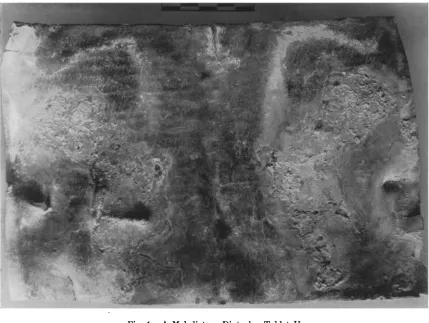
The first maledictory inscription from the Athenian Agora was recently published in this Journal.' Two more are here illustrated and discussed, listed as Nos. II and III. These like their predecessor are inscribed upon sheets of lead. One was open when
Viv~~~~~~~~~~-
Fig. 1. A Maledictory Diptych. Tablet II
found, the other was easily opened in the course of washing. The excellent photographs which were made soon after discovery are more easily read than the tablets themselves, and this fact seems to warrant the conclusion that chemical treatment for the rehabilitation of the lead and the removal of foreign matter tends to dull the sharpness of the letters. Tablet II is unusual in that it is a diptych (Fig. 1) which was folded between the two
1 Hesperia, V, 1936, pp. 43-49.
American School of Classical Studies at Athens is collaborating with JSTOR to digitize, preserve, and extend access to Hesperia
columns of writing whereas tablet III was rolled in accordance with prevailing practice. In both tablets parts of the text have been obliterated and in both there are erasures which were effected by lines drawn lengthwise through the words.
Tablet II, the diptych, is an unusually substantial plaque.' A nail was driven through it but this has disappeared. The left column is the better preserved and averaged perhaps 37 letters to a line. In some cases the missing words can be safely restored thanks to repetition which rendered the curse more effective. Comparison of this tablet with the one already published shows that the same general formula was used in both, which facilitates the restoration of certain missing passages.
TABLET II
Column I
1 BOaefo ofOaToflae t??oea :o&?oe aa
2 p0 O/i e ava leTv XQ O c QcCl &wt # ro2 a8t ICOl
5
8 exfTzO-r .
11 ...rrjraq. 'xovoroP
12 ----
13 [TO] vu(ore'&iu ovaa
14 A2oao I.... V ee:aeca
15 atat xccaralviovra [vra] ovv(p [t2o] orTar [a] rpET&exe 16 yoQy17r7rtcero7rrv&va [rf'Vw@V] pjrvrsa
17 MlrTwVr1fXVrTOw@IaTa!1eXAIV&VeQfaOTao
18 [T] a araQaQTrrta[grn] vxa&tavrovQov
19 xa%r [oVr] xeV O)vT ..*... raerogcTarra
20 xeaia [uj] vvqg a We .: f3aO(yov 21 e3a. a. . aaaaaa7ia ...x a] Tartpviore
22 aqgaVYtLCo . 7rOQa . vir1vqi2 o [arQa] Tepr)87T
23 XJ7ytLzic:L ta[I]t:axo0v(ltatw(0eA0: L ) 24 /o?X[?oo]io: aycagg tagx: aTVOlqJye
25 pw 6TVeTw8evovefVQpfQevxvwv.
The inventory number is IL 372. It was found in a well in Sectioii 11 at 47/lB on May 8, 1936; it was associated with objects dating fiom the second to the fourth century A.D. The measurements are
0.225 X 0.15 m.
26 bsVrQlVt g .pOQKlV4)gTaVTaOrOpMK
27 UalpvyErtworw x*1qJxo6TOrQa [c ] agarQ ET8Xy0o
28 2/11uirtaxaratl [v] XE 0 orTfV [8v] tartiy@Wvr 'ig
Column II
29 l1%VgTo6wfjtcy& tfvcvWQcq!aIqAfl3gTaOvaTc 30 ata taTno aQdlaOtOJ'vX6;OffaQoXevt [w] v[T] a 31 !svVOg,iravrwlvcaQceoAv0O. aIlffe..
32 )08l wAO wYal1aQ8j5 a
33 aaaa1wl4 aax
34 xvQEt6vvcpwaQeaXUUOvCp1XOaT0aTV [ia ] ]Vmrxe
35 o yoQ)'i iririax i
36 ...aUVLVtvAv1XVlVVOJVF3rVXUC 8!TiX
37 woraprav8veVr,QWgTQVgOVv%agTTck
38 %IX8QagTOvg7(oYagotta
39 . .. . t8VffauhiaQwi TE
40 X . g7e . wrgvOVg
41
42 O8VTlVqwva
43 raT aa ltovo
44 *os . aOsVowX xvT8vreavT
45 Mf = 8TX
46 --txO6i7Qe
47 TaVNy4r83XfV [V[OQylifla a] aaaa Xma
48 eaXvcorX1 xara [pvgr1]
49 . . TTax Ira']axvaO)!(plXOoTQa
50 -raVyV exX6v[yoQyl lta]a] CtaxaTar vJov
51 xatermv rOwa2tv aax
TRANSCRIPTION OF TABLET II
Column I
1 Ba?oqeaoefoloeoe:poeflae .loea: floo Saefla 2 qoeflafatn: xearau Tv pg lraQeaohwpt afot
3 otkiouoieraf<tv Y or(xEVn F 10Q2l'ffa Ta a aX i og xaraiup6r,
4 rtr a&rig Co IuVdXa 't)V ;WiV T)V MaI5ra1V 'I3
Yxv
l oU" a rC( t(X a r& v FYe a (FOC -&g
(As
6 lag T&Q Vrrjeag rt8v xae tav roit Yvv?x( To r a 7 r6V irV)u'tOva Vr& 8'vr6 ia'vra. V Nat x1vot TvqHig
9 . . w at f3lOrp(ov a&o ? O'i bl 0iO0qaTa Voo7 8[X 10 ....I[a 'ooyln[Tia ... v
Tiv I8Q(OF6VVljV ai- 11 g.!og 'Xp ....O... 6. a 8 vora XOlVoiv
12 . _
13 - [ro] ViTrv XiiiovyOa
14 RM& o: lOQp . .... . . . ... aewla
15 atat:xa-riCpv)ov T a[VTra] jjp JJ[iXo]LrQTaQ[c] v 'Texe 16
Foeyuuria ,o' irveV-pa [Trv woijv] TI>' d6va-
17 fl v T)v t?V TCO' a6a W C ye'y d2 iC V8vQa v& 0
18 c&g cpU?ag r&g ?erreiag vtv xaoedlav rToi Jvv- 19 xa? TdOv Tx8v4yova T[o >Trao] Ta 8)eT8 ra 20 KQaTaM. TvLq5 * a... . a . . /i'aaov
21 ea. a.. aaaaaa :a... [Xa]Tai/iVVOV bd 22 aOjar'twrp . ToQa . v TI>v (PXI?O[6fTQaTJV V 23 FoXQytr7ria:'1IaC Iaxoz49ta 1w EQoi;O:
24 Boa7oorip Toaaya?oa!ax af?4cp
25 pw: 68 1ve W8V(OPV8vQI veui'wXJV.
26 ?8vryQlVIQIX. CpOQax8V, Ci Ta5Ta T& OVOilaC-
27 Ta vt/JV%Teat OuTCOg xa't Di xO6Q[caag iSg e8 F O,-
28 yt717f'a xaTaIb[VXE,] 0 TO mnI3ua ,V tw? ) 66vaytI
Column I1
29 l aiig To a(4a 'r&l 12xU T& vzviYa ac (PUflEg ' Ta
30 at dQQOat @ XAQa'a Ol 0VV%8g TO iS7raQ O' ir24Vt[w]v [T]&
31 8vrOg ir&vua Vva graaavOiV. Ateawe . .
32 Q~tOe~o61~aea8?
33 1bTrtaTaC0aC08Cl80t, aTcy'riYaXTaX
34 XzVQ1e Tvqfdg ira&hvov OV iot?orT&aTaV tV erexe
35 rOQ)tZUliia xatl xaTal/tvOV TF 1IAI To a6iypa T[v
36 dVValltv TIP YInZv TO irV8L,aa TI>v xcQJ,av
37 TO I78Q Ta V8ivQa Tr&' oY,QTI9a TOVg' O'vV%ag T&M
38 X&Q;a Tr'bg io6ag O-Tt a
39 . .. 8.I8VIOrat IraQwC1T6 Te
40 X . i LE? * TIg T0V
42 t60v TvqCrva
43 r1a aatovo
44 T. avoXz x8rIevo8aVT
45 ir q -
46 -__ _ _o__ _
48 eQav' q xca xv[lqI 45y] VXELv, 49 .. Tv p" x [Mae] (Avoov WIOUXeao
so Ta6:Y v '~V eT v [I-0-eytirda] RX& xa'uadtPV QV
51 xarch/OpvR nar42v ra CA
TRANSLATION
Column I
1 Barbaphorphorbarphorbor Bora Borbor Barbar
2 phorbabaie, mighty Typhos, I deliver to you
3 Philostrata whom Gorgippia bare in order that you may chill everything hers, 4 her spirit, life, power,
s strength, body, limbs, sinews, bones, veins,
6 arteries, heart, nails, liver,
7 lungs, everything inside her. Yes, Lord Typhos
8 avenge whom bare
9 and aid him because Philostrata whom Gorgippia 10 bare dishonored(?) her priesthood
If of Aphrodite(?)
12
13 from these(?) drinking
14 peteiere ar5ia
is aiai, chill everything with Philostrata whom
16 Gorgippia bare, spirit, life, power,
17 strength, body, limbs, sinews, bones, 18 veins, arteries, heart, nails,
19 lungs, liver, everything inside her. 20 Mighty Typhos a te basou
21 ea aaaaaa (paralyse and) chill,
22 in order that she may disappear, . Philostrata 23 whom Gorgippia bare. Iao Jakoubia I6 Erbeth 16 2' Bolchoseth Tebapagaphoeamach Apopsoe
25 pho Setnepheeoenonesuriphreuknon
26 leueerinirike Phoraiken as these names
27 are chilled so also of Philostrata whom Gorgippia 28 bare let be chilled the spirit, life, power
Column II
29 strength, body, limbs, sinews, veins, bones,
30 arteries, heart, nails, liver, lungs,
32 lerthexaiozethreluoodaiemarebaieba 33 ppiata6a6eaieoedRd6pachpach,
34 Lord Typhos, paralyse Philostrata whom Gorgippia 35 bare and clhill her limbs, body,
36 power, strength, spirit, heart, 37 liver, sinews, arteries, nails, 38 hands, feet because . 39
40
41 evils
(?)
42 god Typhon
43
41
45 bare
46 (1 deliver to you) Philostrata
47 whom Gorgippia bare .aaaaa, to para- 48 lyse and chill nkennel 49 Typhos (chill and) paralyse Philostrata
Lo whom Gorgippia bare, but chill,
51 chill again.
COMMENTARY
Line 1. The long magical title which occupies the entire first line and part of the seconad is perhaps composed of variations of the syllable foae in &aoeocaoe. Barbarous phrases "para clae claexoi were employed by the priests of Cybele in their incantations, and were the more potent because people did not understand them.' If foreign language sounded like barbar to the Greeks, a magical title designedly unintelligible might logically be made up of that sound and various modifications of it. That this title is of Egyptian provenance is a safe inference from its occurrence in Greek magical papyri where it is applied to Hecate.2 It came over to Attica along with other magical titles as is shown by the tablet already published where however I made the erroneous conjecture that it was the title of Hecate rather than of Typhon who is later invoked in the same inscription. A magical papyrus of the third century, and therefore roughly contemporary with our tablet, gives the earliest name of Typhon at which the entire universe seems to have trembled. The name had a hundred letters.3 Apparently the Athenian devotees of the curse were aware of the length of the name of Typhon-Seth and of its compelling
1 Graillot, Le Culte de CybWle, p. 308, n. 8; Legge, Forerunners and Rivals of Christianity, I, p. 92. For
an Ethiopic charm with secret names of deity see Elworthy, 1'he Evil Eye, pp. 392, 397; Ctimont, T. et M., I, p. 313.
2 Preisendanz, Papyri Grcaecae Magicae, 1, p. 120, line 1433.
power although they did iot give it one hundred letters. If barbarous phrases made
up of barbar were uttered by the priests of Cybele in the cure of disease the name !1faepaoe for a woman well versed in the art of healing seems quite appropriate.'
Line 2. The name Philostrate is found in Attic inscriptions of the period approximately of our tablet. Kirchner cites three examples from grave stelae.2 The name Gorgippia is however new but the name Gorgippos is attested for Attica in the second century. The practice in the tablets of naming the mother of the accursed rather than the father reduces the chances of identifying the persons involved.
Lines 4-7. Here and agfain below where the parts of the body are listed there is a noticeable decency in the selection of parts. Comparison with other such lists shows that the juxtaposition of certain parts was perhaps a matter of traditional formula. With the grouping in line 5 may be compared that in a curse tablet which was found at Alexandria, the more significant because of the indebtedness of the Athenian curses
to
the
Eg,yptian: Isv ioxvv s)v 8Y5llu... i, rQa & 2.4 This enumeration isfollowed by a clause of purpose with l'v'a as in line 31 of our inscription. The Alexandrian tablet is dated to the third century after Christ. With the sequence sro
vaeQa i& &rri compare nervias ossu in a curse inscription from Latium,5 and with
0bYVtOVag XCedicav on a tablet discovered at Megara6 compare cor, fulmones, itestinas on
another from Minturnae.7 Why the word " nails," perhaps " finger-nails," should be
inserted between the words for heart and liver, as in line 6 of our inscription, is a mystery unless the nails were conceived of as clawing the seats of passion and love. In general the original juxtaposition of parts of the body in these curses was obviously suggested by natural groupings. It will be observed that in our inscription the list of parts cursed begins and ends with the inclusive terms frev (4) and ncaOvra (7).
Line 7. The repetition of the name TvqWg with the particle vat occurs also in tablet I"
Line 8. In this line which is for the most part beyond repair the author of the inscription may have called upon Typhon to avenge him. He seems on second thought to have erased his name and that of his mother.
Lines 10-11. The word for priesthood is certain but the restoration of the name Aphrodite depends largely upon they two initial letters of the name which are clear. Perhaps Philostrata is accused of malfeasance in her office as priestess of Aphrodite.
Line 12. This line hias suffered both obliteratioln and erasure.
l Abel, Orphica, p. 124; Lithica 455. The name is as old as Homer (II. 6, 22). ' -A., IT, p. 378.
I
ibid., I, p. 202; Stindwall, N.P.A., p. 45.
4 Auidollent, Defixionurn Tabellae, p. 70, no. 38, lines 22 ff.
5 ibid., p. 191, nlo. 135 A, line 7.
6 Ibid., p. 77.
Ibid., p. 249, no. 190, lines 9-10.
Line 14. The letters oyoeO may be the remnant of the participle d8oecaqdt.
Line 20. The auithor of the curse appeals to Typhon to chill Philostrata and cause her disappearance. She is to share the fate of her name which is inscribed upon the tablet. She is to disappear in the cold waters of the well on her way to Typhon. The sequence of the request here that first the offending lady be chilled and then disappear offers a possible interpretation of the phrase TQtoveiy'l ?irt dqavioujo in tablet I. The
first word may be a magical combination of the verbs for " shiver," TQewo and 0ir8w. The restoration of -rac as 7 aecWov is more likely than as 7raraOraos.
Line 23. The magical names lao Jakoubia, Jo Erbeth lo Bolchoseth all occur in tablet I.
Line 27. The pronoun tg is attracted to the case of its noun.
Line 28. The form of the verb here is not clear. The restoration is made with the help of tablet I, 16.
Line 29. The previous articles explain the r which the author of the tablet deletes. The second column of the inscription is for the most part repetition of the first.
Line 36. The juxtaposition of xaodiav and irae occurs also in an inscription from Megara.2
Line 48. The subjunctives here are certainly of purpose and dependent iipon a missing
,')a as is shown by comparison with lines 2-3.
This tablet is of considerable help in the reconstruction of some obliterate(d passages in tablet I. Both begin with an invocation of chthonic deity whose long magical titles are concatenations of the same syllables. Hence the missingf initial part of this title in tablet I is to be filled in with syllables such as p&aeQAae while the missing final syllable is probably rj thus giving both titles the same ending -air,.' The initial gap in the second line of tablet I is to be filled with xearad' TvT dv of which only the v survives. This tablet uses the form Tuc(hp whereas tablet II uses TvTcpc. The formula of consign- ment which follows this name is in both cases the same. This coincidence raises the question whether in the gap in line three of tablet I we should restore xcadtpvSov.
TABLET III
.... 8eq [e] ,ovp ero ' [x] araey'
2 pOV?raxeTOvazOhe [wahlTa] o-l ovxe 3 XwvcaX,avavXaL [oiiev] ogdctrovg 4 XXtagTrov1o7rotetxarac'awexxTaa
5 Tt0effilEX) VOvudvIx tot reqa,cpovi
6 x88eQ8i vvYtxzravZi xawtxxaoart O,uexeexa [rn]
I Cf.
ptoveQyEI, Audollent, op. cit., p. 509.
2 Ibid., p. 77, no. 42, col. B 1. 3.
7 8 [8ff] 8 U0? (oaT'0 a' LO8S18X88088a!S6018(a1tXaXO0
8~~~~~~~~~~~~~fL
8 V [,j OliX88QjLt8L1aXOVWXaTaTL O8eTEO vgX)i8l [ar] 9 ragairoTovol X81 JtovXI ToavoovrovXaX'ovjlvov [v] 10 x
11 [o] vapac -tovx8vxovxevovxavxaSov
12 - QOvVuVV8ZaX8vz/aXwttaTcatv . roV
13 * agctQXe8vxap IaffTtXVlt mhQ8eu'txaTa
14 uO81t8x8,rOVYoV?'8IOaOfag/riX8ip81X8aQV [o]
15 VIt] 8JovgXcxrcaJl O8uE8dx8oXotgViroY8Ea1 8
16 [ax] ove8Tamv(eQo 18pa8xa T1iXaTa7QWa
17 Wdo8rTOlva 8z XaZOVQ avta8xaTriXa
18 [u]qXoovla8xarr2 Q IO(YTI 18Xa1rCQ1lO
19 QCp8XTrjt,UOV 0 IfQO 0W T8XaQetOTa
20 rq [o] 'WrovgX)8 l/avTrgaTov
21 [X] 87paVTa'ra8 V Cf 8QO^lV
22 c1 r8av80V (g) YvV 8tdO (I) ,raxavajea
23 [o8]xaw. . ftovov .... Oa axa
24 axxaar'a81Ta V 1g. . .X Von'
25 TIXZ2g 1g Ct a 7 avro vgavrov
26 wv?f coSVa1vOgg1V81l a avToI g
27 8T8 q%aQX8O'O XOIf t av
28 Tovg
29 . . ... .(r/iOvy8t8TOVXaTraQa1OVj7a
30 vX8OcUaCO X8.aV ra
TRANSCRIPTION
1 .... g ' q[e] ov Y8 rOV [X] a1ayQec-
2 povta x8 rOv dzroxu [anara] 8t oV,x 8-
3 X(wv &ea dvavzaqC[?'pv]oQ dl & rob
4 8x1trrag roviro 1ot8t. KaraIyQeaw X8 XaTa-
5 rio8ell IlovvCot))'t x8 MoiQ8g xE 18Qo6,pOvi
6 xs 'Ea8mI3ot s\ mav'a XAX\ xax , raO861t A 'Exd[qr]
7 E [QIT]8tOCp't, XaTa (108118 Xa 08C6.; 086al X X8 O8%t- xaiaxoo-
8 v[t']otg x8 'Eopjd diaxO'(po, XaTarau08f8 Uoi\ x)tlp[av]-
9 rag daf 'roV olX8lctYoV ItroaVppo'dov roy za)Xovjl8vov[g].
10 X8)v8lvO xCX8avZ(a 'Exa0T7 vav aZQCbotalrCa rFQ0- 11 [w] va jla)JhC)trov X.6Vz6V X8I'OV XC\V XOu4OV
12 = yQOV'R uv8ney& X6vzo\ xWVala(ca )IV . TOV 13 ag TQ8tCg EvXva'g liaohlXiV 1iilr8QlV. "Et xcara-
15 qt]']VOVg. Karat'1-ette as6 x.6 &ovOg. `Yi6degat a
16 [&'X]OV i VqO'dyVA, 'Ex6rw. Kavaycp- xa-
17 W( 3i errotlvc aExctr oV 'Exctw xa- a
18 [,r]cXOoviCa 'EXa TqlOYtTt 'Exdj eltyo-
19 Qe 'EXzarc 11Opo' QoZrwire xadtIo[YaT]T]a
20 8dSOV Tot; ToT %A6tAV[g '
21 [X] /Jwra Ky) r& E
22 arir8 avo'b [g] ovveYdO(Kt) rag Xara2'&-
23 [(PC) E]X& ... fliovoV .... Oaq9Xa 24 dXka vevosalsog. .... ezVV
25 T1XTrgg ir&oig Ci rov
26 e8WJcOpaatqrjaOgigevie>ac ai3roTg
27 eTreXaQx8o)o vO /p1 av-
28 'roVg.
29 ... .o. .elov tie d6 r6v xarayeaTovpTa
30 xe r6V cooxeOaa'ra
TRANSLATION
1 .... es, have regard for me the inscriber .
2 and the loser because not willingly 3 but compelled by thieves
4 he does this. I inscribe and consign 5 to Pluto and Fates and Persephone
6 and to Furies and every evil one, I consign also to Hecate
7 eater of animals, I consign to underworld goddesses (the two goddesses) and gods 8 and to Hermes messenger, I consign the thieves who take their
9 name from the little house of a certain slum quarter. 10 Bid the thief, 0 Hecate, restore(?) three coverlets,
ii a fleecy white new cloak and even a corn measure(?) 12
13 three white poplars, a mastich-tree, a pepper-tree. Further 14 I consig,n also those who have knowledge of the theft and
1s deny that they know about it. And I consign all (of them). And receive,
16 hear this message, Hecate. I inscribe
17 oh mistress Hecate Urania, Hecate Katachthonia,
18 Hecate of the cross-roads, Hecate trimorphous, 1 9 Hecate of one person only, feaster upon hearts, 20 bind the thieves or
23 I inscribe, Hecate ... 2'
25 .. .. ... either them or him
26 to them
27
28 them
29 Have regard for me the inscriber
and the loser.
COMMENTARY
In this curse inscription (Fig. 2) the writer consigns to the underworld powers the thief or thieves who made off with some of his property. He is reluctant to address these powers but finds himself constrained to do so, thus placing at the door of the thieves any annoyance which the appeal may cause Hecate and her associates. He has no well defined suspicion as to the identity of the offenders for he mentions thief or thieves but he goes so far as to say that they get their name from a little house in a certain quarter of the town. Not only are the actual perpetrators of the deed delivered to the chthonic gods but those as well who, knowing something about the theft, deny that they have such knowledge.
This curse like numbers I and II is carefully written with only an occasional slip, and in one place there is an erasure. The use of e for at and the omission of the iota
of the dative may be mentioned. The tablet is very fragile along the edge. The upper
part of the pronoun pd survives on a small fragment from the first line.'
Line 1. At the beginning, the author invokes a deity whose name or more likely whose magical title ends in &i. This is probably Hecate since she is subsequently invoked under varlous titles. The verb xavayeaTqow occurs in another Attic curse.2
Lines 5-7. Of the deities here mentioned Hermes, Pluto, Persephone and Hecate are invoked in a curse inscription which was discovered in Alexandria.3 Moira and Erinys are associated in the great magical papyrus at Paris.4 The epitheton aQ7ro-
qT4yt seems to be the only possible restoration. Later (line 19) Hecate is invoked as the " feaster upon hearts." Towards the end of line 7 the author has inscribed
eatv under 0Gotg apparently having in mind as an afterthought Denmeter and Perse-
phone, the latter of whom has already been mentioned in line 5. The - is placed partly between the first two letters of Oeo?- to make its 0 serve double duty. The
1 The inventory number of the tablet is IL 493. It was found in a well in Section fHo at 6jNE on
February 26, 1936; it was lying in a deposit dating from the first century A.D. It measures 0.23 X 0.177 in.
2 Winseh, Defixionum labellae Atticae, no. 160.
3 Audollent, op. cit., p. 69, no. 38.
W, t v
4
44
:4
J4,
Tv!
R.Vr,
curser consigns the offenders as entities and does not specify their various organs or faculties as is usual.
Line 9. Xitoavqo'Yov is quite clear and must be a compound of Xtr6g and 4yTodov.
Line 10. varv presents a difficulty. It cannot mean " spin " and may be the final syllable of an infinitive part of which has been omitted.
Line 11. x,Po6v for xa1vodv. The reading xl'v xa6/op is not satisfactory and the erasure following it increases the difficulty.
Line 12. What is the meanin(g of avmevvya hvxee Zz(laxa? Can it refer to earth of light color which was to be used in setting out the trees which are mentioned in the succeeding line?
Line 16. Starting with this line the author has sketched crudely the figure of a bat with outspread wings which reaches downward to line 29. The inscription continues across the figure but for the most part the letters are placed in the interstices of the wings and the body. The head of the bat is flanked by repetitions of the name Hecate each with an epitheton which is known from other sources. This juxtaposition shows that the bat is here closely associated with Hecate. Its name vvxr&64s "the bird of night" (vvn) suggests that it is appropriate in the -darkness of Hecate's abode. There is probably special purpose in its presence on the tablet which consigns trans- gressors to Hecate. The thieves are to go down the dark ways to Hades as did the slaughtered suitors of Odysseus who fluttered like bats behind Hermes.1 In the great magical papyrus at Paris Nyx is given with Moira as a name of Hecate. The appearance of "illustrations " in the curse tablets was inspired by the similarly crude drawings in the approximately contemporary magical papyri of Egypt.2 This obligation is confirmed by the appearance in the papyri of the lesser'linear designs of the tablet,
[
andFl
Lines 18-19. The author seems to feel that in invoking the trimorphous Hecate he must mention the oneness of her person. Hence etyofQ9q is immediately followed by
ytovon6qawir. The concluding appellative of the series xa&dtola is an instance of haplo-
graphy. The complete epitheton XaedtodactTB occurs in the great papyrus at Paris4 which, to judge from its several coincidences with the tablets from the Agora, seems to have served as a reference book for the Athenian who wished to- curse an offender. The title " feaster upon hearts " which was applied to the underworld goddess may have been suggested by the importance of the heart in the scenes of judgment which appear in the Egyptian papyri.
I Odyssey, XXIV, 6. Cf. Pauly-Wissowa, B. E. s. v. Fledermaus. 2 Cf. Preisendanz, P.M. G., 11, pls.I, III.
3 Ibid., pl. 1, fig. 5.
Line 24. araC)ra may be Anahita or Artemis.'
Lines 29-30. The author ends as he began with an appeal to Hecate that she be considerate of him. It is but another version of the magical: '2aO' aOt xaFoVY xcd
841'60 86aXOVOOV. 2
Ibid., lines 2815 if.: Tob'vexd IE xgovcrt 'Ex3cT7v, 7ro)vJWvvy, M4fvnv, d4Qu aiv t vov v 'rT AQTEhtV
iox cIQUV XTd.
2 Ibid., lines 2728-29, reading e; for El; in the last word so as to improve the hexameter.