Licensed under Creative Common Page 322
http://ijecm.co.uk/
CHARACTERISTICS OF LOVE OF MONEY AND PROFESSIONAL
COMMITMENTS IN MODERATING THE EFFECT OF WORK
EXPERIENCE ON THE MAKING OF ETHICAL DECISIONS OF
TAX CONSULTANTS IN BALI PROVINCE, INDONESIA
Ni Made Wiwekandari
Faculty of Economics and Business, Udayana University, Bali – Indonesia
Dewa Nyoman Badera
Faculty of Economics and Business, Udayana University, Bali – Indonesia
Herkulanus Bambang Suprasto
Faculty of Economics and Business, Udayana University, Bali – Indonesia
I Ketut Sujana
Faculty of Economics and Business, Udayana University, Bali – Indonesia
Abstract
Licensed under Creative Common Page 323
consultant tax decisions are Simple Linear Regression Analysis and to test whether Love of Money and Professional Commitment are able to moderate the influence of experience on ethical decisions of tax consultants used Moderated Regression Analysis. The results of the data show that the work experience a positive influence on the ethical decisions of tax consultants in the Region Bali. Love of Money is able to weaken the influence of work experience on ethical decision making tax consultant registered in Bali Province. Professional Commitment is able to strengthen the influence of work experience on ethical decision making of tax consultant in Bali Province.
Keywords: Experience, Love of Money, Professional Commitment, Ethical Decision
INTRODUCTION
Tax is a compulsory contribution for an individual or a coercive body in accordance with the provisions of the law and does not receive compensation directly (Law No. 16 year: 2009). The current tax collection system in Indonesia is a self-assessment system, which is a tax collection system that gives trust to taxpayers to calculate and report their tax obligations themselves. Tax regulations that are increasingly complicated and always experience changes from time to time make taxpayers have difficulty in following developments. This makes the tax consultant services increasingly instrumental in facilitating taxpayers to carry out tax obligations.
Taxpayers understand that the knowledge and insights possessed by tax consultants can facilitate taxpayers in fulfilling their tax obligations to a minimum amount. This often makes tax consultants faced with issues that involve ethical decision making, because the real task of a tax consultant is not to deal with the government to defend his clients, but tax consultants have a role to help the community fulfil tax obligations correctly in accordance with applicable tax regulations (Sutanto and Tjondro, 2013).
Licensed under Creative Common Page 324 The case of the involvement of other tax consultants such as the case of Robertus Santonius in helping taxpayers he handled to commit fraud. The fraud was revealed in the case of Gayus Tambunan (News Satu, 2011). Another shirt was revealed in the Hendro Tirtawijaya case which was a tax concession from PT Ditax Management Resolindo which was detained by a special criminal investigation team of Agung as a new suspect in a case of alleged corruption in taxes and money laundering of former Tax Director General named Dhana Widyamika (Merdeka Daily, 2013). In addition to violations of the code of ethics that lead to criminal offences, there are other important codes of ethics violations which are often ignored by tax consultants. For example, such as the seizure of clients between one tax consultant and another tax consultant. This is actually clearly stipulated in the IKPI AD / ART concerning the Code of Ethics for Tax Consultants.
Cases of ethical violations involving tax consultants can occur when tax consultants experience ethical dilemmas. The material economic rewards provided by taxpayers to tax consultants cause tax consultants to produce unethical decisions. Blanthorne, Burton, and Fisher (2005) mention the issue involving tax consultant ethical decision making occurs because there is a dual agency between the tax consultant relationship with his client. On the one hand, the tax consultant is obliged to foster good relationships with his clients but on the other hand, the tax consultant must comply with the applicable laws and regulations. Tax consultants must cling to the professional code of ethics in dealing with these situations in order to make ethical decisions.
A decision can be said to be ethical if the decision is a decision that is both legally and morally acceptable to the wider community (Trevino, 1986). Tax consultants are often faced with ethical dilemmas in carrying out their profession, so they are required to always be able to make ethical decisions so as not to harm any party. Harmana et al. (2017) state that a tax consulta nt will make a decision that is contrary to the principles of professionalism when he receives economic rewards or gets pressure that causes a dilemma.
Trevino (1986) states that ethical decisions made by tax consultants will greatly depend on individual factors of the person making the decision, so further research is needed to examine the factors that can influence the ethical decision making of tax consultants, especially factors. internal factors of each individual. One of the internal factors that can influence one's ethical decisions is an experience.
Licensed under Creative Common Page 325 attitude and assess an ethical problem so as not to violate the tax consultant's code of ethics. Thus the decision taken by a tax consultant will tend to be more ethical if he has experience. Utilitarianism theory in ethical theory is a theory about optimizing decision making. Tax consultants can optimize decisions made if they have high experience compared to tax consultants who have no experience. The definition of experience according to Gusnardi (2003) is a learning process and potential behavioural enhancements obtained from formal and non -formal education.
Harmana et al. (2017) state that the more experience a tax consultant has, the more ethical decisions will be made. Experience is based on continuous work so that it provides opportunities for learning and knowledge to be able to make ethical decisions (Gusnardi, 2003). Experience can make a tax consultant more able to place themselves in the face of a problem that causes a dilemma in making decisions. This is because the tax consultant will have an overview of ethical issues to be able to act more ethically based on his experience.
Nadirsyah (2007) states that experience has a positive effect on ethical decision making. Experience can make a person more conservative when facing an ethical dilemma and will influence the ethical decisions taken (Larkin, 2000). The results of research conducted by Stewart and O’Leary (2007) found that experience has a significant effect on ethical dilemmas in
ethical decision making. The results of these studies are supported by research conducted by Kidwell, et al. (1987) who found that auditor managers with longer work experience had a positive relationship with ethical decision making. Glover (2012) conducted research on several business program students and found that senior students behaved more ethically than junior students.
Many studies have found that experience influences ethical decision making, but the results of these studies contradict the results of research conducted by Budi, et al. (2005) and Oktavia (2006) who found that experience had no effect on decision making. This is in line with the results of a study conducted by Januarti (2011) which found that ethical orientation had a significant effect on perceptions and ethical considerations, while experience, professional commitment, and organizational ethical values did not significantly influence perceptions and ethical considerations. Hapsari (2016) found that the length of time a state auditor worked had not been able to describe what the results of ethical decisions to be taken were always good and right. Napolitano (2011) says that the key to the success of professional staff is when he can work with clients correctly, not how long he works or how many clients he receives.
Licensed under Creative Common Page 326 study developed the variable love of money and professional commitment as a moderating variable. The reason researchers use the variable love of money is that based on the research conducted by Tang and Chiu (2003), it shows that the variable love of money is the root of all existing problems and has a significant impact on unethical behaviour. Even though the tax consultant has experience in dealing with ethical dilemmas, if he has a love of high money, there will be a possibility that he can make unethical decisions. Basri (2014) defines the love of money as the attitude of someone who loves money. Individuals with high love of money will prioritize money in aspects of their lives. In ethics, individuals become less sensitive, less ethical, and sensitive if they have a high love of money compared to individuals who have low love of money.
Based on the Theory of Planned Behavior there are three kinds of beliefs that can direct human actions, one of which is control belief. Love of money is included in the control beliefs that can hinder the relationship between the experience of tax consultants and the ethical decision making of tax consultants. Rosianti and Mangoting (2014) state that tax consultants who love money will place their highest priority on money in their daily lives. An experience that is owned by a tax consultant makes tax consultants have knowledge of tax regulations including utilizing tax rules that contain grey areas or unclear laws. If the tax consultant has a high love for money, he will use his knowledge to help his clients in tax evasion with material economic benefits.
Licensed under Creative Common Page 327 The difference in this study compared to previous studies is the use of objects that are different from previous studies. Previous research used the auditor as the object of his research while this study used a tax consultant as the object of research. The reason for choosing a tax consultant as a respondent in this study is because several previous studies have more tested the ethical decision making of auditors, both government auditors such as the BPK, the Bawasda internal examiners and independent auditors, while very few conduct research on the behavior of one important profession in accounting, namely a tax consultant. Another factor that is considered is the choice of registered tax consultants is the organizational culture that tends to be heterogeneous in each tax consultant when compared to auditors both in government and independent auditors. Auditors have standards in conducting audits, especially the standard of field work, while these standards are not clearly regulated in the tax consulting profession.
LITERATURE REVIEW
Bertens (2000) states that ethical theory can help the process of decision-making related to morals and justification of the decision. The Ethical Theory used in this study to develop hypotheses (Duska and Duska, 2010), namely Utilitarianism Theory is a theory about optimizing individual decision making.
Cognitive moral development theory was developed by (Kohlberg 1971) which discusses the emergence of a scheme of how one perceives the environment in the stages of development when one acquires a new way of representing information mentally.
This Theory of Planned Behavior was developed by Ajzen (1991) which shows the relationship of the behaviours shown by individuals in response to something. The factors that underlie this theory of palm behaviour are intentions, which are interpreted as how much desire or effort is made by individuals to realize their behaviour (Kurniawati and Toly, 2014).
Licensed under Creative Common Page 328 moral principle that becomes a guideline in thinking, acting and acting by every member of the IKPI. The Tax Consultant's profession must also have a code of ethics that becomes a guideline in thinking, acting and acting in carrying out his profession.
Research Hypotheses
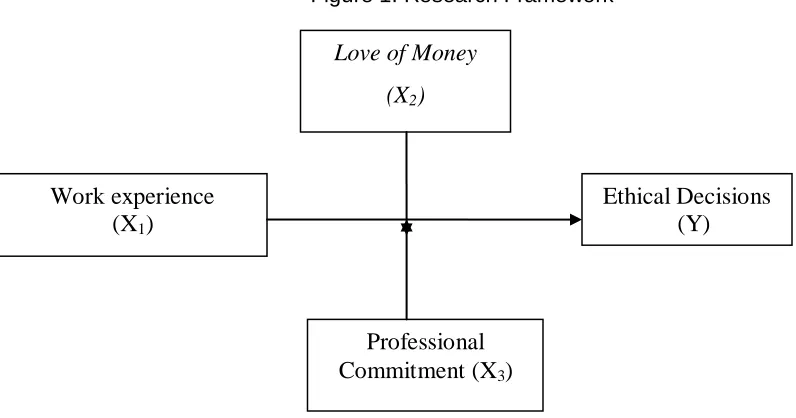
H1: Work experience has a positive effect on the ethical decisions of tax consultants in Bali
Province.
H2: Love of money weakens the influence of work experience on the ethical decisions of tax
consultants in the Province of Bali.
H3: Professional commitment strengthens the influence of work experience on ethical decisions
of tax consultants in Bali Province.
Figure 1. Research Framework
RESEARCH METHODS
The data of this study are primary data, namely data obtained directly from the original source either by using questionnaires or direct interviews. The method used to obtain primary data is the method of documentation and survey methods, using a questionnaire that is a list of questions or structured statements aimed at tax consultants who work in the Tax Consultant Office in the Bali Region and are registered with the Indonesian Tax Consultant Association (IKPI ) Based on the hypothesis proposed, there are three types of variables used in this study, namely the independent variable, the dependent variable and the moderating variable. The independent variable in this study is work experience. The dependent variable in this study is ethical decisions. The moderating variable in this study is the love of money and professional
Work experience
(X
1)
Professional
Commitment (X
3)
Ethical Decisions
(Y)
Love of Money
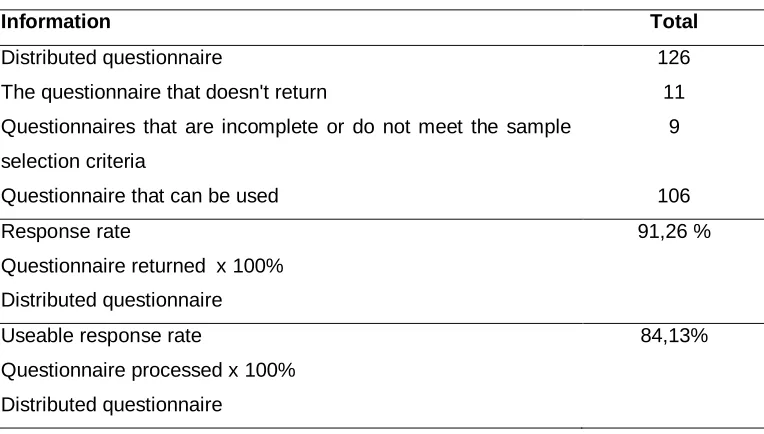
Licensed under Creative Common Page 329 commitment. The analysis technique used to analyze the data is a simple linear regression and MRA. Before the regression analysis is carried out, the classic assumption test is first done which consists of the Normality Test and the Heteroscedasticity Test of the data. The results of the analysis are then interpreted and then concluded and given suggestions. The population used in this study is all tax consultants who work in the tax consultant office in the Bali Region registered with IKPI. The questionnaire used was adopted from several studies including, work experience variables using research indicators from Gusnardi (2003), on the variable love of money, indicators used were adopted from (Tang and Chiu 2003) and Martini (2016). In the professional commitment variable, the indicator used was adopted from Januarti (2011), and ethical decision variables were adopted from Abdurrahman and Yuliani's (2011) study.The number of questionnaires distributed is presented in table 1.
Table 1 Description of the Questionnaire
Information Total
Distributed questionnaire 126
The questionnaire that doesn't return 11
Questionnaires that are incomplete or do not meet the sample selection criteria
9
Questionnaire that can be used 106
Response rate
Questionnaire returned x 100% Distributed questionnaire
91,26 %
Useable response rate
Questionnaire processed x 100% Distributed questionnaire
84,13%
Licensed under Creative Common Page 330 corporate taxpayers and has worked for one or more years has been considered to have sufficient experience to make an ethical decision.
RESEARCH RESULTS
Data collection is done by visiting respondents directly to the Tax Consultant Office in the Province of Bali. The researcher distributed 126 questionnaires to the questionnaire, but only 115 copies of the questionnaire returned and only 106 respondents who met the sample criteria in this study. Thus the number of questionnaires that can be processed are 106 copies of the questionnaire. tax consultants have a working period of one year to three years as many as 70 people (66.0%), tax consultants who have a working period of four to six years as many as 24 people (22.7%), tax consultants who have a working period for seven to nine years there were 10 people (9.4%), and tax consultants who had a working period of more than ten years as many as 2 people (1.9%). The tax consultant used in this study who has a range of ages 21 to 30 years is 95 people (89.6%), tax consultants who have an age range of 31 to 40 years as many as eight people (7.6%), tax consultants who have a range age 41 to 50 years as many as three people (2.8%), tax consultants who have an age range above 50 years are not included in this study. The research instrument consisted of four statement items for experience variables (X1), seventeen statement items for the Love of Money variable (X2), six statement items for Professional Commitment (X3), and four statement items for ethical decision variables (Y) having correlation coefficient above 0.3. Cronbach's alpha results show that all research instruments have Cronbach's Alpha values above 0.7. This means that the data passes the validity and reliability test.
In this study only using two classic assumption tests, namely the normality test and heteroscedasticity test. This is because this study is a cross-sectional study, where the period of this study was only conducted for one year so there is no need to do autocorrelation tests such as time series research. In addition, this study also did not conduct a multicollinearity test because this study conducted an MRA Test to examine the effect of the interaction of independent variables with moderating variables on the dependent variable.
Table 2 Normality Test Results
No. Equation N Asym. Sig. (2-tailed)
1 Y=ɑ +β1X1+e 106 0,091
Licensed under Creative Common Page 331 Based on Table 2 shows that the value of Asym. Sig. (2-tailed) the first equation model is 0.091 and the second equation model is 0.187. This means that the data used in both models is normally distributed because of the value of Asym. Sig. (2-tailed) greater than the 0.05 significance level. Therefore the data can be used to carry out simple linear regression tests and MRA tests.
Table 3 Heteroscedasticity Test Results
No. Equation Variable Sig.
1 Y=ɑ +β1X1+e X1 0,892
2 Y=ɑ+β1X1+β2X1.X2+β3X1.X3+e
X1 0,080
X2 0,053
X3 0,635
X1X2 0,099
X1X3 0,804
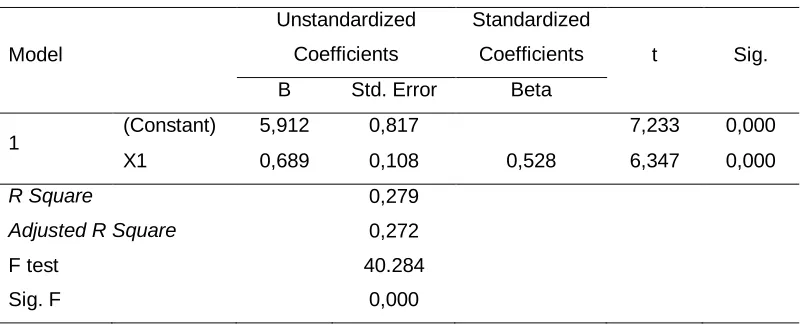
Based on Table 3 the significance value of each variable in the two regression models is greater than 0.05 so it can be concluded that the regression model is greater than the symptoms of heteroscedasticity. The results of simple linear regression analysis in this study are presented in table 2 below.
Table 4 Simple Linear Regression Test Results
Model
Unstandardized Coefficients
Standardized
Coefficients t Sig. B Std. Error Beta
1 (Constant) 5,912 0,817 7,233 0,000
X1 0,689 0,108 0,528 6,347 0,000
R Square 0,279
Adjusted R Square 0,272
F test 40.284
Sig. F 0,000
Based on Table 4, it can be seen that the regression coefficient of the work experience variable (X1) and the constant of the dependent variable (ethical decision), the simple linear regression equation is obtained as follows:
Y = ɑ + β1X1 + ℇ………..………(1)
Licensed under Creative Common Page 332 Based on the above equation, an interpretation can be made as follows:
1) The constant value (ɑ) of 5.912 means that if the work experience variable is considered
non-existent, then the value of ethical decision making for tax consultants in Bali Province is 5.912.
2) Regression coefficient (β1) in the work experience variable of 0.689. The regression
coefficient that has a positive value means that work experience increases by one year, it will increase the ethical decision of tax consultants in Bali Province by 0.689.
Determination Coefficient Test (R2)
The coefficient of determination test is used to measure how far the ability of a model in explaining dependent variable variations can be explained by variations in independent variables. In this study, the test results of the coefficient of determination for simple linear regression analysis are seen from the value of R Square.
Based on table 4 the value of R Square in this study is 0.279. This means that 27.9% of the variation in the dependent variable (ethical decision) can be explained by variations in experience variables, while the remaining 72.1% is influenced by other variables not included in this research model.
T-test
The t-test aims to test how far the influence of one independent variable individually in explaining the variation of the dependent variable. The basis for acceptance or rejection of the hypothesis can be seen from its significance value. If the significance value is below 0.05 then the null hypothesis is rejected and an alternative hypothesis is accepted.
Based on table 4 experience variables have a count of 6.347 and the significance value is 0.000 (<0.05) which means that H0 is rejected and H1 is accepted. This proves that the experience variable has a positive effect on the tax consultant's ethical decisions. This means that the higher the experience of the tax consultant, the more ethical decisions made by tax consultants.
Moderated Regression Analysis (MRA)
Licensed under Creative Common Page 333 Table 5 Test Results Moderated Regression Analysis (MRA)
Model Unstandardized
Coefficients
Standardized Coefficients
t Sig.
B Std. Error Beta
2 (Constant) 0,100 1,358 0,074 0,942
X1 0,007 0,237 0,005 0,028 0,977
X2 0,206 0,038 0,839 5,478 0,000
X3 0,012 0,11 0,018 0,113 0,911
X1_X2 -0,014 0,006 -0,777 -2,44 0,016
X1_X3 0,043 0,015 0,854 2,926 0,004
R Square 0,798
Adjusted R Square 0,787
F test 78,782
Sig. F 0,000
Based on Table 5 the regression equation can be arranged as follows: Y = ɑ + β1X1 + β2X2 + β3X3 + β4X1X2 + β5X1X3 + e……….…………..(2)
Y= 0,100 + 0,007X1 + 0,206X2 + 0,012X3 – 0,014X1X2 + 0,043X1X3 + e
Based on the above equation, the following interpretations can be made:
1) The constant value (ɑ) of 0.100 means that if the independent variable is deemed to be absent, the ethical decision value of the tax consultant in Bali Province is 0.100.
2) Regression coefficient (β1) on work experience variables of 0.007. The regression
coefficient which has a positive value means that work experience increases by one unit, it will lead to an increase in the ethical decision making of tax consultants in Bali Province by 0,007 assuming the other variables equal zero.
3) Regression coefficient (β2) in the variable love of money is 0.206. Positive regression coefficients have meaning if the love of money increases by one unit, it will result in an increase in the ethical decision making of tax consultants in the Province of Bali amounting to 0.206 assuming other variables equal zero.
Licensed under Creative Common Page 334 5) The moderation coefficient (β4) of -0.014 indicates that if the interaction between work
experience and love of money increases by one unit, it will weaken the ethical decision making of tax consultants in Bali Province by -0.014.
6) The moderating coefficient (β5) of 0.043 indicates that if the interaction between work experience and professional commitment increases by one unit, it will strengthen the ethical decision making of tax consultants in Bali Province by 0.043.
F-test
The feasibility test of the model (Test F) was conducted to test the effect of simultaneous independent variables on the dependent variable. If the independent variable has a simultaneous effect on the dependent variable, the regression equation model is included in the criteria of fit or fit. The F test is carried out by looking at the significance values in the ANOVA table if the significance value F ≤ ɑ (0.05), then this model is said to be feasible or the
independent variable is able to explain the dependent variable.
Based on Table 5, it can be seen that the F test in this study produces a significance level of 0,000 which is smaller than 0.05. Thus the model of this research is feasible to be used to prove the hypothesis formed or in other words a model fit.
Determination Coefficient Test (R2)
The coefficient of determination test is used to measure how far the ability of a model in explaining dependent variable variations can be explained by variations in independent variables. In this study, the test results of the coefficient of determination for the MRA test are seen from the value of Adjusted R Square. Adjusted R Square value is used in the determination coefficient test in the MRA test because the Adjusted R Square value is more consistent than the R Square value when there is an addition of one variable.
Based on table 5 the value of Adjusted R Square in this study was 0.787. This means that 78.7% of the variation in the dependent variable (ethical decision) can be explained by experience variables that are moderated by the variable love of money and professional commitment, while the remaining 21.3% is influenced by other variables not included in this research model.
T-test
Licensed under Creative Common Page 335 hypothesis can be seen from its significance value. If the significance value is below 0.05 then the null hypothesis is rejected and an alternative hypothesis is accepted.
Based on Table 3, it can be seen that the value of the t-count for the interaction of experience variables with love of money is -2.44 with a significance level of 0.016 (<0.05) which means that H0 is rejected and H2 is accepted. This proves that Love of money is able to moderate the influence of experience on the tax consultant's ethical decisions. Judging from β2,
the negative value means that the higher the characteristics of the tax consultant's love of money, the higher the tax consultant's experience in love of money further weakens the influence of the tax consultant's experience in making ethical decisions.
In table 5 also shows the magnitude of the interaction of experience and professional commitment variables have a count of 2.926 and a significance value of 0.004 (<0.05) which means H0 is rejected and H3 is accepted. This proves that professional commitment is able to moderate the influence of work experience on tax consultant ethical decisions. Viewed from β3
which has a positive value means that the higher the professional commitment of tax consultants, the work experience of tax consultants who are interacted with high professional commitment further strengthens the influence of the experience of tax consultants on ethical decision making.
DISCUSSION OF RESULTS
Effect of Experience on Making Ethical Decisions of Tax Consultants in Bali Province
An in-depth discussion is needed to give meaning or meaning to static values from hypothesis testing, namely the influence of work experience on ethical decisions of tax consultants in Bali Province. Based on the results of simple linear regression analysis, it can be seen that the experience has a positive effect on the ethical decisions of tax consultants in the Province of Bali. This is intended with a significant value of 0,000 whose value is smaller than the predetermined significance value (ɑ = 0.05) and has a coefficient of 0.689, so H1 is accepted, ie
work experience has a positive effect on the ethical decisions of tax consultants in Bali Province.
Licensed under Creative Common Page 336 Indonesia, the understanding possessed by the tax consultant can help tax consultants to be able to make ethical decisions.
This is in line with the research conducted by Gustini (2016) who found that experience has a positive effect on ethical decisions. Experience is based on continuous work so as to provide learning opportunities and knowledge to be able to make ethical decisions. Budi et al. (2005) reveal that experienced people will make more ethical decisions. Experienced tax consultants have a good understanding of the tax consultant's code of ethics and the risks that are likely to be faced if they violate applicable tax regulations, so they will have a tendency to make ethical decisions. Nadirsyah (2007) states that when a person is faced with an ethical dilemma, the knowledge gained through experience will increase ethical sensitivity in making decisions. Ethical dilemmas experienced by tax consultants compel tax consultants to make unethical decisions for the satisfaction of their clients, but if tax consultants have high experience, they will tend to make ethical decisions because experience makes tax consultants understand well the risks which will be faced if he does not make unethical decisions.
Based on the theory of cognitive moral development proposed by Kohlberg (1971) states that the more a person ages, his experience will also increase. Experience makes tax consultants more able to take a stand when facing ethical dilemmas and will tend to be more careful in giving tax advice or input to clients. Experienced tax consultants will usually tend to provide an explanation of the risks or sanctions that will be received from violating tax rules and will lead their clients to want to follow the applicable tax rules.
Love of Money Weakens the Effect of Experience on Making Ethical Decisions on Tax
Consultants in Bali Province
The discussion of testing the next hypothesis is the influence of the characteristics of the love of money in moderating the influence of work experience on ethical decisions of tax consultants. Based on the analysis of the Moderated Regression Analysis (MRA) shows that love of money weakens the influence of work experience on the ethical decisions of tax consultants in the Province of Bali. This is indicated by a significance value of 0.016 whose value is smaller than the predetermined level of significance (0.05) and has a coefficient of -0.014. The negative coefficient means that the higher the tax consultant's love of money, the weaker the influence of experience on the ethical decisions of tax consultants in Bali Province, so H2 is accepted, that is the love of money can weaken the influence of experience on ethical decision making in tax consultants in Bali Province.
Licensed under Creative Common Page 337 years with a total of 95 respondents (89.6%) of 106 respondents. Based on the results of data analysis, tax consultants who are of that age have a tendency towards higher love of money characteristics. This is usually because people who are at that age do not have targeted career achievements. Thus, even if someone has work experience, if you have a high love for money, the decisions made by tax consultants can be unethical.
This is in line with the Theory Plan of Plan Behavior (TPB) which shows that human actions are directed by three kinds of beliefs, namely control beliefs (Ajzen, 1991). In this study love of money relates to control beliefs that can hinder the influence of work experience on the ethical decisions of tax consultants in the Province of Bali. Tax consultants who have the characteristics of the love of high money will always be faced with an ethical dilemma because they have a tendency to be selfish and gain great personal benefits even though they must make unethical decisions. Ermawati and Kuncuro (2016) reveal that money plays an important role in various aspects of human life, so money becomes everything. Himmah (2013) states that individual characteristics, materialism and capitalization encourage people to do negative things without thinking about the impact of these actions, one of which is to conduct unethical behaviour.
The experience possessed by tax consultants will make tax consultants have the knowledge to streamline the number of tax obligations that must be paid. When work experience interacts with high love of money, the tax consultant will tend to use knowledge based on his experience to behave unethically such as helping taxpayers to streamline the number of tax obligations. This is in line with research conducted by Manoe (2014) who found that materialism has a negative influence on the view of the role of ethics and social responsibility. Individuals with a high type of materialism assume that pursuing material is like an irreplaceable main instinct. Unethical decision making such as helping taxpayers to carry out tax avoidance is done so that the taxpayers handled do not turn to other tax consultants. If the tax consultant can fulfil the desire of the taxpayer to help carry out tax avoidance or minimize the amount of tax liability that should be paid then it will be possible for the obligatory to continue to use his services. Thus the work experience witnessed with high love of money will affect the ethical decisions made by tax consultants.
Professional Commitment Strengthens the Effect of Experience on Ethical Decisions of
Tax Consultants in the Province of Bali
Licensed under Creative Common Page 338 (MRA), it shows that professional commitment is able to strengthen the influence of work experience on ethical decision making in tax consultants in Bali Province. This is indicated by a significance value of 0.004 whose value is smaller than the predetermined level of significance (0.05) and has a coefficient of 0.043. It has that the higher the professional commitment, the higher the influence of work experience on ethical decision making of tax consultants in Bali Province, so that H3 is accepted, namely professional commitment able to strengthen the influence of experience on ethical decision making in tax consultants in Bali Province.
This is in line with the Theory Plan of Plan Behavior (TPB) which shows that human actions are directed by three kinds of beliefs, namely control beliefs (Ajzen, 1991). In this study professional commitment is related to control beliefs that can support the influence of work experience on ethical decision making in tax consultants in Bali Province. Commitment tends to have the meaning of agreement with yourself. If someone has made a decision accompanied by a commitment, he will strive and struggle to carry out the decision as well as possible (Budi, 2010).
When a tax consultant has a high professional commitment, he will tend to behave ethically because he wants to continue to be in the professional association, so he will not violate the code of ethics that has been agreed upon by his professional association (Dewi, et al., 2015). However, to strengthen one's professional commander, a tax consultant needs time or experience in his involvement to become a part and receive benefits as part of a professional community. Therefore to produce an ethical decision tax consultants need experience that is supported by professional commitment. Every profession, especially those who provide services to the community, requires special knowledge and skills acquired through work experience and training and every professional is expected to have certain personal qualities such as professional commitment so that services provided to taxpayers do not violate the tax consultant's ethical code agreed by IKPI.
CONCLUSION
Licensed under Creative Common Page 339 tax consultants in the Province of Bali. Professional commitment strengthens the influence of tax consultative work experience on ethical decisions made by tax consultants. This means that the higher the professional commitment, the work experience of tax consultants interviewed with high professional commitment further strengthens the influence of the experience of tax consultants on ethical decision making of tax consultants in the Province of Bali.
SUGGESTIONS
Licensed under Creative Common Page 340 it is feared that respondents will only direct their responses in a positive direction. Further research can be developed through experimental studies or a combination of questionnaire and interview methods to get more information from respondents so that they can maximize the extraction of data and information needed for research.
REFERENCES
Abdurrahman and Nur Laila Yuliani. 2011. “Determinasi Pengambilan Keputusan Etis Auditor Internal (Studi Empiris Pada BUMN Dan BUMd Di Magelang Dan Temanggung).” Widya Warta. 1(2):133–50.
Ajzen, Icek. 1991. “The Theory of Planned Behavior.” Organizational Behavior and Human Decision Processes. 50(2):179–211.
Aranya, Nissim and Ferris. 1984. "Reexamination of Accountant's Organizational Profesional Conflict." The Accounting Review. 59:1–15.
Aranya, Nissim, Azy Barak, and Joel Amernic. 1981. “A Test of Holland's Theory in a Population of Accountants." Journal of Vocational Behaviou.r 19(1):15-24
Basri, Yesi Mutia. 2014. “Etika Dan Tanggung Jawab Sosial: Keputusan Etis Dalam Penghindaran Pajak.” JSAL. 1(1):73–84.
Basri, Yesi Mutia. 2015. “Pengaruh Gender, Religiusitas Dan Sikap Love of Money Pada Persepsi Etika Penggelapan Pajak Mahasiswa Akuntansi.” Jurnal Ilmiah Akuntansi Dan Bisnis. 10(1):45–54.
Berita Satu. 2011. “Robertus Dituntut Empat Tahun Penjara.” (http://www.beritasatu.com/hukum/7863-robertus-dituntut-empat-tahun-penjara.html).
Blanthorne, Burton, and Fisher. 2005. “The Aggressiveness of Tax Professional Reporting: Examining the Influence of Moral Reasoning.” Working Paper Series College of the Business Administration University of Rhode Island. Budi, Rachmat Hidayat Sumawi. 2010. “Pengaruh Komitmen Profesional Dan Pengalaman Kerja Terhadap Dilema Etika Internal Auditor Dalam Pengambilan Keputusan Etis.” Universitas Islam Negeri Syarif Hidayatullah.
Budi, S., Basuki, and Hendaryanno. 2005. “Internal Auditor Dan Dilema Etika.” Internal Auditor Dan Dilema Etika. Jurnal Ekonomi Bisnis Dan Akuntans.i 8(1):1–36.
Chen, Yuh Jia and Thomas Li Ping Tang. 2006. “Attitude toward and Propensity to Engage in Unethical Behavior: Measurement Invariance across Major among University Students.” Journal of Business Ethics. 69(1):77–93.
Dewi, Putu Purnama, I. Wayan Ramantha, and Ni Ketut Rasmini. 2015. “Pengaruh Pengalaman, Orientasi Etika, Komitmen Dan Budaya Etis Organisasi Pada Sensitivitas Etika Auditor Badan Pengawasan Keuangan Dan Pembangunan Perwakilan Provinsi Bali.” E-Jurnal Ekonomi Dan Bisnis Universitas Udayana.4(11):841–66.
Duska, R. and B. .. Duska. 2010. “Accounting Ethics.” in Blackwell Publishing Ltd.
Ermawati, N. and A. Kuncuro. 2016. “Determinan Persepsi Etika Mahasiswa Akuntansi Dengan Love of Money Sebagai Variabel Intervening (Studi Kasus Mahasiswa Akuntansi Universitas Kudus).” Riset Akuntansi Terpadu. 9(17):12–24.
Falah, Syaikhul. 2006. “Pengaruh Budaya Etis Organisasi Dan Orientasi Etika Terhadap Sensitivitas Etika (Studi Empiris Tentang Pemeriksa Intern BAWASDA).” Universitas Diponogoro.
Glover, S. H. 2012. “Gender Difference in Ethical Decision Making.” Woman in Mangement Review. 17(5):217–27. Gusnardi. 2003. “Analisis Perbandingan Faktor-Faktor Yang Mempengaruhi Judgment Risiko Penetapan Audit Oleh Auditor Yang Berpengalaman Dan Auditor Yang Belum Berpengalaman.” Universitas Padjajaran.
Gustini, Emilia. 2016. “Pengaruh Pengalaman Audit , Komitmen Profesional , Pengambilan Keputusan Etis Auditor Internal Di Kota Palembang.” Jurnal Ilmiah Ekonomi Global Masa Kini. 7(02):62–73.
Hapsari, Niken Nindya. 2016. “Pengaruh Pengalaman Auditor Dan Orientasi Etika Terhadap Keputusan Etis Auditor Negara Dengan Komitmen Profesional Sebagai Variabel Intervening.” Universitas Brawijaya.
Licensed under Creative Common Page 341 Harmana, I. Made Dwi, Made Gede Wirakusuma, and Dewa Gede Wirama. 2017. “Pengaruh Idealisme, Pengalaman, Dan Komitmen Profesional Pada Pembuatan Keputusan Etis Konsultan Pajka Terdaftar Di Wilayah Bali-Nusa Tenggara.” E-Jurnal Ekonomi Dan Bisnis Universitas Udayana. 6(10):3549–78.
Himmah, E. F. 2013. “Persepsi Etis Mahasiswa Akuntansi Mengenai Skandal Etis Auditor Dan Corporate Manager.” Jurnal Akuntansi Multiparadigma. 4(1):26–39.
Januarti, Indira. 2011. “Analisis Pengaruh Pengalaman Auditor, Komitmen Profesional, Orientasi Etis, Dan Nilai Etika Terhadap Persepsi Dan Pertimbangan Etis (Auditor Badan Pemeriksa Keuangan Indonesia).” Simposium Nasional Akuntansi XIV.
Jeffrey, C. and N. Weatherholt. 1996. “Ethical Development, Professional Commitment, and Rule Observannce Attitudes: A Study Case of CPAs and Corporate Accountans.” Behavioral Research in Accounting. 8:8–36.
Kidwell, Jeaneen M., Robert E. Stevens, and Art L. Bethke. 1987. “Differences in Ethical Perceptions between Male and Female Managers: Myth or Reality?” Journal of Business Ethics. 6:489–93.
Knoers and Haditono. 1999. Psikologi Perkembangan: Pengantar DalamBerbagai Bagian. Yogyakarta: Gajah Mada University Pers.
Kohlberg, L. 1971. “The Cognitive-Developmental Approach to Moral Education.” Issue In Adolescent Psychology. 283–99.
Kurniawati, Meiliana and Agus Arianto Toly. 2014. “Analisis Keadilan Pajak, Biaya Kepatuhan, Dan Tarif Pajak Terhadap Persepsi Wajib Pajak Mengenai Penggelapan Pajak Di Surabaya Barat.” Tax & Accounting Review. 4(2):1–12.
Kusuma, Tirta Hadi, Hamidah Nayati Utami, and Ika Ruhana. 2016. “Pengaruh Persepsi Peran Etika Dan Tanggung Jawab Sosial, Sifat Machiavellian, Dan Preferensi Risiko Terhadap Pengambilan Keputusan Etis (Studi Pada Konsultan Pajak Di Kota Malang).” Jurnal Perpajakan (JEJAK). 10(1):1–10.
Larkin, Joseph M. 2000. “The Ability of Internal Auditors to Identify Ethical Dilemmas.” Journal of Business Ethics. 23(4):401–9.
Manoe, R. V. 2014. “Pengaruh Idealisme, Relativisme Dan Materialisme Terhadap Pandangan Akan Peran Dan Tanggung Jawab Sosial Perusahaan (TJSP).” Jurnal Magister Manajemen. 1–22.
Martini. 2016. “Pengaruh Love of Money, Organizational Citizenship Behaviour Dan Kecerdasan Emosional Pada Kinerrja Pegawai Universitas Udayana.” Universitas Udayana.
Mowday, R. T., Porter LW., and R. M. Steers. 1979. “Employee-Organizational Linkages : The Psychology Of Commitment, Absenteeism And Turnover.” Academic Press.
Nadirsyah, R. M. 2007. “Pengaruh Perilaku Etis, Tekanan Ketaatan Dan Pengalaman Auditor Terhadap Pengambilan Keputusan Etis Auditor (Studi Empiris Pada Auditor BPKP NAD).” 2(2).
Napolitano, John. 2011. “The Client Audition (Choose To Work Only With Those Who Work Best For Your Firm).” Accounting Today. 25(6):1–22.
Rosianti, Camelia and Yenny Mangoting. 2014. “Pengaruh Money Ethics Terhadap Tax Evasion Dengan Intrinsic Dan Extrinsic Religiosity Sebagai Variabel Moderating.” Tax & Accounting Review. 4(1):1–11.
Stewart, Jenny and Conor O’Leary. 2007. “Governance Factors Affecting Internal Auditors’ Ethical Decision Making: An Exploratory Study.” Managerial Auditing Journal. 22(8):787–808.
Sugiyono. 2016. Metode Penelitian. Bandung: Alfabeta.
Sutanto, Lusiana and Elisa Tjondro. 2013. “Preferensi Wajib Pajak Terhadap Konsultan Pajak Dalam Memilih Konsultan Pajak: Honest Consultant, Creative Consultant, Dan Cautious Consultant.” Tax & Accounting Review. 3(2):1–14.
Tang, Thomas L. and Randy K. Chiu. 2003. “Income, Money Ethic, Pay Satisfaction, Commitment, and Unethical Behavior: Is the Love of Money the Root of Evil for Hong Kong Employees?” Journal of Business Ethics. 46(1):36–43. Tang, Thomas Li Ping and Yuh Jia Chen. 2008. “Intelligence vs. Wisdom: The Love of Money, Machiavellianism, and Unethical Behavior across College Major and Gender.” Journal of Business Ethics. 82(1):1–26.