The Significance of Dedications
The Elizabethan period was a watershed in the history of literary patronage. The printing press had provided a means for easier
publication, distribution and availability of books; and therefore a great patron, the public, was accessible to all authors who managed to get Into print. In previous times there were too many discourage-ments and hardships to be borne so that writing attracted only the dedicated and clearly talented writer. In addition, generous patrons were not at all plentiful and most authors had to be engaged in
other occupations to make a living. In the last half of the sixteenth century, a far-reaching change is easily discernible. By that time there were more writers than there were patrons, and a noticeable change occurred In the relationship between patron and protge'. In-stead of a writer quietly producing a piece of literature for his patron's circle of friends, as he would have done in medieval times, he was now merely one of a crowd of unattached suitors clamouring for the favours and benefits of the rich. Only a fortunate few were able to find a patron generous enough to enable them to live by their pen. 1 Most had to work at other vocations and/or cultivate the patronage of the public and the publishers. •The fact that only a small number of persons had more than a few works dedicated to them indicates the difficulty in finding a beneficent patron. An examination of 568 dedications of religious works reveals that only ten &catees received more than ten dedications and only twelve received between four and nine. There were 127 dedicatees who received only one dedication; an indication of the search by authors to find patrons.
Expectation of material reward was only one of several reasons why authors dedicated their works to a particular person or persons.
it aside or commit it to the press.' Many times the dedication merely acknowledges the author's appreciation of the dedicatee's remarkable character and abilities or of his generosity. On one occasion, at least, an author dedicated a work to his opponent -- attacking him, of course. Laced with sarcasm, he wrote
This my answere, albeit you bake not for it, I dedicate to your owne selfe, and not without just cause. I doe not look for any thankes at your handes. I know it is an ungratefull world. Yet if you will patronize this booke and vouchsafe to stay the vnbridled tongues of your disciples,
that In their Bacchanall banquettes and disciplinary feastes degorge their malice, and speake their pleasures of whom they list, I wil accept it at your hands as a f au-our, and put it into the reckining of your good doings. 2
Another author, Richard Hakluyt, the famous geographer, deliberately used dedications as part of a publicity campaign for Sir Walter Raleigh's adventures. He wrote to Raleigh concerning the dedication
In Peter Martyr: "if there be anythinge else that you wold have mentioned in the epistle dedicatorie, yow shal doe wel to let mee understand of yt betymes." In 1587 Peter Martyr appeared and its dedication, in large part, was devoted to advertisement of Raleigh and Virginia.3
But mentioned more often than any other reason for dedicating a religious writing to a prestigious dedicatee was to offer him the opportunity of advancing the Protestant faith. One author pointed out in a dedication to Dr. Babington, Bishop of Worcester, that Erasmus and Calvin dedicated their works to kings, princes, and nobles "to make them in loue with religion [and] to make them to fauour and further it, to the vtmost of theyr power." He, therefore, was following their example and trusted that the bishop would "further Gods Church and the ministrie by this means." 4 What Eleanor Rosen-berg found to be true of Robert Dudley, Earl of Leicester, was true also of the other important patrons of Protestant literature: "the dissemination of propaganda was the most powerful single purpose
behind the production of patronized religious writing in the period."5
1 See infra., p. 281.
2Dedicated to Thomas Cartwright by M. Sutcliffe, The Examination Of N. Thomas Cart-wrights late apologie....(1596), sigs. A2, B2.
3 See E. Rosenberg, "Giacoso Castelvetro: Italian Publisher in Eliza-bethan London and His Patrons," reprinted from The Huntingdon Library Quarterljr, Vol. VI: No. 2: Feb. 1943 (BM. Press. l0635.e. 30.)
Certaine Godlie and learned Ser-mons....(l601); see also Muf-fet, A Commenta-rie vpon ... Prouerbs ... (1592), sig. A3.
Though times had changed with the Invention of the printing press and authors were no longer totally dependent upon a patron, most clung to the tradition of dedicating their work to wealthy and
Important persons. When successful, the benefits of such a system could be considerable. Peter Martyr (Pietro Martire Vermigli), the Italian reformer, received twenty crowns from Bishop Cox for his commentary on Judges. Radoiph Gualter of Zurich did much better by using a multi-patron dedication. He dedicated his homilies on I Corinthians to Bishops Grindal, Sandys, Horn, Cox, Parkhurst and Pilklngton. From Grindal he received thirty crowns, from Pilklngton about twenty-five, from Cox about seventeen (25 gulden plus 5 crowns), and probably similar amounts from Sandys, Horn, and Parkhurst) On the other hand, remuneration from a dedicatee could be quite meagre, arid sometimes not forthcoming at all. Richard Robinson received only two shillings and sixpence from Mr. Syinon Roe, Master of the Company of Leathersellers, for dedicating to him Certeyn Select Historyes for Christian Recreation....(l576) and only two shillings from Bishop Watson of Chichester for his A Record of Ancyent Historyes....(1602). Even worse for poor Robinson, he received nothing on at least three occasions -- from Ambrose Dudley, Earl of Warwick, Queen Elizabeth, and Sir Thomas Egerton, Lord Keeper of the Great Seal of England.2 Robinson was not typical of the Elizabethan author of religious literature in that he was a hack writer trying to eke out a living by his pen. A talent for writing he clearly lacked; his works con-sisted of translations and compilations. There is little doubt that expectation of material reward was his main reason in making a dedication. There was no chance at all that Robinson could have followed Bucer's example of a few decades before when he told
Archbishop Cranmer not to send him an "additional" thirty crowns for one of his dedications: "I have never yet received a farthing from any one for dedicating my works: so that if your reverence will treat me with such liberality, there will be some danger of my
1 Cox to Martyr, Aug. 5, 1562; Cox to Gualter, June 12, 1573, and Feb. 4, 1573; Pilkington to Gualtee, July 20, 1573; Grindal to Gualter, July 31, 1573. H. Robinson (ed.) The Zurich Letters (1842), pp. 112, 282, 284-6, 288, 293-4.
Robinson, "Eupolemia Or The Good Warfare Agenst Ye Devill,"
B.M. Ms. Royal 18A. lxvi, fols. 5,7,8v, llv. See Studies In Philology (Oct. 1924), Vol. xxi, 629-48, for reproduction of Robinson's
growing covetous." Disclaiming any motivation for material gain, Bucer states that his purpose in dedicating his work to Cranmer was "to set forth your faith to the godly ... and thereby to encourage our hopes and also to procure some kind of access from us to you, and
some communion In the Lord." 2 That statement goes a long way in ex-pressing the motivation behind most dedications by Elizabethan authors of serious religious literature.
Not all dedications, however, reflect the acceptance of the dedicatee of the work or his sympathy with what is expressed in it. Most probably did. There were some that only came to the attention
of the dedicatee after the printing. Robinson received a tongue-lashing from Sir Thomas Egerton for that very thing -- besides a flat refusal to remunerate him. 3 Nevertheless, dedications in all ages have been generally accepted as evidence of patronage and of sympathy with what has been written. 4 Therefore, while it would be dubious to deduct a dedicatee's religious preferences from two or
three dedications, yet much can be said about his or her religious sympathies by the kind of authors and translators they attracted, especially if they had sufficient number of works dedicated to
them. There is little doubt, for example, that the Earl of Leicester's identification with the extreme Protestant faction at Court was
reflected in the type of literature dedicated to him. Of twenty-five dedications to Leicester eighteen were written by Puritans.5 There was no doubt in the minds of Puritans that sympathetic nobles
like Leicester were elevated to their high social status by God
to support His cause. In a dedication to George, Earl of Cumberland, Christopher Shutte stated plainly that what bounty he had received of the Earl ought to be the expression of "the zeale and loue of all Nobilitie, (whereof your Honoure is a most towarde Braunche) always with maine and might, to defend the cause of true Religion ... for which cause the Lorde hath stirred vp most noble men and godly
'M. Bucer to Cranmer, Oct. 23, 1538. Original Letters of the Reformation, Vol. 2, p. 523.
3B.M. Ms. Royal 18A. lxvi, fol. liv.
4Holzknecht, op. cit., p. 135. .3. Caidwell, A Sermon preached before the ... Earle of Darbie (1577), sig. A2v, for example of dedicatee offering to finance the publication.
Magistrates, to bee, as Patrones, and Protectoures too the Pmbassa-doures of his woorde, for the better proceeding of Religion...."1
Single-Patron Dedications
The Queen and Archbishop of Canterbury, John Whitgift, as would be expected, were among those receiving above average numbers of dedications of religious works. 2 The scarcity of dedications to them by Puritans is striking and underlines the antagonism that lay between them. Out of some twenty-six dedications of religious works
to Elizabeth, only two dedicators could be classified as Puritan --and moderate Puritans at that. They were Lawrence Humphrey --and
William Fulke. There were none by the later and more radical Puritans of the stamp of Cartwright, Field or Wilcox. Much the same can be said of Archbishop Whitgift. Only two dedications out of ten were written by Puritans, but, one must add, whose Puritanism was of an earlier period. 3 Most of the Queen's and the Archbishop's dedicators were staunchly orthodox in their religious views.
Other prominent Elizabethans were involved In the Protestant booktrade. None was more active than Sir Francis Walsingham. Re-lated to the Queen through his stepfather, Walsingham had served as resident ambassador in Paris and wituessed the Massacre of St.
Bartholomew. Ever since his days at Cambridge, he held advanced Protestant views and had to flee abroad during Mary's reign. He returned with religious attitudes typical of the Marian exile. When William Cecil became Lord High Treasurer upon the death of the old Marquis of Winchester in March 1572, Walsingham was appointed second Principal Secretary nine months later. 4 His appointment altered little, if at all, his religious viewpoint. While too discreet to be caught in the Puritan camp, there was no doubt about his anti-Catholic zeal and sympathetic attitudes to Puritanism.
Walsingham, it seems, was the co-ordinator of an organized
1 c. Shutte, A compendious fornie and summe of Christian doc-trine (1581), sigs. A3-A3v.
2Parker and Grindal received some dedications during their shorter incumbencies, but insignificant compared with Whitgift.
3 .
They were Miles Mosse and Thomas Sparke. Within a decade, Sparke was urging his wayward brethren to conform in his Brotherly perswasion to unitie and uniformitie (1607).
campaign to reply to the Roman Catholic books being distributed in England by the Jesuits and Seminary priesLs. Noces by him set out three points to be considered in dealing with the problem:
"1. What books are fit to be answered. 2. By whom.
3. And how the Charges shall be defrayed."
The consideration of the first was to be referred to "D. Hammond, H. Knowles, Mr. Beale, D. Crook, Reynoldes, Travers, Reynoldes (six), Charke, Sootheacke C?), Mr. Norton, Thomson." With regard to the second point, the authors would be "well chosen Persons of Cam-bridge and Oxford" and "learned Ministers in London and in other Diocesses." And the last point, the problem of expenses, would be met in the following manner:
"1. Bishops to make collections in their Diocesses and Chancellors in the Universities.
2. The well affected to be moved publickly by the Preachers at Pauls Crosse to yielde Contributions. Others that are thought to be religious, may be appointed with the city.
3. To move particular Persons for Contribution.
4. To make choice of a Printer to have the printing of these bookes who is to give some allowance to the
Notarys that are to write these books. The Bookes to be perused before the Printing by the best learned in both the Universities, as also by other learned Fathers of the Church." 1
The plan soon became practice. Three of the eighteen works dedicated to him were written against the Jesuits, 2 and be was directly in-volved in two others of a similar nature. One of the latter was The copie of a letter sent out of England (n.d.), a piece of anti-Spanish and anti-Catholic propaganda which John Wolfe printed in Italian at the warrant of Sir Francis. 3 The other was Thomas Cart-wright's A Confutation Of The Rhemists Translation, Gosse And AnnotationsQn The New Testament....(1618). A letter written to Cartwright on July 5, 1586(?) from the Court at Greenwich, almost surely by Walsingham, informed him that the Queen wished his removal as master of Leicester's hospital in Warwick, but that he was
"earnestly desired by some" to spend his time in answering "books of
1 S.P. Dom. Eliz. 12. Vol. cxxxiii. (1579?).
Keltridge, Two Godlie And learned sermons, appointed and preached before the Iesuites....(l581); A Munday, A breefe Aunswer made vnto two seditious Pamphlets....(l582); and T. Lupton, The Christian against the Iesuite....(1582).
3A.E.M. Kirwood,'Richard Field, Printer, 1589-1624,"The Library,
the Jesuites." He then was offered one hundred pounds a year to reply to the Catholic Rhemish New Testament, the finished product
to be "seane and allowed by the best learned of both the Universities." In addition to free accommodation, he also could have whatever
assistants he thought necessary, "as many as you will, and they like-wise shall have good allowance made them." It was suggested, further-more, that the book should be dedicated to the Lord Treasurer or to the Queen, "whom you best lyke and this way is thought best to make an overture for your further favour." 1 The preface to the Confutation, published posthumously in 1618, outlined the conditions of Walsing-ham's generous offer and referred to proof of receipt of the one hundred pounds In Cartwright's letters.2
Walsingham's Protestant fervour and zeal were often alluded to in dedications to him. John Foxe, for example, In A Sermon prea-ched at the Christe-ning of a certaine lew .... (1578), reminded Sir
Francis that when he missed the preaching of Foxe's sermon due to sickness, he had him come to his chamber and repeat it. 3 John Stock-wood dedicated his translation of Brentius' discourse on the Book of Esther to him, and clearly defends the position of the Puritans in the dedicatory epistle. Stockwood likens Walsingham to Mordecai, the uncle of Queen Esther, who pleads with her to use her influence to thwart the murderous designs of the enemies of her people, the Jews. Just as Mordecai championed the cause of his people, so Walsingham has advanced the cause of "the children of god both of our own church at home, and also abroad in other countreis [sic], as occasion hath bene offered." The villain of the piece was Haman, "the most powerful official in the empire next to the king himself."4 Given the year of publication of this work, 1584, the year of the Subscription crisis, 5 there is little doubt that Stockwood's Haman is really John WhItgift, Archbishop of Canterbury. "We see then first in [H]aman what enuie and ambition meeting together can doe, namely that It can procure the partie in whom It taketh place, to bende all his studie, labor, trauell, and policies to seeke the vtter
Dom. Eliz. 12. Vol. CL1V (48).
2 Sig. A2. See Cartwright to Cecil, June 23, 1590, Aug. 5, 1590, Lansd. Ms 64. (15). fol. 49, (17) fols. 57-58.
3 Sig. *2. 4 Esther 3:1
mine, yea euen of the Church of Cod, making him quite and deane to forget all thankfulnesse vnto God for aduancing him vp from low estate, vnto the high top of dignitie, and for taking him from the dunghll ... to place him amongst princes, and causing him further to imploy his preferment (to) ... the vtter defacing of true religion, and extreame destruction of the most sincere folowers and embracers of the same." But Mordecai's influence with Queen Esther prevailed, and Hanian swung from the gallows he had prepared for the people of God.' Stockwood was only one of eight Puritans who presented their work to Walsingham. Thomas Wilcox, John Keltridge, Nathaniel Baxter, Anthony Munday, Stephen Gosson, Laurence Tomson, were others.2
There were further indications of Walsingham's Puritan sympathies. According to Thomas Jackson, the Puritan minister of Wye, Kent,
Walsingham was responsible for persuading the Queen to assign yearly stipends of fifty pounds to "some" godly ministers in Lancashire. He also refers to Sir Francis Walsingham as that "most worthie, religious, and deepely prudent Councellour." 3 And when Puritan opposition to the Queen's proposed marriage to the Duke of Alencon reached a crescendo in the publication of the Gaping Gulf, with the wrath of Elizabeth falling upon John Stubbes, the author, and his cohorts, the rumour was that Walsirgham had inspried it. Memoranda left by him shows that his thinking regarding the Queen's marriage coincided with Stubbes' pamphlet to a remarkable degree. In their arguments against the marriage, the difference cf religion weighed more heavily than any political consideration. 4 While no connection between Stubbes and Walsingham can be proved before the publication of his pamphlet, there is evidence that he was known to associates of Walsingham, and that after its publication he had dealings with
5 Leicester, Burghley and Walsingham.
Next to Sir Francis Walsingham in the number of religious dedications they attracted were the Earls of Huntingdon, Bedford,
J. Brentius, A Right Godly and learned discourse vpon the booke of Ester.... (1584), sigs. A2v, A3, A4v, A8v, B2.
2 See authors listed in Bibliography II. under Walsingham.
3T. Jackson, Davids Pastoral Poeme. ....(1603), sig. S6v. For Jackson's participation in a weekly lecture conducted by five ministers in
Ashford, Kent, every market day, see sig. *2.
4 See U. J. By-mom, ttEdmund Spenser's First Printer, Hugh Singleton," The Libray, Ser. 4, Vol. 14, 1933-34, P. 137-138.
Warwick, and Essex. On the whole, the kinds of rel1gous works
dedicated to them were similar in nature: translations of commentaries, sermons, treatises, etc., of Continental reformers and anti-Catholic propaganda much of which contained trenchant criticism of the Church of England. At least ten of the sixteen dedications to the Earl of Huntingdon were made by Puritans, 1 nine out of nineteen to Francis, Earl of Bedford, and to his son Edward, 2 ten out of sixteen to the Earl of Warwick, 3 and six out of twelve to the Earl of Essex. 4 The four earls were linked together not only by their strong Protestantism but also by marriage. Huntingdon married Katherine Dudley, a daughter of Northumberland, and so became brother-in--law to the Earls of
Leicester and Warwick. Early in Elizabeth's reign Warwick married the daughter of the Earl of Bedford. Essex was Warwick's nephew, Leicester's stepson, and became Walsingham's son-in-law. Together with Leicester and Walsinghain, the four Earls formed a complex of religious literary patronage that was the backbone of the effort to put the Puritan viewpoint into print. At least sixty-three works written by Puritans were dedicated to this small group of Protestant peers. 5 They were all praised by their dedicators for their staunch support of Christ's Church and, as Bartimaeus Andrewes added in his dedication to Huntingdon, of "good causes".6
Henry Hastings, Earl of Huntingdon, was supportive particularly of iiilitant Protestantism. While he did encourage and patronize such radicals as John Field, Thomas Wilcox, and John Udall, he certainly did not embrace their presbyterianism. Though his dedi-cators did not hesitate to condemn corruption in the Church, none attacked episcopacy in their dedications to him. The self-restraint exercised by Field and Udall in their dedications was admirable.
1 John Udall, Bartimaeus Andrewes, Arthur Hildersam, John Stockwood, Anthony Gilby, Arthur Golding, Robert Fy11, Christopher Fetherstone, and John Field.
Francis: John Udall, Eusebius Paget, Thomas Wilcox, Arthur Colding, and John Field. To Edward: Thomas Wilcox, William Perkins
(3) and Elijah Wilcox.
3John Udall, George Gif ford, John Knewstub, William Fulke, William Kethe, Thomas Tymme, and Richard Greenham.
4George Gif ford (3), Nicholas Bownd, William Hubbocke, and Josais Nichols.
5 See Bibliography II.
Field, for example, concentrated on railing against the "Papistes") Throughout his life, the Earl seems to have consistently favoured the cause of moderate reform. He chose for his livings men of the type of Anthony Gilby, Thomas Sampson, and Arthur Hildersham. After his death, his brother Francis wrote of him:
he never sett a strayinge Foote in anye place, where he did not labour at the least to settle the preachinge of the word to the people. And in manie places I knowe hee broughte it to passe to the comforte of manie consciences, and the knitting of there hartes in all loyaltie and obedience to there soveraigne and Queene: and in whome soever he found eyther backwardnes or blinde ignorance, bee would seeke lovinglie to have them instructed, or else by Just severtie to correcte and reforme them. 2
It must be added that his concern for the proclaiming of the Word of God encompassed the printing of it.3
A similar picture emerges from dedications to Francis Russell, Earl of Bedford. Bedford was a staunch supporter of radical Protes-tants in the West Country. A Marian exile at Zurich, he maintained friendships with such reformers as Calvin and Beza into Elizabeth's reign. His keen interest in advancing the Protestant cause was in-dicated by the numerous books In his library by leading Puritan divines
4
and by Calvin and Beza. Such radicals as John Field could testify of his patronage. Field dedicated to the Earl and his wife his translation of Thirteene Sermons Of Maister Iohn Caluine ....(1579) "because I can not ... by arye other meanes testifie the dutie that I owe you." Field felt free enough to go on to write a ringing exhortation:
Beware of those twoo Cankers that corrupte the whole worlde, and is moste likely to assayle Nobilitie, I
meane Pride and Couetousness; Let them not once bee named arnongest you as becommeth Saintes .... Stand fast in his trueth in these slipperie daies .... Examine your selues often ... and neglect not holy exercies .... Care not for the contempt of the woride, but holde fast a good conscience that you may be approued before God. 5
See J. Calvin, Foure Sermons ....(1579), sigs. *2v, *3, *4v. 2 Quoted in M. Claire Cross, "Noble Patronage In The Elizabethan Church," The Historical Journal, Vol. III, No. 1, 1960, p. 9. 3For an excellent monograph on Henry Hastings, Earl of Huntingdon, see M. Claire Cross, The Puritan Earl (Macmillan, 1966).
Arthur Golding referred to Bedford's God-given "sthgulaer desire to aduaunce his glorie, and benefite his Churche." The main reason for the dedication, wrote Golding, was because "your Lordshippes good gouernment, and conuersation in these North partes of Englande,
,,1
hath furdered not a fewe, to the light of true Religion. Thomas Gibson, the Puritan minister of Ocham in Rutland, thought the Earl one of "the cheefe Patrons and defenders of the Godly preachers and the worde of God." Gibson went on to refer to him as one of the "defenders of the Lord's cause, and tried Friends and fauorers of God and his truth" and to commend him for his "zeale of Gods glory and
2
furtherance of his religion. Gibson published his sermon in the year of the Subscription crisis 3 and was clearly on the side of those who refused to subscribe. He implied that this was one of the reasons for dedicating it to Bedford. After mentioning the
"bitter persecution" the "dearest children of God" were suffering for contending for "sinceritie of religion" and "the pure preaching of the worde of God," he sated: "This I say, is hated, rejected and persecuted so farre as may bee, of the greater sorte, and therefore not without cause haue I attempted to dedicate this my labour" to you.4 Bedford's patronage, however, was by no means one-sided. Among the dedicators acknowledging his bounty to them were a bishop, William Alley of Exeter, and two who later became bishops, John Bridges and
5 John Woolton.
Ambrose Dudley, Earl of Warwick, and Robert Devereux, Earl of Essex, gave every indication of sympathizing with the
ultra-Protestant cause. Although the religious works dedicated to them are not so numerous compared with Walsingham and Huntingdon, some indication of their zeal is contained in them. 6 John Knewstub
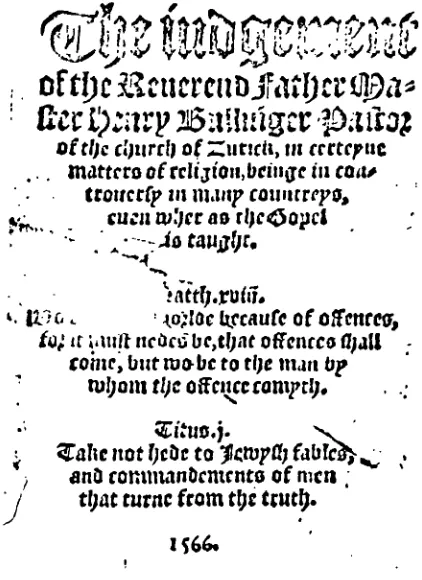
Calvin, A Little Booke ....(1566), sig. *4v, *5
2T. Gibson, A Fruit-ful sermon ....(1584), sigs. A2, A5v, A7. 3 See supra., pp. 90-95.
4Gibson, A Fruit-ful sermon ....(1584), sig. A2.
5w. Alley, The poore mans Librarie....(1570); J. Bridges (Dean of Salisbury, 1577-1604; Bishop of Oxford) dedicated to Bedford his
translation of R. Waither, An hundred, threescore and fiftene Homelyes ....(l572); J. Woolton (Bishop of Exeter, 1578-1594), A Treatise of the lininortalitie of the Soule....(1576). It was due to Bedford's patronage that Woolton became Bishop of Exeter. See Collinson, The Elizabethan Puritan Movement, p. 201.
6 .
acknowledged Warwick's benevolence to him by providing "a safe harborow wider your honourable protection" for himself and others.1 To William Kethe, one of the Puritan ministers to accompany Warwick to the Netherlands, the Earl was most worthy as a dedicatee "beyng desirous to further vertue, and the sincere religion of lesus Christ, with the fauourers of the same." Kethe went on to say that "some
of Higher calling" in the county of Dorset had "misliked" his sermon for Its plain speaking about abusing the Sabbath, but that he
dedicated it to Warwick knowing from experience that he appreciated 2
his forthrightness. William Fulke mentioned his gratitude for the Earl's singuler good wyll" towards him and that while his "godlye zeale to the glorye of God, and the detestation of Papistrye, may appeare to all men ... it is throughly knowen to those that daylye haue experience of .your honorable disposition." 3 Similar sentiments
4 were expressed by George Gif ford, John Udall and Thomas Tyinme.
The young Earl of Essex, according to Thomas Cartwright, was "a father of his people." Cartwright was a regular correspondent with Essex and was one of several Puritans directly associated with him.5 Stephen Egerton was another ardent Puritan who received favours from Essex. Egerton would later emerge as the leader of the militant
Puritan ministers in London. 6 George Gifford dedicated his A Treatise Of True Fortitude (1594) to the Earl because it was "the common hope and expectation of our whole Land, (at the least, of so many as carry faithfull harts to their Prince and Country, and loue to the truth) that God hath prepared your Honour as a right worthy instrument furnished with an heroicall spirite for the defence of cur most noble Queene and Kingdome." 7 Josias Nichols of Kent pointed out to examination of some 1,700 Elizabethan publications (including ballads, news-sheets, pamphlets, etc.), of which approximately 568 contained dedications. Of these, 16 were to the Earl of Warwick and 12 to the Earl of Essex.
'Knewstub, A Confutation ....(1579), sig. *7v.
Kethe, A Sermon made at Blanford Forum....(l571), sig. A2v-A3v. 3W. Fulke, A Sermon preached at Hamp-ton Court ....(1572), sig. A2. 4 Tyinme translated A Commentarie of Iohn Caluine, vpon ... Genesis....
(1578).
5 See Collinson, The Elizabethan Puritan Movement, p. 445. Ibid., p. 446.
Essex that Queen Esther became the intercessor for the Jews in the face of "wicked Haman," and added "Who knoweth whether thou art come to kingdome for such a time?" The same reference and words, only this time applied to King James, appeared later in the Millenary Petition. Queene Esther and her uncle Mordecal were favourite Old Testament figures of the Puritans when urging prominent and important Elizabethans to take up their cause.' In similar vein but using a different analogy, Nicholas Bownd informed Essex that in "these euil daies" the "best causes are drluen to seeke patronage where it male doe them most good." Consequently, he was dedicating his Doctrine of the Sabbath (1595) to him. The Lord had raised up the Earl, continued Bownd, and had "inlarged your honorable name, abouc a great nianie, which as a precious ointment flowing from yourselfe, comfortablie refresheth and perfumeth a great number."2
As was the case with the other prominant Protestant patrons, Essex was the recipient of dedications from orthodox writers. In later life, he seems to have supported both reformers and maintainers of the status quo. Richard Harvey, for example, in his tract against
acknowledges the Earl's "fauourable affection" whici "hath bene euer so euldent and your bountlfull hand alwaies so open vnto me." 3 During his disgrace and fall, Essex maintained that his affection for the Protestant zealots was a passing fancy of his
youth and that he much admired and respected Archbishcp Whitgift. In fact Whitgift remained true. to him in the last tragic years of his life. 4 A letter from Essex to Lady Ann Bacon, probably written early in 1597 as it was a reply to her letter of December 1596, suggests that he had a falling out with the godly preachers. He
defended himself against Lady Bacon's accusation that he had committed adultery with a certain unnamed lady and protested that it was the work of his enemies slandering him to the Queen. After complaining
that his enemies were consolidating support against him in his absence, he added: "Yea the very Oracles (I meane those that are accounted to be plaine and sincere) doe ... speake the language of the strongest
faction." 5 Nevertheless, in the few days before his fateful rising
Nichols, An Order of Houshold Instruction ....(1596), sig. A3v; see also supra., pp. 181-182.
2 Sig. A2-A2v.
3Harvey, A Theologicall Discourse....(1590), sig. A2.
4 George Paule, The Life of John Whitgift (London, 1612. 2nd ed., 1699), p. 64.
5
against the Queen, zealous preachers addressed the great number of citizens assembled at Essex House. 1 The passing fancy of his youth, if that is what his relationship with the Puritans was, had returned on the eve of his death.
Another cluster of influential patrons of Protestant religious literature consisted of Sir William Cecil, Sir Thomas Egerton, and Sir Christopher Hatton, all receiving a similar number of dedications. Only Cecil gave some indication of being sympathetic to the reformist cause; the other two clearly were not. Cecil was involved with the publication of Protestant literature from the early years of the reign and, by virtue of his positions as Principal Secretary and later Lord Treasurer, continued to be throughout his career. Through the agency of Cecil, William Seres was granted the patent for the sole printing of Protestant Primers containing the Psalter. 2 Cecil was also responsible for the writing and publication of Jewel's Apology in 1561, for the publication of Grindal's sermon upon the death of Emperor Ferdinand, and later on, for numerous tracts de-fending English religious and foreign policy. 3 In 1562 Bishop Cox of Ely, in appealing to Cecil for a new translation of the Bible, referred to him as a "speciall instrumente" chosen by God "to the furtherance of His heavenly truth."4
With regard to religion, William Cecil was the epitome of
discretio-i. As Elizabeth strove for a via media between continental Protestantism and Catholicisrii, so Cecil worked for a middle way within the Church of England. Both Grindal and Whitgift found advancement at his hands; both were critized by him when their actions did not concur with his thinking. Though Cecil supported without equivoca-tion the established Church, he frequently sympathized with Puritan ministers and lent some of them his support. Thomas Cartwright
corresponded with him and enjoyed his support in frequent difficulties.5
'Neale, Queen Elizabeth, p. 371.
2 Lansd. Ms. 48. (80). fol. 196, Wm. Seres, Jn. to Cecil (1582). See also C. Blagden, "The English Stock of the Stationers' Company: An Account of its origins," The Library, Ser. 5, Vol. 10, 1955, p. 164; also H. J. Byrom, "John Wayland-Printer, Scrivener, and Litigant," The Library, Ser. 4, Vol. II, 1930-31, p. 342.
In 1584 he upbraided Whitgift for dealing harshly with the Puritan ministers, Thomas and Edward Braine, of Cambridgeshlre. In the same year he advanced the name of Walter Travers for the mastership of the Temple. 1 He was in close contact with continental divines including Calvin. The latter felt himself close enough to Cecil to remind him "that all delay/ in reforming the Church!, coloured by whatever specious pretexts ought to be regarded by you with suspicion." 2 In the matter of reform of the Church Cecil trod most warily. While at times sympathetic to the moderate reformers, he had no truck with the extremists. In a letter to Archbishop Parker (Aug. 12, 1561), he expressed consternation and impatience with Bishop Parkhurst of Norwich for winking at "schisinatics and anabaptists" and tolerating "indiscreet behaviour of the readers and ministers in these eastern counties of Suffolk and Essex." 3 When Archbishop Grindal, a long-time recipient of Cecil's favour and support, 4 refused to follow the Queen's order to suppress the prophesyings, and was suspended from exercising his office, Cecil urged him to acknowledge his error.5
Although the number of dedications of religious works to Cecil is relatively small, he was involved in publication more directly than any other lay patron. 6 Several authors of works that touched on sensitive religious or political topics sent them to Cecil for
perusal before committing them to the press. Such was the case with Alexander Nowell, Thomas Bell of Catabridge, Thomas Cartwright, Lord Henry Howard and Sir John Smith. The case of Smith throws some
'See Collinson, TheElizabethan Puritan Movement, p. 271.
2 Letter from Calvin to Cecil, quoted in C.D. Cremeans, "The Reception of Calvinistic Thought in England," Illinois Studies In The Social Sciences, Vol. xxxi, (Univ. of Illinois Press, Urbana, Illinois, 1949), p. 42. See also Jewel to Martyr, March 5, 1560, The Zurich Letters, p.71.
3
Quoted in Read, Mr. Secretary Cecil...., p. 261.
4See Grindal to Cecil, May 30, 1567, Sept. 20, and Oct. 22, 1569, W. Nicholson, ed., The Remains of Edmund Grindal, pp. 291, 309, 315. 5 Coliinson, The Elizabethan Puritan Movement, p. 197.
light on Elizabethan licensing procedures. He sent two books to Cecil "both dedicated vnto your Lp: incase that your Lp: had any liking that they should go to the printe; These are humbly to
beseche your Lp: incase that you doe allowe them that then your Lp: will confirme the same wth some three or four wordes to the printer written In each first leafe of those bookes." 1 Furthermore, it fell to Cecil, as instrument of the Queen and Privy Council, to see that authors, printers, and distributers of Illicit literature were
ferreted out and apprehended. Consequently, one finds him intimately involved in the tracking-down of clandestine presses, such as those used by the Jesuits and seminary priests and Martin Marprelate.2
Sir Thomas Egerton, solIcitor-general, and Sir Christopher Hatton, vice-chamberlain and Lord Chancellor, were the only dedicatees re-ceiving a significant number of dedications of religious works who did not attract at least a couple of Puritans. Egerton was chosen as dedicatee only once, and Hatton never, it seems, by a Puritan. Edward Bulkley, an erstwhile Puritan minister of Northamptshlre, dedicated to Egerton an anti-Catholic pamphlet entitled, An Apologie For Religion ....(l602). Egerton received at least thirteen dedications of re-ligious works, of which three were by his own chaplains (John King, Samuel Gardiner, Roger Fenton) and five were by authors who had enjoyed or were aware of his benevelonce to ministers and scholars.3 A good example of the latter group were the sentiments expressed by Dr. John Dove: "Your integritle in bestowing spirituall liuings, and making choyse of learned men vpon whom you bestow them, hath satis-fied the common expectation, arLd fully answered that great hope which the Cleargie of Englande hath conceiued of you. It is the voyce of all them which are religiously affected, that God in his mercy bath raysed YOU vp to bee an expeciall instrument of his glorie." Dove went on to acknowledge his indebtedness to Sir Thomas for his own
1 Smith to Cecil, 12 March 1591/2. Lansd. Ms. 69 (56). fol. 127. See also Novell to Cecil, 1 April 1566, Lansd. Ms. 9 (42). fol. 165; R. Young to Cecil July 5, 1593, re Bell, Lansd. Ms. 75. (21). fol. 42; Cartwright to Cecil. Aug. 5, 1590, Lansd. Ms. 64. (17). fols.57, 58; Howard to Cecil, 1594, Lansd. Ms. 885. fol. 87v.
2 See infra., pp. 291-298 . Also T. Heneage, Vice-chamberlain, to Cecil, 4 May 1590, Lansd. Ms. 64 (43). fol. 105; Whitgift to Cecil, Aug. 24, 1589, Lansd. Ms. 61. (3). fol. 5.
3J. Dove, A Sermon preached at Paules Crosse....(1596?), sigs. A3-A3v; Luis de Granada (trans. Francis Meres), The Sinners Guyde....(1598),
preferment .
Sir Christopher Hatton belonged undoubtedly to the anti-Puritan party; a fact clearly reflected in the dedications of religious works received by him. At least thirteen religious works contain dedications to Hatton and no less than three attacked the Puritans and condemned their "heapes of Nouelties." 2 Everard Dtgby, a Cambridge divine, was one who attacked the Puritans as schismatics. A fellow of St. John's, Digby was deprived of his fellowship by the Master of the College. His expulsion was confirmed through the influence of that friend of the Puritans, the Earl of Leicester. 3 In a pamphlet urging the state to "cut these [Puritans] off," William Covell referred to Hatton as "the Muses fauorite: the Churches musick: Learnings Patron." While the author of the anonymous Humble Motlues For Association To
Maintaine Religion Established (1601) reminded his readers that when "the Earle of Leicester hued, it went for currant that all Papists were Traitors in action, or affection. He was no sooner dead, But
Sir Christopher Hatton ... he (I say) bearing sway, Puritans were trounced and traduced as troublers of the state." He went on to exhort his readers to beware of "some crafty Simon of Sir Christopher Hattons stamp," a probable reference to the bishop of London, Richard
4 Bancroft, formerly Hatton's chaplain.
Hatton certainly was a patron of letters, but his preverence seems to have been towards the authors of non-religious literature. The literary men who had the most continuous relationship with him
5
were Thomas Churchyard, Barnabe Rich, and Dr. John Dee. No work of any religious significance is listed under their names in the Short-title Catalogue. Furthermore, Hatton was the patron of printer Henry Bynneman, and Bynneinan describes himself in the im-print of one book as "Servant to the Right Honourable Sir Christopher Hatton, Vice-Chamberlain." 6 Archbishop Parker had been Bynneman's
J. Dove, op. cit., sigs. A3, A3v.
James, A Sermon Preached at Paules Crosse ....(1590), sigs. A2-A2v; R. Bancroft, A sermon preached at Paules Crosse (1588).
3Digby, op. cit., sigs. A2-A2v; also E. St. John Brooks, Sir Christo-pher Hatton: Queen Elizabeth's Favourite (Jonathan Cape, 1946), p. 136. 4w. Covehl, Politnanteia....(1595), sigs. P4v, Q2; Humble Motiues....
(1601), sig. Dl. The latter is ascribed to W. Bradshaw or L. Digges in STC No. 3518.
5 E. St. John Brooks, op. cit., p. 125.
patron, and when he died in May 1575 Bynneman found another in Rattan. It was with Hatton's help that Bynneman secured the privilege to print "all Dictionaries in all tongues, all Chronicles and histories what-soever." 1 Bynneman acknowledged his indebtedness to him by dedicating
to Hatton the second edition of Wolfgang Musculus' Common places of Christian Religion ....(1578). Although flattery was an ingredient of almost every dedication, there was more truth than sycophancy in
the tribute of Dr. John Harvey, physician, to Hatton: "I haue already mentioned your bounteous long approued fauer toward learning, and
the professors therof; neither can I forget in generall so assured an argument, and praegnant testimony, as so many famous Dedications, Inscriptions, Praefaces, Titles, Directions, and Letters missiue extant in your Right Worshipfull, and Right Honorable most renowned name, do continually suggest and afford."2
Receiving fewer dedications than any of the above, but neverthe-less significant for their patronage of Protestant religious litera-ture were the following: Sir Thomas Heneage; Thomas, Earl of Sussex; Sir George Carey; Henry, Earl of Pembroke; Sir Nicholas Bacon; Sir Julius Caesar; Lord Arthur Grey of Wilton; Lord Thomas Wentworth; Lord Edward de Vre, Earl of Oxford; Lord Robert Rich and Lord John St. John, Baron of Bletsoe. To a few of these dedicatees, some of the most radical Puritans presented dedications. Thomas Wilcox frequented the household of Sir Nicholas Bacon and dedicated to Lady Bacon AShort, Yet sound Commentarie ....(1589). Re remaiked that just as she is "beloued at home in the midst of Gods sainets and faithful seruants here, and these not onlie common professors, but many worthie ministers: (for kindes towards whom, and particularlie
towards my selfe, I doo humblie here in all our names thanke GOD, and you as his gracious instrument) so you are made truely famous abroad
in forraine Churches and countries, & highly reuerenced of many
Eccies, "Bynneman's Books," The Library, Ser. 5., Vol. 12, 1957, p. 81. See also H. Plomer, "Henry Bynneman, Printer, 1566-83, "The Library, New Series, 9, 1908, p. 240; E. St. John Brooks, op. cit., p. 141.
worthie men there, indued doubtles with singular graces for Gods
glory, and the building VP of the bodie of the fellowship of Saincts."1 Thomas Sparke, Ezekiel Culverwell, William Burton, and William Cupper acknowledged receipt of benefits and encouragement in dedications to, respectively, Lord Grey, Lord Rich, Lord Wentworth, and Lord St. John. There were further indications of support for radical Protestantism from Grey, Rich, and St. John. Robert Wright a Puritan preacher who had been ordained by presbyterian ministers and elders in Antwerp, confessed to the authorities that he had preached and catechized in the households of all three.2
The above twenty dedicatees were the recipients of the bulk of single-patron dedications. They were the small group of men to whom Elizabethan authors of Protestant literature looked for moral support, and sometimes financial reward, more than any others. Of 459 single-patron dedications examined, 230 were presented to twenty-three
dedicatees receiving four or more, 102 to forty-six receiving two 3
or three, and 127 to those receiving just one dedication. As would be expected the predominant social group represented by the dedicatees
(196) was the nobility. However, the tendency for those belonging to the social groups inferior to the greater nobility to become increasingly involved in the life of the nation can be seen clearly in that they
were in the majority. The social composition of the dedicatees was as follows:
1Sigs. A3-A3v. The Puritan preachers, Humphrey Wildblud and Percival Wiburn, were permanent residents at Gorhambury and were responsible for catechising the household. Dr. Collinson thought that there was "a strong probability that it was in this group and under this patron-age that A Parte of a Register was prepared for its publication in 1593 and Gorhanibury may well have harboured the MS collections now
known
to us as 'A Seconde Parte of a Register." P. Collinson, "The Elizabethan Classical Movement," pp. 1178-80.Lansd. Ms. 109. (3). fols. 7-8. See also Collinson, The Elizabethan Puritan Movement p. 344; Sparke and J. Seddon, A catechisme .... (1588); Sparke, A Sermon Preached At Cheanies
l585) and An Answere To Ma-ster Iohn De Albines .... (1591);
Culverwell's Dedications in A. Dent, The Ruine of Rome .... (1603); Burton, Dauids Euidence .... (1596); Cupper, Certaine Sermons Con-cerning Gods Late visitation .... (1592).
194
Greater Nobility = 52 Lesser Nobility = 72
Gentry = 44
Ecciesiastics = 21
Merchants 7
TOTAL 196
Included in the total were forty-nine women consisting of the wife of a bishop, forty wives of noblemen and eight of Gentlemen. Furthermore, as the following figures for each decade show, the monopoly of patronage by the great nobles in the early sixteenth century constantly declined throughout the Elizabethan period.
DEDICATIONS ARRANGED BY DECADES AND ACCORDING TO SOCIAL GROUP 1558-67 1568-77 1578-79 1588-97 1598-1603 Greater
Nobility 20 39 60 50 18
Lesser
Nobility 5 15 51 50 27
Gentry 4 7 15 15 9
Eccies-iastics 3 9 16 21 9
Merchants - 1 2 2 2
TOTAL 32 71 144 138 65
% to Greater
Nobility 63% 55% 42% 36% 28%
authors were free to present their works to dedicatees for other than financial reasons. The result, of course, was that many other persons were chosen and joined the great nobles as dedicatees of
Protestant literature. The same trend was reflected in other forms of dedications.
Multi-Patron and Collective Forms of Dedications.1
Becoming more and more common by the end of the period, perhaps because of increased remuneration as indicated early in the chapter, was the multi-patron form of dedication. Thomas Bell dedicated
The suruey of Popery .... (1596) to the Archbishops of Canterbury and York, Sir Thomas Egerton, and the Bishop of Durham. He explained why:
"you my L. of Canturburie, did harbour me a long time in your owne house .... You my L. of York for rare curtesies receiued both of old
and late dales, haue made me greatly bound vnto your grace. You my L. Keeper, to speake nothing of your great zeale for the free passage
of Christes gospel .... aswel for your rare honourable fauour to-werds [me)." The Bishop of Durham had never met him but nevertheless had been of great spiritual assistance to him. 2 Instead of the bishops, Puritans tended to dedicate their literary efforts to groups of
laymen, usually those related by blood or marriage and who shared a religious zeal. Robert Cleaver explained to Robert Burgaine, J.P.,, of Roxall, County of Warwick, John Dive, of Ridlington Part,
County of Rutland, and Edmund Temple, of Temple Hall, County of Lelcester, and to their "religious and vertuous Wiues" his reasons
for choosing them as dedicatees: "calling to mind the holy exercises dayly vsed and exercised in all your houses: I was moued for two
'See Bibliography II. 2 Sig. A2v.
causes, to make you all loyntly Patrones hereof. First, for that I acknowledge my selfe beholden and indebted vnto you all diuersely, since my first acquaintance with you by reason of marriage: so also you are, and have beene a long time inseparably knit in a zealous and sincere profession of Gods word and religion."' Similar in
content to single-patron dedications, the recurring reasons given for choosing dedicatees were acknowledgement of benefits received or of expertise on the subject of the publication, or the desire for
protection from possible detractors, or occasionally, the desire for remuneration for honest labour.
For much the same reasons, a collective form of dedication was often used. Examples of the most popular were dedications to the Privy Council, the Church of England, the Episcopate, the Clergy, the Lord Mayor, Sherriffs, and Aldermen of London, the Judiciary, arid the Companies of London. Such dedications often were little more than appeals or petitions. John Field expressed his outrage at the public activities permitted in London on the Sabbath in a slim pamphlet and dedicated it to the Lord Mayor and Aldermen as he "thought it should more concern you then others. I professe that I do it ad-uisedly, and my reason is, because it most concerneth you, and such as are in authoritie." 3 In the literary skirmish between John
4
Darrell, the exorcist, and John Deacon and John Walker, Darrell dedicated his defence to the Church of England. Deacon and Walker responded by dedicating their accusations not only to the bishops and clergy of "our English Church" but, since Darrell was before the courts, to the "Judges, Sir Thomas Egerton knight, Lord Keeper of the great Seale of England: Sir Iohn Popham knight, Lord cheefe lustice of England: Sir Edmund Anderson knight, Lord cheefe lustice of the common Pleas: and Sir William Periam knight, Lord cheefe Baron of the Exchequer; and other Judges of the coimnan Lawes." 5 The Puritan divine and preacher at Newcastle, James Baimford, put into print what
1R. Cleaver, A "Godly Forme Of Household Gouern-ment ....(1603), sig. A2v.
2 See H. Saravia, D. Saravia 1. Of the degrees of the Ministers.... (1592), sig. Al; R. Abbot, A mirrour of popish subtilties (1594), sig, A2v; E. Bicknoll, A Swoord agaynst Sweyng....(l579), sig. A2; J. Deacon, A Treatise, Intituled; Nobody is my name....(1580?), sig. A4; T. Morton, A Treatise of the Nature of God (1599), Sig. A3v.
Field, A godly exhortation ....(1583), sig. A2. 4Supra. pp. 171-172.
he had taught publicly "concerning the vnlawfulnes of playing at
Cards or Tables, or any other game consisting in chance" and dedicated it to the Mayor, Aldermen, and burgesses of Newcastle.1
Sometimes collective dedicatees were chosen for no obvious per-sonal reason. John Stockwood, for example, dedicated a sermon to "the Maiers, Baylifes, rurates, and Freemen of her Majesties Cinque Portes, and lymes of the same", even though he was a stranger to them, because he had preached the sermon on election day in one of the ports. 2 Obviously such an impersonal dedication held out small hope of financial remuneration. Yet its frequent use underlines the fact that for many authors of religious literature, material reward was clearly secondary to the primary motive of extending the Kingdom of God. A Sermon Of Christ crucified....(1570) was dedicated by John Foxe "To all them that labour and be heauy laden in conscience." And the Puritan pamphlet, A Triall of Subscrip-tion....(1599), was addressed to "such Ministers of the Gospell as would seem desirous of reformation; and yet haue subscribed to the Arch-Bishop of Can-erburie his Articles." In both cases, religious conviction was of paramount importance.
For most authors of religious literature, particularly Puritans, the greatest benefit derived from dedications to prestigious per-sonages was not financial reward but the enhanced prospect of public acceptance and for some, respectability. In this regard, the sympathy and support given to Puritans by the progressive Protestant patrons was invaluable. Works which had multiple editions published were more often than not written by Puritans and endorsed by a dedication
to an influential patron. Then, as now, controversial literature had an appeal of its own. For example, the bulk of multi-edition works were originally dedicated to those Protestant patrons who had strong
leanings toward Puritanism: Leicester, Walsingham, Huntingdon, Bed-ford, Warwick, and Essex. Obviously the more radical Protestants had more to gain from such patronage than orthodox writers since it was they who were challenging the establishment. Hence, the great
of Spirits....(1601), sig. A2.
1 Balmford, A Short And Flame Dialogue....(1593), sig. A2. This appeared also anonymously in a single-sheet folie, entitled To the Maior, Aldermen, and Inhabitants of N. (n.d. See STC No. 18324).
2 .
emphasis on the godly zeal of the patron because he or she was not only a patron but an example. The implication, of course, was that the other pillars of the establishment ought to be as advanced in their protestantism and reform the Church accordingly.
With regard to the actual financing of the publication of Protestant religious literature, the contribution of Patrons appears
to have been much less than of those actually involved in the booktrade. It is significant that it is the exception, rather than the rule, when an author mentions the contribution or the offer of a contribution by the dedicatee towards publication. Most of the dedications in the 1700
(approximate) pieces of literature examined in this study are lavish in thanksgiving and praise to the dedicatee, often excessively so, but rarely is gratitude extended for financing publication.' The financial burden of publication, as could be expected since they reaped most of the
profits, was borne by the printers and publishers.. 2 And it is their con-tribution to the Elizabethan Protestant press that is the subject of the next chapter.
'See Caidwell, A sermon preached before the Earle of Darbie (1577) for patron offering to finance the printing of sermon. See also W. Fulke, Two Treatlses....(1577), sig. *3, for "a godly and learned brother" who paid the bill for publication.
2Further evidence can be found in comparing Robinson's "Eupolemia" with Barker's report to Lord Burleigh, see pp. 177, 212. In the former, contri-butions by dedicatees to Robinson were generally small and sometimes
not forthcoming at all; in the latter, Barker points out not only the profitability of the booktrade to printers and publishers but the economic risks also and complains bitterly about his own "desperate adventure." Although Robinson may not be a typical Elizabethan author of religious
As with the dedicatees, so it was with the printers and publishers: a relatively small group of persons was responsible for the lion's share of publications. The men chiefly responsible for the production of Elizabethan Protestant literature, some forty of them, may be divided into two general groups. The first group were zealous Protestant master printers and publishers who had had first hand experience of the Marian exile and persecution.
These were the printers who began their careers or served their appren-ticeship in King Edward's reign. For convenience, they will be called in this study the Edwardian-Elizabethan printers and publishers. The liaison which developed between this group and the new regime under Queen Elizabeth must be considered one of the important factors which paved the way for the general acceptance of the Elizabethan settlement of religion.' There was John Day's close relationship with Archbishop Parker; Rowland Hall's preoccupation with Calvinist literature; and Edward Whitchurch's and
Reginald Wolfe's intimacy with the continental reformers. 2 And conspicuous in publications by Thomas Purfoot, John Charlewood, John Awdely, John
Ailde, and Thomas Marshe was the great number of works by the Protestant leaders on the continent and by the more progressive English Protestants. The object of most hostility in these works, of course, was the Roman Catholic Church.
Few of the Marian printers, it seems, did not adapt themselves to the new conditions under Elizabeth. There were exceptions, however. One Roman Catholic printer who continued to prosper v;as Richard Tottel, and did so without printing any strictly Protestant works. Tottel was fortunate, however, to have had a monopoly of the printing of all books relating to Common Law -- a patent which Christopher Barker described as having been "very beneficiall" in 1582. Robert Caley, another Marian printer, was not as fortunate as Tottel, but perhaps a more zealous Catholic. Caley fled from London when he was summoned by the ecclesiastical commissioners to answer charges that he had organized gatherings of Roman Catholics to hear mass.4
The second group, the Elizabethan printers and publishers, were those who had served both their apprenticeship and were made free of
1
See Garrett, The Harlan Exiles, p. 44. 2 See infra., pp. 202, 207-9.
3 Barker's report to Lord Burghley, 1582.
the Company after 1559, and whose publications contained a wide variety of Protestant opinion. Not only did they contain anti-Catholic sentiment, but also strong expressions of anti-Puritanism and anti-sectarianism, along with stout apologies of the Church of England. As the book trade expanded and as more and more apprentices became journeymen, economic considerations increasingly came into prominence. 1 Thus arose the quarrel over book patents around 1577 and which lasted until the Star Chamber Decree of 1586. Pressed by economic problems and led by John Wolfe and Roger Ward, the younger and poorer members of the printers began to print books regardless of whether they were covered by royal letters patent. No doubt even the first group of printers and publishers were greatly, if not mainly, influenced by the prospect of economic gain; but an added incentive to many was the part they could play in spreading the Gospel of Protestantism -- the faith for which some of them had already suffered. They were few, however, in this second group whose religious convictions had been tempered in the fire of perse-cution. By the end of the reign their approach to the publication of Protestant literature was that of a businessman and not of a Protestant zealot.
Edwardian-Elizabethan Printers and Publishers
John Day was the outstanding printer and publisher of Protestant literature in the first half of Elizabeth's reign. Of the 276 items ascribed to him in the STC for this period, at least 105 are
Protestant books and pamphlets. 2 He began his long career of over forty years in 1546, when he and William Seres went into partnership at the sign of the Resurrection in Holborn. Shortly after this they acquired another shop in Cheapside, and 1549 flay moved to Aldersgate to yet another shop. 3 But the year following Mary's accession, in 1554, he was sent to the Tower for printing "noythy bokes." 4 It has
1Arber, Transcript, II. 16; Blagden, "The English Stock of the Sta tioners' Co: An Account of its origins," The Library, Ser. 5, Vol. 10, 1955, p. 166.
G. Morrison, Index of Printers, Publishers, and Booksellers in A. W. Pollard and G. R. Redgrave A Short-Title Catalogue....(Virginia, 1950), p. 24.
3Duff, op. cit., p. 38; see Clair, op. cit., p. 75, for view that most of Day's books in these early years were printed for him in the Low Countries.
been suggested that these were the group of Protestant books bearing the iuiprint o "Nicholas Dorcastor, Wittonburga," 1 or, as is thought more likely, the several books bearing the imprint of "Michael Wood, Roan" (I.e. Rouen). 2 Notwithstanding, in October 1554 Day was arrested and imprisoned. It was then that he encountered John Rogers waiting for martyrdom, as Fox later recorded, and who informd him rather apocalyptically, "Thou shalt live to see the alteration of this religion and the gospel freely to be preached again." 3 How long he spent in prison is not known, but by 1556, and possibly earlier, he was back in business again in London printing works that were in-offensive to the Marlan authorities.4
Throughout the rest of his career, apart from a few minor mis-demeanors such as printing a book now and again .iithout license, Day worked in close collaboration with secular and ecclesiastical
authorities. 5 He was fortunate to secure from the outset of the reign the patronage of the Earl of Leicester, who possibly influenced the Queen's decision to grant Day in 1559 the sole right to print William Cunningham's The Cosmographical Glasse ....(1559) during his lifetime and also, for seven years, "all suche Bookes, and workes, as he hath Imprinted ... or herafter shall Imprint, being devised
by any learned man."6
Archbishop Parker was also a generous patron of John Day. With his help and encouragement, Day cut several founts of type and became the first ELlglish printer of whom it can be said with certainty that and compelled" to cease printing Protestant literature at this time, see Roger Hutchinson, A Faithfuj Declaration of Christes hol1upper ....(i560), sig. *4
1 STC. Nos. 5630, 7059, 15059 and three unrecorded in Bodl., A.F. 107. L. Oastler, "John Day, The Elizabethan Printer" (Unpublished B. Litt, Thesis, University College, Oxford, 1965), pp. 33-37.
3J. Foxe, Actes and Monuments....(ed. J. Pratt, 1877), Vol. 5, p. 610. 4 Oastler, p. 41; see also C. H. Garrett, Marian Exiles (1938), pp. 142-3, for view that Day possibly fled to Strasbourg after his release. 5 Day was fined twelve shillings by the Court of Stationers for print-ing a "Quartron [25] of psalmes with notes" without licence on Oct. 2, 1559. Arber, Transcript I. 124; see A. W. Pollard, "Regulation of the Book Trade ...," p. 39, for another instance of Day being fined five shillings "for prynting of a boke without lycense called an Excellent treates made by Nosterdamus."
6 Calendar Of The Patent Rolls (1939), Eliz. I. 4; E. Rosenberg, Leicester Patron of Letters (New York, 1958), p. 30.
he was his own letter-founder. 1 When the Lord Mayor and Alderman refused to allow Day to set up a stall in St. Paul's churcrLyard, which some of his friends had procured for him, Archbishop Parker wrote to Lord Burghley and requested him "to move the Queenes Majestie to subscribe her hand to thes or such letters that all this entendement maye the better goe forward...." 2 Day needed the shop, according to Parker, because he had two or three thousand pounds worth of stock on his hands. Eventually he got his shop, but no mention of it occurs in his books until l578. A major factor in Day's prosperity was the exercise he had of some profitable patents, among which were the printing of the Psalms in metre and the A B C with the Little Catechism.4 Furthermore, John Day also became Printer to the City of London, and although it is not likely to have been of great profit, yet it did mean work that could be counted on and, in addition, the office did carry some prestige. 5 With his prosperity came other positions of influence: he was elected by the Court of Assistants once to be Under-warden 1 twice Upper-Under-warden and finally Master of the Company from
July 11, 1580 to July 10, 1581.6 By this time, he possessed and operated four printing presses.7
'Clair, op. cit., p. 76; see also G. akeman, "The Design of Da'y's Saxon," The Library, Ser. 5, Vol. 22, 1967, 283-98. This is rejected by Oastler (p.114) who suggests that Day never did work as a founder and was dependent for his supplies of his type on foreign workmen, like other Elizabethan printers and probably acted Only as an agent for Parker'3 Anglo-Saxon type.
2Parker to Burghley, Dec. 12, 1572, Lansd. MS. 15. fol. 99; Printed in Arber, Transcript, I. 454.
3Oastler, pp. 99-100.
4 Christopher Barker's report to Lord Burghley on "the state of the Company of Printers, Bookesellers, and Bookebynders comprehended under the name of Stacioners, with a valuation also of all the ires patents concerning printing," December 1582, Lansd. MS. No. 48, pp. 189-194; printed in Arber, Transcript, I. 114.
5The appointment of the City Printer was in the gift of the Chamber-lain and sold for a price fixed by the Corporation. It is not known what the price was in the sixteenth century. Although there is evi-dence that Day was City Printer at the beginning of the reign, his name does not appear in the minutes of the Court of Aldermen until August 4, 1584, when Hugh Singleton was appointed his successor. City of London, Re. 21f. 78r; Oastler, op. cit., pp. 54-55; see also C. Welch, "The City Printers," Transactions Of the Bibliographical
Society (1919), XIV pp. 176-8.
6July 22, 1564 - July 22, 1565, Under-Warden; July 22, 1571 - July 1572 and July 20, 1575 - July 20 1576, Upper-Warden. Arber,
Not only was John Day an excellent and industrious printer and publisher, but he was an enthusiastic Frotestant. The works in the early years of the reign that bear his imprint indicate his zeal and display the important support his printing shop lent to the new regime. As if he was trying to blot out the memory of the Harlan years of religious reaction, Day published works that seemed to be designed to bridge the gap between the reigns of Edward and Elizabeth. For example, he issued works by such outstanding Edwardlan Protestant authors as Latitner, Ridley, Thomas Becon, Roger Hutchinson and later Cranmer. 1 The sufferings of Protestants in the reign of Mary, however, were not allowed to be forgotten as Day published Miles
Coverdale's Certaine most godly letters of such true saintes as gave their lyves ....(l563) and, of course, the well-known Book of Martyrs
(1563) by John Foxe. 2 Furthermore, in these early years Day issued works by the continental reformers who had sheltered and nourished,
physically and spiritually, the Marian exiles: in 1560, Calvin's Sermons upon the Songe that Ezechias made ....; in 1561, Bullinger's A Hundred Sermons upon the Apocalips of Jesu Christe ....; in 1564, Peter Martyr's Most fruitfull and learned commentaries upon Judges ____ and Martyr's commentary upon Romans in 1568; and Pierre Vlret's
The first parte of the christian instruction .... in 1565. A work by Zwingli entitled A briefe rehersal of the death of Christ
(1560?), followed later on by works of Luther, Innocent Gentillet, Reginaldus Gonsalvius Montanus, Cuido, Bernardino Ochino, Urbanus Regius, increased still more Day's part in disseminating Reformed
theology in the first half of the reign.3
Although such a great propagator of the works of the continental reformers and of Puritans of the stamp of Thomas Becon, Miles
Cover-'H. Latimer, The seven sermons preached before King Edward VI in 1549 ....(1562) and 27 sermons ....(1562); N. Ridley, A Friendly Farewell ....(1559); The Worckes of Thomas Becon ....(1564); R. Hutchinson, A Faithful Declaration Of Christes holy supper ....(1560) and The
Image of God ... .(l560); Cranmer, An answer unto a crafty caull-lation by S. Gardiner ....(l580). Thomas Becon was the only one of these authors to live on into Elizabeth's reign.
2 The first line of John Day's epitaph in Little Bradley church, Suffolk, accredits him with Initiating the research for Foxe's book: "He set a Foxe to write how martyrs run
3 Luther, A very comfortable sermon concerning the commyng of Christ ....(1578) and An exposition of ... Ecclesiastes....(l573); Gentil-let, An Apology or defence for the Christians of France ....(1579); Gonslavius Montanus, A Discovery of ... the Holy Inquisition
dale, John Foxe and Thomas Norton, Day gave Presbyterianism a wide
- 1
berth
and was a staunch supporter o the established church. The evidence to prove this is ample. He was probably the printer ofBishop Aylmer's reply to John Knox's First Blaste. He published Bishop Jewel's Challenge Sermon of 1559 and the subsequent correspondence between Cole, the Roman Catholic apologist, and Jewel. 2 Archbishop Parker was his patron. And it was John Day's imprint that appeared on A Sermon, at the Funeral solemnitie of ... Ferdinandus the late emperour (1564) preached by Edmund Grindal, Bishop of London.
There is further evidence of Day's strong support for the
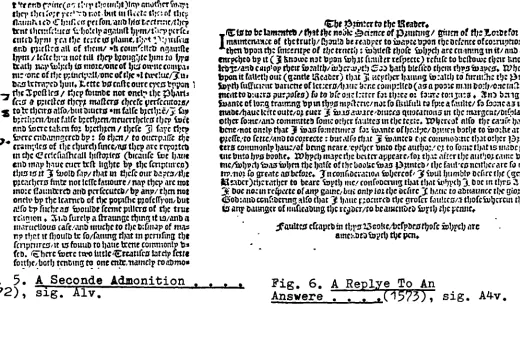
established Church. In 1572 he was not only outside the Presbyterian circle but was publicly derided and scorned by them for his part, as Upper-Warden, in trying to track down their secret press -- the press that was responsible for the offensive Admonition to the Parliament. In the Second Admonition reference is made to "certaine persecuting printers," who were lackeys of the bishops. 3 Another Presbyterian work, printed about the same time, made explicit reference to John Day as one of these printers. Its title-page carried the following lines:
Thys worke is fynished thankes be to God!
And he only wil keepe us from the searchers rod. And though master Day and Toy watch & warde/ We hope the living God is our savegarde.
Let them seeke/looke/ and doe now what they can! It is but inventions and pollicies of man. 4
Perhaps it was indicative of Presbyterian hostility towards John Day when a printer called Asplyn, one of the secret printers who printed "Cartwrightes boke" (a probable reference to the Second Admonition), according to Archbishop Parker, attempted to murder Day and his wife and afterwards explained that "the Spryte moved hyrn" to do so.5
Sermons concerning ... predestination and election ....(1570?) Regius, The sermon which Christ made on the way to Emaus ....(1578).
'Although the imprint of Aylmer's An Harborowe .. ..(1559) refers to "Strasboroie" as the place of printing, it was probably printed by Day in London. It is attributed to John Day in STC. No. 1005. See also infra., p. 232.
2
Supra., pp. 27ff.
3T. Cartwright, A Second Admonition to the Parlirnent (1572), sig. *4; see infra., p. 299.
4Anonymous, Certaine Articles, collected ... out of ... an admonition (1572).
Day's involvement with the Admonition controversy of 1572 may help to exp1aire the trouble he encountered in trying to lease the "little shop" or stall in St. Paul's churchyard in the same year. According to a letter from Archbishop Parker to Lord Burghley, the
lease had already been granted to Day by the Dean and Chapter of St. Paul's but the Lord Mayor and Aldermen would "not suffer him to sett it up in the Church yearde, wherin they have nothing to Doe." 1 The question that needs answering is why the Mayor and Aldermen exhibited such hostility to Day at this time, especially when he was Printer to the City? An obvious answer might be that Day became involved in a jurisdictional dispute between the Cathedral and the City; or, as one historian of the Stationers' Company suggests, Day was opposed by the booksellers who were sensitive at this time about printers involved in retail trade. 2 One other factor, however, could have entered into It: there is some indication that some aldermen might have disapproved of Day's part in tracking down the printers of the Admonition. Take, for example, Parker's remark to Lord Burghley in August 1572 regarding the Admonition: "Since the first printing it hath been twise printed," he wrote, "and nowe with addi[ti]ons
wherof I send your honour one of them! we wrote lettres to the Major and sum aldermen of London to laie in waite for the Charectes,
printer and Corrector, but I feare they deceave us, they are not willing to disclose this matter"!3
It is known also that John Field and Thomas Wilcox, the joint authors of the Admonition to the Parliament, had the backing of "some Aldermen and some wealthie citizens," according to Bishop Sandys, and were visited by Aldermen while they were in prison.4 That the City Council may have sympathized with the Puritan movement at this time is further suggested by Hugh Singleton, a well-known Puritan printer, succeeding John Day as Printer to the City of Lon-don in 1584. Five years prior to his appointment, Singleton had printed the infamous Discovery of a Gaping Gulf, a blunt and outright
1Parker to Lord Burghley, Dec. 13, 1572, Lansd. MS. 15, fol. 99; printed in Arber, Transcript, I. 454.
2 Blagden, op. cit., p. 165
3Parker to Lord Burghley, Aug. 25, 1572, Lansd. MS. 15. fol. 75; printed in Arber, Transcript, I. 454.