Academic Performance And Experience In
Research Project And The Result Of Course
Feedback Survey Of Engineering Students
Jake M. Laguador, Evelyn L. De Castro, Mary Angelie I. Pamplona, Nemy H. ChavezAbstract: This study aims to determine the performance of the engineering students in terms of their final grade in the research project and its relationship with the result of course feedback survey in the research course and research experience. Descriptive type of research was utilized in the study with the engineering students enrolled in their undergraduate research course and conducting design project and feasibility study. Results revealed that the engineering students obtained very good rating in the final grades in research project but they experienced difficulty in writing and conducting research and considered the research process as not interesting activity. Various levels of experiences and interpretation of engineering students in the research process make them diverse on what they believe is either easy or difficult but they see positively the course feedback in contrast with the level of their research experience. Motivating students to write simple research as early as first year will somehow provide them a sense of appreciation regarding the nature and benefits of offering solutions to the problems of the community.
Index Terms: course feedback, design project, feasibility study, research project, undergraduate research
—————————— ——————————
1.
INTRODUCTION
There are some challenges in writing and conducting research that students often remember and hope not to happen again as result of their experience. The problem or difficulty on research writing occurs although students may have control but did not consider it as priority due to lack of expertise, awareness and interest in doing the research process. There are times they do not know how to do it properly which brings them to the scenario of repeating the processes all over again, which cause them delays with stressful moments. Students consider writing and conducting research as tedious process which might cause of decreasing the level of their motivation and interest towards fulfilling an enjoyable research experience. This study is anchored in the theory of conceptual understanding of Ohlsson and Rees [1] which focuses its role in the learning and execution of arithmetic procedures. Their hypothesis is that conceptual understanding constrains problem states and, thereby, enables the learner to monitor his or her own performance and detect and correct his or her errors. Litzinger et al. [2] noted that the development of deep conceptual understanding in a domain is a necessary condition for the development of expertise. Unfortunately, students often fail to develop such conceptual understanding due to the nature of the learning experiences that they encounter. Institutions of higher learning provide different approaches on how to make the research experience of the students meaningful and relevant to their field of specialization.
Discipline-based education research comprises related
research fields that investigate learning and instruction within a discipline that are grounded in the priorities, worldview, knowledge, and practices of that discipline [3]. The rationale of conducting research is very ideal and its goal provides deeper understanding of the world on how knowledge can be transferred in a useful form that community can also benefit from the research outputs. Students bring experiences that will serve as input for the improvement of the institutions. Getting feedback from the students in the research course they completed is one way of evaluating certain areas of instruction for continuous quality improvement on the teaching and learning process. Keane and Labhrainn [4] noted that some evaluation mechanisms in place in higher education give the impression that they have been implemented solely for the purpose of fulfilling a regulatory or administrative obligation and provide little useful insight into the student learning experience on a course other than very general and vague feedback. An effective evaluation is one which can potentially lead to genuine change in a course or programme where that is required.The needs of the students might be different from one another that affects their academic performance as one of the measures for student outcomes. Research project on the context of this study refers to the design project and feasibility studies in partial fulfillment of the baccalaureate degrees in engineering. It served as the application of their technical knowledge and skills learned from the general and professional courses. The course feedback survey is being conducted before the end of the semester in the University under study which focuses on the relevance of the course, course organization and Intended Learning Outcomes (ILOs), Teaching and Learning Activities (TLAs) of the course, assessment, learning environment and counselling. It serves as a feedback mechanism for the college to assess how a certain course was delivered and obtain relative data to improve the course offerings. It explores on various possibilities to address challenges and identified gaps on the results of the survey from the students. Garcia et al., [5] studied the feedback on the professional courses of the Marine Transportation students as part of the OBE implementation where they emphasized on the sufficiency of the learning environment as an important aspect to support ————————————————
Jake M. Laguador is a doctorate degree holder of educational management and currently the Research Director of Lyceum of the
Philippines University-Batangas. E-mail:
Evelyn L. De Castro is currently the department chair of computer engineering in Lyceum of the Philippines University-Batangas. E-mail: [email protected]
Marie Angelie I. Pamplona is a faculty member of electronics engineering in in Lyceum of the Philippines University-Batangas. Nemy H. Chavez is currently the department chair of industrial
the quality of education being offered by all academic institutions. The adequacy of facilities and provision for technological advancement would lead each student to better understanding of their courses and improved interest towards their enrolled degree program. Likewise, the course feedback study of Dayao [6] intends to contribute to the development of the course which is responsible in providing students the qualities significant to be successful. Due to limited studies conducted on the course feedback in the setting of this study, this will shed light to the significance and growing needs in analyzing and utilizing the result of the course feedback survey as part of the implementation of the Outcome-Based Education (OBE). An [7] noted that giving student feedback on instruction provides various ways on how to improve the delivery of the course and even the program in relation to the OBE approach of teaching and learning process. Meanwhile, assessing the research experience of the engineering students also define the quality on the delivery of instruction and how students were properly mentored and guided from the research proposal up to the completion of their research projects. Research teachers and advisers have specific roles that contribute to the meaningful experience of the students through mentoring and advising. Wrenn and Wrenn [8] noted that educators of professional degree programs are constantly seeking ways to show students the importance of a solid grounding in theory in order to achieve excellence in their professional practice. This goal is achieved through both classroom and practice learning experiencesPutting research in the proper perspective and giving the students with the opportunity to identify problems within the community will help them develop the ability to become critical thinkers with a noble purpose. Litzinger, Lattuca, Hadgraft and Newstetter [2] emphasized that although engineering education has evolved in ways that improve the readiness of graduates to meet the challenges of the twenty-first century, national and international organizations continue to call for change. Future changes in engineering education should be guided by research on expertise and the learning processes that support its development. Research process makes the students analytical and logical thinkers. Possessing the right mind-set and goal to achieve the scientific approach in exploring solutions and alternatives will help them measure how they can contribute to the development of the community and the country at large.
2
OBJECTIVES
OF
THE
STUDY
This study aims to determine the performance of the engineering students in terms of their final grade in the research project and its relationship with the result of course feedback survey and the research experience. It specifically aims to determine the final grade of the engineering students in their research projects; determine the result of the course feedback survey in terms of relevance of the research course, course organization and ILOs, TLAs of the course, assessment, learning environment and counselling; determine the extent of research experience; and test the significant relationship between the final grade in research project the result of course feedback survey as well as their research experience.
3
METHODS
3.1 Research Design
The descriptive type of research was utilized in the study. Descriptive survey method is appropriate for data derived from simple observational situations, whether these are actually physically observed or observed through the use of a questionnaire or poll techniques [9].
3.2 Participants
The respondents of this study are the total populations of the Engineering students who completed the thesis and research projects during the School Year 2017-2018. There are 3 Electronics Engineering students; 34 Industrial Engineering students who completed the Undergraduate Research; only 26 same Industrial Engineering students enrolled in Feasibility study; 17 Mechanical Engineering students completed the ME Project Study 2; and 7 Computer Engineering students enrolled in the Design Project.
3.3 Instrument
A questionnaire was used to determine the feedback of the students regarding their research course through Course Feedback Survey as a centralized instrument from the Outcome-Based Education Center of the University. The instrument used to gather data from their general experience in writing and conducting research is content-validated and reliability tested with Cronbach’s alpha value of 0.721 which is considered good to be utilized. This questionnaire is being administered before the end of every semester to evaluate specifically the course taken by the students for continuous improvement.
3.4 Procedure and Ethical Consideration
The questionnaires were personally administered by the teachers themselves or by the college secretary. Students were informed regarding the purpose of the survey and ensured that the data and information gathered from the study will solely be used for the improvement of the delivery of instruction in the College of Engineering. Only those students who were willing to participate in the survey were given the questionnaire. Strict confidentiality of their identity as one of the respondents in the study was observed. Meanwhile, the list of the students as well as their corresponding final grades in research subject and/or thesis of the students were obtained from the College of Engineering where documentary analysis was used in gathering data. Upon encoding all their grades and corresponding answers from the research experience and course feedback survey, names of the students were deleted in the database in adherence to the data privacy act.
3.5 Data Analysis
4
RESULTS
AND
DISCUSSION
Table 1. Final Grade of Engineering in Research Project Equivalent Grade f Interpretation
1.00 (98-100) - Excellent
1.25 (95-97) - Outstanding
1.50 (92-94) - Very Superior
1.75 (89-91) 18 Superior
2.00 (85-88) 16 Very Good
2.25 (82-84) 17 Good
2.50 (79-81) 9 Satisfactory
2.75 (76-78) 11 Fair
3.00 (75) - Passing
5.00 (below 75) 1 Failed
INC 11 Incomplete
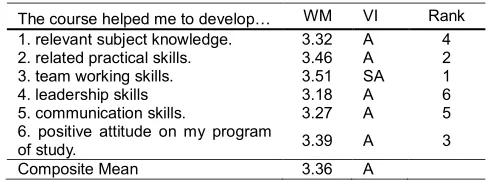
There are 18 final grades in research project with an equivalent grade of 1.75 (88-90) and 16 final grades with an equivalent grade of 2.00 ( (85-87) and 17 final grades with 2.25 (82-84) followed by 9 final grades with 2.50 (79-81) and 11 final grades with 2.75 (76-78). However, there is still 1 student failed in the Undergraduate Research and 11 with incomplete grade during the data gathering. All final grades obtained by the three (3) Electronics Engineering is 2.25 which is satisfactory while all grades obtained by the Mechanical Engineering students is 2.75 (Fair) and 2.00 (Very Satisfactory) for three (3) Computer Engineering students. Meanwhile, most of the final grades obtained by the Industrial Engineering students for their Undergraduate Research and FS ranging from 1.75 to 2.75. These final grades are low in average but getting high grades in engineering is considered difficult by most students. Table 2 presents the feedback on relevance of research course with a computed composite mean score of 3.36 which implies that the research course obtained a very satisfactory rating from the students in terms of its relevance in developing necessary skills. They strongly agree that the research course helped them in developing their team working skills (3.51). It is a given fact that the research project is considered a group activity where each member is given individual assignment to work on and reported to the group leader for whatever output completed to be integrated in the final manuscript for consolidation.
Table 2. Feedback on Relevance of Research Course The course helped me to develop… WM VI Rank 1. relevant subject knowledge. 3.32 A 4 2. related practical skills. 3.46 A 2 3. team working skills. 3.51 SA 1
4. leadership skills 3.18 A 6
5. communication skills. 3.27 A 5 6. positive attitude on my program
of study. 3.39 A 3
Composite Mean 3.36 A
The students appreciate the value of being team player that needs unity and group effort to come up with a successful research project. The contribution of each member is measured through assessing their mastery of the content of the manuscript during final defense. Meanwhile, they agree that the research course helped them in developing related practical skills (3.46), positive attitude on their program of study (3.39), relevant subject knowledge (3.32) and communication skills (3.27). The research course is considered relevant in acquiring practical skills that are useful
in their future employment like handling and managing conflicts within the group, building camaraderie among team members and being resourceful in maximizing the limited materials for the project. Dotong [10] emphasized that conducting and writing research provide relevant experiences that are contributory to employment as being required by the employers like being analytical, logical and critical thinker which can be acquired from the research process. It is also believed that the research course also helped them establish deeper appreciation of engineering where they can already apply theories into practice and they can see the practical application of subject knowledge into tangible outputs. They can also enhance their communication skills through written and oral. Wrenn and Wrenn [8] cited that the educators in professional degree programs are charged with multiple responsibilities in the classroom and in practice settings. However, leadership skills (3.18) obtained the least score among the six indicators in terms of relevance. Not all members of the group was given the chance to become a leader but only one is assigned who usually stands out in the class. They will encounter some conflicts if all of them will emerge as leaders and nobody wants to become followers. It is understood that developing leadership in the research course could be somehow lacking to some extent but in other aspects of interdependence and confidence of the members can be applied and acknowledged in other tasks or assignments after the research project has completed. Table 3 presents the feedback on the organization and Intended Learning Outcomes of the Research course with a computed composite mean score of 2.96. This implies that the research course obtained a satisfactory rating in terms of its organization and ILOs.
Table 3. Feedback on Research Course Organization and Intended Learning Outcomes (ILOs)
Course Organization and ILOs WM VI Rank 1. The course was implemented according
to the approved curriculum. 3.18 A 2 2. ILOs of the course was made known
from the beginning. 3.11 A 3
3. ILOs of the course were clear. 2.45 D 5 4. ILOs of the course were relevant. 2.87 A 4 5. There was no overlapping of contents
within the course. 3.21 A 1
Composite Mean 2.96 A
that develop it, indicates that engineering education should encompass a set of learning experiences that allow students to construct deep conceptual knowledge, to develop the ability to apply key technical and professional skills fluently, and to engage in a number of authentic engineering projects. Table 4 presents the feedback on teachers and teaching learning activities (TLAs) of Research course with a computed weighted mean score of 3.25 which implies that there is a very satisfactory evaluation rating from the students in terms of teachers and TLAs. Although students were given independent learning activities through field works and exploration of their identified problems, they keep track of their outputs towards the right direction with the help of the advisers. They strongly agree that the teachers provided adequate opportunities for team work (3.62), Independent Learning Skills (ILS) activities such as journal reading, research work, project etc. were useful (3.59) and team teaching is done as applicable (3.51). They appreciate the learning activities in research where they were given the freedom to explore and discover on their own but they said during the interviews that their advisers were not always available for consultation due to limited time of their availability in the university. They can still communicate with their adviser through email but students still wanted to consult their output face-to-face. According to Gomez and Panaligan [11], online communication between students and teachers in conducting and writing research can be done through email and social media to lessen the burden of going to school for economic reason as well as the travel time.
Table 4. Feedback on Teachers and TLAs of Research Course
Teachers and TLAs WM VI Rank
1. Teaching - Learning Activities (TLAs) such as practical, educational tour etc. were useful and relevant.
2.17 D 7
2. Independent Learning Skills (ILS) activities such as journal reading, research work, project etc. were useful.
3.59 SA 2
3. The TLAs within the course were
sequenced in a logical manner 3.24 A 5 4. Team teaching is done as applicable. 3.51 SA 3 5. The teachers motivated the students to
learn. 3.17 A 6
6. The teachers provided adequate
opportunities for team work. 3.62 SA 1 7. The teachers provided adequate
opportunities for independent learning. 3.47 A 4
Composite Mean 3.25 A
Meanwhile, the students agree that their teachers provided them with adequate opportunities for independent learning (3.47), the TLAs within the course were sequenced in a logical manner (3.24) and the teachers motivated them to learn (3.17). It is very evident in research course the independent learning approach of teaching where students are being encouraged to make some adjustments on their schedule specially that it is enrolled with other professional courses. Students find it difficult based from the interviews with them that they really need to manage their time effectively in order to meet all the research deadlines and the requirements of other enrolled courses during the semester as well as their preparation with the minor and major examinations. According to them admittedly, no matter how motivated they are in doing
the research project, sometimes due to bulk of work loads, they cannot meet the deadlines for submission of research outputs. However, they disagree on how useful and relevant the TLAs such as practical, educational tour etc (2.17). According to the interviewed advisers and research teachers, educational tour is not being done in the research course but ideally, it could be very useful to visit research laboratories and sites. According to Mendoza et al. [12], the environment especially the workplace is an important aspect of learning process which provides visual element to create meaningful experience and sustain the knowledge gained from practical application of theories and principles. Table 5 presents the feedback on assessment of research course with computed composite mean score of 3.13 which implies very satisfactory evaluation rating. It is always important that the students were informed regarding the process and rubrics on how their research outputs will be assessedthat they can prepare the course requirements based on the set standards and criteria of assessment.
Table 5. Feedback on Assessment of Research Course Assessments WM VI Rank 1. Assessment methods to be used were told
at the beginning of the course. 3.57 SA 1 2. Assessment covered all the main topics
taught in the course 3.16 A 4
3. The number of assessments is appropriate
and adequate. 3.08 A 5
4. Distribution of assessments over the
semester was satisfactory. 3.31 A 2 5. Allocation of marks/grades among
assessments was satisfactory. 3.22 A 3 6. The teachers provided timely feedback on
student performance. 2.46 D 6
Composite Mean 3.13 A
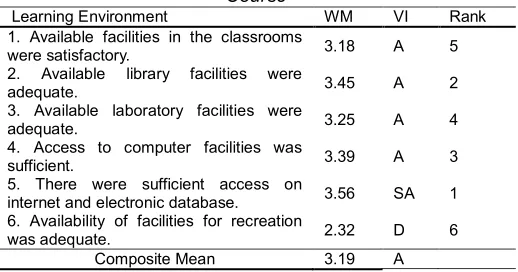
assessment covered all the main topics taught in the course (3.16) and the number of assessments is appropriate and adequate (3.08). Panel defense is one way of assessing the performance of the students through presentation of their research output in front of the panel members to scrutinize and enhance further their work. Assessing the research paper during the process of conducting and writing is considered one of the most important part of mentoring the students in order for them to produce quality paper through proper guidance and giving appropriate instruction on what to do and how to do it right. The paper underwent series of revisions from the research adviser but most of the time students submitted late their research outputs and they are not following the deadlines that gave them so much stress due to their procrastination. However, they disagree that the teachers provided timely feedbackon student performance as denoted by the least computed mean score of 2.46. There are times teachers have hectic schedules to attend in all their teaching and some administrative responsibilities and extension activities, therefore, reviewing their manuscript would take time before they received the comments and suggestions for further revision. Table 6 presents the feedback on learning environment of research course with a computed composite mean score of 3.19 which implies very satisfactory evaluation rating. Learning environments served as important part in the process of acquiring relevant knowledge from the research course. It builds strong connection between the cognitive and affective domain of learning that creates an atmosphere for positive behavior and outcomes.
Table 6. Feedback on Learning Environment of Research Course
Learning Environment WM VI Rank
1. Available facilities in the classrooms
were satisfactory. 3.18 A 5
2. Available library facilities were
adequate. 3.45 A 2
3. Available laboratory facilities were
adequate. 3.25 A 4
4. Access to computer facilities was
sufficient. 3.39 A 3
5. There were sufficient access on
internet and electronic database. 3.56 SA 1 6. Availability of facilities for recreation
was adequate. 2.32 D 6
Composite Mean 3.19 A
The students strongly agree that they have sufficient access on internet and electronic database (3.56) particularly from the SHL Learning Resource Center. The students are able to do their research work in the University Library equipped with WiFi connection and available computer units. These are required facilities to support the learning and development of the students in accordance with the standards of program accreditation and other regulatory bodies. Meanwhile, they agree that there is adequate available library facility (3.45) with sufficient access to computer facilities (3.39), there is also adequate laboratory facilities (3.25) and satisfactory available facilities in the classrooms (3.18). The students believed that they need to maximize any learning resources available to them so that they could benefit from it. Litzinger et al. [2] noted that students’ understanding of a domain can be enhanced when they engage in laboratory experiments. They could have better understanding of the concepts and principles when they
were given the chance and more opportunities for hands-on experience. Mcnay, Tolat and Watch [14] added that teaching laboratories on the other hand, acts like a flexible framework, holding dynamic student work groups, research zones, and support equipment in unlimited arrangements However, the students disagree on the adequacy and availability of facilities for recreation (2.32). Although these facilities are not directly related to the research work of the students, these could still help them lessen their stress and fatigue from doing tedious work. They said that there are available facilities but they cannot really maximize its use due to unavailability of personnel who can assist them to facilitate the recreational activity.
Table 7. Feedback on Counselling of Research Course
Counselling WM VI Rank
1. The teachers were available for
consultation whenever needed. 2.86 A 2 2. Academic counselling was available when
needed. 3.03 A 1
3. Counselling on non-academic matters was
available when needed. 2.56 A 3
Composite Mean 2.82 A
Table 7 presents the feedback on counselling of Research course with computed composite mean score of 2.82 which implies satisfactory evaluation rating. Teachers also served as counselors inside the classroom and they should be open to be consulted not only within the scope of the research course but also for personal and other matters that might influence to the performance of the students. Students agree that the academic counselling was available when needed (3.03) and teachers were available for consultation whenever needed (2.86). Although the students agree on this indicator but these are considered in the lower limit of evaluation compared with other indicators in the study. Based on the experience of the students, they were given academic counselling relevant to the completion of their research projects regarding the consequences if they were not able to produce the expected output on the specified time. They were given practical advises and they took it seriously as part of their personal and professional development that deemed useful for their future employment. However, counselling on non-academic matters was available when needed obtained the least weighted mean score of 2.56. Students were not be able to get direct counselling from their research teachers because some of them were part-timers and they can only see them whenever they have classes during Saturdays but the students can still visit the Counselling Office where there are available Counselors who could help them on non-academic matters. Laguador and Pesigan [15] noted that teachers also served as guidance counselors when inside the classroom and they can give direct support and motivation to students related to academics, attitude, behavior and study habits which are important dimensions of student life.
Table 8. Percentage Distribution of Engineering Students Regarding their Research Experience
Research Experience SA A D SD
I did not experience difficulty in
I acquired enough support or guidance
from my adviser 31.0 47.9 12.7 8.5
I found research writing as an
interesting activity 25.4 15.5 54.9 4.2
I gained knowledge on how to write the
research paper 40.8 35.2 12.7 11.3
I learned how to identify problems and
offer solutions through research 54.9 29.6 9.9 5.6
Table 8 reveals that majority of the engineering students with 67.7 percent experienced difficulty in conducting and writing research while 59.1 percent of them also found research writing as not interesting activity. As indicated by the 78.9 percent, the respondents have acquired enough support or guidance from their adviser and 76 percent of them gained knowledge on how to write research paper. The contradicting results of their agreement reveals that it seems they do not want to make another research due to the tension, stress and pressure given to them by their thesis and research projects. There is 84.5 percent combined percentage of agree and strongly agree that students learned how to identify problems and offer solution through research but their experience on how they learned it is something not pleasurable or gratifying. From the study of Abante, Almendral, Manansala and Mañibo [16] revealed that engineering students have different learning styles that should be considered in making the teaching and learning process more suitable to the kind of students inside the classroom. Group dynamics is an essential component of accomplishing group research project as it brings all ideas of the members that contribute to the attainment of their goal to complete the task. During the interview with the students, they noted that some of their members did not that fully cooperate and they encountered some problems on the conflict of their schedules because some of them were irregular students. There are some of them finishing their internship while others are still enrolled with few academics left. Result of the study of Falconer and Holcomb [17] indicates that intellectual stimulation and personal relationships with other students and faculty were the most important elements of the research experience.Likewise, Singer and Smith [3] also emphasized that having students work in groups and incorporating open-ended, authentic problems and activities into assignments also enhance problem-solving abilities. Lack of student involvement in research activities of the University through curricular and co-curricular activities is one of the reasons that might influence their readiness to recognize and appreciate the entire research process.
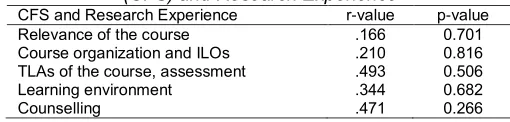
Table 9. Relationship between Course Feedback Survey (CFS) and Research Experience
CFS and Research Experience r-value p-value
Relevance of the course .166 0.701
Course organization and ILOs .210 0.816 TLAs of the course, assessment .493 0.506
Learning environment .344 0.682
Counselling .471 0.266
*Significant at p-value<0.05
Table 9 reveals that there is no significant relationship between research experience of the engineering students and the course feedback survey results as denoted by the
computed p-values which are all greater than 0.05 alpha level. Relationship is not established due to the diverse responses of the students with negative and positive research experiences against the positive response towards the course feedback survey. This signifies that the course feedback survey did not capture actual research experience of the students with the indicators included in the survey. The questionnaire for assessing the research experience of the engineering students has limited statements which directly value their interest, difficulty, knowledge gained, support from the teacher and research problem identification. Students have diverse response on their research experiences while the data for course feedback survey result is positively straightforward. The content of the course feedback survey is gearing towards the performance of the teacher in the classroom and the adequacy of physical facilities and availability of resources of the University to deliver the program or the specific course. But it cannot always be associated if the appropriateness and adequacy of the instructional materials are present during the delivery of the course will result to positive learning experiences. Garcia et al. [5] noted that the course feedback survey provides relevant information on how to improve the delivery of instruction and performance of the same faculty member handling the course to enrich the learning experiences of the students.
Table 10. Relationship between the Academic Performance and the Course Feedback Survey (CFS) and Research
Experience
Academic Performance r-value p-value Remarks
Course Feedback Survey .727 0.042 Significant Research Experience .139 0.605 Not Significant
*Significant at p-value<0.05
5 CONCLUSIONS
The performance of the students collectively is below average based on their final grade in the research course in terms of undergraduate research, feasibility study and design project. The research course obtained an outstanding rating from the engineering students in terms of its relevance and opportunities to develop team working skills; Independent Learning Skills activities such as journal reading, research work, project etc. were useful; assessment methods to be used weretold at the beginning of the course and there was sufficient access on internet and electronic database.No relationship exists between Course Feedback Survey Result and the Research Experience of the engineering students. Thus, students have diverse research experiences that cannot be associated to their feedback in the research course. Engineering students with higher academic performance have the tendency in obtaining higher results on course feedback survey while their research experience is not considered a factor to determine their academic performance. Research like any other mathematics subjects needs to be understood conceptually, its underlying scientific process in order to arrive on a precise and accurate solution to the problem. Therefore, theory of conceptual understanding can be affirmed in the study on how the students can benefit from monitoring their performance and correcting immediately their errors through the guidance of the research teacher and adviser. This study is only limited for engineering students enrolled in one academic year of a private academic institution in the Philippines. Therefore, results cannot be generalized as representation of larger population. The students may be given grades along with the feedback on the initial assessment of their research outputs so that they will be informed regarding their performance in the research course. The research teachers and advisers should find ample time for consultation and online meetings and always provide the students with the timeline or Gantt Chart for their guidance and reference regarding their deadline of submission. Students should effectively and efficiently manage their time and strictly follow the timeline and deadline for submission of outputs and avoid getting INC remarks at the end of the term. Students should be given research assignment related to research such as conducting literature review, writing research-based documentary report, analyzing case studies, exposing them to research laboratories and allowing them to attend in research seminars and conference. The College of Engineering may ensure that the courses with research projects or thesis as output is enrolled in a semester with professional courses which are not highly technical and difficult for the students to comply with other requirements. The Course Feedback Survey may be revised to integrate the experiences of the students towards the improvement on the delivery of the course gearing towards enhancing and developing positive experiences. Research teachers must ensure that the students are properly guided with specific instructions on how to conduct and write research appropriately so that they are confident of their output which follows certain standards and protocols of the institution. The Research Center may establish a society of students engaged in research that will support to their research activities. For future researchers, a study on the attitude and interest of the engineering students regarding research writing may be
conducted to determine how they experienced the research process in part and as a whole.
REFERENCES
[1]Ohlsson, S., & Rees, E. (1991). The function of conceptual understanding in the learning of arithmetic procedures. Cognition and Instruction, 8(2), 103-179. [2]Litzinger, T., Lattuca, L. R., Hadgraft, R., & Newstetter, W.
(2011). Engineering education and the development of expertise. Journal of Engineering Education, 100(1), 123-150.
[3]Singer, S., & Smith, K. A. (2013). Discipline‐based education research: Understanding and improving learning in undergraduate science and engineering. Journal of Engineering Education, 102(4), 468-471.
[4]Keane, E., & Labhrainn, I. M. (2005). Obtaining student feedback on teaching & course quality. Briefing paper, 2, 1-19.
[5]Garcia, O. B., Agena, E. M., Gonzales, A. A., Reyes, J. A., Salazar, L. R., & Laguador, J. M. (2015). First Year Students’ Feedback Survey on Marine Transportation Professional Courses during SY 2012-2013. Asian Journal of Educational Research Vol, 3(1).
[6]Dayao, J. D. R., Gaddi, D. P., Gagan, R. J. G., Hernandez, E. C., Rosales, L. J. H., Alcanata, F., & Caiga, B. T. (2015). Feedback on Personality Development Course from First Year BSMT Students. Asia Pacific Journal of Maritime Education, 1(1).
[7]An, I. L. (2014). Impact of Outcome-Based Education Instruction to Accountancy Students in an Asian University, Asia Pacific Journal of Education, Arts and Sciences, 1(5 ), 48-52.
[8]Wrenn, J., & Wrenn, B. (2009). Enhancing learning by integrating theory and practice. International Journal of Teaching and learning in higher education, 21(2), 258-265.
[9]Zulueta, F. M. &Costales Jr., N. E. B. (2001).Methods of Research Thesis-Writing and Applied Statistics, National Bookstore, Mandaluyong City, Philippines.
[10]Dotong. C. I. (2014). School – Related Factors in the Development of Graduates’ Competencies towards Employability, Journal of Education and Literature, 1(1), 28-36.
[11]Gómez, M., & Panaligan, C. (2013). Level of research competencies and satisfaction of the faculty members from the college of criminology. Asian Academic Research Journal of Social Science and Humanities, 1(14), 39-55. [12]Mendoza, M. P., Masangcay, R. M., Batalla, E. T., Bacay,
T. E. (2014). Environmental Elements of Learning Style Preference of High and Low Performing Marine Engineering Students, Studies in Social Sciences and Humanities, 1(4), 150-156
[13]Camello, N. C. (2014). Factors Affecting the Engineering Students’ Performance in the OBE Assessment Examination in Mathematics, International Journal of Academic Research in Progressive Education and Development, 3(2), 87-103.
[14]Mcnay G., Tolat D. Watch D. (2014) Academic Laboratory.
Retrieved from:
[15]Laguador, J. M., & Pesigan, M. (2013). Academic Performance and Measure of Character and Personality of Engineering Students With and Without Referral from Counselling Center. Asian Academic Research Journal of Social Science & Humanities, 1(16), 281-293.
[16]Abante, M. E. R., Almendral, B. C., Manansala, J. E., Mañibo, J. (2014). Learning Styles and Factors Affecting the Learning of General Engineering Students, International Journal of Academic Research in Progressive Education and Development, 3(1).
[17]Falconer, J., & Holcomb, D. (2008). Understanding undergraduate research experiences from the student perspective: A phenomenological study of a summer student research program. College Student Journal, 42(3), 869.