2404
Efficient Multi Hop Inter Cluster Routing In
Wireless Sensor Network
G.R. Annushakumar, V. Padmathilagam
Abstract: Wireless Sensor Networks (WSN) are currently being used in many real time applications and suffers mainly due to low power supply available in the wireless nodes. Many constructive approaches are formulated by many active researchers to resolve the energy constraints in the WSN. The main focus in all those research is to utilize the energy available in the network effectively using an optimal routing between the sensor node and the base station. This paper proposes a multi-hop routing protocol based on Low Energy Adaptive Clustering Hierarchy (LEACH) routing protocol aiming at balancing the energy consumption in the network evenly and thereby extending the life span of the network. The transfer of data from cluster nodes in the Cluster Head (CH) remains unchanged. The cluster formation is centralized approach wherein the Base Station (BS) will elect the CH and informs the decision to all the cluster heads and respective cluster nodes. The routing phase is designed differently from the routing approach used in LEACH. The multi hop routing decision is dynamic and reactive based on a probabilistic rule. This protocol is expected to minimize the energy consumption, even when the certain CHs are positioned far away from the BS. The overall performance of the protocol will be better when compared to the single hop inter clustering routing approaches being used at present.
Keywords: Wireless Sensor Networks, Low Energy Adaptive Clustering Hierarchy, inter clustering routing, multi hop routing.
————————————————————
INTRODUCTION
Wireless Sensor Network consists of a group of nodes equipped with radio antennas, for wireless communication with other nodes and they are deployed in a more dynamic environment. The nodes are capable of sensing, processing and forwarding data to other neighboring nodes and Base Station (BS). The nodes are equipped with limited resources such as low amount of memory, low processing power, and small power unit (generally batteries of small power). A target region is monitored with the use of sensor nodes, which are scattered across the large area. The data sensed by the nodes must be forwarded to the BS for further processing. An efficient algorithm for routing these data from the sensor node to the BS must be available [1-4]. In a WSN the nodes are designed to be available as an on-board low cost device capable of transferring data packets over wireless channels. The nodes have the self-organizing ability and can connect to the internet to control and monitor office space, smart cities, and other places [5]. The nodes can be deployed in multiple locations, including ground, under sea/ ocean, human body, air space, vehicles, and multi-storey buildings. During last two decades various researchers have developed techniques and methods for enhancing the capacity of the WSN in comparison with VANETs (Vehicular Area Network), mobile communication, and IoT (Internet of Things) [6-10]. Different methods and techniques are proposed in various literatures for efficient utilization of resources in WSN especially the energy available in the form of battery units. The main aim is to increase the energy efficiency and thereby increase the overall network lifetime. The most widespread technique to achieve the aforementioned aim is hierarchical routing. The clustering techniques encompass efficient cluster formation and cluster head selection methods. These methods reduce the volume of redundant messages in the network and increase the effective utilization of available bandwidth. Even though many such literatures are proposed still there is lot scope and need for future research for providing solutions to optimize efficiency of energy utilization and balancing the data traffic in the network. In some of the earlier proposed approaches, grid-based methods are utilized to make energy utilization in the network more efficient. A poor performance of the network can be seen
when there is excessive consumption of energy due to iterative restructuring of clusters and change of cluster head [11, 12]. Because of the limited battery and computation resources a light-weight approach is required for clustering and cluster head selection when WSN is deployed in an outdoor environment. The challenges and issues prevailing in the WSN make it difficult to manage scalability and increase the overall lifetime of the network. While designing a clustering algorithm many such issues and challenges are to be considered and they are summarized as follows. The step by step process in cluster formation and the volume of nodes in each individual clusters are very essential factors to be considered while designing a clustering protocol. The number of nodes in the clusters must be well balanced and the overhead for the messages broadcasted during cluster formation must be reduced. The complexity of the clustering algorithm and the density of the network must have a linear relationship. The cluster head selection also has a serious impact on the overall performance of the network. The overall lifetime of the network and the stability can be increased by selecting an optimal node as a cluster head [13]. The cluster head aggregates the data received from the other cluster nodes and forwards the aggregated data packet to the BS [14, 15]. The cluster head node is selected based on the energy and the location of the node. The clustering algorithms used in WSN must be able to meet different requirements of the applications. WSN can be used also in military and healthcare applications where the sensitivity of the data must be taken care by the respective clustering method used.
2405
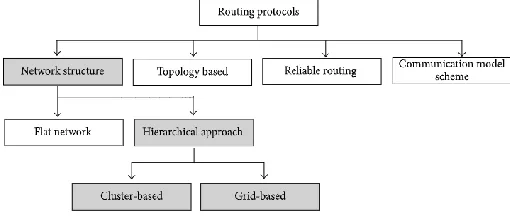
Among all the other categories of wireless networks, including MANET, VANET, and PAN; the routing of data packets in WSN is more challenging as there is lot constraint in the available energy and other resources in the network. Various routing protocols are proposed in the literature and they can be categorized as shown in Fig. 1. In flat networks, each node has the same role and responsibility and they communicate with each other through a multi-hop approach. This paper focuses on designing and developing a multi-hop inter-clustering routing approach. The flat network based approach has the ability to maintain the topology of the network and provide reliable and stable communication links between sending and receiving nodes. In the proposed method the flooding of data packets is reduced to eliminate the redundant messages and lessen the energy consumption. When the flooding messages are reduced the available bandwidth can be effectively utilized and the end to end delay can be reduced [16].
Fig. 2 Direct communication in WSN.
Use the resources available in WSN are limited, the direct transferring of data packets from sending nodes to the BS or multi-hop communication through intermediate sensor nodes is not possible. Any mode of communication will cause early expiry of nodes in the network. In a large scale WSN due to high energy consumption and low utilization of available bandwidth the direct communication cannot be employed. Therefore, to overcome these issues and challenges a multi-tier architecture based on hierarchical clustering approach is suggested in many literatures. The early dying of nodes indirect communication is presented in Fig. 2. In a hierarchical architecture the cluster heads positioned in the upper level receives periodically data from the cluster nodes lying in the lower level. The cluster head spends more energy in aggregating the data and forwarding it to the BS. The data transmitted from the cluster head to the BS travels a long distance and the probability of early dying for cluster head is high when compared to other cluster nodes. To retain the participation of the cluster head nodes in the network and increase its lifetime the cluster
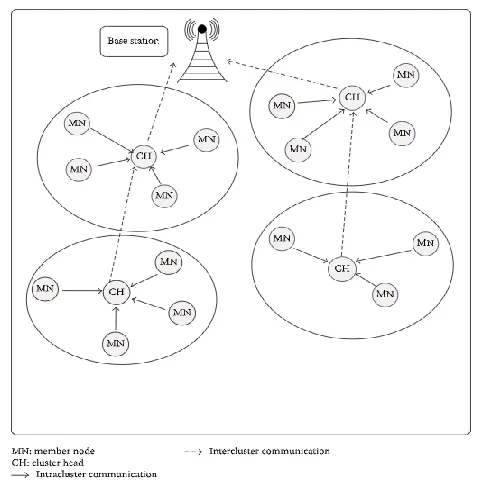
head is changed periodically. This rotation of cluster head at regular intervals balances the energy consumption in the network evenly [17]. The methodology adopted in most of the literature for intra-cluster routing is single hop and inter-cluster routing is multi-hop and it is presented in Fig. 3.
Fig. 3 Cluster-Based communication
For deriving a mathematical representation of the radio model for the overall energy consumption in the WSN, let us assume that all the nodes in the network have minimum required throughput. Between sending and receiving data there are different energy calculations and the energy consumption of a transmitter-receiver is defined as Eelec
J/bit. The energy consumption of a transmitter amplifier with a signal to noise ratio is defined as Eamp J/bit. The energy
consumed when transferring a k-bit message from a node to a destination at a distance of d meters is defined as
( )
Eq.1 The receiving energy can be defined as
( )
Eq.2
In the case of multi-hop clustering the distance is set to R instead of d,
( )
Eq.3
( )
Eq.4
PROPOSED MULTI-HOP INTER-CLUSTER ROUTING PROTOCOL
2406
network and thereby increasing the lifetime of the cluster heads. This approach will also help to provide a reliable connectivity for all the nodes in the cluster irrespective of their distance from the base station. The proposed protocol can be implemented in a three stage process including clustering, data collection & aggregation, and distributed routing between CHs. The procedure for the initial stage, i.e. data collection and aggregation is adopted from the LEACH protocol [18]. The network is comprised of nodes which are aware of their location using a Bayesian node localization approach described in [19]. During aggregation the sensed information communicated to the cluster head by the cluster nodes is averaged to maintain the uniform size of the aggregated packets in all the cluster heads.
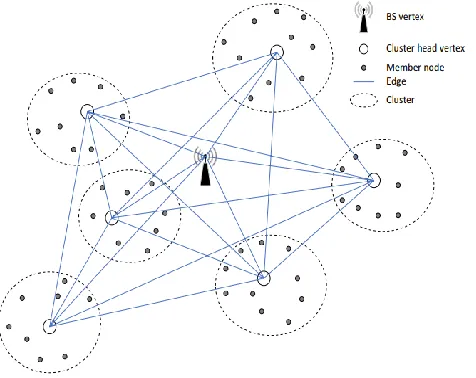
Fig. 4 Schematic view of Cluster head networks
The clustering is a centralized process wherein the total nodes in the network are grouped into N number of clusters (N is the number of Cluster Heads excluding Base station). The node with the highest energy will be assigned as the Cluster Head. At regular interval the cluster head will be re-elected and the proposed method assumes that the nodes in the clusters are static. Hence the clustering process need not be re-initiated. The K-means clustering algorithm is used for establishing clusters in the network [20]. The selection of cluster heads and clustering will be handled by the base station. The number of clusters formed in the network is decided based on several parameters, especially based on the topology of the network. Initially, all the nodes forwarding their location and energy level of the base station. After receiving the nodes location the base station runs the K-means clustering algorithm and forms the cluster. Based on the nodes energy level in the cluster the base station elects the cluster head and communicates the Cluster head and cluster information to the nodes respectively. The base station sends the information about the position and energy levels of all cluster heads to each of the cluster head. After receiving the message regarding cluster information from the Base station each cluster node sends a JOIN message to their respective cluster heads. For coordinating the packet transfers within the cluster, each cluster head prepares a TDMA schedule and broadcasts it to all the respective cluster nodes. Each cluster node transfers their sensed data along with its
energy level to their respective cluster head as per the schedule fixed by the cluster head. After transferring the data the cluster node switch off its transmission radio to save the energy consumed. Each cluster head selects the new cluster head for next round based on the remaining energy level in the nodes. If none of the node has remaining energy more than its cluster head, then the cluster head remains as the head for the next iteration also. In the proposed multi-hop inter cluster routing a route from one cluster head to the BS can be represented by a graph G with a set of vertices denoting the each cluster head. When a cluster node wants to communicate its aggregated data to the BS it finds an optimal path to the Base station after considering both the energy level and the distance from the current node to the next node. The multi hop path from the cluster head to the BS can be denoted as pthck =
{S, i, j,…..,E} start of node S and ends in node E. At each intermediate node in the decision of the next node is taken based on a probabilistic rule which ensures an optimal route with a balanced distribution of the data traffic in the network. Whenever a CH forwards the data packets it appends its node number, energy level, and the cost of the link connecting it with the previous cluster head in the path.
( ) {∑ ( ) ( )
(
) ( ) * +
Eq. 5
The probability of a data packet being forwarded from cluster head node CHi to CHj can be estimated based on the
Eq. 5. The value denotes the pheromone value of the edge connecting the CHi and CHj . Whenever the frequency
of the data packets travelling from node CHi to CHj is
increasing then the pheromone value is updated. The
value indicates the visibility of the respective edge. The
constants and are used to quantify the weightage of the
and . The value of each edge is updated as per the equation given below.
∑
Eq. 6
∑ denote the sum of pheromone value of the edge for
all the transmissions happening through the respective edge under consideration.
Eq. 7
The Eavg and Emin values represent the average and by a minimum energy level in the nodes connected by the respective edge under consideration and it will be kept on updating for every transmission or reception of data packets. The denominator represents the remaining energy available in the node CHi. The visibility of the edge can be
defined as
Eq. 8
Where ei,j is the sum of energy required for transmission of
data packets from the node CHi to CHj and the reception of
the same in node CHj.
2407
Whenever a cluster head needs to transmit the data to the base station, it forwards the packets to the next cluster head based on the above mentioned probability. The data packet includes the unique id of the source cluster and the destination is by default the base station. Upon receiving the data packets from the source node or other intermediate node, the receiving node forwards the packets based on the probability estimation. In between each transfer, the respective visibility value and the pheromone value is updated. This routing process is applied to each cluster by the respective cluster head CH. The routing decision is taken locally and simultaneously for different data transfer happening through multiple cluster heads. This makes the protocol to save more energy and makes the inter cluster a decentralized one.
EXPERIMENT AND RESULTS
The aim is to improve the direct transmission of data packets from CH to BS in LEACH protocol. When the network nodes are spread across the large scale geographic region this direct transmission approach suffers due to imbalanced load distribution in the network. A CH positioned at large distance from the BS needs to spend more energy when compared to CH located nearby the BS and thereby affecting the overall lifetime of the network. Instead of a single hop communication in the proposed approach a multi hop communication is employed. The simulation parameters are summarized in Table 1. This section presents the comparison of performance of the proposed approach with the LEACH using two metrics namely the standard deviation of CH load and the maximum difference of energy between two CH. If the difference is low, then it is more evenly distributed among the CHs. It is defined mathematically as follows;
* +| |
Eq. 9
The standard deviation of the cluster load can be calculated as
( ) √∑ ( )
Eq. 10
TABLE 1 SIMULATION PARAMETERS
Transmission and receiving energy 50 nJ/bit
Initial energy in node 2 J
Initial energy in BS 103 J
Energy required to aggregate data 5n J/bit/message
Size of packet 2000 bits
% of Cluster Head 5%
# of nodes 200
Network area 100m x 100m
Location of BS 50m x -100m
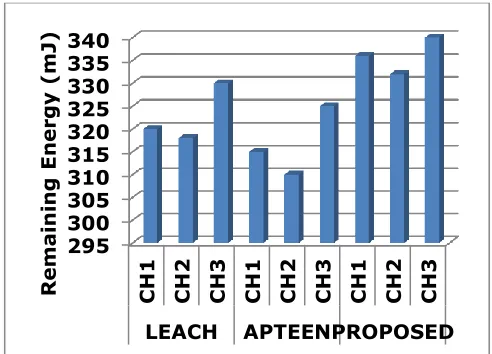
In the simulations the cluster heads are placed in the network at various distance ranges to measure whether the remaining energy level is uniform or not. The data transfers were simulated between the various clusters and base station via the respective cluster heads. For each transmission the CHs selects the next hop based on the probabilistic rule and ensures the even distribution of load
in the network. The simulation results are compared with performance of LEACH and APTEEN routing protocols.
Fig. 5 Comparison of Residual Energy in Cluster Heads (CH1, CH2, and CH3)
CONCLUSION
The routing methods in WSN have to overcome several issues and challenges due to adhoc topology, the characteristics of the application, and dynamic nature of the nodes. This paper has mainly focussed on establishing a multi-hop clustering protocol for a distributed network spread across a large geographical region. The basic objective is to distribute the energy consumption among the clusters in balanced proportion and to increase the overall lifetime of the network. The multi hop inter cluster routing is achieved based on a probabilistic rule by which the next hop in the transmission path is determined based on the visibility and the pheromone value of the edge connecting the one cluster head and the other. The cluster formation and the cluster head selection are usually in the proposed as similar to LEACH and other WSN routing protocols. The difference between the existing and proposed routing protocols lies in the routing phase of the protocol wherein the multi-hop path is followed to transmit data from one CH to the BS. The results obtained and its comparison showed that the energy consumption is evenly distributed in the network irrespective of the distance between the CH and BS. At present the protocol is designed for a static network in the future the proposed protocol will be modified to make it suitable for dynamic network where the position of the nodes in the network will be changing periodically. The clusters have to be restructured frequently to adopt the mobility of the network.
References
[1] D. Lin and Q. Wang. “A game theory based energy efficient clustering routing protocol for WSNs,” Wirel. Netw., vol. 23, no. 4, pp. 1101-1111, 2017. [2] B. Erkal and O. Kaynak. “Design of a fuzzy variable
structure controller for controlling satellite attitude suffering from sensor data delay,” Proceedings of 5th International Conference on Recent Advances in Space Technologies-RAST2011, Istanbal, Turkey, 2011, pp. 566-569.
295 300 305 310 315 320 325 330 335 340
CH
1
CH
2
CH
3
CH
1
CH
2
CH
3
CH
1
CH
2
CH
3
LEACH APTEENPROPOSED
Rema
ini
ng
E
ner
gy
2408
[3] Z. Sheng, S. Yang, Y. Yu, et al. “A survey on the ietf protocol suite for the internet of things: standards, challenges, and opportunities,” IEEE Wirel. Commun., vol. 20, no. 6 pp. 91-98, 2013. [4] L. Parra, S. Sendra, J. Lloret, et, al. “Low cost
wireless sensor network for salinity monitoring in mangrove forests,” Proceedings of the 2014 IEEE on Sensors, Valencia, Spain, 2014, pp. 126-129. [5] Karamitsos, Ioannis, Charalampos Manifavas, and
Muhieddin Amer. "The Influence of Big Data and IoT on Smart Cities." Smart Cities in the Gulf. Palgrave Macmillan, Singapore, 2019. 151-172 [6] E. C. Eze, S. Zhang and J. C. Eze, “Advances in
Vehicular Ad-Hoc Networks (VANETs): Challenges and Road - map for Future Development,” 2016. [7] Anna Triantafyllou, Panagiotis Sarigiannidis, and
Thomas D. Lagkas, “Network Protocols, Schemes, and Mechanisms for Internet of Things (IoT): Features, Open Challenges, and Trends,” Wireless Communications and Mobile Computing, vol. 2018, Article ID 5349894, 24 pages, 2018.
[8] Asghari, Parvaneh, Amir Masoud Rahmani, and Hamid Haj Seyyed Javadi. "Internet of Things applications: A systematic review." Computer Networks 148 (2019): 241-261.
[9] Hameed, Sufian, Faraz Idris Khan, and Bilal Hameed. "Understanding security requirements and challenges in Internet of Things (IoT): A review." Journal of Computer Networks and Communications 2019 (2019).
[10]Nayak, Chinmaya Kumar, and Satyabrata Das. "Minimization of Energy-Holes in Wireless Sensor Network (WSN) Using Hierarchical Routing Protocols." Journal of Computational and Theoretical Nanoscience 16.5-6 (2019): 2357-2361.
[11]Pacharaney, Utkarsha Sumedh, and Rajiv Kumar Gupta. "Cluster Restructuring and Compressive Data Gathering for Transmission Efficient Wireless Sensor Network." Intelligent Communication Technologies and Virtual Mobile Networks. Springer, Cham, 2019.
[12]Ghosh, Arnab, and Niladri Chakraborty. "A novel residual energy‐based distributed clustering and routing approach for performance study of wireless sensor network." International Journal of Communication Systems 32.7 (2019).
[13]Sarkar, Amit, and T. Senthil Murugan. "Cluster head selection for energy efficient and delay-less routing in wireless sensor network." Wireless Networks 25.1 (2019): 303-320.
[14]Krishnaswamy, Vani, and Sunil Kumar S. Manvi. "Clustering and data aggregation scheme in
underwater wireless acoustic sensor
network." Telkomnika 17.4 (2019).
[15]Wan, Runze, et al. "Similarity-aware data aggregation using fuzzy c-means approach for wireless sensor networks." EURASIP Journal on Wireless Communications and Networking 2019.1 (2019): 59.
[16]Roy, Animesh, Tamaghna Acharya, and Sipra DasBit. "Quality of service in delay tolerant
networks: A survey." Computer Networks 130 (2018): 121-133.
[17]Selvi, G. Vennira, and R. Manoharan. "Balanced Unequal Clustering Algorithm For Wireless Sensor Network." i-Manager's Journal on Wireless Communication Networks 3.4 (2015): 23.
[18]Singh, Sunil Kumar, Prabhat Kumar, and Jyoti Prakash Singh. "A survey on successors of LEACH protocol." IEEE Access 5 (2017): 4298-4328. [19]Huang, Yue-Yang, Yuan-Wei Jing, and Yuan-Bo
ShI. "Non-parametric mobile node localization for IOT by variational Bayesian approximations adaptive Kalman filter." Cognitive Systems Research 52 (2018): 27-35.