904
Numerically Simulated Functionally Graded Plate
Subject To Transverse Mechanical Loads
Manish BhandariAbstract: The Functionally gradient materials (FGM) has widely been in engineering applications because of their advantages over composites. Experimental and computational research work are going on various structures made of FGM. Hence numerical simulation has become a prominent area for research in the field of FGM. The aim of current paper is to numerically simulate using finite element method and analyse an FGM plate which is subjected to a transverse mechanical load. The gradation is assumed to vary according to Power law distribution for its constituents materials. The simulation is done using appropriate software. The simply supported FGM plate has been considered for the purpose.
Index Terms: FEM, FGM, ANSYS, Power law, Plate, Mechanical, simulation.
—————————— ——————————
1.
INTRODUCTION
THE FGM is made up of the combination of ceramic and metal with a certain material gradation. It shows the properties which are useful in various engineering applications. The properties of ceramic and metal can be utilized in combination where thermal resistance and metal properties are in demand. The research on FGM structure has increased tremendously in past few years. It is because of FGM composition changes in a predecided direction. FGMs are proved to be useful in engineering applications such as aerospace structures, heat engine components and nuclear power plants etc. The variable nature of FGMs makes production, design and computations complicated as compared to traditionally available materials. The availability of FEA codes (e.g., ABAQUS, ANSYS, and NASTRAN) makes FEA attractive for design and analysis of FGMs. ANSYS is a finite-element modeling package for numerically solving a wide variety of problems. These problems include static, dynamic and structural analysis problems. A lot of published literature has been surveyed for computation of mechanical response of functionally gradient material plate using finite element analysis techniques. Reddy [1] developed FEM and used 4-noded rectangular element with 5 dof. Regular mesh of 8 x 8 was chosen forthe convergence studies. Linear and nonlinear finite element model have been developed. Glaucio et.al. [2] developed boundary element methods for FGM and computed deformations in the thickness direction analytically under mechanical load. Ashraf [3] developed exact mixed-classical solutions for the bending analysis of shear deformable rectangular plates. Xiao and Shen [4] computed nonlinear vibration and dynamic response of FG Plates in thermal environments using the Laplace transformation method to reduce equations to an ordinary differential equation (ODE) in the thickness direction. Shin [5] considered heterogeneous objects using FEA alongwith ANSYS commercial software (ANSYS Inc.) and evaluated thermally independent effective properties by performing a linear elastic analysis and presented the accuracy level of the FE technique by comparing the standard results. Nakasoneet.al. [6] used ANSYS for performing engineering analysis and also presented the utilization of the same. Wang and Qin [7] conducted thermomechanical analysis of functionally graded materials using meshless approach and gave the conditions for optimum thermal conditions under mechanical loads. Kyung and Hwan [8] conducted studies on mechanical stress analysis of functionally graded plates and analyzed the response of the FG plates. Rasheedat et. al. [9] reviewed the
FGM and proposed the research gaps which need to be addressed. Nguyen et. al. [10] developed FE technique to analyze functionally graded plates by using node-based strain smoothing method. Wasim [11] derived optimum material gradient for FG rectangular plate with FEM. Bhandari and Purohit [12] conducted static analysis of FGM plate with various functions such as Power, Sigmoid and Exponential. Sharma et.al. [13] conducted thermomechanical analysis on FGM plate. The mechanical response of FGM structures have drawn attention of researchers in the past few years. The finite element analysis techniques in conjunction with appropriate simulation software like ANSYS have proved to be very useful and accurate in computing behavior of FG plates under various loads. A functionally graded (FG) two-phase plate is analyzed using classical lamination theory, wherein each layer is given a different volume fraction. In this analysis technique properties are employed for each layer. In the current work an attempt has been made to numerically simulate FG plate using FEM and ANSYS and parametric behavior has been computed in terms of non-dimensional parameters e.g. deflection, stress, strain etc.
2
METHODLOGY
2.1 Problem formulation
The current analysis is to present parametric response of FG plate under transverse mechanical load. The numerical results are depicted in non-dimensional parameters terms e.g. deflection, stress and strain for material gradation which are governed by Power law distribution. The boundary condition used here is all edges clamped or fixed. The modelling is done using finite element method and simulation software is used to simulate the plate. The consituient materials are Aluminum (Al) and Zirconia (ZrO2). The physical properties such as Young‘s modulus, Poisson‘s ratio, Density are given below:
Young's modulus (EAl) = 70x10 9
Pa Young's modulus (EZrO2) = 151x10
9 Pa
The Poisson's ratio is taken as 0.3 which is same for both the materials as the effect is negligible.
The properties of the material are graded as per Power law distribution (Eq. 1) in which the volume fraction (Vf) varies as per Eq. (2):
P(z) = (Pt −Pb)Vf +Pb (1)
Vf = (z/h+1/2) n
INTERNATIONAL JOURNAL OF SCIENTIFIC & TECHNOLOGY RESEARCH VOLUME 9, ISSUE 04, APRIL 2020 ISSN 2277-8616
905
Metal x
y
z
a
b
Ceramic
h/2 -h/2 bottom surface of the plate.
At bottom surface, (z/h) = -1/2 and Vf =0, hence P(z) = Pb (Metal side)
and
At top surface, (z/h) =1/2 and so Vf =1, hence P(z)= Pt (Ceramic side)
Fig. 1 FGM Plate
Fig. 2: Young’s modulus in a Power law distribution FGM plate through plate thickness for various values of ‘n’
Fig. 1 shows the geometry of plate and Fig. 2 shows the distribution of physical property variation of plate with depth from neutral axis of the plate as per the power law distribution for various values of volume fraction index ‗n‘.
2.2 Modeling and simulation
ANSYS-APDL covers a broad area of abilities in any one of the processors. The software provides ease of use for optimization in design, mesh adaptation and customization of variation of material properties, variation in load types and loading conditions and most importantly the wide range of element types useful for analysis.
A. Idealizations:
No. of ‗layers‘ are created in the numerical model in order to visualize the change in material properties of the FGM. The properties are graded along the plate thickness. Each layer is treated as an isotropic materials and it occupies finite place. The properties associated with each layer are layered together to find out the through-the-thickness change of material properties. A particular number of layers can approximate the material gradation even though the layered structure may not
show gradual variation properties. ANSYS provides a number of choices of elements from the element library for the required modeling. The layered FGM plate is modeled using appropriate element taken from finite element model. In the present model SHELL 181 element is used for modelling.
B. Model generation
UX, UY and UZ are displacements in the X, Y and Z coordinates respectively and ROTX, ROTY and ROTZ are rotations about the X, Y and Z coordinates respectively. The rectangular plate of thickness 0.02m is modeled after defining material and material properties (Fig.3) and the plate is meshed (Fig. 4) with a predecided mesh size using the mesh tool. Fig.5 shows the isometric view of the meshed square plate. The modeled plate is applied with condition i.e. in the X direction, UX=UZ=0 and in the Y direction UY=UZ=0. It is shown in Fig.6.
Fig. 3 Square plate
906 Fig. 5 Isometric zoomed view of meshed plate
C. Solve
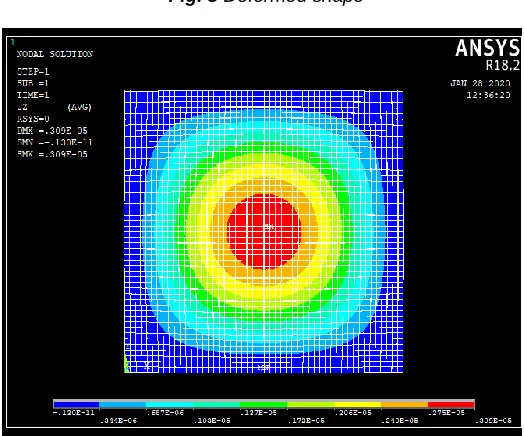
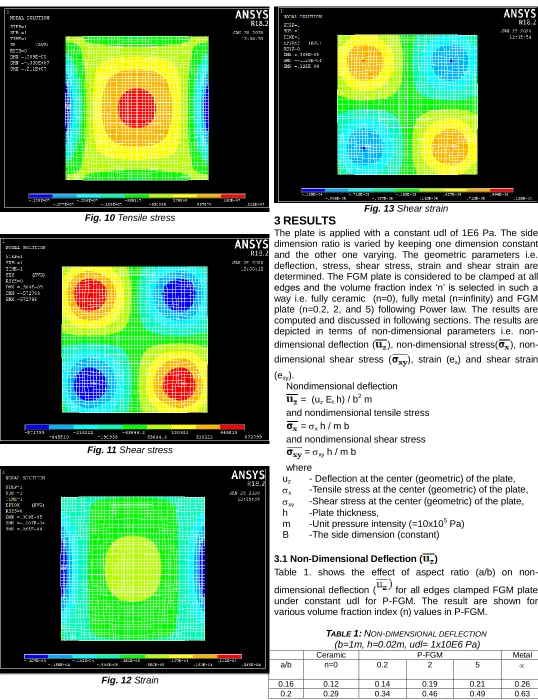
The next step is to apply the load. In the present case the load is uniformly distributed and the value is 1E6 Pa. Afterwards SOLVE command is run to obtain the results e.g. deflection, stress etc. (Fig.7). The deformed shape is shpwn in Fig. 8. Fig. 9,10,11,12 and 13 show various result parameters such as deflection, tensile stress, shear stress, strain and shear strain. The intensity of distribution of respective parameter is shown with the colour variation.
Fig. 6 Boundary conditions applied
Fig. 7 Load Applied
Fig. 8 Deformed shape
INTERNATIONAL JOURNAL OF SCIENTIFIC & TECHNOLOGY RESEARCH VOLUME 9, ISSUE 04, APRIL 2020 ISSN 2277-8616
907 Fig. 10 Tensile stress
Fig. 11 Shear stress
Fig. 12 Strain
Fig. 13 Shear strain
3
RESULTS
The plate is applied with a constant udl of 1E6 Pa. The side dimension ratio is varied by keeping one dimension constant and the other one varying. The geometric parameters i.e. deflection, stress, shear stress, strain and shear strain are determined. The FGM plate is considered to be clamped at all edges and the volume fraction index ‗n‘ is selected in such a way i.e. fully ceramic (n=0), fully metal (n=infinity) and FGM plate (n=0.2, 2, and 5) following Power law. The results are computed and discussed in following sections. The results are depicted in terms of dimensional parameters i.e. non-dimensional deflection ( ), non-dimensional stress( ),
non-dimensional shear stress ( ), strain (ex) and shear strain
(exy).
Nondimensional deflection = (uz Et h) / b
2 m
and nondimensional tensile stress = x h / m b
and nondimensional shear stress = xy h / m b
where
uz - Deflection at the center (geometric) of the plate, x -Tensile stress at the center (geometric) of the plate, xy -Shear stress at the center (geometric) of the plate, h -Plate thickness,
m -Unit pressure intensity (=10x105 Pa) B -The side dimension (constant)
3.1 Non-Dimensional Deflection ( )
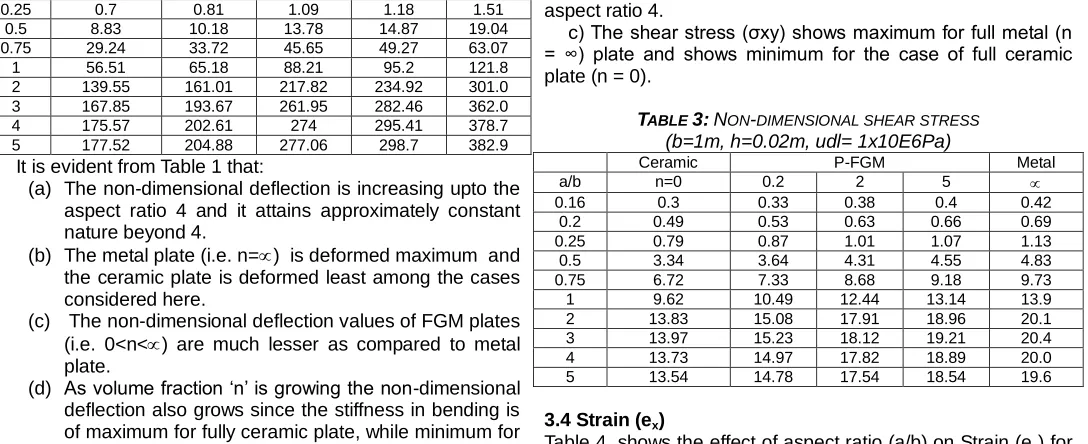
Table 1. shows the effect of aspect ratio (a/b) on
non-dimensional deflection ( for all edges clamped FGM plate under constant udl for P-FGM. The result are shown for various volume fraction index (n) values in P-FGM.
TABLE 1:NON-DIMENSIONAL DEFLECTION
(b=1m, h=0.02m, udl= 1x10E6 Pa)
Ceramic P-FGM Metal
a/b n=0 0.2 2 5
0.16 0.12 0.14 0.19 0.21 0.26
908
0.25 0.7 0.81 1.09 1.18 1.51
0.5 8.83 10.18 13.78 14.87 19.04
0.75 29.24 33.72 45.65 49.27 63.07
1 56.51 65.18 88.21 95.2 121.8
2 139.55 161.01 217.82 234.92 301.0 3 167.85 193.67 261.95 282.46 362.0
4 175.57 202.61 274 295.41 378.7
5 177.52 204.88 277.06 298.7 382.9 It is evident from Table 1 that:
(a) The non-dimensional deflection is increasing upto the aspect ratio 4 and it attains approximately constant nature beyond 4.
(b) The metal plate (i.e. n=) is deformed maximum and the ceramic plate is deformed least among the cases considered here.
(c) The non-dimensional deflection values of FGM plates (i.e. 0<n<) are much lesser as compared to metal plate.
(d) As volume fraction ‗n‘ is growing the non-dimensional deflection also grows since the stiffness in bending is of maximum for fully ceramic plate, while minimum for fully metal plate.
3.2 Non-Dimensional Stress ( )
Table 2. shows the effect of aspect ratio (a/b) on non-dimensional tensile stress ( for all edges clamped FGM plate under constant udl for P-FGM. The result are shown for various volume fraction index (n) values in P-FGM.
TABLE 2:NON-DIMENSIONAL TENSILE STRESS
(b=1m, h=0.02m, udl= 1x10E6Pa)
Ceramic P-FGM Metal
a/b n=0 0.2 2 5
0.16 0.96 1.05 1.25 1.32 1.41
0.2 1.5 1.63 1.95 2.06 2.19
0.25 2.32 2.53 3.02 3.2 3.4
0.5 7.72 8.42 10.04 10.64 11.3
0.75 12.23 13.34 15.92 16.88 17.9
1 14.53 15.86 18.94 20.07 21.3
2 14.04 15.32 18.31 19.39 20.6
3 13.47 14.7 17.55 18.59 19.7
4 13.42 14.65 17.49 18.53 19.7
5 13.42 14.64 17.48 18.52 19.6
The observations which can be made are:
(a) The non-dimensional tensile stress increases when the aspect ratio is increased upto 2 and as it passes 2 it starts reducing. The non-dimensional tensile stress increases sharply between values of aspect ratio 0.25 to 2.
(b) The non-dimensional tensile stress is highest for pure metal (n = ∞) and lowest for pure ceramic (n = 0).
3.3 Non-dimensional Shear Stress ( )
Table 3. shows the effect of aspect ratio (a/b) on
non-dimensional tensile shear stress ( ) for all edges clamped FGM plate under constant udl for P-FGM. The result are shown for various volume fraction index (n) values in P-FGM.
By viewing Table 3 it is obvious that
a.) the non-dimensional shear stress (σxy) moves upside with the aspect ratio increments, it reaches peak value at aspect ratio 3 and when the aspect ratio increases beyond 3 non-dimensional shear stress reduces.
b) The non-dimensional shear stress (σxy) has a sharp decline in between aspect ratio 3 to 4 and a slow decline after
aspect ratio 4.
c) The shear stress (σxy) shows maximum for full metal (n = ∞) plate and shows minimum for the case of full ceramic plate (n = 0).
TABLE 3:NON-DIMENSIONAL SHEAR STRESS
(b=1m, h=0.02m, udl= 1x10E6Pa)
Ceramic P-FGM Metal
a/b n=0 0.2 2 5
0.16 0.3 0.33 0.38 0.4 0.42
0.2 0.49 0.53 0.63 0.66 0.69
0.25 0.79 0.87 1.01 1.07 1.13
0.5 3.34 3.64 4.31 4.55 4.83
0.75 6.72 7.33 8.68 9.18 9.73
1 9.62 10.49 12.44 13.14 13.9
2 13.83 15.08 17.91 18.96 20.1
3 13.97 15.23 18.12 19.21 20.4
4 13.73 14.97 17.82 18.89 20.0
5 13.54 14.78 17.54 18.54 19.6
3.4 Strain (ex)
Table 4. shows the effect of aspect ratio (a/b) on Strain (ex) for all edges clamped FGM plate under constant udl for P-FGM. The result are shown for various volume fraction index (n) values in P-FGM.
TABLE 4: STRAIN (X1000) (b=1m, h=0.02m, udl= 1x10E6Pa)
Ceramic P-FGM Metal
a/b n=0 0.2 2 5
0.16 0.29 0.32 0.39 0.43 0.62
0.2 0.45 0.49 0.61 0.67 0.97
0.25 0.7 0.76 0.94 1.04 1.51
0.5 2.21 2.42 2.97 3.29 4.76
0.75 3.19 3.5 4.3 4.76 6.89
1 3.37 3.69 4.54 5.02 7.27
2 2.28 2.5 3.08 3.41 4.92
3 2.15 2.36 2.9 3.21 4.64
4 2.14 2.34 2.88 3.19 4.61
5 2.13 2.33 2.87 3.18 4.59
The remarks which can be put by viewing the Tables 4 that (a) The strain (ex)shows positive growth as the aspect ratio is increased, it approaches peak value at aspect ratio 1, further as the aspect ratio crosses 1 it reduces and it becomes stagnant as aspect ratio is taken beyond 3. This shows that square plate is giving maximum strain.
(b) The strain (ex) is maximum for pure metal (n = ∞) and minimum for pure ceramic (n = 0) plate.
3.5 Shear Strain (exy)
Table 5. shows the effect of aspect ratio (a/b) on Shear Strain (exy) for all edges clamped FGM plate under constant udl for P-FGM. The result are shown for various volume fraction index (n) values in P-FGM.
The observations which can be viewed from Table 5 that (a) The shear strain (exy) is increasing with the aspect ratio increment, it approached peak value at aspect ratio 3, it becomes almost constant as the aspect ratio value is increased beyond 4.
(b) The shear strain (exy) is highest for fully metal (n = ∞) plate and lowest for fully ceramic (n = 0) plate
TABLE 5:SHEAR STRAIN (X1000) (b=1m, h=0.02m, udl= 1x10E6Pa)
INTERNATIONAL JOURNAL OF SCIENTIFIC & TECHNOLOGY RESEARCH VOLUME 9, ISSUE 04, APRIL 2020 ISSN 2277-8616
909
a/b n=0 0.2 2 5
0.16 0.26 0.32 0.46 0.48 0.56
0.2 0.42 0.52 0.75 0.79 0.91
0.25 0.68 0.83 1.22 1.27 1.47
0.5 2.87 3.5 5.13 5.4 6.2
0.75 5.79 7.05 10.33 10.87 12.49
1 8.29 10.08 14.77 15.54 17.87
2 11.91 14.47 21.19 22.35 25.68
3 12.03 14.62 21.41 22.63 25.94
4 11.82 14.36 21.05 22.24 25.5
5 11.66 14.19 20.74 21.84 25.15
4
CONCLUSION
The FGM plate is modeled and subjected to transverse mechanical. The work includes variation of ratio of side dimensions of FGM plate and also the variation of volume fraction index ‗n‘. The conclusions which are drawn:
(a) The layered structure of the plate provides approximately accurate results. The non dimensional deflection values of FGM plates (i.e. 0<n<) are lesser than that of pure metal plate.
(b) The non-dimensional tensile stress is highest for pure metal (n = ∞) and lowest for pure ceramic (n = 0).
(c) The shear strain (exy) is highest for fully metal (n = ∞) plate and lowest for fully ceramic (n = 0) plate
(d) FG plates provide a high ability to withstand bending stresses.
The work may be extended by varying the type of loading such point load and sine load. Also the work may be done by applying thermal and thermomechanical loading.
REFERENCES:
[1] Reddy J. N., ―Analysis of functionally graded plates,‖ Int. J. Numer. Meth. Engg, vol 47, pp. 663-684, 2000.
[2] Glaucio HP, Alok S, Gray LJ Boundary Element Methods for Functionally Graded Materials. Int Association for Boundary Element Methods; vol. 5: pp.1-12, 2002. [3] Ashraf MZ. Exact Mixed-Classical Solutions for the
Bending Analysis of Shear Deformable Rectangular Plates. Applied Mathematical Modeling, vol. 27, pp 515– 534, 2003.
[4] Xiao-Lin H, Hui-Shen S. Nonlinear Vibration and Dynamic Response of Functionally Graded Plates in Thermal Environments. Int J of Solids and Structures, vol. 41, pp. 2403–2427, 2004.
[5] Shin K.H., ―FEA based design of heterogeneous objects,‖ Int. Design Engg. Technical Conferences & Computers and Information in Engg. Conference, Philadelphia, Pennsylvania, Usa, pp. 10-13, 2006.
[6] Nakasone Y, Yoshimoto S, Stolarski TA. Engg. Analysis with Ansys Software. Elsevier Butterworth-Heinemann; 2006.
[7] Wang H. & Qin Q.H., ―Meshless approach for thermo-mechanical analysis of functionally graded materials,‖ Engg. analysis with boundary elements, vol. 32, pp. 704– 712, 2006.
[8] Kyung-Su N. & Ji-Hwan K., ―Comprehensive studies on mechanical stress analysis of functionally graded plates,‖ World Academy of Science, Engg. And Technology, vol. 60, pp. 768-773, 2011.
[9] Rasheedat MM, Esther T. Akinlabi Member, Iaeng, Mukul S, Sisa P. Functionally Graded Material. An Overview. Proceedings of The World Congress on Engg. London, U.K. Vol III; 2012.
[10] Nguyen-Xuan H., Chienh.T. & Nguyen-Thoi T., ―Analysis of functionally graded plates by an efficient finite element method with node-based strain smoothing,‖ Thin-Walled Structures, vol. 54, pp. 1–18, 2012.
[11] Wasim MK, Helal MK, Dongyan SH. Optimum Material Gradient for Functionally Graded Rectangular Plate with The Finite Element Method. Indian J of Materials Science 2013; Hindawi, 2013.
[12] Bhandari M., Purohit K. and Sharma M. Static Analysis of Functionally Gradient Material Plate with various Functions. Research Journal of Recent Sciences, vol. 3(12), pp. 99-106, 2013.