UNH Personality Lab Research Institutes, Centers and Programs
7-29-2014
(2014) TEST OF PERSONAL INTELLIGENCE 1.4 (TOPI 1.4)
(2014) TEST OF PERSONAL INTELLIGENCE 1.4 (TOPI 1.4)
MANUAL
MANUAL
John D. Mayer
University of New Hampshire, Durham, [email protected]
Abigail T. Panter
University of North Carolina, Chapel Hill
David R. Caruso
Yale University
Follow this and additional works at: https://scholars.unh.edu/personality_lab
Part of the Personality and Social Contexts Commons, and the Social Psychology Commons
Recommended Citation Recommended Citation
Mayer, J. D., Caruso, D R. & Panter, A. T. (2014). Test of Personal Intelligence 1.4 (TOPI 1.4) Manual.
T
EST OF
P
ERSONAL
I
NTELLIGENCE
1.4
(TOPI
1.4)
M
ANUAL
John D. Mayer, Abigail T. Panter and David R. Caruso
July 29, 2014; Copyedits and updates:
August 17th, 2014
September 28th, 2014
October 1st, 2014
October 29th, 2014
November 19th, 2014
January 23rd, 2015
Please cite this document as:
Chapter 1: Introduction
Personal Intelligence
Personal intelligence is a newly-proposed intelligence that describes people’s ability to problem-solve in the area of personality and personality-related information. The theory of personal intelligence describes the problem solving more specifically as taking place in four areas:
Identifying clues to personality
Forming models of personality
Guiding choices with personality-related information, and
Systematizing goals and plans (Mayer, 2008; Mayer, 2009)
We now recommend the Test of Personal Intelligence 1.4 (TOPI 1.4) as the preferred version of the full-length tests of personal intelligence developed in our laboratory, effective February, 2014. Researchers may also make use of a brief version, the TOPI-MINI-12 (Mayer, Panter, & Caruso, 2013). Although it is hard to estimate the longevity of a test, we anticipate that version 1.4 will remain the recommended version of the TOPI through 2017.
Rationale
We introduced the TOPI 1.4 in February 2014 after it became clear that a revision of the TOPI 1.2 (and the reformatted version, the TOPI 1.2Rf), reported in Mayer, Panter & Caruso, 2012) was overly long, that several segments of the test were not performing well or at all and that an updated version was advisable that discarded non-working items and clusters, and that
combined clusters into scales in a better fashion.
Description
The TOPI 1.4 is a 96 item test made up entirely of multiple choice questions. In comparison with the TOPI 1.2 and 1.2Rf, there are no visual materials.
Availability and Scoring
Chapter 2: Test Description
General Description of the TOPI: Consistencies across Forms
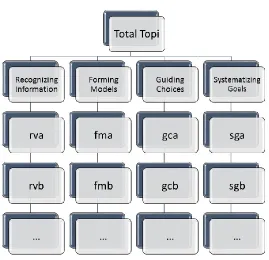
There are several consistencies of the Test of Personal Intelligence across its versions that are worth noting at the outset. The invariant aspects of the test’s form are shown in Figure 1. The overall test is divided into four areas of problem solving, from “Recognizing Information,” to “Systematizing Plans.” Within each such area are a set of “item clusters” designated by three-letter codes. The first two three-letters indicate one of the problem solving areas, such as “RV” for Recognizing Information (of a verbal nature about personality) and “SG” for Systematizing Goals. The third letter indicates the specific item cluster within the problem solving area (see Figure 1).
The overall number of clusters used depends upon the specific TOPI version but has generally varied from 13 to 18. The precise number of clusters within an area also varies and the cluster labels tend to be lettered alphabetically. By the time of the TOPI 1.4, however, certain gaps appeared in the lettering as poorly-performing clusters were deleted.
Within every item cluster are between 4 and 16 test items. All items are multiple choice and each one has four alternatives labeled “a” “b” “c” and “d.” Correct answers are identified with reference to relevant research in the field of personality psychology.
FIGURE 1. AN OVERVIEW OF THE GENERAL FEATURES OF THE TEST OF PERSONAL INTELLIGENCE
Comparison of the Text of the TOPI 1.4 to the TOPI 1.2 and 1.2Rf
The following are a list of changes made from the TOPI 1.2 to the TOPI 1.4:
Introductory and concluding text refer to the TOPI 1.4 rather than to the TOPI 1.2Rf.
Five scales were deleted including the three visual subscales faces, spaces, and pets (which failed to exhibit reliability in recent studies), and RVB and RVC, due to their very low reliability.
Item sgc1 (the first item in “SGC”) was rewritten to eliminate overlap with sgb1 and sgc2.
Two items were added: rva11 and sgc7. In addition, on some distributed forms, item rva12 may appear. These new items should be omitted from scoring. We are treating the TOPI 1.4 as a strict subset of the TOPI 1.2 and 1.2Rf, excepting the rewrite of sgc1.
The number of clusters mention on the second slide is adjusted from 19 to “a number of sections”
Description of the Item Clusters of the TOPI 1.4
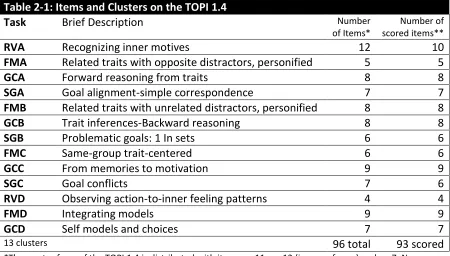
Table 2-1: Items and Clusters on the TOPI 1.4
Task Brief Description Number
of Items*
Number of scored items**
RVA Recognizing inner motives 12 10
FMA Related traits with opposite distractors, personified 5 5
GCA Forward reasoning from traits 8 8
SGA Goal alignment-simple correspondence 7 7
FMB Related traits with unrelated distractors, personified 8 8
GCB Trait inferences-Backward reasoning 8 8
SGB Problematic goals: 1 In sets 6 6
FMC Same-group trait-centered 6 6
GCC From memories to motivation 9 9
SGC Goal conflicts 7 6
RVD Observing action-to-inner feeling patterns 4 4
FMD Integrating models 9 9
GCD Self models and choices 7 7
13 clusters 96 total 93 scored *The master form of the TOPI 1.4 is distributed with items rva11, rva12 (in some forms) and sgc7. Newer forms may omit these three items—in which case RVA has 10 items and SGC has 6.
**The official TOPI 1.4 excludes items rva11, rva12, and sgc7 (where present)—items which appear on some test forms—from scoring. These items should be omitted from scoring to keep findings consistent with the comparison data reported in this manual.
Sample Items
The TOPI is made up of a number of multiple choice items. The first item of the RVA task is:
1. If a person wants to be with one or more people, talk to them, go out with them, and have a good time, the person is likely going to:
a. be in love
b. express warmth toward someone c. meet a goal of excellence
*d. socialize
As a second example, the first item from the FMA task is:
1. A person is depressed and self-conscious. Most likely, she also could be described as: a. calm and even-tempered
*b. anxious and impulsive c. self-controlled
And the first item from the SGB area is:
1. A person wants to make friends. Which goal might cause him problems when he pursues new friendships?
a. be a good friend to his friends *b. to be all things to all people c. to be myself
d. to spend time meeting new people
Chapter 3: Comparison Samples
The Three Samples Who Took the TOPI 1.2, 1.2Rf or TOPI 1.4
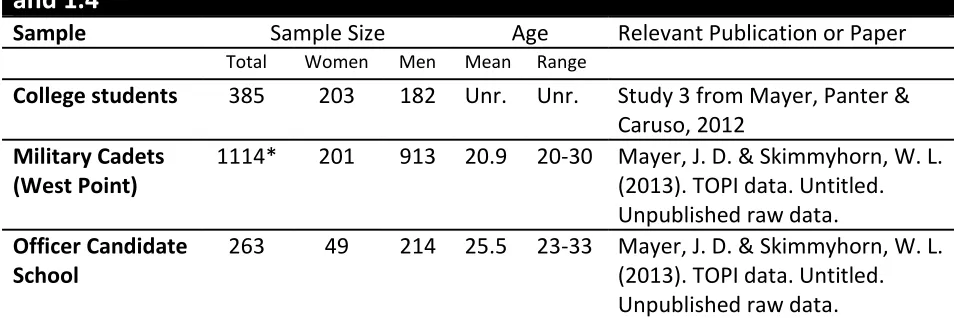
The TOPI 1.2Rf itself was administered initially to 385 college students in the form of the TOPI 1.2 (Mayer, Caruso & Panter, 2012), and as the 1.2Rf in two additional samples that we will refer to here as West Point 2013 and Officer Candidate School 2013. Because the TOPI 1.4 is a subset of the TOPI 1.2Rf, we can consider it to have been administered to the same three samples. The samples are described in Table 3-1.
Table 3-1: Sample Characteristics of the Three Groups Taking the TOPI 1.2/1.2Rf
and 1.4
Sample Sample Size Age Relevant Publication or Paper
Total Women Men Mean Range
College students 385 203 182 Unr. Unr. Study 3 from Mayer, Panter & Caruso, 2012
Military Cadets (West Point)
1114* 201 913 20.9 20-30 Mayer, J. D. & Skimmyhorn, W. L. (2013). TOPI data. Untitled. Unpublished raw data.
Officer Candidate School
263 49 214 25.5 23-33 Mayer, J. D. & Skimmyhorn, W. L. (2013). TOPI data. Untitled. Unpublished raw data.
*15 cadets were added to the sample late; some analyses in the document are based on an N of 1091.
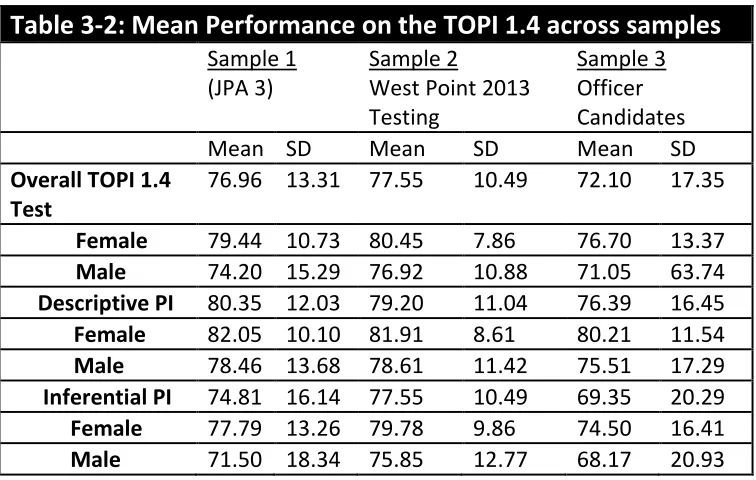
Descriptive Statistics for the TOPI 1.4 across the Samples
Table 3-2: Mean Performance on the TOPI 1.4 across samples
Sample 1 (JPA 3)
Sample 2
West Point 2013 Testing
Sample 3 Officer Candidates
Mean SD Mean SD Mean SD
Overall TOPI 1.4 Test
76.96 13.31 77.55 10.49 72.10 17.35
Female 79.44 10.73 80.45 7.86 76.70 13.37
Male 74.20 15.29 76.92 10.88 71.05 63.74
Descriptive PI 80.35 12.03 79.20 11.04 76.39 16.45
Female 82.05 10.10 81.91 8.61 80.21 11.54
Male 78.46 13.68 78.61 11.42 75.51 17.29
Inferential PI 74.81 16.14 77.55 10.49 69.35 20.29
Female 77.79 13.26 79.78 9.86 74.50 16.41
Chapter 4: Reliability and Validity of the
TOPI 1.4
Test Reliability
We’ve calculated the TOPI 1.4 reliability using coefficient alphas because of their familiarity to our test users. The reliabilities of the TOPI 1.4 for the three samples described in Chapter 3 are described in Table 4-1.
Table 4-1: Reliability of the Personal Intelligence Scores and Factor Scales for
the Three Comparison Samples
JPA-3 West Point 2013 Officer Candidates
Total PIQ .90 .86 .92
Descriptive PIQ .72 .70 .83
Inferential PIQ .86 .82 .90
Content Validity
Evidence for Structural Validity of the TOPI 1.4
We believe that the TOPI 1.4 has two factors, but we have more work to do on the test, and our two-factor approach is contingent on future research. We have analyzed the test over several samples, employing both SPSS and Mplus to do so. The following remarks reflect those analyses in the aggregate (the analyses are not all shown here).
Reasons for Caution about the Structure at this Time
We regard the TOPI’s structure as speculative because of the test’s design and in particular, our emphasis on item clusters as we developed the test. When we developed the test we were interested, most of all, in the question of whether personal intelligence existed. To determine that, one of our key aims was to create a diverse set of item clusters in order to ensure the content validity of the scale relative to the theory. We believe that the item clusters are sampled from the four areas of problem solving specified by the theory.
As we set out to further explore the test’s structure one of our challenges was that without four area scores (e.g., identifying clues, forming models, etc.) forming a set of reliable scales, the only indicators left were item clusters. We had not designed the clusters with the intention that they would be used as indicators of latent variables. Moreover, because we were conducting item analyses and removing non-performing items, some of the clusters had become very small (e.g., 4 items) and commensurately low in reliability by the time of the TOPI 1.2 and TOPI 1.4.
In short, the TOPI has a diverse set of item clusters at its lowest level (above the item level). But the item clusters themselves vary in reliability as one would expect for clusters that range in number from 4 to 12 items in length. The reliabilities of the clusters range from (depending upon sample) as low as r = .20 or so, with the largest number of clusters very roughly speaking in the r = .40 to .60 range. The sometimes low reliability of the clusters, in turn, means that they may not always serve well as indicators of factors (Little, Cunningham, Shahar, & Widaman, 2002; MacCallum, Widaman, Zhang, & Hong, 1999; Sterba, 2011). For that reason, and also because our two factors are so highly correlated, we are treating the two-factor model tentatively at this time and are reluctant to make a definitive statement as to the test’s structure at this time.
Best Model To-Date
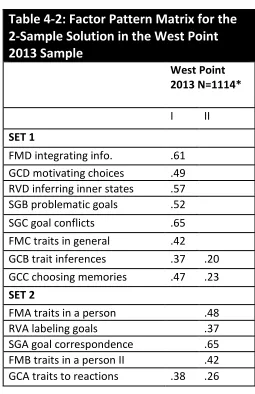
With those reservations in mind, over a series of samples, the clearest factor structure for the test appears to involve two highly correlated abilities. A representative set of factor loadings is shown in Table 4-2 for the 2013 sample collected at West Point. SPSS principal axis factoring is shown, and more specifically, results from the pattern matrix after an Oblimin rotation. Loadings less than .20 are blanked out.
Table 4-2: Factor Pattern Matrix for the
2-Sample Solution in the West Point
2013 Sample
West Point 2013 N=1114*
I II
SET 1
FMD integrating info. .61
GCD motivating choices .49
RVD inferring inner states .57
SGB problematic goals .52
SGC goal conflicts .65
FMC traits in general .42
GCB trait inferences .37 .20
GCC choosing memories .47 .23
SET 2
FMA traits in a person .48
RVA labeling goals .37
SGA goal correspondence .65
FMB traits in a person II .42
GCA traits to reactions .38 .26
Although the two factors appear to be present, as Table 4-3 indicates, the factors are highly correlated.
Table 4-3 Obtained and Estimated Correlations between Factors across
samples
Sample 1 Sample 2 Sample 3
Obtained Estimated Obtained Estimated Obtained Estimated
Correlation .63 .66a .59 .87b .74 Not donec
a. Mplus exploratory analysis [file: Abigail’s Mplus 1.4 exploratory and confirmatory/jpa-St3 2 factor 1 13 14 wo rvb rvc.out] b. Mplus confirmatory analysis [file: Abigail’s Mplus 1.4 exploratory and confirmatory/wp cfa 2 factor 1 28 14.out. This analysis was on
the first 1091 participants.
c. In a further confirmatory analysis with a new sample, Mplus estimated the correlation at .92.
As can be seen, at present the TOPI 1.4 does a limited job of separating the two factors. They are so highly correlated that use of the single overall PI score may be warranted under many conditions. Therefore although for now we are reporting three scores from the TOPI 1.4, the overall score and the two factor scores, researchers may choose to use only the overall score.
Criterion Validity
Interrelations among the TOPI 1.2, 1.2Rf and 1.4
all samples, the overall PI scores produced by the TOPI 1.2, 1.2Rf, and 1.4 are almost indistinguishable. The TOPI 1.4 has the additional advantage of producing reliable if overly-correlated subscale scores.
Relations with Criteria
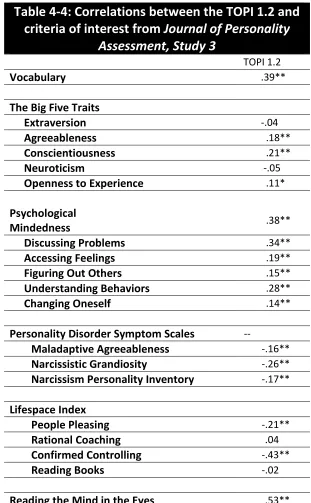
For that reason, the correlations between the overall TOPI 1.2 and criteria reported in JPA-3 reflect what, essentially will be the TOPI 1.4 correlations given the r = .97 correlation between the 1.4 and the 1.2. The central criterion correlations are shown in Table 4-4.
Table 4-4: Correlations between the TOPI 1.2 and
criteria of interest from
Journal of Personality
Assessment, Study 3
TOPI 1.2
Vocabulary .39**
The Big Five Traits Extraversion -.04
Agreeableness .18**
Conscientiousness .21**
Neuroticism -.05
Openness to Experience .11*
Psychological Mindedness .38**
Discussing Problems .34**
Accessing Feelings .19**
Figuring Out Others .15**
Understanding Behaviors .28**
Changing Oneself .14**
Personality Disorder Symptom Scales
--Maladaptive Agreeableness -.16**
Narcissistic Grandiosity -.26**
Narcissism Personality Inventory -.17**
Lifespace Index
People Pleasing -.21**
Rational Coaching .04
Confirmed Controlling -.43**
Reading Books -.02
Interpersonal Competency .06
Questionnaire
Initiating Relationships -.01
Providing Emotional Support .17**
Asserting Influence .04
Self-Disclosure -.01
Conflict Resolution .07
MSCEITc Strategic EI .69**
Understand Emotions .68**
Changes .63**
Blends .60**
Manage Emotions .55**
Emotion Management .51**
Emotional Relations .48**
Replications and Extensions in Progress
As of summer, 2014, we are analyzing further data from the samples above and from additional samples. Those data sets allow us to correlate the TOPI 1.4 with measures that include mental aptitude, the Big Five, and several real-life criteria. Our analyses are ongoing but it is safe to report at this time that the TOPI 1.4 correlates with measures of mental aptitude and the Big Five in a pattern that is very similar to what we have obtained in the past (e.g., Mayer, Skimmyhorn, Caruso & Panter, 2014).
Psychometric Strengths and Limitations of the TOPI 1.4: A Bulleted List
Summary of Strengths:
The test is designed with good content validity for verbal-problem solving in the area of personal intelligence
The test is reliable at the full scale level
The test exhibits modest reliability at the factor scale level
The test shows good evidence from criterion correlations for its validity
Summary of Limitations:
o Owing to the lack of mid-level structure of the test, the two factors are tentative at this time
o The two factors also correlate with one another at levels that are higher than is desirable
The test items are easier than is desirable. This means that:
o The distribution of test scores are negatively skewed
o As a practical consequence, the test is:
Relatively accurate at distinguishing among poor performers
Chapter 5: Availability of the TOPI 1.4
We are now making the TOPI 1.4 available to researchers in an arrangement through the University of New Hampshire.
To protect the security and therefore the validity of the test, we are disseminating the test items to researchers, asking them to keep the test items secure.
Also for reasons of security, we are holding the scoring key at UNH and treating the key as proprietary information for the time being. For that reason, we are asking researchers who collect data to send it to us in an Excel or SPSS file using the variable names on the test.
For quick responses to scoring requests, please be sure to submit your data in the following manner:
Remove any information that could be used to personally identify study participants from your Qualtrics or other survey before you forward it to us. (Participant IDs assigned for the study can be included).
Label your subject identifier variable as “id”
Use the variable names specified in the TOPI 1.4 test document (rva1, rva2, etc.)
Code responses to the test as follows:
o A=1
o B=2
o C=3
o D=4
Submit all columns in a numeric form (in Excel: ‘general format’ works fine)
At present, our scoring returns a full-scale score and two subscores, one for the descriptive and one for the inferential factor scales.
We will then return scored data in an Excel file containing an N x 4 matric including (1) the participant ID, (2) the total TOPI 1.4 score, and (3) scores on the descriptive and (4) on the inferential factor scales.
In addition, we can provide reliability data for the overall test for a researchers’ particular sample.
References
Little, T. D., Cunningham, W. A., Shahar, G., & Widaman, K. F. (2002). To parcel or not to parcel: Exploring the question, weighing the merits. Structural Equation Modeling, 9(2), 151-173. doi:10.1207/S15328007SEM0902_1
MacCallum, R. C., Widaman, K. F., Zhang, S., & Hong, S. (1999). Sample size in factor analysis. Psychological Methods, 4(1), 84-99. Retrieved from
http://search.ebscohost.com/login.aspx?direct=true&db=psyh&AN=1999-10139-007&site=ehost-live
Mayer, J. D. (2008). Personal intelligence. Imagination, Cognition and Personality, 27(3), 209-232. doi:10.2190/IC.27.3.b
Mayer, J. D. (2009). Personal intelligence expressed: A theoretical analysis. Review of General Psychology, 13(1), 46-58. doi:10.1037/a0014229
Mayer, J. D., Panter, A. T., & Caruso, D. R. (2013). Test of personal intelligence MINI MARKER-12 (TOPI MINI-12) (2nd ed): Brief manual. Unpublished manuscript.
Sterba, S. K. (2011). Implications of parcel-allocation variability for comparing fit of item-solutions and parcel-item-solutions. Structural Equation Modeling, 18(4), 554-577. Retrieved from http://search.ebscohost.com/login.aspx?direct=true&db=psyh&AN=2011-24185-005&site=ehost-live