https://doi.org/10.5194/amt-11-515-2018 © Author(s) 2018. This work is distributed under the Creative Commons Attribution 4.0 License.
Revisiting internal gravity waves analysis using GPS RO density
profiles: comparison with temperature profiles and application
for wave field stability study
Petr Pisoft1, Petr Sacha1,2, Jiri Miksovsky1, Peter Huszar1, Barbara Scherllin-Pirscher3, and Ulrich Foelsche4 1Department of Atmospheric Physics, Faculty of Mathematics and Physics, Charles University,
V Holesovickach 2, 180 00 Prague 8, Czech Republic
2Environmental Physics Laboratory (EPhysLab), Faculty of Sciences of Ourense, University of Vigo, 32004, Ourense, Spain 3Zentralanstalt für Meteorologie und Geodynamik (ZAMG), Vienna, Austria
4Institute for Geophysics, Astrophysics, and Meteorology/Inst. of Physics (IGAM/IP) and Wegener Center for Climate and Global Change (WEGC), University of Graz, Graz, Austria
Correspondence:Petr Pisoft ([email protected])
Received: 14 July 2017 – Discussion started: 14 September 2017
Revised: 23 November 2017 – Accepted: 1 December 2017 – Published: 25 January 2018
Abstract. We revise selected findings regarding the utiliza-tion of Global Posiutiliza-tioning System radio occultautiliza-tion (GPS RO) density profiles for the analysis of internal gravity waves (IGW), introduced by Sacha et al. (2014). Using various GPS RO datasets, we show that the differences in the IGW spec-tra between the dry-temperature and dry-density profiles that were described in the previous study as a general issue are in fact present in one specific data version only. The differ-ences between perturbations in the temperature and density GPS RO profiles do not have any physical origin, and there is not the information loss of IGW activity that was sug-gested in Sacha et al. (2014). We investigate the previously discussed question of the temperature perturbations charac-ter when utilizing GPS RO dry-temperature profiles, derived by integration of the hydrostatic balance. Using radiosonde profiles as a proxy for GPS RO, we provide strong evidence that the differences in IGW perturbations between the real and retrieved temperature profiles (which are based on the assumption of hydrostatic balance) include a significant non-hydrostatic component that is present sporadically and might be either positive or negative. The detected differences in re-lated spectra of IGW temperature perturbations are found to be mostly about ±10 %.
The paper also presents a detailed study on the utiliza-tion of GPS RO density profiles for the characterizautiliza-tion of the wave field stability. We have analyzed selected stability parameters derived from the density profiles together with
a study of the vertical rotation of the wind direction. Regard-ing the Northern Hemisphere the results point to the western border of the Aleutian high, where potential IGW breaking is detected. These findings are also supported by an analysis of temperature and wind velocity profiles. Our results confirm advantages of the utilization of the density profiles for IGW analysis.
1 Introduction
Although IGWs are traditionally regarded as small-scale processes, they are often distributed in large-scale hot spots (e.g., Sacha et al., 2015) and are thus able to influence large-scale circulation. All these findings stress the necessity of ob-servational studies and comprehensive knowledge of IGWs and their various characteristics.
IGWs in the atmosphere are studied by a variety of obser-vational techniques based on remote sensing measurements. Among them, the radio occultation (RO) using signals from the Global Positioning System (GPS) has proven to be a pow-erful tool that globally provides detailed information about the vertical structure of the atmosphere (e.g., Anthes, 2011; Scherllin-Pirscher et al., 2017). The significance of GPS RO for atmospheric sciences will most likely increase even more in the future, considering growing numbers of planned satel-lites and related mission projects (e.g., Cook et al., 2016).
GPS RO provides a perfect vertical but worse horizontal resolution of the measured profiles, and the technique is sen-sitive mostly to IGWs with small ratios of vertical to hori-zontal wavelengths (Wu et al., 2006). In the uppermost at-mosphere, the exploitation of RO profiles is limited by iono-spheric errors; from below, there is a potential problem of artificial enhancement of the wave activity in the tropopause region when temperature profiles are considered (Foelsche et al., 2008; Schmidt et al., 2008). Therefore, we focus IGW analysis based on GPS RO profiles on the levels above the tropopause up to 35–40 km.
The GPS RO information relevant for IGW studies is re-trieved in a series of steps (e.g., Kursinski et al., 1997, 2000; Steiner et al., 1999, 2001; Hajj et al., 2002). The bending an-gles are retrieved from profiles of the excess phase of Global Navigation Satellite System (GNSS) signals passing though the atmosphere. Assuming spherical symmetry, the bending angle profiles can be converted into the refractivity profiles. Subsequently, the dry density is derived from refractivity, and using the hydrostatic balance, and the state equation for dry air, (dry-)temperature profiles are calculated (Steiner et al., 1999; Hajj et al., 2002). Although IGWs have been studied almost exclusively using temperature profiles, density pro-files can be used too. An original approach to determine key IGW parameters using vertical profiles of temperature, den-sity, or buoyancy frequency was suggested in a series of pa-pers by Gubenko et al. (2008, 2011, 2012).
Sacha et al. (2014) introduced a novel method for the uti-lization of GPS RO density profiles. The paper also discussed differences of IGW characteristics obtained using either RO density or RO temperature profiles. The authors found that there is an information loss due to the hydrostatic filtering when the temperature profiles are used. The comparison of perturbations in density and temperature calls into question the nature of the temperature profiles derived under the as-sumption of hydrostatic balance, in particular, what is the difference between the GPS RO temperature and real tem-perature perturbations (with nonhydrostatic modes included) in the presence of a broad IGW spectrum? In this paper, we
revisit the findings of Sacha et al. (2014) and investigate re-lated questions using different GPS RO datasets as well as radiosonde profiles as a proxy for RO.
The utilization of atmospheric density profiles has impor-tant advantages because the retrieval of density is not based on additional assumptions that are used in the retrieval of temperature profiles. Density is the first quantity of state gained in the retrieval process, and the hydrostatic balance does not need to be presumed. Moreover, the background density vertical profile is theoretically inferable by means of statistical physics and can be analytically derived.
It should also be noted that the spectra arising from the GPS RO density and temperature profiles are derived from “apparent” vertical wavelengths measured from slanted soundings as described by de la Torre et al. (2018). The re-sulting spectra (which are analyzed in this paper) should be then also considered as “apparent”.
In comparison with temperature profiles, density pro-files can also provide more information about potential IGW breaking by calculation of specific stability parameters (Sacha et al., 2015). This is highly important for observa-tional studies of the dynamical mechanisms that may sup-port theories regarding IGW instability and breaking. The internal gravity wave spectrum observed in the stratosphere is not only shaped by different sources; it also reflects back-ground conditions prevailing in lower layers. This is illus-trated by the propagation of orographic gravity waves that are critically filtered when the background wind speed is zero (this condition is fulfilled if the directional shear ex-ceeds 180◦; e.g., Khaykin, 2016). Due to this filtering effect, orographic IGW modes cannot contribute to observed IGW activity above regions with zero wind speed. On the other hand, regions of small wind rotation at lower levels are often precursors of enhanced IGW activity higher up (Alexander et al., 2009). The theoretical background (Sutherland, 2010) suggests that the IGW should dissipate below the critical level of 180◦ directional shear rotation. Corresponding re-search and related discussion are still ongoing. However, by analyzing the stability parameters together with the rotation of the wind direction, this mechanism can be properly tested. In the presented study, we have analyzed the vertical rotation of the wind direction together with the distribution of the gra-dient Richardson number (Galperin et al., 2007; Sutherland, 2010) andσ2representing maximum growth rate of distur-bances arising from the Rayleigh–Taylor convective instabil-ity (Sutherland, 2010).
pro-35
30
25
20
0 0.02 0.04 0.06 0.08 210 220 230 240 -0.01 0 0.01 35
30
25
20
Profile Profile Temp.
Fit
1 : 2.5
Fit Dens.
Density (kg m )-3
(a) (b) (c)
Temperature (K)
A
ltitude (k
m)
Normalized perturbations
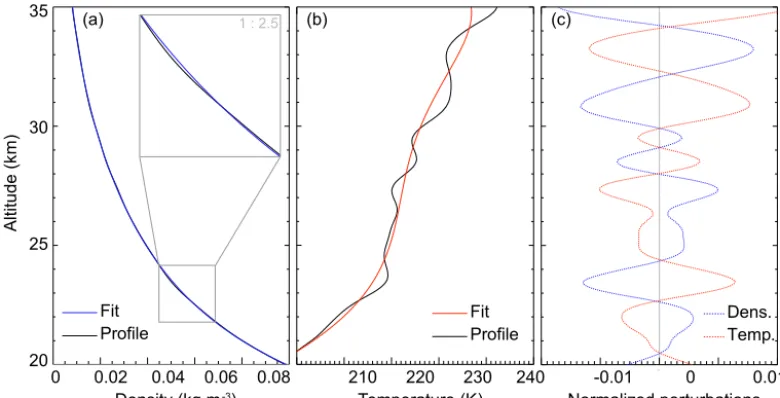
Figure 1.Example profile, background fit for density(a)and temperature(b), and normalized perturbations(c).
files with results indicating significant differences between real measured temperature and temperature calculated as-suming hydrostatic balance. Analyses of stability parameters and stratospheric dynamics are introduced in Sect. 4. Spe-cific variables derived from GPS RO data are analyzed to de-scribe regions with potential IGW breaking and its connec-tion to vertical rotaconnec-tion of the wind direcconnec-tion. The resulting distribution of the studied characteristics points mainly to the processes at the western border of the Aleutian high (AH).
2 IGW perturbations of GPS RO density and temperature profiles
2.1 Data and methodology
Sacha et al. (2014) studied GPS RO profiles produced by the Wegener Center Occultation Processing System version 5.4 (OPSv5.4; Steiner et al., 2009; Pirscher, 2010). Both den-sity and temperature profiles from this specific dataset were analyzed for the 2006–2010 time period. In this study we again use the OPSv5.4 data but additionally include pro-files from a more recent retrieval version (OPSv5.6; Schwärz et al., 2016; Scherllin-Pirscher et al., 2017; Angerer et al., 2017), and also profiles from the COSMIC Data Analysis and Archive Center (CDAAC; Rocken et al., 2000) and from the Radio Occultation Meteorology Satellite Applications Facil-ity (ROM SAF; Syndergaard, 2016). All the profiles were analyzed for the same time period (2006–2010), applying the same methodology.
For a proper comparison of the profiles and the derived IGW spectra we started with the construction of background profiles. To separate the density perturbations, we applied a method for the background separation based on fitting the buoyancy frequency height profile with consequent
analyti-cal derivation of the background density. To get an appropri-ate temperature background, we assumed hydrostatic balance and evolution of pressure in the form
p0(z)= ˆp0−g z0 Z
z
ρ0(z)dz. (1)
Using the state equation, we gained
T (z)=p0
−gRz0
z ρ0(z)dz Rρ0(z)
(2) for the temperature evolution. To fit the background we iter-ated perturbed values of pressure and gravity acceleration at the lower boundary. Figure 1a and b show the final fit of the background density and temperature from an example pro-file. By subtracting the background from the original profile, we gained perturbations that were subsequently normalized (by dividing the result by the background). The resulting den-sity and temperature disturbances for the example profile are illustrated in Fig. 1c. As a direct consequence of the appli-cation of hydrostatic balance in the GPS RO retrieval, there is a phase shift by 180◦ between the obtained density and temperature perturbations.
To evaluate differences in the amplitude and frequency of IGW vertical modes, we have applied frequency analysis (us-ing the fast Fourier transform algorithm, FFT) on the pertur-bations derived from all the density and temperature profiles. The resulting spectra were compared and the differences sta-tistically analyzed.
2.2 IGW perturbation spectra
10-4
10-5
10-6
10-7
10-8
10-4
10-5
10-6
10-7
10-8
40 20 0 -20 -40
40 20 0 -20 -40
Wavenumber (cycle km ) Wavenumber (cycle km ) 0.1 1 10 0.1 1 10
P
S
D
(
km
c
yc
le
)
Diff
er
enc
e (%)
Dens. Dens.
Temp. Temp.
CDAAC ROM SAF
10-4
10-5
10-6
10-7
10-8
10-4
10-5
10-6
10-7
10-8
40 20 0 -20 -40
40 20 0 -20 -40 0.1 1 10 0.1 1 10
P
S
D
(
km
c
yc
le
)
Diff
er
enc
e (%)
Dens. OPSv5.6 Temp. OPSv5.6 Dens. OPSv5.4 Temp. OPSv5.4 10-4
10-5
10-6
10-7
10-8
10-4
10-5
10-6
10-7
10-8
40 20 0 -20 -40
40 20 0 -20 -40 0.1 1 10 0.1 1 10
P
S
D
(
km
c
yc
le
)
Diff
er
enc
e (%)
Dens.
(a)
(e)
(i) (b)
(f)
(j)
(c)
(g)
(k) (d)
(h)
(l)
OPSv5.4 OPSv5.6
Dens.
Temp. Temp.
OPSv5.4, dens. - temp.
CDAAC, dens. - temp.
Dens. OPSv5.6 - dens. OPSv5.4
OPSv5.6, dens. - temp.
ROM SAF, dens. - temp. Temp. OPSv5.6 - temp. OPSv5.4
-1
-1
-1
-1 -1
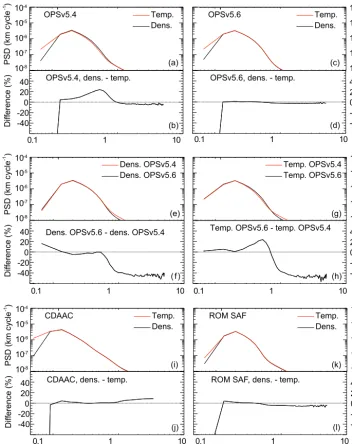
Figure 2.Power spectra density (PSD) of normalized perturbations and their differences for selected variables and datasets (indicated in the individual panels).
for the OPSv5.4 data. The spectra were calculated as an average from individual profiles over the northern midlati-tudes. While vertical wavelengths larger than about 9 km and smaller than about 1 km are higher for temperature, density perturbations have larger vertical wavelengths between 1 and 9 km with a maximum of about 20 % at about 2–3 km.
Sacha et al. (2014) found similar differences between IGW characteristics from density and temperature and suggested that they might be caused by nonhydrostatic IGWs. However, there is no physical explanation of why GPS RO tempera-ture fluctuations should have larger amplitudes than density fluctuation because the involvement of hydrostatic balance
should only cause a phase difference between temperature and density fluctuations (see discussion below). However, higher values of temperature fluctuations for wavelengths smaller than 1 km could also be connected with noise, and wavelengths larger than 9 km could be connected with back-ground fit deficiencies. If these assumptions were true, the results would point to limits for the vertical wavelength cut-offs.
cal-culated from individual profiles. The differences between the PSDs of temperature and density perturbations are signifi-cantly less pronounced than those of OPSv5.4, and they are only up to 2 %. The region where the density spectrum has higher values is delimited by different vertical wavelengths than in the case of OPSv5.4. It is bounded by vertical wave-lengths of about 1–7 km without a distinct maximum. The very small difference between temperature and density spec-tra is illusspec-trated also by an analysis of the respective CDAAC and ROM SAF profiles. Small differences and no distinct maxima were detected in those cases too (Fig. 2i–l). The similarity of the density and temperature spectra might be considered as evidence of the suitability and accuracy of the method for subtracting similar background conditions.
To more closely study the disagreement among results for the spectra of different datasets, we have further analyzed the differences of the power spectra of the normalized perturba-tions between the OPSv5.4 and OPSv5.6 profiles. The results illustrated in Fig. 2e–h show that in the case of the OPSv5.6 density profiles there is a significant increase for the modes above 10 km of vertical wavelengths, a slight decrease of about 5 % for wavelengths between about 7 and 1.5 km and finally a significant decrease for high wave numbers. In the case of OPSv5.6 temperature profiles, the comparison with OPSv5.4 points to an increase in the power spectrum val-ues for most of the wave numbers. This increase has a maxi-mum of about 30 % for vertical wavelengths around 2 km and is followed by significant decrease for wavelengths smaller than about 1 km.
The results point to a distinct change between the OPSv5.4 and OPSv5.6, and comparisons with CDAAC and ROM SAF show that there is mutual agreement with the OPSv5.6 pro-files. The reason for the significant difference between the OPS data versions is not clear. There were minor changes in handling of the background information used in the retrieval (e.g., co-located ECMWF profiles) and in the background atmosphere itself in processing the OPSv5.4 and OPSv5.6 data. However those changes could not lead to significant dif-ferences in the spectral density of the related perturbations. The answer may possibly lie outside the processing changes at the Wegener Center and could be connected to different UCAR versions of excess phase and orbit data.
Comparison of the density and temperature disturbances for the example profile in Fig. 1c points to the phase shift between the perturbations. This difference between normal-ized temperature and density profiles is in principle theoret-ically inferable from the ideal gas law under the assumption of negligible pressure perturbations (for details please see She et al., 1991). The resulting relationship shows that the normalized perturbations are in anti-phase (shifted by 180◦). There is also a rather theoretical question going beyond the scope of this study on how this assumption squares with the hydrostatic balance utilization (see the Appendix of Doswell III and Markowski, 2004).
3 Nonhydrostatic forcing and GPS RO dry-temperature profiles
In the GPS RO retrieval, dry-pressure and dry-temperature profiles are derived from density profiles under the assump-tion of hydrostatic balance. They would therefore correspond to their real atmospheric counterparts only if the atmosphere were in a state of hydrostatic balance. For IGWs this implies that, if the hydrostatic balance is assumed, the temperature perturbations will correspond to actual temperature pertur-bations only if the disturbances are created by hydrostatic waves only. If nonhydrostatic modes are present too, pres-sure and density are not hydrostatically linked and the in-duced dry-density perturbations are connected with different temperature perturbations from those that are derived using the hydrostatic balance integration. In this case, the corre-sponding temperature disturbances could only be computed from a separately measured temperature or pressure profile. To analyze this hypothesis and to quantify the effect of de-viation from the hydrostatic balance assumption on GPS RO IGW analysis, we have studied proxy data from radiosonde measurements. The PSDs resulting from radiosondes should be compared to those from GPS RO with caution because of the wavelength distortion due to a different viewing geome-try (de la Torre et al., 2018). However in the presented anal-ysis PSDs either from the same GPS RO observations events or from radiosondes are compared. Therefore the effect of the wavelength distortion does not influence the comparison. 3.1 Data and methodology
We have analyzed data from the GRUAN (The Global Cli-mate Observing System Reference Upper-Air Network) ra-diosonde network (Dirksen et al., 2014; Immler et al., 2010). All available profiles for altitudes between 15 and 30 km from the stations in Lindenberg (Germany), Ny-Alesund (Norway), and Tateno (Japan) were included in the analy-sis, for both temperature and pressure. Density was calcu-lated using the equation of state. Having the vertical profiles of density, we have integrated the hydrostatic balance to ac-quire pressure and temperature profiles similarly to the GPS RO dry-temperature retrieval process. The integration was initiated at the top level using the value from correspond-ing pressure profiles. Variable gravitational acceleration was included in the calculation. Temperature profiles were subse-quently derived from the pressure profiles using the equation of state.
10-4
10-5 10-6
10-7
10-8 6 3
0
-3 -6
Wavenumber (cycle km )
0.1 1 10
P
S
D
(
km
c
yc
le
)
Diff
er
enc
e (%)
Original temp. Derived temp.
Original–derived temp.
-1
-1
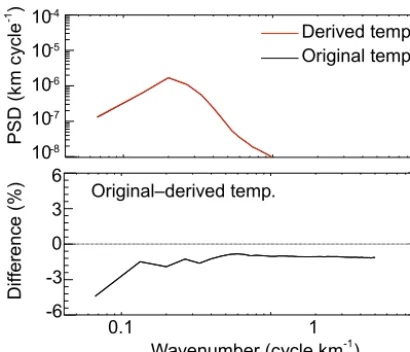
Figure 3.Power spectra density of normalized temperature pertur-bations and their differences for GPS RO and derived temperature profiles.
with vertical extent only up to 35 km. To compare resulting temperature profiles and to quantify our methodology error, we calculated IGW perturbations for all our temperature pro-files and those from CDAAC (using the methodology intro-duced in the previous section) and applied frequency anal-ysis. Figure 3 shows typical power spectra of the normal-ized perturbations for the derived and original temperature CDAAC profiles, and their difference as a mean over all pro-files obtained at midlatitudes in June 2013. The difference between the profiles is about 2 % for most wave numbers, though with a maximum over 5 % for wavelengths longer than about 8 km. Based on these results, we have estimated the methodology error to be about 5 % and applied the al-gorithm of the temperature derivation to the radiosonde pro-files. It is important to note that methodology error could also result from different gravity fields (Scherllin-Pirscher et al., 2017), different (or additional) smoothing procedures, or dif-ferent internal vertical grids.
3.2 Comparison of temperature perturbations
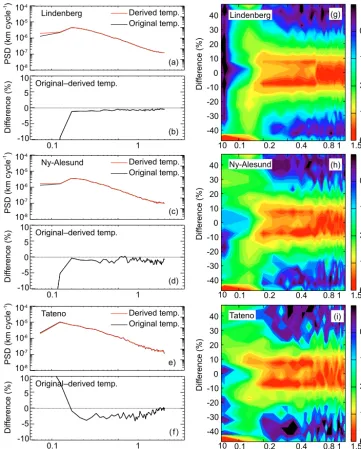
Figure 4a–f illustrate resulting spectra of the normalized tem-perature perturbations for the derived and original radiosonde profiles, as well as their differences. Although the nonhy-drostatic forcing is always present to some degree, signifi-cant forcing is assumed to be sporadic. However the pertur-bation spectra represent an average, and the nonhydrostatic impact would be neglected if all profiles were included. To account for this and considering the estimated methodology error, we have selected only those profiles where the mean difference between the temperature disturbances was above 5 % for vertical wavelengths shorter than 8 km. Depending on the analyzed station, 10–30 % of the analyzed radiosonde profiles satisfied this criterion. Still, the resulting differences between the perturbations of the original and derived
tem-perature profiles shown in Fig. 4a–f are not significant, rang-ing from less than 1 up to 5 %. This might be connected to the fact that there could be nonhydrostatic effects of oppo-site signs and those might be canceled out in the profiles’ mean. To test this case we have also analyzed an actual dis-tribution of the perturbations differences related to individual profiles that were included in the previous analysis step. This is shown in Fig. 4g–i, where the color scale represents the number of profiles falling into specific intervals of perturba-tion differences and wave numbers. Regarding vertical wave-lengths between about 8 and 1 km, more than 60 % of the perturbation differences are found between−10 and+10 %. For wavelengths longer than about 8 km, the applied method-ology fails and the differences are mostly more than−40 %. For wavelengths shorter than 1 km, the differences between the temperature disturbances are distributed approximately uniformly between−10 and+10 %.
Our results point to several interesting findings. There is a significant difference between the IGW perturbations of the original temperature profiles and those that were derived us-ing integration of the hydrostatic balance. These differences can be attributed to nonhydrostatic forcing. Results presented in Sect. 2 showed that the IGW perturbations in GPS RO dry-temperature profiles are the same as for the density profiles (except for the phase shift). In the case of hydrostatic equilib-rium, temperature (pressure) and density are hydrostatically linked, so there should not be a difference between perturba-tions of derived and actually measured temperature profiles. However, atmospheric processes are of both hydrostatic and nonhydrostatic nature, meaning that temperature and density are not entirely linked by the hydrostatic balance. Hence, the perturbations of the derived temperature still correspond to the density perturbations, but they do not represent the whole perturbation spectrum of the separately measured tempera-ture.
Wavenumber (cycle km ) Wavenumber (cycle km ) 10-4 10-5 10-6 10-7 10-8 40 30 20 10 0 -10 -20 -30 -40 40 30 20 10 0 -10 -20 -30 -40 40 30 20 10 0 -10 -20 -30 -40 10-4 10-5 10-6 10-7 10-8 10-4 10-5 10-6 10-7 10-8 10 5 0 -5 -10 10 5 0 -5 -10 10 5 0 -5 -10
0.1 1 10
0.1 1 10
0.1 1 10
0.1 0.2 0.4 0.8 1 1.5 2
0.1 0.2 0.4 0.8 1 1.5 2
0.1 0.2 0.4 0.8 1 1.5 2
P S D ( km c yc le ) Diff er enc e (%) Diff er enc e (%) Diff er enc e (%) P S D ( km c yc le ) P S D ( km c yc le ) Diff er enc e (%) Diff er enc e (%) Diff er enc e (%) (a) (c) e) (b) (d) (f) Original temp. Original temp. Original temp. Derived temp. Derived temp. Derived temp. Original–derived temp. Original–derived temp. Original–derived temp. Lindenberg Ny-Alesund Tateno 0.5 1 3 10 60 0.5 1 3 10 60 0.5 1 3 10 60 (g) (h) (i) Lindenberg Ny-Alesund Tateno -1 -1 -1 -1 -1
Figure 4. Power spectra density (PDS) of normalized temperature perturbations(a, c, e) and their differences(b, d, f)for radiosonde-measured and derived temperature profiles at the stations Lindenberg, Ny-Alesund, and Tateno. Distributions of the PSD differences between
the radiosondes and derived profiles are shown in panels(g–i); the color scale represents the number of profiles falling into a specific interval
of perturbation differences and wave numbers.
4 IGW (in)stability using GPS RO density profiles 4.1 Data and methodology
To study the wave field stability and to illustrate advantages of the utilization of GPS RO density profiles, we have ana-lyzed two derived IGW parameters introduced by Sacha et al. (2015), i.e., the gradient Richardson number and maximum growth rate of disturbances arising from Rayleigh–Taylor convective instability.
According to Sutherland (2010), the necessary condition for dynamical instability when disturbances overcome the stabilizing effect of buoyancy by drawing kinetic energy from the mean flow is expressed by
Rig= N02
s02 < 1
4, (3)
variance of the vertical gradient of density perturbations, and using the polarization relations for IGWs, this can be further adjusted (Senft and Gardner, 1991) to
Rig= g2 N4
* ∂ ∂z
ρ0
ρ0 2+
. (4)
The parameterσ2represents the maximum growth rate of disturbances arising from Rayleigh–Taylor convective insta-bility that is used to describe overturning instabilities. It is defined by
σ2= g ρ0
dρ 0 dz +
∂ρ0 ∂z
, (5)
and its values are real if the wave forcing drives the fluid to overturn.
Similarly to the methodology used in Sacha et al. (2015) we did not analyze these parameters to detect exceedance of an exact threshold. Values of the studied parameters Rigand σ2are generally expected to be below the thresholds for the turbulence and mixing to occur because there is a low prob-ability that the GPS RO profile represents the exact time of IGW breaking and also due to the observational filter effect (Lange and Jacobi, 2003). For these reasons we studied the parameters as indicators of potential instabilities in the sense that, in the case of lower Rigvalues and higher value ofσ2, there is higher probability of IGWs breaking and interaction of the waves with the mean state. We have also calculated the mean potential energy density defined in
Ep= 1 2N
2Dξ2E=1 2
g N
2 *
ρ0 ρ0
2+
(6) (Wilson et al., 1991).
To analyze the influence of background conditions, monthly mean climatological wind fields from sampling-error-corrected geopotential height fields were calculated us-ing OPSv5.6 GPS RO data. For our purpose, the data of-fer unique advantages, including geopotential height being accurately obtained as a vertical coordinate jointly with an accurate retrieval of pressure, very high vertical resolution, and global coverage. The wind fields were subsequently de-rived using the approach described in Scherllin-Pirscher et al. (2014, 2017) as monthly means in a grid of 5◦×5◦. For fur-ther analysis we have also calculated monthly mean values of σ2, Richardson gradient number, and potential energy using OPSv5.6 GPS RO profiles.
4.2 Results
For the winter season (December–January–February, DJF), Fig. 5a and b illustrate the distribution of wind direction ro-tation from the ground up to 7 hPa and the distribution of maximum σ2. In the Northern Hemisphere, the wind rota-tion exceeds 180◦mainly over the Northern Pacific. Maxi-mum σ2 is located over East Asia (EA). The geographical
distribution of the maximumσ2values overlaps a small part of the western flank of the critical rotation region. This is in accordance with the findings by Sacha et al. (2015).
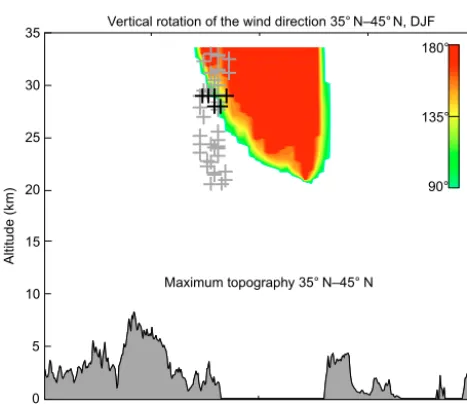
To examine the possible connection between wind direc-tion rotadirec-tion and dissipadirec-tion of IGW, we focused our analy-sis on profiles with maximumσ2 values that were detected below the 180◦ rotation level (provided that the 180◦ rota-tion was detected at the selected grid point). With regard to the results of the critical rotation study presented in Fig. 5b, the analysis comprised profiles mainly in the Southern Hemi-sphere and over the Northern Pacific. Locations of the grid points with maximumσ2values detected below the 180◦ ro-tation level are shown in Fig. 5c. Selecting only the maxi-mumσ2 values that are located below the critical line for IGWs propagating from the surface, our analysis highlighted grid points mainly in the western boundary region of the Aleutian high. To analyze the vertical structure and longitu-dinal variability of this region where maximumσ2values are found below the critical rotation level, the follow-up analysis was focused on the vertical profile in the latitudinal belt of 35–45◦N (highlighted in Fig. 5c).
Max. sigma below 180° rotation Maximum sigma
Wind direction rotation up to 7hPa
0 30 60 90 120 180 -0.16 -0.145 -0.138 -0.135 -0.130 -0.12
35° N–45° N
(a) (b) (c)
Figure 5.Vertical rotation of the wind direction between the surface and 7 hPa(a), distribution of maximumσ2values(b), and grid points
where the maximumσ2values were detected below the critical rotation level(c). All the results are for the DJF season. The color scale
represents the rotation in degrees(a)andσ2(b).
35
30
25
20
15
10
5
0
0° E 90 E ° 180° E 270° E 360° E
A
ltitude (k
m)
Longitude
Vertical rotation of the wind direction 35° N–45° N, DJF
Maximum topography 35° N–45° N
180°
135°
90°
Figure 6.Vertical profile of the wind direction rotation between the
surface and 7 hPa for the DJF season and 35◦–45◦N latitudinal belt
(top) and related maximum topography (bottom). The color scale represents degrees of the rotation. The crosses represent the height
of maximumσ2 values (black represents the profile means; grey
represents individual profiles).
Vertical profiles in the latitudinal belt of 35–45◦N for other studied variables are shown in Fig. 7. The position of the maximum σ2is depicted in the same way as in Fig. 6. The white line represents the borders of the region where the wind direction rotation exceeds 180◦.
In Fig. 7a and b we can see that the average zonal wind and temperature cross section is dominated by the planetary wave 1 (PW1) with a typical westward tilt with height and a sharp transition of phase around 150◦E. RigandEpfields (Fig. 7c and d) both seem to be strongly connected to subsi-dence, which can be inferred from the temperature field. The fields of extreme Rig and Ep values slope downward with longitude, in agreement with the downward penetration of
the subsidence with longitude, peaking around 150◦E, where the high temperature linked to the subsidence reaches be-low 20 km. East of approximately 150◦E we can observe an abrupt change to upwelling (visible in the temperature field; see also Demirhan Bari et al., 2013; Sacha et al., 2016) and also horizontal wind reversal and consequentlyEp and Rigdisappearing. The maximumσ2values are concentrated along the line of this change. An interesting fact is that the in-terface between highEpand Rigvalues around 150◦E does not show any vertical tilt with height (as is the case of zonal wind and temperature) and penetrates the western flank of the AH. This is again a strong indication of the relationship of those quantities (Ep, Rig) with the orography lying directly below (Fig. 6). The abrupt end of the IGW activity eastward of approximately 150◦E can be attributed to the transition from the continent to the ocean.
5 Conclusions
5.1 IGW perturbations of GPS RO density and temperature profiles
accu-35
30
25
20
0.1 1 2 2.5 3.5 5 0.2 1 1.5 2 3 60 -40 5 15 20 30 60 205 210 215 220 225 250
0° E 90 E ° 180° E 270° E 360° E
A
ltitude (k
m)
A
ltitude (k
m)
A
ltitude (k
m)
A
ltitude (k
m)
Longitude 35
30
25
20 35
30
25
20
35
30
25
20
(c) Richardson gradient number
(d) Potential energy (b) Temperature
(a) Zonal wind speed Z
on
al
w
in
d s
pe
ed
(m
s
)
Temper
atur
e (K
)
P
ot
en
tial ener
gy
R
ichar
dson g
radien
t number
Figure 7.Vertical profiles of the zonal wind speed(a), temperature(b), Richardson gradient number(c), and potential energy(d)for the
DJF season and the 35◦–45◦N latitudinal belt. The crosses represent the height of maximumσ2values (black represents profile means; grey
represents individual profiles). The white line depicts the borders of the region where the vertical rotation of the wind direction exceeds 180◦.
racy of the applied method for the subtraction of density and temperature backgrounds.
5.2 Comparison of the influence of retrieved and measured temperature on IGW activity
We have confirmed that there are differences between the perturbation spectra of measured temperature profiles and those that are derived assuming hydrostatic balance (used in the retrieval of GPS RO dry temperature). However, these differences are negligible when averaging over a large num-ber (more than 100) of profiles. To illustrate the differences, it
is necessary to analyze the distribution for individual profiles as shown in Fig. 4g–i. Then, more than 60 % of the perturba-tion differences are found to be close to±10 % for vertical wavelengths between about 8 and 1 km.
5.3 Wave field stability from GPS RO density profiles We have presented a detailed analysis of the connection be-tween IGW activity, wave breaking, and background condi-tions (zonal wind, its rotation with height, temperature), uti-lizing data from GPS RO exclusively. High correspondence between the spatial distribution of theσ2parameter and crit-ical rotation of background wind values (Fig. 6) validates the utilization ofσ2as a wave breaking proxy. This may be of great importance for the IGW observations community as it supplements efforts for estimation of the gravity wave drag (GWD) from pseudomomentum gradients (Ern et al., 2011, 2014) by indicating areas of likely breaking and also regions where the breaking is not likely (and the observational filter dominates).
Our analysis further underlines the importance of the EA/NP (Northern Pacific) region (Sacha et al., 2015; Sacha et al., 2016) as a unique source of GWD in the lower strato-sphere, showing an important role of the Aleutian high, which acts as a robust region of low-level-positioned critical wind rotation. The results also pointed to an interesting be-havior of the fields ofEpand Rig(Fig. 7) that copy the PW1 structure at the lower boundary (probably due to Doppler-shifted IGWs) but lack the typical westward tilt with height at the upper boundary of our analysis.
Based on the presented results, we recommend the utiliza-tion of density profiles in IGW analyses.
Data availability. CDAAC and ROM SAF occultation data are
available upon registration at the websites of CDAAC (http:// cdaac-www.cosmic.ucar.edu/cdaac/) and ROM SAF (http://www. romsaf.org/registration.php). For the OPS occultation data please contact processing team members at the Wegener Center for Cli-mate and Global Change: https://wegcenter.uni-graz.at. Radiosonde profiles from the GRUAN network are accessible at https://www. gruan.org/.
Author contributions. PP and PS designed the study structure and working hypotheses. The algorithms were elaborated by PP, who prepared the figures and draft of the manuscript, advised and sup-ported in this work by JM, PH, and PS. PS provided valuable feed-back regarding the wave field stability and nonhydrostatic forcing. BSP prepared GPS RO profiles of the circulation field and together with UF provided discussion of the GPS RO retrieval and utiliza-tion. All authors contributed for submission and towards publication of the paper.
Competing interests. The authors declare that they have no conflict of interest.
Special issue statement. This article is part of the special issue “Observing Atmosphere and Climate with Occultation Techniques – Results from the OPAC-IROWG 2016 Workshop”. It is a result
of the International Workshop on Occultations for Probing Atmo-sphere and Climate, Leibnitz, Austria, 8–14 September 2016.
Acknowledgements. The presented work would not be possible
without the utilized datasets. We are grateful to the UCAR/CDAAC, ROM SAF, and WEGC RO processing team members. We would also like to thank the staff at the GRUAN sites at Lindenberg, Ny-Alesund, and Tateno for conducting the observations. This study was supported by GA CR under grant no. 16-01562J and project 7AMB16AT021 of the Czech Ministry of Education Youth and Sports. Collaboration of the Czech and Austrian team was supported by OeAD cooperation project CZ 06/2016. Petr Sacha was also supported by the Government of Spain under the grant no. CGL2015-71575-P.
Edited by: Andrea K. Steiner
Reviewed by: Alejandro de la Torre and one anonymous referee
References
Alexander, S. P., Klekociuk, A. R., and Tsuda, T.: Gravity wave and orographic wave activity observed around the Antarc-tic and ArcAntarc-tic stratospheric vorAntarc-tices by the COSMIC GPS-RO satellite constellation, J. Geophys. Res., 114, D17103, https://doi.org/10.1029/2009JD011851, 2009.
Angerer, B., Ladstädter, F., Scherllin-Pirscher, B., Schwärz, M., Steiner, A. K., Foelsche, U., and Kirchengast, G.: Quality as-pects of the Wegener Center multi-satellite GPS radio occul-tation record OPSv5.6, Atmos. Meas. Tech., 10, 4845–4863, https://doi.org/10.5194/amt-10-4845-2017, 2017
Anthes, R. A.: Exploring Earth’s atmosphere with radio occulta-tion: contributions to weather, climate and space weather, Atmos. Meas. Tech., 4, 1077–1103, https://doi.org/10.5194/amt-4-1077-2011, 2011.
Boos, W. R. and Shaw, T. A.: The effect of moist convec-tion on the tropospheric response to tropical and subtropical zonally asymmetric torques, J. Atmos. Sci., 70, 4089–4111, https://doi.org/10.1175/JAS-D-13-041.1, 2013.
Cook, K., Wenkel, M. J., Fong, C.-J., Yen, N., and
Chang, G. S.: From paper to production: status update for the COSMIC-2/FORMOSAT-7 program, IEEE, 1–10, https://doi.org/10.1109/AERO.2016.7500755, 2016.
Demirhan Bari, D., Gabriel, A., Körnich, H., and Peters, D. W. H.: The effect of zonal asymmetries in the Brewer-Dobson cir-culation on ozone and water vapor distributions in the north-ern middle atmosphere, J. Geophys. Res., 118, 3447–3466, https://doi.org/10.1029/2012JD017709, 2013.
de la Torre, A., Alexander, P., Llamedo, P., Menendez, C., Schmidt, T., and Wickert, J.: Gravity waves above the An-des detected from GPS radio occultation temperature pro-files: jet mechanism?, Geophys. Res. Lett., 33, L24810, https://doi.org/10.1029/2006GL027343, 2006.
Dirksen, R. J., Sommer, M., Immler, F. J., Hurst, D. F., Kivi, R., and Vömel, H.: Reference quality upper-air measurements: GRUAN data processing for the Vaisala RS92 radiosonde, Atmos. Meas. Tech., 7, 4463–4490, https://doi.org/10.5194/amt-7-4463-2014, 2014.
Doswell III, C. A. and Markowski, P. M.: Is
buoyancy a relative quantity?, Mon. Weather
Rev., 132, 853–863,
https://doi.org/10.1175/1520-0493(2004)132<0853:IBARQ>2.0.CO;2, 2004.
Egger, J., Weickmann, K., and Hoinka, K.-P.: Angular momen-tum in the global atmospheric circulation, Rev. Geophys., 45, RG4007, https://doi.org/10.1029/2006RG000213, 2007.
Ern, M., Preusse, P., Gille, J. C., Hepplewhite, C. L.,
Mlynczak, M. G., Russell, J. M., and Riese, M.:
Impli-cations for atmospheric dynamics derived from global
observations of gravity wave momentum flux in strato-sphere and mesostrato-sphere, J. Geophys. Res., 116, D19107, https://doi.org/10.1029/2011JD015821, 2011.
Ern, M., Ploeger, F., Preusse, P., Gille, J. C., Gray, L. J., Kalisch, S., Mlynczak, M. G., Russell, J. M., and Riese, M.: Interaction of gravity waves with the QBO: A satellite perspective, J. Geophys. Res., 119, 2329–2355, https://doi.org/10.1002/2013JD020731, 2014.
Foelsche, U., Borsche, M., Steiner, A. K., Gobiet, A., Pirscher, B., Kirchengast, G., Wickert, J., and Schmidt, T.: Observing up-per troposphere-lower stratosphere climate with radio occulta-tion data from the CHAMP satellite, Clim. Dynam., 31, 49–65, https://doi.org/10.1007/s00382-007-0337-7, 2008.
Fritts, D. C. and Alexander, M. J.: Gravity wave dynamics and effects in the middle atmosphere, Rev. Geophys., 41, 64 pp., https://doi.org/10.1029/2001RG000106, 2003.
Fröhlich, K., Schmidt, T., Ern, M., Preusse, P., de La Torre, A., Wickert, J., and Jacobi, C.: The global distribution of gravity wave energy in the lower stratosphere derived
from GPS data and gravity wave modelling: attempt
and challenges, J. Atmos. Sol.-Terr. Phy., 69, 2238–2248, https://doi.org/10.1016/j.jastp.2007.07.005, 2007.
Galperin, B., Sukoriansky, S., and Anderson, P. S.: On the critical Richardson number in stably stratified turbulence, Atmos. Sci. Lett., 8, 65–69, https://doi.org/10.1002/asl.153, 2007.
Gubenko, V. N., Pavelyev, A. G., and Andreev, V. E.: De-termination of the intrinsic frequency and other wave pa-rameters from a single vertical temperature or density profile measurement, J. Geophys. Res., 112, 2156–2202, https://doi.org/10.1029/2007JD008920, 2008.
Gubenko, V. N., Pavelyev, A. G., Salimzyanov, R. R., and Pave-lyev, A. A.: Reconstruction of internal gravity wave parameters from radio occultation retrievals of vertical temperature profiles in the Earth’s atmosphere, Atmos. Meas. Tech., 4, 2153–2162, https://doi.org/10.5194/amt-4-2153-2011, 2011.
Gubenko, V. N., Pavelyev, A. G., Salimzyanov, R. R., and An-dreev, V. E.: A method for determination of internal gravity wave parameters from a vertical temperature or density profile mea-surement in the Earth’s atmosphere, Cosmic Res., 50, 21–31, https://doi.org/10.1134/S0010952512010029, 2012.
Hajj, G. A., Kursinski, E. R., Romans, L. J., Bertiger, W. I., and Leroy, S. S.: A technical description of atmospheric sounding by GPS occultation, J. Atmos. Sol.-Terr. Phy., 64, 451–469, https://doi.org/10.1016/S1364-6826(01)00114-6, 2002.
Immler, F. J., Dykema, J., Gardiner, T., Whiteman, D. N., Thorne, P. W., and Vömel, H.: Reference Quality Upper-Air Measurements: guidance for developing GRUAN data products, Atmos. Meas. Tech., 3, 1217–1231, https://doi.org/10.5194/amt-3-1217-2010, 2010.
Kalisch, S., Preusse, P., Ern, M., Eckermann, S. D., and Riese, M.: Differences in gravity wave drag between realistic oblique and assumed vertical propagation, J. Geophys. Res., 119, 10081– 10099, https://doi.org/10.1002/2014JD021779, 2014.
Khaykin, S.: Retrieval of gravity waves from RO measure-ments: Capacities and limitations, Visiting Scientist Report 29 SAF/ROM/DMI/REP/VS/29, ROM SAF CDOP-2, 2016. Kursinski, E. R., Hajj, G. A., Schofield, J. T., Linfield, R. P.,
and Hardy, K. R.: Observing Earth’s atmosphere with
radio occultation measurements using the Global
Po-sitioning System, J. Geophys. Res., 102, 23429–23465, https://doi.org/10.1029/97JD01569, 1997.
Kursinski, E. R., Hajj, G. A., Leroy, S. S., and Herman, B.: The GPS radio occulation technique, Terr. Atmos. Ocean. Sci., 11, 53–114, 2000.
Lange, M. and Jacobi, C.: Analysis of Gravity Waves from Radio Occultation Measurements, Springer, Berlin, 479–484, 2003. Pirscher, B.: Multi-satellite climatologies of fundamental
atmo-spheric variables from radio occultation and their validation (PhD thesis), Wegener Center Verlag Graz, Austria, sci. Rep. 33-2010, 2010.
Rocken, C., Kuo, Y.-H., Schreiner, W. S., Hunt, D., Sokolovskiy, S., and McCormick, C.: COSMIC system description, Terr. Atmos. Ocean. Sci., 11, 21–52, 2000.
Šácha, P., Foelsche, U., and Pišoft, P.: Analysis of internal grav-ity waves with GPS RO densgrav-ity profiles, Atmos. Meas. Tech., 7, 4123–4132, https://doi.org/10.5194/amt-7-4123-2014, 2014. Šácha, P., Kuchaˇr, A., Jacobi, C., and Pišoft, P.: Enhanced internal
gravity wave activity and breaking over the northeastern Pacific– eastern Asian region, Atmos. Chem. Phys., 15, 13097–13112, https://doi.org/10.5194/acp-15-13097-2015, 2015.
Šácha, P., Lilienthal, F., Jacobi, C., and Pišoft, P.: Influence of the spatial distribution of gravity wave activity on the middle at-mospheric dynamics, Atmos. Chem. Phys., 16, 15755–15775, https://doi.org/10.5194/acp-16-15755-2016, 2016.
Scherllin-Pirscher, B., Steiner, A. K., and Kirchengast, G.: Deriving dynamics from GPS radio occultation: three-dimensional wind fields for monitoring the climate, Geophys. Res. Lett., 41, 7367– 7374, https://doi.org/10.1002/2014GL061524, 2014.
Scherllin-Pirscher, B., Steiner, A. K., Kirchengast, G.,
Schwaerz, M., and Leroy, S. S.: The power of
ver-tical geolocation of atmospheric profiles from GNSS
radio occultation, J. Geophys. Res., 122, 1595–1616,
https://doi.org/10.1002/2016JD025902, 2017.
Schmidt, T., de la Torre, A., and Wickert, J.: Global grav-ity wave activgrav-ity in the tropopause region from CHAMP radio occultation data, Geophys. Res. Lett., 35, L16807, https://doi.org/10.1029/2008GL034986, 2008.
Senft, D. C. and Gardner, C. S.: Seasonal variability of gravity wave activity and spectra in the mesopause
re-gion at Urbana, J. Geophys. Res., 96, 17229–17264,
https://doi.org/10.1029/91JD01662, 1991.
She, C. Y., Yu, J. R., Huang, J. W., Nagasawa, C., and Gard-ner, C. S.: Na temperature lidar measurements of grav-ity wave perturbations of wind, densgrav-ity and temperature in the mesopause region, Geophys. Res. Lett., 18, 1329–1331, https://doi.org/10.1029/91GL01517, 1991.
Steiner, A. K., Kirchengast, G., and Ladreiter, H. P.: Inversion, error analysis, and validation of GPS/MET occultation data, Ann. Geophys., 17, 122–138, https://doi.org/10.1007/s00585-999-0122-5, 1999.
Steiner, A. K., Kirchengast, G., Foelsche, U., Kornblueh, L., Manzini, E., and Bengtsson, L.: GNSS occultation sounding for climate monitoring, Phys. Chem. Earth Pt. A, 26, D09102, https://doi.org/10.1016/S1464-1895(01)00034-5, 2001. Steiner, A. K., Kirchengast, G., Lackner, B. C., Pirscher, B.,
Borsche, M., and Foelsche, U.: Atmospheric temperature change detection with GPS radio occultation 1995 to 2008, Geophys. Res. Lett., 36, L18702, https://doi.org/10.1029/2009GL039777, 2009.
Sutherland, B. R.: Internal Gravity Waves, Cambridge University Press, Cambridge, 2010.
Syndergaard, S.: Near Real-Time Level 2a Refractivity Profiles: Metop-A (GRM-01, NRPMEA) and Metop-B (GRM-40, NRP-MEB), Validation Report SAF/ROM/DMI/RQ/REP/001, ROM SAF CDOP-2, 2016.
Wilson, R., Chanin, M. L., and Hauchecorne, A.: Gravity waves in the middle atmosphere observed by Rayleigh li-dar: 2. Climatology, J. Geophys. Res., 96, 5169–5183, https://doi.org/10.1029/90JD02610, 1991.