S T U D Y P R O T O C O L
Open Access
Rationale and design of active play @ home: a
parent-led physical activity program for
children with and without disability
Daniela A Rubin
1*, Kathleen S Wilson
1, Lenny D Wiersma
1, Jie W Weiss
2and Debra J Rose
1Abstract
Background:Compared to other children, those with disability have additional challenges to being physically active. Prader-Willi Syndrome is a genetic form of childhood obesity that is characterized by hypotonia, growth hormone deficiency, behavioral, and cognitive disability. In children, the low prevalence of this syndrome (1 in 10,000 to 15,000 live births) makes group-based physical activity interventions difficult. In contrast, the home environment presents a natural venue to establish a physical activity routine for this population. This manuscript describes the design of a parent-led physical activity intervention incorporating playground and interactive console-based games to increase physical activity participation in youth with and without Prader-Willi Syndrome.
Methods/Design:The study participants will be 115 youth ages 8-15 y (45 with the syndrome and 70 without the syndrome but categorized as obese). The study will use a parallel design with the control group receiving the intervention after serving as control. Participants will be expected to complete a physical activity curriculum 4 days a week for 6 months including playground games 2 days a week and interactive console games 2 days a week. Parents will be trained at baseline and then provided with a curriculum and equipment to guide their implementation of the program. Tips related to scheduling and coping with barriers to daily program implementation will be provided. Throughout, parents will be contacted by phone once a week (weeks 1-4) and then every other week to receive support in between visits. Measurements of children and parents will be obtained at baseline, 12 weeks, and at the end (week 24) of the intervention. Children main outcomes include physical activity (accelerometry), body composition (dual x-ray absorptiometry), motor proficiency (Bruininks-Oseretsky Test of Motor Proficiency), quality of life and physical activity self-efficacy (questionnaires). Intervention compliance will be monitored using mail-in daily self-report checklists.
Discussion:This parent-guided physical activity intervention aims to increase physical activity by using a curriculum that builds physical activity related self-confidence through the development and/or enhancement of motor skill competency. Ultimately, helping children develop these skills as well as joy in being physically active will translate into sustained behavior change.
Trial Registration:Current Controlled Trial: NCT02058342
Keywords:Prader-Willi syndrome, Obesity, Childhood, Family, Interactive games, Playground games, Exercise routine
* Correspondence:[email protected] 1
Department of Kinesiology, California State University, 800 N. State College Blvd., KHS-138, Fullerton, CA 92834, USA
Full list of author information is available at the end of the article
Background
The U.S. Department of Health and Human Services, the Subcommittee of the President’s Council on Fitness, Sports & Nutrition and the American College of Sports Medicine, among others, recommend that children and youth partici-pate in 60 minutes a day of moderate to vigorous physical activity (PA) [1,2]. It is further recommended that the content of the PA include aerobic, muscle, and bone-strengthening activities [2]. Similar recommendations have been put forward to stimulate the participation of children with disability in sports and recreational activities as well as to achieve the same expected 60 minutes-a-day of moderate-to-vigorous PA (MVPA) [3]. Recommendations reside on the fact that PA provides numerous health bene-fits for children such as helping regulate blood sugar, insu-lin, lipids and blood pressure, maintaining a healthy weight, developing stronger bones, building muscle mass and im-proving physical fitness [2,4,5]. Additionally PA is associ-ated with increased self-efficacy, less depression and anxiety and ultimately a higher quality of life [2].
Currently, 58% of children ages 6-11 y are not meeting these recommended guidelines [6]. And, available studies in children and adolescents with physical and/or cognitive dis-ability suggest that their participation in PA may be lower [7-11] and does not meet the recommended minutes [11]. Low participation in PA has been linked to the increasing prevalence of obesity in youth with disability [7].
Prader-Willi Syndrome (PWS) is a rare congenital dis-ease stemming from an alteration or the lack of expression of the paternal chromosome 15 in the locus 13-15q. This syndrome is the best-characterized form of childhood obesity and people with PWS have abnormally high body fat percentage and low lean mass [12]. In addition, having PWS is associated with innate lethargy, delayed motor de-velopment, lower motor competencies, lower cognitive function, and behavioral challenges, with most individuals presenting with physical and intellectual disability [13]. Children and adults with this condition exhibit low levels of ambulatory PA [14,15], little vigorous PA, and appear to perform few activities aimed at improving muscular strength [16]. In children with PWS, more PA has been as-sociated with lower body mass index (BMI), and reduced engagement in self-injury behavior common to PWS such as skin picking [17]. To date, four approaches to promot-ing PA in persons with PWS have been evaluated: two strength-training routines delivered at home for children [18,19], and a walking and an at home strengthening pro-grams for adults [20,21]. Although these propro-grams were successful at improving body composition, spontaneous physical activity and general fitness levels, none of these approaches considered the multiple dimensions of phys-ical fitness (e.g., aerobic endurance, strength, flexibility), the development and improvement of motor competen-cies, or the concept of developing a fun family PA routine.
Theoretical framework
Social Cognitive Theory was the theoretical framework used to guide the development and implementation of this physical activity intervention [22]. Self-efficacy is a focal determinant of Social Cognitive Theory and has often been a key target of PA interventions [23]. For individuals to adopt and maintain a healthy lifestyle including behav-iors such as PA, the person needs to have the self-regulatory skills and the confidence to regulate the behavior [24]. Self-regulatory skills (i.e. self-monitoring, planning, coping with barriers) have been related to improving PA behavior by increasing adherence in adults [25] and often are included in interventions that employ a social cognitive theory framework [26].
Individuals may manage or regulate their own behavior and/or have another individual serve as a proxy to manage their behavior [27]. In children, parents may serve as a proxy and aid in the management and regulation of their child’s PA by scheduling opportunities for PA and provid-ing equipment and/or transportation. Further, it might be speculated that in children with disability the parent may take a more active role in regulating the child’s behavior. The primary assumption of Social Cognitive Theory is that behavior, environment, and the person are reciprocally linked [28]. A key part of children’s environment involves the influence from parents as they play an essential role in the development of their children’s behaviors, attitudes, and values. In fact, previous studies have shown that par-ental influences are associated with children being more physically active [29]. Parents have the potential not only to serve as proxy agents for their children’s PA but also to dir-ectly influence their children’s perceptions and behaviors. By targeting aspects of the person (e.g., PA self-efficacy) and the environment (e.g., social influences received from parents), an associated change in the child’s physical activity may emerge.
Successful approaches to increase PA in children
Studies targeting lifestyle changes in children with obes-ity, inclusion of the family has been identified as a key component in effective interventions [43]. In fact, in chil-dren with disability, family participation in PA has been shown to be a positive predictor of the child’s PA [9]. Un-fortunately, only a few studies have explored the feasibility of family interventions [44-46]; some interventions have targeted solely the parents as agents of change [47-49] and other interventions have included parent-child dyads par-ticipating in home-based PA programs [50,51]. Co-activity, in which parents and children participate in physical activ-ity together, is positively associated with PA in children [52], and thus appears to be important to target in a PA intervention. A recent report on strategies to promote PA in youth highlighted the need to test strategies that can take place at home and involve the parents or family [2].
The development of the active play @ home curriculum
Considering the abilities, needs, constraints, and prefer-ences of children with PWS and their parents as well as previous intervention approaches that proved successful in this population [18,19] we developed a home-based PA curriculum called Active Play @ Home. This well-rounded and varied PA curriculum includes all the essential exercise components recommended in the national guidelines (progressive games and exercises targeting cardiovascular fitness, muscular strength and endurance) while also tar-geting motor skill competencies. In addition, the curricu-lum incorporates the use of interactive console-based games that were carefully chosen to stimulate fitness com-ponents as well as specific motor skill competencies. The curriculum therefore blends more traditional playground games and exercises with interactive console-based games. The inclusion of the interactive console-based games aims to provide the children with a choice of activities that can be performed indoors while the playground games can be played outdoors. The curriculum is designed to involve an adult leader and one child; however, all activities can be played with more than one child in the home environment.
The goal of the Active Play @ Home study is to deter-mine if a parent-led PA curriculum incorporating play-ground games and interactive console-based games can increase levels of PA and lead to positive motor and health-related outcomes in children with PWS and in chil-dren without the syndrome but who are obese. Changes in PA and motor and health-related parameters will be evalu-ated in these two groups in comparison to control groups following a 24-week PA intervention. The primary hypoth-esis is that an age-appropriate home-based PA interven-tion will increase PA levels in children with and without PWS. The secondary hypotheses include the following: 1) motor proficiency, central sensory reception and inte-gration, and body composition will significantly improve
in children, with and without PWS, following completion of the home-based PA intervention, and 2) self-efficacy and quality of life will increase significantly in children, with and without PWS, who complete the home-based PA intervention.
Methods/Design
Study design
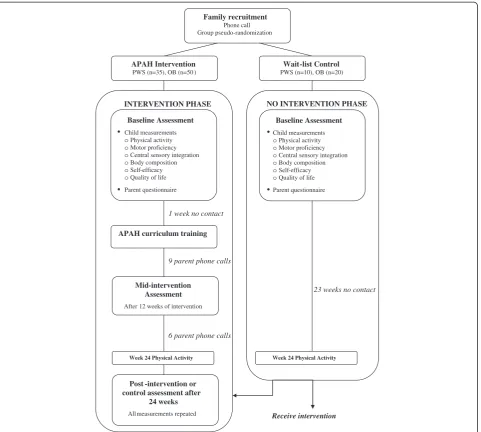
The Active Play @ Home study will evaluate the effective-ness of a 24-week PA intervention on select motor and health–related parameters in children with PWS and chil-dren with obesity but without PWS. The study has a quasi-experimental design with semi-random assignment to an intervention group or a wait-listed control group. The intervention group will consist of families with a child with PWS (n=35) and families with a child who is obese (n=50). Ten additional families with a child with PWS will be assigned to a wait-list control group and 20 families with an obese child without PWS will also serve as a wait-list group. Both wait-wait-listed groups will serve as control groups prior to being enrolled in the PA intervention. Groups of two to four families will complete all baseline and follow-up testing on the same day throughout the study. The semi-random assignment consists of a priori established participant cohorts for both intervention and control groups. Upon recruitment, participants will be provided with tentative dates for their visits and their randomization to the cohort (intervention vs. control) will be based on their date preferences. Ethic committee ap-provals have been obtained from the California State University Fullerton Institutional Review Board and the United States Army Human Research Protection Office. During the first visit, after all study procedures are verbally explained, participants will have time to read the informed assent and consent forms and ask questions regarding the procedures. Afterwards, children participants will sign the informed assent form and their parents or guardians will sign the informed consent form. Figure 1 presents a time-line of the study procedures.
Intervention description
This home-based intervention was developed by a team of experts with backgrounds in physical education, physical activity and obesity prevention in children, psychological aspects of physical activity, and motor control/learning. The intervention will consist of providing parents and children with a physical activity curriculum and its accom-panying equipment needed to engage in four days of PA per week for 24 weeks. In addition, parents will be trained on the delivery of the Active Play @ Home curriculum, and will receive follow up support phone calls throughout the intervention.
28 parents of children and adults with PWS (2-22 years old) and a questionnaire completed by 90 parents with a child with PWS [16]. The group interviews indicated that most parents understood the benefits and the thera-peutic role of PA for their children. The most frequently raised issues were as follows: the physical limitations as-sociated with PWS may make it difficult to engage in PA; the children may consider PA to be more work than fun and therefore not enjoy it; the children may get eas-ily frustrated, especially when the activities are too diffi-cult to perform successfully; the parents may find the time spent in PA with their children too burdensome; and the cost of a PA program may be too expensive. Par-ents’ preferences for PA mode, frequency, and location for a successful PA program included: 1) Activities that
can occur at home, in a caring, supportive, and non-competitive environment that foster participation from all family members; 2) interventions that include a variety of fun activities such as interactive console games, goal-oriented games, and dancing; 3) PA intervention materials such as a handbook or DVD with ideas for activities and hands-on instructions; and 4) a flexible schedule. The questionnaire findings emphasized the need to incorporate vigorous activities in the curriculum since children with PWS tend to spend more time engaging in moderate PA and much less time performing muscle and bone strength-ening activities [16].
Additional formative work included designing the set of progressive games and activities to be included in the cur-riculum, evaluating the feasibility of the assessment tools
NO INTERVENTION PHASE Family recruitment
Phone call Group pseudo-randomization
APAH Intervention PWS (n=35), OB (n=50 )
Wait-list Control PWS (n=10), OB (n=20)
Baseline Assessment
Child measurements oPhysical activity oMotor proficiency oCentral sensory integration oBody composition oSelf-efficacy oQuality of life Parent questionnaire
23 weeks no contact
Week 24 Physical Activity
Receive intervention INTERVENTION PHASE
1 week no contact
9 parent phone calls
6 parent phone calls Baseline Assessment
Child measurements oPhysical activity oMotor proficiency oCentral sensory integration oBody composition oSelf-efficacy oQuality of life Parent questionnaire
APAH curriculum training
Mid-intervention Assessment
After 12 weeks of intervention
Week 24 Physical Activity
Post -intervention or control assessment after
24 weeks
All measurements repeated
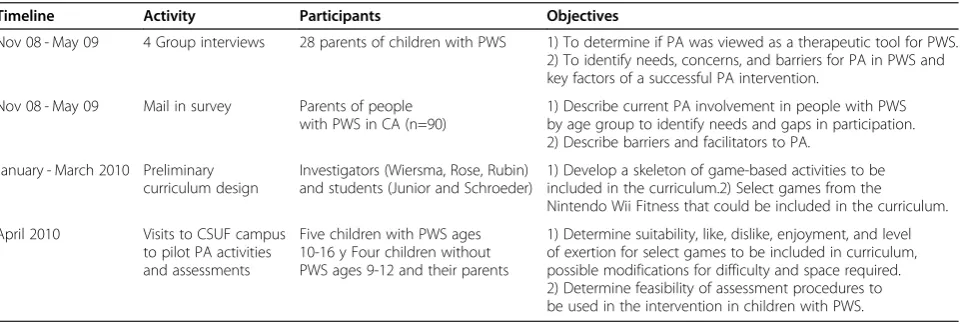
selected to measure the desired intervention outcomes, and then piloting the selected activities with children with and without PWS to ensure that they were appropriate for different skill levels, of adequate intensity, and met different space requirements. As a result of this formative work it was determined the need to obtain test-retest reli-ability data in children with PWS for the measurements of motor proficiency, central sensory reception and inte-gration, self-efficacy and quality of life. In addition, the parents outcomes were further refined. Table 1 sum-marizes the different formative work and the objectives from each activity.
Curriculum and parental support
The Active Play @ Home curriculum includes age-appropriate goal-oriented physical activities that com-bine playground and video games with specific exercises that target the following parameters: muscular strength and endurance, aerobic endurance, flexibility, balance, agility, and motor coordination. This curriculum was designed for children ages 8-11 years without disability and children ages 8-15 years with PWS. The curriculum includes playground games and interactive console-based games using the Nintendo Wii™, each of which are to be performed twice weekly. The duration of activ-ity is systematically progressed from 25 to 45 minutes of MVPA over the course of the 24-week intervention. Both the parents and children will be trained to use the curriculum during a hands-on session at baseline. Each family receives the Active Play @ Home manual that contains a daily schedule detailing the activities for each of the four days of the week for the 24 weeks. The manual includes four sections: 1) introduction to the program that includes the philosophy guiding the pro-gram, a description of the motor skill and fitness com-ponents targeted, and a description of the parent’s role in leading the activities; 2) the daily schedule; 3) detailed
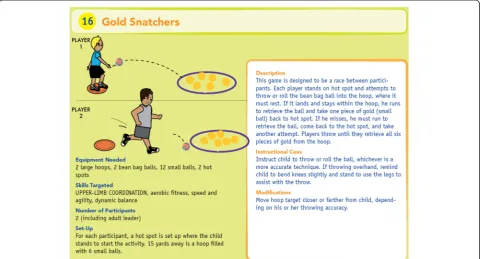
descriptions of the playground games; and 4) instruc-tions for playing the interactive console-based games. Each illustrated playground game is accompanied by structions on how to carry out the activity, as well as in-structional cues and modifications to assist the parent in leading the activities for his/her child (See Figure 2). In the interactive console-based games section of the manual we have included instructions on how to set-up the Nintendo Wii™system and step-by step instructions for playing each of the selected games. Families receive all media equipment necessary as well as a variety of play balls, cones, hoops, foam mats, and boundary markers to be used throughout the intervention.
Over the 24-week program, parents will receive phone calls from a member of the research team who provides PA counseling and troubleshooting for parents regarding the implementation of the curriculum. Phone calls will take place every week during the first four weeks and then once every two weeks for the remainder of the intervention. In addition, the parents and children will complete physical activity checklists associated with each day of prescribed activity. The inclusion of self-monitoring techniques, along with discussions about planning and overcoming barriers into the parent train-ing component of the program were considered to be important from the social cognitive theory perspective [24]. These regulatory skills of monitoring, planning/ scheduling, and goal setting are incorporated into the baseline training of parents and during the follow-up phone calls [25]. The self-efficacy of children and par-ents will be targeted with the age-appropriate progres-sive nature of the curriculum that is designed to provide the opportunity for successful mastery experiences for the children. Further, self-efficacy in the children will be targeted through parents serving as skilled or learn-ing models for the activity and providlearn-ing verbal encour-agement throughout the program.
Table 1 Formative work done prior to development of the physical activity intervention“Active play @ home”
Timeline Activity Participants Objectives
Nov 08 - May 09 4 Group interviews 28 parents of children with PWS 1) To determine if PA was viewed as a therapeutic tool for PWS. 2) To identify needs, concerns, and barriers for PA in PWS and key factors of a successful PA intervention.
Nov 08 - May 09 Mail in survey Parents of people
with PWS in CA (n=90)
1) Describe current PA involvement in people with PWS by age group to identify needs and gaps in participation. 2) Describe barriers and facilitators to PA.
January - March 2010 Preliminary curriculum design
Investigators (Wiersma, Rose, Rubin) and students (Junior and Schroeder)
1) Develop a skeleton of game-based activities to be included in the curriculum.2) Select games from the Nintendo Wii Fitness that could be included in the curriculum.
April 2010 Visits to CSUF campus
to pilot PA activities and assessments
Five children with PWS ages 10-16 y Four children without PWS ages 9-12 and their parents
Measurements
Outcome measurements in children.
Physical activity
Physical activity will be measured using accelerometers, which provide detailed information on the temporal pat-terns (duration, frequency, and intensity) of PA. Data will be stored as acceleration counts recorded in 5-second epochs using the 4 MB GT3X (Actigraph, Pensacola, FL) triaxial activity monitor. This accelerometer model has ex-cellent intra- and inter-instrument reliability across a wide range of accelerations and has been validated for use with children ages 10 to 15 years [53]. The accelerometer will be worn at the right hip and secured with an elastic belt. Children will wear the accelerometer for eight consecu-tive days (Sunday to Sunday) while awake. They will be instructed to remove the accelerometer for showering/ bathing, swimming, or when going to bed. Initially the data will be screened for compliance of wear time (at least 10 hours per day on 3 weekdays and 1 weekend day). Non-wear periods will be defined as any period with 60+ con-secutive minutes of missing data (0 counts). Because the families will participate in data collection on Saturdays, only accelerometry data collected on Sundays will be eli-gible for analyses for a weekend day. To determine thresh-olds for sedentary, light, moderate, and vigorous physical activity we will use the children cut-points established by Evenson et al. (2008) [54]. These cut-points were recently
recommended as the best choice for categorizing physical activity intensities in children [55]. In addition, the parent with his/her child will also complete a log of all the physical activities the child engages in over the eight-day period.
Motor proficiency
Motor proficiency will be evaluated using the long form ver-sion 2 of the Bruininks-Oseretsky Test of Motor Proficiency (BOT-2) [56]. The BOT-2 is composed of 53 items and provides a total motor composite score across 4 domains: fine manual control (fine motor precision and fine motor integration), manual coordination (manual dexterity and upper limb coordination), body coordination (bilateral co-ordination and balance), and strength and agility (running speed and agility and strength). We expect to see baseline differences between the children and youth with PWS and those without PWS in all domains and composite areas. In addition, we expect significant improvements following completion of the PA intervention in the areas of upper limb coordination, bilateral coordination, balance, running speed, and agility and strength. As fine manual control and manual dexterity are not targeted in this intervention, change in these parameters will not be assessed. The BOT-2 is designed to identify individuals with mild-to-moderate coordination deficits and has been validated for use in 4–21 year olds [56]. A sub-sample of participants with PWS will complete the BOT-2 twice at baseline, separated by an interval of one week, to determine test-retest reliability.
Sensory-motor reception and integration
The evaluation of sensory reception and motor integration is an exploratory component of this study. The intent is to first establish the validity and reliability of the Sensory Organization Test® (SOT) when administered to children and adolescents with PWS on two days separated by a week in a small sample of participants. The same sub-sample will also perform the SOT at regular interventions during the intervention period to determine if any changes in sensory reception and integration occur as a result of the intervention.
The SOT is designed to identify impairments in one or more of the three sensory systems (i.e., vision, somatosen-sory, vestibular) that contribute to standing balance. This test has been previously used with pediatric populations, with and without disabilities [57]. The test is comprised of six test conditions. Condition one serves as the control condition because there is no manipulation of the sensory environment. Incondition two, vision is removed by hav-ing the participant wear a blindfold while standhav-ing on a stable support surface, whereas incondition three, vision is manipulated by sway-referencing the visual three-sided surround as the participant stands quietly on a stable sup-port surface. Incondition four, somatosensory inputs are manipulated by sway-referencing the support surface. Spe-cifically, the support surface is rotated in an anterior or posterior (AP) direction in direct response to the sway generated by the standing participant. The ratio of sup-port surface movement to AP sway of the participant is 1:1. In condition five, the support surface is once again sway-referenced but vision is also removed by having the participant wear a blindfold. Finally, incondition six, input from the visual and somatosensory systems are removed. For the SOT, all participants will be required to wear an overhead safety harness to ensure their safety during prac-tice and test trials. Each participant will stand on the force platform of the Smart Balance Master® with the arms ex-tended and to the sides of the body. The participants’feet will be positioned in accordance with the manufacturer’s requirements for data collection (i.e., feet facing forward and the medial malleolus and the lateral calcaneus aligned with a grid superimposed on the surface of the force plate). The alignment of the feet is based on the individ-ual’s height and done to ensure consistency of foot pos-ition across testing sessions.
During the first testing session, the test will be verbally explained to the participants after which they will physic-ally perform one trial in each of the six sensory conditions. This practice trial is intended to familiarize them with the equipment, harness, and actual test protocol. Following a three-minute rest interval, participants will then perform three 20-second trials in each of the six sensory conditions. Participants will be permitted to rest as needed throughout the test.
Anthropometric and body composition measures
Anthropometric measures include body mass obtained to the nearest 0.1 Kg without shoes using an electric scale, and stature (measured without shoes, jackets, or other heavy clothing) at the end of inhalation to the nearest 0.1 cm using a wall-mounted stadiometer. BMI will be com-puted by dividing body mass (kg) by stature (m2) and BMI percentile values will be determined from the Centers for Disease Control growth charts [58]. Percentage of body fat and lean mass will be measured in a supine position using dual x-ray absorptiometry (DXA) scan (Lunar Prodigy Ad-vance Plus; GE Healthcare, Milwaukee, WI). This specific DXA unit provides a reliable and accurate measurement of distribution of lean and fat mass [59]. We will perform regional fat mass and lean mass calculations, in addition to total body analysis, using the enCORE pediatric soft-ware version 12.30.008, which automatically demarcates the regional boundaries for all regions.
Health-related quality of life
The measurement of health-related quality of life provides information about physical, emotional, social, and school components of wellbeing based on the calculation of two summary scores (i.e., physical and psychological). For this measurement we will use the validated 23-item PedsQL™4.0 Generic Scale [60]. This measure has shown good reliability and validity in children and adolescents ages 2-18 years old [60]. In addition, parents will complete the parent version of the PedsQL scale. Both measurements will be used to evalu-ate changes in quality of life. For participants with PWS we will first determine the test-retest reliability of this instru-ment at two time intervals separated by one week to decide if this measurement is reliable and is acceptable for use.
Child’s self-efficacy for physical activity
Self-efficacy for physical activity will be measured with an eight item questionnaire rated on a five point scale ranging from disagree a lot to agree a lot [61-64]. This question-naire was originally developed for use with children in fifth grade, but also validated with children in eighth grade [61-64]. This questionnaire had a test-retest reliability of r=0.84 over a period of two weeks. Additionally, the ques-tionnaire had an internal consistency score of 0.88 [62,63]. For participants with PWS we will first determine the test-retest reliability of this instrument at two time intervals separated by one week to decide if this measurement is re-liable and is acceptable for use.
Dietary intake
diet during two days of the week and one day on the weekend. In this record the parent will include quantity of food and fluids consumed, the preparation method, and the brand of the product. Before the baseline measure-ment, parents will attend a training session with a regis-tered dietitian to learn how to estimate portion sizes and keep a food record. The information collected through the food records will be entered into The Food Processor, ESHA Research, Salem, OR, USA program and analyzed for macronutrient percent intake and total calories.
Parent measurements
The parent who consents to participate in the study will provide demographic (ethnicity, family income, occupa-tion, primary language spoken at home, etc.) and medical information (e.g., child’s medical history, current condi-tions related to the child’s ability to engage in physical ac-tivity, medications use, intelligence scores in the case of children with PWS). Each parent will also complete sev-eral questionnaires to measure the following:
Regulatory efficacy for the parent Parents’confidence to regulate and manage their child’s PA will be assessed using a modified version of a proxy efficacy scale for regulating exercise behavior [65]. The original scale will be adapted to reflect the parents’confidence to regulate and motivate their children to participate in PA. In a survey of parents of children aged 2-18 years, this modi-fication of the proxy efficacy scale has shown excellent reliability (Cronbach Alpha=.98) and an acceptable one week test-retest reliability correlation of .64 [66].
Parental influenceThis scale assesses the regulation (i.e., social control) used by parents to encourage PA behavior in their children [67]. This scale is separated into three types of social control. The two positive types of social control include positive (encouraging) and collaborative (being active with the child). The negative type of social control examines nagging and ordering to be active. In a recent study of parents of children ages 2 to 16 years the reliability of this measure has been shown to be acceptable-to-good for all types of social control: collabora-tive (Cronbach alpha=.77), posicollabora-tive (Cronbach alpha=.67) and negative (Cronbach alpha=.85) [68].
Process measures
Qualitative information will also be collected to further evaluate the feasibility of this type of PA intervention. Par-ents will be asked to provide information in the form of completed checklists addressing the implementation of the specific playground games in terms of difficulty and enjoyment by the children as well as total time spent per session doing the prescribed activities. This information will serve as a form of adherence monitoring as well as a
means by which the families can provide feedback to the research team about the content of the intervention.
Additional information will be obtained during on-site feedback sessions conducted at 12- and 24-weeks of the intervention. Parents will be asked about barriers and facili-tators for the implementation of the intervention, likelihood of participating in a future project, satisfaction with the study, the influence of participation in the study on their life-style, and their child’s overall participation in PA. Parents will also be asked to provide suggestions as to how the interven-tion could be modified to better serve their individual needs.
Data analyses
The main purpose of this study is to investigate short-term changes (immediately following the 24-week inter-vention) in PA, motor proficiency, and health-related outcomes in children with and without disability following completion of a physical activity program conducted in the home environment. A 2 (time: pre, post) by 2 (group: control, intervention) by 2 (youth: obese or PWS) mixed model ANOVA will be used to assess changes in the pri-mary outcome (i.e., physical activity). Similar analyses will also be performed to assess changes in gross motor profi-ciency, body composition, and central sensory reception and integration. Other changes that will also be evaluated using mixed model ANOVAs include changes in quality of life, child self-efficacy, parent regulatory efficacy, and parent social influences. Potential confounders will serve as covariates where appropriate.
A power analysis was performed using G*Power 3.1.9 to identify the appropriate sample size for a power of .95, an alpha level of .05 and a correlation between time points was assumed to be .50. A small to moderate effect size (f=.20) was chosen, given the variability in physical activity expected in children with PWS [15]. A sample size of 84 was identified to provide sufficient power to detect an interaction. Given a 30% probability of drop-outs, 115 children will be recruited.
Discussion
The Active Play @ Home study differs from other home-based intervention studies because it provides parents and children with a well-rounded and systematically progressed game-based curriculum. Additionally, the 24-week PA intervention is much longer than previous studies (i.e., 3-weeks to 3-months). Moreover, in terms of intervention programs designed for children with disability, this study is unique in that it is delivered in the home environment with parents or caregivers serving as agents of change. More-over, the games and exercises can be modified for larger or smaller play spaces and indoor or outdoor environments using minimal playground equipment.
requires active involvement of the parents in providing PA opportunities for their children. In families that have more than one child, the implementation of this curriculum can also benefit other children in the family. Moreover, all activ-ities can be adapted to be played with more children, in which case neighbors, cousins, or friends can participate.
Children who have a rare disease may have less oppor-tunity to participate in appropriate PA in a group setting. Sometimes their motor skills or their intellectual ability present a hurdle for such participation. Individual PA pro-grams may promote PA in an appropriate manner. Several strategies using console-based games have been tested in different populations with disability suggesting promising results. However, strategies that include a game-based cur-riculum including both playground games and console-based games to be played in the home environment such as the one we have designed have yet to be tested. This type of strategy needs to tested as it could provide an alternative option to common after-school programs to increase phys-ical activity in children with and without disability.
Abbreviations
PA:Physical activity; PWS: Prader-Willi syndrome; BMI: Body mass index; DXA: Dual x-ray absorptiometry; BOT: Bruininks-Oseretsky test of motor proficiency; SOT: Sensory organization test.
Competing interests
The authors have no competing interests to declare.
Authors’contributions
DAR conceived the study, participated in its design and the development of the Active Play @ Home curriculum, and drafted the manuscript. KSW contributed to study procedures, selected the statistical analyses, and drafted sections of the manuscript. LW contributed to the study procedures, developed the playground games portion of the Active Play @ Home curriculum, provided edits for the manuscript. JWW contributed to study design and provided edits for the manuscript. DJR contributed to the design of the study as well as the development of the Active Play @ Home curriculum, provided edits for the manuscript. All authors read and approved the final manuscript.
Authors’information
DAR is trained in exercise physiology as well as in physical education. Her experience in physical activity intervention studies includes a multi-site middle school trial as well as two after school programs. DAR brings expertise on PWS and exercise. KSW is trained in exercise psychology with a background in promotion of physical activity and she contributes her knowledge of behavior change theories and social influence to this study along with her statistics background. LDW is trained in sport psychology with an emphasis in youth sports and has been involved with several grants promoting developmentally appropriate physical activity in children and adolescents. JWW is a clinical health psychologist with further training in preventive medicine. JWW contributes expertise in the area of family impact on children’s physical activity and overall wellbeing. DJR contributes expertise in the area of motor control and learning and has designed and implemented several intervention studies aimed at improving balance, gait, and overall motor performance.
Acknowledgements
Authors are funded by the US Army Medical Research and Materiel Command Awards W81XWH-09-1-0682 (DAR, DJR, LW, KSW, JWW) and W81XWH-11-1-0765 (DAR, DJR, LW, KSW). The authors would like to thank Dr. Marilyn Dumont-Driscoll for her role as collaborator at The University of Florida Gainesville. Dr. Dumont-Driscoll is responsible for conducting this study at The University of Florida Gainesville where she will recruit 15 youth
with PWS and 20 children with obesity. Dr. Dumont-Driscoll is also funded under awards W81XWH-09-1-0682 and W81XWH-11-1-0765.
Author details
1Department of Kinesiology, California State University, 800 N. State College Blvd., KHS-138, Fullerton, CA 92834, USA.2Department of Health Sciences, California State University, Fullerton, CA, USA.
Received: 28 January 2014 Accepted: 10 February 2014 Published: 14 February 2014
References
1. Haskell WL, Lee IM, Pate RR, Powell KE, Blair SN, Franklin BA, Macera CA, Heath GW, Thompson PD, Bauman A:Physical activity and public health: updated recommendation for adults from the American College of Sports Medicine and the American Heart Association.Med Sci Sports Exerc 2007,39(8):1423–1434.
2. Services USDHHS:Physical activity guidelines for American midcourse report: strategies to increase physical activity among youth.In Edited by Services USDHHS. Washington, DC: US Department of Health and Human Service Services; 2012.
3. Murphy N, Carbone P:Promoting the participation of children with disabilities in sports, recreation, and physical activities.Pediatrics2008, 121:1057–1061.
4. American Academy of Pediatrics:Active healthy living: prevention of childhood obesity through increased physical activity.Pediatrics2006, 117(5):1834–1842.
5. Strong WB, Malina RM, Blimkie CJ, Daniels SR, Dishman RK, Gutin B, Hergenroeder AC, Must A, Nixon PA, Pivarnik JM,et al:Evidence based physical activity for school-age youth.J Pediatr2005,146(6):732–737. 6. Troiano RP, Berrigan D, Dodd KW, Masse LC, Tilert T, McDowell M:Physical
activity in the United States measured by accelerometer.Med Sci Sports Exerc2008,40(1):181–188.
7. Rimmer JA, Rowland JL:Physical activity for youth with disabilities: a critical need in an underserved population.Dev Neurorehabil2008, 11(2):141–148.
8. Law M, King G, King S, Kertoy M, Hurley P, Rosenbaum P:Patterns of participation in recreational and leisure activities among children with complex physical disabilities.Dev Med Child Neurol2006,48:337–342. 9. King G, Law M, Hurley P, Petrenchik T, Schwellnus H:A developmental
comparison of the out-of-school recreation and leisure activity participation of boys and girls with and without disability.Int J Disabil Dev Educ2010,57(1):77–107.
10. Majnemer A, Shevell M, Law M, Birbaum R, Chilingaryan G, Rosembaum P: Participation and enjoyment of leisure activities in school aged children with cerebral palsy.Dev Med Child Neurol2008,50(10):751–758. 11. Phillips AC, Holland AJ:Assessment of objectively measured physical
activity levels in individuals with intellectual disabilities with and without Down’s syndrome.PLoS ONE2011,6(12):e28618.
12. Rubin DA, Cano-Sokoloff N, Castner DM, Judelson DA, Wright P, Duran A, Haqq AM:Update on body composition and bone density in children with Prader-Willi Syndrome.Horm Res Paediatr2013,79(5):271–276. 13. Cassidy SB, Schwartz S, Miller JL, Driscoll DJ:Prader-Willi syndrome.
Genet Med2012,14(1):10–26.
14. Butler MG, Theodoro MF, Bittel DC, Donnelly JE:Energy expenditure and physical activity in Prader-Willi syndrome: comparison with obese subjects.Am J Med Genet A2007,143(5):449–459.
15. van den Berg-Emons R, Festen D, Hokken-Koelega A, Bussmann J, Stam H: Everyday physical activity and adiposity in Prader-Willi syndrome. J Pediatr Endocrinol Metab2008,21(11):1041–1048.
16. Rubin DA, Weiss JW, Mouttapa M, Barrera-Ng A:Physical activity in children with Prader-Willi syndrome: a parents' perspective.Calif J Health Promotion2012,10(Special):57–66.
17. Dykens EM:Leisure Activities in Prader-Wlli Syndrome: implications for health, cognition and adaptive functioning.J Autism Dev Disord2014, 44(2):294–302.
18. Eiholzer U, Nordmann Y, l’Allemand D, Schlumpf M, Schmid S, Kromeyer-Hauschild K:Improving body composition and physical activity in Prader-Willi Syndrome.J Pediatr2003,142(1):73–78.
and spontaneous physical activity in children with Prader-Willi syndrome after 6 months.J Pediatr Endocrinol Metab2006,19:65–74.
20. Silverthorn KH, Hornak JE:Beneficial effects of exercise on aerobic capacity and body composition in adults with Prader-Willi syndrome. Am J Ment Retard1993,97(6):654–658.
21. Vismara L, Cimolin V, Grugni G, Galli M, Parisio C, Sibilia O, Capodaglio P: Effectiveness of a 6-month home-based training program in Prader-Willi patients.Res Dev Disabil2010,31(6):1373–1379.
22. Bandura A:Social cognitive theory: an agentic perspective.Annu Rev Psychol2001,52:1–26.
23. Williams SL, French DP:What are the most effective intervention techniques for changing physical activity self-efficacy and physical activity behaviour— and are they the same?Health Educ Res2011,26:308–322.
24. Bandura A:The primacy of self-regulation in health promotion. Appl Psychol2005,54(2):245–254.
25. Anshel MH, Seipel SJ:Self-monitoring and selected measures of aerobic and strength fitness and short-term exercise attendence.J Sport Behavior 2009,32(2):125–151.
26. Baranowski T, Anderson C, Carmack C:Mediating variable framework in physical activity interventions: How are we doing? How might we do better?.Am J Prev Med1998,15:266–297.
27. Bandura A:Toward a psychology of human agency.Perspect Psychol Sci 2006,1:164–180.
28. Bandura A:Social foundations of thought and action: A social cognitive theory. Englewood Cliffs, N. J.: Prentice-Hall; 1986.
29. Pugliese J, Tinsley B:Parental socialization of child and adolescent physical activity: a meta-analysis.J Fam Psychol2007,21:331–343. 30. Cliff DP, Okely AD, Morgan PJ, Steele JR, Jones RA, Colyvas K, Baur LA:
Movement skills and physical activity in obese children: randomized controlled trial.Med Sci Sports Exerc2011,43(1):90–100.
31. Salmon J, Ball K, Hume C, Booth M, Crawford D:Outcomes of a group-randomized trial to prevent excess weight gain, reduce screen behaviours and promote physical activity in 10-year-old children: switch-play.Int J Obes (Lond)2008,32(4):601–612.
32. Fisher A, Reilly JJ, Kelly LA, Montgomery C, Williamson A, Paton JY, Grant S: Fundamental movement skills and habitual physical activity in young children.Med Sci Sports Exerc2005,37(4):684–688.
33. Morgan PJ, Okely AD, Cliff DP, Jones RA, Baur LA:Correlates of objectively measured physical activity in obese children.Obesity (Silver Spring)2008, 16(12):2634–2641.
34. Duncan MJ, Stanley M:Functional movement is negatively associated with weight status and positively associated with physical activity in British primary school children.J Obes2012,2012:697563.
35. Sallis JF, McKenzie TL, Alcaraz JE, Kolody B, Faucette N, Hovell MF:The effects of a 2-year physical education program (SPARK) on physical activity and fitness in elementary school students. Sports, play and active recreation for kids.Am J Public Health1997,87(8):1328–1334. 36. Luepker RV, Perry CL, McKinlay SM, Nader PR, Parcel GS, Stone EJ, Webber LS,
Elder JP, Feldman HA, Johnson CC,et al:Outcomes of a field trial to improve children's dietary patterns and physical activity. The child and adolescent trial for cardiovascular health. CATCH collaborative group.JAMA1996, 275(10):768–776.
37. O'Loughlin EK, Dugas EN, Sabiston CM, O'Loughlin JL:Prevalence and correlates of exergaming in youth.Pediatrics2012,130:806–814. 38. Maloney AE, Carter Bethea T, Kelsey KS, Marks JT, Paez S, Rosenberg AM,
Catellier DJ, Hamer RM, Sikich L:A pilot of a video game (DDR) to promote physical activity and decrease sedentary screen time. Obesity2008,16:2074–2080.
39. Maddison R, Foley L, Ni Mhurchu C, Jiang Y, Jull A, Prapavessis H, Hohepa M, Rodgers A:Effects of active video games on body composition: a randomized controlled trial.Am J Clin Nutr2011,94(1):156–163. 40. Sandlund M, Waterworth EL, Hager C:Using motion interactive games to
promote physical activity and enhance motor performance in children with cerebral palsy.Dev Neurorehabil2011,14(1):15–21.
41. Jelsma J, Pronk M, Ferguson G, Jelsma-Smit D:The effect of the Nintendo Wii Fit on balance control and gross motor function of chil-dren with spastic hemiplegic cerebral palsy.Dev Neurorehabil2013, 16(1):27–37.
42. Lin H-C, Wuang Y-P:Strength and agility training in adolescents with Down syndrome: a randomized controlled trial.Res Dev Disabil2012, 33:2236–2244.
43. Ho M, Garnett SP, Baur L, Burrows T, Stewart L, Neve M, Collins C: Effectiveness of lifestyle interventions in child obesity: systematic review with meta-analyses.Pediatrics2012,130:e1647–e1671.
44. Epstein LH, Wing RR, Koeske R, Valoski A:Effects of diet plus exercise on weight change in parents and children.J Consult Clin Psychol1984, 52(3):429–437.
45. Rooney BL, Gritt LR, Havens SJ, Mathiason MA, Clough EA:Growing healthy families: family use of pedometers to increase physical activity and slow the rate of obesity.WMJ2005,104(5):54–60.
46. Barkin SL, Gesell SB, Poe EK, Ip EH:Changing overweight Latino preadolescent body mass index: the effect of the parent-child dyad. Clin Pediatr (Phila)2011,50(1):29–36.
47. Golley RK, Magarey AM, Baur LA, Steinbeck KS, Daniels LA:Twelve-month effectiveness of a parent-led, family-focused weight-management program for prepubertal children: a randomized, controlled trial. Pediatrics2007,119(3):517–525.
48. Harvey-Berino J, Rourke J:Obesity prevention in preschool native-american children: a pilot study using home visiting.Obes Res2003,11(5):606–611. 49. Janicke DM, Sallinen BJ, Perri MG, Lutes LD, Huerta M, Silverstein JH,
Brumback B:Comparison of parent-only vs family-based interventions for overweight children in underserved rural settings: outcomes from project STORY.Arch Pediatr Adolesc Med2008,162(12):1119–1125. 50. Hardman CA, Pauline HJ, Lowe CF:A home-based intervention to increase
physical activity in girls: the Fit 'n' Fun Dudes program.J Exerc Sci Fit 2009,7(1):1–8.
51. Ransdell LB, Taylor A, Oakland D, Schmidt J, Moyer-Mileur L, Shultz B: Daughters and mothers exercising together: effects of home- and community-based programs.Med Sci Sports Exerc2003,35(2):286–296. 52. Lee SM, Nihiser A, Strouse D, Das B, Michael S, Huhman M:Correlates of
children and parents being physically active together.J Phys Act Health 2010,7(6):776–783.
53. Hanggi JM, Phillips LR, Rowlands AV:Validation of the GT3X ActiGraph in children and comparison with the GT1M ActiGraph.J Sci Med Sport2013, 16(1):40–44.
54. Evenson KR, Catellier DJ, Gill K, Ondrak KS, McMurray RG:Calibration of two objective measures of physical activity for children.J Sports Sci2008, 26(14):1557–1565.
55. Trost SG, Loprinzi PD, Moore R, Pfeiffer KA:Comparison of accelerometer cut points for predicting activity intensity in youth.Med Sci Sports Exerc 2011,43(7):1360–1368.
56. Bruininks R, Bruininks B:Bruininks-Oseretsky test of motor proficiency
Second edn.Minneapolis, MN: NCS: Pearson; 2005.
57. Cherng RJ, Su FC, Chen JJ, Kuan TS:Performance of static standing balance in children with spastic diplegic cerebral palsy under altered sensory environments.Am J Phys Med Rehabil1999,78(4):336–343. 58. Centers for Disease Control and Prevention, National Center for Health
Statistics:CDC growth charts: United States.May 30, 2000 (http://www.cdc.gov/growthcharts/cdc_charts.htm).
59. Margulies L, Horlick M, Thornton JC, Wang J, Ioannidou E, Heymsfield SB: Reproducibility of pediatric whole body bone and body composition measures by dual-energy X-ray absorptiometry using the GE lunar prodigy.J Clin Densitom2005,8(3):298–304.
60. Varni JW, Seid M, Kurtin PS:PedsQL™4.0: reliability and validity of the pediatric quality of life inventory™version 4.0 generic core scales in healthy and patient populations.Med Care2001,39(8):800–812. 61. Saunders RP, Pate RR, Felton G, Dowda M, Weinrich MC, Ward DS, Parsons
MA, Baranowski T:Development of questionnaires to measure psychosocial influences on children's physical activity.Prev Med1997, 26(2):241–247.
62. Dishman RK, Saunders RP, McIver KL, Dowda M, Pate RR:Construct validity of selected measures of physical activity beliefs and motives in fifth and sixth grade boys and girls.J Pediatr Psychol2013,38(5):563–576. 63. Dishman RK, Motl RW, Sallis JF, Dunn AL, Birnbaum AS, Welk GJ,
Bedimo-Rung AL, Voorhees CC, Jobe JB:Self-management strategies mediate self-efficacy and physical activity.Am J Prev Med2005,29(1):10–18. 64. Motl RW, Dishman RK, Saunders RP, Dowda M, Pate RR:Perceptions of
physical and social environment variables and self-efficacy as correlates of self-reported physical activity among adolescent girls.J Pediatr Psychol 2007,32(1):6–12.
66. Kraft LA, Wilson KS, Nelson MM:Parents pressuring their kids to be active: Parent self-efficacy, other-efficacy and negative social control.InNorth American Society for the Psychology of Sport and Physical Activity.Hawaii; 2012. 67. Wilson KS, Spink KS:Perceived parental social control following a recalled
physical activity lapse: impact on adolescents' reported behavior. Psychology of Sport and Exercise2010,11(6):602–608.
68. Wilson KS, Spink KS, Priebe CS:Parental social control in reaction to a hypothetical lapse in their child's activity: the role of parental activity and importance.Psychology of Sport and Exercise2010,11:231–237.
doi:10.1186/1471-2431-14-41
Cite this article as:Rubinet al.:Rationale and design of active play @ home: a parent-led physical activity program for children with and without disability.BMC Pediatrics201414:41.
Submit your next manuscript to BioMed Central and take full advantage of:
• Convenient online submission
• Thorough peer review
• No space constraints or color figure charges
• Immediate publication on acceptance
• Inclusion in PubMed, CAS, Scopus and Google Scholar
• Research which is freely available for redistribution