Performance evaluation of fingerprint
image processing for high Security
Ad-hoc network
P.Velayutham and Dr.T.G.Palanivelu
Abstract
With the rapid development of wireless technology, various mobile devices have been developed for military and civilian applications. Defense research and development has shown increasing interest in ad-hoc networks because a military has to be mobile peer-to-peer is a good architecture for mobile communication in coalition operations. In this paper, the methodology proposed is an novel robust approach on secure fingerprint authentication and matching techniques to implement in ad-hoc wireless networks. This is a difficult problem in ad-hoc network, as it involves bootstrapping trust between the devices. This journal would present a solution, which provides fingerprint authentication techniques to share their communication in ad-hoc network. In this approach, devices exchange a corresponding fingerprint with master device for mutual communication, which will then allow them to complete an authenticated key exchange protocol over the wireless link. The solution based on authenticating user fingerprint through the master device, and this master device handshakes with the corresponding slave device for authenticating the fingerprint all attacks on the wireless link, and directly captures the user's device that was proposed to talk to a particular unknown device mentioned previously in their physical proximity. The system is implemented in C# and the user node for a variety of different devices with Matlab.
Key words: Ad hoc network, Fingerprint, minutiae, information security, user authentication Introduction:
Ad-hoc networking, primarily born for battlefields, has become a very active research and development field in recent years [1-3]. It enables wireless devices to establish a dynamic network without the need of a fixed infrastructure. In such a self-organized network, nodes assist each other to make the network connected. Each node can pass information and control packets from one neighbor node to another. This type of network is very useful in coalition operations in which there exists great needs to exchange information among commanders, soldiers, allies, and coalition partners, regardless of where they are located.
Although the security of either wired or wireless networks is composed of the same primary components, applications of ad-hoc networks for PCs, PDAs, and cellular phones introduce different security risks than those for fixed networks. This is cost by the dynamical nature of the Ad-hoc networks [4-6]. Among different security issues in ad-hoc networks, user authentication is the core requirement for integrity, confidentiality and non-repudiation, since ad-hoc networks have no fixed infrastructure and allow memberships to be changed frequently. Self-organized networks are secure only if the identities of all the members can be verified.
infrastructure, biometric authentication becomes a challenge in ad hoc networks [5-9]. This paper addresses the needs of biometric authentication for information security in ad hoc networks and services.
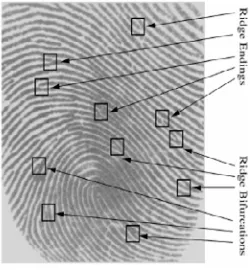
Fingerprint Recognition systems offer greater security and more convenience than traditional methods of personal recognition. The system performance and its accuracy are the key role in classifying the system unit. Fingerprint based identification has been one of the most successful biometric techniques used for personal identification. Each individual has unique fingerprints. A ridge ending is defined as the point where the ridge ends abruptly and the ridge bifurcation is the point where the ridge splits into two or more branches. Identical authentication system unit function using Fingerprint classification techniques proposed an approach for identifying a unique person based on characteristics [4]. The technology [7] represents the standard to process the fingerprint orientation software and automatic minutiae detection becomes a difficult task in low quality fingerprint images where noise and contrast deficiency result in pixel configurations similar to that of minutiae. This is an important aspect that has been taken into consideration in this project for extraction of the minutiae with the minimum error in a particular location and to transfer information into a network, the process to identify the global structure and to extract the minutiae in fingerprint [2][8] and to provide the orientation technique to classify the range.
Figure 1: Fingerprint Minutiae Description
This project is to implement the system in ad-hoc network, and to verify the fingerprint imaging with master and slave to communicate with the slave device, using the master for mutual sharing of information. Fingerprint capture is an input/output technique, where it can be achieved in real time. The minutiae extraction is the phase where to classification of the bifurcation and ridge ending happens. In minutiae matching extraction is the phase where fingerprint image is captured and delivered. The process ranging and classification factor depends on the pixel co-ordinates, image visualization and the extraction of minutiae ranging. In this paper, the methodology proposes a cheaper, more secure, and more user-friendly solution to this problem and to the problem of authentication in local ad-hoc networks. The major steps involved in automating the fingerprint recognition is acquiring the corresponding input from the scanner, segmenting the fingerprint to divide the m into pixel and process the corresponding Fingerprint for Enhancing the fingerprint image co-ordinates, Feature extraction, Minutiae matching to classify the fingerprint from the minutiae.
FINGERPRINT PROCESS METHODOLGY
[A] Pre-Processing
The Pre-Processing steps are mainly followed to enhance the input fingerprint image for extracting the corresponding minutiae for the next phase of classification where the following steps are used.
We propose using a pixel wise adaptive wiener filter for noise reduction. The filter is based on local statistics estimated from a local neighborhood of size 5X5 of each pixel and is given by the equation.
Where v2 is the noise variance, the µ and the σ2 are the local mean and variance and represent the gray level intensity in n1, n2∈ η. Segmentation is an important process in fingerprint classification. To improve the performance and lowering the computational cost, the process like coherence of an image is followed; coherence measures the gradient features of a fingerprint image pointing in the same direction. To compute the process, the input image is segmented by separating the sections with several blocks of size WxW to calculate the coherence value in an image. A. wahab [6] proposed an algorithm for segmentation that features dots used to obtain segmentation curve and the surpasses directional field [3,5,9] and orientation based methods for segmenting the fingerprint image to remove noise in an image. Histogram equalization method is used to stretch the contrast of the image and normalization is done for the image.
The resulting coherence image is smoothened by using Gaussian smoothing to process the binarized output. A Gabor filtering is done for each image using the orientation angle and frequency. The final image obtained from the pre-processing step is the enhanced image.
[B] Minutiae Extraction
[C] Post-Processing
The Post-Processing phase consists of an image where the false minutiae and unwanted co-ordinates are removed during the process. The detection of unwanted minutiae at the cross sectional of local maximum will occur at the image ends. Another processing of segmentation is carried to delete the unwanted minutiae at the border for composite to each other. For deleting a valid minutiae or not, windows sum size is taken along the border axis to vary the classification in a minutiae, and thus taking a windows size as 12X12, if the sum is lesser then 144 then the minutiae is invalid and if greater than 144 then minutiae is to be conserved. For the deletion of spurious minutiae, a window of size 12X12 is taken around each point. Thus the ridge endings are eliminated from the point thus this process to removes the unwanted minutiae.
SYSTEM IN AD HOC NETWORK
Ad hoc Network is a wireless network and it is connected by corresponding device and the device, which is of free to move in any direction. In security unit system, Ad hoc Network do not use any sort of fixed infrastructure or centralized unit for communication. In terms each node can pass information and controls packets from one neighbor to another, communication and network operations are extremely vulnerable without the use of stronger user authentication. Attack in a network describes the path flow, channel capacity to implement next generation protocol for describing the authentication, which is stronger between the master and the slave [10][16].
By combining the features of Biometric Fingerprint and Ad hoc Network it acts as a security code or unique mode of identification of the user to pass the information between the two nodes through the master node.
Routing in Ad hoc Network
Routing is the most important aspect in ad hoc network since ad hoc network topology frequently changes and multi-hop communication is required. Every node keeps routing information of all the nodes it knows in table format. Routing information is updated periodically. There are several characteristics of ad hoc network that makes it much more difficult to secure as compared to the infrastructure-based network. The characteristics are Channel vulnerability, Node vulnerability, Absence of infrastructure, Dynamically changing network topology, and Power and computational limitations. To implement and passing of mutual information between the master and slave nodes, the corresponding sender and the receiver sends the route message to the specified node. The network defines the propagation path to describe the channel range and topology model [11][14] The ratio propagation model within the network, which defines the parameter and the work path to visualize the system and to transfer the data rate within the model of the network [12]. The slave node sends an request to the another slave node through master node with the corresponding
fingerprint authentication and the routing message along with it, The master co-ordinates the request and the response between the corresponding nodes to authenticate the legitimate users who have access to the nodes in a network, the Biometric Fingerprint mechanism helps to prevent physical internal attacks to nodes in the network. The distance between the two nodes through the intermediate nodes in an Ad hoc network using the fingerprint authentication unit, by authenticating the corresponding user to share the information in a networkenvironment.The positioning of each node in the multi path environment in ad hoc network describes the protocol [13][15] and measuring the behavioral model. The implementation of Fingerprint in the Ad hoc network between the intermediate nodes is carried through authenticating their corresponding fingerprint between the nodes with the system unit.
EXPERIMENTAL RESULTS
Figure 2: Extracted minutiae from the fingerprint image
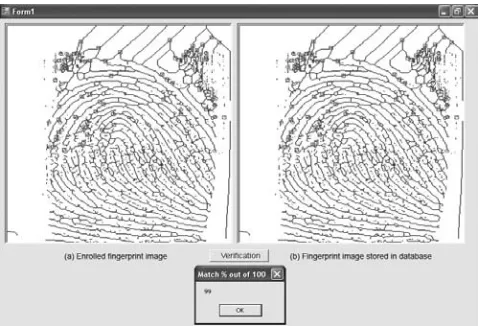
Fingerprint images are compared and the minutiae are extracted. (Figure) shows the extracted minutiae from the fingerprint image. The Fingerprint images undergo three phases and the extracted minutiae results of corresponding time and score are delivered in the (Figure). Fingerprint score and the time are compared with the enrollment and verification phase. In verification phase, the enrolled image is compared with template which is already stored in the database to extract the corresponding minutiae and the score to attain the False Acceptance Rate [FAR] and False Rejection Rate [FRR] as shown in the (Figure) for the matches between the score and the frequency of matching between the two fingerprints. In this experimental comparison between the two Fingerprint images, the minutiae are extracted and the scoring rate and time are compared between the enrolled and template in the verification phase. There corresponding classification are shown in the graph, in which the comparison scoring in the FAR and FRR are passed it into the wireless ad hoc network. The Framework provides both master and the slave components to authenticate the fingerprint as unit to share the information between the nodes. The Framework maintains high degree of tracking to monitor the authenticity between the master and the slave to share their information and the type of information, which is sharing between the nodes. (Figure) represents the graphical representation to show the sensor nodes and the time with the authentication unit. The graph shows the efficiency of information that is passed between the slave nodes through the master nodes from the output obtained between the fingerprints.
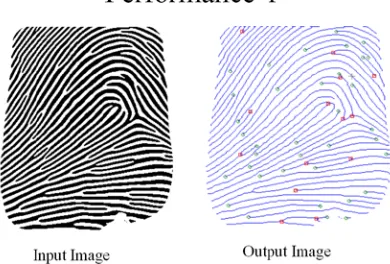
Figure 4: Performance of a finger image after processing
Figure 5: Performance of a noisy finger image after processing
0 20 40 60 80 100 120
1 6
11 16 21 26 31 36 41 46 51 56 61 66 71 76 81 86 91 96
101
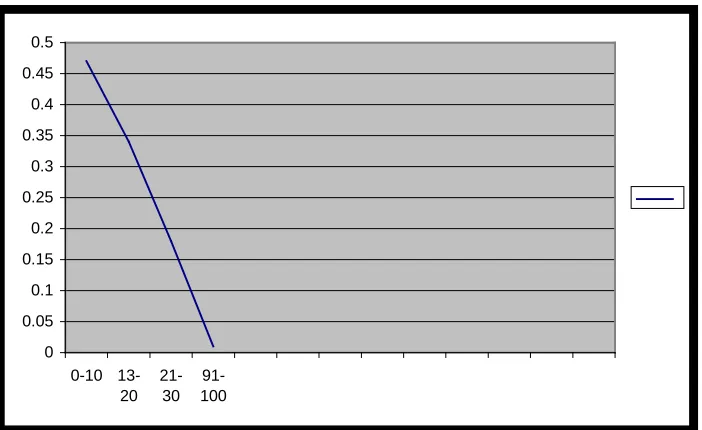
Figure 7: False acceptance rate verses matching score of fingerprints in the database
The FAR and FRR result is generated using Fingerprint minutiae extraction algorithm, the resultant FAR is shown and it is similar in all cases throughout the process. An example scenario can be taken where the slave node1 initiates the fingerprint authentication unit to the slave node 2 through the master node. The master node listens for a connection on both the slave nodes 1&2, but allows the connection between the two nodes, if preliminary authentication already exists for the fingerprint between the nodes through the server, the payload bytes is transmitted between the two nodes and within the small payload bytes, the transmission rate depends on the lower bandwidth of data and the simulation is shown in the figure 8, which explains the storage and transmission of data between the two nodes through the master node.
Figure 8: Transmission of data between the two nodes through the master node in fingerprint authentication
Conclusions
In this paper, the performance results of our approach clearly indicate that it is far better than any other approach. Our method produces 99% matching sore for genuine fingerprint and less than 0-30% matching score for other fingerprints. Also we have obtained the FAR (False Acceptance Rate) is very low .01 by using our methodology. Noises in the fingerprint image are considered and features of the
0 0.05 0.1 0.15 0.2 0.25 0.3 0.35 0.4 0.45 0.5
0-10 13-20
21-30
environment for user authentication. Thus, the result shows the efficiency of the fingerprint algorithm by comparing the features with other related work and to pass the authenticate fingerprint keys to an ad hoc network to enhance the security in wireless ad hoc network communication.
References
[1] Fingerprint Minutiae Extraction, Department of Computer Science National Tsing Hua University Hsinchu, Taiwan 30043
[2] Handbook of Fingerprint Recognition by David Maltoni (Editor), Dario Maio, Anil K. Jain, Salil Prabhakar
[3] Lin Hong, Yifei Wan and Anil Jain. Fingerprint Image Enhancement: Algorithm and Performance Evaluation. East
Lansing, Michigan.
[4] A. K. Jain, L. Hong, S. Pantanki and R. Bolle, An Identity Authentication System Using Fingerprints, Proc of the IEEE, vol, 85,
no.9,1365-1388, 1997
[5] D. Maio, D. Maltoni, R. Cappelli, J. L. Wayman, A. K. Jain, “FVC2000:fingerprint verification competition “ Pattern Analysis
and Machine Intelligence,’ in IEEE Transactions on , Volume: 24 Issue: 3 , March 2002 Page(s): 402 –412.
[6] A. Wahab, S.H. Chin, E.C. Tan, “Novel approach to automated fingerprint recognition,” in Vision, Image and
Signal Processing, IEE Proceedings.-Visual Image Signal Process , Volume: 145 Issue: 3 , June 1998
[7] User’s Guide to NIST Fingerprint Image Software (NFIS). NISTIR 6813, National Institute of Standards and
Technology.
[8] Jiang, X., Yau, W., Fingerprint minutiae matching based on the local and global structures,
Proceedings 15th International Conference on Pattern Recognition. ICPR-2000. IEEE Comput. Soc. Part, vol.2, 2000, pp.1038-41 vol.2. Los Alamitos, CA, USA.
[9] Hrechak, AK and McHugh, JA. Automated fingerprint recognition using structural matching, Pattern Recognition, vol.23, no.8,
1990, pp.893-904. UK.
[10] Daemen, J. and Rijmen, V.,“Resistance Against Implementation Attacks: A Comparative Study of the AES Proposals”,
Proceedings of the 2nd AES Candidate Conference, 1999, pp.122-132.
[11] Penrose, M. 1998. Extremes for the minimal spanning tree on normally distributed points. Advances Appl. Probab. 30, 628--639.
[12] H. Hashemi, “The indoor radio propagation channel”, Proceedings of the IEEE, vol. 81, no. 7, July 1993.
[13] Yihong Qi Suda, H. Kobayashi, “On time-of-arrival positioning in a multipath environment”, Vehicular Technology Conference,
2004, pp. 3540- 3544 Vol. 5.
[14] Borbash, S. and Jennings, E. 2002. Distributed topology control algorithm for multihop wireless networks. In Proceedings of the
IEEE International Joint Conference on Neural Networks. 355--360.
[15] Anderson, Bergadano, Crispo, Lee, Manifavas, and Need- ham. A new family of authentication protocols. ACMOSR: ACM
Operating Systems Review, 32, 1998.
[16] F. Stajano. The resurrecting duckling - what next? In Security Protocols—8th International Workshop, Lecture Notes in