Journal of Agriculture, Food Systems,
and Community Development
Volume 2, Issue 4
Summer 2012
Published online at www.AgDevJournal.com
New Leaf Associates, Inc.
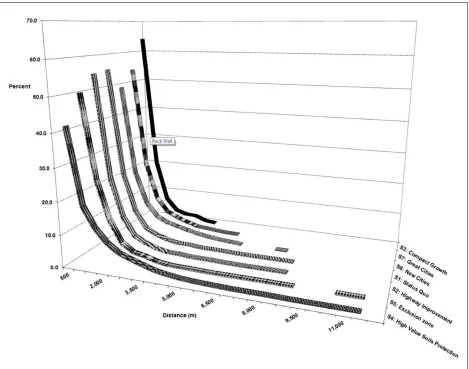
Figure 1. Simplified Map of Crop Locations Near Fresno, California
University (USA) (cochair)
Heidi Mouillesseaux-Kunzman, Development Sociology, Cornell University (USA) (cochair)*
Pierre Clavel, City and Regional Planning (Emeritus), Cornell University (USA)
Cheryl Danley, Center for Regional Food Systems, Michigan State University (USA)
Mary Jo Dudley, Development Sociology and Cornell Farmworker Program, Cornell University (USA) Gilbert W. Gillespie, Cornell University (Retired) (USA)* Joanna Green, Groundswell Center for Local Food &
Farming, Ithaca, NY (USA)
Richard Kiely, Center for Community Engaged Learning and Research, Cornell University (USA)
Scott Peters, Imagining America, Syracuse University (USA)
Ricardo Salvador, Union of Concerned Scientists (USA) Jennifer Wilkins, Nutritional Sciences, Cornell University
(USA)
JAFSCD Advisory Committee Laura Brown, University of Wisconsin Cooperative Extension (USA)*
Kate Clancy, Minnesota Institute for Sustainable Agriculture (USA) †
Nevin Cohen, The New School (USA)* David Conner, University of Vermont (USA)* Cornelia Butler Flora, Iowa State University (USA) Julia Freedgood, American Farmland Trust (USA)* R. Bruce Gregory, Farmer, Mitchell Bay Farm & Nursery
(USA)*
Shermain Hardesty, University of California (USA)* John Ikerd, University of Missouri, Columbia (Emeritus)
(USA)†
Anupama Joshi, National Farm to School Network/Occidental College (USA)* Larry Lev, Oregon State University (USA) Joseph McIntyre, Ag Innovations Network (USA)* † Ken Meter, Crossroads Resource Center (USA)* † Rich Pirog, Iowa State University (USA) Ken Robinson, Clemson University (USA) John Smithers, University of Guelph (Canada) G. W. (Steve) Stevenson, University of
Wisconsin-Madison (USA)
Dawn Thilmany McFadden, Colorado State University (USA)
Mark Winne, Community Food Security Coalition (USA) Larry Yee, Fairhaven Strategy Group (USA)
Rami Zurayk, American University of Beirut (Lebanon)*† *Also serves on editorial committee
† Also writes a regular column
JAFSCD Editorial Committee Paivi Abernethy, University of Waterloo (Canada) Mahbubul Alam, Ehime University (Japan) Colin Anderson, University of Manitoda (Canada) Sandip Banerjee, Hawassa University (India) Herb Barbolet, Simon Fraser University, Centre for
Sustainable Community Development (Canada) Mary Margaret Barth, Responsible Source, UIUC (USA) Ricky Martin Bates, Penn State University (USA) Dani E. Battle, Patriot RC&D (USA) Molly K. Bean, The Ohio State University (USA) Mihaela Begea, Institute of Food Research (Romania) Eliav Bitan, National Wildlife Federation (USA) Colleen Boodleman, University of Arizona (USA) Rachelle Bostwick, Farmer, Earthkeeper Farm (USA) Mladen Brnčić, University of Zagreb (Croatia) Megan Carney, U.C.–Santa Barbara (USA) Marcia Caton Campbell, Center for Resilient Cities
(USA)
Elizabeth Church, Jacobs Farm/DelCabo (USA)
Sean Connelly, Alberta Social Economy Research Alliance Centre for Sustainable Community Development (Canada)
Christine Costello, Cornell University (USA) Sasha Cuerda, University of Illinois at
Urbana-Champaign (USA)
Michael L. Dougherty, Illinois State University (USA) Leslie Duram, Southern Illinois University (USA) Patti Taranto Erickson, Salisbury University (USA) Mark Estep, Montana Mobile Processing Company
(USA)
James R. Farmer, Earlham College (USA)
Anna Fedman, University of California–Berkeley (USA) Melissa Fernandez Arrigoitia, London School of
Economics (UK)
Ian Finch, University of Montana (USA) Rok Fink, Univerza v Ljubljani (Slovenia) Danielle Nicholas Fisher, Eagle Ridge Ranch (USA) Jill Ann Fitzsimmons, University of Massachusetts–
Amherst (USA)
Katherine Flynn, SAFE Consortium (France) Nancy Franz, Iowa State University (USA) Lynn Fredericks, FamilyCook Productions (USA) Jasenka Gajdoš Kljusurić, University of Zagreb (Croatia) Hanna Garth, University of California–Los Angeles
(USA)
Angela Gordon Glore, AmeriCorps/VISTA (USA) Carol Goland, Ohio Ecological Food and Farm
Association (USA)
Sheila L. Gray, Washington State University–Lewis County Extension (USA)
John Guszkowski, CME Associates, Inc. (USA) Edmund Harris, Clark University (USA) Amber A. Heckelman, Washington State University
(USA)
Elizabeth Hill, University of Maryland Extension (USA) Leslie Hossfeld, University of North Carolina–
Wilmington (USA)
Susanne Howard, Missouri State University (USA) Guiping Hu, Iowa State University (USA)
Alan Hunt, Newcastle University/Local Food Strategies LLC (UK)
Lauren Hunter, Coop. Extension, University of Idaho-Blaine County (USA)
Lucilla Iacumin, University of Udine (Italy) Valerie Imbruce, Bennington College (USA) George Irwin, Green Living Technologies (USA) Martin Kabaluapa, World Food Programme (Kenya) Joel Kimmons, Centers for Disease Control and
Prevention (USA)
Franz Klingender, Canada Agriculture Museum (Canada) David A. Knauft, University of Georgia (USA) Fiona Knight, Private food system consulting practice
(Canada)
Uma Koirala, Tribhuvan University (Nepal) Jane Kolodinsky, University of Vermont (USA) Laura Lavid, American Community Gardening
Association (USA)
John D. Lee, Farmer, Allandale Farm, Inc. (USA) Dale Levering, LCC International University (Lithuania) Matt Lobley, University of Exeter (UK)
Bohdan Lojka, Czech University of Life Sciences (Czech Republic)
Samya Lutz, Whatcom County (USA)
Uford A. Madden, Florida A&M University (USA) Lisa Markowitz, University of Louisville (USA) Sarah Martin, University of Waterloo (Canada) Derek Masselink, Masselink Environmental Design
(Canada)
Florentina Matei, Universitatea de Stiinte Agronomice si Medicina Veterinara – Bucuresti (Romania) Allen Matthews, Chatham University (USA)
Jesse C. McEntee, Cardiff University (UK) Devan McGranahan, Sewanee: The University of the
South (USA)
Kim McMann, Berkshire Community Action Council (USA)
Mahbubur R. Meenar, Temple University (USA) Bethann G. Merkle, Missoula Urban Demonstration
Project (USA)
Farhad Mirzaei, Animal Sciences Research Institute of Iran (Iran)
Bernadette Montanari, University of Kent, Canterbury (UK)
Alfonso Morales, University of Wisconsin–Madison (USA)
Vicki Morrone, Michigan State University (USA) Phil Mount, University of Guelph (Canada) Scot Nelson, University of Hawaii at Manoa (USA) Kim L. Niewolny, Virginia Tech (USA) Kimberly Norris, University of Maryland (USA) Lydia Oberholtzer, Penn State University (USA) Fernando Ona, Indiana University (USA) Aleck Ostry, University of Victoria (Canada)
Isidro Ovando-Medina, Center of Biosciences, University of Chiapas (Mexico)
Tapan B. Pathak, University of Nebraska (USA) Mary Peabody, Northeast Regional Center for Rural
Development (USA)
François Pelatan, AMAP Dordogne (France) Jan Perez, University of California–Santa Cruz (USA) Robert Perry, University of Kentucky (USA) Greg Pillar, Queens University of Charlotte (USA) Michael Pinto, Osborn Architects (USA)
William A. Powers, Nebraska Sustainable Agriculture Society (USA)
Madeleine Pullman, Portland State University (USA) Masud Parves Rana, Rajshahi University (Bangladesh) Shivaugn M. Rayl, Carolina Farm Stewardship
Association (USA)
Taylor Reid, Michigan State University (USA) Kristin A. Reynolds, The New School, New York (USA) David Richey, Lane Council of Governments (USA) Suzana Rimac Brnčić, University of Zagreb (Croatia) Antonio Roman-Alcalá, Alemany Farm (USA) Natalie R. Sampson, University of Michigan, School of
Public Health (USA)
Valerie M. Scopaz, VMS Planning Services (USA) Syed Suhail Mumtaz Shah, The Agronomy Institute
(Scotland)
Uma i Shankari, Rashtriya Raithu Seva Samithi, a farmers’ organization (India)
Christopher Sneed, The University of Tennessee Extension–Blount County (USA)
Garry Stephenson, Oregon State University (USA) Bill Swanson, Valentine Hill Farm (USA) Nicole Elizabeth Tichenor, Tufts University (USA) Diana Vergis Vinh, Public Health Department, Seattle
(USA)
Gerald W. Warmann, South Dakota State University (USA)
Amy Webb Girard, Emory University (USA) E. Christian Wells, University of South Florida (USA) Robert Wengronowitz, University of Chicago (USA) Melissa White Pillsbury, Maine Organic Farmers and
Gardeners Association (USA)
Niki C. Whitley, North Carolina A&T State University (USA)
Mollie Woods, Michigan State University (USA) Jen Wrye, Carleton University (USA)
Steve Young-Burns, PastureLand Cooperative and freelance food writer (USA)
Lorna Zach, University of Wisconsin (USA)
The Journal of Agriculture, Food Systems, and Community Development is published quarterly (Summer, Fall, Winter, Spring) by New Leaf Associates, Inc., ISSN 2152-0801 (online only). Corporate office: 295 Hook Place, Ithaca, NY 14850 USA. Online subscriptions: Farmer/Student/Sole Proprietor/Retiree: US$39; Agency/Nonprofit Staffperson: US$49; Faculty/Consultant/Corporate Employee: US$69; Institutional Library: US$239–US$693 (based on FTE students).
Contents /
Volume 2, Issue 4 / Summer 2012
On the cover: Images from papers in this issue that discuss aspects of urban food policy and planning are from (top to bottom) Community Supported Agriculture in the City: The Case of Toronto; Modeling Impacts to Agricultural Revenue and Government Service Costs from Urban Growth; and Toward a Food Policy “First Step” in Oakland, California: A Food Policy Council’s Efforts To Promote Urban Agriculture Zoning.
In This Issue:
The Forefront of Food Systems Policy and Practice / Duncan Hilchey 1Open Call
Exploring Food System Policy: A Survey of Food Policy Councils in the United States /
Allyson Scherb, Anne Palmer, Shannon Frattaroli, and Keshia Pollack 3
Toward a Food Policy “First Step” in Oakland, California: A Food Policy Council’s Efforts To Promote
Urban Agriculture Zoning / Nathan McClintock, Heather Wooten, Alethea (Harper) Brown 15
Modeling Impacts to Agricultural Revenue and Government Service Costs from Urban Growth /
Nathaniel E. Roth, James H. Thorne, Robert A. Johnston, James F. Quinn, Michael C. McCoy 43
Linking Farmers, Healthy Foods, and Underserved Consumers: Exploring the Impact of Nutrition Incentive Programs on Farmers and Farmers’ Markets / Lydia Oberholtzer, Carolyn Dimitri, and Gus
Schumacher 63
Demystifying the Local: Considerations for Higher Education Engagement with Community Food Systems /
Howard Rosing 79
Community Supported Agriculture in the City: The Case of Toronto / Sima Patel and Rod MacRae 85
More Than Counting Beans: Adapting USDA Data Collection Practices To Track Marketing
Channel Diversification / Alan R. Hunt and Gary Matteson 101
Understanding the Loss of Traditional Agricultural Systems: A Case Study of Orchard Meadows in Germany /
Kristine Hammel and Thorsten Arnold 119
Making It Too Simple? Researchers, Recommendations, and NGOs in the Sundarbans, Indian West Bengal /
Cathy Rozel Farnworth and Mette Vaarst 137
Safe Re-use Practices in Wastewater-Irrigated Urban Vegetable Farming in Ghana / Bernard Keraita, Robert C. Abaidoo, Ines Beernaerts, Sasha Koo-Oshima, Philip Amoah, Pay Drechsel,
IN THIS ISSUE
D
UNCANH
ILCHEYThe forefront of food systems policy and practice
Published online 22 September 2012
Citation: Hilchey, D. L. (2012). The forefront of food systems policy and practice [Editorial]. Journal of Agriculture, Food Systems, and Community Development, 3(1), 1–2. http://dx.doi.org/10.5304/jafscd.2012.024.006
Copyright © 2012 by New Leaf Associates, Inc.
hough completely coincidental, this issue has a strong theme of food systems policy and practice. If we’d actually formally announced a special topic call on this subject, I don’t think we would have gotten a better set of submissions! In this issue we offer a collection of papers that provide both depth and breadth across a wide range of issues related to food system policy and practice: land use, farm viability, food assistance, urban agriculture, public engagement, and others.
In Exploring Food System Policy: A Survey of Food Policy Councils in the United States,Allyson Scherb, Anne Palmer, Shannon Frattaroli, and Keshia Pollack report the results of a survey of a sample of food policy councils and find the need for more rigorous evaluation of the processes, outcomes, and impacts of their work. Nathan McClintock, Heather Wooten, and Alethea (Harper) Brown provide a highly detailed account of one food policy council’s efforts in Toward a Food Policy “First Step” in Oakland, California: A Food Policy Council’s Efforts To Promote Urban Agriculture Zoning. Nathaniel Roth, James Thorne, Robert
Johnston, James Quinn, and Michael McCoy utilize urban growth modeling to identify the farmland loss and economic impact of sprawl on the agriculture community near Fresno, California, in Modeling Impacts to Agricultural Revenue and Government Service Costs from Urban Growth.Lydia Oberholtzer, Carolyn Dimitri, and Gus Schumacher identify the types of farmers’ markets and vendors most likely to benefit from federal nutrition benefit and incentive usage in Linking Farmers, Healthy Foods, and Underserved
Consumers: Exploring the Impact of Nutrition Incentive Programs on Farmers and Farmers’ Markets.Howard Rosing
challenges conventional wisdom about town-gown relationships in Demystifying the Local: Considerations for Higher Education Engagement with Community Food Systems.Sima Patel and Rod MacRae wrap up a three-part series of papers on Toronto’s urban food productive capacity with Community Supported Agriculture in the City: The Case of Toronto.
In More Than Counting Beans: Adapting USDA Data Collection Practices To Track Marketing Channel Diversification,
Thorsten Arnold explore the challenges and opportunities in revitalizing a still productive, traditional European farming landscape in Understanding the Loss of Traditional Agricultural Systems: A Case Study of Orchard Meadows in Germany.Cathy Rozel Farnworth and Mette Vaarst provide a remarkable case study of the complex and often frustrating relationships of researchers and their intended beneficiaries in Making It Too Simple? Researchers, Recommendations, and NGOs in the Sundarbans, Indian West Bengal. Finally, wrapping up this issue’s theme on food and agriculture policy is Safe Re-use Practices in Wastewater-Irrigated Urban Vegetable Farming in Ghana, by Bernard Keraita, Robert C. Abaidoo, Ines Beernaerts, Sasha Koo-Oshima, Philip Amoah, Pay Drechsel, and Flemming Konradsen, who provide a thorough list of research-based best practices for producers using wastewater irrigation.
Exploring food system policy: A survey of food policy councils
in the United States
Allyson Scherba, The Johns Hopkins Bloomberg School of Public Health
Anne Palmerb, The Johns Hopkins Bloomberg School of Public Health Center for a Livable Future
Shannon Frattarolic, The Johns Hopkins Bloomberg School of Public Health
Keshia Pollackd*, The Johns Hopkins Bloomberg School of Public Health
Submitted 18 August 2011 / Revised 30 December 2011 and 14 March 2012 / Accepted 29 March 2012 / Published online 24 August 2012
Citation: Scherb, A., Palmer, A., Frattaroli, S., & Pollack, K. (2012). Exploring food system policy: A survey of food policy councils in the United States. Journal of Agriculture, Food Systems, and Community Development, 2(4), 3–14.
http://dx.doi.org/10.5304/jafscd.2012.024.007
Copyright © 2012 by New Leaf Associates, Inc.
Abstract
Food policy councils (FPCs) have become a popular way to organize various food system stakeholders at the local, municipal, and state levels. FPCs typically build partnerships with stakeholders; examine current policies, regulations, and ordinances related to food; and support or create programs that address food system issues. While FPCs have the potential to affect policy change and often include policy-related goals in their missions, the literature on how FPCs engage in the policy process, what policies FPCs address, and the policy impacts of their work are very limited. We conducted an electronic survey of FPC leaders to describe FPCs, their level of engagement in policy processes, and the scope of their policy activities. We invited all U.S. FPCs that were included in an FPC database (N =92) to participate. Of the 56 FPCs that completed the survey (64 percent response rate), 52 percent had
aThis research was conducted while Allyson Scherb was a master’s of public health student at The Johns Hopkins Bloomberg School of Public Health.
Allyson Scherb is now at Health Resources in Action; 622 Washington Street; Boston, Massachusetts 02124 USA;
b The Johns Hopkins Bloomberg School of Public Health Center for a Livable Future; 615 North Wolfe Street, Suite W7010; Baltimore, Maryland 21205 USA;
c Department of Policy and Management, The Johns Hopkins Bloomberg School of Public Health; 624 North Broadway Street, Room 545; Baltimore, Maryland 21205 USA;
d Department of Policy and Management, The Johns Hopkins Bloomberg School of Public Health; 624 North Broadway Street, Room 557; Baltimore, Maryland 21205 USA.
been in existence for at least 3 years and 85 percent were engaged in policy activities at the time of the survey. Most FPCs engage in policy work in multiple venues (88 percent) and on multiple topics (79 percent). Many FPCs reported participating in the policy process through problem identification (95 percent) and education (78 percent); few mentioned evaluating their policy work. Those not engaged in policy most often cited lack of
resources and technical expertise as barriers. These results suggest that while most FPCs are engaging in policy, why and how they engage varies greatly. Since FPCs are frequently cited as an effective way to address local and state food system issues, there is a need for more rigorous evaluation of the processes, outcomes, and impacts of their work.
Keywords
evaluation, food policy council, food system, policy
Introduction
Food has never figured so prominently on the public agenda as it does now. Recognizing the interdependence of hunger, malnutrition, diet-related disease, agriculture, poverty and access to food, and economic development, food policy councils (FPCs) are being created to address multiple sectors of the food system (Harper, Shattuck, Holt-Giménez, Alkon, & Lambrick, 2009). The first FPC was started in Knoxville in 1982, and the growing number of FPCs (from 50 or 60 North American FPCs in 2000 to approxi-mately 150 in 2011 (M. Winne, personal commu-nication, 2011)) reflects a trend that shows no sign of abating. FPCs take many forms, from local government entities to nonprofit organizations, and include representatives from different sectors of the food system. Their primary functions are “to serve as forums for discussing food issues; to foster coordination between sectors in the food system; to evaluate and influence policy; and to launch or support programs and services that address local needs” (Harper et al., 2009, p. 2). More simply stated, “Food policy councils offer a concrete example of a deliberate attempt to develop the practice of food democracy”
(Hassanein, 2003, p. 79). FPCs provide a space for seemingly disparate sectors to develop
relation-ships that lead to changes in food system policy. Given the increase in interest and subsequent resources dedicated to them, understanding how FPCs are addressing policy is of critical
importance.
Food policy can be defined as “any decision made by a government agency, business, or organization which affects how food is produced, processed, distributed, purchased and protected” (Hamilton, 2002, p. 423). While federal food and agricultural policy has helped to create the current food system, state and municipal governments, and nonprofit organizations are examining their respective roles in changing policies at the institu-tional, local, regional, state, and federal levels to influence the food system (K. Clancy, personal communication, 2011). With the growth of FPCs around the country, as well as the sanctioning of many FPCs by local and state governments, they are positioned to contribute to this policy process, but more information about the work and impact of FPCs is needed.
Published research on FPCs is scant, leaving many gaps in knowledge as to their role in the policy process. Much of what is known about FPCs is based on several decades of work by a few food policy experts (Clancy, Hammer, & Lippoldt, 2007; Dahlberg, 1994; Fiser, 2006; Lang, Rayner, Rayner, Barling, & Millstone, 2004; Schiff, 2007; Winne, 2008). In “Food Policy Councils: Past, Present and Future,” Dr. Clancy and colleagues describe the work of eight government-sanctioned state and local FPCs that were operational for at least three years (as of 2007), and concluded that these FPCs’ policy activities were focused on advising and making recommendations to local and state government agencies. FPCs most frequently offered recommendations to local policy agencies and participated in creating comprehensive food policy plans designed to improve local food systems (Clancy et al., 2007). The degree to which these plans have been implemented is undocu-mented in the literature and may be related to each council’s length of existence and/or efficacy.
coordi-nating state agencies that affect food security to increasing state procurement of local foods. Connecticut is highlighted by both Clancy et al. (2007) and Winne (2008) as a model state FPC that was established in response to a state statute charging the council to “develop, coordinate, and implement a food system policy” (Connecticut General Assembly, 1997). The scope of this research by Clancy and Winne provides important foundational examinations of FPCs and their role in the policy process and sets the stage well for a more in-depth assessment of the range of topics and processes through which FPCs engage in policy.
Previous research has looked at the structures, processes, and outcomes of individual or small samples of FPCs. Two doctoral dissertations have taken more comprehensive views of the population of FPCs, though these have remained focused primarily on organizational structure, processes, and activities (Fiser, 2006; Schiff, 2007). One study of 13 FPCs revealed that 10 had previously engaged in policy or hoped to do so in the future. This study also found that many councils report spending time on programs rather than policy (Schiff, 2008). Several FPCs reported they were focusing on building their credibility and capacity before becoming more involved in policy formu-lation (Schiff, 2008). Schiff’s research primarily focused on defining the mission or roles of FPCs (versus their specific policy activities) and investi-gating their organizational characteristics, “as a foundation for identifying what may lead to ‘best-practice’ organizational structure and process in fulfilling these roles” (2007, p. vi).
The need for research on FPCs’ efficacy has been cited repeatedly in the literature (Feenstra, 1997; Webb, Hawe, & Noort, 2001). Aside from these aforementioned studies based on small samples, little evaluation research has been con-ducted on FPCs’ engagement in policy processes. The complex, multisector work of FPCs makes evaluation difficult. Lack of data or evaluation procedures within individual councils may also hamper FPCs’ abilities to monitor and evaluate their efforts in the food system. The difficulty of evaluating efforts for some FPCs may also be due
evaluation expertise. This lack of evaluation data limits the dissemination of information about effective FPCs and the strategies they use, and inhibits the planning efforts of groups interested in replication (Webb, Pelletier, Maretzki, & Wilkins, 1998). Most recently, Food First, a national research and advocacy organization, has called for more research on the activities of FPCs: “As the momentum behind Food Policy Councils grows, there is a clear need to evaluate the effectiveness of councils in meeting their stated goals, and their broader effect on the food system as a whole” (Harper et al., 2009, p. 5).
As part of a larger study exploring FPC policy efforts in the U.S., we conducted an electronic survey of FPCs, which marks the first attempt to measure at a national level how FPCs work on policy issues. The purpose of the survey was to document the number of FPCs involved with policy, describe the scope of policy activities underway, and identify the barriers and facilitators to engaging in the policy process. The survey also informed case selection for a multiple case study that is part of a larger study of FPCs.
Significance of this Research
This study seeks to both fill a gap in the literature and provide information useful to FPCs and others engaging in food policy. The survey results
describe both successes and challenges associated with FPCs’ policy initiatives. As such, the findings offer empirical evidence that may help FPCs assess their role in the policy arena and make strategic decisions about which policy issues to focus on. With this information, FPCs can reallocate scarce resources to influence strategic planning and more effectively engage in the policy process. This research also has the potential to inform decisions about how FPCs and their funders think about the appropriate structures and processes for engaging in food system policy. Finally, this research may provide guidance for cities and states planning to undertake food system policy work.
Methods
we decided to analyze data separately from the first phase, the electronic survey. In this paper we present the findings from this survey.
Population of U.S. Food Policy Councils
In order to form our sample, we sought to identify all FPCs in existence in the U.S. as of January 2011. The list of eligible FPCs was assembled from several sources: the Community Food Security Coalition (CFSC) website (CFSC, 2011); a list of national food policy conference attendees; and the websites of individual FPCs. The CFSC maintains a list of FPCs in North America, 92 of which are in the U.S. This list was the primary source for identifying FPCs and was verified using the food policy conference attendee list and websites of individual FPCs. Two national food policy experts (K. Clancy and M. Winne), consultants to the Johns Hopkins Center for a Livable Future (CLF), reviewed the final list of FPCs for completeness.
Survey Development
The FPC survey was created through collaboration between the project investigators and two CLF food policy experts. Survey questions were based on the CFSC Evaluation Toolkit (CFSC, n.d.) and supplemented with questions applying specifically to this research. Out of this collaboration, a brief 12-question survey was developed to assess back-ground information on FPCs, whether and how FPCs are engaging in the policy process, what barriers FPCs face in policy engagement, and in what policy activities and topics FPCs are engaging. Some questions about the types of policy activities in which FPCs were engaged and barriers to engaging in policy had predetermined close-ended responses; other questions had open-ended responses. For example, a question about policy issues and topics the FPC was working on at the time of the survey was open-ended.
For the purposes of this research we defined “policy” very broadly. A policy can be legislative, regulatory, or simply visionary (e.g., an internal policy that guides an organization’s actions), and can be made at any level — institutional, local, county, regional, state, or federal (Peters Moschetti, 2010).
Survey Administration
The CFSC list of FPCs includes an email address for the primary contact. Using this publicly available contact information, we emailed each FPC a brief message explaining the research and the purpose of the survey and included a link to the survey using Survey Monkey (2011). The survey was administered from March 7, 2011, to April 7, 2011. After one week, we re-sent the email to those who had not responded. A third and final reminder was sent one week later. Once
respondents completed the survey, we contacted them only if clarification about their responses was needed.
Consistent with the collaborative nature of the food policy community, we found that several individuals were involved with multiple FPCs. This led to individuals responding in a single survey on behalf of more than one FPC. When this occurred, we asked the respondent to retake the survey and represent a single FPC. Separate representatives of the other FPCs were contacted to respond on behalf of these FPCs. Ultimately, two responses were discarded because we were unable to secure separate responses for the individual FPCs (these two respondents represented seven FPCs).
Data Analysis
Data were downloaded from Survey Monkey and analyzed in Excel using descriptive statistical techniques. Limited data were available for both the entire population of FPCs and the sample surveyed. Thus, in assessing the representativeness of the sample of FPCs included in the survey relative to the entire population of FPCs, we were only able to compare measures pertaining to geographic distribution (Northeast, South,
Midwest, or West) and geographic area served (city, county, region or, state). Analyses of open-ended responses included review of the text, followed by organization of responses into similar categories by one of the authors. Two other co-authors reviewed these results and confirmed the original
Results
Sample
Of the 92 representatives from FPCs we invited to participate, 56 responded to the survey for a response rate of 61 percent. One respondent started but did not complete the survey. Of the survey invitations sent, six bounced back and two respondents opted out. Efforts were made to obtain contact information for other individuals associated with these eight FPCs and when such information was identified, we sent additional invitations that yielded four completed surveys, which were included in our final sample of 56. Geographic characteristics of FPC survey respond-ents were compared to the total population of FPCs in terms of geographic distribution and geographic area served. Survey respondents represented 67 percent of existing FPCs in the West and 79 percent in the Northeast. Fifty-four percent of FPCs in the Midwest and 47 percent of FPCs in the South were included among respond-ents. Fifty-three percent of FPCs serving cities responded to the survey as well as 56 percent of state FPCs. Additionally, county and regional FPCs were overrepresented in the survey sample. The initial list of FPCs from the CFSC identified seven FPCs that served a regional area. However, 13 survey respondents identified themselves as responding for regional FPCs.
Characteristics of FPCs
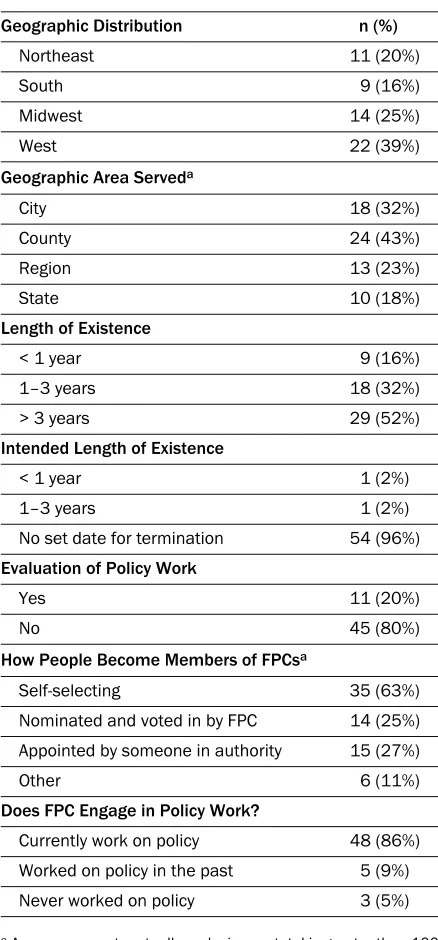
Table 1 displays characteristics of FPCs in the survey sample. FPCs are located throughout the U.S., although the highest concentrations are in the Midwest and West, particularly California. FPCs typically serve one geographic area, such as a city or state. Fifty of the 56 survey respondents re-ported that they serve one geographic area. How-ever, several FPCs represent multiple geographic areas, most often a county FPC serving the county as a whole as well as its constituent municipalities. Nearly 50 percent of FPCs surveyed have been in existence for three or fewer years, with nine FPCs being formed in the last year. Two FPCs reported they intend to last no more than three years, while fifty-four have no set date for
Seventy percent of the FPCs surveyed reported that they engage in some kind of data collection and/or evaluation, though many conceded that they have yet to start evaluation activities. Specific data collection and/or evaluation efforts described range from process evaluations and case studies to community food assessments and food system impact evaluations. Several FPCs that receive grant
Table 1. Description of Sample of FPCs (N=56)
Geographic Distribution n (%)
Northeast 11 (20%)
South 9 (16%)
Midwest 14 (25%)
West 22 (39%)
Geographic Area Serveda
City 18 (32%)
County 24 (43%)
Region 13 (23%)
State 10 (18%)
Length of Existence
< 1 year 9 (16%)
1–3 years 18 (32%)
> 3 years 29 (52%)
Intended Length of Existence
< 1 year 1 (2%)
1–3 years 1 (2%)
No set date for termination 54 (96%) Evaluation of Policy Work
Yes 11 (20%)
No 45 (80%)
How People Become Members of FPCsa
Self-selecting 35 (63%)
Nominated and voted in by FPC 14 (25%) Appointed by someone in authority 15 (27%)
Other 6 (11%)
Does FPC Engage in Policy Work?
Currently work on policy 48 (86%) Worked on policy in the past 5 (9%)
Never worked on policy 3 (5%)
funding stated that they have specific process and outcome measures required by their funders. Over-all, 11 of 56 FPCs surveyed (20 percent) mentioned evaluation related to policy efforts.
FPCs and Policy Activities and Challenges
As the name suggests, 86 percent (n=48) of FPC respondents reported that they are currently work-ing on policy. Those FPCs not workwork-ing on policy cited challenges around defining priorities, lacking leadership, and not being allowed to undertake policy work because of their government affilia-tion. Of the respondents who are working on policy, there was not a uniform definition of what constitutes policy, and several FPCs mentioned that they had not defined policy for themselves. Some FPCs viewed policy as formal, public decisions that include laws, ordinances, guidelines, and official statements made by government entities. One respondent, citing Winne’s definition, defined policy as “any government action or inaction.” Other FPCs described policy as “the way business is done,” and include organizational and community practices and procedures.
Most FPCs are engaging in policy at multiple levels, from institutional and city policy to state and federal policy. Table 2 shows at what levels FPCs were engaging in policy at the time they completed the survey.
FPCs are primarily engaging in policy at the local, institutional, and county levels. Most FPCs in our sample reported representing cities and
counties. Thus, our respondents’ policy work most often focuses at the city or county level, although
the levels are not mutually exclusive. Institutions are another major area of focus for FPCs, with schools being the predominant institutional venue reported.
The ways FPCs engage in policy vary from council to council, yet there are some activities in which most FPCs are involved. Table 3 lists the policy activities in which FPCs are engaged, based on their selection of closed-ended options. The survey question asked how each FPC engages in policy and listed the options shown in table 3.
Almost all FPCs responded that they identify problems that could be addressed through policy, and more than three fourths of FPCs educate the public about food policy issues. Fewer FPCs, though still significant percentages, engage more actively in policy by developing policy proposals (62 percent), lobbying for specific legislation (48 percent), and participating in the regulatory process (34 percent).
Through these policy activities, FPCs engage in a range of policy-related topics across all sectors of the food system, including production, purchasing, distribution, and consumption. Open-ended responses to two questions reveal past and current policy initiatives of the responding FPCs. We grouped these responses into similar categories
Table 2. Levels of Policy Work at Which FPCs
Engagea
n (%)
City 37 (74%)
Institutional (e.g., schools, private sector) 33 (66%)
County 33 (66%)
State 26 (52%)
Federal 17 (34%)
Regional 11 (22%)
a Answers are not mutually exclusive, so total is greater than 100 percent.
Table 3. Types of Policy Activities in Which FPCs
Engagea
n (%) Identify problems that could be addressed
through policy 47 (94%)
Educate public about food policy issues 39 (78%)
Develop policy proposals 31 (62%)
Lobby for specific proposals 24 (48%) Participate in the regulatory process 17 (34%) Endorse other organizations’ or institutions’
policies 16 (32%)
Implement policies 11 (22%)
Other (including general food system advocacy, formation of coalitions, and provision of expert testimony to decision-makers)
4 (8%)
(table 4). The 22 respondents who specified past policies with which their FPCs were involved described 46 policy efforts. (Seven additional respondents provided answers that were not specific enough to be categorized, such as, “we specifically focus on policy level efforts.”) More than half of these policies sought to increase access to local and/or healthy foods; promote agriculture; and encourage state and municipal food planning efforts. When asked to identify two policies they were working on at the time of the survey, 48 respondents (100 percent of those indicating they were engaging in policy work at the time of the survey) answered this open-ended question with enough detail to categorize. Most of the policies described sought to influence institutional food
governments; improve access to local and/or healthy foods; promote agriculture; and support community gardens. Other policy topics detailed as part of past and present policy efforts are detailed in table 4.
We were also interested in understanding whether the policies aimed to change the physical food environment and/or individual behaviors. Of those policies for which we could discern the target of influence (117 of the 142 identified as past or current policy initiatives), all but two sought some type of institutional change that would affect the food environment and facilitate access to local and/or healthy food. For example, procurement policies aim to change the food that large institu-tions buy on behalf of the populainstitu-tions they serve. Table 4. Responses to: If You Worked on Policies in the Past, Please Specify, and What Two Policies Are You Working On?
Subject of Policy Effort
Number of Past Policies Reported by 22 Respondents
Number of Current Policies Reported
by 48 Respondents Examples of Responses
Access to Food 9 15 Policies that promote access to healthy, local foods for school children, low-income people, farm workers, and people living in food deserts.
Agriculture 8 15 Policies that promote urban agriculture, land
preservation, and reject GMO use.
Procurement 4 16 Policies that mandate the source of food purchased by
schools, hospitals, government, and universities.
Animals 5 6 Policies that permit chickens and bees to be raised in
urban areas.
Community Gardens 1 10 Policies that support gardens in the community, including schools.
Food Planning 7 4 Policy efforts to promote county food charters, local sustainable agriculture generally, county food plans, and food policy councils.
Farmers’ Markets 2 7 Policies that facilitate access to farmers’ markets through SNAP/EBT use, and access by low-income people.
Policy Analysis 3 6 Efforts to assess existing policies and the need for additional policies.
Small Business Support 2 6 Policies that promote small businesses, including farmers and retailers.
Other (policies with fewer than five responses to either question)
5 11 Policies that include food assistance, trans fat bans, promoting composting, addressing the emergency food supply, menu labeling, budget decision-making around food, and federal bills.
food, the target institution will alter the food environment in which their employees and clients make their food choices. Many of the institutions targeted have captive audiences, such as schools, hospitals, and prisons, and so the institution provides those people with their available food choices.
Another type of environmental change policy is that which changes the environment in order to encourage individuals to engage the food system differently. Examples of such policies include those related to agriculture, community gardens, and farmers’ markets that look to government to expand the range of production and distribution options available for people to grow crops, raise livestock, and sell the food that results from these efforts. By allowing an expansion of the ability to generate a local, healthy food supply, these policies have the potential to alter the food environment in ways that will improve access to healthy foods for residents. The two policies that did not fit within this category of changing the physical food environment sought support for public education and efforts to increase WIC enrollment.
Many of the FPCs included in our survey were working on urban agriculture issues, likely a reflec-tion of where the FPCs were located geograph-ically. However, many urban FPCs also work on issues that transcend urban/rural lines. These include farm-to-institution policies and general work on the farm bill, as well as issues concerning school food policy and farmers’ markets. Addi-tionally, several FPCs mentioned their work on cropland policy to preserve open space and agri-cultural land preservation, for example conserva-tion easements for preservaconserva-tion of high quality soils.
While most FPCs are currently engaging in policy on multiple topics and multiple levels, they face a variety of challenges to their involvement in policy work. As shown in table 5, 76 percent of respondents cite lack of time, 66 percent report lack of financial support for policy work, and 46 percent say lack of training or skills are barriers to engaging in the policy process. Other barriers to engaging in policy work mainly relate to challenges with government and challenges with FPC
members. Government barriers include
incon-sistent government support of FPC activities, lack of members’ trust of government, and discourage-ment of governdiscourage-ment employees taking positions on policy issues. Additionally, several FPCs mentioned that their members represent a diverse network of stakeholders and often have differing positions on specific policies and differing abilities to engage in policy.
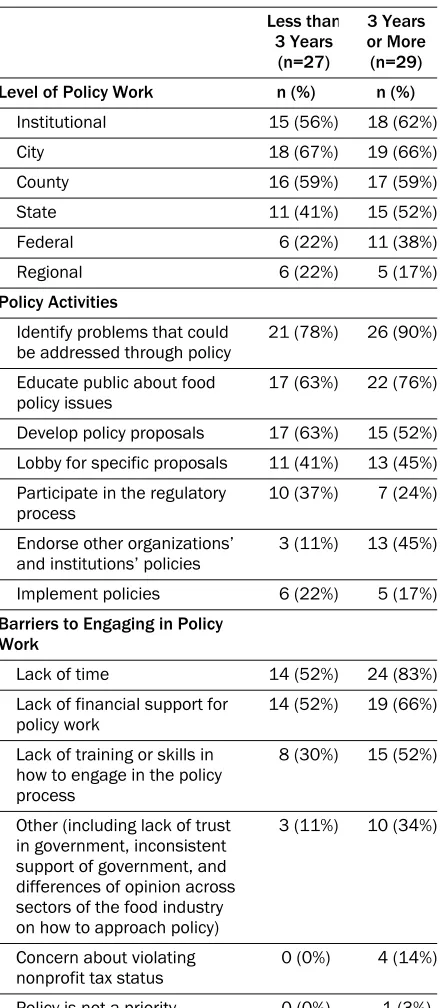
From this list of barriers, one might hypothe-size that the more established FPCs would have greater success in influencing policy because of their experience. Therefore, we explored FPCs’ policy activities based on how long they had been in existence. Prior work by Clancy et al. (2007) explored FPCs that had been in existence for at least three years; thus, we also analyzed the coun-cils’ policy activities comparing those in existence for less than three years to those in existence for three years or more (table 6). The FPCs surveyed, regardless of length of existence, generally work at the same levels of policy, engage in the same policy activities, and face the same barriers to policy work. However, there are a few notable exceptions when comparing newly formed FPCs to long-standing FPCs. FPCs that have been in existence longer (three or more years) report working on federal policy issues more than newer FPCs. In terms of type of policy activities (in other words, how FPCs engage in policy), there are differences between those FPCs that have been around more than three
Table 5. Barriers to FPC Involvement in Policy Worka
n (%)
Lack of time 38 (76%)
Lack of financial support for policy work 33 (66%) Lack of training or skills in how to engage in
the policy process
23 (46%)
Other (including lack of trust in government, inconsistent support of government, and differences of opinion across sectors of the food industry on how to approach policy)
14 (28%)
Concern about violating nonprofit tax status 4 (8%)
Policy is not a priority 1 (2%)
years compared to FPCs newer than three years. Newer FPCs develop more of their own policy proposals and participate in the regulatory process. Older FPCs engage in problem identification,
public education, and most significantly endorse others’ policies more frequently than newer FPCs. Barriers to policy engagement cited by longer-standing FPCs emphasize lack of time and training or skills for engaging in the policy process.
Discussion
Though the number of FPCs continues to grow, research on FPCs remains limited, leaving several gaps in the literature that this study seeks to fill. Prior research has examined a handful of local and state FPCs, focusing on organizational structure and processes (Clancy et al., 2007; Dahlberg, 1994; Harper et al., 2009; Winne, 2008). All these authors acknowledge the limited scope of their work and call for more research evaluating the outcomes and impacts of FPCs. Our research is one of the few studies to examine the entire population of FPCs in the U.S. and the only study, to our knowledge, that specifically examines how FPCs are engaging in the policy process. Although 70 percent of responding FPCs report some kind of data collec-tion and evaluacollec-tion effort of their work in general, both the variety of survey responses and the literature suggest a need for more systematic, rigorous evaluation of the FPCs work specifically in the policy arena. As more FPCs have emerged, organizations such as the Community Food Security Coalition and the United States Depart-ment of Agriculture (USDA) have created tools for FPCs to evaluate their work (CFSC, n.d.).1
Our results suggest that most of the FPCs we surveyed are engaging in policy work. FPCs were asked to define policy as they understood it, and our results show that many FPCs do not share a common definition of policy, and instead operate under individual working definitions that govern their activities. While the definitions for food policy vary, we found consistency in the types of policies that FPCs focus on. These include pro-curement (i.e., local food sourcing by institutions), agriculture (e.g., land preservation, urban
agriculture) and access to healthy food (i.e., access in underserved areas), followed by community
1 The CFSC reported in August 2012 that it will cease its operations by the end of 2012.
Table 6. Policy Work by FPCs’ Length of Existencea
Less than 3 Years
(n=27)
3 Years or More (n=29) Level of Policy Work n (%) n (%)
Institutional 15 (56%) 18 (62%)
City 18 (67%) 19 (66%)
County 16 (59%) 17 (59%)
State 11 (41%) 15 (52%)
Federal 6 (22%) 11 (38%)
Regional 6 (22%) 5 (17%)
Policy Activities
Identify problems that could
be addressed through policy 21 (78%) 26 (90%) Educate public about food
policy issues 17 (63%) 22 (76%)
Develop policy proposals 17 (63%) 15 (52%) Lobby for specific proposals 11 (41%) 13 (45%) Participate in the regulatory
process 10 (37%) 7 (24%)
Endorse other organizations’ and institutions’ policies
3 (11%) 13 (45%)
Implement policies 6 (22%) 5 (17%) Barriers to Engaging in Policy
Work
Lack of time 14 (52%) 24 (83%)
Lack of financial support for
policy work 14 (52%) 19 (66%)
Lack of training or skills in how to engage in the policy process
8 (30%) 15 (52%)
Other (including lack of trust in government, inconsistent support of government, and differences of opinion across sectors of the food industry on how to approach policy)
3 (11%) 10 (34%)
Concern about violating
nonprofit tax status 0 (0%) 4 (14%) Policy is not a priority 0 (0%) 1 (3%)
gardening, food planning, farmers’ markets, animal ordinances, and small business support. We found that these policy topics that seek to change the physical food environment were represented among both current and previous FPC policy activities, thus suggesting possible policy topics that newer FPCs also may want to explore. These common areas of policy focus, and the strategy of pursuing policies that aim to change the physical environment, may also suggest topics on which future evaluations can focus.
The primary policy activities FPC respondents noted are identifying issues that could be addressed through policy, and educating the public about food policy issues. While there are many explana-tions, these indirect forms of policy work may be the result of a lack of time or financial resources to engage in more direct, time-consuming policy work, lack of skills (46 percent reported the lack of skills as a barrier), or a lack of clarity about laws governing tax-exempt organizations and public employees (a concern reported by less than 10 percent of respondents). Resources to inform both of these latter issues are available, such as policy training and technical assistance by the CFSC, and efforts to assure that FPC leaders have access to them and that these resources are understood by and relevant to FPCs may help to address these barriers. In spite of the challenges identified by respondents, many FPCs reported developing policy proposals and engaging in efforts to support ongoing policy efforts. Although this study gener-ated critical information not previously reported, more research is needed to better understand how FPCs engage in policy and what challenges they face in their policy work.
As discussed, FPCs organized within
government agencies face particular challenges to engaging in the policy process. Inconsistent support for the FPC and lack of understanding of food system issues by their host agencies were two challenges cited by respondents who experience this barrier. Additional research is also needed on how FPCs are situated within the communities they represent and serve. Similarly, it would be helpful to know if and how nongovernmental FPCs engage in policy and whether their independ-ence facilitates or hampers efforts to change policy.
Based on the challenges to policy engagement expressed by the FPCs, a need exists for more training and skill development focusing on how to participate in the policy process. Additionally, lack of time and staff were frequently cited as barriers. More explicit discussion within FPCs and priori-tization of policy work could help FPCs direct time and resources to fulfilling their mission of improv-ing food system policy. Support for staff time from funding agencies that is targeted at policy advocacy may help to focus FPCs’ resources on policy.
Length of existence does not seem to indicate significant differences in FPCs’ policy engagement. Long-standing FPCs tend to work more on policy at the federal level and engage in more indirect policy activities, such as endorsing the policies of other salient organizations. Our survey was not designed to fully capture these differences and future research could benefit from further explora-tion of the influence of length of existence on FPC policy-related activities.
Thirty-four percent of FPCs reported that they are working on policy at the federal level. This may reflect nationwide advocacy regarding the 2012 Farm Bill or the recent Child Nutrition Reauthor-ization law. The CFSC organizes FPCs around these issues and provides forums for discussion and avenues for action. From federal food assis-tance and zoning for urban agriculture to infra-structure development for poultry processing and school lunch programs, FPCs play a role in shaping many aspects of the U.S. food system. Assuring these efforts are effectively harnessed to maximize the potential of FPCs is a challenge we hope this research and future studies will help guide.
Study Limitations
are for nonresponders, though possible causes include lack of time, lack of interest in the topic, lack of incentive for taking the survey, and survey fatigue. Thus, our sample, while it includes a majority of identified FPCs, does not represent all of them.
The survey data provide a cross-sectional view as opposed to an historical or longitudinal view, which is difficult given the high turnover (short lifespan) of some FPCs. To address some of these limitations and further the research on policy engagement of FPCs, we are conducting a multiple case study of select FPCs and their policy work. This will allow for a more in-depth examination of the policy efforts of a small group of FPCs.
Conclusion
Most FPCs are currently working to effect policy change at multiple levels, on multiple topics, and through multiple activities. In part because of the lack of resources for policy work and the need for greater policy skills, the policy activities of FPCs tend toward more indirect activities, such as problem identification and education. Support for FPC policy work, in the form of both technical assistance and grant support, will likely be needed in order to accomplish a higher level of direct engagement with the policy process.
The findings of this research suggest there is a need for more systematic, rigorous evaluation of the processes, outcomes, and impacts of FPCs’ policy work. These results, combined with ongoing data collection for the multiple case study, will generate additional and important information regarding how FPCs engage in the policy process, the facilitators and barriers they face, and the outcomes and impacts of their policy work.
Food policy councils have been in existence for the past 30 years, with a noticeable surge in activity during the past 10 years. As our food system becomes more complex and as the public and politicians realize the importance of food to our nation’s health and sustainability, FPCs will continue to emerge and serve as vehicles for influencing food system policy. It is important that such efforts are informed by empirical evidence, which this research is the first to provide.
Acknowledgements
This publication was supported by a directed research grant from the Johns Hopkins Bloomberg School of Public Health Center for a Livable Future. The authors express appreciation to Dr. Kate Clancy and Mr. Mark Winne, visiting scholars at the Center for a Livable Future, for their
invaluable guidance throughout this research, and for their helpful comments on this paper. The authors also thank each of the food policy councils that participated in the survey.
References
Clancy, K., Hammer, J., & Lippoldt, D. (2007). Food Policy Councils: Past, present and future. In C. C. Hinrichs & T. A. Lyson (Eds.), Remaking the North American Food System: Strategies for Sustainability (pp. 121–143). Lincoln, Nebraska: University of Nebraska Press.
Community Food Security Coalition [CFSC]. (n.d.).
Evaluation program materials. Retrieved February 8, 2011, from http://www.foodsecurity.org/ evaluation_pg2.html
Community Food Security Coalition [CFSC]. (2011).
List of Food Policy Councils in North America. Retrieved March 2, 2011, from http://www.foodsecurity.org/ FPC/council.html
Connecticut General Assembly. (1997). Public Act 97-11, Section 21: An act establishing a statewide food policy council under the auspices of the
Department of Agriculture.
http://www.cga.ct.gov/2011/pub/chap438d.htm Dahlberg, K. (1994, June 11). Food Policy Councils: The
experience of five cities and one county. Paper presented at the Joint Meeting of the Agriculture Food and Human Values Society and the Association for the Study of Food and Society, Tucson, Arizona. Feenstra, G. W. (1997). Local food systems and
sustainable communities. American Journal of Alternative Agriculture, 12, 28-36.
http://dx.doi.org/10.1017/S0889189300007165 Fiser, D. (2006). Democratic food: Food Policy Councils and the rebuilding of local agriculture (Unpublished doctoral dissertation). University of Chicago, Chicago, Illinois.
Harper, A., Shattuck, A., Holt-Giménez, E. Alkon, A., & Lambrick, F. (2009). Food Policy Councils: Lessons learned (Development Report 21). Oakland, California: Food First/Institute for Food and Development Policy. Retrieved from
http://www.foodfirst.org/en/foodpolicycouncils-lessons
Hassanein, N. (2003)Practicing food democracy: A pragmatic politics of transformation. Journal of Rural Studies, 19(1), 77-86.
http://dx.doi.org/10.1016/S0743-0167(02)00041-4 Lang, T., Rayner, G., Rayner, M., Barling, D., &
Millstone, E. (2004) Discussion paper: Policy Councils on food, nutrition and physical activity: the UK as a case study. Public Health Nutrition, 8(1), 11-19. http://dx.doi.org/10.1079/PHN2005654 Peters Moschetti, W. (2010). Food policy blueprint.
Retrieved April 24, 2011, from the LiveWell Colorado website: http://www.livewellcolorado.org Schiff, R. (2007). Food Policy Councils: An examination of
organisational structure, process, and contribution to
alternative food movements (Doctoral dissertation). Murdoch University, Perth.
Schiff, R. (2008). The role of Food Policy Councils in developing sustainable food systems. Journal of Hunger and Environmental Nutrition, 3(2), 206-228.
http://dx.doi.org/10.1080/19320240802244017 Survey Monkey (2011). Survey Monkey. Retrieved April 24, 2011 from http://www.surveymonkey.com Webb, K., Hawe, P., & Noort, M. (2001) Collaborative
intersectoral approaches to nutrition in a community on the urban fringe. Health Education and Behavior, 28, 306-319.
http://dx.doi.org/10.1177/109019810102800305 Webb, K., Pelletier, D., Maretzki, A., & Wilkins, J.
(1998). Local food policy coalitions: Evaluation issues as seen by academics, project organizers, and funders. Agriculture and Human Values, 15, 65-75.
http://dx.doi.org/10.1023/A:1007408901642 Winne, M. (2008). Closing the food gap. Boston,
Toward a food policy “first step” in Oakland, California: A food policy
council’s efforts to promote urban agriculture zoning
Nathan McClintocka, c, *, Toulan School of Urban Studies & Planning, Portland State University
Heather Wootenb, c,ChangeLab Solutions
Alethea (Harper) Brownc,Oakland Food Policy Council
Submitted 14 June 2011 / Revised 20 March 2012 and 11 May 2012 / Accepted 18 May 2012 / Published online 8 September 2012
Citation: McClintock, N., Wooten, H., & Brown, A. H. (2012). Toward a food policy “first step” in Oakland, California: A food policy council’s efforts to promote urban agriculture zoning. Journal of Agriculture, Food Systems, and Community Development, 2(4), 15–42. http://dx.doi.org/10.5304/jafscd.2012.024.009
Copyright © 2012 by New Leaf Associates, Inc.
Abstract
Urban agriculture (UA) is cropping up in back-yards, vacant lots, rooftops, and city parks across
North America. Despite popular interest, zoning often serves as an obstacle to UA’s expansion. In this reflective case study, we document the efforts of the Oakland Food Policy Council (OFPC) to develop recommendations for urban agriculture zoning in Oakland, California, as a means of fostering UA’s expansion. First, we focus on the role of zoning in urban agriculture planning, draw-ing on best practices from around the country. Then we provide an overview of Oakland’s food system and place the OFPC within the context of local food justice initiatives. Next, we outline the process by which the council prioritized food system goals before focusing more specifically on its efforts to create new zoning definitions and operating standards for UA, including both suc-cesses and obstacles to gaining the attention of city officials and moving the policy agenda forward. We conclude by reviewing the OFPC’s lessons learned.
Keywords
urban agriculture, food policy councils, food systems planning, land use planning, zoning
a Toulan School of Urban Studies & Planning, Portland State University, P.O. Box 751, Portland, Oregon 97207 USA.
b ChangeLab Solutions, 2201 Broadway, Suite 502, Oakland, California 94612 USA.
c Oakland Food Policy Council, c/o Food First, 398 60th Street, Oakland, California 94618 USA.
* Corresponding author: Nathan McClintock; +1-503-725-4064;
Introduction
Statistics portray a bleak picture of food access in Oakland, California: 87% of schoolchildren receive free or reduced lunch; 20% of families live below the federal poverty line; one in three children will develop diabetes; one third of Alameda County residents are food insecure (Beyers et al., 2008; OFPC, 2010). This is particularly striking given Oakland’s position at the heart of the Bay Area’s “foodie” culture, where gourmet restaurants abound and fresh organic produce is available at a farmers’ market every day of the week (Alkon, 2008; Farley, 2010; Guthman, 2007).1 Indeed, the landscape of food access in this city of 391,000 is a bifurcated one. In the lower-income “flatlands” of North, West, and East Oakland, fast-food
restaurants and liquor stores dominate food retail, while in the affluent Oakland hills, supermarkets and gourmet food shops are much more common. This geography also marks the demographic make-up of the city; Oakland’s flatlands are largely home to people of color, while the hills are mostly white. This geographic delineation is due in large part to a post–World War II history of racially discrimina-tory housing restrictions and mortgage lending and the flight of industrial and residential capital to the suburbs (McClintock, 2011a; Self, 2003).
A recent public health report states that an African American child in West Oakland is seven times more likely to be born into poverty as a white child born in the Oakland hills and will die 15 years earlier on average due to higher incidence of diabetes, hospitalization, cancer, stroke, and heart disease (Beyers et al., 2008). In another study using a human development index — a measure of life expectancy, earnings, and educational attain-ment — the Oakland hills rank 11 of 233 census neighborhood and county groups in California, while the flatlands rank 222 (Burd-Sharps & Lewis, 2011). The child who grows up in the hills will have access to healthier food, due not only to closer proximity to a farmers’ market or super-market, but also to greater purchasing power given
1 Furthermore, food processing historically was a cornerstone of the city’s economy, and two major supermarket chains, Safeway and Lucky Stores, were once headquartered there (McClintock, 2011a; Walker 2001, 2005)..
significantly higher incomes for hills residents. A meta-analysis of various assessments of the
Oakland food system underscores that affordability is the most important factor that influences where low-income residents shop for food (Wooten, 2008). Limited access to transportation is another fundamental constraint to accessing healthy food for flatlands residents (Treuhaft, Hamm, & Litjens, 2009).
Over the last few years, nonprofit organiza-tions, community groups, and government agencies have all mounted efforts — both individual and coordinated — to address the inequities of Oakland’s food system. While these efforts have centered on the various components of the food system, from production to distribution, retail, and food waste recycling, urban agriculture (UA), in particular, has played a prominent role in the food justice and community food security movement in Oakland.2 Since the early 2000s, several food justice organizations, mostly concentrated in West Oakland, have mobilized volunteers and commu-nity residents to grow food in the flatlands. Organizations such as City Slicker Farms, People’s Grocery, Phat Beets Produce, and Planting Justice provide fresh produce to North and West Oakland through a variety of models: community-supported agriculture (CSA), sliding-scale produce stands, and backyard garden mentorship. Oakland Food Connection, the East Oakland Boxing Association, East Bay Asian Youth Center, and PUEBLO have been central to UA efforts in East Oakland. In addition to the work of these organizations, Oakland Parks and Recreation Department
manages community gardens in 10 city parks. More than 100 schools in Oakland have school gardens that have received support from Alameda County Cooperative Extension and a series of state grants. Finally, a large but uncounted number of Oakland residents practice UA in their yards
Ramirez, Olivera, Pascoe, & Safinya-Davies, 2010; McClintock, 2011b; Reynolds, 2011).
The current momentum around UA builds on a long history of cultivation in the city. Indeed, UA in Oakland, as in most American cities, is not a new phenomenon; home gardens have always supplemented urban diets with fresh fruits and vegetables. Influxes of rural populations at various moments have also contributed to UA’s presence in Oakland. Tens of thousands of African
Americans migrated to Oakland during World War II for wartime manufacturing jobs, bringing with them culinary and agricultural traditions from the rural South. While older generations hold much of this knowledge, they remain a rich resource base for urban farmers in Oakland. More recently, large numbers of Latino, Chinese, and Southeast Asian immigrants have brought UA to the Oakland flatlands (McClintock, 2011b).
A long history of social justice activism in Oakland and environs has also been central to rise of UA. In the 1960s and ’70s, the Black Panther Party integrated fresh produce from urban gardens into its free food programs. In the 1990s and 2000s, several environmental justice campaigns in the flatlands invigorated a new generation of acti-vists, many of whom became involved in more recent food justice efforts. At the same time, garden-based education efforts in Berkeley, many of which arose in coordination with national community food security efforts and funding, benefited fledgling garden efforts in neighboring Oakland and provided both material support and expertise to fledgling projects in Oakland (Lawson, 2005; McClintock, 2011b).
As UA programs oriented toward food justice began to take root in the flatlands in the early 2000s, a growing emphasis on sustainability began to filter into Oakland’s municipal policy and plan-ning decisions. A series of sustainability reports, a food system assessment, and a climate action plan have all emphasized the important role that a local food system (including UA) should play in moving the city toward a vision of sustainability (City of Oakland, 2010; OFPC, 2010; Unger & Wooten, 2006). Until recently, however, city policies that explicitly address UA in Oakland were virtually
which have been slow to respond to UA’s growing popularity.
This is changing slowly. Since early 2011, UA zoning has become a priority for Oakland’s Planning Department. In preparation for the development of UA zoning proposal, planners convened a public hearing on UA in July 2011 to elicit community input on how best to update the municipal code in relation to UA. A crowd of over 300 people participated in what Deputy Planning Director Eric Angstadt described as “the biggest meeting I’ve seen” in his 20 years of zoning work (quoted in Florez, 2011). In August and Septem-ber, planning staff consulted with a Technical Advisory Group to discuss best practices and has since been drafting UA zoning language. This process is still underway. Project managers antici-pate that the proposal will be presented to the public for comment by the end of 2012, with hopes of moving from the Zoning Update Com-mittee to passage by the Planning Commission and City Council by the end of 2013.
A brief note on method: This reflective case study is written from an insider perspective by three individuals who were active participants in the OFPC during the organization’s first two years, from 2009 to 2011, as it actively pursued the development of UA zoning as one of 10 “food policy first steps” in Oakland.3 For this article, we draw on city and OFPC documents, email archives, articles in popular media, our observations as participant observers, and interviews with planners involved with the UA zoning effort. As with any engaged or participatory scholarship, our perspec-tive inevitably has been shaped by our role as participants (Elwood, 2006; Minkler & Wallerstein, 2003; Petersen, Minkler, Vasquez, & Baden, 2006). We nevertheless have attempted to reflect on this process as objectively as possible, and, as such, offer as honest and reflexive an appraisal as possible given our position within the process.
We begin in the first section by providing an overview of recent efforts by planners and advo-cates to incorporate UA into municipal zoning ordinances. We discuss the role of land use con-trols in supporting UA and highlight some “best practices” currently underway in the U.S. and Canada. In the second section, we briefly review the history of the Oakland Food Policy Council and the process of identifying first policy steps. We then describe the OFPC’s efforts in 2010 and 2011 to get UA integrated in to city’s planning code. In the paper’s final section, we discuss the lessons learned from our experiences.
Food Policy and Land Use Tools To Support Urban Agriculture: Lessons from the Field
Over the last decade, food systems have once again come to the attention of city and regional planners (Clancy, 2004; Pothukuchi & Kaufman, 1999, 2000).4 Despite efforts to formalize food systems
3 A. Brown was the council’s coordinator from 2009 to 2011; N. McClintock served as an appointed member of the Council from 2009 to 2011, and H. Wooten has been an appointed member since 2009. Both McClintock and Wooten served on the City Innovations working group (with four other OFPC members) during this period.
4 Challenging the popular idea that food systems are “a stranger to the planning field” (Pothukuchi & Kaufman, 2000, p. 113), Donofrio ( 2007) delineates three periods prior to the
planning (American Planning Association [APA], 2007; Pothukuchi, 2009; Raja, Born, & Russell, 2008), however, it remains a relatively nascent and specialized practice among professional city and regional planners. Given the lack of food systems expertise within planning departments themselves (Raja et al., 2008) as well as the growing emphasis on collaborative approaches to planning (Forester, 1999; Healey, 1992; Innes & Booher, 2010), many planners have worked closely with other public agencies, nonprofits, community-based organiza-tions, and citizen activists. While food policy initiatives in some cities (e.g., Seattle, Vancouver, and New York) have arisen from within the halls of municipal government, food policy councils have played a central role in bringing the expertise of
outside stakeholders to municipal planners and politicians in many cities across the U.S. and Canada (Clancy, Hammer, & Lippoldt, 2008; Pothukuchi, 2009; Schiff, 2008). Food policy councils often serve a range of functions that can help facilitate the integration of food systems into municipal planning and policy: (1) bringing together a diversity of stakeholders from the food system; (2) integrating and coordinating issues of food, health, transportation, and economic development; (3) generating locally appropriate policy recommendations; and (4) formulating programs that help to implement food systems change (Harper, Shattuck, Holt-Giménez, Alkon, & Lambrick, 2009). This cross-sector networking of various actors has helped to mainstream concerns over public health (Dixon et al., 2007; Muller, Tagtow, Roberts, & MacDougall, 2009) and equity (Allen, 2010; Bedore, 2010; Wekerle, 2004) within the food system, bringing them into discussions over land use planning.
Given its multifunctionality, UA figures centrally in the efforts of many community food security and food justice advocates (Bellows, Brown, & Smit, 2003; Brown & Jameton, 2000; Gottlieb & Joshi, 2010). While UA is of interest to city health officials, economic development staff, environmental managers, and parks administrators, given its potential to provision cities with food, create jobs, beautify neighborhoods, and provide ecosystems servi