University of New Hampshire
University of New Hampshire Scholars' Repository
Master's Theses and Capstones Student Scholarship
Spring 2019
Quadcopter Attitude Control Optimization and
Multi-Agent Coordination
John McCormack
University of New Hampshire, Durham
Follow this and additional works at:https://scholars.unh.edu/thesis
This Thesis is brought to you for free and open access by the Student Scholarship at University of New Hampshire Scholars' Repository. It has been accepted for inclusion in Master's Theses and Capstones by an authorized administrator of University of New Hampshire Scholars' Repository. For more information, please [email protected].
Recommended Citation
McCormack, John, "Quadcopter Attitude Control Optimization and Multi-Agent Coordination" (2019).Master's Theses and Capstones. 1277.
QUADCOPTER ATTITUDE CONTROL OPTIMIZATION AND MULTI-AGENT COORDINATION
BY
JOHN MCCORMACK
BS, Mechanical Engineering, University of New Hampshire, 2016
THESIS
Submitted to the University of New Hampshire in Partial Fulfillment of
the Requirements for the Degree of
Master of Science
in
Mechanical Engineering
ALL RIGHTS RESERVED
©2019
This dissertation has been examined and approved in partial fulfillment of the requirements for the degree of Master of Science in Mechanical Engineering by:
Committee Chair, May-Win Thein,
Associate Professor of Mechanical Engineering
Se Young Yoon,
Assistant Professor of Electrical and Computer Engineering
Michael Carter,
Associate Professor of Electrical and Computer Engineering
on May 14th, 2019.
TABLE OF CONTENTS
Page
LIST OF TABLES. . . .vi
LIST OF FIGURES . . . vii
ABSTRACT . . . x
CHAPTER 1. INTRODUCTION . . . 1
1.1 Particle Swarm Optimization . . . 1
1.2 Robotic Swarm Control Methods . . . 2
1.3 Organization . . . 3
2. QUADCOPTER MODELING AND CONTROL. . . 4
2.1 Quadcopter Model . . . 4
2.2 Sliding Mode Control . . . 7
3. QUADCOPTER CONTROLLER GAIN OPTIMIZATION . . . 9
3.1 Particle Swarm Optimization . . . 9
3.2 SMC Gain Tuning . . . 11
3.3 Simulation Results and Discussion . . . 14
4. ARTIFICIAL POTENTIAL FIELD SWARM COORDINATION. . . 17
4.1 Leader-Follower Framework . . . 17
4.2 Formulation . . . 18
4.2.1 Decentralization . . . 18
4.2.2 Balancing Forces . . . 18
4.2.3 Smoothness . . . 19
4.3 Equilibrium Distance . . . 21
4.4.1 Swarm Centroid Dynamics . . . 28
4.4.2 Agent Dynamics . . . 32
4.5 Stability Under General Dynamics . . . 34
4.6 Simulation Results and Discussion . . . 39
4.6.1 Quadcopter Swarm . . . 39
4.6.2 Point-Mass Swarms . . . 44
5. EXPERIMENTAL DEVELOPMENT . . . 49
6. CONCLUSION AND FUTURE WORK . . . 52
BIBLIOGRAPHY. . . 54
LIST OF TABLES
Table Page
2.1 System Parameters . . . 6
2.2 SMC Gain Search Bounds onki . . . 8
2.3 SMC Gain Search Bounds onci . . . 8
3.1 PSO Tuned Quadcopter SMC Gains with Coupled Responses . . . 14
3.2 PSO Tuned Quadcopter SMC Gains with Decoupled Responses . . . 15
3.3 PSO Tuned Quadcopter SMC Gains from Coupled Responses and MSE Cost . . . 15
LIST OF FIGURES
Figure Page
2.1 Quadrotor Model . . . 5
3.1 Visualization of varying PSO gains . . . 11
3.2 Visualization of reflect boundary technique . . . 12
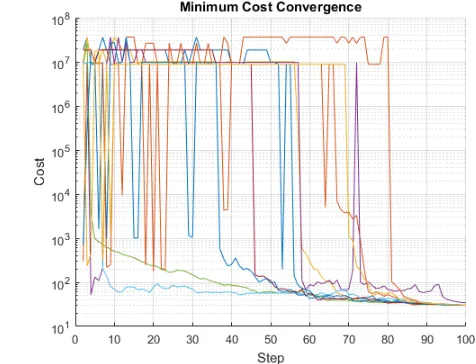
3.3 Cost convergence of 30 particle over 100 steps . . . 16
4.1 Multi-agent swarm aggregation . . . 19
4.2 Artificial Potential Field visualization in a single dimension . . . 20
4.3 Real branches of the Lambert-W Function . . . 22
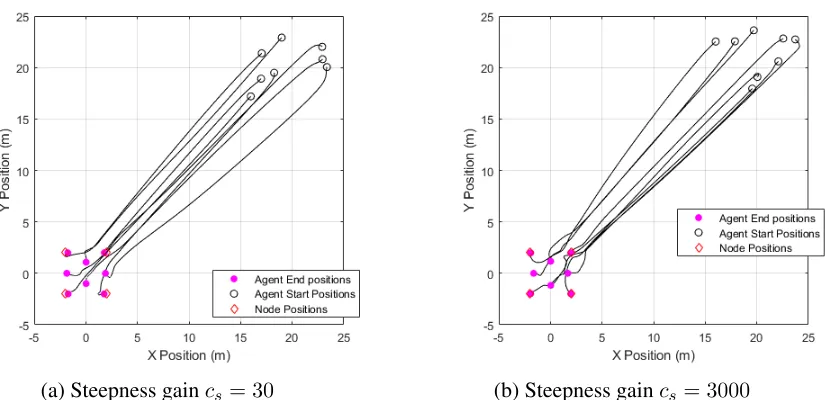
4.4 Trajectories aggregating a 4-node formation . . . 40
4.5 Trajectories tracking a 2-node formation . . . 41
4.6 Quadcopter swarm trajectories before and after agent failure . . . 42
4.7 Agent coordinates aggregating a 2 node formation with single-agent failure . . . 43
4.8 Lawnmower path achieved through waypoint navigation . . . 43
4.9 Large swarms with formation and point mass dynamics . . . 46
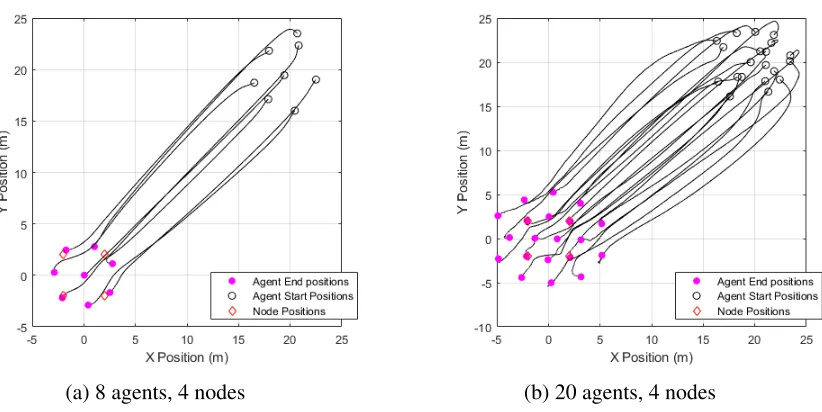
4.10 8-agent swarms with 4-node formation and point mass dynamics . . . 46
4.11 Large swarms with point mass dynamics and varying equilibrium distance . . . 47
4.12 Large swarms with formation and point mass dynamics with limited communication . . . 48
4.13 Inline formation with and without assigning agents to specific nodes . . . 48
A.1 Cost of each particle’s controller at each step using equation (3.3) as the cost
function and coupled responses (N = 10,kf = 100) . . . 58
A.2 Controller gains for each particle at each step using equation (3.3) as the cost
function and coupled responses (N = 10,kf = 100) . . . 58
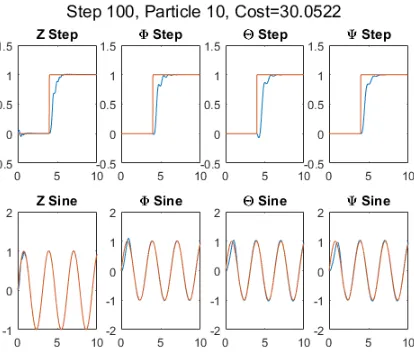
A.3 Quadcopter responses using the final optimized controller found using equation
(3.3) as the cost function and coupled responses (N = 10,kf = 100) . . . 59
A.4 Cost of each particle’s controller at each step using equation (3.3) as the cost
function and coupled responses (N = 100,kf = 10) . . . 59
A.5 Controller gains for each particle at each step using equation (3.3) as the cost
function and coupled responses (N = 100,kf = 10) . . . 60
A.6 Quadcopter responses using the final optimized controller found using equation
(3.3) as the cost function and coupled responses (N = 100,kf = 10) . . . 60
A.7 Cost of each particle’s controller at each step using equation (3.3) as the cost
function and coupled responses (N = 30,kf = 100) . . . 61
A.8 Controller gains for each particle at each step using equation (3.3) as the cost
function and coupled responses (N = 30,kf = 100) . . . 61
A.9 Quadcopter responses using the final optimized controller found using equation
(3.3) as the cost function and coupled responses (N = 30,kf = 100) . . . 62
A.10 Cost of each particle’s controller at each step using equation (3.3) as the cost
function and decoupled responses (N = 10,kf = 100) . . . 62
A.11 Controller gains for each particle at each step using equation (3.3) as the cost
function and decoupled responses (N = 10,kf = 100) . . . 63
A.12 Quadcopter responses using the final optimized controller found using equation
(3.3) as the cost function and decoupled responses (N = 10,kf = 100) . . . 63
A.13 Cost of each particle’s controller at each step using equation (3.3) as the cost
function and decoupled responses (N = 100,kf = 10) . . . 64
A.14 Controller gains for each particle at each step using equation (3.3) as the cost
function and decoupled responses (N = 100,kf = 10) . . . 64
A.15 Quadcopter responses using the final optimized controller found using equation
A.16 Cost of each particle’s controller at each step using equation (3.3) as the cost
function and decoupled responses (N = 30,kf = 100) . . . 65
A.17 Controller gains for each particle at each step using equation (3.3) as the cost
function and decoupled responses (N = 30,kf = 100) . . . 66
A.18 Quadcopter responses using the final optimized controller found using equation
(3.3) as the cost function and decoupled responses (N = 30,kf = 100) . . . 66
A.19 Cost of each particle’s controller at each step using equation (3.5) as the cost
function and coupled responses (N = 10,kf = 100) . . . 67
A.20 Controller gains for each particle at each step using equation (3.5) as the cost
function and coupled responses (N = 10,kf = 100) . . . 67
A.21 Quadcopter responses using the final optimized controller found using equation
(3.5) as the cost function and coupled responses (N = 10,kf = 100) . . . 68
A.22 Cost of each particle’s controller at each step using equation (3.5) as the cost
function and coupled responses (N = 100,kf = 10) . . . 68
A.23 Controller gains for each particle at each step using equation (3.5) as the cost
function and coupled responses (N = 100,kf = 10) . . . 69
A.24 Quadcopter responses using the final optimized controller found using equation
(3.5) as the cost function and coupled responses (N = 100,kf = 10) . . . 69
A.25 Cost of each particle’s controller at each step using equation (3.5) as the cost
function and coupled responses (N = 20,kf = 100) . . . 70
A.26 Controller gains for each particle at each step using equation (3.5) as the cost
function and coupled responses (N = 30,kf = 100) . . . 70
A.27 Quadcopter responses using the final optimized controller found using equation
ABSTRACT
Quadcopter Attitude Control Optimization and Multi-Agent Coordination
by
John McCormack
University of New Hampshire, May, 2019
This thesis presents a method of automated control gain tuning for a Quadcopter Unmanned
Aerial Vehicle and proposes a method of coordination multiple autonomous robotic agents capable
for formation aggregation. Sliding Mode Control for Quadcopter altitude and attitude
stabiliza-tion is presented and tuned using Particle Swarm Optimizastabiliza-tion. Different configurastabiliza-tions for the
optimization process are compared to determine an effective and time-efficient setup to complete
the control gain tuning. The multi-agent coordination scheme expands upon an existing adjustable
swarm framework based on an Artificial Potential Field Sliding Mode Controller. The original
leader-follower scheme is modified with the goal of producing a leaderless swarm where agents
move towards specific locations to aggregate a desired formation. Analysis of the swarm control
scheme pays particular attention to maintaining proper distance between agents. Using Lyapunov
methods following that of the original controller analysis, stability under first order and general
higher order dynamics is analyzed. Numerical simulations of the swarm controller using agents
with nonlinear Quadcopter or second order point mass dynamics are presented to illustrate the
ca-pabilities of this algorithm. The automatically tuned Quadcopter controller is used in simulations
when applicable. The development of an experimental test platform is discussed with the intention
CHAPTER 1
INTRODUCTION
Applications of groups of autonomous robots, such as unmanned aerial vehicles (UAV), have
grown rapidly in numerous fields such as agricultural monitoring, land surveying, and search and
rescue operations [1, 2, 3]. Quadcopter UAVs in particular have become increasingly popular
due to their high maneuverability and versatility in a wide range of tasks. Therefore, the UNH
Advanced Controls Laboratory began the development of a custom Quadcopter platform to serve
as a testbed for potential control techniques and experimental applications.
During development of this platform, it was found that tuning control gains was a time
con-suming and non-trivial process due to the coupled and nonlinear nature of quadcopter dynamics.
As such, an automated tuning process was desired. Additionally, a method of controlling the
po-sitions of multiple robotic agents was needed with the potential for formation aggregation. This
thesis presents a potential solution to each of these problems. Firstly, Particle Swarm Optimization
(PSO) is considered for automatic tuning of the Quadcopter control gains. Secondly, an Artificial
Potential Field (APF) Sliding Mode Control (SMC) is considered for decentralized multi-agent
coordination and formation aggregation.
1.1
Particle Swarm Optimization
PSO, first introduced in [4, 5] and developed further in [6, 7], was inspired by the movements of
flocks of birds and schools of fish and has been found to be highly effective in solving complicated
optimization problems [8, 9]. Genetic algorithms and evolutionary programming are well studied
methods often used for comparison with PSO which has some notable advantages over those and
other optimization techniques. First and foremost, PSO does not require anya prioriinformation
optimiza-tion of highly complicated systems with variables that may not be directly or evidently related in a
hyper-spatial search region. PSO works to minimize a cost function by comparing multiple
sam-ples of the optimization variables in successive steps. The values of the optimization variables for
the next step are then weighted to tend toward a set which gives the lowest cost. This is performed
with any constant number of samples (or particles) for any number of steps until an end condition
is met. Additionally, PSO is relatively simple when compared with other optimization methods
and requires very little processing time and power.
Particle swarm optimization has proven to be an effective and efficient method of gain tuning
for a number of systems and controller types [10, 11]; namely Fuzzy SMC for chaotic systems
[12] and various PID controllers for quadcopters. Position PID gains were tuned in [13] while both
position and attitude PID controllers were tuned simultaneously in [14]. A Fuzzy PID quadcopter
attitude controller was tuned in [15]. In [16], a PSO-tuned PID position controller for formation
control of multiple quadcopters was found to perform better than LQR control for the same system.
Finally, a modified version of PSO was used in [17] and shown to simultaneously tune PID gains
for quadcopter attitude and position.
This thesis proposes a novel cost function for PSO tuning of quadcopter altitude and attitude
control gain. This cost function is composed of several parameters extracted from both regulation
and tracking simulations which utilize the nonlinear and coupled dynamics of a quadcopter. The
performance of resulting controllers from various PSO configurations are compared to determine
the best PSO configuration while also considering the time required to complete the optimization.
1.2
Robotic Swarm Control Methods
Within these groups or swarms, agents must often work collaboratively to complete a task.
Meth-ods of coordination of agents is often inspired by studies of groups in nature such as flocks of birds
or schools of fish. Flocking behavior in particular was considered in [18] where follower agents
flock around, a leader following a set trajectory and [19] which incorporated a virtual leader to
A weakness of the flocking method of swarm coordination that is there exists very little control
over agents’ relative positions. A predefined structure or formation may be needed. Methods such
as virtual structures in [20] and finite-time consensus [21] are capable of aggregating a formation
from a swarm. However, this generally requires assigning agents to specific target locations a
prioriand lacks flocking behavior.
The use of an artificial potential field (APF) in the sliding manifold in sliding mode control
(SMC), proposed in [22] and expanded on in [23], shows particular promise in swarm coordination
for leader-follower flocking behavior [24] and robot navigation and obstacle avoidance [25]. This
method also may be applied in satellite constellation aggregation [26].
This thesis expands upon the leader-follower APF-SMC framework presented by Fabian et al.
in [24] with the goal of a multi-agent distributed control scheme capable of aggregating a
time-varying formation while additional agents in a larger swarm flock in the vicinity of the formation.
The inclusion of flocking agents with the formation introduces redundancy in the swarm enabling
the continuation of group missions regardless of agent failure.
1.3
Organization
In Chapter 2 quadcopter dynamics are reviewed and a Sliding Mode Control scheme is presented
for attitude and altitude control. Chapter 3 details the Particle Swarm Optimization process and
the cost function used. Optimization results are also presented and discussed. The APF-SMC
multi-agent coordinator is derived in Chapter 4 followed by a stability analysis which follows
the process presented in [24]. Swarm simulations using both point mass agents and quadcopter
dynamics are shown and discussed. In Chater 5 the development of the experimental platform and
implementation of the PSO-tuned controller and APF-SMC multi agent coordinator is discussed.
CHAPTER 2
QUADCOPTER MODELING AND CONTROL
In this chapter the kinematic and dynamic model for a Quadrotor Unmanned Aerial Vehicle
(UAV) is reviewed and Sliding Mode Control (SMC) laws presented in [27] are described. This
model and attitude controller is used in simulation to test automatic controller gain tuning and
multi-agent coordination in later chapters.
2.1
Quadcopter Model
Modeling assumptions follow that of [27] and are itemized as follows:
1. The center of mass is located at the origin of the body coordinate axes which lie along the
principle axes of inertia.
2. Generated thrust and drag are proportional to the square of propeller speed.
3. The quadrotor platform is flying in a closed, laboratory setting.
4. Modeling uncertainties are considered negligible.
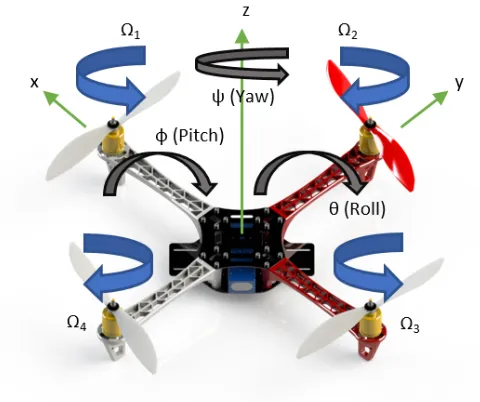
Figure 2.1 represents the quadrotor model used in this study and in previous work [27]. Here,
the motor configurations are shown, with the red propeller indicating the forward direction of the
Figure 2.1: Quadrotor Model
The rotational kinematics and translational dynamics are:
¨
φ =b1U2+a1θ˙ψ˙−a2θ˙Ωr
¨
θ =b2U3+a3φ˙ψ˙+a4ψ˙Ωr
¨
ψ =b3U4+a5φ˙θ˙
¨ x= U1
m(sinφ sinψ+ cosφ cosψ sinθ)
¨ y = U1
m(cosφ sinψ sinθ−cosψ sinφ)
¨ z = U1
m(cosφ cosθ)−g (2.1)
whereU1,U2,U3, andU4 are the thrust forces relating to heave, pitch, roll, and yaw, respectively.
The state variables φ, θ, ψ, x, y, z represent pitch, roll, yaw, x-position, y-position, and altitude,
respectively. where l is the arm length of the quadrotor and Jr is the rotor inertia. The system
parameters are obtained through physical modeling of a prototype experimental platform and
lit-erature search [28, 29]. The parameters assigned to the simulated system are shown in Table 2.1.
Table 2.1: System Parameters
m 0.98 kg g 9.81 m/s
l 0.17 m Ixx 0.01548 kgm2
Iyy 0.01565 kgm2
Izz 0.03024 kgm2
Jr 6e-5 kgm2
Kf 3.13e-5 N-s2
Km 3.13e-5 N-m-s2
U3 U4]T, the dynamics represented in (2.1) are written as:
˙
X =f(X) + Φ(X)U(t) (2.2)
wheref(X) ∈ <12×1 and Φ(X) ∈ <12×4 is the input coefficient matrix. The system inputs are
related to rotor speeds as:
U1 U2 U3 U4 =
Kf Kf Kf Kf
0 −Kf 0 Kf
Kf 0 −Kf 0
Km −Km Km −Km
Ω21
Ω22
Ω23
Ω2 4 (2.3)
whereKf andKmare the aerodynamic force and moment constants respectively. The relative rotor
speedΩris the sum of rotor speeds:
Ωr =−Ω1+ Ω2 −Ω3+ Ω4 (2.4)
The parametersai andbi are the normalized and simplified inertia terms of the quadrotor,
a1 =
Iyy −Izz
Ixx
a2 =
Jr
Ixx
a3 =
Izz −Ixx
Iyy
a4 =
Jr
Iyy
a5 =
Ixx−Iyy
Izz
b1 =
l Ixx
b2 =
l Iyy
b3 =
1 Izz
(2.5)
2.2
Sliding Mode Control
The SMC attitude and altitude control laws from [27] are
U1 =
m
cosφcosθ[kzsgn(sz) +cz( ˙z−z˙d) +g+ ¨zd] U2 =
1 b1
[kφsgn(sφ) +cφ( ˙φd−φ) + ¨˙ φd+a2θΩ˙ r−a1θ˙ψ]˙
U3 =
1 b2
[kθsgn(sθ) +cθ( ˙θd−θ) + ¨˙ θd−a4φΩ˙ r−a3φ˙ψ]˙
U4 =
1 b3
[kψsgn(sψ) +cψ( ˙ψd−ψ) + ¨˙ ψd−a5φ˙θ]˙ (2.6)
The sliding surface is defined assi =ciei+ ˙ei, where tracking error isei =Xd,i−Xiwithi=φ,
θ, ψ and z. The equivalent and discontinuous control gains are ci and ki, respectively. These
control gains are selected through Particle Swarm Optimization (detailed in a later chapter) given
a finite range. The lower of the discontinuous gainski is determined from the maximum system
uncertainty to satisfy Lyapunov stability while the upper bound is selected to prevent excessive
control action [28, 30, 29, 31]. Ranges for the equivalent control gains ci were selected using a
Table 2.2: SMC Gain Search Bounds onki
Gain z φ θ ψ
min 0.0542 0.0542 0.0542 0.0542
max 200 30 30 30
Table 2.3: SMC Gain Search Bounds onci
Gain z φ θ ψ
min 0.05 0.05 0.05 0.05
max 10 10 10 10
The quadcopter inputs (2.6) control the roll, pitch, yaw, and altitude only while the x and
y horizontal positions are dependent on the attitude and heave U1. A multi-agent coordination
algorithm detailed in a later chapter is used to determine the virtual inputsux, uy, anduz which
are used to determine the desired rollθdand pitchφdsuch that
θd= tan−1
uxcosψ+uysinψ
uz+g
φd= tan−1
cosθd
uxsinψ−uycosψ
uz +g
(2.7)
and the modified altitude inputU1using
U1 =
m
CHAPTER 3
QUADCOPTER CONTROLLER GAIN OPTIMIZATION
Finding a suitable set of control gains for a system can be an ambiguous and time-consuming
process, particularly when optimal control methods, such as Linear Quadratic Regulators, are not
in use. This is especially true of highly nonlinear systems, such as quadcopters. In the previous
chapter Sliding Mode Control (SMC) was chosen for use on the quadcopter test platform due to it’s
robustness against system uncertainties and unmodeled dynamics. Stable and reasonable ranges
for the SMC gains were found through Lyapunov analysis and literature review. In this chapter
the method of Particle Swarm Optimization (PSO) is introduced and used to automatically tune
attitude and altitude SMC gains for a quadrotor experimental test platform. These results were
presented in [27].
3.1
Particle Swarm Optimization
A finite search space is established where each dimension is a parameter to be optimized. There
is no limit on the number of optimization variables. As such PSO is able to optimize a system
in an N-dimensional hyperspace. Artificial particles move through this search space to find an
optimal location. A particle’s N-dimensional location in the search space is used in a cost function
to determine that location’s fitness, a scalar value. In general optimization practice, a low cost is
considered favorable. Cost functions can take many forms; the Ackley, Easom, and McCormick
functions are commonly used for examining an optimization technique’s efficacy [32]. PSO iterates
to minimize the cost function until an ending condition is met. The most common end condition,
which is used in this study, is a set number of iterations.
Initialization- PSO begins by generating two initial test locations at random within the search
point to the other for each particle in the swarm. The cost at each of these locations is calculated
to provide seed data for each particle’s personal (or local) best tested location. From the swarm’s
set of personal best locations, a global best location is selected. The particles’ velocity, personal
best location, and the swarm’s global best location are used to determine where each particle will
move next in the search space.
PSO Equation- The general PSO equation for thej-th particle in a swarm at any stepkis
∆xj(k+ 1) =W(k)∆xj(k) +P(k)r1(j, k)[Pb,j(k)−xi(k)]
+G(k)r2(j, k)[Gb(k)−xj(k)]
xj(k+ 1) =xj(k) + ∆xj(k+ 1) (3.1)
where∆xj(k)and∆xj(k+1)are the current and next velocities,xj(k)andxj(k+1)are the current
and next positions, Pb,j(k) and Gb(k) are the personal and global best locations, respectively,
r1(j, k)andr2(j, k)are random values on the interval [0,1]generated for each particle at each step,
andW(k),P(k), andG(k)and the inertial, personal, and global weights which can be constant or
vary during the optimization process. Depending on these weights, different swarm behaviors can
emerge. Without loss of generality, the inertial, personal, and global weighting functions for this
study are chosen as
G(k) =e4( k kf−1)
P(k) = 1−G(k)
W(k) =e−4 k
kf (3.2)
wherekf is the total number of steps. These functions are visualized in Figure 3.1. By having high
inertial and personal weight early in the optimization process, particles are encouraged to explore
the search space, seeking out new potential solutions. As the time step k increases, the personal
Figure 3.1: Visualization of varying PSO gains
of the way to the final step (solid black line in Figure 3.1). During this stage the particles tend
towards the global best solution, potential discovering new solutions due to the dominant inertial
weight. At roughly 83% completion (dashed black line in Figure 3.1), the global weight become
dominant, influencing the particles to converge to and refine a single optimal solution.
Boundary Handling - Several methods of ensuring particles remain in the search space were
considered including reflection, nearest, personal best, and random techniques. In [33], it was
found that the reflection boundary handling method resulted in the least sampling bias and will
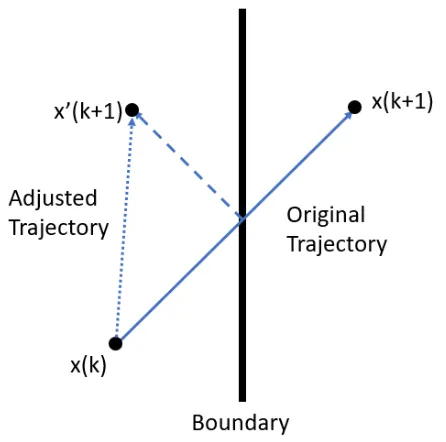
be used for this study. Under this technique, when a particle’s next test position is outside of the
search space, the exterior trajectory is mirrored by the boundary resulting in a new next position
inside the search space. This is visualized in figure 3.2.
3.2
SMC Gain Tuning
The SMC control gains ki and ci where i = z, φ, θ, and ψ in the quadcopter control laws in
equation (2.6), reproduced below, are tuned using PSO. A set of gains take the place ofx in the
PSO equation (3.1) as the pseudo-location in the search space such thatxj(k) = [kzkφkθkψ czcφ
Figure 3.2: Visualization of reflect boundary technique
U1 =
m
cosφcosθ[kzsgn(sz) +cz( ˙z−z˙d) +g+ ¨zd] U2 =
1 b1
[kφsgn(sφ) +cφ( ˙φd−φ) + ¨˙ φd+a2θΩ˙ r−a1θ˙ψ]˙
U3 =
1 b2
[kθsgn(sθ) +cθ( ˙θd−θ) + ¨˙ θd−a4φΩ˙ r−a3φ˙ψ]˙
U4 =
1 b3
[kψsgn(sψ) +cψ( ˙ψd−ψ) + ¨˙ ψd−a5φ˙θ]˙ (2.6)
To determine the effectiveness or cost associated with of each set of gains, performance metrics
are calculated from step and sine wave tracking responses (without loss of generality) in each
respective degree of freedom. Performance metrics include time constants, steady state error,
tracking error, and controller effort. These are used to determine the costJj(k)such that
Jj(k) =
4
X
i=1
(ατ,iτi,j(k) +αE,iEi,j(k) +αT ,iTi,j(k) +αW,iWi,j(k) +αV,iVi,j(k)) (3.3)
y(τi,j(k)) = 0.632yss
Ei,j(k) =|yss−yd|
Ti,j(k) =
Z tf
0
|y(t)−yd(t)|dt
Wi,j(k) =
Z tf
0
|Ui,step|dt
Vi,j(k) =
Z tf
0
|Ui,sine|dt (3.4)
Hereiis each degree of freedom:z,φ,θ, andψ. τi,j(k),Ei,j(k), andWi,j(k)are the time constant,
steady state error, and control effort, respectively, from the step input response. ydand yd(t)are
a unit step and sine wave desired inputs, respectively. yssis the steady state value of the unit step
response. Steady state is reached if the absolute value of the first derivative of the response to a
step input reduces to a threshold chosen a priori before the final time of the simulation. Assuming
a first order response,τi,j(k)is then found as the time at which the step response reaches one time
constant, as defined in [34]. If the first derivative does not become smaller than the threshold before
the end of the simulation, it is assumed steady state is not reached and an arbitrarily largeτi,j(k)is
assigned. Ti,j(k)andVi,j(k)are the tracking error and control effort, respectively, from tracking a
sine wave. Each of these values are calculated such that they are always positive. Therefore, PSO
will work to minimize (3.3). Theαterms are combined normalizing and weighting gains.
Optimizations with this cost function are performed with simulations in both coupled and
de-coupled cases. In the de-coupled case, the simulated quadcopter receives command signals in all
degrees of freedom simultaneously. For example, step response maneuvers for altitude, roll, pitch,
and yaw are executed at the same time. In the decoupled case each degree of freedom is tested
independently while all others are told to remain at zero. Furthermore, optimizations with various
particle swarm sizes and iterations are performed and the results compared.
Other cost functions used in literature review are often more simple than equation (3.3). As
such the optimization results using the above cost function will be compared to optimizations using
Jj(k) =
4
X
i=1
αi,jMSEi,j(k) (3.5)
where MSEi,j(k)is the mean square error of a coupled step response of each degree of freedom
i=z,φ,θ, andψ. The resulting gains from optimizations using each cost function and simulation
technique are compared for consistency of results and time require to complete the optimization
process. The method which can produce consistent results in a comparatively reasonable amount
of time is used to obtain controller gains for implementation on a physical platform.
3.3
Simulation Results and Discussion
The Particle Swarm optimization of the SMC gain was performed with various combinations of
total iterationskf, numbers of particlesN, and the aforementioned cost functions. Sample result
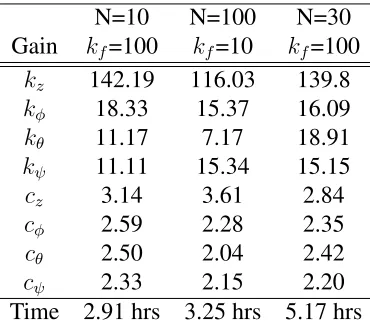
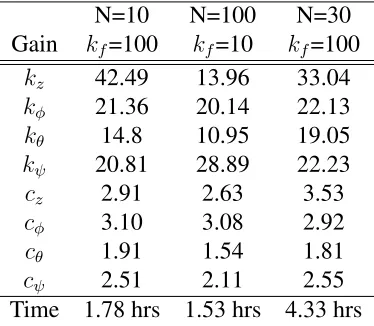
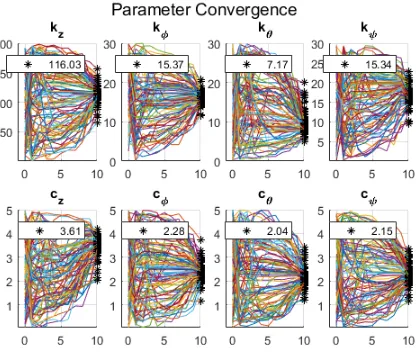
are shown in Tables 3.1, 3.2, and 3.3 below. Additionally, cost figures, controller gain evolution
plots, and final step and sine tracking responses can be found in Appendix A.
Table 3.1: PSO Tuned Quadcopter SMC Gains with Coupled Responses
N=10 N=100 N=30 Gain kf=100 kf=10 kf=100
kz 142.19 116.03 139.8
kφ 18.33 15.37 16.09
kθ 11.17 7.17 18.91
kψ 11.11 15.34 15.15
cz 3.14 3.61 2.84
cφ 2.59 2.28 2.35
cθ 2.50 2.04 2.42
cψ 2.33 2.15 2.20
Time 2.91 hrs 3.25 hrs 5.17 hrs
Through successive runs, several general observations are made. Firstly, it was seen that
with-out a sufficient number of steps in the optimization process, particles do not converge to a solution.
Conversely, allowing the optimization process to continue for a very large number of steps, such
as 1,000, does not produce any noticeable improvements to a final solution. Next, the number of
particles is found to greatly impact the swarm’s ability to find an optimal solution. With fewer
Table 3.2: PSO Tuned Quadcopter SMC Gains with Decoupled Responses
N=10 N=100 N=30 Gain kf=100 kf=10 kf=100
kz 195.02 1.44 172.6
kφ 25.04 17.74 15.66
kθ 10.03 28.67 15.12
kψ 20.71 15.83 17.31
cz 3.81 2.92 2.94
cφ 1.19 3.73 2.12
cθ 3.63 1.12 2.41
cψ 0.93 1.58 0.48
Time 11.77 hrs 12.18 hrs 35.1 hrs
Table 3.3: PSO Tuned Quadcopter SMC Gains from Coupled Responses and MSE Cost
N=10 N=100 N=30 Gain kf=100 kf=10 kf=100
kz 42.49 13.96 33.04
kφ 21.36 20.14 22.13
kθ 14.8 10.95 19.05
kψ 20.81 28.89 22.23
cz 2.91 2.63 3.53
cφ 3.10 3.08 2.92
cθ 1.91 1.54 1.81
cψ 2.51 2.11 2.55
Time 1.78 hrs 1.53 hrs 4.33 hrs
for the optimization precess depends almost exclusively on the number of simulations performed.
Thus, more steps and more particles result in longer runtime. This also applies to the coupled
ver-sus decoupled simulation responses. Because the decoupled method uses independent simulations
for each degree of freedom, it takes a significantly longer amount of time to complete the
opti-mization using this method than using coupled responses. Furthermore no significant difference in
responses is seen between the two methods.
When considering the two cost functions presented in the previous section, it is found the
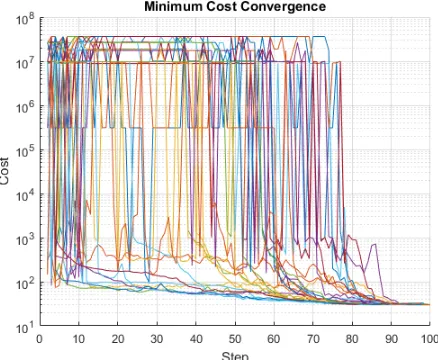
Figure 3.3: Cost convergence of 30 particle over 100 steps
resulting from Equation (3.3). This is most notable in step responses where significant oscillations
are present.
With these observations in mind, a balance of efficacy and efficiency is found for final tuning
of the Quadcopter SMC gains. Coupled responses are used with a swarm consisting of 30 particles
iterated for 100 steps using Equation (3.3) as the cost function. This setup yields consistent results.
Furthermore, particles exhibit the desired behavior from the selected inertial, global, and personal
weights as can be seen through the cost at each step for each particle in Figure 3.3. It is also
observed that the cost has discrete values when very large. This may be an artifact of the plotting
technique, a result of Sliding Mode Controller saturation, caused by cost parameter assignment
when bounds are exceeded, or a combination of these or other factors. The final gains used for
implementation on physical test platforms and in later simulations are given in table 3.4.
Table 3.4: Optimized SMC Gains
Gain z φ θ ψ
CHAPTER 4
ARTIFICIAL POTENTIAL FIELD SWARM COORDINATION
In this chapter a multi-agent control scheme capable of aggregating multiple autonomous
robotic agents into a formation as well as coordinating supplemental agents in a larger swarm
is presented. The algorithm is based on the leader-follower Artificial Potential Field-Sliding Mode
Control (APF-SMC) presented in [24]. Several modifications are introduced to the APF equation
to achieve formation aggregation and additional analysis is performed to prove certain assumptions
made in the original Lyapunov stability proof. These modifications were presented in [35]. The
new swarm coordinator is then proven stable following the form of the original work.
4.1
Leader-Follower Framework
The APF presented in [24] was built on attractive and repulsive forces as function of the distances
between each pairs of agenta. The attractive forces encourage swarm cohesion and aggregation
while the repulsive forces prevent agents from colliding and the swarm from collapsing into a
singularity. The potential field took the general form
∇xiVi(X) =
N
X
j=1
fi,ja(kxi−xjk)(xi−xj)−fi,jr (kxi−xjk)(xi−xj)
+fi,La (kxi−xLk)(xi−xL)−fi,Lr (kxi−xLk)(xi −xL) (4.1)
where Vi(X) is the potential at agent i as a function of the states of all agents X in the swarm
withN agents,xis the position of agentsiandj,faandfr are the attractive and repulsive force
Vi(X) = N X j=1 ka
2 kxi−xjk+ krr
2 e
−kxi−xjk
2
r
+ka,L
2 kxi−xLk+ kr,LrL
2 e
−kxi−xLk
rL (4.2)
whereka andkr are attractive and repulsive forces respectively, r influences the area of effect of
the repulsive force,xi andxj are the positions of the agents iandj. This is the starting point for
the formulation of a decentralized swarm control algorithm with internal formation.
4.2
Formulation
4.2.1 Decentralization
By removing the leader components of equation (4.1) and separating the attractive forces from
the agent dynamics and assigning them to attractive nodes νk, which have their own prescribed
dynamics. The resulting general equation for a swarm ofN agents andM attractive nodes is
∇xiVi(X,N) =
M
X
k=1
fi,ka (kxi−νkk)(xi−νk)− N
X
j=1
fi,jr (kxi−xjk)(xi−xj) (4.3)
More specifically,
Vi(X,N) = M
X
k=1
kakxi−νkk+ N
X
j=1
kre−
kxi−xjk2
r (4.4)
whereNis the states of all nodes in the potential field. Attractive nodes can be stationary in space
for regulation or move for tracking and can be used to aggregate the swarm into a specific formation
or structure. The repulsive forces remain dependent on agent dynamics to avoid collision.
4.2.2 Balancing Forces
During preliminary simulations using APF (4.4) to control a swarm of double-integrator point
masses, it was found that a zero-gradient region would form in the area enclosed by attractive
nodes due to symmetry in the attractive forces. An example of this can be seen in Figure 4.1a.
Furthermore, when more agents than nodes were in a swarm, often times no agent would reach
(a) Four agent, four node swarm trajectories,
dia-mond formation (b) Three agents, one node swarm trajectories
Figure 4.1: Multi-agent swarm aggregation
balancing forces of a lower magnitude than the attractive and repulsive forces already present,
these effects could be mitigated. That is, introducing a small linear repulsive force has the effect
of pushing agents towards nodes when in the aforementioned zero-gradient region. Introducing a
small Gaussian attractive force or "sink" holds agents at a node. With the inclusion of these forces
the APF becomes
Vi(X,N) = M
X
k=1
kakxi−νkk −kse
−kxi−νkk2
a
+
N
X
j=1
kre
−kxi−xjk2
r −klkxi−xjk
(4.5)
whereklis the long range repulsive gain,ksis the short range attractive gain, andainfluences the
area of effect of the short range attractive force..
4.2.3 Smoothness
To avoid singularities and potentially unstable dynamics, the APF must be smooth (i.e.
Figure 4.2: Artificial Potential Field visualization in a single dimension
in the gradient whenνk orxj is equal to xi. As such, these terms are modified with a hyperbolic
function with a "smoothness" factorcm. The final form of the proposed APF equation is
Vi(X,N) = M X k=1 ka p
kxi−νkk2+c2m−kse
−kxi−νkk2
a + N X j=1
kre
−kxi−xjk2
r −kl q
kxi−xjk2+c2m
(4.6)
The profile of this APF in one dimension with one agent and one attractive node, both at the origin,
is shown in Figure 4.2. the attractive forcesfa and repulsive forcesfr for the APF in the form of
Equation (4.3), are
fi,ka (kxi−νkk) =
ka
p
kxi−νkk2 +c2m
+2ks a e
−kxi−νkk2
a (4.7)
fi,jr (kxi−xjk) =
2kr
r e
−kxi−xjk2
r + kl
p
kxi−xjk2+c2m
(4.8)
4.3
Equilibrium Distance
In Fabian et al. [24] it is assumed that there exists an equilibrium distance de where agents will
settle in relation to each other and the attractive and repulsive forces are equal. When considering
the overall swarm behavior it is useful to be able to assign an equilibrium distance such that agents
will settle with safe and proper space between themselves. As such, Equation (4.6) will be
ana-lyzed to find the analytical solution to the equilibrium distance as well as determine bounds and
expressions for gains to guarantee the specified equilibrium distance.
Definition 4.3.1(Equilibrium distance). There equilibrium distancedeis a distance away from an
agent where the attractive and repulsive forces balance each other satisfying fa
i,k(de) = fi,kr (de).
Moreover,fa
i,k(d)> fi,jr (d)for alld > deandfi,ka (d)< fi,jr (d)for all0< d < de
Definition 4.3.2(Lambert-W Function). Also called the product logarithm, the Lambert-W
func-tionW(z)is the inverse function off(z) =zez. That is,
Iff(z) = zez
ThenW(z) =f−1(z) (4.9)
Useful properties of the Lambert-W function used in the following analysis include
W(zez) = z (4.10) W(z)eW(z) =z (4.11)
Furthermore, for inputsx∈ <, the real output ofW(x)is divided into the principal branchW0
and the lower branchW−1 plotted in Figure 4.3 [36].
Assumption 4.3.1. A swarm governed by (4.6) will settle such that x¯ = ¯ν and that agents and
Figure 4.3: Real branches of the Lambert-W Function
Lemma 4.3.1. Consider a swarm of size N agents and M attractive nodes, with interactions
governed by (4.6) which satisfies Assumption 4.3.1. There exists an equilibrium distance
de =
−r 2 W−1
−r 2 K
2e−2c
2
m r
−c2m
12
(4.12)
and it is a local minimum in the potential field.
Proof. Applying Assumption 4.3.1 to Equation (4.6) and recognizing summation limits the APF
at agentibecomes
Vi(X,N) =M
ka
p
kxi−x¯k2+c2m−kse
−kxi−x¯k2
a
+(N −1)
kre
−kxi−x¯k2
r −klpkxi−x¯k2+c2
m
(4.13)
Since an agent is at zero distance from itself, it cannot experience any repulsive forces from itself.
Therefore, the inter-agent forces sumN−1times for a swarm of sizeN.
Assigning the balancing force gains askl =δlka,ks =δskranda=r, like functions can now
be grouped together to yield
Vi(X,N) = [M −(N −1)δl]ka
p
kxi−x¯k2+cm2 + [(N −1)−M δs]kae
−kxi−x¯k2
The equilibrium pointkxi−x¯k=deoccurs at the local minimum of the potential field such that
d dxi
Vi(X,N)
k
xi−x¯k=de
= [M −(N−1)δl]ka
de
p
d2
e+c2m
+ [(N −1)−M δs]kr
−2de
r
e
−d2e r = 0
(4.15)
The equilibrium distancedecan be solved for by first manipulating (4.15) into the formf(de)ef(de)
such that
[M −(N−1)δl]ka
de
p
d2
e+c2m
= [(N −1)−M δs]ka
2de
r
e
−d2e r
[M −(N −1)δl]
[(N−1)−M δs)]
ka
kr
= 2 re
−d2e r pd2
e+c2m
LetK be a value such that
K = [M −(N −1)δl] [(N −1)−M δs)]
ka
kr
(4.16)
Then,
K2 = 2 r
2 r d
2
e+c
2
m
e−2d 2 e r r 2K
2e−2c
2
m r = 2
r d
2
e+c
2
m
e−2d 2
e r e
−2c2m r
−r 2 K
2e−2c
2
m
r = −2 (d
2
e+c2m)
r e
−2(d2e+c2m)
r (4.17)
Applying the Lambert-W function to both sides and recognizing the property Equation (4.10)
yields W − r 2 K 2 e
−2c2m r
= −2 (d
2
e+c2m)
r −r 2 W − r 2 K 2 e
−2c2m r
The equilibrium distance becomes
de =
− r 2 W − r 2 K
2e−2c
2
m r
−c2m
12
(4.19)
Note that for de ∈ <+, W(−2rK2e
−2c2m
r ) must be negative and −r
2 W( −r
2 K
2e−2c2m r )−c2
m must be
greater than zero. For Equation (4.19) to be a minimum, the APF described by Equation (4.6) must
have a positive second derivative (i.e., be concave up) atde.
Letµ= −2rK2e−2c
2
m
r andz2 = −r
2 W(µ), then Equation (4.19) may be written as
d2e =z2−c2m (4.20)
Taking the second derivative of Equation (4.14), evaluating it at kxi −x¯k = de, substituting in
Equation (4.20), and setting it greater than zero yields
[M −(N −1)δl]ka
"
z−z2−c2m
z
z2
#
+ [(N −1)−M δs]kre
−(z2−c2m)
r
−
2 r +
4 r2 z
2−c2
m
>0 (4.21)
Simplifying
K
1 z −
z2−c2m z3
> 2 re
−z2 r e
c2m r
1 +W(µ) + 2c
2 m r Kc 2 m
z3 >
2 r
eW(µ) 1 2 ec 2 m r
1 +W(µ) + 2c
2 m r Kc 2 m z2 1 −r
2 W(µ)
12 > 2 r µ W(µ) 12 ec 2 m r
1 +W(µ) + 2c
2 m r Kc 2 m
z2 >
2 r
r2 4K
2e−2c
2 m r 12 ec 2 m r
1 +W(µ) + 2c
2 m r c2 m
z2 >
1 +W(µ) + 2c
2
m
r
−2c2
m
r < W(µ)
1 +W(µ) + 2c
2
m
r
−2c2m r < W
2(µ) +
1 + 2c
2
m
r
W(µ) (4.22)
Completing the square
−2c2
m
r +
1 4
1 + 2c
2 m r 2 <
W(µ) + 1 2
1 + 2c
2 m r 2 1 4
1− 2c 2 m r 2 <
W(µ) + 1 2
1 + 2c
2 m r 2 1 2
1− 2c 2 m r >
W(µ) + 1 2
1 + 2c
2 m r (4.23)
Considering all possible sign combinations resulting from the absolute value functions, to satisfy
the inequality
−r
2 W(µ)−c
2
m >0 (4.24)
necessary for a real positive equilibrium distancedefrom Equation (4.19), it is found thatW(µ)<
−1must be hold true. This is satisfied using the lower branch of the Lambert-W functionW−1(z)
forz ∈(−e1,0). Therefore, the equilibrium distance
de =
−
r 2 W−1
−
r 2 K
2e−2c2m r
−c2m
12
(4.12)
is a local minimum of the potential field.
Lemma 4.3.2. Consider a swarm of size N agents and M attractive nodes, with interactions
governed by Equation (4.6) which satisfies Assumption 4.3.1. By selecting APF parameters such
thatde>0,ka>0,cm >0,δl < NM−1,δs < NM−1,cs >1, and calculated gains
kr =ka
[M −(N −1)δl]
[(N −1)−M δs)]
ecsc2m
γeγ
12
Where
γ = −c
2
m
d2
e+c2m
W−1
−
1 ecs
(4.26)
r= 2c
2
m
W0(K2ecsc2m)
(4.27)
Here,
K = [M −(N −1)δl] [(N −1)−M δs)]
ka
kr
(4.16)
The resulting artificial potential field will have a local minimum at a distance de away from an
agent.
Proof. For realdein Equation (4.12)
−r 2 W−1
−
r 2 K
2e−2c
2
m r
−c2m >0
W−1
−
r 2 K
2
e
−2c2m r
< −2c
2
m
r (4.28)
Note thatW−1(z)∈ <−for−1/e < z <0only. Therefore,
−1 e <
−r 2 K
2e−2c
2
m r <0
0< r 2K
2e−2c2m r < 1
e (4.29)
The design parametercs >1is introduced such that
r 2K
2e−2c
2
m r = 1
ecs
satisfies the inequality (4.29). Equation (4.30) may be used to solve for the APF gainras follows:
r 2e
−2c2m
r = 1
K2ec
s
2 re
2c2m
r =K2ec
s
2c2
m
r e 2c2m
r =K2ecsc2
m
2c2m
r =W0 K
2ec
sc2m
r= 2c
2
m
W0(K2ecsc2m)
(4.27)
To solve for one of the gains, Equations (4.30) and (4.27) are substituted into Equation (4.12)
yielding
de =
−
c2
m
W0(K2ecsc2m)
W−1
−
1 ecs
−c2m
12
d2e+c2m
−c2
m
=
W−1
−1
ecs
W0(K2ecsc2m)
W0 K2ecsc2m
= −c
2
m
d2
e+c2m
W−1
−1 ecs
(4.31)
Defineγ such that
γ = −c
2
m
d2
e+c2m
W−1
−1 ecs (4.26) Then
W0 K2ecsc2m
=γ (4.32)
Applying the properties of the Lambert-W function yields
K2ecsc2m =γe γ
K2 = γe
γ
Substituting Equation (4.16) yields
[M −(N −1)δl]
[(N −1)−M δs)]
ka
kr
=
γeγ ecsc2m
12
Thus, the repulsive gainkrcan be defined such that
kr =ka
[M −(N −1)δl]
[(N −1)−M δs)]
ecsc2m
γeγ
12
(4.25)
Noting thatka∈ <+,
M −(N −1)δl >0
δl <
M
N−1 (4.33)
and
(N −1)−M δs >0
δs <
N−1
M (4.34)
The inequalities (4.33) and (4.34) must hold to yield a finite, real, kr. Thus, selecting APF
pa-rameters such that de > 0, ka > 0, cm > 0, δl < NM−1, δs < NM−1, cs > 1, and gains kr and r
from Equations (4.25) and (4.27), respectively, results in an Artificial Potential Field with a local
minimum at a distancede away from an agent.
4.4
Stability Under First-Order Dynamics
4.4.1 Swarm Centroid Dynamics
This stability analysis follows the process developed and presented by Fabian et al. in [24].
Consider the first order dynamics and control input
˙
and the APF
∇xiVi(X,N) =
M
X
k=1
fi,ka (kxi−νkk)(xi−νk)− N
X
j=1
fi,jr (kxi−xjk)(xi−xj) (4.3)
with gains selected via Lemma 4.3.2. Node dynamics are assigned as
˙
νk=µk(t) (4.36)
which is chosen by the design engineer. The centroid of the attractive nodes is
¯ ν = 1
M
M
X
k=1
νk (4.37)
Assumption 4.4.1. Letfa(t) =fa
i,k(kxi−νkk). There existFa,F a
∈ <+such that
Fa≤fa(t)≤Fa (4.38)
for allt. Furthermore, there existsFr ∈ <+such that
0< fi,jr (kxi−xjk)kxi−xjk< F r
(4.39)
Lemma 4.4.1. Consider a swarm of sizeN agents with dynamics described in Equation (4.35),
ofM attractive nodes with dynamics of Equation (4.36), with interactions governed by (4.6) and
with gains selected via Lemma 4.3.2. The swarm centroid dynamics are governed exclusively by
attractive node interaction forces such that the swarm centroidx¯dynamics follow
˙¯ x= −1
N
N
X
i=1
M
X
k=1
Proof. The swarm centroidx¯is defined as
¯ x= 1
N
N
X
i=1
xi (4.41)
Differentiating and applying the control law in Equation (4.35) yields
˙¯ x= 1
N
N
X
i=1
˙ xi =
1 N
N
X
i=1
ui (4.42)
˙¯ x= −1
N N X i=1 " M X k=1
fi,ka (kxi−νkk)(xi −νk)− N
X
j=1
fi,jr (kxi−xjk)(xi−xj)
#
(4.43)
Note that inter-agent forces are equal and opposite for any given agent pair. That is, fr
i,j(kxi −
xjk) = −fj,ir (kxj −xik). Therefore, the second term of Equation (4.43) is zero, resulting in
Equation (4.40).
By applying Assumption 4.4.1 and recognizing the summation bounds to Equation (4.40), the
swarm centroid dynamics can be reduced to
˙¯
x=−M fa(t)(¯x−ν)¯ (4.44)
Lemma 4.4.2. Consider a swarm of sizeN agents with dynamics described in Equation (4.35), of
M attractive nodes with dynamics of Equation(4.36), with interactions governed by (4.6) and with
gains selected via Lemma 4.3.2. Ast → ∞the swarm centroidx¯will asymptotically approach a
hyperball around node centroidν¯of radius˜such that
˜
= µ(t)¯
M fa(t). (4.45)
Proof. Consider the Lyapunov candidate
L(x) = 1 2˜e
T˜e (4.46)
where ˜e = ¯x−ν¯ represent the vector from the agent swarm centroid x¯to the node centroid ν¯.
Taking the time derivative of the Lyapunov candidate yields
˙
L= ˙˜eTe˜= ( ˙¯x−ν)˙¯ T(¯x−ν) = ˙¯¯ xT˜e−ν˙¯T˜e (4.47)
By taking the time derivative of Equation (4.37) and applying Equation (4.36) we obtain the
aver-age movement of the nodes as
˙¯ ν = 1
M
M
X
k=1
µk(t) = ¯µ(t) (4.48)
By applying Lemma 4.4.1 and Assumption 4.4.1 yields
˙
L=−M fa(t)(¯x−ν)¯ T˜e−µ(t)¯ Te˜ ˙
L≤ −M fa(t)k˜ek2+ ¯µ(t)ke˜k (4.49)
For stability and aggregationL˙ ≤0. Therefore
−M fa(t)ke˜k+ ¯µ(t)<0
k˜ek> µ(t)¯
M fa(t) ≡˜ (4.50)
Thus, while the above inequality holds, the swarm centroid will converge to the node centroid.
Remark4.4.1. Rearranging Equation (4.50) as
¯
µ(t)< M fa(t)ke˜k (4.51)
and recall thatfa(t) = fi,ka (kxi−νkk),e˜= ¯x−ν¯, and the APF gradient in the form of Equation
experienced by agents in the swarm. Therefore, from Equation (4.51), to maintain stability and
achieve swarm aggregation, the average node movement must be less than the total average
attrac-tive force. Moreover, if the nodes are stationary (i.e.,µk(t) = 0for allk = 1,2, ..., M), the swarm
centroidx¯will converge to the node centroidν¯.
4.4.2 Agent Dynamics
Theorem 4.4.3. Consider a swarm of sizeN agents with dynamics described in Equation (4.35),
ofM attractive nodes with dynamics of Equation(4.36), with interactions governed by (4.6) and
with gains selected via Lemma 4.3.2. The agents will converge to a hyperball around the swarm
centroid of radius
= (N −1)F
r
M fa (4.52)
Proof. Letei =xi−x¯, and consider the Lyapunov functionLi = 12eTi ei. Taking the time derivative
of the Lyapunov candidate along agent trajectories yields
˙
Li = ˙eTi ei = ( ˙xi−x)˙¯ Tei = (ui−x)˙¯ Tei (4.53)
LetL˙i be defined in terms ofΘ1,Θ2, andΘ3 such that
˙
Li = Θ1+ Θ2 + Θ3
Θ1 =
N
X
j=1
fi,jr (kxi−xjk)(xi−xj)Tei
Θ2 =−
M
X
k=1
fi,ka (kxi−νkk)(xi−νk)Tei
Θ3 =
1 N
N
X
i=1
M
X
k=1
fi,ka (kxi−νkk)(xi−νk)Tei (4.54)
Θ1 = (N−1)F
r
keik
Θ2 =−M fa(t)(xi−νk)Tei
=−M fa(t)(ei+ ˜e)Tei
Θ3 =M fa(t)(¯x−ν)¯
=M fa(t)˜eTei
Thus,
˙
Li ≤(N −1)F r
keik −M fa(t)(ei+ ˜e)Tei+M fa(t)˜eTei
≤(N −1)Frkeik −M fa(t)eTi ei
≤(N −1)Frkeik −M fa(t)keik2
≤ keik
(N −1)Fr−M fa(t)keik
(4.55)
Sincekeik ≥0, the time derivative of the Lyapunov candidate is negative if
keik>
(N −1)Fr
M fa(t) ≡ (4.56)
Thus, while keik > , agents will be attracted to the set point ei = xi −x¯ = 0and converge
asymptotically to the hypersphere of radiusaround the swarm centroidx¯.
Corollary 4.4.3.1. Given proper APF gain selection, while the distances from an agent to each
at-tractive nodekxi−νkkand the distances between agentskxi−xjkare greater than the equilibrium
distancede, agents will converge towards the swarm centroidx¯.
Proof. Consider Theorem 4.4.3 at Equation (4.54). By recognizing summation limits, applying
Assumption 4.4.1 and similarly assuming there exists a function fr(t) wherefr(t) = fi,jr (kxi −
˙
Li ≤(N −1)fr(t)eTi ei−M fa(t)(ei+ ˜e)T +M fa(t)˜eTei
≤[(N −1)fr(t)−M fa(t)]keik2 (4.57)
Thus Lyapunov stability is achieved when
[(N −1)fr(t)−M fa(t)]<0
(N −1)fr(t)< M fa(t) (4.58)
Considering the state dependent force Equations fi,ka (kxi −νkk)andfi,jr (kxi −xjk)in Equation
(4.58), and recalling that using gains determined via Lemma 4.3.2 satisfy Lemma 4.3.1i t is found
that whilekxi−νkkandkxi−xjkare greater thande, Equation (4.58) is satisfied and the controller
is stable in the sense of Lyapunov forei =xi −x¯→0ast→ ∞.
From Lemmas 4.4.1 and 4.4.2 and Theorem 4.4.3, it is proven that agents converge to a
hy-perball around the swarm centroid x¯, which converges to the centroid of the attractive nodes.
Therefore, the agents converge to a hyperball around the node centroid.
4.5
Stability Under General Dynamics
With the first order system and input described in Equation (4.35) shown to be stable, these results
can be extended to general higher order systems using Sliding Mode Control. This analysis is
based on [24] and, as such, requires the same assumptions and has the same process as follows.
Consider general agent dynamics governed by
Mi(xi)¨xi+gi(xi,x˙i) = ui (4.59)
whereMi(xi) is the inertial matrix for agent iand gi contains any higher order or nonlinear
Assumption 4.5.1. For all agentsi= 1,2, ..., N
Miky2k ≤yTMi(xi)y≤Miky2k<∞ (4.60)
for real scalars
0< Mi < Mi <∞ (4.61)
and any arbitraryy
Assumption 4.5.2. For allt≥0the time derivatives of the force functions must be such that
˙
fi,ka (kxi−νkk)kxi−νkk ≤Γa(X,N)for alli, k
˙
fi,jr (kxi−xjk)kxi−xjk ≤Γr(X)for alli, j (4.62)
whereΓaandΓrare state dependent upper bounds, however, global bounds are sufficient.
Assumption 4.5.3. For all {i, j} and {i, k} pairs, where i = 1,2, ..., N, j = 1,2, ..., N, and
k = 1,2, ..., M, the potential field gradients are bounded by
k∇xiV(X,N)k ≤α(X,N)
k∇xj[∇xiV(X,N)]k ≤β(X,N)
k∇νk[∇xiV(X,N)]k ≤γ(X,N) (4.63)
whereα(X,N),β(X,N), andγ(X,N)are known, finite functions of the agent and node states.
Assumption 4.5.4. x˙i(0) = 0fori= 1,2, ..., N
Theorem 4.5.1. Consider a swarm of sizeN agents with dynamics described by Equation (4.59),
Potential Field described by Equation (4.6), gains selected via Lemma 4.3.2, and which satisfies
the aforementioned assumptions. Let the control input for agentibe
ui =−Ki(X,N)sign(si) +gi(x, xi) (4.64)
with gain
Ki(X,N)> Mi(xi)(Ji(X,N) +i) (4.65)
for some >0, where
Ji(X,N) =M γ(X,N)(α(X(0),N(0)) +α(X,N))
+N β(X,N)(α(X(0),N(0)) +α(X,N))
+MΓa(X,N)−(N −1)Γr(X) (4.66)
and sliding manifold
si = ˙xi+∇xiV(X,N) (4.67)
Then sliding mode occurs in allsi and
˙
xi =−∇xiV(X,N) (4.68)
is satisfied in finite time.
Proof. For the Lyapunov candidate
Λi =
1 2s
T
i si (4.69)
sliding mode occurs in finite time if
˙
for somei > 0, also know as the reaching condition. Taking the time derivative of the sliding
manifold yields
˙
si = ¨xi+
d
dt∇xiV(X,N)
=Mi(xi)−1ui−Mi(xi)−1gi(xi,x˙i) +
d
dt∇xiV(X,N) (4.71)
Thus,
sTi s˙i =sTi
Mi(xi)−1ui−Mi(xi)−1gi(xi,x˙i) +
d
dt∇xiV(X,N)
(4.72)
Recalling that
∇xiVi(X,N) =
M
X
k=1
fi,ka (kxi−νkk)(xi−νk)− N
X
j=1
fi,jr (kxi−xjk)(xi−xj) (4.73)
and taking the time derivative and applying the product rule yields
d
dt∇xiVi(X,N) =
M
X
k=1
∇νk[∇xiV(X,N)] ˙νk+
N
X
j=1
∇xj[∇xiV(X,N)] ˙xj (4.74)
+
M
X
k=1
˙
fi,ka (kxi−νkk)(xi−νk)− N
X
j=1
˙
fi,jr (kxi−xjk)(xi−xj) (4.75)
As stated in [24], it is shown in [37] that
k
M
X
k=1
∇νk[∇xiV(X,N)] ˙νkk ≤M γ(X,N)(α(X(0),N(0)) +α(X,N))
k
N
X
j=1
Therefore,
kd
dt∇xiV(X,N)k ≤M γ(X,N)(α(X(0),N(0)) +α(X,N)) +N β(X,N)(α(X(0),N(0)) +α(X,N))
+MΓa(X,N)−(N −1)Γr(X) (4.77)
and
kd
dt∇xiV(X,N)k ≤Ji(X,N) (4.78)
Then
˙ Λi ≤sTi
Mi(xi)−1ui−Mi(xi)−1gi(xi,x˙i) +Ji(X,N)
≤sTi Mi(xi)−1(−Ki(X,N)sign(si) +gi(x, xi))−Mi(xi)−1gi(xi,x˙i) +Ji(X,N)
≤sTi −Mi(xi)−1Ki(X,N)sign(si) +Ji(X,N)
(4.79)
LetKi(X,N)be such that
Ki(X,N)> Mi(xi)(Ji(X,N) +i) (4.80)
Then
˙
Λi ≤ −sTi
(Ji(X,N) +i)sign(si)−Ji(X,N)
≤ −ksik(Ji(X,N) +i)−sTi Ji(X,N)
≤ −ksik(Ji(X,N) +i) +ksikJi(X,N) (4.81)
Which results in
˙
Thus, the reaching condition is met, sliding occurs in finite time and the control input described in
Equation 4.64 for general dynamics described in Equation (4.59) is stable in the sense of Lyapunov.
4.6
Simulation Results and Discussion
4.6.1 Quadcopter Swarm
Using the quadcopter model detailed in Equation (2.1) for a homogeneous swarm, attitude
Sliding Mode Control Equation (2.6), modified altitude input Equation (2.8), desired roll and pitch
Equations (2.7), and artificial potential field multi-agent position controller given as
ui =−Kisat(si) (4.83)
for agent i whereui = [ui,x ui,y ui,z]T are the virtual position inputs, Ki = [Kx Ky Kz]T
are the APF-SMC discontinuous gains which is the same for each agent, the signum function is
replaced with a saturation function to reduce chattering and operate element wise on the sliding
manifoldsi = [si,x si,y si,z]T, and
si = ˙ˆxi+∇xˆiVi(X,N)
Vi(X,N) = M
X
k=1
ka
p
kxˆi−νkk2+c2m−kse
−kxiˆ−νkk2
a
+
N
X
j=1
kre
−kxiˆ−xjˆ k2
r −kl q
kxˆi−xˆjk2+c2m
(4.6)
where xˆi = [xi yi zi]T is the position of agent i. Without loss of generality, gains used in
Equation (4.6) for simulations were chosen as ka = M4 , de = 3, cs = 30, ck = 0.5, a = r,
δl = 0.2MN, and δs = 0.2MN, with gains kr and r are determined through Lemma 4.3.2. The
Figure 4.4: Trajectories aggregating a 4-node formation
Figure 4.4 shows a group of 4 quadcopters (N = 4) with initial conditions:
x0 =
25 20 0
15 20 0
20 25 0
20 15 0
(4.84)
and 4 stationary attractive nodes (M = 4) stationary atν:
ν =
2 2 5
−2 2 5
−2 −2 5
2 −2 5
(4.85)
It is observed that all agents flock towards the attractive nodes without collision and settle in the
intended formation without assigning specific agents of specific nodes.
Figure 4.5: Trajectories tracking a 2-node formation
ˆ x0 =
5 0 0
−5 0 0
0 5 0
0 −5 0
(4.86)
and 2 attractive nodes (M = 2) with trajectories
ˆ ν(t) =
sin(0.5t) + 3 0.25t 5
sin(0.5t)−3 0.25t 5
(4.87)
It can be seen that 2 quadcopters successfully track the moving nodes on their trajectories while
the additional agents follow the swarm centroid while maintaining separation.
Figures 4.6a through 4.7 show a swarm of 4 quadcopters (N = 4) with initial conditions:
x0 =
5 0 0
−5 0 0
0 5 0
0 −5 0
(a) Trajectories aggregating a 2 node formation be-fore single-agent failure
(b) Trajectories aggregating a 2 node formation with single-agent failure
Figure 4.6: Quadcopter swarm trajectories before and after agent failure
and 2 attractive nodes (M = 2) stationary at:
ν(t) =
3 0 5
−3 0 5
(4.89)
The agent trajectories during initial swarm aggregation can be see in Figure 4.6a. At t = 30
seconds in the simulation, Agent 1 is artificially sent out of the formation in the negativezdirection.
The full trajectories can be seen in Figure 4.6b. For clarity, Figure 4.7 shows the x, y, and z
coordinates versus time on separate plots for all agents. When Agent 1 exits the formation, it
is observed that the remaining agents adjust themselves to re-aggregate the desired formation.
That is, Agents 3 moves to the now vacant node while Agent 4 finds a new equilibrium in the
swarm. Agent 2 remains stationary during the re-aggregation. This is achieved solely through the
interactions from the artificial potential field, noting that no assignments for agents to nodes are
madea priori.
The Artificial Potential Field method of multi-agent coordination may also be used for
Figure 4.7: Agent coordinates aggregating a 2 node formation with single-agent failure
(a) Agent trajectory in space
(b) Agent positions in x, y, andz directions versus time
within a threshold distance of the current waypoint, the attractive node changes to the next desired
location. A waypoint list
w=
0 0 5
0 10 5
5 10 5
5 −10 5
10 −10 5
10 10 5
15 10 5
15 −10 5
20 −10 5
20 10 5
(4.90)
contains the corners of a basic lawnmower path. The waypoint iterates when the agent is within 1
meter of the current target. For this simulation gains were selected aska = 10,de = 2,cs = 100,
ck = 10, a = r, δs = 0.2, and δl = 0.2. Gains kr and r are determined through Lemma 4.3.2.
The discontinuous gains are selected asKi = [2 2 20]T. Figure 4.8 shows simulated quadcopter
initially at (0, 2, 0) moving towards each successive waypoint, following the lawnmower path.
4.6.2 Point-Mass Swarms
Swarm Aggregation
Due to large computational loads, simulating numerous quadcopters requires a significant
amount of time. As such, having shown proof of concept with relatively small quadcopter swarms,
to lessen the computational load, larger swarms are simulated with simple point-mass, double
inte-grator dynamicsx¨ˆi =ui. Furthermore, while it is shown in the previous section that the APF-SMC
multi-agent coordinator is capable of controlling agents in three dimensions, the following
simu-lations will be restricted to horizontal movement and interaction through the APF to thex-yplane
to improve interpretability of Figures. APF gains ka = M4 , de = 3, cs = 30, ck = 0.5, a = r,