Abstract—Generation and Control Operation is main
function of power flow operation. Economic Load Dispatch is one of the problems of optimal power flow. Genetic Algorithm is versatile method in the field of optimization over past few years. This paper presents an Economic Load Dispatch using Genetic Algorithm. The objective of Economic Load Dispatch is sharing the Power Demand among the on line generators while the keeping the minimum cost generation as a constraint. The aim of this paper is to operate the Economic Load Dispatch problems of Power System while meeting the total load plus transmission line losses within generation limits. This work aims in modeling the economic load dispatch problem with transmission loss and is being applied to the test systems IEEE 30 BUS using MATLAB.
Index Terms— Economic load dispatch (ELD), genetic
algorithm (GA), fuel cost.
I. INTRODUCTION
Electrical power systems are designed and operated to meet the continuous variation of power demand. In power system minimizing, the operation cost is very important. Economic Load Dispatch (ELD) is a method to schedule the power generator outputs with respect to the operate the power system most economically, and load demands, or in other words, we can say that main objective of economic load dispatch is to allocate the optimal power generation from different units at the lowest cost possible while meeting all system constraints many efforts have been made to solve the ELD problem, Over the years, incorporating different kinds of constraints or multiple objectives through optimization techniques and various mathematical programming. The conventional methods include Lambda Iteration method, Newton- Raphson method, Gradient method, Participation Factor method etc [14]. However, these classical dispatch algorithms require the incremental cost curves to be monotonically increasing or piece-wise linear. The input/output characteristics of modern units are inherently highly nonlinear (with rate limits, valve-point effect etc) and having multiple local minimal points in the cost function [14]. Their characteristics are approximately to meet the requirements of classical dispatch algorithms leading to suboptimal solutions and therefore, resulting in huge revenues loss over the time. Judgment of highly nonlinear characteristics of the units requires highly robust
Gajendra Sahu1, Electrical Engineering dept., Madhav Institute of Technology and Science, Gwalior, India, mob. No. 08889176867.
Kuldeep Swarnkar2, Electrical Engineering dept. Madhav Institute of Technology and Science, Gwalior, India, mob. No. 09827569098,
algorithms to avoid getting stuck at local optima. The classical calculus based techniques fail in solving these types of subjects. In this respect, search algorithms like genetic algorithm (GA), evolutionary strategy (ES) [1-6], evolutionary programming (EP), particle swarm optimization (PSO) and simulated annealing (SA) may prove to be very efficient in solving highly nonlinear ELD problem without any restrictions on the shape of the cost curve [19]. Although these heuristic methods do not always guarantee the global optimal solution, they generally provide a fast and reasonable solution (sub optimal or near global optimal) [18].
Genetic algorithm (GA) technique is successfully applied to ELD case. Genetic Algorithm technique is based on the theory of natural genetics and natural selection. One of the advantage of GA is using stochastic instead of deterministic rules to search a extrication. Therefore global optimal of the problem can be approached with possibility high. In modern years, the interest in these algorithms is increase fast and provides robust and adaptive search mechanisms. GA has an large potential for applications in the power system and applied to solve problem such as ELD, unit commitment, reactive power control, hydrothermal scheduling and distribution system planning. So, global optimal of the issue can be approached with possibility high. Another attractive property of GA is it searches for many optimum points in parallel. The efficient and optimum economic operation and planning of electric power generation systems have always occupied an important position in electric power industry. The main component of power system is transmission lines, distribution systems and generating stations. The economic scheduling based on the actual production cost that includes labor charge, cost of fuel (coal, nuclear material, oil, water etc) and the charges of other accessories and maintenance. The basic economic dispatch problem is to minimize the total generation cost among the committed units satisfying all unit and system equality and inequality constraints. Traditional optimization Techniques such as the, gradient Method, the linear programming method and Newton’s Method are used to solve the ELD problem. In our case, GA is used to solve the economic load dispatch problem under some non linear.
Recently, a global optimization technique known as genetic algorithm (GA) which is a kind of the probabilistic heuristic algorithm has been studied to solve the power optimization problems. The GA may find the several
sub-Optimization of Economic Load Dispatch
Problem using Genetic Algorithm
optimum solutions within a realistic computation time. Even if there is no guaranty that the GA may find the globally optimal solutions in a finite time.
In this paper Genetic Algorithms have been executed. Economic Load Dispatch using Matlab programming for the test system IEEE 30 bus system to show the effectiveness of Genetic Algorithm.
II. ECONOMICLOADDISPATCH
A. Economic Load Dispatch
The Economic Load Dispatch can be defined as the process of allocating generation levels to the generating units, so that the system load is supplied well enough and most economically. For an interconnected system, it is compulsory to minimize the expense. The objective of economic load dispatch is to minimize the overall cost of generation. The economic load dispatch is used to define the production level of every plant, so that the total cost of transmission and generation is minimum for a prescribed panel of load.
B. Generator Operating Cost
The total cost of operation includes the cost of labour, fuel cost, maintenance and supplies. Generally, costs of labour, supplies and maintenance are fixed percentages of incoming fuel costs. The throttling losses are large when a valve is just opened and small when it is fully opened. The power output of fossil plants is increased sequentially by opening a set of valves to its steam turbine at the inlet.
B T G
Boiler Turbine Generator Fuel Input
Fig. 1. Simple model of fossil plant
Figure 1.shows the simple model of a fossil plant dispatching purposes. The operating cost of the plant has the form shown in Figure 2. The cost is usually approximated by one or more quadratic segments.
O pe ra ti ng c os t ( R s/ hr ) Output Power (MW) Pg i min Pg i max
Fig. 2. Operating costs of fossil fired generator The discontinuities occur when the output power is extended by using steam condensers, additional boilers, or other equipment. The fuel cost curve may have a number of discontinuities. Within the continuity range the incremental fuel cost may be expressed by a number of short line segments or piece-wise linearization. They may also appear
if the cost represents the operation of an entire power station, and so that cost has discontinuities on paralleling of generators.
The Pgi min is the minimum loading limit below which, operating the unit proves to be uneconomical (or may be technically infeasible) and Pgi max is the maximum output limit.
III. FORMULATIONOFELDPROBLEM
A. Objective function
The objective of the economic dispatch problem is to minimize the total fuel cost of thermal power units subjected to the equality and inequality constraints of a power system. The simplified cost function of every generator can be represented as a quadratic function as given in (2). NG F(P ) = mingi F (P )i gi i=1 (1) Subject to: 2 F (P ) = a Pi gi i gi + b P + c Rs / hri gi i (2) Here:
ai, bi and ci are the known coefficients; for ith unit NG : number of generators;
Pgi: real power generation of ith plant ; Fi (Pgi): The total cost of generation
B. Equality and Inequality Constraints
a. Active power balance equation
For power balance, an equality constraint should be acquiescent. The total generated power should be the same as total load demand plus the total transmission line loss.
NG
P =P + Pgi D loss
i=1 (3) Where PD is the total load demand and P loss is the total line loss.
b. Minimum and Maximum power limits
Generation output of each generator should be lie between maximum and minimum limits. The compatible inequality constraints for each generator are.
min max
Pi Pi Pi (i = 1, 2,..., NG) (4) Where Pgi min is the lower permissible limit of real power generation, Pgi max is the upper permissible limit of real power generation.
IV. GENETIC ALGORITHM
Genetic algorithms are categorized as global search heuristics. Genetic algorithms are a special class of Evolutionary Algorithms (EA) that use techniques inspired by evolutionary biology such as inheritance, selection, crossover, and mutation. A Genetic Algorithm (GA) is a search technique used in computing to find exact or approximate solutions to optimization and search problems.
Once we have the genetic representation and the fitness function prescribe, GA proceeds to initialize a population of solutions randomly, and then improve it care of repetitive application of mutation, inversion, crossover, and selection operators. Traditionally, solutions are represented in binary as strings of 0s and 1s, but other encodings are also possible. Genetic algorithms are implemented in a computer simulation in which a population of abstract representations (called chromosomes or the genotype of the genome) of candidate solutions (called creatures, individuals, or phenotypes) to an optimization problem evolves toward better solutions. If the algorithm has terminated due to a maximum number of generations, a satisfactory solution may not or may have been reached. The evolution usually starts from a population of randomly generated individuals and happens in generations. In every generation, multiple individuals are stochastically selected from the current population (based on their fitness), the fitness of every individual in the population is evaluated, and modified (recombined and possibly randomly mutated) to form a new population. Commonly, the algorithm terminates when either a maximum number of generations has been manufacture, or a satisfactory fitness level has been reached for the population. The new population is then used in the next iteration of the algorithm.
A. Representation
In GA, the design variables or features that characterize an individual are represented in an ordered list called a string. Genetic Algorithms are derived from a study of biological method. In biological method evolution takes place on organic devices used to encode the structure of living beings. Each design variable corresponds to a gene and the string of genes corresponds to a chromosome. Chromosomes are built up of discrete units known as genes. Natural selection is the link between chromosomes and the performance of their decoded structures. These organic devices are known as chromosomes. A live being is only a decoded fabrication of the chromosomes.
B. Encoding
This requires a mapping mechanism between the solution space and the chromosomes. This mapping is known as an encoding. Normally, a chromosome corresponds to a unique solution x in the solution space. The application of a genetic algorithm to a problem starts with the encoding. In fact, GA works on the encoding of a problem, not on the problem itself. The encoding specifies a mapping that transforms a possible solution to the problem into a structure containing a collection of decision variables that are relevant to the problem.
C. Decoding
The decoded feature values are used to compute the problem characteristics like the fitness values, constraint
violation, objective function, and system statistical characteristics like standard deviation variance, and rate of convergence. The stages of crossover, selection, mutation etc are repeated till some termination condition is reached. Decoding is the process of conversion of the binary structure of the chromosomes into decimal equivalents of the feature values. Usually this procedure is done after de-catenation of the entire chromosome to individual chromosomes. The equivalent decimal integer of binary string is obtained as j i-1 j y = 2 bi (j = 1, 2,..., L) i=1 l (5) Where bijis the thi binary digit of the thj string, l is the length of the string, L is the number of strings or population size.
The continuous variable can be obtained to represent a point in the search space according to a fixed mapping rule, i.e. max min λ - λ j min j λ = λ + y (j = 1, 2,..., L) 2 -1l (6)
Where minλ is the minimum number of variable, maxλ is the maximum value of variable, y is the binary coded j
value of the string. λm i n and λmax represent the initially computed minimum and maximum values:
dF (P )
min i gi, min
λ = min dPgi (7) And dFi(P , max) max gi λ = min dPgi (8) D. Generation Output
If the Lagrange function methods conditions are applied to the constrained optimization, the economic dispatch problem can be reformulated as follows:
NG NB NGL P , λgi P = F (P )+ λi gi P PD + Ploss- Pgi i=1 i=1 i i=1
(9)This, after some rearrangement of terms, becomes
NG NG NBL P , λgi P = F (P )- λi gi P P -Pgi loss + λP PDi
i=1 i=1 i=1
(10)
Where NB is the number of bus.
min maxPF 2a P + bi i gi i = λ for Pi Pi (11)
max
minPF 2a P + bi i gi i λ for P = Pi i (13)
Where PFi is the penalty factor of unit ith, given by 1 PF =i Ploss 1-Pgi (14) E. Initialization
Initially many individual solutions are randomly generated to form an initial population. Occasionally, the solutions may be "seeded" in areas where optimal solutions are likely to be found. Traditionally, the covering the entire range of possible solutions (the search space), population is generated randomly. The population size depends on the nature of the case, however typically contains several hundreds or thousands of possible solutions.
F. Evaluation
The evaluation function is a procedure for establishing the fitness of each chromosome in the population and is very much application orientated. This function is derived from the objective function and used in successive genetic operation. Suitability of the solutions is determined from the initial set of solution of the problem. For this suitability allocation, we use a function called fitness function. In the case of command interpreter routines, the fitness is the value of the objective function to be optimized. Penalty functions can also be inclusive into the objective function, in order to achieve a constrained problem. Since Genetic Algorithms proceed in the direction of evolving the fittest chromosomes and the performance is highly sensitive to the fitness values.
G. Fitness function
Fitness value f (x) is derived from the objective function and is used in successive genetic operations. Minimization problems are usually transferred into maximization problems using some suitable transformations. The Genetic algorithm is based on Darwin’s principle that “The candidates, which can survive, will live, others would die”. This principal is used to finding fitness value of the process for solving maximization problems. The fitness function for maximization problem can be used the same as objective function F(X ).
The fitness function for the maximization problem is: f(x) = F(X) (15) For minimization problems, the fitness function is an equivalent maximization problem chosen such that the optimal point Arrears stationary. The following fitness function is often used in minimization problems
1 F(X) =
1+ f(x) (16) Here f (x) is fitness function and F(X ) is objective function.
H. Selection
Individual solutions are selected through a fitness-based process, where fitter solutions (as measured by a fitness function) are typically more likely to be chosen. Certain
selection methods rate the fitness of each solution and preferentially select the best extrication. Other methods rate only a random sample of the population, as this process may be very time consuming. During every continuously generation, a proportion of the existing population is selected to breed a new generation.
This helps keep the diversity of the population major, preventing premature convergence on beggarly solutions. Popular and well-studied selection methods include roulette wheel selection and tournament selection. Most functions are stochastic and designed so that a small proportion of less fit solutions are selected.
I. Reproduction
The farther step is to generate a second generation population of solutions from those selected through genetic operators: crossover (also called recombination), and/or mutation.
By producing a "child" solution using the above methods of crossover and mutation, a new solution is Generate which typically shares many of the characteristics of its "parents". For each new solution to be produced, a pair of "parent" solutions is selected for breeding from the pool selected previously. New parents are selected for every new child, and the procedure continues until a new population of solutions of appropriate size is created. Although reproduction methods that are based on the use of two parents are more "biology inspired,” some research suggests more than two "parents" are better to be used to reproduce a good quality chromosome.
Generally the average fitness will have increased by this procedure for the population, because only the best organisms from the first generation are selected for breeding, along with a little proportion of less fit solutions, for reasons already mentioned above. These processes ultimately result in the next generation population of chromosomes that is different from the initial generation.
J. Termination
This generational process is repeated until a termination condition has been attained. Common terminating conditions are:
1) A solution is found that satisfies minimal criteria. 2) Fixed number of generations reached.
3) Allocated budget (computation time/money) reached. 4) The higher ranking solution's fitness is reaching or has
reached a plateau such that successive iterations no longer produce better results.
5) Manual inspection.
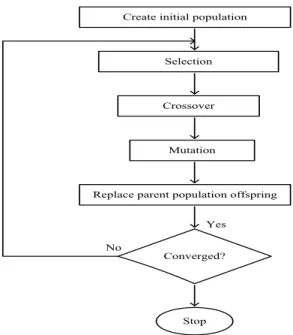
K. Flow Chart of Genetic Algorithm
Create initial population
Selection
Crossover
Mutation
Replace parent population offspring
Stop Converged?
Yes No
Fig. 3. Flow chart of Genetic Algorithm V. PROPOSED ALGORITHM
The step-wise procedure is outlined below:
1. Read data, namely cost coefficients, ai, bi, ci, no. of iterations, length of string, population size, probability of crossover and mutations, power demand and Pmin and
Pmax .
2. Create the initial population randomly in the binary form. 3. Decode the string, or obtain the decimal integer from the
binary string using Eq. (5)
4. Calculate the power in MW generated from the decoded population by using Eq. (17)
max min P - P j min i i j P = Pi i + y (i = 1, 2,....NG, j = 1, 2,..., L)i 2 -1l (17)
Where L is the number of strings or population size, yij is
the binary coded value of the thi substring
5. Check pij
If P >Pij imax, then setP = Pij imax If P < Pij imin, then set P = Pij imin 6. Find fitness if (fi > fmax) then set fmax = fi If fi < fmin then set, fmin = fi
7. Find population with maximum fitness and average fitness of the population.
8. Select the parents for crossover using stochastic remainder roulette wheel selection method.
9. Perform single point crossover for the selected parents. 10. Perform mutation
11. If the number of iterations reaches the maximum, then go to step 12. Otherwise, go to step 2.
12. The fitness that generates the minimum total generation cost is the solution of the problem.
A. Parameter Selection
The genetic algorithm has a number of parameters that must be selected. These include population size,
Generation, Time Limit, and Stall Time Limit:
Population Size', 50,' Generations', 200,' Time Limit', 300,' Stall Time Limit', 300,' StallGenLimit',100.
VI. RESULT AND DISCUSSIONS
MATLAB is a advanced-level language and interactive atmosphere for numerical calculation, visualization, and programming. Using MATLAB, you can examine data, develop algorithms, and generate models and experiment,. The language, tools, and manufacture-in math functions enable you to explore various approaches and reach a solution faster than with spreadsheets or traditional programming languages, such as C/C++ or Java. It has since proceeded into anything much large, and it is used to implement numerical algorithms for a wide range of experiment. The basic language used is very identical to standard linear algebra notation, but there are some extensions that will likely cause you some problems at first.
TABLE I. TEST SYSTEM PROPERTIES [6]
TABLE II
COST COEFFICIENTS AND POWER GENERATION LIMITS OF TEST SYSTEM [6] Gen.
no. P
max
pu P
min
pu aCost Co- efficient
i bi ci 1 0.5 1.5 0.01 0.4 32 2 0.5 0.7 0.02 0.6 60 3 0.1 0.4 0.07 0.095 45 4 0.1 0.5 0.02 1.8 30 5 0.1 0.3 0.02 3 31 6 0.1 0.3 0.02 3 32 TABLE III.
COMPUTATIONAL RESULTS AND GENETIC ALGORITHM SETTING Population Size 50 Crossover probability 0.6 Mutation probability 0.01 Maximum Generation 101 Fcount 5100 Total Power(MW) 292.6732
Fuel Cost (USD/Hr) 801.9099 Total network losses PL
(MW)
9.2732
Number of buses 30
Number of units 6
Number of branches 43
Number of tie lines 6
TABLE IV.
OPTIMAL RESULT OF GA FOR 6 GENERATORS P1 (MW) 176.1416 P2 (MW) 48.3018 P3 (MW) 22.1323 P4 (MW) 23.6347 P5 (MW) 12.0204 P6 (MW) 10.4424 TOTAL POWER 292.6732
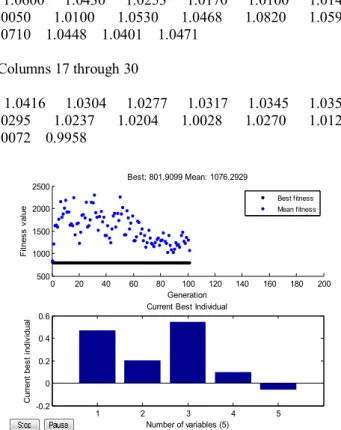
Optimal Economic Load Dispatch for Power Generation Using Genetic Algorithm and figure- 4 shows the iteration result. vv = Columns 1 through 16 1.0600 1.0430 1.0253 1.0170 1.0100 1.0147 1.0050 1.0100 1.0530 1.0468 1.0820 1.0597 1.0710 1.0448 1.0401 1.0471 Columns 17 through 30 1.0416 1.0304 1.0277 1.0317 1.0345 1.0351 1.0295 1.0237 1.0204 1.0028 1.0270 1.0128 1.0072 0.9958
Fig. 4. Fuel cost test system on IEEE 30 bus system. Best Fitness value-801.9099
Transmission Loss-9.2732 (MW) VII. CONCLUSION
In this paper, an approach based on a genetic algorithm has been successfully presented and applied to the generation cost in electric power network to obtain the optimum solution of Economic Load Dispatch (ELD). Operators are used in lagrangian to generate a set of solutions for this problem. Lagrangian method is most useful for large power systems, it lagrangian have well results and it is much faster and more effective than iterative method.
The developed system was then tested and validated on the IEEE30-bus system. Solutions obtained with the developed Genetic Algorithm Optimal Power Flow
program has shown to be almost as fast as the solutions given by a conventional language. Our GAOPF appears to be faster than other published GAOPF methods.
ACKNOWLEDGMENT
The authors would like to thanks Dr. Sanjeev Jain, Director MITS, Gwalior, and M.P. to promoting this work.
REFERENCES
[1] T.Govindaraj, and M.Vidhya. "Optimal Economic Dispatch for Power Generation Using Genetic Algorithm," International Journal Of Innovative Research In Electrical, Electronics, Instrumentation And Control Engineering, voI.2, no. 1, pp. 808-814, Jan. 2014.
[2] R. Ouiddir, M. Rahli, and L. Abdelhakem-Koridak. “Economic Dispatch using a Genetic Algorithm: Application To Western Algeria’s Electrical Power Network,’’ Journal Of Information Science And Engineering, vol.21, pp. 659-668, 2005.
[3] Naveen Kumar, K.P. Singh Parmar, and Surender Dahiya, “A Genetic Algorithm Approach for the Solution of Economic Load Dispatch Problem,” International Journal on Computer Science and Engineering (IJCSE), Vol. 4 No. 06 pp. 1063- 1068, June 2012.
[4] Tarek Bouktir, Linda Slimani, and M. Belkacemi. “A Genetic Algorithm for Solving the Optimal Power Flow Problem,” Leonardo Journal of Sciences, no. 4, pp. 44-58. January-June 2004.
[5] Bishnu Sahu, Avipsa Lall , Soumya Das, and T. Manoj Patra. “Economic Load Dispatch in Power System using Genetic Algorithm,” International Journal of Computer Applications (0975 – 8887) Volume 67, No.7, pp.17- 22, April 2013.
[6] Priyanka Roy, Umesh Kumar Tiwari, Vikas Singh, Md. Zeeshanullah, and A.Chakrabarti. “Genetic Algorithm Based Transmission Loss Constraint Economic Load Dispatch Solution Considering Valve Point Effect,” International Conference on Electrical Engineering and Computer Science Engineering (ICEECS), pp. 9-13, 9 sep, 2012.
[7] Dharamjit, and D.K.Tanti. “ Load Flow Analysis on IEEE 30 bus System,” International Journal of Scientific and Research Publications, vol. 2, no. 11, pp. 1-6, November 2012.
[8] Sevugarathinam MUTHU VIJAYA PANDIAN, and Keppanagowder THANUSHKODI. “Considering transmission loss for an economic dispatch problem without valve-point loading using an EP-EPSO Algorithm,” Turk J Elec Eng & Comp Sci, vol. 20, no. 2, pp. 1259-1267, 2012.
[9] G Kalidas Babu, and Rajesh Kumar Samala. “Network and Generator Constrained Economic Dispatch Using Real and Binary Coded Genetic Algorithms,” G Kalidas Babu et al Int. Journal of Engineering Research and Applications, vol. 3, no. 5, pp. 1185-1192, sep-oct 2013.
[10] BOMMIRANI.B, and THENMALAR.K. “ Optimization Technique for the Economic Dispatch in Power System Operation,” International Journal of
0 20 40 60 80 100 120 140 160 180 200 500 1000 1500 2000 2500 Generation F itn e s s v a lu e Best: 801.9099 Mean: 1076.2929 1 2 3 4 5 -0.2 0 0.2 0.4 0.6 Number of variables (5) C u rr e n t b e s t in d iv id u a l
Current Best Individual
Best fitness Mean fitness
Computer and Information Technology, vol. 2 no. 1, pp. 158-153, jan-2013.
[11] T. Yalcinoz, H. Altun, and M. Uzam. “Economic Dispatch Solution Using A Genetic Algorithm Based on Arithmetic Crossover,” IEEE Porto Power Tech Conference, Porto Portugal, 10-13 September 2001. [12] Thakkar Vishal C. “Optimal Power Flow using Genetic
Algorithm Technique,” National Conference on Recent Trends in Engineering & Technology, 13 may 2011. [13] Satyendra Singh, and K.S. Verma. “Optimal Power
Flow using Genetic Algorithm and Particle Swarm Optimization,” IOSR Journal of Engineering (IOSRJEN), vol. 2, no. 1, pp. 046-049.
[14] Arunpreet Kaur, arinder Pal Singh, and Abhishek Bhardwaj. “Analysis of Economic Load Dispatch Using Genetic Algorithm,” International Journal of Application or Innovation in Engineering & Management (IJAIEM), vol. 3, no. 3, pp. 240-246, march-2014.
[15] Satyendra Pratap Singh, Rachna Tyagi, and Anubhav Goel. “Genetic Algorithm for Solving the Economic Load Dispatch,” International Journal of Electronic and Electrical Engineering, International Research Publication, vol. 7, no. 5, pp. 523-528, 2014.
[16] M. Anuj Gargeya, and Sai Praneeth Pabba. “Economic Load Dispatch using Genetic Algorithm and Pattern Search Methods,” International Journal of Advanced Research in Electrical, Electronics and Instrumentation Engineering, vol. 2, no. 4, pp. 1203-1212, april-2013. [17] Anjali Tikalkar, and Manju Khare. “Economic Load
Dispatch Using Linearly Decreasing Inertia Weight Particle Swarm Optimization,” International Journal of Emerging Technology and Advanced Engineering, vol. 4, no. 1, pp. 668-673, January- 2014.
[18] R. Arul, Dr. G. Ravi, and Dr. S. Velusami. “Non-convex Economic Dispatch with Heuristic Load Patterns using Harmony Search Algorithm,” International Journal of Computer Applications, vol. 16, no. 1, pp. 26-33, February 2011.
[19] U. K. Rout, R. K. Swain, A. K. Barisal, and R. C. Prusty. “Clonal Selection Algorithm for Dynamic Economic Dispatch with Nonsmooth Cost Functions,” International Journal of Scientific & Engineering Research, vol. 2, no. 12, pp. 1-5, December-2011.
Gajendra Sahu was born on jul, 4, 1990 in Gwalior, mp. He received his
B.E. degree in Electrical and Electronics Engineering from Institute Information of Technology and Management (IITM, Gwalior) in Gwalior 2012 and currently pursuing M.E. with specialization in Power System from Madhav Institute of Technology and Science (MITS, Gwalior) in Gwalior (2012-2014).
Kuldeep Swarnkar was born on may, 19, 1984. He received his M.E.
degree in Electrical Engineering from Madhav Institute of Technology and Science (MITS, Gwalior) in Gwalior.
He is currently working as a Professor in the Department of Electrical Engineering, Madhav Institute of Technology and Science (MITS, Gwalior) in Gwalior, M.P. His areas of interest include application of soft computing techniques to different power system problems