Abstract— In the present venture an endeavor is made utilization normal soil acquired from the side of palsana village of Surat. Surat advances improvement of development of exchange, business, administration division adding to ascend in mechanization and encountering fast increasing velocities in urban travel enthusiasm putting weight on confining road space in the consistently changing environment particularly on road running in clayey soil ranges are known for bed condition and erratic conduct for which the nature of soil way add to some degree
The research facility examinations is done to assess engineering properties of characteristic soil as per Indian Standard (1498 – 1970) and consequently methodology is received to alter CBR utilizing compound added substance cement as 1 percent as a part of suitable dose and the outcome got mirroring the adjustments in properties contrasted and the common soil. This will advantage the Road contractors, engineers, arrangement producers and pavement designers too.
Keywords
—
Cement, Soil Stabilization, Strength, SubgradeI. INTRODUCTION
India has diverse structures of soil, however the mother soil comprising almost greatest silica content. To the Civil Engineer, soil is any unestablished gathering of mineral particles shaped by weathering of rocks. A class of soil, known as extensive soils is one of the major provincial soil stores in India, covering a region of around 3.0 lakh, when utilized for highway construction, is generally influenced by natural conditions and they experience impeding volumetric and water driven conductivity changes as a result of the variety in dampness substance. All mud soils are not far reaching and the level of development shifts with the sort of earth mineral dominatingly shows in the soil mass. The vicinity of montmorillonite in these soils gives them high swell-shrink possibilities. These soils are hard when dry, yet lose quality totally when wet. Amid the most recent couple of decades harm because of swelling activity has been unmistakably seen in the semiarid districts as splitting and separation of asphalts, roadways and so forth. Bituminous structures on such poor soil subgrades indicate early troubles bringing about the untimely disappointment of the asphalt. On the off chance that the roads should be made on this soil, it is impractical go for uprooting the whole soil which may
.
turn out to be immoderate, the main option left go to be for adjusting the properties of subgrade to meet standard detail by alteration/adjustment procedures as per the need of asphalt creators as the road needs to shoulder the repetitions applications of vehicle loads and regularly changing environment as well. India is confronted with the huge test of saving and upgrading the transportation roadwork, these require the interest of new inventive material for enhance the steadiness of soils.
II. PROBLEM AREA:
The City of Surat situated at South Gujarat region in India having majority of subgrade soil as black cotton soil. This soil being expansive required special attention for road constructions as well as pavement design as roads are vital to link to communities and sustain the economy and quality of life in society. It has been found amid treatment of different road examination venture assignments for surveying reasons for road disappointments that water has got simple access into the bituminous roads. It soaks into the sub subgrade soil and along these lines brings down its bearing limit, at last bringing about depressions and settlement. In the top bituminous surfacing, raveling, stripping and splitting grow because of water stagnation and its drainage into these layers.
III. OBJECTIVES
The aim is to balance out nearby soil material utilizing substance stabilizer with a basic objective to study the physical & engineering properties of local soil before and after the addition of cement as an additive of 1 percent dosage and to investigate the changes in CBR values and to adopt the optimum value for determining the thickness of flexible pavement design.
IV. LITERATURE REVIEW
3.1 Nandan A. Patel, Prof.C. B. Mishra, Mr. Vasu V. Pancholi (2015) In their paper titled ―Scientifically Surveying the Usage of Terrasil Chemical for Soil Stabilization‖ emphasized that it is the responsibility of the
Alleviating the strength of expansive soil
using cement as an additive
Chaudhari Shivani1 , Chaudhari Riddhi2 , Tabiyar Suman3 , Bholanda Heena4 B.E. Final year
Civil Engineering Students, BVM Engineering College, Vallabh Vidyanagar Prof. C.B. Mishra, Dept. of Civil Engineering, Vallabh Vidyanagar
road authorities to use the local material and correct the soil properties using additives enhancing the strength of soil and make the road durable. The examination was completed to focus first soil engineering properties (with and without stabilizer), standard compaction; four days soaked California Bearing Ratio (CBR), permeability test and cyclic loading test according to codal procurement. A concoction named Terrasil was utilized as stabilizer and it was utilized for altered measurement i.e. 0.041% by dry aggregate weight of soil test according to the convention of Zydex Industries, Vadodara. Test outcome demonstrates that designing properties got modified and CBR on stabilized clayey samples increased considerably, which reflects the lower thickness in correlation with natural characteristic soil properties. Additionally the expense is diminishing which advantages the road builders, engineers, policy makers and pavement designers as well.
3.2 B M Lekha S Goutham, A U Ravi Shankar – (2013) in his work on "L
aboratory investigation of soil stabilized
with nano chemical‖
expresses that the conduct of Black Cotton (BC) soil with and without adjustment was contemplated. A chemical named Terrasil was utilized as stabilizer and it was utilized for distinctive measurements and cured for 7-28 days. Due to the compound response, the soil mass densifies by minimizing the voids in the middle of particles and it make the soil surface impermeable. The vital geotechnical properties of soil were resolved in the research facility. It is noticed that CBR qualities increment with the increment in rate of stabilizer. Penetrability is observed to be nil for treated soil. It makes the dirt impermeable totally. The XRD and SEM investigation led for the soil examples were not ready to legitimize the change for balanced out so. The study implies that addition in measurements of Terrasil as a stabilizer brought about decrement of consistency cutoff points. So it is clear that the substance makes the soil solid. It is noticed that CBR qualities increment with the increment in rate of stabilizer. The perception record expresses those UCS quality increments with expansion in dose of stabilizer and curing period.3.3 K. S. Gandhi (2012) - ―Expansive Soil Stabilization Using Bagasse Ash‖ in this study emphasis is given to expansive clay soil that change fundamentally in volume with change in water substance are the reason for mutilations to structures that cost citizens a few billion dollars yearly in the India. This paper is in view of a portion of the key advances grew in the course of recent years in enhancing our comprehension of the nature and strategies for adjusting and settling broad dirt soils. Subsequently to enhance the quality of far reaching soil of Surat district, bagasse slag utilized as the added substance which build the security of soil and decline the swelling of soil? As bagasse ash is high in silica, calcium, and other minerals is provides the necessary homogenous mass for performing the required test. Diverse tests are done with differing rate of bagasse ash to check the impact on swelling pressure and on essential properties. The findings indicates that Bagasse ash effectively dries wet soils and provides an initial rapid strength gain, which is useful during construction in wet, unstable ground conditions. Bagasse ash also decreases swell potential of expansive soils
by replacing some of the volume previously held by expansive clay minerals and by cementing the soil particles together. This method will be applicable to this region in future, unless there is extensive change in geological formation of the strata.
3.4 Grytan sarkar, md. rafiqul Islam, Muhammed alamgir, md. Rokonuzzaman (2012) ―Study on the Geotechnical Properties of Cement based Composite Fine-grained Soil‖ states that the effect of cement on the performance of soil, collected from Khanjahan Ali Hall at Khulna University of Engineering & Technology (KUET) in Khulna, Bangladesh. The addition of cement was found to improve the engineering properties of available soil in stabilized forms specifically strength, workability, and compaction and compressibility characteristics. Therefore, laboratory tests such as compaction, Atterberg limits, unconfined compressive strength, direct shear and consolidation tests for different percentages of cement content and original soil samples were performed. These test results show that the soil can be made lighter which leads to decrease in dry density and increase in moisture content and reduced compressibility due to the addition of cement with the soil. Besides that the unconfined compressive strength and shear strength of soil can be optimized with the addition of 7.5% of cement content. (Grytan sarkar, md. rafiqul Islam, Muhammed alamgir, md. Rokonuzzaman (2012)
3.5 Ibrahaim M.A. Moafaq, A.A. Abdulrahman, H.A. (2011) – in his study on "Long haul Quality and Durability of Clayey Soil stabilized with Lime" goes on that durability characteristics of clayey soil settled with lime were controlled by coordinating tests contains UCS for tests with the perfect lime percent (4%), and subjected to cycles of the WD, dry-wet and FT durability tests and moreover, long haul soaking and slake test.
V. MATERIALS
Following are the materials which are to be used in this study.
A. Soil
In this study, the soil under investigation is collected from Palsana village of Surat located at 21° 5' 0" North, 72° 59' 0" East, Gujarat. The material is a black cotton soil. These soils passed high strength in summer and decreased rapidly in winter. The soil has a swelling property due to the presence of montmorillonite mineral. In rainy season, these soils become very soft by filling up of water in the cracks and fissures and reduce the bearing capacity of the soils. Due to low bearing capacity construct or maintenance of road is very costly as well as difficult to maintain the quality throughout the life
.
B. Cement
The reaction between clay and cement is thought to be a three-phase mechanism. Cement also bonds with the sandy skeleton of the soil in the conventional way. The cement does not bond with all of the soil particles, but helps to form a stable matrix throughout. The cement has an effect to decrease the liquid limit, plastic limit thereby plasticity index of clayey soils. Cement helps to increase the strength of soils and the strength increases with the curing time. Portland cement is a multi-mineral compound made up of oxides of calcium, silica, alumina and iron. When 1% of cement as per Zydex protocol is mixed with water, cementing compounds
of calcium-silicate-hydrate (CS-H) and
calcium-aluminate-hydrate (C-A-H) are formed and excess calcium hydroxide is released. Some calcium is therefore available to react with the clay particle early in the modification process when the water is added, and additional calcium becomes available later as it forms during cement hydration.
VI. TEST RESULTS
Various tests were performing for identify the Engineering property of soil as per Indian Standard are as below
A. Test Result of Untreated Soil
1) Atterberg Limits of Soil:
They are the basic measure of the critical water contents of a fine-grained soil, such as its shrinkage limit, plastic limit, and liquid limit. As a dry, clayey soil takes on increasing amounts of water, it undergoes dramatic and distinct changes in behavior and consistency and along these lines designing properties are determined. Therefore, the limit between each one state of solid, semi-solid, plastic and liquid can be characterized focused around a change in the Soil's conduct. The cutoff points were refined by Arther Casagrande.
2) Plasticity Index:
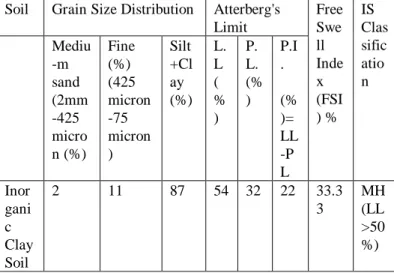
It is the range of water content over which a soil behaves plastically. It is the numerical difference between its liquid limit and its plastic limit, and is a dimensionless number. Both the liquid and plastic limits are moisture contents. Soil is silt of higher plastic (range 20-40) as the value obtained is 22, hence silt + clay content is more.
3) Soil Classification
Soil classification is the arrangement of soils into various groups or subgroups to provide a common language to express briefly the general usage characteristics without detailed descriptions. Unified Soil Classification Systems use simple index properties such as grain-size distribution, liquid limit, and plasticity index of soil. IS code 2720 (part V 1985)
is followed for evaluating the Atterberg’s limits in the laboratory for classification of soil. The soil is characterized as organic clay (MH) with silt of high plasticity as per unified soil classification system (USCS) as fine grained soil passing 0.075 mm sieve is more than 50 percent and liquid limit falls more than 50%. The test result for untreated soil is shown in table 1.
Table 1 Soil Classification, FSI & Atterberg’s Limit
4) Compaction result for Natural Soil
As water is added to a soil at low dampness substance, it gets to be less demanding for the particles to move past each other amid the use of compacting power. The particles come closer, the voids are lessened and this causes the dry thickness to increment. As the water substance builds, the soil particles create bigger water movies around them.
This increment in dry density proceeds till a stage is reached to where water begins possessing the space that could have been involved by the soil grains. In this manner the water at this stage hinders the closer packing of grains and lessens the dry unit weight. The most extreme dry density (MDD) happens at an optimum water content (OMC), and their qualities can be acquired from the Fig. 1.
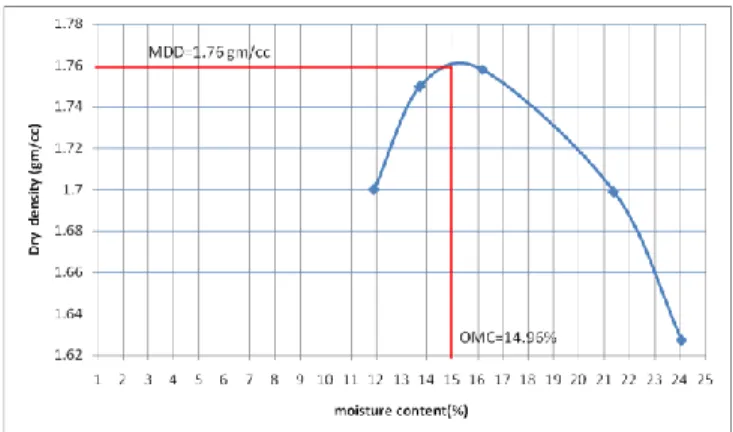
Fig.1 MDD Vs OMC Graph for soil Soil Grain Size Distribution Atterberg's
Limit Free Swe ll Inde x (FSI ) % IS Clas sific atio n Mediu -m sand (2mm -425 micro n (%) Fine (%) (425 micron -75 micron ) Silt +Cl ay (%) L. L ( % ) P. L. (% ) P.I . (% )= LL -P L Inor gani c Clay Soil 2 11 87 54 32 22 33.3 3 MH (LL >50 %)
5) CBR Result of Natural Soil
CBR is implied for deciding the resistance of the subgrade to deformation under the load from vehicle wheels. The more strong the subgrade (the higher the CBR perusing) the less thick it is important to outline and build the road pavement; this gives an extensive expense sparing. Thus CBR-quality is utilized as a record of soil quality and bearing limit. According to Codal provision of IS : 2720 (Part 16 – 1987) CBR test was performed for 100 % natural clayey soil with MH class remolded at OMC (16.22%) & MDD (1.77 gm/cc). The extra charge weight of 5.0 kg is put on the example and was soaked for 96 hours. During testing, initial loading is applied on it so that the plunger is properly in contact with soil and penetration values are consistent with respect to the load applied. The results indicate that 2.5 mm penetration is higher which needs to be taken for design purpose.
Fig.2 Load Penetration Curve for natural soil CBR value from Graph
6) Test Result for Natural Soil Treated Soil with 1% Cement:
The gathered soil with 1 % cement substance was oven dried at 100°C overnight to uproot dampness and curb microbial movement. Oven specimens were blended completely by hand in a substantial plate in a dry state. The list property of test got for Atterberg's test is having liquid limit 51%, plastic limit 31% and plasticity index as 20%.
Fig.3
MDD vs. OMC for soil+1% Cement lIn field control, most extreme dry thickness for particular data vitality level is done on fine grained soil with 1 % concrete as added substance with suitable measure of water is added to lubricate up the contact surfaces of soil particles and enhance the soils compressibility matrix added before accomplish compaction mechanically expanding the thickness of soil. The densification of soil is accomplished by diminishing air void space. The MDD obtained is 1.76 gm/cc while as OMC is 14.96%.
Fig. 4 CBR Graph for soil + 1% Cement CBR value from Graph Std. Penetration Load*100/St. load CBR % 2.5 mm (145.79*100)/1370 10.641 5 mm (231.43*100)/2055 11.262
There is a significant change in CBR value is noted for MH soil with 1% PPC content. The graph shows that the value of CBR at 5 mm is more compared to 2.5 mm penetration. Tests were repeated as per the codal practice and values again obtained for 5 mm penetration is more than CBR at 2.5 mm penetration, hence CBR at 5 mm is considered for carrying out study Std. Penetration Load*100/Std. load CBR % 2.5 mm (48.94*100)/1370 3.58 5 mm (61.17*100)/2055 2.98
VII. CONCLUSION
Legitimate field examinations, material recuperation and exploration focus mix arrangement techniques are basic in ensuring the strategy's achievement. These preliminary examinations led to stabilize the MH category soil with high plasticity with 1% Cement content help in giving fundamental information to quality control design a more practical way to deal with bituminous development. The going with key conclusions drawn after investigative examinations is:
Soil adjustment with cement offers the bitumen build a different option for the conventional "evacuate and replace" techniques normally used. The procedure not just offers the capacity to improve the designing attributes of an unsatisfactory soil, additionally offers the specialist a more supportable way to deal with bituminous road development. It has been noticed that liquid most extreme decreases and plastic utmost of restriction qualities are declining yet the plasticity is reducing differentiated and untreated soil. The augmentation in most great dry thickness is a delayed consequence of flocculation and agglomeration of soil with low versatility soil particles with cement which is a direct result of the outcome of starting covering of soils by cement to structure greater total, which in this way have greater spaces.
VIII. REFERENCES
B M Lekha S Goutham, A U Ravi Shankar, ―Laboratory investigation of soil stabilized with nano chemical‖
Proceedings of Indian Geotechnical Conference December 22-24, 2013, Roorkee
Christopher Holt (2010), Chemical Stabilization of Inherently Weak Subgrade Soils for Road Construction – Applicability in Canada, Development of New Technologies for Classification of Materials Session of the Annual Conference of the Transportation Association of Canada Halifax, Nova Scotia.
Grytan Sarkar, Md. Rafiqul Islam, Muhammed Alamgir, Md. Rokonuzzaman (October 2012), Study on the Geotechnical Properties of Cement based Composite Fine-grained Soil International Journal of Advanced Structures and Geotechnical Engineering, ISSN 2319-5347, Vol. 01, No. 02
Ibrahaim, M.A., Moafaq, A.A. and Abdulrahman, H.A. (2011), Long Term Strength and Durability of Clayey Soil Stabilized With Lime, Eng. and Tech. Jl, Vol.29, No.4.
IS: 2720 (Part II) – 1973, Determination of Water Content. IS: 2720 (Part IV) – 1985, Determination of Grain Size Analysis. IS: 2720 (Part V) – 1985, Determination of Liquid and Plastic Limit. IS: 2720 (Part VIII) – 1987, Determination of Water Content – Dry Density Relation Using Light Compaction.
IS: 2720 (Part XVI) – 1997, Laboratory Determination of CBR.
IS: 1498 – 1987, Classification and Identification of Soils for General Engineering Purposes.
K. S. Gandhi, ―Expansive Soil Stabilization Using Bagasse Ash‖, International Journal of Engineering Research & Technology (IJERT) Vol. 1 Issue 5, July – 2012.
Mehdi Gharib, Hamidreza Saba, Arash Barazesh (2012), An experimental study for identification and comparison of plastic index and shrinkage properties of clay soils with the addition of cement, European Journal of Experimental Biology.
Mohammed Y. Fattah, Firas A. Salman and Bestun J. Nareeman (2010),A treatment of expansive soil using different additives, Acta Montanistica Slovaca.
Nandan A. Patel, Prof.C. B. Mishra ,Mr. Vasu V. Pancholi, ―Scientifically Surveying the usage of terrasil chemical for soil stabilization‖, International
Journal of Research in Advent Technology, Vol.3, No.6, June 2015.
Omer, N.M. (2012), Soil stabilization by chemical agent. Geotech. Geol.Eng,30, 1345–1356.
S. Bhuvaneshwari, R. G. Robinson, S. R. Gandhi (2005), Stabilization of Expansive Soils Using Fly ash Fly Ash India, New Delhi.
Y. Keerthi, P. Divya Kanthi, N. Shyam Chamberlin, B. Satyanarayana (April 2013), Stabilization of Clayey Soil using Cement Kiln Waste, International Journal of Advanced Structures and Geotechnical Engineering ISSN 2319-5347, Vol. 02, No. 02