Anticancer drugs-related QTc prolongation, torsade de pointes
and sudden death: current evidence and future research
perspectives
Jialin Duan
1, Jingwen Tao
1, Maocai Zhai
1, Chengpeng Li
2, Ning Zhou
1, Jiagao Lv
1,
Lin Wang
1, Li Lin
1and Rong Bai
3,41Division of Cardiology, Department of Internal Medicine, Tongji Hospital, Tongji Medical College, Huazhong University of
Science and Technology, Wuhan, P.R. China
2Department of Cardiology, Wuhan Hospital of Integrated Traditional Chinese and Western Medicine, Wuhan, P.R. China 3Department of Cardiology, An Zhen Hospital, Capital Medical University, Beijing, P.R. China
4Texas Cardiac Arrhythmia Institute at St. David’s Medical Center, Austin, TX, USA Correspondence to: Li Lin, email: [email protected]
Rong Bai, email: [email protected]
Keywords: anticancer therapy; QT interval prolongation; torsade de pointes; molecularly targeted drugs Received: June 01, 2017 Accepted: March 13, 2018 Published: May 22, 2018
Copyright: Duan et al. This is an open-access article distributed under the terms of the Creative Commons Attribution License 3.0 (CC BY 3.0), which permits unrestricted use, distribution, and reproduction in any medium, provided the original author and source are credited.
ABSTRACT
Anticancer drugs may have proarrhythmic effects including drug-induced QT interval prolongation, which is of particular importance because it can lead to a fatal polymorphic ventricular tachycardia termed torsade de pointes (TdP). QT interval prolongation and TdP are rare life-threatening untoward effects of anticancer therapy, particularly with arsenic trioxides and anthracyclines, and even some novel molecular targeted drugs touted as ‘tumor specific’. Several factors that affect myocardial repolarization can further increase the risk of TdP. This article reviews the mechanism of QT interval prolongation, risk factors for TdP and the QT toxicity of anticancer drugs as well as its management. Specific attention should be paid to high-risk populations such as patients with underlying heart diseases, electrolyte imbalance and bradycardia. To minimize the occurrence of QT interval prolongation and TdP, it is advisable to conduct a careful risk factor assessment before antitumor therapy. To this end, several new biomarkers have been introduced to predict TdP triggering and recent studies have pointed out the potential clinical relevance of genetic testing.
INTRODUCTION
Cancer treatment has greatly benefited from recent
developments in drug therapy. However, anticancer drugs
despite their increased target specificity are not without
toxicities, and among cardiac ones, prolongation of the QT
interval is particularly concerning [1]. Many drugs affect
heart repolarization and prolong the QT interval, thereby
increasing the risk for torsades de pointes (TdP), a lethal
ventricular arrhythmia, and sudden cardiac death.
QT-interval prolongation and TdP not uncommonly underlie
drug withdrawal from the market [2].
The term torsades de pointes (Figure 1) was first
introduced by Dessertenne in 1966 as “a polymorphic
ventricular tachycardia where QRS complexes
twist around an isoelectric line” on the surface
electrocardiogram (ECG) [3, 4]. Although polymorphic
ventricular tachycardia with normal QT interval is also
called TdP, its treatment is very different and most scholars
stress that TdP only refers to polymorphic ventricular
tachycardia with prolonged QT interval [5].
www.oncotarget.com
Oncotarget, 2018, Vol. 9, (No. 39), pp: 25738-25749
Review
QT INTERVAL MEASUREMENT
The QT interval as measured on an ECG is measured
from the beginning of the QRS complex to the end of the
T wave, reflecting the depolarization and repolarization of
both left and right ventricles. Usually, the QT interval is
measured in lead II [12] and should be determined as a mean
value derived from at least 3–5 cardiac cycles [6]. The QRS
duration also influences the QT interval when perturbed
by pre-excitation, bundle branch block, or pacemaker
implantation. In these situations, the JT interval may offer
more information [7, 8, 9]. Figure 2 QT and JT interval
measurement with ECG [9], although standards for the JT
interval are unclear at this time. The QT interval is closely
related to heart rates, so a correction of the QT interval for
heart rates is necessary. Bazett’s formula (QT
C=QT/RR
1/2)
and the Fridericia formula (QT
C=QT/RR
1/3) are widely used
to correct the QT interval. Bazett’s formula is considered
to be the standard for this type of measurement although it
may exaggerate the QT interval at fast heart rates [10, 11].
The Fridericia formula has similar problems but is more
accurate with tachycardia [10, 11], and for patients with
atrial fibrillation, the Fridericia formula is preferred [13].
A QT
C<450 ms in women and a QT
C<430 ms in men is
considered abnormal with a stable sinus rate. QT
Cvalues
from 450 to 470 ms in women and 430 to 450 ms in men
are considered borderline [6]. Values of QT
C>500 ms are
considered strikingly abnormal because deadly arrhythmic
events can occur at this value.
MECHANISM OF DRUG-INDUCED QT
PROLONGATION
The QT interval as measured by ECG represents
the total duration of ventricular depolarization and
repolarization. Generally, the process of ventricular
depolarization is much shorter than that of
repolarization. Hence, factors that prolong ventricular
action potential duration, especially repolarization,
prolong the QT interval. An increase in the inward
current and a decrease in an outward current will delay
action potential duration. Among the ion currents of
the action potential, two delayed rectifier potassium
current subtypes, I
Kr(rapid) and I
Ks(slow) are important
to ventricular repolarization [14]. Blockade of I
Krwhich
is encoded by the human ether-a-go-go-related gene
(HERG) of chromosome 7 is the most common target
of drug-induced QT prolongation [15]. The HERG
channel (the KCNH2 potassium voltage-gated channel)
is responsible for most QT-associated drug toxicity.
However, HERG channel blockade is not necessarily
related to QT prolongation. For example, raloxifene
inhibits cardiac delayed rectifier potassium currents but
does not lead to QT prolongation [16], underscoring
uncertainties regarding the mechanism of drug-induced
QT prolongation.
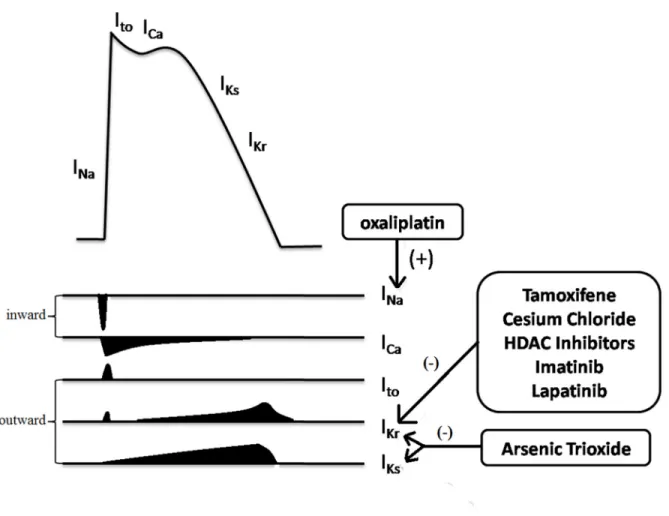
Figure 3 Arsenic trioxide blocks both I
Krand I
Ksat
clinically relevant concentrations and activates the I
K-ATPwhich maintains normal repolarization [17]. Oxaliplatin
might prolong QT interval by increasing Na
+influx due
to prolonged opening of Na
+channels [18]. However, the
mechanisms underlying QT toxicity of many molecularly
targeted cancer drugs need to be defined.
RISK FACTORS AND PREMONITORY
SIGNS OF TDP IN ECG
There are many risk factors (Table 1) for
drug-induced long QT syndrome (diLQTS), including those
that damage repolarization reserve, a term introduced by
Roden [19] to reflect that normal cardiac repolarization
depends on multiple ion currents which provide some
redundancy or “reserve,” which protects against excessive
QT prolongation by xenobiotics [19].
The ECG often features predictors of TdP. First,
significant QT and QTc interval prolongation is essential
for TdP—each 10-ms increase in QTc contributes a ~5–
7% exponential increase in TdP risk [20]. Almost all case
reports of TdP caused by antineoplastic drugs occurred
with a QTc>500 ms. Secondly, “short-long-short” patterns
of R-R intervals (Figure 4) are often observed prior to
TdP and this pattern consists of short-coupled premature
ventricular complex (PVC) followed by a compensatory
pause and then a second PVC that typically falls close to
the peak of the T wave [5]. The first PVC is thought to
increase the heterogeneity of repolarization of the next
sinus beat and provoke TdP. Thirdly, T-wave alternans
(TWA; Figure 5) which is a rare but dangerous ECG
manifestation of TdP, manifests as a regular alternation
of T-wave morphology with each beat [21] reflecting an
instability of ventricular repolarization that predisposes to
TdP.
CLASSIC ANTINEOPLASTIC DRUGS
Arsenic trioxide
Arsenic trioxide, which is widely used in patients
with acute promyelocytic leukemia (APL), might cause
prolongation of the QT interval and TdP at therapeutic
doses [22]. Previous studies suggest that—compared with
baseline—the QT
Cinterval was prolonged by 30–60 ms
in 36.6% of treatment courses, and by more than 60 ms in
35.4% of patients [23]. The precise mechanism of arsenic
trioxide-induced QT prolongation is complicated and the
research results differ among species [24]. Furthermore, a
recent study suggests that arsenic trioxide-induced cardiac
fibrosis may involve in diLQTS [25]. In reported cases,
arsenic trioxide-induced TdP frequently occurred several
(usually more than 20) days after the start of therapy
and other risk factors were present (Table 1) [26, 27],
emphasizing the need for monitoring ECG and serum
electrolyte data throughout therapy. Mild prolongation of
the QT interval (440–500 ms) is common during treatment
and does not limit the use of arsenic trioxide. Alpha lipoic
acid has been reported to be protective against arsenic
trioxide-induced QT interval prolongation in anesthetized
guinea pigs [28], suggesting a potential approach for
preventing arsenic trioxide-induced LQTS.
Anthracyclines
Anthracyclines are effective for treating various
tumors, including solid ones, and hematologic
malignancies. However, the severe cardiotoxicity
of anthracyclines has limited their use. QT interval
prolongation and TdP are important signs of cardiotoxicity
and there are several mechanisms of
induced LQTS including effects on cardiomyocytes and
ion currents. A plausible explanation for
anthracycline-induced cardiomyocyte injury is the generation of reactive
oxygen species (ROS) leading to oxidative stress [29,
30]. Ion channel effects also contribute to
anthracycline-induced QT prolongation. Anthracycline treatment can
increase sensitivity to the pro-arrhythmic potential of I
Kr-blocking drugs and reduce redepolarization reserve [31]
increasing patient susceptibility to drugs that promote
TdP. Several cases of anthracycline-induced LQTS have
been reported [32], mostly in female patients, one of
whom died of TdP and ventricular fibrillation [33]. Most
patients in the study were within the recommended safe
dose range and the risk was conferred from weeks to years
of anthracycline therapy. Risk factors such as hypokalemia
and drug-drug interactions were common in these cases,
specifically interactions between azole derivatives and
arsenic trioxide. Dexrazoxane is FDA approved for
prevention of anthracycline cardiotoxicity in women with
breast cancer.
Other classic drugs
Tamoxifen and its derivatives (4-hydroxytamoxifen)
have been associated with QT interval alterations
likely due to HERG potassium channel blockade [33].
4-hydroxytamoxifen has been reported to inhibit K
+currents in mouse ventricular myocytes [34], and effects
on calcium channels also contribute to QT-interval
prolongation. A recent study suggests that high-dose
tamoxifen decreases contraction amplitude, slows
relaxation, and decreases the Ca
2+transient amplitude,
which may explain tamoxifen-induced LQTS [35].
Platinum compounds have been associated with
QT interval prolongation and TdP, especially oxaliplatin
[36, 38, 39]. Oxaliplatin can increase Na
+influx by
prolonging Na
+channel opening, thereby affecting cardiac
repolarization [18]. Acetyl-L-carnitine, DL-α-lipoic acid
and silymarin can ameliorate cardiotoxicity associated
with cisplatin in rats [37], but further studies are needed
before human use is considered.
Cesium chloride, an alternative or second-line
treatment for several cancers, also has been reported
Figure 3: Multiple ion currents involved in the myocardial action potential.
Among them, IKr (HERG) is the most common target for anticancer drugs induced QT prolongation. Arsenic trioxide and oxaliplatin prolong the QT interval in unique ways. (+) represented for enhancing and (-) for inhibiting. Ito, transient outward potassium current.Figure 4: “Short-long-short” pattern prior to triggering a TdP.
Table 1: Common clinical risk factors for drug-induced QT prolongation and TdP [19]
Female
Conditions predisposing to heightened QT prolongation and risk of arrhythmia
Heart disease
Congestive heart failure
Left-ventricular hypertrophy
Hours following conversion of atrial fibrillation to sinus rhythm
Congenital long-QT syndrome (may be clinically unrecognized)
Bradycardia and conduction disease
Increased drug bioavailability
Altered function of specific cytochrome P450 (CYP450) isoforms (for liver metabolized drugs) Genetic variants
Concomitant inhibitory drugs
Liver disease
Altered renal or liver function (for renally or hepatically excreted drugs)
Electrolyte imbalance
Hypokalaemia
Hypomagnesaemia
Hypocalcaemia (possible)
Administration of other drugs which might cause QT prolongation
to induce LQTS [41, 42, 43, 44]. TdP occurred several
weeks to one year after cesium therapy in the presence
of multiple risk factors (female gender, hypokalemia, and
bradycardia). Cesium chloride blocks HERG potassium
channels, prolonging the QT interval and inducing TdP
[45]. Prussian blue has been reported to treat cesium
chloride-induced LQTS [41].
5-fluorouracil, Cesium chloride, cyclophosphamide,
paclitaxel and docetaxel are often associated with
QT-interval prolongation [40], but this complication is
infrequent and often due to high doses of the drugs or to
drug-drug interactions.
NOVEL ANTINEOPLASTIC DRUGS
Trastuzumab
Trastuzumab, a monoclonal antibody against the
Her2 signaling pathway, is widely used in Her2 metastatic
breast carcinoma and acute trastuzumab infusion has been
shown to have no effect on cardiac repolarization and
the QT interval [47]. However, a recent study suggests
that long-term (12 weeks) treatment with trastuzumab
significantly prolonged QT intervals and increased QTd
(QT dispersion) in patients with breast cancer [46]. Thus,
chronic cardiomyocyte toxicity of trastruzumab may
contribute to QT alterations. ACE inhibitors and
beta-blockers can prevent trastuzumab-induced cardiotoxicity
and recent clinic trials suggest that combined therapy with
ACE inhibitors/angiotensin receptor blockers and
beta-blockers may prevent trastuzumab-related cardiotoxicity
[48].
HDAC inhibitors
QT prolongation and TdP has also been observed
in patients taking histone deacetylase with prolongation
of the QT interval and sudden cardiac death in clinical
trials. In a phase II study with 15 patients with metastatic
neuroendocrine tumors, after an infusion of depsipeptide,
one patient died suddenly and this was attributed to
possible fatal ventricular arrhythmia. Two other patients
had asymptomatic nonsustained ventricular tachycardia,
and prolonged QT was noted in three patients [49].
Vorinostat, a HDAC inhibitor used to treat cutaneous
T-cell lymphoma (CTCL), has been reported to induce
TdP in a 49-year-old African American man [50]. Other
HDAC inhibitors, such as romidepsin and LAQ824 have
also been associated with QT-interval prolongation, but
no fatal ventricular arrhythmia has been reported [51,
52]. HDAC inhibitor-induced QT interval prolongation
and TdP is thought to occur via HERG channel blockade,
but this is uncertain. The development of new HDAC
inhibitors that are highly efficacious but with weak
affinity for hERG may offer a way to prevent such adverse
reactions.
Tyrosine kinase inhibitors
The development of tyrosine kinase inhibitors
(TKIs) is one of the most important advances in
anticancer therapy these years. They have been widely
used in solid tumors and hematologic malignancies.
However, their use has been associated with underlying
cardiac toxicities including hypertension, left ventricular
dysfunction and QT prolongation [53]. Many TKIs,
including crizotinib, ponatinib, nilotinib, cediranib,
vandetanib, lapatinib, sunitinib, Bosutinib, Dasatinib,
Lenvatinib, Osimertinib, Pazopanib, Ceritinib, imatinib,
are associated with QT prolongation [54–61, 84–90].
Among them, Crizotinib deserves special mentioned.
Crizotinib, an anaplastic lymphoma kinase (ALK)
inhibitor, is FDA-approved for the treatment of
non-small cell lung carcinoma (NSCLC) [62]. However,
it has been associated with QT bradycardia and
prolongation. In two clinical trials, 4/306 with QTc
≥500 ms and ΔQTc ≥60 ms in 10/289 were observed
[63]. Besides, according to Ou’s research, there was
an average decrease of 26.1 beats per minute (bpm)
from pretreatment heart rate (HR) among all patients
on crizotinib [64]. As mentioned, QT prolongation
is more dangerous with bradycardia, so carefully
monitoring in patients under the treatment of crizotinib
is necessary. According to the formal studies, imatinib
could preferentially block the open HERG channel,
contributing to QT interval prolongation [65]. Lapatinib
can block the HERG channel in transfected HEK293
cells and prolong the action potential duration [66],
prolonging the QT interval. These data suggest that
HERG channel blockade may explain QT prolongation,
but more work is required.
Rituximab
Rituximab is an anti-CD20 monoclonal antibody
and effective for patients with lymphoid malignancies.
However, cardiotoxicity of rituximab is likely
under-reported. A case report regarding rituximab-induced
polymorphic ventricular tachycardia [67] suggests that
a female patient with malignant lymphoma who had
undergone atrioventricular nodal ablation and pacemaker
implantation, developed syncope due to polymorphic
ventricular tachycardia during an initial rituximab
infusion. Unfortunately, the ECG was not timely, and the
arrhythmia was recorded by intracardiac electrogram from
pacemaker interrogation, complicating the recognition
of TdP. The QT interval was prolonged according to the
ECG recorded later, underscoring the possibility that TdP
should not be excluded. Other cardiac adverse reactions
from rituximab, including acute coronary syndromes and
complete atrioventricular block were observed [68, 69,
70], but how these occurred is unclear.
Combretastatin A4 phosphate
Combretastatin A4 phosphate (CA4P) is a
vascular-disrupting agent that targets existing tumor blood vessels
can causes tumor necrosis. Adverse reactions after
intravenous infusion of CA4P have been documented
in a pilot study as was elevated blood pressure (46.7%),
QTc prolongation (23.3%), elevated temperature
(13.3%), and headache (10%), as well as by nausea and
eye infection(6.7%) [71]. In a single-dose phase I study
of patients with advanced cancer, significant increases
in QTc intervals were observed at 3 or 4 h after CA4P
infusion [72]. Two cases of CA4P-induced Takotsubo
cardiomyopathy and QT interval prolongation were also
reported [73] and for these two cases, elderly females who
received combretastatin suffered severe decreased left
ventricular systolic function and significant wall-motion
abnormalities, but acute coronary syndrome was excluded
suggesting that this acute myocardial injury might be
associated with combretastatin.
Other molecularly targeted drugs
Vemurafenib, a BRAF inhibitor, is effective for
treating patients with BRAF V600E mutation-positive
inoperable and metastatic melanoma but this drug is
associated with QT prolongation. In a single-arm,
open-label, expanded access study of vemurafenib among 374
patients, 2 patients were discontinued because of recurrent
QT prolongation [74]. Thus, regular monitoring of ECGs
Table 2: Antineoplastic drugs that prolong the QT interval
Drugs
Effect of QT
TdP
References
Classic drugs
Arsenic Trioxide
37% with 30–60 ms↑, 35%
with > than 60 ms↑
+
[23, 26, 27]
Anthracycline
9.56 ms↑in doxorubicin
therapy
+
[32]
Tamoxifen
Dose related
possible
[34]
Platinum compounds
6.25% in cisplatin treatment,
no data for oxaliplatin
treatment
+
(oxaliplatin)
[36, 38, 39]
5-fluorouracil (5-FU)
Significant increases in
QTmax and QTd were
observed as early as 24 h
after 5-FU treatment
−
[40]
Cesium chloride
QT prolongation usually
occurs with total cesium
intakes of 6 g/day
+
[41–44]
Molecularly-targeted drugs
Trastuzumab
Prolongs QT interval with
long-term treatment (12
weeks)
−
[46]
HDAC inhibitors
36% with vorinostat
treatment
(vorinostat and depsipeptide)
+
[49–52]
Rituximab(possible)
1 case report
possible
[67]
TKIs
Varieties of TKIs could lead
to QT interval prolongation.
−
[54-61, 84-90]
CA4P
23.3% QTc prolongation
−
[71]
BRAF inhibitors
Vemurafenib and Dabrafenib
−
[74, 91]
Eribulin
a minor prolongation of QTc
−
[92]
is recommended during vemurafenib therapy [75]. Another
BRAF inhibitor, Dabrafenib, has also been associated with
QT prolongation [91].
Other molecular targeted drugs such as Eribulin
(microtubule inhibitor), Bortezonib (proteasome inhibitor),
are also associated with QT problems [76, 92, 93], but TdP
has not been reported.
DISCUSSION
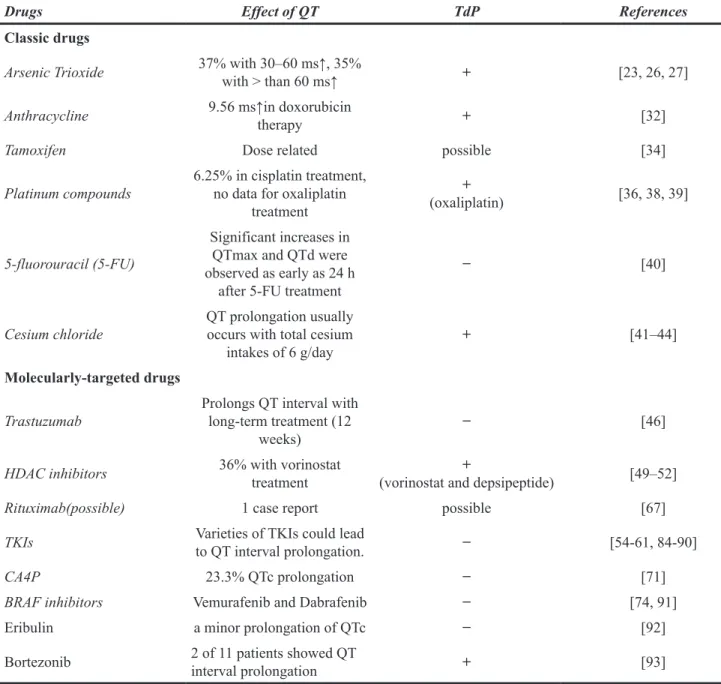
Antineoplastic drugs that prolong the QT interval
are listed as Table 2. Other common cardiotoxicities of
anticancer drugs include left ventricular dysfunction and
myocardial ischemia. Anthracyclines, anti-Her2 agents
and anti-VEGF treatments were commonly associated
with acute or chronic heart failure during anticancer
therapy [94]. Takotsubo syndrome of cardiomyopathy
(ballooning of left ventricle) was observed in two men
treated with bevacizumab for metastatic cancer [95]. The
myocardial ischemia most often associated with 5-FU
or its fluoropyrimidine prodrug capecitabine is coronary
vasospasm [96]. Bevacizumab can also lead to arterial
thromboembolic events, including myocardial infarction
in 0.6---1.5% of patients [97].
Benefit/risk evaluations are warranted to improve
safety of cancer therapy. Special attentions should be paid
for patients undergoing chemotherapy with other factors
that increase the risk of TdP, such as hypokaliemia, use
of antibiotics that can prolong the QT (macrolides,
quinolones) and use of psychotropic drugs. Because TdP
is lethal, risk factors must be assessed and the risk must
be managed where possible. Thus, more precise predictors
for TdP are needed. New noninvasive biomarkers have
been introduced to predict potential risks of drug-induced
TdP. For example, T-wave morphology such as
T(peak)-T(end) intervals, notched T wave, and giant T-U waves
correlate with the risk of TdP. T(peak)-T(end) of 117 ms is
also a reliable discriminator [77, 78]. Microvolt TWA may
predict risks for sudden cardiac death [79] being useful in
drug-induced LQTS. Index of cardiac electrophysiological
balance (iCEB=QT/QRS) can help predict drug-induced
cardiac arrhythmias including ventricular tachycardia/
ventricular fibrillation (VT/VF) and TdP and may be more
useful than current biomarkers [80]. Pharmacogenomics
also may offer ways for predicting drug-induced LQTS.
As genetic test has become less expensive in few years,
more and more researches based on large populations
have been investigated and more variants have been
found. Both pharmacokinetics and pharmacodynamics
are associated with diLQTS [81]. Interestingly, five to
nineteen percent of patients with drug-induced torsade de
pointes carry mutations in genes involved in congenital
long QT syndrome [82]. Besides, genes that affect the
drug metabolism such as cytochrome P450 substrates
have also been proved with diLQTS [83]. Thus, a genetic
background may be one of several factors for drug-induced
LQTS. Also, specific drugs may have unique mechanisms
of inducing TdP. Still, pharmacogenomics for predicting
LQTS and TdP has the potential to be helpful in the future.
Abbreviations
TdP: torsade de pointes; SNP: single nucleotide
polymorphism; HERG: human ether-a-go-go-related
gene; ECG: electrocardiogram; TWA: T wave alternans;
PVC: premature ventricular complex; APL: acute
promyelocytic leukemia; LQTS: long QT syndrome;
ROS: reactive oxygen species; Top2β:
topoisomerase-II β; EDTA: ethylenediaminetetraacetic acid; HDAC:
histone deacetylase; CTCL: T-cell lymphoma; CA4P:
Combretastatin A4 phosphate; iCEB: Index of cardiac
electrophysiological balance; GWAS: Genome wide
association studies; SJS/TEN: Stevens-Johnson syndrome/
toxic epidermal necrolysis; diTdP: drug-induced torsade
de pointes.
CONFLICTS OF INTEREST
The author states no conflict of interest.
FUNDING
L Lin is supported by the National Natural Science
Foundation of China (NSFC-81372402). R Bai is
supported from China by the Program for New Century
Excellent Talents in University (NCET-09-0376); the
National Natural Science Foundation (NSFC-81370290)
and the Scientific Research Foundation for the Returned
Overseas Chinese Scholars (SFR ROCS 2008-101).
N Zhou is supported by the National Natural Science
Foundation of China (NSFC-81100087).
REFERENCES
1. Bagnes C, Panchuk PN, Recondo G. Antineoplastic chemotherapy induced QTc prolongation. Curr Drug Saf. 2010; 5:93–96.
2. Roden DM. Drug-induced prolongation of the QT interval. N Engl J Med. 2004; 350:1013–22.
3. Dessertenne F. [Ventricular tachycardia with 2 variable opposing foci]. [Article in French]. Arch Mal Coeur Vaiss. 1966; 59:263-72.
4. Kallergis EM, Goudis CA, Simantirakis EN, Kochiadakis GE, Vardas PE. Mechanisms, risk factors, and management of acquired long QT syndrome: a comprehensive review. Sci World J. 2012; 2012:212178.
5. Drew BJ, Ackerman MJ, Funk M, Gibler WB, Kligfield P, Menon V, Philippides GJ, Roden DM, Zareba W, American Heart Association Acute Cardiac Care Committee of the Council on Clinical Cardiology; the Council on Cardiovascular Nursing, and the American College of
Cardiology Foundation. Prevention of torsade de pointes in hospital settings: a scientific statement from the American Heart Association and the American College of Cardiology Foundation. Circulation. 2010; 121:1047–60.
6. Goldenberg I, Moss AJ, Zareba W. QT interval: how to measure it and what is “normal”. J Cardiovasc Electrophysiol. 2006; 17:333–36.
7. Tsai SF, Houmsse M, Dakhil B, Augostini R, Hummel JD, Kalbfleisch SJ, Liu Z, Love C, Rhodes T, Tyler J, Weiss R, Hamam I, Winner M, Daoud EG. QTc compared to JTc for monitoring drug-induced repolarization changes in the setting of ventricular pacing. Heart Rhythm. 2014; 11:485–91.
8. Crow RS, Hannan PJ, Folsom AR. Prognostic significance of corrected QT and corrected JT interval for incident coronary heart disease in a general population sample stratified by presence or absence of wide QRS complex: the ARIC Study with 13 years of follow-up. Circulation. 2003; 108:1985–89.
9. Zhou SH, Wong S, Rautaharju PM, Karnik N, Calhoun HP. Should the JT rather than the QT interval be used to detect prolongation of ventricular repolarization? An assessment in normal conduction and in ventricular conduction defects. J Electrocardiol. 1992; 25:S131–36.
10. Indik JH, Pearson EC, Fried K, Woosley RL. Bazett and Fridericia QT correction formulas interfere with measurement of drug-induced changes in QT interval. Heart Rhythm. 2006; 3:1003–07.
11. Luo S, Michler K, Johnston P, Macfarlane PW. A comparison of commonly used QT correction formulae: the effect of heart rate on the QTc of normal ECGs. J Electrocardiol. 2004; 37:S81–90.
12. Rautaharju PM, Surawicz B, Gettes LS, Bailey JJ, Childers R, Deal BJ, Gorgels A, Hancock EW, Josephson M, Kligfield P, Kors JA, Macfarlane P, Mason JW, et al.; American Heart Association Electrocardiography and Arrhythmias Committee; Council on Clinical Cardiology; American College of Cardiology Foundation; Heart Rhythm Society; and Endorsed by the International Society for Computerized Electrocardiology. AHA/ACCF/HRS recommendations for the standardization and interpretation of the electrocardiogram: part IV: the ST segment, T and U waves, and the QT interval: a scientific statement from the American Heart Association Electrocardiography and Arrhythmias Committee, Council on Clinical Cardiology; the American College of Cardiology Foundation; and the Heart Rhythm Society. J Am Coll Cardiol. 2009; 53:982–91. 13. Musat DL, Adhaduk M, Preminger MW, Arshad A,
Sichrovsky T, Steinberg JS, Mittal S. Correlation of QT interval correction methods during atrial fibrillation and sinus rhythm. Am J Cardiol. 2013; 112:1379–83.
14. McCauley M, Vallabhajosyula S, Darbar D. Proarrhythmic and Torsadogenic Effects of Potassium Channel Blockers in Patients. Card Electrophysiol Clin. 2016; 8:481–93.
15. Vandenberg JI, Perry MD, Perrin MJ, Mann SA, Ke Y, Hill AP. hERG K(+) channels: structure, function, and clinical significance. Physiol Rev. 2012; 92:1393–478.
16. Liu H, Yang L, Jin MW, Sun HY, Huang Y, Li GR. The selective estrogen receptor modulator raloxifene inhibits cardiac delayed rectifier potassium currents and voltage-gated sodium current without QTc interval prolongation. Pharmacol Res. 2010; 62:384–90.
17. Drolet B, Simard C, Roden DM. Unusual effects of a QT-prolonging drug, arsenic trioxide, on cardiac potassium currents. Circulation. 2004; 109:26–29.
18. Adelsberger H, Quasthoff S, Grosskreutz J, Lepier A, Eckel F, Lersch C. The chemotherapeutic oxaliplatin alters voltage-gated Na(+) channel kinetics on rat sensory neurons. Eur J Pharmacol. 2000; 406:25–32.
19. Roden DM. Long QT syndrome: reduced repolarization reserve and the genetic link. J Intern Med. 2006; 259:59–69. 20. Moss AJ, Schwartz PJ, Crampton RS, Tzivoni D, Locati
EH, MacCluer J, Hall WJ, Weitkamp L, Vincent GM, Garson A Jr, Jennifer L. The long QT syndrome. Prospective longitudinal study of 328 families. Circulation. 1991; 84:1136–44.
21. Garcia EV. T-wave alternans: reviewing the clinical performance, understanding limitations, characterizing methodologies. Ann Noninvasive Electrocardiol. 2008; 13:401–20.
22. Soignet SL, Frankel SR, Douer D, Tallman MS, Kantarjian H, Calleja E, Stone RM, Kalaycio M, Scheinberg DA, Steinherz P, Sievers EL, Coutré S, Dahlberg S, et al. United States multicenter study of arsenic trioxide in relapsed acute promyelocytic leukemia. J Clin Oncol. 2001; 19:3852–60. 23. Barbey JT, Pezzullo JC, Soignet SL. Effect of arsenic
trioxide on QT interval in patients with advanced malignancies. J Clin Oncol. 2003; 21:3609–15.
24. Lu HR, Vlaminckx E, Cools F, Gallacher DJ. Direct effects of arsenic trioxide on action potentials in isolated cardiac tissues: importance of the choice of species, type of cardiac tissue and perfusion time. J Pharmacol Toxicol Methods. 2012; 66:135–44.
25. Chu W, Li C, Qu X, Zhao D, Wang X, Yu X, Cai F, Liang H, Zhang Y, Zhao X, Li B, Qiao G, Dong D, et al. Arsenic-induced interstitial myocardial fibrosis reveals a new insight into drug-induced long QT syndrome. Cardiovasc Res. 2012; 96:90–98.
26. Naito K, Kobayashi M, Sahara N, Shigeno K, Nakamura S, Shinjo K, Tobita T, Takeshita A, Ohno R, Ohnishi K. Two cases of acute promyelocytic leukemia complicated by torsade de pointes during arsenic trioxide therapy. Int J Hematol. 2006; 83:318–23.
27. Unnikrishnan D, Dutcher JP, Varshneya N, Lucariello R, Api M, Garl S, Wiernik PH, Chiaramida S. Torsades de pointes in 3 patients with leukemia treated with arsenic trioxide. Blood. 2001; 97:1514–16.
28. Kumazaki M, Ando H, Kakei M, Ushijima K, Taniguchi Y, Yoshida M, Yamato S, Washino S, Koshimizu TA, Fujimura A. α-Lipoic acid protects against arsenic trioxide-induced acute QT prolongation in anesthetized guinea pigs. Eur J Pharmacol. 2013; 705:1–10.
29. Simůnek T, Stérba M, Popelová O, Adamcová M, Hrdina R, Gersl V. Anthracycline-induced cardiotoxicity: overview of studies examining the roles of oxidative stress and free cellular iron. Pharmacol Rep. 2009; 61:154–71.
30. Sawyer DB, Peng X, Chen B, Pentassuglia L, Lim CC. Mechanisms of anthracycline cardiac injury: can we identify strategies for cardioprotection? Prog Cardiovasc Dis. 2010; 53:105–13.
31. Milberg P, Fleischer D, Stypmann J, Osada N, Mönnig G, Engelen MA, Bruch C, Breithardt G, Haverkamp W, Eckardt L. Reduced repolarization reserve due to anthracycline therapy facilitates torsade de pointes induced by IKr blockers. Basic Res Cardiol. 2007; 102:42–51. 32. Arbel Y, Swartzon M, Justo D. QT prolongation and
Torsades de Pointes in patients previously treated with anthracyclines. Anticancer Drugs. 2007; 18:493–98. 33. Thomas D, Gut B, Karsai S, Wimmer AB, Wu K,
Wendt-Nordahl G, Zhang W, Kathöfer S, Schoels W, Katus HA, Kiehn J, Karle CA. Inhibition of cloned HERG potassium channels by the antiestrogen tamoxifen. Naunyn Schmiedebergs Arch Pharmacol. 2003; 368:41–48. 34. El Gebeily G, Fiset C. 4-Hydroxytamoxifen inhibits K(+)
currents in mouse ventricular myocytes. Eur J Pharmacol. 2010; 629:96–103.
35. Asp ML, Martindale JJ, Metzger JM. Direct, differential effects of tamoxifen, 4-hydroxytamoxifen, and raloxifene on cardiac myocyte contractility and calcium handling. PLoS One. 2013; 8:e78768.
36. Woei Chung L, Liao YM, Hsieh CY, Lin CY. Oxaliplatin-induced long QT syndrome in a patient with appendiceal adenocarcinoma. Acta Oncol. 2009; 48:156–57.
37. El-Awady ES, Moustafa YM, Abo-Elmatty DM, Radwan A. El-Awady el-SE1, Moustafa YM, Abo-Elmatty DM, Radwan A. Cisplatin-induced cardiotoxicity: mechanisms and cardioprotective strategies. Eur J Pharmacol. 2011; 650:335–41.
38. Chang RY, Lee MY, Kan CB, Hsu WP, Hsiao PC. Oxaliplatin-induced acquired long QT syndrome with torsades de pointes and myocardial injury in a patient with dilated cardiomyopathy and rectal cancer. J Chin Med Assoc. 2013; 76:466–69.
39. Kim HJ, An SH, Cho YH, Kim SY, Lee HG, Yoon SY. Oxaliplatin-induced Torsades de pointes and long QT syndrome in a patient with gastric cancer. Acta Oncol. 2013; 52:1223–24.
40. Oztop I, Gencer M, Okan T, Yaren A, Altekin E, Turker S, Yilmaz U. Evaluation of cardiotoxicity of a combined bolus plus infusional 5-fluorouracil/folinic acid treatment by echocardiography, plasma troponin I level, QT interval and
dispersion in patients with gastrointestinal system cancers. Jpn J Clin Oncol. 2004; 34:262–68.
41. Chan CK, Chan MH, Tse ML, Chan IH, Cheung RC, Lam CW, Lau FL. Life-threatening Torsades de Pointes resulting from “natural” cancer treatment. Clin Toxicol (Phila). 2009; 47:592–94.
42. Sessions D, Heard K, Kosnett M. Fatal cesium chloride toxicity after alternative cancer treatment. J Altern Complement Med. 2013; 19:973–75.
43. Vyas H, Johnson K, Houlihan R, Bauer BA, Ackerman MJ. Acquired long QT syndrome secondary to cesium chloride supplement. J Altern Complement Med. 2006; 12:1011–14. 44. Saliba W, Erdogan O, Niebauer M. Polymorphic ventricular
tachycardia in a woman taking cesium chloride. Pacing Clin Electrophysiol. 2001; 24:515–17.
45. Jones DL, Petrie JP, Li HG. Spontaneous, electrically, and cesium chloride induced arrhythmia and afterdepolarizations in the rapidly paced dog heart. Pacing Clin Electrophysiol. 2001; 24:474–85.
46. Tanriverdi O, Meydan N, Barutca S. Long-term effect of trastuzumab on QT dispersion in adjuvant treatment for patients with Her2 receptor positive breast cancer: a pilot study. Med Oncol. 2012; 29:3265–71.
47. Yavas O, Yazici M, Eren O, Oyan B. The acute effect of trastuzumab infusion on ECG parameters in metastatic breast cancer patients. Swiss Med Wkly. 2007; 137:556–58. 48. Oliva S, Cioffi G, Frattini S, Simoncini EL, Faggiano P,
Boccardi L, Pulignano G, Fioretti AM, Giotta F, Lestuzzi C, Maurea N, Sabatini S, Tarantini L, and Italian Cardio-Oncological Network. Administration of angiotensin-converting enzyme inhibitors and β-blockers during adjuvant trastuzumab chemotherapy for nonmetastatic breast cancer: marker of risk or cardioprotection in the real world? Oncologist. 2012; 17:917–24.
49. Shah MH, Binkley P, Chan K, Xiao J, Arbogast D, Collamore M, Farra Y, Young D, Grever M. Cardiotoxicity of histone deacetylase inhibitor depsipeptide in patients with metastatic neuroendocrine tumors. Clin Cancer Res. 2006; 12:3997–4003.
50. Lynch DR Jr, Washam JB, Newby LK. QT interval prolongation and torsades de pointes in a patient undergoing treatment with vorinostat: a case report and review of the literature. Cardiol J. 2012; 19:434–38.
51. Kim M, Thompson LA, Wenger SD, O’Bryant CL. Romidepsin: a histone deacetylase inhibitor for refractory cutaneous T-cell lymphoma. Ann Pharmacother. 2012; 46:1340–48.
52. Bruserud Ø, Stapnes C, Ersvaer E, Gjertsen BT, Ryningen A. Histone deacetylase inhibitors in cancer treatment: a review of the clinical toxicity and the modulation of gene expression in cancer cell. Curr Pharm Biotechnol. 2007; 8:388–400.
53. Moslehi JJ. Cardiovascular toxic effects of targeted cancer therapies. N Engl J Med. 2016; 375:1457–67.
54. Kim TD, le Coutre P, Schwarz M, Grille P, Levitin M, Fateh-Moghadam S, Giles FJ, Dörken B, Haverkamp W, Köhncke C. Clinical cardiac safety profile of nilotinib. Haematologica. 2012; 97:883–89.
55. Heigener DF, Reck M. Crizotinib. Recent Results Cancer Res. 2014; 201:197–205.
56. Annunziata CM, Walker AJ, Minasian L, Yu M, Kotz H, Wood BJ, Calvo K, Choyke P, Kimm D, Steinberg SM, Kohn EC. Vandetanib, designed to inhibit VEGFR2 and EGFR signaling, had no clinical activity as monotherapy for recurrent ovarian cancer and no detectable modulation of VEGFR2. Clin Cancer Res. 2010; 16:664–72.
57. Fox E, Aplenc R, Bagatell R, Chuk MK, Dombi E, Goodspeed W, Goodwin A, Kromplewski M, Jayaprakash N, Marotti M, Brown KH, Wenrich B, Adamson PC, et al. A phase 1 trial and pharmacokinetic study of cediranib, an orally bioavailable pan-vascular endothelial growth factor receptor inhibitor, in children and adolescents with refractory solid tumors. J Clin Oncol. 2010; 28:5174–81. 58. Sonnichsen D, Dorer DJ, Cortes J, Talpaz M, Deininger
MW, Shah NP, Kantarjian HM, Bixby D, Mauro MJ, Flinn IW, Litwin J, Turner CD, Haluska FG. Analysis of the potential effect of ponatinib on the QTc interval in patients with refractory hematological malignancies. Cancer Chemother Pharmacol. 2013; 71:1599–607.
59. Deremer DL, Ustun C, Natarajan K. Nilotinib: a second-generation tyrosine kinase inhibitor for the treatment of chronic myelogenous leukemia. Clin Ther. 2008; 30:1956–75.
60. Bello CL, Mulay M, Huang X, Patyna S, Dinolfo M, Levine S, Van Vugt A, Toh M, Baum C, Rosen L. Electrocardiographic characterization of the QTc interval in patients with advanced solid tumors: pharmacokinetic- pharmacodynamic evaluation of sunitinib. Clin Cancer Res. 2009; 15:7045–52.
61. Kazandjian D, Blumenthal GM, Chen HY, He K, Patel M, Justice R, Keegan P, Pazdur R. FDA approval summary: crizotinib for the treatment of metastatic non-small cell lung cancer with anaplastic lymphoma kinase rearrangements. Oncologist. 2014; 19:e5–11.
62. Masters GA, Temin S, Azzoli CG, Giaccone G, Baker S Jr, Brahmer JR, Ellis PM, Gajra A, Rackear N, Schiller JH, Smith TJ, Strawn JR, Trent D, Johnson DH, and American Society of Clinical Oncology Clinical Practice. Systemic Therapy for Stage IV Non-Small-Cell Lung Cancer: American Society of Clinical Oncology Clinical Practice Guideline Update. J Clin Oncol. 2015; 33:3488–515. 63. Shah RR, Morganroth J, Shah DR. Cardiovascular safety of
tyrosine kinase inhibitors: with a special focus on cardiac repolarisation (QT interval). Drug Saf. 2013; 36:295–316. 64. Le DL, Cao H, Yang LX. Cardiotoxicity of
molecular-targeted drug therapy. Anticancer Res. 2014; 34:3243–49. 65. Dong Q, Fu XX, Du LL, Zhao N, Xia CK, Yu KW, Cheng
LX, Du YM. Blocking of the human ether-à-go-go-related
gene channel by imatinib mesylate. Biol Pharm Bull. 2013; 36:268–75.
66. Lee HA, Kim EJ, Hyun SA, Park SG, Kim KS. Electrophysiological effects of the anti-cancer drug lapatinib on cardiac repolarization. Basic Clin Pharmacol Toxicol. 2010; 107:614–18.
67. Poterucha JT, Westberg M, Nerheim P, Lovell JP. Rituximab-induced polymorphic ventricular tachycardia. Tex Heart Inst J. 2010; 37:218–20.
68. Cervera Grau JM, Esquerdo Galiana G, Belso Candela A, Llorca Ferrándiz C, Juárez Marroquí A, Maciá Escalante S. Complete atrioventricular block induced by rituximab in monotherapy in an aged patient with non-Hodgkin’s diffuse large B-cell lymphoma. Clin Transl Oncol. 2008; 10:298–99.
69. Armitage JD, Montero C, Benner A, Armitage JO, Bociek G. Acute coronary syndromes complicating the first infusion of rituximab. Clin Lymphoma Myeloma. 2008; 8:253–55.
70. Passalia C, Minetto P, Arboscello E, Balleari E, Bellodi A, Del Corso L, Molinari E, Ponassi I, Oneto C, Sicbaldi V, Ghio R. Cardiovascular adverse events complicating the administration of rituximab: report of two cases. Tumori. 2013; 99:288e–92e.
71. Ibrahim MA, Do DV, Sepah YJ, Shah SM, Van Anden E, Hafiz G, Donahue JK, Rivers R, Balkissoon J, Handa JT, Campochiaro PA, Nguyen QD. Vascular disrupting agent for neovascular age related macular degeneration: a pilot study of the safety and efficacy of intravenous combretastatin A-4 phosphate. BMC Pharmacol Toxicol. 2013; 14:7.
72. Cooney MM, Radivoyevitch T, Dowlati A, Overmoyer B, Levitan N, Robertson K, Levine SL, DeCaro K, Buchter C, Taylor A, Stambler BS, Remick SC. Cardiovascular safety profile of combretastatin a4 phosphate in a single-dose phase I study in patients with advanced cancer. Clin Cancer Res. 2004; 10:96–100.
73. Bhakta S, Flick SM, Cooney MM, Greskovich JF, Gilkeson RC, Remick SC, Ortiz J. Myocardial stunning following combined modality combretastatin-based chemotherapy: two case reports and review of the literature. Clin Cardiol. 2009; 32:E80–84.
74. Flaherty L, Hamid O, Linette G, Schuchter L, Hallmeyer S, Gonzalez R, Cowey CL, Pavlick A, Kudrik F, Curti B, Lawson D, Chapman PB, Margolin K, et al. A single-arm, open-label, expanded access study of vemurafenib in patients with metastatic melanoma in the United States. Cancer J. 2014; 20:18–24.
75. Jordan EJ, Kelly CM. Vemurafenib for the treatment of melanoma. Expert Opin Pharmacother. 2012; 13:2533–43. 76. Rademaker-Lakhai JM, Beerepoot LV, Mehra N, Radema
SA, van Maanen R, Vermaat JS, Witteveen EO, Visseren-Grul CM, Musib L, Enas N, van Hal G, Beijnen JH, Schellens JH, Voest EE. Phase I pharmacokinetic and pharmacodynamic study of the oral protein kinase C
beta-inhibitor enzastaurin in combination with gemcitabine and cisplatin in patients with advanced cancer. Clin Cancer Res. 2007; 13:4474–81.
77. Topilski I, Rogowski O, Rosso R, Justo D, Copperman Y, Glikson M, Belhassen B, Hochenberg M, Viskin S. The morphology of the QT interval predicts torsade de pointes during acquired bradyarrhythmias. J Am Coll Cardiol. 2007; 49:320–28.
78. Panikkath R, Reinier K, Uy-Evanado A, Teodorescu C, Hattenhauer J, Mariani R, Gunson K, Jui J, Chugh SS. Prolonged Tpeak-to-tend interval on the resting ECG is associated with increased risk of sudden cardiac death. Circ Arrhythm Electrophysiol. 2011; 4:441–47.
79. Verrier RL, Klingenheben T, Malik M, El-Sherif N, Exner DV, Hohnloser SH, Ikeda T, Martínez JP, Narayan SM, Nieminen T, Rosenbaum DS. Microvolt T-wave alternans physiological basis, methods of measurement, and clinical utility—consensus guideline by International Society for Holter and Noninvasive Electrocardiology. J Am Coll Cardiol. 2011; 58:1309–24.
80. Lu HR, Yan GX, Gallacher DJ. A new biomarker—index of cardiac electrophysiological balance (iCEB)—plays an important role in drug-induced cardiac arrhythmias: beyond QT-prolongation and Torsades de Pointes (TdPs). J Pharmacol Toxicol Methods. 2013; 68:250–59.
81. Niemeijer MN, van den Berg ME, Eijgelsheim M, Rijnbeek PR, Stricker BH. Pharmacogenetics of Drug-Induced QT Interval Prolongation: an Update. Drug Saf. 2015; 38:855–67.
82. Lehtonen A, Fodstad H, Laitinen-Forsblom P, Toivonen L, Kontula K, Swan H. Further evidence of inherited long QT syndrome gene mutations in antiarrhythmic drug-associated torsades de pointes. Heart Rhythm. 2007; 4:603–07. 83. Eap CB, Crettol S, Rougier JS, Schläpfer J, Sintra Grilo
L, Déglon JJ, Besson J, Croquette-Krokar M, Carrupt PA, Abriel H. Stereoselective block of hERG channel by (S)-methadone and QT interval prolongation in CYP2B6 slow metabolizers. Clin Pharmacol Ther. 2007; 81:719–28. 84. Abbas R, Hug BA, Leister C, Sonnichsen D. A randomized,
crossover, placebo- and moxifloxacin-controlled study to evaluate the effects of bosutinib (SKI-606), a dual Src/ Abl tyrosine kinase inhibitor, on cardiac repolarization in healthy adult subjects. Int J Cancer. 2012; 131:E304–11. 85. Johnson FM, Agrawal S, Burris H, Rosen L, Dhillon N,
Hong D, Blackwood-Chirchir A, Luo FR, Sy O, Kaul S, Chiappori AA. Phase 1 pharmacokinetic and drug-interaction study of dasatinib in patients with advanced solid tumors. Cancer. 2010; 116:1582–91.
86. Nishimoto M, Nakamae H, Matsumoto K, Morita K, Koga Y, Momose D, Hino M. Dasatinib and Prednisolone Induction Therapy for a Case of Philadelphia Chromosome-Positive Acute Lymphoblastic Leukemia with Dilated Cardiomyopathy Accompanied by Life-Threatening
Ventricular Tachycardia. Case Rep Hematol. 2017; 2017:4027908.
87. Shumaker RC, Zhou M, Ren M, Fan J, Martinez G, Aluri J, Darpo B. Effect of lenvatinib (E7080) on the QTc interval: results from a thorough QT study in healthy volunteers. Cancer Chemother Pharmacol. 2014; 73:1109–17.
88. Shah RR, Morganroth J. Update on Cardiovascular Safety of Tyrosine Kinase Inhibitors: With a Special Focus on QT Interval, Left Ventricular Dysfunction and Overall Risk/ Benefit. Drug Saf. 2015; 38:693–710.
89. Goss G, Tsai CM, Shepherd FA, Bazhenova L, Lee JS, Chang GC, Crino L, Satouchi M, Chu Q, Hida T, Han JY, Juan O, Dunphy F, et al. Osimertinib for pretreated EGFR Thr790Met-positive advanced non-small-cell lung cancer (AURA2): a multicentre, open-label, single-arm, phase 2 study. Lancet Oncol. 2016; 17:1643–52.
90. Ghatalia P, Je Y, Kaymakcalan MD, Sonpavde G, Choueiri TK. QTc interval prolongation with vascular endothelial growth factor receptor tyrosine kinase inhibitors. Br J Cancer. 2015; 112:296–305.
91. Bronte E, Bronte G, Novo G, Bronte F, Bavetta MG, Lo Re G, Brancatelli G, Bazan V, Natoli C, Novo S, Russo A. What links BRAF to the heart function? New insights from the cardiotoxicity of BRAF inhibitors in cancer treatment. Oncotarget. 2015; 6:35589–601. https://doi.org/10.18632/ oncotarget.5853.
92. Lesimple T, Edeline J, Carrothers TJ, Cvitkovic F, Darpo B, Delord JP, Léna H, Penel N, Edwards GJ, Law K, Wanders J, Kristensen A, Reyderman L. A phase I, open-label, single-arm study for QT assessment of eribulin mesylate in patients with advanced solid tumors. Invest New Drugs. 2013; 31:900–09.
93. Walker AR, Klisovic R, Johnston JS, Jiang Y, Geyer S, Kefauver C, Binkley P, Byrd JC, Grever MR, Garzon R, Phelps MA, Marcucci G, Blum KA, Blum W. Pharmacokinetics and dose escalation of the heat shock protein inhibitor 17-allyamino-17-demethoxygeldanamycin in combination with bortezomib in relapsed or refractory acute myeloid leukemia. Leuk Lymphoma. 2013; 54:1996–2002.
94. Moudgil R, Yeh ET. Mechanisms of Cardiotoxicity of Cancer Chemotherapeutic Agents: cardiomyopathy and Beyond. Can J Cardiol. 2016; 32:863–870.e5.
95. Franco TH, Khan A, Joshi V, Thomas B. Takotsubo cardiomyopathy in two men receiving bevacizumab for metastatic cancer. Ther Clin Risk Manag. 2008; 4:1367–70. 96. Kosmas C, Kallistratos MS, Kopterides P, Syrios J,
Skopelitis H, Mylonakis N, Karabelis A, Tsavaris N. Cardiotoxicity of fluoropyrimidines in different schedules of administration: a prospective study. J Cancer Res Clin Oncol. 2008; 134:75–82.
97. Ewer MS, Ewer SM. Cardiotoxicity of anticancer treatments: what the cardiologist needs to know. Nat Rev Cardiol. 2010; 7:564–75.
![Figure 3 Arsenic trioxide blocks both I Kr and I Ks at clinically relevant concentrations and activates the I K-ATP which maintains normal repolarization [17]](https://thumb-us.123doks.com/thumbv2/123dok_us/9671763.469003/2.918.196.725.780.1052/arsenic-trioxide-clinically-relevant-concentrations-activates-maintains-repolarization.webp)

![Table 1: Common clinical risk factors for drug-induced QT prolongation and TdP [19]](https://thumb-us.123doks.com/thumbv2/123dok_us/9671763.469003/5.918.124.794.894.1020/table-common-clinical-risk-factors-drug-induced-prolongation.webp)