Please cite this article as: M. Izadi, M. Tabatabaee Ghomi, G. Pircheraghi, Mechanical Strength Improvement of Mud Motor’s Elastomer by Nano Clayand Prediction the Working Life via Strain Energy, International Journal of Engineering (IJE), IJE TRANSACTIONS B: Applications Vol. 32, No. 2, (February 2019) 338-345
International Journal of Engineering
J o u r n a l H o m e p a g e : w w w . i j e . i rMechanical Strength Improvement of Mud Motor’s Elastomer by Nano Clay and
Prediction the Working Life via Strain Energy
M. Izadia, M. Tabatabaee Ghomi*a, G. Pircheraghib
a Technology Development Institute, Academic Center for Education, Culture and Research (ACECR), Tehran, Iran b Materials science and Engineering, Sharif University of Technology, Tehran, Iran
P A P E R I N F O
Paper history: Received 06 October 2018
Received in revised form 02 January 2019 Accepted 03 January 2019
Keywords: Down Hole Mud Motors Nitrile Rubber Nanoclay Fracture Toughness Strain Energy
A B S T R A C T
In directional drilling, the most important thing that leads to pulling out the drill string is end of mud motor working life. Considering the working conditions of down hole mud motors; increasing the mechanical properties of their stator’s elastomer is crucial. Some attempts were done to increase the motor performance through geometrical changes but lack of material improvement is significant in previous studies. In this study, NBR/nanoclay composite samples were prepared through melt intercalation in an internal mixer and tested with regard to the temperature and drilling mud of down hole. Hardness, tear, fatigue and tensile test results of neat NBR elastomer and nanocomposite of NBR and different loading of nanoclay showed that the mechanical strength of new composites are considerably increased. With the help of strain energy method it was revealed that the life of NBR/nanoclay composite compared to neat NBR was enhanced. Therefore, increasing the working life and performance of the motor is achievable by using this nanocomposite. In the drilling industry, there is a direct relation between time and cost; therefore, increasing the working life of the motor leads to a considerable cost reduction in this expensive industry.
doi:10.5829/ije.2019.32.02b.20
NOMENCLATURE
PHR Per Hundred Rubber IPPD Isopropyl Phenyl Phenylene Diamine
NC Nano Clay OBTS Oxydiethylene Benzothiazole Sulfenamide
NBR Nitrile Butadine Rubber TMTD Tetramethylthiuram Disulfide
ERT Even Rubber Thickness PCF Pounds per Cubic Foot
CB Carbon Black CPM Cycle Per Minute
DOP Dioctyl Phthalate ROP Rate of Penetration
1. INTRODUCTION1
The most important tools for drilling directional and horizontal oil and gas wells are downhole mud motors [1, 2] which are designed based on Moineau pumps [3]. These motors convert the hydraulic energy of the
*Corresponding Author Email: [email protected]
(M. Tabatabaee Ghomi)
Figure 1. Composition of positive displacement motor [7]
Both the stator and rotor are helical where the stator always has one more helix than the rotor. The power section can be made in different lobe configurations. Drilling fluid is pumped into the power section of the motor making the rotor rotates inside the stator. Therefore, the used elastomer is subject to mechanical stresses at the high pressure and high temperature of drilling fluid environment [8]; consequently, the probability of stator failure is more than other parts [4]. Reinforcement of the elastomer, which increase the motor working life; reduces the number of drill string trip times for changing the motor and in turn will reduces the working days of the drilling rig. Considerable time and cost reduction is possible to achieve by increasing the working life of mud motors [9].
Various elastomers are used to produce stator lining, among which nitrile-based elastomers such as NBR are widely used. A comparison of various types of elastomers used in motors was done by Hendrik [10] and NBR shows a better outcome among the types. It shows better chemical and thermal resistance, and also better mechanical and fatigue strength. NBR or nitrile rubber is a copolymer of butadiene and acrylonitrile made by emulsion copolymerization method [11]. The properties of NBR depend on the acrylonitrile weight percentage which varies from 20 to 50 percent [12]. NBR is particularly used in oil field applications where a resistance to hydrocarbons at high temperatures is required [11]. Drilling fluids are often divided into water-based, oil-based and polymer-based types. Among these, oil-based drilling fluid has the highest effect on the elastomer degradation [13]. Usage of heavier fluid and the higher temperature of the well precipitate the degradation of the elastomer [14]. NBR showed satisfactory resistance to nonpolar fluids [10]. Mechanical cyclic stresses are the main reason of elastomer failure. The mechanical stresses are due to interactional and continuous contact of rotor and elastomer.
Several attempts were made to extend the elastomer life by developing the different design and materials [15]. By developing the design and introducing Even
Rubber Thickness (ERT) stators motor performance and working life was enhanced [7]. The difference between the ERT motors with the conventional Motors is their uniform even rubber thickness over the inner surface of the stator housing. The two most significant improvements are the higher efficiency and higher temperature tolerate over conventional stators [16]. The problem is that manufacturing the ERT are very expensive and normally do not yield accurate parts. On the other hand, developments in the material composition of the elastomer can enable more durability and working life that is not fully investigated so far.
Nanocomposites are a new group of composites in which at least one dimension of the filler materials is in the nanometer range [17, 18]. Considering the need for increasing the elastomer mechanical properties, nanoclay has been selected as the nano reinforcement in several studies [19-22]. The clay, known as montmorillonite consist of plates with an inner octahedral layer sandwich between two silicate tetrahedral layers [23]. The privilage of nano clay on other fillers was investigated from different aspect [24, 25]. For example the mechanical properties of natural rubber (NR) with 10 per hundred rubber (PHR) organoclay are comparable to the compound with 40 PHR carbon black without any reduction in the elasticity of the material [26]. Particle size of the filler is prime importance in composite reinforcement, whereas the chemical nature of the filler appears to be of secondary importance [27, 28]. The effect of filler sized on the NBR/clay composites was investigated; two different filler dimensions; clay micro particles and clay nano particles. The ultimate stress at rupture of nanocomposites is much higher than microcomposites [29, 30]. The tensile strength of the Polymer-Clay hybrids loading 4% clay exhibited two times higher value compared to that of neat polymers [31]. The effect of nanoclay type also was investigated. Different clay types were used as fillers in specific blends through melt mixing processes to produce polymer-clay nanocomposites and the optimum concentration to have maximum thermomechanical properties was found for each nanocaly [32]. Many attempts have been made on characterization of morphology, preparation and mechanical properties of polymer–layered silicate nanocomposites [33-35]. The dispersion state and mechanical and thermal properties are strongly depends on nanocomposite preparation system. The preparations of rubber/clay nanocomposites by solution blending, latex compounding, and melt intercalation are covered and a complete discussion of the mechanical proportions of these various systems are discussed in literature [36-38]. The potentialities of these new materials are still strongly dependent on the development of reliable processing routes [39-41].
with the presence of clay was also studied and its thermal stability and its useful lifetime was compared with that of the virgin polymer [42].
The purpose of this work is to improve elastomer resistance under mechanical loads using NBR/clay nanocomposite instead of pure NBR and prediction the working life in different loading of nanomaterials. Therefore, in this study, different loads of nanoclay have been added to the nitrile rubber and the effect of nanoclay loading on mechanical behavior of elastomer was studied. To investigate the effect of nanoclay on performance and properties of elastomer, hardness, tear, fatigue and tensile strength tests were conducted regarding to working conditions of mud motors in downhole. In addition, prediction of working life for nanocomposites stator via strain energy method was conducted. Toughness, refers to the ability of a material to absorb energy without fracturing [43]. The corresponding modulus, called the modulus of toughness, is the strain-energy density when the material is stressed to the point of failure. It is equal to the area below the entire stress-strain curve. The higher the modulus of toughness, the greater the ability of the material to absorb energy without failing [44, 45]. Variation of the fracture toughness with the filler percentage were studied in previous research [46-48].
Although the use of nanoclay in polymer matrix to improve mechanical properties of materials were discussed in several research; the application of nanomaterials in elastomer matrix of mud motors regarding down hole condition are not presented before and it is a novel application. Nanocomposite design of elastomer is an important step to improve the service life of motor.
2. MATERIAL AND EXPERIMENTAL METHODS
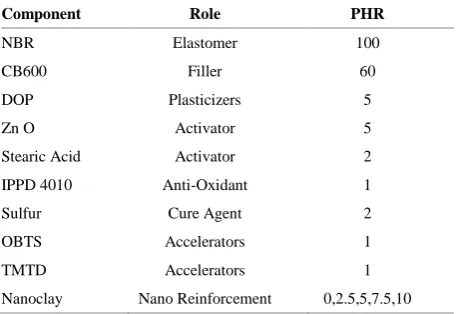
Nitrile rubber containing 33 percent acrylonitrile with the specific gravity of 0.98 was supplied from Pars Company. Rubber compound formulation is given in Table 1. To obtain a nanocomposite with more distance among its layers, nanoclay of the modified Montmorillonite type of Cloisite 30B was used as the nanofiller since its polarity is more similar to the NBR [49]. The higher polarity of this nanoclay compared to other types of nanoclay not only causes it to be more compatible with nitrile rubber which is polar but also makes the role of electrostatic forces in increasing the basal spacing of nanoclay layers and the penetration of polymer into its layer structure more effective [50]. Different percentages of nanoclay were mixed with the NBR from 0 to 10 PHR by adding 2.5 PHR in each steps. Therefore, 2.5 PHR NC stands for the nanocomposite, which contains 2.5 PHR nanoclay.
2. 1. Sample Preparation The compound was
TABLE 1. Nanocomposite compound formulation with
elastomer matrix
Component Role PHR
NBR Elastomer 100
CB600 Filler 60
DOP Plasticizers 5
Zn O Activator 5
Stearic Acid Activator 2
IPPD 4010 Anti-Oxidant 1
Sulfur Cure Agent 2
OBTS Accelerators 1
TMTD Accelerators 1
Nanoclay Nano Reinforcement 0,2.5,5,7.5,10
mixed for 12 minutes at 60 °C in a Brabender internal mixer with rotational speed of 50 rpm. Then in order to eliminate its bubbles, the compound was rolled by an open two-roll mill. The rubber compound was cured in a hot press machine at 165 °C and under the pressure of 10 MPa, according to optimal curing time of ASTM D-5289-17 standard obtained from Rheometer [51]. The results have shown that the curing time is reduced with an increase of the nanoclay percentage. This effect can be attributed to the ammonium groups in the organoclay and facilitation of the formation of crosslinks [52]. To age, the oil-based drilling mud was selected with the mud weight of 85 PCF (pounds per cubic foot) and funnel viscosity of 43 seconds per quart. Drill pipe and annulus space that is between drill pipe and well is filled with high temperature and high pressure environment of drilling fluid. To simulate better, the required samples for each test were placed in oil based drilling mud at 75 °C for 72 hours in the laboratory oven (Figure 2). The temperature and working hours were chosen according to the temperature of most oil & gas wells and the drilling working hours [53]. It is impossible to achieve all the down hole conditions in the lab, for example the down hole pressure, depend on vertical depth and mud weight, reaches to around 8000 psi in most of the common oil wells all over the worlds.
Figure 2. Tensile sample plunging in drilling mud sample and
2. 2. Experimental Methods The hardness test is given by ASTM D2240 standard that is a criterion for resistance against indentation in specific conditions [54]. In this test hardness is based on shore A scale which is the common method for calculating the hardness of rubber. In conducting this test, the surface must be flat and the samples must be at least 6 mm thick. Hardness test is conducted to identify overall mechanical strength of elastomer.
According to ASTM D624 standard method, there are three different types of rubber tear strength tests [55]. Herein, tear strength type C was chosen, which is the maximum force needed to cut the sample with a 90-degree angle divided by its thickness and referenced as tear energy in kN/m or lbf/in. The tearing of rubber is a mechanical process, which begins due to stress concentration and leads to rupture and failure. The rupture of motors’ elastomers is one of the main modes of motor failures.
Mud motor elastomer faces to reciprocate loading condition of rotor contact. Therefore, fatigue life of elastomer is important and nanoclay effect on fatigue behavior of elastomer was measured. The ASTM D4482 method covers one procedure for determining fatigue life at various extension ratios [56]. The number of cycles before fracture is registered as life cycle at specified strain ration. The fatigue testing specimens were designed according to the standard and consisted of a modified dog bone shape. Specimens stretched and released via a continuously rotating cam with 100 CPM frequency. Device records number of cycles applied to each specimen before sample is destroyed by fatigue. Fatigue failures accelerate when elastomer strains are high and the stator lobes are subjected to high cyclic loading, consequently compression fit between the rotor and stator must be selected for the downhole conditions [57]. Maintaining elastomer dimension in drilling fluid and decreasing cyclic load number is suggested to have more fatigue strength. Although decreasing flow rate leads to decrease in the number of collisions per unit time, but it can cause less input power and also cutting transport problem; therefore, it is not preferred.
Tensile strength test was done based on ASTM D412-06 standard using uniaxial tensile testing machine (model: H10KS) [58]. For the test, dumbbell-shaped samples were cut from sheets based on standard C mold. The test was done at 23 °C with tensile speed of 50 mm per minute. The values of tensile strength, Young’s modulus, and elongation at break were directly determined from the digital display at the end of each test. Tensile test is the other display of overall mechanical strength of specimens. The reinforcement of rubbers is expressed by enhancement of the modulus and failure properties which means tensile and tear strength of the compounds [26].
3. RESULT AND DISCUSSION
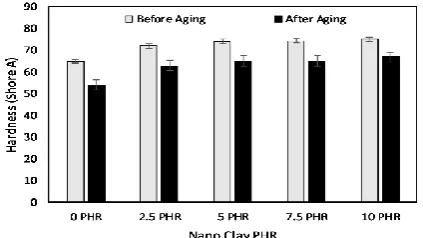
Figure 3 depicts the rising trend of hardness with increasing the clay content. It is predictable that hardness increases by adding nanoclay for both samples, before aging and after aging test. Increasing hardness in samples before aging is 10.8, 13.8, 14.6 and 15.4 % and for aged samples is 16.7, 20.4, 20.4 and 24 % by nanoclay PHR increment in each step.
After aging, the reduction in hardness of pure NBR to hardness before aging is about 16% whereas this value is between 10-12% in all nanocomposite samples. It indicates, nanoclay shows good effect to maintain elastomer hardness and minimize hardness reduction in down hole condition. It is believed that the reduction in hardness caused rapid stator destruction. This phenomenon could be ascribed to the strong interactions established between the elastomer chains and silicate layers [59]. Figure 4 demonstrates tear strength, which proved to be also a useful indicator for mechanical strength of specimens [60]. Different nanoclay content compounds demonstrated 22.4, 23.2, 38.4, and 34.4 percent increase in tear strength, respectively compared to neat NBR. Improved tear strength is also in concordance with tensile and hardness results. The maximum improvement observed in the sample containing 7.5 PHR nanoclay.
Figure 3. The comparison of the results obtained from
hardness test (Shore A) for different compounds
Figure 4. The comparison of tear strength for different
Fatigue life of aged elastomer was measured based on standard. Strain percentage was set on 60, 90, 120 and 150 %. Results were derived by averaging between six samples. Increasing fatigue life of nanocomposite is clear in Figure 5 for each definitive elongation. There is a significant increase in the fatigue life with increasing nanoclay content. Chunking occurs when the rotor wear stator in its circular movement and elastomer has reached the fatigue limit. Small pieces break free therefore the drilling mud could leak between rotor and stator, consequently efficiency of power section decreases. This lead to ROP decrement and to maintain efficiency and rate of penetration, operators will normally push motors harder and increase flow rate, further accelerating the motor working life time. Therefore, the elastomer has to have ample fatigue strength to withstand the cycling loads. Stalling the motor is most probable and pulling out and changing the mud motor is inevitable.
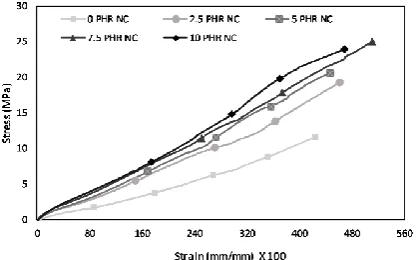
Motor elastomer mechanical properties decrease in downhole conditions; both temperature and time are the main factors during aging. Increasing the Young modulus, tensile strength and elongation at break decrease throughout the ageing period and accelerating degradation. The strain stress diagram is presented in Figure 6. The Young’s Modulus and also tensile strength and maximum elongation at break are comparable factors. This shows the increased modulus for different compounds of nanoclay. Compounds samples containing 2.5, 5, 7.5, and 10 PHR nanocaly demonstrated 71, 80, 120, and 110 percent increase in tensile strength compared to pure NBR. In addition, the percentage increase of nanomaterials has increased the amount of elongation at break point, 11, 6, 22 and 11 percent respectively. Nanocomposite samples have higher loading capacity than conventional elastomer. Trend of mechanical improvement is not linear and decrement of strength at higher loading are representative of worse nanoclay dispersion within elastomer phase. For the nanocomposites, the tensile strength increased rapidly with increasing clay content from 0 to 2.5 wt%, but the change was less when the clay content increased beyond 2.5 wt%. Pattern indicate that intercalation of elastomer chains into the nano silicate layers is restricted with increasing the clay content [45]. Remarkable rise of compound modulus is consequent of chemical bonds between silicate layers and the elastomer matrix and increased crosslink density at the presence of nanoclay. The increased hardness and tensile strength of the elastomer lead to better sealing between the rotor and stator and consequently higher efficiency of motor is expected. On the other hand, by decreasing the wear rate of the elastomer, the life of stator increases.
Mud Motor Elastomer is exposed to successive rotor contact under harsh down hole condition. When the
elastomer chunking occurs the failure begins; therefore, that is a good idea to correspond failure time to the energy required to destruction the elastomer [57]. In other words, elastomer strain energy can be correlated to stator life. Table 2 shows an example of stator life prediction for samples with different loading of Nano clay normalized to predicted life of motor with pure elastomer stator.
The increased life of mud motor, which are containing nanocomposite elastomer, expected because of increased toughness modulus. The 7.5 PHR has maximum strain energy and estimation of mud motor life with this elastomer is nearly three times of mud motors with virgin elastomer.
Figure 5. Cycles to Failure under different strain for samples
with different NC content
Figure 6. The strain stress diagram for different loading of
nanoclay
TABLE 2. Mud Motor life prediction from Strain Energy
Strain Energy (kJ/m3)
Normalized Stator Life
Stator life Estimation (Hours)
0 PHR NC 2102.20 1 150
2.5 PHR NC 4216.07 2.00 300
5 PHR NC 4367.69 2.08 311
7.5 PHR NC 6255.36 2.97 446
4. CONCLUSION
With proper selection of tests required for evaluation elastomer of downhole mud motors performance, the conducted experiments demonstrate improvements in stator mechanical strengths. In hardness, tear resistance, fatigue life and tensile tests, the increase in the mechanical strength of the new samples was confirmed. The specimens showed a significant increase in their strength particularly by addition of small amounts of nanoclay in first steps. The percentage increase of nanoclay does not show a linear relationship with strength increase. This may be due to the less distribution and dispersion of nanoclay particles in the matrix phase in higher loading of the nanofiller. No remarkable changes are recognized in the mechanical properties with the addition of more than 7.5 wt % of nanoclay, which suggests the agglomeration of silicate layers in high content. This is a result because of constant hardness and a little deduction in tear strength and toughness energy. The results of this study, confirm that the incorporation of right selected nanoclay into NBR matrix, offers increased mechanical strengths over conventional virgin elastomer. Based on the mentioned points, the proposed nanocomposite from the nanoclay strongly increases mud motor performance and working life. Using the concept of fracture toughness, increasing motor life is estimated. The result showed the stator life is possible to increase three times by adding 7.5 PHR Nano clay in elastomer matrix. Eventually by increasing motor life by improving the mechanical strength of elastomer, the total drilling time will be reduced. Since time and cost is directly related in drilling industry; therefore, by decreasing the drilling time significant savings will be made in drilling cost.
5. REFERENCES
1. Syzrantseva, K., Syzrantsev, V., and Dvoynikov, M.,
“Designing a High Resistant, High-torque Downhole Drilling
Motor (Research Note)”, International Journal of Engineering,
Transaction A: Basics, Vol. 30, No. 10, (2017), 1615–1621.
2. Royal, A.C.D., and Riggall, T.J., “Analysis of steering in
horizontal directional drilling installations using down-hole
motors”, Tunnelling and Underground Space Technology,
Vol. 25, No. 6, (2010), 754–765.
3. Nguyen, T., Al-Safran, E., Saasen, A., and Nes, O.M.,
“Modeling the design and performance of progressing cavity
pump using 3-D vector approach”, Journal of Petroleum
Science and Engineering, Vol. 122, (2014), 180–186. 4. Zhang, J., Liang, Z., and Han, C., “Failure analysis and finite
element simulation of key components of PDM”, Engineering
Failure Analysis, Vol. 45, (2014), 15–25.
5. Zhang, Z., Yu, X., Zhao, W., Zhang, L., and Zhang, R.,
“Exploring wear detection method for special drilling parts in
liquid media”, International Journal of Refractory Metals and
Hard Materials, Vol. 61, (2016), 249–258.
6. Huang, M., Wang, Y., Liu, B., Gao, M., and Wang, L.,
“Development of downhole motor drilling test platform”,
Procedia Engineering, Vol. 73, No. May, (2014), 71–77.
7. Zhang, J., Han, C., and Liang, Z., “Physics of failure analysis of
power section assembly for positive displacement motor”,
Journal of Loss Prevention in the Process Industries, Vol. 44, (2016), 414–423.
8. Ranjbar, K., and Sababi, M., “Failure assessment of the hard
chrome coated rotors in the downhole drilling motors”,
Engineering Failure Analysis, Vol. 20, (2012), 147–155.
9. Lukawski, M.Z., Anderson, B.J., Augustine, C., Capuano Jr,
L.E., Beckers, K.F., Livesay, B., and Tester, J.W., “Cost analysis of oil, gas, and geothermal well drilling”, Journal of Petroleum Science and Engineering, Vol. 118, (2014), 1–14. 10. Hendrik, J., “Elastomers in mud motors for oil field
application”, In Corrosion97, NACE International, (1997). 11. Liu, J., Li, X., Xu, L., and Zhang, P., “Investigation of aging
behavior and mechanism of nitrile-butadiene rubber (NBR) in the accelerated thermal aging environment”, Polymer Testing, Vol. 54, (2016), 59–66.
12. Klingender, R.C., Handbook of Specialty Elastomers, CRC Press Taylor & Francis Group, (2008).
13. Jr, E.K., Ross, K.C., Pugh, T., and Huycke, J., “Performance characteristics of drilling equipment elastomers evaluated in various drilling fluids”, In SPE/IADC Drilling Conference, Society of Petroleum Engineers, (1991).
14. Han, C., Zhang, J., and Liang, Z., “Thermal failure of rubber bushing of a Positive Displacement Motor: A study based on
thermo-mechanical coupling”, Applied Thermal Engineering,
Vol. 67, No. 1–2, (2014), 489–493.
15. Susman, H., “The VARI FLOTM Motor : A New Mud Motor Concept , its Design , Development and Applications”, In Offshore Europe, Society of Petroleum Engineers (SPE), (1993). 16. Azizov, A., Davila, W., Nnanna, O., and Rizen, A., “Positive displacement motor innovation drives increased performance with PDC in unconventional plays”, In SPE/IADC Middle East Drilling Technology Conference and Exhibition. Society of Petroleum Engineers, Society of Petroleum Engineers, (2011), 1–15.
17. Pavlidou, S., and Papaspyrides, C.D., “A review on
polymer-layered silicate nanocomposites”, Progress in Polymer Science,
Vol. 33, No. 12, (2008), 1119–1198.
18. Tamilselvan, T., and Prasanna, S.C., “Review on the Effect of Nanofiller Addition on the Technical Properties of Polymers”,
International Journal of Mechanical and Production Engineering Research and Development (IJMPERD), Vol. 8, No. 2, (2018), 1023–1032.
19. Robert, T.M., Chandran, M.S., Jishnu, S., Sunitha, K., Rajeev, R.S., Mathew, D., Sreenivas, N., Aravindakshan Pillai, L., and Nair, C.R., “Nanoclay modified silica phenolic composites: mechanical properties and thermal response under simulated
atmospheric re-entry conditions”, Polymers for Advanced
Technologies, Vol. 26, No. 1, (2015), 104–109.
20. Santamaría, P., González, I., and Eguiazábal, J.I., “Mechanical and barrier properties of ternary nanocomposite films based on polycarbonate/amorphous polyamide blends modified with a
nanoclay”, Polymers for Advanced Technologies, Vol. 26, No.
6, (2015), 665–673.
21. Khalkhali, A., and Daghighi, S., “Optimum Design of a Coir Fiber Biocomposite Tube Reinforced with Nano Silica and Nano
Clay Powder”, International Journal of Engineering,
Transactions C: Aspects, Vol. 30, No. 12, (2017), 1894–1902. 22. Müller, K., Bugnicourt, E., Latorre, M., Jorda, M., Echegoyen
Their Applications in the Packaging, Automotive and Solar
Energy Fields”, Nanomaterials, Vol. 7, No. 4, (2017), 74–120.
23. Olphen, H. V, “An introduction to clay colloid chemistry, for clay technologists, geologists, and soil scientists”, John Wiley & Sons, New York, (1963).
24. Chandran, V., Manvel Raj, T., Lakshmanan, T., and Senthil Kumar, M., “Influence of Different Fillers on Natural Rubber
Composites to Assess Mechanical Performance”, International
Journal of Engineering, Transaction C: Aspects, Vol. 28, No. 6, (2015), 932–939.
25. Jlassi, K., Krupa, I., and Chehimi, M.M., “Overview: Clay Preparation, Properties, Modification”, In Clay-Polymer Nanocomposites, Elsevier, (2017), 1–28.
26. Arroyo, M., Lopez-Manchado, M.A., and Herrero, B., “Organo-montmorillonite as substitute of carbon black in natural rubber
compounds”, Polymer, Vol. 44, No. 8, (2003), 2447–2453.
27. Vasudeo Rane, A., Kanny, K., Abitha, V.K., Patil, S.S., and Thomas, S., “Clay–Polymer Composites: Design of Clay Polymer Nanocomposite by Mixing”, In Clay-Polymer Nanocomposites, Elsevier, (2017), 113–144.
28. Kim, J.K., Pal, K., and Sridhar, V., “Role of Different Nanoparticles in Elastomeric Nanocomposites”, Springer, Berlin, Heidelberg, (2011), 3–55.
29. Ahmadi, S.J., G’Sell, C., Huang, Y., Ren, N., Mohaddespour, A., and Hiver, J.M., “Mechanical properties of NBR/clay
nanocomposites by using a novel testing system”, Composites
Science and Technology, Vol. 69, No. 15–16, (2009), 2566– 2572.
30. Guo, F., Aryana, S., Han, Y., and Jiao, Y., “A Review of the Synthesis and Applications of Polymer–Nanoclay Composites”,
Applied Sciences, Vol. 8, No. 9, (2018), 1696.
31. Usuki, A., “Preparation and properties of EPDM–clay hybrids”,
Polymer, Vol. 43, No. 8, (2002), 2185–2189.
32. Tiggemann, H.M., Ribeiro, V.F., Celso, F., and Nachtigall, S.M.B., “Effect of commercial clays on the properties of SEBS/PP/oil thermoplastic elastomers. Part 1. Physical,
mechanical and thermal properties”, Applied Clay Science, Vol.
109–110, (2015), 151–156.
33. LeBaron, P.C., Wang, Z., and Pinnavaia, T.J., “Polymer-layered silicate nanocomposites: an overview”, Applied Clay Science, Vol. 15, No. 1–2, (1999), 11–29.
34. Paul, D.R., and Robeson, L.M., “Polymer nanotechnology:
Nanocomposites”, Polymer, Vol. 49, No. 15, (2008), 3187–
3204.
35. Sinha Ray, S., and Okamoto, M., “Polymer/layered silicate nanocomposites: a review from preparation to processing”,
Progress in Polymer Science, Vol. 28, No. 11, (2003), 1539– 1641.
36. Sengupta, R., Chakraborty, S., Bandyopadhyay, S., Dasgupta, S., Mukhopadhyay, R., Auddy, K. and Deuri, A.S., “A short review on rubber/clay nanocomposites with emphasis on
mechanical properties”, Polymer Engineering & Science, Vol.
47, No. 11, (2007), 1956–1974.
37. Chiu, C.W., Huang, T.K., Wang, Y.C., Alamani, B.G., and Lin, J.-J., “Intercalation strategies in clay/polymer hybrids”, Progress in Polymer Science, Vol. 39, No. 3, (2014), 443–485.
38. Liang, C., Hu, C., Zheng, Y., Yan, K., and Zhu, X., “Modification of isotactic polypropylene by silica nanocapsules
via melt blending method”, Polymer Composites, Vol. 39, No.
3, (2018), 762–769.
39. Mohan, T.P., and Kanny, K., “Preparation and characteristics of
polypropylene-clay nanocomposite fibers”, Journal of Polymer
Engineering, Vol. 35, No. 8, (2015), 773–784.
40. Peponi, L., Puglia, D., Torre, L., Valentini, L., and Kenny, J.M.,
“Processing of nanostructured polymers and advanced polymeric
based nanocomposites”, Materials Science and Engineering:
R: Reports, Vol. 85, (2014), 1–46.
41. Mir, S., Asghar, B., Khan, A.K., Rashid, R., Shaikh, A.J., Khan, R.A., and Murtaza, G., “The effects of nanoclay on thermal, mechanical and rheological properties of LLDPE/chitosan
blend”, Journal of Polymer Engineering, Vol. 37, No. 2,
(2017), 143–149.
42. Choudhury, A., Bhowmick, A.K., and Soddemann, M., “Effect of organo-modified clay on accelerated aging resistance of hydrogenated nitrile rubber nanocomposites and their life time prediction”, Polymer Degradation and Stability, Vol. 95, No. 12, (2010), 2555–2562.
43. Majzoobi Gh. H., and Fariba, F., “A New Technique Based On Strain Energy For Correction of Stress-Strain Curve”,
International Journal of Engineering, Transaction B: Applications, Vol. 27, No. 8, (2014), 1287–1296.
44. Ghosh, P., “Polymer science and technology of plastics and rubbers”, Tata McGraw-Hill, 1990.
45. Goh, K.L., Holmes, D.F., Lu, H.Y., Richardson, S., Kadler, K.E., Purslow, P.P., and Wess, T.J., “Ageing Changes in the Tensile Properties of Tendons: Influence of Collagen Fibril
Volume Fraction”, Journal of Biomechanical Engineering,
Vol. 130, No. 2, (2008), 021011–021018.
46. Fouad, H., Elleithy, R., Al-Zahrani, S.M., and Ali, M.A.,
“Characterization and processing of High Density
Polyethylene/carbon nano-composites”, Materials & Design,
Vol. 32, No. 4, (2011), 1974–1980.
47. Wang, M., Fan, X., Thitsartarn, W., and He, C., “Rheological and mechanical properties of epoxy/clay nanocomposites with
enhanced tensile and fracture toughnesses”, Polymer, Vol. 58,
(2015), 43–52.
48. Bortz, D.R., Merino, C., and Martin-Gullon, I., “Carbon nanofibers enhance the fracture toughness and fatigue
performance of a structural epoxy system”, Composites Science
and Technology, Vol. 71, No. 1, (2011), 31–38.
49. Tolooei, S., Naderi, G., Shokoohi, S., and Soltani, S., “Elastomer nanocomposites based on NBR/BR/nanoclay:
Morphology and mechanical properties”, Journal of Polymer
Engineering, Vol. 33, No. 2, (2013), 133–139.
50. Islam, M.S., Masoodi, R., and Rostami, H., “The Effect of Nanoparticles Percentage on Mechanical Behavior of
Silica-Epoxy Nanocomposites”, Journal of Nanoscience, Vol. 2013,
(2013), 1–10.
51. ASTM D5289, “Standard Test Method for Rubber Property—
Vulcanization Using Rotorless Cure Meters”, ASTM
International, West Conshohocken, PA, (2017).
52. Kim, M.S., Kim, G.H. and Chowdhury, S.R., “Polybutadiene rubber/organoclay nanocomposites: Effect of organoclay with various modifier concentrations on the vulcanization behavior and mechanical properties”, Polymer Engineering & Science, Vol. 47, No. 3, (2007), 308–313.
53. Zhang, Z., Xiong, Y., Gao, Y., Liu, L., Wang, M., and Peng, G., “Wellbore temperature distribution during circulation stage when well-kick occurs in a continuous formation from the
bottom-hole”, Energy, Vol. 164, (2018), 964–977.
54. ASTM D2240, “Standard Test Method for Rubber Property—
Durometer Hardness”, ASTM International, West
Conshohocken, PA, (2015).
55. ASTM D624-00, “Standard Test Method for Tear Strength of
Conventional Vulcanized Rubber and Thermoplastic
Elastomers”, ASTM International, West Conshohocken, PA, (2012).
PA, (2011).
57. Delpassand, M.S., “Stator life of a positive displacment downhole drilling motor”, Energy resources, Vol. 121, No. 2, (1999), 110–116.
58. ASTM D412, “Standard Test Methods for Vulcanized Rubber and Thermoplastic Elastomers-Tension”, ASTM International, West Conshohocken, PA, (2006).
59. Mahallati, P., Arefzar, A., and Naderi, G., “Thermoplastic
Elastomer Nanocomposites Based on PA6/NBR”, International
Polymer Processing, Vol. 25, No. 2, (2010), 132–138. 60. Nah, C., Ryu, H.J., Han, S.H., Rhee, J.M., and Lee, M.H.,
“Fracture behaviour of acrylonitrile-butadiene rubber/clay
nanocomposite”, Polymer International, Vol. 50, No. 11,
(2001), 1265–1268.
Mechanical Strength Improvement of Mud Motor’s Elastomer by Nano Clay and
Prediction the Working Life via Strain Energy
M. Izadia, M. Tabatabaee Ghomia, G. Pircheraghib
a Technology Development Institute, Academic Center for Education, Culture and Research (ACECR), Tehran, Iran b Materials science and Engineering, Sharif University of Technology, Tehran, Iran
P A P E R I N F O
Paper history: Received 06 October 2018
Received in revised form 02 January 2019 Accepted 03 January 2019
Keywords: Down Hole Mud Motors Nitrile Rubber Nanoclay Fracture Toughness Strain Energy
هدیکچ
د ر هج یرافح هاچ رادت تفن یاه ، لماع نیرتمهم ی
یم یرافح هتشر ندیشک نوریب هب رجنم هک نامز مامتا دوش
یراک
رموتسلاا یکیناکم ماکحتسا تیوقت یهاچ نورد یاهروتوم یراک طیارش نتفرگ رظن رد اب .تسا یهاچ نورد یاهروتوم
یم رظن هب یرورض اهروتوم نیا روتوم درکلمع دوبهب یارب یتاقیقحت .دسر
رد رییغت قیرط زا هدش ماجنا یحارط و هسدنه
تسا ، د هدام تیوقت نادقف اما ر
ریگمشچ یلبق تاعلاطم تسا
تیزوپماک قیقحت نیا رد . “NBR/Nanoclay”
قیرط زا
طولخم رد یبوذ بیکرت و امد نتفرگ رظن رد اب و تسا هدش هدامآ یلخاد هدننک
ریثات تست یهاچ نورد یرافح لایس
هدیدرگ تست .دنا هراپ ،یتخس یاه یششک ماکحتسا ،یگتسخ ،یگ
یور رب اب رموتسلاا NBR صلاخ و تیزوپماکونان NBR
سرونان فلتخم نازیم یواح هک تسا هدوب
ناشن هجوت لباق شیازفا زا دیدج تیزوپماک یکیناکم ماکحتسا
دراد اب نینچمه .
تیزوپماک رمع شیازفا یشنرک یژرنا شور کمک “NBR/Nanoclay”
یاقم رد اب هس NBR .تسا هدش هداد ناشن صلاخ
هطبار ،یرافح تعنص رد دراد دوجو هنیزه و نامز نیب یمیقتسم ی
و هنیزه شهاک هب رجنم روتوم یراک رمع شیازفا اذل
.دش دهاوخ نارگ تعنص نیا رد یهجوت لباق
doi: : 10.5829/ije.2019.32.02b.20
![Figure 1. Composition of positive displacement motor [7]](https://thumb-us.123doks.com/thumbv2/123dok_us/22291.2002413/2.595.60.282.101.210/figure-composition-positive-displacement-motor.webp)