© Shiraz University
PERFORMANCE COMPARISON OF THE NEYMAN-PEARSON FUSION
RULE WITH COUNTING RULES FOR SPECTRUM
SENSING IN COGNITIVE RADIO
*S. MOSLEH
1, A.A. TADAION
2 **, M. DERAKHTIAN
3AND M. R. AREF
4 1,2Dept. of Electrical and Computer Engineering, Yazd University, Yazd, I. R. of Iran Email: [email protected]
3
Dept. of Electrical Engineering, Shiraz University, Shiraz, I. R. of Iran 4
Dept. of Electrical Engineering, Sharif University, Tehran, I. R. of Iran
Abstract– Distributed spectrum sensing (DSS) is of great importance in Cognitive Radio, especially under fading or shadowing effects. In order to evaluate the performance of a distributed system, it is commonly compared with the centralized system as an upper performance bound. Now the question is whether or not one can obtain a distributed strategy serving as an upper bound to benchmark any distributed strategy, tighter than that of the centralized scheme. Here, we suggest employing the Neyman-Pearson (NP) fusion rule to achieve an upper bound. Furthermore, the analysis of a randomized fusion rule has been provided, which is a long-existing problem in this field. For this purpose, theoretical analysis on the performance of the NP fusion rule is carried out. Next, we compare the traditional fusion rules with the proposed bound and observe in which special cases of the probability of false alarm at the fusion center these counting rules are optimum. We further study the effects of varying the number of participating sensors on fusion performance in detail. Remarkably, simulation results in some applicable examples illustrate the significant cooperative gain achieved by the proposed NP fusion rule.
Keywords– Cognitive radio, distributed spectrum sensing, neyman-pearson criterion, decision fusion rule, data fusion
1. INTRODUCTION
In the traditional spectrum allocation policy, most of the spectrum is allocated exclusively to different licensed users, known as Primary Users (PUs). Due to the rapid growth of wireless communications and emergence of new applications in recent years, we are faced with a lack of available spectrum [1-4].
The Cognitive Radio (CR) has been introduced as an enabling technology for improving spectrum utilization efficiency and meeting the increasing demand for wireless communications [1-4]. The idea of CR is to permit unauthorized users known as Secondary Users (SUs), to access the free bands when and where the PUs are not using it. Since SUs are considered to be of lower priority, a fundamental requirement is to avoid the interference with PUs in their vicinity [3, 5], as well as proper channel assignment [6]. Therefore, it is necessary that SUs reliably detect the existence of the PUs through continuous spectrum sensing, making the spectrum sensing an essential task for CR. Spectrum sensing can be conducted either non-cooperatively, where each SU detects the PUs without informing the other SUs, or cooperatively, in which a group of SUs perform spectrum sensing by collaboration.
Spectrum sensing at each SU can be performed locally by different schemes such as Likelihood Ratio Test [7], energy detection [7-8], matched filter [9-10], or cyclostationary feature detection [11-13],
Received by the editors July 31, 2011; Accepted June 27, 2012.
depending on the PU signal and the environment. The low Signal to Noise Ratio (SNR), multi-path fading and shadowing effects, unknown time scatter channel, time varying of the noise/interference level and hidden terminal problem, encourages the study of spectrum sensing by multiple SUs, cooperatively.
Cooperative spectrum sensing, which has recently been studied, outperforms the non-cooperative spectrum sensing in several aspects [14-19] and can be implemented in two scenarios: centralized or distributed [20-23]. Since some practical issues restrict the applicability of the centralized detection, we consider a distributed scheme. In this scheme, each SU individually creates its own discrete messages based on its local measurement and then reports to the fusion center. For the distributed scheme, different structures have appeared, among which the parallel structure seems to be the most convenient [24].
It can be seen that the overall performance depends very much on the fusion scheme [25], thus it is important how we combine the local data from the SUs in order to improve the local sensing performance as much as possible. Since in a CR network, a larger probability of detection ( ) leads to less interference with PUs, and smaller probability of false alarm ( ) results in higher spectrum efficiency, it is desirable to maximize the while is minimized. Nonetheless, it can be shown that this optimization cannot be carried out on and simultaneously [7] and the Neyman-Pearson (NP) criterion is a good candidate to maximize , putting a restriction on .
A general problem in NP distributed detection is optimizing the SU detectors and the fusion center, simultaneously. However, to alleviate the limitations, two distinct cases have been considered in literature. In the first one, the design of the SU detectors is studied, assuming that the fusion decision rule is given [26-28]. The second one, which is the focus of our attention in this paper, is to obtain the optimum fusion rule for given local detectors. Varshney and Hoballah in [29] and Thomopoulos et al. in [30], in their pioneering efforts, used the LRT as the decision rule for the fusion center. They studied the case of PUs, with binary decisions in each, resulting in 2 nonlinear coupled equations that should be solved to obtain the optimum fusion rule. Apparently, the computational complexity of this process grows exponentially with . In [25], the performance of the distributed NP detection systems for the case of two, three and more sensors is studied under some simplifying assumptions. In this paper, an attempt is made to describe the problem in a detailed form and to evaluate the performance of the fusion center for all possible situations, resulting in more generality. An important motivation of this field is whether one may obtain a distributed strategy to benchmark any distributed strategy. Our scheme is simple and possesses some unique features, summarized as follows:
1) Derives an upper performance bound of distributed detection. 2) Analyzes the randomized fusion rule.
3) Obtains a closed form formulation for the case of two and three sensors. 4) Generalizes the fusion rule to the case of sensors.
5) Compares the performance of our proposed fusion rule with the traditional fusion rules. Extensive simulation results illustrate the effectiveness of the proposed scheme, resulting in higher compared with the existing solutions.
The rest of the paper is organized as follows, in Section 2a, we describe the detection problem, both local detection problems at the sensors and the decision fusion problem. Then in Section 2b, we briefly introduce the optimal decision fusion rule using NP criterion. The analytical study including the cases of two and three detectors are represented in Section III. Simulation results are given in Section IV. Finally, Section V concludes the paper.
2. THE PROBLEM FORMULATION
a) System model
ℋ : = , = 1,2, … , ,
ℋ: = + , = 1,2, … , , (1)
where, is the PU signal received at the SU. We also assume that the PU signals and noise received at each SU are independent. Each SU employs a decision rule ( ), = 1,⋯, to make a local decision as follows,
= ( ) = 1 , ∈ Γ,
0 , ∈ Γ, (2)
where Γ and Γ are the decision regions for the null and alternate hypotheses, respectively. Then each local detector sends a summary of its own observations to the fusion center in the form of , and , where and denote the probability of false alarm and the probability of detection for the detector, respectively.
b) Hypothesis test at the fusion center
The final decision is to be made at the fusion center based on the received information. Spectrum sensing can therefore be stated as a binary hypothesis testing problem, with the null and alternative hypotheses
ℋ : PUsignal is absent,
ℋ : PUsignal is present. (3)
The optimal decision rule at the fusion center in the sense of maximizing for a given is the NP test. We must note that the structure of the fusion rule is obtained independently from the values of the local decisions ; however the final decision is made upon the local decisions.
c) Analysis of randomized fusion rule based on the NP criterion
In order to make the final decision , we consider an NP test at the fusion center. The NP formulation of this problem can be stated as follows: for a prescribed bound on the probability of false alarm at the fusion center, , find the optimum decision rule which maximizes the probability of detection, ,
( ) = P
( )
( |ℋ ) + P
( )
( |ℋ ),
( ) = P
( )
( |ℋ ) + P
( )
( |ℋ ). (4)
where = [ ,⋯, ] , ( ) is the conditional probability of accepting ℋ , 0≤ ≤1 is the randomization constant and the decision threshold, are determined according to the desired false alarm probability, at the fusion center, i.e, ( ) = . Since, the decisions of the sensors are independent from each other, the fusion center test based on a likelihood ratio test (LRT) can be formulated as follows:
( ) = ( |ℋ ) ( |ℋ )=
( |ℋ)
( |ℋ)= ( ). (5)
We must note that
( )takes two di
ff
erent values, either
(
1− d)/(1− fa)when
= 0with
probability
(
1− fa)under hypothesis
ℋand probability
(
1− d)under hypothesis
ℋ, or
/when
= 1with probability
under hypothesis
ℋand probability
under hypothesis
ℋ.Therefore, we have,
( ) =
∏ (1− )( )
∏ (1− )( )≷
ℋ
Now, employing Eqs. (4)-(6), we can implement the NP test at the fusion center. Note that the
person-by-person optimal solution under the independent observation assumption still requires a
simultaneous solution of
2 +equations. Apparently, the computational complexity of this
process grows exponentially with
N
. In the following section, we present a method to reduce the
computational complexity of the implementation.
3. PERFORMANCE ANALYSIS OF THE PROPOSED OPTIMAL FUSION RULE FOR COOPERATIVE SPECTRUM SENSING
As mentioned previously, to assess the performance of the distributed scheme, the performance is compared with the centralized scheme which uses much more information. Here, we suggest an upper performance bound of distributed detection tighter than the centralized scheme. Therefore, in this Section we obtain the upper bound of the distributed scheme through implementation and performance evaluation of the proposed NP strategy and the existing detectors. We show that AND, OR and Majority fusion rules are optimum only in special cases of the probability of false alarm at the fusion center, i.e. in special cases their performance meets our bound, simplify the equations and expression of our analysis, as follows:
≜ 1−
1−
. (7)
We must note that since the ROC of the NP detector is convex, it follows that > , = 1,2,⋯, and
≥1 and ≤1; i.e. is always greater than or equal to unity, ≥1. In the following, we study
the NP fusion rule in special cases.
a) Implementation of the proposed optimal fusion rule with two SUs ( = )
In this subsection, we consider two SUs in the network which independently sense the PU’s spectrum. Regarding different values of , we find the corresponding , via computation of the threshold and to obtain the ROC. In order to find the value of , we have { ( );ℋ} = ; Therefore, we should consider different permutations of ( ), i.e. 2 !; since can take 2 different values. In the configuration of two sensors, the decision vector can take four realizations, i.e., ≜[0,0] , ≜[0,1] , ≜ [1,0] , ≜[1,1] and according to (6) the LR at the fusion center can be written as:
( ) =
⎩ ⎪ ⎪ ⎪ ⎨ ⎪ ⎪ ⎪
⎧ , = ,
(1− )
(1− ) , = , (1− )
(1− ) , = ,
(1− )(1− )
(1− )(1− ) , = .
(8)
So we have 2 ! = 24 different permutations of ( ). According to the condition > , it can be shown that there are only two valid cases of possible permutations which we need to consider [31]. We consider these cases and use the NP fusion rule and obtain the upper bound of the distributed cooperative sensing scheme (see [32] for details).
1) Case 1: <
= ⎩ ⎪ ⎪ ⎪ ⎨ ⎪ ⎪ ⎪
⎧ , 0≤ <
(1− )
(1− ) ( − ) + , ≤ < (1− )
(1− )( − ) + , ≤ < (1− )(1− )
(1− )(1− )( − ) + , ≤ < 1
(9)
where
= ,
= 1−(1− )(1− ). (10)
2) Case 2: >
Once again, we obtain for different values of .In this case, is given as
= ⎩ ⎪ ⎪ ⎪ ⎨ ⎪ ⎪ ⎪
⎧ , 0≤ <
(1− )
(1− )( − ) + , ≤ < (1− )
(1− ) ( − ) + , ≤ < (1− )(1− )
(1− )(1− )( − ) + , ≤ < 1
(11)
3) Case 3: =
In this case, assuming that the detectors are identical, we have = and = . In the following, we obtain for different values of given by (12).
= ⎩ ⎪ ⎪ ⎨ ⎪ ⎪
⎧( ) , 0≤ <
2( (1− )
(1− ))( − ) + , ≤ <
(1−
1− ) ( − ) + , ≤ < 1
(12)
In [32], we depict the ROC curve in these cases. As it can be seen in the figures, the use of NP fusion rule improves the performance compared to conventional fusion rules. As shown in the figures, we should note that with given local probability of false alarm and probability of detection, AND and OR would lead to specific values of the probability of false alarm at the fusion center, in which their probability of detection meets the optimal NP performance. Hence it is clear that AND and OR of all or some of the local decisions lead to optimum performance only for special cases of the probability of false alarm in the fusion center.
b) Generalization of the proposed optimal fusion rule to multi-SUs ( > )
≜[1,1,1] , ≜[1,1,0] , ≜[1,0,1] , ≜[1,0,0] , ≜[0,1,1] , ≜[0,1,0] , ≜[0,0,1] , ≜[0,0,0] .
(13)
and the LRT at the fusion center can be written as:
( ) = ⎩ ⎪ ⎪ ⎪ ⎪ ⎪ ⎪ ⎪ ⎪ ⎨ ⎪ ⎪ ⎪ ⎪ ⎪ ⎪ ⎪ ⎪ ⎧ , = ,
(1− )
(1− ) , = ,
(1− )
(1− ) , = ,
(1− )(1− )
(1− )(1− ) , = , (1− )
(1− ) , = ,
(1− ) (1− )
(1− ) (1− ) , = , (1− )(1− )
(1− )(1− ) , = , (1− )(1− )(1− )
(1− )(1− )(1− ) , = .
(14)
We must note that the threshold should be computed for different values of . In order to find the proper value of we use { ( );ℋ } = ; therefore, we should consider different permutations of ( ), i.e. 2 !. In this case we have 2 ! = 40320 cases and regarding the fact that > , it is reduced to 12
cases. That for each case, the ROC should be obtained. For example, assume that < < <
. The detection probability of the resulting NP test is then given by (15) (see Appendix A for details). = ⎩ ⎪ ⎪ ⎪ ⎪ ⎨ ⎪ ⎪ ⎪ ⎪
⎧ ( ) , 0≤ <
( − ) ( ) + , ≤ < ( , |ℋ)
( − ( , |ℋ)) ( ) + ( , |ℋ) , ( , |ℋ)≤ < ( , . . . , | ) ( − ( , . . . , |ℋ)) ( ) + ( , . . . , |ℋ)) , ( , . . . , |ℋ)≤ <
( − ) ( ) + ( , , , |ℋ , ≤ < ( , . . . , |ℋ) ( − ( , . . . , |ℋ)) ( ) + ( , . . . , |ℋ) , ( , . . . , |ℋ)≤ < ( , . . . , |ℋ) ( − ( , . . . , |ℋ)) ( ) + ( , . . . , |ℋ) , ( , . . . , |ℋ)≤ <
( − ) ( ) + ( , . . . , |ℋ) , ≤ < 1
1 , = 1
(15)
As stated earlier, the proposed fusion rule can be generalized to the case of more secondary
users (
N
>
3). The derivations for each case is similar to the one described for
N
=
3.
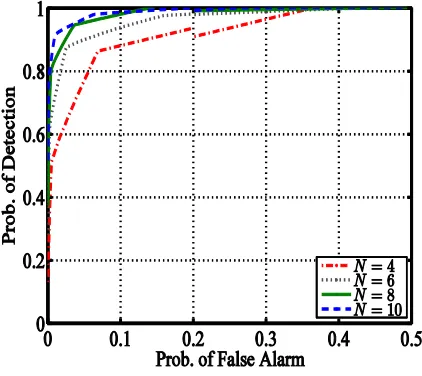
In Fig. 1, with simulation we illustrate the ROC curves for > 3. In this Figure it has been shown that the performance increases with . In the next section, we illustrate the effect of our NP fusion rule on the performance of a distributed detection system with three examples.Fig. 1. ROCs for a fusion center
4. SIMULATION RESULTS AND DISCUSSIONS
Simulation examples are provided to evaluate and compare the performances of the proposed NP fusion rule. In the first one, we consider the detection of a known signal in additive white gaussian noise (AWGN) and in the second one, a signal with fast phase variation as the PU signal in AWGN is examined and in extremity, we consider an orthogonal frequency division multiplexing (OFDM) PU signal in AWGN. Thenceforth, we evaluate the performance of the NP fusion rule which has led to the derivation of the upper bound and then compare it with AND, OR and Majority fusion rules with simulation in each example. We will also see that AND, OR and Majority fusion rules for special cases for in the fusion center are the NP fusion rule. Simulation results illustrate the relative performance of the proposed detector. In all cases, the probability of false alarm at the fusion center is specified. After computing the required threshold at the local sensors, the probability of detection at the fusion center is obtained as a function of and . In all simulations, SNR is defined as the ratio of the signal power to the noise variance in the fusion center, ( = | | / ) and we determined the threshold in each local detector, as follows. The decision statistics for 10 independent trials in the absence of any signal was sorted in ascending order, and the threshold was chosen as the 100%∗ -percentile of the resulting data. For example, for = 0.01, the threshold is chosen as the 0.01∗10 = 10 th ordered data; i.e. such that
100%∗ of the decision statistics is above the threshold. For determining the threshold in fusion center, please see the Appendix.
a) Detection of a known signal in additive White Gaussian Noise
We consider the following hypothesis test for detecting the problem of a known signal in additive Gaussian noise in each sensor [7]:
ℋ: = , = 1,2, … , ,
where = [1,⋯,1] , s are independent and identically distributed (i.i.d.) Gaussian random variables with zero mean and known variance , and is the DC level [7]. Sufficient statistics, in this case, are equal to:
= [ ]≷
ℋ
ℋ . (17)
where denotes the threshold of the local detector and is determined by the false alarm probability at each detector, i.e, = . Note that the probability of detection, , and the probability of false alarm,
, are given by
= ( = 1|ℋ ) =
√ , (18)
= ( = 1|ℋ ) = −
√ , (19)
where
( ) = 1 √2 exp
−
2 . (20)
Computing the threshold from Eq. (18) and replacing it in Eq. (19) we have
= ( )− √ . (21)
Therefore, , and of the local detectors are sent to the data fusion center where the desired final results are obtained.
b) Invariant activity detection of a constant magnitude signal with unknown parameters in White Gaussian Noise
As a second example we consider the detection of a signal with fast phase variation [33-35] as the following hypothesis test in each sensor:
ℋ : = ,
ℋ: = + . (22)
where = [ [1], [2], . . . , [ ]] is the observed signal, = [ [1], [2], . . . , [ ]] is the zero mean complex white Gaussian noise with unknown variance , > 0 is the amplitude of the received signal and = [ , , . . . , ] represents the unknown received signal phase. This problem is encountered in the detection of a Phase Shift Keying (PSK) signal. The GLR detector is given by
≜∥ ∥
∥ ∥ > , (23)
where ∥ ∥ = (∑ | | ) is the p-norm of ; ∥ ∥ is the squared of the Euclidean norm of and is chosen to satisfy the required probability of false alarm (for derivation detail, see [33]).
c) OFDM PU signal in White Gaussian Noise
modulation type to achieve efficient use of spectrum resources [3, 4, 36]. Besides, one of the main constraints in CR networks is that PU’s signal detection should be performed in a very short time [37-39]. OFDM-based CR networks are known to be an excellent fit for the physical architecture of CR networks [40-41], mainly because multi-carrier sensing can be exploited in OFDM-based CR networks and the overall sensing time can be reduced.
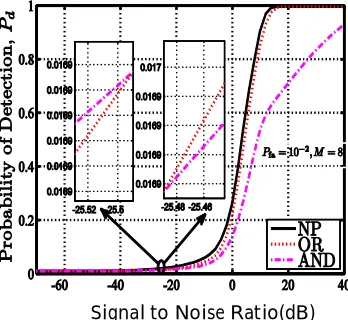
Figure 2 depicts the probability of detection versus SNR for a known signal in AWGN with = 10 .
We compare the performances of a single detector with that of the distributed detection in a
data fusion system (
N
=
2) and and we show the significant cooperative gain achieved by the NP
fusion rule. It is seen that at low values of
N
(here
N
=
2), the performance of the OR fusion rule
is close to the performance of the NP fusion rule. However, as will be seen, as the number of SUs
increases, significant increase in performance gain of the NP fusion rule over the OR fusion rule
is observed (see e.g. Fig. 7). We must note that the degrade in the performance of the AND fusion
rule in high SNRs is due to the fact that the AND fusion rule decides on the detection only if all
the sensors (SUs) send the detection signal
Figures 3-5 illustrate the comparison between the traditional data fusion rules (AND and OR) and the proposed data fusion rule (NP fusion rule) for the case = 2. We see that the best is obtained in the fusion center with NP fusion rule, which is always superior to AND and OR fusion rules. For the purpose of
detecting the PSK signal
with = 8, Fig. 4 compares the AND, OR and NP fusion rules for the case= 2 . It is clear that the NP fusion rule is always superior to AND and OR fusion rules.
The fusion rule
AND performs better than the OR fusion rule for smaller values of SNR untill the crossover
point, after which the OR fusion rule performs better. This should be justified noting the fact that
the detection by SUs at low SNRs is so rare and then the OR fusion rule can not outperforms the
AND fusion rule (see [41] for more discussion).
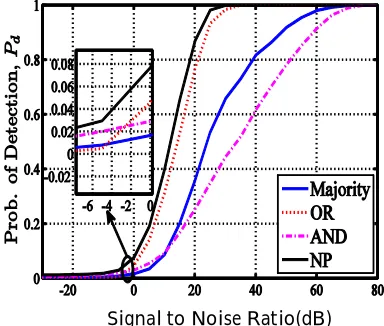
Figures 6-8 illustrate the comparison between the traditional data fusion rules (AND, OR and Majority) and the proposed data fusion rule (NP) for the case = 3.
In Fig. 7, the performance of
proposed data fusion rule (NP) comparing with that of the other decision fusion rules are
investigated. As expected, the performance of NP improves with increasing the number of SUs.
However, the performances based on decision rules come with di
ff
erent compromises. For
example, the fusion rule AND is the best decision rule at low SNR but definitely a bad choice at
high SNR. The Majority rule behaves well at very low SNRs but performs poorly at higher SNR.
The performance of the fusion rule OR lies between the two extremes of AND rule and the
Majority rule.
Fig. 8 compares the AND, OR, Majority and NP fusion rules for the case = 3 for the problem detection of a PSK signal with = 8 and = 10 . It is clear that the NP fusion rule is always superior to AND, OR and Majority fusion rules. Also, AND is superior to OR and Majority at a low SNR, with increasing the SNR Majority is superior to AND and OR is superior to AND and Majority at a high SNR.As expected, as the number of SUs increases, significant increase in the performance gain
of the optimum NP fusion rule over other fusion rules is observed
SNRs, the upper bound obtained mentioned in this paper is superior to the performance of other traditional fusion rules.
Fig. 2. Performance comparison of the data fusion rule ( = ) and single detector in terms of versus SNR for the problem detection of a known signal in additive
Gaussian noise with =
Fig. 3. Performance comparison of the NP fusion rule and AND and OR data fusion rules: in terms of versus SNR for the problem detection of a known signal in additive
Gaussian noise with = and =
Fig. 4. Performance comparison of the NP fusion rule and AND and OR fusion rules: in terms of versus SNR for the problem detection of a PSK
signal with = , = and =
Signal to Noise Ratio(dB)
Signal to Noise Ratio(dB)
Fig. 5. Performance comparison of the NP fusion rule and AND and OR fusion rules: in terms of versus SNR for the problem detection of a PSK
signal with = , = and =
Fig. 6. Performance comparison of the NP fusion rule and AND, OR and Majority fusion rules: in terms of versus SNR for the problem detection of a known signal in
additive Gaussian noise with = and =
Fig 7. Performance comparison of the NP fusion rule and AND, OR and Majority data fusion rules: in terms of versus SNR for the problem detection of a PSK
signal with = , = and =
Signal to Noise Ratio(dB)
Signal to Noise Ratio(dB)
Fig 8. Performance comparison of the NP fusion rule and AND, OR and Majority data fusion rules: in terms of versus SNR for the problem detection of a PSK signal
with = , = and =
Fig 9. Performance comparison of the NP fusion rule and AND and OR data fusion rules: in terms of the Probability of Detection versus SNR for the problem detection of a OFDM
signal with = and =
Fig. 10. Performance comparison of the NP fusion rule and AND, OR and Majority data fusion rules: in terms of the Probability of Detection versus SNR for the problem detection of a
OFDM signal with = and =
Signal to Noise Ratio(dB)
Signal to Noise Ratio(dB)
5. CONCLUSION
We studied the performance of the parallel distributed NP detection system consisting of sensors and a fusion center. We assumed that the decision rules of the sensors are given, and that decisions of different sensors are conditionally independent. The decisions at the sensors and the false alarm and detection probabilities are sent to the fusion center, where we try to obtain a detection performance that is better than that of the local sensors. We analyzed the performance of the NP fusion rule and evaluated the performance in different situations. In this study, an upper bound of distributed detection has been successfully derived, which has led to our claim that it is more convenient to compare the performance to this upper bound of the distributed scheme rather than the centralized scheme. Thenceforth, for two and three sensor configuration, analytical formulation were derived and the performance illustrated by simulation examples. Also, we showed that the AND, OR and Majority decision fusion rules in special cases for in the fusion center are optimum. For greater number of sensors, we developed a computer simulation structure and evaluated the performance of the fusion center. Also, the effects of varying the number of participating individual sensors on fusion were studied in detail and it has been shown that the performance increases with . It is shown that distributed spectrum sensing is a practical and efficient approach to increase the probability of signal detection to reduce sensitivity requirements of individual radios.
REFERENCES
1. Mitola, J. & Maguire, G. Q. (1999). Cognitive radio: Making software radios more personal. IEEE Personal Communication, Vol. 6, No. 4, pp. 13-18.
2. Mitola, J. (2000). Cognitive radio: an integrated agent architecture for software defined radio. PhD Dissertation, Royal Institute of Technology (KTH), Stockholm, Sweden.
3. Haykin, S. (2005). Cognitive radio: Brain-empowered wireless communications. IEEE Journal on Selected Areas in Communications, Vol. 23, No. 2, pp. 201-220.
4. Socheleau, F. X., Houcke, S., Ciblat, P. & Aïssa-El-Bey, A. (2011). Cognitive OFDM system detection using pilot tones second and third-order cyclostationarity. Elsevier Signal Processing, Vol. 91, No. 2, pp. 252-268. 5. Wang, B. & Liu, K. J. R. (2011). Advances in cognitive radio networks: A survey. IEEE Journal of Selected
Topics in Signal Processing, Vol. 5, No. 1, pp. 5-23.
6. Yazdanpanah, M. J., Madanian, E. & Farahmand, A. M. (2005). Exploitation of spectral redundancy in cyclostationary signals. Iranian Journal of Science and Technology, Transaction B: Engineering, Vol. 29, No. B4, pp. 459-467.
7. Kay, S. M. (1998). Fundamentals of statistical signal processing: Detection theory. Prentice-Hall.
8. Urkowitz, H. (1967). Energy detection of unknown deterministic signals. Proceedings of the IEEE, Vol. 55, No. 4, pp. 523-531.
9. Sahai, A. & Cabric, D. (2005). Spectrum sensing: fundamental limits and practical challenges. Proc. IEEE International Symposium on New Frontiers in Dynamic Spectrum Access Networks (DySPAN), Baltimore. 10. Cabric, D., Tkachenko, A. & Brodersen, R. W. (2006). Experimental study of spectrum sensing based on energy
detection and network cooperation. Proceedings of the ACM 1st International Workshop on Technology and Policy for Accessing Spectrum (TAPAS).
11. Gardner, W. A. (1991). Exploitation of spectral redundancy in cyclostationary signals. IEEE Signal Processing Magazine, Vol. 8, No. 2, pp. 14-36.
13. Enserink, S. & Cochran, D. (1994). A cyclostationary feature detector. Proc. 28th Asilomar Conference on Signals, Systems and Computers, Vol. 2, pp. 806-810.
14. Zarrin, S. & Lim, T. J. (2010). Cooperative spectrum sensing in cognitive radios with incomplete likelihood functions. IEEE Transactions on Signal Processing, Vol. 58, No. 6, pp. 3272-3281.
15. Shen, J., Liu, S., Zeng, L., Xie, G., Jin, G. & Liu, Y. (2009). Optimization of cooperative spectrum sensing in cognitive radio network. IET Communications, Vol. 3, No. 7, pp. 1170-1178.
16. Nagaraj, S. V. (2009). Entropy-based spectrum sensing in cognitive radio. Elsevier Signal Processing, Vol. 89, No. 2, pp. 174-180.
17. Unnikrishnan, J. & Veeravalli, V. V. (2008). Cooperative sensing for primary detection in cognitive radio. IEEE Journal of Selected Topics in Signal Processing, Vol. 2, No. 1, pp. 18-27.
18. Akyildiz, I. F., Lo, B. F. & Balakrishnan, R. (2011). Cooperative spectrum sensing in cognitive radio networks: A survey. Elsevier Physical Communication Journal, Vol. 4, No. 1, pp. 40-62.
19. Quan, Z., Cui, S. & Sayed, A. H. (2008). Optimal linear cooperation for spectrum sensing in cognitive radio networks. IEEE Journal of Selected Topics in Signal Processing, Vol. 2, No. 1, pp. 28-40.
20. Salami, G., Durowoju, O., Attar, A., Holland, O., Tafazolli, R. & Aghvami, H. (2011). A comparison between the centralized and distributed approaches for spectrum management. ” IEEE Communications Surveys and Tutorials, Vol. 13, No. 2, pp. 274-290.
21. Akyildiz, I. F., Lee, W. Y., Vuran, M. C. & Mohanty, S. (2006). Next generation/dynamic spectrum access/ cognitive radio wireless networks: A survey. Elsevier Computer Networks, Vol. 50, No. 13, pp. 2127-2159. 22. Yucek, T. & Arslan, H. (2009). A survey of spectrum sensing algorithms for cognitive radio applications. IEEE
Communications Surveys and Tutorials, Vol. 11, No. 1, pp. 116 - 130.
23. Yue, W. & Zheng, B. (2010). Spectrum sensing algorithms for primary detection based on reliability in cognitive radio systems. Elsevier Computers and Electrical Engineering, Vol. 36, No. 3, pp. 469-479.
24. Viswanathan, R. & Varshney, P. K. (1997). Distributed detection with multiple sensors I. fundamentals.
Proceedings of the IEEE, Vol. 85, No. 1, pp. 54-63.
25. Xiang, M. & Zhao, J. (2001). On the performance of distributed neyman-pearson detection systems. IEEE Transactions on Systems, Man and Cybernetics, Part A: Systems and Humans, Vol. 31, No. 1, pp. 78-83. 26. Srinivasan, R. (1986). Distributed radar detection theory. IEE Proceedings of Communications, Radar and
Signal Processing, Vol. 133, No. 1, pp. 55-60.
27. Liu, W., Lu, Y. & Fu, J. S. (2002). Threshold optimization algorithm for weak signal in distributed-sensor fusion system. Elsevier Signal Processing, Vol. 82, No. 10, pp. 1329-1336.
28. Conte, E., D’Addio, E., Farina, A. & Longo, M. (1983). Multistatic radar detection: synthesis and comparison of optimum and suboptimum receivers. IEE Proceedings F Communications, Radar and Signal Processing, Vol. 130, No. 6, pp. 484-494.
29. Hoballah, I. Y. & Varshney, P. K. (1986). Neyman - pearson detection with distributed sensors. 25th Conference on Decision and Control, Vol. 25, pp. 237-241.
30. Thomopoulos, S. C. A., Viswanathan, R. & Bougoulias, D. C. (1987). Optimal decision fusion in a multiple sensor system. IEEE Transactions on Aerospace and Electronic Systems, Vol. AES-23, N0. 5, pp. 644-653. 31. Poor, H. V. (1994). An introduction to signal detection and estimation. New York Springer-Verlag.
32. Mosleh, S., Tadaion, A. A. & Derakhtian, M. (2009). Performance analysis of the Neyman-pearson fusion center for spectrum sensing in a cognitive radio network. IEEE EUROCON 2009, EUROCON ’09, pp. 1420-1425. 33. Derakhtian, M., Tadaion, A. A., Gazor, S. & Nayebi, M. M. (2009). Invariant activity detection of a constant
34. Tadaion, A. A., Derakhtian, M., Gazor, S., Nayebi, M. M. & Aref, M. R. (2006). Signal activity detection of phase-shift keying signals. IEEE Transactions on Communications, Vol. 54, No. 6, pp. 1439-1445.
35. Gazor, S., Derakhtian, M. & Tadaion, A. A. (2010). Computationally efficient maximum likelihood sequence estimation and activity detection for M-PSK signals in unknown flat fading channels. IEEE Signal Processing Letters, Vol. 17, No. 10, pp. 871-874.
36. Lien, J. P., Chen, P.A. & Chiueh, T. D. (2006). Design of A MIMO OFDM Baseband transceiver for cognitive radio system. IEEE International Symposium on Circuits and Systems, pp. 4098 - 4101.
37. Sahai, A., Hoven, N. & Tandra, R. (2004). Some fundamental limits on cognitive radio. Allerton Conference on Communication, Control, and Computing, pp. 131-136.
38. Ganesan, G. & Li, Y. G. (2005). Agility improvement through cooperative diversity in cognitive radio networks.
IEEE Global Telecommunications Conference, Vol. 5, pp. 2505–2509.
39. Bouzegzi, A., Ciblat, P. & Jallon, P. (2010). New algorithms for blind recognition of OFDM based systems. Elsevier Signal Processing, Vol. 90, No. 3, pp. 900-913.
40. Tang, H. (2005). Some physical layer issues of wide-band cognitive radio system. First IEEE International Symposium on New Frontiers in Dynamic Spectrum Access Networks, pp. 151-159.
41. Weiss, T. A. & Jondral, F.K. (2004). Spectrum pooling: an innovative strategy for the enhancement of spectrum efficiency. IEEE Communication Magazine, Vol. 42, No. 3, pp. 8-14.
APPENDIX
A. Derivation of The Decision Fusion Using NP Criterion for N=3
In order to find the threshold for achieving a -level NP test, we must consider ( ( ) > |ℋ ). We have
P( ( ) > |ℋ ) =
⎩ ⎪ ⎪ ⎪ ⎨ ⎪ ⎪ ⎪
⎧ ( , . . . ,1 |ℋ ) ,, ( )≤< (< () ),
( , . . . , |ℋ ) , ( )≤ < ( ), ( , . . . , |ℋ ) , ( )≤ < ( ), ( , , , |ℋ ) , ( )≤ < ( ), ( , , |ℋ) , ( )≤ < ( ), ( , |ℋ ) , ( )≤ < ( ), ( |ℋ ) , ( )≤ < ( ),
0 , ( )≤ ,
(24)
where
( , , , , , , |ℋ ) = , ( , , , |ℋ ) = ,
( |ℋ) = .
(25)
we see that the desired threshold for different values of in the NP test is given by (26) and the randomization constant is (27).
= ⎩ ⎪ ⎪ ⎪ ⎪ ⎨ ⎪ ⎪ ⎪ ⎪
⎧ ( ) , 0≤ < ,
( ) , ≤ < ( , |ℋ ), ( ) , ( , |ℋ )≤ < ( , . . . , |ℋ ), ( ) , ( , . . . , |ℋ )≤ < , ( ) , ≤ < ( , . . . , |ℋ ), ( ) , ( , . . . , |ℋ)≤ < ( , . . . , |ℋ ), ( ) , ( , . . . , |ℋ )≤ < , ( ) , ≤ < 1,
0 , = 1,
= ⎩ ⎪ ⎪ ⎪ ⎪ ⎪ ⎪ ⎪ ⎪ ⎨ ⎪ ⎪ ⎪ ⎪ ⎪ ⎪ ⎪ ⎪
⎧ , 0≤ < ,
−
( |ℋ) , ≤ < ( , |ℋ ), − ( , |ℋ )
( |ℋ) , ( , |ℋ )≤ < ( , . . . , |ℋ ), − ( , . . . , |ℋ )
( |ℋ) , ( , . . . , |ℋ )≤ < , −
( |ℋ) , ≤ < ( , . . . , |ℋ ), − ( , . . . , |ℋ )
( |ℋ) , ( , . . . , |ℋ )≤ < ( , . . . , |ℋ ), − ( , . . . , |ℋ )
( |ℋ) , ( , . . . , |ℋ )≤ < , −
( |ℋ) , ≤ < 1,
0 , = 1.
(27)
By using (14), (26), and (27) the resulting NP test, for different values of will be
( ) = , = , 0 , others,
(28)
for 0≤ < , and
( ) =
1 , = ,
−
( |ℋ) , = , 0 , others,
(29)
for ≤ < ( , |ℋ ), and
( ) =
1 , = , ,
− ( , |ℋ )
( |ℋ) , = ,
0 , others,
(30)
for ( , |ℋ )≤ < ( , , |ℋ ), and
( ) =
1 , = , , ,
− ( , , |ℋ )
( |ℋ) , = ,
0 , others,
(31)
for ( , , |ℋ )≤ < , and
( ) =
⎩ ⎨
⎧1 − , = , , , ,
( |ℋ ) , = , 0 , others,
(32)
for ≤ < ( , . . . , , |ℋ ), and
( ) =
1 , = , . . . , , − ( , . . . , |ℋ )
( |ℋ) , = ,
0 , others,
(33)
( ) =
1 , = , . . . , , − ( , . . . , |ℋ )
( |ℋ) , = ,
0 , others,
(34)
for ( , . . . , |ℋ )≤ < , and
( ) = −
( |ℋ ) , = , 1 , others,
(35)