Iranian Journal of Environmental Technology
1st Year, Vol. 1, No. 2, Autumn & Winter 2015
Received: October 26, 2014/ Accepted: June 30, 2015. Page: 1- 10
*Corresponding author, Iran National Science Foundation (INSF)
Copyright © 2015, University of Isfahan. This is an Open Access article distributed under the terms of the Creative Commons Attribution License (http://creativecommons.org/licenses/BY-NC-ND/4.0/), which permits others to download this work and share it with others as long as they credit it, but they cannot change it in any way or use it commercially.
Application of microfiltration membrane for treatment of car wash effluent by Taguchi method prediction
Anahita Daneshyar *
M.Sc. of Analytical chemistry, Young Researchers and Elites Club, Islamic Azad University, Omidieh Branch, Iran, [email protected]
Mehrorang Ghaedi
Professor of Analytical chemistry, Yasouj University, Yasouj, Iran, [email protected]
Abstract
In this study conditions of refinement of car wash effluent from Paniz station in omidiyeh, Khuzestan by microfiltration polyvinylidene fluoride (PVDF- MFB) membrane with pore size 0.13 micrometer by taguchi method was investigated. Taguchi method has been applied to investigate the effect of various operating parameters such as feed pressure at 3 levels (0.4, 0.7 and 1.00 bars), feed Flow rate at 3 levels (30, 40 and 50 L/h) and feed temperature at 3 levels (25, 35 and 45°C) on the permeation flux of car wash effluentin the treatmentprocess. In addition, the effect and contribution of each pertinenet parameter on flux and the interaction among them was determined by Taguchi analysis. Results showed that the most influential factor was feed pressure. The second significant contribution was observed for the feed temperature. Feed Flow rate a low effect on permeation flux. At optimum conditions (i.e. 1.00 bar, 50 L/hr, and 45°C), the Taguchi model predicted the value of the response (the permeation flux) as 19.76 kg/m2.h, which had a good agreement with the experimental results.
Key words:PVDF membrane, Permeation flux, Car washeffluent, Taguchi method
Highlights
Treatment of car wash effluent by PVDF-MFB membrane.
Effects of feed pressure, flow rate and temperature parameters on the permeation flux.
2 Iranian Journal of Environmental Technology, 1st Year,Vol. 1, No. 2, Autumn & Winter 2015
Introduction
In recent years car washing has attained a great importance in human society in order to achieve better vehicle performance. Declining water resources across the globe is forcing the policy makers to impose stringent regulations on the usage of fresh water. A majority of countries have introduced a number of laws on waste water recycling associated with car washing (1 & 2). In Netherlands and Scandinavian countries 60- 70 L/car is the maximum allowable fresh water consumption (3). A recycle of 80% car wash effluent is compulsory in Germany and Austria. The Australian commission has established a maximum limit of 100 L fresh water per car. However, in current scenario car wash industries do not have efficient treatment methods to reclaim car wash water. Membranes have been previously reported in the literature to be useful in treating various kinds of industrial wastewater such as textile dyeing effluent (4 & 5), oily water (6 & 7), municipal wastewater (8), wastewater from pulp and paper industry
(9) as well as poultry processing
wastewater (10). However, little attention is paid to the car wash industry. The phenomena can be reflected by the limited number of articles and technical papers available in the open literature (11 & 12). The biggest limitation to implement car wash best management practices may be lack of knowledge regarding the impacts of polluted runoff. It is generally perceived by public that the wastewater from car washing is not severely contaminated
compared with other industrial
wastewaters. It is reported that many treatment methods such as coagulation,
chemical oxidation, absorption and
filtration, are available to be employed in
car wash industry, but only insignificant car wash stations are equipped with on-site wastewater treatment system. By taking into account the huge quantity of water consumed per car and the various chemical agents used in car wash industry, it is important to treat the effluents properly before discharging into the environment. From a viewpoint of environmental protection and effective utilization of water resources, initiative on water treatment should be emphasized to deal with the problem. The increase in car volume on the road together with the existing number of cars would definitely further boost the car wash industry, leading to increase in car
wash service, particularly in high
population of residential area located in urban areas. Depending on the type of car wash installation and the size of a car, it is
reported that an average of 150- 600 l
wastewater is produced from every car washing (13 & 14). These membrane processes are reverse osmosis (RO), microfiltration (MF), ultrafiltration (UF), nanofiltration (NF), electrodialysis (ED) and gas separation, which have been developed for various applications (15- 17).
In this work, microfiltration
Application of microfiltration membrane for treatment of car wash effluent by Taguchi method prediction 3
Material and Method
Materials: Feed samples (Car wash wastewater samples) from Paniz station in omidiyeh, Khuzestan were prepared.
A commercial hydrophobic membrane made of PVDF- MFB with 0.13 μm pore size was used for the experiments. The specifications of the applied membrane are presented in Table 1.
Table 1- Properties of microfiltration membrane used in this work.
Membrane Polymer Water affinity Pore Size (µm) PVDF-MFB Polyvinyliden
e difluoride Hydrophobic 0.13
Experimental apparatus and procedure: The setup consisted of a plate and frame module, a booster pump (Model: TYP– 2500), a flow meter (Model: LIQUID-Sp.Gr.1.0/ZYIA) and pressure gauges. Fig. 1 shows the general scheme of the
experimental apparatus applied for
experiments.
Fig. 1- The car wash wastewaters of reclamation systems.
In this study, a hydrophobic type PVDF membrane was used for the experiments. Prior to the permeation tests, all the
membrane with effective area of 104 cm2
each were compacted at pressure of 1.00 bar for at least 45 min to achieve steady
state flux. The permeate flux of membrane,
J (kg/m2 h), at different pressures can be
determined using the equation as follows. Where Q is quantity of permeate (kg), A is
effective membrane area (m2) and t is time
to obtain the quantity of Q (h) (18).
J = At Q
(1)
Taguchi method of experimental design: In order to use the Taguchi method to investigate the effects of pressure, flow rate
and temperature parameters on the
permeation flux of car wash are effluentin
the treatmentprocess. Three levels for each
parameter were selected. Experimental runs were conducted according to L9 array in the
Taguchi procedure. The Taguchi method is very useful for the optimization of process parameters, because it is insensitive to the variation of environmental conditions and other noise factors. With this method, analysis of a special design of orthogonal
arrayswas conducted to study the entire
process parameter space in only a small
number of experiments (19). In the present
study, there are 6 degrees of freedom (DOF) due to three sets of three-level process parameters. The degree of freedom for the orthogonal array should be greater than or at least equal to those for the process parameters. The process parameters and their levels are shown in Table 2.
Based on the Taguchi design
methodology, an L9 orthogonal array (three
variables in three levels, Table 2) was investigated. This array has 26 degrees of freedom and can handle three level process parameters. Nine experiments were required to study the entire process parameter space
when the L9 orthogonal array was used.
Nine experiments with the arrangement of
Table 3 were performed and the
permeation flux was calculated by
4 Iranian Journal of Environmental Technology, 1st Year,Vol. 1, No. 2, Autumn & Winter 2015
Table 2- Operating variables and their levels
Parameter Unit Level 1 Level 2 Level 3
P bar 0.4 0.7 1.00
Q L/h 30 40 50
T 0C 25 35 45
Table 3- Operating conditions of each experiment based on Taguchi L9 orthogonal array No. P (bar) Q (L/h) T (0C) Mean flux (kg/m2h)
1 0.4 30 25 4.84
2 0.4 40 35 6.42
3 0.4 50 45 7.60
4 0.7 30 35 8.88
5 0.7 40 45 12.75
6 0.7 50 25 11.32
7 1.00 30 45 19.58
8 1.00 40 25 14.46
9 1.00 50 35 17.73
Results
In the previous works (15 & 18), different hydrophobic membranes were
characterized and used for various
membrane treatment purposes. Results indicated that the PVDF- MFB membrane with 0.13 μm pore size could be investigated as the best choice, due to its
higher hydrophobicity, higher solute
rejection, higher chemical and physical resistance, and better overall performance. Therefore, this membrane was investigated for experiments in this study. Based on the Taguchi experimental design in this work, nine experiments were required to study the permeation flux variation during the
treatment of car wash effluent, when the L9
orthogonal array was used. The
experimental layout for the membrane
process variables using the L9 orthogonal
array is shown in Table 3.
Nine experiments with the arrangement of Table 3 were performed. The permeation
flux was measured after 45 min.
Permeation flux has the higher the better performance characteristic. The result of experiments is shown in Table 3. The effect of each operating variable on the main
effect (permeation flux) at different levels
could be separated because the
experimental design is orthogonal. Fig. 2 shows the response value for each level.
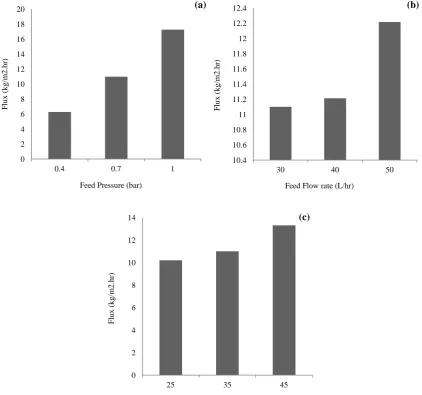
Main effects of operating variables: The first studied factor was feed pressure. Three levels for feed pressure (0.4, 0.7 and 1.00 bars) were tested. This result could be observed in Fig. 4a which shows the effect of feed pressure on the response, the permeation flux. As could be observed, the increase in the feed pressure increases the
flux value up to 17.26 kg/m2h, and this
increase was almost linear. This result was in good agreement with those obtained in literature (20- 21). The second studied factor was feed flow rate. Fig. 4b shows the main effect of feed flow rate (30, 40, and 50 L/h) on the response, the permeation flux. As could be observed, an increase in the feed flow rate led to a little increase in the permeation flux. With an increase in the feed flow rate from 40 to 50 L/h, the
permeation flux increased from ∼11.21 to
∼12.21 kg /m2
Application of microfiltration membrane for treatment of car wash effluent by Taguchi method prediction 5
fouling attachment, which forms an additional resistance for water molecules to pass through. The fouling attachment on PVDF-MFB membrane can be strongly linked to the oil and grease in a car wash which could come from any of the petroleum products on the surface of vehicle or leaking from the engine. This behavior was in good agreement with published data in literature (22). The third studied factor was feed temperature. Three levels for feed temperature (25, 35 and
45°C) were tested. As could be observed,
an increase in the feed temperature led to an increase in the permeation flux due to
providing more molecular mobility at
higher temperatures. Fig. 4c shows the
main effect of feed temperature on the response, the permeation flux. It could be observed that the flux increased with an increase in the feed temperature. Moreover, the increase in feed temperature from 35 to
45°C was more effective than those
increases from 25 to 35°C.This result was
in good agreement with those obtained in literature (22).
Fig. 2- Main effects of operating parameters on the permeation flux: (a) feed pressure, (b) feed flow rate, (c) feed temperature.
0 2 4 6 8 10 12 14 16 18 20
0.4 0.7 1
F
lu
x
(
k
g
/m2
.h
r)
Feed Pressure (bar)
(a)
10.4 10.6 10.8 11 11.2 11.4 11.6 11.8 12 12.2 12.4
30 40 50
F
lu
x
(
k
g
/m2
.h
r)
Feed Flow rate (L/hr)
(b)
0 2 4 6 8 10 12 14
25 35 45
F
lu
x
(
k
g
/m2
.h
r)
Feed Temperature (0C)
6 Iranian Journal of Environmental Technology, 1st Year,Vol. 1, No. 2, Autumn & Winter 2015
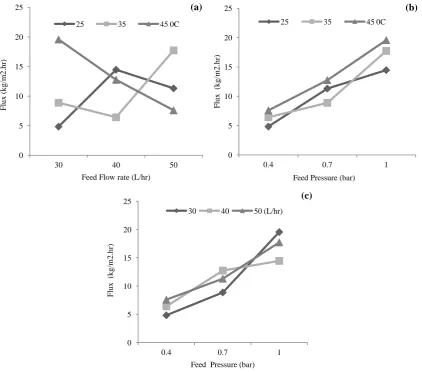
Interactive study of operating variables: Table 5 presents the results for the response of each level. These results indicated that there are some interactions between the operating variables. To find the interactions
between investigated variables, the
response of each parameter against others shall be constructed (23). The results are shown in Fig. 3a–c. This figure shows the regions in which there are interactions. In each region in which the lines cross each other there is interaction and the slope of the lines at the cross point is a criterion for the interaction percentage. The operating variables’ interactions could be evaluated based on the severity index (SI%). The term SI is defined such that it is 100%
when the angle between the lines is 90◦ and
0 when the angle is zero. After all
interactions are calculated, the Taguchi method uses the SI values to order them (see Table 4). Among three interactions tested, the SI values range between 41.01% (as the highest) and 7.76% (as the lowest). The higher SI value was between the feed temperature and flow rate. This is due to the effect of molecular mobility at higher
temperatures on the recirculation rate of the
feed stream. The lowest SI value was between the feed pressure and flow rate. This is due to low liquids compressibility, the interaction feed pressure is lower than other variables.
Fig. 3- Plotted interaction lines of operating parameters, (a) Q × T, (b) P × T, (c) P × Q.
0 5 10 15 20 25
30 40 50
F
lu
x
(
k
g
/m2
.h
r)
Feed Flow rate (L/hr)
(a)
25 35 45 0C
0 5 10 15 20 25
0.4 0.7 1
F
lu
x
(k
g
/m2
.h
r)
Feed Pressure (bar)
(b)
25 35 45 0C
0 5 10 15 20 25
0.4 0.7 1
F
lu
x
(k
g
/m2
.h
r)
Feed Pressure (bar)
(c)
Application of microfiltration membrane for treatment of car wash effluent by Taguchi method prediction 7
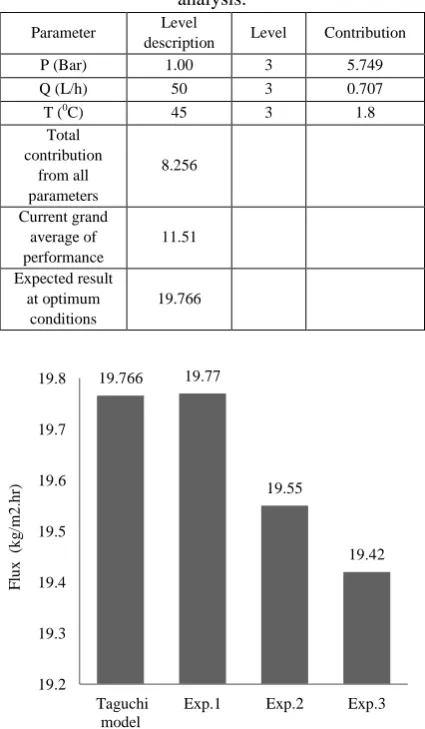
Optimum conditions and responses based on Taguchi method: A new Taguchi design was done and the permeation flux was introduced as the target parameter and the permeation flux was introduced again as “bigger is better”. Considering the data presented in Table 6, it was found that the best combination of the operating variables
for treatment of car wash effluent using
microfiltration membrane was P3Q3T3. In
other words, using this combination of the factors which were predicted by Taguchi, the best response (higher permeation flux)
with minimum required operational
conditions will be attainable. Based on this
prediction, 19.766 Kg /m2h permeation flux
should be reached. In order to verify the validity of Taguchi model’s prediction, this combination is within the runs in Table 3 (Run#7) and the measured permeation flux for this run was obtained as 19.58 kg/m2.h which is reasonably close to the predicted value. Basically, the larger the response, the better the performance characteristic. As could be observed in Fig. 4, good validity
was achieved between the excess
experiments and the Taguchi prediction for the response.
Analysis of variance (ANOVA) : To determine those process parameters having significant effects on the performance characteristics, an analysis of variance (ANOVA) was carried out. This was accomplished by separating the total variability of each level, which is measured by the sum of the squared deviations from the total mean of the responses, into the
contribution by each process parameterand
the error (24). The percentage contribution
from each of the process parameters in the total sum of the squared deviations can be used to evaluate the importance of the
process parameter change on the
permeation flux.
Table 4- The percent of interactions between the process parameters (Interaction Severity Index).
Intraction Columns SI (%)
1. Q×T 2×3 41.01
2. P×T 1×3 13.62
3. P×Q 1×2 7.76
Table 5- Responses for the Taguchi analysis of the permeation flux.
Response Operating parameter P (bar) Q (L/h) T (0C)
L1 6.286 11.101 10.208 L2 10.985 11.213 11.012 L3 17.26 12.217 13.311 L2-L1 4.698 0.111 0.804
Table 6- Optimum conditions based on Taguchi analysis.
Contribution Level
Level description Parameter
5.749 3
1.00 P (Bar)
0.707 3
50 Q (L/h)
1.8 3
45 T (0C)
8.256 Total
contribution from all parameters
11.51 Current grand
average of performance
19.766 Expected result
at optimum conditions
Fig. 4- Response values (permeation flux) based on the Taguchi model’s predictionand the excess
experiments.
19.766 19.77
19.55
19.42
19.2 19.3 19.4 19.5 19.6 19.7 19.8
Taguchi model
Exp.1 Exp.2 Exp.3
F
lu
x
(k
g
/m2
.h
8 Iranian Journal of Environmental Technology, 1st Year,Vol. 1, No. 2, Autumn & Winter 2015
Results of ANOVA which are shown in Table 7 indicate that feed pressure is the significant operating variable to affect the
performance characteristics (target
parameter, the permeation flux). Based on
the above discussion, the optimal operating
variables are feed pressure level 3, feed flow rate level 3 and feed temperature level 3 (Fig. 2). Moreover, the contribution of the error is 4.54%, which may be assumed to be reasonable.
Table 7- Results of the ANOVA
Process
parameters DOF
Sum of
squares Variance
Percent (%) P (bar) 2 545.587 272.793 87.542 Q (L/h) 2 6.805 3.402 0.746
T (0C) 2 46.662 23.331 7.167
Error 20 21.689 1.084 4.545 Total 26 620.744 100.00
Discussion and Conclusion
In this work, the effect of various operating variables on treatment of car
wash effluent by microfiltration
polyvinylidene fluoride (PVDF- MFB)
membrane was studied. Results indicated
that maximum permeation flux was achieved when feed pressure of 1.00 bar and feed temperature of 45◦C were used. Moreover, this concluded that feed flow rate has a low role permeation flux. The Taguchi analysis of the data shows that there are some interactions between the
operating variables and the best
experimental conditions, which were
predicted based on the Taguchi model are
(P3Q3T3). The contribution of feed pressure
on the process response, the permeation flux, are greater compared with other factors. The features demonstrated by
PVDF-MFB membrane in treatment from
car wash effluent from Paniz station in omidiyeh, Khuzestan are at a relatively low operating pressure (1.00 bar) coupled with
stable water production can offer an environmentally sustainable option to car wash industry, i.e. meeting regulatory requirements for discharge and reducing fresh water consumption from water reclamation.
Acknowledgement
The authors express their appreciation to the Young Researchers and Elites Club of the Omidiyeh Azad University for financial support of this work.
References
(1) Dunn R.; Bush G. Using process integration technology for CLEANER production. Cleaner Production2001, 9, pp 1- 23.
(2) Al- Odwani A., Ahmed M., Bou-Hamad S., Car wash water reclamationin Kuwait. Desalination
2007, 206, pp 17- 28.
(3) Boussu K., Kindts C., Vandecasteele C., Van der Bruggen B. Applicability of nanofiltration in the car wash industry. Separation and Purification Technology2007, 54, pp 139- 146.
(4) Ciardelli G., Corsi L., Marcucci M. Membrane separation for wastewater reuse in the textile industry. Resources, Conservation and Recycling
2001, 31, pp 189- 197.
(5) Lau W. J., Ismail, A. F. Application of response surface methodology in PES/SPEEK blend NF membrane for dyeing solution treatment.
Membrane Water Treatment 2010, 1.1, pp 49- 60.
(6) Chakrabarty B., Ghoshal A. K., Purkait M. K. Ultrafiltration of stable oil-in-water emulsion by polysulfone membrane. Membrane Science
2008, 325, pp 427- 437.
(7) Xu Z. L., Chung T. S., Loh K. C., Lee B. C. Polymeric asymmetric membranes made of polyetherimide/ polybenzimidazole/ poly (ethylene glycol) (PEI/PBI/PEG) for oil– surfactant water separation. Membrane Science
Application of microfiltration membrane for treatment of car wash effluent by Taguchi method prediction 9
(8) Ravazzini A. M., Van Nieuwenhuijzen A. F., Van der Graaf, J.H.M.J. Direct ultrafiltration of municipal wastewater: comparison between filtration of raw sewage and primary clarifier effluent. Desalination2005, 178, pp 51- 62.
(9) Tavares C. R., Vieira M., Petrus J. C. C., Bortoletto E. C., Ceravollo F. Ultrafiltration/ complexation process for metal removal from
pulp and paper industry wastewater.
Desalination2002, 144, pp 261- 265.
(10) Martin Lo Y., Cao D., Argin-Soysal S., Wang J., Hahm T. S. Recovery of protein from poultry processing wastewater using membrane ultrafiltration. Bioresource Technology2005, 96, pp 687- 698.
(11) Boussu K., Eelen D., Vanassche S., Vandecasteele C., Van der Bruggen B., Van Baelen G., et al. Technical and economical evaluation of water recycling in the car wash industry with membrane processes. Water Science & Technology2008, 57, pp 1131- 1135.
(12) Jönsson C., Jönsson A. S. The influence of degreasing agents used at car washes on the performance of ultrafiltration membranes.
Desalination1995, 100, pp 115- 123.
(13) Karakulski K., Morawski A. W. Treatment of wastewater from car washes by ultrafiltration",
Fresenius Environmental Bulletin 2003, 12 (4),
pp 343- 348.
(14) Panizza, M., Cerisola, G. Applicability of
electrochemical methods to car wash
wastewaters for reuse. Part 1: Anodic oxidation with diamond and lead dioxide anodes.
Electroanalytical Chemistry 2010, 638 (1), pp 28- 32.
(15) Takht Ravanchi M., Kaghazchi T., Kargari A. Application of membrane separation processes in petrochemical industry: a review.
Desalination 2009, 235, pp 199- 244.
(16) Boussu K., Kindts K., Vandecasteele C., Van der Bruggen B. Applicability of nanofiltration in the car wash industry. Separation and Purification Technology2007, 54, pp 139- 146.
(17) Jӧnsson C., Jӧnsson A. The influence of degreasing agents used at car washes on the performance of ultrafiltration membranes.
Desalination1995, 100, pp 115- 123.
(18) Lau W. J., Ismail A. F., Firdaus S. Car wash industry in Malaysia: Treatment of car wash effluent using ultrafiltration and nanofiltration membranes. Separation and Purification Technology2013, 104, pp 26- 31.
(19) Tavakoli A., Sohrabi M., Kargari A., Choi Chul-Jin. Taguchi Method Prediction of Effect of Processing Parameters on Nanoparticle Size in Chemical Vapor Condensation Process.
Metals and Materials International2009, 15 (5),
pp 877- 880.
(20) Mohammadi T., Abbasi M., Mirfendereski M., Nikbakht M., Golshenas M. Performance study of mullite and mullite– alumina ceramic MF membranes for oily wastewaters treatment
Desalination2010, 259, pp 169- 178.
(21) Abbasi M., Salahi A., Mirfendereski M., Mohammadi T., Pak A. Dimensional analysis of permeation flux for microfiltration of oily wastewaters using mullite ceramic membranes
Desalination2010, 252, pp 113- 119.
(22) Gorouhi E., Sadrzadeh M., Mohammadi T. Microfiltration of oily wastewater using PP hydrophobic membrane. Desalination2006, 200, pp 319- 321.
(23) Kargari A., Kaghazchi T., Sohrabi M., Soleimani. M. Batch extraction of gold (III) ions from aqueous solutions using emulsion liquid membrane via facilitated carrier transport.
Membrane Science 2004,233, pp 1- 10.
(24) Mohammadi T., Kazemi P. Taguchi
optimization approach for phenolic wastewater treatment by vacuum membrane distillation.
ناریا یطیحم تسیز یروانف ، لاس لوا ، هرامش 2 ، و زییاپ ناتسمز 9314 9
دربراک
یاشغ
نویسارتلیفورکیم
یارب
هیفصت
باسپ
شاوراک
اب
هدافتسا
زا
ییوگشیپ
شور
یچوگات
اتیهانآ رایشناد * یسانشراک دشرا یمیش هیزجت ، هاگشاب نارگشهوژپ ناوج و ناگبخن ، هاگشناد دازآ یملاسا ، دحاو هیدیما ، ناریا ، [email protected] گنروارهم یدئاق داتسا یمیش هیزجت ، هاگشناد جوسای ، ناریا ، [email protected] چ هدیک،رضاح شهوژپ رد طیارش هیفصت باسپ شاوراک هاگتتسیا تیناپ رد هتیدیما ، ناتتسزوخ تب ه ههیتسو یاتشغ نویسارتهیفوركیم یهپ نیدیهینیو ید دیاروهف
(PVDF- MFB)
اب هزادنا فانم 93 / 0 رتموركیم با شور ییوواتت
دش یسررب . شور ییووات هب یسررب رثا صخاش یاه یتایهمع فهتخم زا ههمج راشف کاروخ رد هتس طتس ( 4 / 0 ، 7 / 0 و 9 راب ) ، تعرس نایرج کاروخ رد هس طس ( 30 ، 40 و 00 رتیل رب تعاتس ) و اتمد ی کاروتخ رد هس طس ( 20 ، 30 و 40 هجرد یتناس دارو ) رب یور راش یذوفن باسپ شاوراک رد رف آ دنی هیفصت ب ه راک هدرتب دش . نوزفا رب نیا ، رثا و مهس ره صخاش هطوبرم رب یور راش و لخادت نیب نآ اته اتب لتیهحت ییوواتت نیتیعت هدش دوب . جیاتن ناشن داد هک م ؤ نیرترث صخاش راشف کاروخ هدوب تسا . نیمود مهس لباق هجوت یارتب یاتمد کاروخ هدهاشم دش . تعرس نایرج کاروخ رثا یمک رب یور راش یذوفن دراد . رد طیارش هنیهب ( 9 / 00 راتب ، تعرس نایرج 00 رتیل رب تعاس و یاتمد 40 هتجرد یتناتس دارتو ) ، نازتیم ییوگختساپ لدتم ییوواتت ( راتش یذوفن )
kg/m2h