Joe Onosko is an associate professor in the education department at the University of New Hampshire. His research interests include curriculum issues, secondary social- studies teaching and learning, and teacher preparation.
Race to the Top Leaves Children
and Future Citizens Behind
Th
e Devastating Eff ects of Centralization,
Standardization, and High Stakes Accountability
Joe Onosko
Abstract
President Barack Obama’s Race to the Top (RTT) is a profoundly fl awed educational reform plan that increases standardization, centralization, and test- based accountability in our nation’s schools. Following a brief summary of the interest groups supporting the plan, who is currently participating in this race, why so many states voluntarily submitted proposals, and what features of the plan are most problematic, eight arguments are off ered as to why RTT is highly detrimental to our nation.
P
resident Barack Obama’s Race to the Top (RTT)is a plan that profoundly increases standardization, centralization, and test- based accountability in our nation’s schools. For many education observers, it is stunning to see that in less than twenty years we’ve gone from district- designed curriculum and testing, to state- driven standards and testing under Clinton and Bush, to Obama’s national common core standards, national curriculum materials, and high- stakes national tests. I argue here that RTT is a profoundly fl awed national education reform plan. Following a brief summary of who is promoting this Race, why it gained traction so quickly with the individual states, and what features of the plan are most problematic, I off er eight reasons why RTT is not in the best interest of the nation and our nation’s children.
Who’s in the Race?
Since its inception in 2009 through 2010, RTT has been a $4.35 billion, competitive, voluntary grant program off ered to the states and funded through the $787 billion American Recovery and Reinvestment Act (U.S. Department of Education, 2009). Over the past two years, Secretary of Education Arne Duncan has secured the commitment of 48 states and the District of Columbia to national common standards. In addition, over the past two years, 40 states have reviewed and committed to this federal initiative by submitting RTT grant proposals, with many states submitting twice. Below are the 12 winners to date and the staggering monies they have been awarded (U.S. Department of Education, Aug.
2010), leading some critics to rename the program Race to the Trough:
• New York: $700,000,000 • Florida: $700,000,000 • Tennessee: $502,000,000 • Georgia: $400,000,000 • North Carolina: $400,000,000 • Ohio: $400,000,000
• Maryland: $250,000,000 • Massachusetts: $250,000,000 • Delaware: $107,000,000
• District of Columbia: $75,000,000 • Hawaii: $75,000,000
• Rhode Island: $75,000,000
groups plan to develop curriculum materials and instructional guides for America’s teachers. As reported in EducationWeek in February of this year (Gewertz, 2011), “Th e two groups’ plans, fi nal-ized in January, show that they intend to wade more deeply into providing curriculum resources and instructional materials to teachers than they proposed in their original grant applications.” Currently, 45 states are partnered with one or both of these assessment groups, including an agreement to pilot the fi rst national tests in language arts and mathematics in 2014 (U.S. Department of Education, September 2010).
With a budget request in 2011 of $1.35 billion, Obama and Duncan would like to continue the race either (a) in its current form but with much less money to entice the remaining 39 states; (b) as district rather than state competitions, given the reduced monies available and the fracturing support from districts in grant-winning states (McNeil, February 2011; Starzyk, 2010); or, preferably, (c) as the nation’s blueprint for the long overdue renewal of the Elementary & Secondary Education Act that would replace No Child Left Behind (McNeil, January, 2011). At a recent Congressional subcommittee meeting, Duncan employed crisis rhetoric (“next year . . . the number of schools not meeting their goals under No Child Left Behind (NCLB) could double to over 80%”), presumably to motivate Congress to replace NCLB so his race could move from voluntary state participation to mandated national education policy (Duncan, 2011).
Who’s Promoting the Race?
Given the divisiveness in Washington on virtually every public policy issue, how did RTT gain traction so quickly with so many states? Off ering $4.35 billion in RTT monies to the nation’s desperate, cash- strapped states was strategically brilliant. To further maximize support, the federal government invited to the planning table the nation’s governors (through the National Governors Association) and chief state school offi cers (through the Council of Chief State School Offi cers) to create program features that appealed to interested groups from the left to the far right. I can identify at least seven overlapping interest groups that support the plan:
• Th ose genuinely committed to equality of educational opportu-nity and who believe that only a centralized, federal plan can move the nation in this direction.
• Th ose who believe more competition is needed to improve public schools, necessitating grant competitions (rather than propor-tional funding), napropor-tional testing, and high- stakes accountability. • Dominant players in the educational assessment industry who
see a whole lot of profi t potential.
• Corporate America, which spends billions a year on employee training and hopes to reduce a portion of their training costs through a better education system.
• Th ose who believe that hierarchical, rational organization (including the power of technology, centralization, standardiza-tion, input/output models, quantitative data, and so on) is the best way to improve student achievement.
• Cash- strapped governors and state department of education leaders who see Race to the Top as the only way to access millions of dollars in desperately needed revenue.
• Free marketers and other charter- school proponents who’d like to see a partial or complete dismantling of public education by demonstrating the superiority of charters.
What Features of Obama’s Race Imperil Public Education?
Time limitations prevent a summary of the plan (U.S. Department of Education, 2009)— including some of the good features such as increased emphasis on science education (relative to No Child Left Behind)— but there are four components that will prove devastating: • National common standards (including curriculum materials such
as lesson plans, student readings, and workbooks) in mathematics and language arts will homogenize and centralize classroom teaching and learning to the detriment of students, teacher recruitment and retention, and our nation’s economic vitality. • Annual high- stakes national testing (with sensationalized media
reporting of the results) in only mathematics and language arts will perpetuate NCLB’s fi nancial and human resource hyperfocus on two curricular areas at the expense of all other subjects, including students’ academic aptitudes and interests.
• Teacher and administrator removal, retention, and bonus/merit pay based, in part, on student test scores will undermine teacher/ student relations, student- centered curriculum and engagement, and teacher recruitment and retention.
• Th e privatization of education through charter schools will deliver market- based decision making to the classroom despite research studies that question the performance of charters relative to public schools.
Eight Reasons Why Obama’s Race to the Top Is a Profoundly Flawed National Reform Plan
Th e above features of RTT greatly increase the centralization, standardization, and high- stake accountability of our nation’s schools, at least until RTT fails and public education becomes privatized through charter schools under this same plan. Th e following eight fl aws in Obama’s reform initiative frame this critique: • Th e plan’s focus on high- stakes testing and accountability to
raise achievement in math and language arts has a track record of failure.
• Th e plan creates a false savior in charter schools.
• Th e plan creates hostile school environments, undermines teacher- student relations, and infl icts the greatest harm on students in greatest need— that is, minority students and students living in poverty.
• Th e plan narrowly focuses the educational goals and energies of school personnel on two learning outcomes at enormous opportunity cost.
• Th e plan demonizes teachers, reduces the status of the profession, and ensures that many of our most talented and motivated young people will not become educators.
• Th e plan threatens the entrepreneurial vitality and economic future of our country, despite, ironically, support from corporate America.
• Th e plan threatens our democracy due to students’ reduced capacity for informed decision making.
In the sections that follow each of the eight fl aws in Obama’s Race to the Top will be explained to, hopefully, motivate readers to oppose its expansion to all 50 states via the reauthorization of the American Elementary and Secondary Education Act.
Th eplan’s focus on high- stakes testing and accountability to raise achievement in math and language arts has a track record of failure. Since the advent of high- stakes testing in the mid- 1990s, under the Clinton administration, 12th- grade scores in reading have remained fl at on our most trustworthy national metric, the National Assessment of Educational Progress, or NAEP (Willingham, 2010). Th e respective scores for White and Latino students have each dropped 2 points between 1992 and 2008, while Black students have improved only 3 points over the 16- year period. Th is 16- year period, the two- term presidencies of both Clinton (1992– 2000) and Bush (2000– 2008), began our nation’s experi-ment with nationally mandated state standards and testing over local control. Also note that between 2002 and 2008 NCLB funded Reading First and associated programs for $1 billion per year, an increase of 60% annually compared to the pre- NCLB era (Klien, 2008; Zehr, 2009). Given the fl at test scores despite the enormous increase in federal funding, one could argue that NCLB state standards and testing have actually hindered reading achievement.
Fourth- and eighth- grade NAEP reading results show a slight uptick but, again, are disappointing. Over the last two years (2007– 2009), 49 of 50 states failed to see their reading scores increase in both fourth and eighth grades. Kentucky was the exception, though in October of 2010 it was revealed that Kentucky’s student exclusion rate on testing day jumped 300%, from 2% in 2007 to more than 6% in 2009— the highest exclusion rate in the nation (Gewertz, 2010). So, it now looks like a national shutout: not a single state has improved reading scores in grades four and eight between 2007 and 2009. Can we think of another education goal in the history of federal funding that has received more sustained attention, fi nancial support, human capital, and accountability pressure than has reading?
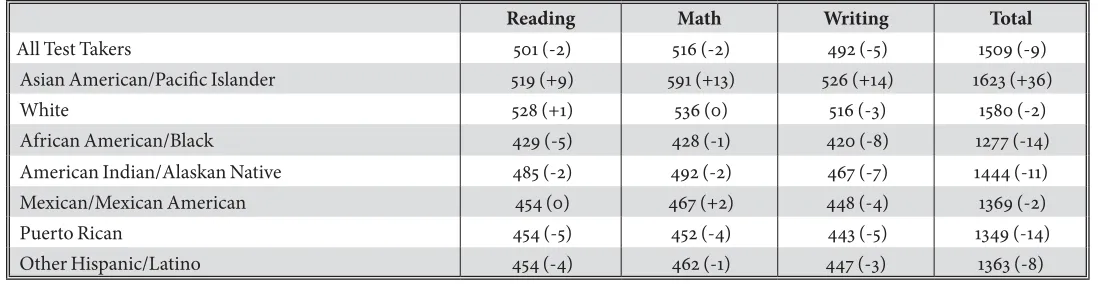
Is student achievement improving among America’s college bound? Th e answer is no on both the Scholastic Aptitude Test (SAT) and the American College Test (ACT). In Table 1 below, FairTest (2010) reveals the declining SAT scores in reading, math, and writing over the last fi ve years, 2006 to 2010, in every student subgroup except one (Asian American or Pacifi c Islander).
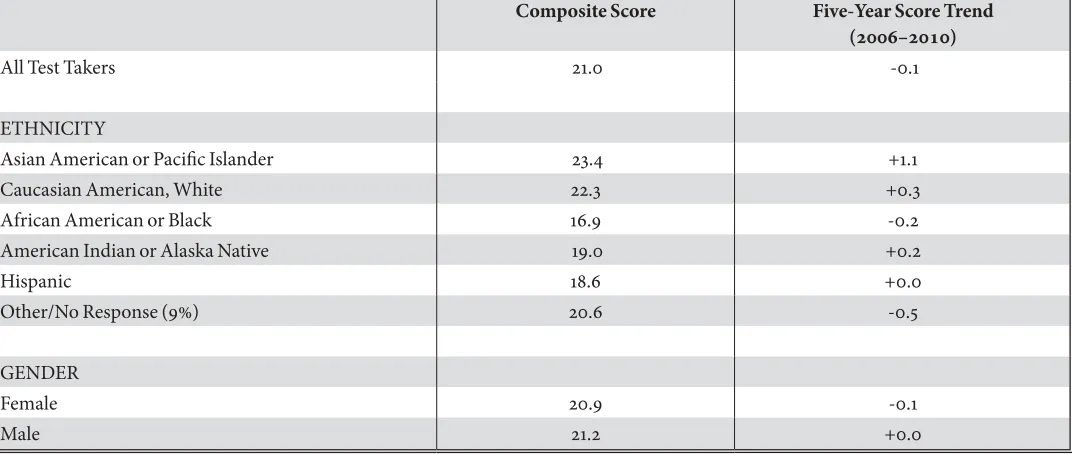
Similarly, in Table 2 below, FairTest (2010b) reveals there is nothing encouraging to be found on the ACT over the last fi ve years, as regardless of gender or subgroup (except, again, Asian American or Pacifi c Islander) scores have remained fl at among the nearly 1.6 million students who have taken the ACT.
Is U.S. performance improving on international comparisons involving the world’s 15 year olds? Th e answer again is no and, unfortunately, in all three subject areas tested. A recent report from the National Center for Educational Statistics (NCES) said “there was no measurable change in the U.S. average scores” in reading achievement between 2000 and 2009 on the Program for
International Student Assessment, or PISA; that is, U.S. 15 year olds scored 504 in 2000 and 500 in 2009 (NCES, 2010). Again, keep in mind that these stagnant reading scores occurred while the Bush administration increased annual funding for reading instruction by 60%, starting in 2002 and maintaining through 2008.
Mathematics scores between 2000 and 2009 among our nation’s 15 year olds also remained fl at, with a statistically insignifi cant decrease from 493 to 487 (NCES, 2010). Finally, PISA science scores among our nation’s 15 year olds also reveal no statistically signifi -cant change between 2000 and 2009, rising a meager 3 points from 499 to 502 (NCES, 2010).
Analysts are baffl ed when they juxtapose these persistent fl at lines in student performance on our nation’s fi nest standardized tests during the NCLB era with Secretary Duncan’s assertion that Race to the Top is a “research- based” reform initiative. In a comprehensive review of research cited by the Obama administra-tion to support Race to the Top, the Naadministra-tional Educaadministra-tion Policy Center off ered the following conclusions: “the research cited was of inadequate quality”; there was “extensive use of non- research and advocacy sources to justify policy recommendations”; and there was “an overwhelming reliance, with little or no research justifi ca-tion, on standardized test scores as a measure of student learning and school success” (National Education Policy Center, 2010). A
Table 1. 2010 College- Bound Seniors’ Average SAT Score (With Changes Since 2006)
Reading Math Writing Total
All Test Takers 501 (- 2) 516 (- 2) 492 (- 5) 1509 (- 9)
Asian American/Pacifi c Islander 519 (+9) 591 (+13) 526 (+14) 1623 (+36)
White 528 (+1) 536 (0) 516 (- 3) 1580 (- 2)
African American/Black 429 (- 5) 428 (- 1) 420 (- 8) 1277 (- 14)
American Indian/Alaskan Native 485 (- 2) 492 (- 2) 467 (- 7) 1444 (- 11)
Mexican/Mexican American 454 (0) 467 (+2) 448 (- 4) 1369 (- 2)
Puerto Rican 454 (- 5) 452 (- 4) 443 (- 5) 1349 (- 14)
stunning recent admission by Joseph Willhoft , executive director of SBAC (one of the two national state- of- the- art assessment design groups), raises additional questions about the assessment portion of Obama’s reform plan:
Th ere’s an expectation that out of the gate this [assessment] is going to be so game- changing, and maybe aft er four or fi ve years it will be game- changing, but not immediately . . . the amount of innovation we’ll be able to carry off in that amount of time is not going to be that much. (Sparks, 2011)
Note, however, that there are never any fl at lines when one
compares student achievement to family income; that is, as a group children of wealth always outperform students of modest means, and children of poverty perform the worst (Rampell, 2009). Th e architects of Race to the Top know about this economic elephant in the room and the nearly two decades of stagnant achievement on state, national, and international high- stakes tests (as summarized above); nonetheless they tell the American public that replacing state curriculum frameworks with national common standards and scrapping state assessments for non- “game- changing” national tests will somehow trigger achievement gains missing since the advent of high- stakes testing in the early 1990s.
Given that the architects of the national assessments (PARCC and SBAC) involve many of the same players and organizations that directed state testing eff orts during the Clinton and Bush years, and given the recent acknowledgement by Willhoft that the new national tests won’t be much diff erent than current state assessments, I am left to conclude that Obama’s continued hyperfo-cus on high- stakes testing in two subject areas (combined with increased standardization and centralization) will only perpetuate the nearly two decades of stagnant mathematics and reading achievement among our nation’s youth.
Th eplancreatesafalsesaviorincharterschools. Stanford’s Center for Research on Education Outcomes (CREDO) in June 2009 conducted the most comprehensive review of charter schools, spanning 70% of children attending charters in the United States. CREDO found that only 17% of charter schools outper-formed public schools, 37% peroutper-formed worse, and 46% were comparable. In another major study of charter schools, researchers Buckley and Schneider in their 2007 book, CharterSchools: Hope or Hype? conclude that “charter schools, on the whole, are falling short, at least viewed through the eyes of the students and parents who are their customers” (p. 268).
Questions about charter schools also emerge in a June 2010 report from Mathematica Policy Research, a study commissioned by the U.S. Department of Education to compare public and charter school achievement using 36 middle- school charters in 15 states. Th e study compared students admitted to charters through a random-ized lottery process with those not admitted on a variety of outcome measures, including math and reading test scores, attendance, grade promotion, and conduct in school and out of school. Th e conclu-sion: charter middle schools that hold lotteries are not more successful than traditional public schools at improving student achievement, behavior, and other indicators of student progress.
Analyzing randomized admissions is critically important due to reports that charter schools are oft en selective during the admission process and that student turnover in charters is signifi -cantly higher. As an example, Diane Ravitch reported the following statement by a Los Angeles public middle school principal in
EducationWeek:
Since school began, we enrolled 159 new students (grades 7 and 8). Of the 159 new students, 147 of them are far below basic . . . Of the 147 . . . 142 are from charter schools. It is ridiculous that they can pick and choose kids and pretend that they are raising scores when, in fact, they are purging nonperforming students at an alarming rate. (Ravitch, 2010)
Table 2. 2010 College- bound Seniors’ Average ACT Scores
Composite Score Five- Year Score Trend
(2006– 2010)
All Test Takers 21.0 - 0.1
ETHNICITY
Asian American or Pacifi c Islander 23.4 +1.1
Caucasian American, White 22.3 +0.3
African American or Black 16.9 - 0.2
American Indian or Alaska Native 19.0 +0.2
Hispanic 18.6 +0.0
Other/No Response (9%) 20.6 - 0.5
GENDER
Female 20.9 - 0.1
In addition, 588 charters (one of every 10) have failed in the United States since 1992 (Allen & Consoletti, 2008), leaving communities scrambling to fi nd alternative schools for their children. Others have avoided closure only due to the generous fi nancial support from corporations and other benefactors promoting the school privatization movement (LosAngelesTimes, 2010).
Despite CREDO’s and Mathematica’s fi ndings that charters perform no better and oft en worse than public schools and that many charter schools go bankrupt and close, Race to the Top guidelines require that states create legislation and other regulations that promote charter- school growth (U.S. Department of
Education, 2009).
It’s essential to understand the very diff erent race to the top that charter- school advocates are pursing under Obama’s plan. In a 2008 article entitled, “Wave of the Future: Why Charter Schools Should Replace Failing Urban Schools,” Andy Smarick of the Fordham Institute, and former CEO of the National Alliance for Public Charter Schools, revealed a radically diff erent fi nish line— that is, privatized, free- market schooling:
As chartering increases its market share in a city, the district will come under growing fi nancial pressure. Th e district, despite educating fewer and fewer students, will still require a large administrative staff to process payroll and benefi ts, administer federal programs, and oversee special education. With a lopsided adult- to- student ratio, the district’s per- pupil costs will skyrocket. At some point along the district’s path from monopoly provider to fi nancially unsustainable marginal player, the city’s investors and stakeholders— taxpayers, foundations, business leaders, elected offi cials, and editorial boards— are likely to demand fundamental change. (Smarick, 2008)
With the audacity of hope, Obama must believe the above scenario won’t occur or he is willing to risk substantial school privatization should his reform plan fail. Regardless, it’s a dangerous game to play given that district- run public schooling paralleled our nation’s ascendancy to superpower status during the 20th century— or do our nation’s teachers and schools deserve no credit for America’s remarkable 20th- century successes?
Th e potential recklessness of Obama’s new policy on charters can be illustrated in a hypothetical. What if it turns out that Obama’s plan results in charter schools slightly outperforming comparable public schools on standardized achievement tests? And then, over time, the achievement diff erences become large enough that conservative Republicans dismantle the U.S.
Department of Education (as Ronald Reagan tried to do early in his presidency), and each state is left to decide if it will phase out public schools or allow a battle between publics and charters to continue? It’s hard to imagine any permutation in this scenario resulting in more rather than less equality of educational opportunity, despite the fact that equality of educational opportunity is the foundational justifi cation for income disparities and other inequalities in American society.
Fortunately, the most recent and best research we have on charters provides some peace of mind (i.e., they underperform relative to publics); however, one cannot underestimate the
number of powerful individuals and groups that worship the totem of privatized, free- market schooling. In an era when ideology too oft en trumps facts, the American public needs to know the facts about charter- school performance, especially given the prominent role that charters assume in Obama’s fl awed reform plan.
Th eplancreateshostileschoolenvironments, undermines teacher- student relations, and infl icts the greatest harm on students in greatest need— that is, minority students and students living in poverty. In Obama’s Race to the Top, as much as 50% of teachers’ yearly evaluations and professional future is to be based on student test scores in math and language arts. Th e metric is called valueadded— that is, the value that a teacher adds above and beyond a student’s expected level of improvement. Teachers who fail to improve student test scores at the projected rate for three consecutive years can be fi red or transferred.
Underperforming schools over a three- year period will see their administrators removed.
All that goofy, kids- being- kids stuff that for decades was considered amusing and, at times, actually supportive of student learning will be viewed as threats to a teacher’s livelihood, home, and family. If we are currently seeing a lack of love in some class-rooms because of NCLB testing pressure, what love remains will be replaced by a whole lot of hate under Race to the Top. Exemplary educators I work with all agree that student learning requires human connection and rapport (except maybe for a small group of turbocharged high achievers). In short, teacher rapport— including care for students, recognition of student individuality, and teacher enthusiasm— is essential for student motivation and performance (Bergin & Bergin, 2009).
Th is kind of human relationship between teachers and students is likely to be signifi cantly undermined in Race to the Top due to the increased test score scrutiny and sanctioning of teachers and administrators. If Obama thinks too many schools are “dropout factories” (Marr, Sept. 2010), the big stick he applies to teachers and administrators will only ensure more dropouts, as educators— out of frustration and panic— apply the same kind of wood to students.
Th e many draconian school practices that escalated during NCLB will only increase under Race to the Top. Th e Advancement Project et al., using U.S. Department of Education data, reported that between 2002 (the start of NCLB) and 2007, out- of- school suspension rates increased nationally by 8% for Black students and 14% for Latino but dropped 3% for Whites. Expulsion rates are also divided by race: up 6% for Latino and 33% for Black students but down 2% for Whites (2011). In a very revealing analysis, Advancement Project et al. reported there was nearly a 500% increase in out- of- school suspensions (from 5,468 in 2002 to 25,140 in 2008) when Arne Duncan served as CEO of the Chicago public schools. As for high school graduation rates, from 2002 through 2006, 73% of our nation’s 100 largest school districts saw a decline in student graduate rates. However, in the six years before NCLB (1996 to 2002), 68% of the 100 largest districts saw an increase in the graduation rate (Advancement Project et al., 2011).
Star, wrote that kindergarten was “once a place where children primarily learned social skills” but now “children’s artwork is accompanied by a caption noting the chapter and verse of the guideline that the work fulfi lls” (2010, ¶13). Lorrie Shepard, the pio-neering and internationally recognized expert on school retention eff ects, attributed the city’s action to high- stakes testing “trickling down to lower grades” (¶19).
Eight percent of all New York City eighth graders, 5,017 in all, were held back in 2010, even though school budget cuts for the next year eliminated the weekly tutoring sessions these students were to receive, tutoring that purportedly justifi ed the retentions (Otterman, 2010, September). Note that these eighth graders started kindergarten at the start of NCLB, in 2002. So much for a full dose of high- stakes testing reform.
Th ere are numerous other examples, but I’ll end with Tennessee, the fi rst Race to the Top grant winner (a $500 million award). Th e state recently mandated that all schools must factor 15 to 25% of students’ state test scores into students’ course grades in math and language arts. One Tennessee administrator admitted, “Th is is really going to sink some kids” (Gauthier, 2010).
It defi es logic how the punitive school environments and hostile teacher- student relationships that are likely to be created by Obama’s reform plan will enhance student achievement and attitudes about learning.
Th eplannarrowlyfocusestheeducationalgoalsand energiesofschoolpersonnelontwolearningoutcomesat enormousopportunitycost. Because Race to the Top is focused on two learning outcomes, all of the social sciences (including geography, economics, political science, and psychology), history, contemporary issues and problems, philosophy, civic education, the arts (visual, performing, and musical), all of the sciences (biology, earth science, general science, physics, chemistry, and more), all foreign languages, the building trades, and other curricular areas and school programs will remain background staging to the spotlight on testing in math and reading.
Less than two years ago, I was on a search committee for the new superintendent of my local district in New Hampshire and saw fi rsthand how deeply NCLB has permeated the educational vision and practices of school leaders. Of the eight fi nalists brought in for initial interviews, four were unable to identify a single educational goal or priority other than those articulated by NCLB. Committee members were stunned.
Aft er eight years of NCLB, 72% of New Hampshire’s elemen-tary, middle, and high schools were failing to make adequate yearly progress (New Hampshire Department of Education, 2010). Th e rational response for administrators in the humiliating grip of SINI (school in need of improvement) status is to allocate more
resources to test prep, including cutting funding in other subject areas and school programs, hire literacy coaches, bring in outside reading consultants, and increase class time on math and reading instruction.
A national survey from the Center on Education Policy reported that between 2002 and 2007, 62% of districts in the country increased class time in the elementary grades for language arts or math instruction, and 20 % did so in middle schools
(McMurrer, 2007). Measured in minutes per week, language arts increased 46% and math increased 37%, while minutes in social studies decreased 36%, science 28%, lunch and recess 20% each, and art and music 16% each. We also know that some schools have gutted arts programming, cut back or eliminated extracurricular activities, punished low- performing students by taking away recess, replaced retiring social studies teachers with additional language arts instructors on middle school teams, and so on. And test performance pressures have only increased for school districts since 2007, no doubt fueling additional curricular erosion in the other subject areas.
Th e above statistics provide powerful evidence of the oppor-tunity cost of Race to the Top’s narrow educational focus; however, specifi c incidents might best illustrate how a myopic focus on two educational goals can aff ect the perception and judgment of educators. A New York City fi ft h grader with a learning disability, Christina LaForge, dutifully went to summer school in the hope of not being held back (Gonen, 2010). She worked hard, successfully completed all of the portfolio assignments, and at the end of the summer was told by her teacher and the principal that she’d be able to move with her friends up to the middle school. However, a week before school started, a central- offi ce administrator overruled not only the teacher who had spent the summer working with Christina but also the building principal. Why? Because this student’s test score was 7 points shy of a 647 out of 800, the city’s cut point for passage into sixth grade. Th at diff erence amounts to one or two additional correct answers on the state’s standardized reading test. Christina had passed the math test. In a recent follow- up article (Gustafson, 2010), it was reported that she is not sleeping or eating well and sits alone at recess. Her parents are very concerned, but their petition for a review was denied. So much for no child left behind.
How can we explain such a callous decision except as an example of the degree to which some administrators have drunk the poison, truly believing that treating every case the same will save the majority of New York City students and resurrect the nation’s economy? In this bizarre calculus, the potential destruc-tion of America’s empire and way of life is so near at hand that Christina’s personal devastation— socially, emotionally, and intellectually— is nowhere on the bureaucrat’s radar.
Concern over the cutoff in reading and math scores have school personnel doing more than off ering summer remediation to students like Christina; they’re also changing students’ answers on tests! In what appears to be the largest abuse on record, the
Finally, opportunity cost is embedded in “get tough” student retention policies. As an example, if the 11,000 third- through- eighth- grade students held back last spring in New York City make it through high school, the additional cost to taxpayers (at a modest estimate of $10,000 per student per year) will be $110 million— and that’s if each student is retained only once. Th e 300 retained kindergartners in Indianapolis that were mentioned earlier will cost the city an extra $3 million (again, assuming $10,000 per year and only one retention per student). Th at’s a lot of money that could have been allocated to student exploration of the arts, sciences, social sciences, and applied fi elds of study.
Th e opportunity costs described above will be exacerbated under Obama’s plan. By raising the stakes from state to national testing, by evaluating and sanctioning teachers and administrators using standardized test scores, and by maintaining a hyperfocus on only two learning outcomes, the depth and diversity of school curricula will continue to erode and, in the process, so will the richness of student development.
Th eplandemonizesteachers, reduces the status of teaching as a profession, and ensures that many of our most talented and motivated young people will not go into the fi eld. It’s hard to imagine a better way to tarnish public perception of schools and diminish the status of teaching than to design an accountability system like NCLB that guarantees the failure of virtually every public school by 2014. Teachers feel the stigma, and faculty morale continues to erode in schools across the country (Gardner, 2010; Rado, 2010). Homeschooling is on the rise (NCES, 2008), and charter schools are perceived by many to be superior despite the facts. Th e fi lm WaitingforSuperman (2010) sure hasn’t helped.
Race to the Top will be even more damaging to public schools and the profession. Under Obama’s plan, the public fl ogging will target individual teachers by ranking them according to their value- added quotient. As a mathematical artifact, rank ordering ensures that 50% of math and language arts teachers will be below average. Who’ll go into a profession where one out of every two teachers is guaranteed to be “inferior”? What other profession ranks individuals in this way? And if no other profession does it, is teaching no longer a profession? Why is the leadership of the education profession— state school offi cers, state school boards, superintendents, principals, and professors of education— not doing more to combat the bashing?
Value- added rankings have already been announced to the world. In mid- August of last year, only weeks before school started, the LosAngelesTimes published the rankings of 6,000 third- , fourth- , and fi ft h- grade Los Angeles teachers based on their value- added quotient (Felch, Song, & Smith, 2010). Th ousands of highly respected teachers, their acclaim earned through years of shared love, sweat, and tears with students, parents, and colleagues, saw their professional reputations ruined in an instant by two numbers.
Rigoberto Ruelas, who taught fi ft h grade in one of the city’s toughest neighborhoods, was one of those teachers. Most of his students, 97%, at Miramonte Elementary were Latino, 60% were English language learners, and 95% received free or reduced lunch. Ruelas grew up in the area, began his career as a teacher’s aide, got
certifi ed at age 25, and for 14 years had a near- perfect attendance record. Year aft er year he volunteered to teach the most diffi cult kids in his class, counseled boys and girls out of joining gangs, came to school early and stayed late, tutored kids on weekends, and made home visits. But his value- added score as reported by the L.A. Times
told the community he was only “average” as a math teacher and “less eff ective” as a reading teacher (Faturechi, 2010). Friends and family reported that Ruelas was crushed, and now so are his students, colleagues, and the community. On Sunday, September 22, 2010, he jumped to his death. Responsible to the very end, he informed the school on Friday they’d need a substitute teacher for his class on Monday and Tuesday (Lovelace, 2010).
Arne Duncan continues to promote the use of value- added calculations of teacher performance despite the outcry in Los Angeles and recent studies showing them to be grossly inaccurate. New York University professor Sean Corcoran, in a 2010 analysis on valued- added measures using New York City data, discovered that three years of longitudinal data resulted in, on average, a 34% measurement error when calculating teachers’ value- added scores. Th is means that a teacher with a value- added score at in the 60th percentile appears to be “above average” but may, in fact, be among the top quartile of all teachers (77th percentile) or may be “below average” (43rd percentile).
Corcoran pointed out that if we use a single year of student test data, the measurement error on average increases to 61 points. Th is means that a teacher with a value- added ranking at the 50th percentile may, in fact, be among the top 20% (i.e., 81st percentile) of teachers or in the bottom 20% (20th percentile). Corcoran concluded that “value- added assessments . . . are, at best, a crude indicator of the contribution that teachers make to their students’ academic outcomes.” Many others are raising concerns about using value- added assessment measures (Otterman, 2010, December).
In a similar analysis, but using diff erent data sets, the Economic Policy Institute concluded that value- added ranking “should not be used to make operational decisions because such estimates are far too unstable to be considered fair or reliable . . . Legislatures should not mandate a test- based approach to teacher evaluation that is unproven and likely to harm not only teachers but also the children they instruct” (Baker et al., 2010).
Th ose who believe in this fl awed value- added calculation have already accepted two larger fl awed assumptions: that standardized tests accurately measure student ability in math and reading and that achievement gains in math and reading suffi ciently encompass what is important about a teacher’s work with student. Educator Art Costas was on the mark when he said, “What was educationally signifi cant but hard to measure has been replaced by what is educationally insignifi cant but easy to measure” (Horn, 2007).
one- third of the country’s college graduates. It’s prestigious to be a teacher in Finland, and their superior subject- matter expertise allows them to model good thinking and deliver sophisticated content understanding to students. By comparison, in the United States only 23% of teachers are among the top third of college graduates, and only 14% in high- poverty schools.
Given the ability of CEOs to sell products and of politicians to spin events, if these leaders used their powers of persuasion to herald the education profession rather than to crucify it, our nation’s corps of teachers would begin to look more like Finland’s. Unfortunately, the demonizing of teachers and public schools, the de- skilling of the profession through teach- by- number national curriculum materials and high- stakes tests, and the use of value- added quotients to determine teacher quality— all components of Race to the Top— will drive out many excellent teachers and keep our top college graduates from considering a career in the profession.
Th eplanunderminestheintellectual, aesthetic, social and emotional engagement and development of students. Bush’s No Child Left Behind and now Obama’s Race to the Top have thrown our nation’s children under the bus of social effi ciency— that is, the primary goal of federal education policy is to have students read, compute, and possess other workplace skills to better serve the nation’s economy. In short, the needs, interests, and talents of children have become roadkill in the nation’s race to the top.
Since the late 1970s, there’s been an American cultural shift away from viewing education as the valuing and promoting of children’s attachments. Attachments are the thoughts and things in the world that animate children, making their lives enviously rich with curiosity, aff ect, and meaning. Dostoyevsky’s appreciation is apparent when he says, “Th e soul is healed by being with children.” Child- centered schooling— with its commitment to fashioning curriculum that draws upon students’ knowledge and interests, introduces them to rich and varied modes of thought, and provides new ways of seeing the world— used to be the norm; however, over the last few decades this has come to be viewed as intellectually soft and a threat to economic growth.
Th e educational shift toward national interests, including so- called objective measures of student progress through high- stakes testing in reading and math, was seismic under Bush and will be nearly complete if Obama’s RTT replaces NCLB. In an enormous gamble, Obama’s plan locks America into a single educational path designed to produce a workforce possessing greater ingenuity, expertise, and workplace skills. Th e architects of this reform will have their system up and running by 2014 if all goes according to their plan, however, it is a plan that will signifi cantly undermine the intellectual, social, aesthetic and emotional development of most children.
Th e “teach- by- number” reading and math textbook series that districts have purchased from vendors under NCLB, along with the proposed “soup to nuts” national curriculum and assessment program under Race to the Top, will likely fail to interest and motivate many students— and, I might add, our best teachers. Th ese comprehensive teacher- proof curricula, designed to improve test scores, undermine the professionalism, including the creativity and motivation, of educators. Most tragic, the tests destroy
students’ love of learning, because classroom teachers intimately know their students and are best equipped to design activities that honor students’ interests and draw upon their prior knowledge.
Attempts to connect student interests, important concepts from other subject areas, and current issues and events to commer-cially published curricula is forbidden or discouraged, as school administrators and publishers emphasize the importance of completing the “learning treatment” to maximize test prep and performance. On a personal note, I am shocked to hear that occasionally some of the elementary interns at my affi liate institu-tion are unable to implement a required portfolio component— a two- week unit plan based on their philosophy of teaching— because the interns (and their veteran cooperating teachers) are not allowed to veer from the school’s purchased curriculum.
Second, the coverage demands of state and national frame-works too oft en result in lessons with little content complexity and, therefore, minimal cognitive complexity and opportunities for students to think. In a fascinating, widely read 2005 study that compared the science frameworks of 46 countries, the highest achieving nations (defi ned by performance on PISA) covered far fewer topics than did the United States. Th e researchers concluded that the U.S. framework is “unfocused, repetitive, and undemand-ing” (Schmidt, Hsing, & McKnight, 2005). Stanford University professor Nell Noddings sized up the problem quite well:
“We should be . . . restoring opportunities for kids to invent, communicate, explore, and use a variety of talents to fulfi ll course requirements. We have sacrifi ced richness, depth, and creativity to a dull struggle for higher and higher scores on on material that is quickly forgotten when the test is over.” (2010, ¶13)
Conceptualizing a good education involves so much more than developing reading skills and computational abilities as measured by standardized tests. Th e myopic obsession to improve two outcomes through surgical strikes using off - the- shelf curricula and high- stakes testing has blinded educational leaders to the impor-tance of honoring students’ intellectual, social, aesthetic, and emotional interests (and needs!). A good education animates consciousness about topics, issues, and questions, involves the student in continued refl ection outside of class, and promotes understanding and emerging expertise. A commitment to human development implies a need to identify and cultivate learner interests, if for no other reason than a person’s psychic energy resides in and refl ects their interests in the world. A national education policy that errs so profoundly toward social effi ciency in only two areas of human performance and neglects student engagement across a broad spectrum of human experience will serve neither our children nor our nation.
capital, a concept central to all models of economic development. Similarly, corroding teacher- student relations by using value- add measures, de- skilling the education profession through canned curriculum, and undermining the cultural status of teaching negatively impacts student learning and, by implication, the nation’s economic vitality.
In an important book, Catching Up or Leading the Way: American Education in the Age of Globalization, Michigan State professor Yong Zhao argues that America is at a crossroads and warns against nationalizing education, as it will undermine the diversity of thought, creativity, individual talent, and expertise that previously made the American education system so impressive to much of world. He also warns against a national reform agenda focused on test scores in only two subject areas, and recommends a return to the tradition of local control because it will provide “more diverse talents rather than standardized labourers, more creative individuals rather than homogenized test- takers, and more entrepreneurs rather than obedient employees” (2009, p.181). Ironically, Zhao points out that Asian countries with extremely high PISA international test scores, like Singapore and China, want to move away from centralized education in an eff ort to produce more creative, innovative, and diverse thinkers.
Consistent with Zhao’s claims, the brilliant muckraking educational researcher Gerald Bracey assured the cultivators of human capital, just before his untimely death, that our pre– No Child Left Behind system was actually producing excellent
scientifi c thinkers. In 2006, before NCLB had enough traction to be given credit for PISA test scores, twice as many American students (about 67,000 in all) scored at the very highest level (a “6”) on the international high school science test compared to second place Japan with 31,000 students (Bracey, 2008). England came in third with 22,000 and Finland, the world’s highest scoring nation in 2006, had only 2,500 students in the top category. Do we really want Race to the Top to radically restructure America’s education system, given our high- end performance on international compari-sons and the potential economic fallout?
One of the great ironies about the business community’s general support for Race to the Top is that its hallowed values of free enterprise and innovation are lost under a mountain of common core profi ciencies, annual testing in most grades, national reading materials, lesson activity guides, and post- assessment remediation protocols. Of course, there are no shortcuts to entrepreneurial vitality and a strong national economy, certainly not through repeated cycles of test prep, test taking, test result analysis, and back again to the next round of test prep. As child psychologist Jean Piaget rhetorically asked:
What is the goal of education? Are we forming children who are only capable of learning what is already known? Or should we try to develop creative and innovative minds capable of discovery from the pre- school age on, throughout life? (Davidson Films, 1989)
Race to the Top places an inordinate emphasis on learning and testing what is known, and in only two subject areas! Piaget would
be dumbfounded. Th e creation of a robust economy requires, and the next generation of citizen- workers deserves, so much more.
Th eplanthreatensourdemocracyduetostudents’ reduced capacity for informed decision making. Th e sizeable reductions in class time for social studies, science, and other areas of the elementary and middle school curricula are very likely to get worse under Race to the Top due to its spotlight on national testing and heightened sanctions against teachers and administrators. A generation of young people, at a time in life when imagination is in full bloom, will not experience fascinating alternative worlds both past and present that animate and delight consciousness, reveal possibilities, and serve to anchor— and call into question— personal beliefs and those of others. Young people’s social perspec-tives, cultural appreciations, sense of time, place and wonder, aesthetic preferences, and many other areas of interest and under-standing we include in the defi nition of worldview will be further impoverished by Race to the Top.
Decision-making and problem analysis are not generic mental muscles or intellectual skills that can be massaged in language arts classes and then magically applied to civic problems and issues, though this fl awed and persistent assumption underlies the common standards movement and its sibling, “21st-century skills” (Willingham, 2008). Skilled thinking is never generic; rather, it involves skilled use of specifi c information, ideas, theories, general-izations, and other understandings (McPeck, 1981). Th is is why an individual can exhibit remarkable comparison- and- contrast skills in one area but look like an intellectual buff oon when attempting the same with an unfamiliar topic. For example, skilled analysis and decision making about a U.S. foreign- policy issue requires citizens to draw upon a variety of conceptual frameworks, including political, geographic, economic, and historical understanding related to the issue. How will our nation’s future citizens acquire these understandings given the erosion that has occurred in social studies and science curricula during NCLB, erosion that will continue due to Obama’s desire to increase penalties for teachers and administrators who fail to improve test scores in language arts and mathematics?
Gaming the system will continue under Race to the Top. At a recent social studies state conference, I learned from two very angry teachers that social studies positions at their middle school had been fi lled by language arts and mathematics teachers— these new hires would deliver the social studies curriculum. In short, grade- level teams at this school are doubling up on math and language arts teachers due to NCLB testing pressures. No doubt other methods of gaming the system will emerge at the expense of the social studies and the fi eld’s fundamental mission of creating more enlightened citizens. Incredibly, Obama’s Race to the Top is silent on social studies reform and the need for a robust civic- education curriculum.
Conclusion
rather the rats are myopic educational reformers focused on student competency in reading and math, and on overhauling the profession by evaluating teacher and administrator performance using standardized test results. Th is agenda falls far short of what it means to be an educated person and democratic citizen. President Richard Nixon in 1970 warned Congress about focusing education reform on simplistic “verbal and mathematical achievement” outcomes:
To achieve this fundamental reform it will be necessary to develop broader and more sensitive instruments of learning than we now have. Th e National Institute for Education would take the lead in developing these new measurements of educational output. In doing so it should pay as much heed to what are called “immeasurables” of schooling (largely because no one has yet learned to measure them) such as responsibility, wit, and humanity as it does to verbal and mathematical achievement . . . From these considerations we develop another new concept of accountability. (Rothstein & Jacobsen, 2009)
Obama’s reform plan will not take us to the top precisely because it fails to “pay as much heed” to many other important, complex, and diffi cult- to- achieve (and measure) educational goals. It’s a plan that employs crisis rhetoric about a dire economic future and then off ers up test- score surveillance as a central strategy to supposedly motivate educators to develop children in narrow ways for national purposes. In short, the opportunity cost to individual human development and our nation’s most valuable resource, human capital, will prove devastating. And, of course, lurking in the background is plan B: the privatization of our educational system should Obama’s nationalized, centralized, standardized reform eff ort fail.
As our nation’s legislators begin to craft a new elementary- and- secondary- education act to replace NCLB, they need to be educated by constituents about the many fl aws of Race to the Top. Historians of education will identify the current legislative moment as one of the most critical in public education. It’s not too late to infl uence the course of history.
References
Advancement Project, Education Law Center- PA, FairTest, Th e Forum for Education and Democracy, Juvenile Law Center, & NAACP Legal Defense and Educational Fund, Inc. (2011, March). Federal policy, ESEA reauthorization, and the school- to- prison pipeline. Retrieved from http://advancementproject.org/sites/default/fi les/Federal %20Policy%20ESEA%20Reauthorization%20and%20the%20School-to-Prison%20 Pipeline%20-%2003%2009%2011.pdf
Allen, J., & Consoletti, A. (2008). Annual survey of America’s charter schools. Center for Education Reform. Retrieved from http://www.edreform.com/_upload/cer _charter_survey_2008.pdf
Auguste, B., Kihn, P., & Miller, M. (2010). Closingthetalentgap: Attracting and retaining the top- third graduates to careers in teaching. McKinsey & Company. Retrieved from http://www.mckinsey.com/clientservice/Social_Sector/our_practices/ Education/Knowledge_Highlights/~/media/Reports/SSO/Closing_the _talent_gap.ashx
Baker, E. L., Barton, P. E., Darling- Hammond, L., Haertel, E., Ladd, H. F., Linn, R. L., . . . & Shepard, L. A. (2010). Problems with the use of student test scores to evaluate teachers. (Briefi ng Paper #278). Economic Policy Institute. Retrieved from http:// www.ksde.org/LinkClick.aspx?fi leticket=SS3xOtapWTE%3d&tabid=1646& mid=10218
Bergin, C., & Bergin, D. (2009). Attachment in the classroom. EducationalPsychology Review,21(2), 141– 170.
Bracey, G. (2008, November 13). Th e U.S. produces the lion’s share of top scoring students.
Huffi ngtonPost. Retrieved from http://www.huffi ngtonpost.com/gerald-bracey/ the-u-s-produces-the-lion_b_143740.html
Buckley, J., & Schneider, M. (2007). Charterschools: Hope or hype? Princeton, NJ: Princeton University Press.
Center for Research on Education Outcomes. (2009, June). Multiple choice: charter school performance in 16 states— executive summary. Retrieved from http://credo .stanford.edu/reports/MULTIPLE_CHOICE_EXECUTIVE%20SUMMARY.pdf Corcoran, S. (2010). Can teachers be evaluated by their students’ test scores? Should they
be? Th e use of value- added measures of teacher eff ectiveness in policy and practice. Annenberg Institute. Retrieved from http://www.annenberginstitute.org/ products/Corcoran.php
Davidson Films (Producer). (1989). Piaget’s developmental theory: An overview [DVD]. Retrieved from http://www.encyclopedia.com/video/lEam9lpa6TQ-piagets -developmental-theory-overview-davidson.aspx
Duncan, A. (2011, March 9). Winning the future with education: Responsibility, reform and results. Retrieved from http://www.ed.gov/news/speeches/winning-future -education-responsibility-reform-and-results
FairTest .(2010). 2010 College- bound seniors average SAT scores [Data fi le]. Retrieved from http://fairtest.org/2010-collegebound-seniors-average-sat-scores FairTest. (2010b). 2010 College- bound seniors average ACT scores [Data fi le]. Retrieved
from http://fairtest.org/2010-collegebound-seniors-average-act-scores Faturechi, R. (2010, September 27). Mourning for teacher found dead in forest. Los
AngelesTimes. Retrieved from http://latimesblogs.latimes.com/lanow/2010/09/ south-gate-elementary-teacher-death.html
Felch, J., Song, J., & Smith, D. (2010, August 14). Who’s teaching L.A.’s kids? A Times
analysis, using data largely ignored by LAUSD, looks at which educators help students learn, and which hold them back. LosAngelesTimes. Retrieved from http://articles.latimes.com/2010/aug/14/local/la-me-teachers-value-20100815 Gardner, W. (2010, December 20). Another look at teacher absenteeism and resignations.
EducationWeek. Retrieved from http://blogs.edweek.org/edweek/walt_gardners _reality_check/2010/12/another_look_at_teacher_absenteeism_and_resignations .html?qs=teacher+morale
Gauthier, K. (2010, October 15). TCAP scores to count toward students’ letter grades.
TimesFreePress. Retrieved from http://www.timesfreepress.com/news/2010/ oct/15/tcap-scores-count-toward-students-letter-grades
Gewertz, C. (2010, March 25). Exclusion rates in NAEP: A pot still simmering [Web log post]. Retrieved from http://blogs.edweek.org/edweek/curriculum/2010/03/ would_naep_results_look_even_w.html
Gewertz, C. (2011, February 11). Common- assessment consortia expand plans: Extra federal funds will go toward curricula, teacher training. Education Week. Retrieved from http://www.edweek.org/ew/articles/2011/02/11/21consortia.h30.html Gonen, Y. (2010, September 6). Cruel surprise foils grade expectations. NewYorkPost.
Retrieved from http://www.nypost.com/p/news/local/queens/cruel_surprise _foils_grade_expectations_PV2YIUsDu6yZxEguBOWxgM#ixzz1HB6ElzUB Gustafson, A. (2010, September 22). Boro mother challenges decision not to promote daughter. NewYorkPost. Retrieved from http://www.nypost.com/p/news/local/ queens/boro_mother_challenges_decision_BFLEes5PsA1LtnqHPgLReL Horn, J. (2007). What is left behind. School Matters. Retrieved from http://www
.schoolsmatter.info/2007/11/what-is-left -behind.html
King, R. (2010, October 10). IPS kids repeat kindergarten at a high rate, but does it help?
IndianapolisStar. Retrieved from http://www.indy.com/posts/ips-kids-repeat -kindergarten-at-a-high-rate-but-does-it-help
Los Angeles Times. (2010, December 9). L.A. charter school group secures $10.5- million bailout. Retrieved from http://latimesblogs.latimes.com/lanow/2010/12/ leading-local-charter-school-secures-fi nancial-bailout.html
Lovelace, D. (2010, September 27). Teacher’s apparent suicide may be linked to online ratings. KTT Fox 11 Online. Retrieved from http://www.myfoxla.com/dpp/news/ local/teachers-apparent-suicide-may-be-linked-to-online-ratings-20100927 Marr, K. (2010, September 27). President Obama: Fire failing teachers. Politico. Retrieved
from http://www.politico.com/news/stories/0910/42758.html
Mathematica Policy Research. (2010, June 29). Charter school study shows no signifi cant overall impacts on achievement. Retrieved from http://www
.mathematica-mpr.com/newsroom/releases/2010/Charterschool_6_10.asp McMurrer, J. (2007, July 24). NCLB year 5: Choices, changes, and challenges: Curriculum
and instruction in the NCLB era. Center on Education Policy. Retrieved from http://www.cep-dc.org/displayDocument.cfm?DocumentID=312
McNeil, M. (2011, January 19). Obama to seek $1.35 billion Race to Top expansion.
Education Week. Retrieved from http://www.edweek.org/ew/articles/2010/ 01/19/19rttt-budget.h29.html
McNeil, M. (2011, February 12). ARRA brings home mixed report card. EducationWeek.
Retrieved from http://www.edweek.org/ew/articles/2011/02/09/20stim-overview _ep-2.h30.html?r=1842601355
McPeck, J. (1981). Criticalthinkingandeducation. New York: St. Martin’s Press. National Center for Education Statistics. (2008, December). 1.5 million homeschooled
students in the United States in 2007. Retrieved from http://nces.ed.gov/ pubs2009/2009030.pdf
National Center for Educational Statistics. (2010). PISA 2009 results. Retrieved from http://nces.ed.gov/surveys/pisa/pisa2009highlights.asp
National Education Policy Center. (2010). Reviews of the Obama administration’s six research summaries for “A Blueprint for Reform.” Retrieved from http://nepc .colorado.edu/reviews-obama-administrations-six-research-summaries New Hampshire Department of Education. (2010). 2011 AYP results. Retrieved from
http://www.education.nh.gov/instruction/accountability/ayp/index.htm Noddings, N. (2010, August 31). Teacher Tess in testing land. EducationWeek. Retrieved
from http://www.edweek.org/ew/articles/2010/09/01/02noddings.h30 .html?r=1097612766
Otterman, S. (2010, September 23). City reports nearly fi vefold increase in students repeating a grade. NewYorkTimes. Retrieved from http://www.nytimes.com/ 2010/09/24/nyregion/24promotion.html
Otterman, S. (2010, December 26). Hurdles emerge in rising eff ort to rate teachers. Th e NewYorkTimes. Retrieved from http://www.nytimes.com/2010/12/27/nyregion/ 27teachers.html?_r=1&pagewanted=1
Pickel, M., & Badertscher, N. (2010, July 8). Atlanta students struggle with math, reading.
AtlantaJournal- Constitution. Retrieved from http://www.ajc.com/news/atlanta/ atlanta-students-struggle-with-567059.html
Rado, D. (2010, February 4). Teacher morale scores plunge at majority of DISD schools, survey fi nds. DallasMorningNews. Retrieved from http://www.dallasnews.com/ news/education/headlines/20100204-Teacher-morale-scores-plunge-at -majority-9399.ece
Rampell, C. (2009, August 27). SAT scores and family income. Th eNewYorkTimes.
Retrieved from http://economix.blogs.nytimes.com/2009/08/27/sat-scores -and-family-income
Ravitch, D. (2010, October 12). Are charters the silver bullet? EducationWeek. Retrieved from http://blogs.edweek.org/edweek/Bridging-Diff erences/2010/10
Rothstein, R., & Jacobsen, R. (2009). Measuring social responsibility: We can— and should— measure a far broader set of outcomes than just reading and math.
EducationalLeadership, 66(8), 14-19. Retrieved from http://www.ascd.org/ASCD/ pdf/journals/ed_lead/el200905_rothstein.pdf
Schmidt, W. H., Hsing, C. W., & McKnight, C. C. (2005). Curriculum coherence: An examination of U.S. mathematics and science content standards from an international perspective. JournalofCurriculumStudies, 37(5), 525– 559.
Smarick, A. (2008). Wave of the future: Why charter schools should replace failing public schools. EducationNext,8(1). Retrieved from http://educationnext.org/ wave-of-the-future
Sparks, S. (2011, April 12). Experts see hurdles ahead for common core tests. Education Week. Retrieved from http://www.edweek.org/ew/articles/2011/04/12/28aera.h30 .html?r=1582870194
Starzyk, E. (2010, Nov. 14). Some Ohio schools quit Race to the Top as political sparring threatens program. Th ePlainDealer. Retrieved from http://blog.cleveland.com/ metro/2010/11/race_to_the_top_money_about_to.html
Torres, K. (2010, August 3). 109 Atlanta educators suspected of test cheating. Atlanta Journal- Constitution. Retrieved from http://www.ajc.com/news/atlanta/ 109-atlanta-educators-suspected-583484.html
U.S. Department of Education. (2009). RacetotheTopexecutivesummary. Retrieved from http://www2.ed.gov/programs/racetothetop/executive-summary.pdf
U.S. Department of Education (2010, August 24). Race to the Top fund awards. Retrieved from http://www2.ed.gov/programs/racetothetop/awards.html
U.S. Department of Education. (2010, September 2). U.S. Secretary of Education Duncan announces winners of competition to improve student assessments [press release]. Retrieved from http://www.ed.gov/news/press-releases/us-secretary-education-duncan-announces-winners-competition-improve-student-asse
Willingham, D. (2008, December 1). Education for the 21st century: Balancing content knowledge with skills [Web log post]. Retrieved from http://www.britannica.com/ blogs/2008/12/schooling-for-the-21st-century-balancing-content-knowledge -with-skills
Willingham, D. (2010, April 5). What NAEP reading scores really show. Th eWashington Post. Retrieved from http://voices.washingtonpost.com/answer-sheet/daniel -willingham/willingham-misunderstanding-na.html
Zehr, M. (2009, December 7) Unproved early- reading program likely to prevail.
EducationWeek. Retrieved from http://www.edweek.org/ew/articles/2009/12/09/ 14read_ep.h29.html