Journal of Mathematical Nanoscience
Available Online at: http://jmathnano.sru.ac.irOn topological properties of boron triangular sheet
BTS
(
m
,
n
)
,
borophene chain
B36
(
n
)
and melem chain
MC
(
n
)
nanostruc-tures
Haidar Ali
1,∗, Abdul Qudair Baig
2, Muhammad Kashif Shafiq
11Department of Mathematics, Government College University, Faisalabad, Pakistan
2Department of Mathematics, COMSATS Institute of Information Technology, Attock
Cam-pus, Pakistan
Academic Editor: Ali Reza Ashrafi
Abstract. Topological indices are numerical parameters of a graph which characterize its topol-ogy and are usually graph invariant. In QSAR/QSPR study, physico-chemical properties and topo-logical indices such as Randi´c, atom-bond connectivity(ABC)and geometric-arithmetic(GA)index are used to predict the bioactivity of chemical compounds. Graph theory has found a considerable use in this area of research. In this paper, we study and derive analytical closed results of general Randi´c index Rα(G)with α=1,12,−1,−12, for boron triangular sheetBTS(m,n), borophene chain of
B36(n)and melem chainMC(n). We also compute the general first Zagreb,ABC,GA,ABC4andGA5 indices of sheets and chains for the first time and give closed formulas of these degree based indices.
Keywords. general Randi´c index, atom-bond connectivity(ABC)index, geometric-arithmetic(GA)
index, boron triangular, borophene, melem.
1 Introduction and preliminary results
Graph theory has provided chemists with a variety of useful tools, such as topological in-dices. Molecules and molecular compounds are often modeled by molecular graph. A molec-ular graph is a representation of the structural formula of a chemical compound in terms of
∗Corresponding author (Email address: [email protected].).
graph theory, whose vertices correspond to the atoms of the compound and edges corre-spond to chemical bonds. Cheminformaticsis a new subject which is a combination of chem-istry, mathematics and information science. It studies Quantitative structure-activity (QSAR) and structure-property (QSPR) relationships that are used to predict the biological activi-ties and properactivi-ties of chemical compounds. In the QSAR /QSPR study, physico-chemical properties and topological indices such as Wiener index, Szeged index, Randi´c index, Zagreb indices and ABCindex are used to predict bioactivity of the chemical compounds.
A graph can be recognized by a numeric number, a polynomial, a sequence of numbers or a matrix. A topological index is a numeric quantity associated with a graph which char-acterizes the topology and is invariant under graph automorphism. There are some major classes of topological indices such as distance based topological indices, degree based topo-logical indices, counting related polynomials and indices of graphs. Among these classes, degree based topological indices are of great importance and play a vital role in chemi-cal graph theory and particularly in chemistry. In a more precise way, a topologichemi-cal index Top(G) of a graph, is a number with the property that for every graph H isomorphic toG, Top(H) =Top(G). The concept of topological indices come from Wiener [?], while he was working on boiling point of paraffin, be named this index aspath number. Later on, the path number was renamed asWiener index[5].
In this article, G is considered to be network with vertex set V(G) and edge set E(G), deg(u)is the degree of vertex u∈V(G)andSu = ∑
v∈NG(u)
deg(v)where NG(u) ={v∈V(G)|
uv∈E(G)}. The notations used in this article are mainly taken from books [6, 10]. LetGbe a graph. Then the Wiener index ofGis defined as
W(G) = 1
2(
∑
u,v)
d(u,v), (1)
where (u,v) is any ordered pair of vertices in G and d(u,v) is u−v geodesic. The very first and oldest degree based topological index isRandi´cindex [20] denoted byR−1
2(G), was introduced by Milan Randi´c and defined as
R−1
2(G) =
∑
uv∈E(G)
1
√
deg(u)deg(v). (2)
The general Randi´c index Rα(G)is the sum of(deg(u)deg(v))α over all edgese=uv∈E(G) is defined as
Rα(G) =
∑
uv∈E(G)
(deg(u)deg(v))α for α=1,1
2,−1,− 1
2. (3)
An important topological index introduced by Ivan Gutman and Trinajsti´c is theZagrebindex denoted byM1(G)and defined as
M1(G) =
∑
uv∈E(G)
One of the well-known degree based topological index isatom-bond connectivity(ABC)index introduced by Estradaet al. in [7] and defined as
ABC(G) =
∑
uv∈E(G)
√
deg(u) +deg(v)−2
deg(u)deg(v) . (5)
Another well-known connectivity topological descriptor isgeometric-arithmetic GAindex which was introduced by Vukiˇcevi´cet al. in [23] and defined as
GA(G) =
∑
uv∈E(G)
2√deg(u)deg(v)
(deg(u) +deg(v)). (6)
ABC4 and GA5 indices can only be computed if we are able to find the edge partition of these interconnection networks based on the sum of the degrees of end vertices of each edge in these graphs. The fourth version of ABC index is introduced by Ghorbani et al. [8] and defined as
ABC4(G) =
∑
uv∈E(G)
√
Su+Sv−2
SuSv . (7)
Recently, the fifth version ofGAindex is proposed by Graovacet al.[9] and defined as
GA5(G) =
∑
uv∈E(G)
2√SuSv
(Su+Sv). (8)
The general Randi´c index forα=1 is the second Zagreb index for any graphG.
2 Main Results
We study the general Randi´c, first Zagreb, ABC, GA, ABC4 and GA5 indices and give a closed formulae of these indices for boron triangular sheet BTS(m,n), borophene chain of B36(n) and melem chain MC(n). Imran et al. studied various degree based topological in-dices for various networks like silicates, hexagonal, honeycomb and oxide in [12]. Nowadays there is an extensive research activity on ABCandGAindices and their variants. For further study of topological indices of various graph families, see [1–4, 13–19, 21, 22].
2.1 Results forBTS(m,n), B36(n)andMC(n)nanostructures
Figure 1. Boron triangular sheet (BTS(4, 4))).
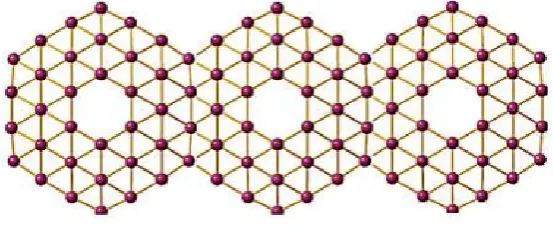
Figure 2. Borophene chain (B36(n)(3)).
Theorem 2.1. Consider the boron triangular sheet BTS(m,n)for m=n≥3. Then
Rα(BTS(m,n)) =
−2(7m−108mn+7(2+n)), α=1;
12+8√3+4(−4+m+n)+
(4√6+2√15+3√30)(−2+m+n)+
3√2(4+m+n)−36(−1+m−mn+n), α= 12; 1
720(204+193m+120mn+193n), α=−1; 1
60
(
80+40√3+15(−4+m+n)+ (10√6+8√5+6√30)(−2+m+n)+
10√2(4+m+n)−60(−1+m−mn+n)),α=−12.
Proof. LetG∼=BTS(m,n)be the boron triangular sheet. The boron triangular sheetBTS(m,n)
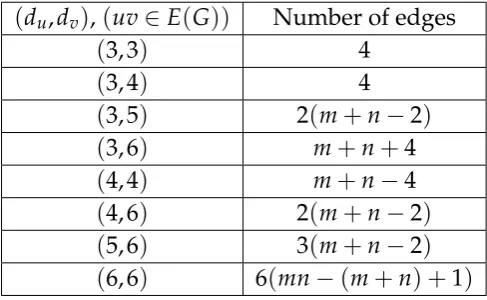
hasm+n+4 vertices of degree 3,m+n−2 vertices of degree 4,m+n−2 vertices of degree 5 and 2mn−m−n+1 vertices of degree 6. The edge set of BTS(m,n) is divided into eight partitions based on the degree of the end vertices. The first edge partition E1(BTS(m,n))
contains 4 edges uv, where deg(u) =deg(v) =3. The second edge partition E2(BTS(m,n))
(du,dv),(uv∈E(G)) Number of edges
(3, 3) 4
(3, 4) 4
(3, 5) 2(m+n−2)
(3, 6) m+n+4
(4, 4) m+n−4
(4, 6) 2(m+n−2) (5, 6) 3(m+n−2) (6, 6) 6(mn−(m+n) +1)
Table 1. Edge partition of boron triangular sheetBTS(m,n)based on degrees of end vertices of each edge.
contains 4 edgesuv, wheredeg(u) =3 anddeg(v) =4. The third edge partitionE3(BTS(m,n)) contains 2m+2n−4 edgesuv, wheredeg(u) =3 anddeg(v) =5. The fourth edge partition E4(BTS(m,n))containsm+n+4 edgesuv, wheredeg(u) =3 anddeg(v) =6. The fifth edge partition E5(BTS(m,n)) containsm+n−4 edgesuv, wheredeg(u) =deg(v) =4. The sixth edge partitionE6(BTS(m,n))contains 2m+2n−4 edgesuv, wheredeg(u) =4 anddeg(v) =
6. The seventh edge partitionE7(BTS(m,n))contains 3m+3n−6 edgesuv, wheredeg(u) =5 and deg(v) =6 and the eighth edge partition E8(BTS(m,n)) contains 6mn−6m−6n+6 edges uv, where deg(u) =deg(v) =6. Table 1 shows such an edge partition of BTS(m,n). Thus from(3)it follows that
Rα(G) =
∑
uv∈E(G)
(deg(u)·deg(v))α.
Now, we apply the formula of Rα(G)forα=1
R1(G) =
8
∑
j=1uv∈
∑
Ej(G)deg(u)·deg(v).
By using edge partition given in Table 1, we get
R1(G) =9|E1(BTS(m,n))|+12|E2(BTS(m,n))|+15|E3(BTS(m,n))|+18|E4(BTS(m,n))| +16|E5(BTS(m,n))|+24|E6(BTS(m,n))|+30|E7(BTS(m,n))|+36|E8(BTS(m,n))|
=−2(7m−108mn+7(2+n)).
We apply the formula ofRα(G)forα=12
R1 2(G) =
8
∑
j=1uv∈
∑
Ej(G)√
By using edge partition given in Table 1, we get
R1
2(G) =3|E1(BTS(m,n))|+2
√
3|E2(BTS(m,n))|+√15|E3(BTS(m,n))|
+3√2|E4(BTS(m,n))|+4|E5(BTS(m,n))|+2√6|E6(BTS(m,n))|
+√30|E7(BTS(m,n))|+6|E8(BTS(m,n))|
=12+8√3+4(−4+m+n) + (4√6+2√15+3√30)(−2+m+n) +3√2(4+m+n)−36(−1+m−mn+n).
We apply the formula ofRα(G)forα=−1. Then we have
R−1(G) =
8
∑
j=1uv∈
∑
Ej(G)1
deg(u)·deg(v)
= 1
9|E1(BTS(m,n))|+ 1
12|E2(BTS(m,n))|+ 1
15|E3(BTS(m,n))|
+ 1
18|E4(BTS(m,n))|+ 1
16|E5(BTS(m,n))|+ 1
24|E6(BTS(m,n))|
+ 1
30|E7(BTS(m,n))|+ 1
36|E8(BTS(m,n))|
= 1
720(204+193m+120mn+193n).
We apply the formula ofRα(G)forα=−12. Then we have
R−1 2(G) =
8
∑
j=1uv∈
∑
Ej(G)1
√
deg(u)·deg(v)
= 1
3|E1(BTS(m,n))|+
√
3
6 |E2(BTS(m,n))|+ 1
√
15|E3(BTS(m,n))|
+
√
2
6 |E4(BTS(m,n))|+ 1
4|E5(BTS(m,n))|+
√
6
12 |E6(BTS(m,n))|
+ √1
30|E7(BTS(m,n))|+ 1
6|E8(BTS(m,n))|
= 1
60(80+40
√
3+15(−4+m+n) + (10√6+8√5+6√30)(−2+m+n)
+10√2(4+m+n)−60(−1+m−mn+n)).
In the following, we compute first Zagreb index of boron triangular sheetBTS(m,n).
Theorem 2.2. For boron triangular sheet G∼=BTS(m,n)for m=n≥3, we have
Proof. Let G be the boron triangular sheetBTS(m,n). By using edge partition from Table 1, the result follows. From (4) we have
M1(BTS(m,n)) =
∑
uv∈E(G)
(deg(u) +deg(v)) =
8
∑
j=1uv∈
∑
Ej(G)(deg(u) +deg(v))
=6|E1(BTS(m,n))|+7|E2(BTS(m,n))|+8|E3(BTS(m,n))|
+9|E4(BTS(m,n))|+8|E5(BTS(m,n))|+10|E6(BTS(m,n))|
+11|E7(BTS(m,n))|+12|E8(BTS(m,n))|.
By doing some calculations, we get M1(BTS(m,n)) =2(−5+7m+36mn+7n).
Now, we computeABCandGAindices of boron triangular sheetBTS(m,n).
Theorem 2.3. Let G∼=BTS(m,n)be the boron triangular sheet for m=n≥3, then
ABC(G) = 1
60(160+40
√
15+15√6(−4+m+n)
+ (40√3+24√10+18√30)(−2+m+n)
+10√14(4+m+n)−60√10(−1+m−mn+n)),
GA(G) =6+16
7
√
3−5m+6mn−5n
+ (4
5
√
6+
√
15 2 +
6 11
√
30(−2+m+n) +2
3
√
2(4+m+n)).
Proof. By using edge partition given in Table 1, we get the result. From(5)it follows that
ABC(G) =
∑
uv∈E(G)
√
deg(u) +deg(v)−2 deg(u)·deg(v) =
8
∑
j=1uv∈
∑
Ej(G)√
deg(u) +deg(v)−2 deg(u)·deg(v)
= 2
3|E1(BTS(m,n))|+
√
15
6 |E2(BTS(m,n))|+
√
10
5 |E3(BTS(m,n))|
+
√
14
6 |E4(BTS(m,n))|+
√
6
4 |E5(BTS(m,n))|+
√
3
3 |E6(BTS(m,n))|
+
√
30
10 |E7(BTS(m,n))|+
√
10
6 |E8(BTS(m,n))|.
By doing some calculations, we get
ABC(G) = 1
60
(
160+40√15+15√6(−4+m+n)
+ (40√3+24√10+18√30)(−2+m+n) +10√14(4+m+n)
and from (6) we get
GA(G) =
∑
uv∈E(G)
2√deg(u)deg(v) (deg(u) +deg(v))
8
∑
j=1uv∈
∑
Ej(G)2√deg(u)deg(v) (deg(u) +deg(v)).
Then we have
GA(G) =|E1(BTS(m,n))|+4 7
√
3|E2(BTS(m,n))|+
√
15
4 |E3(BTS(m,n))|
+ 2
3
√
2|E4(BTS(m,n))|+|E5(BTS(m,n))|+2
5
√
6|E6(BTS(m,n))|
+ 2
11
√
30|E7(BTS(m,n))|+|E8(BTS(m,n))|.
By doing some calculations, we get
GA(G) =6+16
7
√
3−5m+6mn−5n
+ (4
5
√
6+
√
15 2 +
6 11
√
30(−2+m+n) + 2
3
√
2(4+m+n)).
Now, we compute ABC4 and GA5 indices of boron triangular sheet BTS(m,n). Let us consider an edge partition based on the degree sum of neighbors of end vertices. Then the edge set E(BTS(m,n)) can be divided into twenty four edge partitions Ej(BTS(m,n)), 9≤
j≤32, where the edge partitionE9(BTS(m,n)) contains 4 edges uv with Su =13 and Sv=
14, the edge partition E10(BTS(m,n)) contains 4 edges uv with Su =13 and Sv =19, the
edge partition E11(BTS(m,n)) contains 4 edgesuv with Su =13 and Sv=27, the edge
par-tition E12(BTS(m,n)) contains 4 edges uv with Su = 14 and Sv =24, the edge partition
E13(BTS(m,n)) contains 4 edges uv with Su = 14 and Sv = 27, the edge partition
E14(BTS(m,n))contains 2m+2n−8 edgesuvwith Su =16 and Sv=24, the edge partition
E15(BTS(m,n))containsm+n−4 edgesuvwith Su =16 andSv=31, E16(BTS(m,n)) con-tains 4 edges uvwithSu=19 andSv=20, E17(BTS(m,n))contains 4 edges uvwithSu=19
and Sv =27, E18(BTS(m,n)) contains 4 edges uv with Su =19 andSv=32, E19(BTS(m,n)) containsm+n−8 edgesuvwith Su=Sv=20,E20(BTS(m,n))contains 2m+2n−12 edges uv with Su =20 andSv =32, E21(BTS(m,n))contains 4 edgesuvwith Su =24 and Sv=27,
E22(BTS(m,n)) contains 2m+2n−8 edges uv with Su =24 and Sv =31, E23(BTS(m,n)) contains m+n−2 edgesuv with Su =24 andSv=35, E24(BTS(m,n)) contains 4 edgesuv with Su =27 and Sv =32, E25(BTS(m,n)) contains 4 edges uv with Su =27 and Sv =35,
E26(BTS(m,n)) contains 2m+2n−8 edges uv with Su =31 and Sv =35, E27(BTS(m,n)) contains m+n−4 edges uv with Su =31 and Sv=36, E28(BTS(m,n)) contains m+n−6 edges uv with Su =Sv=32, E29(BTS(m,n)) contains 4 edgesuv with Su =32 andSv =35,
Theorem 2.4. Let G∼=BTS(m,n)be the boron triangular sheet for m=n≥5, then
ABC4(G) =10
√
2 91+4
√ 30 247 + 8 3 √ 11 57+2
√
37 95+2
√ 3 7 + √ 13 14 + 7 9 √
2+2
3
√
26 7
+ 8
3√7 + 1 3 √ 19 2 + 7 √ 38 + 152 3√39+
1 18
√
35
2 (34−15m+6mn−15n)
+ 1
10
√
19
2 (−8+m+n) + ( 1 4 √ 11 3 + 1 4 √
5+ 1
16
√
31
2 )(−6+m+n)
+ (3
4 √ 5 31+ √ 53 186+ 1 6 √ 65 31 + 1 4 √ 19 3 + 16 √
1085)(−4+m+n)
+1
2
√
19
70(−2+m+n) + 1 2
√
23
105(−10+3m+3n),
GA5(G) =20+48 17
√
2+96
59
√
6+16
19
√
21+32
51
√
38+3
5
√
39+24
41 √ 42 +12 23 √
57+32
67
√
70+16
39
√
95+12
31
√
105+ 8
27
√
182+1
4
√
247
−13m+6mn−13n+ (24
17
√
2+ 8
13
√
10)(−6+m+n)
+ (4
5
√
6+ 1100
3149
√
31+ 8
55
√
186+ 2
33
√
1085)(−4+m+n)
+ 4
59
√
210(−2+m+n) +12
71
√
35(−10+3m+3n).
Proof. By using edge partition given in Table 2, we get the result. From(7)it follows that
ABC4(G) =
∑
uv∈E(G)
√
Su+Sv−2
SuSv
=
32
∑
j=9uv∈
∑
Ej(G)√
Su+Sv−2
SuSv
= √5
182|E9(BTS(m,n))|+
√
30
247|E10(BTS(m,n))|+ 1 3
√
38
39|E11(BTS(m,n))|
+
√
21
14 |E12(BTS(m,n))|+
√
182
42 |E13(BTS(m,n))|+
√
57
24 |E14(BTS(m,n))|
+3
4
√
5
31|E15(BTS(m,n))|+ 1 2
√
37
95|E16(BTS(m,n))|+ 2 3
√
11
57|E17(BTS(m,n))|
+1
4 7
√
38|E18(BTS(m,n))|+
√
38
20 |E19(BTS(m,n))|+
√
5
8 |E20(BTS(m,n))|
+ 7
36
√
2|E21(BTS(m,n))|+1
2
√
53
186|E22(BTS(m,n))|+ 3 2
√
6
210|E23(BTS(m,n))|
+
√
38
24 |E24(BTS(m,n))|+ 2 21
√
7|E25(BTS(m,n))|+ √8
1085|E26(BTS(m,n))|
+1
6
√
65
31|E27(BTS(m,n))|+
√
62
32 |E28(BTS(m,n))|+
√
182
+
√
33
24 |E30(BTS(m,n))|+ 1 6
√
69
35|E31(BTS(m,n))|+
√
70
36 |E32(BTS(m,n))|.
Thus, we have
ABC4(G) =10
√
2 91+4
√ 30 247 + 8 3 √ 11 57+2
√
37 95+2
√ 3 7 + √ 13 14 + 7 9 √
2+2
3
√
26 7
+ 8
3√7 + 1 3 √ 19 2 + 7 √ 38 + 152 3√39+
1 18
√
35
2 (34−15m+6mn−15n)
+ 1
10
√
19
2 (−8+m+n) + ( 1 4 √ 11 3 + 1 4 √
5+ 1
16
√
31
2 )(−6+m+n)
+ (3
4 √ 5 31+ √ 53 186+ 1 6 √ 65 31 + 1 4 √ 19 3 + 16 √
1085)(−4+m+n)
+1
2
√
19
70(−2+m+n) + 1 2
√
23
105(−10+3m+3n).
From (8) we get
GA5(G) =
∑
uv∈E(G)
2√SuSv
(Su +Sv)
=
32
∑
j=9uv∈
∑
Ej(G)2√SuSv
(Su+Sv).
Then,
GA5(G) =2
√
182
27 |E9(BTS(m,n))|+
√
247
16 |E10(BTS(m,n))|+3
√
39
20 |E11(BTS(m,n))|
+4
√
21
19 |E12(BTS(m,n))|+6
√
42
41 |E13(BTS(m,n))|+2
√
6
5 |E14(BTS(m,n))|
+8
√
31
47 |E15(BTS(m,n))|+4
√
95
39 |E16(BTS(m,n))|+3
√
57
23 |E17(BTS(m,n))|
+8
√
38
51 |E18(BTS(m,n))|+|E19(BTS(m,n))|+4
√
10
13 |E20(BTS(m,n))|
+12
√
2
17|E21(BTS(m,n))|+4
√
186
55 |E22(BTS(m,n))|+4
√
210
59 |E23(BTS(m,n))|
+24
√
6
59|E24(BTS(m,n))|+3
√
105
31 |E25(BTS(m,n))|+
√
1085
33 |E26(BTS(m,n))|
+12
√
31
67 |E27(BTS(m,n))|+|E28(BTS(m,n))|+8
√
70
67 |E29(BTS(m,n))|
+12
√
2
17|E30(BTS(m,n))|+12
√
35
Thus, we have
GA5(G) =20+48
17
√
2+96
59
√
6+16
19
√
21+32
51
√
38+3
5
√
39+24
41
√
42+12
23
√
57+32
67
√
70
+16
39
√
95+12
31
√
105+ 8
27
√
182+1
4
√
247−13m+6mn−13n
+ (24
17
√
2+ 8
13
√
10)(−6+m+n)
+ (4
5
√
6+1100
3149
√
31+ 8
55
√
186+ 2
33
√
1085)(−4+m+n)
+ 4
59
√
210(−2+m+n) +12
71
√
35(−10+3m+3n).
Chemical engineers have determined that a unique arrangement of 36 boron-atoms in a flat disc with a hexagonal hole in the middle may be the preferred building blocks for borophene. A 36-atom cluster of boron, left, arranged as a flat disc with a hexagonal hole in the middle, fix the theoretical requirements for making a one-atom-thick boron chain, right, a theoretical nanomaterial dubbed borophene. A borophene chain B36(n)forn≥2 has order 32n+4 and size 81n+3.
Now, we calculate certain degree based topological indices of borophene chainB36(n)of dimension n. In the coming theorems we compute general Randi´c index Rα(G) with α=
{1,−1,12,−12}, ABC, GA, ABC4andGA5ofB36(n).
Theorem 2.5. Consider the borophene chain B36(n)for n≥2. Then
Rα(B36(n)) =
6(−32+373n), α=1; 8+8√5(−1+n) +46n+ (6√2+8√3)(2+n)+
16√6(1+2n) +6√30(−1+4n) +18(−3+7n), α= 12; 1
1800(1255+5732n), α=−1; 1
30(−30+20
√
2+40√3−12√5+20√6−6√30+
(171+10√2+20√3+12√3+40√6+24√30)n),α=−12.
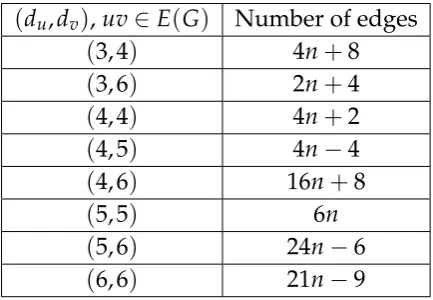
Proof. Let Gbe the borophene chainB36(n). The borophene chain B36(n)has 2n+4 vertices of degree 3, 8n+4 vertices of degree 4, 8n−2 vertices of degree 5 and 14n−2 vertices of degree 6. The edge set of B36(n) is divided into eight partitions based on the degree of end vertices. The first edge partition E1(B36(n))contains 4n+8 edges uv, wheredeg(u) =
(Su,Sv),uv∈E(G) Number of edges (Su,Sv),uv∈E(G) Number of edges
(13, 14) 4 (24, 27) 4
(13, 19) 4 (24, 31) 2m+2n−8
(13, 27) 4 (24, 35) m+n−2
(14, 24) 4 (27, 32) 4
(14, 27) 4 (27, 35) 4
(16, 24) 2m+2n−8 (31, 35) 2m+2n−8
(16, 31) m+n−4 (31, 36) m+n−4
(19, 20) 4 (32, 32) m+n−6
(19, 27) 4 (32, 35) 4
(19, 32) 4 (32, 36) 2m+2n−12
(20, 20) m+n−8 (35, 36) 3m+3n−10
(20, 32) 2m+2n−12 (36, 36) 6mn−15(m+n) +34
Table 2. Edge partition of boron triangular sheetBTS(m,n)based on degrees sum of end vertices of each edge.
(du,dv),uv∈E(G) Number of edges
(3, 4) 4n+8
(3, 6) 2n+4
(4, 4) 4n+2
(4, 5) 4n−4
(4, 6) 16n+8
(5, 5) 6n
(5, 6) 24n−6
(6, 6) 21n−9
Table 3. Edge partition of borophene chainB36(n)based on degrees of end vertices of each edge.
uv, where deg(u) =5 anddeg(v) =6. The eight edge partitionE8(B36(n)) contains 21n−9 edgesuv, wheredeg(u) =deg(v) =6. Table 3 shows such an edge partition ofB36(n). Thus from(3)is follows that
Rα(G) =
∑
uv∈E(G)
(deg(u)deg(v))α.
Now we apply the formula ofRα(G)forα=1
R1(G) = 8
∑
j=1uv∈
∑
Ej(G)deg(u)·deg(v).
By using edge partition given in Table 3, we get
R1(G) =12|E1(B36(n))|+18|E2(B36(n))|+16|E3(B36(n))|+20|E4(B36(n))|
Then R1(G) =6(−32+373n). We apply the formula ofRα(G)forα= 12
R1 2(G) =
8
∑
j=1uv∈
∑
Ej(G)√
deg(u)·deg(v).
By using edge partition given in Table 3, we get
R1
2(G) =2
√
3|E1(B36(n))|+3
√
2|E2(B36(n))|+4|E3(B36(n))|+2
√
5|E4(B36(n))|
+2√6|E5(B36(n))|+5|E6(B36(n))|+
√
30|E7(B36(n))|+6|E8(B36(n))|.
Then
R1
2(G) =8+8
√
5(−1+n) +46n+ (6√2+8√3)(2+n) +16√6(1+2n)
+6√30(−1+4n) +18(−3+7n).
We apply the formula ofRα(G)forα=−1
R−1(G) = 8
∑
j=1uv∈
∑
Ej(G)1
deg(u)·deg(v).
We have
R−1(G) = 1
12|E1(B36(n))|+ 1
18|E2(B36(n))|+ 1
16|E3(B36(n))|+ 1
20|E4(B36(n))|
+ 1
24|E5(B36(n))|+ 1
25|E6(B36(n))|+ 1
30|E7(B36(n))|+ 1
36|E8(B36(n))|
= 1
1800(1255+5732n).
We apply the formula ofRα(G)forα=−12
R−1
2(G) = 8
∑
j=1uv∈
∑
Ej(G)1
√
deg(u)·deg(v).
Thus
R−1
2(G) =
√
3
6 |E1(B36(n))|+
√
2
6 |E2(B36(n))|+ 1
4|E3(B36(n))|+
√
5
10 |E4(B36(n))|
+
√
6
12|E5(B36(n))|+ 1
5|E6(B36(n))|+
√
30
30 |E7(B36(n))|+ 1
6|E8(B36(n))|
= 1
30(−30+20
√
2+40√3−12√5+20√6−6√30
In the following theorem, we compute first Zagreb index of borophene chainB36(n).
Theorem 2.6. For borophene chain G∼=B36(n)for n≥2. Then
M1(B36(n)) =−22+850n.
Proof. Let Gbe the borophene chainB36(n). The result can be obtained by using edge parti-tion from Table 3. From (4) we have
M1(B36(n)) =
∑
uv∈E(G)
(deg(u) +deg(v)) =
8
∑
j=1uv∈
∑
Ej(G)(deg(u) +deg(v)).
Then we have
M1(B36(n)) =7|E1(B36(n))|+9|E2(B36(n))|+8|E3(B36(n))|+9|E4(B36(n))| +10|E5(B36(n))|+10|E6(B36(n))|+11|E7(B36(n))|+12|E8(B36(n))|.
By doing some calculation, we get M1(B36(n)) =−22+850n.
Now, we computeABCandGAindices of borophene chainB36(n).
Theorem 2.7. Let G∼=B36(n)be the borophene chain, for n≥2, then
ABC(G) = 1
60(24
√
35(−1+n) +144√2n+ (20√14+40√15)(2+n)
+ (160√3+30√6)(1+2n) +36√30(−1+4n) +30√10(−3+7n)),
GA(G) =−7+16
9
√
5(−1+n) +31n+ (48
√
3+28√2
21 )(2+n)
+ 16
5
√
6(1+2n) +12
11
√
30(−1+4n).
Proof. The result is obtained by using edge partition given in Table 3. From(5)it follows that
ABC(G) =
∑
uv∈E(G)
√
deg(u) +deg(v)−2 deg(u)·deg(v) =
8
∑
j=1uv∈
∑
Ej(G)√
deg(u) +deg(v)−2 deg(u)·deg(v) .
Then, we have
ABC(G) =
√
15
6 |E1(B36(n))|+
√
14
6 |E2(B36(n))|+
√
6
4 |E3(B36(n))|
+
√
35
10 |E4(B36(n))|+
√
3
3 |E5(B36(n))|+2
√
2
5 |E6(B36(n))|
+
√
30
10 |E7(B36(n))|+
√
10
By doing some calculation, we get
ABC(G) = 1
60(24
√
35(−1+n) +144√2n+ (20√14+40√15)(2+n)
+ (160√3+30√6)(1+2n) +36√30(−1+4n) +30√10(−3+7n)).
From (6) we get
GA(G) =
∑
uv∈E(G)
2√deg(u)deg(v) (deg(u) +deg(v)) =
8
∑
j=1uv∈
∑
Ej(G)2√deg(u)deg(v) (deg(u) +deg(v)).
By doing some calculation, we get
GA(G) =4
√
3
7 |E1(B36(n))|+2 2
3|E2(B36(n))|+|E3(B36(n))|+4
√
5
9 |E4(B36(n))|
+2
√
6
5 |E5(B36(n))|+|E6(B36(n))|+2
√
30
11 |E7(B36(n))|+|E8(B36(n))|.
We have
GA(G) =−7+16
9
√
5(−1+n) +31n+ (48
√
3+28√2
21 )(2+n)
+ 16
5
√
6(1+2n) +12
11
√
30(−1+4n).
Now, we compute ABC4and GA5indices of borophene chain B36(n). Let us consider an edge partition based on degree sum of neighbors of end vertices. Then the edge setE(B36(n)) can be divided into twenty four edge partitions Ej(B36(n)), 9 ≤j≤28, where the edge par-tition E9(B36(n)) contains 4n+8 edges uv with Su =14 and Sv =19, the edge partition
E10(B36(n))contains 2n+4 edgesuvwithSu=14 andSv=28, the edge partitionE11(B36(n)) contains 6 edgesuv withSu =Sv=19, the edge partitionE12(B36(n))contains 4n−4 edges uv with Su =19 andSv=20, the edge partition E13(B36(n))contains 4n+8 edges uv with Su=19 andSv=28, the edge partitionE14(B36(n))contains 4n+8 edgesuvwithSu=19 and
Sv=30, the edge partition E15(B36(n))contains 4n−4 edges uv with Su =20 andSv =26,
E16(B36(n))contains 4n−4 edgesuv withSu =20 and Sv=30, E17(B36(n))contains 4n−4 edges uvwith Su =20 andSv =31, E18(B36(n))contains 4n−4 edgesuv with Su =26 and
Sv=31,E19(B36(n))contains 2n−2 edgesuvwithSu =26 andSv=35,E20(B36(n))contains 8n+4 edgesuvwithSu=Sv=28,E21(B36(n))contains 12n+12 edgesuvwithSu =28 and
Sv=30,E22(B36(n))contains 4n−4 edgesuvwithSu =28 andSv=31,E23(B36(n))contains 4n−4 edgesuvwithSu =28 andSv=34,E24(B36(n))contains 4n−4 edgesuvwithSu =30
Theorem 2.8. Let G∼=B36(n)be the borophene chain, for n≥2, then
ABC4(G) = 36 19+ (6
√
14 527 +2
√
134 595 +2
√
30 119+2
√
118 465+
√
118 455+2
√ 57 217 +2 √ 110 403 +2
√
22 65 +2
√ 37 95+ 4 3 √
2+ 2
35
√
17+√14
155 + 32 √ 1085) +4 √ 3
5(1+n) + (6
√
5 133+2
√
94 285 +2
√ 62 133 + 2 7 √
5)(2+n) +3
7
√
6(1+2n),
GA5(G) =9+ (8 5
√
6+16
39
√
95+ 8
23
√
130+16
51
√
155+16
59
√
217+ 8
31
√
238+ 8
57 √ 806 + 4 61 √
910+ 8
61
√
930+ 8
65
√
1054+ 4
33
√
1085+ 8
69
√
1190)(−1+n) +9n
+ 24
29
√
210(1+n) + (4
3
√
2+16
47
√
133+ 8
33
√
266+16
49
√
570)(2+n).
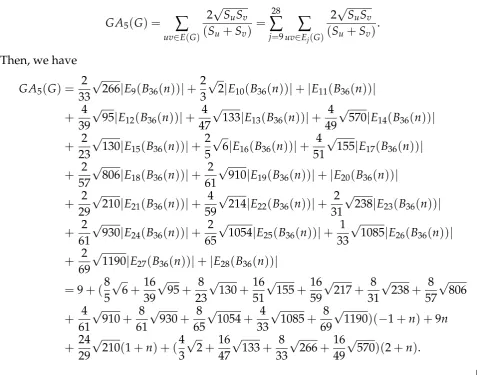
Proof. we get the result by using edge partition given in Table 4. From(7)it follows that
ABC4(G) =
∑
uv∈E(G)
√
Su +Sv−2
SuSv
=
28
∑
j=9uv∈
∑
Ej(G)√
Su+Sv−2
SuSv .
Then, we have
ABC4(G) =
√
31
266|E9(B36(n))|+ 1 7
√
5|E10(B36(n))|+ 6
19|E11(B36(n))|
+3
2
√
5
133|E13(B36(n))|+
√
47
570|E14(B36(n))|+
√
15
130|E14(B36(n))|
+1
3
√
2|E16(B36(n))|+ 7
2√155|E17(B36(n))|+
√
55
806|E18(B36(n))|
+ √
59
910|E19(B36(n))|+ 3 28
√
6|E20(B36(n))|+
√
15
15 |E21(B36(n))|
+1
2
√
57
217|E22(B36(n))|+
√
15
238|E23(B36(n))|+
√
59
930|E24(B36(n))|
+3
√
7
1054|E25(B36(n))|+ 8
√
1085|E26(B36(n))|+
√
67
1190|E27(B36(n))|
+ 2
35
√
17|E28(B36(n))|+1 2
√
37
95|E12(B36(n))|. Thus, we have
ABC4(G) = 36
19 + (6
√
14 527+2
√
134 595 +2
√
30 119 +2
√
118 465+
√
118 455+2
√
57 217+2
√ 110 403 +2 √ 22 65+2
√ 37 95 + 4 3 √
2+ 2
35
√
17+√14
155+ 32
√
1085) +4
√
3
5(1+n)
+ (6
√
5 133 +2
√
94 285+2
√ 62 133+ 2 7 √
5)(2+n) +3
7
√
(Su,Sv),uv∈E(G) Number of edges (Su,Sv),uv∈E(G) Number of edges
(14, 19) 4n+8 (26, 35) 2n−2
(14, 28) 2n+4 (28, 28) 8n+4
(19, 19) 6 (28, 30) 12n+12
(19, 20) 4n−4 (28, 31) 4n−4
(19, 28) 4n+8 (28, 34) 4n−4
(19, 30) 4n+8 (30, 31) 4n−4
(20, 26) 4n−4 (31, 34) 4n−4
(20, 30) 4n−4 (31, 35) 4n−4
(20, 31) 4n−4 (34, 35) 4n−4
(26, 31) 4n−4 (35, 35) n−1
Table 4. Edge partition of borophene chainB36(n)based on degrees sum of end vertices of each edge.
and from (8) we get
GA5(G) =
∑
uv∈E(G)
2√SuSv
(Su+Sv)
=
28
∑
j=9uv∈
∑
Ej(G)2√SuSv
(Su+Sv).
Then, we have
GA5(G) = 2 33
√
266|E9(B36(n))|+2 3
√
2|E10(B36(n))|+|E11(B36(n))|
+ 4
39
√
95|E12(B36(n))|+ 4 47
√
133|E13(B36(n))|+ 4 49
√
570|E14(B36(n))|
+ 2
23
√
130|E15(B36(n))|+2
5
√
6|E16(B36(n))|+ 4
51
√
155|E17(B36(n))|
+ 2
57
√
806|E18(B36(n))|+ 2
61
√
910|E19(B36(n))|+|E20(B36(n))|
+ 2
29
√
210|E21(B36(n))|+ 4
59
√
214|E22(B36(n))|+ 2
31
√
238|E23(B36(n))|
+ 2
61
√
930|E24(B36(n))|+ 2 65
√
1054|E25(B36(n))|+ 1 33
√
1085|E26(B36(n))|
+ 2
69
√
1190|E27(B36(n))|+|E28(B36(n))|
=9+ (8
5
√
6+16
39
√
95+ 8
23
√
130+16
51
√
155+16
59
√
217+ 8
31
√
238+ 8
57 √ 806 + 4 61 √
910+ 8
61
√
930+ 8
65
√
1054+ 4
33
√
1085+ 8
69
√
1190)(−1+n) +9n
+ 24
29
√
210(1+n) + (4
3
√
2+16
47
√
133+ 8
33
√
266+16
49
√
570)(2+n).
con-densed C−N−H compounds (e.g., melamine C3N3(NH2)3, dicyandiamide H4C2N4, am-monium dicyanamide NH4[N(CN)2], or cyanamide H2CN2, respectively) at temperatures as high as 450◦Cin sealed glass ampules. The vertices and edges in melem chain are 18n+4 and 21n+3 respectively.
Now we compute Randi´cRα(G)withα={1,−1,12,−12},ABC,GA, ABC4andGA5indices for melem chain MC(n)nanotube.
Theorem 2.9. Consider the melem chain MC(n)for n∈N. Then
Rα(MC(n)) =
135n+9, α=1; 3(6n+4√6n+√3(1+n)),α= 12; 1√+113n, α=−1;
3+ (2+√3+2√6)n, α=−12.
Proof. LetGbe the melem chain. The melem chainMC(n)has 3n+3 vertices of degree 1, 6n vertices of degree 2, and 9n+1 vertices of degree 3. The edge set of MC(n) is divided into three partitions based on the degree of end vertices. The first edge partition E1(MC(n))
contains 3n+3 edges uv, where deg(u) = 1 and deg(v) = 3. The second edge partition E2(MC(n)) contains 12n edges uv, where deg(u) =2 and deg(v) =3. The third edge par-tition E3(MC(n))contains 6n edgesuv, where deg(u) =deg(v) =3. Table 5 shows such an edge partition of MC(n)with mentioned characteristies. Thus from(3)is follows that
Rα(G) =
∑
uv∈E(G)
(deg(u)deg(v))α.
Now we apply the formula ofRα(G)forα=1
R1(G) =
3
∑
j=1uv∈
∑
Ej(G)deg(u)deg(v).
By using edge partition given in Table 5, we get
R1(G) =3|E1(MC(n))|+6|E2(MC(n))|+9|E3(MC(n))|=135n+9.
We apply the formula ofRα(G)forα=12
R1 2(G) =
3
∑
j=1uv∈
∑
Ej(G)√
deg(u)·deg(v).
By using edge partition given in Table 5, we get
R1 2(G) =
√
3|E1(MC(n))|+√6|E2(MC(n))|+3|E3(MC(n))|
(du,dv),uv∈E(G) Number of edges
(1, 3) 3n+3
(2, 3) 12n
(3, 3) 6n
Table 5. Edge partition of melem chainMC(n)based on degrees of end vertices of each edge.
We apply the formula ofRα(G)forα=−1
R−1(G) = 3
∑
j=1uv∈
∑
Ej(G)1
deg(u)·deg(v)
= 1
3|E1(MC(n))|+ 1
6|E2(MC(n))|+ 1
9|E3(MC(n))|
=1+11n
3 .
We apply the formula ofRα(G)forα=−12
R−1 2(G) =
3
∑
j=1uv∈
∑
Ej(G)1
√
deg(u)·deg(v)
= √1
3|E1(MC(n))|+ 1
√
6|E2(MC(n))|+ 1
3|E3(MC(n))|
=√3+ (2+√3+2√6)n.
In the following theorem, we compute first Zagreb index of melem chainMC(n).
Theorem 2.10. For melem chain G∼=MC(n)for n∈N. Then
M1(MC(n)) =12(1+9n).
Proof. Let G be the borophene chain B36(n). The result is obtained by using edge partition from Table 5. From (4) we have
M1(MC(n)) =
∑
uv∈E(G)
(deg(u) +deg(v))
=
3
∑
j=1uv∈
∑
Ej(G)(deg(u) +deg(v))
=4|E1(MC(n))|+5|E2(MC(n))|+6|E3(MC(n))|.
By doing some calculation, we get M1(MC(n)) =12(1+9n).
Theorem 2.11. Let G∼=MC(n)be the melem chain, for n∈N, then
ABC(G) =√6+ (4+6√2+√6)n,
GA(G) =6n+24
√
6 5 n+
3√3
2 (1+n).
Proof. We get the result by using edge partition given in Table 5. From(5)it follows that
ABC(G) =
∑
uv∈E(G)
√
deg(u) +deg(v)−2 deg(u)·deg(v)
=
3
∑
j=1uv∈
∑
Ej(G)√
deg(u) +deg(v)−2 deg(u)·deg(v)
= √
2
3|E1(MC(n))|+ 1
√
2|E2(MC(n))|+ 2
3|E3(MC(n))|.
By doing some calculation, we get ABC(G) =√6+ (4+6√2+√6)n, from (6) we get
GA(G) =
∑
uv∈E(G)
2√deg(u)deg(v) (deg(u) +deg(v)) =
3
∑
j=1uv∈
∑
Ej(G)2√deg(u)deg(v) (deg(u) +deg(v)).
By doing some calculation, we get
GA(G) =
√
3
2 |E1(MC(n))|+ 2√6
5 |E2(MC(n))|+|E3(MC(n))|,
=6n+24
√
6 5 n+
3√3
2 (1+n).
Now, we computeABC4andGA5indices of melem chainMC(n). Let us consider an edge partition based on degree sum of neighbors of end vertices. Then the edge setE(MC(n))can be divided into six edge partitionsEj(MC(n)), 4≤j≤9, where the edge partitionE4(MC(n)) contains 2n+4 edgesuvwithSu=3 andSv=5, the edge partitionE5(MC(n))containsn−1 edgesuvwithSu=3 andSv=7, the edge partitionE6(MC(n))containsn+2 edgesuvwith Su =5 and Sv =7, the edge partition E7(MC(n)) contains 12n edges uv with Su =6 and
Sv=7, the edge partitionE8(MC(n))contains 2n−2 edgesuvwithSu=Sv=7 and the edge
partitionE9(MC(n))contains 3nedgesuvwithSu=7 andSv=9.
Theorem 2.12. Let G∼=MC(n)be the melem chain, for n≥2, then
ABC4(G) = (2
√
2 21 +
4√3
7 )(−1+n) + (
√
2+2
√
66 7 )n+ (
√
2 7 +2
√
2
5)(2+n),
GA5(G) =−2+1
5
√
21(−1+n) + (2+9
√
7 8 +
24√42 13 )n
+ (1
2
√
15+1
6
√
(Su,Sv),uv∈E(G) Number of edges
(3, 5) 2n+4
(3, 7) n−1
(5, 7) n+2
(6, 7) 12n
(7, 7) 2n−2
(7, 9) 3n
Table 6. Edge partition of Melem chainMC(n)based on degrees sum of end vertices of each edge.
Proof. By using edge partition given in Table 6, we can get the result. From(7)it follows that
ABC4(G) =
∑
uv∈E(G)
√
Su+Sv−2
SuSv
=
9
∑
j=4uv∈
∑
Ej(G)√
Su+Sv−2
SuSv
= √
2
5|E4(MC(n))|+ 2√2
√
21|E5(MC(n))|+
√
2
7|E6(MC(n))|
+ √
11
42|E7(MC(n))|+ 2√3
7 |E8(MC(n))|+
√
2
3 |E9(MC(n))|
= (2
√
2 21 +
4√3
7 )(−1+n) + (
√
2+2
√
66 7 )n+ (
√
2 7 +2
√
2
5)(2+n), and from (8) we get
GA5(G) =
∑
uv∈E(G)
2√SuSv
(Su+Sv)
=
9
∑
j=4uv∈
∑
Ej(G)2√SuSv
(Su+Sv)
=
√
15
4 |E4(MC(n))|+
√
21
5 |E5(MC(n))|+
√
35
6 |E6(MC(n))|
+ 2
√
42
13 |E7(MC(n))|+|E8(MC(n))|+
√
63
8 |E9(MC(n))|
=−2+1
5
√
21(−1+n) + (2+9
√
7 8 +
24√42 13 )n+ (
1 2
√
15+1
6
√
35)(2+n).
3 Conclusion
4 Acknowledgment
The authors are very grateful to the referees for their careful reading with corrections and useful comments, which improved this work very much.
References
[1] H. Ali, A. Q. Baig and M. K. Shafiq, On topological properties of hierarchical interconnection networks, J. Appl. Math. Comput. 55 (1-2) (2017) 313–334.
[2] M. Baˇca, J. Horv´athov´a, M. Mokriˇsov´a and A. Suh´anyiovˇa, On topological indices of fullerenes, Appl. Math. Comput. 251 (2015) 154–161.
[3] A. Q. Baig, M. Imran and H. Ali, Computing Omega, Sadhana and PI polynomials of benzoid carbon nanotubes, OAM-RC. 9 (2015) 248–255.
[4] A. Q. Baig, M. Imran and H. Ali, On Topological Indices of Poly Oxide, Poly Silicate, DOX and DSL Networks, Can. J. Chem. 93 (2015) 1–10.
[5] M. Deza, P. W. Fowler, A. Rassat and K. M. Rogers, Fullerenes as tiling of surfaces, J. Chem. Inf. Comput. Sci. 40 (2000) 550–558.
[6] M. V. Diudea, I. Gutman and J. Lorentz, Molecular Topology, Nova, Huntington, 2001.
[7] E. Estrada, L. Torres, L. Rodr´ıguez and I. Gutman, An atom-bond connectivity index: Modelling the enthalpy of formation of alkanes, Indian J. Chem. 37A (1998) 849–855.
[8] M. Ghorbani and M. A. Hosseinzadeh, ComputingABC4index of nanostar dendrimers, Optoelec-tron. Adv. Mater. Rapid Commun. 4 (2010) 1419–1422.
[9] A. Graovac, M. Ghorbani and M. A. Hosseinzadeh, Computing fifth geometric-arithmetic index for nanostar dendrimers, J. Math. Nanosci. 1 (2011) 33–42.
[10] I. Gutman and O. E. Polansky, Mathematical concepts in organic chemistry, Springer-Verlag, New York, 1986.
[11] S. Hayat and M. Imran, Computation of certain topological indices of nanotubes, J. Comput. Theor. Nanosci. 12 (2015) 70–76.
[12] S. Hayat and M. Imran, Computation of topological indices of certain networks, Appl. Math. Com-put. 240 (2014) 213–228.
[13] M. Imran, A. Q. Baig and H. Ali, On topological properties of dominating David derived graphs, Can. J. Chem. 94 (2016) 137–148.
[14] M. Imran, A. Q. Baig and H. Ali, On molecular topological properties of hex-derived graphs, J. Chemometrics. 30 (2016) 121–129.
[15] M. Imran, A. Q. Baig, H. Ali and S. U. Rehman, On topological properties of poly honeycomb graphs, Period Math Hung 73 (2016) 100–119.
[16] A. Iranmanesh and M. Zeraatkar, Computing GA index for some nanotubes, Optoelectron. Adv. Mater. Rapid Commun. 4 (2010) 1852–1855.
[17] W. Lin, J. Chen, Q. Chen, T. Gao, X. Lin and B. Cai, Fast computer search for trees with minimal ABC index based on tree degree sequences, MATCH Commun. Math. Comput. Chem. 72 (2014) 699–708.
[18] P. D. Manuel, M. I. Abd-El-Barr, I. Rajasingh and B. Rajan, An efficient representation of Benes networks and its applications, J. Discrete Algorithms. 6 (2008) 11–19.
[19] J. L. Palacios, A resistive upper bound for the ABC index, MATCH Commun. Math. Comput. Chem. 72 (2014) 709–713.
[20] M. Randi´c, On Characterization of molecular branching, J. Amer. Chem. Soc. 97 (1975) 6609–6615. [21] F. Simonraj, A. George, Embedding of poly honeycomb networks and the metric dimension of star
of david network, GRAPH-HOC 4 (2012) 11–28.
[22] F. Simonraj and A. George, Topological properties of few poly oxide, Poly Silicate, DOX and DSL Networks, International Journal of Future Computer and Communication 2 (2013) 90–95.
[23] D. Vukiˇcevi´c and B. Furtula, Topological index based on the ratios of geometrical and arithmetical means of end-vertex degrees of edges, J. Math. Chem. 46 (2009) 1369–1376.