Does chronic smoking affect induced-exercise catecholamine release?
İpekoğlu G
1*, Sever O
2,
Gönülateş S
3, Akan Bayrakdar
4,
Arslanoğlu
E
1,
Arslanoğlu
C
1, Mor A
1, Çolakoğlu
FF
41Sinop University, Sports Sciences Faculty Turkey,([email protected]) 2Ataturk University, Sports Sciences Faculty,
Turkey,3Pamukkale University, Sports Sciences Faculty, Turkey4Gazi University, Sports Sciences Faculty, Turkey
ABSTRACT: Introduction and objectives: This study was performed to investigate the acute effect of the submaximal aerobic exercise upon
epinephrine and nor-epinephrine levels in chronic smokers and non-smoker. The study was carried out upon 10 regular (15> cigarettes/day) smoker
untrained male along five years and 10 never smoker untrained male. Methods: Subjects performed an endurance exercise that continues 40 minutes
at 70% maximal heart rate. There were 15cc venous blood samples extracted from the forearm pre-exercise (PRE), exercise (POST),
post-exercise 2 hours (2h), post-post-exercise 24 hours (24h) to measure of epinephrine and nor-epinephrine levels. Results: The plasma level of each hormone
increased after exercise and the tendency of rise was similar between groups as it seen in which 55,6% and 54,68% for epinephrine and 27,1% and
35,7% for norepinephrine. In this respect no group-time relationship has been found (p>0,05). But in between-group analyses, basal and after exercise
levels were different (p<0,05). Discussion and conclusion: The study revealed the fact that, smokers have higher plasma levels of epinephrine and
norepinephrine before and after exercise. The results demonstrate that long-term smoking induces elevate baseline and post-aerobic submaximal
exercise plasma epinephrine and nor-epinephrine levels. The sympatho-adrenal activity appears to be disrupt with long-term smoking which effect
the glycolytic and fat metabolism during exercise.
KEY WORDS: smoke, epinephrine, nor-epinephrine, aerobic exercise, catecholamines
INTRODUCTION
Tobacco kills approximately 6 million people which includes about
600,000 are also estimated to die from the effects of second-hand smoke
[1] and causes more than half a trillion dollars of economic damage each
year [2]. In total, tobacco use is responsible for the death of about 1 in 10
adults worldwide. Smoking is often the hidden cause of the disease
recorded as responsible for death. Even though notable progress has been
made in raising awareness of cigarettes in relation to cardiovascular and
lung diseases approximately 21,1%(36,9% males; 7,3% female) of the
world population still smoke. For Europe this rate is 29,6% according to
VOL. 5 (1)
ever smoked regularly compared to their nonathletic counterparts, there isno sharp difference between them [3]. Besides even if the studies show
different results, it is seen that the use of smokeless nicotine is common in
athletes [4, 5] as well as tobacco smoking. This epidemic hazard points to
the importance of cigarette use and exercise-performance relationship.
Smoking cessation have important improvements on athletic performance.
For example oxygen cost of breathing decrease between %13-79 and
hearth rate lower %5-7 with smoking abstinence for habitual smokers after
one day [6] and air resistance increases three-fold after 15 puffs [7]. During
graded exercise testing on treadmill seven days smoking abstinence
produce significant reduction in hearth rate and increase performance by
the time to exhaustion [8]. In the long run, chronic cigarette smokers tend
to have lower fitness levels and sedentary lifestyles than counterparts [9].
Smoking enhances dependence on carbohydrate substrate for energy
supply in exercise for some reason and decreases lung capacity [10]. All
these findings reveal that while one day of abstinence decrease the cost of
breathing and enhance performance [10], it is well documented that there
are several important negative adaptations of long-term tobacco smoking
including lipid profiles, immune function, central adiposity, bone mineral
density and reproductive function [11]. Because of these adverse effects,
the response during exercise accumulated stress may be expected to react
differently in smokers than in non-smokers. In exercise many of hormones
are regulated via various regulatory axes including the hypothalamic–
pituitary–adrenal axis, the hypothalamic–pituitary–gonadal axis and the
hypothalamic–pituitary–thyroid axis as the body transitions from resting to
an active state with the increase in metabolism. A major component in the
autonomic control during exercise is the adrenergic activity [12].
Adrenergic means the nervous system that uses epinephrine or
norepinephrine as its neurotransmitter. The adrenal medulla is the
innermost part of the adrenal gland which is responsible for epinephrine,
norepinephrine and peptide F secretion with the stimulation of sympathetic
nerves [13] and neuronal terminals of the preganglionic sympathetic nerves
are mostly responsible for secretion of nor-epinephrine [14]. In basal and
homeostatic state these hormones usually stay fixed. Although there are
different responses in chronic and acute use, cigarette smoking affects the
release of hormones acting in these axis for a variety of reasons. When
smoke is inhaled it enters the blood stream, crosses the blood–brain barrier,
reaches the central nervous system and peripheral nervous system where it
acts as a stimulant [15]. For example activation of nicotinic receptors in
chromaffin cells and neurons allows secretion of catecholamine from
postganglionic sympathetic neurons and adrenal medulla [16]. During
smoking, due to an increase in plasma nicotine levels, neurotransmitter and
neuroendocrine disturbances occur. Correlative hormonal response and the
increase in catecholamine is also emerge due to the exercise-induced
metabolic stress. Based upon these findings it is hypothesized that during
submaximal aerobic exercise this chronic negative effect of tobacco
smoking will turn into a different and abnormal hormonal response in
chronic users compared to non-smoking counterparts.
METHODS
Ten regular smokers (27,7 ± 6,4 age, 184,2 ± 6,6 cm, 82,5 ± 11,6 kg) for
five years (>15 cigarettes per day) and ten non-smokers (30,7 ± 4,6 age,
178,0 ± 6,8 cm, 82,7 ± 12,0 kg) participated in this study. The subjects with
any symptoms (hypertension, thyroid, diabetes, cardiac etc.) and those
involved any training program was not included in study.
Subjects performed an endurance exercise on treadmill (Dunlop EL900)
that continues 40 minutes in 70% maximal heart rate–
(approximately%55-63 MaxVO2) (Pollock et al., 1998). To verify and record the duration and
intensity of exercise, participants wore a heart rate monitor (Polar RS400,
Polar, Kempele, Finland). There were 15 cc venous blood samples
extracted from the forearm pre-exercise (PRE) and post-exercise (POST)
to measure plasma epinephrine and nor-epinephrine levels. The blood
samples were first centrifuged at a rate of 5000 revolution/minute and the
upper phases were transferred to eppendorf tubes and kept at -80 C until
the use [17]. Serum epinephrine and nor-epinephrine levels of all subjects
were analyzed PRE-POST. Concentrations were studied with the immuno
chemiluminescence method using the DiaSorin Liaison auto analyzer kit.
The participants were given detailed information about the objectives of
the study in accordance to the Helsinki Medical Declaration and they gave
their full content. This study was carried out according to the approval of
Selçuk University Faculty of Sports Science Non Enterprising Ethical
Committee.
Distributions of the variables according to the groups were analyzed and
the normality of the distribution and the homogeneity of the variances were
determined with the Mauchly’ Sphericity Test and Levene test.
Within-group and smoking-effect analysis were carried out with the repeated
measures ANOVA and between-group analysis were carried out with
Mann-Whitney U tests, level of significance was accepted as 0,05.
STATISTICAL RESULTS
Descriptive statistics of non-smoker and smoker groups has been given in
the table above. The equality of variances and anthropometric differences
between groups analyzed with Levene test and independent samples t-test.
According to results which is not shown in table there is no between group
difference in any measured data (p>0,05) (Table 1).
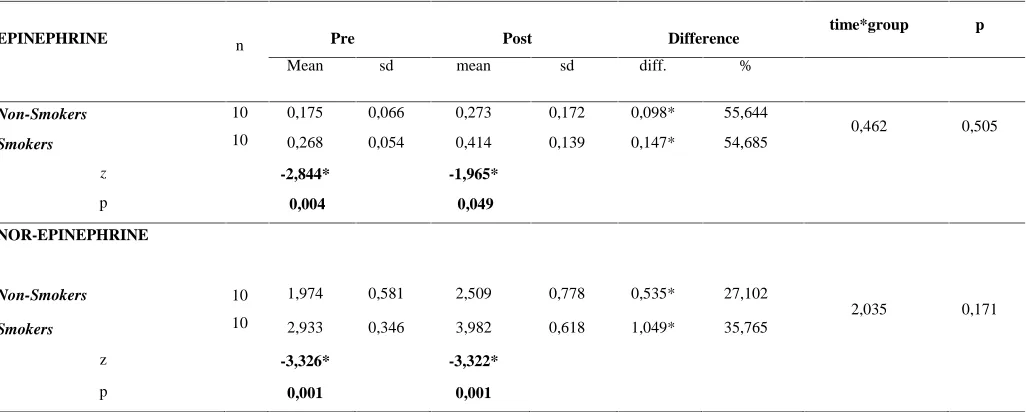
The plasma level of each hormone increased after exercise and the tendency
of rise was similar between groups as it seen in which 55,6% and 54,68%
for epinephrine and 27,1% and 35,7% for norepinephrine. In this respect
no group-time relationship has been found (p>0,05). But in between-group
analyses, basal and after exercise levels were different (p<0,05). Smokers
have higher plasma levels of epinephrine and norepinephrine before and
VOL. 5 (1)
18
Table 1. Descriptive statistics for smokers and non-smokers.n Min. Max. Mean Std. Dev.
Non-Smoker
Age
10
23,0 37,0 30,7 4,6
Weight (kg) 64,7 107,2 82,7 12,0
Height (cm) 167,0 192,0 178,1 6,8
BMI 19,7 31,0 25,9 3,4
BFP (%) 10,2 24,1 18,5 4,9
Smoker
Age
10
21,0 38,0 27,7 6,4
Weight (kg) 65,6 101,0 82,5 11,6
Height (cm) 175,0 195,0 184,2 6,6
BMI 20,2 28,0 24,2 2,4
BFP (%) 11,4 20,8 15,3 3,0
Table 2. Between-group and within-group comparisons of pre-post endurance training epinephrine and nor-epinephrine values
EPINEPHRINE n Pre Post Difference time*group p
Mean sd mean sd diff. %
Non-Smokers 10
10
0,175 0,066 0,273 0,172 0,098* 55,644
0,462 0,505
Smokers 0,268 0,054 0,414 0,139 0,147* 54,685
z -2,844* -1,965*
p 0,004 0,049
NOR-EPINEPHRINE
Non-Smokers 10
10
1,974 0,581 2,509 0,778 0,535* 27,102
2,035 0,171
Smokers 2,933 0,346 3,982 0,618 1,049* 35,765
z -3,326* -3,322*
p 0,001 0,001
*: within group difference is significant p<0,05 sd: standard deviation, diff: difference
DISCUSSION
Pre-exercise basal plasma epinephrine and nor-epinephrine levels were
high in untrained smokers than smokers. Likewise, post-exercise plasma
hormone levels are also higher in smokers. Smoking appears to induce
increased sympathetic discharge and leads to an increase in plasma levels
of both the adrenomedullary hormone epinephrine and the sympathetic
neurotransmitter norepinephrine [18, 19, 20]. At the cellular level nicotine
acts by binding to and activating the nicotinic acetylcholine receptors in the
brain and in the adrenal medulla which leads to increased catecholamine
levels with corresponding cardiovascular and metabolic responses [15]. In
another study, it was explained by effect of long-term cigarette smoking on
beta-adrenoceptor density and catecholamine response. The density of
VOL. 5 (1)
twins compared with their nonsmoking cotwins [19]. In another studybeta-adreno receptor blockade significantly reduced oxygen consumption in
nonsmokers but not in smokers who also incurred a significantly greater
oxygen debt and had higher serum lactate levels[21]. These findings
explain the mechanism which leads to have more secreted plasma
catecholamine in smokers.
In the present study, both hormones elevated post-exercise for both groups.
The increment in plasma catecholamine levels with both aerobic [22, 23,
24, 20] and anaerobic exercise [25, 26] has been demonstrated in many
studies. In the present study, the duration of the exercise was 40 minutes or
until exhaustion with the intensity of %70 HRmax which was almost equal
to 65-70% of VO2max for untrained subjects [27]. Studies with similar
intensity show parallel catecholamine responses [22, 23, 28].
On the other hand, the relationship of catecholamine increment with
exercise in terms of tobacco smoking has not been well studied. The plasma
increment tendency was similar for non-smokers and smokers respectively
55,6% and 54,68% for epinephrine and 27,1% and 35,7% for
norepinephrine during submaximal aerobic effort. Chronic smoking habit,
did not make a significant difference in the hormonal responses during
exercise. In a previous study epinephrine and nor-epinephrine did not
significantly elevated with exercise for smokers and non-smokers but the
total catecholamine level, expressed as epinephrine plus norepinephrine,
was significantly elevated in smokers compared with nonsmokers at rest in
the basal state and at peak heart rate (85% of age-adjusted maximal heat
rate) [19]. In the present study the total amount of epinephrine and
nor-epinephrine also did not make a significant difference between smokers and
non-smokers (not shown in statistical analyses). The exercise intensity
(increased in steps of 50 W to reach a heart rate corresponding to 85% of
the age-adjusted maximum, continued approximately 10 min in previous
study) or the statistical method used might be the conflict of these two
studies in catecholamine responses. Although the trend is similar, it was
seen that the level of catecholamine is higher in smokers. This suggests that
catecholamine sensitivity is decreased in smokers [19]. Catecholamine
effect on plasma free fatty acid circulation has been shown to decrease in
smokers [19] which may enhance dependence on carbohydrate substrate
for energy supply in exercise [10].
In summary, the present study shows that long-term smoking induces
elevate baseline and post-aerobic submaximal exercise epinephrine and
nor-epinephrine plasma levels. The sympatho-adrenal activity appears to
be disrupt with long-term smoking which effect the glycolytic and fat
metabolism during exercise
.
ACKNOWLEDGEMENT
Thanks to all the healthy subjects who participated. The authors also thank
Fatmanur Er, Ceren Suveren Erdoğan and nurses who contributed to the
volunteer’s enrollments, taking blood samples and laboratory work.None of
the authors have any potential conflicts of interest associated with this
research.