TELL, Vol. 7, No. 1, Spring & Summer 2013, pp. 1-31
The relationship between collocational
knowledge, speaking proficiency, and the use of
collocation in Iranian EFL learners' oral
performance
Karim Sadeghi1
Associate Professor, Urmia University, Iran Fatemeh Panahifar
Instructor, Bonab University, Iran
Received on August 5, 2012 Accepted on November 2, 2012
Abstract
The ability to speak a foreign language requires more than a mere knowledge of its grammatical and semantic rules. Learners must acquire the knowledge of how native speakers use the language naturally by capitalizing on a wealth of prefabricated forms such as collocations and idioms. Owing to dearth of collocational knowledge, most EFL learners’ oral or written productions are recognized “unnatural” or “strange” by a native speaker. The present study was an attempt to uncover relationship between collocational knowledge and speaking
1 Corresponding author at Urmia University
TELL, Vol. 7, No. 1
Collocational knowledge and speaking proficiency
2
proficiency, collocational knowledge and use of collocations, and also relationship between speaking proficiency and use of collocations. The data for this study came from 30 intermediate Iranian EFL learners who sat a collocation test and were interviewed on a range of topics. The results indicated that there is a significant relationship between collocational knowledge and speaking proficiency and also between speaking proficiency and oral use of collocations. However, no significant relationship was found between collocational knowledge and use of collocations. Further findings of the study as well implications for the teaching and learning of collocations are discussed in the paper.
Keywords: collocational knowledge, speaking proficiency, Iranian EFL learners
1. Introduction
For decades, teaching professionals devoted themselves to teaching grammar, so much so that other aspects of language learning, especially vocabulary, were either ignored or undervalued. The rational was that if you knew the grammatical rules of the language, you would be able to use it for communication (Richards & Renandya, 2002), but the fact that most learners who, in spite of having good mastery of grammar, were not able to speak, contradicted such an argument.
TELL, Vol. 7, No. 1
Sadeghi and Panahifar
3
approach by Lewis (1993), attention turned to vocabulary in general and to collocations in particular. The significance of vocabulary was better recognized when words came to be used together in certain patterns or as collocations. The term collocation was for the first time adopted by Palmer (1933) to refer to the recurring groups of words.
According to Richards and Renandya (2002), there are some lexical items that need to be learned by language learners to achieve a high degree of fluency as quickly as possible. These include polite formulas, items for controlling language use, high-frequency words, and more importantly, collocations. Nesselhauf (2003) suggests that the role of collocations along with other prefabricated patterns in developing fluency in second or foreign language highlights the importance of these contextualized words. The author maintains that fluency means making the best use of what one already knows to improve speed and smoothness of delivery.
A great number of suggestions have been made by linguists in order to develop competence in speaking English. According to Shumin (2002), “EFL learners need explicit instruction in speaking, which, like any language skill, generally has to be learned and practiced” (p. 204). In the recent years, a number of highly renowned scholars have come to draw teachers’ attention to the importance of collocations in developing communicative competence. Nattinger and Decarrico (1992) have proposed that a good control of collocations can help foreign language learners to improve their speaking proficiency and to speak more fluently. According to Hill (2000):
A student with a vocabulary of 2000 words will only be able to function in a fairly limited way. A different student with 2000 words, but collocationally competent with those words, will also be far more communicatively competent. Many native speakers function perfectly well using a limited vocabulary with which they are collocationally competent. (p. 62)
TELL, Vol. 7, No. 1
Collocational knowledge and speaking proficiency
4
and Chiu (2008) cite many scholars (e.g. as Aston, 1995; Fillmore, 1979; Kjellmer, 1991; Pawley & Syder, 1983) who have emphasized collocational knowledge as an important factor that contributes to the differences between native speakers and foreign language learners. To be considered a competent and fluent user of a language, one needs not only to have a vast repertoire of lexical items but also to know which combinations of these items are acceptable and normal. And that is why Hyland (2008) regards multi-word expressions as an important component of fluent linguistic production and a key element in successful language learning.
2. Literature Review
There have been few published studies measuring collocational proficiency of second language learners. Among the most comprehensive studies conducted thus far is Ha (1988, cited in Bonk, 2000) who measured ESL learners’ collocational knowledge using cloze-type tests in order to investigate the correlation between general English proficiency and collocational knowledge. Three types of collocations (verb-preposition, verb-noun, and adjective-noun) were selected and items were developed by consulting BBI Combinatory Dictionary (Benson & Benson, 1986). A cloze test was also administered to measure general proficiency. The test instruments used enjoyed acceptable reliability estimates (K-R 21 = 0.86 and 0.70, respectively) and an acceptably high correlation (r= .83) was found between the scores of collocation measures and
those of general proficiency tests. Gitsaki (1996, cited in Bonk, 2000) apparently conducted the
TELL, Vol. 7, No. 1
Sadeghi and Panahifar
5
problems including the absence of a proficiency test to determine the students’ proficiency level, found a positive relationship between general proficiency and collocational knowledge whereby learners at higher levels of proficiency used collocations more frequently and more accurately than others in their free written production. Instead of determining learners’ proficiency levels and grouping them using an independent measure, three intact groups were used and the groups’ essays were analyzed for five measures of proficiency (holistic rating, lexical phrases, words per T-unit, error-free T-units, and S-nodes per T-unit). Statistical tests were used to determine if differences were significant between the groups on the five measures.
Having used a modified version of TOEFL to determine the proficiency level of 98 ESL students of low-intermediate to advanced proficiency and an improved version of collocation test to measure their collocational knowledge, Bonk (2000) likewise found a strong correlation estimate (r=.73) between collocational knowledge of English language learners and their general proficiency in English, confirming the previous study by Gitsaki (1996, cited in Bonk, 2000). The researcher, nevertheless, admits that there is a great deal of variation from learner to learner in the relationship between these two variables.
TELL, Vol. 7, No. 1
Collocational knowledge and speaking proficiency
6
Hsu and Chiu (2008) also found a significant correlation between EFL learners’ knowledge of collocations and their general speaking proficiency. Data for their study came from 56 Taiwanese junior English majors who went through three tests: (1) one lexical collocation test to measure the subjects’ knowledge of collocations; (2) one English speaking test conducted to collect the subjects’ use of lexical collocations and to measure their speaking proficiency; and (3) Phone Pass spoken English test which was combined with the speaking test to measure the subjects’ speaking proficiency. Phone Pass spoken English test is a standardized test and the only English spoken testing system which combines computerized design, telephone, Internet and professional test contents to measure the test taker’s speaking proficiency over the telephone. Their findings showed a significant correlation between Taiwanese EFL learners’ knowledge of lexical collocations and their speaking proficiency. However, no significant correlation was found between knowledge of collocations and collocational use. In the same manner, use of lexical collocations did not correlate significantly with the subjects’ general speaking proficiency. Based upon the findings, they concluded that knowledge of collocations is an indicator of non-native speakers’ language proficiency.
TELL, Vol. 7, No. 1
Sadeghi and Panahifar
7
learning background and learning styles on the participants’ collocational competence, indicated that learning background and learning styles had significant effects on collocational knowledge.
Similarly, Boers et al. (2006) conducted a study with the purpose of testing two hypotheses: 1) the use of formulaic sequences, including collocations, can help learners come across as proficient L2 speakers; and 2) an instructional method that emphasizes ‘noticing’ of L2 formulaic sequences can help language learners’ add such phrases to their linguistic repertoire. A total of 32 students majoring in English in Brussels, who were divided randomly into two groups, (i.e. experimental and control) participated in this study. Over the course of 22 teaching hours, the experimental group’s attention was directed towards common word combinations (syntagmatic dimension of vocabulary), whereas in the control group, attention was drawn to individual word or grammar patterns and vocabulary at paradigmatic dimension. At the end, the participants’ oral proficiency was gauged using an interview and their use of formulaic sequences counted. The results indicated that the experimental group’s oral proficiency scores were higher than those of the control group. Similarly, as regards the use of formulaic expressions, the experimental group outperformed their control peers. Such findings, which prompted them to conclude that “helping learners build a repertoire of formulaic sequences can be a useful contribution to improving their oral proficiency” (p. 245), highlight the importance of ‘input-enhancement' in general and ‘phrase-noticing’ in particular in second language acquisition.
TELL, Vol. 7, No. 1
Collocational knowledge and speaking proficiency
8
significant correlation between collocational knowledge and reading comprehension.
3. Purpose of the Study
As Wray (2002) rightly emphasizes, collocations are of particular importance for learners who wish to achieve a high degree of competence in the second language, but they are also important for learners with less ambitious aspirations, as they enhance not only accuracy but also fluency. Accordingly, teaching collocations should be emphasized in EFL courses at all levels since “the correct usage of collocations contributes greatly to ones’ idiomaticity and nativelikeness” (James, 1998, p. 152). However, in spite of the growing recognition of collocational knowledge as both indispensable and problematic for foreign language learners, it seems that contextualized vocabulary (i.e., collocations) has not received due attention among language teachers and researchers so far, especially in our country. Indeed, a search in the Iranian Research Institute for Scientific Information and Documentation database for research studies done in this area did not yield any results. Accordingly, the current study aimed at investigating the learners’ oral use of collocations and uncovering the relationship between the collocational knowledge and the speaking proficiency, thus adding one more ring to the still chain of the research on lexis in general and of collocations in particular. More precisely, this
study sought to find answers to the following questions:
(1) Is there any relationship between collocational knowledge and speaking proficiency of Iranian intermediate EFL learners? (2) Is there any relationship between collocational knowledge and
use of collocations in Iranian intermediate EFL learners’ speaking?
TELL, Vol. 7, No. 1
Sadeghi and Panahifar
9
The following hypotheses were put forward for the above questions:
(1) There is no relationship between collocational knowledge and speaking proficiency of Iranian intermediate EFL learners. (2) There is no relationship between collocational knowledge and
use of collocations in speaking by Iranian intermediate EFL learners.
(3) There is no relationship between use of collocations and speaking proficiency of Iranian intermediate EFL learners.
4. Method
The design of this study is largely correlational. The relationship between collocational knowledge and speaking proficiency, collocational knowledge and the oral use of collocations and also between speaking proficiency and oral use of collocations are assessed.
4.1 Participants
TELL, Vol. 7, No. 1
Collocational knowledge and speaking proficiency
10
Table 1: Characteristics of participants included in the study
Total 30 12 18 2 28
4.2 Instruments
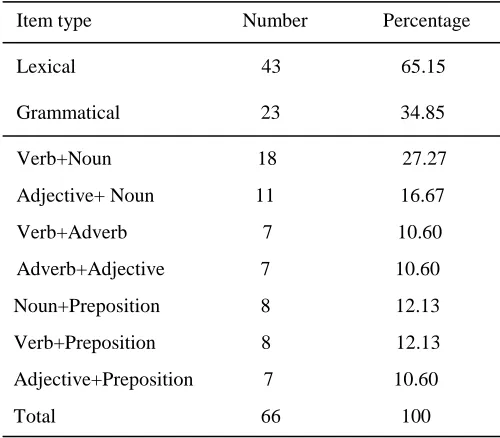
Test of collocational knowledge: In order to answer the research questions raised above, a test of collocations was used to determine the participants’ collocational knowledge. Some of the items of this test were based on Bonk (2009), Chen (2008) and Sadeghi’s study (2009). For the patterns which had not been covered by the studies in question (i.e., noun-preposition, preposition, adjective-adverb and verb-adjective-adverb), the researcher designed some items consulting Oxford Collocations Dictionary for Students of English (Lea, 2002), English Collocations in Use (McCarthy & O’Dell, 2005) and Vocabulary for the High School Students (Levine, 1967). The final Test of Collocational Knowledge was arrived at after several subjective and objective reviewing, taking item characteristics into consideration by the researchers. This 66-item multiple-choice test was used to elicit the participant’s collocational knowledge of the seven collocational patterns based on Benson’s categorization (1985) (see Appendix A for this Test of Collocational Knowledge). Table 2 summarizes the distribution of the number and types of lexical and grammatical collocations in the test.
Group N Average score on TOEFL
Azeri Persian Male Female
University 12 students
38 12 0 2 10
Institution 18 students
TELL, Vol. 7, No. 1
Sadeghi and Panahifar
11
Table 2: Number and types of collocational patterns in the Test of Collocational
Knowledge
Item type Number Percentage
Lexical 43 65.15
Grammatical 23 34.85
Verb+Noun 18 27.27
Adjective+ Noun 11 16.67
Verb+Adverb 7 10.60
Adverb+Adjective 7 10.60
Noun+Preposition 8 12.13
Verb+Preposition 8 12.13
Adjective+Preposition 7 10.60
Total 66 100
Learners’ corpus: Apart from the data gathered using the Test of Collocational Knowledge, other data for this study came from a corpus of 30 spoken productions of EFL learners using semi-structured interviews on a range of topics, among which were childhood, language, shopping, money, and employment. The topics were selected based on the speaking topics of IELTS and were meant to be of interest to the participants.
TELL, Vol. 7, No. 1
Collocational knowledge and speaking proficiency
12
were used to provide information on the words that headwords could combine with.
The British National Corpus (BNC) comprises 100 million words of written and spoken language; the written part includes 90 million words from eight genres and the spoken part consists of 10 million words from four social-class groupings. BNC is one of the most important research tools which is currently used in corpus-based studies of English.
TOEFL test: A paper-based version of the TOEFL test was used to determine the proficiency level of the participants. The test was adapted to cover only Grammar and Reading as the testing conditions and the fact that participants came from two institutions made it almost impossible to administer a listening test. The findings in validation research, furthermore, indicated a high correlation between components of the proficiency test. So after consulting the supervisor, it was decided that the written section of the TOEFL would be enough for our purposes considering the practicality issue. The TOEFL used here consisted of 60 multiple- choice items with 25 grammar items, and 4 reading passages followed by 35 comprehension questions.
4.3 Data Collection Procedure
4.3.1 Pilot Study
To find out whether the designed Test of Collocational Knowledge was at the right level of difficulty and to measure and improve the validity and reliability of this test, the test was piloted 2 months before the main study.
The pilot test was administered to a total of 20 students studying English Translation at Azad University of Maragheh. The test was administered within the time limit of 35 minutes. The participants were in the fifth term of their studies at the university, and it was assumed that they were at the intermediate level of proficiency.
TELL, Vol. 7, No. 1
Sadeghi and Panahifar
13
Test of Collocational Knowledge was scored and coded by the researcher. Subsequently, item analyses including estimating item difficulty, item discrimination, and calculating choice distribution were done to find the potentially weak items. Sixteen items were found to be too difficult for the participants; however, in order to have more data about the learners’ collocational knowledge and hoping that these same items may prove not as difficult for main study participants and may, therefore, yield some useful data and make the test more reliable, it was decided to keep such items in the final test. They were, however, moved to the end of the test to make it easier for the analysis to be done with or without them being included, and this is why the analysis was done twice (as shown later); once including and another time excluding these seemingly weak items.
4.3.2 Main Study
Measuring language proficiency: A total of forty-five participants including 20 BA students from Payame Noor University of Bonab and 25 EFL learners enrolled in one of the branches of Kish Institute of Science and Technology were invited to take part in the study. At first, in order to ascertain that the participants were at the same level of language proficiency (intermediate level), the TOEFL test (as described above) was administered. The test had 60 items and took 50 minutes to complete. A total of thirty participants whose scores were between the mean ± 1 SD, were selected as being at intermediate level of language proficiency and were asked to sit the Test of Collocational Knowledge.
TELL, Vol. 7, No. 1
Collocational knowledge and speaking proficiency
14
Interview: Having taken the Test of Collocational Knowledge, all 30 participants were individually interviewed by the researcher and were asked to speak about a range of topics (Childhood, Language, Shopping, Money, and Employment). Each participant was asked more than 30 questions regarding these topics. The interviews followed the style used in IELTS speaking test and they lasted between 10 and 15 minutes each. With the participants’ permission, the interviews were recorded using an MP3 recorder.
4.4 Data Analysis
In order to guarantee score reliability of the participants’ spoken production, the researcher and a PhD student in TEFL (Teaching English as a Foreign Language) rated analytically the participants’ spoken data using Weir’s speaking rating criteria (2005). The estimated inter-rater reliability index was calculated to be 0.913. Moreover, the collocations test was scored twice by the researcher. In so doing, each participant received two scores, one in 66-item test including the 16 difficult items and the other for the 50-item test, excluding those items. The reliability coefficient of the Test of Collocational Knowledge was computed to be 0.64, with the standard deviation and the mean being 0.1 and 30, respectively. In addition, the correlation between collocational knowledge and use of collocations, collocational knowledge and speaking proficiency, and between speaking proficiency and use of collocations were measured by Pearson product-moment correlation.
TELL, Vol. 7, No. 1
Sadeghi and Panahifar
15
National Corpus.
5. Results
5.1 Collocational Knowledge and Speaking Proficiency
The first question of the present study concerned investigating the relationship between EFL learners’ collocational knowledge and their speaking proficiency. It was hypothesized that there is no relationship between EFL learners’ collocational knowledge and their speaking proficiency.
As stated above, each participant received two scores for their collocational knowledge, one for the 66-item test and the other for the 50-item test. Hence, the correlation between collocational knowledge and speaking proficiency was also measured twice, one between the 66-item test scores and speaking proficiency scores, and once more between the 50-item test scores and speaking proficiency scores. The estimated mean and standard deviation of the participants’ speaking proficiency scores were 12.7 and 2.02, respectively.
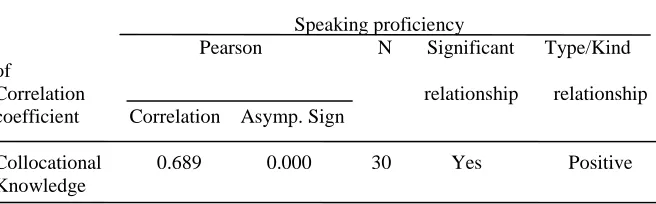
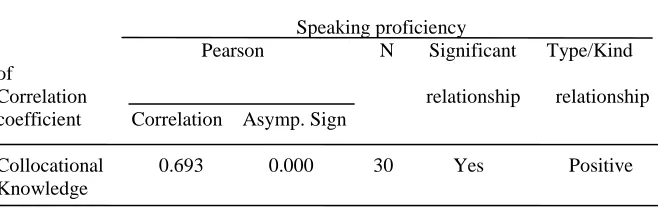
A Pearson correlation was run to measure the correlation between the scores of the test of collocational knowledge and those of speaking proficiency. As Tables 3 and 4 display, the relationship between collocational knowledge and speaking proficiency is positive. In other words, a statistically significant correlation exists between collocational knowledge and speaking proficiency of the EFL learners, participating in this study. Hence, the first null hypothesis was rejected.
Table 3: Correlation between collocational knowledge and speaking proficiency
scores based on 50-item test of collocations
Speaking proficiency
Pearson N Significant Type/Kind of
Correlation relationship relationship coefficient Correlation Asymp. Sign
TELL, Vol. 7, No. 1
Collocational knowledge and speaking proficiency
16
Table 4: Correlation between collocational knowledge and speaking proficiency
scores based on 66-item test of collocations
Speaking proficiency
Pearson N Significant Type/Kind of
Correlation relationship relationship coefficient Correlation Asymp. Sign
Collocational 0.693 0.000 30 Yes Positive Knowledge
5.2 Collocational Knowledge and Use of Collocations
The second research question dealt with the relationship between collocational knowledge and use of collocations in oral performance of EFL learners. It was hypothesized that there is no relationship between EFL learners’ collocational knowledge and use of collocations in their oral performance.
In this case, likewise, each participant received two scores for the use of collocations, one for the correct use of collocations and the other for the total use of collocations. As such, four correlations were measured, one between collocational knowledge scores in 66-item test of collocational knowledge and the correct use scores, the second correlation between collocational knowledge scores in 66-item test and scores on the total use of collocations, the third collocation between knowledge scores in 50-item test and the correct collocational use scores, and the last correlation between collocational knowledge scores in 50-item and scores on the total use of collocations.
TELL, Vol. 7, No. 1
Sadeghi and Panahifar
17
Table 5: Correlation between collocational knowledge and correct use of
collocations’ scores based on 50-item test of collocations
Collocational use
Pearson N Significant Type/Kind of
Correlation relationship relationship coefficient Correlation Asymp. Sign
Collocational 0.192 0.310 30 No Positive Knowledge
Table 6: Correlation between collocational knowledge and total use of
collocations’ scores based on 50-item test of collocations
Collocational use
Pearson N Significant Type/Kind of
Correlation relationship relationship coefficient Correlation Asymp. Sign
Collocational 0.219 0.245 30 No Positive Knowledge
Table 7: Correlation between collocational knowledge and correct use of
collocations’ scores based on 66-item test of collocations
Collocational use
Pearson N Significant Type/Kind of
Correlation relationship relationship coefficient Correlation Asymp. Sign
TELL, Vol. 7, No. 1
Collocational knowledge and speaking proficiency
18
Table 8: Correlation between collocational knowledge and total use of
collocations’ scores based on 66-item test of collocations
Collocational use
Pearson N Significant Type/Kind of Correlation relationship relationship
coefficient Correlation Asymp. Sign
Collocational 0.210 0.266 30 Yes Positive Knowledge
5.3 Speaking Proficiency and Use of Collocations
The third research question was posed during carrying out the study as to the relationship between EFL learners’ speaking proficiency and their use of collocations. It was hypothesized that there is no relationship between EFL learners’ speaking proficiency and their use of collocations.
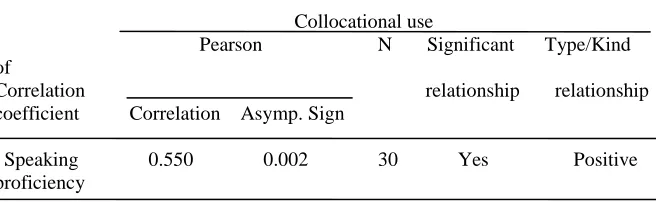
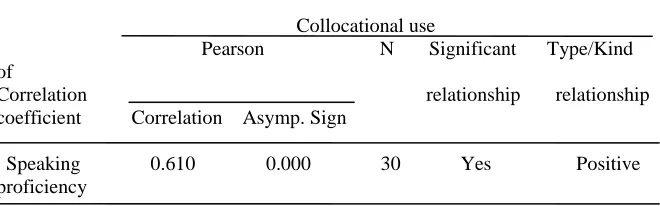
The Pearson correlation was employed to measure correlation between the frequency of total collocational use and the scores of speaking proficiency as well as between the frequency of correct use of collocations and the scores of speaking proficiency. According to Tables 9 and 10, a significant correlation was found between collocational use and speaking proficiency, thus rejecting the third null hypothesis.
Table 9: Correlation between speaking proficiency and correct use of
collocations’ scores
Collocational use
Pearson N Significant Type/Kind of
Correlation relationship relationship coefficient Correlation Asymp. Sign
TELL, Vol. 7, No. 1
Sadeghi and Panahifar
19
Table 10: Correlation between speaking proficiency and total use of collocations’
scores
Collocational use
Pearson N Significant Type/Kind of
Correlation relationship relationship coefficient Correlation Asymp. Sign
Speaking 0.610 0.000 30 Yes Positive proficiency
6. Discussion
6.1 Collocational Knowledge and Speaking Proficiency
The results of the present study showed a significant relationship between the learners’ knowledge of collocations and their speaking proficiency, thereby lending support to the claims of Hsu and Chiu (2008) that collocational knowledge is indicative of non-native speakers’ speaking proficiency. The findings are also in line with those of Sung (2003, cited in Hsu & Chiu, 2008).
As William's (2000) study indicated, collocational knowledge was found to correlate strongly with general proficiency of the EFL learners. By the same token, the results of previous studies also showed positive relationship between the knowledge of collocations and other language skills, such as general English proficiency (Bonk, 2000) and reading (Abdollahzadeh Kalantari, 2009). The findings of the present study lend further credence to the relationship existing between one aspect of language proficiency (that is, speaking proficiency) and collocational knowledge.
6.2 Collocational Knowledge and Oral Use of Collocations
TELL, Vol. 7, No. 1
Collocational knowledge and speaking proficiency
20
use of collocations. The findings confirm those of Hsu and Chiu (2008) who also found a weak correlation between the subjects’ knowledge of collocations and their oral use of collocations. A possible explanation is that owing to investigating the participants’ collocational use in their oral productions, factors other than their lack of competence (e.g. distraction) may affect the use of collocations. Furthermore, as Brown (2000) rightly points out, adults understand more vocabulary than they ever use in their speech. Moreover, this finding lends support to the claim of Farghal and Obiedat (1995) that there is a big gap between L2 learners receptive and productive knowledge of collocations. Such an observation may also mean that not all knowledge, including collocational knowledge, is easily transferred and made ready for use in spontaneous and unmonitored use of language, and that enough practice needs to take place before language users can effectively use the knowledge they have internalized in practice.
6.3 Speaking proficiency and Oral Use of Collocations
TELL, Vol. 7, No. 1
Sadeghi and Panahifar
21
7. Conclusion
This study, though limited in scope, was an attempt to investigate the relationship between collocational knowledge, speaking proficiency and use of collocations in Iranian EFL learners’ oral performance, hence adding a further piece of evidence on the nature of collocational knowledge and its relationship with productive oral proficiency to the few studies already conducted in this area. On the whole, the content analysis of the spoken data and the test of collocations revealed that the learners did not have sufficient collocational competence. The findings also indicated that there was a significant relationship between collocational knowledge and speaking proficiency. Additionally, the results showed a significant relationship between speaking proficiency and oral use of collocations. Based on the findings, it can be concluded that knowledge of collocations goes together with EFL speakers’ language proficiency in a positive direction. In other words, as learners broaden their collocational knowledge, they become more proficient in their oral performance. However, further research is required to draw firm conclusions on the findings reported and discussed here. It should be reiterated that the study is open for replication, and generalizability in its true sense may not be too strongly claimed to hold true here. What readers can leave this report with is, for sure, the observation that competent use of language depends on an appropriate command of associated words or collocations.
References
Abdollahzadeh Kalantari, H. (2009). The effect of collocational knowledge on Iranian EFL learners’ reading comprehension. Unpublished master's thesis, University of Urmia, Iran.
Benson, M. (1985). Collocations and idioms. In R. Ilson (Ed.), Dictionaries, lexicography and language learning (pp. 61-68). Oxford, UK: Pergamon.
TELL, Vol. 7, No. 1
Collocational knowledge and speaking proficiency
22
Boers, F., Eyckmans, J., Kappel, J., Stengers, H., & Demecheleer, M. (2006). Formula sequences and perceived oral proficiency: Putting a lexical approach to the test. Language Teaching Research, 10(3), 245-261.
Bonk, W. (2000). Testing ESL learners’ knowledge of collocations (Report No. FL 801 384). N/A. (ERIC Document Reproduction Service No. ED 442 309)
Brown, H. D. (2000). Principles of language learning and teaching (4th ed.). London: Longman.
Canale, M., & Swain, M. (1980). Theoretical bases of communicative approaches to second language teaching and testing. Applied Linguistics, 1, 1-47.
Chen, M. H. (2008). A study of the English collocation competence of college students in Taiwan. Unpublished master's thesis, National Taiwan University of Science and Technology, Taiwan.
Farghal, M., & Obiedat, H. (1995). Collocations: A neglected variable in EFL. International Review of Applied Linguistics, 33, 315-331.
Hill, J. (2000). Revising priorities: from grammatical failure to collocational success. In M. Lewis (Ed.), Teaching collocation: further developments in the lexical approach (pp.49-50). Hove: Language Teaching Publications.
Hsu, J. Y., & Chiu, C. Y. (2008). Lexical collocations and their relation to speaking proficiency of college EFL learners in Taiwan. Retrieved November, 2009, from
http://www.asian-efl- journal.com/March_08_jth.php Hyland, K. (2008). As can be seen: Lexical bundles and disciplinary
variation. English for Specific Purposes, 27(1), 4-21.
James, C. (1998). Errors in language learning and use. London: Longman.
Lea, D. (Ed.). (2002). Oxford collocations dictionary for students of English. Oxford: Oxford University Press.
TELL, Vol. 7, No. 1
Sadeghi and Panahifar
23
Lewis, M. (1993). The lexical approach: The status of ELT and a way forward. Hove: Language Teaching Publications.
Nattinger, J. & Decarrico, J. (1992). Lexical phrases and language teaching. Oxford: Oxford University Press.
Nesselhauf, N. (2003). The use of collocations by advanced learners of English and some implications for teaching. Applied Linguistics Journal, 24(2), 223-242.
Palmer, H. E. (1933). Second interim report on English collocations. Tokyo: Kaitaksusha.
Richards, J. C., & Renandya, W. A. (2002). Methodology in language teaching: An anthology of current practice. Cambridge: Cambridge University Press.
Sadeghi, K. (2009). Collocational differences between L1 and L2: Implications for EFL learners and teachers. TESL Canada Journal, 26, 100-125.
Shumin, K. (2002). Factors to consider: Developing adult EFL students’ speaking abilities. In J. C. Richards, & W. A. Renandya, , Methodology in language teaching: An anthology of current practice (pp. 204-211). Cambridge: Cambridge University Press.
Weir, C. J. (2005). Language testing and validation: An evidence-based approach. New York: Palgrave Macmillan.
William, J. (2000). Testing ESL learners’ knowledge of collocations. ELT Journal, 35, 115-122.
TELL, Vol. 7, No. 1
Collocational knowledge and speaking proficiency
24
APPENDIX (A): Test of Collocational Knowledge
Dear Participants:
The test aims at investigating the relationship between English collocational knowledge and speaking proficiency in Iranian EFL learners’ oral performance. The collected data is merely for academic research. Your personal information will be kept confidential.
Your cooperation is greatly appreciated.
Please complete this section.
Name: ………Age: ………L1: ………….
University where you study at: ……….. Year of studies at university:
………..
Do you know other language except for English? ………..
Time: 35 minutes
A. Please choose the most appropriate verb.
Example: When I go to wedding, I … perfume. a. wear b. hit c. have d. beat
TELL, Vol. 7, No. 1
Sadeghi and Panahifar
25
3. He ... regular donations to the charity.
a. does b. provides c. presents d. makes
4. She prepared the meals, swept the rugs and……… the beds. a. did b. put c. made d. set 5. I ………. about Julie. She’s quite nice really.
a. did a mistake b. did wrong c. made a mistake d. made wrong 6. She ……… her 50th
birthday in Paris.
a. took b. made c. paid d. spent 7. The water was boiling and she began to ……… the coffee.
a. cook b. do c. make d. boil 8. The government must………….. action now to stop the rise in violent crime.
a. get b. adopt c. have d. take 9. If I’m not there when you phone, ………. a message. a. put b. lay c. leave d. place 10. He’s ……… weight since he gave up smoking.
a. put on b. grown c. added d. increased
11. Punk rockers dye their hair red and green because they want other people to……….. attention to them.
a. give b. pay c. have d. make
12. We all ………. the feeling that she didn’t really want to come to our party.
a. had b. made c. took d. felt
B. Please choose the most appropriate adjective
Example: Jack had ………. information on the recent event.
TELL, Vol. 7, No. 1
Collocational knowledge and speaking proficiency
26
13. My Grandfather was a ……… smoker.
a. heavy b. strong c. thick d. deep 14. We got stuck in……….. traffic for more than an hour. a. crowded b. jam c. heavy d. condensed 15. He is tall and has ……….. .
a. broad shoulders b. four shoulders c. broad shoulder d. four shoulder
16. They have raised the……… on the interstate to 75 miles per hour.
a. allowed speed b. speed limit c. limit speed d. speed allowed
17. Doctors believe that ………. is detrimental to health. a. strong tea b. bold tea c. colorful tea d. dark tea 18. Joe gave Lynne a ………. glance to see if she was OK. a. speedy b. fast c. quick d. rapid
19. A war between groups of people living in the same country leads to a/an……….
a. inner war b. civil war c. internal war d. internal fight 20. If someone has a………., he says unkind things.
a. harsh tongue b. sharp tongue c. rough tongue d. bitter tongue
21. She had such a ……… that I couldn’t hear what she said.
TELL, Vol. 7, No. 1
Sadeghi and Panahifar
27
a. A live b. An energetic c. An active d. An awakening
C. Please choose the most appropriate preposition
Example: There are major financial constraints………… all schools.
a. to b. on c. off d. toward
23. The dry weather had an adverse effect …………. the potato crops.
a. in b. of c. on d. for 24. I look forward to receiving your comments…………. my composition.
a. in b. on c. with d. for 25. Children go to school ……… .
a. by car b. with car c. by a car d. with a car 26. She called her mum instead of her husband ……… . a. by mistake b. by wrong c. with mistake d. with wrong 27. He has a good command ………. English.
a. in b. of c. to d. over 28. I have an allergy……….. flower pollen. a. with b. from c. to d. by
29. A policeman is required to wear his uniform while he is ………… duty.
TELL, Vol. 7, No. 1
Collocational knowledge and speaking proficiency
28
32. He was terribly unfair ……….. the younger children. a. on b. to c. with d. about 33. She was ignorant ……… her rights.
a. to b. of c. on d. from
34. Instructors should keep their students informed ……… any changes in procedure.
a. to b. from c. with d. of
35. That case is identical ……… the one I am working on.
a. to b. with c. of d. as 36. We’ve been talking about this for over an hour; let’s move……….. to another topic.
a. up b. over c. in d. on
37. I’m sorry I can’t drive you all the way to school, but I can drop you ………at the bus stop if you like. a. off b. on c. out d. back
38. It’s taken me more than a month to get……….. this cold. a. away b. over c. back d. down 39. Patty was Ron’s girlfriend for a long time, but they
broke……….two weeks ago.
a. with b. out c. down d. up
40. My father never studied English formally, he just picked it …….when he came here ten years ago.
TELL, Vol. 7, No. 1
Sadeghi and Panahifar
29
41. She told me that she wanted to go Alaska and work on a fishing boat for the summer, but I talked her………. of it.
a. off b. down c. out d. over
42. My grandfather has been feeling very sad; let’s go to his house and cheer him……… .
a. up b. on c. off d. out
D. Please choose the most appropriate adverb
Example: I ………. remember that we agreed to meet at the gym.
a. strongly b. completely c. distinctly d. entirely 43. She’s practicing ……….. for the piano competition. a. hard b. strongly c. a lot d. intensely 44. I didn’t know what to do so I just ……….. around town all morning.
a. wandered aimlessly b. walked entirely c. wandered entirely d. walked aimelessly 45. The hotel is……….. recommended for its excellent facilities.
a. deeply b. highly c. absolutely d. completely 46. It’s difficult to calculate ……….. how much we’ve spent.
a. correctly b. rightly c. accurately d. appropriately 47. She seemed intelligent and ……….. educated.
a. very b. extremely c. so d. fully 48. The children were ………. asleep in bed. a. entirely b. intensely c. deeply d. completely 49. This oven is ………. economical.
TELL, Vol. 7, No. 1
Collocational knowledge and speaking proficiency
30
50. The two ideas are………. related.
a. closely b. totally c. exactly d. really 51. Do you think this color……….. me?
a. suits b. makes c. fits d. matches
52. Bill said the two parties could not ……… an agreement on financing issues.
a. arrive b. make c. reach d. get
53. Hear are some important points to……… in mind. a. put b. bear c. have d. place
54. She……… me a big favor and took care of the kids for the afternoon when I had to visit the doctor.
a. made b. did c. paid d. gave
55. When I met John for the first time, I ………. . a. made friends with him c. made a friend with him b. became a friend with him d. found friends with him 56. If you don’t make back-up copies of all the files on your
computer, you’ll be ……….. the risk of losing all your data during a power failure.
a. doing b. making c. running d. developing
57. If you are …..., you accept behavior or beliefs that are different from yours.
a. broad-minded b. broad-mind c. minded d. light-mind
58. The second draft was an improvement ……… the first. a. to b. on c. of d. for
TELL, Vol. 7, No. 1
Sadeghi and Panahifar
31
a. fundamentally b. really c. entirely d. bitterly
60. John was ……… disappointed when he failed the exam.
a. bitterly b. totally c. strongly d. absolutely 61. He ……….. believed that he was right. a. entirely b. firmly c. strongly d. totally
62. Other kids always pick ……….. her because she’s so overweight.
a. out b. up c. off d. on 63. His death was ………….. unexpected.
a. really b. quite c. fully d. so 64. He is a ………. religious person.
a. really b. deeply c. strongly d. entirely
65. For the first few days the loss of a friend was ………. painful.
a. intensely b. severely c. really d. strongly
66. Before his injury, Mike used to jump from the stairs heedless……….. the ‘No Jumping’ sign.