Teacher Creativity in Light of Autonomy and
Emotional Intelligence
Flora Pashazadeh
PhD, Urmia University
Parviz Alavinia
1Associate Professor, Urmia University
Abstract
Though creativity in teaching has always constituted a seminal issue in discussions of successful pedagogical endeavours, renewed interest in how creativity can be integrated into teaching practices seems to be a fairly recent phenomenon which has gained increased momentum in the current decade. In an attempt to pinpoint the factors underpinning teacher creativity, the researchers in this study embarked on probing the potential relationship between Iranian high school teachers' creativity, on the one hand, and their autonomy and emotional intelligence, on the other. In so doing, 100 high school teachers were selected as participants based on availability and convenience. To conduct the study, Torrance's (2008) test of creativity, Shutte et al.'s (1998) Emotional Intelligence Questionnaire, and Breaugh's (1985) Work Autonomy Scale (BWA) were utilized. Running Spearman rho correlation and Structural Equation Modelling, the researchers came up with a positive relationship between creativity and emotional intelligence, as well as creativity and autonomy. However, teachers' gender was not found to be a significant determiner of their creativity. Furthermore, as the results revealed, teachers' emotional intelligence had a greater predictive power than autonomy for their creativity. The implications of the study are discussed throughout the paper.
Keywords: Emotional Intelligence, Iranian High School EFL Teachers, Teacher Creativity, Teacher Autonomy,
Received on March 21, 2018 Accepted on July 1, 2019
1. Introduction
The burgeoning movement of a society is tremendously contingent upon its educational system and teachers' role in directing this cause seems indisputable. A successful instructional program must take account of a variety of factors, including the establishment of creative learning opportunities, endorsement of individual differences among learners, and accreditation of learners' individual and unique potentials for learning (Jedynak, 2012). Thus, teaching, as Takahashi, Austin and Morimoto (2000) contend, must be "purposeful, interactive, and creative" (p. 119).
Richards (2013) is of the view that though a great many qualities and characteristics may underlie good teaching, teacher creativity is to be regarded as one of the most prominent factors in this regard. As he rightfully puts it, "creativity is said to provide a powerful way of engaging learners with their learning. Creative teaching is said to increase levels of motivation and self-esteem on the part of learners and to prepare them with the flexible skills they need for the future" (Richards, 2013, p. 20).
Beghetto, and Dow (2004, p. 90), creativity is defined as "the interaction among aptitude, process, and environment by which an individual or group produces a perceptual product that is both novel and useful as defined within a social context" (cited in Hartley, Plucker & Long, 2016). Finally, elaborating on teacher creativity, Xerri and Vassallo (2016) state that
Being creative means we are not just followers but leaders, not just consumers but creators, not just an audience but sharers. Being creative means we do not hermetically seal our knowledge and experience inside our heads, but rather expressing the willingness to share with others (p. 3).
As Stewart and Irie (2012) state, creativity and autonomy are the indispensable components of learner-centered education (LCE), and hence the amelioration of these features for both learners and teachers must constitute the major focus of pedagogy in postmodern era. Communicative language teaching (CLT) as the quintessential epitome of LCE stresses the role of creativity as a principal building block of language learning (Ben Said & Zhang, 2014). In this regard, Arends (2012) is of the view that while "the goals of instruction are to teach students how to think more clearly, more critically, and more creatively" (p. 325), teacher-fronted methodologies promulgate "excessive attention to control, orderliness, and efficiency at the expense of creativity and spontaneity" (p. 26). Also, as Richards and Rogers (2001) rightfully contend,
needs and interests. At the same time, there is often little room for the teacher's own personal initiative and teaching style. The teacher must submit herself or himself to the method. (p. 247).
Among other factors that may thwart teacher creativity and in turn, hamper sense of autonomy in teachers, mention can be made of the role of textbooks, tasks and activities (Montijano Cabrera, 2014). In this respect, Bell and Pomerantz (2016) are of the view that adding a touch of humour and language play to instructional activities may help bring about more creative use of language and foster autonomy.
A third factor that may encumber teacher creativity according to Maslow (cited in Korthagen, 2001) is excessive 'rationality' which is said to tamper with teachers' spontaneity. Creative teaching is thus said to be facilitated by a state of "one-ness of the teacher, the students, teaching, and learning" (Korthagen, 2001, p. 236) or the so-called flow experience, a harmonious relationship among the "thoughts, intentions, feelings and all the senses" (Csikszentmihalyi, 1991, p. 41).
analytical intelligence – "an individual's cognitive processes" – creative intelligence – "an individual's insight for coping with new experiences" – and practical intelligence – "an individual's ability to adapt and reshape his or her environment" (Arends, 2012, p. 50) – the last two are thought to be more relevant to the concept of teacher creativity discussed in this study.
2. Literature Review
As Shin and Jang (2017) put it, "creativity has become one of the core competencies recognized by proponents of 21st century education, as it equips students with the ability to cope with an unpredictable future" (p. 5). Gardiner (2017) is of the view that activities such as narrative practice, engaging in art, empathy and collaboration are among the factors that can foster creativity in pedagogical contexts. In like manner, Yates and Twigg (2017) also subscribe to the view that creativity is a culturally-framed trait rather than a personal attribute.
Jónsdóttir (2017) makes a distinction between the two overlapping concepts of teaching for creativity and teaching creatively. While the former deals with applying teaching styles which center around amelioration of creative thinking in learners, the latter refers to the application of innovative techniques and approaches with the aim of producing more efficacious and fascinating learning. Though these two concepts may appear to be distinct at the first sight, there is a need to integrate them in our instructional endeavors to bring about more creative learning. The interrelatedness and unified nature of these two notions is also underscored by Jeffrey and Craft (2004, cited in Shin & Jang, 2017).
classroom, and the latter being more learner-supportive in the sense that it allows for more choice on the part of learners and ameliorates their agency.
The importance of creativity in learning contexts has engrossed so many researchers around the world. In the study conducted by Benedek et al. (2016), for instance, a test was devised by the researchers to gauge teachers' creativity evaluation skills and the results pointed to the importance of teachers' intelligence as one of the determining factors in predicting their creativity evaluation skills.
Furthermore, Hartley, Plucker and Long (2016) probed into the go-togetherness between teachers' creative self-efficacy and their evaluation of learner creativity. In their study which was carried out in the Chinese elementary school context, 60 teachers and 3623 students participated. The findings revealed a significant correlation between teachers' reported and real Creative Self-Efficacy (CSE) ratings. Moreover, a significant difference was reported between teachers' perceptions of the degree to which they could embolden learners' CSE and their real classroom CSE.
Jónsdóttir (2017), on the other hand, performed an action research to explore the factors that lead to producing more pedagogical creativity. Using a variety of data collection means including research group meetings, journals, reflective notes and student information, she found that the most domineering themes acting as constraints on the way of creative teaching were the amount of control in learning context and the degree of agency provided for learners.
as being characterized by behaviors such as social conformity, high mental ability, and artistic talent, while according to experts creative behavior is manifested by features such as nonconformity, flexibility, critical thinking, risk taking and the like; and 3) lacked the skills and abilities for assessment of creativity in learners.
Research on teacher autonomy has gained more momentum in the recent years. Wang and Zhang (2014) highlight the prominence of fostering teacher autonomy and maintain, "finding ways to support teacher research for developing teacher autonomy is vital to sustain the continuity of the curriculum reform" (p. 223).
Hermansen (2017) raises the notion of teachers' collective autonomy and contends that collective autonomy is to be taken more seriously than individual autonomy, and fostering collective autonomy for teachers can be made feasible through "teachers' interactions with knowledge resources, through activities like instructional planning or teacher collaboration" (p. 6).
In like manner, Vangrieken, Grosemans, Dochy, and Kyndt (2017) advocate this novel trend of flourishing teacher autonomy via collaboration in their study, and maintain that, though "older definitions focus on autonomy as meaning independence through isolation and alienation, more recent conceptions include collaborative decision-making and freedom to make prescriptive professional choices" (p. 303).
implementing teacher autonomy, they came up with both structural/cultural as well as individual factors restricting teachers' autonomy. Concerning the structural constraints, for instance, they found the teachers' compliance with the prescribed, mainstream curriculum-related and assessment regulations was the main confining element for teachers' autonomous practice.
Teachers' Emotional Intelligence (EI) is the other factor investigated in relation to teacher creativity in the study. Attempts made at schools to enhance emotional and social intelligence of teachers and school staff, according to Brady (2006), help school administrators reach their overall instructional objectives. Teaching with emotional intelligence, as Mortiboys (2005, p. 8) states, involves attempts aimed at "creating a positive emotional climate; recognizing and working with the feelings of yourself and of your learners; using listening skills with groups as well as with individuals; dealing with learners' expectations; and having a developed self-awareness."
Browsing the literature on the issue at hand, the researchers came up with only two relevant studies concerning the role of emotional intelligence in enhancing creativity. In their probe into the association between emotional intelligence and creativity, Noorafshan and Jowkar's (2013) used a sample of 548 high school learners. Running regression analysis, they came up with the high predictive power of emotional intelligence for creativity. Though different researchers have grappled with the notions of teacher creativity, autonomy and emotional intelligence, particularly in the recent years, meagre investigations, if any, have strived to probe into the relationship between the three variables in the study. Thus, the present study intends to bridge the gap in this regard through analysing these three factors in a single research in relation to one another.
Delpueyo (2017) chose a sample of 631 schoolchildren from a primary school. Though some degree of gender-induced variation was observed with regard to emotional intelligence, learners' EI was not found to be a predictor of their creativity.
Building upon the postulation that intelligence and creativity are inextricably intertwined, the researchers in the current study set out to investigate the potential go-togetherness between teachers' emotional intelligence and their creativity. Another major strand of the study at hand deals with the relationship between teacher autonomy and creativity. To track the objectives of the study, the following research questions were formulated:
1) Is there any significant relationship between high school teachers' emotional intelligence and their creativity?
2) Is there any significant relationship between high school teachers' autonomy and their creativity?
3) Is there any difference between male and female high school teachers in terms of their creativity?
4) Which of the teacher variables (emotional intelligence & autonomy) has a greater predictive power as regards teacher creativity?
3. Method
3.1 Design of the Study
As the researchers sought to find the relationship between emotional intelligence, autonomy and creativity, the research at hand followed a correlational design.
3.2 Participants
The participants were 100 English language teachers in high schools in Tabriz, Maragheh, Ajabshir, Malekan and Urmia, cities from West and East Azerbaijan, Iran. At the outset of study, the researchers got the consent from
Science and Research Centre of Education as well as the teachers to conduct
safely-returned questionnaires. The participants came from different age groups, with the lowest age being 20. Table 1 demonstrates frequencies and percentages of teachers in terms of age groupings.
Table 1
Descriptive Statistics Relevant to Teacher Participants' Age
Age Frequency Percent Valid Percent Cumulative Percent
Valid 20-25 11 11.0 12.0 12.0
26-30 20 20.0 21.7 33.7
31-35 28 28.0 30.4 64.1
Above 35 33 33.0 35.9 100.0
Total 92 100.0
As Table 1 illustrates, 92 Iranian EFL high school teachers from different cities of Iran (Tabriz, Maragheh, Ajabshir, Malekan, & Urmia) participated in the study. The frequencies of teacher participants with mean ages of 20-25, 26-30, and 31-35 were 11, 20 and 28, respectively, and the frequency of teachers above the age of 35 was 33. Sixty two females and 30 male teachers participated in the study. Table 2 cross-tabulates information regarding teachers' educational stand and teaching experiences. The total number of participants was 92 including 37 teachers with BA and 55 with MA and above.
Table 2
Cross Tabulation of Teachers' Teaching Experiences and their Degree
Education Stand
Teaching experiences
Below 5 6-10 11-15 Above 15 Total
BA 9 8 9 11 37
MA and above 18 20 6 11 55
Total 27 28 15 22 92
3.3 Instruments
unique and unusual ideas), fluency (presenting large amount of solutions to a problem) and elaboration (considering the details of an activity to enhance ideas). Out of the entire 60 items, 22 were related to fluency (items 1-22), 11 items tapped into elaboration (items 23-33), 16 items measured originality (items 34-49), and 11 items were related to flexibility (items 50-60). Each item provided three possible choices for responses. The more the score is nearer to 100, the more the person is creative. The scores between 100-120 show the highest creativity, and the ranges of 85-100, 75-85, 50-75 and below 50 indicate higher creativity, medium creativity, low creativity and the lowest creativity, respectively. According to Almeida, Prieto, Ferrando, Oliveiraa, and Ferrandiz (2008), TTCT "is the most well-known and widely used test of measuring creativity" (p. 54). Furthermore, as Althuizen, Wierenga, and Rossiter (2010) state, TTCT enjoys a good amount of predictive validity with an individual's subsequent achievement in life. Teachers' Emotional Intelligence Test: Teachers' Emotional Quotient (EQ) test, designed by Shutte et al. (1998) based on Salovey and Mayer’s (1990) model of EQ was utilized in the study. The test was a 33-item self-report questionnaire ranging from 1 (strongly agree) to 5 (strongly disagree) on a 5-point Likert scale. It encompassed three categories: appraisal or expression of emotions, regulation of emotions and utilization of emotions. Shutte et al. reported that the 33-item measure has good internal consistency and test-retest reliability. Moreover, Petrides and Farnham (2000) reported correlation coefficients above .30 between each of the subscales and Siaroochi (2000) came up with the reliability index of 0.84.
between 7 and 21 indicate low work autonomy, those between 21 and 42 represent average autonomy and those above 42 show higher autonomy. The reliability of the questionnaire was reported by Waymer and Robert (1995) to be .81. Breaugh (1985) reported reliability coefficients of .93, .88, and .85 for the three components of the scale, namely method autonomy, scheduling autonomy, objectives and criteria autonomy, respectively.
3.4 Procedure
To conduct the study, the three aforementioned questionnaires (Torrance's test of creativity, Shutte et al.'s Teachers' emotional quotient test and Breaugh's work autonomy scale) were distributed among the study participants (100 English language teachers in high schools in Tabriz, Maragheh, Ajabshir, Malekan & Urmia). Before the administration of the questionnaires, consent was gained from Science and Research Center of Education as well as the teachers themselves. It is also worth noting that 92 questionnaires were returned and constituted the basis of final analysis.
3.5 Data Analysis
To analyze the data obtained from questionnaire administration, and to come up with cogent responses to study questions, a number of statistical analyses were run, including mainly Spearman rho correlation and Structural Equation Modeling (SEM).
4. Results
4.1 Findings relevant to research questions one and two
The first and the second questions dealt with the possible relationship between high school teachers' emotional intelligence and their creativity, on the one hand, and their autonomy and creativity, on the other.
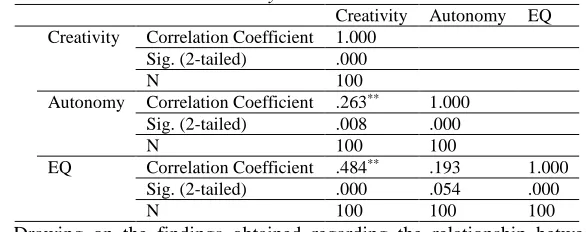
Table 4, Spearman coefficient values of variables are significant (Creativity = 1.000, autonomy = .263, EQ = .484), and positive correlation between variables is observable.
Table 3
Descriptive Statistics Concerning the Study Variables
Mean Std. Deviation Skewness Kurtosis
Creativity 80.063 19.163 .068 -.403
Autonomy 49.059 15.082 -1.559 1.168
EQ 132.729 20.814 -1.353 1.601
Table 4
Spearman Correlation Run on Study Variables
Creativity Autonomy EQ
Creativity Correlation Coefficient 1.000 Sig. (2-tailed) .000
N 100
Autonomy Correlation Coefficient .263** 1.000
Sig. (2-tailed) .008 .000
N 100 100
EQ Correlation Coefficient .484** .193 1.000
Sig. (2-tailed) .000 .054 .000
N 100 100 100
Drawing on the findings obtained regarding the relationship between teachers' emotional intelligence and creativity, on the one hand, and their autonomy and creativity, on the other, the first and second null hypotheses postulating significant relationship between high school teachers' emotional intelligence and their creativity, on the one hand, and their autonomy, on the other, were rejected.
4.2 Findings relevant to the third research question
Table 5
Independent Samples t-test for Comparing Male and Female Teachers' Creativity
Gender Mean Leven's test T-value Df Sig
Female 77.797 .121 -1.535 91 .128
Male 84.263
As it is seen in Table 5, the observed p-value is higher than .05, and hence no significant difference is observed between creativity level of male and female teachers. Thus, the null hypothesis postulating no differences between male and female high school teachers in terms of their creativity is accepted. 4.3 Findings Relevant To Research Question Four
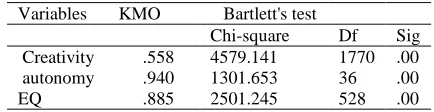
The last question put forth in the study was after pinpointing the predictive power of emotional intelligence and autonomy for teacher creativity. Although correlation coefficient indicates the strength of relationship between variables, it does not give any information about the extent of changes in independent variable. To study the correlation among variables, Structural Equation Modeling (SEM) was utilized. One of the ways of testing the appropriateness of data is Kaiser-Mayer-Olkin (KMO) and Bartlet's test. The range of KMO should be between 0-1 and the more it is closer to 1, the more data are appropriate. The acceptable value for KMO should be above 0.6 (Pallant, 2007). Field (2009) reported that values greater than 0.5 are average and above 0.9 are superb. With regard to the results provided in Table 6, we can conclude that factor analysis for these data (creativity = .558, autonomy = .940, & EQ = .885) is appropriate.
Table 6
KMO and Bartlett's Test
Variables KMO Bartlett's test
PLS is a useful method for SEM when there is a limited number of participants and the data distribution is skewed (Wong, 2011, as cited in Guy-Soo, 2016). PLS-smart is able to represents reliability and validity of latent variables. Convergent validity is subcategory of construct validity. Heir, Hult, Ringle, and Sarstedt (2013) state that the latent variables above .05 indicate appropriate convergent validity, and as seen in Table 7, the value of each variable is above .05.
Table 7
Convergent Validity of Study Variables
Mean Variance Variables
.752 .671 .613 creativity
autonomy EQ
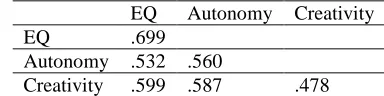
To measure discriminant validity of constructs, Fornell-Larker criterion was used. It compares the root of convergent validity values with latent variable correlations. The square root of each construct's convergent validity should be greater than its highest correlation with any other constructs (Hair et al. 2013). He suggests that the square of convergent validity in each latent variable can be used to determine discriminant validity if this value is larger than other correlation values among latent variables. The logic of this method is that a construct shares more variance with its associated indicators than with any other constructs. Table 8 represents the results of Fornell-Larker criterion analysis.
Table 8
Fornell-Larker Criterion Analysis
EQ Autonomy Creativity
EQ .699
Autonomy .532 .560
Creativity .599 .587 .478
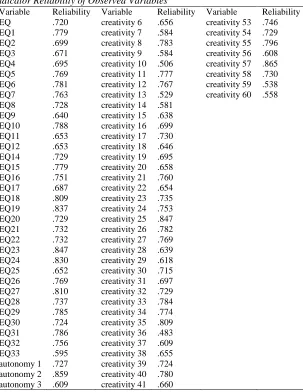
variable is reliable to the extent that it is higher than .7. Table 9 shows indicator reliability for study variables. As is seen, all the observed variables enjoy relative indicator reliability (e.g. EQ = .720 > .7; autonomy = .727 > .7).
Table 9
Indicator Reliability of Observed Variables
Variable Reliability Variable Reliability Variable Reliability
EQ .720 creativity 6 .656 creativity 53 .746
EQ1 .779 creativity 7 .584 creativity 54 .729
EQ2 .699 creativity 8 .783 creativity 55 .796
EQ3 .671 creativity 9 .584 creativity 56 .608
EQ4 .695 creativity 10 .506 creativity 57 .865
EQ5 .769 creativity 11 .777 creativity 58 .730
EQ6 .781 creativity 12 .767 creativity 59 .538
EQ7 .763 creativity 13 .529 creativity 60 .558
EQ8 .728 creativity 14 .581
EQ9 .640 creativity 15 .638
EQ10 .788 creativity 16 .699
EQ11 .653 creativity 17 .730
EQ12 .653 creativity 18 .646
EQ14 .729 creativity 19 .695
EQ15 .779 creativity 20 .658
EQ16 .751 creativity 21 .760
EQ17 .687 creativity 22 .654
EQ18 .809 creativity 23 .735
EQ19 .837 creativity 24 .753
EQ20 .729 creativity 25 .847
EQ21 .732 creativity 26 .782
EQ22 .732 creativity 27 .769
EQ23 .847 creativity 28 .639
EQ24 .830 creativity 29 .618
EQ25 .652 creativity 30 .715
EQ26 .769 creativity 31 .697
EQ27 .810 creativity 32 .729
EQ28 .737 creativity 33 .784
EQ29 .785 creativity 34 .774
EQ30 .724 creativity 35 .809
EQ31 .786 creativity 36 .483
EQ32 .756 creativity 37 .609
EQ33 .595 creativity 38 .655
autonomy 4 .557 creativity 42 .772 autonomy 5 .526 creativity 43 .698 autonomy 6 .682 creativity 44 .860 autonomy 7 .753 creativity 45 .736 autonomy 8 .761 creativity 46 .794 autonomy 9 .704 creativity 47 .757 creativity 1 .776 creativity 48 .736 creativity 2 .769 creativity 49 .761 creativity 3 .705 creativity 50 .596 creativity 4 .708 creativity 51 .619 creativity 5 .780 creativity 52 .715
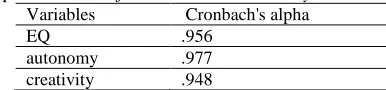
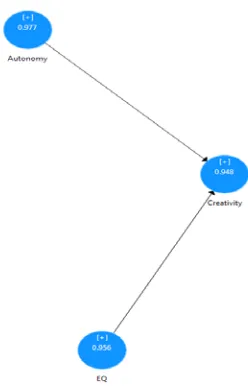
For internal consistency reliability, Cronbach's alpha was used. Cronbach's alpha reliability varies between 0 and 1. The value of .7 is acceptable in exploratory research. The results presented in Table 10 show that all the variables have appropriate internal consistency (e.g., EQ = .956 > .7). Figure 1 illustrates the internal consistency of study variables in a schematic manner.
Table 10
Cronbach's Alpha Obtained for Internal Consistency
Variables Cronbach's alpha
EQ .956
autonomy .977
Figure 1. Internal Consistency of Variables
Structural Path Coefficient examines the model's predictive nature and the relationship between constructs. The estimation of path coefficient in the structural model is based on regression of each variable on its predictor. Estimation of structural model and path model is based on nonparametric approaches. Coefficient of Determination (R2) is one way of determining model’s predictive accuracy and is estimated by the squared correlation between specific endogenous construct's actual and predictive values. As Table 11 represents, (R2) = .547 and this shows higher value of creativity. It means that endogenous variables are effective in demonstrating exogenous latent variables.
Table 11
Coefficient of Determination of Creativity
Variable R2 Creativity .547
mediating constructs (Heir et al. 2013). The value of effect size ranges between .02 (small), .15 (medium) and 0.35 (large).
Table 12
Results of Structural Model Path Coefficient
Number Path coefficient T values P value Results
1 EQ-creativity .401 5.164 .000 Accepted
2 Autonomy-creativity .057 .601 .548 Accepted
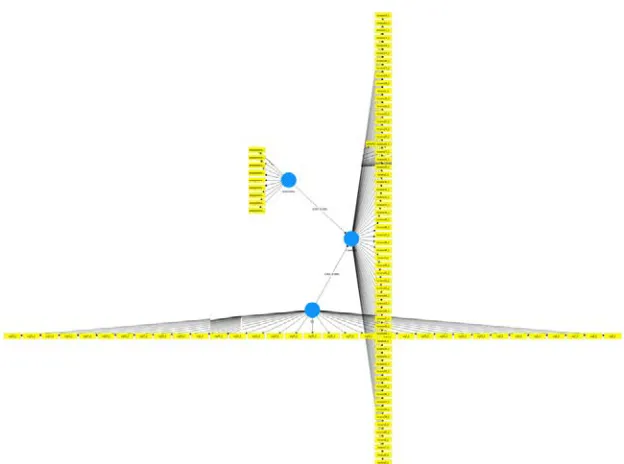
As Table 12 demonstrates, EQ has a higher impact on creativity compared to autonomy. Figure 2 illustrates the relationship among the study variables in structural equation modeling.
Figure 2. Structural Equation Modeling for the study variables
5. Discussion
Educational system of a country is at the heart of its entire attempts toward success, and teachers are supposed to play a major part in this burgeoning movement. As stated earlier, teachers' sense of creativity is among the key determiners of their success in educational arena. Recently too much attention has been paid to creativity (e.g., Chan & Yuen, 2014; Lin, 2014) as an important factor in educational development. Despite the importance of teacher creativity, there is little research considering effective factors impacting on it. Thus, the study delved into the potential relationship between teacher creativity, on the one hand, and their autonomy and emotional intelligence, on the other.
intelligence and creativity seems to be well justifiable, in that creativity is greatly hinged upon the individual's ability in "expanding the boundaries of what we know about teaching and learning in order to discover new worlds within the confines of our classrooms" (Xerri & Vassallo, 2016, p. 3). Two of the components of Sternberg's framework of intelligence, known as creative intelligence "an individual's insight for coping with new experiences" and practical intelligence "an individual's ability to adapt and reshape his or her environment" are worth reiterating vis-à-vis the relationship between intelligent behavior and creativity (Arends, 2012, p. 50).
As to the second research question which delved into the potential relationship between high school teachers' autonomy and their creativity, the results pointed to a positive correlation between the two variables for teachers. As Wang and Zhang (2014) contend, increased teacher autonomy can bring about more creative practices and foster curriculum reform. Hermansen (2017) and Vangrieken et al.'s (2017) emphasis on collective and collaborative autonomy also seems to help open new horizons for practitioners and communities of practice to mull over more creative breakthroughs for more successful teaching. Furthermore, to pave the way for more autonomous and creative practice on the part of teachers, as Nguyen and Wlakinshaw's (2018) study reveals, initially an attempt must be made to remove the constraints (structural, contextual, cultural & individual ones) hampering teachers' sense of autonomy and creativity.
greatly affected by gender differences, though little variation in creativity levels might, at times, be encountered with regard to gender.
Finally, the findings obtained for the fourth research question, which investigated the predictive power of teacher autonomy and emotional intelligence for their creativity, indicated that EQ has a stronger predictive power than autonomy as regards teacher creativity. This finding again corroborates the results obtained in Noorafshan and Jowkar (2013) and Benedek, et al.'s (2016) studies, both of which confirmed the positive correlation between individuals’ (emotional) intelligence and creative practice.
6. Conclusion and Implications
The researchers in the study strived to renew attention to the long-established notion of creativity via observing teacher creativity in light of autonomy and emotional intelligence. Though the positive correlation between teacher creativity, on the one hand, and emotional intelligence and autonomy, on the other, was established through the findings of the study, further scrutiny is required to corroborate the findings obtained by the current researchers.
about further indoctrination and institutionalization of the concept of creativity in pedagogy.
To tackle the issue in a proper way, our endeavors aimed at opening up the space for creative practice of teaching must be organized along the following lines. First and foremost, teachers as the principal agents of change should be trained in how to apply creativity in teaching. As Hall and Simeral (2008, p. 9) state, teachers tend to "suppress their creative intellect and ignore their prior training in order to follow a lockstep, one-size-fits-all instructional program." This may be so because most teachers feel more at ease with the already-familiar and practiced teaching methods and techniques and are reluctant to implement novelty and creativity, which may at times prove to be endangering their career. Indeed, a major impediment limiting teachers' creativity is their "over-reliance on methods and the view that lessons can be looked at as a series of 'plannable' mini-episodes" (Pugliese, 2016, p. 21).
Furthermore, as Mullet et al.'s (2016) meta-analysis of research on creativity revealed, teachers mostly hold restricted, inaccurate and unclear perceptions of creativity, misconceive the meaning of creativity and lack the skills and abilities required for assessment of creativity in learners. Thus, to bring about successful practice of creative teaching, the first step might be empowering teachers by giving them knowledge and awareness of what creativity entails and how it can be implemented.
textbooks mostly disregard individual needs and restrain learner creativity. Maley (2016), on the other hand, raises a different argument claiming that constraints also bring about more creative practice of teaching. The logic behind his statement is that "when we are forced to work with limited resources, or within a rigid set of rules, we are stimulated to find creative solutions" (p. 12).
Last but not least, learners must be made familiar with creative learning practice. Creative behavior of teachers and their interest in implementing creative methodologies, can in turn, enhance learners’ creativity. As Soh (2017) contends, creativity is a behavioral trait that can be enhanced through the practice of social modelling (the emulation of teacher's creative behavior), reinforcement (providing rewards for learners as they behave creatively) and classroom ecology (enthralling learners in a social context which is laden with creativity).
References
Almeida, L. S., Prieto, L. P., Ferrando, M., Oliveira, E., & Ferrandiz, C. (2008). Torrance test of creative thinking: The question of its construct validity. Thinking Skills and Creativity, 3, 53–58.
Althuizen, N., Wierenga, B., & Rossiter, J. (2010). The validity of two brief measures of creative ability. Creativity Research Journal, 22(1), 53–61. Arends, R.I. (2012). Learning to teach (9th edition). New York:
McGraw-Hill.
Bell, N. D., & Pomerantz, A. (2016). Humor in the classroom: A guide for
language teachers and educational researchers. London, England:
Routledge.
Benedek, M., Nordtvedt, N., Jauk, E., Koschmieder, C., Pretsch, J., Krammer, G., & Neubauer, A. C. (2016). Assessment of creativity evaluation skills: A psychometric investigation in prospective teachers. Thinking Skills and Creativity, 21, 75-84.
Ben Said, S., & Zhang, L. J. (Eds.) (2014). Language teachers and teaching:
Global perspectives, local initiatives. London: Routledge.
Brady, K. P. (2006). Emotionally intelligent school administrators: Developing a positive school climate. In J. Pellitteri, R. Stern, C. Shelton, & B. Muller-Ackerman (Eds.), Emotionally intelligent school
counseling (pp. 151-165). Mahwah, New Jersey: Lawrence Erlbaum
Associates.
Breaugh, J. H. (1985). The measurement of work autonomy. Human Relations, 38, 551-570.
Farrell, T.S.C. (2014). Reflective practice in ESL teacher development
groups: From practices to principles. UK: Palgrave Macmillan.
Field, A. (2009). Discovering statistics using SPSS. Sage: London.
Gardiner, P. (2017). Rethinking feedback: Playwriting pedagogy as teaching and learning for creativity. Teaching and Teacher Education, 65, 117-126.
Gardner, H. (1983). Multiple intelligences: The theory in practice. New York: McGraw-Hill.
Goodwyn, A. (2011). The expert teacher of English. London: Routledge. Hall, G. (2011). Exploring English language teaching: Language in action.
London, England: Routledge.
Hall, P., & Simeral, A. (2008). Building teachers' capacity for success: A
collaborative approach for coaches and school leaders. Alexandria:
Association for Supervision and Curriculum Development.
Hartley, K. A., Plucker J. A., & Long, H. (2016). Creative self-efficacy and teacher ratings of student creativity in Chinese elementary classrooms.
Thinking Skills and Creativity, 22, 142–151.
Heir, J. F., Hult, G. T., Ringle, C. H. & Sarstedt, M. (2013). A primer on
partial least squares structural equation modelling (PLS-SEM). SAGE:
Hermansen, H. (2017). Knowledge relations and epistemic infrastructures as mediators of teachers' collective autonomy. Teaching and Teacher Education, 65, 1-9.
Jedynak, M. (2012). Gifted visually impaired children learning foreign languages. In M. Pawlak (Ed.), New perspectives on individual
differences in language learning and teaching (pp. 337-348). Berlin:
Springer.
Jónsdóttir, S. R. (2017). Narratives of creativity: How eight teachers on four school levels integrate creativity into teaching and learning. Thinking Skills and Creativity, 24, 127–139.
Korthagen, F. A. J. (2001). Linking practice and theory: The pedagogy of
realistic teacher education. Mahwah, New Jersey: Lawrence Erlbaum
Associates, Inc.
Maley, A. (2016). Creativity: The what, the why and the how. In D. Xerri, & O. Vassallo (Eds.), Creativity in English language teaching. (pp. 9-18). Malta: Progress Press.
Montijano Cabrera, M. P. (2014). Textbook use training in EFL teacher education. In J. D. Martínez (Ed.), English as a foreign language teacher
education: Current perspectives and challenges (pp. 267-286).
Amsterdam: Rodopi.
Mortiboys, A. (2005). Teaching with emotional intelligence: A step-by-step
guide for higher and further education professionals. London and New
York: Routledge.
Mullet, D., Willerson, A., Lamb, K., Kettler, T. (2016). Examining teacher perceptions of creativity: A systematic review of the literature. Thinking Skills and Creativity, 21, 9-30.
Nguyen, X. N. C. M., & Wlakinshaw, I. (2018). Autonomy in teaching practice: Insights from Vietnamese English language teachers trained in Inner-Circle countries. Teaching and Teacher Education, 69, 21-32. Noorafshan, N., & Jowkar, B. (2013). The effect of emotional intelligence
and its components on creativity. Procedia Social and Behavioural Sciences, 84, 791-795.
Nunan, D. (2013). Learner-centered English language education: The
selected works of David Nunan. London, England: Routledge.
Pallant, J. (2007). SPSS survival manual: A step-by-step guide to data
analysis using SPSS program. England: McGraw-Hill, Open University
Press.
Pugliese, C. (2016). Creativity in the classroom: From a pedagogy of certainties to a pedagogy of possibilities. In D. Xerri, & O. Vassallo (Eds.), Creativity in English language teaching. (pp. 19-23). Malta: Progress Press.
Richards, J. C. (2013). Creativity in language teaching. Iranian Journal of
Language Teaching Research, 1(3), 19-43.
Richards, J. C., & Rodgers, T. S. (2001). Approaches and methods in
language teaching (2nd edition). Cambridge: Cambridge University
Richardson, P. W., Karabenick S. A., & Watt, H. M. G. (2014). Teacher motivation matters: An introduction. In P.W. Richardson, S. A. Karabenick & H.M.G. Watt (Eds.), Teacher motivation: Theory and
practice (pp. xiii-xxii). London, England: Routledge.
Salavera, C., Usán, P., Chaverri, I., Gracia, N., Aure, P., & Delpueyo, M. (2017). Emotional intelligence and creativity in first- and second-year primary school children. Procedia Social and Behavioural Sciences, 237, 1179 – 1183
Shin, N., & Jang, Y.-J. (2017). Group creativity training for children: Lessons learned from two award-winning teams. The Journal of Creative
Behavior, 51(1), 5–19.
Soh, K. (2017). Fostering student creativity through teacher behaviors. Thinking Skills and Creativity, 23, 58-66.
Stewart, A., & Irie, K. (2012). Realizing autonomy: Contradictions in practice and context. In K. Irie, & A. Stewart (Eds.), Realizing
autonomy: Practice and reflection in language education contexts (pp.
1-17). UK: Palgrave Macmillan.
Takahashi, E., Austin, T., & Morimoto, Y. (2000). Social interaction and language development in a FLES classroom. In J.K. Hall & L.S. Verplaetse (Eds.), Second and foreign language learning through
classroom interaction (pp. 118-135). Mahwah, New Jersey: Lawrence
Erlbaum Associates, Inc.
Torrance, E. P. (2008). The Torrance tests of creative thinking: Norms—
Technical manual. Bensenville, IL: Scholastic Testing Service.
Vangrieken, K., Grosemans, I., Dochy F., & Kyndt, E. (2017). Teacher autonomy and collaboration: A paradox? Conceptualizing and measuring teachers' autonomy and collaborative attitude. Teaching and Teacher
Education, 67, 302-315.
Wang, Q., & Zhang, H. (2014). Promoting teacher autonomy through university–school collaborative action research. Language Teaching
Research, 18(2), 222-241.
Xerri, D., & Vassallo, O. (2016). Creativity in ELT: An introduction. In D. Xerri, & O. Vassallo (Eds.), Creativity in English language teaching. (pp. 1-7). Malta: Progress Press.