Yesterday
masked
, today
modified
; what do mycotoxins
bring next?
Marija Kovač
1, Drago Šubarić
2, Mateja Bulaić
1, Tihomir Kovač
2, and Bojan Šarkanj
2,3Inspecto Ltd., Đakovo1, Josip Juraj Strossmayer University of Osijek, Faculty of Food Technology Osijek2, Department
of Food Technology, University North, Koprivnica3, Croatia
[Received in February 2018; Similarity Check in February 2018; Accepted in May 2018]
Mycotoxins are secondary metabolites produced by toxigenic fungi in crops worldwide. In (micro)organisms such as plants,
fungi, bacteria, or animals they may be further metabolised and modified, but this is also true for food processing, which
may lead to a wide range of masked mycotoxin forms. These often remain undetected by analytical methods and are the
culprits for underestimates in risk assessments. Furthermore, once ingested, modified mycotoxins can convert back to their parent forms. This concern has raised the need for analytical methods that can detect and quantify modified mycotoxins
as essential for accurate risk assessment. The promising answer is liquid chromatography-mass spectrometry. New masked
mycotoxin forms are now successfully detected by iontrap, time-of-flight, or high-resolution orbitrap mass spectrometers. However, the toxicological relevance of modified mycotoxins has not been fully clarified.
KEY WORDS: LC-MS/MS; LC-HRMS; secondary fungal metabolites; toxicology
Global concern about the contamination of agricultural commodities with mycotoxins, secondary fungal metabolites, has increased over the last years (1-3). Although the total number of mycotoxins is unknown, it is estimated that there are thousands of fungal secondary metabolites, but only a few hundred have been documented as toxic at low amounts. This low-amount toxicity is what sets mycotoxins apart from other secondary metabolites, such as ethanol. Ethanol is not a mycotoxin, even though it is a secondary fungal metabolite (4). The United Nations Food and Agriculture Organization (FAO) has estimated that about 25 % of the crops worldwide are contaminated with mycotoxins (1, 5). Recent reports, however, indicate that the contamination of commodities (cereals and feed)
is much higher: roughly 80 % (1, 5, 6). These figures are
expected to rise with the use of more sensitive detection methods and equipment, which will increase the mycotoxin database and standards.
The most important fungal genera producing mycotoxins
are Aspergillus, Fusarium, Alternaria, and Penicillium (6)
(Figure 1) and the most relevant mycotoxins for animal and
human health worldwide are aflatoxins B1 (AFT B1), B2
(AFT B2), G1 (AFT G1), G2 (AFT G2), and M1 (AFT M1), ochratoxin A (OTA), zearalenone (ZEN), deoxynivalenol (DON), T-2 and HT-2 toxins, fumonisins B1 (FB1) and B2 (FB2), and patulin. The European Union has regulated their maximum levels in certain foodstuffs in the Commission
Regulation (EC) No. 1881/2006 (8) and the Commission Recommendation 2013/165/EU (9).
Toxicity syndromes resulting from the intake of mycotoxins by humans and animals are known as mycotoxicoses (10). In some cases, the manifested clinical
symptoms of a mycotoxicosis are significantly greater than
expected from food or feed contamination level. This has
led to the discovery of the so-called masked mycotoxins,
which, as their name implies, escape detection by conventional analytical methods, initially developed for
specific mycotoxins (7, 11).
As the term masked mycotoxins has often been used for
all conjugated mycotoxins generated by or present in plants, animals, fungi, and food processing, Rychlik et al. (12) proposed a systematic four-tier hierarchy displayed in
Figure 2 (11-13). The first tier distinguishes free mycotoxins
from matrix-associated mycotoxins and mycotoxins with
modified basic chemical structure. The second tier further distinguishes biologically modified mycotoxins from the
chemically modified ones. The third tier includes
biologically modified compounds that are divided into
functionalised, conjugated, and differently modified mycotoxins. Finally, the fourth tier, which consists of the biologically conjugated mycotoxins, is divided into plant, animal, and fungal conjugates (12). This system, however,
is sometimes difficult to use, since some masked forms can
be synthesised by both fungi and plants (e.g. zearalenone sulphate) (14).
The presence of modified mycotoxins in cereals had
long been speculated, until Schneweis et al. (15)
Correspondence to: Tihomir Kovač, Josip Juraj Strossmayer University
of Osijek, Faculty of Food Technology, Franje Kuhača 18, 31107 Osijek,
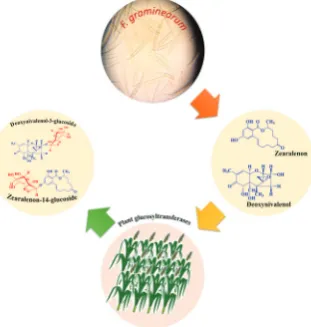
demonstrated modified zearalenone-14-glucoside (ZEN14Glc) (Figure 3) in naturally contaminated wheat. Three years later, Berthiller et al. (16) reported another mycotoxin glucoside in naturally infected cereals, deoxynivalenol-3-glucoside (DON3Glc) (Figure 3). Years that followed witnessed new evidence about mycotoxins
masked/modified by technological processes, especially in cereal-based products. Mechanical or thermal processing was shown to induce mycotoxin reactions with macromolecules such as polysaccharides and proteins or
decomposition of their modified form and the release of a
free mycotoxin (17, 18).
Recent research using advanced techniques based on
mass spectrometry (MS) has detected and confirmed a
number of modified mycotoxin derivatives. The most powerful technique among them is liquid chromatography coupled to orbitrap high resolution mass spectrometry (LC-HRMS), which has pointed to a whole new range of possibly
masked mycotoxins (19) that have later been confirmed by
triple quadrupole (QqQ) mass spectrometry analyser in real wheat (20) and human urine samples (21). Beside these, liquid chromatography/tandem mass spectrometry (LC-MS/
MS) has confirmed the existence of theoretical molecules
such as DON-glutathione conjugates in cereals, first synthesised and characterised by nuclear magnetic resonance spectroscopy (22, 23).
Despite these discoveries, there are still no directives, regulations, or recommendations regarding modified mycotoxins (11, 24). The European Food Safety Authority (EFSA) has emphasised the need for more occurrence data
on modified mycotoxins in food and feed in order to assess
exposure and the effects on human and animal health (13, 25). In addition, the latest zearalenone (ZEN) risk
assessment (26) included the modified forms of ZEN and
confirmed even higher toxicity than that of the parent
mycotoxin. The aim of this review is to describe the current
knowledge about common modified mycotoxins, their
formation, occurrence, analytical aspects, and toxicology.
FORMATION OF MODIFIED
MYCOTOXINS
Biological modifications of mycotoxins through
conjugation by plants or fungi as well as modifications
caused by food processing can be the main contributors to food and feed contamination levels (11). Table 1 gives an
overview of the most common modified mycotoxins and their profile, including the matrices in which they usually
occur.
Conjugation by plant
To protect themselves from xenobiotics such as
mycotoxins, plants trigger a detoxification process (7, 11)
consisting of the following three stages: transformation,
solubilisation, and compartmentalisation. In the first stage,
xenobiotics undergo hydrolysis, reduction or oxidation, which form reactive groups in the xenobiotic structure. This stage is typical for lipophilic compounds, which become more hydrophilic. When foreign substances, such as the hydrophilic ones, already possess reactive groups,
detoxification skips the first stage and immediately starts
with the second. In the second stage, xenobiotics are conjugated with endogenous molecules such as sugars, sulphates, or amino acids. Formed conjugates are more polar than the original xenobiotic molecule, which facilitates their compartmentalisation (the third stage) (11).
Figure 1 The most important mycotoxin-producing fungi with their respective conidia microphotography: a) Aspergillus flavus (NRRL
3251); b) Fusarium verticilioides (CBS 119.825); c) Penicillium expansum (CBS 325.48); and d) Alternaria alternata (wt) grown on
Glc levels were about 12 % of the parent mycotoxin. Glucoside forms of fusarenon-X (FUSX-Glc) and nivalenol (NIV-Glc) have been reported by Nakagawa et al. (28) in
wheat artificially infected with Fusarium spp. They
estimated that over 15 % of fusarenon-X (FUSX) and nivalenol (NIV) are converted into glucosides. NIV-Glc occurrence in wheat was also reported by the EFSA (13). Nakagawa et al. (29) also found neosolaniol-glucoside (NEO-Glc) and diacetoxyscirpenol-glucoside (DAS-Glc), glucosides derived from type A trichotecenes, in corn powder mycotoxin reference material. The existence of oligoglycosylated forms of deoxynivalenol (DON) has been reported by Zachariasova et al. (30) in beer, malt, and bread This prevents harmful interaction between conjugated
xenobiotics and plant components. Even so, these conjugates persist in plants long enough to have important toxicological consequences for their consumers. It has been suggested that some plant conjugates undergo hydrolysis after ingestion, thereby releasing the unconjugated parent mycotoxins (7, 11).
Beside the above mentioned ZEN14Glc and DON3Glc,
there are several other plant conjugates identified and
characterised in both artificial and natural samples.
Lattanzio et al. (27) were the first to report T-2-glucoside
(T-2-Glc) and HT-2-glucoside (HT-2-Glc) presence in naturally contaminated wheat and oats. T-2-Glc and
HT-2-Figure 2 Mycotoxin systematisation proposed by Rychlik et al. (12)
Table 1
The occurr
ence of selected modified mycotoxins in differ
ent matrices and their corr
esponding structural formulas
Fr
ee/par
ent mycotoxin
Modified and other mycotoxin forms
Matrix
Refer
ence
Structural formula
Zearalenone (ZEN)
ZEN14Glc
Naturally contaminated wheat
Schneweis et al. (2002) (15)
OH
O
O
O
CH
3
O
HO
H
H
OH
H
HO
H
HO H
O
ZEN14Sulph
Plants, fruits and vegetables
Broekaert et al. (2015) (85)
OH
O
O
O
CH
3
S
O O
O
HO
Deoxynivalenol (DON)
DON3Glc
Naturally infected cereals
Berthiller et al. (2005) (16)
H3
C O
OH
CH
2
O
H
CH
3
H
O
H
H
H
OH
O
O
H
OH
H
OH H
HO
H
H
OH
3Ac-DON and 15Ac-DON
Cereals
EFSA
(2013) (25);
Alexander et al. (201
1)
(34); Y
oshizawa
and
Marooka (1975) (35)
HC3 O
OH
CH
2
O
H
CH
3
H O
H
H
H
OH
O
CH
3
O
3Ac-DON
H3
C O
OH
CH
2
O
H
CH
3
H O OH H
H
H
O
H3
C
O
Fr
ee/par
ent mycotoxin
Modified and other mycotoxin forms
Matrix
Refer
ence
Structural formula
Deoxynivalenol (DON)
Oligoglycosylated forms of DON
Beer
, malt and bread
Zachariasova et al. (2012)
(30)
H3
C O
OH
CH
2
O
H
CH
3
H
O
H
H
H
OH
O
n
O
H
OH
H
OH H
HO
H
H
OH
D3GlcA
and
D15GlcA
Urine
Šarkanj et al. (2013) (40); Warth et al. (2013) (42)
D3GlcA
D15GlcA
DON3Sulf and DON15Sulf
Wheat/Urine
W
arth et al. (2015; 2016)
(20, 21)
DON3Sulf
Fr
ee/par
ent mycotoxin
Modified and other mycotoxin forms
Matrix
Refer
ence
Structural formula
Deoxynivalenol (DON)
DON-GSH and related conjugates
Naturally contaminated grain
Uhlig et al. (2016) (23)
O H CH 2 HO O H H CH 3 H OH H O H3 C HO S O N O H N OH OH O NH 2 DON-GSH
T-2 toxin and HT
-2
toxin
T-2-Glc and HT
-2-Glc
Naturally contaminated wheat
and oats
Lattanzio et al. (2012) (27)
H3 C CH 3 O O H3 C O O H O H H H O CH 3 O CH 3 O CH 3 O n O H OH H OH H HO H H OH T-2-3-oligoGlc CH 3 CH 3 O O CH 3 O O H O H H H OH CH 3 O CH 3 O n O H OH H OH H HO H H OH HT -2-3-oligoGlc
More highly glyco
-sylated forms of
T-2
and HT
-2
Corn powder mycotoxin reference
material
Nakagawa et al. (2016) (31)
Neosolaniol (NEO)
and Diacetoxyscripenol
(DAS)
NEO-Glc and DAS-Glc
Corn powder mycotoxin reference
material
Nakagawa et al. (2013) (29)
O H CH 2 O H H CH 3 O O H
HC3
O C O CH 3 HO O O H OH H OH H HO H H OH NEO-3-Glc O H CH 2 O H H CH 3 O O H H3 C HO C O CH 3 O H OH H OH H HO H H
Fr
ee/par
ent mycotoxin
Modified and other mycotoxin forms
Matrix
Refer
ence
Structural formula
Alternaria
toxins
Mixed sulfate/
glucoside diconjugate of
Alternaria
toxins
Tomato tissues and tobacco
suspension cells inoculated with
Alternaria
toxins
Soukup et al. (2016) (33)
O
O
OH
O
O
CH
3
CH
3
O
H
HO
H
HO
H
H
OH
H
OH
AME-9-Glc
O
O
OH
O
OH
CH
3
O
H
HO
H
HO
H
H
OH
H
OH
AOH-9-Glc AOH-3-S
SO
3
-O
O
OH
O
O
CH
3
O
H
HO
H
HO
H OH H
H
OH
AOH-3-S-9-Glc
Fusarenon-X (FUSX) and Nivalenol (NIV)
FUSX-Glc and NIV
-Glc
Wheat artificially infected with
Fusarium
spp.
Nakagawa et al. (201
1) (28)
NIV
-3-Glc
H3
C O
OH
CH
2
O
H
CH
3
H O
H
O
H
OH
O
O
H
OH
H
OH H
HO
H
H
OH
CH
3
FUSX-3-Glc
NIV
-Glc
Wheat
Yoshinari et al. (2014) (92)
FUSX
Fusarium
infected maize
Fr
ee/par
ent mycotoxin
Modified and other mycotoxin forms
Matrix
Refer
ence
Structural formula
Ochratoxin
A
(OT
A)
OT
A
degradation products (14R-ochratoxin A and 14-decar
-boxy-ochratoxin, OT
A
esters)
Roasted cof
fee
Bittner et al. (2013) (47); Rychlik et al. (2014) (12); Crews et al. (2016) (48); Han et al. (2013) (91)
N H
O
OH
O
OH Cl
O O
CH
3
(R)
(R)
14R-OT
A
N H
O
OH Cl
O O
CH
3
(R)
14-decarboxy-OT
A
N H
O
O
O
OH Cl O O
CH
3
(S)
(R)
O
H
OH
H
OH
H
HCO3
HO
H
H
OT
A-methyl-a-Dglucopyranoside ester
N H
O
O
O
OH Cl O O
CH
3
O
H
OH
H
OH
H
HO HO
H
H
(R)
(S)
OT
A-glucose ester
N H
O
O
O
OH Cl
O O
CH
3
O
H
H
HO
H
OH
OH
H
H
(R)
(S)
O
O
H
HO
H
HO
H
H
OH
H
OH
OT
A
Fr
ee/par
ent mycotoxin
Modified and other mycotoxin forms
Matrix
Refer
ence
Structural formula
Fumonisins (FBs)
Hydrolysed FB1
Maize-based products
Bryła et al. (2016; 2017) (54, 56); Voss et al. (2017) (55)
OH HO
OH
OH
OH NH
2
FBs thermal
degradation products
(NDF
, NCM)
Maize products
Seefelder et al. (2001) (52); Dall`Asta and Battilani
(2016) (50)
O
O
COOH
COOH
O O
OH
COOH
COOH
OH
OH NH OH
O
NCM
O
O
COOH
COOH
O O
OH
COOH
COOH
OH
OH HN
H
HO
OH
H H
OH OH
O NDF
Bound FBs
Maize and maize-based bread
Dall’Asta et al. (2009) (58); Falavigna et al. (2012) (59); Scott (2012) (60); Bryła et
al. (2014) (57)
Hidden FBs
Maize and maize-based products
Dall’Asta et al. (2009) (58); Falavigna et al. (2012) (59);
were also reported in corn by Nakagawa et al. (31). Except for the typical glucolysated mycotoxin forms, other mycotoxin glycosides can occur, formed through
conjugation by sulphatase (i.e. deoxynivalenol-suflates,
DON3Sulf and DON15Sulf) (20) or glutathione S-transferase (19, 22). A glutathione DON adduct (DON-GSH), together with a range of related conjugates, has been investigated by Uhlig et al. (24) in naturally contaminated grain. The authors managed to identify glutathione (GSH), cysteinylglycine (CysGly), cysteine (Cys),
γ-glutamylcysteine (γ-GluCys), and N-acetylcysteine
(NAC) coupled at the 13th position on the epoxy group in
the DON molecule, which was the first report of in vivo
conjugation of trichotecenes via their epoxy group, generally considered as unreactive. Since DON-GSH is likely to be nontoxic and its formation irreversible, it was
suggested that the identification of cereal genotypes that
utilise the GSH-conjugation pathway may be useful in the future breeding strategies aiming to decrease DON accumulation in cereals (24). On the other hand, enhancing
resistance to Fusarium spp. head blight (FHB) in wheat,
often regarded as the best option to reduce fungal colonisation and mycotoxin contamination, showed to have an unexpected effect on masked mycotoxin content. According to Lemmens et al. (32), FHB-resistant wheat lines can metabolise DON to DON3Glc and decrease both DON and DON3Glc contamination. However, increased FHB resistance together with a decrease in DON content results in a conjugate increase in the relative fraction of the masked toxin compared to the parent. Such result is explained by the fact that increasing FHB resistance makes
the reduction of DON content more efficient than the
reduction of DON3Glc contamination.
In addition, other mycotoxin forms can occur, such as
a mixed sulphate/glucoside diconjugate of a mycotoxin first
reported by Soukup et al. (33) in 2016. The conjugates were found in tomato tissues and tobacco suspension cells
inoculated with Alternaria toxins [alternariol (AOH),
alternariomethyether (AME), tenauzonic acid (TEA), tentoxin (TTX) and others]. Regarding the fact that they can be formed by all mycotoxins and their phase I metabolites with two or more hydroxyl groups, the authors suggested that diconjugates should be taken into account
in future modified mycotoxin analyses.
Conjugation by fungi
3-acetyl-deoxynivalenol (3Ac-DON) and 15-acetyl-deoxynivalenol (15Ac-DON) are well known fungal conjugates. The production of these two biosynthetic precursors of DON was studied by Alexander et al. (34), who have elucidated the genetic basis for the difference between the 3- and 15Ac-DON chemo type. It was later
found in a study with F. graminearum (11) that it is an
esterase encoded by TRI8 which mediates the acetylation
DON at either the C-3 or C-15 position, and that its differential activity determines 3Ac-DON or 15Ac-DON formation. 3Ac-DON and 15Ac-DON have generally been reported to occur together with DON (25). According to the EFSA opinion of 2013 (25), the average contribution of 3Ac-DON to the sum of DON and its derivatives was <2 % at the lower-bound estimate and 13-20 % at the upper bound estimate, and of 15Ac-DON 10-15 % at both lower and upper bound estimates. As early as 1975, Yoshitzawa
and Morooka (35) made one of the first attempts to elucidate
acetyl transformation of DON by trichothecene-producing
strains of Fusariumnivale, F.roseum, and F.solani.
FUSX is another fungal conjugate that is a precursor in the biosynthesis of NIV. The presence of FUSX has already
been proven in Fusarium infected maize, even though the
concentrations and the incidence were small (11).
Fungi also have the ability to metabolise mycotoxins produced by mycotoxigenic fungi. The case in point is zearalenone (ZEN) and the formation of
zearalenone-14-sulphate (ZEN14Sulph) in the saprobic Rhizopus fungus,
frequently found on plants, fruits, and vegetables (11).
Conjugation by mammals
Conjugates formed by mammalian mycotoxin metabolism in the liver and excretion via urine are unlikely to play any important role in food (7) but are worth mentioning to get a comprehensive overview of the topic. Common mycotoxin conjugates produced by mammals are DON (36, 37) and ZEN (37–39) glucoronides and sulphates. Mammalian conjugates in urine can serve as biomarkers of exposure to certain mycotoxins. This is particularly true since a dose-response relationship has been established by Šarkanj et al. (40) in pregnant women from Croatia. A DON
glucuronide was first suggested by Meky et al. in 2003 (41)
and DON-3-glucoronide (D3GlcA) and
DON-15-glucoronide (D15GlcA) first identified and characterised
in naturally contaminated urine samples and human and animal liver microsomes a decade later (42, 43). The third glucuronide, DON-7-glucoronide (D7GlcA), was suggested
and confirmed in 2013 (40). A recent report by De Boevre
et al. (44) added to the list another DON glucuronide, with a possible hydroxylation point at C-8 position.
Beside conjugation, mammalian metabolism can create a cleavage, such as the one of phenylalanine moiety in
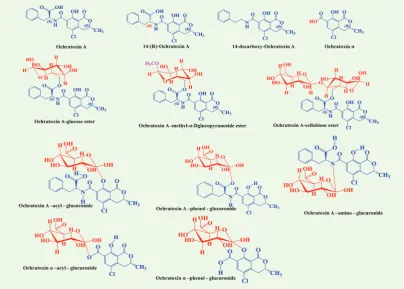
ochratoxin A (OTA), and produce ochratoxin alpha (OTα) (Figure 4). To eliminate OTA and OTα, animals resort to
glucuronidation, and the new glucuronides can occur on several positions: OTA-acyl-GlcA, OTA-phenol-GlcA, and
OTA-amino-GlcA. OTα is also glucuronidated and mainly excreted via urine as OTα-acyl-GlcA and OTα-phenol-GlcA (Figure 4). The conjugated forms of OTA and OTα have been confirmed only indirectly with and without enzymatic hydrolysis of biological fluids of subjects exposed to OTA
unregulated mycotoxins far less so. Still, we do know that
food processing can significantly contribute to the formation and the final concentrations of modified mycotoxins in
certain food products (11, 46).
One such process is coffee roasting, which causes the formation of several degradation products of OTA (Figure 4), such as 14R-ochratoxin A and 14-decarboxy-ochratoxin (12, 47, 48). According to Bittner et al. (47), further thermal reaction leads to the binding of OTA to coffee polysaccharides
via esterification and production of OTA esters such as OTA-glucose ester, OTA-methyl-α-D-glucopyranoside
ester, and OTA-cellobiose ester (Figure 4).
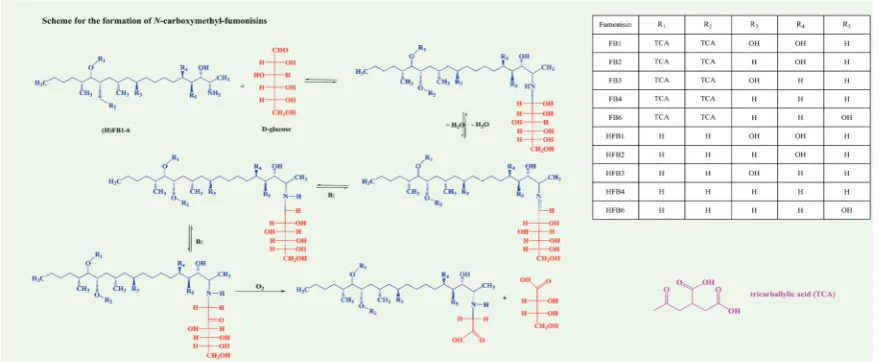
Effects of extrusion on mycotoxins depend on time and temperature of the process, as well as on other factors. In the case of fumonisins (FBs) (Figure 5), the presence of additives, reducing sugars, and sodium chloride is crucial (46). Studies indicate that the greatest reduction of FBs occurs in the presence of glucose at 160 °C or more (13, 46, 49). In the Maillard-type reaction with reducing sugars,
this loss in FB content likely reflects on the formation of
degradation products N-carboxymethyl fumonisin B1
(NCM-FB1) and N-deoxyfructosyl fumonisin B1
(NDF-FB1) (50, 51). These fumonisin derivatives have been reported in maize products by Seefelder et al. (52), and their toxicity investigated by Hartl and Humpf (53). In addition, the hydrolysed form of fumonisin B1 (HFB1) created by
America (46). Due to similar chemical properties of FBs
and HFBs, the reaction scheme proposed for the modification
of FB1 to NCM-FB1 and NDF-FB1 can also apply for the
modification of FBs and HFBs (Figure 5). The occurrence of HFBs was recently investigated by Bryła et al. (54) in
maize-based products, who concluded that the masked to
free fumonisin concentration ratio in thermally processed
food such as corn flakes and various snacks was higher than in unprocessed products such as flour or raw popcorn grains due to food processing. Voss et al. (55) have also confirmed
that extrusion and nixtamalisation can reduce FB toxicity
through hydrolysation. In 2017, Bryła et al. (56) investigated
the effect of pH and baking temperature on the stability of FBs in a maize product and confirmed that FBs are decomposed to HFBs and partly hydrolysed FBs. Thermal processing of up to 250 °C, did not, however, degrade the FBs. The authors also detected that only 20 % of FBs were bound and that lower dough pH increased the bound FB content. Earlier, the same group of authors found FBs physically entrapped into the structure of macromolecular components such as starch during bread making (57). These FBs were entrapped in a gluten-free bread up to 80 % of the parent form. They have also reported a smaller decrease in the content of hidden FBs compared to the free molecules, which was explained by a matrix stabilisation effect (57). In addition, these forms of FBs formed through an associative interaction between the toxin and matrix
while the above mentioned FBs, covalently linked to any matrix constituents, are referred to as “bound” (58-60).
Even though the entrapping mechanism is still to be clarified
from the physicochemical point of view, the existing data indicate that biopolymers such as amylose and amylopectin can form inclusion complexes with FBs. These forms can
easily degrade under in vitro digestion conditions and are
therefore toxicologically relevant (50).
The fate of DON and DON3Glc during bread making was studied by several other authors (30, 61-63). Vidal et al. (61) reported that baking reduced the concentration of DON but increased that of DON3Glc. They attributed this rise to glycosidation of DON in the initial stages of baking, before enzyme inactivation. This hypothesis is supported by the fact that DON3Glc also increases during fermentation, as previously suggested by Zachariasova et al. (30). The most recent, 2017 study by Generotti et al. (17) investigated the effects of baking on the final trichotecene (DON,
DON3Glc, and Fusarium metabolite culmorin) content by
modifying technological parameters and recipe ingredients. The results suggest that pH and baking time have an important role in minimising mycotoxins in the final product, while changes in the recipe can change mycotoxin extractability by affecting biscuit microstructure. Higher pH during wholegrain biscuit production reduced DON concentrations. Baking time effectively reduced DON and DON3Glc content in the final product (up to 80 %). Culmorin concentrations positively correlated with DON.
Beer production, in turn, raises great concern about
possible formation and transfer of Fusarium mycotoxins
from raw materials to final beer products (13, 46). A
significant increase in the level of DON3Glc was observed
during malting and brewing (64, 65). An increase was also observed in the levels of acetylated DON forms (AC-DONs) across the beer production chain (64). Their levels in barley were about 40 % of free DON, while in beer they were comparable or higher (64, 66). Even though there are several theories explaining the increase in DON3Glc, there are two
phenomena that should be considered. The first includes de
novo growth of Fusarium spp. during malting, accompanied
by the production of additional mycotoxins and their transformation products. The second phenomenon relates to the degradation of cell walls, membrane-bound proteins, and starch depots by enzymes produced during mashing of malt grits, which leads to releasing DON3Glc from insoluble forms (18, 65).
Recently, Karlovsky et al. (67) gave an overview of
how food processing and detoxification treatments relate
to mycotoxin contamination. In some cases, food processing reduces mycotoxin content, such as cleaning, milling, brewing, fermentation, cooking, baking, roasting, alkaline cooking, nixtamalisation, and extrusion. However, food processing can seldom completely eliminate mycotoxins from a food product. The authors pointed out that the disappearance of parent mycotoxin does not necessarily
“masked” form that escapes detection and has unknown toxic potential. They also allowed the possibility of co-contamination with other mycotoxin-producing fungi (63).
OCCURRENCE
The information on mycotoxin occurrence in food and feed is crucial for the assessment of consumer exposure and for setting maximum regulatory levels for certain products. It is general perception that mycotoxin levels have been
underestimated exactly because of the modified mycotoxins
(48). Over the past few years, however, the occurrence of the modified forms has been extensively researched, DON3Glc and ZEN14Glc in particular. Malachová et al. (68) monitored the occurrence of several mycotoxins in 116 cereal-based products from the Czech market. DON was found in 75 % of samples with its levels varying between
13 and 594 μg kg-1, while the prevalence of DON3Glc was even higher (80 %) and its levels ranged between 5 and
72 μg kg-1. The latter was found in a single whole-grain slice product (68).
The occurrence of DON, DON3Glc, and 3Ac-DON in beer was investigated by Varga et al. (66). 3Ac-DON was not found in any of 384 beer samples from 38 countries, but DON3Glc and DON were found in 93 and 77 % of the
samples, averaging 6.9 µg L-1 and 8.4 µgL-1, respectively.
De Boevre et al. (69) analysed 30 food and feed samples
(maize, wheat, oats, cornflakes, and bread) from Belgium
for ZEN, ZEN14Glc, DON, DON3Glc, and AC-DON. DON was the most common contaminant in both cereals and cereal-derived food. 3Ac-DON and 15Ac-DON were found in 87 % and 73 % of the samples, respectively. 66 % of the analysed samples were contaminated with DON3Glc, with
the highest levels in maize samples (max. 1003 µg kg-1).
Regarding the DON equivalents, of the total DON content, 62 % were metabolites, whereof 17 % were the glycosylated form DON3Glc. The occurrence of ZEN was 80 %, while its glycosylated and sulphated forms were detected in 40 % of the samples (69).
Cereal-based products (fibre-enriched bread,
bran-enriched bread, breakfast cereals, popcorn, and oatmeal) from Belgium were also analysed by De Boevre et al. (44) for the occurrence of DON, DON3Glc, AC-DONs, T-2, HT-2, and ZEN and its conjugates. All 174 samples were co-contaminated with three to eight mycotoxins, including one to three modified forms. DON was the major contaminant of wheat-based matrices. DON3Glc was found
in half of the fibre-enriched bread samples and breakfast
while that of ZEN conjugates was the highest in breakfast cereal samples (roughly 30 %).
An extensive global research of animal feed contamination by mycotoxins by Kovalsky et al. (1), that
included 1113 samples (of finished feed, maize, and maize
silage) collected between 2012 and 2015 from 44 countries and analysed for 57 mycotoxins and metabolites, showed that the regulated toxins, DON, ZEN, and to a certain extent FBs had the highest levels. ZEN contaminated 88 % of the investigated matrices and DON 79 %. The prevalence of the related masked forms ZEN14Sulph and DON3Glc was also high: 47 % and 70 %, respectively. The authors also established a positive correlation between DON and ZEN and their masked forms. In addition, the authors observed distinct trends of mycotoxin occurrence within a region over the years, suggesting the importance of cultivars and local weather (1).
Even though the data on the occurrence of modified
mycotoxins are coming to light all over the world, this cannot be said for Croatia. There are only a few reports of
masked mycotoxin levels in Croatian cereals: 47.8 µg kg-1
for DON3Glc and 176.6 µg kg-1 for DON3Glc in wheat
(40), and 546 µg kg-1 for DON3Glc and 788 µg kg-1 for
DON3Glc in maize (70).
ANALYTICAL ASPECTS
Obviously, there are no accurate data on the occurrence
of free and modified mycotoxins without reliable analytical
methods. There are many chromatographic methods, mainly based on liquid chromatography (LC), and immunochemical methods, such as enzyme-linked immunosorbent assays (ELISA), that provide reliable measurement of free mycotoxins. However, the latter are still not selective enough for modified mycotoxins, as they sometimes respond to more than one compound and yield a single,
fake positive, or overestimated result (7, 12, 13). This “cross-reactivity” effect was evidenced for DON, AC-DONs, and DON3Glc. The latter two can contribute to DON content overestimation in some matrices (7, 71). Yet,
cross-reactivity can be useful in determining modified
mycotoxins. For instance, commercially available
immunoaffinity columns (IACs) for DON analysis are
known to cross-react with its analogues DON3Glc, 15Ac-DON, and 3Ac-DON to a variable extent, which can be a valuable tool for evaluating total DON content in samples (72).
In general, mycotoxin analysis is a complex process which requires proper sampling (strategies), sample
preparation, detection, and quantification by means of
suitable analytical instruments. Sample preparation implies extraction of the toxin from the matrix with suitable solvent, clean-up of the extract in order to eliminate interferences from the matrix, and sample concentration if necessary. The
analysis of modified mycotoxins is even more complicated
and usually involves one of the two approaches: direct or indirect (7, 12, 13). The direct approach employs the conventional, standardised methods developed for free mycotoxin determination but adjusted and optimised to suit the properties (polarity, extraction behaviour, detection
characteristics) of targeted modified mycotoxins. The major
drawback of the direct approach is the lack of analytical standards necessary for the analysis of all masked or
modified forms of mycotoxins. The indirect approach, in
turn, is usually based on chemical and/or enzyme treatment
to transform modified forms into their parent mycotoxin,
which can then be determined with routine analysis. The downside is that the information it provides does not
distinguish between free and modified mycotoxins.
This is why direct LC-MS methods have become
methods of choice when it comes to modified mycotoxin
determination (12). For over a decade, LC-MS/MS has been the golden standard for routine food safety control, as it
Figure 5 Formation of N-carboxymethyl-fumonisins
The structures of fumonisin B1-6 (FB1-6); hydrolysed fumonisin B1-6 (HFB1-6); N-carboxymethyl fumonisin B1-6 (NCM-FB1-6);
N-deoxyfructosyl fumonisin B1-6 (NDF-FB1-6); N-carboxymethyl hydrolysed fumonisin B1-6 (NCM-HFB1-6); and N-deoxyfructosyl
required by law. Mycotoxin analysis now as a rule uses QqQ mass spectrometry analyser and multiple reaction monitoring (MRM). Being selective, mass spectrometry no longer requires clean-up steps and is particularly useful for simultaneous determination of multiple mycotoxins and
their metabolites. The first multi-mycotoxin method was developed by Sulyok et al. (73) in 2006 for the quantification of 39 free and modified mycotoxins in wheat and maize,
including AC-DONs, DON3Glc, ZEN14Glc, ZEN14Sulph,
and hydrolysed FB1. More recently, Jackson et al. (74) developed a method for the quantification of free and modified mycotoxins in feed samples, and De Boevre et al.
(69) for simultaneous determination of mycotoxins in cereals and cereal-derived food. In 2014, Malachová et al. (75) expanded Sulyok’s method (73) to the determination of 295 fungal and bacterial metabolites, including free and
modified mycotoxin forms.
Yet, these QqQ methods have their limitations. Firstly, the number of analytes that can be analysed in a single run is restricted by the MS/MS quality. Secondly, only targeted
compounds can be detected, and quantification requires the
use of analytical standards, which limits determination of
most modified mycotoxins (2). Thirdly, accurate mycotoxin quantification in different matrices requires matrix-assisted
calibration or appropriate internal standard, and these
standards and (certified) reference materials are still not
widely available. There are several producers who now
provide modified DON, T-2, HT-2, and Alternaria
mycotoxins (Romer labs®, Toronto Research Chemicals,
Sigma Aldrich® and others) to overcome this limitation.
Recently, full-scan techniques have been studied as a way to complement the QqQ methods. LC coupled to high resolution mass spectrometers (HRMS) has the advantage
over QqQ, as it enables target analysis, identification of
new non-targeted compounds, and retrospective data analysis (2, 13). While it may be less sensitive than QqQ, LC-HRMS orbitrap is regarded as a powerful tool for multi-class, multi-analyte analysis in food safety (76). It has been
used in a number of studies to scan for and measure modified DON, (19, 77) modified type A trichotecenes (29), OTA
polysaccharide esters (47), or glycosyl derivatives of T-2 and HT-2 (27).
However, HRMS still needs to resolve issues such as
isobar co-elution and unknown molecule identification to
become a fully effective food safety control tool. These issues have been addressed by the introduction of ion mobility spectrometry (IMS), which can provide a better insight into the formation and characterisation of novel modified mycotoxins, but requires further testing (2). Another issue of HRMS are the levels of detection, which are much higher than with QqQ. In practical terms, fewer naturally contaminated samples can be quantified by HRMS. Furthermore, HRMS is associated with a huge
number of artefacts and nonspecific peaks in real samples,
so the use of C-13-labelled standards or sample pairs is (19).
In terms of mycotoxin determination in the future, multi-mycotoxin LC-MS/MS and LC-HRMS methods will
continue to play an important role in screening, confirmation, and quantification of hundreds of fungal metabolites in food
and feed samples and will be complemented by metabolomics in order to reveal the fundamental biological processes behind mycotoxin production and its reduction (78).
TOXICOLOGICAL RELEVANCE
Knowledge about the toxicological relevance of
modified mycotoxins is still modest (79-81). Most of the
concerns address the potential health effects of conjugated and matrix-associated mycotoxins, mainly due to indirect toxicity via hydrolysis to their free forms (11, 12, 79, 80).
In vitro studies
By mimicking natural conditions during digestion, in
vitro studies examine the fate of modified mycotoxins in
contact with stomach juices and interaction with human colonic microbiota. So far, these studies have mostly focused on the derivatives of ZEN and DON (11, 12). A
2013 study by Dall’Erta et al. (79) has been the first to
demonstrate that DON and ZEN conjugates are effectively cleaved by the human colonic microbiota. In the process
they release their aglycones and generate unidentified
catabolites. The authors showed nearly the full recovery of DON3Glc, ZEN14Glc, and ZEN14Sulph by enzymatic treatments (99.5 %, 97.3 %, and 98.6 %, respectively). The effects of human colonic microbiota were analysed in the first 30 min and at 24 h of fermentation. The ZEN derivatives were completely cleaved after 30 min, while ZEN was only partially recovered in the faecal slurry (39 % after 30 min and 40 % after 24 h), which implied the possibility of further ZEN degradation into unknown compounds. DON3Glc was almost completely degraded after 24 h (11, 79).
In 2016, Cirlini et al. (82) reported that ZEN14Glc and its positional isomer ZEN16Glc crossed the cell barrier and were absorbed by Caco-2 cells in a time- and concentration-dependent manner. The conjugates were cleaved to release the parent molecule, and ZEN14Glc was more prone to deglycosylation than ZEN16Glc. The authors also showed that human cytosolic b-glucosidase cleaved ZEN14Glc but not ZEN16Glc, and that ZEN14Glc and ZEN16Glc were hydrolysed inside the cell. This implies that ZEN generated
in situ can be taken up by intestinal cells and metabolised into phase I and phase II metabolites, which can contribute to the overall oestrogenic load.
Pierron et al. (83) also used Caco-2 cells to assess the ability of DON3Glc to elicit a ribotoxic stress and induce intestinal toxicity. DON3Glc did not bind to the main targets
ribosome and decreased its intestinal toxicity.
One in vitro digestion assay proved the stability of FB
covalent conjugates (bound fumonisins) (59), while another (84) showed that FBs forming complexes with matrix macroconstituents (hidden FBs) released their free forms and became available for intestinal absorption. The static model used by Dall’Erta et al. (79) was also used to analyse
modified FBs. These studies suggest that even if FB levels
in products do not exceed the legal limit, digestion can increase their bioavailability through hidden FBs. This brings us back to the need to include masked mycotoxins in any serious risk assessment.
Considering that the intrinsic cytotoxicity of modified
DON3Glc, 3Ac-DON, and 15Ac-DON (AC-DONs) has not been investigated as extensively as of their parent
mycotoxins, Broekaert et al. (85) compared their in vitro
cytotoxicity towards differentiated and proliferative porcine intestinal epithelial line derived from the jejunum
(IPEC-J2). The cytotoxicity of DON and its modified forms
after a 72-hour exposure was as follows:
DON3Glc<<3Ac-DON<DON≈15Ac-DON. The authors, however,
emphasized that cytotoxicity to IECs was only one toxicological endpoint, while other, such as the effects on
the immune system, could have significantly more or less
sensitive dose-response curves.
Beside in vitro studies, Dellafiora et al. (86) carried out
an in silico study to gain an insight into the systemic fate
of ZEN14Glc. They monitored the hydrolysis and the transformation of the masked mycotoxin in bovine blood and blood components. All matrices showed hydrolysis, and the whole blood showed ZEN isomers. Further assessment of (bio)transformation in the blood stream is
needed to better understand the in vivo action of ZEN and
its modified forms.
In vivo studies
The first reported study on modified mycotoxins in vivo
comes from 1990, when Gereis et al. (87) noted a decomposition of ZEN14Glc in pigs and detected ZEN and its metabolites in urine and faeces. Although they evidenced the complete hydrolysis of ZEN14Glc, they found no associated clinical signs of oestrogenic activity. Two decades later, Veršilovskis et al. (88) reported unstable ZEN14Glc in rat stomach (35 % and 46 % were recovered), which rapidly hydrolysed to free ZEN. In the intestine only small amounts of ZEN14Glc were observed (0.5 % in the small intestine, 2.5 % in the colon). Both studies evidence
that ZEN14Glc is rapidly hydrolysed in vivo and that its
contribution to overall mycotoxin toxicity is highly probable. However, to fully understand toxicokinetics and species differences further research is needed (80, 81).
free DON and small traces of DON3Glc were found. In another study by Nagl et al. (89) only a very small percentage of DON3Glc was found in urine after administration, while the majority was found in faeces, indicating that faecal excretion is the major route of DON3Glc elimination in rats. The authors have suggested that DON3Glc in food and feed is less toxic than DON but have also allowed that its bioavailability and metabolism are species-dependent due to differences in the anatomy and gut microbiota. Two years later the same group of authors (90) studied the possibility of DON3Glc cleavage during ingestion in pigs. After the oral dosing of DON3Glc, urinary DON was the main excretion product after 24 h, while only trace amounts of the metabolite were found in
faeces. These findings indicate that DON3Glc is almost
completely hydrolysed in the gastro-intestinal tract of pigs. Compared to its parent form, DON3Glc seems to be less bioavailable and therefore less relevant toxicologically. However, the authors emphasised the possibility of DON3Glc having a biological activity of its own, which deserved more attention.
CONCLUDING REMARKS
The term masked mycotoxin was initially used to
highlight difficulties in the detection of certain compounds
by routine analysis. To avoid misunderstanding and introduce uniform interpretation, especially in legislation, the term has been limited to cover only biologically
modified mycotoxins conjugated by plants.
Mass spectrometers brought the possibility to analyse
several mycotoxins at once and simplified the discovery of
novel compounds. Consequently, it has become evident that
modified mycotoxins co-exist with their native compounds
in contaminated agricultural commodities, sometimes in the same or even higher level. This has raised the question of their toxicological relevance and adverse health effects.
Toxicological studies have confirmed that certain modified
mycotoxins are hydrolysed into their free forms after the ingestion. However, further research is needed to fully clarify their fate upon ingestion. Their physiological and toxicological role should also be assessed, because some of the toxins may not act as their parent compound. The outcome of these toxicological researches will hopefully drive the legislators to expand regulations to encompass
both free and modified mycotoxins.
REFERENCES
1. Kovalsky P, Kos G, Nährer K, Schwab C, Jenkins T,
Toxins 2016;8:363. doi: 10.3390/toxins8120363
2. Righetti L, Paglia G, Galaverna G, Dall’Asta C. Recent advances and future challenges in modified mycotoxin analysis: Why HRMS has become a key instrument in food contaminant research. Toxins 2016;8:361. doi: 10.3390/ toxins8120361
3. Berthiller F, Maragos CC, Dall’Asta C. Introduction to masked mycotoxins. In: Dall’Asta C, Berthiller F, editors. Masked mycotoxins in food - formation, occurrence and toxicological relevance. Cambridge: The Royal Society of Chemistry; 2016. p. 1-13. doi: 10.1039/9781782622574-00001
4. Bennett JW. Mycotoxins, mycotoxicosis, mycotoxicology
and Mycopathologia. Mycopathologia 1987;100:3-5. doi:
10.1007/BF00769561
5. Streit E, Naehrer K, Rodrigues I, Schatzmayr G. Mycotoxin occurrence in feed and feed raw materials worldwide:
Long-term analysis with special focus on Europe and Asia. J Sci
Food Agr 2013;93:2892-9. doi: 10.1002/jsfa.6225
6. Nährer K, Kovalsky P. A summary of the major threats.
BIOMIN Mycotoxin Survey [displayed 12 July 2018].
Available at http://www.biomin.net/uploads/tx_news/ ART_No09_MYC_EN_0214.pdf]
7. Berthiller F, Crews C, Dall’Asta C, Saeger SD, Haesaert G,
Karlovsky P, Oswald IP, Seefelder W, Speijers G, Stroka J.
Masked mycotoxins: A review. Mol Nutr Food Res 2013;57:165-86. doi: 10.1002/mnfr.201100764
8. Commission Regulation (EC) No 1881/2006 of 19 December 2006 setting maximum levels for certain contaminants in foodstuffs setting maximum levels certain contamination
foodstuffs [displayed 12 July 2018]. Available at
http://eur-l e x . e u r o p a . e u / http://eur-l e g a http://eur-l - c o n t e n t / E N / T X T /
PDF/?uri=CELEX:32006R1881&from=EN
9. 2013/165/EU: Commission Recommendation of 27 March 2013 on the presence of T-2 and HT-2 toxin in cereals and
cereal products Text with EEA relevance [displayed 12 July
2018]. Available at https://eur-lex.europa.eu/legal-content/
EN/TXT/PDF/?uri=CELEX:32013H0165&from=EN
10. Van Egmond HP, Schothorst RC, Jonker MA. Regulations
relating to mycotoxins in food perspectives in a global and European context. Anal Bioanal Chem 2007;389:147-57. doi: 10.1007/s00216-007-1317-9
11. Broekaert N, Devreese M, De Baere S, De Backer P, Croubels S. Modified Fusarium mycotoxins unmasked: From occurrence in cereals to animal and human excretion. Food Chem Toxicol 2015;80:17-31. doi: 10.1016/j.fct.2015.02.015 12. Rychlik M, Humpf H-U, Marko D, Dänicke S, Mally A,
Berthiller F, Klaffke H, Lorenz N. Proposal of a comprehensive definition of modified and other forms of mycotoxins including “masked” mycotoxins. Mycotoxin Res 2014;30:197-205. doi: 10.1007/s12550-014-0203-5
13. EFSA Panel on Contaminants in the Food Chain. Scientific
opinion on the risks for human and animal health related to
the presence of modified forms of certain mycotoxins in food and feed. EFSA J 2014;12(12):3916. doi: 10.2903/j.
efsa.2014.3916
14. Binder SB, Schwartz-Zimmermann HE, Varga E, Bichl G, Michlmayr H, Adam G, Berthiller F. Metabolism of
zearalenone and its major modified forms in pigs. Toxins
2017;9:56. doi: 10.3390/toxins9020056
of zearalenone-4-β-D-glucopyranoside in wheat. J Agr Food
Chem 2002;50:1736-8. doi: 10.1021/jf010802t
16. Berthiller F, Dall’Asta C, Schuhmacher R, Lemmens M, Adam G, Krska R. Masked mycotoxins: determination of a deoxynivalenol glucoside in artificially and naturally contaminated wheat by liquid chromatography-tandem mass
spectrometry. J Agr Food Chem 2005;53:3421-5. doi:
10.1021/jf047798g
17. Generotti S, Cirlini M, Šarkanj B, Sulyok M, Berthiller F, Dall’Asta C, Suman M. Formulation and processing factors affecting trichothecene mycotoxins within industrial biscuit-making. Food Chem 2017;229:597-603. doi: 10.1016/j. foodchem.2017.02.115
18. Di Mavungu JD, De Saeger S. Masked mycotoxins in food
and feed: challenges and analytical approaches. In: De Saeger S, editor. Determining mycotoxins and mycotoxigenic fungi in food feed. Cambridge: Woodhead Publishing Ltd; 2011; p. 385-400. doi: 10.1533/9780857090973.5.387
19. Kluger B, Bueschl C, Lemmens M, Michlmayr H, Malachova A, Koutnik A, Maloku I, Berthiller F, Adam G, Krska R, Schuhmacher R. Biotransformation of the mycotoxin deoxynivalenol in Fusarium resistant and susceptible near isogenic wheat lines. PLoS One 2015;10(3):e0119656. doi: 10.1371/journal.pone.0119656
20. Warth B, Fruhmann P, Wiesenberger G, Kluger B, Sarkanj
B, Lemmens M, Hametner C, Fröhlich J, Adam G, Krska R, Schuhmacher R. Deoxynivalenol-sulfates: identification and quantification of novel conjugated (masked) mycotoxins in
wheat. Anal Bioanal Chem 2015;407:1033-9. doi: 10.1007/ s00216-014-8340-4
21. Warth B, Favero G Del, Wiesenberger G, Puntscher H, Woelflingseder L, Fruhmann P, Sarkanj B, Krska R,
Schuhmacher R, Adam G, Marko D. Identification of a novel
human deoxynivalenol metabolite enhancing proliferation of intestinal and urinary bladder cells. Sci Rep-UK 2016;6:33954. doi: 10.1038/srep33854
22. Stanic A, Uhlig S, Sandvik M, Rise F, Wilkins AL, Miles CO. Characterization of deoxynivalenol-glutathione conjugates using nuclear magnetic resonance spectroscopy and liquid chromatography-high-resolution mass
spectrometry. J Agr Food Chem 2016;64:6903-10. doi:
10.1021/acs.jafc.6b02853
23. Uhlig S, Stanic A, Hofgaard IS, Kluger B, Schuhmacher R, Miles CO. Glutathione-conjugates of deoxynivalenol in naturally contaminated grain are primarily linked via the epoxide group. Toxins 2016;8:329. doi: 10.3390/ toxins8110329
24. Dellafiora L, Dall’Asta C. Masked mycotoxins: An emerging
issue that makes renegotiable what is ordinary. Food Chem 2016;213:534-5. doi: 10.1016/j.foodchem.2016.06.112 25. European Food Safety Authority (EFSA). Deoxynivalenol
in food and feed: occurrence and exposure. EFSA J
2013;11:3379-434. doi: 10.2903/j.efsa.2013.3379
26. European Food Safety Authority (EFSA). Appropriateness to set a group health-based guidance value for zearalenone
and its modified forms. Panel on Contaminants in the Food Chain (CONTAM). EFSA J 2016;14:4425. doi: 10.2903/j.
efsa.2016.4425
27. Lattanzio VMT, Visconti A, Haidukowski M, Pascale M.
75. doi: 10.1002/jms.2980
28. Nakagawa H, Ohmichi K, Sakamoto S, Sago Y, Kushiro M, Nagashima H, Yoshida M, Nakajima T. Detection of a new
Fusarium masked mycotoxin in wheat grain by
high-resolution LC-OrbitrapTM MS. Food Addit Contam A
2011;28:1447-56. doi: 10.1080/19440049.2011.597434 29. Nakagawa H, Sakamoto S, Sago Y, Kushiro M, Nagashima
H. Detection of masked mycotoxins derived from type A trichothecenes in corn by high-resolution LC-Orbitrap mass spectrometer. Food Addit Contam A 2013;30:1407-14. doi: 10.1080/19440049.2013.790087
30. Zachariasova M, Vaclavikova M, Lacina O, Vaclavik L,
Hajslova J. Deoxynivalenol oligoglycosides: new “masked”
Fusarium toxins occurring in malt, beer, and breadstuff. J
Agr Food Chem 2012;60:9280-91. doi: 10.1021/jf302069z 31. Nakagawa H. Research on mycotoxin glucosides (masked
mycotoxins). JSM Mycotoxins 2016;66:21-5. doi: 10.2520/
myco.66.21
32. Lemmens M, Steiner B, Sulyok M, Nicholson P, Mesterhazy A, Buerstmayr H. Masked mycotoxins: does breeding for enhanced Fusarium head blight resistance result in more
deoxynivalenol-3-glucoside in new wheat varieties? World Mycotoxin J 2016;9:741-54. doi: 10.3920/WMJ2015.2029
33. Soukup ST, Kohn BN, Pfeiffer E, Geisen R, Metzler M,
Bunzel M, Kulling SE. Sulfoglucosides as novel modified
forms of the mycotoxins alternariol and alternariol
monomethyl ether. J Agr Food Chem 2016;64:8892-901. doi:
10.1021/acs.jafc.6b03120
34. Alexander NJ, McCormick SP, Waalwijk C, Van Der Lee T,
Proctor RH. The genetic basis for 3-AC-DON and 15-AC-DON trichothecene chemotypes in Fusarium. Fungal Genet Biol 2011;48:485-95. doi: 10.1016/j.fgb.2011.01.003 35. Yoshizawa T, Morooka N. Biological modification of
trichothecene mycotoxins: acetylation and deacetylation of deoxynivalenols by Fusarium spp. Appl Microbiol 1975;29:54-8. PMCID: PMC186910
36. Prelusky DB, Veira DM, Trenholm HL, Foster BC. Metabolic fate and elimination in milk, urine and bile of deoxynivalenol
following administration to the lactating sheep. J Env Sci
Health 1987;22:125-48. PMID: 3584838
37. European Food Safety Authority (EFSA). Opinion of the
Scientific Panel on Contaminants in the Food Chain on a
request from the Commission (CONTAM) related to Zearalenone as undesirable substance in animal feed. EFSA
J 2004;89:1-35. doi: 10.2903/j.efsa.2004.89
38. Mirocha CJ, Pathre SV, Robison TS. Comparative
metabolism of zearalenone and transmission into bovine milk. Food Cosmet Toxicol 1981;19:25-30. doi: 10.1016/0015-6264(81)90299-6
39. Olsen M, Mirocha CJ, Abbas HK, Johansson B. Metabolism
of high concentrations of dietary zearalenone by young male turkey poults. Poultry Sci 1986;65:1905-10. doi: 10.3382/ ps.0651905
40. Šarkanj B, Warth B, Uhlig S, Abia WA, Sulyok M, Klapec T, et al. Urinary analysis reveals high deoxynivalenol exposure in pregnant women from Croatia. Food Chem Toxicol 2013;62:231-7. doi: 10.1016/j.fct.2013.08.043
73. doi: 10.1016/S0278-6915(02)00228-4
42. Warth B, Sulyok M, Berthiller F, Schuhmacher R, Krska R. New insights into the human metabolism of the Fusarium
mycotoxins deoxynivalenol and zearalenone. Toxicol Lett 2013;220:88-94. doi: 10.1016/j.toxlet.2013.04.012
43. Maul R, Warth B, Kant J-S, Schebb NH, Krska R, Koch M,
Sulyok M. Investigation of the hepatic glucuronidation pattern of the Fusarium mycotoxin deoxynivalenol in various species. Chem Res Toxicol 2012;25:2715-7. doi: 10.1021/ tx300348x
44. De Boevre M, Njumbe Ediage E, Van Pouckea C, De Saeger
S. Chapter 4: Untargeted analysis of modified mycotoxins
using high-resolution mass spectrometry. In: Dall’Asta C, Berthiller F, editors. Masked mycotoxins in food - formation, occurrence and toxicological relevance. Cambridge: The Royal Society of Chemistry; 2016. p. 50-72. doi: 10.1039/9781782622574-00050
45. Klapec T, Šarkanj B, Banjari I, Strelec I. Urinary ochratoxin A and ochratoxin alpha in pregnant women. Food Chem Toxicol 2012; 50:4487-92. https://doi.org/10.1016/j. fct.2012.09.030
46. Suman M, Generotti S. Chapter 5: Transformation of mycotoxins upon food processing: Masking, binding and degradation phenomena. In: Dall’Asta C, Berthiller F, editors. Masked mycotoxins in food - formation, occurrence and toxicological relevance. Cambridge: The Royal Society of Chemistry; 2016. p. 73-96. doi: 10.1039/9781782622574-00073
47. Bittner A, Cramer B, Humpf H-U. Matrix binding of
ochratoxin A during roasting. J Agr Food Chem
2013;61:12737-43. doi: 10.1021/jf403984x
48. Crews C, Jane S, Donald MAC. Chapter 2: Natural
Occurrence of Masked Mycotoxins. In: Dall’Asta C, Berthiller F, editors. Masked mycotoxins in food - formation, occurrence and toxicological relevance. Cambridge: The Royal Society of Chemistry; 2016. p. 14-31. doi: 10.1039/9781782622574-00014
49. Humpf HU, Voss KA. Effects of thermal food processing on the chemical structure and toxicity of fumonisin mycotoxins. Mol Nutr Food Res 2004;48:255-69. doi: 10.1002/ mnfr.200400033
50. Dall’Asta C, Battilani P. Fumonisins and their modified
forms, a matter of concern in future scenario? World Mycotoxin J 2016;9:727-39. doi: 10.3920/WMJ2016.2058
51. Howard PC, Churchwell MI, Couch LH, Marques MM, Doerge DR. Formation of N-(carboxymethyl)fumonisin B1,
following the reaction of fumonisin B1 with reducing sugars.
J Agr Food Chem 1998;46:3546-57. doi: 10.1021/jf980194q
52. Seefelder W, Hartl M, Humpf H-U. Determination of
N-(carboxymethyl)fumonisin B1 in corn products by liquid
chromatography/electrospray ionization-mass spectrometry.
J Agr Food Chem 2001;49:2146-51. doi: 10.1021/jf001429c
53. Hartl M, Humpf HU. Toxicity assessment of fumonisins using the brine shrimp (Artemia salina) bioassay. Food Chem Toxicol 2000;38:1097-102. doi: 10.1016/S0278-6915(00)00112-5
54. Bryła M, Roszko M, Szymczyk K, Jędrzejczak R,
10.1016/j.foodcont.2015.06.032
55. Voss K, Ryu D, Jackson L, Riley R, Gelineau-Van Waes J.
Reduction of fumonisin toxicity by extrusion and
nixtamalization (Alkaline Cooking). J Agr Food Chem
2017;65:7088-96. doi: 10.1021/acs.jafc.6b05761
56. Bryła M, Waśkiewicz A, Szymczyk K, Jędrzejczak R. Effects
of pH and temperature on the stability of fumonisins in maize products. Toxins 2017;9:88. doi: 10.3390/toxins9030088
57. Bryła M, Roszko M, Szymczyk K, Jędrzejczak R, Bieta
Słowik E, Obiedzinki MW. Effect of baking on reduction of free and hidden fumonisins in gluten-free bread. J Agr Food
Chem 2014;62:10341-7. doi: 10.1021/jf504077m
58. Dall’Asta C, Mangia M, Berthiller F, Molinelli A, Sulyok M, Schuhmacher R, Krska R, Galaverna G, Dossena A,
Marchelli R. Difficulties in fumonisin determination: the
issue of hidden fumonisins. Anal Bioanal Chem 2009;395:1335-45. doi: 10.1007/s00216-009-2933-3 59. Falavigna C, Cinirni M, Galaverna G, Dall’Asta C. Masked
fumonisins in processed food: co-occurrence of hidden and bound forms and their stability under digestive conditions.
World Mycotoxin J 2012;5:325-34. doi: 10.3920/ WMJ2012.1403
60. Scott PM. Recent research on fumonisins: a review. Food A d d i t C o n t a m A 2 0 1 2 ; 2 9 : 2 4 2 - 8 . d o i : 10.1080/19440049.2010.546000
61. Vidal A, Morales H, Sanchis V, Ramos AJ, Marín S. Stability
of DON and OTA during the breadmaking process and determination of process and performance criteria. Food Control 2014;40:234-42. doi: 10.1016/j.foodcont.2013.11.044 62. Simsek S, Burgess K, Whitney KL, Gu Y, Qian SY. Analysis of deoxynivalenol and deoxynivalenol-3-glucoside in wheat. Food Control 2012;26:287-92. doi: 10.1016/j. foodcont.2012.01.056
63. Kostelanska M, Dzuman Z, Malachova A, Skerikova A,
Hajslova J. Effects of milling and baking technologies on
levels of deoxynivalenol and its masked form
deoxynivalenol-3-glucoside. J Agr Food Chem 2011;59:9303-12. doi:
10.1021/jf202428f
64. Kostelanska M, Hajslova J, Zachariasova M, Malachova A,
Kalachova K, Poustka J, Fiala J, Scott PM, Berthiller F, Krska
R. Occurrence of deoxynivalenol and its major conjugate, deoxynivalenol-3-glucoside, in beer and some brewing
intermediates. J Agr Food Chem 2009;57:3187-94. doi:
10.1021/jf803749u
65. Lancova K, Hajslova J, Poustka J, Krplova A, Zachariasova
M, Dostalek P, Sachambula L. Transfer of Fusarium
mycotoxins and “masked” deoxynivalenol
(deoxynivalenol-3-glucoside) from field barley through malt to beer. Food
A d d i t C o n t a m A 2 0 0 8 ; 2 5 : 7 3 2 - 4 4 . d o i : 10.1080/02652030701779625
66. Varga E, Malachova A, Schwartz H, Krska R, Berthiller F. Survey of deoxynivalenol and its conjugates deoxynivalenol-3-glucoside and 3-acetyl- deoxynivalenol in 374 beer samples. Food Addit Contam A 2013;30:137-46. doi: 10.1080/19440049.2012.726745
67. Karlovsky P, Suman M, Berthiller F, De Meester J,
Eisenbrand G, Perrin I, Oswald IP, Speijers G, Chiodini A, Recker T, Dussor P. Impact of food processing and detoxification treatments on mycotoxin contamination.
0257-7
68. Malachova A, Dzuman Z, Veprikova Z, Vaclavikova M,
Zachariasova M, Hajslova J. Deoxynivalenol,
deoxynivalenol-3-glucoside, and enniatins: the major mycotoxins found in
cereal-based products on the Czech market. J Agr Food Chem
2011;59:12990-7. doi: 10.1021/jf203391x
69. De Boevre M, Di Mavungu JD, Maene P, Audenaert K,
Deforce D, Haesaert G, Eeckhout M, Callebaut A, Berthiller F, Van Peteghem C, De Saeger S. Development and validation of an LC-MS/MS method for the simultaneous determination of deoxynivalenol, zearalenone, T-2-toxin and some masked metabolites in different cereals and cereal-derived food. Food A d d i t C o n t a m A 2 0 1 2 ; 2 9 : 8 1 9 - 3 5 . d o i : 10.1080/19440049.2012.656707
70. Šarkanj B, Varga E, Habschied K, Krstanović V, Sakač N.
Preliminarno praćenje pojavnosti mikotoksina u kukuruzu na području kontinentalne Hrvatske [Preliminarily research
on the occurrence of mycotoxins in maize samples in
continental Croatia, in Croatian]. In: Stipišević B, Sorić R,
editors. Proceedings & abstracts of 5th international scientific/
professional conference Agriculture in nature and environment
protection; 4-6 June 2012. Vukovar, Croatia. Osijek: Glas
Slavonije d.d.; 2012. p. 264-9.
71. Zachariasova M, Hajslova J, Kostelanska M, Poustka J,
Krplova A, Cuhra P, Hochel I. Deoxynivalenol and its conjugates in beer: A critical assessment of data obtained by enzyme-linked immunosorbent assay and liquid chromatography coupled to tandem mass spectrometry. Anal Chim Acta 2008;625:77-86. doi: 10.1016/j.aca.2008.07.014
72. Gonçalves C, Stroka J. Cross-reactivity features of
deoxynivalenol (DON)-targeted immunoaffinity columns
aiming to achieve simultaneous analysis of DON and major conjugates in cereal samples. Food Addit Contam A 2016;33:1053-62. doi: 10.1080/19440049.2016.1188436 73. Sulyok M, Berthiller F, Krska R, Schuhmacher R.
Development and validation of a liquid chromatography/ tandem mass spectrometric method for the determination of 39 mycotoxins in wheat and maize. Rapid Commun Mass Sp 2006;20:2649-59. doi: 10.1002/rcm.2640
74. Jackson LC, Kudupoje MB, Yiannikouris A. Simultaneous
multiple mycotoxin quantification in feed samples using three
isotopically labeled internal standards applied for isotopic dilution and data normalization through ultra-performance liquid chromatography/electrospray ionization tandem mass spectrometry. Rapid Commun Mass Sp 2012;26:2697-713. doi: 10.1002/rcm.6405
75. Malachová A, Sulyok M, Beltrán E, Berthiller F, Krska R. Optimization and validation of a quantitative liquid chromatography-tandem mass spectrometric method covering 295 bacterial and fungal metabolites including all
regulated mycotoxins in four model food matrices. J
Chromatogr A 2014;1362:145-56. doi: 10.1016/j. chroma.2014.08.037
76. Berthiller F, Berera C, Iha M, Krska R, Lattanzio V,
MacDonald S, Malone RJ, Maragos C, Solfrizzo M, Stranska-Zachariasova M, Stroka J, Tittlemier SA. Developments in
mycotoxin analysis: an update for 2015-2016. World
Mycotoxin J 2017;10:5-29. doi: 10.3920/WMJ2016.2138
77. Zachariasova M, Lacina O, Malachova A, Kostelanska M,