DOI: 10.2478/10004-1254-65-2014-2493 Original article
Occupational exposure to blood among hospital workers in
Montenegro
Ljiljana Cvejanov-Kezunović
1, Jadranka Mustajbegović
2, Milan Milošević
2, and Rok Čivljak
3School of Medicine Podgorica, University of Montenegro, Podgorica, Montenegro1, Andrija Štampar School of Public Health, School of Medicine, University of Zagreb2, Dr Fran Mihaljević Zagreb University Hospital for Infectious
Diseases3, Zagreb, Croatia
Received in January 2014 CrossChecked in January 2014
Accepted in September 2014
This cross-sectional study was performed in nine Montenegrin hospitals to estimate the burden of occupational exposure to blood among hospital workers in Montenegro in 2010 using a modified Croatian self-reporting questionnaire on exposure to blood-borne infections. Of the 1043 respondents, 517 (49.6 %) reported exposure to blood. Variations between the hospitals were not significant, except for the hospital in Kotor, which stands out with the high percentage of exposed hospital workers (p<0.05). More than 77 % of exposures were not reported through standard hospital protocols at the time of the incident. The most exposed group to blood were nurses (357 of 517; 69.1 %), but the percentage of exposed nurses within the group did not stand out compared to other occupations and was close to that reported by physicians (50.57 % vs. 57.49 %, respectively). The number of hospital workers with appropriate HBV vaccination was surprisingly low (35.7 %) and significantly below the recommended best practice (at least two consecutive doses of HBV vaccine documented for 100 % of employees) (p<0.001). Even with its limitations, our study fills a gap in knowledge about the actual number of sharps incidents and other occupational exposure to blood among hospital workers in Montenegro as well as about the issue of underreporting, which is very common. It also confirms the urgent need for active implementation of special, comprehensive measures to prevent needle-stick and other sharps injuries. Constant staff training, life-long learning, and standardising post-exposure procedures are also recommended.
KEY WORDS:blood-borne infections; sharps injuries, epidemiology
Occupational exposure to blood among hospital workers poses a significant risk of blood-borne infection (BBI) to pathogens such as the hepatitis B virus (HBV), the hepatitis C virus (HCV), and the human immunodeficiency virus (HIV) and consequent transmission of blood-borne diseases. The most likely type of occupational exposure is the sharps, or more specifically, needlestick injury (NSI), followed by the contact of the mucous membrane or non-intact skin (exposed skin that is chapped, abraded, or afflicted with dermatitis) with blood, tissue, or potentially infectious body fluids (1, 2). However, NSIs are believed to be grossly underreported (often half the incidents are not reported) (3, 4).
In the worldwide healthcare population of 35 million, about three million percutaneous exposures to blood-borne pathogens are reported every year. These exposures are estimated to result in 16,000 hepatitis C, 66,000 hepatitis B, and 1,000 HIV infections among healthcare workers (5). Over 90 % of these infections occur in low-income countries, and most are preventable (5, 6). The transmission of HBV, HIV, and HCV to patients by infected healthcare workers has also been documented (7).
can be prevented by vaccination. Furthermore, if a susceptible (vaccinated or vaccine non-responsive) individual is exposed to HBV, prophylaxis with hepatitis B immune globulin is also effective (9).
A range of interventions has been implemented to maximise the safety of healthcare workers in high-income countries, including standard/universal precautions, personal protective equipment, routine hepatitis B vaccination, post-exposure prophylaxis, engineered safety devices, injury surveillance, and enactment of relevant legislation (10). However, these benefits are rarely available to healthcare workers in low-income countries where less attention is paid to the risks associated with occupational exposure to blood, and the risks are arguably greater because of suboptimal infection control practices and higher incidence of BBIs (2). Other risk-promoting factors include hospital overcrowding, low healthcare worker-to-patient ratio, limited awareness of the risks associated with exposure to blood (11), failure to implement universal precautions; low supply of the basic safety equipment for handling contaminated needles and other sharps (2, 11, 12), and unavailable hepatitis B immunisation and post-exposure prophylaxis for HIV.
In developing countries, Montenegro included, exposure and health impacts are rarely monitored and much remains to be done to protect healthcare workers from the risks of infection, illness, disability, and death. To better target prevention efforts, information on the burden caused by occupational transmission would be useful (5, 12-14).
Since reporting on sharps incidents and occupational BBIs among Montenegrin hospital workers is low, we wanted to establish the extent of occupational exposure to blood and the risk of BBI from all sources among hospital workers by occupation and by hospital. We also wanted to assess hepatitis B immunisation coverage and the awareness of BBIs at work among hospital workers.
PARTICIPANTS AND METHODS
This cross-sectional multicentre study was carried out among hospital workers at nine centres: the Clinical Centre of Montenegro (CCMNE), six general hospitals (Bar, Berane, Bijelo Polje, Cetinje, Kotor, Nikšić), and two specialist hospitals (Brezovik Hospital for Pulmonary Diseases and Tuberculosis,
and Risan Orthopaedic Hospital) from April to September 2011.
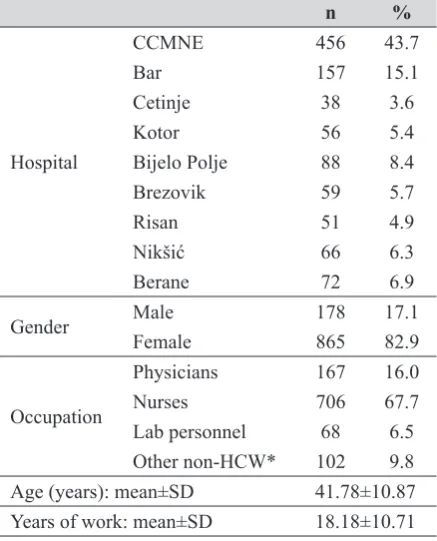
The total number of hospital workers in Montenegro is 4,008, and the total number of hospital workers in the nine participating hospitals is 3,639. We distributed 1,600 questionnaires to hospital workers with at least one year of working experience, whose job involves the risk of BBI. This includes staff not providing health care but providing services that may put them at risk such as cleaning, delivery, and maintenance. We excluded the first-year employees because the questionnaire asks participants to report events of the previous year (13, 14). We also excluded hospital administrative staff for obvious reasons. The response rate was 65.2 %; of the 1,043 respondents 865 (82.9 %) were women and 178 (17.1 %) men (Table 1).
Table 1 Respondentdemographic data (n=1043)
n %
Hospital
CCMNE 456 43.7
Bar 157 15.1
Cetinje 38 3.6
Kotor 56 5.4
Bijelo Polje 88 8.4
Brezovik 59 5.7
Risan 51 4.9
Nikšić 66 6.3
Berane 72 6.9
Gender Male 178 17.1
Female 865 82.9
Occupation
Physicians 167 16.0
Nurses 706 67.7
Lab personnel 68 6.5
Other non-HCW* 102 9.8 Age (years): mean±SD 41.78±10.87 Years of work: mean±SD 18.18±10.71 CCMNE – Clinical Centre of Montenegro
*Servicing staff such as cleaning, delivery, and maintenance whose job involves incidental exposure to blood
The study protocol was approved by the Ethics Committee of the Clinical Centre of Montenegro, the institution responsible for the approval of all research in humans. All hospital directors and senior personnel were informed about the study aims and questionnaire content.
collected in unmarked envelopes by one of the authors with the help of senior hospital personnel. Those who did not wish to participate were asked to return a blank questionnaire.
Questionnaire
We used an anonymous self-reporting questionnaire on exposure to blood-borne infections in hospital workers. The questionnaire had been utilised in several studies in Croatia (13, 14) and we modified it to obtain quantitative and qualitative data on exposure to blood through skin (sharps injuries, needlestick, cuts from sharp objects) and mucosa, on hepatitis B vaccination coverage, on HBV, HCV, and HIV test findings, incident reporting and reasons for non-reporting, and whether the site had a protocol in place for post-exposure prevention. The definition of NSI included injuries caused by sharps such as hypodermic needles, blood collection needles, i.v. cannulas, suture needles, winged needle i.v. sets, and needles used to connect parts of the i.v. delivery systems. Hospital workers were asked to report the frequency of occupational exposure to blood and other body fluids in the previous year (2010) and over their working lifetime. Those who had an injury were also asked whether they reported the injury when it happened and why not if they did not.
Other data included demographics (hospital site, gender, occupation, age, and years of work), compliance with universal precautions, hepatitis B immunisation status, availability of safety equipment, perception of risk, awareness of BBI transmission, perception of workplace safety climate, and barriers to implementation of safe practices.
Statistical analysis
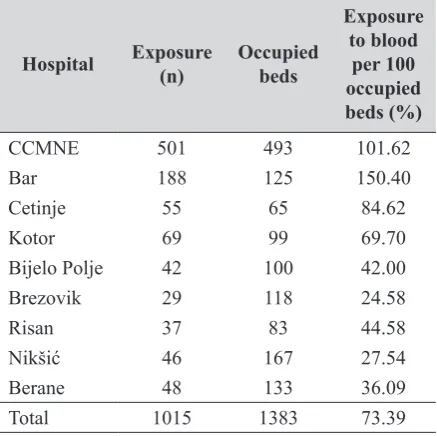
Data distribution was tested using the Kolmogorov-Smirnov test. Differences between exposure to blood, exposure reporting, and hepatitis B vaccination status between hospitals, occupations, and departments were analysed using the chi-square test. The rate of exposure to blood per 100 occupied beds per year was calculated by dividing the total number of blood exposure incidents reported over one year (2010) (numerator) with the number of occupied hospital beds in an institution for the same time period (denominator) multiplied with 100. We used this denominator, as it corrects for unused hospital beds. All p values below 0.05 were considered significant. All statistical
calculations were made in Statistica, version 10.0 (Stat Soft, Inc Tulsa, USA).
RESULTS AND DISCUSSION
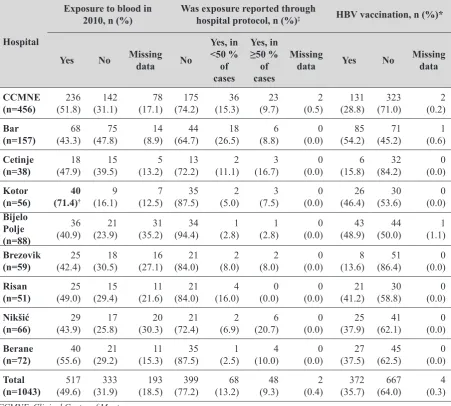
Table 1 shows the demographic data about the 1043 respondents (hospital, gender, occupation, age, and years of work). Exposure to blood, hepatitis B vaccination coverage, and exposure reporting are shown in Table 2. Nearly 50 % of the respondents had experienced at least one incident of occupational exposure to blood in 2010, but more than 75 % did not report them through standard hospital protocols. In terms of best practice (100 % reporting rate), underreporting was significant (p<0.001). The primary reason for underreporting incidents was that workers were not aware of a protocol for reporting or protective procedures after an incident. More than one-quarter replied that the reason for not reporting was that the patients involved in the incident did not belong to groups at risk. Similarly, a cross-sectional study in Iranian nurses showed that only 36.8 % of those who experienced a needle-stick injury reported the incident through regular proceedings. The primary reasons for not reporting were dissatisfaction with follow-up investigations (33.3 %) and low-risk considerations concerning source patients (29.2 %) (15).
It would be interesting to explore the relationship between organisational and workplace characteristics of individual hospitals with varying levels of exposure, but this is beyond the scope of our study. However, it is important to note that NSI rates are affected by a number of factors, including the level of NSI underreporting and the types of patients a hospital treats. For example, the CCMNE is likely to treat a higher number of patients requiring intensive care than a community hospital and may therefore have a higher NSI rate per patient.
HBV vaccination turned out to be surprisingly low: only 35.7 % of the respondents reported to have received at least two doses of HBV vaccine whereas more than 60 % worked without adequate HBV protection. Again, in terms of the best practice (at least two consecutive doses of HBV vaccine documented for 100 % of employees), the undervaccination was statistically significant (p<0.001) (3).
whereas differences between departments were not significant. However, even the lowest reported rate of 13.6 % in the non-surgery departments is alarmingly high (8). A Croatian survey (13) showed that the risk of occupational exposure in gynaecology and obstetrics departments was greater than expected; 89 % of healthcare workers experienced at least one type of exposure throughout their working life. A number of studies have shown that healthcare workers who perceived that they were at high risk of occupational exposure to BBIs reported more sharps injuries in the preceding year than those who did not see themselves at risk (14,16). It is possible that this perception of risk is related to the actual experience of sharps injuries and that healthcare workers who
experience sharps injuries are more likely to associate health care in general with increased risk. In turn, healthcare workers who are more compliant with the universal precautions are less likely to experience a sharps injury. This relationship between occupational exposure to blood and compliance with the universal precautions has been demonstrated by Garb (17) and Grime et al. (18) and reinforces the assumption that the universal precautions enhance the safety of health care workers who use them.
Table 4 presents the rate of blood exposure incidents per occupied bed per day. The average daily census of occupied hospital beds for the same year as the reported needle-sticks served as the denominator since it corrects for unused hospital beds. This gives
Table 2 Exposure to blood, hepatitis B vaccination coverage, and exposure reporting in Montenegrin hospitals in 2010
Hospital
Exposure to blood in
2010, n (%) Was exposure reported through hospital protocol, n (%)‡ HBV vaccination, n (%)*
Yes No Missing data No
Yes, in <50 %
of cases
Yes, in
≥50 %
of cases
Missing
data Yes No Missing data
CCMNE
(n=456) (51.8)236 (31.1)142 (17.1)78 (74.2)175 (15.3)36 (9.7)23 (0.5)2 (28.8)131 (71.0)323 (0.2)2 Bar
(n=157) (43.3)68 (47.8)75 (8.9)14 (64.7)44 (26.5)18 (8.8)6 (0.0)0 (54.2)85 (45.2)71 (0.6)1 Cetinje
(n=38) (47.9)18 (39.5)15 (13.2)5 (72.2)13 (11.1)2 (16.7)3 (0.0)0 (15.8)6 (84.2)32 (0.0)0 Kotor
(n=56) (71.4)40 † (16.1)9 (12.5)7 (87.5)35 (5.0)2 (7.5)3 (0.0)0 (46.4)26 (53.6)30 (0.0)0 Bijelo
Polje (n=88)
36
(40.9) (23.9)21 (35.2)31 (94.4)34 (2.8)1 (2.8)1 (0.0)0 (48.9)43 (50.0)44 (1.1)1 Brezovik
(n=59) (42.4)25 (30.5)18 (27.1)16 (84.0)21 (8.0)2 (8.0)2 (0.0)0 (13.6)8 (86.4)51 (0.0)0 Risan
(n=51) (49.0)25 (29.4)15 (21.6)11 (84.0)21 (16.0)4 (0.0)0 (0.0)0 (41.2)21 (58.8)30 (0.0)0
Nikšić
(n=66) (43.9)29 (25.8)17 (30.3)20 (72.4)21 (6.9)2 (20.7)6 (0.0)0 (37.9)25 (62.1)41 (0.0)0 Berane
(n=72) (55.6)40 (29.2)21 (15.3)11 (87.5)35 (2.5)1 (10.0)4 (0.0)0 (37.5)27 (62.5)45 (0.0)0 Total
(n=1043) (49.6)517 (31.9)333 (18.5)193 (77.2)399 (13.2)68 (9.3)48 (0.4)2 (35.7)372 (64.0)667 (0.3)4 CCMNE–Clinical Centre of Montenegro
†Significant difference (chi-square test; p<0.05) compared to total average exposure to blood in 2010 (49.6 %)
‡All values compared to recommended best practice (100 % reporting rate) were statistically significant (chi-square test; p<0.001)
a rough idea of the institutional needle-stick experience, which can then be used to track NSI levels over time (19, 20).
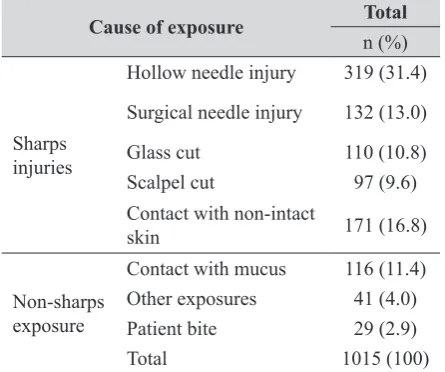
Table 5 shows that the most common cause of exposure to blood (multiple exposures included) were hollow needle injuries (31.4 %).
The proportion of exposure incidents reported in our study (totalling 1015) is comparable to that found in studies on other low-income countries. A study on Turkey included 988 hospital workers: 500 nurses (51 %), 212 residents (21 %), 152 nursing assistants (15 %), and others (13 %) and showed that 634 (64 %) of the HCWs had been exposed to blood and body fluids at least once in their professional life (0.85 % exposure per person-years). Of the injured hospital workers, 60 (28 %) had no form of personal protective equipment at the time of the incident, and 144 (67 %) sought no medical advice about the injury (21). Experience from China showed that the subjects with the highest risk of needle-stick and other sharps injuries were from departments of gynaecology and obstetrics, surgical departments, intensive care units and emergency rooms (22). The sharps injuries mainly occurred when the healthcare workers were breaking ampoule or vial glass (incidence 46.7 %), withdrawing needles (31 %), preparing sharp devices (25.7 %), or performing surgery (14.5 %).
When interpreting the findings of this study, some limitations should be considered. Retrospective reporting of occupational exposures is subject to recall bias. Furthermore, it was not possible to identify the characteristics of non-respondents and establish
whether they were different in some important way from respondents.
Even with its limitations, our study fills a gap in knowledge about the actual number of sharps incidents and other occupational exposure to blood among hospital workers in Montenegro as well as about the issue of underreporting, which is very common. It also confirms the urgent need for active implementation of special, comprehensive measures to prevent needle-stick and other sharps injuries. Constant staff training, life-long learning, and standardising post-exposure procedures are also recommended.
Hospitals should adopt systematic control measures, prospective record keeping, and set up a
Table 3 Distribution of exposed and unexposed hospital workers by occupation and department Number of respondents exposed to blood
in 2010 One vs.
Without exposures
p value
Multiple
vs. Without exposures
p value Without
exposures exposureOne exposuresMultiple
n (%) n (%) n (%)
Occupation
Physicians (n=167) 71 (42.5) 51 (30.5) 45 (27.0)
0.012 <0.001
Nurses (n=706) 350 (49.6) 260 (36.8) 96 (13.6)
Lab personnel (n=68) 40 (58.8) 18 (26.5) 10 (14.7) Other non-HCW (n=102)* 65 (63.8) 23 (22.5) 14 (13.7)
Department
Non-surgical (n=546) 295 (54.0) 177 (32.4) 74 (13.6)
0.001 0.003
Surgical (n=378) 158 (41.8) 146 (38.6) 74 (19.6) Laboratory (n=113) 67 (59.3) 29 (25.7) 17 (15.0)
No data (n=6) 6 (100.0) 0 (0.0) 0 (0.0)
*Servicing staff such as cleaning, delivery, and maintenance whose job involves incidental exposure to blood
Table 4 Blood exposure among respondents adjusted for occupied beds per day in 2010
Hospital Exposure (n) Occupied beds
Exposure to blood
per 100 occupied beds (%)
CCMNE 501 493 101.62
Bar 188 125 150.40
Cetinje 55 65 84.62
Kotor 69 99 69.70
Bijelo Polje 42 100 42.00
Brezovik 29 118 24.58
Risan 37 83 44.58
Nikšić 46 167 27.54
Berane 48 133 36.09
Total 1015 1383 73.39
special occupational health and safety unit to implement these measures. On the national level, it is necessary to establish specific programmes for health workers and adapt the existing laws and regulations to the specific needs of healthcare jobs.
REFERENCES
1. Centers for Disease Control Prevention. Update: provisional Public Health Service recommendations for chemoprophylaxis after occupational exposure to HIV. MMWR 1996;45:468-72.
2. Gessessew A, Kahsu A. Occupational exposure of health
workers to blood and body fluids in six hospitals of Tigray
region (August 1-30, 2006): magnitude and management. Ethiop Med J 2009;47:213-9. PMID: 19954124
3. Kuhar DT, Henderson DK, Struble KA, Heneine W, Thomas V, Cheever LW, Gomaa A, Panlilio AL; USPHS Working
Group on Occupational Postexposure Prophylaxis; National
Center for Emerging and Zoonotic Infectious Diseases (US) Division of Healthcare Quality Promotion. Guidelines for the Management of Occupational Exposures to HIV Updated U.S. Public Health Service guidelines for the management of occupational exposures to HIV and recommendations for postexposure prophylaxis. MMWR Recomm Rep 2013 September 9:1-48.
4. Kermode M, Jolley D, Langkham B, Thomas MS, Crofts N.
Occupational exposure to blood and risk of bloodborne virus infection among health care workers in rural north Indian health care settings. Am J Infect Control 2005;33:34-41. PMID: 15685133
5. Panlilio AL, Cardo DM, Grohskopf LA, Heneine W, Ross CS, Service USPH. Updated US Public Health Service guidelines for the management of occupational exposures to HIV and recommendations for postexposure prophylaxis. MMWR Recomm Rep 2005;54:1-17.
6. Centers for Disease Control and Prevention, U.S. Public Health Service Task Force. U.S. Public Health Service Task
Force recommendations for use of antiretroviral drugs in pregnant HIV-1-infected women for maternal health and interventions to reduce perinatal HIV-1 transmission in the United States. MMWR Recomm Rep 2002;51:1-38;quiz CE1-4. PMID:12489844
7. Centers for Disease Control and Prevention. Updated CDC Recommendations for the Management of Hepatitis B Virus-Infected Health-Care Providers and Students. MMWR Recomm Rep 2012 [displayed 3 September 2014]. Available at http://www.cdc.gov/mmwr/preview/mmwrhtml/rr6103a1. htm
8. Au E, Gossage JA, Bailey SR. The reporting of needlestick injuries sustained in theatre by surgeons: are we under-reporting? J Hosp Infect 2008;70:66-70. doi: 10.1016/j. jhin.2008.04.025
9. West DJ. The risk of hepatitis B infection among health professionals in the United States: a review. Am J Med Sci 1984;287:26-33. PMID: 6369984
10. Makary MA, Al-Attar A, Holzmueller CG, Sexton JB, Syin
D, Gilson MM, Sulkowski MS, Pronovost PJ. Needlestick injuries among surgeons in training. New Engl J Med
2007;356:2693-9. PMID: 17596603
11. Richman KM, Rickman LS. The potential for transmission
of human immunodeficiency virus through human bites. J Acquir Immune Defic Syndr 1993;6:402-6. PMID: 8455145
12. Prüss-Ustün A, Rapiti E, Hutin Y. Estimation of the global burden of disease attributable to contaminated sharps injuries among health-care workers. Am J Ind Med 2005;48:482-90. PMID: 16299710
13. Obad I PD, Čivljak R, Milošević M, Stamenić V, Kalenić S. Procjena profesionalne izloženosti infekcijama koje se
prenose krvlju u djelatnika ginekološko-porodiljskih odjela u Hrvatskoj [Assessment of occupational exposure to blood borne infections among personnel at obstetrics and gynecology departments in Croatia, in Croatian]. Infektološki glasnik 2012;32:159-66.
14. Čivljak R. Učinak propisanog snopa postupaka na smanjenje rizika profesionalne izloženosti bolničkog osoblja
infekcijama koje se prenose krvlju. [Care bundles in lowering hospital workers occupational risk exposure to the blood borne infection, in Croatian]. PhD thesis. Zagreb: Zagreb University School of Medicine; 2014.
15. Azadi A, Anoosheh M, Delpisheh A. Frequency and barriers of underreported needlestick injuries amongst Iranian nurses,
a questionnaire survey. J Clin Nurs 2011;20:488-93. doi:
10.1111/j.1365-2702.2010.03252.x
16. Puro V, De Carli G, Petrosillo N, Ippolito G. Risk of exposure
to bloodborne infection for Italian healthcare workers, by job category and work area. Studio Italiano Rischio Occupazionale da HIV Group. Infect Control Hosp Epidemiol 2001;22:206-10. PMID: 11379710
17. Garb JR. One-year study of occupational human
immunodeficiency virus postexposure prophylaxis. J Occup
Environ Med 2002;44:265-70. PMID: 11911028
18. Grime PR, Ris L, Binns C, Carruthers JR, Williams S. Pan-Thames survey of occupational exposure to HIV and the use
of post-exposure prophylaxis in 71 NHS trusts. J Infect
2001;42:27-32. PMID: 11243750
19. Magnavita N, Placentino RA, Puro V, Sacco A. Management
of health care workers with blood-borne infections. Arch Intern Med 2003;163:1489-90; author reply 1490. PMID: 12824103
Table 5 Specific causes of blood exposure (including multiple exposures) among 517 respondents reporting exposure in 2010
Cause of exposure Total
n (%)
Sharps injuries
Hollow needle injury 319 (31.4) Surgical needle injury 132 (13.0)
Glass cut 110 (10.8)
Scalpel cut 97 (9.6)
Contact with non-intact
skin 171 (16.8)
Non-sharps exposure
Contact with mucus 116 (11.4) Other exposures 41 (4.0)
Patient bite 29 (2.9)
20. Gajić Z, Rajčević S, Đurić P, Ilić S, Dugandžija T. Knowledge
and attitudes of health care workers from the Primary Health Center Indjija, Serbia, on occupational exposures to bloodborne infections. Arh Hig Rada Toksikol 2013;64:145-51. doi: 10.2478/10004-1254-64-2013-2268
21. Azap A, Ergönül O, Memikoğlu KO, Yeşilkaya A, Altunsoy
A, Bozkurt GY, Tekeli E. Occupational exposure to blood
and body fluids among health care workers in Ankara,
Turkey. Am J Infect Control 2005;33:48-52. PMID: 15685135
Sažetak
Profesionalna izloženost krvi u bolničkih radnika u Crnoj Gori
Kako bi se procijenila profesionalna izloženost krvi bolničkih radnika u Crnoj Gori tijekom 2010. godine, provedeno je presječno istraživanje prilagođenim Hrvatskim upitnikom samoprocjene izloženosti infekcijama koje se prenose krvlju u devet bolnica. Od 1043 ispitanika, njih 517 (49,6 %) prijavilo je izloženost krvi. Nije bilo značajnih razlika između bolnica, osim bolnice u Kotoru koja se izdvaja visokim udjelom izloženih bolničkih radnika (p<0,05). Više od 77 % izloženosti nije prijavljeno u vrijeme nastanka incidenta putem standardnog bolničkog protokola. Najizloženija skupina bile su medicinske sestre (357 od 517; 69,1 %), ali udio izloženih sestara unutar skupine nije se značajno razlikovao u usporedbi s liječnicima (50,57 % prema 57,49 %). Broj bolničkih radnika koji imaju odgovarajući HBV cjepni status bio je iznenađujuće nizak (35,70 %) i značajno ispod preporučene dobre prakse (najmanje dvije uzastopne doze HBV cjepiva koje su dokumentirane u 100 % zaposlenih; p<0,001). Unatoč svojim ograničenjima, rezultati istraživanja popunjavaju raskorak u spoznajama o stvarnom broju ozljeda oštrim predmetima, ostalim profesionalnim izloženostima krvi i o vrlo uobičajenoj praksi bolničkih radnika u Crnoj Gori da ne prijavljuju te incidente. Također potvrđuju potrebu hitnog djelovanja u aktivnom uvođenju specifičnih i sveobuhvatnih mjera za prevenciju ubodnih incidenata i ozljeda oštrim predmetima. Preporučuje se kontinuirana obuka osoblja, cjeloživotno učenje i standardiziranje postekspozicijskih postupaka.
KLJUČNE RIJEČI: epidemiologija; infekcije prenosive krvlju; ozljede oštrim predmetima
CORRESPONDING AUTHOR:
Ljiljana Cvejanov Kezunović, MD PhD Associate Professor
Chair, Department of Occupational Health