3
, I
ssu
e
4
, D
e
ce
m
b
e
r
2
0
1
3
V
o
l.
3
, I
ssu
e
4
, D
e
ce
m
b
e
r
2
0
1
3
Modern Journal of Language Teaching Methods (MJLTM)
ISSN: 2251 - 6204
www.mjltm.com
Editor – in – Chief
Hamed Ghaemi, Islamic Azad University, Iran
Editorial Board
Abednia Arman
, PhD in TEFL, Allameh Tabataba’i University, Tehran, Iran
Azizi Masoud
, PhD in Applied Linguisitcs, University of Tehran, Iran
Basiroo Reza
, PhD in TEFL, University of Tehran, International Campus, Iran
Elahi Shirvan Majid
, PhD in TEFL, Ferdowsi University of Mashhad, Iran
Fernández Miguel
, PhD, Chicago State University, USA
Ghaemi Hamide
, PhD in Speech and Language Pathology, Mashhad University of Medical
Sciences, Iran
Grim Frédérique
M. A., Associate Professor of French, Colorado State University, USA
Izadi Dariush,
PhD candidate in Applied Linguistics, Macquarie University, Sydney,
Australia
Kargozari Hamid Reza
, PhD Candidate in TEFL, Payame Noor University of Tehran,
Iran
Kaviani Amir
, Assistant Professor at Zayed University, UAE
Kirkpatrick Robert
, Assistant Professor of Applied Linguistics, Shinawatra International
University, Thailand
Morady Moghaddam Mostafa,
PhD Candidate in TEFL, University of Tabriz, Iran
Ndhlovu Finex,
PhD, Linguistics Programme, University of New England, Australia
Raddaoui
Ali Hechemi,
PhD, Associate Professor of Applied Linguistics, University of
Wyoming in Laramie, USA
Rezaei Saeed
, PhD in TEFL, Sharif University of Technology, Tehran, Iran
Rolstad Kellie,
PhD, Associate Professor of Education, University of Maryland, USA
Shahbazirad Mohammad
, PhD in English language and Literature, Yerevan State
University, Armenia
Weir George R. S.,
PhD in Philosophy of Psychology, University of Strathclyde, Glasgow,
UK
Zegarac Vladimir
, PhD, University of Bedfordshire, UK
3
, I
ssu
e
4
, D
e
ce
m
b
e
r
2
0
1
3
Abstracting/Indexing
MJLTM is indexed in the following databases:
Index
Copernicus 2011
Linguistics Abstract
EBSCO Publication
Lulu Publication
V
o
l.
3
, I
ssu
e
4
, D
e
ce
m
b
e
r
2
0
1
3
Directory of Open Access Journals
ProQuest
Modern Language Association
Cabell's Directories
COPE
3
, I
ssu
e
4
, D
e
ce
m
b
e
r
2
0
1
3
Directory of Research Journal Indexing (DRJI)
Indian Citation Index
International Society of Universal Research in Sciences
J-Gate
Ulrich's
V
o
l.
3
, I
ssu
e
4
, D
e
ce
m
b
e
r
2
0
1
3
Education Full Text (H.W. Wilson)
3
, I
ssu
e
4
, D
e
ce
m
b
e
r
2
0
1
3
TABLE OF CONTENTS
Teaching English to non-native learners of English with mild cognitive impairment
Abdullah Coşkun…..………8
An investigation into Iranian students' translation strategies based on Gerloff's model of think -aloud
Mahsa Gandomkar and Amin Karimnia……….17
An investigation into the strategies applied to Persian translation of the neologisms created in Persian academy
Leila Houshyar and Amin Karimnia………34
The effect of keeping portfolios on writing ability of advanced EFL learners
Mohammad Reza Khodashenas, Somayeh Kishani Farahani and Elaheh Amouzegar………...45
An investigation into the translation methods applied by Iranian translators with special reference to English lyrics translating based on Newmark’s (1988) flattened v diagram
Fatemeh Moradi and Amin Karimnia……….51
Promoting the Reading Comprehension of high-school Students through CRITICAL discourse analysis
Said Rahimi...61
The effect of teaching culturally-oriented materials on the listening comprehension of Iranian EFL learners
Maryam Danaye Tous and Sara Haghighi………..69
Problem solving strategies affect on teaching poems among EFL learners
Mahjoobeh Salehi, Firouzkallai Kjouri and Omid pourkalhor……….79
The relationship between emotional intelligence and writing performance of IELTS learners
M.S.Bagheri and Elnaz Ghasemi………...88
The effect of lexical frequency knowledge on Iranian EFL learners’ speaking ability
Masoumeh Shahrestanifar and Ramin Rahimy………..94
Cognitive neuropsychological processes, language learning disorders and task-integrated pair reading: evidence from dyslexic EFL learners’ word decoding impairment
Ali Eliasiand Tayebeh Razaqi……….103
V
o
l.
3
, I
ssu
e
4
, D
e
ce
m
b
e
r
2
0
1
3
TEACHING ENGLISH TO NON-NATIVE LEARNERS OF
ENGLISH WITH MILD COGNITIVE IMPAIRMENT
Abdullah Coşkun, PhD School of Foreign Languages, Abant Izzet Baysal University,
Turkey [email protected]
Abstract
As the field of English language teaching (ELT) to cognitively impaired learners is neglected, this paper aims to contribute to this field by introducing Talking Tactile Technology (T3) as a means of teaching English to non-native learners of English with mild cognitive impairment. Therefore, after discussing the characteristics of the ideal foreign language classroom for learners with special learning needs, this paper introduces a case in Turkey for applying T3 to teach English as a foreign language (EFL) to learners with mild cognitive impairment described by the Diagnostic and Statistical Manual of Mental Disorders (4th ed., text rev.; DSM-IV-TR; American Psychiatric Association, 2000) as educable individuals whose IQ scores range from 50 to 70. In this study, ten T3-based beginner level English lesson content materials were created. These materials were tested by candidate and practicing English teachers as well as special education teachers. Their opinions about T3 and the T3-based materials were collected immediately after they tried the technology in the training sessions organized by the researcher. Their opinions led to the conclusion that T3 can be used to teach some Basic English to learners with mild cognitive impairment. It is hoped that this study will trigger more research studies focusing on different ways to learn and to teach English to these learners.
Key words: Talking Tactile Technology, ELT, Cognitively impaired learners
Background to the Study
It is common knowledge that learners with learning disabilities are disadvantaged by their disability and tend to have problems in accessing and communicating information. More specifically, because of their repeated failure at school, it is likely these learners to have the feeling that their academic success is beyond their control and to perceive themselves as less competent than their peers (Ntshangase, Mdikana, & Cronk, 2008). To be able to create an ideal teaching-learning process for these students, it is suggested that we should realize how these learners can mentally focus on classroom tasks more effectively (Anderson, Klassen, & Georgiou, 2007). As pointed out by Londono-Patino and Aguilar-Gutierrez (2012), these learners need special conditions to learn a new skill. For instance, they argue that entertaining activities activate their attention and memory in addition to optimizing the development of their bodies and senses. Games are also considered to be effective because they raise participation in class activities, minimize the anxiety related to classroom situations and encourage cooperation as well as peer communication.
Specifically, if we want to teach some basic foreign language to learners with special education needs, there are some ways to create an ideal classroom atmosphere. Whether they are at special education schools only accepting these learners or inclusive education schools where mainstream and learners with special education needs are placed in the same classroom, these learners should be approached differently to teach them some foreign/second language. For instance, Roseberry-McKibbin (2002) argues that activities like drawing, painting, grouping; labeling, pointing, selecting, and matching should be incorporated into the language classroom. In a similar way, Eibeed (2000, cited by Al Yaari, Al Hammadi, & Alyami, 2013) underline the importance of touching textiles and other materials as a useful way of presenting language components to cognitively impaired learners.
3
, I
ssu
e
4
, D
e
ce
m
b
e
r
2
0
1
3
On the other hand, audio-visual aids are believed to be effective means of introducing a foreign language skill in an entertaining way (Al Yaari et al., 2013).Believing in the merits of special
multisensory techniques aiming to teach students through all sensory channels (i.e., visual, auditory, kinesthetic, tactile), Schneider (1996) underlines that speech sounds can be taught through repetitive drills addressing to different senses. Furthermore, Schneider and Crombie (2003, p. 17) summarized their motto of multi-sensory techniques with the words ‘hear it, see it, say it, write it, act it out’, through which they believe learning can be activated. Moreover, Holešinská (2006) exemplifies multi-sensory techniques by referring to the tactile drawings requiring learners both to see the symbols and to feel their shapes as a way to help learners make the connection between the symbol and its sound.
For some researchers (Savic, 2007; Schneider & Crombie, 2003), teachers can help children with special education needs by giving them the chance to practice the newly learned language by repeating it as many times as needed; in addition, not interrupting these learners, being patient, praising their effort, encouraging them and building their confidence are important points to take into account when teaching these learners. On the other hand, Rodriguez (2001) highlights the need to activate these learners’ prior knowledge and avoid presenting unfamiliar concepts in the language classroom. Roseberry-McKibbin (2002) also thinks that providing a high amount of various
experiences, centering teaching on surrounding events and enabling learners to do things themselves
are among strategies applicable for learners with special education needs. As argued by some researchers (Rondal, 2000; Sands, Kolzeski, & French, 2000), learning a language
has to be functionally-oriented and functional daily life skills as well as concrete and real-life teaching materials should be used in the language classroom. Besides, for an effective language classroom atmosphere, the need for collaboration of teaching professionals and families, the application of assistive technology, and the adaptation of curriculum are emphasized (Bryant & Seay, 1998). Furthermore, Schneider and Crombie (2003) argue that the presentation of foreign language instruction should be carried out at a slower pace and with regular breaks as their attention span is not as long as the mainstream students.
If necessary conditions as discussed above can be created, many researchers (Kay-Raining Bird, Cleave, Trudeau, Thordardottir, Sutton, & Thorpe, 2005; Baker, 1995; Woll & Grove, 1996; Feltmate & Kay-Raining Bird, 2008; Londono-Patino & Aguilar-Gutierrez, 2012; Nicoladis & Genesee, 1997) hold the idea that it is possible for learners with cognitive impairment to learn a foreign/second language in addition to their mother tongue and enjoy many benefits arising from the familiarity with another language and culture. Still, despite the fact that English is now a recognized international language used for international communication by a great number of people who do not share a native
language (Mauranen, 2003; McKay, 2002; Jenkins, 2005), research studies have focused largely on the first language acquisition process of the cognitively impaired learners (Rondal, 2000) and have thus neglected the issue of foreign language learning and teaching for these learners (Krapez, 2012). Unfortunately, as claimed by Londono-Patino and Aguilar-Gutierrez (2012), the shortage of
information, research studies and special educators in the field of ELT for these learners make them even more disadvantaged in learning a foreign language. What is worse is that teachers do not feel sufficiently trained to discover the potentials of these learners and manage classes effectively (Sawka,
McCurdy, & Manella, 2002).
In order to contribute to the neglecting field of ELT for cognitively impaired learners, this study aims to introduce and evaluate Talking Tactile Technology (T3) as a way of presenting beginner level functional English for learners with mild cognitive impairment in Turkey. Ten audio-haptic T3 overlays aiming to teach these learners basic functional English concepts like numbers and clothes were created by the researcher for piloting purposes and tested by candidate and practicing English teachers as well as special education teachers who took part in the study. These participants were provided with training about how T3 works by using the created overlays. Now that the primary aim of this research study was to make a special case for applying T3 in teaching English to learners with mild cognitive impairment in Turkey and to investigate its usefulness in ELT from the perspective of the participants, the following research question was formulated: “How useful is T3 in teaching beginner level English to learners with mild cognitive impairment?” Before giving information about
V
o
l.
3
, I
ssu
e
4
, D
e
ce
m
b
e
r
2
0
1
3
the methodology of the study and analyzing the evaluative opinions of these participants to give an answer to this research question; a short introduction to T3 and its benefits are presented, and ten audio-haptic T3 overlays tried and tested by the participants are illustrated.
Introduction to T3
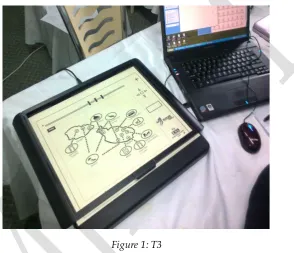
As can be seen in Figure 1, T3 hardware is a lap-top sized, portable, touch sensitive device that is connected to a standard computer, activated by touch when a tactile overlay is placed on the pressure sensitive regions. It is a multi-media, audio-haptic system that enables access to complex graphic material. The technology comprises a pressure sensitive talking tactile tablet on which a specially constructed overlay is placed. When the overlay is touched, the pressure pad is activated and the information for that point is spoken. By applying touch to certain regions of the tactile overlay the audio file comes into operation and can provide up to 10 layers of information. Wherever the diagram is touched, the computer speaks recorded information for that point.
Figure 1: T3
T3 has a number of benefits for various disadvantaged groups in the society. Although originally developed for visually impaired users, it would be fair to claim that T3 is suited to cognitive impaired learners as well because it gives equal access to graphic information embedded in lesson content material. It uses a combination of touch, sound and learns systems called audio-haptic pedagogy through the creation of tactile overlays carrying layers of information that can be vocal, musical or other audio sounds. Moreover, thanks to T3, learners can learn at their own pace once they familiarize themselves with how the technology works, and thus the learning process can be reinforced without further teacher input. Besides, the visual presentation of edited diagrammatic material in T3 is reproduced with high contrast, exaggerated color and high relief tactile format with integrated and merged sound files, which adds to the quality of foreign language instruction for learners with cognitive impairment.
It is assumed that the standard visual representations in ELT materials are largely inaccessible to cognitively impaired learners. Thus, the use of T3 is believed to be a solution in that images are simplified and made accessible by combining a tactile diagram with integrated and merged sound-files. Another benefit of T3 for these learners is that the ICT approach in T3 encourages cognitively impaired learners to develop ICT skills. These learners tend to have problems in accessing and communicating information and they are not always able to take advantage of developments in
3
, I
ssu
e
4
, D
e
ce
m
b
e
r
2
0
1
3
technology. Therefore, T3 can be a solution as an assistive technology minimizing the negative influence of their disability.
In addition, T3 encourages learners to learn independently, which allows the teacher to spend more time on developing the lesson where graphic and visual material dominated rather than by being encumbered by the fundamentals. It is common knowledge that in traditional English language teaching, the teacher determines the pace of teaching, and sometimes a learner might fall behind and his/her progress slows down. However, the use of T3 assumes continuous learning for each talking tactile used with the learner working at a self-determined pace. In other words, it reduces the need for the teacher to repeat information, which the learner can gather independently from the talking tactile overlays. Thus, the learners’ confidence is built up and they perceive participation in education as something more enjoyable. Thanks to its independent learning feature, T3 can also increase cognitively impaired people’s self-esteem, employment skills and their capacity to adapt to the competitive business world dominated by the English language. Finally, it is known that there are insufficient English teachers skilled in the foreign language requirements of learners with cognitive impairment, and T3 is expected to help these teachers to cope with these requirements.
Before the application of this technology in teaching basic English to learners with mild cognitive impairment, T3 had also been successfully implemented to teach English to visually impaired learners with the project funded by the Prime Minister’s Initiative, UK in 2009 (Coşkun, 2013).
Through projects coordinated by the Royal National College for the Blind (Hereford, UK), T3 was also used to teach other subjects to visually impaired learners. RNC received funds from the EU to
produce talking tactile overlays through the AHVIIT-ACCESS (Audio Haptics for Visually Impaired Information technology) project. The following talking tactile overlays aiming to teach different subjects to visually impaired learners in partnering countries were developed at the end of the project: Sports massage (Netherlands), basic computer awareness and operation (Germany), food
hygiene and basic cookery skills (UK). Another project coordinated by RNC was TrAHVIIT (Transfer of audio-haptics for visually impaired
information technology) which aims to transfer the AHVIIT project to new countries in the European Union and to new subject areas. As the major outcome of this project which also paved the way for the current study, T3 overlays dealing with introduction to economic theories (UK), introduction to music theory (Bulgaria), access to public spaces (Romania), tourism in Malta (Malta) and planets and their satellites (Austria) were produced considering the needs of the sensory impaired people while overlays to teach beginner level functional English (Turkey) were developed for learners with mild cognitive impairment. At the end of all these projects, it was realized that T3 is applicable to teaching various subject matters to various disadvantaged groups with special learning needs.
Audio-Haptic Overlays
To be able to investigate how useful T3 is for teaching English to learners with mild cognitive impairment, ten T3-based audio-haptic lesson content materials referred to as overlays in this study were produced. A number of different participants attended the training sessions to be familiar with
the T3 and the overlays. During these sessions, they piloted the overlays. By developing new resources for T3, this study also aims to support the curriculum for special
education schools and for other schools applying the inclusive model in which all the students
regardless of their disabilities are placed into the same classroom. Within the scope of this study, it was thought that learners with mild cognitive impairment should
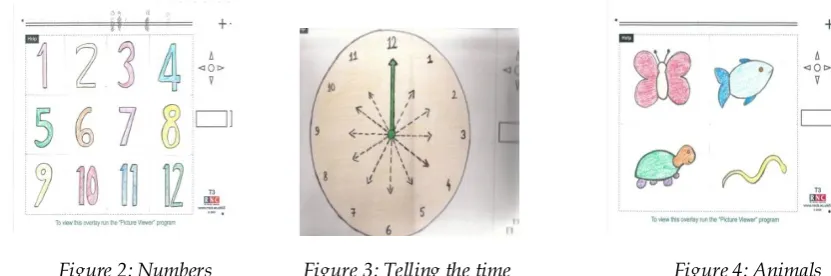
start learning English with beginner level functional English made up of useful lexical items and functions. It was also kept in mind that overlays for these learners should be simple, memorable, and unambiguous with scope for much repetition of key images and ideas. Thus, ten overlays some of which were illustrated below were created on the basis of the following ten topics covered by any beginner level English course book written for EFL learners: electrical household appliances, transportation vehicles, clothes, accessories, numbers, telling the time, fruits, household appliances, kitchen utensils and animals.
V
o
l.
3
, I
ssu
e
4
, D
e
ce
m
b
e
r
2
0
1
3
Figure 2: Numbers Figure 3: Telling the time Figure 4: Animals
For example, the overlay illustrated in Figure 2 aims to teach numbers in English while the overlay in Figure 3 shows the numbers as well as a clock. In the overlay with a clock learners hear how to tell the time in English when they press on the pictures over the talking tactile overlay first and then Turkish equivalent of those words for their next press. They are asked to repeat the time expression in English when they press the picture for the third time. The same procedure holds true for all the overlays created for the study. The overlay in Figure 4 shows animals. Learners hear the words in English when they press the pictures over the talking tactile overlay first and then Turkish equivalent of those words for their next press. They are asked to repeat the word in English when they press the picture for the third time.
Method of Research
The data for the evaluation of the usefulness of T3 in teaching English to non-native learners of English with mild cognitive impairment was collected from a total of 53 participants selected on the basis of convenience sampling. All the participants attended the training sessions introducing T3 and its use in ELT in the city where the study was conducted. 28 candidate English teachers, 10 practicing English teachers and 15 special education teachers took part in the training to test the technology and the T3 overlays dealing with some beginner level functional EFL content (e.g., clothes, time,
household appliances and animals). Each trainee group was first given the training booklet including the pictures of the overlays in addition to an introduction to T3 and was later provided with an approximate 50-minute training session organized separately for each group by the researcher. Immediately after the training sessions, participants, who had hands-on experience about how T3 could be integrated into teaching English, were asked to reflect on their perceptions about the usefulness of T3 in teaching English to learners with mild cognitive impairment. They were asked to respond to open-ended and six-point Likert-type (i.e., excellent, very good, good, fair, poor, very poor) questions. Each Likert-type question was followed by a “comments” part so that the participants could give more detailed answers to these questions. The qualitative data was
analyzed by applying content analysis to reveal common trends in the participants’ responses. All individual responses were analyzed and similar responses were grouped as central comments
formulated by the researcher as representative comments embodying other similar comments. On the other hand, the analysis of the quantitative data was done through SPSS.
Results
As a result of the analysis of the data collected from practicing and candidate English teachers as well as special education teachers, it was realized that the positive comments about T3 were found to overwhelm the negative ones. While the majority of the participants made positive comments, a few of them voiced some of their concerns about the use of T3 for learners with mild cognitive
impairment.
As for the reason why they were interested in using the overlays, nearly all the participants thought that the overlays could somehow be integrated into their classes in order to teach basic English to the
3
, I
ssu
e
4
, D
e
ce
m
b
e
r
2
0
1
3
cognitively impaired learners. When asked to share their reflections about the usefulness of T3 in teaching English to the target group, most of the participants (n=37) made positive comments while some participants (n=16) voiced their concerns. Considering the list of benefits formulated by the researcher in line with the comments made by the participants, it would be fair to conclude that most of the participants believe in the usefulness of T3 in ELT for the target population:
• T3 provides audio-visual support for them (n=12).
• It helps them to improve their eye-hand coordination (n=9).
• It gives them the chance to learn at their own pace and actively engages them (n=7). • T3 is good for their self-study (n=7).
• T3 is fun and can motivate them (n=5).
• A creative teacher can produce limitless number of overlays his/her student needs (n=5). • T3 can be adapted to teach other subjects (n=3).
• Students without any impairment can also benefit from T3 (n=3).
Despite these positive comments, the following central issues were raised by some participants as problems related to the use of T3 to teach English to learners with cognitive impairment:
• They cannot use T3 without the assistance of an adult (n=8). • Those with severe cognitive impairment cannot use T3 (n=6). • T3 is good for practicing, but not for teaching (n=6).
• One can only teach concrete nouns with T3 (n=5).
• T3 is better suited to learners with visual impairment (n=5).
• T3 is not practical as state schools in Turkey might not afford it (n=2).
As far as the participants’ perceptions about the clarity of the diagrams are concerned, it would be fair to suggest that there was a high level of satisfaction with how the graphical symbols are related to the content with which it was associated. To illustrate, out of 53 participants, 40 marked either “good” or “very good” while 12 thought that the diagrams were excellent in terms of their clarity. In terms of the question seeking an answer to whether it was easy for the participants to distinguish the lines, infill and points, it can be stated that nearly all the participants evaluated the diagrams positively by marking “excellent, very good or good”. Similarly, the clarity of the sound was considered to be good by a vast majority of the participants while only 5 of them evaluated this aspect negatively by
marking either “fair, poor or very poor”.
Regarding the clarity of the diagrams and the voice recorded for the overlays, a few participants made the following comments in the space provided under the relevant question:
• “The diagrams could be bigger” • “Some diagrams do not look realistic”
• “A native speaker English teacher should have done the recording” • “The pitch of the voice should be higher”
When it comes to the relevance of the overlays to the subject matter, while the majority of the participants (n=46) expressed that they were pleased (excellent, very good, good) with the level of relevance of the overlays to the topics, only a few of them (n=7) evaluated the relevance aspect of the overlays as poor or very poor. In addition, regarding the way in which the information was divided into layers on these overlays, most of the participants (n=45) agreed that it was either good or very good. Only 4 of them marked “excellent” for this aspect and the same number of participants held the idea that the division of the layers was poor.
With regards to the usefulness of the Training Booklet, many of the participants (N=44) indicated that the booklet was either very good or good whereas the remaining participants expressed their
concerns about the usefulness of the booklet by marking either “fair” or “poor”. Also, some of the participants made comments focusing on the simplicity and practicality of the content of the booklet. When asked if the participants plan to use T3 in their future work, almost all of them marked “yes”. Likewise, about the overlays on the specific topics, most of the participants (n=41) expressed their willingness to use them. Some of them even favored the idea of opening in their schools a separate T3 unit which students could get access to in their free-time and use the overlays whenever they want.
V
o
l.
3
, I
ssu
e
4
, D
e
ce
m
b
e
r
2
0
1
3
Regarding the content of the overlays, it can be stated that most of the participants (n=39) had positive attitudes towards their contents as they mainly marked “excellent, very good or good” while only some of them (n=14) evaluated the quality of the content of the overlays negatively by marking “fair, poor or very poor”. Similar to their views about the content of the overlays, they held positive attitudes towards the didactic methodology of delivering information through the overlays created for the current study. To exemplify, except for three participants marking “poor” for the methodology of the delivering, all the others expressed their positive opinions about the issue by marking
“excellent, very good or good”. Among few of the comments made by the participants about the content and the methodology of the delivery, the one about the need for more layers in the overlays was also emphasized by 6 participants.
Conclusion
The aim of this study was to introduce T3 as a way of teaching some beginner level English to learners with mild cognitive impairment and evaluate its usefulness by collecting data from candidate and practicing English teachers as well as special education teachers. The data indicates that the overlays that were developed during the study had a relevant impact on the target group. In addition, T3 was believed by the majority of participants to have potential usefulness in teaching and learning the English language although some technical problems and concerns were revealed by some participants as problems to be dealt with for a more effective application of T3.
From the perspective of practicing and prospective teachers, among strong points of the technology are that it has audio-visual support, improves eye-hand coordination, enables learning at the learners’ pace, activates learners’ engagement, encourages self-study, has a fun nature, can be adapted easily by the teacher to other subjects and for mainstream students as well. On the other hand, participants voiced their concerns associated with the usefulness of T3 to teach beginner level English to learners with mild cognitive impairment. Some participants drew attention to the fact that learners with serious cognitive impairment cannot use T3 and T3 is more suited to learners with visual impairment. Furthermore, some of them believed that T3 is only good for practicing purposes rather than teaching or learning a new skill, and some argued that only some concrete nouns could be presented through T3. Finally, some participants claimed that T3 is not practical as state schools in Turkey might not afford it.
T3 overlays for this study were designed in line with the pedagogy described in the “Background to the Study” part of the paper. For instance, T3 is known to be an assistive technology to facilitate learning for cognitively impaired learners and such technologies are praised by researchers such as Bryant and Seay (1998). Also, T3 overlays developed for the current study presented the vocabulary items and functional language components such as telling the time in an entertaining way. According to Londono-Patino and Aguilar-Gutierrez (2012), entertaining activities are believed to increase participation in class activities and minimize cognitively impaired learners’ classroom anxiety. As the use of T3 requires touching, it would be fair to claim that the technology also contributes to their language learning process by facilitating the learning process (Roseberry-McKibbin, 2002). T3 overlays in this study were also rich in their visual illustrations. It is argued that audio-visual aids are indispensable in teaching English to cognitively impaired learners (Al Yaari et al., 2013). Besides, the overlays centering on functional topics ranging from fruits to clothes depend upon the idea that these learners can learn the language more easily when they are exposed to surrounding events (Roseberry-McKibbin, 2002) and objects in their surroundings. Similarly, as suggested by some researchers (Rodriguez, 2001; Rondal, 2000; Sands et al., 2000), these learners should not be taught by using unfamiliar concepts; instead, the language they need to learn should be functionally oriented and directly related to their daily life. Concepts such as numbers and animals presented in the overlays illustrated in this study were considered to be already existent in the learners’ prior knowledge and are directly related to their daily life. In addition, now that Savic (2007) argues that these learners should be given plenty of time to practice language they learn by repeating it as many times as they need, the repetitive nature of T3 can be considered to be a useful way of enabling learners to practice the language at their own pace.
3
, I
ssu
e
4
, D
e
ce
m
b
e
r
2
0
1
3
As suggested by many researchers (Baker, 1995; Kay-Raining Bird, et al., 2005; Felmate & Kay-Raining Bird, 2008; Woll & Grove, 1996; Nicoladis & Genesee, 1997; Londono-Patino & Aguilar-Gutierrez, 2012), cognitively impaired learners can learn a second/foreign language provided that necessary conditions as explained above can be created. However, the issue of foreign language learning and teaching for these learners are neglected (Krapez, 2012). Thus, there is an urgent need for more research studies focusing on different ways of teaching foreign languages to cognitively impaired learners in different contexts to bridge this wide gap in this neglected field of ELT. It is hoped that studies like the current one will trigger more research studies and projects focusing on T3 and many other ways to create the ideal foreign language learning and teaching atmosphere for cognitively impaired learners.
Acknowledgement
This study is part of the project entitled Transfer of Audio-Haptics for Visually Impaired Information Technology which is co-financed by the European Union within the Lifelong Learning Programme, Leonardo da Vinci Action. The project was coordinated by Royal National College for the Blind (Hereford, UK) and Abant Izzet Baysal University (Bolu, Turkey). I would like to express my
gratitude to Sinan & Aylin Olguner for their support in all phases of the project and to Lennox Adams for his coordination of the project and invaluable advice in the process of writing this paper.
References
Al Yaari, S., Al Hammadi, F., & Alyami, S. (2013). Teaching Mentally Handicapped Children (MHC) Using Audio-Visual Aids: A Pedagogic & Psychoneurolinguistic Approach. International Journal of English Language Education, 1(2), 119-141.
American Psychiatric Association. (2000). Diagnostic and statistical manual of mental disorders (4th ed.,text rev.). doi:10.1176/appi.books.9780890423349
Anderson, C., Klassen, R., & Georgiou, G. (2007). What teachers say they need and what school psychologists can offer. School Psychology International, 28(2), 131-147.
Baker, C. (1995). A Parents’ and Teachers’ Guide to Bilingualism. United Kingdom: Multilingual Matters. Bryant, B. R., & Seay, P. C. (1998). Technology-Related Assistance to Individuals with Disabilities Act: Relevance to individuals with learning disabilities and their advocates. Journal of Learning Disabilities, 31, 4-15.
Coşkun, A. (2013). English Language Teaching for the Visually Impaired Learners: Training Non-native English Teachers. International Journal of Social Sciences and Education, 4(1), 289-295.
Feltmate, K. & Kay-Raining Bird, E. (2008). Language Learning in Four Bilingual Children with Down Syndrome: A Detailed Analysis of Vocabulary and Morfosintaxis. Canadian Journal of Speech Language Pathology and Audiology, 32, 6-20.
Holešinská, A. (2006). Teaching English as a Foreign Language to Students with Learning Difficulties.
Unpublished undergraduate thesis, Masaryk University, The Czech Republic.
Jenkins, J. (2005). ELF at the gate: the position of English as a Lingua Franca, Humanising Language Teaching, 7(2).
Kay-Raining Bird, E., Cleave, P. L., Trudeau, N., Thordardottir, E., Sutton, A., & Thorpe, A. (2005). The language abilities of bilingual children with Down syndrome. American Journal of Speech-language Pathology, 14, 187-199.
Krapež, S. (2012). Second Language Comprehension and Acquisition in Mentally Disabled Children – Illusion or Reality. IBS Newsletter poročevalec.
Londono-Patino, A. & Aguilar-Gutierrez, D.C. (2012). Teaching and learning beyond academic-reality: an
experience on teaching English to cognitively impaired learners. Unpublished undergraduate thesis,
Universidad Tecnológica de Pereira, Spain.
Mauranen, A. (2003). The corpus of English as lingua franca in academic settings TESOL Quarterly, 37(3), 513-527.
McKay, S. L. (2002). Teaching English as an International Language: Rethinking Goals and approaches. Oxford, England: Oxford University Press.
V
o
l.
3
, I
ssu
e
4
, D
e
ce
m
b
e
r
2
0
1
3
Nicoladis, E., & Genesee, F. (1997). Language development in preschool bilingual children. Journal of Speech Language Pathology and Audiology, 21, 258-270.
Ntshangase, S., Mdikana, A., & Cronk, C. (2008). A comparative study of self-esteem of adolescent boys with and without learning disabilities. International Journal of Special Education, 23(2), 75-84. Rodríguez, T. (2001). From the known to the unknown: Using cognates to teach English to Spanish-speaking literates. The Reading Teacher, 54, 744-746.
Rondal, J.A. (2000). Bilingualism in mental retardation: some prospective views. Child Development & Disability, 26, 57-64.
Roseberry-McKibbin, C. (2002). Multicultural students with special language needs. Practical strategies for assessment and intervention (2nd ed.). Oceanside, CA: Academic Communication Associates.
Sands, D.J., Kolzeski, E.B., & French, N.K. (2000). Inclusive education for the 21st century. United States. Wadsworth Thomson Learning.
Savic, V. (2007). Approaching Children with Special Educational Needs in Primary ELT, ELTA Newsletter. Retrieved from http://www.britishcouncil.org/december-newsl-07-feature-article-approaching children-with-special-educational-needs-in-primary-elt.doc
Sawka, K.D., McCurdy, B.L., & Manella, M.C. (2002). Strengthening emotional support services: Anempirically based model for training teachers of students with behavior disorders. Journal of Emotional and Behavioral Disorders, 10, 223-232.
Schneider, E. (1996). Teaching Foreign Languages to At-Risk Learners. ERIC Digest. Washington, DC: ERIC Clearinghouse on Languages and Linguistics. ERIC Document Reproduction Service No. ED 402 788.
Schneider, E., & Crombie, M. (2003). Dyslexia and Foreign Language Learning. London: David Fulton Publishers.
Woll, B., & Grove, N. (1996). On language deficit and modality in children with Down syndrome: A case study of twins bilingual BSL and English. Journal of Deaf Studies and Dead Education, 1, 271- 278.
3
, I
ssu
e
4
, D
e
ce
m
b
e
r
2
0
1
3
AN INVESTIGATION INTO IRANIAN STUDENTS'
TRANSLATION STRATEGIES BASED ON GERLOFF'S
MODEL OF THINK -ALOUD
Mahsa Gandomkar
Department of Translation Studies, Science and Research Branch, Islamic Azad University, Fars, Iran
Amin Karimnia
Department of English Language, Fasa Branch, Islamic Azad University, Iran
Abstract
The present study tended to investigate different strategies applied by Iranian B.A students of translation. The researchers used Gerloff’s (1986) model of TAP in order to review the procedures applied by such students during the process of translating a text from English into Persian with special reference to literacy genre. To begin with, using the model of TAP in question, each and every recorded action done by the translators were categorized under their possible classifications. Then, applying the Chi-Square procedure, the differences between the frequencies of such students were investigated. The results indicated that there were statistically significant differences between the frequencies of the TAP strategies applied by the participants while dealing with translation of literary genre from English into Persian. The findings also revealed that ‘extra-textual or language use & task monitoring (LUTM)’, ‘Editing (ED)’, and ‘text contextualization (TC)’ were the most frequently used strategies among the seven main strategies introduced by Gerloff (ibid.).
Key Words: Think-Aloud Protocol, Translation Strategies, Literary Genre, Gerloff (1986).
1. Introduction
During the history of translation, there have been a lot of theories, models and procedures introduced by several scholars in order to understand the phenomenon of translation better. Although
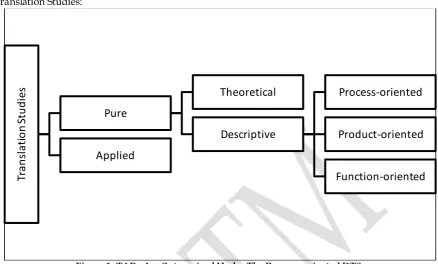
Translation Studies has not been treated as an academic field of science (Munday, 2008) and thus has not been studied in isolation within the academic context, the history of translation shows that many attempts have been made without noticing the academic issues in this field of science. Recently, it has been a core topic of discussion to investigate into different aspects in a translation project in order to know what really takes place from the very beginning steps while translating a text. In doing so, a considerable number of scholars have already categorized different aspects of translation. One of the most tangible one, was made by Holmes (1988). In his “map” of Translation Studies (henceforth TS), he (ibid.) divided the TS into two main categories namely pure and applied TS. The pure branch further is subdivided into theoretical and descriptive TS. The present study relates to the Descriptive Translation Studies (henceforth DTS). Its different sub-divisions are given a brief introduction as follows:
1.
Product-oriented DTS: examines existing translations. In most cases, a comparison is made between a translated text with its original one.2.
Process-oriented DTS: is related to the psychology of translation and seeks to find out what happens in a mind of a translator (Munday, 2008, p.11).3.
Function-oriented DTS: is the study of context rather than the text. It examines which books were translated when and where, and what influences they exerted (Munday, 2008, p.10).V
o
l.
3
, I
ssu
e
4
, D
e
ce
m
b
e
r
2
0
1
3
Figure 1. gives a more tangible overview on what has been referred to as Descriptive Translation Studies:
Figure 1. TAPs Are Categorized Under The Process-oriented DTS.
During 1990s, an increasing attention was given to process-oriented DTS research, as Holmes (1988) termed it, where the mental activity of translating is studied. Empirical data were collected through “think-aloud protocols” (henceforth TAP), where translators were asked to verbalize their thinking during or immediately after the translation process (see Lörscher 1996; Fraser 1996). These studies have observed translators at various levels of expertise, both trainees and professionals. As Venuti (2004, p.339) points out, “some research emphasizes psycholinguistic procedures; some aims to improve training, especially by giving it a stronger vocational slant, approximating current trends in the profession.”
Think-aloud protocols are beset by a number of theoretical problems that must be figured into any use made of their data. According to Venuti (2004, p.339) “verbalization won’t register unconscious factors and automatic processes, and it can change a mental activity instead of simply reporting it. Similarly, subjects are sometimes instructed to provide specific kinds of information: description, for instance, without any justification.”
TAPs tend to document the practices that translators perform during the process of translation. As Séguinot (1996, p.77) believes, TAPs are “useful to test theories in the light of concrete data” (as cited in Venuti, 2004, p.339). These protocols not only include abstract mental processes, but also could discuss specific intercultural dimensions of translating and this was meant to be the main significance of the present study, i.e. to delve into the process in search for any cultural issues. In addition, a better understanding on the most and least frequent strategies could be found out while rendering a Source Text (henceforth ST) into a Target Text (henceforth TT).
The present study aimed at investigating the steps taken through the process of translation by a group of translators in order to see which strategies are the most frequent and which are the least ones through using its related methodology based on Gerloff’s (1986) model of TAP. Although the present study was related to psychological aspects of translation, the trainees and professionals were among the ones to benefit from the results of this study. It could also be of a great help to the
professors and instructors dealing with TS.
The following research question was formulated in order to be dealt with during the steps taken in the present investigation:
Tra
n
sl
a
ti
o
n
S
tu
d
ie
s
Pure
Theoretical
Descriptive
Process-oriented
Product-oriented
Function-oriented
Applied
3
, I
ssu
e
4
, D
e
ce
m
b
e
r
2
0
1
3
Is there any statistically significant difference between the frequencies of the strategies proposed by Gerloff (1986) taken by Iranian undergraduate students of Translation while translating from English to Persian?
2. The Literature on TAPs
TS faced a turning point in the 1990s, as the tendency towards the then-general topics of debates faced a gradual move from issues like equivalence to other ones. As Venuti (2004) points out, in the 1990s increasing attention was given to the “process-oriented” research, dealing with the mental activity of translating (p.339). In order to deal with this sub-branch of TS, “think-aloud protocols” were used to see what was going on in the mind of a translator. In this regard, the translators were asked to verbalize their thinking and a decision-making procedure during the process of translation or right after it was dealt with.
Venuti (2004) also believed that TS research in 1990s was manifested through a diverse mixture of the theories and methodologies which characterize the previous decade. In Venuti’s (ibid.) opinion, 1990s was the time for other sub-branches of TS to enter the realm of research. In fact he pointed out that “theoretical approaches to translation multiply, and research, which for much of the century has been shaped by traditional academic specializations, then fragmented into subspecialties within the growing discipline of translation studies” (p.333). In this regard, TS scholars and researchers were interested to see what really happens in the mind of a translator to choose or not to choose a
translation procedure. This was previously discussed under the category of “process-oriented DTS”, introduced in Holmes’ (1988) map of TS, in order to refer to the stages and processes involved during the process of translation. To begin with, the author provided some existing models of TAP as follows:
2.1. Related Models on TAPs
First, it seemed crucial to have a look on the related models of TAP introduced previously. Although these models were few in number, each tended to delve into specific aspects of translation in general, and translating in partial.
2.1.1. Lörscher’s (1996) Model
A brief search into literature provides the researchers with few systematic models of TAPs, one of which was introduced by Lörscher (1996), who defines translation strategies as procedures that the subjects employ in order to solve translation problems. He (ibid. pp.27-8) adds:
Accordingly, translation strategies have their starting-point in the realization of a problem by a subject, and their termination in a (possibly preliminary) solution to the problem or in the subject’s realization of the insolubility of the problem at the given point in time. Between the realization of a translation problem and the realization of its solution or insolubility, further verbal and /or mental activities can occur which can be interpreted as being strategy steps or elements of translation strategies.
Lörscher’s (1996) model is as follows:
Table 1. Lörscher’s (1996) Model of TAP
Strategy Definition
RR Realizing a translational problem VP Verbalizing a translational problem
SP Search for a (possible preliminary) solution to a translational problem SP Solution to a translational problem
SP a. b. c… Parts of a solution to a translational problem
SP Ø A solution to a translational problem is still to be found (Ø) SP = Ø Negative (Ø) solution to a translational problem
PSL Problem in the reception of the SL text
V
o
l.
3
, I
ssu
e
4
, D
e
ce
m
b
e
r
2
0
1
3
The first step involves the act of translator realizing a problem while dealing with the process of translation. Then, the translator begins to saying the discovered translational problem out-loud. In the next stage, the translator begins to look for the most primer solution to the problem in question in order to find a suitable answer to that question. Although this solution may not be the final one, it might provide the translator with some basic components to understand the final answer to the problem faced. As Lörscher’s (1996) points out, this stage will then lead to one of the five possible endings listed as follows:
a. The translator finds the final solution to the translational problem;
b. The translator will partly find the final solution to the translational problem; c. The translator has not yet found the final solution to the translational problem; d. The translator could not find the solution to the translational problem; and e. The translator faces a problem in the reception of the SL text.
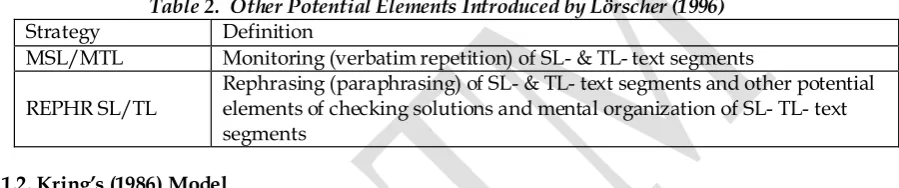
In addition to these original elements of translation strategies, Lörscher (1996, p.28) proposes other potential elements which consist of:
Table 2. Other Potential Elements Introduced by Lörscher (1996)
Strategy Definition
MSL/MTL Monitoring (verbatim repetition) of SL- & TL- text segments
REPHR SL/TL
Rephrasing (paraphrasing) of SL- & TL- text segments and other potential elements of checking solutions and mental organization of SL- TL- text segments
2.1.2. Kring’s (1986) Model
Another systematic model concerning TAPs was introduced by Krings (1986). This model offers eleven features in order to achieve a model of translation strategies, which is the main topic of discussion in TAPs. These features are as follows:
Table 3. Kring’s (1986) Features existing in a Model of Translation Strategies
Strategy Strategy and Sequence
1 The subjects’ explicit statement of problems. On this very first stage, the subject states the faced translational problem explicitly.
2
The use of reference books (i.e. dictionaries). On this stage, the translator begins to look up the components of the translational problem in the related reference books. These may include dictionaries, encyclopedias, grammars, online data-bases or through the use of IT applications.
3 The underlining of source-language text passages. On this stage, a possible understanding of the translational problem in the SL might be discovered by the translator.
4 The semantic analysis of source-language text items. On this stage, the translator begins to analyze the SL text items semantically.
5 Hesitation phenomena in the search for potential equivalents. On this stage, the translator hesitates in choosing the final suitable equivalent for the SL text items. 6 Competing potential equivalents. On this stage, the translator begins to weigh the probable potential equivalents available in the TL.
7 The monitoring of potential equivalents. On this stage, the translator monitors the potential equivalents in the TL to choose the best ones.
8 Specific translation principles. On this stage, the translator chooses the specific principles needed to decide which equivalent to be chosen and why.
9 The modification of written target-language texts. On this stage, the translator confirms the equivalents chosen through modifying the written TL texts. 10 The assessment of the quality of the chosen translation. On this stage, the
3
, I
ssu
e
4
, D
e
ce
m
b
e
r
2
0
1
3
translator assesses the quality of the equivalents chosen during the process of translation.
11
Paralinguistic or non-linguistic features (i.e. groaning and sighing). This stage involves the act of translator taking into consideration the paralinguistic or non-linguistics actions taken place during the process of translation, generally known as the extra-linguistic components of translation.
What all these models seem to have in common is their systematicity in the steps taken during the process of data analysis while being applied. In fact, they mostly start with the ST comprehension and finally lead to TT production.
2.2. Empirical Work Based on TAPs
Viewing translation mainly as a problem-solving process, some TS scholars have put forward the suggestion that it should be possible to study it by means of TAPs, and have set up experiments to test their hypotheses. Most early TAP studies were conducted with foreign language learners or translator trainees. As Bernardini (2002, p.244) pointed out, this was mainly due to “the availability of subjects and to the pedagogic concerns of the experimenters”. However, the hypothesis was also put forward that the verbalizations produced by professionals would be less informative than those produced by non-professionals, due to their more Think-aloud protocols in translation research “automatized” processing styles. In her pilot study named “Using Think-Aloud Protocols to investigate the translation process: methodological aspects”, Bernardini (ibid) tended to survey the breakthroughs as well as the limits of the growing body of literature dealing with TAPs in TS, and pointed at the necessity to take issues of experimental, theoretical and environmental validity more seriously. This study also attempted to address some of these issues, at the levels of experimental design/administration, data analysis and report. It was claimed that the risks involved in the
adoption of a lax experimental methodology in TAP studies had been underestimated in the past, and that the generalized lack of concern with it can invalidate not only the results obtained in the single projects, but the validity of the approach itself.
In another study, Hubscher (2004) investigated the influence of personalities on translator behavior and discovered links between attitudes, performance and creativity in the target text. The fieldwork of her study consisted of a translation test from French into English which was administered to twenty postgraduate translation students, and in which they verbalized their thought processes and explained their choices, thereby expressing certain revealing attitudes and behaviors. The
experiments were analyzed with different methods, and correlations were made between results found which gave credence to the idea that translators’ personality characteristics, which were reflected in their attitude towards their work influenced, and were apparent in their performances. The students’ different qualities (resourcefulness, originality, creativity…) were also displayed in varying degrees in the experiment and helped create patterns in the target texts.
In their “Think-Aloud Protocol Analysis in Translation Studies”, Kussmaul and Tirkkonen (1995) reported on think-aloud protocol research in Finland and Germany. They also discussed some methodological issues including choice of subjects, TAPs in a language-learning and in a professional context, monologue and dialogue protocols, and the use of models provided by psycholinguistics. Two types of processes - successful and less successful ones - were distinguished and specified as to the subjects' comprehension and re-verbalization processes, their focus of attention, decision-making, monitoring, flexibility, creative thinking and attitude toward the task. Some tentative results of the research going on in Germany and Finland were presented, too and the results were expected to serve as hypotheses for the teaching of translation.
Lörscher’s (2005) ‘The Translation Process: Methods and Problems of its Investigation’ is an empirical attempt towards the issue of translation processes. In this research, after the introductory remarks made about the analysis of mental translation processes and an outline of the investigation reported on, the methodology used was presented. It consisted of the methods for data elicitation, as well as
V
o
l.
3
, I
ssu
e
4
, D
e
ce
m
b
e
r
2
0
1
3
for data analysis and evaluation presenting a strategic analysis of translation processes carried out on three levels: the level of the elements of translation strategies, of the strategies themselves, and of the translation versions. The paper ended with a brief comparison of professional and non-professional translation processes.
In another study carried out by Lörscher (1996), he takes a psycholinguistic approach towards the translation processes. This article outlined a project in which translation processes were investigated empirically on the basis of a corpus of translations. After a description of the methodology used, a model for the analysis of translation processes was presented followed by a brief comparison of professional and non-professional translation processes. In the concluding section, considerations were made regarding implications of translation process analysis for translation teaching.
Empirical studies of the translation process have used think-aloud protocols to provide a window into the mental activity which is not directly observable. In this regard, Séguinot’s (1996) paper reported on a protocol study in a natural discourse situation involving two professional translators and discussed the relevance of the data to the debate on the use of verbalization as a methodology. The protocol provided evidence of translation strategies and pointed to the need for a dynamic model of the translation process that takes into account activation, suppression, and attending mechanisms. Mental constructs and processes in general and translation processes in particular have been the focus of much research in the past three decades. Among the techniques used in studying such cognitive processes and strategies, the use of TAPs has extensively been proposed. As Eftekhary and
Aminizadeh (2012) claim, though much has been written on the use of TAPs in recognizing the mental processes translators experience, very little if any can be found to address the mechanisms and mental processes they undergo while translating a piece of literary text. The purpose of their study was to investigate the strategies senior translation students of Islamic Azad University, Bandar Abbas Branch applied while translating literary texts using TAPs. To achieve this end, 12 senior translation students of Islamic Azad University, Bandar Abbas Branch participated in the study. Participants were chosen according to the convenience sampling method. The subjects then were asked to translate four literary texts and while translating verbalize whatever goes on in their mind within a TAP framework. The “think aloud protocols” were categorized based on the frequency table and the translations were analyzed qualitatively. The data was analyzed to reveal the strategies used by the respondents. In the analysis of the strategies, just the types of strategies were of importance to the researcher though the frequency of each strategy was also, collected and reported. Based on the findings, fourteen strategies were detected with Look-up was as the most frequent strategy used by the subjects in the study .Using imagery and Paraphrasing were the second and third most frequent strategies used by the subjects respectively. Switching to L1 while translation was found the lowest strategy as reported in TAPs by the subjects. Deductive reasoning strategies were the second lowest strategy reported. Such strategies as Resourcing and referencing, evaluating and monitoring, problem solving and co-text recourse stood in between.
According to Hansen (2005), in empirical process-oriented translation research with different kinds of introspection, two important questions are raised repeatedly: 1. does concurrent verbalization, like Think-aloud, have an influence on the translation process and 2. What do we actually learn from introspective methods like think-aloud and retrospection? Based on ideas from modern psychology and brain research, Hansen (ibid.) argued that think-aloud must have an impact on the translation process. Furthermore, it was suggested that it was not only spontaneous, unmodified thoughts about the actual task that were verbalized, but also memories, reflections, justifications, explanations, emotions and experiences.
TAPs have often been used to study the cognitive aspect of translation. On a paper, Künzli (2009) showed the usefulness of TAPs for investigating the linguistic aspect of translation. Examples are drawn from material collected in forty think-aloud sessions over several years. The participants were professional translators or trainee translators. The language pairs involved are French-German and French-Swedish. The translational linguistic problems discussed fell into the following categories: a) grammatical (the interpretation of French participial clauses), b) textual (the use of connectors), c) functional (different realizations of one and the same linguistic function in French on the one hand,
3
, I
ssu
e
4
, D
e
ce
m
b
e
r
2
0
1
3
and in German and Swedish on the other), and d) sociolinguistic (the rendering of the formal vous into Swedish by the more formal ni or the less formal du).
3. The Study 3.1. Participants
Six Iranian undergraduate students formed the participants of this study. As in analyzing the data, every single word and gesture was important and all had to be recorded and taken into account. This procedure was very time consuming so the number of participants was limited to the aforementioned sum. These students were chosen from senior students in the last semester of B.A program studying Translation at Islamic Azad University, Shiraz Branch. The reason of choosing senior students was that they were at the last semester of their educational program and it was assumed that they were completely familiar with the strategies in translation and they had been exposed enough to different strategies in their technical courses during their education. The participants were selected through simple random sampling, out of a class consisting some 40 students. In order to avoid any interfering issues during the process of data collection e.g., the interviewer’s confirmations, approvals or
disapprovals, the data were drawn out from the dialogues between pairs of three students rather than monologues.
3.2. Materials
The selected material was in literary genre. Three paragraphs selected from one page of a short story by Richard Connell with the title of The Most Dangerous Game were prepared for the participants according to its syntactic and semantic complexity to fit their knowledge. The participants were supposed to translate the text into Persian in about twenty minutes.
4. The Model
The text was given to the groups of students in order to be translated into Persian. The translators were then asked to verbalize what they were thinking about. As a simple word could possibly have an impact on the results of the study, all the conversations were tape-recorded and then carefully analyzed.
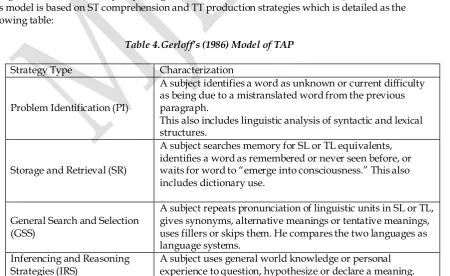
To begin with, each and every step was given its related issue based on Gerloff’s (1986) model of TAP. This model is based on ST comprehension and TT production strategies which is detailed as the following table:
Table 4. Gerloff’s (1986) Model of TAP
Strategy Type Characterization
Problem Identification (PI)
A subject identifies a word as unknown or current difficulty as being due to a mistranslated word from the previous paragraph.
This also includes linguistic analysis of syntactic and lexical structures.
Storage and Retrieval (SR)
A subject searches memory for SL or TL equivalents, identifies a word as remembered or never seen before, or waits for word to “emerge into consciousness.” This also includes dictionary use.
General Search and Selection (GSS)
A subject repeats pronunciation of linguistic units in SL or TL, gives synonyms, alternative meanings or tentative meanings, uses fillers or skips them. He compares the two languages as language systems.
Inferencing and Reasoning
Strategies (IRS) A subject uses general world knowledge or personal experience to question, hypothesize or declare a meaning.
V
o
l.
3
, I
ssu
e
4
, D
e
ce
m
b
e
r
2
0
1
3
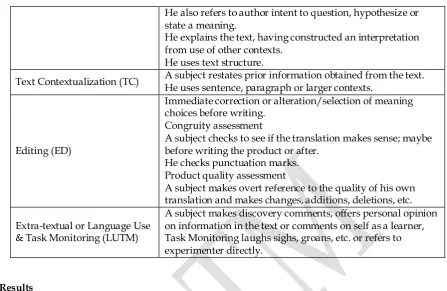
He also refers to author intent to question, hypothesize or state a meaning.
He explains the text, having constructed an interpretation from use of other contexts.
He uses text structure.
Text Contextualization (TC) A subject restates prior information obtained from the text. He uses sentence, paragraph or larger contexts.
Editing (ED)
Immediate correction or alteration/selection of meaning choices before writing.
Congruity assessment
A subject checks to see if the translation makes sense; maybe before writing the product or after.
He checks punctuation marks. Product quality assessment
A subject makes overt reference to the quality of his own translation and makes changes, additions, deletions, etc.
Extra-textual or Language Use & Task Monitoring (LUTM)
A subject makes discovery comments, offers personal opinion on information in the text or comments on self as a learner, Task Monitoring laughs sighs, groans, etc. or refers to experimenter directly.
4. Results
After gathering the required data, they were categorized and placed within Gerloff’s (1986) model of TAP. As discussed before, this model is based on the participants’ verbalizations of what they are thinking about and what they do. Table 5. provides some primary information on the data gathered. In this table, the students were divided into two pairs. This was justified before as each and every gesture, movement, saying, etc., of the participants mattered and might have a possible impact on the output of the research. The recorded data were then analyzed carefully and the strategies applied, along with their frequencies of usage were extracted and then presented in Table 5.
Table 5. Some Primary Information on the Data Collected