Journal of Computing and Security
Full Secret Disclosure Attack against an EPC- C1 G2 Compliant
Authentication Protocol
Masoumeh Safkhani
a,∗
aComputer Engineering Department, Shahid Rajaee Teacher Training University, Tehran, Iran.
A R T I C L E I N F O.
Article history:
Received:16 March 2018 Revised:8 August 2018 Accepted:23 September 2019 Published Online:25 November 2019
Keywords:
RFID, EPC-C1 G2,
Authentication Protocol, Secret Disclosure Attack, GNY Logic.
A B S T R A C T
Security analysis of a protocol is an important step toward the public trust on its security. Recently, in 2018, Moradi et al.considered the security of the Wei and Zhang RFID EPC-C1 G2 compliant authentication protocol and presented desynchronization attack and also server/reader impersonation attack against it. Then they proposed an improved version of the protocol. However, in this paper as the first third party analysis of this protocol to the best of our knowledge, we present an efficient secret disclosure attack with the complexity of only two runs of protocol and doing O(216) PRNG offline evaluations. We
also recommend that designing a secure protocol by using 16-bit CRCs and 16-bit PRNGs in the framework of EPC-C1 G2 may not be possible and changing this standard to allow the use of lightweight cryptographic functions should be inevitable. In this line, we present an improved version of the Moradi
et al.protocol and also prove its security both informally and formally, through GNY logic.
©2019 JComSec. All rights reserved.
1
Introduction
Today, the science of designing security protocols has grown well. Perhaps a reason for this progress is the security analyses done on the previous security proto-cols such as [1–13] which help the designers to learn the errors in the existing protocols and not to repeat them in their design.
Given that RFID tags are very constrained and the passive tags have no internal power resource and should harvest the required energy from the reader, it is not possible to use conventional cryptographic primitives to provide the desired security for their communications. On the other hand, the transferred information should be critical,e.g.a patient
informa-∗ Corresponding author.
Email address:[email protected](M. Safkhani) https://dx.doi.org/10.22108/jcs.2019.110886
ISSN: 2322-4460©2019 JComSec. All rights reserved.
tion or the identity of the tag holder. Hence, the secu-rity of the communication of those devices are also im-portant. To address these concrens, many researchers have tried to provide the expected security using lightweight/ultralightweight operations/functions. For example, Tianet al.[14] proposed a protocol called RAPP which uses a very lightweight permutation as the security core. However, later analysis showed that it suffers from several flaws [15, 16]. Later, to improve the security of RAPP, Zhuanget al.proposed another ultralightweight RFID mutual authentication proto-col [17] called R2AP. However, later analysis have
to protect the medical privacy in an IoT system [22]. However, Aghili et al.later have shown that it has trivial security flaws [23]. Aghiliet al.also proposed an improved version of the protocol, based on the similar designing paradigm, called SecLAP. However, recently Safkhaniet al. in [24] have shown that Se-cLAP suffers from secret disclosure attacks. On the other hand, given that EPC- C1 G2 standard compli-ant tags support 16-bit PRNG, several protocols have been proposed based on this component. For example, Jeon and Yoon proposed RAPLT [25] and Panget al.
proposedSRP+ [26] based on this paradigm.
How-ever, Wanget al. analyzed those two protocols and presented successful attacks with the complexity of
O(216) [27] against them. Moreover, Wanget al.also
proposed a new protocol calledSRP++, conforming
to the EPC- C1 G2 standard and claimed that their protocol can resist against the disclosure attacks up to the complexity of O(232). However, later it has been shown that it may not be possible to achieve security beyond 2lusing anl-bit PRNG [28].
In the same vein, Moradiet al.in [29] cryptanalyzed the Wei and Zhang RFID authentication protocol[30] and presented desynchronization attack and also server and reader impersonation attack against it. Then they proposed an improved version of it and informally and formally, through BAN logic, proved its security against different attacks, including secret disclosure attack. However, in this paper, we present an efficient secret disclosure attack with the com-plexity of two runs of the protocol and doingO(216)
PRNG evaluations.
1.1 Our Contribution
The contribution of this paper has two folds, as follows: (1) We analyse the security of the improved proto-col proposed by Moradiet al.in [29] and show that it has some security flaws. More precisely, thanks to the short length PRNG which is used in the structure of this protocol, we demonstrate an attack that retrieves whole secret parameters with the complexity of O(216). Although the used technique is almost similar to the technique used in related papers such as [27–29], however, it is the first third party analysis of Moradiet al.’s protocol and we used a non-trivial combi-nation of messages to retrieve the secrets with the complexity ofO(216).
(2) Considering the recent advances in the designing of lightweight crypto-primitives for constrained environments,e.g., many lightweight block ci-pher which have been proposed over the last decade, we improve the Moradi et al.’s proto-col, mainly by replacing the used PRNG by a
block cipher such as SKINNY [31]. In addition, we formally/informally evaluate the security of the proposed protocol and show that it provides desired security against attacks.
1.2 Paper Organization
The rest of the paper is organized as follows: in Sec-tion 2, we briefly review the Moradiet al.RFID pro-tocol. We present our secret disclosure attack against the Moradiet al.protocol in Section 3. We improve the protocol in Section 4 and in Section 5, we prove the security of our proposed protocol both informally and formally through GNY logic. We also compare the proposed protocol with its predecessors in Section 6 from security and computational complexity aspects. Finally, the paper is concluded in Section 7.
2
Description of Moradi
et al.’s
Proto-col
The Moradiet al.’s protocol, as depicted in Figure 1 using notations represented in Table 1, runs in two phases as below:
Registration Phase :
In this phase of the protocol, any protocol’s party saves its related records. More precisely, the tag stores metaIDi, Ki1 and Ki2. The server stores
(metaIDi)old,(metaIDi)new,(Ki2)old and (Ki2)new.
The reader storesKi1which is the same for all the tags.
Authentication Phase :
This phase of the protocol runs as below:
(1) The reader starts this phase of protocol by gener-ating a random numberNrand sending it along
withqueryto the tag.
(2) Once the tag receives the message, it does as follows:
• generates another random numberNt;
• computesM1= [P RN G(Ki2⊕Nr)kP RN G
(Ki2⊕Nt)]⊕metaIDi;
• computesN=CRC([K1
i]RkNr)⊕Nt;
• and sendsM1andNk(Nt⊕[Ki1]L) to the
reader.
(3) Upon receipt of the message, the reader: • retrievesNt0from (Nt⊕[Ki1]L);
• computesN0 =CRC([K1
i]RkNr)⊕Nt0and
checks whether it equals with the received value ofN or not. If it is not, terminates the protocol.
• If it is ok, it sendsM1along withNtand Nrto the server;
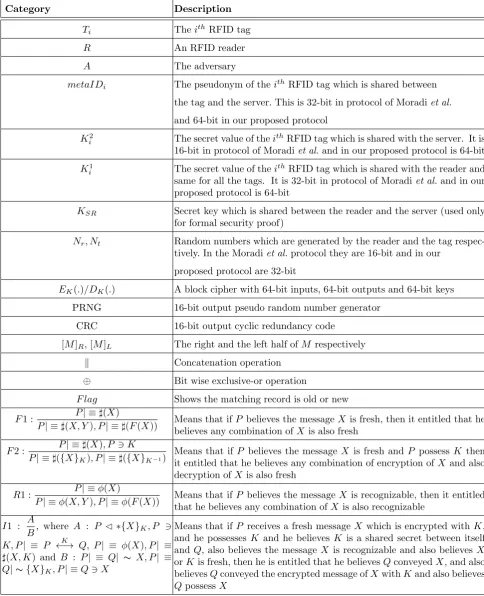
Table 1. Notations Used in This Paper.
Category Description
Ti TheithRFID tag
R An RFID reader
A The adversary
metaIDi The pseudonym of theithRFID tag which is shared between
the tag and the server. This is 32-bit in protocol of Moradiet al.
and 64-bit in our proposed protocol
K2
i The secret value of theithRFID tag which is shared with the server. It is
16-bit in protocol of Moradiet al.and in our proposed protocol is 64-bit
K1
i The secret value of theithRFID tag which is shared with the reader and
same for all the tags. It is 32-bit in protocol of Moradiet al.and in our proposed protocol is 64-bit
KSR Secret key which is shared between the reader and the server (used only
for formal security proof)
Nr, Nt Random numbers which are generated by the reader and the tag
respec-tively. In the Moradiet al.protocol they are 16-bit and in our proposed protocol are 32-bit
EK(.)/DK(.) A block cipher with 64-bit inputs, 64-bit outputs and 64-bit keys
PRNG 16-bit output pseudo random number generator CRC 16-bit output cyclic redundancy code
[M]R, [M]L The right and the left half ofM respectively
k Concatenation operation
⊕ Bit wise exclusive-or operation
F lag Shows the matching record is old or new
F1 : P| ≡](X)
P| ≡](X, Y), P| ≡](F(X)) Means that ifP believes the messageX is fresh, then it entitled that he believes any combination ofX is also fresh
F2 : P| ≡](X), P 3K
P| ≡]({X}K), P| ≡]({X}K−1)
Means that ifP believes the message X is fresh andP possess K then it entitled that he believes any combination of encryption ofX and also decryption ofX is also fresh
R1 : P| ≡φ(X)
P| ≡φ(X, Y), P| ≡φ(F(X)) Means that ifP believes the message X is recognizable, then it entitled that he believes any combination ofX is also recognizable
I1 : A
B, where A : P ∗{X}K, P 3 K, P| ≡ P ←→K Q, P| ≡ φ(X), P| ≡
](X, K) and B : P| ≡ Q| ∼ X, P| ≡
Q|∼{X}K, P| ≡Q3X
Means that ifP receives a fresh messageX which is encrypted withK, and he possesses K and he believes K is a shared secret between itself and Q, also believes the messageX is recognizable and also believesX
orKis fresh, then he is entitled that he believesQconveyedX, and also believesQconveyed the encrypted message ofXwithKand also believes
• for each of the database records, i.e.
(metaIDi)old, (metaIDi)new, (Ki2)old,
(K2
i)new, it calculatesM10 and checks if it
is equal to the received value ofM1.This
step is repeated so that a record can be found, which indicates the successful au-thentication of the tag;
• at the same time, if F lag = 0, the matching record is (metaIDi)old, (Ki2)old,
so, it computes M2 = [CRC(Ki2kNt)
kCRC(K2
ikNr)]⊕metaIDi and does not
change (metaIDi)old and (Ki2)old and
up-dates (metaIDi)newas [P RN G((metaIDi) new) kCRC((metaIDi)new)] ⊕Nt ⊕ Nr
and (K2
i)newasP RN G((Ki2)new)⊕Nt;
• if F lag = 1, the matching record is (metaIDi)new,(Ki2)new so, it computes M2= [CRC((Ki2)newkNt)kCRC((Ki2)newk Nr)]⊕metaIDiand updates (metaIDi)old
as (metaIDi)new, (Ki2)old as (Ki2)new,
(Ki2)new as P RN G((Ki2)new) ⊕ Nt and
(metaIDi)new as [P RN G((metaIDi)new)
kCRC((metaIDi)new)]⊕Nt⊕Nr;
• and sendsM2to the reader;
(5) Once the reader receives the message, it sends
M2to the tag.
(6) Upon receipt of the message, the tag: • computesM20 = [CRC(K2
ikNt)kCRC(Ki2
kNr)]⊕metaIDi;
• checks whether M20 is equal to the re-ceived value of M2. If it is ok, it
au-thenticates the server and updates K2 i
and metaIDi as P RN G(Ki2) ⊕Nt and
[P RN G(metaIDi)kCRC(metaIDi)] ⊕ Nt⊕Nrrespectively.
3
Secret Disclosure Attack
Secret disclosure attack is classified among the very strong attacks, because by doing this attack and re-trieving one or all of protocol secret values, it may be easy to do other attacks such as impersonating one of the protocol’s parties or trace a tag holder.
For the proposed secret disclosure attack, it is enough that the adversary does the following proce-dure:
Reader Impersonation Phase (Learning
Phase): In this phase, the attacker pretends to be a legitimate reader as follows:
(1) The adversary generates a random numberNr1
and sends it, along withquery, to the tag. (2) Once the tag receives the message, it does as
follows:
• generates a random numberNt1;
• computesM1= [P RN G(Ki2⊕Nr1)k P RN G(K2
i ⊕Nt1)]⊕metaIDi;
• computesN=CRC([K1
i]RkNr1)⊕Nt1;
• and sendsM1andNk(Nt1⊕[Ki1]L) to the
reader, which is impersonated by the adver-sary.
(3) The attacker receives the messages and stores them. Then, the attacker terminates this session. Up to now, the tag has not updated its secret values yet.
(4) The adversary initiates another session and re-peats the above steps once again for this session, where it generates another random numberNr2
and sends it along withqueryto the tag. (5) Once the tag receives the message, it does as
follows:
• generates another random numberNt2;
• computesM10 = [P RN G(K2
i ⊕Nr2)k P RN G(Ki2⊕Nt2)]⊕metaIDi;
• computesN0 =CRC([Ki1]RkNr2)⊕Nt2;
• and sendsM10 andN0k(Nt2⊕[Ki1]L) to the
reader which is the adversary.
Secret Disclosure Attack Phase :In this phase of the attack, using the information which the adver-sary received in the learning phase of the attack, based on below observation, it does the following computa-tions:
Observation 1 : Given that the messageM1 in
the Moradiet al.’s protocol is calculated as follows:
M1 = [P RN G(Ki2 ⊕Nr)kP RN G(Ki2 ⊕Nt)]⊕ metaIDi;
If we divideM1 into two parts, its left and right
halves are as follows:
[M1]L=P RN G(Ki2⊕Nr)⊕[metaIDi]L;
[M1]R=P RN G(Ki2⊕Nt)⊕[metaIDi]R;
where [metaIDi]Land [metaIDi]Rare the left and
the right halves ofmetalIDirespectively.
Based onObservation 1 and given the stored in-formation from the learning phase of the protocol, to retrieve the secret parameters of the Moradiet al.’s protocol, the adversary does as follows:
• given,Nk(Nt1⊕[Ki1]L) and N0k(Nt2⊕[Ki1]L),
whereN =CRC([K1
i]RkNr1)⊕Nt1 andN0 = CRC([K1
i]RkNr2)⊕Nt2, the adversary retrieves
∆Nt=Nt1⊕Nt2;
• adversary also calculates ∆Nr=Nr1⊕Nr2;
• computes [M1]L ⊕ [M10]L which is equal to P RN G(Ki2⊕Nr1)⊕P RN G(Ki2⊕Nr2);
Server (S) Reader (R) Tag (Ti)
1.GeneratesNr
2.query,Nr
=⇒ 5. RetrievesN0tfromNt⊕[Ki1]L
4.M1,Nk(Nt⊕[Ki1]L)
⇐= 3.ComputesM1,N
7. For each record of database 6.M1⇐,Nt,Nr= and computesN0 10. ComputesM20, ifM20=M2,
calculatesM10 and compares it 8=.M⇒2If N’6=N authenticates the server and
withM1, ifM10=M1 otherwise continues the protocol 9=.M⇒2 goes to updating phase authenticates the tag and computesM2
and goes to the updating phase
Updating Phase Updating Phase
IfF lag= 1: metaIDi= [P RN G(metaIDi)
(metaIDi)old= (metaIDi)new; kCRC(metaIDi)]⊕Nt⊕Nr;
((Ki2)old= (Ki2)new; K2i =P RN G(K2i)⊕Nt; (metaIDi)new= [P RN G((metaIDi)new)
kCRC((metaIDi)new)]⊕Nt⊕Nr;
(Ki2)new=P RN G((Ki2)new)⊕Nt; IfF lag= 0:
does not changemetaIDiold and (Ki2)old
(metaIDi)new= [P RN G((metaIDi)new) kCRC((metaIDi)new)]⊕Nt⊕Nr;
(Ki2)new=P RN G((Ki2)new)⊕Nt;
Figure 1. Moradiet Al.’S Improved Authentication Protocol[29].
• forj= 0, ...,216−1:
◦ K2
i ⊕Nr1←j;
◦ if [M1]L⊕[M10]L =P RN G(j)⊕P RN G(j⊕
∆Nr), returnsjasKi2⊕Nr1;
◦ returnsK2
i asj⊕Nr1;
• forj= 0, ...,216−1:
◦ K2
i ⊕Nt1←j;
◦ if [M1]R⊕[M10]R=P RN G(j)⊕P RN G(j⊕
∆Nt), returnsjasKi2⊕Nt1;
◦ returnsNt1asj⊕Ki2;
◦ returns [Ki1]L as (Nt1⊕[Ki1]L)⊕Nt1;
• given thatN =CRC([Ki1]RkNr1)⊕Nt1, forj=
0, ...,216−1: ◦ [K1
i]R←j;
◦ ifN =CRC(jkNr1)⊕Nt1, returnsjas [Ki1]R;
• retrieves metaIDi as M1 ⊕ [P RN G(Ki2 ⊕ Nr)kP RN G(Ki2⊕Nt)];
Hence, all the secret parameters of the protocol,i.e.
metaIDi,Ki1andK 2
i, are disclosed. The complexity
of the proposed attack is only two times reader imper-sonation attack and doing only at mostO(216) offline
computations. Given all secret parameters, applying any other attack on the protocol would be trivial. Hence we exempt them.
4
Recommendation for Improving the
Protocol
The current study and previous related studies,
e.g.[16, 32–35], that compromise security of protocols which have been designed based on EPC- C1 G2, show
that it may not be possible to design a new secure protocol based on EPC- C1 G2 standard. The reason is due to this fact that the EPC- C1 G2 standard recommended using 16-bit CRCs and 16-bit PRNGs in designing secure protocols. However, as shown in [28], without EPC- C1 G2 standard change, the design of a secure protocol sounds to be impossible and the standard must be changed, and lightweight block ciphers such as SKINNY [31], SIMON and SPECK [36] should be allowed in the new standard to be employed. If we use lightweight cryptography primitives instead of 16-bit CRCs and 16-bit PRNGs, it should be possible to design a secure protocol. In this section, we propose a secure protocol based on this strategy. It should be noted that K2
i andKi1are
64-bit variables in the proposed protocol (despite the protocol of Moradiet al.). In addition, the length of the random numbers that are generated by protocol’s parties are changed to 32 bits, instead of 16 bits in the predecessor protocols. Similar to the Moradiet al.’s protocol, to avoid traceability, both parties update their shared parameters after each successful run of the protocol. We also assume the channel between the reader and the server is secure. Assuming that we are given a lightweight block cipher EK(M) :
{0,1}64 × {0,1}64 → {0,1}64, e.g. SKINNY-64-64
with tweak part considered as blank or identical to the secret key, the proposed protocol proceeds as follows: (1) The reader starts the protocol by generating a random numberNrand sending it along with queryto the tag.
follows:
• generates a random numberNt;
• computes M1 = EK2
i(([metaIDi]R ⊕
Nr)kNt);
• computes N = EK1
i(([metaIDi]L ⊕
Nt)kNr);
• sendsNt,M1andN to the reader;
(3) Upon receipt of the message, the reader: • retrieves ([metaIDi]L ⊕ Nt)kNr0 from
DK1
i(N) and compares the extractedN
0 r
with its record for the generated random number to validate the tag’s access toK1
i;
if the comparison is violated, the reader terminates the protocol.
• If it is ok, the reader extracts [metaIDi]L
from [metaIDi]L⊕Ntand sends it along
with M1, Nt and Nr through the secure
channel to the server;
(4) Once the server receives the message, it does as follows:
• For each of the database records i.e.
(metaIDi)old, (metaIDi)new, (Ki2)old,
(K2
i)new that matches the received
[metaIDi]L, it calculates M10 and checks
if it is equal to received value of M1 to
authenticate the tag. This step is repeated among the matched records so that a matching can be found, which indicates the successful authentication of the tag. • At the same time, if the matching
record is (metaIDi)old, (Ki2)old so, it
computes M2 = E(K2
i)old(NrkNt) and does not change (metaIDi)old and
(K2
i)old but updates (metaIDi)new as E(K2
i)old((metaIDi)old ⊕ (NrkNt)) and (Ki2)new asE(K2
i)old((K
2
i)old⊕(NrkNt)) .
• If the matching record is (metaIDi)new,
(K2
i)newso, it computesM2=E(K2
i)new(Nr kNt) and updates (metaIDi)old and
(K2
i)old respectively with (metaIDi)new
and (K2
i)new. Moreover, given the
up-dated values of (metaIDi)oldand (Ki2)old,
the server updates (metaIDi)new as E(K2
i)old((metaIDi)old ⊕ (NrkNt)) and (Ki2)new asE(K2
i)old((K
2
i)old⊕(NrkNt)) .
• Finally, the server sendsM2to the reader;
(5) Once the reader receives the message, it sends
M2to the tag.
(6) Upon receipt of the message,M2, the tag
ver-ifies whether M2 ?
= EK2
i(NrkNt) to authenti-cate the server and updates K2
i andmetaIDi
as EK2
i(metaIDi ⊕(NrkNt)) and EK
2
i(K
2 i ⊕
(NrkNt)) respectively; otherwise, the tag
termi-nates the session.
5
Security Analysis of the Proposed
Protocol
In this section, at the first, we argue about the in-security of the Moradiet al.’s protocol with regard to formal proof and then informally and after that formally prove the security of our proposed protocol.
5.1 In Security of the Moradiet Al.’S Proto-col With Regard to Formal Proof
Formal security proof methods of protocols are divided into two categories: manual and automated. The logic of BAN [37] and GNY and etc. are among the cate-gory of the manual, and AVISPA [38], Proverif [39] and Scyther [40] are among the category of automated tools. Manual security proof methods are based on assumptions and goals, and if there is a wrong as-sumption or a wrong goal so the protocol is apparently proven to be safe while it is not. Moradiet al.in [29] have provided formal security proof for their protocol using BAN logic but, based on the below-mentioned reason, unfortunately, security of their scheme is lost within formal proof. Precisely, in their formal proof, Moradiet al.implicitly assumed that 16-bit PRNGs and also 16-bit output CRCs are fully secure. In the formal security proof of their proposed protocol, they explained the messages of protocols for exampleM2 = [P RN G(Ki2⊕Nr)kP RN G(Ki2⊕Nt)]⊕metaIDias
encrypted messages i.e. {{Nr}K2
i,{Nt}Ki2}metaIDi. However, in this paper we showed that such primitives are not enough strong encryption functions and so explanation of protocol messages as encrypted mes-sages are wrong. BAN logic, with the assumption that the cryptographic functions are fully secured based on their own rules, will result protocol’s goals. Moradi
et al. assumed that their protocol messages, which have a secure value in their calculations, are such that they are encrypted with a secret value, and with this assumption and explanations, based on the BAN logic rules, they proved that their protocol is safe. However, in our proposed protocol we actually used cryptographic encryption functions in calculating of messages, and so they are correctly considered as en-crypted messages and hence, using the GNY logic’s rules, we proved that the proposed protocol is safe.
5.2 Informal Security Analysis
5.2.1 Resistance Against Secret Disclosure Attack
Since the proposed protocol has properties such as keeping old and new versions of the secret parameters on the server side and participating both the tag and the reader in randomizing all the messages, the proposed protocol is also safe against DoS attacks.
5.2.3 Resistance Against Impersonation At-tacks and Replay AtAt-tacks
Since all messages which are exchanged in the protocol are generated using the block ciphers, and also the random numbers that the parties have generated are used in calculating all of the protocol messages, it is not possible for the adversary to be able to generate a valid protocol message or to get the confirmation from protocol parties only by replaying the messages of previous sessions.
5.2.4 Resistance Against Traceability
At-tacks
Since in the proposed protocol, messages that contain the protocol’s parties’ identity are encrypted, and the messages of each session are randomized by random numbers generated by the protocol parties, cannot be interconnected to one another, or other session messages. Therefore the constant information that is needed to trace the protocol’s parties cannot be obtained from them. So the proposed protocol is secure against the traceability attack.
5.3 Formal Security Analysis
Formal Proof through GNY Logic
In this section by using GNY Logic [41], we formally prove our proposed protocol’s security.
The security analysis of protocol by using GNY logic involves four steps:
• Expression of protocol messages : in this step, the protocol messages are written using mathematical relationships and also GNY logic relationships as follows. Since we assumed that the channel between the reader and the server is secure, we consider all transferred messages between the reader and the server encrypted using a secret key, i.e., KSR, which is shared
between the reader and the server.
M1 :R→T :Nr, query; M2 :T →R:M1=EK2
i(([metaIDi]R ⊕Nr)kNt),N =EK1
i(([metaIDi]L⊕Nt)k
Nr));
M3 : R → S : {[metaIDi]L}KSR,{M1 =
EK2
i(([metaIDi]R⊕Nr)kNt)}KSR,{Nr}KSR,{Nt}KSR;
i
M5 :R→T :M2=EK2
i(NrkNt); which is also written as follows:
M1 :TCNr, queryquery M2 :RC{metaIDi, Nr, Nt}K2
i,{metaIDi,
Nr, Nt}K1
i;
M3 :SC{[metaIDi]L}KSR,{{metaIDi, Nr, Nt}Ki2}KSR,; {Nr}KSR,{Nt}KSR;
M4 :RC{{Nr, Nt}K2
i}KSR;
M5 :T C{Nr, Nt}K2
i;
• Idealization of protocol messages: in this step, the messages that are plain will be deleted as below:
IM2 :RC{metaIDi, Nr, Nt}K2
i,{metaIDi,
Nr, Nt}K1
i;
IM3 :SC{[metaIDi]L}KSR,{{metaIDi, Nr, Nt}K2
i}KSR, {Nr}KSR,{Nt}KSR;
IM4 :RC{{Nr, Nt}K2
i}KSR;
IM5 :T C{Nr, Nt}K2
i;
• Expression of protocol assumptions and se-curity goals:
The proposed protocol’s assumptions are ex-pressed as:
A1 :T| ≡]Nt; A2 :T 3Nt; A3 :T| ≡φ(Nt); A4 :R| ≡]Nr; A5 :R3Nr; A6 :R| ≡φ(Nr); A7 :S| ≡S K
2
i ←→T;
A8 :T| ≡T K 2
i ←→S;
A9 :R| ≡R K 1
i ←→T;
A10 :T| ≡T K 1
i ←→R;
A11 :S| ≡SmetaIDi ←→ T;
A12 :T| ≡T metaIDi ←→ S;
A13 :T 3Ki2;
A14 :T 3Ki1;
A15 :S3Ki2;
A16 :R3Ki1;
A17 :S| ≡S KSR ←→R;
A18 :R| ≡RKSR ←→S;
The security goals of the proposed protocol are as:
G1 :T| ≡S|∼]{Nr, Nt}K2
i;
G2 :R| ≡T|∼]{metaIDi, Nr, Nt}K1
i;
any control on encrypted values and also random numbers which are plain and send through inse-cure channel.
• Deduction of security goals from protocol messages and assumptions using proper GNY logic rules:
Given A1 assumption, then based on F1 rule of GNY logic, we deduce that D1 : T| ≡
]({Nr, Nt});
After that we consider D1 and A13, then based onF2 rule of GNY logic, we deduce that
D2 :T| ≡]{Nr, Nt}K2
i;
After that we consider A3, then based on R1 rule of GNY logic, we deduce that D3 : T| ≡
φ({Nr, Nt});
If we consider IM5, A13 , A8, D3 and D1, then based onI1 rule of GNY logic, we deduce
D4 :T| ≡S|∼]{Nr, Nt}K2
i which is sameG1. Given A4 assumption, then based on F1 rule of GNY logic, we deduce that D5 : R| ≡
]({metaIDi, Nr, Nt});
After that we consider D5 and A16, then based onF2 rule of GNY logic, we deduce that
D6 :R| ≡]{metaIDi, Nr, Nt}K1
i;
After that we consider A6, then based on R1 rule of GNY logic, we deduce that D7 : R| ≡
φ({metaIDi, Nr, Nt});
If we consider IM2, A9 , A16, D7 and D5, then based onI1 rule of GNY logic, we deduce
D8 :T| ≡R ∼]{metaIDi, Nr, Nt}K1
i which is sameG2.
6
Comparison
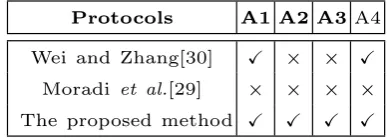
In this section, we compare the proposed protocol with its predecessors from security and computational cost aspects. As can be seen in Table 2, the proposed pro-tocol, despite its predecessors, resists different attacks while as depicted in Table 3 our protocol is costly than the others. We used encryption functions with 64-bit inputs, outputs, and keys. There are lightweight block ciphers such as SKINNY-64-64 [31] that requires reasonable resource and suitable for lightweight ap-plications like EPC- C1 G2 standard. Based on the designers report, SKINNY-64-64 [31] can be imple-mented in round-based implementation mode which provides a trade off between delay and area, using 1223 gates while its delay is 1.77−ns, they reported that throughput of the scheme in 100 KHz is 200 Bit/s in this mode. A nibble /bit serial implementations of the scheme also have been provided which require
only 988/839 gates and its delay will be 1.03−ns. Moreover, Jeanet al.[42] also presented a bit-serial ASIC implementations of SKINNY, called bit-sliding implementation, which requires 1054 gates for a 64-bit block with 128-64-bit key version, which could be a good candidate to provide higher security. In this case, the required gates for SKINNY-64-64 is 747 while the delay will be 2.25−ns. Hence, SKINNY-64-64 could be a good candidate for lightweight applications like EPC- C1 G2 standard. However, as it also pointed out correctly by an anonymousness reviewer, “IoT systems have many challenges, and security is only one of them and other criteria such as processing and exe-cution time and transmission overhead should also be considered”.By the way, we tried to reduce the proto-col overhead as much as possible. More precisely, the more constrained side, which is the tag, only requires the encryption function and even not the decryption function. More over it only encrypts 320 bits in total including update phase, in each session, which could be reasonable. Any way we can not achieve desired security without any cost.
Table 2. The Security Comparison of the Improved Protocol With Its Predecessors Where A1: Secret Disclosure Attack; A2: Impersonation Attack and Replay Attack; A3: DoS Attack and A4: Traceability Attack.
Protocols A1 A2 A3A4
Wei and Zhang[30] X × × X
Moradi et al.[29] × × × ×
The proposed method X X X X
Table 3. The Computation Complexity Comparison of the Improved Protocol With Its Predecessors.
Protocols]of ⊕
] of k
] of
CRC ] of
P RN G ] of
EK(.)
DK(.)
] of trans-ferred bits
Wei and Zhang[30]
16×
16 17 12 4 − 10×16 Zhang[30]
Moradi et al.[29]
18×
16 13 8 8 − 10×16
The proposed
method 6×
64 10 − − 10 8×64
method
7
Conclusion
investigated the security of Moradiet al.EPC- C1 G2 authentication protocol and showed its vulnerability against secret disclosure attack. The complexity of the proposed attack is only two times reader imperson-ation and doing almost 3×216offline computations. We also presented an improved version of the protocol and proved its security against the attack presented in this paper and also other known active and passive attacks.
Acknowledgements
This work was supported by Shahid Rajaee Teacher Training University.
References
[1] C. Wei, C.Yang, M. Hwang, and A. Chin. Crypt-analysis of li–wang authentication protocol for secure and efficient rfid communication. In
Recent Developments in Intelligent Computing, Communication and Devices, pages 699–705. Springer, Singapore, 2019. ISBN 978-981-10-8943-5. doi:10.1007/978-981-10-8944-2 80.
[2] P. Arulmozhi, J. B. B. Rayappan, and Pethuru Raj. A lightweight memory-based protocol au-thentication using radio frequency identification (rfid). InAdvances in Big Data and Cloud Com-puting, pages 163–172. Springer, Singapore, 2019. ISBN 978-981-13-1881-8. doi:10.1007/978-981-13-1882-5 14.
[3] L. Zhou, X. Li, K. Yeh, C. Su, and W. Chiu. Lightweight iot-based authentication scheme in cloud computing circumstance. Future Gen-eration Computer Systems, 91:244–251, 2019. doi:10.1016/j.future.2018.08.038.
[4] Y. Bendavid, N. Bagheri, M. Safkhani, and S. Ros-tampour. Iot device security: Challenging “a lightweight rfid mutual authentication protocol based on physical unclonable function”. Sensors, 18(12):4444, 2018. doi:10.3390/s18124444. [5] F. Moradi, H. Mala, and B. Tork Ladani. Security
analysis and strengthening of an rfid lightweight authentication protocol suitable for vanets. Wire-less Personal Communications, 83(4):2607–2621, 2015. ISSN 0929-6212. doi:10.1007/s11277-015-2558-0.
[6] A. Falahati and H. Jannati. All-or-nothing ap-proach to protect a distance bounding protocol against terrorist fraud attack for low-cost devices.
Electronic Commerce Research, 15(1):75–95, 2015. ISSN 1389-5753. doi:10.1007/s10660-014-9167-y. [7] Y. Liu, M. F. Ezerman, and H. Wang. Double verification protocol via secret
shar-ation Computer Systems, 90:118–128, 2019. doi:10.1016/j.future.2018.07.004.
[8] Hoda Jannati. Cryptanalysis and enhance-ment of two low cost rfid authentication pro-tocols. arXiv preprint arXiv:1202.1971, 2012. doi:10.5121/iju.2012.3101.
[9] Y. Liu, X. Yin, Y. Dong, and K. Huang. Lightweight authentication scheme with inverse operation on passive rfid tags. Journal of the Chinese Institute of Engineers, 42(1):74–79, 2019. doi:10.1080/02533839.2018.1537811.
[10] S. F. Aghili, M. Ashouri-Talouki, and H. Mala. Dos, impersonation and de-synchronization at-tacks against an ultra-lightweight rfid mutual authentication protocol for iot. The Journal of Supercomputing, 74(1):509–525, 2018. ISSN 0920-8542. doi:10.1007/s11227-017-2139-y.
[11] P. Huang, H. Mu, and C. Zhang. Cryptanalysis and enhancement of a secure group ownership transfer protocol for rfid tags. In Global Secu-rity, Safety and Sustainability & e-Democracy, pages 186–193. Springer, Berlin, Heidelberg, 2011. ISBN 978-3-642-33447-4. doi:10.1007/978-3-642-33448-1 26.
[12] C. Liu, I. Liu, C. Lin, and J. Li. A novel tag searching protocol with time ef-ficiency and searching accuracy in rfid sys-tems. Computer Networks, 150:201–216, 2019. doi:10.1016/j.comnet.2019.01.011.
[13] A. Falahati, H. Azizi, and R. M. Edwards. Rfid light weight server-less search protocol based on nlfsrs. In 2016 8th International Sympo-sium on Telecommunications (IST), pages 741– 745. IEEE, 2016. ISBN 978-3-540-70543-7. doi:10.1109/ISTEL.2016.7881921.
[14] Y. Tian, G. Chen, and J. Li. A new ultra-lightweight rfid authentication protocol with permutation. IEEE Communications Let-ters, 16(5):702 – 705, 2012. ISSN 1089-7798. doi:10.1109/LCOMM.2012.031212.120237. [15] S. h. Wang, Z. Han, S. Liu, and D. w. Chen.
Security analysis of rapp an rfid authentication protocol based on permutation.IACR Cryptology ePrint Archive, page 327, 2012.
[16] N. Bagheri, M. Safkhani, P. Peris-Lopez, and Juan E. Tapiador. Weaknesses in a new ultralightweight rfid authentication pro-tocol with permutation—rapp. Security and Communication Networks, 7(6):945–949, 2014. doi:10.1002/sec.803.
[18] E. Taqieddin, H. Al-Dahoud, and K. Mhai-dat. Security analysis and improvement of reconstruction based radio frequency iden-tification authentication protocol. Inter-national Journal on Communications An-tenna and Propagation (IRECAP), 8(3), 2018. doi:10.15866/irecap.v8i3.13398.
[19] M. Safkhani. Cryptanalysis of r2ap an ultra-lightweight authentication protocol for rfid. Jour-nal of Electrical and Computer Engineering In-novations, 6(1):107–114, 2018. ISSN 2322-3952. [20] P. Huang, H. Mu, and C. Zhang. A new lightweight rfid grouping proof protocol. In Ad-vanced Technologies, Embedded and Multimedia for Human-centric Computing, pages 869–876. Springer, Dordrecht, 2014. ISBN 0-8186-2060-9. doi:978-94-007-7261-8.
[21] S. Rostampour, N. Bagheri, M. Hosseinzadeh, and A. Khademzadeh. On the security of permu-tation based authentication protocols for internet of things applications: The case of huang et al.’s protocol. Journal of Computing and Security, 3 (4):201–209, 2016. ISSN 2322-4460.
[22] K. Fan, W. Jiang, H. Li, and Y. Yang. Lightweight rfid protocol for medical privacy protection in iot. IEEE Transactions on Industrial Infor-matics, 14(4):1656–1665, 2018. ISSN 1551-3203. doi:10.1109/TII.2018.2794996.
[23] S. F. Aghilia, H. Mala, P. Kaliyar, and M. Conti. Seclap: Secure and lightweight rfid authentica-tion protocol for medical iot. Future Gener-ation Computer Systems, 101:621 – 634, 2019. doi:10.1007/s11277-014-2189-x.
[24] M. Safkhani, Y. Bendavid, S. Rostampour, and N. Bagheri. On designing lightweight rfid security protocols for medical iot.IACR Cryptology ePrint Archive, page 851, 2019.
[25] I. Jeon and E. Yoon. A new ultra-lightweight rfid authentication protocol using merge and separation operations. International Journal of Mathematical Analysis, 7(49):2583–2593, 2013. doi:10.12988/ijma.2013.36146.
[26] L. Pang, L. He, Q. Pei, and Y. Wang. Se-cure and efficient mutual authentication proto-col for rfid conforming to the epc c-1 g-2 stan-dard. In Wireless Communications and Net-working Conference (WCNC), 2013 IEEE, pages 1870–1875. IEEE, 2013. ISBN 978-1-4673-5938-2. doi:10.1109/WCNC.2013.6554849.
[27] S. Wang, S. Liu, and D. Chen. Security analysis and improvement on two rfid authentication pro-tocols.Wireless Personal Communications, 82(1): 21–33, 2015. ISSN 0929-6212. doi:10.1007/s11277-014-2189-x.
[28] M. Safkhani, M. Hosseinzadeh, M. E. Namin, S. Rostampour, and N. Bagheri. On the (im)
possibility of receiving security beyond 2 l using an l-bit prng. Wireless Personal Communica-tions, 92(4):1591–1597, 2017. ISSN 0929-6212. doi:10.1007/s11277-016-3623-z.
[29] F. Moradi, H. Mala, B. Tork Ladani, and F. Moradi. Security analysis of an epc class-1 generation-2 compliant rfid authentication pro-tocol. Journal of Computing and Security, 3(3): 163–174, 2016.
[30] G. Wei and H. Zhang. A lightweight au-thentication protocol scheme for rfid secu-rity. Wuhan University Journal of Natural Sci-ences, 18(6):504–510, 2013. ISSN 1007-1202. doi:10.1007/s11859-013-0964-2.
[31] C. Beierle, J. Jean, S. K¨olbl, G. Leander, A. Moradi, T. Peyrin, Y. Sasaki, P. Sasdrich, and S. M. Sim. The skinny family of block ciphers and its low-latency variant mantis. In Annual Cryptology Conference, pages 123–153. Springer, Berlin, Heidelberg, 2016. ISBN 978-3-662-53007-8. doi:10.1007/978-3-662-53008-5 5.
[32] G. Avoine and X. Carpent. Yet another ultra-lightweight authentication protocol that is bro-ken. InInternational Workshop on Radio Fre-quency Identification: Security and Privacy Is-sues, pages 20–30. Springer, Berlin, Heidelberg, 2012. ISBN 978-3-642-36139-5. doi:10.1007/978-3-642-36140-1 2.
[33] P. D’Arco and A. D. Santis. On ultralightweight rfid authentication protocols. IEEE Trans-actions on Dependable and Secure Comput-ing, 8(4):548 – 563, 2011. ISSN 1545-5971. doi:10.1109/TDSC.2010.75.
[34] G. Avoine, X. Carpent, and B. Martin. Privacy-friendly synchronized ultralightweight authenti-cation protocols in the storm.Journal of Network and Computer Applications, 35(2):826–843, 2012. doi:10.1016/j.jnca.2011.12.001.
[35] Z. Ahmadian, M. Salmasizadeh, and M. R. Aref. Recursive linear and differential cryptanalysis of ultralightweight authentication protocols. IEEE Transactions on Information Forensics and Se-curity, 8(7):1140 – 1151, 2013. ISSN 1556-6013. doi:10.1109/TIFS.2013.2263499.
[36] R. Beaulieu, S. Treatman-Clark, D. Shors, B. Weeks, J. Smith, and L. Wingers. The simon and speck lightweight block ciphers. In2015 52nd ACM/EDAC/IEEE Design Automation Confer-ence (DAC), pages 1–6. IEEE, 2015. ISBN 978-1-4799-8052-9. doi:10.1145/2744769.2747946. [37] M. Burrows, M. Abadi, and R. Needham. Ban
a logic of authentication. Technical report 39, Digital Equipment Systems Research center, Palo Alto, California, 1989.
S. M¨odersheim, D. von Oheimb, M. Rusinow-itch, J. Santiago, M. Turuani, L. Vigan`o, and L. Vigneron. The avispa tool for the automated validation of internet security protocols and ap-plications. InInternational conference on com-puter aided verification, pages 281–285. Springer, Berlin, Heidelberg, 2005. ISBN 978-3-540-27231-1. doi:10.1007/11513988 27.
[39] B. Blanchet and A. Chaudhuri. Automated for-mal analysis of a protocol for secure file shar-ing on untrusted storage. In2008 IEEE Sympo-sium on Security and Privacy (sp 2008), pages 417–431. IEEE, 2008. ISBN 978-0-7695-3168-7. doi:10.1109/SP.2008.12.
[40] Cas J. F. Cremers. The scyther tool: Verifica-tion, falsificaVerifica-tion, and analysis of security pro-tocols. In International Conference on Com-puter Aided Verification, pages 414–418. Springer, Berlin, Heidelberg, 2008. ISBN 978-3-540-70543-7. doi:10.1007/978-3-540-70545-1 38.
[41] L. Gong, R. Needham, and R. Yahalom. Rea-soning about belief in cryptographic protocols. In Proceedings. 1990 IEEE Computer Society Symposium on Research in Security and Privacy, pages 234–248. IEEE, 1990. ISBN 0-8186-2060-9. doi:10.1109/RISP.1990.63854.
[42] J. Jean, A. Moradi, T. Peyrin, and P. Sasdrich. Bit-sliding: a generic technique for bit-serial im-plementations of spn-based primitives. In In-ternational Conference on Cryptographic Hard-ware and Embedded Systems, pages 687–707. Springer, Cham, 2017. ISBN 978-3-319-66786-7. doi:10.1007/978-3-319-66787-4 33.
![Figure 1. Moradi et Al.’S Improved Authentication Protocol[29].](https://thumb-us.123doks.com/thumbv2/123dok_us/37525.2004277/5.595.64.532.88.329/figure-moradi-et-al-s-improved-authentication-protocol.webp)