Evaluating the Impact of Instructional
Sup-port Using Data Mining and Process
Min-ing: A Micro-Level Analysis of the
Effec-tiveness of Metacognitive Prompts
Christoph Sonnenberg
University of Wuerzburg, Instructional Media, Germany [email protected]
Maria Bannert
Technical University of Munich, Teaching and Learning with Digital Media, Germany [email protected]
In computer-supported learning environments, the deployment of self-regulatory skills represents an es-sential prerequisite for successful learning. Metacognitive prompts are a promising type of instructional support to activate students’ strategic learning activities. However, despite positive effects in previous studies, there are still a large number of students who do not benefit from provided support. Therefore, it may be necessary to consider explicitly the conditions under which a prompt is beneficial for a student, i.e., so-called adaptive scaffolding. The current study aims to (i) classify the effectiveness of prompts on regulatory behavior, (ii) investigate the correspondence of the classification with learning outcome, and (iii) discover the conditions under which prompts induce regulatory activities (i.e., the proper tem-poral positioning of prompts). The think-aloud data of an experiment in which metacognitive prompts supported the experimental group (n= 35) was used to distinguish between effective and non-effective prompts. Students’ activities preceding the prompt presentation were analyzed using data mining and process mining techniques. The results indicate that approximately half of the presented prompts induced metacognitive learning activities as expected. Moreover, the number of induced monitoring activities correlates positively with transfer performance. Finally, the occurrence of orientation and monitoring ac-tivities, which are not well-embedded in the course of learning, increases the effectiveness of a presented prompt. In general, our findings demonstrate the benefits of investigating metacognitive support using process data, which can provide implications for the design of effective instructional support.
Keywords:self-regulated learning, instructional support, micro-level analysis, metacognitive prompt-ing, think-aloud data, process mining
1.
INTRODUCTION
Winne & Hadwin, 2008; Zimmerman, 2008). Therefore, our main objective is to provide effec-tive instructional support for hypermedia learning. In this context, metacognieffec-tive prompting is a promising approach that affects the learning process by inducing regulatory activities as well as learning performance (e.g., Bannert & Mengelkamp, 2013; Bannert & Reimann, 2012). The purpose of these prompts is to foster SRL activities such as orientation, planning, monitoring, and evaluation strategies by asking students to monitor and to control their learning process (Bannert, 2009; Veenman, 1993). However, post-hoc analyses of students’ prompt use revealed that approximately half of the sample demonstrated poor compliance with the provided sup-port (Bannert & Mengelkamp, 2013). Thus the students did not benefit from the metacognitive prompting as intended. To improve the provided instructional support, it is our aim to investigate the conditions that influence the effectiveness of metacognitive prompts by taking into account fine-grained process data.
Referring to an event-based view of SRL that describes regulatory activities as dynamically unfolding over time during a learning task (e.g., Azevedo, 2009; Winne, 2014), the current re-search is increasingly interested in analyzing sequences of learning activities that are measured online during learning (e.g., measured by log files or think-aloud data). Moreover, the devel-opment and application of new methods that can take into account the sequential and temporal order of learning events (Martin & Sherin, 2013; Molenaar & J¨arvel¨a, 2014), as well as the dynamic relationship between SRL processes (Ben-Eliyahu & Bernacki, 2015), accompany the increasing importance of analyzing process data. In particular, the techniques in the field of edu-cational data mining (EDM) have the potential to support the discovery of event patterns in SRL (Winne & Baker, 2013), for example, by modeling events that are crucial for an understanding of learning through the use of process mining (Reimann & Yacef, 2013; Trˇcka, Pechenizkiy, & van der Aalst, 2010). As a consequence, these recent developments provide new opportunities for the evaluation of instructional support on the micro level. More precisely, an in-depth process analysis contributes to the investigation of scaffolding effects (e.g., metacognitive prompting) on learning activities, and the evaluation results can inform researchers about how to develop their supporting strategies (e.g., Jeong et al., 2008; Johnson, Azevedo, & D’Mello, 2011; Molenaar & Chiu, 2014; Sonnenberg & Bannert, 2015). In general, we argue that the analysis of fine-grained process data is necessary for the development and the design of effective instructional support (e.g., Bannert & Mengelkamp, 2013; Sonnenberg & Bannert, 2015).
Hence, the aim of the current contribution is to demonstrate the potential of evaluating metacognitive prompting by analyzing process data (i.e., concurrent think-aloud protocols) by using data mining and process mining techniques. Because metacognitive prompts do not al-ways optimally support students (e.g., Bannert & Mengelkamp, 2013; Bannert, Sonnenberg, Mengelkamp, & Pieger, 2015), we investigate the conditions of effectiveness to derive im-plications for an improved prompt design. According to the concept of adaptive hypermedia systems and adaptive scaffolding (Bouchet, Harley, Trevors, & Azevedo, 2013; Brusilovsky, 2001, 2007; Molenaar & Roda, 2008), the system and the provided support should be tailored to the student’s requirements, for example, to prior knowledge and to performed SRL activi-ties (Azevedo, Cromley, & Seibert, 2004; Azevedo, Cromley, Winters, Moos, & Greene, 2005). Moreover, Molenaar and Roda (2008) note that the evaluation of scaffolds needs to be contin-gent on the learner’s current activities and his or her goals. Therefore, it is crucial to examine the conditions that contribute to the effectiveness of a scaffold when its presentation successfully supports a student.
hyper-media learning through metacognitive prompts. We focus on the challenges regarding prompt design and the concept of adaptive scaffolding, including the results of the related research. Second, we introduce the analysis of fine-grained process data for the evaluation of instructional support. Third, we investigate the effects of prompting using the coded think-aloud data of an experimental study. To that end, we first classify the prompts by considering the increase of metacognitive utterances following the prompt presentation. Then we explore the conditions of effectiveness applying data mining and process mining techniques to the learning activities that precede each prompt. Finally, the significance of the findings for the design of the prompts and the development of a micro-level theory of SRL processes are discussed.
2.
S
CAFFOLDINGHYPERMEDIA
LEARNING
THROUGH
INSTRUCTIONAL
S
UPPORTEspecially in open-ended learning settings, the use of self-regulatory skills represents a predic-tor of learning success (e.g., Azevedo, 2005; Lin, Hmelo, Kinzer, & Secules, 1999). However, students often do not perform regulatory activities spontaneously, which in general results in lower learning outcomes (e.g., Azevedo, 2009; Bannert & Mengelkamp, 2013). Consequently, instructional support aims to counteract this deficiency by promoting the activation of strategic learning processes. For example, the research on metacognitive prompting has provided evi-dence for its beneficial effects on learning process and outcome (e.g., Azevedo, Cromley, Moos, Greene, & Winters, 2011; Bannert, 2009; Bannert et al., 2015). In a series of experiments com-paring students supported by different types of metacognitive prompts to a control group without support, we found medium effects on metacognitive processes and transfer performance (Ban-nert & Mengelkamp, 2013). This magnitude is in line with meta-analyses on metacognitive instruction (d = 0.59; Hattie, 2009). The research on metacognitive prompting is presented in more detail below.
2.1. EFFECTS OF METACOGNITIVE PROMPTING
For example, Zimmerman (2008) highlights the importance of motivational variables such as self-efficacy, task interest, value, and goal orientation, which influence the student’s proactive pursuit towards his or her learning goals.
According to the expected effect mechanism, the presentation of metacognitive prompts fosters the activation of one’s repertoire of metacognitive skills (e.g., Bannert & Mengelkamp, 2013). Metacognitive prompting thereby attempts to remedy the phenomenon of production deficit(e.g., Winne, 1996; Wirth, 2009). That is, students possess knowledge about regulatory capacities, but they do not use such skills spontaneously. Consequently, metacognitive prompts can foster the performance of learning activities that are described in the framework above and even the sequential order of their implementation during a learning task.
Several studies on metacognitive prompting have confirmed its positive effect on learning activities and learning outcome (e.g., Azevedo et al., 2011; Ge, 2013; Johnson et al., 2011; Kramarski & Gutman, 2006). However, the research also indicates that its effectiveness may depend on learner characteristics or the features of the prompt design (e.g., Bannert, 2009). For instance, the use of prompts requires additional cognitive capacities, which makes it necessary to have sufficient prior domain knowledge or to offer training in advance on how to use the prompts during learning (Bannert & Reimann, 2012; Veenman, 1993). Moreover, Thillmann, K¨unsting, Wirth, and Leutner (2009) found that strategy instruction must be embedded in the ongoing course of learning. Similarly, findings from cognitive support strengthen the necessity to integrate strategy instruction into ongoing cognitive learning activities (e.g., Wittwer & Renkl, 1998). However, a study on metacognitive feedback for help-seeking skills using an intelligent tutoring system showed that real-time feedback may be not beneficial to learning gains for all students (Aleven, Roll, McLaren, & Koedinger, 2016; Roll, Aleven, McLaren, & Koedinger, 2011). Possible explanations that were discussed by the authors are a cognitive overload that is caused by the real-time interventions or a lack of awareness of the value of the provided feedback (i.e., a motivational issue). As a result, more research is needed that investigates the conditions under which metacognitive support is beneficial.
In our previous experiments, we investigated the effects of different types of metacognitive prompts during hypermedia learning (Bannert & Mengelkamp, 2013; Bannert et al., 2015). The presentation of prompts took place during a 40-minute learning session, and the prompts stim-ulated or even suggested appropriate regulatory activities to university students. Overall, the results showed positive effects on learning processes, measured by coded think-aloud protocols (0.35<d<1.17) as well as on navigation behavior (0.42<d<0.59), and finally on transfer performance (0.42<d<0.59). With regard to the learning process, the students that were sup-ported by prompts showed significantly more metacognitive learning activities and significantly better navigation behavior in comparison to the students in a control group who received no sup-port. In addition, a detailed analysis that used process mining revealed differences among the process models of the students who learned with prompts and the students who learned without support (Sonnenberg & Bannert, 2015). These findings indicate that metacognitive prompting affects not only the frequency of regulatory activities but also the deployment of the sequences of learning activities.
extends this work by analyzing think-aloud data to gain a deeper insight into the effectiveness of the presented prompts and to address the challenges of prompt design better.
2.2. CHALLENGES OFPROMPT DESIGN
Despite the reported beneficial effects in the previous section, an optimal prompt design in open-ended learning environments remains challenging (Azevedo & Hadwin, 2005). In our studies, a post-hoc analysis based on videos and verbal protocols showed that in general only half of the sample used the provided prompts in the intended manner (Bannert & Mengelkamp, 2013). For example, students started to read the contents of the learning environment immediately instead of first planning their learning steps as requested by prompts, or they even ignored the prompts by not considering the requests at all. Moreover, some students reported that they felt restricted in their course of learning by the prompts. Consequently, the important question arises as to why many students do not comply with a provided support device (Clarebout & Elen, 2006; Clarebout, Elen, Collazo, Lust, & Jiang, 2013). The recent research has noted that the temporal positioning of a prompt within the learning process can significantly influence compliance and thereby the effectivness of prompting (Azevedo et al., 2011; Sitzmann, Bell, Kraiger, & Kanar, 2009; Thillmann et al., 2009). As a consequence, more research that concerns the temporal characteristics of SRL is needed to inform the timing of scaffolds (Molenaar & J¨arvel¨a, 2014; Sonnenberg & Bannert, 2015).
In general, there are two possible approaches to improve the timing of a scaffold during hypermedia learning. First, researchers can try to involve students in designing their scaffolds. Because students should be the experts in their course of learning, it may be best to provide them with the opportunity to adapt the support to their needs (e.g., Bannert et al., 2015). Second, one can attempt to develop an adaptive hypermedia system that can diagnose the demands of a student and that can present a scaffold when it is needed based on specific embedded rules (e.g., Bouchet et al., 2013). Both are promising approaches for optimizing the positioning of metacognitive prompts during hypermedia learning, but they also present certain challenges, which are described below.
In a recent study (Bannert et al., 2015), we investigated the first approach, that is, the effects of so-called self-directed metacognitive prompts. The idea behind these prompts is to involve students in the configuration or even the creation of their prompts before learning, for example, by determining the time when a prompt should appear in their course of learning (e.g., after 5 minutes, after 12 minutes, and so on). Contrary to our expectations, despite the beneficial effects compared to a control group, there was no significant improvement of prompt use. Although the students had been familiarized with the hypermedia learning environment by performing some training tasks, it may be possible that they were overcharged with adapting the scaffolds to their needs. It is possible that they could not correctly determine when they should best be supported by a prompt.
how scaffolds affect these activities to derive the conditions under which a scaffold can opti-mally support a learner. Moreover, these analyses can contribute to the development of more specific models that describe how to support self-regulated behavior and to develop rules for the implementation of adaptive scaffolds into learning environments. For example, which learning activities should trigger a support device or the appropriate timing to present a scaffold. As de-scribed in the following, related studies have already addressed the impact of adaptive support on the enhancement of computer-supported learning.
2.3. EFFECTS OF ADAPTIVE SUPPORT
In general, the research that has investigated adaptive scaffolding has confirmed the beneficial ef-fects of individualized support on the regulation of learning processes and on learning outcome (e.g., Azevedo et al., 2004, 2005, 2011; Lehmann, H¨ahnlein, & Ifenthaler, 2014; Schwonke, Hauser, N¨uckles, & Renkl, 2006; Yeh, Chen, Hung, & Hwang, 2010). For example, Azevedo et al. (2005) compared the effects of adaptive scaffolding, fixed scaffolding, and no scaffolding during hypermedia learning. The results showed that adaptive scaffolding, which was provided by a human tutor, facilitated the shift in students’ mental models significantly compared to the other two groups, and, further, it improved the deployment of regulatory strategies. More-over, Lehmann et al. (2014) investigated the effectiveness of so-called preflective and reflective prompts. They found benefits in the preflective prompts, which stimulate to reflect on future events, but only for novice learners. Hence, they concluded that the adaptation of prompting in online research is crucial for future research.
adaptively and dynamically by calibrating the scaffolds to the student’s progress and his or her characteristics.
Despite the beneficial impact of adaptive scaffolds and the possible implementation of adap-tive rules in hypermedia systems, there are still many issues for future research. For example, Yeh et al. (2010) noted the missing theoretical understanding of prompt formats that are tailored to students’ different levels of expertise. Moreover, the questions of how to diagnose the proper time to scaffold, how to calibrate the support for the appropriate phase of SRL, and how to gradually reduce support as students progress in self-regulating their learning (e.g., Azevedo & Hadwin, 2005) still need to be addressed in future studies. In the current contribution, we con-centrate on the investigation of the appropriate temporal positioning of scaffolds by exploring the conditions of effective scaffolds using process data.
3.
E
VALUATION OFINSTRUCTIONAL
SUPPORT
USING
P
ROCESSDATA
The recent research in SRL that emphasizes the investigation of learning as patterns of events (e.g., Azevedo, 2014; Bannert, Reimann, & Sonnenberg, 2014; Winne, 2014) has begun to con-centrate on the microanalysis of process data, which is comprised of different traces of students’ behavior during learning (e.g., log files, think-aloud data, or eye movements). The develop-ment and application of innovative analysis techniques that are appropriate for this type of data accompany the increasing interest in fine-grained process data. For example, the techniques that address the temporal characteristics and the dynamic relations of regulation activities (Ben-Eliyahu & Bernacki, 2015; Molenaar & J¨arvel¨a, 2014) or that support the discovery of event patterns in SRL activities (Winne & Baker, 2013). These approaches provide new potential for the evaluation of the effectiveness of scaffolds on the micro level. Furthermore, evaluation re-sults can contribute to the advancement of a supporting strategy (e.g., Jeong et al., 2008; Johnson et al., 2011; Molenaar & Chiu, 2014; Sonnenberg & Bannert, 2015).
The analysis of process data using EDM techniques can stimulate the development and de-sign of effective instructional support that is based on discovered process patterns. For example, Bouchet et al. (2013) investigated how adaptive versions of their learning environment respond differently to students, clustered by their SRL behavior. The authors drew implications for the implementation of increasingly adaptive, individualized support based on learners’ profiles. Moreover, Kinnebrew, Segedy, and Biswas (2014) were able to track students’ cognitive skills as well as their use of metacognitive skills in learning environments using log files and sequence mining methods. Additionally, the evaluation of scaffolds using process data can support the de-velopment of SRL micro-level models that comprise assumptions on the conditions of effective scaffolding (e.g., positioning, students’ level of expertise, type of scaffold).
on the concept of Petri nets, which represent an executable system of places and transitions (Bannert et al., 2014). Using PM algorithms for discovery, a model can be generated based on event data. The functionality of a discovery algorithm is described in more detail in the section titled ‘Analysis techniques’. In the context of computer-supported learning research in particular, PM techniques are increasingly used to study learning from an event-based perspective (e.g., Malmberg, J¨arvel¨a, J¨arvenoja, & Panadero, 2015; Reimann, Markauskaite, & Bannert, 2014; Reimann & Yacef, 2013; Schoor & Bannert, 2012).
In previous analyses that have used PM, we compared the process models of students with high versus low learning performance and demonstrated that PM techniques can reveal differ-ences in the sequential patterns of regulatory activities (Bannert et al., 2014). Furthermore, we investigated the effects of metacognitive prompts on the sequential structure of SRL activities by comparing the process models of students supported by prompts and of students in a control group without support (Sonnenberg & Bannert, 2015). Compared to the traditional frequency-based analysis of learning events, which is not able to take into account the sequential order of activities, additional findings on prompting effects were revealed. Now, we aim to obtain more detailed information on the learning process that precedes the presentation of a prompt to derive the conditions for its effectiveness. For example, discovered patterns could indicate that the performance of certain events or sequences of events is beneficial, or detrimental, for the effectiveness of a subsequent prompt presentation. Again, it is expected that PM can contribute to deeper insights into the sequence of learning activities.
4.
RESEARCH
QUESTIONS
Metacognitive prompts can stimulate the activation of one’s repertoire of strategic learning ac-tivities. Despite the beneficial effects of prompting on learning process and learning outcome, students often do not comply with the provided support optimally (Bannert & Mengelkamp, 2013). Poor compliance is most probably caused by a lack of tailoring of instructional support, that is, the conditions under which a scaffold is needed are often not considered. For instance, the presentation of a prompt may not be necessary, and it can even be disruptive at certain times in the learning process. Therefore, we argue that it is necessary to consider students’ current learning process to provide adequate instructional support. The conditions of the learner and his or her learning progress (e.g., learner characteristics, learning material, or current learning activity) need to be analyzed by process analysis to inform the decisions of when and how of-ten a prompt should be presented, that is, the amount of scaffolding, the timing, and the fading out of support. In the present analysis, we aim to classify the effectiveness of metacognitive prompts by considering their impact on subsequent learning activities. Additionally, we focus on the conditions of effectiveness by analyzing the learning activities that precede each prompt. We address the following research questions in detail:
1. Is it possible to distinguish between metacognitive prompts with high and low effective-ness in terms of the activation of regulatory learning activities using process data?
3. What are the conditions under which metacognitive prompts effectively induce regulatory activities?
With respect to the effect mechanism of metacognitive prompts, we expect that the pre-sentation of an effective prompt enhances the deployment of metacognitive learning activities. Moreover, the number of induced metacognitive activities should be associated with the learning outcome. Finally, it should be possible to discover the conditions, that is, the learning activities that precede the prompt presentation that influence its effectiveness.
5.
METHOD
The present analysis relates to the data of an experimental study that was reported in Bannert et al. (2015), which examined the general effects of metacognitive prompts on navigation pa-rameters and learning performance. In the following analysis, we proceed by concentrating on a microanalysis using think-aloud data. Both contributions refer to the same participants, but they investigate different research questions and mainly consider different data sources.
5.1. SAMPLE AND RESEARCH DESIGN
The participants were N = 70 undergraduate students from a German university (mean age = 20.07, SD = 1.88, 82.9% female). The students were randomly assigned to the experimental group (n = 35, mean age = 20.29, SD = 1.89, 88.6% female), or to the control group (n = 35, mean age = 19.86, SD = 1.87, 77.1% female). All of the participants majored either in media communication or human-computer interaction, and their recruitment was accomplished through an online system that was administered by our institute. Each student received an in-centive of 40 Euros (approximately $47 USD) for their participation.
All of the students participated in a hypermedia learning session. The students who were as-signed to the experimental group received support through metacognitive prompts, whereas the control group received no support during learning. Due to the research questions of the current study, we will only focus on the data of the experimental group. More detailed information about the procedure and the findings of the group comparison is reported in Bannert et al. (2015).
5.2. LEARNINGENVIRONMENT AND PERFORMANCE MEASUREMENT
Both the learning material and metacognitive prompts were presented in a hypermedia learning environment. The learning content comprised a chapter on learning theories (i.e., classical con-ditioning, operant concon-ditioning, and observational learning). Altogether, this chapter included 50 nodes with approximately 13,000 words, 20 pictures and tables, and 300 hyperlinks. The pages that were relevant to the learning goals were limited to 10 nodes with approximately 2,300 words, five pictures and tables, and 60 hyperlinks. Thus, each node comprised approximately 230 words, and there was a figure on approximately every second page. All of the remaining nodes comprised overviews, summaries, and pages with content that were not relevant to the learning task.
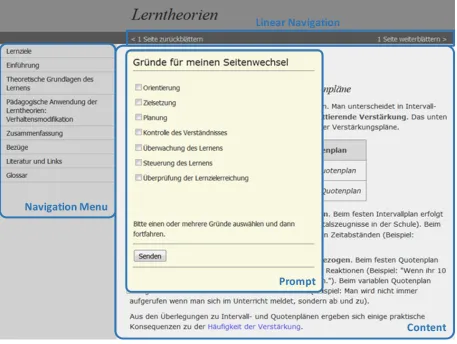
Figure 1: Screenshot of the learning environment including a metacognitive prompt. The main el-ements are labeled here for a better understanding of the environment, however it was not labeled in the learning sessions. Participants were asked to select at least one reason for node selection by choosing among a list of strategic reasons presented in the prompt window. The list comprised
orientation, goal-setting,planning, checking of understanding,monitoring of learning,control of learning, andevaluation of goal attainment.
several times during learning. Each pop-up window comprised the same list of strategic reasons for node selection. Examples of these reasons areorientation,goal-specification, orevaluation of goal attainment. The participants had to select at least one reason for node selection before continuing with learning. Figure 1 presents a metacognitive prompt in the form of a pop-up window that was implemented in the learning environment.
situations in educational settings, which were not explicitly addressed in the learning material. For example, in one task they had to apply the principles of operant conditioning to solve a classroom situation in which a teacher experiences discipline problems. Two research assistants rated the answers to these situations on a researcher-developed rating scale (maximum score = 40 points; Cohen’sκ = .84). In the case of disagreement among the raters, one of the authors determined the final score. More examples of the knowledge tests that were used in our studies are available in Bannert and Reimann (2012).
5.3. PROCEDURE
The hypermedia learning session began with an introductory section. First, the experimenter explained the navigation elements of the learning environment. Then, the participant was in-structed to perform a series of exercises using a practice lesson while thinking aloud concur-rently during the task. More specifically, he or she was asked to verbalize every thought that came to his or her mind, without any interpretation or justification. These instructions refer to level 2 verbalizations, as specified by Ericsson and Simon (1993). If necessary, the experi-menter provided feedback to the participant. Additionally, further exercises could be used until the participant firmly mastered the think-aloud technique.
Next, the participants received a short tutorial regarding the use of metacognitive prompts (approximately 10 minutes). This tutorial comprised information on the importance of reflecting on one’s learning activities, an explanation of the reasons for strategic node selection that is listed in the prompts, and the desired usage of the prompts. Such a tutorial is necessary to guarantee the adequate application of metacognitive strategies during learning (e.g., Veenman, 2007). We derived the list of reasons for node selection from categories that had been developed in previous work (Bannert, 2006), in which students were asked to name their reasons freely. Following the tutorial, the participants were instructed to configure the prompts by the following arrangements. First, they could change the order of the items in the list of reasons for node selection. The initial order was randomized. Second, they were asked to define eight time stamps when the prompts should appear during learning.
As the next step, the participants engaged in 40 minutes of learning in our hypermedia learn-ing environment. In the beginnlearn-ing, they were instructed about their learnlearn-ing task, that is, to learn the basic concepts of operant conditioning. During learning, the students were supported by metacognitive prompts. All of the participants were completely free to use the navigation elements of the learning environment and to use their learning strategies. During the whole learning phase, the participants had to read and to think aloud as practiced in advance, and their utterances were recorded using a microphone. If a participant stopped his or her verbalizations for more than five seconds, the experimenter prompted him or her to continue by saying “Please think aloud”. Following the learning task, the participants worked on the three knowledge tests that are described above. The total duration of the session was approximately two hours.
5.4. CODINGSCHEME
several sub-categories, as further described in Table 1. Motivation refers to statements that reflect a beneficial or an obstructive embedding of a metacognitive or cognitive learning activ-ity, particularly according to the concepts of achievement motivation, action control, and self-efficacy. More specifically, we assigned a motivational code when a student made an evaluative statement with respect to the task (e.g., “The task is quite difficult”), to his or her competencies (e.g., “I’m good at finding the relevant information”), and to the situation (e.g., “Thinking aloud isn’t as troublesome as I expected”). These utterances reflect motivational states that might af-fect the self-regulatory behavior, for example, the use of strategies. According to Zimmerman (2008) especially self-motivation beliefs, such as self-efficacy, task interest, and value, might impact the student’s engagement during learning.
In general, the coding process followed the procedure that was presented by Chi (1997). We segmented the verbal protocols by units of meaning. Thus, we assigned a segment for every definable learning activity. Furthermore, we did not use multiple nor nested codes. Four trained research assistants coded the verbalizations of all of the participants. We selected a random sample of six participants to compute the inter-rater reliability for our coding scheme. Based on 1,385 segments, the reliability showed substantial agreement (Cohen’s κ = 0.78), which is considered to be sufficient for the following analysis.
5.5. DATA PREPARATION
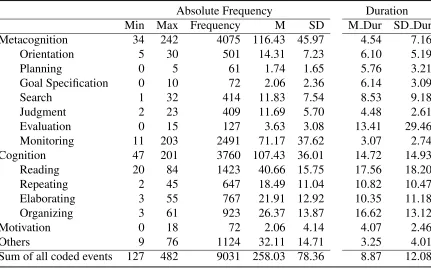
For the purpose of our analysis, we needed to prepare our data as described below. The starting point for the data preparation was the coded verbal protocols of 35 participants during 40 min-utes of hypermedia learning. Each one of the students was supported by metacognitive prompts five to eight times during learning. The absolute frequencies and means of all of the coded learning activities, as well as the mean duration times of the events, are presented in Table 2.
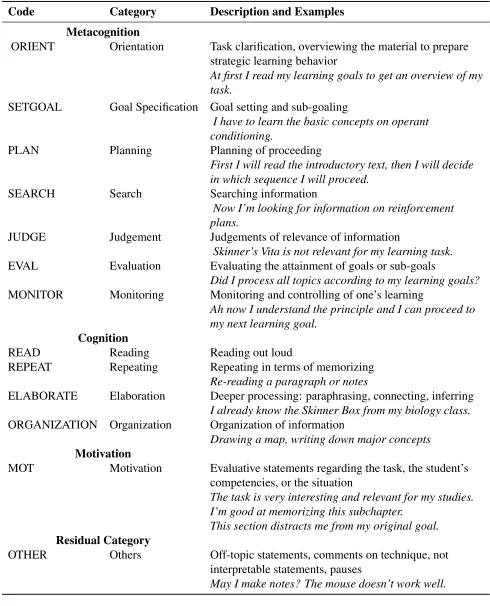
Table 1: Coding scheme for analyzing student’s learning activities
Code Category Description and Examples
Metacognition
ORIENT Orientation Task clarification, overviewing the material to prepare strategic learning behavior
At first I read my learning goals to get an overview of my task.
SETGOAL Goal Specification Goal setting and sub-goaling
I have to learn the basic concepts on operant conditioning.
PLAN Planning Planning of proceeding
First I will read the introductory text, then I will decide in which sequence I will proceed.
SEARCH Search Searching information
Now I’m looking for information on reinforcement plans.
JUDGE Judgement Judgements of relevance of information
Skinner’s Vita is not relevant for my learning task.
EVAL Evaluation Evaluating the attainment of goals or sub-goals
Did I process all topics according to my learning goals?
MONITOR Monitoring Monitoring and controlling of one’s learning
Ah now I understand the principle and I can proceed to my next learning goal.
Cognition
READ Reading Reading out loud
REPEAT Repeating Repeating in terms of memorizing
Re-reading a paragraph or notes
ELABORATE Elaboration Deeper processing: paraphrasing, connecting, inferring
I already know the Skinner Box from my biology class.
ORGANIZATION Organization Organization of information
Drawing a map, writing down major concepts
Motivation
MOT Motivation Evaluative statements regarding the task, the student’s competencies, or the situation
The task is very interesting and relevant for my studies. I’m good at memorizing this subchapter.
This section distracts me from my original goal.
Residual Category
OTHER Others Off-topic statements, comments on technique, not interpretable statements, pauses
Table 2: Absolute frequencies and means of all coded learning events, and mean duration times of events during 40 minutes of hypermedia learning (N = 35)
Absolute Frequency Duration Min Max Frequency M SD M Dur SD Dur Metacognition 34 242 4075 116.43 45.97 4.54 7.16 Orientation 5 30 501 14.31 7.23 6.10 5.19
Planning 0 5 61 1.74 1.65 5.76 3.21
Goal Specification 0 10 72 2.06 2.36 6.14 3.09
Search 1 32 414 11.83 7.54 8.53 9.18
Judgment 2 23 409 11.69 5.70 4.48 2.61
Evaluation 0 15 127 3.63 3.08 13.41 29.46 Monitoring 11 203 2491 71.17 37.62 3.07 2.74 Cognition 47 201 3760 107.43 36.01 14.72 14.93 Reading 20 84 1423 40.66 15.75 17.56 18.20 Repeating 2 45 647 18.49 11.04 10.82 10.47 Elaborating 3 55 767 21.91 12.92 10.35 11.18 Organizing 3 61 923 26.37 13.87 16.62 13.12
Motivation 0 18 72 2.06 4.14 4.07 2.46
Others 9 76 1124 32.11 14.71 3.25 4.01
Sum of all coded events 127 482 9031 258.03 78.36 8.87 12.08
Figure 2: Visualization of four cases using a Dotted Chart Analysis of coded verbal protocols. The horizontal axis represents the first ten minutes of learning with each segment representing one minute. Each dot represents the occurrence of an activity or a prompt presentation. The activities are color-coded and explained at the bottom. The line between two dots represents the duration of an event.
65
Journal
of
Educational
Data
Mining,
V
olume
8,
No
2,
Based on this observation, we decided to use a two-minute time interval following each prompt to determine the successful induction of metacognitive activities. There are additional reasons that support the selection of this measurement unit. A shorter time interval would reduce the sample size to investigate the learning process, that is, the number of investigated events. Here, one must consider that the duration time of learning activities varies from a few seconds (e.g., monitoring one’s learning progress) to longer time periods (e.g., reading a paragraph). Table 2 presents the means and standard deviations for the duration times of all of the coded categories. On the other hand, the selection of a longer time interval would be accompanied by a possible overlap of prompt presentations. The participants were instructed to determine eight time stamps for the presentation of prompts, considering a distance of at least two minutes be-tween two presentation times. Each selected time interval comprised all of the coded utterances within this timeframe, including overlapping events, that is, events that started and respectively ended beyond the two-minute interval. Because the duration of events varied from seconds to minutes, the number of events that are included in a time interval also varied (M = 14.16,SD= 5.86, Min = 1, Max = 31).
In addition to selecting the two minutes following each prompt, we also computed an in-dividual baselineof metacognitive utterances for each participant. This baseline is necessary to determine if an increase of metacognitive events following a prompt occurred. It represents the amount of spontaneous metacognitive utterances within an interval of two minutes. For the computation of this baseline, we excluded the two-minute time interval following each prompt because this time span is supposed to be affected by the prompted requests. The remaining time span of the total learning time was used to compute a baseline for each participant. For exam-ple, one participant showed a total of 127 metacognitive utterances within the total learning time of 40 minutes. He or she received eight prompts with 64 metacognitive utterances within the two-minute time intervals following each prompt. For the individual baseline, we considered the number of remaining metacognitive events (i.e., 127 - 64 = 63) and the remaining time span (i.e., 40 - 16 = 24 minutes). In this case, the computation yields a baseline of 5.25 metacognitive utterances within a time span of two minutes. Overall, the individual baselines for all of the students ranged from 1.47 to 12.68 metacognitive utterances (M = 5.32,SD= 2.29).
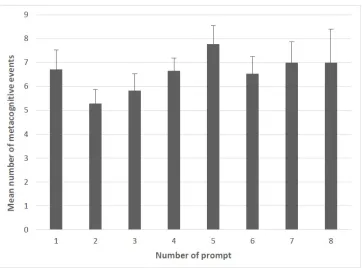
Although the observed learning time of 40 minutes was quite short, and, therefore, we did not expect the number of metacognitive utterances to vary significantly by time, we conducted additional analyses to account for a possible influence of time or the number of prompts that were received. First, we checked if the number of prompts that are received predicts the number of metacognitive utterances following a prompt (i.e., a possible additivity of prompting effects). The results of a linear regression showed no significant correlation between prompt number and metacognitive utterances, F(1, 239) = 3.16, p = .077, R2 = .013, R2
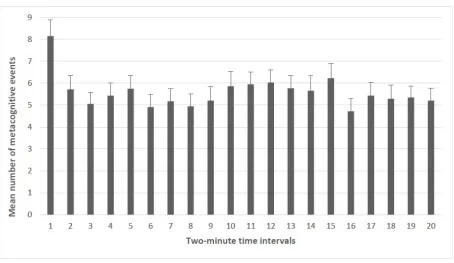
adjusted = .009. Figure 3
presents the mean numbers of metacognitive utterances for all of the students (N = 35) in each two-minute time interval following a prompt. Second, we considered whether there was a gen-eral upward drift of metacognitive utterances during the total learning time. Again, a linear regression using the time interval as the predictor and the number of metacognitive utterances as the independent variable revealed no significant influence of time,F(1, 698) = 2.36,p= .125,
R2 = .003,R2
adjusted=.002. Additionally, Figure 4 shows that no upward trend is present. The
Figure 3: The mean number of metacognitive utterances for all students (N = 35) in each two-minute time interval following a prompt. Error bars represent standard errors.
adjusted for these factors.
By comparing the individual baseline with the number of metacognitive utterances in the two-minute time interval following a prompt, it is possible to determine whether there was an increase of metacognitive activities. If the number of metacognitive utterances exceeds the individual baseline, we regard the prompt as effective. Because it may be possible that both values are equal or very close to one another, we decided to set a cutoff value to solve those cases. We selected an absolute value of one metacognitive event because it represents the smallest possible threshold. For example, if the individual baseline of a participant is 5.30, then the number of metacognitive utterances in the time interval following a prompt must be greater than 6.30 to indicate an increase, that is, a successful induction of metacognitive activities based on our criteria.
Finally, we selected two-minute time intervals preceding the presentation of prompts for the purpose of our third research question, that is, an analysis of the conditions of effectiveness. Again, we decided that this time span represents a suitable sample for our analysis. The selection of time intervals that precede and follow a prompt presentation is illustrated in Table 3, using two prompting times of an example case.
5.6. ANALYSISTECHNIQUES
Table 3: The selection of two-minute time intervals preceding and following the presentation of the first two prompts for the case EDMI18
Case ID Activity (Code) Timestamp Case ID Activity (Code) Timestamp
. . . .
EDMI18 READ 00:04:46 EDMI18 MONITOR 00:11:13 EDMI18 PLAN 00:06:08 EDMI18 ORGANIZATION 00:11:19 EDMI18 MONITOR 00:06:09 EDMI18 OTHER 00:11:53 EDMI18 READ 00:06:14 EDMI18 ELABORATE 00:11:56 EDMI18 MONITOR 00:06:48 EDMI18 ELABORATE 00:12:38
EDMI18 PROMPT1 00:06:56 EDMI18 OTHER 00:12:50
EDMI18 OTHER 00:07:19 EDMI18 ELABORATE 00:12:52
EDMI18 READ 00:07:44 EDMI18 PLAN 00:12:56
EDMI18 MONITOR 00:07:46 EDMI18 MONITOR 00:13:00 EDMI18 ORGANIZATION 00:08:10 EDMI18 EVAL 00:13:02 EDMI18 OTHER 00:08:13 EDMI18 MONITOR 00:13:10 EDMI18 MONITOR 00:08:19 EDMI18 PROMPT2 00:13:13
EDMI18 ELABORATE 00:08:25 EDMI18 OTHER 00:13:24 EDMI18 MONITOR 00:08:27 EDMI18 SETGOAL 00:13:26 EDMI18 ORGANIZATION 00:08:52 EDMI18 ORGANIZATION 00:13:27 EDMI18 MONITOR 00:08:53 EDMI18 READ 00:13:35 EDMI18 READ 00:09:04 EDMI18 ORGANIZATION 00:13:59 EDMI18 MONITOR 00:09:04 EDMI18 READ 00:14:25 EDMI18 ORGANIZATION 00:09:10 EDMI18 MONITOR 00:14:31 . . . EDMI18 ORGANIZATION 00:14:32 EDMI18 READ 00:14:38 EDMI18 MONITOR 00:15:09 EDMI18 ORGANIZATION 00:15:11 EDMI18 OTHER 00:15:24
. . .
Figure 4: The mean number of metacognitive utterances for all students (N = 35) in each two-minute time interval. The total learning time was 40 two-minutes, resulting in 20 two-two-minute time intervals. Error bars represent standard errors.
within the determined time interval successfully, the mean number of metacognitive utterances in these intervals should be higher than the mean baseline. Additionally, we examined the correlation between the number of induced metacognitive activities and learning performance. According to our theoretical framework, we assumed that students who show a higher number of induced metacognitive activities should perform better than students who show less induced regulatory activities.
The second step of our analysis considered the conditions of effectiveness. For this purpose, we first used the RapidMiner Studio Version 6.3 (2015) and a linear regression learner to explore the learning activities that occurred before a prompt appeared. A linear regression can be used as a classification method in the case of exclusive numeric attributes, and it has the advantages of working well on small data sets and of generating simple models to enable a natural inter-pretation (H¨am¨al¨ainen & Vinni, 2010). As described above, we decided to use two-minute time intervals for our analysis. The coded learning activities that occurred before each prompt were used as the predictors, and the number of metacognitive events that followed each prompt as the outcome variable. We applied cross-validations to avoid over-fitting of the learning algorithm. By using this data mining (DM) approach, we expected to find conditions, that is, states of the learning process, that indicate when a prompt is more likely to be effective and non-effective, respectively, in inducing regulatory activities.
the Fuzzy Miner algorithm (G¨unther & van der Aalst, 2007) to generate inductively a process model for the learning events that preceded all of the prompts that were classified as effective and a process model for the activities that preceded all of the prompts that were classified as non-effective. A comparison of these process models provides more detailed information on the conditions that may influence the effectiveness of prompts. In the following section, we provide a short introduction to the principle of the Fuzzy Miner algorithm.
Fuzzy Mining (G¨unther & van der Aalst, 2007) is an approach that was designed to find underlying processes in data that are less structured in appearance, such as our coded learning activities. The algorithm allows a flexible simplification of output models by distinguishing between the important and the less important details of an input event sequence. Thus, it is possible to generate a model that emphasizes the main features of a process and that is easily understandable. More precisely, the Fuzzy Miner transforms an event sequence into a process model that consists of nodes (event classes or categories) and edges (relations between two event classes). The data input comprises several cases with every case including an event sequence, which is ordered by a timestamp. First, the Fuzzy Miner algorithm uses these data to generate a complete model that comprises all of the observed nodes and edges by taking into account the relative importance and the sequential order of all of the events. Then, the algorithm uses two fundamental metrics, which are referred to as significanceand correlation, to compute a simplified model for the given data set. Significance measures the relative importance of the occurrence of event classes and relationships between events. For instance, events that occur more frequently are assessed as being more significant. Correlationis calculated for edges. It indicates the closeness of two events, measured by their temporal proximity. The basic con-cepts of significance and correlation are embedded in a metrics framework that calculates three primary types of metrics: unary significance (event classes), binary significance (relationships between event classes), and binary correlation (relationships between event classes). G¨unther and van der Aalst (2007) describe these metrics in more detail. As a final step, the model is simplified by making decisions regarding the inclusion of nodes and edges in the final model using the following rules: Events that are highly significant are preserved, events that are less significant, but highly correlated, are aggregated, and events that are less significant and lowly correlated are removed. It is possible to influence the model simplification by parameter set-ting, for example, by specifying cutoff values. To bring structure to the model, the algorithm uses edge filtering and thereby tries to focus only on the most important relationships between event classes. The utility of edges, which is the weighted sum of significance and correlation of an edge, is calculated, and this weighting is then configured by the utility ratio. Moreover, by setting an edge cutoff, an absolute threshold value for filtering edges can be determined. The higher the value at which the edge cutoff is set, the more likely the Fuzzy Miner is to remove an edge. Finally, there is another important mean to simplify the model: node aggregation and abstraction. Nodes are removed based on a parameter referred to as the node cutoff. If the unary significance of a node is below this cutoff, it will be excluded from the resulting model, or it will be aggregated. The latter happens if it is possible to preserve less significant nodes by merging them into a cluster of highly correlated nodes.
6.
RESULTS
metacognitive utterances. Additionally, we refer to the correlation between our classification and learning performance. Second, the findings of the investigation of conditions for the effec-tiveness of prompts are reported. We further present the results of a linear regression learner as well as those of a process mining algorithm.
6.1. CLASSIFICATION OF PROMPTS
In the first step of our analysis, we took into account the number of metacognitive utterances in a two-minute time interval following each prompt as well as an individual baseline to determine each prompt’s effectiveness in inducing regulatory activities. To verify our classification criteria, we used a Wilcoxon signed-rank test to compare the participants’ mean baseline and the mean number of metacognitive utterances following each prompt presentation. The number following the prompts was significantly higher (Mdn = 6.80) than the individual baseline (Mdn= 5.05),
z = -4.18, p < .001, d = 2.00. Thus, in general, the participants showed significantly more metacognitive activities within the two-minute time intervals following each prompt compared to their individual baseline (i.e., the mean number of metacognitive utterances within any two minutes). The results support the selection of a two-minute time span following a prompt to evaluate the successful induction of metacognitive activities.
Next, we analyzed the correlation between the induced number of metacognitive utterances through prompts and learning outcome. The alpha level was adjusted according to the pro-cedure of Benjamini and Hochberg (1995) because we conducted multiple tests of statistical significance. The results showed no significant correlation for any of the performance measure-ments (recall: r = -.23, comprehension: r = .08, transfer: r = .12). Because the total number of metacognitive activities within 40-minutes learning time also showed no significant correla-tion with learning outcome, we checked the correlacorrela-tions with the sub-categories. The findings revealed that the sub-category Monitoring shows the highest positive correlation with two mea-surements of learning performance (recall:r= -.17,n.s., comprehension:r= .25,n.s., transfer:r
= .27,n.s.). Therefore, we additionally analyzed the correlation between the number of monitor-ing activities within the two-minute intervals followmonitor-ing the prompts and learnmonitor-ing performance. The number of monitoring activities corresponds positively with transfer performance (r = .26,
n.s.) and comprehension performance (r = .22,n.s.), but not with recall performance (recall: r
= -.18,n.s.). Possibly due to the small sample size, all of the correlations are non-significant. A regression equation to predict transfer performance (y= 18.95 + 0.068 x) shows that a low number of induced monitoring activities through prompting (M = 24.54, SD = 15.89; M –SD
= 8.65) results in a performance score of y= 19.54 points and that a high number (M +SD = 40.43) results in a score ofy= 21.70 points. These observations are in line with previous work (Bannert & Mengelkamp, 2013), which indicated that prompting primarily enhances transfer performance. Additionally, a process analysis showed that the positive effect on transfer per-formance is mainly mediated by inducing monitoring activities (Sonnenberg & Bannert, 2015). In conclusion, the positive correlation between the number of monitoring activities and transfer performance indicates the usefulness of our classification based on a two-minute time interval following each prompt. The students who showed a higher number of induced monitoring ac-tivities through prompting performed better at transfer tasks than the students who showed less monitoring events.
base-line and the number of metacognitive utterances following a prompt, resulted in a total of n= 113 effective prompts andn= 127 non-effective prompts for our learner sample (N = 35). Fur-thermore, the classification shows that each student received a mean of M = 3.23 (SD= 1.46, Min = 1, Max = 6) effective prompts. Except for one student whose prompts were all classified as being effective, each student received both effective and non-effective prompts.
The selection of two-minute time intervals following the presentation of a prompt and the classification of prompts represents the starting point for the following analyses, which aim at exploring conditions for effectiveness. Please note that for the purposes of these analyses, each prompt was regarded as a separate case labeled either as “effective” or “non-effective” (N= 240,
neffective= 113,nnon-effective= 127).
6.2. CONDITIONS FOR THE EFFECTIVENESS OF PROMPTS
We analyzed the coded events that preceded effective and non-effective prompts by using two approaches. First, we applied a linear regression learner taking into account the absolute fre-quency of coded events as predictors and the number of metacognitive events following a prompt as the outcome variable. Then, we considered the sequential order of coded learning activities by generating process models for the time interval before a prompt appeared using a PM algorithm.
LINEAR REGRESSION LEARNER. We applied a linear regression learner to our data set us-ing the RapidMiner Studio Version 6.3 (2015). Because we used the same data set for trainus-ing and for measuring the performance of the linear regression model, we used two cross-validation techniques to avoid over-fitting. First, a ten-fold cross-validation was conducted, randomly split-ting the data into a training and a test set at the prompt-level (N = 240 prompts). Second, we conducted a student-level cross-validation by defining a subset for each student (in RapidMiner: Batch-X-Validation) to account for the possible influence of student factors. In this procedure, complete cases are removed iteratively before training the algorithm and are then used to esti-mate the goodness of the model. Moreover, we activated the automatic feature selection using the M5 prime method. The input predictors were all learning activities that occurred in a two-minute time interval preceding each prompt, whereas the outcome variable was the number of metacognitive utterances that followed each prompt. We used the VIF and tolerance statistics to assess potential multicollinearity within our data. Because VIF values were well below 10 (average VIF = 1.182) and tolerance statistics were well below 0.2, there was no cause for con-cern. The feature selection method selected the categories Orientation, Search, and Monitoring as relevant predictors for the regression model.
Table 4: Weight table of the learned linear regression model
B SE B β p
Constant 3.40 0.44 <.001 Orientation 0.78 0.20 .24 <.001 Search 0.13 0.22 .01 .550 Monitoring 0.61 0.08 .05 <.001
Note. Prediction of the metacognitive activities following a prompt by considering all activities in a two-minute time interval preceding the prompt presentation. N = 240 prompts. All codes were included, but only three codes were selected by feature selection. Estimation of model goodness using cross-validation: prompt-level,RMSE= 3.64,R2 = .24; student-level: RMSE=
3.60,R2= .12.
PROCESS MINING USING THE FUZZY MINER ALGORITHM. In a further analysis, we used the approach of PM and an algorithm for process discovery. This algorithm inductively gen-erated process models for the time interval before an effective prompt appeared and before a non-effective prompt appeared. Our analysis was conducted by using the following parameter settings: edge filtering was set with the edge cutoff = 0.20 and the utility ratio = 0.75 (both are default values); the significance cutoff of the node filter was set to 0.20.
Figure 5 shows the resulting models with the event classes and their process relationships. Event classes are represented by the rectangular nodes that include the label and its significance (a value between 0 and 1). The arcs between categories indicate successive events (the upper number displays significance, that is, their relative importance, and the lower number shows correlation, that is, a measure which indicates how closely related two events are). The arcs that point towards a category indicate a repeated occurrence of that category. Less significant and lowly correlated events were discarded from the process model. Thus, the nodes and arcs that fall into this category were not included in the graph.
Figure 5: Process models for the time interval preceding non-effective prompts (n= 127, left) and effective prompts (n = 113, right). For an explanation of the codes please see the coding scheme presented in Table 1.
74
Journal
of
Educational
Data
Mining,
V
olume
8,
No
2,
The process model of non-effective prompts comprises five metacognitive event classes. Furthermore, the most important event classes are MONITOR, READ, ORGANIZATION, and ELABORATION. Referring to the edges in the process model, the most important connections among event classes are between READ and MONITOR, between ELABORATE and MONI-TOR, between ORIENT and EVAL, as well as between ORGANIZATION and ELABORATE. Moreover, the classes MONITOR and ORIENT show several connections to other events, thus representing significant routing points for the process. Finally, there is a triple loop between READ, MONITOR, ELABORATE, and ORGANIZATION, which indicates a very active pro-cessing of information which is constantly monitored. In general, the integration of metacogni-tive event classes in the model of non-effecmetacogni-tive prompts can be interpreted as a successful reg-ulation of learning activities with respect to SRL assumptions. According to SRL models (e.g., Winne & Hadwin, 2008; Zimmerman, 2008), students ideally perform various metacognitive ac-tivities and run through different regulation phases (forethought, performance, and evaluation).
In contrast, the process model of effective prompts only shows the three metacognitive cate-gories, MONITOR, ORIENT, and SETGOAL, but all of the four cognitive event classes previ-ously described. The most important event classes are MONITOR, READ, ELABORATE, and REPEAT. Furthermore, important edges are between MONITOR and ORGANIZATION, be-tween ELABORATE and MONITOR, as well as bebe-tween ORGANIZATION and READ. There is a cycle that connects READ, ELABORATE, MONITOR, and ORGANIZATION. This cycle can be interpreted as the processing of information that is monitored. However, compared to the model of non-effective prompts, there is a less active interconnection between these four event classes. Finally, the event classes REPEAT, SETGOAL, and ORIENT represent a second cycle, which shows a weak structure between these events. In general, the performance of cognitive activities, which is connected with MONITOR, represents the only clear structure in this process model. Furthermore, there is poor regulation of learning activities in comparison to the model of non-effective prompts.
This may be due to the fact that effective prompts helped to cycle back to monitoring and the cognitive loop.
7.
DISCUSSION
In this contribution, we evaluated the effectiveness of metacognitive prompts on the micro level to investigate the conditions for effective scaffolding during hypermedia learning. Because the research on SRL and scaffolding hypermedia learning has noted the importance of tailoring support to the needs of the learner (e.g., Azevedo & Hadwin, 2005), and learning systems offer the possibility of implementing adaptive features (e.g., Brusilovsky, 2001; Molenaar & Roda, 2008), we attempted to explore the reasons why a provided metacognitive prompt is sometimes effective in stimulating regulatory activities and why sometimes it is not. In general, this type of research is important for the improvement of scaffold design because information on the conditions for effectiveness can inform the positioning of support in the course of learning (e.g., Thillmann et al., 2009). For our purpose, we analyzed fine-grained process data, which was measured by coded think-aloud protocols, using DM and PM. With this approach, we sought to classify the effectiveness of prompts, to investigate the correspondence of the classification with learning outcome, and to discover the conditions under which prompts induce regulatory activities (i.e., the proper temporal positioning).
Our findings indicate that it is possible to distinguish between effective and non-effective prompts by considering the increase of metacognitive utterances following the prompt presen-tation. Overall, approximately half of the prompts that were provided to the students were classified as effective according to our chosen classification criteria. Because we had to make a decision about how to determine the time intervals to investigate the increase of metacogni-tive utterances, it is possible that a different selection of measurement units would result in a different prompt classification. The determination of measurement units is a general challenge in analyzing fine-grained process data (Johnson et al., 2011; Winne, 2014). Therefore, we val-idated our decision by showing that the mean number of metacognitive events following the prompts is significantly higher than the baseline of metacognitive utterances. Moreover, we re-lated the selection of time intervals to learning performance. Ideally, the students who showed a higher number of induced metacognitive activities in the two-minute time intervals following a prompt would also show a better learning performance. The results revealed that there is no significant correlation between the total number of induced metacognitive activities and learning performance. A closer look at the sub-categories of metacognition showed that the highest cor-relation was between monitoring and transfer performance. However, this small effect was not significant, possibly because of the small sample size. Nevertheless, the positive correspondence between monitoring and transfer performance is in line with the previous research (Sonnenberg & Bannert, 2015).
the conditions under which it might be more likely to be effective and non-effective, respec-tively) to improve the positioning of metacognitive support in future scaffold design. First, we analyzed the frequency of learning activities in the time intervals that preceded each prompt by applying a linear regression learner. The findings indicate that a high occurrence of orientation and monitoring activities fosters the desired prompting effects (i.e., the activation of regulatory activities).
These findings were supported by applying a PM algorithm that not only takes into account the frequency of coded learning activities but also their relative positioning (i.e., their sequential order). We compared two process models, both inductively generated by the Fuzzy Miner algo-rithm, that represent the learning processes (more precisely, the workflow of learning activities) that precede the appearance of an effective and a non-effective prompt. The sequence of learning activities in the process model of non-effective prompts resembles the performance of success-ful regulation patterns as described in SRL models (e.g., Winne & Hadwin, 2008; Zimmerman, 2008). Additionally, this process model shows a very active sequence of monitored information processing. In contrast, the process model of effective prompts comprises the execution of cog-nitive activities, which are only connected with one metacogcog-nitive activity, namely monitoring. This could be interpreted as a poor regulation of the learning process.
In summary, the findings of the learned linear regression function and the process models indicate that the occurrence of orientation and monitoring activities, if they are not yet well em-bedded in the course of learning, increase the likelihood of effectiveness. In this case, metacog-nitive prompting may be successful in fostering further regulatory activities and in structuring the regulating of the learning process. If students already show a highly regulated process and an intense sequence of cognitive processing, the intervention of a metacognitive scaffold may not be necessary, and it may even be disruptive. These results relate to the implications for the design of adaptive systems based on attention management of Molenaar and Roda (2008). The authors note that one has to evaluate the cost of switching attentional focus and that learners should be able to predict interruption times.
Our results can be considered for future scaffold design, for example, for adapting the pre-sentation of a metacognitive prompt to the current learning process. In general, our analysis shows how to use process data to evaluate the effectiveness of provided support on the micro level by applying DM and PM techniques. Furthermore, the findings strengthen the importance of using process data in the investigation of the effectiveness of instructional support, which in turn provides implications for improving its design (e.g., by providing conditions for adaptive scaffolds).
With regard to the limitations of our study, it should be noted that the results depend on our learning setting (e.g., learning material and learning environment) and on our participants. Therefore, our findings may be task-specific, and they probably do not represent general pat-terns. For different learning settings, metacognitive regulatory processes may look entirely dif-ferent. Additionally, because the sample group of this study was predominately female, the results may be influenced by gender differences. The question of possible differences between male and female students could be addressed in future studies.
the process data were measured by concurrent think-aloud protocols. The results should also be replicated using process data on different levels (e.g., log files or eye tracking), ideally advanc-ing towards a temporal alignment of different data channels (Azevedo, 2014), and towards an integration of findings across several SRL studies (Dent & Hoyle, 2015). However, approaches that use log files to track students’ cognitive and metacognitive strategies in learning environ-ments imply a more difficult interpretation of awareness and intent regarding students’ actions and behaviors than coded think-aloud protocols (e.g., Kinnebrew et al., 2014). Finally, we did not consider the impact of previously presented prompts in detail, but there seems to be no ad-ditive effect in our data. Additivity means that it might be possible that the success of a scaffold depends on the effectiveness of previous scaffolds. For example, Molenaar and Roda (2008) rec-ommend considering the history of a learner’s interactions with previously provided scaffolds to calibrate the presentation of support. Moreover, without this type of history, the challenge of fading support when the learner’s regulative behavior progresses cannot be addressed.
Future directions should address the following issues. In our study, we investigated the learning process that precedes a prompt by analyzing coded learning activities to discover the conditions for effectiveness. However, there may be further conditions that influence the effec-tiveness of metacognitive prompts that were not considered in the present analysis. For example, the students’ level of expertise could be another important factor that affects scaffolding effects (e.g., Yeh et al., 2010). Moreover, questions with regard to the role of the presentation time (e.g., is a prompt that appears during the first minutes of the learning session more effective than a prompt that appears in the middle of the learning time?) and of the number of prompts (e.g., is the first prompt already effective or are two or more prompts needed to affect the regulatory behavior?) still have to be investigated in future research. Furthermore, the findings on possible conditions for the effectiveness of scaffolds should be related to models of SRL and metacogni-tion. For example, the COPES model (Winne & Hadwin, 2008) could be specified by including positions for intervening the SRL cycle. These findings could contribute to a micro-level theory of SRL and to the impact of scaffolds on learning processes that is needed to implement opti-mally adaptive support in learning environments, and that is currently missing in the field of SRL (Molenaar & J¨arvel¨a, 2014). Additionally, more research on the automatic detection of learn-ing processes (e.g., Cocea & Weibelzahl, 2009) is needed to improve the diagnosis of adaptive learning systems. The next step in our future research will be the validation of findings on the effectiveness of metacognitive prompts by analyzing think-aloud data from another prompting experiment. Additionally, we will aim to derive standards and guidelines for the application of DM and PM techniques in SRL settings.
ACKNOWLEDGEMENTS
This research was supported by funds from the German Science Foundation (DFG: BA 2044/7-1). We would like to thank our student research assistants, Ferdinand Guggenberger, Valentina Haspert, Michaela Hofbauer, and Lisa M¨usse, for their assistance with regard to coding the think-aloud data.
REFERENCES
ALEVEN, V. (2013). Help seeking and intelligent tutoring systems: Theoretical perspectives and a step towards theoretical integration. In R. Azevedo & V. Aleven (Eds.), International Handbook of Metacognition and Learning Technologies(pp. 311–335). New York: Springer. doi:10.1007/978-1-4419-5546-3 21
ALEVEN, V., ROLL, I., MCLAREN, B. M., & KOEDINGER, K. R. (2016). Help helps, but only so much: Research on help seeking with intelligent tutoring systems.International Journal of Artificial Intelligence in Education,26(1), 205–223. doi:10.1007/s40593-015-0089-1
AZEVEDO, R. (2005). Using hypermedia as a metacognitive tool for enhancing student learn-ing? The Role of self-regulated learning. Educational Psychologist, 40(4), 199–209. doi:10.1207/s15326985ep4004 2
AZEVEDO, R. (2009). Theoretical, conceptual, methodological, and instructional issues in research on metacognition and self-regulated learning: A discussion. Metacognition and Learning, 4, 87–95. doi:10.1007/s11409-009-9035-7
AZEVEDO, R. (2014). Issues in dealing with sequential and temporal characteristics of self- and socially-regulated learning.Metacognition and Learning,9, 217–228. doi:10.1007/s11409-014-9123-1
AZEVEDO, R., CROMLEY, J. G., MOOS, D. C., GREENE, J. A., & WINTERS, F. I. (2011). Adaptive content and process scaffolding: A key to facilitating students’ self-regulated learning with hyperme-dia.Psychological Testing and Assessment Modeling, 53(1), 106–140.
AZEVEDO, R., CROMLEY, J. G., & SEIBERT, D. (2004). Does adaptive scaffolding facilitate students’ ability to regulate their learning with hypermedia?Contemporary Educational Psychology,29, 344– 370. doi:10.1016/j.cedpsych.2003.09.002
AZEVEDO, R., CROMLEY, J. G., WINTERS, F. I., MOOS, D. C., & GREENE, J. A. (2005). Adap-tive human scaffolding facilitates adolescents’ self-regulated learning with hypermedia.Instructional Science,33, 381–412. doi:10.1007/s11251-005-1273-8
AZEVEDO, R., & HADWIN, A. F. (2005). Scaffolding self-regulated learning and metacognition - Implications for the design of computer-based scaffolds. Instructional Science, 33, 367–379. doi:10.1007/s11251-005-1272-9
AZEVEDO, R., LANDIS, R. S., FEYZI-BEHNAGH, R., DUFFY, M., TREVORS, G., HARLEY, J. M., . . . HOSSAIN, G. (2012). The effectiveness of pedagogical agents’ prompting and feedback in facilitating co-adapted learning with MetaTutor.Lecture Notes in Computer Science, 212–221. doi:10.1007/978-3-642-30950-2 27
BANNERT, M. (2006). Effects of reflection prompts when learning with hypermedia.Journal of Educa-tional Computing Research,35(4), 359–375. doi:10.2190/94V6-R58H-3367-G388
BANNERT, M. (2007).Metakognition beim Lernen mit Hypermedia. Erfassung, Beschreibung und Ver-mittlung wirksamer metakognitiver Lernstrategien und Regulationsaktivit¨aten [Metacognition and hypermedia learning]. M¨unster: Waxmann.
BANNERT, M. (2009). Promoting self-regulated learning through prompts: A discussion.Zeitschrift f¨ur P¨adagogische Psychologie,23(2), 139–145. doi:10.1024/1010-0652.23.2.139
BANNERT, M., & MENGELKAMP, C. (2013). Scaffolding hypermedia learning through metacognitive prompts. In R. Azevedo & V. Aleven (Eds.),International Handbook of Metacognition and Learning Technologies(pp. 171–186). New York: Springer. doi:10.1007/978-1-4419-5546-3 12
BANNERT, M., & REIMANN, P. (2012). Supporting self-regulated hypermedia learning through prompts.